• By Kevin E. Noonan –
    Federal Circuit SealPatent law has always been tasked with interpreting law in an ever-shifting factual environment, where well-established principles need to be applied to new technology.  Twenty years ago, the Federal Circuit grappled with the application of the written description requirement to biotechnology inventions, in seminal cases beginning with Regents of the University of California v. Eli Lilly & Co. (1996), and culminating in Ariad v. Eli Lilly (2010) (en banc).  More recently (and with the Supreme Court taking an active interest, less certainly) the contours of subject matter eligibility has bedeviled patent applicants and patentees.

    The Supreme Court in Bilski v. Kappos was aware of the risk of making rules perfectly adequate for present technological circumstances but that could impede progress (and patenting) for new technologies.  Justice Kennedy's plurality opinion stated:

    It is true that patents for inventions that did not satisfy the machine-or-transformation test were rarely granted in earlier eras, especially in the Industrial Age.  . . .  But times change.  Technology and other innovations progress in unexpected ways.  For example, it was once forcefully argued that until recent times, "well-established principles of patent law probably would have prevented the issuance of a valid patent on almost any conceivable computer program."  Diehr, 450 U. S., at 195 (STEVENS, J., dissenting).  But this fact does not mean that unforeseen innovations such as computer programs are always unpatentable.  Section 101 is a "dynamic provision designed to encompass new and unforeseen inventions."  A categorical rule denying patent protection for "inventions in areas not contemplated by Congress . . . would frustrate the purposes of the patent law" [citations omitted].

    The Federal Circuit's recent decision in In re Cray regarding application of the patent venue statute, 28 U.S.C. § 1400(b), raises (albeit obliquely) similar questions.  The Court, based on an exegesis of the statutory language based on dictionary definitions from the time the statute was first enacted at the turn of the last century, determined that because the statute requires a "place" from which its business is conducted, it was error for the District Court to decide the venue question on the basis that "a fixed physical location" was not required.  Important to the decision (and the modern era), the statute cannot be satisfied "merely [with reference] to a virtual space or to electronic communications from one person to another" and that there must be a specific geographical location within the district for this statutory requirement to be satisfied.

    Similarly, the Court decided that the presence of defendant Cray's employee in the Eastern District of Texas was insufficient to satisfy what the Court recognized was the patent venue standard (which was more stringent that personal jurisdiction or general "doing business" standards appropriate in other contexts):

    There is no indication that Cray owns, leases, or rents any portion of [the employee's] home in the Eastern District of Texas.  No evidence indicates that Cray played a part in selecting the place's location, stored inventory or conducted demonstrations there, or conditioned [either employee's] employment or support on the maintenance of an Eastern District of Texas location.  No evidence shows that Cray believed a location within the Eastern District of Texas to be important to the business performed, or that it had any intention to maintain some place of business in that district in the event [either employee] decided to terminate their residences as a place where they conducted business.

    Relevant to the question of the response to patent law to changing technology, the dispositive considerations enunciated by the Court apparently disregard or fly in the face of changes in the way companies do business in the 21st Century.  It is certainly the case that many retailers, following a model pioneered thirty years ago by Amazon, sell the bulk of their products on-line and never set foot in any state except the one of incorporation; indeed, "presence" in the incorporating state is unnecessary in many instances.  Insofar as the company's products are "virtual" (software, for example) there is no need for there to be a presence in any U.S. state because servers and other instrumentalities of their business can be situated somewhere offshore.  Similarly, many companies' personnel are employed in call centers or customer service roles, with it being commonplace for those employees to be globally dispersed.

    These circumstances, which will undoubtedly only become more frequent, raise an issue for patentees when attempting to sue an infringer.  Under the Cray analysis, the fact that there may be a salesforce or other representation in a district is not enough; it is unlikely that any individual salesperson would be any more tied to a district than were Cray's employees, nor is it likely that a company (particularly one in the virtual marketplace) would pay for a "brick-and-mortar" presence that is the employees home.  All employees are able to "change jobs" as the Cray Court found, and as virtual companies become more and more present nowhere other than the Internet there will be even less of a need for the type of administrative and secretarial support found lacking to support venue in the Cray case.

    This raises the likelihood that there may be no district (except perhaps the district where the infringer is incorporated) in which an infringer can be sued.  The Federal Circuit recognized that one reason for enactment of the patent venue statute was to make more liberal the standard existing at that time, which limited venue to an infringing corporation's incorporation states.  Yet, just such a strict venue requirement seems to be an increasing likely consequence of the Federal Circuit's Cray decision.  It seems likely that, as in so many areas of patent law, the only remedy for this state of affairs will be if Congress steps in and changes the statute to again liberalize where proper venue in patent cases can be found.

  • CalendarOctober 2-3, 2017 – Paragraph IV Disputes master symposium*** (American Conference Institute) – Chicago, IL

    October 4, 2017 – "Patent Eligibility of Software Innovations in a Post-Alice Environment" (Technology Transfer Tactics) – 1:00 to 2:30 pm (Eastern)

    October 12, 2017 – "Patent Term Adjustments and Extensions: Leveraging Recent Decisions and USPTO Rules" (Strafford) – 1:00 to 2:30 pm (EDT)

    October 17, 2017 – "The Good, the Bad, and the Ugly: Patent Litigation Forum Selection in the Wake of TC Heartland" (McDonnell Boehnen Hulbert & Berghoff LLP) – 10:00 am to 11:15 am (CT)

    November 2-3, 2017 – Summit on IP Due Diligence*** (American Conference Institute) – Philadelphia, PA

    ***Patent Docs is a media partner of this conference or CLE

  • MBHB Logo 2McDonnell Boehnen Hulbert & Berghoff LLP will be offering a live webinar entitled "The Good, the Bad, and the Ugly: Patent Litigation Forum Selection in the Wake of TC Heartland" on October 17, 2017 from 10:00 am to 11:15 am (CT).  In this presentation, MBHB attorneys Grant Drutchas and Aaron Gin will examine the differences between the courts with regard to their willingness to resolve § 101 issues and other substantive case-dispositive issues on motions to dismiss, and the applicability and scope of Local Patent Rules mandating early disclosures, and provide insight as to how plaintiffs and defendants can leverage such differences when selecting a forum or deciding whether to raise a forum challenge.  The webinar will address the following topics:

    • How does TC Heartland constrain a plaintiff's filing options?
    • What effect does TC Heartland have on cases involving multiple defendants, declaratory judgment actions, and cases where an earlier venue challenge was not raised?
    • What are the differences between the primary district court options on substantive issues and potential motions to dismiss?
    • How do Local Patent Rules (or the lack thereof) and a possible stay pending Inter Partes Review affect litigation strategy?

    While there is no fee to participate, attendees must register in advance.  Those wishing to register can do so here.  CLE credit is pending for the states of California, Illinois, New Jersey, New York, North Carolina, and Virginia.

  • Strafford #1Strafford will be offering a webcast on "Patent Term Adjustments and Extensions: Leveraging Recent Decisions and USPTO Rules" on October 12, 2017 from 1:00 to 2:30 pm (EDT).  Thomas L. Irving, Jill K. MacAlpine, and Charles E. Van Horn of Finnegan Henderson Farabow Garrett & Dunner will provide guidance to IP counsel for calculating patent term adjustments, interplay with patent term extensions, examine recent court treatment, and offer approaches for preserving rights and maximizing patent term adjustments and patent term extensions.  The webinar will review the following topics:

    • What are the lessons from the recent Federal Circuit decisions regarding the patent term calculation?
    • How will the recent changes for the USPTO alter the landscape for PTA and PTE practice?
    • What best practices should patent applicants take to preserve rights and maximize PTA and PTE?

    The registration fee for the webcast is $297.  Those interested in registering for the webinar, can do so here.

  • Technology Transfer Tactics will be offering a webinar entitled "Patent Eligibility of Software Innovations in a Post-Alice Environment" on October 4, 2017 from 1:00 to 2:30 pm (Eastern).  Tyson B. Benson of Harness, Dickey and Pierce, PLC will cover the following topics:

    • Review of the Alice decision to understand what brought us here
    • How to conduct the two-part test for patentability under Alice
    • Review of pertinent Federal Circuit and PTAB decisions, including:
        – McRO v. Bandai
        – Thales Visionix v. U.S.
        – Visual Memory v. NVIDIA
    Best practices for evaluating patent eligibility of software-related invention disclosures
    • Claim construction tips and tactics
    • Alternative strategies for IP protection — copyrights and trade secrets

    The registration fee for the webinar is $197.  Those interested in registering for the webinar, can do so here.

    Technology Transfer Tactics

  • By Andrew Williams

    AbbvieEarlier today, both parties to the AbbVie v. Amgen litigation announced a settlement that resolves all intellectual property-related litigation over Amgen's FDA-approved adalimumab biosimilar AMGEVITA™/AMJEVITA™ (see AbbVie press release & Amgen press release).  While the financial terms of the agreement were not disclosed, it was reported that AbbVie will grant non-exclusive patent licenses worldwide, on a country-by-country basis, for the use and sale of Amgen's biosimilar product.  AMGEVITA is expected to launch in most countries of the European Union on October 16, 2018, and AMJEVITA (adalimumab-atto) in the U.S. on January 31, 2023.  AbbVie reported that all related pending litigation will be dismissed, and that "Amgen has acknowledged the validity of AbbVie's intellectual property related to HUMIRA."  The prices of both companies' stock were up at the end of the day, although on a percentage basis, AbbVie's was up higher.  This could be due to the certainty in the delay of competition that AbbVie will face from Amgen in the United States.  However, HUMIRA could face competition from Boehringer Ingelheim's biosimilar Cyltezo (adalimumab-adbm), which was approved by the FDA in late August (see "FDA Approves First Cancer-Treatment Biosimilar — Amgen's Mvasi").

    AmgenAs we reported at the time, AbbVie filed suit against Amgen in the United States District Court for the District of Delaware on August 4, 2016, pursuant to the BPCIA and 35 U.S.C. 271(e)(2)(C).  In its Counterclaims and Answer, Amgen reported that it had certified to AbbVie that it would not begin commercial marketing of its biosimilar before at least one of the patents identified by AbbVie had expired on December 31, 2016.  Obviously, Amgen did not launch-at-risk after that date.  Moreover, Amgen had stated that it intended to fully comply with the 180-day Notice of Commercial Marketing provision of the BPCIA (at least as it understood it before the Supreme Court's Sandoz v. Amgen case), which would have prevented them from launching until at least March, 2017.  However, the present litigation only encompassed 10 of the 61 patents identified by AbbVie and Amgen during the so-called patent dance.  Because AbbVie would have certainly filed the second-phase litigation if Amgen had provided commercial-marketing notice, it is reasonable to assume that such notice was not yet given.

    Boehringer IngelheimThe AbbVie v. Boehringer Ingelheim litigation, on the other hand, is just getting started.  On August 2, 2016, almost a year after the Amgen case, AbbVie sued Boehringer pursuant to the BPCIA and 35 U.S.C. 271(e)(2)(C) because Boehringer submitted its application to the FDA to market its HUMIRA® biosimilar.  Boehringer answered the Complaint on September 11, 2017.  AbbVie alleged that there are more than 100 patents concerning the HUMIRA product, and that it identified 74 of which that were (or would be) infringed.  Nevertheless, because Boehringer, as the Biosimilar application, had the ability to cap the number of patents in the suit, the initial phase litigation only concerns eight patents.  Boehringer had selected the number of patents each side could identify for litigation as five, but the litigation only concerns eight patents because two appeared on both lists.  The second wave can only occur after Boehringer provides its 180-day commercial-marketing notice.

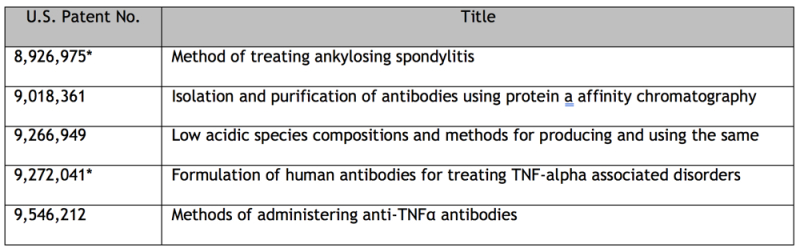
    Specifically, for the first wave, AbbVie identified:

    Table 1
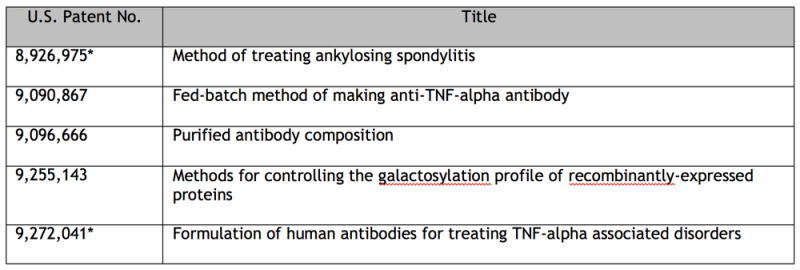
    One of these, the '041 patent, is the same as it asserted in the Amgen litigation.  For its part, Boehringer identified (with the common patents identified by the symbol "*"):

    Table 2
    Boehringer also identified AbbVie's '041 patent asserted in the Amgen case, and listed the '666 patent, which Amgen had similarly listed.  For those interested, the entire list of 74 patents can be found on pages 15-19 of the complaint.  Boehringer asserted, though, that at least four of these patents were improperly listed, as they had either expired or had been determined by the PTAB to be unpatentable.  This case is at the very early stages, and there have been no reports of its settlement.  As always, we will continue to monitor this case and provide updates as warranted.

  • By Nicholas Vincent* and Anthony D. Sabatelli** —

    As we have discussed in previous installments of "The Emergent Microbiome," we have seen a distinct growth in the interest of the microbial communities found in our environment beyond the confines of the human body.  Earlier articles in this series have focused on the microbiology of the built environment (see "Part VII, The Microbiology of the Built Environment") and the microbial communities of plants that have been characterized and manipulated to maximize their growth and crop yield (see "Part XI: Agriculture and the Microbiome").  In both circumstances, we noted robust intellectual property activity.  Likewise, we have also observed an increased interest in the microbial communities found in livestock animals, and how manipulations of these communities could result in more effective, productive, and sustainable means of food production.  Although this area is less well developed than other areas of microbiome research, including that of plant agriculture, we see it as a promising area of development in terms of both the science and the innovation that will inevitably flow from it.

    Antibiotics and Livestock Microbiomes

    Antibiotics have played a central role in the treatment of bacterial infections and disease and the reduction of associated deaths, yet, according to the United States Food and Drug Administration (FDA), use in humans constitutes a mere 20% of total usage.  The remaining 80% is devoted to increasing the productivity of livestock:  animals fed antibiotics grow faster and larger than their counterparts that are not fed antibiotics.  Importantly, antibiotics have been shown to elicit changes in the bacterial communities that live within the confines of the digestive tracts of both humans and livestock animals.  In fact, it is even possible that these changes in microbial communities are what cause the larger growth seen in antibiotic-fed animals.  In addition to these changes, however, there are serious concerns over the effects that such antibiotic usage can have, including unintended ingestion by humans and the risk for increased bacterial resistance to antibiotics, and, as a result, resistant strains that can no longer be combatted with any known antibiotics.

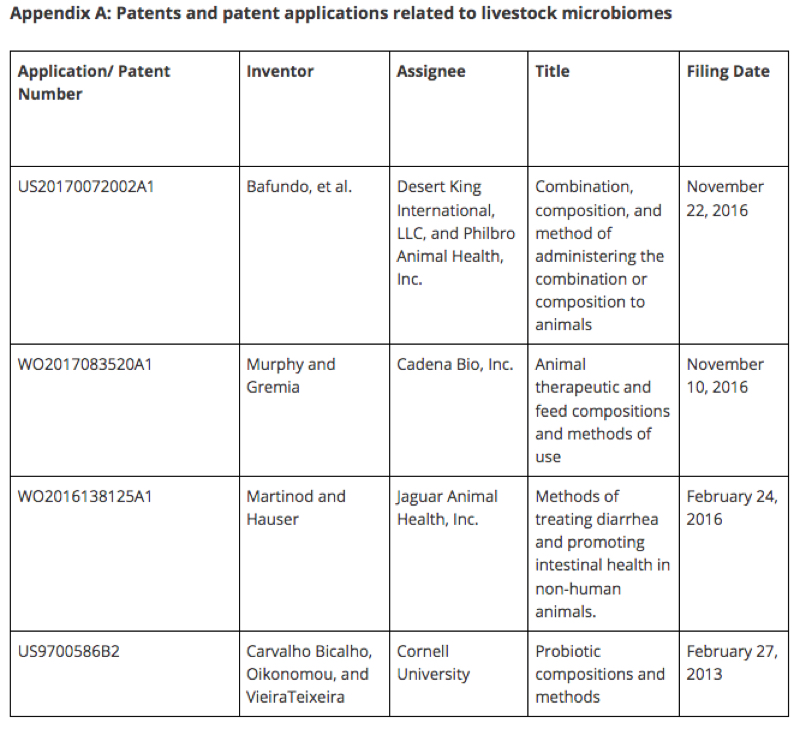
    Antibiotics are not the only agent responsible for changes in livestock microbiomes; changes in dietary content have also been shown to affect the microbiome population distribution of livestock animals.  Taken together, these areas have seen increased research and increased intellectual property activity, which, we believe, will continue to expand in the coming years.  In particular, we have observed an interest in modulating the dietary intake of livestock animals with the aims of subsequently modifying their microbiomes (Appendix A).

    Intellectual Property Challenges

    As we have discussed more extensively in earlier installments of this series (see "Part XI: Agriculture and the Microbiome"), there have historically been challenges related to the patenting of naturally occurring bacterial communities and inoculants.  The basis for these challenges is rooted in 35 U.S.C. § 101, which states three judicial exceptions that are not patent-eligible:  laws of nature, natural phenomena, and abstract ideas.  In the landmark case Funk Brothers Seed Co. v. Kalo Inoculant Co., (1948), the Supreme Court held that the use of naturally occurring bacterial species, or combinations of these species, could not be patented since the inoculant amounted to a naturally occurring product, and was therefore considered a judicial exception under 35 U.S.C. § 101.  In the area of livestock and the microbiome, we have noticed an interest in attempts to modulate the diets of livestock animals with the end goal of modifying their microbiome, either to prevent disease or to improve growth, without the use of antibiotics.  As a result, we do believe that there is a path to patent-eligible advancements in this space, particularly if the patent claims are carefully crafted to distinguish themselves from Funk Bros. and those of more recent cases on subject matter eligibility.

    Recent Developments and Future Paths

    The desire to manipulate livestock microbiomes is strong with clear benefits to food production.  Although livestock microbiome research and business efforts are not as developed as those in the agriculture sector, it does not mean that corresponding growth will not occur in this space.  In fact, we expect that researchers and innovators in this space will look towards the advancements made in the area of plant agriculture, as well as human microbiome research, as guidance to the further development of advancements.

    Some recent examples of patents and applications in this space are provided in Appendix A.  In particular, WO 2017/083520 A1 (Animal therapeutic and feed compositions and methods of use) concentrates on modulating the host microbiome through the use of oligosaccharide compounds added to feed. Additionally, US 2017/0072002 A1 (Combination, composition, and method of administering the combination or composition to animals) seeks to use plant extracts to modulate the microbiome in livestock hosts with the aim of treating disease or increasing overall productivity and production.  As previously discussed, these efforts are focusing on attempts to modulate the microbiome through feedstock changes, not through the addition of bacterial strains or inoculants.

    There have, however, been attempts to modify livestock microbiomes through the introduction of live bacteria.  One new startup company of note, Bactana, is seeking to modulate the microbiome of livestock animals through the introduction of Faecalibacterium prausnitzii, which is a naturally occurring bacterium that has been found preferentially in the digestive tracts of healthy calves (see Appendix A: US9700586B2, Probiotic compositions and methods).  Trials have revealed a 13% increase in weight gain in animals that have been colonized with F. prausnitzii, suggesting a promising, antibiotic-free method of weight gain for livestock.

    In order to progress, livestock microbiomes will need to be characterized further, thereby establishing an understanding of how microbiomes are established and persist in these animals.  While basic microbiome communities have been investigated in cattle, chicken, and swine, there has yet to be a synthesizing effort similar to the Human Microbiome Project.  In particular, it will also be important to see precisely how different antibiotic cocktails modulate the microbiomes of these animals and how those changes may be directly linked to the weight gain that many meat producers focus on so heavily.  Some work has already been done in this area, but it has lagged behind that of human microbiome research.

    A Path Forward

    Modulating the microbiome of livestock is a very exciting area that we expect will expand rapidly in the coming years.  As research into the human microbiome and microbial communities around us expands, we expect to see a corresponding increase in both the basic science surrounding livestock microbiome research as well as the desire to innovate novel methods of modulating microbial communities in these animals with the specific aim of increasing production without relying on antibiotics.

    Table

    * Nicholas Vincent is a Technology Specialist at Dilworth IP
    ** Dr. Sabatelli is a Partner with Dilworth IP

    For additional information regarding this topic, please see:

    • "The Emergent Microbiome: A Revolution for the Life Sciences Part XI: Agriculture and the Microbiome," July 17, 2017
    • "The Emergent Microbiome: A Revolution for the Life Sciences — Part X, The Big Data Component," February 20, 2017
    • " The Emergent Microbiome: A Revolution for the Life Sciences — Part IX, The Microbiome and Immunotherapy II," December 6, 2016
    • "The Emergent Microbiome: A Revolution for the Life Sciences — Part VIII, The Microbiome and Immunotherapy I," October 31, 2016
    • "The Emergent Microbiome: A Revolution for the Life Sciences — Part VII, The Microbiology of the Built Environment," October 5, 2016
    • "The Emergent Microbiome: A Revolution for the Life Sciences – Part V, Patents Relating to Obesity and Metabolic Disorders," February 28, 2016
    • "The Emergent Microbiome: A Revolution for the Life Sciences – Part IV, Obesity and other Metabolic Disorders," February 18, 2016
    • "Jackson Laboratory Hosts Microbiome Symposium Related to Cancer and Immunology," January 19, 2016
    • "The Emergent Microbiome: A Revolution for the Life Sciences – Part III, Psychobiotics," October 13, 2015
    • "The Emergent Microbiome: A Revolution for the Life Sciences – Part II, 2015 Patent Trends," August 11, 2015
    • "The Emergent Microbiome: A Revolution for the Life Sciences – Part I, R&D Leaders," August 10, 2015

  • By Kevin E. Noonan –

    Saint Regis Mohawk TribeNot unexpectedly, on Friday, the Saint Regis Mohawk Tribe (SRMT) filed a motion before the Patent Trial and Appeal Board (PTAB) to have inter partes review Nos. IPR2016-01127, IPR2016-01128, IPR2016-01129, IPR2016-01130, IPR2016-01131, and IPR2016-01132, instituted against U.S. Patent Nos. 8,685,930, 8,629,111, 8,642,556, 8,633,162, 8,648,048, and 9,248,191 respectively, dismissed based on the tribe's sovereign immunity upon Allergan's assignment of the patents to them (see "Allergan Avails Itself of Sovereign Immunity").

    The SRMT's assertion of its sovereign immunity is based, according to the brief, on the principle that only Congress can abrogate the Tribe's immunity as a sovereign government (and then only explicitly) or that the immunity can be waived by the Tribe, which the brief affirmatively states is has not done and will not do.  Citing recent PTAB precedent related to the principle as it applies to state universities (Covidien LP v. Univ. of Fla. Research Found. Inc.; Neochord, Inc. v. Univ. of Md. et al.; and Reactive Surfaces Ltd, LLP v. Toyota Motor Corp.), the Tribe asserts that it does not submit to the Board's authority or jurisdiction (except insofar as is necessary to appear to defend its motion) and that the IPRs should be dismissed.

    The brief (perhaps wisely but certainly strategically) sets forth this tribe's (like all Native American tribes') need to find ways to develop their economy and the difficulties tribes have had in doing so.  Paradoxically, these difficulties stem in part to the restricted sovereignty Native American tribes have, insofar as they cannot levy property nor income taxes and yet are responsible for providing essential government functions such as education, policing, infrastructure, housing services, social services, and health care.  The history of tribes' attempts to develop their economies over the past thirty years have most famously involved casinos and other venues for gambling in jurisdictions where such practices are otherwise banned.  The brief notes that efforts to remedy tribes' economic woes extends to Federal government policy, putting the government's imprimatur generically if not specifically to this particular effort at economic development (citing the Indian Self-Determination and Education Assistance Act, 25 U.S.C. § 5302(b) and the Indian Financing Act, 25 U.S.C. § 1451).  Similar support for Indian sovereignty is cited from the Executive branch (Executive Order 13647) and the judiciary (Justice Sotomayor's concurring opinion in Michigan v. Bay Mills Indian Community, 134 S. Ct. 2024, 2043–44 (2014) (Sotomayor, J., concurring)).

    AllerganIn view of these economic realities, the brief puts its acquisition of the Allergan patents in context, as a way to generate much-needed revenue for the tribe's citizens.  Not merely a one-off, the brief asserts that this agreement is the result of efforts by the Tribe's Economic Development Department and the Office of Technology, Research and Patents.  The Office intends to "strengthen the Tribal economy by encouraging the development of emerging science and technology initiatives and projects, and promoting the modernization of Tribal and other businesses" to "create revenue, jobs, and new economic development opportunities for the Tribe and its members."

    Turning to its legal arguments, the brief asserts the Tribe's inherent sovereign immunity from suit as recognized for almost two centuries.  Worcester v. State of Ga., 31 U.S. 515, 519 (1832).  This common law immunity has been consistently reaffirmed by the Supreme Court, according to the brief, citing Kiowa Tribe of Okla. v. Mfg. Techs. Inc., 523 U.S. 751, 754 (1998); Okla. Tax Comm'n v. Citizen Band Potawatomi Indian Tribe of Okla., 498 U.S. 505, 510 (1991); Santa Clara Pueblo v. Martinez, 436 U.S. 49, 58 (1978); Puyallup Tribe, Inc. v. Dep't of Game, 433 U.S. 165, 172-73 (1977); and U.S. v. U.S. Fid. & Guar. Co., 309 U.S. 506, 512 (1940).  In somewhat of an understatement, this long line of consistent precedent shows that the Tribe's sovereign immunity is "firmly established."

    One exception to the Tribe's sovereign immunity (and a way that it differs from that immunity enjoyed by the States) is when Congress has expressly (not impliedly) abrogated it.  Santa Clara Pueblo v. Martinez and Ransom v. St. Regis Mohawk Educ. and Cmty. Fund, Inc., 86 N.Y.2d 553, 560 (1995).  The other exception is when a Tribe waives the immunity, which also must be "unequivocally expressed," C & L Enters. Inc. v. Citizen Band Potawatomi Tribe of Okla., 532 U.S. 411, 418 (2001), and cannot stem from a Tribe's actions (an important consideration here, where this should be an expected line of argument by Petitioners).  Florida v. Seminole Tribe of Florida, 181 F.3d 1237, 1243 (11th Cir. 1999).  Indeed, Demontiney v. U.S. ex rel. Dept. of Interior, Bureau of Indian Affairs, 255 F.3d 801, 811 (9th Cir. 2001), supports the existence of a presumption against any such waiver unless the presumption is expressly rebutted.  Moreover, a party challenging the Tribe's sovereign immunity bears the burden of establishing waiver or abrogation of the immunity.

    The brief then sets forth the lack of either abrogation or waiver in this case.  As for abrogation, it is undisputed that nothing in the Patent Act abrogates Tribal sovereign immunity and that Congress has tried (and failed) to abrogate State sovereign immunity (e.g., in Florida Prepaid Postsecondary Education Expense Bd. v. College Savings Bank, 527 U.S. 627, 635-36 (1999).  Analogous circumstances regarding gaming support the proposition that the Tribe's participation in the patent system (by accepting assignment of the Allergan patents) does not act to abrogate the Tribe's sovereign immunity.  Florida v. Seminole Tribe of Florida.  Not only has the Tribe not waived its sovereign immunity but the brief affirmatively states that it will not do so, and the brief characterizes as "black letter law" that waiver cannot be implied.  And the brief cautions the PTAB that "waiver of tribal sovereign immunity cannot be premised on policy concerns, fairness, or the unique circumstances of a case.  No court has ever found a waiver of tribal sovereign immunity based on equitable or policy concerns and it would be unprecedented for the Board to do so," citing Ute Distrib. Corp. v. Ute Indian Tribe, 149 F.3d 1260, 1267 (10th Cir. 1998).

    While the legal arguments and precedent cited in the brief relate in large part to lawsuits, the brief also cites Supreme Court precedent that sovereign immunity extends to adjudicatory proceedings of all kinds, including administrative agency matters.  Fed. Mar. Comm'n v. S.C. State Ports Auth., 535 U.S. 743, 754–756 (2002).  The Board has applied this reasoning in the Covidien, Neochord, and Reactive Surfaces cases, and the brief argues their position is supported (albeit not directly addressed) by the Federal Circuit, for example, in SAS Inst., Inc. v. ComplementSoft, LLC, 825 F.3d 1341, 1351 (Fed. Cir. 2016); In re Magnum Oil Tools Int'l, Ltd., 829 F.3d 1364, 1375 (Fed. Cir. 2016); and Vas-Cath, Inc. v. Curators of Univ. of Missouri, 473 F.3d 1376, 1382 (Fed. Cir. 2007).  Extension of Tribe's sovereign immunity to administrative proceedings has also been affirmed in other situations.  See, In the Matter of Jamal Kanj v. Viejas Band of Kumeyaay Indians, 2007 WL 1266963, *1 (DOL Adm. Rev. Bd. Apr. 27, 2007); Great Plains Lending, LLC v. Conn. Dep't of Banking, No. HHBCV156028096S, 2015 WL 9310700, at *4 (Conn. Super. Ct. Nov. 23, 2015); In the Matter of Tammy Stroud v. Mohegan Tribal Gaming Authority, 2014 WL 6850018, at *2-3 (DOL Admin Rev. Bd. Nov. 26, 2014); lhameed v. Grand Traverse Resort & Casino, 10 OCAHO 1126 (DOJ Exec Office for Hearing Review Sept. 25, 2008); and In the Matter of Private Fuel Storage, 56 N.R.C. 147, 159 (Oct. 1, 2002).

    The patents having been assigned, and sovereign immunity established, the brief then notes that the IPRs cannot proceed without the Tribe as an indispensible party under Fed. R. Civ. Pro. 19 and otherwise.  Allergan cannot substitute for the Tribe because their interests are not identical (A123 Sys. Inc. v. Hydro-Quebec, 626 F.3d 1213, 1217 (Fed. Cir. 2010)) as the Board found in the Reactive Systems case.  Supporting their position, the Tribe argues that it has transferred less than "substantially all" of their patent rights, specifically being limited in a field-of-use license for "all FDA-approved uses in the U.S." and retains the right to sue third parties, either outside the scope of Allergan's license or if Allergan declined to file suit.  The Tribe controls prosecution and maintenance of the patents should Allergan decline to do so, and Allergan cannot assign its rights without the Tribe's consent.  Finally, in addition to these considerations, the brief notes that a sovereign's rights are granted "heightened protections" under Klamath Tribe Claims Comm. v. United States, 106 Fed. Cl. 87, 95 (2012), aff'd sub nom. 541 F. App'x 974 (Fed. Cir. 2013), and that Allergan cannot adequately protect the Tribe's interests in favor of it members and citizens.

    While the Federal Rules of Civil Procedure do not apply to Board proceedings, the "four factors" set forth in Rule 19(b)"have served as a touchstone" for determining whether a case can go forward without a consenting sovereign.  These four factors are:

    (1) the extent to which a judgment rendered in the person's absence might prejudice that person or the existing parties;
    (2) the extent to which any prejudice can be lessened or avoided by protective provisions in the judgment, the shaping of relief, or other measures;
    (3) whether a judgment rendered in the person's absence will be adequate; and
    (4) whether the plaintiff will have an adequate remedy if the action is dismissed for non-joinder.

    As a threshold matter, with regard to sovereign immunity per se, the Tribe's interest in its immunity must be given "significant, if not dispositive, weight" according to the brief.  Regarding the factors, there would be "significant prejudice" under the first factor if the IPRs continued, citing inter alia the possibility that Allergan might be willing to accept (or not challenge) a claim construction that supported patent rights necessary for its field of use but would not support aspects of the patents not licensed to Allergan.  Having the Board invalidate the patents would be severely prejudicial in view of the financial consequences to Tribe revenue.  As to mitigation the Board's decision is "binary" according to the brief; the patents are valid or they are not and there is no opportunity for mitigation under these circumstances.  Petitioners have an adequate alternative remedy (the ANDA litigation recently concluded) and the brief notes that the aspects of patent invalidity considered in district court are much broader than the more limited grounds under §§ 102 and 103 available before the PTAB in an IPR.

    Finally, the brief argues that only Petitioners and patentees can participate in an IPR and, after assigning its rights to the Tribe, Allergan is neither under the IPR statute.

    While it is possible that the Board will deny the Tribe's motion it is unlikely, in view of the Board's position regarding sovereign immunity for state universities.  Petitioners have the ability to file briefs in opposition, and the content of those briefs will be reviewed in a later post.

  • By Andrew Williams

    District Court for the District of DelawareWe recently reported that Chief Judge Stark of the District of Delaware interpreted the second prong of the patent venue statute, 28 U.S.C. § 1400(b), in Bristol-Myers Squibb Company v. Mylan because the first prong was no longer applicable in view of the Supreme Court's TC Heartland LLC v. Kraft Foods Group Brands LLC case.  Specifically, Judge Stark anticipated how the Federal Circuit would now address venue in the ANDA context.  With impeccable timing, the Federal Circuit provided an answer to at least one of the questions considered by the Delaware Court:  what is a regular and established place of business?  In this post, we look to see if the conclusions and guidance found in the Bristol-Myers Squibb case were correct (or at least on the right track).

    For reference, the patent venue statute reads in its entirety:

    Any civil action for patent infringement may be brought in the judicial district where the defendant resides, or where the defendant has committed acts of infringement and has a regular and established place of business.

    28 U.S.C. § 1400(b).  Because Mylan is not incorporated in Delaware, it appropriately alleged that BMS could not establish venue pursuant to the first prong after the Supreme Court's TC Heartland decision.  However, Judge Stark concluded that Mylan was unable to meet its burden in establishing that it "does not have a regular and established place of business in Delaware."  He also determined that the "acts of infringement" in the Hatch-Waxman context would be all of the acts that would constitute ordinary patent infringement related to a filed ANDA if, upon FDA approval, the generic drug product is launched into the market.  Correspondingly, he denied the motion to dismiss for improper venue without prejudice and allowed BMS to take jurisdictional discovery in advance of a renewed motion by Mylan.

    Federal Circuit SealLast week, in In re Cray Inc., the Federal Circuit granted a petition for a writ of mandamus and directed transfer of a case from the Eastern District of Texas to the Western District of Wisconsin.  As we explained in our previous post, the Federal Circuit concluded that the Texas District Court had abused its discretion by applying an incorrect legal standard.  But did the Delaware Court correctly interpret what a "regular and established place of business" means?

    In analyzing the statute, both the Federal Circuit and the Delaware Court looked to In re Cordis, 769 F.2d 733 (Fed. Cir. 1985).  The Cordis decision held that "in determining whether a corporate defendant has a regular and established place of business in a district, the appropriate inquiry is whether the corporate defendant does its business in that district through a permanent and continuous presence there and not . . . whether it has a fixed physical presence in the sense of a formal office or store."  Judge Stark had noted that Cordis was a mandamus case, and therefore the standard used by the Federal Circuit was more deferential to the lower court.  The Federal Circuit similarly cautioned overreliance on Cordis because "the court did not, in its opinion, evaluate venue in light of the statutory language of § 1400(b).  The court simply determined that, under the facts presented, a writ was not justified."  Of course, because the Court granted Cray's writ of mandamus even in view of the heightened requirement for deference, the conclusions reached in that case are likely to apply in most other situations.

    First, the Federal Circuit concluded that § 1400(b) is unique to patent law, and therefore it was required to apply its own law and not that of the regional circuit from which the case arose.  This is consistent with the conclusion in the BMS case.  Even though Judge Stark looked to Third Circuit law to see which party bears the burden of proof in a motion to dismiss for improper venue, he acknowledged that substantive questions relating to § 1400(b) are controlled by the Federal Circuit.

    Next, Judge Stark had concluded that there are three elements that must be met:  there be a (i) place of business that is (ii) regular and (iii) established.  The Federal Circuit similarly parsed the second prong of the patent venue statute into three elements, but they were not identical:  "(1) there must be a physical place in the district; (2) it must be a regular and established place of business; and (3) it must be the place of the defendant."  In essence, the Federal Circuit combined the second two elements articulated by the Delaware Court, and separated the "place of business" element into one that is "physical" and one that is "of the defendant."  Of course, the question in Cray was whether two employees working in Texas was sufficient to establish venue for their employer in that district.  Nevertheless, even though there was a difference in the parsing of the statute, the Delaware Court still likely addressed all the required elements as identified by the Federal Circuit.

    The Federal Circuit then explained that "the first requirement is that there 'must be a physical place in the district.'"  Importantly, the Court noted that the statute "cannot be read to refer merely to a virtual space or to electronic communications from one person to another."  This is consistent with Cordis.  Indeed, Judge Stark had similarly concluded that there needs to be "some sort of meaningful physical manifestation in the district," an inquiry which is a factually driven.

    Next, the Federal Circuit pointed out that the "place" must be "regular."  As such, "sporadic activity cannot create venue."  This conclusion, according to the Court, is bolstered by the "established" limitation.  Based on the definition of this term, the place must be of sufficient permanence.  Therefore, "while a business can certainly move its location, it must for a meaningful time period be stable, established."

    The Delaware Court came to a similar conclusion.  It first noted what has not sufficed in other cases to establish venue:  (1) simply doing business or being registered to do business in a district, (2) having sufficient "minimum contacts" with the district for the purposes of personal jurisdiction, (3) maintaining a website accessible within the district, and (4) shipping goods into a district, whether to an individual or for distribution by third parties.  Accordingly, it concluded that it "must determine whether a defendant has a regular and established place of business by conducting a fact-intensive inquiry focused on whether the defendant does its business in this District through a permanent and continuous presence here."  This legal framework is not too dissimilar from that articulated in Cray.

    Finally, the Federal Circuit pointed out that the place of business must be "the place of the defendant."  Correspondingly, "the defendant must establish or ratify the place of business," while an employee "on his or her own" will not suffice.  The Delaware Court did not delve into such an analysis, perhaps because the actions of individual employees were not at issue in that case.  It did consider as relevant the fact that "the Mylan family includes at least 55 U.S. subsidiaries, more than 40 of which are incorporated in Delaware."  Nevertheless, the Delaware Court was likely more concerned about the relationship of the entities, and not whether the entities themselves could establish venue for the parent.  For example, the Court indicated that discovery could "include understanding the relationship among the 40 Delaware Mylan entities and" the Mylan entities involved in the present suit.

    As a result, it does not appear that the Delaware Court's BMS  case is inconsistent with the Federal Circuit's Cray case.  If anything, the two Court's appeared to similarly analyze the patent-specific venue statute, even if they did not arrive at exactly the same conclusions.  However, because the Plaintiff in the Cray case could only "show that there exists within the district a physical location where an employee of the defendant carries on certain work for his employer," the issues addressed to establish venue in the two cases were or will be different.  Nevertheless, it would behoove both parties in the BMS case (and any other party to patent litigation going forward) to pay close attention to the Federal Circuit's analysis in Cray when participating in venue-related discovery or in conjunction with any renewed motion to dismiss for improper venue.

  • CalendarSeptember 26, 2017 – "USPTO on Restriction Practice, Terminal Disclaimers, and Patent Term Adjustment" (Intellectual Property Owners Association) – 2:00 to 3:00 pm (ET)

    September 26, 2017 – "Best Practices for Safeguarding University IP When Structuring Deals in China" (Technology Transfer Tactics) – 1:00 to 2:30 pm (Eastern)

    September 26, 2017 – "Patent Prosecution: FTO Opinions, Examiner Interactions, Patent Drafting and More" (Strafford) – 8:30 to 5:20 pm (PDT)

    September 27, 2017 – "ITC Update: Brushing Off the PTAB and Other Recent Developments" (Intellectual Property Owners Association) – 2:00 to 3:00 pm (ET)

    September 27, 2017 – "Patent Venue After TC Heartland: What We've Learned So Far" (West LegalEdcenter) – 12:30 to 1:30 pm (EDT)

    September 28, 2017 – "Negotiating IP Rights in Industry Sponsored Research Agreements — Structuring Ownership, Licensing, Assignment, Confidentiality, Publication and Use Provisions" (Strafford) – 1:00 to 2:30 pm (EDT)

    September 28, 2017 – "Addressing and Understanding the Significant Developments and Latest Decisions on Patent Eligibility" (The Knowledge Group) – 3:00 to 4:00 pm (EST)

    September 29, 2017 – IP & Diagnostics Symposium (Biotechnology Industry Organization) – 8:15 am to 2:00 pm, Alexandria, VA

    October 2-3, 2017 – Paragraph IV Disputes master symposium*** (American Conference Institute) – Chicago, IL

    November 2-3, 2017 – Summit on IP Due Diligence*** (American Conference Institute) – Philadelphia, PA

    ***Patent Docs is a media partner of this conference or CLE