• By Donald Zuhn

    Federal Circuit SealIn an appeal decided last month, the Federal Circuit affirmed a decision by the District Court for the Southern District of Indiana finding claim 20 of U.S. Patent No. 8,435,944 to be invalid as obvious.  The panel also affirmed the District Court's finding that claims 9 and 10 of U.S. Patent No. 8,807,861 were valid and infringed.

    Seeking approval to market generic versions of Eli Lilly's Axiron® testosterone applicator, Defendants Perrigo Company and Perrigo Israel Pharmaceuticals Ltd., Actavis Laboratories UT, Inc., FKA Watson Laboratories Inc., Lupin Pharmaceuticals, Inc. and Lupin Ltd., and Amneal Pharmaceuticals LLC filed Abbreviated New Drug Applications (ANDAs) with the FDA.  In response to those ANDA filings, Eli Lilly brought suit against the Defendants for patent infringement.

    With respect to claim 20 of the '944 patent, which is directed to a transdermal delivery method of applying testosterone to the axilla of a patient, the District Court determined that three prior art references teach and suggest that applying testosterone to the axilla will increase a patient's testosterone level with a reasonable expectation of success.  The District Court therefore found claim 20 to be invalid as obvious.

    On appeal, Lilly argued that the District Court improperly reached a "prima facie" decision of obviousness and treated its secondary considerations as an afterthought.  With respect to secondary considerations, Lilly had argued that the prior art teaches away from applying testosterone to the axilla due to concerns over causing an undesired elevated level of dihydrotestosterone (DHT), and that the claimed method yielded unexpected results.  The District Court, however, determined that the only reference relating to DHT levels in the axilla reported a normal DHT level after application of testosterone to the axilla, and that Lilly's assertion of unexpected results was based on a flawed extrapolation of data reported in a prior art reference.  According to the Federal Circuit, "[t]he district court thus could not have committed any reversible legal error in the order of how it considered the evidence, given that Lilly's proffered evidence was unhelpful," and the panel therefore determined that "the lower court correctly found that Lilly's objective indicia lacked weight."

    As for Lilly's argument that the District Court improperly reached a "prima facie" decision of obviousness, the Federal Circuit explained that "even if Eli Lilly's secondary consideration/objective indicia evidence carried probative weight, there is nothing to indicate that the [district] court reached the ultimate conclusion of obviousness prematurely, or without fully considering all the evidence before it, including the evidence of objective indicia."  Thus, the panel did not find that the District Court's admitted use of phrase "prima facie" constituted reversible error in this case, "since it does not accurately reflect what the district court actually did."

    With respect to claims 9 and 10 of the '861 patent, which are directed to an applicator with a "resiliently deformable wall" used to administer a testosterone solution to the axilla, the District Court determined that the claims were not anticipated or obvious over two prior art references.  The District Court also found that claims 9 and 10 of the '861 patent were infringed by Amneal's applicator.

    On appeal, the Federal Circuit noted that "Amneal offers a plethora of record citations as proof that it had raised below its newly-minted argument [that one reference cited by Amneal discloses the double wall required by the claims as construed]."  But after "carefully review[ing] every single one of Amneal's citations," the Court "did not find any testimony or briefing showing [that Amneal] argued that annular rib 204 together with annular rib 201/202 form a double-wall structure."  The Federal Circuit, therefore, concluded that "[t]he district court accordingly never addressed this theory."  As for Amneal's argument that its applicator did not infringe claims 9 and 10 of the '861 patent, the Federal Circuit determined that Amneal's argument relied on a specific interpretation of the claims that went beyond the District Court's construction.  The Federal Circuit therefore found Amneal's arguments to be unpersuasive, and affirmed the District Court's finding that claims 9 and 10 of U.S. Patent No. 8,807,861 were valid and infringed.

    Eli Lilly and Company v. Perrigo Co. (Fed. Cir. 2017)
    Nonprecedential disposition
    Panel: Circuit Judges Chen, Plager, and Hughes
    Opinion by Circuit Judge Chen
  • By Kevin E. Noonan –

    One of the characteristics of autumn is a harvest of vegetables in the squash family, including the ubiquitous pumpkin (equally famous for pumpkin pie and infamous for pumpkin spiced varieties of seemingly any food product).  Appropriately, a recent report in the scientific journal Molecular Plant disclosed the genetic relationship between two squash family species, showing an interesting pattern of genomic co-existence that has persisted for about three million years.

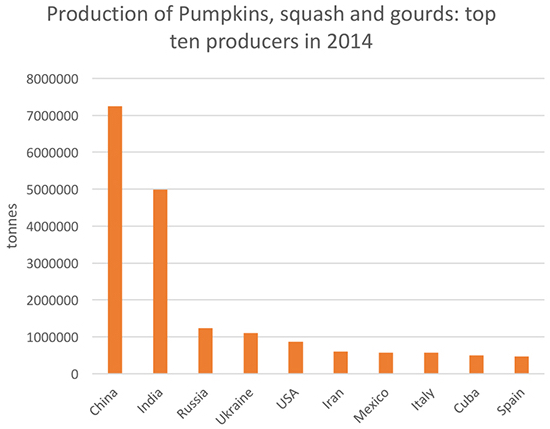
    The report, entitled "Karyotype Stability and Unbiased Fractionation in the Paleo-Allotetraploid Cucurbita Genomes" was published by a group of researchers* from China and Cornell University in New York.  Molecular Plant 10: 1293-306 (October 2017).  The species, C. maxima Duch. and C. moschata Duch., are the most economically important members of the Cucurbitaceae family (Cucurbita species) having at least 10 wild and 5 domesticated species of squash.  These squash species originated in South America (southern and northern regions, respectively) and were introduced into Europe following first contact.  The species were secondarily domesticated in China/Japan and India/Myanmar, and today are cultivated globally (with annual production of 25.2 million tons for all species, predominantly in India and China; see chart below from "Pumpkin genomes sequenced revealing uncommon evolutionary history").  These species are also important as root stock for other produce (cucumbers, Cucumis sativus; watermelon, Citrullus lanatus; melon, Cucumis melo), and in particular one called Shintosa, a hybrid between C. maxima cv. Rimu and C. moschata cv. Rifu; C. maxima has better fruit flavor and texture but C. moschata has better disease resistance and resistance to abiotic stress.

    Pumpkin-graph
    Generically, Cucurbita species have a chromosome number of 40, which is higher than some other species, with evidence for whole-genome duplication being involved in evolution of this genus, but there was until now little whole genome sequence data available. Accordingly these authors describe whole genomic sequences for both species.

    The results disclosed indicate an ancient allotetraploidization event that resulted in whole genome duplication, which the authors ascribe to "hybridization between two highly diverged diploid progenitors." The two genomes appear to have maintained the chromosomal structure of their progenitor species, having each experienced equivalent amounts of gene loss and neither of which showing dominance in gene expression levels (several homoeologous genes show divergent expression patterns). These data were used to analyze allele-specific gene expression in the Shintosa hybrid (F1).

    The researchers sequenced the parent genomes of C. maxima cv. Rimu and C. moschata cv. Rifu at a total of 109.3 and 80.1 Gbps, respectively, giving an estimate of 386.6 and 371.0 Mkb respectively. Using 2030 SNPs the authors produced a draft genome of 271.4 Mb for C. maxima and 269.9 Mb C. moschata and constructed genetic map comprising 20 linkage groups (LGs)(corresponding to n=20 chromosomes in the haploid genome).  These linkage groups were anchored to species-specific scaffolds, with 93% and 87% of the sequence reads mapping to the C. maxima and C. moschata assemblies, respectively.  An assessment of the extent of repetitive sequences in the assembled genomes revealed about 40% in both, with about 70% of these repeat sequences being long terminal repeat (LTR) retrotransposons (mostly of the copia and gypsy type), consistent with results in other members of the family including cucumber, melon and watermelon.

    mRNA sequences also mapped to these assemblies for C. maxima (93.8-95.8%) and C. moschata (86.2-95%). These RNA sequences mapped to an estimated 32,076 (C. maxima) and 32,205 (C. moschata) protein-coding genes, a much higher number than in cucumber (23,248 genes), melon (27,230 genes) or watermelon (23,440 genes). Sequence comparisons identified the biological functions of about 84% of the genes from each species, in which about 10% of the genes were identified as transcription factors. These analyses also identified disease-resistance  genes; while most of these genes in  C. maxima had homologues in C. moschata there were also disease-resistance genes that were unique to C. moschata.

    Further comparisons of syntenic blocks in both C. maxima and C. moschata "clearly indicated" that both species underwent whole-genome duplication (WGD) also observed in some other Cucurbita species including pumpkin (C. pepo) but not others.  The syntenic arrangement of the genes showed they corresponded to two subgenomes that could be distinguished according to genetic distance to orthologs for other related species (again, cucumber, melon and watermelon comprising the comparator set of related species).  The authors drew the following conclusions:

    Based on these findings, we separated the entire chromosomes into two groups to represent the two paleo-subgenomes.  Eight and 11 chromosomes were assigned to subgenomes A and B, respectively.  Chromosome 4 was divided into three segments with two assigned to subgenome A and one to subgenome B.  The reconstructed subgenomes A and B of Cmaxima contained 14,816 and 16,068 protein-coding genes, respectively (15,136 and 16,473 genes in Cmoschata, respectively).  Phylogenetic analysis clearly indicated an allotetraploid origin of Cucurbita from two progenitors that diverged from one another approximately 30.75 million years ago (Mya).  One ancestor gave rise to watermelon, cucumber, and melon in the Benincaseae tribe, as well as to the B-genome progenitor of Cucurbita, which has not been sampled and may be extinct.  No extant diploid species that could represent the A-genome progenitor have been sampled, so it is possible that this genome donor is also extinct.  The oldest possible date for the polyploidy event is the date of divergence of Benincaseae from the B-genome of Cucurbita (approximately 26.28 Mya.  There was extensive shared synteny between the two Cucurbita species with only a few inversions, consistent with a shared polyploidy event.

    The report also assessed gene families amongst C. maxima, C. moschata, cucumber, melon, watermelon, grape, and papaya, and found 52 gene families that had expanded "significantly" during the natural history of these species.  These included genes for pectin lyases, pathogenesis-related 1 proteins, carbohydrate esterases, pectinesterase inhibitors, subtilisin-like serine protease inhibitors, and mitogen-activated protein kinases (all of which are thought to act in modifying plant cell walls during growth and when fruit softens as well as in plant defense).  The authors also reported expansions in gene families involved in meristem activity control and organ morphogenesis such as the gibberellin 3β-hydroxylase family.  Although most of these expansions were found in both subgenomes, certain of them (such as pectin lyase and terpenene synthase) were from one subgenome while others (pectinesterase and carbohydrate esterase genes) were from the other subgenome.

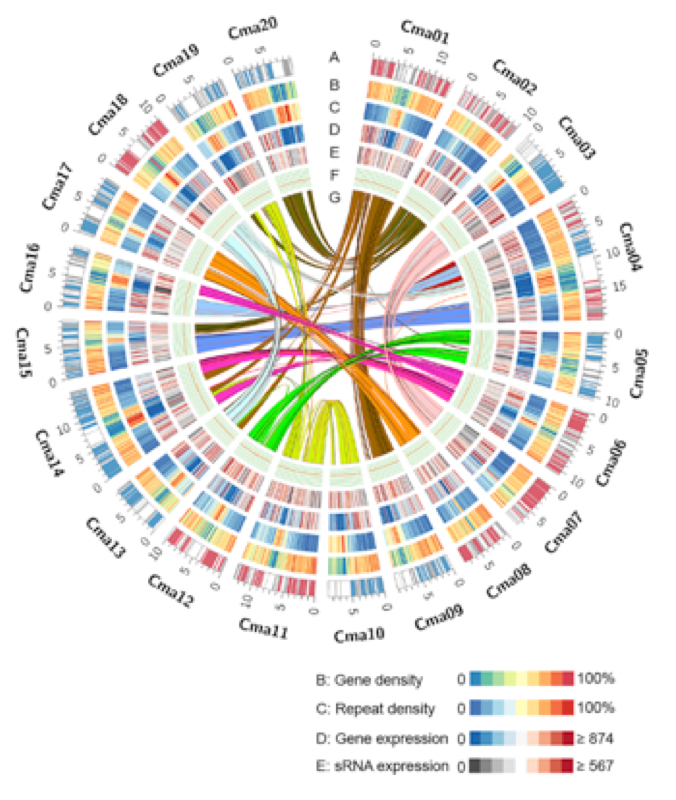
    Figure 1
    Figure 1 of Sun et al., 2017, Molecular Plant 10: 1293-306.

    Another aspect of similarities and differences between C. maxima and C. moschata was divergence in gene expression between the two species, wherein between 22-32% of the genes were differentially expressed (distributed as 7303 in fruit, 6464 in leaf, 7749 in stem, and 9371 in root).  Comparison of the mode of gene regulation (cis or trans) indicated that trans regulation was the predominant form of expression divergence in these species.  This pattern was consistent, according to the authors, with a pattern of gene expression regulation evinced by less divergent species, in accord with their relatively recent evolutionary split.  The report concludes with relative gene expression levels found in the F1 Shintosa hybrid, wherein changes in gene expression in root indicated a "trade off" between growth and defense responses, and the hybrid showed greater expression of genes involved in carotenoid biosynthesis.

    The report contains a closing discussion of the unusual result that the two subgenomes appear for have engaged in extremely limited interchromosomal rearrangements since the hybridization of the two diploid progenitors that produced these species at least 3 million years ago.  This pattern of chromosomal behavior has not been observed in other plant polyploidy species but has been observed in an allotetraploid frog with a long history as an experimental animal (Xenopus laevis); the hybridization event that created that species arose 17-18 million years ago.

    * Honghe Sun (National Engineering Research Center for Vegetables, Beijing Academy of Agriculture and Forestry Sciences, Key Laboratory of Biology and Genetic Improvement of Horticultural Crops (North China), Beijing Key Laboratory of Vegetable Germplasm Improvement, Beijing, China and Boyce Thompson Institute, Cornell University, Ithaca, NY USA), Shan Wu (Boyce Thompson Institute), Guoyu Zhang (Beijing Key Laboratory of Vegetable Germplasm Improvement), Chen Jioa (Boyce Thompson Institute), Shaogui Guo (Beijing Key Laboratory of Vegetable Germplasm Improvement), Yi Ren (Beijing Key Laboratory of Vegetable Germplasm Improvement), Jie Zhang (Beijing Key Laboratory of Vegetable Germplasm Improvement), Haiying Zhang (Beijing Key Laboratory of Vegetable Germplasm Improvement), Guoyi Gong (Beijing Key Laboratory of Vegetable Germplasm Improvement), Zhangcai Jia (Beijing Key Laboratory of Vegetable Germplasm Improvement), Fan Zhang (Beijing Key Laboratory of Vegetable Germplasm Improvement), Jiaxing Tian (Beijing Key Laboratory of Vegetable Germplasm Improvement), William J. Lucas (Department of Plant Biology, College of Biological Sciences, University of California, Davis, CA, USA),  Jeff J. Doyle (Section of Plant Breeding & Genetics, School of Integrated Plant Sciences, Cornell University), Haizhen Li (Beijing Key Laboratory of Vegetable Germplasm Improvement), Zhangjun Fe (Boyce Thompson Institute and USDA-ARS Robert W. Holley Center for Agriculture and Health, Ithaca, NY USA), and Yong Xu (Beijing Key Laboratory of Vegetable Germplasm Improvement).

  • By Kevin E. Noonan –

    Supreme Court Building #1Perhaps overlooked in the widespread assessments of the Supreme Court's questioning of the parties in Oil States Energy Services, LLC. v. Greene's Energy Group, LLC is the argument before the Court in SAS Institute, Inc. v. Complementsoft, LLC that immediately followed.  Assuming the Court affirms the Federal Circuit in Oil States (considered likely, despite the "man bites dog" quality such decisions have had recently), the Court's decision should clarify how (and in individual cases whether) future inter parties review proceedings will proceed.

    The case arose in litigation over U.S. Patent No. 7,110,936 assigned to Complementsoft.  SAS filed its IPR petition on claims 1-16, and the Board instituted as to claims 1 and 3-10 on obviousness grounds.  The PTAB found all instituted claims but claim 4 obvious and issued a final written decision on these claims.  SAS appealed, arguing that "the Board's final written decision is deficient for failing to address the patentability of all claims SAS included in its IPR petition, including those for which the Board did not institute IPR."

    The Federal Circuit held that the Board was not required to render a decision as to claims for which it did not institute the IPR, and that its decision in Synopsys, Inc. v. Mentor Graphics Corp., 814 F.3d 1309 (Fed. Cir. 2016) was controlling.  In that case, the Federal Circuit held that "no statutory requirement that the Board's final decision address every claim raised in a petition for inter partes review.  Section 318(a) only requires the Board to address claims as to which review was granted."  Id. at 1316–17.  At least one basis for this decision was the differences between the statutory language in 35 U.S.C. § 318(a), which recited "claims challenged by the petitioner," and the language in 35 U.S.C. § 314, in which the language "claims challenged in the petition" was used to describe the institution decision.  The Court held that this difference evinced a Congressional intent that the Board was able to institute on a claim-by-claim basis and was not compelled to render a decision on any non-instituted claim.

    SAS's petition for certiorari set forth this Question Presented:

    Whether 35 U.S.C. § 318(a), which provides that the Patent Trial and Appeal Board in an inter partes review "shall issue a final written decision with respect to the patentability of any patent claim challenged by the petitioner," requires that Board to issue a final written decision as to every claim challenged by the petitioner, or whether it allows that Board to issue a final written decision with respect to the patentability of only some of the patent claims challenged by the petitioner, as the U.S. Court of Appeals for the Federal Circuit held.

    At oral argument on November 27th, the Court, in particular Justice Sotomayor, questioned SAS's counsel (Gregory Castanias) on whether its argument was a poorly disguised attempt to circumvent the Court's decision in Cuozzo Speed Technologies LLC v. Lee (2016) ("Ah, you want to get around Cuozzo.").  The Justice's challenge was in one way practical:  how can the Board rule on claims that were not considered in the IPR because the Board exercised its discretion not to institute on those claims?  And on appeal, the argument would need to be that the Board should have instituted on those claims, and that's exactly what the Court said a party could not do under the statute.  Mr. Castanias's attempt to clarify his position was unavailing ("All right," said the Justice, "you do want to get around Cuozzo . . . .  Because there is absolutely no way that that's anything other than that.")  As to the practicalities of an appellate court reviewing patentability of uninstituted claims (where there would be "no record"), Mr. Castanias told the Court that the record before the Board is inherently fuller ("the petition filed here was a complete document") than a complaint before a district court, due to the requirement that the institution petition establish that at least one claim is unpatentable.  That was not enough for the Justice ("You're asking the appellate court to decide patentability on the basis of an incomplete, undeveloped record") who expressed her view that what SAS wanted to argue was that "the Board shouldn't institute partial reviews" and that "once it determines you have enough evidence to challenge one claim, it should hold a hearing on everything.  Because without that, you can't really decide patentability in a due process way, in a fair way" (perhaps being influenced somewhat by the arguments in Oil States that were heard by the Court immediately before this argument).  To Mr. Castanias's agreement with those statements Justice Ginsberg rejoined "[b]ut the statute precludes you from contesting the Institution decision," putting SAS back at Square One.  (At this point Mr. Castanias responded to Justice Ginsberg by answering a question the Justice had posed at the beginning of the argument.)  Mr. Castanias argued that the section of PTAB regulations rejecting SAS's position that all claims should be considered did not do so in the context of § 318.  His position was that Congress intended that the PTAB render a decision on "all challenged claims" and that this should include claims where review was instituted by the Board as well as claims where the Board did not grant review (as a matter of statutory interpretation).

    Justice Kagan then asked about the status of cancelled claims, and whether the Board should be required to render a decision as to their patentability.  In the Justice's view, SAS did not dispute that the Board was not required to render a patentability decision on cancelled claims and wanted to know what distinguished those two classes of claims.  Mr. Castanias drew the distinction that "there's a world of difference between" cancelled claims and claims where the Board did not institute review, because cancelled claims "no longer exist."  This was unavailing before the Justice, who understood the practical implications but did not see the difference with regard to the statutory interpretation issue.

    Justice Kennedy suggested that the Board could give a petitioner the choice:  either accept review on a subset of the challenged claims or forego the IPR proceeding in favor of district court litigation.  While Mr. Castanias agreed, this colloquy was cut off by Justice Sotomayor who asked where in the statute was the Board "prohibited" from instituting partial review (i.e., on only some of the challenged claims).  And the Justice then continued by asking why, if the Board was not so prohibited, should the Court read the statute differently than the Board has regarding the statutory requirements on the scope of the Final Written Decision under § 318?  Which prompted Justice Kagan to state:

    Well, one of the stories that the statute as written seems to tell is of great discretion to the Board with respect to the institution decision.  . . .  It says you never have to institute; it's your choice whether to institute; you can't get review of the institution decision, which is our Cuozzo case; you get to write your own rules about the institution decision, which is the — the rule-making delegation.  So it's a little bit odd to say, well, here's the one thing you don't have discretion over when it comes to institution:  you can't say these claims but not those claims.  In a — in a context in which Congress said the institution decision is really for the Board, it's a discretionary decision that lies in its bailiwick, why should we carve out that one thing?

    Mr. Castanias responded that as in litigation, it is typically the plaintiff who is the "master of the complaint" and that SAS petitioned the Board to institute with regard to all the claims; as it turned out what the Board actually did frustrated SAS's purpose for filing the IPR, in how it instituted with regard to one claim (claim 4) compared to another claim where it did not (claim 2).  Justice Breyer raised the issue that, as SAS would have it, the Board would be subject to appeal on all challenged claims even under circumstances where petitioner had only established the likelihood that one of the claims was unpatentable ("why [] would [someone] write a statute like that?") (later saying "I find it very practical to think of the statute as your opponents want it.").  Mr. Castanias responded by saying that having all challenged claims capable of appeal and then properly having estoppel attach as to those claims was the reason Congress legislated IPRs.

    Complementsoft's counsel, Jonathan Bond, was challenged by the Chief Justice on the differences between challenged and unchallenged claims put to the Court by SAS, which the Chief said "put[s] them in a difficult position."  Mr. Bond relied on the discretion the statute gives the PTAB to make these distinctions and the burden on petitioners to make their case in the institution petition.  Responding to Justice Kennedy's hypothetical that the Board could require a petitioner to withdraw a claim before institution, Mr. Bond said that it was an illustration of the "artificiality" of SAS's position that "the Board could get to the same result, just through a more cumbersome, multistage process."  With regard to taking the district court option, as discussed with Mr. Castanias, Mr. Bond reminded the Court that SAS could have done that here as well ("A challenger here who's dissatisfied with the Board's decision about the scope of review can say, you know what, it's not worth our time, we can settle with the — the Patent Owner our — our IPR dispute, we can agree not to pursue it and can proceed in litigation.").

    Justice Alito asked whether there was any ambiguity in the language of § 318 (and by implication why the statute should not be read as SAS had argued).  Mr. Bond's argument was that the language was plain in context (even if ambiguous in isolation) and that this didn't pose a "hard question" (drawing an incredulous "You think that's not a hard question at least?" from Justice Alito).  Justice Breyer suggested that the proper meaning of the term "patent claim" in the context of a challenged claim was only one where the Board instituted the IPR (an interpretation that the Chief characterized as "a stretch").  To Mr. Bond's reasonable foray into statutory language interpretation (on the word "any" in the statute being limited to instituted claims) Justice Alito echoed earlier argument by asking "why in the world would they phrase [its intention] the way it is phrased in § 318(a)?:

    Why wouldn't they say with respect to the patentability of any claim found by the director to have at least some likelihood of success?  Or any claim on which review was granted?  Why in the world would they say any patent claim challenged by the Petitioner?

    Mr. Bond countered by cataloguing the many types of claims that can be encompassed by the statutory language (instituted claims, amended claims, cancelled claims, noninstituted claims), and Justice Breyer speculated that perhaps Congress enacted the statute to be intentionally vague, permitting the PTAB to "decide which way it wants to go."  The Chief Justice reacted skeptically to that suggestion, and Justice Sotomayor directed the question to the differences between how Congress worded § 314 and § 318 ("If Congress intended claims challenged in the petition to be a part of 318, it could have used exactly the same words.").  Mr. Bond readily agreed (although it appeared that Justice Alito did not).  Justice Gorsuch raised the common-sense interpretation that the phrase as used in § 314 merely means all claims in the petition and in § 318 just means all those that are left after institution.  Justice Gorsuch also interrogated Mr. Bond on the interplay of his interpretation of § 314 and § 318 with the provisions of § 316 and whether the Director has the authority to pick and choose which claims to review.  Mr. Bond then presented his strongest statement of Complementsoft's position (with regard to policy and Congressional intent):

    The Petitioner's all-or-nothing approach puts the Board to an untenable choice; either it wastes time on claims it's already determined don't have a reasonable likelihood of being invalidated at least based on the arguments presented in the petition, or it doesn't use this new tool at all and all of the work of creating inter partes review was for nothing.

    Mr. Castanias in his rebuttal answered with "three specific responses to points made by my friend and then four broader points" (the efficiency with which he accomplished his objective caused the Chief to state at his argument's conclusion that "I thought you were being overly ambitious when you said you'd get to four points in rebuttal, but thank you, counsel" to laughter in the courtroom), addressing issues of scope, the requirements for means-plus-function claiming, the Board's purpose in rendering decisions to educate the public on the process, and Justice Breyer's speculation on the meaning of the word "any" in the statute.  He also answered a question from Justice Sotomayor on the status of claims where the parties "settled" during the IPR, and a question from Justice Kagan regarding the statute's commandments prohibiting partial institution, saying clearly that "the Board has already [been] given the discretion whether to institute.  The discretion whether to institute does not hide inside it a secret second level of discretion to decide to institute anything other than the petition."

  • By Donald Zuhn

    District Court for the District of DelawareLast month, in Pacific Biosciences of California, Inc. v. Oxford Nanopore Technologies, Inc., District Judge Richard G. Andrews of the U.S. District Court for the District of Delaware denied a motion to dismiss filed by Defendant Oxford Nanopore Technologies, Inc.  Oxford had sought dismissal of a complaint filed by Pacific Biosciences of California, Inc. ("PacBio"), which asserted that Oxford infringed U.S. Patent No. 9,546,400 by commercializing single-molecule sequencing products based on the use of protein nanopores.  In its motion to dismiss, Oxford contended that the '400 patent was directed to patent ineligible subject matter.  In denying Oxford's motion, Judge Andrews determined that under the circumstances of this case, he did not think patent-ineligibility was something that he could fairly decide on a motion to dismiss.

    The '400 patent asserted by PacBio, which is entitled "Nanopore sequencing using n-mers," is directed to methods for nanopore sequencing.  Representative claim 1 recites:

    1.    A method for sequencing a nucleic acid template comprising:
        a) providing a substrate comprising a nanopore in contact with a solution, the solution comprising a template nucleic acid above the nanopore;
        b) providing a voltage across the nanopore;
        c) measuring a property which has a value that varies for N monomeric units of the template nucleic acid in the pore, wherein the measuring is performed as a function of time, while the template nucleic acid is translocating through the nanopore, wherein N is three or greater; and
        d) determining the sequence of the template nucleic acid using the measured property from step (c) by performing a process including comparing the measured property from step (c) to calibration information produced by measuring such property for 4 to the N sequence combinations.

    Judge Andrews noted that while the Federal Circuit has made it clear that a district court can decide a patent-ineligibility claim at the motion to dismiss stage, the Federal Circuit has also made it clear that there will be cases where the motion to dismiss stage is not the appropriate stage for such a determination.  Judge Andrews' Order cites Transmission LLC v. Wells Fargo Bank, NA., 776 F.3d 1343, 1349 (Fed. Cir. 2014), for the proposition that "[a]lthough the determination of patent eligibility requires a full understanding of the basic character of the claimed subject matter, claim construction is not an inviolable prerequisite to a validity determination under § 101."  Judge Andrews also noted that despite the parties' agreement that claim construction was not necessary in this case, thereby suggesting that the case was an appropriate one for resolving patent eligibility at the motion to dismiss stage, and despite the fact that both parties had briefed and argued the case without suggesting that he wait, Judge Andrews ultimately denied the motion without prejudice to the motion being renewed at the summary judgment stage.

    In denying the motion, the District Court pointed out that PacBio had briefed the motion as though it were a summary judgement motion, submitting an expert declaration, excerpts of deposition testimony, and seventeen patents, patent applications, and journal articles, and that "at argument both sides referred to an understanding of the technology and the state of the art at the time of the invention."  The Court also explained that "[t]he technological understanding can be significant when analyzing the second part — the 'inventive concept' — of the Alice test, including the preemptive effect of the claims."  The Court therefore determined that the instant case was not one in which the motion to dismiss stage was the appropriate stage to resolve the issue of the patent eligibility of the asserted patent.


    Pacific Biosciences of California, Inc. v. Oxford Nanopore Technologies, Inc
    . (D. Del. 2017)
    Order by District Judge Andrews

  • CalendarDecember 5, 2017 – "University Technology Transfer and Licensing Agreements — Determining Type of Transfer Agreement, Structuring Key Provisions, Overcoming Unique Challenges" (Strafford) – 1:00 to 2:30 pm (EST)

    December 5, 2017 – "University Technology Transfer and Licensing Agreements — Determining Type of Transfer Agreement, Structuring Key Provisions, Overcoming Unique Challenges" (Strafford) – 1:00 to 2:30 pm (EST)

    December 6, 2017 – "Functional Claiming After Mastermine Software v. Microsoft" (Intellectual Property Owners Association) – 2:00 to 3:00 pm (ET)

    December 7, 2017 - Chicago Regional IPR Seminar and Reception (PTAB Bar Association and Intellectual Property Law Association of Chicago AIA Trials Committee) – 12:30 to 7:15 pm (CT), Chicago, IL

    December 7, 2017 – "Section 102 Prior Art and Section 103 Obviousness: Leveraging CCPA and Early Federal Circuit Decisions — Withstanding Rejections and Attacks on Patent Validity and Patentability" (Strafford) – 1:00 to 2:30 pm (EST)

    December 12, 2017 – "Capitalizing on Changes in Patent Law" (Practising Law Institute) – 1:00 to 2:00 pm (Eastern)

    December 13, 2017 – "Nuts & Bolts of the Federal Circuit's Rules" (Federal Circuit Bar Association) – 1:30 pm to 2:30 pm (EST)

    ***Patent Docs is a media partner of this conference or CLE

  • Federal Circuit Bar AssociationThe Federal Circuit Bar Association (FCBA) will be offering a webcast entitled "Nuts & Bolts of the Federal Circuit's Rules" on December 13, 2017 from 1:30 pm to 2:30 pm (EST).  Lucas C. Townsend of Gibson, Dunn & Crutcher LLP will moderate a panel consisting of Peter R. Marksteiner, Circuit Executive and Clerk of Court, U.S. Court of Appeals for the Federal Circuit; and Jarrett B. Perlow, Chief Deputy Clerk of Court, U.S. Court of Appeals for the Federal Circuit.  The panel will discuss the "nuts and bolts" of the Federal Circuit's rules, and provide guidance on how to comply with the rules, addressing common filing issues and errors, interaction with the Clerk's Office, and information about the Federal Circuit's move to the next generation of CM/ECF.

    The webinar is complimentary for FCBA members and $50 (government/academic/retired) or $125 (private practitioner) for non-members.  Those interested in registering for the webcast, can do so here.

  • PLI #1Practising Law Institute (PLI) will be offering a one-hour webcast entitled "Capitalizing on Changes in Patent Law" on December 12, 2017 from 1:00 to 2:00 pm (Eastern).  Jonathan Hill of Freeborn & Peters LLP will provide:

    • An overview of the law of issue preclusion (collateral estoppel), which generally operates to preclude litigation over an issue previously decided in a final judgment, but for a change in the legal standard that governs the issue;
    • An overview of the Therasense decision and characteristics of pre-Therasense unenforceability decisions which may merit re-litigation under the current law; and
    • Considerations (e.g., lapse of patents for unpaid maintenance fees) which may influence the decision whether to newly enforce patents held unenforceable under pre-Therasense legal standards.

    The registration fee for this webcast is $299.  Those interested in registering for the webcast, can do so here.

  • Strafford #1Strafford will be offering a webcast entitled "University Technology Transfer and Licensing Agreements — Determining Type of Transfer Agreement, Structuring Key Provisions, Overcoming Unique Challenges" on December 5, 2017 from 1:00 to 2:30 pm (EST).  Heather Meeker of O’Melveny & Myers LLP; Sean D. Solberg of Davis Brown Koehn Shors & Roberts; and Mark Staudt, Licensing Associate, Technology Commercialization, Wisconsin Alumni Research Foundation will provide guidance to counsel for drafting university technology transfer and licensing agreements, and discuss key clauses in the contracts and best practices for negotiating the agreements and avoiding pitfalls unique to the university context.  The webinar will review the following issues:

    • Key provisions to include in university technology transfer and licensing agreements
    • Managing unique challenges that arise when contracting with university personnel
    • Tactics to resolve commonly disputed issues during the negotiation of technology transfer and licensing agreements

    The registration fee for the webcast is $297.  Those interested in registering for the webinar, can do so here.

  • By Andrew Williams

    Supreme Court Building #3Leading up to the Supreme Court oral argument for Oil States Energy Services, LLC. v. Greene's Energy Group, LLC on November 27, 2017, there was a lot of discussion regarding whether patents were a private or public right.  Of course, that question is relevant to whether the Patent Office as an administrative agency can be given the authority to cancel a patent after it has issued, or whether the Constitution requires that the validity of an issued patent be determined by an Article III court.  If patents are indeed private rights, then IPRs and related proceedings are likely unconstitutional grants of authority to the executive branch from Congress.  As we had been reporting for the weeks leading up to the argument, the arguments that patents are private rights appear to be grounded in what the Supreme Court said in the 1898 case McCormick Harvesting Machine v. Aultman, 169 U.S. 606 (1898).  We presented an analysis of that case and concluded that the language in McCormick Harvesting can be used to support both interpretations, whether alleging that the case refines the Constitutional limits of Congress with regard to issued patent rights, or whether alleging that McCormick Harvesting rests solely on the lack of statutory authority at the time.  That post generated a lot of debate, with many well-reasoned (and much appreciated) viewpoints.  Did the Justices see McCormick Harvesting to be as clear-cut as some of the comments to our post suggested it was?  Justice Gorsuch certainly thought that McCormick Harvesting already settled the issue.  But many of the other Justices that asked questions on this topic did not seem to share this view.  If the questions that the Justices asked are any indication, it seems unlikely that a majority will find IPR proceedings per se unconstitutional.  Instead, if the Supreme Court finds any fault with the current system, it will likely base that on due process considerations.

    The position of Justice Gorsuch seemed clear from his questions.  In his first statement on the issue, addressed to Allyson N. Ho, counsel for petitioner, Justice Gorsuch indicated that he believed this issue had already been addressed by McCormick Harvesting and related cases:

    JUSTICE GORSUCH:  Ms. — Ms. Ho, we have a number of cases that have arguably addressed this issue already, like McCormick, for example, in which this Court said the only authority competent to set a patent aside or to annul it or to correct it for any reason whatever is vested in the courts of the United States.  We have cases — and American Bell is another one.  We have that wonderful quote from Justice Story indicating that any correction to a patent has to go to a court.

    Justice Gorsuch then appeared to deride the position of the United States by stating:  "The United States takes the position, as I understand it, that some of those decisions are purely statutory interpretation."  Interestingly, Petitioner, while arguing that McCormick Harvesting was decided on constitutional grounds, did not rest its case solely on the private-right notion that a grant of authority to the Patent Office to cancel an issued patent would always be unconstitutional.  This did not appear to sit well with Justice Gorsuch:

    JUSTICE GORSUCH:  Why not — why not, though, Ms. Ho, just simply say the question is whether there's a private right involved?  In answering Justice Kagan's questions and Justice Breyer's questions, you struggled with how much of an adjudication does an inquisitorial process have to have before it becomes an adjudication.  Why does that matter at all?

    If — if you really want to stake your ground and think McCormick's right, why not just say any time a private right is taken by anyone, it has to be through an Article III forum?

    Of course, Petitioner likely took the more moderate position because such a stance will likely be necessary for Oil States to convince enough of the Justice to decide the case in its favor.  In other words, it would be surprising if Justice Gorsuch does not side for Petitioner in this case, but whether he will be writing a concurrence or a dissent will likely turn on whether enough Justices believe that there are due process concerns with the current state of IPR proceedings.  The problem that Petitioner found itself in, as referenced by Justice Gorsuch, is that it took the position that ex parte reexaminations are constitutional, but that IPRs are not.  Justice Kagan took great interest in this distinction:

    JUSTICE KAGAN:  Can — can I take you back to this question of where you would draw the line -­

    HO:  Yes.

    JUSTICE KAGAN:  — between ex parte and inter partes reexamination on the one hand and this?  Because, as I understand what you would permit, those proceedings too can be initiated by a third party — you know, can be at the request of a third party, and — and those — in those proceedings too, the third party can participate in some way, can file a reply to the patentee's statement, can make known its views.

    So what's the line?  Where would you — what are the procedures that are here that you think make this essentially adjudicatory that are not in those other proceedings?

    In an effort to draw more support, Petitioner may have created a distinction to which no real difference is found.  Ms. Ho responded to Justice Kagan's questioning by stating:  "Yes.  I think — I think certainly the existence of — of discovery, of a hearing, all of these things show that what you have here is — is trial — is trial-like."  Unless Justice Kagan finds this response satisfactory, she may find that Petitioner's entire argument has essentially unraveled.

    Justice Ginsburg also noted the concession by Petitioner, but was clearly in support of it:

    JUSTICE GINSBURG:  I think Ms. Ho conceded that there can be an examination -­ reexamination.  Some of the questions raised in the last few minutes suggest that no — no reexamination, it's a private right, it can't be taken away.

    But Ms. Ho, I think, wisely, recognized that the reexamination procedure between the government is okay.  But — but the problem here is it looks too much like a court proceeding.

    Christopher M. Kise, counsel for Respondent, responded to Justice Ginsberg's observation by agreeing that the issue had already been conceded by Petitioner, turning this into a process question, not a power issue:

    KISE:  May I respond, Mr. Chief Justice?

    Justice Ginsburg, what you're hearing from the Petitioner is a process versus power argument.  The quarrel is with the process.  The Petitioner has conceded that the power exists, the power of revocation, even though there are — there are citations in the brief that — that make that argument seem — their argument inconsistent, this is a process versus power argument.

    With regard to the questioning from Justice Sotomayor, she appeared to agree with Justice Gorsuch that the private-right argument should foreclose the constitutionality of any post-issuance "correction" procedure at the Patent Office:

    JUSTICE SOTOMAYOR:  If this is a private right, as you claim, what does it matter in terms of whether the process is adjudicatory or not?

    If I own something, which is what your basic position, I understand, is, that this is a personal right, how can a government agency take that right away without due process of law at all?  Isn't that the whole idea of Article III, that only a court can adjudicate that issue?

    Nevertheless, Justice Sotomayor did not think that the holding in McCormick Harvesting was so clearly constitutional.

    JUSTICE SOTOMAYOR:  Ms. Ho, I'm sorry, I thought in McCormick, that — why did the Court even bother looking at the statute?  What it did, I understood, was look at the statute and say the statute basically defines the issue of a new patent being issued as one — before the old patent expires.

    And so they were really doing a statutory analysis of whether or not, by that process, the old patent was expired, and they were saying, no, if you want it to expire now, you have to go to court, because there's no statutory authority for doing it currently.

    So I'm not quite sure how — how you get to the constitutional holding.

    As previously suggested, based on the questioning and statements of the Justices (including those provided above), this case will likely not turn on the public versus private right issue, but rather whether there is a due process concern with the current framework for IPR proceedings.  We will address that line of questioning from the Justices in an upcoming post.

  • By Andrew Williams

    USPTO SealEarlier this month, the Patent Trial and Appeal Board released it Standard Operating Procedure 9 entitled "Procedure for Decisions Remanded from the Federal Circuit for Further Proceedings."  To date, the Federal Circuit has remanded about 42 cases to the Board for further processing.  In all but the most recent, the panel had to determine what procedures to use on an ad hoc basis.  Of course the Board has been able to look at what other panels have done in previously remanded cases, and the parties to the remand were certainly able to highlight the past procedures that were most favorable to their particular cases.  But in most cases, the panels were creating procedures on the spot without any apparent guidance.  This SOP 9 seeks to remedy this situation by setting up a mandatory "Remand Meeting" between the panel and Chief Judge and/or Deputy Chief Judge.  The involvement of the Chief Judge should introduce an element of consistency into the remand procedures.  In addition, SOP 9 provides how the remand proceedings are to be initiated by requiring the parties to contact the Board within 10 business days after the mandate issues to arrange a teleconference.  This should streamline the proceedings because previously it was unclear whether the impetus for initiating the procedures was on the Board or the parties.  In fact, in the case of Nike v. Adidas, IPR2013-00067, because the parties did not reach out to the Board for four months after the mandate issued, the Board decided that future briefing would not be permitted in the case (however, briefing was ultimately permitted in that case to address the outcome in the Aqua Products case).  Finally, SOP 9 provides that "[t]he Board has established a goal to issue decisions on remanded cases within six months of the Board's receipt of the Federal Circuit's mandate."  While this has been an unofficial goal espoused by representatives of the Board since the first remanded case of Microsoft Corp. v. Proxyconn, Inc., and the Board has in most cases kept to this timeframe, it is nice to see it made official — especially in view of the fact that the AIA did not provide a statutory timeframe for remands.

    Appendix 1 of SOP 9 provides guidance for the panels in preparing for the remand meetings with the Chief Judge.  The potential topics to be discussed at this meeting include: (1) the procedural history of the case, (2) the issues on remand, (3) the contemplated procedures for the proceedings on remand, and (4) any potential policy considerations.  This remand meeting is not intended to address the substantive outcome of the case.  SOP 9 also specifies that the panel is to schedule the remand meeting within thirty days of receiving the notice of the Federal Circuit opinion.  Of course, because the mandate does not issue until the time for seeking rehearing has expired, this remand meeting should occur well before the parties contact the panel to discuss the case.

    Appendix 2 to SOP 9 provides guidance for the parties.  There were eleven identified issues on which the parties are requested to seek agreement before the call with the Board: (1) whether additional briefing is necessary, (2) subject-matter limitations on briefing, (3) the length of briefing, (4) whether the briefs are to be field concurrently or sequentially, (5) if sequential, which party will file the opening brief, (6) whether a second brief should be permitted from either party, (7) the briefing schedule, (8) whether the parties should be permitted to introduce evidence, (9) limitations on the type of additional evidence, (10) the schedule for permitting additional evidence, and (11) any other relevant procedural issues.  Because of the new goal of 6 months from mandate to decision, any party seeking to introduce new evidence should be prepared to show good cause why it is necessary, and to demonstrate that the previous record is inadequate.

    The Board also identified six different remand scenarios for post-grant procedures before the Board: (1) erroneous claim interpretation, (2) failure to consider evidence, (3) inadequate explanation by the Board, (4) erroneous application of law, (5) lack of due process/denial of APA rights, and (6) improper consideration of the arguments.  In addition, it provided the following chart for the default procedures related to additional briefing, additional evidence, and oral argument:

    TableBy including this list, the Board may influence what arguments are advanced at the Federal Circuit.  For example, parties challenging decisions of the Board will be encouraged by this chart to argue that there was a lack of due process and/or a denial of APA rights, because such findings will have the best chance of changing the previous outcome of the Board through additional briefing, submitting additional evidence, and/or participating in another oral argument.  On the other hand, parties have been successful at the Federal Circuit in arguing that the Board did not adequately explain its position in the final written decision.  This will likely end up being a pyrrhic victory because this chart suggests that panels will not likely entertain additional briefing or the submission of additional evidence in such cases.  As a result, even though the party might end up with a better explanation, the outcomes in these cases will not likely change.

    SOP 9 and the above-referenced table have already been utilized in at least one case.  In Google Inc. v. Intellectual Ventures II LLC, IPR2014-00787, the Board held a telephone conference call with the parties on November 21, 2017.  The parties had requested additional briefing in view of the remand decision because the evidence relevant to the issues raised by the Federal Circuit was located in disparate locations in the record.  However, the reason for the remand was inadequate explanation by the Board, and the SOP 9 table indicates that additional briefing will not be allowed unless the original briefing was inadequate.  As a result, the Board denied the request for additional briefing, but authorized each party to provide an itemized listing of where the relevant evidence could be found.  Hopefully this case is indicative of SOP 9's apparent goal of making remand procedures more consistent and streamlined in the future.