 The authors and contributors of Patent Docs wish their readers and families a Happy Holidays. Publication of Patent Docs will resume on December 26th.

Patent Law Weblog
recent posts
- USPTO Moves to Protect Design Rights for Digital Innovations
- Judicial Conduct and Disability Committee Has Its Say, Denies Judge Newman’s Latest Request for Review
- PTAB Issues Judgment on Priority in CRISPR Interference
- Parties File Supplemental Priority Statements in CRISPR Interference
- Why the Alice Test is Stupid, Part V: The Goalposts Keep Moving
about
-
-
 Strafford will be offering a webcast entitled "After-Final Practice: Navigating PTO Options to Compact Patent Prosecution — Utilizing After-Final Consideration Pilot 2.0, Pre-Appeal Conference and More" on January 9, 2018 from 1:00 to 2:30 pm (EST). Justin J. Cassell of Workman Nydegger and Mandy J. Song of Finnegan Henderson Farabow Garrett & Dunner will provide guidance to patent counsel on the various USPTO options for responding after final rejection of a patent application. The panel will review the basics of each option and focus on strategic considerations and using different options. The panel will also provide an update on the ongoing pilot program, review statistics and discuss their experiences. The webinar will review the following issues:
• What options are available to patent counsel upon receiving a final rejection to a patent application?
• What should patent counsel consider when determining if—and which—PTO option to use in response to a final rejection?
• How can patent counsel and applicants leverage the PTO options for compact patent prosecution?The registration fee for the webcast is $297. Those interested in registering for the webinar, can do so here.
-
 The U.S. Patent and Trademark Office will be holding a customer partnership meeting of Technology Center 2600 from 8:30 am to 4:00 pm (ET) on January 17, 2018. The agenda for the meeting is as follows:
• Morning Network — 8:30 – 9:00 am
• Introductions — TC Contacts for Procedural Issue — 9:00 – 9:30 am
• Presentation: 103 General & TC Specific Training — 9:30 – 10:30 am
• Morning Break — 10:30 – 10:45 am
• Presentation: How SPEs/Primaries are trained to review Office Actions — 10:45 – 11:45 am
• Lunch — 11:45 am – 1:00 pm
• Workshops — 1:00 – 2:15 pm
• Afternoon Break — 2:15 – 2:30 pm
• Presentation: Examiner Interview Trainings and Practices — 2:30 – 3:30 pm
• Director Panel Q&A — 3:30 ~ 4:00 pmAttendees will be able to engage in open conversations with Managers, Quality Assurance Specialists, and Directors during the Morning Network and Lunch sessions.
The meeting will be held in the USPTO's Madison-North Auditorium, 600 Dulany Street, Alexandria, VA. Those wishing to attend the meeting can register here. Additional information regarding the customer partnership meeting, including how to participate via WebEx, can be found here.
-
 Strafford will be offering a webcast entitled "Patent Term Adjustments and Extensions: Leveraging Recent Decisions and USPTO Rule Changes" on January 11, 2018 from 1:00 to 2:30 pm (EST). Thomas L. Irving, Jill K. MacAlpine, and Charles E. Van Horn of Finnegan Henderson Farabow Garrett & Dunner will provide guidance to IP counsel for calculating patent term adjustments, interplay with patent term extensions, examine recent court treatment, and offer approaches for preserving rights and maximizing patent term adjustments and patent term extensions. The webinar will review the following issues:
• What are the lessons from the recent Federal Circuit decisions regarding the patent term calculation?
• How will the recent changes for the USPTO alter the landscape for PTA and PTE practice?
• What best practices should patent applicants take to preserve rights and maximize PTA and PTE?The registration fee for the webcast is $297. Those interested in registering for the webinar, can do so here.
-
 Patent Docs readers are invited to attend a webinar on "Sequence Listings and Patent Applications" that will take place on January 9, 2018 from 1:00 to 2:30 pm (ET). Suzannah K. Sundby of Canady + Lortz LLP and Carl Oppedahl of Oppedahl Patent Law Firm LLC will explain how to prepare and e-file computer-readable sequence listings. The webinar will address the following topics:
• learn about the PatentIn software
• learn about the Checker software
• nuts and bolts of how to generate a sequence listing
• how to download a sequence listing from WIPO and format it for the USPTO
• how to modify an existing Sequence Listing text file without PatentIn
• general requirements for sequence listings
• how to respond to sequence listing notices
• frequently made mistakesWhile there is no cost to participate in the program, advance registration is required. Those interested in attending the webinar can register here.
-
 Strafford will be offering a webcast entitled "Patent Drafting for Machine Learning: Structural Claim Limitations, Avoiding 101 or 112 Rejections" on January 4, 2018 from 1:00 to 2:30 pm (EST). Gregory Rabin of Schwegman Lundberg & Woessner and Michael D. Stein of Baker & Hostetler will provide guidance to patent practitioners on overcoming challenges when seeking patent protection for machine learning inventions, and will also discuss what can be done to anticipate and minimize the risks of § 101 or § 112. The webinar will review the following issues:
• What hurdles must patent counsel overcome to demonstrate inventorship?
• How can patent counsel meet the requirements under § 101 and § 112 in machine learning patent applications?
• What steps should patent counsel take to minimize the likelihood of § 101 or § 112 rejections?The registration fee for the webcast is $297. Those interested in registering for the webinar, can do so here.
-
By John Wizeman* and Anthony D. Sabatelli** —
Clarity on patent subject matter eligibility is still being sought five years after Mayo [1] and three years after Alice [2]. Further adding to the confusion is the fact that discoveries in diagnostics, despite their apparent importance to the biomedical sciences, have been repeatedly determined as ineligible subject matter under 35 USC § 101. The two step Alice/Mayo test has increased the percentage of invalid patents, and the decision by the Supreme Court to deny certiorari in the case of Ariosa vs. Sequenom [3] in 2016 means we are unlikely to see a reversal of this trend in the near future. Inventors are still finding it challenging to implement the current guidelines toward a successful diagnostics patent grant. In this piece we provide perspective from a 2016 Federal Circuit decision that provides some over-looked hints for moving forward with inventions relating to diagnostics.
Three high-profile cases have pushed inventors of clinical diagnostic tools into a more restricted path of subject matter eligibility: the Supreme Court's Myriad [4] decision, and two cases out of the Federal Circuit, Sequenom and Genetics Technologies Ltd.[5] All of these cases involved broad clinical diagnostic innovations, instead of focusing on the specific research methods they created. The first of these, Myriad, was a landmark case that reversed contemporary policy on isolated gene patentability. The Supreme Court not only decided that isolated genes were not patent eligible, but also that the comparison of an isolated gene to a control gene represented an abstract idea, and was therefore also ineligible. The second decision restricting patent eligibility came from the Sequenom case, in which a "significant contribution to the medical field" which represented a truly novel discovery was dismissed as patent ineligible. The discovery, that "cell-free, fetal DNA" (cffDNA) was present in maternal blood, represented a major advancement and clearly deviated from the prior art. The merits of the discovery are still relevant in the use of diagnostic tests, as cffDNA is becoming a more reliable and common non-invasive early pregnancy procedure to diagnose genetic abnormalities. However, the court held that no transformation of "the nature of the claim" into "a patent eligible application" was present, based on the concept that the discovery was simply harnessing an observable natural phenomenon and applying well known assays toward that discovery. The third of these decisions, Genetics Technologies, dealt with a patent regarding coding DNA (protein-creating) and junk DNA (non-protein creating), which could be inherited together at higher than expected frequencies. This finding could be used to selectively analyze junk DNA instead of coding DNA and provide the basis of diagnostic tests for genetic conditions. The patent was deemed invalid due to this being a "law of nature". These cases focused on the clinical impact, rather than on the specific breakthrough research methods involved.
From an overly simplified view, diagnostic tools can be broken down into finding new methods to isolate pure samples (laws of nature), determining changes in those samples in pathological conditions (a natural phenomenon) and comparing the results to non-pathological samples (an abstract idea) — i.e. the three judicially created exceptions to patent subject matter eligibility. By this rudimentary breakdown, there can be almost no new protected innovations in diagnostics. However, a case tangentially related to diagnostics, Rapid Litigation Management Ltd., v. Cellzdirect, Inc.[6], offers significant insight into a clearer path toward patent eligibility. Although it has been over a year since the Federal Circuit ruling, the guidance provided by this important case can have far reaching implications and provide a clearer path forward for diagnostics.
The Federal Circuit Court of Appeals ruled in favor of the patentee, providing insight into eligible subject matter as it relates to the Alice/Mayo test. The patentee claimed a new way of freezing down and preserving hepatocytes, liver cells that have a wide range of uses in research and clinical settings. A key difference in the Rapid Litigation case is that the wording of the claim applies its discovery of a law of nature toward a laboratory technique. The claim in this case referred to hepatocytes frozen down multiple times as a method for laboratory refinement and potential diagnostic testing. In its most basic form, the claim describes a natural phenomenon — hepatocytes can survive multiple freeze-thaw cycles. Given the decisions in the earlier cases, this claim alone would likely be enough to be deemed ineligible in the current environment. However, the additional novel steps of purification and refreezing were not obvious given the prior art. Similar to the Sequenom finding, the Rapid Litigation claim (1) directed to a "law of nature", (2) was non-obvious given the prior art, and (3) relied heavily on established methods. The difference between the Sequenom finding and the finding in the Rapid Litigation case is the application toward which each invention was ultimately aimed. Many diagnostic tests face similar hurdles which can require a new approach to ensure successful patent protection. Although clinical impact may provide weight to the importance of an invention, focus on the underlying laboratory methodology can lead this new approach by focusing on the novelty and practical use.
Although one path to better ensuring eligibility for diagnostic patent claims may be to include treatment options, this path could be restricted toward a single treatment paradigm and become quickly irrelevant as new treatments arise. Summing up the lessons from the cases mentioned above, patents aimed toward new diagnostic tests should not: (1) rely solely on genetic identification or pathology, (2) harness common assays to compare patient information to a standard, (3) rely on the discovery or levels of a pathologically correlated molecule, or (4) be based on any non-synthetic or simply observable method of detection, even if that method is novel. Therefore, rather than examining treatment options, inventors should explore placing their inventions in the context of laboratory research methodology. For instance, if the application of the Sequenom finding related their purification of cffDNA into a lab method for non-invasive preparation and storage of purified fetal DNA by freezing down maternal cells or plasma as a storage system, and then using that material for purification and later use, the novelty of separation from the maternal plasma may have been enough to qualify under the second step of the Alice/Mayo test.
Although dramatic changes to the Alice/Mayo framework may still occur, inventors will need to live in the current eligibility environment for the time being. Recent failures for diagnostic cases can be used as a guide for protecting new discoveries and inventions. Unlike uncertain clinical treatments or new biomarkers, refined laboratory methods, as per Rapid Litigation, could provide a critical outlet for inventors.
[1] Mayo Collaborative Services v. Prometheus Laboratories, Inc., 132 S. Ct. 1289 (2012)
[2] Alice Corp. v. CLS Bank International, 134 S. Ct. 2347 (2014)
[3] Ariosa Diagnostics, Inc. v. Sequenom, Inc., 788 F.3d 1371 (Fed. Cir. 2015)
[4] Association for Molecular Pathology v. Myriad Genetics. Inc., 133 S.Ct. 2107 (2013)
[5] Genetic Technologies Ltd. v. Merial L.L.C., 2015-1202, 2015-1203 (Fed. Cir. 2016)
[6] Rapid Litigation Management Ltd. v. CellzDirect, Inc., 2015-1570 (Fed. Cir. 2016)* John Wizeman recently received his Ph.D. in biomedical sciences with a concentration in neuroscience from the University of Connecticut Health Center. His research focused on retinal injury and repair in addition to several student leadership roles. He then moved into a postdoctoral position researching cerebellar development. He has published numerous papers in different specialties of neuroscience. Currently, he focuses in neurodevelopment and teaches several Medical/Dental and Graduate courses at UConn Health.
** Dr. Sabatelli is a Partner with Dilworth IP -
By Kevin E. Noonan –
 The Patent Trial and Appeal Board was seemingly sufficiently vexed over the question of whether the St. Mohawk Indian Tribe was entitled to have the Board dismiss, on grounds of sovereign immunity, inter partes reviews on patents the Tribe licensed from Allergan (see "Mohawk Nation Exercises Sovereign Immunity in Inter Partes Review") to solicit amicus curiae briefs on the issue from "interested parties." But today, an expanded panel of the Board, including Chief Judge David Ruschke, issued an order dismissing a sovereign immunity challenge by the State of Minnesota in Ericsson Inc. and Telefonaktiebolaget LM Ericsson v. Regents of the University of Minnesota. The coincidence of these two decisions is curious, particularly because while the scope of sovereign immunity enjoyed by the various recognized Tribes of Native Americans is both uncertain and subject to Congressional abrogation (albeit only when express), a State's sovereignty is acknowledged and protected by the Eleventh Amendment. Notwithstanding these considerations, the Board rendered its decision, and the legal rationale set forth in its Order provides some insight into not only how the Board may rule on the Tribe's motion but on how the Board (and the Patent Office) perceives its role and authority to make such decisions.
The Director granted Ericsson's IPR petitions involving U.S. Patents Nos. 7,251,768; 8,718,185; 8,588,317; 8,774,309; and RE45,230. In response to institution, the State of Minnesota filed a motion to dismiss based on its Eleventh Amendment sovereign immunity. The unresolved question before the Board was whether this immunity was available to enable Minnesota to avoid inter partes review. Despite earlier decisions by the Board that states could assert sovereign immunity in IPRs (see Covidien LP v. Univ. of Fla. Research Found., Inc., Case IPR2016-01274 (PTAB Jan. 25, 2017); NeoChord, Inc. v. Univ. of Md., Balt., Case IPR2016-00208 (PTAB May 23, 2017); and Reactive Surfaces Ltd., LLP v. Toyota Motor Corp., Case IPR2016-01914 (PTAB July 13, 2017)), and the panel's agreement that "IPR is an adjudicatory proceeding of a federal agency from which state entities are immune," the expanded panel decided that Minnesota had waived sovereign immunity because it had asserted the IPR-challenged patents in a patent infringement lawsuit in district court.
The expanded panel, which comprised Deputy Chief Administrative Patent Judge Scott R. Boalick, Vice Chief Patent Judges Jacqueline Wright Bonilla and Scott C. Weidenfeller, and Administrative Patent Judges Jennifer S. Bisk, Robert J. Weinschenk, and Charles J. Boudreau in addition to the Chief Administrative Patent Judge, expressly set forth its reliance on the Chief Judge's authority under 35 U.S.C. § 6 to expand panels when issues before the Board are of exceptional importance or are "necessary to secure and maintain uniformity of the Board's decisions" (despite skepticism from reviewing courts, including the Federal Circuit and Supreme Court, about these practices, for example in Oil States Energy Services, LLC v. Greene's Energy Group, LLC). The expanded panel's decision did not overturn or otherwise disturb the Board's earlier decisions that a State could assert its Eleventh Amendment sovereign immunity to have the Board dismiss an IPR proceeding against patents assigned to a state University as an arm of the state. This is consistent with the Supreme Court's decision in Fed. Mar. Comm'n v. S.C. State Ports Auth., 535 U.S. 743 (2002), that administrative agency adjudications can be sufficiently similar to district court litigation for a State to assert sovereign immunity as applied to the Patent Office by the Federal Circuit in Vas-Cath, Inc. v. Curators of Univ. of Mo., 473 F.3d 1376 (Fed. Cir. 2007). And in a footnote, the expanded panel states that the differences between civil litigation and IPR proceedings are not enough to evince a Congressional intent to "compel states to surrender their sovereign immunity" consistent with Fla. Prepaid Postsecondary Educ. Expense Bd. v. Coll. Sav. Bank, 527 U.S. 627 (1999).
Nevertheless, the expanded panel decided that these determinations were not the end of the question before the Board. Here, the State of Minnesota had filed a complaint against the Ericsson Petitioners, and this was enough for the Board to conclude that this action by the State in one forum (the Article III District Court) had waived its sovereign immunity before the Article I PTAB, a different forum both in kind and Constitutional origins. The expanded panel acknowledged that "[a] State's waiver of Eleventh Amendment immunity in one action does not necessarily extend to a separate action, even if the separate action involves the same parties and the same subject matter," citing Biomedical Patent Mgmt. Corp. v. Cal., Dep't of Health Servs., 505 F.3d 1328, 1339 (Fed. Cir. 2007). But the Board did not recognize this Federal Circuit decision to lay out a "bright-line rule" precluding waiver of sovereign immunity in one forum by actions in another forum on the same patents. The expanded panel relied on Lapides v. Bd. of Regents of Univ. Sys. of Ga., 535 U.S. 613 (2002), for the principle that waiver depends on "the need to avoid unfairness and inconsistency, and to prevent a State from selectively using its immunity to achieve a litigation advantage" (illustrating the continuing conflation, when it serves their purpose, for the Board to analogize its proceedings with litigation). The closest case on its facts to the waiver question before the expanded panel in its view is Regents of Univ. of New Mexico v. Knight, 321 F.3d 1111 (Fed. Cir. 2003), where the Federal Circuit found waiver of sovereign immunity by a State asserting its patents in district court with regard to compulsory counterclaims. The grounds for this analogy is the nature of compulsory counterclaims in litigation (which must be asserted "or be forever barred from doing so"; emphasis in opinion) and the provisions of 35 U.S.C. § 315(b) that require a patent infringement defendant to file an IPR petition within one year of being sued "or be forever barred from doing so" (emphasis in opinion). In each case, it is the State's affirmative filing of a patent infringement complaint that imposes the requirement for a defendant to react and this is enough, in the Board's view, for the State to have waived sovereign immunity in this case.
With regard to Minnesota's argument that "any waiver of Eleventh Amendment immunity should be limited to the venue where Patent Owner filed its action," the expanded panel acknowledges that "waiver is generally limited in this way" in district court litigation; once again the Board does not understand this to be a "bright-line rule." And the Board cites its opinion that recognizing a State's sovereign immunity under these circumstances "would result in substantial unfairness and inconsistency."
One member of the expanded panel, APJ Bisk, wrote separately to enunciate her view that "a state university, having availed itself of Patent Office procedures to secure patent rights from the public, may not subsequently invoke sovereign immunity as a shield against reconsideration by the Patent Office in an inter partes review proceeding of whether the agency improvidently granted a patent monopoly in the first instance," her diction plainly reciting her prejudices in these matters. Substantively, she notes the differences between district court litigation and the administrative nature of an IPR, and the factual and procedural distinctions between IPRs and the administrative activities in the Supreme Court's FMC precedent. Citing MCM Portfolio LLC v. Hewlett-Packard Co., 812 F.3d 1284, 1293 (Fed. Cir. 2015), the APJ also improvidently characterizes patent rights as "public rights" in advance of the Supreme Court's impending decision in Oil States on precisely that question, in a portion of her concurring opinion focused on the importance of IPR proceedings to protect the public from improperly granted patents. No doubt aware of similar arguments by amici curiae solicited by the Board in the St. Regis Mohawk Tribe IPRs, the APJ also characterizes IPRs as being actions in rem to defeat claims of sovereign immunity, and cites the (until recently ephemeral) right for a patent owner to amend claims as another distinction between IPRs and litigation.
The decision provides the avenue for the Board's judicial overseers to opine on the extent to which and under what circumstances the Eleventh Amendment shields a State from inter partes review. However it raises the question of whether the Board, as the adjudicatory arm of an administrative agency, is empowered to render such a decision or whether the proper position would have been for the Board (expanded panel or not) to have recognized Minnesota's sovereign immunity and left it to the Federal Circuit (and, likely and ultimately, the Supreme Court) to make the determination that sovereign immunity does not apply or has been waived and on what basis.
Before Chief Administrative Patent Judge David P. Ruschke, Deputy Chief Administrative Patent Judge Scott R. Boalick, Vice Chief Asministrative Patent Judges Jacqueline Wright Bonilla and Scott C. Weidenfeller, and Administrative Patent Judges Jennifer S. Bisk, Robert J. Weinschenk, and Charles J. Boudreau
Order Denying Patent Ownwer's Motion to Dismiss by Chief Administrative Patent Judge Ruschke, concurring opinion by Administrative Patent Judge Bisk -
By Donald Zuhn —
 PricewaterhouseCoopers (PwC) and CB Insight recently released the results of its US MoneyTreeTM Report on U.S. venture funding for the third quarter of 2017. The report indicates that venture capitalists invested $19.0 billion in 1,207 deals in the third quarter, with the number of dollars and deals remaining steady after $18.9 billion was invested in 1,208 deals in the second quarter. The third quarter numbers constituted a 32% increase in dollars and a 6.1% decrease in deals as compared with the third quarter of 2016, when $14.4 billion was invested in 1,286 deals (see chart below, which shows total venture funding from the fourth quarter of 2015 through the third quarter of 2017; chart from MoneyTreeTM Report; click on chart to enlarge). The increase in dollars in the third quarter of 2017 marked the fourth straight quarter in which invested dollars increased.
With respect to funding by sector, the internet sector captured the top spot among the sectors tracked in the report, collecting $7.9 billion in 574 deals in the first quarter of 2017. The healthcare sector came in second, with $3.2 billion invested in 171 deals (see chart below, which shows venture funding for the internet, healthcare, mobile & telecommunications, software (non-internet/mobile), and industrial sectors; chart from MoneyTreeTM Report; click on chart to enlarge).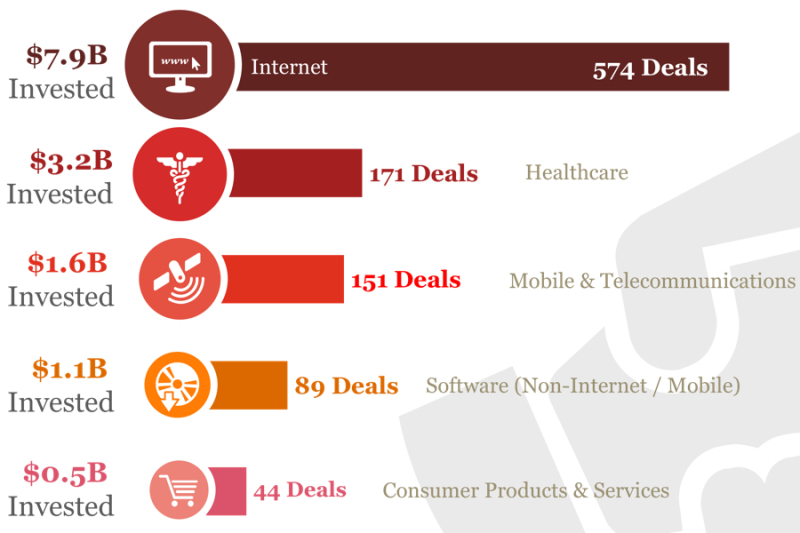
The report also includes separate analyses of funding in the areas of artificial intelligence, digital health, and auto tech, as well as funding by geographic region and a global regional comparison.For additional information regarding this and other related topics, please see:
• "First Quarter Venture Funding Bounces Back from Fourth Quarter Low," May 31, 2017
• "Venture Funding Normalizes in 2016 After Strong First Half," February 8, 2017
• " Second Quarter Venture Funding Increases 20% from First Quarter," October 11, 2016
• "Venture Funding Reaches Highest Level in More Than a Decade," February 25, 2016
• "Third Quarter Venture Funding Declines 27% from Second Quarter," October 22, 2014
• "Software Sector Leads Pack in 2Q Venture Funding and Biotech Sector Finishes Second," July 20, 2014
• "Software Sector Leads First Quarter Venture Funding to Thirteen Year High; Biotech Sector Finishes Second (Again)," April 30, 2014
• "Biotech Venture Funding Rebounded in 2013 After Strong Fourth Quarter," January 26, 2014
• "Biotech Venture Funding Sees Second Quarter Rebound," July 22, 2013
• "Biotech Venture Funding Down 33% in First Quarter," April 30, 2013
• "Annual Venture Funding Drops for First Time in Three Years," February 4, 2013
• "Biotech Venture Funding Up 64% in Third Quarter," October 29, 2012
• "Venture Funding in Life Sciences Sector Drops 9% in Second Quarter," July 22, 2012
• "Biotech Venture Funding Drops 43% in First Quarter," May 3, 2012
• "Venture Funding Increased 22% in 2011," February 2, 2012
• "Life Sciences Venture Funding Drops in Third Quarter," October 27, 2011
• "Life Sciences Venture Funding up 37% in Second Quarter," August 1, 2011
• "VentureSource Reports 35% Increase in 1Q Venture Funding," April 26, 2011
• "NVCA Reports Modest Gains in First Quarter Venture Funding," April 19, 2011
• "NVCA Reports 31% Drop in Venture Funding for Third Quarter," October 17, 2010
• "NVCA Reports 34% Increase in Venture Funding for Second Quarter," July 22, 2010
• "NVCA Report Shows First Quarter Drop in Venture Funding," April 20, 2010
• "Biotech/Pharma Financing Improving, R&D Spending Up," August 31, 2009
• "NVCA Study Shows Increase in Third Quarter Venture Funding," October 23, 2009
• "First Quarter Venture Capital Funding at 12-Year Low," April 23, 2009
• "NVCA Study Shows Decline in 2008 Investment; BIO Study Predicts Biotech Rebound in 2009," February 16, 2009 -
By Donald Zuhn —
 Last week, in Ni-Q, LLC v. Prolacta Bioscience, Inc., District Judge Michael H. Simon of the U.S. District Court for the District of Oregon denied a motion for judgment on the pleadings under Rule 12(c) of the Federal Rules of Civil Procedure filed by Plaintiff Ni-Q that the claims of U.S. Patent No. 8,628,921, which is assigned to Defendant Prolacta Bioscience ("Prolacta"), are invalid under 35 U.S.C. § 101 for failure to claim patent-eligible matter. Ni-Q had initiated the dispute between the parties by filing a complaint for declaratory judgment of noninfringement and invalidity of the '921 patent, as well as alleging a violation of the Oregon Unlawful Trade Practices Act.
The '921 patent, which is entitled "Methods for testing milk," is directed to methods for testing mammary fluid (including milk) to establish or confirm the identity of the donor of the mammary fluid. Independent claims 1 and 13 recite:
1. A method for determining whether a donated mammary fluid was obtained from a specific subject, the method comprising: (a) testing a donated biological sample from the specific subject to obtain at least one reference identity marker profile for at least one marker; (b) testing a sample of the donated mammary fluid to obtain at least one identity marker profile for the at least one marker in step (a); (c) comparing the identity marker profiles, wherein a match between the identity marker profiles indicates that the mammary fluid was obtained from the specific subject; and (d) processing the donated mammary fluid whose identity marker profile has been matched with a reference identity marker profile, wherein the processed donated mammary fluid comprises a human protein constituent of 11-20 mg/mL; a human fat constituent of 35-55 mg/mL; and a human carbohydrate constituent of 70-120 mg/mL.
13. A method for processing a donated human breast milk obtained from a specific subject comprising: (a) testing a donated biological sample from the specific subject to obtain at least one reference identity marker profile for at least one marker; (b) testing a sample of the donated human breast milk to obtain at least one identity marker profile for the at least one marker in step (a); (c) comparing the identity marker profiles of steps (a) and (b), wherein a match between the identity marker profiles indicates that the donated human breast milk was obtained from the specific subject; (d) processing the donated human breast milk whose identity marker profile has been matched with a reference identity marker profile, wherein the processing comprises: (i) filtering the donated human breast milk; (ii) heat treating the donated human breast milk; (iii) separating the donated human breast milk into cream and skim; (iv) adding a portion of the cream to the skim to form a human milk composition; and (v) pasteurizing the human milk composition to produce a processed human breast milk composition; and wherein the processed donated human breast milk comprises a human protein constituent of 11-20 mg/mL; a human fat constituent of 35-55 mg/mL; and a human carbohydrate constituent of 70-120 mg/mL.
Prolacta receives human milk from donors and processes it to make fortifier and other products for use in feeding premature and other medically fragile infants. Ni-Q is also engaged in the procurement, production, and sale of human milk-based products for use in feeding premature infants. In response to Ni-Q's declaratory judgment action, Prolacta alleged infringement of the '921 patent by Ni-Q.
Ni-Q thereafter filed its Rule 12(c) motion for judgment on the pleadings, asserting that the claims of the '921 Patent are directed to the application of a natural phenomenon, namely, the identification of naturally occurring biological markers in the tissues of a milk donor and in the donor's milk. Ni-Q also asserts that the claimed methods are implemented using previously known techniques, such as the analysis of DNA-, protein-, or antibody-based markers, and therefore add no inventive concept to save the patent from a finding of subject matter ineligibility.
Prolacta opposed Ni-Q's motion, arguing that because claim construction had not yet occurred, the claims must be construed entirely in Prolacta's favor (citing BASCOM Global Internet Servs. v. AT&T Mobility LLC, 827 F.3d 1341, 1351-52 (Fed. Cir. 2016)). Prolacta also argued that Ni-Q, in its motion, relied on prior art cited on the face of the '921 patent, and that if the District Court were to consider those references, then the Court should employ the summary judgment standard under Rule 56 (citing Cobra Fixations CIE Ltee-Cobra Anchors Co., Ltd. v. Newell Operating Co., 2011 WL 1399785, *1 (M.D. N.C. 2011)). Prolacta further argued that any ambiguities, including what the '921 patent specification or prior art discloses, must be resolved in favor of Prolacta's pleading under Rule 12(c) (citing Walling v. Beverly Enters., 476 F.2d 393, 396 (9th Cir. 1973), and Mettler-Toledo, Inc. v. B-Tek Scales, LLC, 671 F.3d 1291, 1297 (Fed. Cir. 2012)). Finally, Prolacta submitted two declarations in opposition to Ni-Q's motion.
Ni-Q responded to Prolacta's opposition by arguing that the District Court should not adopt Prolacta's proffered claim construction because it was implausible (citing Atlas IP, LLC v. Exelon Corp., 189 F. Supp. 3d 768, 779 (N.D. Ill. May 17, 2016)). Ni-Q also argued that if the District Court decided to adopt Prolacta's proffered claim construction, then Ni-Q should be entitled to judgment of infringement and the claims of the '921 patent should still be found to be directed to patent ineligible subject matter because the additional method steps relied upon by Prolacta would not save the claims under § 101.
In denying Ni-Q's motion, Judge Simon determined that "[a]fter reviewing the parties' arguments and evidence, including Prolacta's proffered claim construction, . . . it is premature to resolve the substantive disputes presented." The Court expressed the belief that "a sound[] analysis and resolution of the pending dispute will benefit from an orderly claim construction procedure."
Ni-Q, LLC v. Prolacta Bioscience, Inc. (D. Or. 2017)
Order by District Judge Simon
 Patent Docs