• By Kevin E. Noonan –

    Federal Circuit SealThe Federal Circuit reviewed the latest decision from the Patent Trial and Appeal Board (PTAB) in an inter partes review that claims 3-6 and 10 of U.S. Patent No. 6,548,019 are obvious, in Rembrandt Diagnostics LP v. Alere, Inc.; prior proceedings were reported at Alere, Inc. v. Rembrandt Diagnostics, LP, 791 F. App'x 173 (Fed. Cir. 2019), and Rembrandt Diagnostics, LP v. Alere, Inc., 809 F. App'x 903 (Fed. Cir. 2020).

    The claims are directed to assay devices for testing biological fluids, as illustrated in Figures 3 and 6 and explained in the opinion as follows:

    The test assay device receives a fluid sample "introduced directly to the sample loading zone" (30) of one or more assay test strips (22) . . . the assay test strips (22) may each be encapsulated within separate "flow control channel[s]" (34) in one embodiment.  . . .  Figure 6 illustrates that to assemble the full testing assay device, the test strip assembly (22, 28, 34) from Figure 3 may be combined with a holder (40) and placed inside a fluid sample container (i.e., a cup) (2) that has a cap (45) to fit over the opening (3) of the container.  . . .  Figure 6 also shows that the sample loading zones (30) of the assay test strips are oriented toward the base (1) of the fully assembled container.  As the assay sample fluid in the container contacts the sample loading zone (30), it migrates upward through the assay test strip.  Id. at 6:55–67.  In another embodiment, multiple test strips may be held within a single "continuous in width" flow control channel.

    ImageExemplary Claim 3 at issue in this appeal reads as follows (wherein the language of independent claim 1 is distinguished by being in italics):

    3.  A device [according to claim 1] for collecting and assaying a sample of biological fluid, the device comprising:
        (a) a flow control channel defined by at least one liquid pervious side joined to liquid impervious sides, wherein the internal dimensions of the flow control channel are sufficient to permit placement therein of an assay test strip;
        (b) an assay test strip within the flow control channel, wherein the assay test strip has a sample loading zone therein, and wherein further the assay test strip is disposed within the flow control channel so the sample fluid contacts the sample loading zone at a liquid pervious side of the flow control channel; and,
        (c) a sample fluid container having a base, an open mouth, and walls connecting the base to the mouth;
    wherein the flow control channel is disposed inside the sample fluid container with the liquid pervious side oriented the base of the sample fluid container so that the assay sample fluid, when added to the container, is delivered to the sample loading zone of the assay test strip by entry through a liquid pervious side of the flow control channel without migration through an intermediate structure, and     wherein entry of fluid into the flow control channel creates an ambient pressure within the flow control channel equivalent to the ambient pressure outside of the flow control channel, thereby eliminating a pressure gradient along which excess sample fluid could flow into the flow control channel.
        
    wherein one of the liquid impervious sides of the flow control channel is formed as a portion of a liquid impervious backing; and wherein the device farther comprises a holder fittable inside the fluid sample container, the holder having at least one slot formed therein to receive the backing.

    The prior art cited by the Petitioner comprised two combinations of prior art patents:  the first, U.S. Patent No. 5,656,502 (the '502 patent) in view of U.S. Patent No. 5,985,675 (the '675 patent) or U.S. Patent No. 5,602,040 (the '040 patent) and the second, U.S. Patent No. 6,379,620 (the '620 patent) in view of the '502 patent or U.S. Patent No. 5,500,375 (the '375 patent).  As explained in the opinion, the '502 patent discloses a device that holds only one test strip, wherein one end of the strip holder is open permitting liquid to enter the device and come into contact with the test strip.  The '675 patent discloses the additional feature that such devices can contain more than one test strip that can be used for a number of different assays, and the '040 patent discloses that the device can "incorporate two or more discrete bodies of porous solid phase material, e.g., separate strips or sheets, each carrying mobile and immobilised reagents."

    In the second combination, the '620 patent discloses test strips oriented upwards towards the container mouth (which is in the opposite direction to the claimed invention), and the '375 patent discloses one or a plurality of test strips that are contained in a sealed holder laminate that does not require extraneous wicks for augmenting sample migration, wherein multiple tests can be performed at the same time.

    The procedural history of the case began when Rembrandt asserted the '019 patent against Alere in district court proceedings for infringement (this action remains stayed while the IPR proceedings are concluded).  In response, Alere filed an IPR petition, wherein in that IPR the Board did not institute against all '019 patent claims and Rembrandt disclaimed claims 1, 9, and 11-15 of the '019 patent.  As a consequence the Board instituted only as to claims 2-5.  The Board found claim 2 to be invalid for anticipation by the '675 patent but that the challenger failed to establish invalidity for the other claims.  In the appeal from that Board decision the Federal Circuit affirmed the Board's claim construction but remanded for consideration of all challenged claims under SAS Institute Inc. v. Iancu.

    On remand, Rembrandt argued that Alere raised new theories in reply to patentee's patent owner statement, and that through its expert witness had proposed three new theories of invalidity.  As noted in the opinion, these objections were not raised against obviousness rejections based on either of the three combinations of references cited by the panel here.  The Board rejected Rembrandt's objections and found in its Final Written Decision that claims 2-6 and 10 were unpatentable, once again finding claim 2 to be anticipated by the '675 patent and the remaining claims to be obvious.  The Board's reasoning for the obviousness of claims 3-6 credited Alere's expert testimony (Rembrandt did not rebut with an expert witness of its own) that, based on the second combination of references asserted by Alere the skilled worker would have modified the disclosure of the '620 patent "to remove the wicking material and re-orient the flow control channels towards the bottom of the container."  This would have the advantage, Alere persuasively argued, of "reduc[ing] cost, complexity, and oversaturation of the test strip" based on the unrebutted testimony of its expert.  And as for claim 10, the Board credited the first combination of references for teaching modification of the single test strip embodiment disclosed in the '675 patent in view of the other references because the skilled worker would have recognized the advantages of multiple strips, an argument again supported by unrebutted testimony from Alere's expert witness.

    The Federal Circuit affirmed, in an opinion by Judge Reyna joined by Chief Judge Moore and Judge Dyk.  On appeal, Rembrandt argued that the Board abused its discretion in considering Alere's purportedly new theories and erred in its obviousness determinations because they were not supported by substantial evidence.  The Federal Circuit rejected Rembrandt's abuse of discretion argument because, first, it was forfeited when it objected on this basis on one obviousness ground (not at issue here) but did not assert this objection against the Board's obviousness determinations based on either of the two combinations of references at issue before the Court.  The panel rejected what the opinion term Rembrandt's "generic" objection in its brief (merely arguing the existence of their objection without expressly objecting to either of these reference combinations as it had to a third).  Part of the panel's decision was based on lack of notice and unfairness to both parties for the Board to read Rembrandt's objection this broadly.  An additional ground for rejecting Rembrandt's abuse of discretion objection is the Court's recognition of the procedural and strategic context of IPR proceedings, where the Court has not permitted the Board "to consider a new theory of unpatentability raised by petitioner in reply or a new theory of patentability raised by patent owner in surreply," citing for example Intelligent Bio-Sys., Inc. v. Illumina Cambridge Ltd., 821 F.3d 1359, 1369 (Fed. Cir. 2016), and Henny Penny Corp. v. Frymaster LLC, 938 F.3d 1324, 1329–31 (Fed. Cir. 2019), while in other instances the Court held such consideration was within the proper scope of the Board's sound discretion, citing Ericsson Inc. v. Intell. Ventures I LLC, 901 F.3d 1374, 1379 (Fed. Cir. 2018); Chamberlain Grp., Inc. v. One World Techs., Inc., 944 F.3d 919, 925 (Fed. Cir. 2019); and Belden Inc. v. Berk-Tek LLC, 805 F.3d 1064, 1081–82 (Fed. Cir. 2015).  In each of these cases whether the Board exercised its discretion properly or not was fact-specific and depended on whether considering such theories was fair to the parties.  Important to the Court's determination of the Board's exercise of its discretion properly included, for example, whether a party "merely expand[ed] on a previously argued rationale as to why the prior art disclosures are insubstantially distinct from the challenged claims" (Ericsson) or whether a party was "elaborating on their arguments on issues previously raised" (Chamberland).  More generally the panel acknowledged that these situation arose because "the very nature of the reply and sur-reply briefs are to respond (whether to refute, rebut, explain, discredit, and so on) to prior raised arguments within the confines of 37 C.F.R. § 42.23(b)" and thus can be proper.  The Federal Circuit accordingly has held that “there is no blanket prohibition against the introduction of new evidence during an IPR," citing Anacor Pharms., Inc. v. Iancu, 889 F.3d 1372, 1380–82 (Fed. Cir. 2018), provided there is adequate notice to the other party, Genzyme Therapeutic Prods. Ltd. P'ship v. Biomarin Pharm. Inc., 825 F.3d 1360, 1366 (Fed. Cir. 2016).

    Here, the Court found Rembrandt's arguments not to support an abuse of discretion by the Board, citing two examples.  With regard to claim 10, the objection related to Alere's argument that modifying the '675 patent as suggested by the other cited references would be beneficial as to "cost and time savings."  The panel recognized that in their petition Alere argued that modifying the device disclosed in the '675 patent would increase the "efficiency" of that device by permitting "multiple tests to be conducted simultaneously."  Rembrandt countered in its Patent Owner's statement that the secondary references did not provide motivation for the combination, and Alere replied with the "cost and time savings" argument.  The Federal Circuit considered this argument to have a "nexus" in Rembrandt's arguments in its Patent Owner's statement and was "a fair extension of [Alere's] previously raised efficiency argument" and thus was not an abuse of discretion for the Board to consider it.  With regard to similar objections based on similar arguments Alere made in its Reply on the obviousness of claims 3-6, the Court held that Alere's arguments were responsive to Rembrandt's assertions in its Patent Owner statement; in addition in this case Alere was responding to the Board's original institution decision that the petition did "not explain sufficiently why modifying [the '620 patent] to remove the wicking material would have been understood to be beneficial."  Finally, the Court rejected Rembrandt's objection on the grounds that Alere cited previously unidentified disclosure in certain of the cited references.  The Court distinguished precedent where such arguments were prohibited (such as Apple and Ariosa Diagnostics v. Verinata Health, Inc., 805 F.3d 1359 (Fed. Cir. 2015)); the panel considered Alere's arguments to be "a legitimate reply" to Rembrandt's arguments because it was based on the same references and the same legal argument.  Because ("in short") "Alere's responsive reply arguments do not constitute new theories," the Court held it was not an abuse of discretion for the Board to consider them.

    The panel also rejected Rembrandt's other argument, that the Board's factual findings did not support its obviousness determinations.  These arguments, the opinion states, "center on the interpretation of disclosures from the prior art and the presence of motivation to combine."  What Rembrandt is lacking, the opinion notes, is any "counter testimony from a qualified declarant to refute Dr. Bohannon's conclusions regarding how [a skilled artisan] would have interpreted the identified disclosures."  The Court notes that the Board was presented with "two alternative theories" and it was not the Court's "task 'to determine which theory [they] find more compelling,'" citing Shoes by Firebug LLC v. Stride Rite Childs. Grp., LLC, 962 F.3d 1362, 1371 (Fed. Cir. 2020).  Thus, in the Court's opinion, the Board's obviousness determination were supported by substantial evidence.

    Rembrandt Diagnostics LP v. Alere, Inc. (Fed. Cir. 2023)
    Panel: Chief Judge Moore and Circuit Judges Dyk and Reyna
    Opinion by Circuit Judge Reyna

  • By Michael Borella

    The impact of generative artificial intelligence (AI) is unsurprisingly significant in the field of education, with some teachers and professors responding by instituting oral examinations, handwritten essays, or requiring that first drafts of written material can only be composed on "locked down" computers with no access to AI tools.  But as the education system (as just one example) is wrestling with the implication of these tools, so is the legal community.

    In a recent case that has rocketed into infamy, two lawyers filed a brief in the Southern District of New York that had been written at least in part by the large language model (LLM) ChatGPT.[1]  After opposing counsel and the judge determined that the brief cited to case law that did not exist and the quotes from these fictitious cases were fabrications by ChatGPT, the court imposed sanctions under Rule 11 for purposes of deterrence.  The lawyers were ordered to pay a $5,000 penalty.  Their infraction, which was described in detail by the court, was not the mere use of generative AI, but failing to properly cite check and otherwise vet a brief in a judicial proceeding.

    Perhaps in response to this case, we have seen a number of judges issue standing orders on how AI can and cannot be used in proceedings before them.

    Eastern District of Pennsylvania Judge Michael M. Baylson published an order on June 6 which states:

    If any attorney for a party, or a pro se party, has used Artificial Intelligence ("AI") in the preparation of any complaint, answer, motion, brief, or other paper, filed with the Court, and assigned to Judge Michael M. Baylson, MUST, in a clear and plain factual statement, disclose that AI has been used in any way in the preparation of the filing, and CERTIFY, that each and every citation to the law or the record in the paper, has been verified as accurate.[2]

    While Judge Baylson is engaging in an earnest attempt to avoid a mess like the one in New York, his order is overly broad.  Using AI tools such as ChatGPT, Bard, and the like is currently an intentional act on the part of the user.  In the near future, however, as these tools are integrated into legal search and word processing software, lawyers may not know — and have no reasonable way of finding out — whether AI has been used at any point during preparation.  For example, are the case summaries provided by your favorite search engine the result of human effort, AI, or both?  Likewise, is the grammar suggestion provided by your word processor the output of AI or a rules-based algorithm?

    When considering these issues, it is important to keep in mind the differences between traditional AI and generative AI.  Traditional AI is trained to address specific fields or problems and typically is a form of classifier.  Examples include spam filtering, image classification, speech recognition, and recommendation systems.  Generative AI, on the other hand, is capable of creating new content that is open ended and often not limited to any particular field.  Current generative AI tools include ChatGPT and Bard, but also image generation tools (Dall-E, Stable Diffusion, and Midjourney), as well as music composition tools (no suggestions here as I've yet to find one that allows the non-musician to generate high quality music of a variety of styles from a simple prompt).

    In short, traditional AI and generative AI are different animals.  Traditional AI is everywhere already but useful only in limited ways, whereas we are collectively kicking the tires of generative AI but its eventual footprint is likely to be enormous.

    In not differentiating between traditional and generative AI, Judge Baylson's order — if read strictly — puts a significant burden on lawyers appearing in his court, especially those without a technical background.  Luckily, two other judges have issued orders that are more focused.

    U.S. Court of Trade Judge Stephen Alexander Vaden is concerned with the risk of disclosing confidential information to the entities operating generative AI tools.  His order reads:

    Generative artificial intelligence programs that supply natural language answers to user prompts, such as ChatGPT or Google Bard, create novel risks to the security of confidential information.  Users having "conversations" with these programs may include confidential information in their prompts, which in turn may result in the corporate owner of the program retaining access to the confidential information.  Although the owners of generative artificial intelligence programs may make representations that they do not retain information supplied by users, their programs "learn" from every user conversation and cannot distinguish which conversations may contain confidential information . . .

    Because generative artificial intelligence programs challenge the Court's ability to protect confidential and business proprietary information from access by unauthorized parties, it is hereby:

    ORDERED that any submission in a case assigned to Judge Vaden that contains text drafted with the assistance of a generative artificial intelligence program on the basis of natural language prompts, including but not limited to ChatGPT and Google Bard, must be accompanied by:

    (1) A disclosure notice that identifies the program used and the specific portions of text that have been so drafted;

    (2) A certification that the use of such program has not resulted in the disclosure of any confidential or business proprietary information to any unauthorized party.[3]

    These two requirements are simple — lawyers can use LLMs to assist with submissions, but must notify the court that they did so and attest to not having disclosed a party's confidential information to such tools.  This will incentivize the lawyers to think twice before they submit a ChatGPT prompt such as "Write a legal argument that [trade secret] was improperly obtained by John Smith based on [factual allegations]."

    Finally, Judge Arun Subramanian of the Southern District of New York has issued a simple yet balanced and effective order:

    Use of ChatGPT and Other Tools.  Counsel is responsible for providing the Court with complete and accurate representations of the record, the procedural history of the case, and any cited legal authorities.  Use of ChatGPT or other such tools is not prohibited, but counsel must at all times personally confirm for themselves the accuracy of any research conducted by these means.  At all times, counsel—and specifically designated Lead Trial Counsel—bears responsibility for any filings made by the party that counsel represents.[4]

    In a minimally restrictive fashion, Judge Subramanian reminds lawyers that they are ultimately responsible for the veracity and accuracy of their filings.  This is not unlike reminding senior lawyers that they need to review and check the work of their junior associates.

    To be certain, these are not the only standing orders on generative AI that we will see.  Within a few months it may be rare for any judge not to have such an order in place.  Eventually, the gist of such orders will likely be synthesized into a standard of practice adopted by the vast majority of the judiciary.

    Of course, this begs the question of whether such a standard of practice will also put disclosure, confidentiality, and veracity requirements on judges' use of generative AI as well.

    [1] https://storage.courtlistener.com/recap/gov.uscourts.nysd.575368/gov.uscourts.nysd.575368.54.0_2.pdf.

    [2] https://www.paed.uscourts.gov/documents/standord/Standing%20Order%20Re%20Artificial%20Intelligence%206.6.pdf.

    [3] https://www.cit.uscourts.gov/sites/cit/files/Order%20on%20Artificial%20Intelligence.pdf.

    [4] https://www.nysd.uscourts.gov/sites/default/files/practice_documents/AS%20Subramanian%20Civil%20Individual%20Practices.pdf.

  • By Kevin E. Noonan –

    Federal Circuit SealThe Patent Trial and Appeal Board (PTAB) has benefited, particularly after enactment of the Leahy-Smith America Invents Act, from the deference to its factual findings mandated by the Supreme Court's interpretation in Dickenson v. Zurko of the application (deferential for factual determinations) of the standard-of-review provisions in the Administrative Procedures Act.  This deference does not extend to the Board's decisions based on legal standards nor can the PTAB escape from Federal Circuit review of its reasoning (or failure to provide its reasoning), requirements illustrated in the Court's decision in In re Theripion.

    The case arose as an appeal from a decision from the PTAB in ex parte prosecution of U.S. Application No. 15/909,314, a U.S. national phase application from International Publication No. WO 2017/044424.  The Board affirmed the Examiner's determination that claims 1-13, 16, 22-24, and 27 of the '314 application were obvious.  Claim 1 is representative of the claims reviewed by the Court:

    1.  A fusion polypeptide comprising, from an amino-terminal position to a carboxyl-terminal position, ApoA1-L1-D, wherein:
        ApoA1 is a first polypeptide segment comprising an amino acid sequence having at least 95% identity with amino acid residues 19-267 or 25-267 of SEQ ID NO:2, wherein said first polypeptide segment has cholesterol efflux activity;
        L1 is a first polypeptide linker consisting of from 10 to 40 amino acid residues; and
        D is an immunoglobulin Fc region,
        wherein the fusion polypeptide has increased cholesterol efflux activity as compared to the ApoA1-L1-D fusion polypeptide in which L1 is a two amino acid linker or is absent.

    As explained in the opinion, there is a correlation between low blood levels of high-density lipoprotein (HDL) and the risk of stroke and heart attack, which are related to atherosclerosis.  Therapeutic intervention accordingly have been directed towards increasing HDL levels.  Apolipoprotein A-1 ("ApoA1") is "the principal protein component of HDL."  Thus, one stratagem for increasing HDL levels is to introduce ApoA1 into an individual having low HDL levels.  A drawback to this approach is that ApoA1 only remains intact in a human for a short time (it has a short "half-life").  The invention claimed in the '314 application is directed to modifying the protein to increase its half-life by linking it through a polypeptide linker to a portion of an antibody molecule (comprising the immunoglobulin Fc region).  (As explained in the opinion, antibody molecules have a relatively long half-life in vivo in contrast to ApoA1.)  The opinion sets out the understanding in the art that fusion proteins comprising immunoglobulin Fc regions were known to have improved half-lives, the art disclosing an ApoA1-Fc fusion (but in contrast to the claimed invention not having a polypeptide linker between these two components of the fusion protein).  This distinction is relevant, because the prior art fusion protein was deficient in one of ApoA1-HDL's important functions, increasing the process whereby the body removes free cholesterol from the bloodstream (termed reverse cholesterol transport, RCT).  Theripion's claims were directed to ApoA1-Fc fusion proteins joined by a polypeptide linker comprising 10-40 amino acids that had such beneficial RCT properties.

    The Examiner rejected the '314 application's claims for obviousness based on the combination of 4 references:  Knudson et al., 2011, U.S. Patent Publication No. 2011/0178029; Ledbetter et al., 2015, U.S. Patent No. 8,937,157; Bacus et al., 2009, U.S. Patent Publication No. 2009/0318346; and Lagerstedt et al., 2015, U.S. Patent Publication No. 2015/0353626.  (The Examiner applied other references to certain of the claims but these were not considered by the panel on appeal.)  The Board affirmed these rejections and this appeal followed.

    The Federal Circuit vacated and remanded, in an opinion by Judge Stark, joined by Judges Hughes and Cunningham.  Importantly for the panel's decision, the Board is required to "make the necessary findings and have an adequate evidentiary basis for its findings" to enable the Court to review them, under In re Nuvasive, Inc., 842 F.3d 1376, 1382 (Fed. Cir. 2016).  In addition, the Board must "articulate a satisfactory explanation for its action including a rational connection between the facts found and the choice made" concerning obviousness, Motor Vehicle Mfrs. Ass'n v. State Farm Mut. Auto. Ins. Co., 463 U.S. 29, 43 (1983), although the amount of such explanation will vary case-by-case "depending on the complexity of the matter and the issues raised in the record," Pers. Web Techs., LLC v. Apple, Inc., 848 F.3d 987, 992 (Fed. Cir. 2017).

    The basis for Theripion's appeal (with which the panel agreed) is that the Board erred in its analysis of whether the claimed invention showed unexpected results (one of the objective indicia of non-obviousness) and whether the skilled worker would have had a motivation to combine the cited art with a reasonable expectation of success in achieving the claimed invention.  But the Court's agreement was limited by "the extent that we find the Board failed to adequately explain how it determined the '314 application's claims are obvious in light of the totality of the record before it" according to the opinion.  One example of the dearth in the Board's explanation involved whether including the linker would produce the improved RCT activity of the claimed fusion proteins, Theripion's contention that the Board found unpersuasive.  The opinion states that the panel was unable to discern the Board's reasoning of why this result would have been expected on the record before it, which was limited to the declarative statement that "[t]hus, one of ordinary skill in the art would similarly expect that use of a peptide linker, such as Gly4Ser4, would increase the biological activity (i.e., cholesterol efflux activity) of a Fc fusion protein with ApoA1."  In contrast, Theripion had submitted a declaration from one of the named inventors (and the lead author of one of the cited references) that "common practice in the art of Fc fusion protein engineering [was] to not include a peptide linker, or to include only a short, one or two amino acid linker, between the N-terminus of an Fc region and the C-terminus of a fusion partner."  In addition, Theripion provided prior art examples of linker-comprising fusion proteins that did not necessarily increase (and in at least one instance, decreased) protein function.  Finally, Example 1 of the '314 application showed a side-by-side comparison between ApoA1-Fc fusion proteins comprising a 26 amino acid sequence linker and one having none or a 2-amino acid linker, wherein increased RCT activity was seen only in the embodiment having the long linker.  While the Court did not hold that this evidence was insufficient or that the Board erred in finding it unpersuasive, the opinion states that "we cannot discern from [the Board's] opinion the reasons for such a conclusion [of nonpersuasiveness].  Nor can we determine whether the Board adequately considered the totality of Theripion's evidence."

    Illumination of the Board's reasoning was also not present in its explanation of why the Examiner was persuaded by the combination of Bacus and Ledbetter, particularly regarding the disclosure in Bacus of fusion proteins comprising linkers that involved "an entirely different type of protein."  Similarly, the panel found no reasoning on the record of why Ledbetter's disclosure that longer linkers were associated with increased DNase activity (another entirely different protein) using "yet another type of linker" was persuasive.  According to the opinion, "[t]he Board did not provide any rationale for why a skilled artisan would have expected Ledbetter's data relating to DNase fusion protein activity to be predictive of ApoA1 activity in the fusion proteins claimed in the '314 application.  After all, ApoA1 is an entirely different kind of protein than Bacus' ErbB or Ledbetter's DNase."  Finally, the Board apparently entirely ignored (at least on the record) prior art evidence that including a linker could reduce protein activity, particularly because the protein in these studies (DNase) was the same as in the Ledbetter reference relied upon by the Examiner to support the obviousness rejection.  And while recognizing that neither the Board nor the Examiner were obliged to "explicitly discuss every issue or every piece of evidence" and that failure to do so "does not alone establish that [the Board] did not consider [any such evidence]," Novartis AG v. Torrent Pharms. Ltd., 853 F.3d 1316, 1328 (Fed. Cir. 2017), the Board "must examine the relevant data and articulate a satisfactory explanation for its action[,] including a rational connection between the facts found and the choice made" under Motor Vehicle Mfrs. Ass'n. Reaching the heart of the matter, the opinion concludes this portion of its assessment of the Board's performance in this case by stating that "we are concerned that the Board may have improperly used the claims of the '314 application 'as a template for its own reconstruction,'" citing Sensonics, Inc. v. Aerosonic Corp., 81 F.3d 1566, 1570 (Fed. Cir. 1996).

    Theripion also contended that the Board erred its assessment of unexpected results by considering the Bacus and Ledbetter references (which as noted above were directed to different fusion proteins) rather than the reference by Knudson regarding ApoA1-Fc fusion proteins; this reference Theripion argued was the closest prior art which on that basis should have been considered, citing Kao Corp. v. Unilever U.S., Inc., 441 F.3d 963, 970 (Fed. Cir. 2006), and Adapt Pharma Ops. Ltd. v. Teva Pharms. USA, Inc., 25 F.4th 1354, 1372-73 (Fed. Cir. 2022).  Once again the panel states that while it appears the Board believed the Bacus and Ledbetter references were the closest prior art "the Board never expressly says so" and on these grounds the panel instructs the Board on remand to "determine which prior art is the closest prior art and explain why that is, and then consider and explain whether Theripion's results are unexpected relative to that closest prior art."

    Further, regarding the question of unexpected results, the Board failed to address (and thus the Court "had no analysis to review") whether there was a problem known in the prior art regarding low RCT activity in ApoA1-Fc fusion proteins having polypeptide linkers shorter than the 10-40 amino acids recited in Theripion's claims.  The Court recognized that "the '314 application solv[ing] a problem that was not recognized in the prior art, if true, could support a finding of nonobviousness, as it would support Theripion's contention that its results were unexpected," citing In re Gruskin, 234 F.2d 493, 498 (C.C.P.A. 1956).

    Turning to the question of the existence of a motivation to combine by the person of ordinary skill in the art, the panel noted that the Board asserted the combination of the Knudson, Bacus, Ledbetter, and Lagerstedt references, and Theripion argued that the "art fails to teach or suggest any functional relationship between linker length and protein function in the context of an ApoA1-Fc fusion."  Further, Teripion provided declaration evidence that the N-terminus of the Fc portion of the fusion protein "has generally been viewed in the art as a natural linker region that does not require further extension when constructing an Fc fusion protein."  This was evidence, Theripion contended before the Examiner, the Board, and the Federal Circuit that showed the skilled artisan would have had no motivation to combine the cited references.  As it did throughout the opinion, the panel found that the Board provided no basis for its conclusion to the contrary; indeed the opinion states that the Board "made findings regarding what each prior art reference taught in isolation and failed to articulate any reason why a skilled artisan would have modified Knudsen's system with Ledbetter's linker – other than the unexplained assertion that 'incorporation of such a linker increases biological activity of the fusion partner,' for which there is little, if any, support in the record."  This explanation is insufficient, the opinion asserts, because the Board "must articulate a reason why" a person of skill would be motivated to combine references," citing Nuvasive (emphasis in opinion) which in this case the Board did not.

    The Federal Circuit concludes the opinion with an explanation why it vacated and remanded rather than reversed, as Theripion had advocated they do.  The opinion states that "[g]iven that we are presently unsure of the bases on which the Board reached its subsidiary factual findings supporting its ultimate legal conclusion of obviousness, we are not in a position to determine whether there is substantial evidence to support the Board's determination," citing Alacritech, Inc. v. Intel Corp., 966 F.3d 1367, 1370-73 (Fed. Cir. 2020).

    In re Theripion (Fed. Cir. 2023)
    Panel: Circuit Judges Hughes, Cunningham, and Stark
    Opinion by Circuoit Judge Stark

  • By Kevin E. Noonan –

    Federal Circuit SealA Special Committee of Federal Circuit judges (consisting of Chief Judge Kimberly Moore, former Chief Judge Sharon Prost, and Judge Richard Taranto) that has been investigating for several months allegations against Judge Pauline Newman related to her competency to remain on the bench, released an Order on July 31st suspending the Judge from participating in the Court's business for a year.  The suspension, if imposed by the Judicial Council, is subject to review should Judge Newman agree to submit to neurological and psychiatric tests previously mandated by the Special Committee.  To date the Judge has refused, although she has provided evidence from her own medical specialists as to her competency.

    The basis for a hearing held on July 13th (a redacted transcript of which is included as an Exhibit to the Order) and the Special Committee's Order is whether Judge Newman's refusal to comply was itself judicial misconduct, which the Committee found it was.  In its Order, the Committee sets forth the legal, procedural, and factual justifications for its actions and its decision in the Order.  These include a legal justification for the Committee's authority to conduct the investigation and issue its Orders, and the evidence supporting its basis for requiring the mandated medical and psychiatric examination and records that Judge Newman has failed, in their view, to provide.  Judge Newman has had no good cause for that conduct, according to the Order.  Accordingly, her refusal constitutes judicial misconduct.

    The Order recognizes Judge Newman's distinguished career, but says that "[t]he question presented to this Committee, however, is not whether Judge Newman has had an extraordinary career or whether she has made important contributions to the law" but rather to address "the unenviable task of investigating . . . whether Judge Newman now suffers from a disability that renders her no longer capable of performing her job as a judge."  At the same time, the Order asserts that Judge Newman is responsible for "extraordinary delays in issuing opinions" (a substantive allegation about her performance) and "concerns about her mental fitness raised by numerous interactions with court staff" (allegations supported by information in Exhibits appended to the Order).

    The Order goes on to lay the blame on Judge Newman, asserting that the Committee has been frustrated in the performance of their duties "under governing rules and statutes" by the Judge's "consistent refusal to cooperate."  These include the Judge's refusal to submit to "a neurological evaluation and neuropsychological testing ("medical examinations") by professionals selected by the Committee and to provide certain medical records," illustrating an unwillingness to recognized and address that "selected by the Committee" is at least part of the basis for the Judge's resistance.  (Judge Newman supplied such medical and psychiatric information from her own doctors, which did not satisfy the Committee.)  Indeed, the Order characterizes Judge Newman's behavior as unreasonable recalcitrance (complaining that the Committee had asked for this review "in some instances for the third time"; emphasis in Order).  And the consequence according to the Order is that the Committee has not been able to satisfy its statutory duty (which requires a "comprehensive written report"), the Order emphasizing that it has limited the inquiry to whether Judge Newman's resistance is itself judicial misconduct (a meta-style change in the issues that are the subject of the Order); as a consequence the Committee does not need to render a decision on the merits of their investigation.

    The Order justifies the Committee's inquiry on the merits by the existence of "incon­trovertible data from the Clerk's Office establishing that Judge Newman (despite having a significantly reduced workload) is unable to complete her work in a timely fashion."  This evidence is that the Judge authored less than half the number of opinions (including dissents) than the average of the Court's judges (28 versus 61); these statistics are not consistent with a separate study by Professor Paul R. Gugliuzza (32 versus 47) albeit taken over a different timeframe; see "Judge Newman and the On-Going Attempts to Remove Her from the Federal Circuit").  (The Order responds by asserting that the public record is deficient, inter alia, for failing to take into consideration per curiam opinions.)  The Order further cites the length of time taken to issue an opinion (199 days versus 53 days) and the number of panels on which the Judge sat (65 versus 129), summarizing that the Judge "took four times as long to write half the opin­ions while sitting on half the number of cases as her colleagues."  Currently, the Order sets out, Judge Newman has "a backlog of seven opinions that have not issued, and they now average 230 days old."

    Secondly, the Order cites "extensive evidence" from more than 20 interviews with court staff (some of which are in the appended materials).  This evidence is characterized as reports of "deeply troubling interactions" which "sadly suggest(s) significant mental deterioration including memory loss, confusion, lack of comprehension, paranoia, anger, hostility, and severe agitation."  The Committee "strongly disagrees" with Judge Newman's characterizations of the evidence as "minutiae" and "petty grievances," asserting that these events "raise concerns about serious dysfunction on Judge Newman's part" and accordingly "amply warrant" the Committee's demand for medical and psychiatric testing (by their doctors not the Judge's).  The Order follows with a litany of descriptions of these accusations; interestingly in one anecdote a member of Judge Newman's staff refused to curtail her assisting the Judge in personal or scheduling matters, and when compelled to testify under oath this staff member invoked the Fifth Amendment repeatedly.  Another assistant according to the Order was threatened with dismissal by the Judge for his role in raising issues relating to the Judge's behavior, along with allegations by the Judge that the assistant had stolen undefined information when his computer went with him to another assistant's post within the Court.  This description is replete with stories that the Judge was "angry," speaking in an "angry voice," "pacing back and forth," and "mumbling" about alleged slights.  The Order ascribes to unnamed Court staff description of their interactions with the Judge as being "aggressive, angry, combative, and intimidating"; "bizarre and unnecessarily hostile"; making "personal accusations"; "agitated, belligerent, and demonstratively angry"; and "ranting, rambling, and paranoid."  This purported behavior (as well as the Clerk of Court advising staff either not to interact with the Judge or to bring a co-worker with them), the Order states, "does not evince merely bad behavior; it raises serious concerns about Judge Newman's cognitive functioning."  All of these vignettes are asserted in the Order as giving the Committee "ample justification" in its demands for physical and psychological examination.  Coupled with the Judge's refusal to comply the Committee finds her conduct to be "prejudicial to the effective and expeditious administration of the business of the courts" citing 28 U.S.C. § 351(a) and In re Complaint of Judicial Misconduct, C.C.D. No. 17-01 (U.S. Jud. Conf. 2017).

    After setting forth the deficiencies in the medical and psychological testing Judge Newman has offered instead of the Committee's selected medical practitioners, and the importance and statutory bases for the Committee's investigation, the Order states its conclusion that Judge Newman's behavior amounts to judicial misconduct and recommends a one-year ban on the Judge sitting on any new cases until she complies with the Committee's demands.  The remainder of the Order sets forth a history of the proceedings against the Judge and the evidence accumulated relating to the Committee's inquiries (the identities of witnesses and experts being redacted, although their status and position within the Court's staff are noted).  The Order also sets for the Committee's legal and evidentiary justifications for the proceedings and the Order (the evidentiary bases being disclosed in part in the appended affidavits and other Exhibits).  From this evidence, the Committee concluded that:

    Judge Newman's extended delays relative to her colleagues, coupled with her considerably lower productivity during the same period, is strong cause for concern that she suffers from a disability impairing her ability to carry out the responsibilities of her office.

    And that:

    The results of the Committee investigation demonstrate that Judge Newman's lower productivity is indicated in three ways: (1) she does not assign herself a comparable share of opinions (even considering her higher rate of dissenting) and takes unreasonable lengths of time to complete opinions she does assign herself (as detailed above); (2) she does not participate in motions panels, an important and time-consuming task required of active judges; and, (3) Judge Newman's participation in cases has substantially slowed over the last year: May 2022-April 2023.  From May 2022 through April 2023, the average active Federal Circuit judge participated in deciding 129 cases; Judge Newman in contrast participated in deciding only 65 cases.

    Finally, the Order addresses the allegations (see below) raised by Judge Newman in her suit brought in District Court and rejects them, and further rejects any allegations of bias against the Judge.

    The Committee's recommendation for a one-year suspension is mitigated by the Committee's further decision that it may be lifted should Judge Newman undergo the required tests by the Committee's chosen medical and psychiatric professionals and should those results rebut the allegations of unfitness raised in part by the Committee itself.

    Judge Newman for her part has filed suit in the District Court for the District of Columbia on allegations that the Special Committee's actions violate Article III of the Constitution (regarding life tenure for federal judges) and Article I (that the House of Representatives has sole authority to remove a federal judge from office); Fifth Amendment violations of due process; First Amendment violations related to a "gag order" against the Judge; and Fourth Amendment violations for unconstitutional search relating to the compulsory medical and psychiatric examinations.  That suit is ongoing, but the parties are under an Order by the District Court to submit to "informal" mediation that will be overseen by Thomas Griffith, a retired judge on the Court of Appeals for the D.C. Circuit.

    Judge Newman has recently given interviews to IP Law 360, Bloomberg Industry Group  and the Bloomberg's On the Merits podcast, the Washington Post, and Clause 8 podcast to explain her beliefs on the falsity of the allegations against her and why the Special Committee has taken its actions against her.

    Two former Chief Judges of the Court, Judge Paul Michel and Judge Randal Rader, have spoken out in the Judge's defense (see "Chief Judge Moore v. Judge Newman: An Unacceptable Breakdown of Court Governance, Collegiality and Procedural Fairness" and "The Federal Circuit Owes Judge Newman an Apology," respectively) and Dr. Ron Katznelson has published a study on possible motivations other than Judge Newman's competency that may have factored in the creation of the Special Committee and its recent actions.

    It is likely that the Judicial Council will follow the Committee's recommendation and suspend Judge Newman from participating in the Court's business.  In view of her age, this is a significant sanction, imposed not on the asserted basis that Judge Newman cannot satisfy the requirements of her office but that in challenging the allegations against her she has committed judicial misconduct.  However this matter resolves, it is a sad chapter and perhaps ultimately an end to an illustrious career diminished (regardless of the encomiums to it contained in the Order) by these proceedings against her.

  • By Michael Borella

    District Court for the District of DelawareThe storied case of American Axle v. Neapco Holdings has entered a new chapter — not the final chapter but the plot has thickened considerably.  As a recap, Judge Stark, then of the District Court for the District of Delaware, found all asserted claims of U.S. Patent No. 7,774,911 invalid under 35 U.S.C. § 101 as being directed to a law of nature implemented by well-understood, routine, and conventional means.

    The main thrust of this opinion and those that follow was focused on claims 1 and 22, which read:

    1.  A method for manufacturing a shaft assembly of a driveline system, the driveline system further including a first driveline component and a second driveline component, the shaft assembly being adapted to transmit torque between the first driveline component and the second driveline component, the method comprising:
        providing a hollow shaft member;
        tuning at least one liner to attenuate at least two types of vibration transmitted through the shaft member; and
        positioning the at least one liner within the shaft member such that the at least one liner is configured to damp shell mode vibrations in the shaft member by an amount that is greater than or equal to about 2%, and the at least one liner is also configured to damp bending mode vibrations in the shaft member, the at least one liner being tuned to within about ±20% of a bending mode natural frequency of the shaft assembly as installed in the driveline system.

    22.  A method for manufacturing a shaft assembly of a driveline system, the driveline system further including a first driveline component and a second driveline component, the shaft assembly being adapted to transmit torque between the first driveline component and the second driveline component, the method comprising:
        providing a hollow shaft member;
        tuning a mass and a stiffness of at least one liner, and
        inserting the at least one liner into the shaft member;
        wherein the at least one liner is a tuned resistive absorber for attenuating shell mode vibrations and
        wherein the at least one liner is a tuned reactive absorber for attenuating bending mode vibrations.

    A Federal Circuit majority affirmed Judge Stark, adding their observation that the specification of the '911 patent does not disclose how to achieve the claimed goals as further grounds of ineligibility.  Judge Moore penned a vociferous dissent questioning the majority's reading of the record and application of the Alice Corp. v. CLS Bank Int'l two-part eligibility test.

    Less than a year later, in response to a petition for en banc rehearing, the majority withdrew its original opinion and handed down a revised opinion finding claim 22 still ineligible but vacating and remanding the District Court's decision about claim 1.  The majority also took the opportunity to express its disagreement with Judge Moore's view of the facts and relevant law.

    American Axle filed a petition for Writ of Certiorari with the Supreme Court.  After a long wait, the Court denied the petition.  Thus, the majority's reasoning is still good law.  More correctly, it is still binding precedent — whether the decision was good is still hotly debated.  Indeed, the reasoning of American Axle was instrumental in an abomination of an ITC decision finding a diamond-encrusted drill bit to be an abstract idea.

    Today, we have a decision on remand to the District Court.  Judge Williams has taken on the case, given Judge Stark's promotion to the Federal Circuit.  The issues under dispute were cross-motions related to the eligibility of claim 1 and its dependent claims under § 101, as well as validity under § 102 and non-infringement.  Here, we focus just on the § 101 dust-up.

    As an initial matter, the parties disagreed as to whether the Federal Circuit's invalidation of claim 22 could be imputed to claim 1.  Judge Williams quickly put this matter to rest, finding that:

    [T]he Federal Circuit expressly stated that "Claim 1 is different than claim 22," and "that the 'characteristics' that can be 'tuned' in claim 1 include variables other than mass and stiffness," which were the variables the Federal Circuit relied on in finding that claim 22 was directed to a natural law, i.e., Hooke's law.

    Another preliminary motion went in the other direction, with Judge Williams ruling that the issue of whether claim 1 is directed to an abstract idea (as opposed to a natural law) was not waived by Neapco's lack of contentions on that point until now.  Notably, "the Federal Circuit explicitly remanded the case for the district court to address this alternative eligibility theory, i.e., the abstract idea theory, in the first instance."

    Addressing the substance of claim 1 under Alice, Judge Williams started with the premise that "[t]he Alice step one inquiry considers what the patent asserts to be the focus of the claimed advance over the prior art."  He wasted no time concluding that the claimed invention was "directed to a method of designing and manufacturing a tangible propshaft with reduced vibration that includes tuning and  positioning a liner within a propshaft to attenuate bending and shell mode vibration."  According to the judge, this is "[f]ar from an abstract idea," as the claims involve a tangible system and had "an observable real-world impact."

    In this regard, Neapco's position that the claims merely recite a "desired result of attenuating certain vibration modes and frequencies" based on abstract concepts of tuning and positioning failed to consider the claims as a whole.  Judge Williams went back to Diamond v. Diehr's prohibition on dissecting claims in the § 101 calculus to support this point.

    For further support, Judge Williams appears to agree with Judge Moore in principle that the specification describes "a meaningful improvement to the design and manufacturing of propshafts."  He also notes that "the specification provides the design parameters a person of ordinary skill in the art should use to tune a liner to reduce propshaft vibration . . . [o]ther embodiments illustrate how tuned liners may be physically structured in several distinct ways."  Moreover, the dependent claims explicitly recite how to achieve the specific damping of two modes of vibration.

    Neapco's attempt to bifurcate the claims under part one of Alice in order to ignore the "conventional" tangible aspects was, in the opinion of the judge, blurring the line between part one and part two of the test.  Moreover, he was skeptical of Neapco's contentions as improperly incorporating arguments against novelty rather than eligibility.

    Accordingly, the District Court found claim 1 and its dependents to not be non-abstract and eligible under part one of Alice.  This obviated the need for a part two analysis.

    While this opinion is a breath of fresh air in the patent eligibility swamp (if for no other reason than it simply making sense), the story is still not over.  It is almost inevitable that Neapco will appeal again to the Federal Circuit.  And, it is likely that the appellate proceeding will go against American Axle.

    Judge Williams relies heavily on the principles of Diehr, which were modified if not overruled by Alice.  There are numerous precedential Federal Circuit opinions that can be used to counter his findings on the combining of parts one and two of Alice (the Federal Circuit routinely bends it's understanding of Alice to fit its desired outcome), as well as his comments on whether novelty can be considered under part one (it can and has been in many cases including some that Judge Williams quotes for other purposes).  Additionally, if Judge Stark ends up on the panel that hears the appeal, it is unlikely that he will be willing to contradict what he initially concluded about the eligibility of claim 1 over five years ago.

    Memorandum Order by District Judge Gregory B. Williams

  • By Kevin E. Noonan –

    Federal Circuit SealIn earlier times, the Federal Circuit, responding to efforts by the U.S. Patent and Trademark Office to reject patent applications directed to biotechnology-related inventions, held (In re Brana) that utility of such inventions did not require demonstration of therapeutic effectiveness, those determinations being the purview of the FDA.  Among other things, that apportionment of responsibilities was reaffirmed, albeit under different procedural circumstances, in the Federal Circuit's decision in United Therapeutics Corp. v. Liquidia Technologies, Inc.

    The case arose in litigation between NDA holder United Therapeutics Corp. ("UTC") and Liquidia, who filed it own NDA (under § 505(b)(2) of the Food, Drug, and Cosmetic Act).  Both regulatory approval applications were directed towards inhaled formulations of treprostinil for treating pulmonary hypertension (UTC's Tyvaso®, Liquidia's Yutrepia™).  Relevant to the proceedings before the Federal Circuit, pulmonary hypertension (PH) presents in five subgroups, as explained in the opinion:

    Group 1, pulmonary arterial hypertension ("PAH"); Group 2, pulmonary venous hypertension, i.e., pulmonary hypertension related to left-heart disease; Group 3, pulmonary hypertension associated with disorders damaging the lungs; Group 4, pulmonary hypertension caused by chronic thrombotic or embolic disease, including chronic blood clots in the lungs; and Group 5, a miscellaneous category for conditions that do not fit well into the other four subgroups.

    A distinction between Group 2 and the remaining groups is that this malady arises due to cardiac issues ("postcapillary PH") while the rest of the groups are caused by pathologies in pulmonary capillaries ("precapillary PH").  Both parties' treprostinil formulations act by reducing pulmonary blood pressure by vasodilation.

    UTC owns the Orange Book-listed patents at issue, U.S. Patent Nos. 9,593,066 and 10,716,793; representative claims of each patent are set forth in the opinion:

    The '793 patent:

    Claim 1. A method of treating pulmonary hypertension comprising administering by inhalation to a human suffering from pulmonary hypertension a therapeutically effective single event dose of a formulation comprising treprostinil or a pharmaceutically acceptable salt thereof with an inhalation device, wherein the therapeutically effective single event dose comprises from 15 micrograms to 90 micrograms of treprostinil or a pharmaceutically acceptable salt thereof delivered in 1 to 3 breaths.

    The '066 patent:

    Claim 1. A pharmaceutical composition comprising treprostinil or a pharmaceutically acceptable salt thereof, said composition prepared by a process comprising providing a starting batch of treprostinil having one or more impurities resulting from prior alkylation and hydrolysis steps, forming a salt of treprostinil by combining the starting batch and a base, isolating the treprostinil salt, and preparing a pharmaceutical composition comprising treprostinil or a pharmaceutically acceptable salt thereof from the isolated treprostinil salt, whereby a level of one or more impurities found in the starting batch of the treprostinil is lower in the pharmaceutical composition, and wherein said alkylation is alkylation of benzindene triol.

    Claim 6. The pharmaceutical composition of claim 1, wherein the isolated salt is stored at ambient temperature.

    Claim 8. A process of preparing a pharmaceutical product comprising treprostinil or a pharmaceutically acceptable salt thereof, comprising alkylating a triol intermediate of the formula:

    Imagehydrolyzing the resulting compound to form treprostinil, forming a salt of treprostinil stable at ambient temperature, storing the treprostinil salt at ambient temperature, and preparing a pharmaceutical product from the treprostinil salt after storage, wherein the pharmaceutical product comprises Treprostinil or a pharmaceutically acceptable salt thereof.

    UTC brought suit asserting claims 1, 4, and 6-8 of the '793 patent and claims 1-3, 6, 8, and 9 of the '066 patent.  UTC alleged that Liquidia's product, which has not been approved by the FDA and hence not marketed, would directly infringe the asserted claims of the '793 patent under 35 U.S.C. § 271(a) and induce infringement under 35 U.S.C. § 271(b).  Liquidia counterclaimed that all asserted claims were invalid for failure to satisfy the written description and enablement requirements of 35 U.S.C. § 112(a).  The District Court held that the asserted claims of the '793 patent were not invalid and that UTC has established by a preponderance of the evidence that Liquidia's product would infringe these claims directly and by inducement to infringe, rejecting Liquidia's argument that it lacked specific intent for the latter species of infringement.  In this regard, the District Court found that administration instructions on Liquidia's label would "inevitably lead to the administration of a therapeutically effective single event dose" as recited in the asserted claims.  Concerning Liquidia's counterclaims of invalidity, despite the art-recognized differences between PH Group 2 and the other groups of PH (and putative differences in safety and efficacy resulting therefrom), the District Court held that these considerations did not require undue experimentation by the skilled artisan because the claims did not require a showing of safety and efficacy.  And the District Court found no failure to satisfy the written description requirement because the specification taught that "treprostinil would effectively vasodilate the pulmonary vasculature, improve hemodynamics, and treat a patient's elevated pulmonary blood pressure."  Accordingly, the District Court pursuant to the statute stayed FDA approval until expiration of the '793 patent.  (In a separate inter partes review proceeding brought by Liquidia, all claims of the '793 patent were found invalid, that decision being on appeal at the Federal Circuit.  Should the Court affirm the PTAB's Final Written Decision of invalidity presumably this stay would be lifted.)

    The District Court held that the asserted claims 1-3, 6, and 9 of the '066 patent were invalid due to anticipation by a prior art reference (Moriarty, which "discloses the synthesis of analogues of benzindene prostacyclins, including treprostinil"), and claims 1-3 would be infringed by Liquidia's treprostinil product but claims 6, 8, and 9 would not infringed (because Liquidia's product did not satisfy the "ambient temperature" limitation).  Liquidia's counterclaims of invalidity for failure to satisfy the written description requirement, on the other hand, failed.  This appeal followed.

    The Federal Circuit affirmed the District Court's decision in all respects, in an opinion by Judge Lourie joined by Judges Dyk and Stoll; in so doing the opinion illustrates the difficulty appellants have in overcoming factual issues under the "clear error" standard in bench trials, the Federal Circuit repeatedly stating that the panel did not discern clear error in the District Court's factual findings.  With regard to the '793 patent, the Federal Circuit rejected Liquidia's challenge to the District Court's claim construction of the term "treating pulmonary hypertension" not to require that such treatment be safe and efficacious based on the skilled artisan interpreting the claim to have these characteristics.  This argument focused on treatment of Group 2 PH patients, wherein both parties' experts recognized that treprostinil would not benefit them (implicating efficacy at least for such treatments).  While agreeing with the District Court that the phrase "treating pulmonary hypertension" included treating Group 2 PH patients (based on disclosure in the specification that did not distinguish between the PH groups in this regard), the District Court's construction of the phrase "a therapeutically effective single event dose of a formulation comprising treprostinil" (unchallenged by Liquidia), according to the Federal Circuit, did not incorporate into the claims "any additional efficacy limitations or any safety limitations."  Without such a construction, the opinion asserts, "Liquidia's argument concerning the safety and efficacy of treating Group 2 PH patients is not before us" because "[q]uestions of safety and efficacy in patent law have long fallen under the purview of the FDA," citing In re Brana, 51 F.3d 1560, 1567 (Fed. Cir. 1995); Scott v. Finney, 34 F.3d 1058, 1063 (Fed. Cir. 1994); and In re Anthony, 414 F.2d 1383, 1395 (CCPA 1969).  Accordingly, the Court refused to draw the distinctions Liquidia asked and thus the Federal Circuit affirmed the District Court's determination that Liquidia's treprostinil product would infringe the asserted claims of the '793 patent.

    On similar bases, the Federal Circuit affirmed the District Court's determination that Liquidia did not establish by clear and convincing evidence than UTC's asserted claims were invalid for failing to satisfy either the written description or enablement requirements of 35 U.S.C. § 112(a).  The panel held that the District Court had properly relied on expert testimony that "a skilled artisan would understand that the claimed administration of treprostinil would vasodilate the pulmonary vasculature, improve hemodynamics, and in this way for a single dose, treat a patient's elevated pulmonary blood pressure independent of the type (i.e., group) of pulmonary hypertension patient" and thereby satisfy the recited limitations in the asserted claims of the '793 patent.  The Court sets forth these additional reasons for its decision regarding the § 112(a) requirements:

    Liquidia essentially asks us to treat Group 2 PH as a claimed species within a larger genus (i.e., all five groups of pulmonary hypertension). But analogizing a subset of patients having a variant of a particular disease to traditional genus and species claims is inapt.  It would be incorrect to fractionate a disease or condition that a method of treatment claim is directed to, and to require a separate disclosure in the specification for each individual variant of the condition (here, an individual group of pulmonary hypertension patients) in order to satisfy the enablement and written description provisions of 35 U.S.C. § 112, unless these variants are specified in the claims.

    Further:

    Disease-specific treatment requirements are matters for the FDA and medical practitioners.  They are best suited to make these determinations because practitioners are informed by the findings of the regulatory agency to avoid treatment of patients who will not properly respond.  And every claim to a method of treatment of an ailment has refinements.  That is, for any given method of treatment claim, there may be a subset of patients who would not benefit from or should not take the claimed treatment.  That does not mean that such claims are not sufficiently enabled or supported by written description.  A subset of unresponsive patients is not analogous to unsupported species in a generic claim to chemical compounds.

    On the question of inducement to infringe, the panel summarily rejected Liquidia's reliance on the PTAB's decision in a parallel IPR, that all claims of the '793 patent are invalid, because that decision is not yet final, distinguishing Commil USA, LLC v. Cisco Systems, Inc., 575 U.S. 632, 644 (2015).  (This seems a sound application of judicial economy principles, because should the Federal Circuit affirm that PTAB determination Liquidia has a remedy in asking the district court to lift the stay on FDA approval of its commercial product.)  On the merits, the panel agreed with UTC that all Liquidia's eventual label needs to provide is instructions to administer a therapeutically effective amount of treprostinil in a single event dose as required by the asserted '793 patent claims.

    Turning to the '066 patent, the Federal Circuit deigned not to consider the parties' arguments regarding infringement based on the district court's determination that the asserted claims were invalid for anticipation by the Moriarty reference.  UTC argued that the District Court erred in this determination, because the evidence was insufficient that Moriarty's pharmaceutical product contained the pattern of impurities in UTC's treprostinil formulation due to alkylation and hydrolysis steps in its preparation.  The panel agreed with the District Court that the asserted claims were product-by-process claims that were evaluated for anticipation purposes as product claims, and the Moriarty reference showed the same level of impurities as found in UTC's treprostinil product.  Finally, the Federal Circuit affirmed the District Court's finding that Liquidia's product did not infringe claims 6, 8, or 9 based on evidence that the product was stored at 2°-8°C and not ambient temperature as required by these claims.

    For those keeping score, Liquidia is free of liability under the asserted claims of the '066 patent either because these claims are invalid (claims 1-3) or not infringed (claims 6,8, and 9).  While Liquidia is precluded from obtaining FDA approval by the District Court's infringement determination of the asserted claims of the '793 patent, the existing stay on approval will likely be lifted if the Federal Circuit affirms the PTAB determination that these claim are invalid.

    The Court' decision regarding safety and effectiveness appears somewhat paradoxical (at least with regard to efficacy) for claims reciting methods of treatment, particularly when further limited to a "single event dose."  Some of the logic devolves to claim construction and Liquidia's failure to challenge the "therapeutically effective single event dose" limitation, while maintaining a bright line between the purviews of patent and regulatory law provide another reason.  Further considerations involve the distinction the panel chose to draw between "unsupported species in a generic claim to chemical compounds" and "a subset of unresponsive patients" in a method of treatment claim.  Whether these distinctions provide an avenue for applicants of the former class of claims to expand the scope of claims to generic chemical compounds is of course uncertain but perhaps provides a basis for the "clever draftsman" to work semantic magic (or legerdemain) to such ends.

    United Therapeutics Corp. v. Liquidia Technologies, Inc. (Fed. Cir. 2023)
    Panel: Circuit Judges Lourie, Dyk, and Stoll
    Opinion by Circuit Judge Lourie

  • By Kevin E. Noonan –

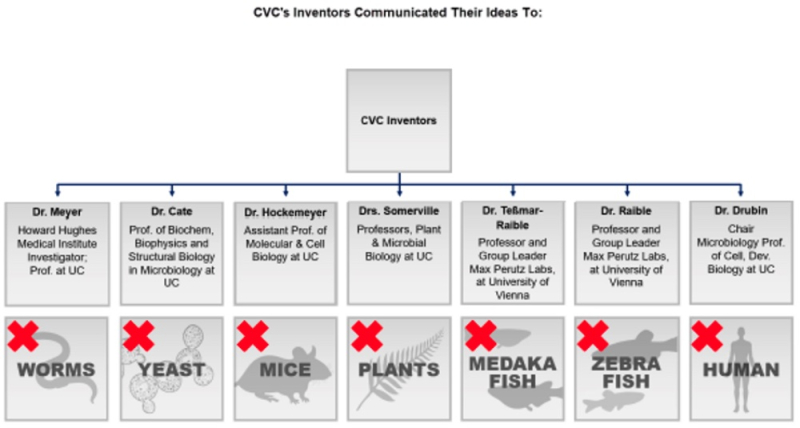
    USPTO SealTwo amici have filed briefs in support of the appeal by Junior Party the University of California/Berkeley, the University of Vienna, and Emmanuelle Charpentier (collectively, "CVC") of the decision by the Patent Trial and Appeal Board (PTAB) in favor of Senior Party the Broad Institute, Harvard University, and MIT (collectively, "Broad") sixteen months ago in the latest CRISPR interference No. 106,115.  The briefs provide arguments separately on the purported scientific (by several noted scientists*) and legal (by Regeneron Pharmaceuticals, Inc.) errors the Board made in arriving at its decision.

    The scientists argue that the Board had a "fundamental misunderstanding" regarding the CVC scientists' expressions of healthy skepticism that scientists apply to their experiments and discoveries with lack of confidence and certainty regarding their invention.  What the Board observed was objectivity, the scientists argue, being expressions of "professional skepticism while confirming their discovery through the routine methods detailed in their patent application."  This skepticism is required by the scientific community as part of the proper exercise of the scientific method.  While the Board came to the wrong decision in this case, the scientists argue, the greater risk is that the decision will "harm science" for reasons elucidated expressly in the brief synopsized here.

    The skepticism by the CVC inventors is a necessary part of the scientific method, these scientists argue, because "[s]cience is not perfect" and even a "perfectly designed experiment can fail for a host of reasons before subsequent experiments vindicate the underlying theories" (and the converse, that "experiments may succeed (or appear to succeed) even when they are designed using incorrect or incomplete theories").  Factors like "[l]uck, human error, and unaccounted-for variables all play a role in determining the results of an experiment," they argue and these cannot be controlled entirely.  In the face of these uncertainties, scientific discoveries verified by experiment are trusted because "scientists have developed rigorous procedures for testing their initial results and moving past initial failures."  These procedures include challenging their "observations, even their own expectations, with a 'tough, sustained scrutiny' beyond what is commonplace among lay persons" the scientists argue, citing Naomi Oreskes, Science Isn't Always Perfect—But We Should Still Trust It, TIME.COM (Oct. 24, 2019).  It is precisely this process of "confirming . . . discovery, collecting and weighing data to determine whether the idea will work" that "makes scientific progress possible."

    This process involves failure, the brief asserts, of two types.  One type are the "mundane failures arising from biological variability, experimental imprecision, and the play of chance" that are "part of day-to-day life at the lab bench" but which can be overcome by "optimization and routine experimentation."  The other type are more fundamental and arise "when a well-designed and well-executed series of experiments fails to support a scientist's expectations despite efforts to optimize or improve the experimental design and execution."  Recognizing that either type of failure is possible, scientific skepticism is needed to avoid "one of the most pernicious problems in science: confirmation bias" they assert, citing Raymond S. Nickerson, Confirmation Bias: A Ubiquitous Phenomenon in Many Guises, 2 REV. GEN. PSYCH. 175, 175 (1998).

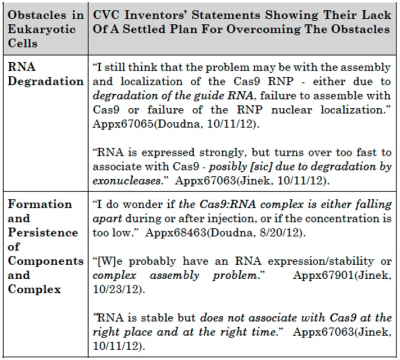
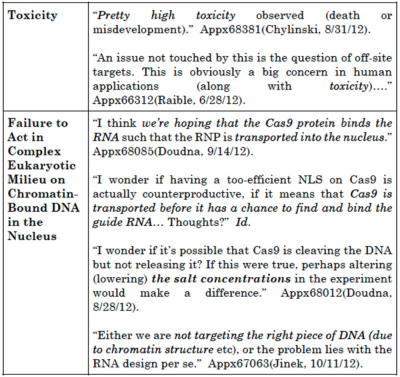
    The PTAB's error, the scientists argue, was in not understanding "how skepticism and failure operate within the scientific method."  What the CVC scientists were attempting to confirm — their conception of how to achieve CRISPR-mediated DNA cleavage in eukaryotic cells — "involve[d] complex biological systems with many variables, and experimental failures are common and are not necessarily indicative of a problem in the underlying theories or experimental design."  These circumstances are illustrated in the brief by a comparison with the experiments the Board accepted as illustrating their reduction to practice, wherein "the Broad Institute reported only two positive results out of 265 sequencing reads in its first 'successful' use of the CRISPR-Cas9 system to cleave DNA in eukaryotic cells, a gene modification rate of less than one percent."  "Objective experimentalism is not fundamental doubt," they argue, and the Board erred in confusing one for the other.  This argument is illustrated by quotations from four of the e-mails the Board used to support its decision, and the Board's citation of the five to eight months it took for the CVC inventors to reduce their invention to practice.  The Board's decision based on this evidence was error the scientists argue because it "mistakes mundane failures—part of everyday lab work—for fundamental failures—which might suggest the inventive idea is inoperative or incomplete."  The time-consuming process of "eliminat[ing] variables one-by-one in a stepwise manner," which is "normal and natural for research at this level" demonstrate not uncertainty but that CVC's inventors "remained objective and open-minded" during the process and the problem-solving that it entailed.  To do otherwise, as the PTAB impliedly suggests CVC's inventors were remiss in not doing, "would have been evidence of an irresponsible departure from the scientific method"according to the brief.  Further, the scientists affirm CVC's contention that their eventual reduction to practice was achieved "in the form in which they had conceived of it . . . using only those routine materials and techniques known to persons of ordinary skill in the art."  The way the CVC inventors achieved their results, the scientists argue, was "evidence show[ing] the CVC inventors never fundamentally doubted their invention" and that "their expression of uncertainty was just ordinary scientific skepticism" (emphasis in brief).

    The scientists also find error in the Board not acknowledging that CVC provided disclosure of eukaryotic CRISPR methods in their first provisional application (No. 61/652,086, filed May 12, 2012, "P1") that would have been recognized by one of ordinary skill in the art.  The brief specifically addresses the hypothetical obstacles enumerated by Broad's expert, Dr. Chad Mirkin, as another misunderstanding of "the ordinary skepticism the scientific community would have had in the absence of empirical data as a reason to deprive the CVC inventors of patent rights," saying that Dr. Mirkin's testimony merely illustrates that "it is easy to come up with a list of any number of theoretical obstacles to reducing to practice an invention—especially in a field as complex as CRISPR research."  That is not enough, scientifically, to "throw into question the inventor's patent rights when the patent application in fact describes all that is needed to practice the invention" they argue.

    Finally, the scientists' brief addresses the consequences they envision should the Board's views prevail and the Federal Circuit affirm their decision.  Such an outcome would "discourage collaboration, slow scientific progress, and reward confirmation bias."  This is because science is no longer the province of "a brilliant individual toiling away in isolation" but instead relies on "the teamwork of scientists, each playing a role in the scientific process."  For such efforts to be successful the scientists must communicate with one another, but the Board's decision used such "internal communications among team members to strip the CVC scientists of their invention."  This can only "discourage the free flow of communication between collaborators" so as not to "jeopardizing future patent rights."  As a result, the scientists argue that "the PTAB's decisions have the potential to slow scientific progress and discourage the types of risk-taking critical to innovation."

    These effects are not limited to collaborators, the scientists argue, but will spread to incentivize scientists from different laboratories to "feel pressure to secret away their inventions until they can muster enough evidence to convince others that their inventions will work" (the brief speculating that in this case "if after filing the P1 patent application the CVC inventors had chosen to conceal their discovery that the single-guide CRISPR-Cas9 system could cleave eukaryotic DNA in vitro (at least until publication of P1 18 months later), they might well have been the first to demonstrate use of the CRISPR-Cas9 system in eukaryotic cells and obtained the patents covering such use").  In addition such secrecy promoted by the Board's decision would have delayed the use by other labs of eukaryotic CRISPR.  At the extreme, upholding the Board's decision could lead scientists to "avoid rigorously testing their own settled expectations" and "be tempted to look for evidence that supports their view, building a case in favor of their invention for fear that proceeding objectively will result in denial of valuable intellectual property rights."

    Regeneron's brief, on the other hand, addresses the legal errors occasioned by the Board's decision.  Citing Thomas Jefferson for the principle that "patent protection was meant as 'encouragement to men to pursue ideas, which may produce utility,'" the brief asserts (relevant to the underlying issues before the Court) that "'invention' thus 'is not the work of the hands, but of the brain,'" citing Edison v. Foote, 1871 C.D. 80, 81 (Comm'r Pat. 1871).  This is why patent law places emphasis on conception rather than production of a physical embodiment of an idea, amicus contends, and that "it is well settled that an invention may be patented before it is reduced to practice," citing Pfaff v. Wells Elecs., Inc., 525 U.S. 55, 60 (1998), for both principles.  The brief also reminds the Court that it is equally well-settled that the first to conceive can properly be deemed the inventor even if she is the last to reduce the invention to practice, citing Price v. Symsek, 988 F.2d 1187, 1190 (Fed. Cir. 1993) (citing Lutzker v. Plet, 843 F.2d 1364, 1366 (Fed. Cir. 1988).  That is the case here, amicus contends, because the CVC inventors were the first to conceive the invention — the practice of CRISPR-Cas9 mediated DNA cleavage in all manner of eukaryotic cells.

    The Board failed to protect this conception by rejecting CVC's argument that its inventors were the first to conceive.  Their "fundamental" errors the brief asserts are that "[i]n doing so, the Board conflated conception—a mental act that the patent system promotes and protects—with actual reduction to practice—a physical step" (emphasis in brief).  The brief recites two specific errors: first, that the Board required CVC's inventors to know that their invention would work to cleave eukaryotic DNA, which was error because "[a]n inventor's belief that his invention will work or his reasons for choosing a particular approach are irrelevant to conception," citing Burroughs Wellcome Co. v. Barr Lab'ys, Inc., 40 F.3d 1223, 1228 (Fed. Cir. 1994) (citing MacMillan v. Moffett, 432 F.2d 1237, 1239 (C.C.P.A. 1970)), and because reduction to practice, not conception, involves showing that an invention actually works, citing Applegate v. Scherer, 332 F.2d 571, 573 (C.C.P.A. 1964), and Oka v. Youssefyeh, 849 F.2d 581, 584 n. 1 (Fed. Cir. 1988).  The Board's second error identified in the brief was the Board's holding that the course of CVC's "post-conception" testing was evidence of incomplete conception, on the same basis: such a course of testing is relevant to reduction to practice and not conception.  The brief asserts in this regard that "post‑conception experimental failures cannot undo an earlier conception," citing In re Jolley, 308 F.3d 1317, 1325 (Fed. Cir. 2002).

    The remedy recommended by amicus is that the Court "reinforce the fundamental distinction between conception and reduction to practice," citing Burroughs Wellcome for the former standard (conception arises when an inventor "had an idea that was definite and permanent enough that one skilled in the art could understand the invention") and Mahurkar v. C.R. Bard, Inc., 79 F.3d 1572, 1578 (Fed. Cir. 1996), Burroughs Wellcome and Oka for the latter (for a showing of reduction to practice, an "inventor must have (1) constructed an embodiment or performed a process that met all the claim limitations and (2) determined that the invention would work for its intended purpose," further citing Fox Grp., Inc. v. Cree, Inc., 700 F.3d 1300, 1305 (Fed. Cir. 2012), and quoting Teva Pharm. Indus. Ltd. v. AstraZeneca Pharms. LP, 661 F.3d 1378, 1383 (Fed. Cir. 2011).  This distinction is significant, amicus argues, because "[c]onception defines the legally operative moment of invention," citing Invitrogen Corp. v. Clontech Lab'ys, Inc., 429 F.3d 1052, 1063 (Fed. Cir. 2005), and they are "separate and distinct concepts and tests," citing Fox Grp.

    This instance of the Board's error, amicus argues requires the Court's correction, because the Board's decision evinces that it misunderstood the distinction between conception and reduction to practice.  Echoing CVC's brief, amicus argues that while the Board recited the black letter law of Burroughs Wellcome regarding conception it then "did not practice what it preached" in reaching its erroneous conclusion, citing the Board's language that required CVC's inventors to know the invention as conceived would work for its intended purpose in order for its conception to be complete.  The brief mentions the necessity that conception cannot be retroactively established, citing Cooper v. Goldfarb, 154 F.3d 1321, 1331 (Fed. Cir. 1998), but that is not the same, amicus argues, as requiring an inventor to know the invention will work before operability (or patentability; Dow Chem. Co. v. Astro-Valcour, Inc., 267 F.3d 1334, 1341 (Fed. Cir. 2001)) is demonstrated by reduction to practice. In its misunderstanding the Board "mangle[d] an actual rule precluding nunc pro tunc conception into a non‑existent rule requiring knowledge that the invention will work."

    Another principle the brief argues the Board mangled is that while conception involves "conceiving a way to make an idea operative," Dawson v. Dawson, 710 F.3d 1347, 1356 (Fed. Cir. 2013), this requirement is intended to distinguish having a "specific, settled idea [for] a particular solution to the problem at hand" (which is conception) with "a general goal or research plan" (which is not), citing Fiers v. Revel, 984 F.2d 1164, 1169 (Fed. Cir. 1993), and Amgen, Inc. v. Chugai Pharm. Co., 927 F.2d 1200, 1206 (Fed. Cir. 1991) (only the first of which was an interference case).

    Amicus argues that the CVC inventors "easily satisfied the test," reciting the particulars of why that is so.  While the Board recognized that the evidence (notebooks, etc.) established CVC's conception the Board nevertheless erred in using the CVC inventors' purported uncertainty, evinced by the course of their reduction to practice, to determine conception was sufficiently uncertain to negate entitlement to priority of invention.

    The brief further argues that the Board's application of these uncertainties was erroneous because they applied evidence related to reduction to practice to assess the sufficiency of CVC's conception; for example, that "in vivo verification is not required for a conception to be definite and permanent," Dana-Farber Cancer Inst., Inc. v. Ono Pharm. Co., 964 F.3d 1365, 1372 (Fed. Cir. 2020), and "[w]hether or not subsequent testing succeeded or failed, or even took place, does not determine whether conception was complete as of that date," In re Jolley.  Indeed, amicus argues, the inventor "may still need much patience and mechanical skill, and perhaps a long series of experiments, to give the conception birth in a useful, working form," citing Cameron & Everett v. Brick, 1871 C.D. 89, 90 (Comm'r Pat. 1871) (emphasis in brief) and Elizabeth v. Am. Nicholson Pavement Co., 97 U.S. 126, 137 (1877).  The Board's error was to "ignore[]" this precedent and cherrypick[]" a single sentence from Burroughs Wellcome regarding incomplete conception:

    A conception is not complete if the subsequent course of experimentation, especially experimental failures, reveals uncertainty that so undermines the specificity of the inventor's idea that it is not yet a definite and permanent reflection of the complete invention as it will be used in practice.

    The brief rebuts the Board's reliance on that sentence because it was limited to "the so-called doctrine of simultaneous conception and reduction to practice" which is limited to instances where "an inventor cannot envision a thing's composition . . . without first experimentally obtaining that that thing."  But in such cases a putative inventor cannot conceive an invention until it is reduced to practice, amicus reminds the Court, because "the event of reduction to practice in effect provides the only evidence to corroborate conception of the invention."  That was not the case here (although Broad raised the argument in its Priority Motion in this interference and later abandoned it).

    The brief also relies on the fact that corroboration is required for date of conception, Burroughs Wellcome, and by definition post-conception testing related to reduction to practice occurs after conception.  While acknowledging that in some cases, such as Burroughs Wellcome reduction to practice was used to corroborate conception, such instances have involved those where reduction to practice provides the only evidence of such corroboration, and that "just because reduction to practice is sufficient evidence of completion, it does not follow that proof of reduction to practice is necessary in every case," citing Pfaff.

    The brief concludes by advocating that the Federal Circuit correct the Board's two fundamental errors: first, by reinforcing the fundamental distinctions between conception and reduction to practice, that "the inventor's knowledge, understanding, or belief about the invention's workability is irrelevant to conception," and second that "post‑experimental failures cannot negate an earlier conception."

    * These include Nobel Laurates Thomas Cech (1989, Chemistry) and Jack Szostak (2009 Physiology or Medicine) and Titia de Lange (Rockefeller University), Michael Levine (Princeton University) and David Jay Segal (University of California, Davis).

  • By Kevin E. Noonan –

    The decision by the Patent Trial and Appeal Board (PTAB) in favor of Senior Party the Broad Institute, Harvard University, and MIT (collectively, "Broad") and against Junior Party the University of California/Berkeley, the University of Vienna, and Emmanuelle Charpentier (collectively, "CVC") sixteen months ago in the latest CRISPR interference No. 106,115 is the subject of appeal from both parties.  CVC filed its brief on September 20, 2022; Broad (discussed herein) filed its (corrected) Responsive Brief (which included a Contingent Cross-Appeal in the event the Federal Circuit did not affirm the PTAB's decision below) on February 15, 2023.

    Broad InstituteBroad's brief is based on two arguments.  The first is one they have advanced since their earlier Interference against CVC (Interference No. 106,048), where the Board held (and the Federal Circuit affirmed) that there was no interference-in-fact between Broad's claims to methods of performing CRISPR-mediated DNA cleavage in eukaryotic cells and CVC's claims for CRISPR methods not limited to cell type.  The rationale in the '048 interference that was asserted in this interference is that being able to perform CRISPR in eukaryotic cells was so inherently unpredictable that only by actual reduction to practice could a party show complete conception.  (It may be remembered that during the Preliminary Motions phase of the '115 interference Broad advocated this reasoning as an instance of "simultaneous conception and reduction to practice," which they later did not pursue.)  Broad includes this list of the litany of inherent uncertainties recited throughout this and the earlier '048 Interference:

    (1) delivery into the eukaryotic cell,
    (2) expression of the components in the cell,
    (3) surviving eukaryotic defense mechanisms,
    (4) formation of the protein:RNA complex,
    (5) toxicity to the cell,
    (6) proper protein folding,
    (7) localization in the nucleus,
    (8) access to the desired DNA target in the chromatin, and
    (9) cleavage of the DNA

    based on (Broad argues) "a 1.5-billion-year evolutionary divergence," including:

    • Eukaryotic cells have a nucleus protecting genomic DNA, organized into discrete structures, called chromosomes, composed of a protein/DNA complex called chromatin;

    • Prokaryotic cells lack nearly all the structural organization found in eukaryotic cells, such as a nucleus and chromatin, that functions to organize and protect DNA;

    • Eukaryotic cells employ different cellular machinery and mechanisms to express genes, relying on proteins and complexes not found in prokaryotic cells. Those proteins and complexes can be essential to the proper transcription and translation of genetic material;

    • Prokaryotic and eukaryotic cells have different environments, including different intracellular temperatures, ion concentrations, and pH; [and]

    • Prokaryotic systems expressed in eukaryotic cells are often destroyed by native eukaryotic defense mechanisms

    (citations to the record omitted).

    The second argument was directed to CVC's incomplete conception (as held by the PTAB), based on evidence that CVC's efforts to reduce eukaryotic CRISPR to practice involved "extensive research, experiment, and modification" based in part on the experimental record and in part on CVC's improvident e-mails and other documentary evidence that (Broad argues) illustrates this incomplete conception.  The brief focuses on the factual determinations made by the Board which, under In re Gartside, 203 F.3d 1305 (Fed. Cir. 2000), and Dickenson v.  Zurko, 119 S.Ct. 1816 (1999), are subject to deference before the Federal Circuit.

    The brief provides a timeline illustrating Broad's comparison between its own conception and reduction to practice with CVC's in a revised diagram related to one advanced before the PTAB:

    Image 1
    Broad primary legal argument regarding why the Federal Circuit should affirm the Board's decision is that the PTAB applied the standard enunciated in Burroughs Wellcome Co. v. Barr Labs., Inc., 40 F.3d 1223, 1228 (Fed. Cir. 1994), properly, that conception "is complete only when the idea is so clearly defined in the inventor's mind that only ordinary skill would be necessary to reduce the invention to practice, without extensive research or experimentation" and "conception is not complete if the subsequent course of experimentation, especially experimental failures, reveals uncertainty that so undermines the specificity of the inventor's idea that it is not yet a definite and permanent reflection of the complete invention as it will be used in practice" (emphasis in brief).  The brief relies for its argument upon these three factual findings by the Board:

    1.  That the CVC inventors and corroborators were of at least ordinary skill in the art and that they engaged in a "prolonged period of extensive research, experiment, and modification" which was contrary to the Burroughs standard of "the exercise of ordinary skill without extensive research and experimentation."

    2.  That the CVC's inventors idea fell squarely within Burroughs standard of incomplete conception, saying:

    [W]e are persuaded that the communications surrounding these experiments reflect "uncertainty that so undermines the specificity of the inventor's idea that it [was] not yet a definite and permanent reflection of the complete invention as it [would] be used in practice."

    The brief Illustrates as follows this "veritable who's-who of eukaryotic-genome-editing experts—working with CVC inventors using cells from worms, yeast, mice, plants, medaka fish, zebrafish, and humans" who failed to reduced CVC's conception of eukaryotic CRISPR either entirely or not without extensive research, experiment, and modification:

    Image 2
    Broad's illustration is in stark contrast to CVC's brief, which emphasizes the lack of ordinary skill in a graduate student that worked unsuccessfully throughout the summer of 2012 to reduce eukaryotic CRISPR to practice followed by success when these experiments were performed by a second graduate student (implied to be of greater skill in the art to explain her success).

    Also in this regard the brief further addresses CVC's argument that the amount of time during which their inventors worked to reduce the invention to practice was "only four months," stating that the CVC researchers engaged in "extensive research, experiment, and modifications" during that time and that the inventors' own communications showed that they lacked a "settled plan" for reducing eukaryotic CRISPR to practice, conducted "ill-fated experiments" and did not have "a definite and permanent idea of how to address the obstacles they encountered."

    3.  CVC offered no evidence of such a "definite and permanent idea" of an operative CRISPR system for cleaving eukaryotic DNA in vivo, Broad emphasizing the PTAB credibility determinations and "finding that the contemporary evidence contradicted CVC's present-day declaration testimony" regarding the routine nature of reducing sgRNA-comprising CRISPR to practice once the CVC inventors conceived of the sgRNA embodiments.  Broad also noted that the PTAB rejected CVC's attempts to use success by others as inuring to their benefit or showing they had conception.

    As in the '048 Interference the underlying context of Broad's argument is the potential impediments in getting a prokaryotic system — CRISPR — to be functional in a eukaryotic cells and that CVC's failures to do so (in the context of contemporaneous evidence that CVC's inventors did not believe their attempts at reduction to practice were successful) was evidence of incomplete conception, as the PTAB held.

    The Broad brief addresses CVC's arguments of PTAB legal error by arguing that CVC never raised the issue before the Board that their conception would be complete if no further invention was required, stating that CVC relied on Burroughs before the Board and is not asserting this standard now because the PTAB did not agree with them.  Further, Broad argues, regarding CVC's argument that the PTAB imposed a "need to know" requirement, such a requirement is not part of the PTAB's "23-page discussion" and indeed that the PTAB stated the opposite.  (In its brief CVC acknowledges that the Board stated that it did not "base [its] decision on a lack of reasonable expectation of success by the CVC inventors" but that the PTAB "contradicted that standard as quickly as it articulated it.")  Broad argues that "CVC ignored the functional eukaryotic system limitation [in the Count] in an effort to strip Count 1 down to simply sgRNA" (which is true, up to a point.)

    Broad's legal arguments revolve around their contentions that Broad achieved undisputed reduction to practice prior to CVC and thus were presumptively the first to invent, and that CVC's difficulties in reducing the invention to practice exhibited their incomplete conception. Broad's brief argues that the record provides substantial evidence supporting the PTAB's decision and thus deserves deference from the Federal Circuit.  While Broad argues the facts more than citing extensive interference precedent the brief expressly recites the following points regarding the Board's factual determinations:

    1.  Persons of at least ordinary skill were unable to reduce the CVC inventors' ideas to practice without extensive experimentation

    This argument focuses on factual determinations made by the PTAB and the support in the record for them, and in particular rebuts CVC's arguments of the incompetent graduate student (Cheng) with the "scores of emails between Doudna/Jinek and Cheng regarding the failed human cell experiments from April to October 2012" that Broad argues shows "near-constant communication with Cheng, directing him on exactly what experiments to perform and setting the parameters."  Moreover the brief names as "these skilled artisans" Drubin, Cheng, Doudna, Charpentier, Jinek, Chylinski, and Raible, all of whom failed to reduce to practice despite "extensive research, experiment, and modification," the brief stating that this is "powerful evidence" of incomplete conception.  The brief in particular cites to evidence regarding microinjection experiments with worms and "months of failure" (as shown in the expanded graphic above) and states that "a 2013 publication by Doudna and Meyer acknowledged that it was not until they obtained guidance from Broad's Cong 2013 article—and used Zhang's eukaryotic CRISPR-Cas9 system with the dual-molecule RNA configuration—that they achieved any success."

    2.  CVC's inventors expressed uncertainty that so undermined the specificity of their idea that it was not a definite and permanent reflection of the complete invention

    These arguments are based on Burroughs and its definition of incomplete conception as recited above, in addition to citing Bard Peripheral Vascular, Inc. v. W.L. Gore & Assocs., Inc., 776 F.3d 837, 845 (Fed. Cir. 2015); Univ. of Utah v. Max-Planck-Gesellschaft Zur Forderung Der Wissenschaften E.V., 734 F.3d 1315, 1323 (Fed. Cir. 2013); and Dawson v. Dawson, 710 F.3d 1347, 1352 (Fed. Cir. 2013), in support of its incomplete conception argument.

    The brief states that "in the months following [CVC's] alleged conception [CVC inventors] expressed uncertainty, doubt, and confusion, and proposed ever-shifting plans to try to overcome their failures."  The brief also provides this table to illustrate the inventors' contemporary statements regarding the obstacles they were unable to overcome:

    Table 1 Table 2
    From this evidence Broad argues that "[t]hese were not minor problems or thoughts to optimize a definite and permanent idea—they are fundamental obstacles to achieving a functional eukaryotic system."

    3.  CVC's inventors lacked a clear plan for overcoming the many obstacles to achieving a functional eukaryotic system

    This argument is a repetition of Broad's earlier argument that instead of a defined plan CVC provided "a laundry-list of techniques that one might use in a research project attempting to deliver CRISPR-Cas9 to eukaryotic cells" (while characterizing the Jinek March 1, 2012 lab notebook page as "a cartoon").  The brief reminds the Court of the "multiple credibility determinations" made against CVC by PTAB which Broad says on appeal are "virtually unassailable," citing Charles G. Williams Const., Inc. v. White, 326 F.3d 1376, 1381 (Fed. Cir. 2003).  These include the familiar litany of improvident contemporaneous statements by Doudna and team regarding experimental difficulties encountered in trying to reduce to practice.

    Addressing CVC arguments regarding other researchers success the brief asserts that PTAB properly disregarded these efforts as support for the completeness of CVC's conception because the work of independent labs did not establish CVC conception, especially Broad's own (for which the brief asserts that Broad's success was due to their successful dgRNA-comprising CRISPR embodiments and not CVC's sgRNA).  Broad also argues that their inventors had "already determined the technical features for creating a functional eukaryotic system" before being informed of sgRNA, and says Broad had demonstrated sgRNA is not necessary for eukaryotic CRISPR (albeit without citation to the record).  With regard to these other labs Broad argues that CVC provided no evidence that these labs were independent of Broad (indicating some were affiliated, for example the Church lab although the brief does not specifically make this identification) or whether these researchers were of extraordinary skill in the art, or that these labs may have encountered obstacles of their own that they overcame.  Broad's brief also addresses CVC's argument that the PTAB did not identify any differences between the system Broad used successfully that CVC did not, on the basis that the finding was "based on the eminently reasonable inference that the PTAB drew from Broad's success in contrast to CVC's many months of abject experimental failures" (raising the questions CVC's brief raised about the balance between inventive conception and the skilled mechanic).

    Broad's brief rebuts CVC's reliance on Acromed Corp. v. Sofamor Danek Grp., Inc., 253 F.3d 1371 (Fed. Cir. 2001), on the grounds that this decision relied on Sewall for the same standard in Burroughs, and Barba v. Brizzolara, 104 F.2d 198, 202 (C.C.P.A. 1939), which Broad distinguished on its facts because in that case the inventors had worked together and the decision involved deciding who was entitled to inventorship.

    Finally with regard to the question of incomplete conception the brief addresses these specific CVC allegations:

    1.  CVC's criticism of the PTAB for finding the CVC inventors' failed eukaryotic experiments relevant to conception is legally incorrect, because CVC had asserted that their conception was complete because reduction to practice used routine and well-established techniques, which is contrary to their repeated failures and contemporary statements.

    2.  CVC's arguments from their alleged conception to alleged reduction to practice is contrary to the PTAB's findings, which are all supported by substantial evidence, including that the PTAB found evidence of repeated failures and contemporary statements regarding different ways to reduce to practice.  These findings are due deference (again rebutting the "blame the graduate student" argument because of evidence of supervision by the named inventors).

    3.  There is no basis for ignoring these contemporaneous communications that document the CVC inventors' lack of a plan to reduce their conception to practice; in this section Broad attacks amici for having "ties to Doudna" (because she was a postdoc in Tom Cech's lab and because Regeneron is "heavily invested in Doudna's CRISPR company), and further relies on PTAB statements in its decision that CVC did not rebut their inventors' contemporary statements in its Reply brief below.

    Broad's arguments in rebuttal of CVC's originality argument is that sgRNA is not the whole invention, stating that "[t]he only element of Count 1 [that Broad inventor] Zhang learned from CVC's public disclosures in June 2012 was the sgRNA species—a configuration that is neither necessary nor sufficient for a functional eukaryotic system."

    As for the APA violations asserted in CVC's brief, Broad reiterates its reliance on the extensiveness of the PTAB's decisions (180 pages, which must include all the Priority Motion decisions), the "hundreds of record citations," and "numerous credibility findings," and rebuts CVC's citation of their inventors winning the Nobel Prize by saying "the Nobel committee did not consider or reach any conclusion about invention of the eukaryotic subject matter of Count 1 under U.S. patent law."  The brief specifically addresses CVC arguments that PTAB's rejection of microinjection arguments was arbitrary and capricious because "the real-world failures using microinjection in worms and zebrafish demonstrate that microinjection did not overcome the hurdles to eukaryotic uses."  Broad further cites its own expert's testimony that microinjection had failed in attempts to get earlier prokaryotic-derived systems for DNA cleavage to work in eukaryotic cells.  "Rejecting CVC's argument[s] does not violate APA" provides a succinct synopsis of Broad's position in its brief.

    Finally, Broad argues that substantial evidence supported PTAB's determination not to give CVC priority to P1 and P2 provisionals, stating that PTAB relied on the "highly unpredictable" state of the art, using the same arguments that were made in the '048 Interference.  These arguments include that there was no disclosure of working example (in the context of the later failures), citing:

    Broad has persuaded us that absent results of a successful working example, the lack of discussion of PAM sequences, or sample target DNA sequences, the lack of special instructions or conditions necessary to accommodate the eukaryotic cellular environment, and the lack of a discussion of whether access to chromatin could hinder CRISPR-Cas activity would have indicated to those of ordinary skill in the art that the P1 applicants were not in possession of an embodiment of Count 1.

    The brief argues that PTAB applied the correct written description standard (another question of fact) in the context of "the nature of the subject matter and the art—highly unpredictable," wherein the PTAB cited Ariad Pharmaceuticals, Inc. v. Eli Lilly & Co., 598 F.3d 1336, 1357-58 (Fed. Cir. 2010) (en banc).  And Broad cited these three categories of substantial evidence that support PTAB's findings:

    1.  Evidence that a person of ordinary skill in the art would have been aware of the many reasons why prokaryotic CRISPR-Cas might not work in eukaryotic cells, reciting the familiar litany of such reasons;

    2.  Evidence of prior art failures to adapt other prokaryotic-derived DNA cleavage systems to eukaryotic cells, including TALENS, ZNF, and Group II introns in particular; and

    3.  Contemporaneous statements of CVC's inventors "indicating doubt that a CRISPR-Cas9 system would work in eukaryotic cells"

    After completing its arguments countering CVC's opening brief, Broad provides its affirmative arguments in support of its appeal (contingent on the Federal Circuit reversing or vacating the PTAB's decision below).  The gist of these argument is that the PTAB erred in limiting "guide RNA" to sgRNA based on claim construction properly performed using the plain and ordinary meaning of the term.  The legal bases for this argument include that "claim terms [in an interference should] receive their broadest reasonable interpretation," citing Dionex Softron GmbH v. Agilent Technologies, Inc., 56 F.4th 1353, 1358 (Fed. Cir. 2023); that "[t]he patentee may deviate from plain meaning only by including 'expressions of manifest exclusion or restriction, representing a clear disavowal of claim scope,'" citing Thorner v. Sony Computer Entertainment Amer. LLC, 669 F.3d 1362, 1366 (Fed. Cir. 2012); and "[a]bsent a clear disavowal or contrary definition in the specification or the prosecution history, the patentee is entitled to the full scope of its claim language," citing Home Diagnostics, Inc. v. LifeScan, Inc., 381 F.3d 1352, 1358 (Fed. Cir. 2004).  The brief (with some irony) cites the Jinek 2012 reference as providing the ordinary and customary meaning of guide RNA to include dgRNA and sgRNA and that the Broad specification is consistent in this definition.

    Broad requests the Federal Circuit vacate the PTAB's denials of their Preliminary Motion 2 and Motion 3, and remand for consideration that would shield Broad from losing priority to its claims to dgRNA-comprising eukaryotic CRISPR embodiments.

  • USPTO SealThe U.S. Patent and Trademark Office will be holding a virtual customer partnership meeting of Technology Center 2600 from 1:00 pm to 3:00 pm (ET) on July 25, 2023.  The meeting will include the following sessions:

    • "Clarity of the Record" presentation
    • Small-Group Exercises — breakout sessions emphasizing presentation points and application of ideas
    • Groups Report Out + Collaborative Discussion — large group discussion with report out

    A complete agenda for the meeting can be found here.  Additional information regarding the customer partnership meeting, including how to register for the meeting, can be found here.

  • IPO #2The Intellectual Property Owners Association (IPO) will offer a one-hour webinar entitled "2023 Mid-Year Case Law Review," on July 26, 2023 from 1:00 pm to 2:00 pm (ET).  Paul Berghoff of McDonnell Boehnen Hulbert & Berghoff LLP, Gregory Castanias of Jones Day, and Wendy Larson of Pirkey Barber will cover recent developments in case law over the past six months, including notable decisions issued by the lower tribunals in the first half of the year.  Among the decisions to be covered will be Amgen v. Sanofi, where the Supreme Court addressed the enablement requirement for patent claims directed to antibodies.

    There is no registration fee for the webinar.  However, those interested in attending the webinar should register here.