• By Michael Borella

    Federal Circuit SealOne of the more frustrating aspects of the current judicial patent eligibility framework is the propensity for courts, even the Federal Circuit, to carry out the two-part test from Alice Corp. v. CLS Bank Int'l in a conclusory fashion.  When this occurs, the claims under review are most likely going to be found non-statutory and invalid under 35 U.S.C. § 101.  In this case, the Federal Circuit actually provides ample reasoning for finding that claims fail the test, albeit in a nonprecedential case.

    Real Estate Alliance Ltd. ("REAL"), is the assignee of U.S. Patent Nos. 5,032,989 and 4,870,576 (both expired over the course of this long litigation, but still relevant for purposes of determining past infringement).  The '989 patent is a continuation-in-part of the '576 patent, and both are directed to geographically searching for real estate properties on a computer.  This process involves "identifying a geographic region of interest for acquiring property and then selecting an inner area within this geographic region by designating boundaries on a map displayed on the screen."  Then, the inner area is "zoomed in on and a second area is selected within the zoomed region."  One can "change the world coordinate display" such that the "size of the viewport remains constant" and the "display now appears to have zoomed down closer to earth."  The elected area "is then cross-referenced with the database of available properties whose approximate locations are then pictorially displayed on screen."  Keep in mind that the '576 patent was filed in 1986 and the '989 patent was filed in 1989, well before such technologies were widely available on personal computers and smartphones.

    Claim 1 of the '989 patent recites:

    A method using a computer for locating available real estate properties comprising the steps of:
        a) creating a database of the available real estate properties;
        b) displaying a map of a desired geographic area;
        c) selecting a first area having boundaries within the geographic area;
        d) zooming in on the first area of the displayed map to about the boundaries of the first area to display a higher level of detail than the displayed map;
        e) displaying the zoomed first area;
        f) selecting a second area having boundaries within the zoomed first area;
        g) displaying the second area and a plurality of points within the second area, each point representing the appropriate geographic location of an available real estate property; and
        h) identifying available real estate properties within the database which are located within the second area.

    The aforementioned Alice case set forth a test to determine whether claims are directed to patent-eligible subject matter under § 101.  One must first decide whether the claim at hand is directed to a judicially-excluded law of nature, a natural phenomenon, or an abstract idea.  If so, then one must further decide whether any element or combination of elements in the claim is sufficient to ensure that the claim amounts to "significantly more" than the judicial exclusion.  But generic computer implementation of an otherwise abstract process does not qualify as significantly more.  On the other hand, a claimed improvement to a computer or technological process is typically patent-eligible.

    The District Court for the Central District of California applied the test and found that the '989 patent was directed to "a method for collecting and organizing information about available real estate properties and displaying this information on a digital map that can be manipulated by the user."  This, according to the District Court, is an abstract idea.

    Reviewing this decision, the Federal Circuit stated that the part one analysis "requires us to consider the claims in their entirety to ascertain whether their character as a whole is directed to excluded subject matter."  The Court quickly determined that the level of detail in claim 1 was insufficient to conclude that it was anything other than abstract.  Particularly, the claim "is aspirational in nature and devoid of any implementation details or technical description."  The Court helpfully clarified that not "every claim involving the collection, organization, manipulation, or display of data is necessarily directed to an abstract idea."  On the other hand, the Court found that claim 1 had much in common with the ineligible data processing claims of Electric Power Group, LLC v. Alstom S.A. and Intellectual Ventures I LLC v. Capital One Fin. Corp.

    Indeed, the Court observed that the claim was similar to others that were found to fail the Alice test due to "simply us[ing] computers to serve a conventional business purpose."  In those cases, the claims recited at a high level what method steps were to be carried out, but not how these steps were implemented.  Thus, the claims were not limited to a particular implementation.  Similarly, while claim 1 "provide[s] steps for using the computer to perform the search, they contain no technical details or explanation of how to implement the claimed abstract idea using the computer."

    REAL attempted to counter this position by arguing that the "creating a database" and "zooming in" steps were technical advancements.  REAL relied on expert testimony to do so, the expert asserting that "databases at the time of the invention could not be queried graphically and that zooming on a computer-displayed map to depict a higher level of detail was neither routine nor conventional."  But the Court remained hung up with the lack of detail in the claim — recitation of the function to be performed rather than the way that this function is carried out was problematic in the Court's view.  That, and the claim's business focus, failed to convince the Court that there was a technical improvement recited.

    Instead, the Court looked to the specification for discussion of such an improvement.  In doing so, the Court looked for evidence that the invention improved the operation of a computer, as opposed to the business goal of identifying available real estate properties.  Finding none, the Court determined that the claim was directed to an abstract idea.

    Turning to part two of Alice, the Court described this inquiry as "examin[ing] the claim limitations more microscopically, to determine whether they contain additional features constituting an inventive concept."  But any such recited features (i.e., a "computer" and a "database") were determined to be generic, thus having no weight in the inventive concept analysis.  Further, the specification stated that the invention could be carried out on a general purpose computer.

    As noted above, REAL's expert argued that the invention provided a technical improvement, stating that:

    It was considered neither routine nor conventional in the mid-1980s for a computer-displayed map to be able to zoom to display a higher level of detail in the sense of displaying information that wasn't present at the lower level of detail at all, and this zooming step cannot be performed by a human.

    But the Court dismissed this testimony as conclusory, noting that "[the expert's] declaration provides no citations to support this assertion and contains no additional rationale."  This, combined that the observations that "the claim language does not explain what is inventive about the zoom feature or explain how it is accomplished" and that "REAL also has not pointed us to any portion of the specification that fills this gap," resulted in the Court concluding that the claim did not recite "significantly more" than the abstract idea therein.  Consequently, failing both steps of the Alice test, the claim was held to be invalid under § 101.

    While not providing a formal precedent, the Federal Circuit's reasoning herein points to a few observations that can be made regarding the ability of a claim to survive a § 101 challenge.

    First, the Court was looking for a nexus between the invention as claimed and an improvement to technology.  This nexus will not be found in a claim that recites steps at a high level that can be performed on generic hardware.

    Second, while the Court repeatedly focused on the claim's lack of implementation detail, it was willing to look to the specification for an explanation of how the invention was a technical improvement.  This approach harmonizes well with other cases, such as Core Wireless Licensing S.A.R.L. v. LG Electronics, Inc. and Thales Visionix Inc. v. U.S., in which very broad and arguably vague claims were found eligible because their specifications explained how they were advancements in their technical fields.  In other words, claim language matters, but the specification may matter just as much.

    Third, expert testimony as to the improvements provided by an invention had best be more than conclusory.  The mere opinion of an expert may not be sufficient, and the expert should supplement this opinion with at least some support from other sources.  This also reopens a can of worms regarding what is the evidentiary standard for both sides in a § 101 challenge, a question that has yet to be answered.

    Move, Inc. v. Real Estate Alliance Ltd. (Fed. Cir. 2018)
    Nonprecedential disposition
    Panel: Circuit Judges Lourie, Wallach, and Stoll
    Opinion by Circuit Judge Stoll

  • CalendarFebruary 8, 2018 – "Exhaustion Tamed? Early Reports and New Ideas after Lexmark" (Intellectual Property Owners Association) – 2:00 to 3:00 pm (ET)

    February 8, 2018 – "There Will Be Blood (and Beer): A Brief Panel Discussion on Oil States Services LLC v. Greene's Energy Group, LLC" (Intellectual Property Law Association of Chicago Young Members Committee) – 5:30 to 8:00 pm (CT) Chicago, IL

    February 13, 2018 – "Patent Drafting for Machine Learning: Structural Claim Limitations, Avoiding §101 or §112 Rejections" (Strafford) – 1:00 to 2:30 pm (EST)

    February 13, 2018 - "eMod Update: Patent Center and Structured Text" (U.S. Patent and Trademark Office) – 12:00 to 1:00 pm (ET)

    February 14, 2018 – "Sect. 112 Indefiniteness in Chemical and Biotech Patent Claims — Drafting and Prosecuting Patent Claims That Will Hold Up Under Any Definiteness Standard" (Strafford) – 1:00 to 2:30 pm (EST)

    February 20, 2018 – "Patent-Eligibility in 2018: Current Status and Best Practices" (McDonnell Boehnen Hulbert & Berghoff LLP) – 10:00 am to 11:15 am (CT)

    February 21-22, 2018 – Advanced Summit on Life Sciences Patents (American Conference Institute) – New York, NY

    March 5-6, 2018 – Advanced Patent Law Seminar (Chisum Patent Academy) – Houston, TX

    March 8-9, 2018 – Advanced Patent Law Seminar (Chisum Patent Academy) – Cincinnati, OH

  • MBHB Logo 2McDonnell Boehnen Hulbert & Berghoff LLP will be offering a live webinar entitled "Patent-Eligibility in 2018: Current Status and Best Practices" on February 20, 2018 from 10:00 am to 11:15 am (CT).  In this presentation, Patent Docs author and MBHB attorney Michael Borella will discuss the state of software and business method patent-eligibility in 2018 by reviewing what changed (and what did not change) in 2017.  Topics to be covered include:

    • Overview of the most recent Federal Circuit case law regarding Section 101;
    • Where this law is relatively clear, and where it is not;
    • The impact of the USPTO not making any significant updates to its subject matter eligibility guidelines;
    • Best practices for drafting and prosecuting software and business method inventions in light of the above.

    While there is no fee to participate, attendees must register in advance.  Those wishing to register can do so here.  CLE credit is pending for the states of California, Illinois, New Jersey, New York, North Carolina, and Virginia.

  • IPO #2The Intellectual Property Owners Association (IPO) will offer a one-hour webinar entitled "Exhaustion Tamed? Early Reports and New Ideas after Lexmark" on February 8, 2018 from 2:00 to 3:00 pm (ET).  Jorge Goldstein of Sterne, Kessler, Goldstein & Fox, PLLC; Brian Kacedon of Finnegan, Henderson, Farabow, Garrett & Dunner LLP; and William Krovatin of Merck & Co Inc. will discuss strategies and recent court cases that involve:

    • Staking out the claim that a sale is not an "authorized sale" — Chrimar v. Alcatel Lucent and Sunoco v. U.S. Venture;
    • Using claims of tortious interference under state law against competitors if they interfere with the patent owner’s contracts with purchasers;
    • Obtaining patent protection on each component of a system, as well as on the system as a whole; and
    • Obtaining separate patents on an inventions’ different methods of use.

    The registration fee for the webinar is $135 (government and academic rates are available upon request).  Those interested in registering for the webinar can do so here.

  • USPTO SealThe U.S. Patent and Trademark Office will be offering the next webinar in its Patent Quality Chat webinar series from 12:00 to 1:00 pm (ET) on February 13, 2018.  The latest webinar, entitled "eMod Update: Patent Center and Structured Text" will be hosted by Richard Fernandez, eMod Project Manager, and Lisa Tran, Communications Manager for eCommerce, who will discuss:

    • New structured text features;
    • Filing structured text via the electronic filing system (EFS-Web); and
    • Accessing structured text submissions, structured text office actions, and XML downloads using the Private Patent Application Information Retrieval (PAIR) system.

    The eMod team will also share information about the upcoming Patent Center Beta Release for participants to use the new Patent Center tool (to replace EFS-Web and PAIR), and provide feedback for further improvements.

    Instructions for viewing the webinar can be found here.  Additional information regarding the Patent Quality Chat webinar series can be found on the USPTO's Patent Quality Chat webpage.

  • IPLACThe Intellectual Property Law Association of Chicago (IPLAC) Young Members Committee will be presenting a panel discussion entitled "There Will Be Blood (and Beer): A Brief Panel Discussion on Oil States Services LLC v. Greene's Energy Group, LLC" on February 8, 2018 from 5:30 to 8:00 pm (CT) at the offices of Foley & Lardner in Chicago, IL.  The panel will discuss Oil States Energy Services LLC v. Greene's Energy Group, LLC, including the proceedings before the Supreme Court, and offer commentary on the issue of whether inter partes review violates the Constitution by extinguishing private property rights through a non-Article III forum without a jury.

    The registration fee for the webinar is $30 (IPLAC members), $10 (IPLAC student memebrs), or $50 (non-members).  Those interested in registering for event can do so here.  Additional information regarding the seminar can be found here.

  • By Andrew Williams

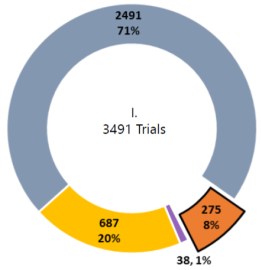
    USPTO SealOn January 12, 2018, the U.S. Patent and Trademark Office's Patent Trial and Appeal Board announced that it had updated its Motion to Amend Study to include all AIA trials through the end of Fiscal Year 2017 (which ended on September 30, 2017).  The original study included data through April 30, 2016.  At that time, only two motions to amend had been granted outright, with another four granted-in-part.  This study was updated last year with data through May 31, 2017.  At that time, two additional motions to amend had been granted outright, with an additional four granted-in-part.  The current study includes no new motions to amend granted outright, but there are two more that have been granted-in-part.  In total, fourteen motions to amend had been granted at least in part as of September 30, 2017 (out of a total of 275 completed trials in which a motion to amend was filed).  Of course, the cut off for this study misses any impact of the October 4, 2017 Aqua Products, Inc. v. Matal decision.  We, however, believe that no additional motions to amend have been granted so far this fiscal year.

    Chart 1
    This updated Motion to Amend Study includes several charts that present data that was obtained.  The first such chart reproduced above highlights just how few trials actually include a motion to amend.  The Purple and Yellow slices represent trials that are still pending, either with or without a filed motion to amend, respectively.  They were otherwise not included in the calculations that followed.  For completed trials, only 275 out of 2,766 trials (or 8%) included a motion to amend.  The Board counted a trial as "completed" when it was terminated due to settlement, when there was a request for adverse judgement, when it was dismissed, or when there was a final written decision.  Moreover, joined or consolidated trials were only counted once in the statistics.  The second chart provided by the Board (not reproduced here) explains the outcome of the motions to amend, whether it was decided in the Final Written Decision, whether it was rendered moot because the claims were patentable, whether it was withdrawn, whether the case settled, whether adverse judgement was requested, whether the case was dismissed, or whether the motion was solely to cancel the claims.  Out of the 275 trials, only 170 motions to amend with substitute claims were decided.

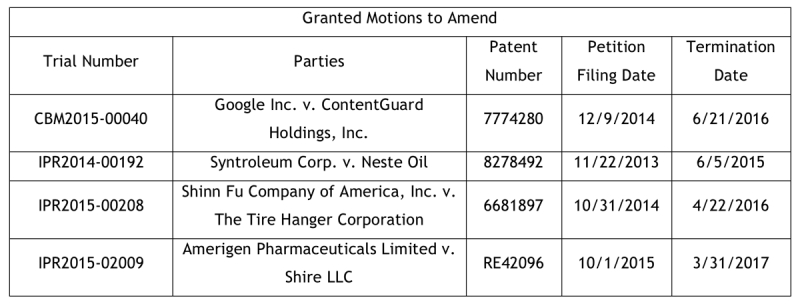
    Chart 2Tellingly, the third chart shows the outcome of the 170 decided motions to amend in which substitute claims were proposed.  In 156 of these cases, or 92%, the Board denied the motion.  The four motions to amend that were granted outright represent 2% of all motions to amend with substitute claims that were decided, and represent a much smaller percentage of all motions to amend.  The ten motions to amend that were granted-in-part represented 6% of the total decided.  The Study included a separate spreadsheet that contained the data from the 275 trials.  This spreadsheet explains in which post-issuance proceedings that motions to amend were granted.  The following tables were compiled from this data:

    Table 1 Table 2
    IPR2014-00090 was interesting because the Board originally denied the motion to amend on April 23, 2015.  However, the Federal Circuit vacated the case in part because it found that the Board had erred on its sole ground for denying the motion.  As a result, on remand, the Board granted the motion-in-part.

    Looking forward to the first few months of fiscal year 2018, we do not believe that the Board has yet granted any motions to amend other than the one in Taiwan Semiconductor Manufacturing Co. v. Godo Kaisha IP Bridge (IPR2016-01249) (reported here). This is interesting because the Aqua Products case came out just as the fiscal year was starting.  At that time, approximately 38 motions to amend were pending.  It is possible that no such motions were granted because practitioners were essentially stuck with the briefing that had already occurred.  The Board has been willing in most cases to allow additional briefing, but it has not been a blanket rule in all case.  As an example, we need look no further than the first PTAB paper after the Aqua Products case, Minerva Surgical, Inc. v. Hologic, Inc., IPR2016-00868, Paper 57.  In that case, the Chief Judge "determined that good cause exists to extend the one-year period for issuing a Final Written Decision" pursuant to 37 C.F.R. § 42.100(c).  This order was most likely entered on October 5, 2017 because the one-year deadline was set to expire on October 6, 2017.  Nevertheless, when the Final Written Decision issued on December 15, 2017, the Board held that "considering the entirety of the record before us, we determine that the preponderance of the evidence shows that the proposed substitute claims are not patentable over the prior art of record."  Cynically, one could speculate that the Board had already come to this conclusion and merely used the language of Aqua Products to insulate its decision.  Nevertheless, the Board in that case did allow the parties additional briefing, so it is probable that the Patent Owner was able to put forth its best argument.  It remains to be seen what will happen in the more recent cases that have only just been instituted, because the Patent Owners in these cases will be able to take full advantage of the knowledge of the Aqua Products case.  Of course, we will probably need to wait about a year for those cases to work through the system.  Nevertheless, they should be captured in some future update of the PTAB's Motion to Amend Study.    

  • By John Cravero

    USPTO SealAbout the PTAB Life Sciences Report:  Each month we will report on developments at the PTAB involving life sciences patents.

    Acclarent, Inc. v. Ford Albritton, IV

    PTAB Petition:  IPR2018-00268; filed December 1, 2017.

    Patent at Issue:  U.S. Patent No. 9,011,412 ("Apparatus, system and method for manipulating a surgical catheter and working device with a single hand," issued April 21, 2015) claims a system, comprising: a guide catheter insertable through an external body passage of a subject, said guide catheter having a substantially rigid shaft, a proximal opening, a distal opening and a lumen extending between the proximal opening and the distal opening; a handle coupled to the guide catheter, the handle having a handle opening, a handle coupling and a structure, wherein the structure is configured to allow a position of the guide catheter to be controlled by some or all of three fingers of one hand of an operator of the handle, and wherein the handle coupling is configured to couple a source of suction to the lumen; and a working device adapted to be insertable through the handle opening into the lumen of the guide catheter, wherein the structure of the handle is adapted to permit the operator to position a thumb and index finger of the hand to manipulate the working device via a portion of the working device immediately adjacent to the handle opening and to control, by one of the thumb or index finger, an amount of suction coupled to the distal opening of the lumen.

    Petitioner Acclarent, Inc. is challenging the '412 patent on two grounds as being obvious under 35 U.S.C. § 103(a).  View the petition here.

    Related Matters:  According to the petition, the '412 patent is involved in the following litigation:  Dr. Ford Albritton IV v. Acclarent, Inc., Civil Action No. 3:16-cv-03340-D (N.D. Tex.).


    Trans Ova Genetics, LC v. XY, LLC

    PTAB Petition:  IPR2018-00250; filed December 1, 2017.

    Patent at Issue:  U.S. Patent No. 8,652,769 ("Methods for separating frozen-thawed spermatozoa into X-chromosome bearing and Y-chromosome bearing populations," issued February 18, 2014) claims a method of producing a frozen-thawed sorted artificial insemination sample.

    Petitioners Intrexon Corp. and Trans Ova Genetics, LC are challenging the '769 patent on five grounds as being obvious under 35 U.S.C. § 103(a).  View the petition here.

    Related Matters:  According to the petition, the '769 patent is the subject of the following litigation:  XY, LLC et al. v. Trans Ova Genetics, LC, No. 1:17-cv-00944 (D. Colo.).  Petitioners have also filed inter partes review petitions on U.S. Patent No. 7,723,116 (IPR2018-00247 and IPR2018-00248; filed 11/30/2017; pending).


    Pfizer, Inc. v. Chugai Pharmaceutical Co.

    PTAB Petition:  IPR2017-01357; filed May 19, 2017.

    Institution of Inter Partes Review; entered December 1, 2017.

    Patent at Issue:  U.S. Patent No. 7,332,289 ("Method of purifying protein," issued February 19, 2008) claims a method for removing contaminant DNA in an antibody-containing sample.

    Petitioner Pfizer, Inc. is challenging the '289 patent on two grounds as being anticipated under 35 U.S.C. § 102(b) (ground 1) or as obvious under 35 U.S.C. § 103(a) (ground 2).  View the petition here.  Administrative Patent Judges Grace Karaffa Obermann, Rama G. Elluru, and Jacqueline T. Harlow (author) issued a decision instituting inter partes review of whether claims 1-8 and 13 are anticipated under 35 U.S.C. § 102(b) by Shadle; and whether claims 1-8 and 13 are unpatentable under 35 U.S.C. § 103(a) over Shadle.

    Related Matters:  According to the petition, Petitioner has filed a petition for inter partes review of related U.S. Patent No. 7,927,815 (IPR2017-01358; filed 05/19/2017; Instituted 12/01/2017; pending).


    Pfizer, Inc. v. Chugai Pharmaceutical Co.

    PTAB Petition:  IPR2017-01358; filed May 19, 2017.

    Institution of Inter Partes Review; entered December 1, 2017.

    Patent at Issue:  U.S. Patent No. 7,927,815 ("Protein purification method," issued April 19, 2011) claims a method for removing contaminant DNA in a sample containing a physiologically active protein.

    Petitioner Pfizer, Inc. is challenging the '815 patent on two grounds as being anticipated under 35 U.S.C. § 102(b) (ground 1) or as obvious under 35 U.S.C. § 103(a) (ground 2).  View the petition here.  Administrative Patent Judges Grace Karaffa Obermann, Rama G. Elluru, and Jacqueline T. Harlow (author) issued a decision instituting inter partes review of whether claims 1-7 and 12 are anticipated under 35 U.S.C. § 102(b) by Shadle; and whether claims 1-7 and 12 are unpatentable under 35 U.S.C. § 103(a) over Shadle.

    Related Matters:  According to the petition, Petitioner has filed a petition for inter partes review of related U.S. Patent No. 7,332,289 (IPR2017-01358; filed 05/19/2017; Instituted 12/01/2017; pending).


    Celltrion Inc. v. Genentech, Inc.

    PTAB Petition:  IPR2017-01373; filed May 9, 2017.

    Institution of Inter Partes Review; entered December 1, 2017.

    Patent at Issue:  U.S. Patent No. 6,407,213 ("Method for making humanized antibodies," issued June 18, 2002) claims a humanized antibody variable domain comprising non-human Complementarity Determining Region (CDR) amino acid residues which bind an antigen incorporated into a human antibody variable domain, and further comprising a Framework Region (FR) amino acid substitution at a site selected from the group consisting of: 4L, 38L, 43L, 44L, 58L, 62L, 65L, 66L, 67L, 68L, 69L, 73L, 85L, 98L, 2H, 4H, 36H, 39H, 43H, 45H, 69H, 70H, 74H, and 92H, utilizing the numbering system set forth in Kabat.

    Petitioner Pfizer, Inc. is challenging the '213 patent on seven grounds as being obvious under 35 U.S.C. § 103(a).  View the petition here.  Administrative Patent Judges Sheridan K. Snedden, Zhenyu Yang (author), and Robert A. Pollock issued a decision instituting inter partes review of whether claims 1-7 and 12 are anticipated under 35 U.S.C. § 102(b) by Shadle; and whether claims 1-7 and 12 are unpatentable under 35 U.S.C. § 103(a) over Shadle.

    Related Matters:  According to the petition, Petitioner has filed a petition for inter partes review of the same claims of the '213 patent based on different art references.  The '213 patent is also the subject of inter partes reviews IPR2016-01693 (Mylan Pharmaceuticals Inc.; filed 08/30/2016; terminated by settlement before institution 03/10/2017); IPR2016-01694 (Mylan Pharmaceuticals Inc.; filed 08/30/2016; terminated by settlement before institution 03/10/2017).  According to the Institution of Inter Partes Review, the '213 patent is the subject of inter partes reviews IPR2017-01488 (Pfizer, Inc.; filed 05/25/2017; pending); IPR2017-01489 (Pfizer, Inc.; filed 05/25/2017); IPR2017-02031 (Boehringer Ingelheim Pharmaceuticals, Inc.; filed 08/31/2017); IPR2017-02032 (Boehringer Ingelheim Pharmaceuticals, Inc.; filed 08/31/2017); IPR2017-02139 (Samsung Bioepis Co., Ltd.; filed 09/29/2017; pending); and IPR2017-02139 (Samsung Bioepis Co., Ltd.; filed 09/29/2017; pending).


    Trans Ova Genetics, LC v. XY, LLC

    PTAB Petition:  IPR2018-00249; filed December 4, 2017.

    Patent at Issue:  U.S. Patent No. 6,372,422 ("Multiple sexed embryo production system for mammals," issued April 16, 2002) claims a method of producing multiple, sexed embryos from a non-human female mammal.

    Petitioners Intrexon Corp. and Trans Ova Genetics, LC are challenging the '422 patent on six grounds as being anticipated under 35 U.S.C. § 102(b) (ground 1) or as obvious under 35 U.S.C. § 103(a) (grounds 2-5).  View the petition here.

    Related Matters:  According to the petition, the '422 patent is the subject of the following litigation:  XY, LLC et al. v. Trans Ova Genetics, LC, No. 1:17-cv-00944 (D. Colo.).  Petitioners have filed separate inter partes review petitions on U.S. Patent No. 7,723,116 (IPR2018-00247 and IPR2018-00248; filed 11/30/2017; pending) and U.S. Patent No. 8,652,769 (IPR2018-00250; filed 12/01/2017; pending).


    KVK-Tech, Inc. v. Shire PLC

    PTAB Petition:  IPR2018-00290; filed December 11, 2017.

    Patent at Issue:  U.S. Patent No. 8,846,100 ("Controlled dose drug delivery system," issued September 30, 2014) claims a pharmaceutical composition comprising: (a) an immediate release bead comprising at least one amphetamine salt; (b) a first delayed release bead comprising at least one amphetamine salt; and (c) a second delayed release bead comprising at least one amphetamine salt; wherein the first delayed release bead provides pulsed release of the at least one amphetamine salt and the second delayed release bead provides sustained release of the at least one amphetamine salt; wherein the second delayed release bead comprises at least one amphetamine salt layered onto or incorporated into a core; a delayed release coating layered onto the amphetamine core; and a sustained release coating layered onto the delayed release coating, wherein the sustained release coating is pH-independent; and wherein the first delayed release bead and the second delayed release bead comprise an enteric coating.

    Petitioners KVK-Tech, Inc. and Abhai LLC are challenging the '938 patent on three grounds as being anticipated under 35 U.S.C. § 102(b) (ground 1) or as obvious under 35 U.S.C. § 103(a) (grounds 2 and 3).  View the petition here.

    Related Matters:  According to the petition, Petitioners concurrently filed an inter partes review petition on related U.S. Patent No. 9,173,857 (IPR2018-00293; filed 12/11/2017; pending).


    KVK-Tech, Inc. v. Shire PLC

    PTAB Petition:  IPR2018-00293; filed December 11, 2017.

    Patent at Issue:  U.S. Patent No. 9,173,857 ("Controlled dose drug delivery system," issued November 3, 2015) claims a method for treating attention deficit hyperactivity disorder (ADHD) which comprises: administering to a patient in need thereof, a pharmaceutical composition comprising: (a) an immediate release bead comprising at least one amphetamine salt; (b) a first delayed release bead comprising at least one amphetamine salt; and (c) a second delayed release bead comprising at least one amphetamine salt; wherein the first delayed release bead provides pulsed release of the at least one amphetamine salt and the second delayed release bead provides sustained release of the at least one amphetamine salt; wherein the second delayed release bead comprises at least one amphetamine salt layered onto or incorporated into a core; a delayed release coating layered onto the amphetamine core; and a sustained release coating layered onto the delayed release coating, wherein the sustained release coating is pH-independent; and wherein the first delayed release bead and the second delayed release bead comprise an enteric coating.

    Petitioners KVK-Tech, Inc. and Abhai LLC are challenging the '938 patent on three grounds as being anticipated under 35 U.S.C. § 102(b) (ground 1) or as obvious under 35 U.S.C. § 103(a) (grounds 2 and 3).  View the petition here.

    Related Matters:  According to the petition, Petitioners concurrently filed an inter partes review petition on related U.S. Patent No. 8,846,100 (IPR2018-00290; filed 12/11/2017; pending).

  • By Donald Zuhn –-

    JanssenLast week, the Federal Circuit affirmed the rejection by the U.S. Patent and Trademark Office's Patent Trial and Appeal Board of claims 1-7 of U.S. Patent No. 6,284,471 as being unpatentable under the doctrine of obviousness-type double patenting.  Janssen Biotech, Inc. and New York University ("Janssen"), co-assignees of the '471 patent, argued on appeal that obviousness-type double patenting was not applicable because the safe-harbor provision of 35 U.S.C. § 121 protected the '471 patent claims.  In affirming the Board's decision, however, the Federal Circuit determined that the '471 patent was not entitled to safe-harbor protections.

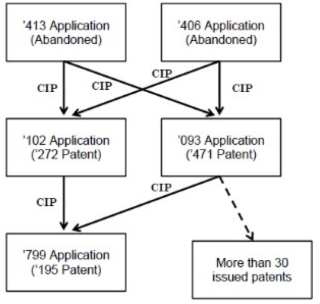
    The '471 patent issued from U.S. Application No. 08/192,093, which was filed as a continuation-in-part application of U.S. Application Nos. 08/013,413 and 08/010,406.  On the same day that the '093 application was filed, Janssen also filed U.S. Application No. 08/192,102, which was also filed as a continuation-in-part application of the '413 and '406 applications, and which later issued as U.S. Patent No. 5,656,272.  Janssen subsequently filed U.S. Application No. 08/324,799, which was filed as a continuation-in-part of the '093 and '102 applications, and which later issued as U.S. Patent No. 5,698,185.  The relationships of the above applications and patents is shown in the chart below, which is reproduced from the Federal Circuit's opinion.

    Chart
    During prosecution of the '413 application, which relates to antibodies specific to human tumor necrosis factor alpha and included claims directed to a chimeric antibody and methods of treatment, a restriction requirement was issued in which Group I was directed to antibodies, pharmaceutical compositions, and assay methods, and Group IV was directed to methods for treating an animal by administering a pharmaceutical composition containing an antibody. Instead of replying to the restriction requirement, Janssen expressly abandoned the '413 application and filed the '093 and '102 applications as continuation-in-part applications of the '413 and '406 applications.

    The '093 application disclosed and claimed subject matter from both the '413 and '406 applications (the '406 application relates to immunoreceptor molecules that are specific for TNF alpha or beta).  After the '093 application was filed, Janssen allowed the '406 application to go abandoned.  Janssen then filed a preliminary amendment in the '093 application, cancelling method claims designated as the invention of Group IV in the restriction requirement issued in the '413 application.  However, Janssen did not limit the claimed subject matter to only that claimed and disclosed in the '413 application, as the '093 application still included claims directed to chimeric antibodies (based on the '413 application) and immunoreceptor molecules (based on the '406 application), and also retained language regarding binding to the TNF genus generally as opposed to the species of TNF alpha.  In an Office action issued during prosecution of the '093 application, the claims were provisionally rejected on obviousness-type double patenting grounds over the '799 application.  Janssen responded by amending the claims, including limiting claim 1 to TNF alpha.  Janssen also filed preliminary amendments in both the '799 and '102 applications, replacing the pending claims of the '799 application with claims directed to methods of treating rheumatoid arthritis, and the pending claims of the '102 application with claims directed to methods of treating Crohn's disease.

    Following the issuance of another Office action in the '093 application, in which the double patenting rejection was maintained, Janssen responded by arguing for withdrawal of the rejection in view of the amendment of the claims of the '799 application to recite methods of treating rheumatoid arthritis and by pointing to the restriction requirement issued in the '413 application, which Janssen argued precluded an obviousness-type double patenting rejection in the '093 application.  The Examiner withdrew the double patenting rejection, and the '093 application eventually issued as the '471 patent, with claims directed to a chimeric antibody specific for TNF alpha (claims 1, 3, and 5–6), immunoassay methods for detecting human TNF (claims 2 and 4), and polypeptides of particular amino acid sequences that bind to human TNF alpha (claims 8 and 9).

    Twelve years after the '471 patent issued, the USPTO instituted a reexamination of the patent (in response to a third-party request) on double patenting grounds over three patents including the '272 and '195 patents.  During the reexamination, Janssen cancelled claims 8 and 9; requested that the benefit claim to the '406 application be deleted; sought amendment of the specification, abstract, and drawings to delete portions that were not in the '413 application; and requested that the application be designated as a divisional of the '413 application.  The Examiner, however, maintained the double patenting rejections on the basis that the safe harbor did not apply, noting that more than thirty-two issued patents "reached through the '471 patent for benefit of a prior filing date" and that the "patentability of those claims . . . cannot be determined without reopening examination of those patents in view of the deletion of the subject matter in the '471 patent."  The Examiner also determined that the one-way test for double patenting applied because the PTO was not "solely responsible" for the '471 patent's later issuance, and that the claims of the '471 patent were unpatentable under that test.  The Board subsequently affirmed the Examiner's determination, and Janssen appealed the Board's decision to the Federal Circuit.

    In an opinion authored by Chief Judge Prost, and joined by Circuit Judges Reyna and Wallach, the Federal Circuit noted that "[t]he main issue on appeal is whether the safe-harbor provision of 35 U.S.C. § 121 applies to the '471 patent and protects it from invalidation based on the '272 and '195 reference patents."  The opinion also noted that "[t]he § 121 safe harbor, 'by its literal terms, protects only divisional applications (or the original application) and patents issued on such applications,'" quoting Pfizer, Inc. v. Teva Pharm. USA, Inc., 518 F.3d 1353, 1360 (Fed. Cir. 2008), and explained that:

    [P]atents issued on CIP applications are not within the scope of § 121.  [Pfizer, 518 F.3d] at 1362.  Nor are patents issued on continuation applications.  [Amgen Inc. v. F. Hoffman-La Roche Ltd., 580 F.3d 1340, 1354 (Fed. Cir. 2009)].  Our precedent is clear: aside from the original application and the original patent, the protection afforded by § 121 is limited to divisional applications and patents issued on divisional applications.  Pfizer, 518 F.3d at 1362.

    The panel noted that in G.D. Searle LLC v. Lupin Pharm., Inc., 790 F.3d 1349 (Fed. Cir. 2015), the question of whether a patent owner can retroactively bring a challenged patent, issued from a CIP application, within the scope of the § 121 safe harbor by amending the CIP application after issuance to redesignate the application as a divisional application was answered by the Federal Circuit in the reissue context, where the Court determined that the patent owner could not take advantage of the safe-harbor provision simply by designating the CIP as a divisional application.  Applying Searle to the instant case, the panel indicated that it was "persuaded by the reasoning in Searle that a patent owner cannot retroactively bring its challenged patent within the scope of the safe-harbor provision by amendment in a reexamination proceeding," stating that "once the '471 patent issued on the '093 application—which, like the application in Searle, at the time of issuance included new matter not disclosed in the original application and so was a properly designated CIP—the '471 patent was barred from safe-harbor protections."

    The panel pointed out that "[t]he '471 patent cannot retroactively become, for the purposes of § 121, a 'patent issued on' a divisional application after it already issued on a CIP application; not even if that CIP application is effectively redesignated as a divisional application during reexamination," and noted that "[f]or a challenged patent to receive safe-harbor protections, the application must be properly designated as a divisional application, at the very latest, by the time the challenged patent issues on that application."  In response to Janssen's argument that it had not enjoyed a benefit from having filed the '093 application as a CIP of the '413 and '406 applications because no issued claims in the '471 patent relied upon the new matter in the '093 application, the panel disagreed, explaining that "the examiner found that Janssen had benefitted because more than thirty patents issued to Janssen claiming priority to the '471 patent and/or the '093 application as a CIP of both the '406 and '413 applications."

    The opinion notes that given the panel's determination that once the '471 patent had issued on a CIP application, it was not entitled to safe-harbor protections of § 121, the panel did not need to consider the USPTO's alternative argument that § 121 does not apply because the '471 patent and the reference patents did not maintain consonance with the restriction requirement made in the '413 application.  In addition, in response to Janssen's argument that the Federal Circuit's holding "creates a rigid 'divisional as filed' test," and ignores longstanding USPTO rules and practices that permit applicants to amend the disclosure and claims of an application after it is filed and to change an application's relationship to a prior-filed application, the panel noted that "[t]hese practices, whether or not they are widely practiced or even permitted under PTO rules, have no relevance here because Janssen did not follow them."  The panel also explained that:

    [W]e do not decide whether such filing practices or amendments made prior to issuance—wherein an application is designated as a divisional application by the time the challenged patent issues on that application—would be sufficient to bring the challenged patent within the scope of the safe-harbor protections.

    The opinion concludes with the panel finding to be unpersuasive Janssen's argument that the Board erred by failing to apply a two-way test for double patenting.  Instead, the panel concluded that Janssen failed to establish that the PTO is "solely responsible" for any alleged delay associated with the issuance of the '471 patent.  Finding that the '471 patent was not entitled to safe-harbor protections, and that the Board did not err in applying the one-way test for double patenting, the Federal Circuit affirmed the Board's rejection of claims 1–7 of the '471 patent as being unpatentable under the doctrine of obviousness-type double patenting.

    In re Janssen Biotech, Inc. (Fed. Cir. 2018)
    Panel: Chief Judge Prost and Circuit Judges Reyna and Wallach
    Opinion by Chief Judge Prost

  • By Kevin E. Noonan –

    USPTO SealIn what everyone (including the Patent Trial and Appeal Board) considers an unprecedented administrative action, the PTAB late last year set out an order (Patent Trial and Appeal Board's Order, 2017 WL 5067421, P.T.A.B. Nov. 3, 2017) inviting amicus briefing on the question of whether the transfer of patent rights from Allergan to the St. Regis Mohawk Nation should lead the Board to dismiss several consolidated inter partes review actions (Nos. IPR2016-01127, IPR2016-01128, IPR2016-01129, IPR2016-01130, IPR2016-01131, and IPR2016-01132, instituted against U.S. Patent Nos. 8,685,930, 8,629,111, 8,642,556, 8,633,162, 8,648,048, and 9,248,191, respectively) on the grounds of sovereign immunity (see "Mohawk Nation Exercises Sovereign Immunity in Inter Partes Review").  The Board has ruled previously that state universities, as "arms of the state," could so assert the immunity and have such IPRs dismissed (see Covidien LP v. Univ. of Fla. Research Found., Inc., Case IPR2016-01274 (PTAB Jan. 25, 2017); NeoChord, Inc. v. Univ. of Md., Balt., Case IPR2016-00208 (PTAB May 23, 2017); and Reactive Surfaces Ltd., LLP v. Toyota Motor Corp., Case IPR2016-01914 (PTAB July 13, 2017)).  The question is not as clear for the Native American tribes, because their sovereign immunity is more proscribed and subject to abrogation by Congress (albeit requiring express and unequivocal government action; see, Santa Clara Pueblo v. Martinez and Ransom v. St. Regis Mohawk Educ. and Cmty. Fund, Inc., 86 N.Y.2d 553, 560 (1995)).  Even assertion of sovereign immunity by the several States is controversial (see "The Wall Street Journal's Problem with the U.S. Constitution"); indeed, the Board denied a motion to dismiss recently based on assertion of the patent in parallel district court litigation (see "PTAB Decides Patent Infringement Lawsuit Waives Eleventh Amendment Sovereign Immunity to Inter Partes Review").

    Despite its unconventionality, fifteen amicus briefs were filed, almost evenly split between those believing that the Tribe could properly assert sovereign immunity and the Board should dismiss the IPRs and those distinguishing this case from the grants of dismissal to state universities on both legal and policy grounds.  (As set forth below, one brief breaks the tie in favor of denying the motion, under a unique contract law theory.)  The briefs were filed by the following parties:

    In favor of granting the motion to dismiss

    Amicus Curiae Brief of the Oglala Sioux Tribe
    Amicus Curiae Brief of The National Congress of American Indians et al.
    Amicus Curiae Brief of Luis Ortiz and Kermit Lopez
    Amicus Curiae Brief of Scholars
    Amicus Curiae Brief of the Seneca Nation
    Amicus Curiae Brief of the NAIPEC
    Amicus Curiae Brief of U.S. Inventor, LLC

    In favor of denying the motion

    Amicus Curiae Brief of the SIIA
    Amicus Curiae Brief of The Association for Accessible Medicines
    Amicus Curiae Brief of The BSA | The Software Alliance
    Amicus Curiae Brief of the Public Knowledge and the Electronic Frontier Foundation
    Amicus Curiae Brief of Askeladden LLC
    Amicus Curiae Brief of Deva Holding A.S.
    Amicus Curiae Brief of the High Tech Inventors Alliance
    Amicus Curiae Brief of James R. Major

    One of these briefs, by practitioners Luis Ortiz and Kermit Lopez challenged the Board's authority to solicit amicus briefs on this question:

    [T]he APA only allows an agency to engage in rulemaking through the notice and comment procedure set forth in 5 U.S.C. § 553, unless the agency is creating rules that "are required by statute to be made on the record after opportunity for an agency hearing."

    And:

    Allowing amici briefs in this IPR by parties aligned with the petitioners does nothing more than allow various commercial interests to complain in the wrong forum.  Only Congress, whose elected members have the authority and duty to make the political decision whether to abrogate sovereign immunity, and who must face voters after such decisions, can choose to eliminate sovereign immunity for Indian tribes in IPRs [emphasis in brief].

    A similar sentiment was echoed in the brief in favor of denying the Tribe's motion, filed by the Public Knowledge and Electronic Frontier Foundation (as amicus collegii), which argued that public notice and comment under the APA are the proper route to permit public comment — "[t]hat procedure would enable participation by members of the public with key knowledge or interests, would guarantee consistency across Board decisions, and would work to avoid conflicts with other policy decisions and positions of the Office."  Certifying the question to the Director would have the advantages that 1) "a notice and comment proceeding would enable all interested parties to participate and provide useful information to the Office and the Board, and to do so without expensive and onerous requirements of retaining registered counsel"; 2) "certification to the Director will avoid inconsistent policy across panels of the Board"; and 3) the Director is best positioned to assess any consequences for the Office as a whole."

    Otherwise, as might be expected, the briefs recite common themes.  Briefs in favor of granting the motion and dismissing the IPRs focus on it being the exclusive provenance of Congress to make any determinations on the scope of sovereign immunity for the Tribes, and that even the Supreme Court has been circumspect in encroaching on Congressional purview in this regard.  These briefs also advocate the policy goals of tribal self-sufficiency; for example, the Oglala Sioux tribe's brief with regard to public policy of encouraging tribes for commercial activity and self-sufficiency, cities White Mountain Apache Tribe v. Bracker to the effect that these efforts can't just be "casinos alone."  Several of these briefs take solace in Justice Sotomayor's concurring opinion in Michigan v. Bay Mills Indian Community, 134 S.Ct. 2024(2014).  In that case, the Justice stated that:

    "Tribes face a number of barriers to raising revenue in traditional ways," and, thus, "[i]f Tribes are ever to become more self-sufficient, and fund a more substantial portion of their own governmental functions, commercial enterprises will likely be a central means of achieving that goal."  134 S.Ct. at 2041 (Sotomayor, J., concurring) (emphasis added).

    The Ortiz and Lopez brief argues that "[t]he PTO has no expertise in determining the scope of sovereign immunity in any context" and addressed the policy arguments by saying "[t]he Board cannot interpret the statutes it administers to meet a policy goal contrary to clearly stated Congressional will, nor can the Board manipulate the statutes it interprets in a way not commensurate with Congressional intent," citing Utility Air Regulatory Grp. v. EPA, 134 S.Ct. 2427, 2445 (2014).  And, using the types of assessments the Supreme Court has been known to employ, their brief argues that the Leahy-Smith America Invents Act was enacted in light of current precedent regarding tribal sovereign immunity, including Kiowa Tribe of Okla. v. Manuf'g Techs., Inc., 523 U.S. 751 (1998), Okla. Tax Comm'n v. Citizen Band Potawatomi Indian Tribe of Okla., 498 U.S. 505 (1991) ("Potawatomi I"), and Santa Clara Pueblo v. Martinez, 436 U.S. 49 (1978) — Potawanomi being particularly relevant because it involved sovereign immunity regarding a tribe's commercial activity — ("not a close call") under Michigan v. Bay Mills Indian Community, 134 S.Ct. 2024, 2037 (2014), that it is up to Congress to limit tribal sovereign immunity.  Finally, this brief uniquely cites Executive Order 13175 in support of "tribal sovereignty and self-determination" and that "[a]gencies shall respect Indian tribal self-government and sovereignty."

    The brief from the National Congress of American Indians raised the pending Supreme Court decision in Oil States and Congressional action (including the STRONGER Patents Act) as reasons for the Board to delay making a decision, counsel that may be less persuasive in view of the statutory 12-month time limit on rendering a decision (albeit tempered by the additional 6-month extension available under extraordinary circumstances, a standard the current situation should easily satisfy).  This brief also finds support for sovereign immunity outside the Constitution (which could be restricted to the States), finding the basis for the immunity in English common law, ALEXANDER HAMILTON, THE FEDERALIST NO. 81, 548-49 (Jacob E. Cooke ed., 1961).  Insofar as the immunity derives from common law it should be "applicable to all sovereigns: federal, state, tribal, and foreign."

    The common themes that 1) abrogation of sovereign immunity is limited to Act of Congress, and 2) the PTAB would be outside of its Constitutional scope as an Article I court is found in briefs from the Seneca Nation and U.S. Invent, an inventor group, the latter brief arguing:

    [I]t would be inconceivable that an Article I administrative agency has the authority to make binding decisions concerning the applicability of Native American tribal sovereign immunity when the U.S. Supreme Court — which has plenary judicial oversight of that same administrative agency — has declared that absent Congressional legislation, the Court does not have the power to qualify or limit the assertion of Native American sovereign immunity.

    This point is also the focus of a brief from a group of Constitutional scholars, including Lawrence Tribe, William Eskridge Jr., Erwin Chemerinsky, Joseph Singer, David Orozco, and Jonathan Massey.  This brief (as well as the Seneca Nation brief) cites Republic of Philippines v. Pimentel, 553 U.S. 851, 864 (2008), which states that "once a tribunal recognizes that an assertion of sovereign immunity is 'not frivolous,' it is 'error' for the tribunal to proceed further to address the merits."  The brief also asserts that the question of tribal sovereign immunity is beyond the Board's "statutory purview and institutional expertise":

    The Supreme Court has established that administrative agencies should not decide questions — especially complex and sensitive questions, such as those arising from Petitioners' arguments against tribal sovereign immunity — beyond their statutory purview and institutional competence.  In such situations, agencies lack the expertise to resolve broader policy issues and risk interference with Congress's legislative prerogatives.  Further, an agency acting beyond its purview lacks legitimacy and accountability.  Controversial measures such as Petitioners' proposed restrictions on tribal sovereign immunity require a broader national democratic debate than an agency like the Board can provide [citing Hampton v. Mow Sun Wong, 426 U.S. 88, 116 (1976), Greene v. McElroy, 360 U.S. 474 (1959), and King v. Burwell, 135 S. Ct. 2480, 2489 (2015)].

    This institutional incompetence is exacerbated by the allegations that:

    [T]he Allergan/Mohawk contract is a 'sham agreement'[,] a 'sham assignment'[,] a 'scheme[] to buy tribal immunity for dubious activities'[,] and even an example of 'rent-a-tribe' schemes" [internal quotation marks and citation omitted] because "[n]ot only are these arguments highly disrespectful to the sovereign Tribe, but adjudicating them will embroil the Board in an intrusive and politically charged inquiry into tribal motivations and the policy wisdom of tribal economic freedom.  These are issues for Congress, not the courts, and not an agency.

    Allegations that the underlying agreement is a sham are also addressed in an amicus brief from the Native American Intellectual Property Enterprise Council.

    In like manner, briefs from amici arguing that the PTAB should deny the Tribe's petition make many of the same arguments, the most prominent of which is that IPRs are proceedings in rem ("one against the world") and not in personem, and that sovereign immunity does not bar these proceedings, analogous to bankruptcies.  The brief from the BSA/The Software Alliance argues that the IPR provisions of the AIA are "statutes of general applicability" (an argument also made in the brief from Askeladden LLC) subject to what they call the Tuscarora rule, from Fed. Power Comm'n v. Tuscarora Indian Nation, 362 U.S. 99, 116 (1960), that such statutes apply unless the application is related to or would abrogate some aspect of tribal autonomy or self-governance.  This brief, as well as most of the other briefs on this side of the question, take the language of the Supreme Court's Cuozzo opinion (see "Cuozzo Speed Technologies LLC v. Lee (2016)") that IPRs are not "mini-trials" or in the form of a lawsuit but rather specialized agency proceedings (despite the rhetoric from supporters of these proceedings that they are indeed intended to be in the form of an adversarial proceeding as a substitute for litigation).

    The policy argument in this brief, as well as others in favor of denial, is that "the IPR process serves to advance the important public policy—rooted in the Constitution's Patent and Copyright Clause—of ensuring that the American public and economy are not burdened by unwarranted monopolies."  The brief also analogizes the IPR proceedings to other agency actions, including NLRA (NLRB v. Little River Band of Ottawa Indians Tribal Gov't, 788 F.3d 537, 555–56 (6th Cir. 2015)), OSHA (Menominee Tribal Enters. v. Solis, 601 F.3d 669, 674 (7th Cir. 2010); Reich v. Mashantucket Sand & Gravel, 95 F.3d 174, 177–82 (2d Cir. 1996)), ERISA (Smart v. State Farm Ins. Co., 868 F.2d 929, 932–36 (7th Cir. 1989)), and EEOC (EEOC v. Fond du Lac Heavy Equip. & Constr. Co., 986 F.2d 246, 249 (8th Cir. 1993).

    The brief from the Association for Accessible Medicines makes similar arguments, characterizing their "significant interest in ensuring that brand-name drug manufacturers are not allowed to abuse the U.S. patent system by attempting to invoke rented Native American tribal immunity to frustrate the Board's authority to review erroneously issued patents."  This brief emphasizes the purported "sham" nature of the assignments and echoing the in rem arguments made by other amici.  This brief also analogizes to other cases involving private property and inapplicability of sovereign immunity, all under state law (Anderson & Middleton Lumber Co. v. Quinault Indian Nation, 929 P.2d 379, 381 (Wash. 1996); Smale v. Noretep, 208 P.3d 1180, 1180 (Wash. Ct. App. 2009); Cass Cnty. Joint Water Res. Dist. v. 1.43 Acres of Land, 643 N.W.2d 685, 688 (N.D. 2002)).  Their contribution to the policy argument is to assert that:

    [A]llowing a drug company patent owner to force an IPR to halt on the eve of an IPR hearing, by paying tens of millions of dollars to rent tribal immunity, would reward bad-faith behavior.  It would also provide other holders of weak but extremely profitable patents with a roadmap for shielding their patents from review while wasting the valuable resources of their competitors and the Board.

    And:

    Prior Board decisions involving sovereign state entities are of limited relevance here because none of those cases involved last-minute bad-faith transfers specifically intended to divest the Board of its authority to take a second look at an issued patent—actions that cannot be squared with equity or good conscience.

    The brief from the Software and Information Industry Association characterizes IPRs as a compromise intended to improve patent quality and "restore confidence in the presumption of validity afforded patents issued by the Patent and Trademark Office."  The brief (as is also argued in the brief from Askeladden LLC) relies heavily on Judge Bryson's decision granting the Tribe's motion to join ANDA litigation involving some of these same patents:

    The essence of the matter is this: Allergan purports to have sold the patents to the tribe, but in reality it has paid the Tribe to allow Allergan to purchase—or perhaps more precisely, to rent—the Tribe's sovereign immunity in order to defeat the pending IPR proceedings in the PTO . . . .  If that ploy succeeds, any patentee facing IRO proceedings would presumably be able to employ the same artifice.  In short, Allergan's tactic, if successful, could spell the end of the PTO's IPR program, which was a central component of the America Invents Act of 2011.

    According to this brief, if the Board does not deny this motion, tribal immunity will be asserted in most if not all IPRs (a fear not without some justification; see "More Instances of Tribal Sovereign Immunity Shielding Patents from PTAB Invalidation").

    A brief from the High Tech Inventors Alliance, Computer & Communications Industry Association, and Internet Association repeats the argument that patent laws are law of general applicability from which sovereign immunity provides no protection, basing this characterization in part because "[private petitioners] cannot compel the Patent Office to conduct a review and their ongoing participation is unnecessary to complete one" (another argument also made in the brief from Askeladden LLC).  According to this brief, "[i]nter partes review is thus 'less like a judicial proceeding and more like a specialized agency proceeding' in which third parties that petition for review 'need not have a concrete stake in the outcome; indeed, they may lack constitutional standing,'" citing Cuozzo Speed Techs., LLC v. Lee, 136 S. Ct. 2131, 2143-44 (2016).  According to this brief (in an argument made nowhere else), "tribes that own patents must, like all other patentees, pay the fees to maintain the patent, or else the patent will expire.  See 35 U.S.C. § 41(b).  The condition that the Patent Office may reexamine or review the patent is no different."

    At least one of the amici arguing for denial of the Tribe's motion has a specific interest in the decision:  Deva Holding A.S. is a Turkish company, in an "early stage" lawsuit against Allergan.  This amicus argues that substitution is unnecessary (and thus tribal sovereign immunity does not prevent IPRs to proceed) because the Tribe and Allergan have identical interests based on litigation conduct, and so Allergan can represent the Tribe's interests — "actions speak louder than words."  In this argument, the purported inconsistency of positions before the Board and the Court, citing a specific September 8, 2017 letter to the Court, mandate this conclusion and provide sufficient basis to deny the Tribe's motion.

    In addition to its recommendation that the Board would be better to certify the question to the PTO Director, the amicus collegii brief from the Public Knowledge and Electronic Frontier Foundation cites Hazel-Atlas Glass Co. v. Hartford-Empire Co. and Precision Instrument Mfg. Co. v. Auto. Maint. Mach. Co. (inequitable conduct) for the "patents in the public interest" concept, saying that the PTAB is an "agency of public justice" and draws analogies to Supreme Court decisions precluding limitations on challenging validity, including Laboratories v. University of Illinois Foundation, Medimmune v. Genentech, Cardinal Chem. Co. v. Morton Int'l, Inc., and Lear v Atkins.

    The brief from James R. Major, D. Phil., opposes the tribe's motion on contractual grounds, arguing that Tribe's patent rights outside the grantback to Allergan are illusory and thus the assignment nugatory, and that the Tribe has no independent interests to assert.  These rights include "research, scholarly use, teaching, education, patient care incidental to the foregoing, sponsored research for itself and in collaborations with Non-Commercial Organizations . . . ."  Dr. Major's point is that the Tribe already had these rights because they were immune from patent infringement liability due to the exercise of sovereign immunity:

    In sum, any infringement suit that the Tribe has the first right to bring would fail.  Therefore, the right of the Tribe to enforce the Licensed Patents in infringement suits unrelated to a Generic Equivalent is nugatory.

    In Dr. Major's view, "the Agreement has stripped the Tribe of any meaningful rights in the Licensed Patents."

    The time for filing amicus briefs in this matter has passed, and the Board is scheduled to render its decision by spring.