• IPO #2The Intellectual Property Owners Association (IPO) will offer a one-hour webinar entitled "PTAB on Wi-Fi One: What's Next for Appeals?" on February 22, 2018 from 2:00 to 3:00 pm (ET).  Hon. Michael Tierney of the U.S. Patent & Trademark Office, Matthew Berkowitz of Shearman & Sterling LLP, Scott Kamholz of Covington & Burling LLP, and David Kelley of Ford Global Technologies LLC will discuss the Federal Circuit's decision in Wi-Fi One LLC v. Broadcom Corp. that PTAB time-bar determinations under 35 U.S.C. § 315(b) are appealable because they do not fall within the scope of the judicial-review prohibition of § 314(d).  The panel will also address the following topics:

    • The AIA's various time bars as adjudicated by the PTAB — and whether there is a standing inconsistency among PTAB panels.
    • On which other issues are litigants likely to press for appeals such as the naming of all interested parties, or the reach of estoppel.
    • Real-party-in-interest and privacy, because in practice many potential appeals involve situations with various parties including joint defense groups, indemnification, and patent aggregators.
    • How will the PTAB respond to increased demands for discovery?

    The registration fee for the webinar is $135 (government and academic rates are available upon request).  Those interested in registering for the webinar can do so here.

  • Strafford #1Strafford will be offering a webinar entitled "Patent Inventorship: Best Practices for Determination and Correction — Distinguishing Between Inventor and Contributor; Navigating Joint Inventorship, Disclosure of Ownership, Real Party in Interest" on February 27, 2018 from 1:00 to 2:30 pm (EST).  Jill K. MacAlpine and Amanda K. Murphy of Finnegan Henderson Farabow Garrett & Dunner will provide guidance for patent counsel on identifying and determining inventorship, offer best practices for correcting errors regarding inventorship, and offer perspectives gained from working with the AIA since it was passed—and outline lessons from recent court decisions.  The webinar will review the following issues:

    • What key information does counsel need to determine inventorship?
    • What are the steps for counsel when inventorship must be corrected?
    • What is the AIA's impact on an inventorship determination?

    The registration fee for the webcast is $297.  Those interested in registering for the webinar, can do so here.

  • Bereskin & ParrBereskin & Parr will be offering a presentation entitled "Going Global with Patents" on February 28, 2018 from 12:00 to 1:00 pm (EST).  Isi Caulder of Bereskin & Parr, Stephen Yang of Co-Talent, and Andrea Hughes of Dehns will discuss how smart organizations obtain global patent coverage to maintain their competitive advantage.  The panel will also address the following topics:

    • Key factors for strategic selection of foreign patent protection
    • How to secure global patent protection on a cost and time effective basis
    • Tips for monetizing a global patent portfolio and identifying collaboration opportunities (cross-licensing)

    Those wishing to register for the presentation can do so here.

  • LexisNexisLexisNexis will be offering a webinar on "Drafting Quality Patents: Avoiding 112 Rejections at the USPTO" on February 22, 2018 at 12:00 pm (ET).  Gene Quinn of IPWatchdog.com and Dave Stitzel of Reed Tech® will discuss best practices for filing a robust application to avoid 112 rejections and associated problems, and will address the following topics:

    • Indefiniteness: Nautilus (SCOTUS standard) versus In re Packard (USPTO standard)
    • Identifying and Interpreting 112(f) means plus function limitations
    • Alternative and Negative Limitations
    • Relational and Exemplary Language
    • Numerical Ranges and Amount Limitation

    Those interested in registering for the webinar, can do so here.

  • Strafford #1Strafford will be offering a webinar entitled "Patent Exclusivity Health Checks for Small Molecules: Are Your U.S. Patents Ready to Maximize ROI? — Phase II Efficacy Trials, Phase III Clinical Trials, NDA Submission, Approval and Marketing" on March 8, 2018 from 1:00 to 2:30 pm (EST).  Thomas L. Irving, Shana K. Cyr, Mark J. Feldstein, and John D. Livingstone of Finnegan Henderson Farabow Garrett & Dunner will provide guidance to patent counsel on the essentials of patent exclusivity that are in critical need of independent checking, and discuss crucial health checks on U.S. patent exclusivity for small molecules in Phase II efficacy trials and proceeding through large-scale randomized Phase III clinical trials, submission of the NDA, and subsequent approval and marketing.  The webinar will review the following issues:

    • What can be done if sub-optimal protection or even serious defects are discovered during the "health check"?
    • Are Orange Book listed patent claims definite or enabled under the current standards?
    • Is there a need for supplemental examination to clear the path to enforceability?

    The registration fee for the webcast is $297.  Those interested in registering for the webinar, can do so here.

  • The Knowledge GroupThe Knowledge Group will offer a webcast entitled "Managing and Defending Against Patent Infringement Lawsuits: Best Strategies and Practical Tips Explored" on February 20, 2018 from 3:00 to 4:00 pm (ET).  Blaney Harper of Jones Day and Peter D. Siddoway of Sage Patent Group, PLLC will discuss the most important aspects of managing as well as defending against patent infringement lawsuits, and present the best strategies as well as the best practices to avoid potential risks and pitfalls.  Key topics to be addressed by the webcast include:

    • Litigation Strategies against NPEs
    • Venue after TC Heartland
    • Considerations regarding whether to file an IPR
    • Damages Assessments and latest case law
    • Latest IPR Trends
    • Recent Court Decisions and Developments

    The registration fee for the webcast is $49.  Those interested in registering for the webinar can do so here.

  • By Aaron Gin –

    Washington - Capitol #3Over the last two months, the United States legislature has introduced three new bills intended to establish a Federal Advisory Committee on the rapidly-evolving field of artificial intelligence (AI) and to analyze and report on the impact and growth of the technology.

    FUTURE of AI Act

    On December 12, 2017, Rep. John Delaney (D-MD) and Sen. Maria Cantwell (D-WA) introduced identical bills in the House (as H.R. 4625) and Senate (as S. 2217).  The twin bills were entitled the "Fundamentally Understanding The Usability and Realistic Evolution of Artificial Intelligence Act of 2017" — or FUTURE of AI Act.

    One aim of the bills is to better understand how AI might maximally benefit the economic prosperity and social stability of the United States.  The bills would also direct the Secretary of Commerce to establish a Federal Advisory Committee, which would be tasked with providing guidance on the development and implementation of artificial intelligence.  Among other roles, the Advisory Committee is to promote a "climate of investment and innovation," "optimize the development of [AI]," support the "unbiased development and application of [AI]," and "protect the privacy rights of individuals."

    The Advisory Committee is asked to provide advice to the Secretary of Commerce with regard to several specific topics including:

    (A) The competitiveness of the United States, including matters relating to the promotion of public and private sector investment and innovation into the development of artificial intelligence.

    (B) Workforce, including matters relating to the potential for using artificial intelligence for rapid retraining of workers, due to the possible effect of technological displacement.

    (C) Education, including matters relating to science, technology, engineering, and mathematics education to prepare the United States workforce as the needs of employers change.

    (D) Ethics training and development for technologists working on artificial intelligence.

    (E) Matters relating to open sharing of data and the open sharing of research on artificial intelligence.

    (F) International cooperation and competitiveness, including matters relating to the competitive international landscape for artificial intelligence-related industries.

    (G) Accountability and legal rights, including matters relating to the responsibility for any violations of laws by an artificial intelligence system and the compatibility of international regulations.

    (H) Matters relating to machine learning bias through core cultural and societal norms.

    (I) Matters relating to how artificial intelligence can serve or enhance opportunities in rural communities.

    (J) Government efficiency, including matters relating to how to promote cost saving and streamline operations.

    The Advisory Committee is additionally required to conduct a study on various intersections between AI and society, including analyzing the effects of AI on the economy, workforce, and competiveness of the United States.  The study also seeks to identify and eliminate bias in AI algorithms, identify potential "harmful outcomes," and contemplate the incorporation of ethical standards in AI development.  Furthermore, within 540 days of enactment of the Act, the Advisory Committee is required to provide a report based on the study to the Secretary of Commerce and Congress.

    The bills direct that the Advisory Committee shall include 19 voting members appointed by the Secretary of Commerce.  Specifically, the voting members will be selected from "diverse" geographical locations within the United States and include:  five members from academia or the AI research community, six from private industry, six from civil society, and two from labor organizations.

    One of the notable features of the twin House and Senate bills is the broad range of technologies being considered under the term "artificial intelligence."  The bills both define AI as:

    (A) Any artificial systems that perform tasks under varying and unpredictable circumstances, without significant human oversight, or that can learn from their experience and improve their performance.  Such systems may be developed in computer software, physical hardware, or other contexts not yet contemplated.  They may solve tasks requiring humanlike perception, cognition, planning, learning, communication, or physical action.  In general, the more human-like the system within the context of its tasks, the more it can be said to use artificial intelligence.

    (B) Systems that think like humans, such as cognitive architectures and neural networks.

    (C) Systems that act like humans, such as systems that can pass the Turing test or other comparable test via natural language processing, knowledge representation, automated reasoning, and learning.

    (D) A set of techniques, including machine learning, that seeks to approximate some cognitive task.

    (E) Systems that act rationally, such as intelligent software agents and embodied robots that achieve goals via perception, planning, reasoning, learning, communicating, decision making, and acting.

    H.R. 4625 and S. 2217 also contemplate "artificial general intelligence," which they define as "a notional future artificial intelligence system that exhibits apparently intelligent behavior at least as advanced as a person across the range of cognitive, emotional, and social behaviors."  Yet further, the bills consider "narrow artificial intelligence," or artificial intelligence systems that address specific applications such as playing strategic games, language translation, self-driving vehicles, and image recognition.

    AI Jobs Act of 2018

    On January 18, 2018, Rep. Darren Soto (D-FL) introduced H.R. 4829 entitled the "AI Jobs Act of 2018".  The bill promotes a "21st century artificial intelligence workforce," and focuses on training and retraining American workers in light of the possible effects of AI on the workforce and human worker demand.

    H.R. 4829 requires the Secretary of Labor to undertake an AI study to determine its potential impacts on the workforce.  A report based on the study is to include:

    (1) An outline of the specific data, and the availability of such data, necessary to properly analyze the impact and growth of artificial intelligence.

    (2) Identification of industries that are projected to have the most growth in artificial intelligence use, and whether the technology will result in the enhancement of workers' capabilities or their replacement.

    (3) Analysis of the expertise and education (including computer science literacy) needed to develop, operate, or work alongside artificial intelligence over the next two decades, as compared to the levels of such expertise and education among the current workforce.

    (4) Analysis of which demographics (including ethnic, gender, economic, age, and regional) may experience expanded career opportunities, and which such demographics may be vulnerable to career displacement, due to artificial intelligence.

    (5) Any recommendations to alleviate workforce displacement, prepare future workforce members for the artificial-intelligence economy, and any other relevant observations or recommendations within the field of artificial intelligence.

    In preparing the report, the Secretary of Labor is tasked with conducting a series of public hearing or roundtables with various organizations, such as industrial stakeholders, heads of Federal agencies, local educational agencies, institutions of higher education, workforce training organizations, and National Laboratories.

    While some language is common, the new House bill defines "artificial intelligence" more succinctly than the earlier twin bills.  Specifically, H.R. 4829 characterizes AI as systems that:

    (A) think like humans (including cognitive architectures and neural networks);

    (B) act like humans (such as passing the Turing test using natural language processing, knowledge representation, automated reasoning, and learning);

    (C) think rationally (such as logic solvers, inference, and optimization);

    (D) act rationally (such as intelligent software agents and embodied robots that achieve goals via perception, planning, reasoning, learning, communicating, decision-making, and acting); or

    (E) automate or replicate intelligent behavior.

    If enacted, the Acts and their resulting reports will undoubtedly lead to further discussion regarding artificial intelligence and provide multiple perspectives on how AI might impact society for better and, perhaps, for worse.  Additionally, as the bills target the Departments of Commerce and Labor separately, it will also be interesting to see how the different organizations read and react based on their respective AI studies.

    For additional information regarding this topic, please see:

    H.R.4625 – FUTURE of Artificial Intelligence Act of 2017
    S.2217 – FUTURE of Artificial Intelligence Act of 2017
    H.R.4829 – AI JOBS Act of 2018
    • "Lawmakers introduce bipartisan AI legislation," The Hill, December 12, 2017
    • "Microsoft Sees Need for AI Laws, Regulations," Industry Week, January 18, 2018
    • "Forget Killer Robots—Bias Is the Real AI Danger," MIT Technology Review, October 3, 2017

  • By Grantland Drutchas

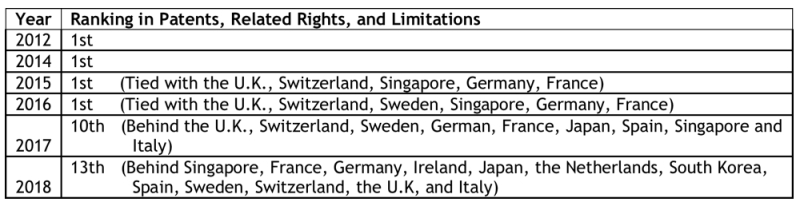
    U.S. Chamber of CommerceThe U.S. Chamber of Commerce's Global Innovation Policy Center released its 5th annual study that ranks intellectual property systems worldwide.  In the Chamber of Commerce's latest study, the U.S. patent system has dropped to 13th in the world, well behind such diverse countries as Singapore, France, Ireland, Japan, South Korea, Spain, Sweden, Switzerland, and Italy.  See "U.S. Chamber International IP Index" ("2018 Report") at p. 35 (Category 1: Patents, Related Rights, and Limitations).  The U.S. Chamber International IP Index uses 40 discrete indicators covering policy, law, regulation, and enforcement.  The Chamber's stated goal:  to determine whether "a given economy's intellectual property system provide[s] a reliable basis for investment in the innovation and creativity lifecycle."  2018 Report at p. 1.

    A review of the last several rankings by the U.S. Chamber of Commerce's studies shows that, although the U.S. had the unquestioned lead in patent protection in 2012-2014, its advantage has dropped each year thereafter, and continues its precipitous decline:

    Table
    See "U.S. Chamber International IP Index," at "View Report".

    The reason for this precipitous drop in 2017, and the U.S.'s continued decline in 2018, is directly tied to recent Supreme Court decisions and the perceived one-sided nature of IPRs under the AIA, particularly as implemented by the U.S. Patent and Trademark Office:

    This change is primarily driven by relative weakness in patentability requirements and patent opposition (indicators 2 and 8).  For the former, the patentability of basic biotech inventions was compromised by the Supreme Court decisions in the 2013 Molecular Pathology v. Myriad Genetics and 2012 Prometheus Laboratories, Inc v. Mayo Collaborative Services cases.  The rulings raised uncertainties over the patentability of DNA molecules that mimic naturally occurring sequences as well as other patented products and technologies isolated from natural sources.  In 2017, interpretation of the recent Supreme Court decisions in Myriad, Mayo, and Alice Corp vs. CLS Bank International by lower courts and guidance from the USPTO remained inconsistent and difficult to apply.  There is considerable uncertainty for innovators and the legal community, as well as an overly cautious and restrictive approach to determining eligibility for patentable subject matter in areas such as biotech, business method, and computer-implemented inventions.  This seriously undermines the longstanding world-class innovation environment in the U.S. and threatens the nation's global competitiveness.

    2018 Report at p. 8; see also pp. 8-9 (citing the "disproportionate rate of rejections" in IPRs and "a lower burden of proof" than in litigation as "inject[ing] a great deal of cost and uncertainty for patent owners compared with other post-grant opposition systems").

    Although the United States remains the leader in IP protection when looked at as a whole, with a very slim lead over the U.K. (one hundredth of a point, 37.98 vs. 38.97) (2018 Report at p. 6), the U.S. has barely maintained that overall lead thanks to the continued strength of protection of copyrights, trademarks, trade secrets, and IP commercialization.

    The U.S. Chamber of Commerce, founded in 1912, is reportedly the world's largest business organization representing the interests of more than 3 million businesses in varying of all sizes, sectors, and regions and represents state and local chambers and industry associations.  The Global Innovation Policy Center is a committee within the U.S. Chamber of Commerce that seeks to promote innovation and creativity globally by advocating for strong IP standards.

  • By Donald Zuhn –-

    USPTO SealIn an interesting decision issued last year, the Patent Trial and Appeal Board reversed the final rejection of claims 1-5 and 9 in U.S. Application No. 12/959,017.  The claims at issue had been rejected under 35 U.S.C. § 101 as reciting patent ineligible subject matter in the form of an abstract idea, and under 35 U.S.C. § 103(a) as being unpatentable over U.S. Patent No. 6,454,707 and U.S. Patent Application Publication Nos. US 2006/0226079 A1 and US 2009/0082684 A1.  This post addresses the Board's reversal of the § 101 rejection.

    The '017 application relates to the identification of a patient undergoing hemodialysis treatments at increased risk for death.  Representative claim 1 recites:

    1.  A method of identifying and treating a patient undergoing periodic hemodialysis treatments at increased risk for death, comprising:
        a) determining at least one clinical or biochemical parameter associated with an increased risk of death of the patient and monitoring said parameter periodically before and/or after the patient is undergoing hemodialysis treatments;
        b) determining a significant change in the rate of change of the at least one clinical or biochemical parameter from a retrospective record review of parameter values of the patient determined at prior hemodialysis treatments;
        c) identifying the patient as having an increased risk for death because the patient has the significant change in the rate of change of the at least one clinical or biochemical parameter; and
        d) treating the patient having an increased risk for death within a sufficient lead time to decrease the patient's risk of death.

    In reversing the § 101 rejection, the Board began by noting that it was "persuaded by Appellants' arguments that the claimed method is not an abstract idea, because the claims 'have the particular practical application of identifying a patient as having an increased risk of death and treating the patient to decrease the risk of death.'"  The Board also noted that the Examiner's rejection of claim 1 was based on the finding that steps a) to c) can be performed with mental thought alone, and that treating step d) is not a "transformation of a patient" because "the treatment step can be anything; i.e. not necessarily having to do with hemodialysis."  In the Examiner's Answer, the Examiner concluded that "the claim is effectively [directed] to the general correlation and the abstract idea of doing the significant change analysis."

    The Board, however, disagreed with the Examiner, stating that:

    Although the claim includes steps that can be performed mentally, "treating the patient . . . to decrease the patient's risk of death" is not a phenomenon of nature, mental process, or abstract intellectual concept.  This is a specific type of treatment, as opposed to, for example, treating only to alleviate pain.  The claim as a whole is directed to more than just steps capable of being performed mentally.

    The Board explained that "the claim, considered as a whole, is not directed merely to an abstract idea, as defined under step one of the Alice analysis, because it includes treating a patient to reduce a risk of death."  Citing Alice Corp. Pty. Ltd. v. CLS Bank Int'l, 134 S. Ct. 2347, 2359 (2014), the Board also suggested that "if one were to consider the claim under the second step of the Alice analysis, the treatment of a patient to reduce the risk of death functions to 'effect an improvement in [another] technology or technical field,' namely medicine."

    The Board therefore refused to sustain the rejection of claim 1 (or dependent claims 2-5 and 9) under § 101.  After also refusing to sustain the rejection of claims 1-5 and 9 under § 103, the Board reversed the rejection of claims 1-5 and 9 under §§ 101 and 103.

    Following the Board's Decision on Appeal on March 20, 2017, a Notice of Allowance was mailed on June 8, 2017.  A Request for Continued Examination and Information Disclosure Statement was filed on August 31, 2017, and a second Notice of Allowance was mailed on September 20, 2017.  The '017 application issued as U.S. Patent No. 9,883,799 on February 6, 2018.

    Ex parte Kotanko (PTAB 2018)
    Panel: Administrative Patent Judges Crawford, Fischetti, and Kim
    Decision on Appeal by Administrative Patent Judge Crawford

  • By Donald Zuhn –-

    ActelionLast week, the Federal Circuit affirmed the grant of summary judgment by the District Court for the Eastern District of Virginia in favor of the U.S. Patent and Trademark Office with respect to the USPTO's determination of Patent Term Adjustment ("PTA") for U.S. Patent No. 8,658,675.  In particular, the Federal Circuit determined that the District Court did not err in affirming the USPTO's finding that Actelion failed to make an express request for early examination of the '619 application, as required by 35 U.S.C. § 371(f), and that the District Court also did not err in affirming the USPTO's A Delay calculation for the '675 patent, which was based on national stage commencement occurring on the day after a federal holiday.

    The '675 patent, which is directed to pyridin-4-yl derivatives that are agonists for the G protein-coupled receptor S1P1/EDG1, is assigned to Actelion Pharmaceuticals, Ltd.  The '675 patent issued from U.S. Application No. 13/383,619, which was filed on January 12, 2012 as a national stage application from International Application No. PCT/IB2010/053224, which claims priority from International Application No. PCT/IB2009/053089, which was filed on July 16, 2009.  The 30-month date for national stage entry of International Application No. PCT/IB2010/053224 was therefore January 16, 2012, which fell on Martin Luther King, Jr. Day, a federal holiday.

    When the '619 application was filed, Actelion also filed a preliminary amendment, which stated that "Applicant earnestly solicits early examination and allowance of these claims."  In addition, Actelion filed a PTO Form 1390 ("Transmittal Letter to the United States Designated/Elected Office (DO/EO/US) Concerning a Submission under 35 U.S.C. 371") when filing the '619 application, but did not check the box indicating that "[t]his is an express request to begin national examination procedures (35 U.S.C. [§] 371(f)). . . ."  The USPTO thereafter issued a restriction requirement on April 26, 2013.

    An Issue Notification was subsequently issued for the '675 patent, which included a PTA determination of 41 days.  Actelion filed a request for reconsideration of PTA in view of the AIA Technical Corrections Act, and the USPTO responded by reducing the PTA for the '675 patent to 40 days.  Actelion then filed a petition for reconsideration, contending that the '675 patent was entitled to 45 days of PTA based on its January 12, 2012 filing date, or alternatively, 41 days based on the 30-month date of January 16, 2012.  The USPTO denied Actelion's petition, Actelion filed a second petition for reconsideration, and then Actelion filed suit against the USPTO in the Eastern District of Virginia pursuant to 35 U.S.C. § 154(b)(4).

    Before the District Court, Actelion filed a motion for summary judgment and the USPTO filed a cross-motion for summary judgment.  The District Court granted summary judgment in favor of the USPTO, finding that Actelion had failed to meet the conditions under 35 U.S.C. § 371(b) and (f) on the day the '619 application was filed, and that the USPTO had properly determined that the national stage did not commence on the 30-month date that fell on a federal holiday.  Actelion appealed to the Federal Circuit.

    The Federal Circuit began by noting that the only dispute in this case was the A Delay calculation under 35 U.S.C. § 154(b)(1)(A)(i)(II) for the '675 patent, which issued from the '619 application, which was filed as a national stage application pursuant to 35 U.S.C. § 371.  The Court also noted that under the current version of § 154(b)(1)(A)(i)(II), which was amended pursuant to the Technical Corrections—Leahy-Smith America Invents Act ("Technical Corrections Act" or "TCA"), the USPTO was required to "provide at least one of the notifications under section 132 or a notice of allowance under section 151 not later than 14 months after . . . the date of commencement of the national stage under section 371 in an international application."  Prior to enactment of the TCA, § 154(b)(1)(A)(i)(II) required that the USPTO provide such notification not later than 14 months after "the date on which an international application fulfilled the requirements of section 371 of this title."  The Court further noted that the commencement of national stage of an international patent application is specified in 35 U.S.C. § 371, which provides in § 371(b) that "[s]ubject to subsection (f) of this section, the national stage shall commence with the expiration of the applicable time limit under article 22(1) or (2), or under article 39(1)(a) of the treaty"; provides applicant filing requirements in § 371(c); and provides in § 371(f) that "[a]t the express request of the applicant, the national stage of processing may be commenced at any time at which the application is in order for such purpose and the applicable requirements of subsection (c) of this section have been complied with."

    On appeal, Actelion argued that the A Delay calculation for the '675 patent should be based on the '619 application's filing date because Actelion "fulfilled the requirements of section 371" by fulfilling the applicant filing requirements of § 371(c).  Actelion also argued that it made an "express request" as required by § 371(f), despite not checking the box on PTO Form 1390, by stating in its preliminary amendment that it "earnestly solicits early examination."  Actelion further argued that even if the A Delay calculation for the '675 patent was not based on the '619 application's filing date, the A Delay calculation should be based on the 30-month date without regard to the fact that the 30-month date fell on a federal holiday.  Actelion based this last argument on § 371(b), which requires that the national stage "shall commence" on the expiration of the date that is 30 months from the priority date.  In affirming the District Court's grant of summary judgment to the USPTO, the Federal Circuit disagreed with all three of Actelion's arguments above.

    With regard to Actelion's first argument, the Court determined that § 154(b)(1)(A)(i)(II) — regardless of whether the pre- or post-TCA version is considered — requires compliance with the entirety of § 371, which includes the requirements under § 371(b) and (f).  With regard to Actelion's second argument that the preliminary amendment filed by Actelion with the '619 application contained an "express request" to commence national stage early (as required by § 371(f)), the Federal Circuit called such argument "unsound," explaining that:

    Even viewed most favorably to Actelion, the casual "solicits early examination" language with no reference to § 371(f), the PCT, or the national stage, when combined with the unchecked box 3 of its completed PTO Form 1390, was, if not an express election not to commence the national stage early, at least an inconsistent or ambivalent request.

    Finally, the Federal Circuit found Actelion's third argument to be unpersuasive, noting that Actelion's argument "is premised on the assumption that any time period of inaction that is not attributable to the applicant should inure to the applicant's benefit," and "[a]s such, Actelion emphasizes its alleged lack of fault during the time periods in question" (emphasis in opinion).  The Court, however, responded that:

    [B]y the same logic, inaction on a holiday is also not attributable to the PTO.  Although the PTA statutes do serve a remedial purpose of restoring patent term lost during prosecution of an application, they only restore "undue delays in patent examination caused by the PTO" as provided by Congress [emphasis in opinion].

    The Federal Circuit therefore concluded that the USPTO did not err in calculating a 40-day PTA for the '675 patent under § 154(b)(1)(A)(i)(II), and affirmed the District Court's decision granting summary judgment in favor of the USPTO.

    Actelion Pharmaceuticals, Ltd. v. Matal (Fed. Cir. 2018)
    Panel: Circuit Judges Lourie, O'Malley, and Wallach
    Opinion by Circuit Judge Lourie