• By Michael Borella

    Federal Circuit SealIn early February, the Federal Circuit published an opinion in HP Inc. v. Berkheimer stating clearly –- for the first time — that patent-eligibility under 35 U.S.C. § 101 should be determined as a matter of law, but with possible underlying factual issues.  While supported in principle by Supreme Court and previous Federal Circuit decisions, neither body had unambiguously stated that facts matter in eligibility disputes.  Thus, this ruling has the potential to fundamentally shift how the § 101 inquiry is carried out.

    Berkheimer's U.S. Patent No. 7,447,713 is directed to "digitally processing and archiving files in a digital asset management system."  This system "parses files into multiple objects and tags the objects to create relationships between them," then compares these objects to "to archived objects to determine whether variations exist based on predetermined standards and rules."  Doing so "eliminates redundant storage of common text and graphical elements, which improves system operating efficiency and reduces storage costs."

    A District Court Judge in the Northern District of Illinois granted HP's motion for summary judgment of patent-ineligibility, contending that as a matter of law the claims of the '713 were directed to no more than unpatentable abstract ideas under the two prong rubric of Alice Corp. v. CLS Bank Int'l.  On review, the Federal Circuit agreed with the District Court for some of the claims, but disagreed for others.  In particular, the purported technical improvement of reducing storage requirements was enough to render a handful of the dependent claims not clearly ineligible.

    In an opinion by Judge Moore, the Court stated "[l]ike indefiniteness, enablement, or obviousness, whether a claim recites patent eligible subject matter is a question of law which may contain underlying facts."  The Court remanded the case back to the District Court for further review, another first for § 101 challenges.

    On March 12, HP filed a petition for en banc review.  In it, HP argued that the panel's decision was inconsistent with precedent, effectively required a factual review for all § 101 analyses, and would lead to protracted litigation.  As I previously wrote, HP is on shaky ground for at least two of these points, and missed an opportunity to expound upon the potential can of factual worms opened by Judge Moore.

    This week, Berkheimer filed a reply, arguing that en banc review is unnecessary.  Berkheimer's position is set forth rather directly — the case law supports consideration of facts in the § 101 evaluation, and HP's parade of horribles is a hyperbolic overreaction to a decision that merely clarifies the status quo.

    To that point, Berkheimer points out that the panel explicitly stated that summary judgment on eligibility issues can be appropriate when there is no material issue of fact regarding whether the claims recite an inventive concept.  Berkheimer further noted that authority to support the position that facts can be considered runs through the Supreme Court's Mayo Collaborative Servs. v. Prometheus Labs., Inc. decision as well as a number of Federal Circuit decisions.  Notably, Enfish, LLC v. Microsoft Corp., McRO, Inc. v. Bandai Namco Games Am. Inc., Amdocs (Isr.) Ltd. v. Openet Telecom, Inc., Thales Visionix, Inc. v. U.S., and several other cases exhibit § 101 outcomes that turned on issues of fact.

    Berkheimer continues by asserting that the panel correctly applied this law:

    The panel recognized that the § 101 inquiry involves a basic question of what is the invention.  This is not simply a question of reading the claims; it involves deeper inquiries as to what the invention is "directed to" at Alice step one, and—if the claims are directed to one of the exceptions to patent eligibility—whether they add an "inventive concept" at Alice step two.  This requires a factual inquiry to evaluate the technological context of an invention, especially when assessing an inventive concept over what was well-understood, routine, and conventional to a skilled artisan at the time of the invention (which itself is an extrinsically facing historical fact variable based on a patent's priority date – namely October 2000 for the '713 patent).

    HP and its amici claim the panel has opened the floodgates for patent assertion entities to manufacture factual allegations, advance an inexhaustible array of extrinsic evidence, proffer expert opinions, merely write bare assertions of improvements or advantages into a specification, or create a material issue of fact by the draftsman's or litigant's art.  This purported "sea change" is illusory.  Dispositive motions may still be made.  The panel does not protect claims involving "nonce" word devices, generic computer components, ubiquitous elements, "apply it" directives, expected functionalities, longstanding commercial practices, methods of organizing human activities, and so on.  Claims and their informing specifications will still be scrutinized under the Alice standard.

    If taken up en banc, the Federal Circuit will have to consider the opposing poles of HP's contention that the panel made a mistake of biblical proportion and Berkheimer's position that the decision was little more than business as usual.  The Court may be a little gun-shy given that the last time it entertained a § 101 dispute en banc, it was the much-maligned 5-opinion split decision that led to the Supreme Court rendering the Alice test.  But in the nearly four years since then, the Federal Circuit has not managed to carry out its gap-filling function in a manner that has made Alice workable in practice.

    Grading purely on the briefs, Berkheimer appears to have the edge in terms of clarity, succinctness, and interpretation of the case law.  But both parties avoid addressing the 800-pound gorilla in the proceeding — how does one properly carry out a factual analysis under § 101?  What is required for the patentee to establish that there is a material issue of fact?  How understood does a claim element need to be in order to qualify as "well understood"?  How does one explain § 101 issues to a jury when judges and patent examiners often express frustration over the jurisprudence and fail to apply the Alice decision clearly or consistently?

    Within a few weeks we may begin to find out.

  • CalendarApril 5, 2018 – "Paragraph IV Litigation and IPRs — Interplay Between Paragraph IV Litigation and IPRs, Multiple Generic Challengers, Key Issues in IPRs" (Strafford) – 1:00 to 2:30 pm (EDT)

    April 6, 2018 – "Are Patents Under Attack?" (Federal Circuit Bar Association and Center for Innovation Policy at Duke Law) – 8:00 am to 4:45 pm (ET), Duke University School of Law, Durham, NC

    April 7, 2018 – "Court of Appeals for the Federal Circuit Practice & Procedure" (John Marshall Law School Center for Intellectual Property, Information & Privacy Law) – 9:00 am to 4:30 pm (CT), John Marshall Law School, Chicago, IL

    April 9, 2018 – "The Patent System: Transformative Times" (Federal Circuit Bar Association and Boston Patent Law Association) – 2:30 pm to 5:30 pm (ET), Northeastern University, Boston, MA

    April 10, 2018 – "Federal Circuit Practice & Insights: A Townhall with Federal Circuit Judge Kara Stoll" (Federal Circuit Bar Association and Michigan IP Inn of Court) – 4:30 pm to 6:30 pm (ET), University of Detroit Mercy School of Law, Detroit, MI

    April 12, 2018 – "Protecting Software as a Medical Device With Patents, Design Patents and Trade Secrets" (Strafford) – 1:00 to 2:30 pm (EDT)

    April 14, 2018 – "Court of Appeals for the Federal Circuit Practice & Procedure" (John Marshall Law School Center for Intellectual Property, Information & Privacy Law) – 9:00 am to 4:30 pm (CT), John Marshall Law School, Chicago, IL

    April 19, 2018 – "Overcoming § 101 Rejections for Computer and Electronics Related Patents — Leveraging USPTO Guidance and Recent Decisions to Meet 101 Patent Eligibility Requirements" (Strafford) – 1:00 to 2:30 pm (EDT)

    April 23-24, 2018 – Paragraph IV Disputes conference (American Conference Institute) – New York, NY

  • Strafford #1Strafford will be offering a webinar entitled "Overcoming § 101 Rejections for Computer and Electronics Related Patents — Leveraging USPTO Guidance and Recent Decisions to Meet 101 Patent Eligibility Requirements" on April 19, 2018 from 1:00 to 2:30 pm EDT.  Charles Bieneman of Bejin Bieneman and Michael P. Shepherd of Fish & Richardson will guide patent counsel for overcoming § 101 rejections for computer and electronics related patents, and review recent case law and USPTO guidance on § 101 patent eligibility and offer strategies to address § 101 rejections.  The webinar will review the following issues:

    • What are the significant recent § 101 decisions at the Federal Circuit, the district courts and PTAB?
    • How can specifications and claims be drafted to guard against § 101 rejections?
    • What strategies and arguments can be used in patent prosecution to overcome § 101 rejections?

    The registration fee for the webcast is $297.  Those interested in registering for the webinar, can do so here.

  • ACIAmerican Conference Institute (ACI) will be holding its 12th Annual Paragraph IV Disputes conference on April 23-24, 2018 in New York, NY.  ACI faculty will provide insights into:

    • Understanding the correlation between Paragraph IV filings and the speed of ANDA approvals
    • Reviewing recent Federal Circuit rulings and District Court interpretations of TC Heartland, and their impact on venue
    • Exploring Oil States vs. Greene's Energy Group and the constitutionality of IPR proceedings
    • Examining the impact of the Sovereign immunity defense and the status of a Congressional response
    • The interplay between the new FDA leadership and Hatch-Waxman litigation
    • Recent PTAB decisions and appeals in the pharmaceutical practice group
    • Deciphering recent Federal Circuit opinions addressing obviousness in the ANDA setting
    • Reviewing the state of the law on induced infringement for Hatch-Waxman cases
    • Evaluating typical ethical predicaments that may arise in Paragraph IV litigation

    The conference will offer presentations on the following topics:

    • Paragraph IV Litigation Year in Review: Present Developments and Future Forecasts
    • The Evolving Principles of Venue and Jurisdiction in the Aftermath of TC Heartland
    IPR Update: Oil States, SAS and the Future of IPRs: An Assessment of Challenges to Inter Partes Review Presently before the Supreme Court
    • IPR Update: The Question of Sovereign Immunity: A Legitimate Means of Pharmaceutical Patent Protection?
    • The Distinctive Roles of The Magistrate Judge and Local Counsel in Paragraph IV Proceedings
    • View From the Bench: The Federal Judges Speak on Paragraph IV Litigation
    • The Impact of New FDA Leadership on Hatch-Waxman Practice
    • PTAB Update: Wins, Losses and Appeals
    • Fireside Chat with the PTAB: Thoughts on Practice, Procedure, IPRs and Other Meanderings in the World of Pharmaceutical Patent Validity Challenges
    • Obviousness Update for PIV Litigation: Matters of Inherency, Anticipation and Secondary Considerations
    • FTC Keynote: Antitrust Developments Concerning Brands & Generics
    • The Devil in the Label Details: A New Test for Induced Infringement
    • Ethics: Case Studies in Ethical Developments Influencing Paragraph IV Practice

    In addition, two post-conference workshops will be offered on April 25, 2018.  The first, entitled "Jurisdiction and Venue Selection Master Class" will be offered from 8:30 am to 12:00 pm, and the second, entitled "Biosimilar Litigation Boot Camp for the Hatch-Waxman Litigator" will be offered from 1:00 to 4:30 pm.

    The agenda for the Paragraph IV Disputes conference can be found here.  More information regarding the workshops can be found here and here.  A complete brochure for this conference, including an agenda, detailed descriptions of conference sessions, list of speakers, and registration form can be obtained here.

    The registration fee for the conference alone is $2,395 (or a special $1,795 in-house rate for pharmaceutical & biotech organizations), or $3,495 for the conference and both workshops.  Patent Docs readers are entitled to a 10% discount off of registration using discount code P10-999-PTD18.  Those interested in registering for the conference can do so here, by e-mailing CustomerService@AmericanConference.com, or by calling 1-888-224-2480.

    Patent Docs is a media partner of ACI's 12th Annual Paragraph IV Disputes Conference.

  • By Kevin E. Noonan

    USPTO SealThere has been a great deal of angst generated by the practice before the U.S. Patent and Trademark Office's Patent Trial and Appeal Board (PTAB) of expanding panels from the customary three Administrative Patent Judges to include additional APJ's, including the Chief Judge and his deputies.  This practice was identified, seemingly by accident, during oral argument in Yissum Research Development Co. v. Sony Corp.; there, it became evident that the USPTO administration can and had intervened to alter or expand panels.  This practice has raised concerns regarding whether the PTAB is observing the procedural niceties that ensure due process will be satisfied.  This happened most recently in Ericsson v. Regents of the University of Minnesota and LSI Logic v. Regents of the University of Minnesota, which some commentators have noted are strikingly similar, and the practice has raised judicial eyebrows at the Supreme Court as well as the Federal Circuit.  The most recent donnybrook has involved production of redacted e-mails and other documents requested by counsel and obtained under a Freedom of Information Act request relating to the St. Regis Mohawk Tribe's assertion (unsuccessful, so far) tribal sovereign immunity to avoid Final Written Decision in a series of inter partes review proceedings initiated prior to transfer of patent rights from drugmaker Allergan to the tribe.

    In an effort to improve the optics of the situation, a March 13, 2018 "Chat with the Chief (Judge)" program, featuring David P. Ruschke, Chief Patent Judge, joined by Michelle N. Ankenbrand, Lead Administrative Patent Judge, addressed the issue by discussing a study of the use of expanded panels in IPR and other proceedings before the PTAB.  The program started with the assertion that the Chief Judge has the authority (albeit not citing the statutory basis therefor), to expand panels but moderated that statement by emphasizing that expanded panels are "rare" and "ordinarily not used."  Expanded panels, when they are used are used for two purposes.  According to these officials.  First, the panels are used when the Board is considering "issues of exceptional importance," which the Judge's PowerPoint slide characterized as "guidance."  Second (and perhaps more controversially), expanded panels are used to maintain uniformity (termed "consistency") in PTAB (USPTO, actually) policy decisions.  The Chief Judge explained that an expanded panel requires a written request to the Commissioner of Patents or his delegate (who?); the request can come from an APJ, a merits or interlocutory panel, a patent owner or applicant in ex parte matters, or the parties in inter partes reexamination, interference, or "AIA trial."  The request must also contain reasons for expanded panel consideration; this can, again with some controversy, relate to an issue of first impression or "governed by a prior Board decision where Commissioner has determined it would not be in the public interest to follow the prior Board decision" (emphasis added).  Acceptable justifications or rationales include:

    • Predictable and uniform application of agency policy
    • Similarly situated parties, under the same facts, are treated the same
    • Notice to the public

    In practice, when expanded panels are employed, it is preferred that the panel include the Chief and a Deputy; include in the decision an explanation of the reason for expanding the panel; and preferably the expanded panel does not change the result arrived at by the original panel.  In view of these rationales, decisions from expanded panels are expected to be designated either as informative or precedential.

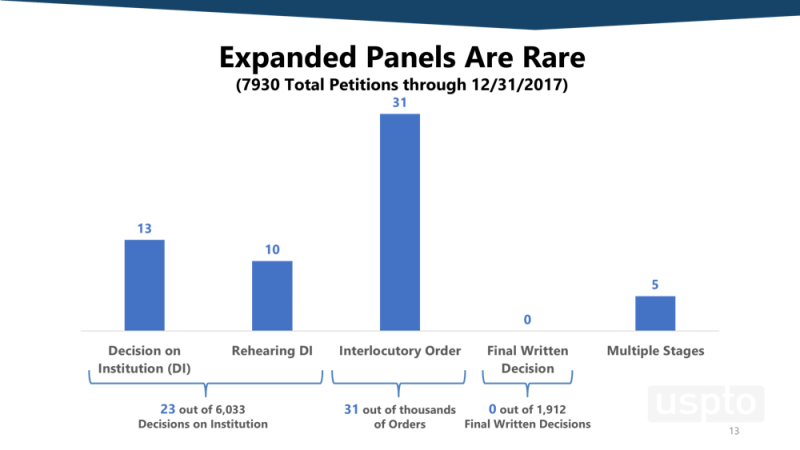
    The study described by the Chief Judge involved four questions:  1) how frequent were expanded panels convened? 2) under what circumstances? 3) what was the reasoning behind expanding the panel? and 4) what was the result?  The study considered 7,390 petitions filed before December 31, 2017, involving 6,033 institution decisions, 1,912 Final Written Decisions (FWDs), and "thousands" of interlocutory orders.  Expanded panel decisions were assessed "manually" and excluded families where expanded panels were used to conserve resources (multiple consolidated cases).

    Regarding the first question, the statistics showed 23 expanded panels of 6,033 institution decisions; 31 expanded panels of thousands of interlocutory orders; no expanded panels in 1,912 FWDs; and 5 expanded panels involving decisions in multiple consolidated IPRs.

    Slide
    Expanded panels when they arose were empaneled to make a decision on the merits 80% of the time and on request for rehearing in the other 20%.

    Data on the rationales for expanded panels were explicated in more detail.

    Slide 17
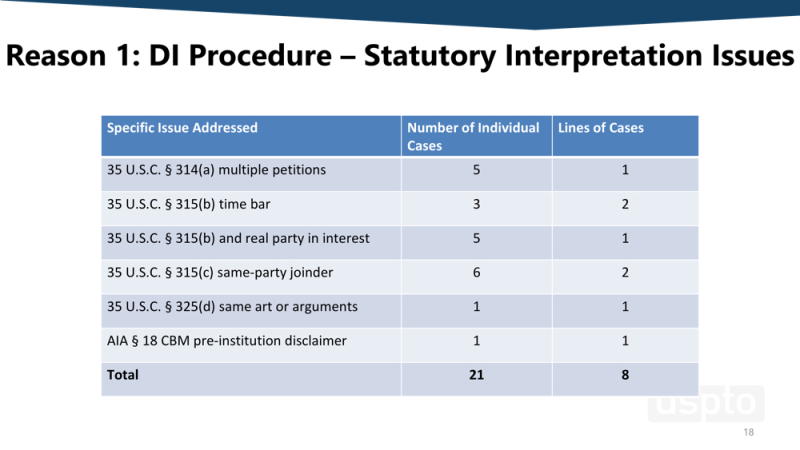
    There were 21 instances where the panel was expanded at institution to consider questions of statutory interpretation.

    Slide 18
    These included:

    • § 314(a) Multiple Petitions:  General Plastic v. Canon, Case IPR2016-01357, -01358, -01359, -01360, -01361 (PTAB Sept. 6, 2017) (Paper 19) (precedential) (vote from 3-0 to 7-0 with expansion on rehearing)
        – Emphasizes the factors that the Board considers in deciding whether to exercise its discretion to deny a follow-on Petition in an AIA proceeding under 35 U.S.C. § 314(a).

    • § 325(d) Similar Art/Arguments:  Neil Ziegmann v. Carlis G. Stephens, Case IPR2015-01860 (PTAB Sept. 6, 2017) (Paper 13) (vote from 3-0 to 5-0 with expansion on rehearing)
        – Emphasizes that prior art or arguments may be considered "substantially the same" under 35 U.S.C. § 325(d) if they are "cumulative to or substantially overlap  with issues previously considered by the Office with respect to the patent."

    • CBM Pre-Institution Disclaimer:  Facebook v. Skky, Case CBM2016-00091 (PTAB Sept. 28, 2017) (Paper 12) (precedential) (vote from 3-0 to 5-0 with expansion on rehearing)
        – Emphasizes that CBM patent review eligibility is determined based on the claims of the challenged patent as they exist at the time of the decision to institute, and that statutorily disclaimed claims must be treated as if they never existed for the purpose of institution.

    Five instances arose at institution decision for questions of petition requirements.

    Slide 20
    Four occurred on motion procedure.

    Slide 21
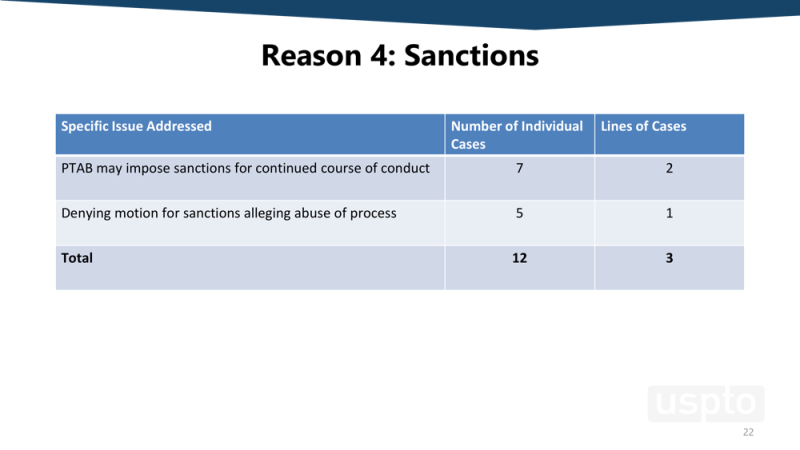
    Twelve involved decisions to impose sanctions.

    Slide 22
    Seven involved questions of sovereign immunity; and ten were at the request of the PTAB panel.  In these ten cases, HTC America v. Virginia Innovation Sciences, Case IPR2017-00870, -00871, -00872, -00873, -00874, -00875, -00876, -00877, -00878, -00879 (PTAB Sept. 13, 2017), the original panel suggested expansion to maintain uniformity due to substantial difference of opinion among the judges on a group of 10 related cases regarding an issue arising under 35 U.S.C. § 112(f).

    With regard to the fourth question, the Chief Judge contended that the expanded panel came to the same conclusion as the original panel, with the exception of Target Corp. v. Destination Maternity Corp. (IPR2014-00508), and Nidec Motor Co. v. Zhongshan Broad Ocean Motor Co., No. 2016-2321, slip op. (Fed. Cir. Aug. 22, 2017).

    The Chief provided these conclusions:

    • Expanded panels are very rare
    Most expanded panel decisions issued as original decisions, not decisions on rehearing
    • Panels were expanded for guidance and consistency:
        • to provide forward-looking guidance on reoccurring issues; and/or
        • to treat similarly situated parties the same
    • Underlying result remained the same after panel expansion on rehearing, except for Target and Nidec, both of which address same-party joinder

    Article I courts, and the PTAB in particular, have a legitimate goal:  providing consistent application of the law to applicants and, in the case of implementing the adversarial avenues the AIA created, developing a consistent body of procedural and substantive law.  To this end, for example, the PTAB has designated some (albeit few) cases precedential, thus providing notice to the public regarding how the Office can be expected to conduct the "trials" mandated by the statute.  But the manner in which the Board has attempted to provide this consistency, in particular with regard to expanded panels in post-grant review proceedings, has provoked sufficient controversy that Chief Judge Ruschke felt it necessary (or at least politically expedient) to requisition a study and include the results in his "chat."  The kerfuffle that has arisen over expanded PTAB panels is the direct result of the chimerical nature of the proceedings engendered by the Leahy-Smith America Invents Act.  Characterized as "trials" in the rhetoric used to obtain passage of the Act, the various post-grant review instruments are more in the nature of "a specialized agency proceeding" as the Supreme Court noted in Cuozzo Speed Technologies v. Lee.  Seen in this light the practice of expanding panels to ensure consistency of agency action would appear to have some merit.  Seen as a trial, however, the overriding consideration is due process, wherein a patentee cannot be deprived of her property except in an adjudicatory proceeding where she has a fair opportunity to be heard without the deck stacked against her.  The Office has been zealous in putting patents of purportedly dubious validity through the gauntlet of post-grant review.  To many, the Board needs to be just as zealous in ensuring that patentees be deprived of their patent properties only if due process is followed as rigorously in the Office as it is in district court.  It may be impossible to reconcile these two diverse mistresses intertwined in post-grant review, but if the Office does not, cannot, or will not, eventually the Supreme Court will.

  • By Kevin E. Noonan

    Saint Regis Mohawk TribeThe Federal Circuit has granted the St. Regis Mohawk Tribe's motion for stay in inter partes review proceedings before the Patent Trial and Appeal Board, in St. Regis Mohawk Tribe v. Mylan Pharmaceuticals Inc.  In the Order, the Court notes that the PTAB had scheduled final hearing in the IPR for April 3, 2018, and that the Court had sua sponte ordered expedited briefing in the Tribe's appeal in advance of a June 2018 date for oral argument.

    The Order also contained this passage, indicating a certain degree of impatience with how the PTAB has observed the jurisdictional niceties:

    At this juncture, it appears that the appeals divested the Board of jurisdiction over the aspects of the case on appeal, see Griggs v. Provident Consumer Discount Co., 459 U.S. 56, 58 (1982); Princz v. Fed. Republic of Ger., 998 F.2d 1 (D.C. Cir. 1993) (appeal from denial of motion to dismiss on grounds of sovereign immunity divests district court of jurisdiction over entire case); Apostol v. Gallion, 870 F.2d 1335 (7th Cir. 1989); accord In re Graves, 69 F.3d 1147, 1149 (Fed. Cir. 1995), and that exclusive jurisdiction to resolve the threshold issue of whether these proceedings must be terminated vests in this court, and that the Board may not proceed until granted leave by this court.  The stay shall remain in effect until the day after oral argument in the appeals in June 2018.  The court will address whether the stay shall remain in effect or whether it will be lifted at that time based on further consideration of the merits of the appeals.

    The Tribe’s opening brief is due no later than April 18, 2018, and Mylan and the other Petitioners' brief are due no later than May 11, 2018, with the Tribe's Reply brief and the joint appendix due no later than May 18, 2018.  While not specifically mentioned, amicus briefing falls under Federal Circuit Rule 29, wherein briefs will be due one week after the Tribe's brief for amici supporting their position and amici supporting neither party, and one week after Petitioner's brief for its amicus supporters.  Amici must obtain permission of all parties or leave of the court.

  •  Virtual Reality Patents Survive Patent-Eligibility Challenge

    By James Korenchan

    District Court for the Northern District of CaliforniaLast week, Judge Seeborg of the U.S. District Court for the Northern District of California ruled that claims related to virtual reality applications are patent eligible under 35 U.S.C. § 101.  Plaintiff Electronic Scripting Products, Inc. (ESPI) accused HTC American, Inc. (HTC) of direct and induced infringement through HTC's VIVE virtual reality headsets.  Defendant HTC then brought the § 101 challenge against ESPI in a motion to dismiss.  While this challenge failed, HTC was still successful in having ESPI's complaint thrown out for failure to state a claim, and the Court granted ESPI leave to amend.

    The patents at issue in this case, U.S. Patent No. 8,553,935 (the '935 patent) and U.S. Patent No. 9,235,934 (the '934 patent), are in the same family and are directed to measuring pose (i.e., a three-dimensional (3D) position) and orientation of objects in real 3D environments using on-board photodetectors and stationary light sources.  The claimed methods and apparatuses have both virtual reality and augmented reality applications.  Both patents state a need in the art for improved motion tracking of all six degrees of freedom inherent in 3D space, which can be achieved with more robust and rapid pose determination of objects, such as remotes, wands, pointers, and gaming controllers.  The tracked pose and motion of such objects can be digitized with respect to a reference location in real space, which makes one-to-one motion mapping between real space and cyberspace possible.  Ideally, such improvements can reduce or eliminate frequency-encountered problems with a user's quality of experience, such as information loss, position aliasing, gradual drift, and position error.

    Representative claims of each patent are as follows:

    U.S. Patent No. 8,553,935:

    12.  A system comprising a manipulated object, said system comprising:
        a) a first plurality of predetermined light sources disposed at known positions in world coordinates;
        b) a photodetector mounted on-board said manipulated object for generating light data indicative of light detected from said first plurality of light sources;
        c) a relative motion sensor mounted on-board said manipulated object for generating relative motion data indicative of a change in an orientation of said manipulated object; and
        d) a processor for determining the pose of said manipulated object based on said light data and said relative motion data, wherein said pose is determined with respect to said world coordinates.

    U.S. Patent No. 9,235,934:

    1.  A wearable article cooperating with a first plurality of predetermined light sources disposed in a known pattern, said wearable article comprising:
        a) a photodetector configured to detect said first plurality of predetermined light sources and generate photodetector data representative of the positions of said first plurality of predetermined light sources; and
        b) a controller configured to identify a derivative pattern of said first plurality of predetermined light sources from said photodetector data, wherein said derivative pattern is indicative of the position of said photodetector.

    In hopes of dismissing these claims on Alice grounds, HTC asserted that the claims are directed to patent-ineligible abstract concepts of observing visible points in space and determining the position (e.g., the pose and orientation) of an object relative to the viewer.  HTC went as far as characterizing the claims as an attempt to patent an abstract process of using objects to determine one's position, "as sailors have done by looking at the stars for centuries."  Further, HTC cited to 2016's In re TLI Communications LLC Patent Litigation, in which the Federal Circuit found the recited tangible components of a telephone unit and a scanner to amount to no more than conduits for an abstract idea of "classifying an image and then storing the image based on its classification."  HTC argued that the tangible components here — namely, the recited photodetector and the motion sensor — are likewise such conduits.

    In response, ESPI relied almost entirely on the Federal Circuit decision in Thales Visionix Inc. v. U.S., in which the Federal Circuit found patent-eligible claims that were "not merely directed to the abstract idea of using mathematical equations for determining the relative position of a moving object to a moving reference frame," but rather "directed to systems and methods that use inertial sensors in a non-conventional manner to reduce errors in measuring the relative position and orientation of a moving object on a moving reference frame."  Further, ESPI noted various manners in which the asserted patents provide novel advantages over conventional systems, such as by increasing the speed and accuracy of 3D pose recovery, reducing noise, and reducing system complexity, and cost.

    HTC attempted to distinguish ESPI's claims from those in Thales, arguing that, while the eligible claims in Thales provided an improvement over the prior art by having a specific configuration of elements and a particular arrangement of sensors, ESPI's claims do not require any specific configuration of either the recited photodetectors or light sources, and also do not provide an improvement over the prior art.

    However, the Court agreed that the claims were similar enough to those in Thales to survive under Alice (albeit saying it was a "close call"), saying that HTC's attempts to distinguish this case from Thales mischaracterize what ESPI's patents state.  Addressing step one of the Alice framework, the Court highlighted differences between the patents and conventional methods.  While conventional methods use photodetectors positioned in and around the environment in order to determine a manipulated object's pose, ESPI's patents specify that a remote control or the manipulated object itself is equipped with motion sensors and the photodetector.  The Court then went on to further emphasize the improvements and non-conventionality of the claimed invention, noting that ESPI recognized a need for improved motion tracking in virtual reality applications "and accomplished this by reversing the usual placement of markers and sensors and using only light sources," thus providing a novel arrangement "eliminat[ing] the need for multiple synchronized imaging cameras located in the environment and also minimiz[ing] the bandwidth and processing needs of the system."

    Concluding its short step one analysis, the Court echoed ESPI's arguments with respect to Thales, and distinguished the claims from those in TLI Communications, stating that the recited sensors "are not mere conduits for abstract principles, but instead their placement is integral to the improved functioning of the system."

    Rather than stop its analysis there, the Court quickly addressed step two, stating that the claims would have survived regardless of the outcome of step one.  Briefly, citing BASCOM Global Internet Services, Inc. v. AT&T Mobility LLC for support ("[A]n inventive concept can be found in the non-conventional and nongeneric arrangement of known, conventional pieces."), the Court yet again emphasized the claimed invention's simpler, less expensive, versatile, and non-conventional approach, calling it "sufficiently inventive."

    This Order is a positive one for patent owners in the virtual and augmented reality fields.  The Court focused quite heavily here on the improvements and advantages of the claimed invention over more conventional approaches.  If patent owners in these fields can invite and rely on the same focus, it would be a useful tool in withstanding Alice scrutiny.

    Order Granting Motion to Dismiss by District Judge Seeborg

  • By George "Trey" Lyons, III

    USPTO SealAs an endcap to a recent webinar Andrew Williams and I did on the most important PTAB stories from the past year, I addressed the effects that multiple, often serial, petitions can have on patent owners and their patents, and what can be done to alleviate some of the associated stresses — or increase them if you're the petitioner.  See Top Stories at the PTAB: What You Need to Know (Mar. 13, 2018), available here.  As final topics often go, however, my coverage was constrainedly brief.  So, here I will unpack the analysis patent owners and petitioners, alike, should keep top-of-mind when moving through this strategy.

    To frame this issue, for PTAB petitioners who pay no attention to sunk-cost fallacies, the idea of throwing good money after a bad petition (e.g., those filed by another petitioner, based on different art and/or arguments) may always seem like the most aggressive and effective option at your disposal.  From the point of view of the patent owner, the anxiety of finding yourself as the recipient of a multiple petition barrage crying for the revocation of your hard-earned patent rights is often real, and may even seem fundamentally unfair.

    Understanding this concern, late last year the PTAB undertook a comprehensive study to look at just how many patents have actually faced multiple petitions, who filed them, when they were filed, and how effective they were, both in terms of institution rate and the number of challenged patents that were ultimately lost (in whole or part).  See Multiple Petitions Study (Oct. 24, 2017), available here.  Because both the ultimate message (i.e., "Fear not, multiple petitions are really not that big of a threat") and the delivery (e.g., fairly confusing metrics, etc.) felt a little unsettling, a few key aspects of the study are likely worth further explication.

    In the study, the PTAB reviewed 7,168 petitions addressing 4,376 patents.  From this, taking a "just the facts" approach where we can, some of the more important statistics presented in the study were as follows:

    Who's Filing:  84.8% of patents were challenged by a single petitioner, and 94.5% faced two or fewer.

    Image 1
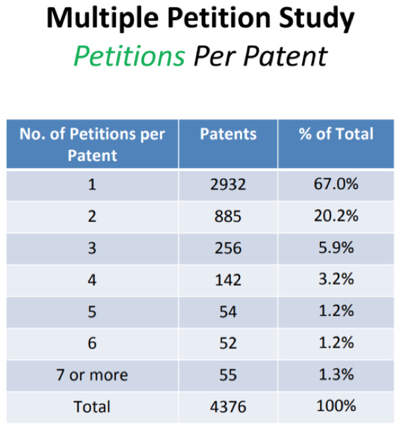
    What's Being Filed:  67% of patents are challenged by one petition, 20.2% of patents are challenged by two petitions, and the numbers fall off quickly from there.

    Image 2
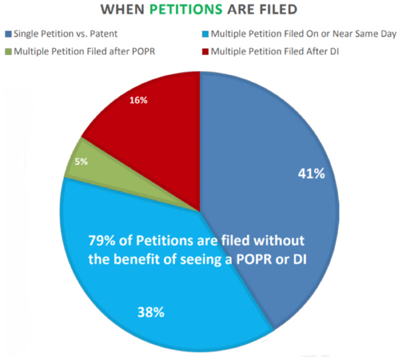
    When Are They Filed:  Next, in slightly different approach, the PTAB examined when all of these petitions were actually filed.  The presentation, however, may have been a little misleading considering the topic at hand — the impact of multiple petitions on post-grant proceedings.  The PTAB's graph below indicates that 79% of petitions are filed before the patent owner preliminary response or institution decision, 95% of petitions are filed in a given petitioner's first round (before any institution decision), and only 5% of petitions are filed after a patent owner preliminary response, but before institution decision.

    Image 3
    The slightly confusing part of this graph, however, is that some might interpret it on first impression as applying only to multiple petitions.  Not so.  Instead, the 41% (seen here in purple) included in the PTAB-touted "79% of Petitions" being filed without the benefit of seeing a patent owner preliminary response or institution decision are actually instances in which only one petition was ever filed.  But, if you are more interested in the more pressing question seemingly at the center of the study — when multiple petitions were filed — the percentage of "wait-and-see" petitioners are actually much more substantial.  Specifically, normalizing these percentages over the number multiple petitions filed, the impact looks more like this:  64.4% of multiple petitions were filed on or near the same day, 8.4% were filed after the patent owner preliminary response, and 27.19% were filed after the decision institution.  Thus, if you're going to be filing (or facing) multiple petitions, the "wait-and-see" strategy seems to be alive and well.

    Finally, perhaps not surprisingly at this point, the Board also found that instances of any further, subsequent rounds of petitions past a second round were statistically insignificant (less than 0.1%, and where a "round" is all petitions filed before receiving a decision institution on one of those petitions).  Considering the typical timeline from filing to institution decision in light of the statutory time bar for filing, the PTAB really only confirmed that there are, statistically, very few instances in which multiple full rounds of petitions were filed.

    Based on these figures, it would seem that some of the biggest challenges for patent owners who consider these petitions (and PTAB proceedings generally) as "death marches" for their hard-earned property rights (e.g., facing more than one petitioner, facing more than two petitions) are not, statistically, as relevant as some may have thought; but facing the ever-dreaded (and often effective) "wait-and-see" petitioners may well be.

    The impact articulated by the PTAB that these petitions actually have on the challenged patent was also very surprising — although a little difficult to appreciate in the graphs presented below.

    Multiple Petition Effect on Institution Decision:

    First, the PTAB noted that although institution rates have decreased, the effect that multiple petitions have on those ultimate institution rates is marginal (70% versus 64% in 2017), but has increased slightly (4% in 2013 to 7% in 2016).  To help cut through these figures, the blue line below indicates a measure of the institution rate by patent, which is agnostic of how many petitions were actually filed against the patent (e.g., two petitions filed against a patent, one gets instituted, one does not = 100% institution rate).  The green line, on the other hand, indicates a measure of the institution rate by petition, which is an outcome averaged by how many petitions were actually filed against the patent (e.g., two petitions filed against a patent, one gets instituted, one does not = 50% institution rate).

    Image 4
    Thus, as you can see, although the overall institution rate in post-grant proceedings has decreased over the past four years, the impact of filing multiple petitions has increased slightly (note, the figures for 2017 only include analysis for the first half of the year).  Even so, the PTAB's answer to biggest question left on everyone's lips — "What will this process ultimately mean for my patent (or the one I'm challenging)?" — was perhaps the most surprising of all.

    Multiple Petition Effect on Ultimate Outcome of the Challenged Patent:

    Turning to this answer, it is clear that the real effect of multiple petitions is most naturally viewed by considering how these same variables affect the ultimate outcome of the trial[s] and how the patent itself actually changed by going through it [them].  In the graph below, once again the blue and green coloration reflects the scenarios above, which indicate that 69% of all petitions result in a patent being unchanged and 58% of patents are completely unchanged at the end of one or more AIA proceedings.  Furthermore, the PTAB's figures also indicate that multiple petitions are slightly more beneficial for challenging some claims as unpatentable, as opposed to all claims as unpatentable.  Regardless, from the PTAB's view, the impact of multiple petitions in post-grant proceedings on the number of challenged patents that were ultimately lost (in whole or part) does not seem as great as some people feared.

    Image 5Takeaways:

    Bringing all of this back home, although somewhat hard to believe the results of the PTAB's "Multiple Petition Study" seem to indicate that the threats posed to patent owners by petitioners "abusing the system" and filing multiple petitions is not as rampant or pressing as many believed — at least based on the PTAB's metrics.  The effect that these statistics really have on strategies for navigating post-grant proceedings moving forward, however, really seems to be threefold, all depending on the chair you're sitting in.

    First, if you're in the petitioner's chair, and you want to make multiple attempts at invalidating a patent using these proceedings (e.g., correct deficiencies of your own petition, divide and conquer claims, or show another petitioner what they should have argued), you're going to be inclined to throw good money after what you've perceived to be bad (or, more fairly, incomplete) results.  Second, if you're in the patent owner's chair, you don't really care what this study says or what happened to anybody else, because you just got a second (or potentially third, etc.) petition dropped in your lap and you want to know the best path forward.  And third, if you're in the PTAB's chair, based on this study, you probably don't even think there's a problem, and even if there is, you'll deal with it in the "broad discretion" you've been granted by 35 U.S.C. §§ 314(a) and 325(d).

    But all said, because this strategy is likely not going away in the foreseeable future, we will turn to the factors and strategies at play when navigating multiple petition proceedings in light of this study and subsequent case law in the next installment. 

  • CalendarMarch 28, 2018 – "Patent Infringement: Structuring Opinions of Counsel — Leveraging Opinion Letters to Reduce the Risks of Liability and Enhanced Damages" (Strafford) – 1:00 to 2:30 pm (EDT)

    March 29, 2018 – "The Evolving Scope of IPR Estoppel" (Federal Circuit Bar Association) – 1:00 pm to 2:00 pm (EST), Washington, DC

    March 29, 2018 – "Patent Prosecution Estoppel from PTAB Proceedings" (Intellectual Property Owners Association) – 2:00 to 3:00 pm (ET)

    March 29, 2018 – "Achieve the 'QUALITY' in Patents and Avoid Common Mistakes" (CPA Global) – 11:00 am (CT)

    April 5, 2018 – "Paragraph IV Litigation and IPRs — Interplay Between Paragraph IV Litigation and IPRs, Multiple Generic Challengers, Key Issues in IPRs" (Strafford) – 1:00 to 2:30 pm (EDT)

    April 6, 2018 – "Are Patents Under Attack?" (Federal Circuit Bar Association and Center for Innovation Policy at Duke Law) – 8:00 am to 4:45 pm (ET), Duke University School of Law, Durham, NC

    April 7, 2018 – "Court of Appeals for the Federal Circuit Practice & Procedure" (John Marshall Law School Center for Intellectual Property, Information & Privacy Law) – 9:00 am to 4:30 pm (CT), John Marshall Law School, Chicago, IL

    April 9, 2018 – "The Patent System: Transformative Times" (Federal Circuit Bar Association and Boston Patent Law Association) – 2:30 pm to 5:30 pm (ET), Northeastern University, Boston, MA

    April 10, 2018 – "Federal Circuit Practice & Insights: A Townhall with Federal Circuit Judge Kara Stoll" (Federal Circuit Bar Association and Michigan IP Inn of Court) – 4:30 pm to 6:30 pm (ET), University of Detroit Mercy School of Law, Detroit, MI

    April 12, 2018 – "Protecting Software as a Medical Device With Patents, Design Patents and Trade Secrets" (Strafford) – 1:00 to 2:30 pm (EDT)

    April 14, 2018 – "Court of Appeals for the Federal Circuit Practice & Procedure" (John Marshall Law School Center for Intellectual Property, Information & Privacy Law) – 9:00 am to 4:30 pm (CT), John Marshall Law School, Chicago, IL

  • CPA GlobalCPA Global will hosting a webinar entitled "Achieve the 'QUALITY' in Patents and Avoid Common Mistakes" on March 29, 2018 beginning at 11:00 am (CT).  Larry M. Goldstein will discuss:

    • The patent value hierarchy
    • Definitions of "good" and "valuable"
    • Quality in provisional applications and non-provisional applications

    Those interested in registering for the webinar can do so here.