• CalendarApril 23-24, 2018 – Paragraph IV Disputes conference (American Conference Institute) – New York, NY

    April 24, 2018 – "Trade Secrets Update 2018: Year Two of the DTSA" (McDonnell Boehnen Hulbert & Berghoff LLP) – 10:00 am to 11:15 am (CT)

    April 26, 2018 – "Patent Eligibility, Duty to Disclose and More: USPTO Manual of Patent Examining Procedure New Guidance" (Strafford) – 1:00 to 2:30 pm (EDT)

    April 27, 2018 – Ethics in the Practice of Intellectual Property Law (John Marshall Law School Center for Intellectual Property, Information & Privacy Law) – 12:30 to 5:15 pm, Chicago, IL

    May 1, 2018 – "Patent Inventorship: Best Practices for Determination and Correction — Distinguishing Between Inventor and Contributor; Navigating Joint Inventorship, Disclosure of Ownership, Real Party in Interest" (Strafford) – 1:00 to 2:30 pm (EDT)

    May 2, 2018 – "Recent Developments in Double Patenting: ODP Challenges and Considerations" (The Knowledge Group) – 12:00 to 1:30 pm (ET)

    May 3, 2018 – "Patent Ownership Rights: Structuring Assignment and Employment Contracts — Key Provisions, Implications for Litigation, Recent Court Treatment" (Strafford) – 1:00 to 2:30 pm (EDT)

    May 3, 2017 – "The Very Essence of Romance is Uncertainty" (Intellectual Property Owners Association European Practice Committee) – Amsterdam, Netherlands

    May 3, 2018 – "The Evolving State of Sovereign Immunity Before the Patent Trial and Appeal Board" (Technology Transfer Tactics) – 1:00 to 2:00 pm (ET)

    May 8, 2018 – Symposium on Intellectual Property (George Washington University Law School, Pillsbury, NERA Economic Consulting, and Mayer Brown) – Washington, DC

    May 8, 2018 – "Intellectual Property Valuation and Damages: Nuts and Bolts in 2018" (The Knowledge Group) – 12:00 to 1:30 pm (ET)

    May 9, 2018 – "Supplemental Examination Requests: Benefits and Limitations, Strategic Use — Assessing Enforceability of Patent Portfolios, Evaluating the High Burden" (Strafford) – 1:00 to 2:30 pm (EDT)

    May 8-10, 2018 – Patent Fundamentals Bootcamp 2018: An Introduction to Patent Drafting, Prosecution, and Litigation (Practising Law Institute) – Chicago, IL

    June 13-15, 2018 – Patent Fundamentals Bootcamp 2018: An Introduction to Patent Drafting, Prosecution, and Litigation (Practising Law Institute) – New York, NY

    June 25-27, 2018 – Summit on Biosimilars (American Conference Institute) – New York, NY

    July 18-20, 2018 – Patent Fundamentals Bootcamp 2018: An Introduction to Patent Drafting, Prosecution, and Litigation (Practising Law Institute) – San Francisco, CA

  • PLI #1Practising Law Institute (PLI) will be holding its Patent Fundamentals Bootcamp 2018: An Introduction to Patent Drafting, Prosecution, and Litigation on May 8-10, 2018 in Chicago, IL, on June 13-15, 2018 in New York, NY, and on July 18-20, 2018 in San Francisco, CA.  The three-day program, which is directed to patent prosecuting and litigating attorneys and patent agents with or without a Patent Office registration number or little patent experience, will focus on teaching the basics of claim drafting, patent application preparation and prosecution, as well as a review of recent developments in the law.  A litigator's perspective is also presented to show how drafting and prosecution can influence the development, and often the outcome, of subsequent patent litigation.  The seminar will feature lectures in the morning followed by small clinic sessions in the afternoon, with day 1 focusing on invention disclosures and patent preparation, day 2 on prosecution and issuance, and day 3 on litigation/claim analysis.  Lectures will explain:

    • Learn how to prepare a patent application that satisfies the statutory requirements for patentability and distinctly claims the subject matter which the applicant regards as the invention with an eye towards successful prosecution and enforcement
    • Understand how to prosecute an application to obtain allowance of an enforceable patent
    • Find out how to interview an Examiner
    • Discover effective uses of reissues, reexamination supplemental examinations, inter partes review, post-grant review and other post-issuance proceedings
    • Determine best practices to anticipate patent litigation issues during the patent prosecution process
    • Get helpful approaches on patent opinion drafting
    • Learn how to prepare infringement/invalidity claim charts for litigation

    PLI faculty will offer presentations on the following topics:

    • Initial Steps of a Patent Invention Disclosure
    • An Overview of Claim Drafting and Preparation of a Patent Application
    • The Basics of Patent Claim Drafting
    • Review of Patent Model Claims
    • An Overview of Patent Prosecution
    • Conducting the Examiner Interview
    • Patent Prosecutor Ethics
    • Patent Litigation Issues
    • Patent Claim Chart Review

    A program schedule and list of speakers for each of the locations can be found herePatent Docs authors Kevin Noonan (Chicago co-chair) and Donald Zuhn will be presenting on day 1 at the Chicago seminar.

    The registration fee for the conference is $2,195.  Those interested in registering for the conference can do so at the PLI website.

  • George Washington University Law SchoolThe George Washington University Law School (with Pillsbury, NERA Economic Consulting, and Mayer Brown) will be holding its annual Symposium on Intellectual Property on May 8, 2018 at The George Washington University Law School, 2000 H Street NW, Washington, DC.  The Symposium will offer presentations on the following topics:

    • Keynote Address — Hon. David Ruschke, Chief Administrative Patent Judge, U.S. Patent and Trademark Office
    • Hot Topics at the Patent Trial and Appeal Board
    • Effective Appellate Advocacy at the Federal Circuit
    • Valuation of Patent Portfolios
    • Current Issues Facing In-House Patent Lawyers

    Additional information about the Symposium, including a program and list of speakers can be found here.  A cocktail reception will take place following the Symposium.

    Registration for the symposium is complimentary.  Those interested in registering for the Symposium can do so here.

  • Technology Transfer Tactics will be offering a webinar entitled "The Evolving State of Sovereign Immunity Before the Patent Trial and Appeal Board" on May 3, 2018 from 1:00 to 2:00 pm (ET). Tyson Benson of Harness, Dickey & Pierce, PLC will address the following topics:

    • Recent decisions handed down by the Patent Trial Appeal Board, including decisions that:
        – held a university entity waived its sovereign immunity by filing a patent infringement case in district court
        – denied trial sovereign immunity for lack of establishment that trial sovereign immunity should be applied in PTAB proceedings
    • What technology managers should be doing to protect their patent portfolio during this ever-evolving subject
    • Potential impact on licensing and patent value
    • Updates from pending cases, new decisions, and/or arguments
    • Potential impact of the newly introduced Preserving Access to Cost Effective Drugs (PACED) Act

    The registration fee for the webinar is $197. Those interested in registering for the webinar, can do so here.

    Technology Transfer Tactics

  • Strafford #1Strafford will be offering a webinar entitled "Supplemental Examination Requests: Benefits and Limitations, Strategic Use — Assessing Enforceability of Patent Portfolios, Evaluating the High Burden" on May 9, 2018 from 1:00 to 2:30 pm (EDT).  Thomas L. Irving, Amanda K. Murphy, and Jennifer S. Swan of Finnegan Henderson Farabow Garrett & Dunner will guide patent counsel on supplemental examination requests generally and specific to chemical patents, examine the supplemental examination successes and its limitations, and provide insight on the strategic use of supplemental examinations.  The webinar will review the following issues:

    • How should counsel balance the benefits and limitations of supplemental examination before filing a request?
    • What are the burdens for patent owners considering a request for supplemental examination?
    • How can pharma patent owners leverage the patent system along with the drug approval process?
    • What is the impact on supplemental examination?

    The registration fee for the webcast is $297.  Those interested in registering for the webinar, can do so here.

  • The Knowledge GroupThe Knowledge Group will offer a webcast entitled "Intellectual Property Valuation and Damages: Nuts and Bolts in 2018" on May 8, 2018 from 12:00 to 1:30 pm (ET).  David Leathers of Alvarez & Marsal, Peter Hess of Analysis Group, and Brian Dies of Hoffman Alvary & Company LLC will address the following topics:

    • IP Valuation Methods: Recent Trends and Developments
    • Estimating Damages in IP Litigation
    • Notable Court Rulings
    • Overcoming Challenges
    • Maximizing IP Asset's Value

    The registration fee for the webcast is $99.  Those interested in registering for the webinar can do so here.

  • By Josh Rich

    ABAOn April 17th, the American Bar Association provided a formal opinion regarding the requirement that attorneys disclose errors to clients.  Its opinion was based on Rule 1.4 of the Model Rules of Professional Conduct, which governs communications with clients.  The ABA concluded that attorneys have a duty to disclose material errors to clients, but no duty to disclose errors to former clients.  In this context, an error is material if a disinterested attorney would believe that the error would likely cause harm or prejudice to the client, or that the error would reasonably cause a client to consider terminating the practitioner's representation — even if there would be no prejudice to the client.

    Rule 1.4 of the Model Rules of Professional Conduct is the widely-adopted basis for the duty of disclosure to clients.  Forty-nine of the fifty states have adopted versions of the Model Rules of Professional Conduct, along with the U.S. Patent and Trademark Office and four of the five U.S. territories.[1]

    The U.S. Patent and Trademark Office's version of Model Rule 1.4 reads:

    (a) A practitioner shall:
        (1) Promptly inform the client of any decision or circumstance with respect to which the client's informed consent is required by the USPTO Rules of Professional Conduct;
        (2) Reasonably consult with the client about the means by which the client's objectives are to be accomplished;
        (3) Keep the client reasonably informed about the status of the matter;
        (4) Promptly comply with reasonable requests for information from the client; and
        (5) Consult with the client about any relevant limitation on the practitioner's conduct when the practitioner knows that the client expects assistance not permitted by the USPTO Rules of Professional Conduct or other law.
    (b) A practitioner shall explain a matter to the extent reasonably necessary to permit the client to make informed decisions regarding the representation.

    37 C.F.R. § 11.104.  The obligation to disclose errors arises primarily out of sections (a)(1) and (a)(3), but also relies upon sections (a)(2) and (a)(4).  Specifically, a material error is the sort of information that forms an important part of the status of a case or matter and would lead the client to have to make informed decisions.  In light of those provisions, numerous states (both courts and bar associations) have found that an attorney has an obligation to disclose any errors that could cause prejudice to a client, underlie an ethics complaint, or give rise to a malpractice claim.

    The ABA found that the obligation of disclosure would go further, however.  Even if there is no prejudice to the client, it concluded that there would be a duty to disclose errors that an independent, disinterested attorney would believe would cause a reasonable client to lose confidence in the erring practitioner.  Notably, no jurisdiction has yet found such an obligation of disclosure, and the issue would not come up in the context of a malpractice case.  However, it could come up in the context of an ethics complaint, and the risk of non-disclosure (or covering up) a non-prejudicial error is likely greater than the cost of disclosing it with an explanation.

    In determining the scope of the obligation of disclosure, however, the ABA found a clear limit.  Namely, the obligation to disclose extends only to current clients.  Rule 1.4 describes the obligation of communication as relating to a "client," not to former clients.  As a result, if the error is not identified until after the representation ends — and the representation has been terminated in accordance with Rule 1.16 — there is no obligation to disclose an error.  There may be practical reasons, such as goodwill or business development, for such a disclosure, but there is no ethical obligation under this ABA opinion.

    Thus, the ABA has drawn a clear division between current and former clients with regard to the disclosure of errors.  For a current client, a practitioner must disclose errors that a reasonable, disinterested practitioner would believe (a) would be reasonably likely to harm or prejudice the client or (b) would reasonably cause the client to consider terminating the representation.  For former clients, as long as the representation has been properly terminated, there is no ethical duty to disclose any errors whatsoever.

    [1] California has not adopted the Model Rules, but has a provision analogous to Rule 1.4 in its rules.  Furthermore, the bar has proposed adoption of the Model Rules to the California Supreme Court.  The only territory that has not adopted the Model Rules is Puerto Rico.

  • Claims for Refreshing Phone Display Found Patent Eligible

    By James Korenchan

    District Court for the Northern District of CaliforniaEarlier this month, the U.S. District Court for the Northern District of California ruled that claims related to refreshing a phone's display are patent eligible under 35 U.S.C. § 101.  In response to an infringement suit brought by Local Intelligence, LLC, Defendants HTC America, Inc. and HTC Corporation (collectively, "HTC") challenged the eligibility of the asserted patents in their motion to discuss.  The motion was denied, with the Court relying almost entirely on the recent Federal Circuit decision in Core Wireless Licensing S.A.R.L. v. LG Electronics, Inc. (Fed. Cir. 2018).

    The patents at issue in this case, U.S. Patent Nos. 8,903,067 (the '067 patent), 9,219,982 (the '982 patent), and 9,084,084 (the '084 patent), are in the same family and are related to "automatically refreshing a display screen of a telephone."  The specification, shared by each patent, states that users typically have to navigate through many different menus to access the numerous services that their phones provide, such as voice messaging, weather and traffic, transferring funds, and ordering merchandise.  Acknowledging that users often access certain services at the same times or locations on a repeating basis (or use some services more than others), the patents purport to improve the display of services by utilizing these types of user behavior.  In particular, the invention involves storing mappings between specific locations or times and certain "functions" that correspond to particular services.  For instance, the function of "home" could represent the location of the user's home and could be mapped to whichever services the user typically accesses at home.  Given these mappings, the invention automatically determines the current time or location and then refreshes the display with whichever services are mapped to the current time or location.

    Both parties agreed that the asserted patents contained minimal differences in their claims, and thus the Court analyzed the asserted claims collectively, using claim 1 of the '067 patent as a representative claim:

    1.  A telephone having a display panel; a datastore including at least one function, wherein the at least one function comprises information relating to a current location of a telephone and at least one other condition associated with a user of the telephone, wherein the at least one function is associated with at least one communication service; circuitry operable to connect the telephone to a location server to obtain a current location of the telephone; and a function selector programmable to refresh a screen on the display panel of the telephone to include at least one communication service associated with the function, based at least in part on a current location of the telephone.

    In its motion to dismiss, HTC argued that the asserted claims are directed to no more than providing communication information based on user location and other information and are thus comparable to the abstract claims in Intellectual Ventures I LLC v. Capital One Fin. Corp. (Fed. Cir. 2017), which involved tailoring web-based content based on a viewer's location and address.  HTC also argued that "tailoring information is a fundamental process that precedes the computer era, and the claims are not sufficiently specific to recite a specific solution."

    Local Intelligence responded by arguing that the claims are instead directed to "specific systems and methods that use a location server associated with a system such as a WiFi network (and not a positioning system like GPS) to obtain a phone's current location, and a phone's 'datastore' or memory (as opposed to a carrier's records), in order to provide and refresh location – relevant communication services on a phone's display as the phone's current location changes."  Thus, Local Intelligence contended that the claims provide a specific solution to problems that arise when "using location-based technology in conjunction with displaying particular communication services on a phone."

    But the Court was not quite satisfied with either party's interpretation.  Finding HTC's interpretation too broad and Local Intelligence's interpretation too narrow, the Court instead concluded that the claims were directed to refreshing location-relevant communication services on a phone's display by obtaining a current location from a location server, selecting communication services using logic in a database, and refreshing the display.

    Given this, the Court turned to step one of the Alice framework and confidently declared that the Federal Circuit's Core Wireless decision is controlling.  In particular, the Court stressed the similarities between the asserted claims and those in Core Wireless, stating that "Both relate to the computer technology of user interfaces.  . . .  Both purport to solve the same problem within the realm of user interfaces: limited display space on electronic devices with small screens.  . . .  And both claim a specific manner of solving this problem."  The Court continued, stating that both the asserted claims and those in Core Wireless recite specific manners of limiting information that is displayed.  The Court then reached its conclusion:

    As such, the claims at issue do more than simply state a result (i.e., display communication services according to current location); they also recite the way in which it is accomplished (i.e., using location retrieved from the location server and functions stored in the datastore).  Accordingly, because the specific improvement to the technology of user interfaces claimed in Core Wireless was not an abstract idea, the Court must conclude that the similarly specific improvement to user interfaces claimed here is also not an abstract idea.

    Before wrapping up its analysis, the Court specifically addressed some of HTC's contrary arguments.  First, the Court dismissed HTC's argument that the asserted patents did not identify a particular technological problem to solve.  (However, though the Court believed the patents aimed to solve the same limited display space problem as in Core Wireless, they made sure to note that "not every purported technological improvement is patent eligible.")  Next, the Court dismissed HTC's argument that the asserted claims were not as specific as those in Core Wireless, particularly emphasizing the "functions," "datastore," and "location server" claim limitations:

    The claims in Core Wireless and the claims at issue here accomplish specificity in different ways, but they both do so to substantially the same degree.  In Core Wireless, the claims at issue recited specific graphical characteristics of the improved user interface (e.g., an "application summary window" which must be "reached directly" from the main menu, which contains "data" which is "selectable to launch the respective application").  . . .  Here, the claims at issue recite specific implementation characteristics as to how the information to be displayed is limited for the small screen (e.g., using a "location server" to supply the current location and using "functions" stored in a "datastore" to determine which communication services should be selected).  . . .  As such, the claims of the Asserted Patents recite the solution with a similar level of specificity to the Core Wireless claims and cannot be distinguished on this basis.

    Finding the claims to be non-abstract, the Court proceeded no further.

    Local Intelligence, LLC v. HTC America, Inc. (N.D. Cal. 2018)
    Order Denying Motion to Dismiss by District Judge Edward J. Davila

  • Slot Machine Patent Invalidated As Being Directed to Ineligible Subject Matter

    By Joseph Herndon

    District Court for the District of NevadaKonami sued High 5 Games for patent infringement of U.S. Patent Nos. 8,096,869; 8,366,540; 8,662,810; and 8,616,955.  The '869 patent, which is entitled "Gaming Machines with Runs of Consecutive Identical Symbols," issued on January 17, 2012, and is the parent patent for the other three patents in this case.  The patents disclose variations on a slot gaming device in which the simulated digital "reels" depict a consecutive run of identical symbols in one reel to heighten the player's anticipation of a winning outcome, with the identical symbol changing for each "game."

    The District Court granted summary judgment for High 5 Games, finding that the patents were directed to ineligible subject matter, i.e., an abstract idea equated to rules of a game.  While the Federal Circuit has noted that a "game using a new or original deck of cards" could potentially survive a § 101 challenge, the claims at issue here were found to only be directed to changes to game rules of a generic slot machine using conventional technology—thus, lacking a new/original "deck of cards" (i.e., new technology).

    Patents At Issue

    The '869 patent describes that there is provided a gaming machine arranged to display a matrix of symbols containing elements: each column of the matrix comprising a portion of a simulated rotatable reel of the symbol containing elements, and each of the symbol containing elements of at least one consecutive run of the symbol containing elements of at least one reel is caused to display an identical symbol.  Preferably, the identical symbol is selected by a game controller from a subset of available symbols.  Figure 1 of the '869 patent, reproduced below, shows a gaming machine with a display having a matrix of elements and symbols comprising portions of simulated rotatable reels.
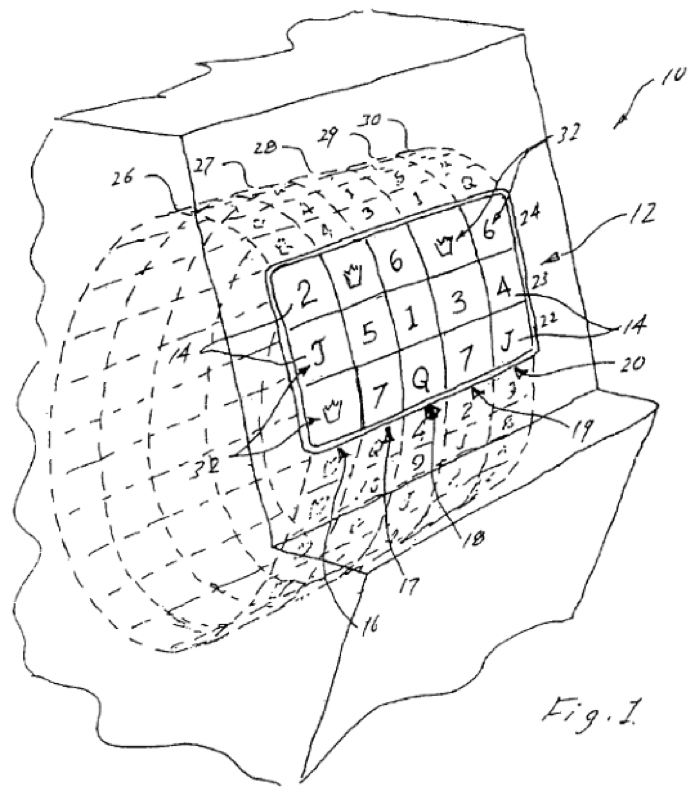
    Figure 1
    A game controller pre-selects at random, at the initiation of a game sequence, a potential win element for each reel from the set of elements.  That is, the game controller predetermines which element, and therefore which symbol, will be displayed at the end of the game, and may therefore contribute to a winning outcome.  In this preferred embodiment, the number of elements in a run and the location of the consecutive run or runs within the strip are predetermined and remain constant for each game played on the machine.  The identical symbol which populates these consecutive run or runs of elements may be considered as one of a set of inner reel symbols.

    The selection of the identical symbol is through a notional rotation of an inner reel, which is in effect, a look-up table and is not displayed, but its simulated rotation and coming to rest determines which symbol will populate the run or runs of consecutive elements of the left-most reel.  The symbols of the inner reel or look-up table from which the selection is made, are a sub-set of the set of symbols displayed in the remaining non-inner reel elements of the left-most reel.

    Claim 1 of the '869 patent is representative of the asserted claims for the patents at issue in this case.

    1.  A gaming machine comprising:
        a processor configured to execute a game displaying a matrix of symbol containing elements having a plurality of rows and a plurality columns;
        at least one column of said matrix comprising a portion of a simulated rotatable reel of a plurality of said symbol containing elements;
        said simulated rotatable reel comprising sections of symbol containing elements displaying a plurality of symbols that are fixed for each game played on said gaming machine;
        said simulated rotatable reel including at least one section in which a consecutive run of three or more of said symbol containing elements is populated by an identical symbol so that, as the simulated rotatable reel rotates, a consecutive string of said same identical symbol is sequentially displayed within said consecutive string of symbol containing elements; and
        said identical symbol is randomly selected anew for each play of said game, wherein said identical symbol is selected by virtually spinning a notional, non-visible, inner reel comprising a subset of said plurality of symbols.

    Section 101 Challenge

    High 5 argued that the claims are invalid as abstract under 35 U.S.C. § 101.  Specifically, High 5 argued that the claims at issue here are directed towards what are essentially game rules, albeit in the context of a computerized "game," and that the abstract concept of the manner in which the "game" is played or depicted, or the arrangement of the symbols in the course of the game, is not patentable, even if it is executed through the use of various technological components, generically recited.

    Konami responded and emphasized that the claims cover a gaming machine that displays virtual reels having sections of identical, repeating symbols separated by sections of non-identical and thus non-repeating symbols, so that the displayed sections of repeating symbols heighten player anticipation of a potential win.  Konami argued that this functionality overcomes a problem recognized in the industry in which machines and games can offer novel and stimulating variations.

    Pursuant to Alice Corp., the Court first determined whether the patents were directed toward a patent-ineligible concept, such as an abstract idea.  Here, the Court found that the patents at issue in this case are directed toward a patent-ineligible concept regarding "rules of a game," i.e., slot machine game rules.  High 5's analogy to game rules was compelling.  As laid out above, the patents recite essentially generic computing components, within the pre-existing framework of the "game" of a slot machine.  These components perform the functions of what may be described as an aesthetic variation on a play of the game—the game is played such that the reels display consecutive runs of the same symbol.  The primary focus of the patents, as acknowledged even by Konami, is displaying a consecutive run of a randomly selected identical symbol in one reel of the simulated digital reels in each iteration of a game as a means of increasing interest in the game and "increasing probability of a winning outcome."  As the Federal Circuit found in In re Smith, claims directed to new game rules or variations of a game are directed to an abstract patent-ineligible concept.  The Court thus found that the four patents at issue in this case are directed to altering the rules of the game regarding slot games, and are thus directed to a patent-ineligible concept.

    Konami argued that, even if the claims are deemed to recite generic computer system components that are not in themselves inventive, the Court should find the "ordered combination" of the limitations, comprising a game in which "as the simulated rotatable reel rotates, consecutive string of the identical symbol . . . is sequentially displayed," to be sufficient.  Konami noted that in In re Smith, the Court posited in dicta that a novel game employing an original deck of cards (e.g., novel game using new technology) might be patentable.  Konami asserted that their patents are equivalent to a new deck of cards; they cover a new and original virtual reel for a slot machine.  Konami argued that in gaming systems prior to this invention, reels did not exhibit identical symbols in consecutive positions, nor where symbols on the reel randomly selected to change from game to game, and while some of the individual computer hardware components may be conventional, the limitations defining this inventive concept all depend on the unconventional configuration recited in the claims.

    Thus, the Court's inquiry did not end with a finding that the patents are directed toward a patent-ineligible concept.  As Konami pointed out, the Court in In re Smith provided the explicit caveat that the invention of a "game using a new or original deck of cards" could potentially survive the second-step inquiry under Alice.  These patents may thus overcome a finding of invalidity for abstractness if they nonetheless disclose an "inventive concept sufficient to transform the claimed abstract idea into a patent-eligible" invention.

    However, the Court did not find that the claims here individually, collectively, or in ordered combination disclose an "inventive concept".  The Court rejected Konami's argument that the ordered combination of claims results in an inventive concept by virtue of the unique display or configuration of symbols on the simulated reels.  While the claims at issue here may disclose a different configuration of the displayed symbols in a slot machine game, they do not disclose a new game or a new technology directed to the slot game.  The claims both individually and in an ordered combination disclose "purely conventional steps to an abstract idea."  Selecting an identical symbol for a consecutive run of symbols in one simulated digital reel, at least as disclosed in the asserted claims here, does not represent a new form of selection or derive from a new technology associated with slot games.  This selection process, as conceded by Konami, relies upon the use of random number generators and look-up tables.  While these technological components require programming, as the Examiner noted in his initial rejection of the patent application, the patents' use of these components does not represent a nonobvious ordered combination.

    Moreover, the Court did not agree that the mere configuration of a consecutive run of symbols in one simulated reel represents something more than changing the rules of the game.  A generic slot game, as noted by experts in this case, has ever changing symbols selected at random.  Realigning and altering the display of symbols on simulated spinning reels is the very essence of the generic slot game.  Changing how often a symbol appears and where it appears in a slot game without more is simply altering the manner of display of random symbols — i.e., changing the rules of the game.  Changes to game rules of a generic slot machine using conventional technology are not patentable.

    The Court noted that the '869 patent was allowed inter alia because it disclosed an alleged unique method of random selection — virtual spinning of a notional non-visible inner reel.  However, a review of the specification and asserted claims indicates that the inventor never actually provided the structure or programming for this process.  Consequently, Konami cannot establish that this selection process represents an inventive concept or new technology (or selection process) directed to a generic slot game.

    Thus, the Court found that Konami's patents' claims individually and collectively are invalid for abstractness.

    Konami Gaming, Inc. v. High 5 Games, LLC (D. Nev.)
    Order by District Judge Richard F. Boulware, II

  • By Kevin E. Noonan

    On April 12th, various news outlets ("fake" and otherwise), as well as several Senators present at the White House, announced that the Trump administration had changed its position on the Trans Pacific Partnership (TPP) Agreement.  To that end, Mr. Trump has directed National Economic Council Director Larry Kudlow and U.S. Trade Representative Robert Lighthizer to take a "second look" at the TPP, but only if it was a "substantially better" deal (presumably meaning more in favor of the U.S. than the TPP negotiated by the Obama administration).  In addition to these traditional avenues of information, Mr. Trump also announced his intentions on Twitter.

    The reason for the change of heart and policy is apparently an effort to ameliorate the effects of the China-U.S. trade war expected to harm farmers and other U.S. industries, and to provide political cover in rural (red) America.

    Unfortunately for Mr. Trump and U.S. interests, however, the agreement his representatives are assessing is not the previous Administration's TPP.  On March 8th, the remaining members of the international group of countries who negotiated the TPP (Australia, Brunei, Canada, Chile, Japan, Malaysia, Mexico, New Zealand, Peru, Singapore, and Vietnam) signed the agreement, now renamed the Comprehensive and Progressive Agreement for Trans-Pacific Partnership, or CPTPP.  While mostly the same as the TPP, there have been some changes in the Agreement after U.S. withdrawal (see "Comprehensive and Progressive Agreement for Trans-Pacific Partnership May Differ Significantly from TPP").  Most of these changes have been in provisions relating to its intellectual property provisions, suspending agreement for provisions supported by the U.S. that provided additional protections in areas of American strengths, like pharmaceuticals and biotechnology.  It is ironic that deficiencies in China's protection of American intellectual property is one ostensible reason for recent tariffs and other trade-related actions by the Trump Administration.  Any rapprochement with the (CP)TPP will require further negotiations to have all signatory nations agree to re-implement these IP-related provisions.

    Specifically, twenty-two provisions have been suspended or modified in the CPTPP, eleven of which relate to IP while the remainder involve technical changes to accommodate U.S. withdrawal or are related to investor relations and the ability (now suspended) for foreign private entities to sue host governments (another area supported by the U.S. in the TPP negotiations).  The most important changes include suspension of provisions that would have:

    • Added patent term for patents experiencing delays in prosecution (Articles 18.46 and 18.48)
    • Provided data and market exclusivity for conventional pharmaceuticals and biologic drugs (Articles 18.50 and 18.51)
    • Expanded protection for new ways of protecting technology and information, such as technological protection measures, rights management information, encrypted satellite and cable signals, and safe harbors for Internet service providers.
    • Extended the copyright term, from life of the creator plus 70 years, now restored in the CPTPP to the creator's life plus 50 years

    Overall the CPTPP remains exceedingly similar to the TPP, there being no changes to chapters 1-4 (definitions, market access for goods, rules of origin, textiles), 6-8 (trade remedies, sanitary and phytosanitary, technical barriers to trade), 12 (temporary movement of business persons), 14 (electronic commerce), 16-17 (competition, state owned enterprises), 19 (labor), 21-25 (cooperation and capacity building, competitiveness and business facilitation, development, SMEs, regulatory coherence), and 28 (dispute settlement), except for changes needed to remove reference to the U.S.

    Additional examples of differences between the CPTPP and the TPP include Article 5 that provides that, "[a]fter the date of entry into force of this Agreement, any State or separate customs territory may accede to this Agreement, subject to such terms and conditions as may be agreed between the Parties and that State or separate customs territory," suggesting that the parties have contemplated other countries, such as China, may be interested in acceding to the treaty's terms (and indeed this eventuality may be desired).

    The changes are nicely summarized here.

    TableSuspension of these provisions removes many of the benefits for biotechnological and pharmaceutical inventions that were part of, and part of the attractiveness of, the TPP as negotiated by the Obama Administration.  While in many ways far less (and in others, for our technological and global age far more) significant than America's withdrawal from the League of Nations after World War I, these alterations of the TPP are the consequence of an abdication of American leadership on intellectual property rights that (despite occasional anomalous decisions by the Supreme Court) have been a consistent part of U.S. innovation policy for over a generation (and arguably throughout our history).

    It remains to be seen, of course, whether the signatory countries have any interest in accommodating the U.S. in re-entering the agreement, or any stomach for providing even a fig-leaf basis for any assertion by the Trump Administration that the CPTPP is a "better deal" than the TPP (which was an excellent trade agreement for American interests; see "Why President Trump Is Wrong about Trans-Pacific Partnership Agreement").  Mr. Trump's feckless withdrawal of U.S. participation in the TPP as one of his first acts as President was in fulfillment of an oft-repeated campaign promise.  Now that he has apparently made an about-face on this promise (a change he cannot blame on an uncooperative Congress or judiciary) it is not unfair to Mr Trump to expect (if not demand) he exhibit his self-vaunted prowess as a negotiator to improve on an agreement that more than adequately protected American interests in the first place.