• Cloud Computing Claims Deemed Patent-Ineligible

    By James Korenchan —

    District Court for the District of DelawareThis month, in an infringement case against Defendant Amazon, Judge Stark of the U.S. District Court for the District of Delaware ruled that Plaintiff Kaavo Inc.'s cloud computing claims are patent-ineligible under 35 U.S.C. § 101.  In related cases dating back to 2016, the Court ordered that the asserted independent claims be found patent-ineligible, as well as one of the dependent claims.  The Court later ordered limited discovery, claim construction, and summary judgement briefing with respect to the eligibility of the remaining dependent claims.  Kaavo then moved for reconsideration of the Court's Order invalidating all of the asserted independent claims and the one dependent claim, whereas Amazon moved for summary judgement.  The Court denied both motions without prejudice and instead ordered new briefing to allow for consideration of the § 101 issues in light of Federal Circuit patent-eligibility decisions since early 2016.  Renewals of both motions were at issue in this latest decision, in which the Court granted Amazon's renewed motion for summary judgement of invalidity of the remaining dependent claims and denied Kaavo's renewed motion to reconsider.

    The patent at issue, U.S. Patent No. 8,271,974 (the '974 patent), entitled "Cloud Computing Lifecycle Management for N-tier Applications," is directed to managing a cloud computing environment, where the cloud environment is used for running a software application (e.g., a web-portal, a word processing program, an inventory management program, a database management service, etc.).  The patent describes a cloud environment as an environment in which cloud providers can provide users with access to resources such as datacenters and/or other IT-related capabilities.  More particularly, the patent describes that a cloud environment can be an "N-tier environment," which refers to logical groupings of components based on their functionality, examples of which include a "presentation tier," an "application tier (e.g., a logic or business logic tier)," and a "database tier."  Notably absent from the patent is a description of the improvements and advantages that the claimed invention provides — an absence that worked heavily against Kaavo in this case.

    The Independent Claims and Dependent Claim 12

    First, the Court addressed Kaavo's motion for reconsideration of the asserted independent claims and dependent claim 12.  A representative independent claim of the '974 patent is as follows:

    1.  A method for managing a cloud computing environment for use by a software application comprising:
        determining a requested initial cloud environment based on user-defined provisioning information, where the requested initial cloud environment is not yet instantiated and is an N-tier computing environment;
        sending an initialization event based on the requested initial cloud environment, where the initialization event is configured to cause an initial cloud environment configuration to be made available to an application;
        sending application data that is configured to cause the application to begin execution in the initial cloud environment configuration;
        receiving monitoring environment data that represents a current cloud environment state;
        determining a requested adjusted cloud environment based on the monitoring environment data, where the requested adjusted cloud environment is an N-tier computing environment; and
        sending a cloud environment adjustment event based on the requested adjusted cloud environment, where the cloud environment adjustment event is configured to cause an adjusted cloud environment configuration to be made available to the application.

    And dependent claim 12 is as follows:

    12.  The method of claim 1, where the determining a requested initial cloud environment is performed using a processor, a hardware circuit, or an integrated circuit.

    In its motion, Kaavo argued that the Federal Circuit decisions in Enfish, McRO, BASCOM, Visual Memory, Core Wireless Licensing, Berkheimer, and Aatrix — all of which had not yet been issued when the Court deemed the independent claims invalid under § 101 — support a finding that the independent claims are directed to an improvement of the functioning of computers and improve existing technology and are thus patent-eligible.  In part, Kaavo argued that cloud computing is a "fairly recent" development and differs from conventional computing technology.

    But the Court was not convinced, briefly highlighting the improvements provided by "the self-referential table in Enfish, the computer memory system in Visual Memory, and the user interface Core Wireless," and noting that neither the claims nor the specification in this case indicate the presence of any improvement sufficient to support a finding of validity.  Thus, the Court maintained that the independent claims are directed to the abstract idea of setting up and managing a cloud computing environment.

    The Court did not specifically address dependent claim 12 in prong one, nor did the Court specifically address McRO, BASCOM, Aatrix, and Berkheimer.  (Though the Court cited Berkheimer elsewhere in the decision: "[w]hen there is no genuine issue of material fact regarding whether the claim element or claimed combination is well-understood, routine, [and] conventional to a skilled artisan in the relevant field, this issue can be decided on summary judgment as a matter of law.")

    The Remaining Dependent Claims

    The Court identified the following additional limitations as representative of all the remaining dependent claims:

    • forecasting an optimal cloud environment for future use with the application based on monitoring environment data (claim 5)

    • forecasting a future cost associated with executing the application based on monitoring environment data (claim 6)

    • the user-defined provisioning information is determined using a needs analysis algorithm and a user input received from a user interface (claim 8)

    • the user-defined provisioning information comprises geographic data (claim 9)

    • receiving security information, determining a requested security action based on the security information, and sending a security event based on the requested security action (claim 11).

    Addressing prong one of Alice, the Court stated that each of these dependent claims broadly recite functional goals of the claimed cloud environment, but that the patent does not describe the technical details of how to achieve the functional goals in a non-abstract way.

    Claims 5 and 6, for instance, each recite a type of forecasting.  The patent generally describes forecasting as being performed using techniques such as "neural networks, time-series algorithms, and regression analysis," but the patent does not provide an algorithm or any additional details as to how forecasting is performed.  With regard to claims 8 and 9, the patent does not describe any algorithm or other manner in which to determine "user-defined provisioning information."  (Note: The Court found "need analysis algorithm" to be indefinite in claim construction.)  And for claim 11, the patent does not provide details as to how security information is received, how a security action is determined, or how a security event is sent.  The Court also noted that the patent mentions various modules for performing operations related to the dependent claims, but the claims do not require use of the modules.

    The Court concluded its prong one analysis by reiterating that the dependent claims do not provide improvements to computer functionality and that the patent does not describe such improvements.  Kaavo's arguments to the contrary relied on expert opinion, but the expert opinion in turn relied on the cloud computing context of the invalid independent claims and was thus insufficient to create a genuine issue of material fact.

    The Court's prong two analysis was much the same as prong one in that the Court highlighted the lack of specificity in the claims and specification:

    For instance, Claims 5 and 6 do not specify how the forecasting is performed, what monitoring data is used, or how it is used; any generic algorithm, neural network, or regression analysis could be used.  Claim 8 does not limit the method to any specific algorithm or user interface; any generic algorithm or user interface could be used.  Claim 9 does not teach how the geographic data is created or determined, or what type of data is required; any generic method or data could be used.  Claim 11 does not limit how the security information is collected, how the security action is determined, or how the security event is used; any generic method could be used.  Plaintiff has not cited to any portion of the specification that fills any of these gaps.

    The post-Alice eligibility landscape can be tumultuous, but it is consistently important that a patent recites and describes sufficient details as to how the invention provides non-abstract, innovative technological improvements.

    Kaavo Inc. v. Amazon.com, Inc. (D. Del. 2018)
    Memorandum Opinion by District Judge Stark

  • CalendarJuly 5, 2018 – "Post-Sale Restrictions: Protecting Patented Products After Lexmark" (Strafford) – 1:00 to 2:30 pm (EDT)

    July 10, 2018 – "Improving Access to Global Patent Data" (U.S. Patent and Trademark Office) – 12:00 to 1:00 pm (ET)

    July 11-12, 2018 – "Advanced Patent Prosecution Workshop 2018: Claim Drafting & Amendment Writing" (Practising Law Institute) – New York, NY

    July 17, 2018 – "Drafting and Defending Software Patents to Survive Section 101 and AIA Challenges — Anticipating and Minimizing the Risk of 101, 103 Rejections, Recent Court Guidance" (Strafford) – 1:00 to 2:30 pm (EDT)

    July 17, 2018 – Technology Center (TC) 2600 Customer Partnership Meeting (Rocky Mountain Regional Office, U.S. Patent and Trademark Office) – 8:15 am to 3:00 pm (MT), Denver, CO

    July 17, 2018 – "Biotech/pharma subject-matter — Patentability at the EPO and how to avoid pitfalls for US based applicants" (Oppedahl Patent Law Firm LLC) – 7:30 to 9:30 am (MT)

    July 17-18, 2018 – Post-Grant PTO Proceedings Conference (American Conference Institute) – Washington, D.C.

    July 18-20, 2018 – Patent Fundamentals Bootcamp 2018: An Introduction to Patent Drafting, Prosecution, and Litigation (Practising Law Institute) – San Francisco, CA

    July 19, 2018 – "Labeling and Induced Infringement in Pharma Patent Litigation and Protecting IP Rights" (Strafford) – 1:00 to 2:30 pm (EDT)

    July 25-27, 2018 – Women Leaders in Life Sciences Law conference (American Conference Institute) – Boston, MA

    August 16-17, 2018 – "Advanced Patent Prosecution Workshop 2018: Claim Drafting & Amendment Writing" (Practising Law Institute) – San Francisco, CA

    September 21, 2018 – "USPTO Post-Grant Patent Trials 2018: Change & Recalibration" (Practising Law Institute) – New York & Groupcasts in Philadelphia, Indianapolis, New Brunswick, NJ, Pittsburgh, and Mechanicsburg, PA

    September 27-28, 2018 – "Advanced Patent Prosecution Workshop 2018: Claim Drafting & Amendment Writing" (Practising Law Institute) – Chicago, IL

  • USPTO SealThe U.S. Patent and Trademark Office will be offering the next webinar in its Patent Quality Chat webinar series from 12:00 to 1:00 pm (ET) on July 10, 2018.  In the latest webinar, entitled "Improving Access to Global Patent Data," Nelson Yang, Acting Director of International Patent Business Solutions in the Office of International Patent Cooperation of the U.S. Patent and Trademark Office, and Jocelyn Ram, Patent Business Analyst in the Office of International Patent Cooperation, will provide an overview of the Global Dossier concept and how the IP5 Offices (USPTO, EPO, JPO, KIPO, and SIPO) have been working together to provide additional services and functionalities.  In particular, the new service, Citation List, will be highlighted to demonstrate its capabilities in prior art searching.

    Additional information regarding this webinar can be found here.  Instructions for viewing the webinar and additional information regarding the Patent Quality Chat webinar series can be found on the USPTO's Patent Quality Chat webpage.

  • USPTO SealThe Rocky Mountain Regional Office and Technology Center (TC) 2600 will be holding a combined Customer Partnership Meeting from 8:15 am to 3:00 pm (MT) on July 17, 2018 at the Rocky Mountain Regional Office in Denver, CO.  TC 2600 examination for patent applications including Communications.

    The event is free, open to the public, and will be webcast to include viewing sessions at USPTO Headquarters in Alexandria, VA and USPTO regional offices in Dallas, Detroit, and San Jose.  Those wishing to attend the meeting can register here.  Additional information regarding the customer partnership meeting can be found here.

  • ACIAmerican Conference Institute (ACI) will be holding is 4th Annual Post-Grant PTO Proceedings Conference on July 17-18, 2018 in Washington, D.C.  ACI faculty will help attendees:

    • Analyze has the recent Supreme Court decision will alter the future of PTAB practice;
    • Review cases that are held concurrently in both the PTAB and District Court, and examine the statistics of upheld decisions by the Federal Circuit;
    • Compare the strategies adopted by leading technology, pharmaceutical, and medical device companies for working through PTAB proceedings;
    • Successfully structure cases and utilize proper language and motions to assure a well-reasoned decision;
    • Understand the more complicated and up-and-coming issues of which all PTAB attorney must be aware;
    • Identify best practices for successful post-grant proceedings;
    • Analyze recent rulings by the Federal Circuit and PTAB to figure out what they mean for PTAB practice moving forward; and
    • Examine the ethical requirements for reviewing and signing documents and the role of non-legal staff members.

    In particular, ACI's faculty will offer presentations on the following topics:

    • Keynote Address — The Honorable David Ruschke, Chief Judge, Patent Trial and Appeal Board, U.S. Patent and Trademark Office
    • Supreme Court Update: Analysis and Impact of Oil States and SAS Institute
    •
    Analyzing the Landscape of the Courts: A Look at the Recent Relationship between the PTAB, District Courts, and the Federal Circuit
    • In-House Round Table Part 1: The Tech Perspective
    • Off the Record: Perspective on the Current State of Affairs and Recent Rulings from Former PTAB Judges
    • Practice Points for Handling Nuanced and Cutting Edge Areas in PTAB Practice
    • A View from the Bench: Judicial Insight Into PTAB Litigation
    • In-House Round Table Part 2: The Life Science Perspective
    • Recent Rulings by the Court: Aqua, Regis Mohawk Tribe, and What Comes Next?
    • Exploring Ethical Requirements When Working Through the Patent and Trademark Process

    An agenda for the conference can be found here.  A complete brochure for this conference, including an agenda, detailed descriptions of conference sessions, list of speakers, and registration form can be obtained here.

    The registration fee is $2,295.  Patent Docs readers are entitled to a 10% discount off of registration using discount code P10-999-PTD18.  Those interested in registering for the conference can do so here, by e-mailing CustomerService@AmericanConference.com, or by calling 1-888-224-2480.

    Patent Docs is a media partner of ACI's 4th Annual Post-Grant PTO Proceedings conference.

  • ACIAmerican Conference Institute (ACI) will be holding the 5th annual Women Leaders in Life Sciences Law conference on July 25-27, 2018 in Boston, MA.  ACI faculty will help attendees:

    • Get legal updates across all practice areas in the life sciences;
    • Devise practical strategies for guiding your company through the latest business trends;
    • Develop tactics for handling the new wave of M&As in the life science industry;
    • Prepare for the future of life science: digital heath;
    • Learn tried and true skills from effective mentors;
    • Learn proven techniques for networking and building your resume;
    • Become an ally to the next generation of women in your field; and
    • Discover strategies for successfully and expediently handling sexual harassment problems in the workplace.

    In particular, ACI's faculty will offer presentations on the following topics:

    • Fireside Chat with the Hon. Tanya R. Kennedy, President of the National Association of Women Judges and Supreme Court Justice of the Supreme Court of New York County Civil Term;
    • Year in Review: 2017-2018 Legal Update by Practice Area;
    • Growing Your Women’s Group: Expanding Your Reach and Increasing Interest;
    • The New Face of M&A in the Life Sciences Industry: Impacts from Antitrust to IP and Beyond;
    • The Impact of the “Me Too” Movement on the Life Sciences Industry;
    • Latest Business Initiatives and Their Legal Implications;
    • Tales from the Front Lines: Changing Negative Situations into Success Stories;
    • Women Leaders in the Public Sector: 2018 Priorities and the Unique Obstacles They Face;
    • Digital Health: Staying Ahead of the Future of Life Sciences;
    • Bridging the Generational Gap: Working Across the Divide to Move Everyone Forward; and
    • Getting Ahead: Tips for Reaching the Top from Mentors of All Types

    In addition, three pre-conference workshops will be offered on July 25, 2018, from 9:00 am to 12:00 noon, 1:00 pm to 2:30 pm, and 3:00 to 6:00 pm, respectively.  The first workshop is entitled "'What I Wish I Had Known': Advice from Inspirational Life Science General Counsel," the second workshop is entitled "Networking as a Woman: Clear-Cut Tools for Enhancing Your Experience and Making it Count," and the third workshop is entitled "'POKERprimaDIVAS' Gain an Edge, Build Confidence, Develop Negotiating Skills – If you want to be in the game, you have to be at the table."

    An agenda for the conference and additional information regarding the workshops can be found here.  A complete brochure for this conference, including an agenda, detailed descriptions of conference sessions, list of speakers, and registration form can be obtained here.

    The registration fee is $1,295 (conference alone), $400 ("What I Wish I Had Known" workshop), $199 each ("Networking As A Women" and "POKERprimaDIVAS" workshops), and $1,995 (All Access Pass: conference and all 3 Workshops).  Patent Docs readers are entitled to a 10% discount off of registration using discount code P10-999-PTD18.  Those interested in registering for the conference can do so here, by e-mailing CustomerService@AmericanConference.com, or by calling 1-888-224-2480.

    Patent Docs is a media partner of ACI's 5th Annual Conference on Women Leaders in Life Science Law.  In addition, Patent Docs notes that MBHB attorneys Alison Baldwin, Paula Fritsch, Lisa Hillman, Sarah Fendrick, and Jelena Janjic Libby will be attending this conference.

  • EPO-EPCOppedahl Patent Law Firm LLC will be offering a webinar on "Biotech/pharma subject-matter — Patentability at the EPO and how to avoid pitfalls for US based applicants" on July 17, 2018 from 7:30 to 9:30 am (Mountain Time).  Sandra Pohlman of df-mp (Munich, Germany) and Klaus-Peter Döpfer, Director Biotechnology, EPO will look at the patentability of biotech/pharma subject‑matter under the European Patent Convention (EPC) and discuss exceptions to patentability.  The webinar will enable participants to draft claims that comply with the EPC encompassing subject-matter such as plants/animals, (stem) cells, micro‑organisms, methods of surgery and diagnosis, antibodies and nucleic acids and medical uses thereof, personalised medicine and dose regimens.  The webinar will also deal with PCT applications as the basis for European applications, including possible pitfalls.

    While there is no cost to participate in the program, advance registration is required.  Those interested in attending the webinar can register here.

  • Strafford #1Strafford will be offering a webinar entitled "Labeling and Induced Infringement in Pharma Patent Litigation and Protecting IP Rights" on July 19, 2018 from 1:00 to 2:30 pm (EDT).  Thomas L. Irving, Shana K. Cyr, and Barbara R. Rudolph of Finnegan Henderson Farabow Garrett & Dunner will guide patent counsel on the implications of recent cases for labeling and discuss strategic considerations of label language, and offer best practices for labeling.  The webinar will review the following issues:

    • What impact will recent decisions have on label language?
    • What impact will recent decisions have on claim drafting?
    • How do use codes fit in?
    • What strategic considerations should patent owners keep in mind when labeling drugs?

    The registration fee for the webcast is $297.  Those interested in registering for the webinar, can do so here.

  • By Kevin E. Noonan –

    The Biologics Price Competition and Innovation Act (BPCIA) was enacted as part of the Affordable Care Act (colloquially called "Obamacare," Public Law 111-148) (see "House Passes Health Care Reform Bill — Biosimilar Regulatory Pathway Makes Cut, Pay-for-Delay Ban Does Not").  It gave the U.S. for the first time a pathway for FDA approval of alternatives to biologic drugs (termed "biosimilars" because the complexity of these molecules precludes the atom-for-atom identity of small molecule generic drugs), codified at 42 U.S.C. § 262(k), as well as provisions for resolving patent disputes between innovator biologic drug companies (termed "reference product sponsors" in the Act) and biosimilar applicants (codified at 42 U.S.C. § 262(l)).

    Nine years later, after promulgation of several Guidances by the FDA regarding how it will (and has) implemented the biosimilar pathway, it is reasonable to review what the BPCIA hath wrought.  While the litigation provisions have been the source of some controversy (and arguably have played out in ways not envisioned when the Act was passed), the biosimilar pathway has been somewhat successful in bringing a first generation of biosimilar drugs to market.  For example, as of December 2017 there were 59 biosimilar products enrolled in the FDA's Biosimilar Development Program:

    Figure 1
    And as of June 2018, 24 biosimilar applications have been filed and eleven biosimilar drugs have received FDA approval.

    Table 1
    FDA approval of these drugs has been relatively rapid, typically taking 10-20 months from FDA acceptance to approval.  There have been some outliers; Pfizer/Hospira's Retacrit® (a biosimilar of Epogen®/Procrit®) was under FDA review for 42 months.  Most (but not all) of these FDA-approved biosimilars have also been approved in Europe (some quite a while ago, paradoxically including Retacrit® which was approved in Europe in 2007).  The FDA decided early in its implementation process that it would accept clinical and other comparative data previously submitted to European regulators, supplemented by so-called "bridging studies," in the FDA approval process. Such studies were submitted for Sandoz's Zarxio® (filgrastim-sndz) and Erelzi® (etanercept-szzs) biosimilars, for example.  Several products (Amgen's Amjetiva® (adalimumab-atto), Pfizer/Celltrion's Inflectra® (infliximab-dyyb), and Merck/Samsung Bioepsis's Renflexis® (infliximab-abda)) were supported by double-blind clinical studies comparing the biosimilar to EU-licensed and RPS-sourced biologic drugs.

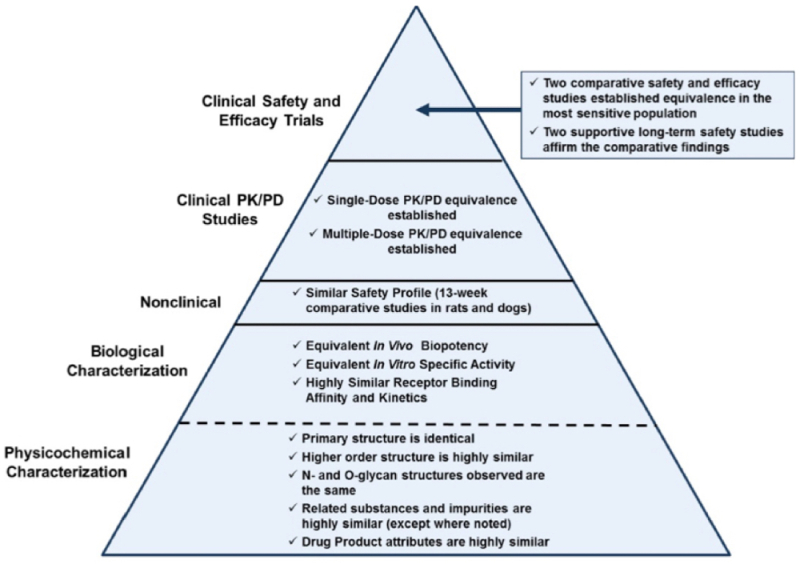
    The prolonged regulatory saga for Retacrit® illustrates the extent to which the FDA can require a biosimilar applicant to satisfy its purity, safety, and efficacy standards for a biosimilar product:

    Figure 2
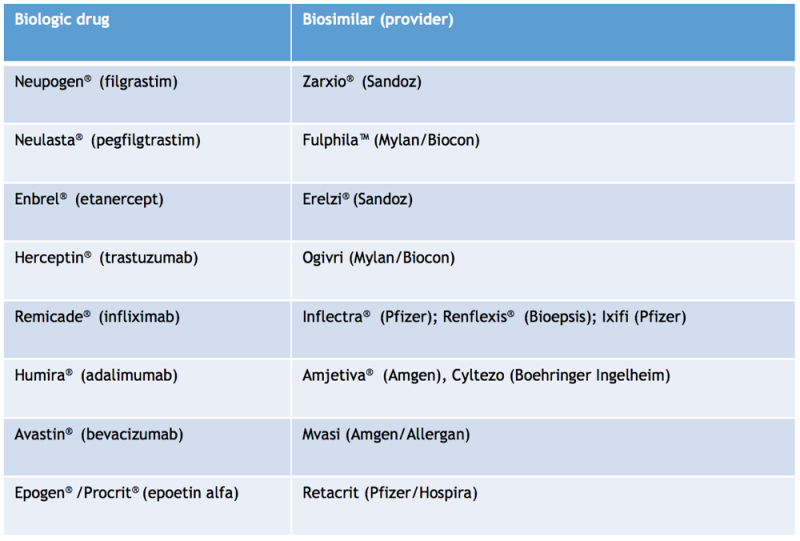
    Mere approval is not sufficient, of course; many but not all of these drugs are on the market in competition with the reference biologic drug.  These include Zarxio® (filgrastim-sndz) (in competition with Amgen's Neupogen®), which launched in September 2015, and Inflectra® (infliximab-dyyb) (in competition with J&J/Janssen's Remicade®), which launched in November 2016; each of these biosimilars are sold at a 15% discount from the reference biologic drug price.  Renflexis® (infliximab-abda) (another Remicade® competitor) launched at risk (i.e., while patent litigation was on-going) at a 35% discount, and Amjetiva® (adalimumab-atto) is scheduled to enter the market in competition with AbbVie's Humira® in January 2023 as the result of a settlement agreement between the parties.  Several other approved biosimilars are not yet on the market, however; these include Boehringer Ingelheim's Humira® biosimilar, Cyltezo® (adalimumab-abdm); Amgen/Allergan's Avastin® biosimilar, Mvasi (bevacizumab-awwb) (Amgen/Allergan); and Mylan/Biocon's Herceptin® biosimilar, Ogivri (trastuzumab-dkst), despite a global licensing agreement with Genentech entered into on March 31, 2017; and Hospira's Epogen® biosimilar, Retacrit® (epoetin alfa-epbx).  In addition, Pfixer has decided not to enter the marketplace with its Remicade® biosimilar, Ixifi, which would also compete with Pfizer's other Remicade® biosimilar, Inflectra®.

    Fourteen biosimilar (§ 262(k)) applications are currently pending:

    Table 2
    These applications have encountered more challenges on their approval pathways; several of them have received Complete Response Letters from the FDA (indicating that the agency will not approve the application under 21 C.F.R. §§ 314.125 or 314.127), and many have been pending longer than the 10-20 month average experienced by the already-approved biosimilars.

    Biosimilar litigation is also proceeding and provides a reason that some of the approved biosimilars are not yet on the market (including Erelzi®, Cyltezo®, Mvasi, and Mylan/Biocon's Neulasta® biosimilar, Fulphila™).  Consistent with expectations during passage of the BPCIA, there is also active litigation involving reference product sponsors and biosimilar applicants:

    Table 3
    So far, approved biosimilars and pending biosimilar applications have been concentrated amongst the top U.S. biologic drugs, but there are several such drugs that are among these top drugs and have no prospective biosimilar competitors:

    Table 4
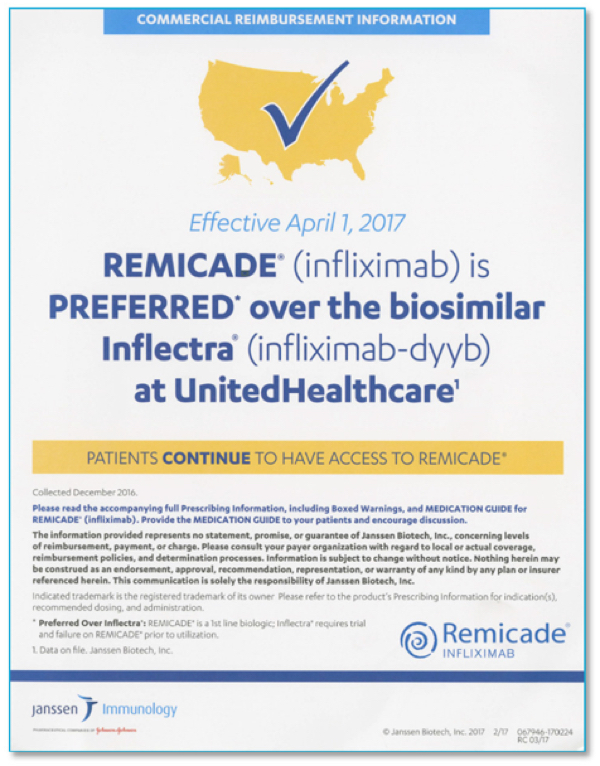
    Finally, it must be recognized that other considerations can and have arisen, particularly antitrust concerns.  Pfizer filed suit against Johnson & Johnson and Janssen Biotech for antitrust violations related to alleged anticompetitive activities surrounding competition between Remicade® and Inflectra®.  Pfizer alleged that the defendants engaged in "improper exclusionary tactics," including exclusionary contracts, coercive rebate policies with insurers, hospitals, clinics ("fail first" restrictions), exclusionary rebates, bundling, and coverage restrictions.  This advertisement hasn't helped:

    Figure 3
    Pfizer's four-count complaint alleged Sherman Act Section 2 violations for monopolization and attempted monopolization; Clayton Act violations for entering into exclusive contracts; and Sherman Act Section 1 violations for entering into agreements in restraint of trade.  Pfizer has asked the court for $150 million in damages, attorneys' fees, costs, and an injunction.  J&J/Janssen has responded with a motion to dismiss under Fed. R. Civ. Pro. 12(b)(6) based in pleadings deficiencies under Ashcroft v. Iqbal and Bell Atlantic Corp. v. Twombly.  Substantively, defendants allege that Pfizer did not show antitrust injury or anticompetitive behavior, and that their actions were just robust capitalist competition.  The motion has been pending since November 2017, and the court has stayed discovery while considering the motion.

    Within the last year, the number of approved biosimilars in the U.S. has more than doubled, and with the number of pending biosimilar applications it is likely that this trend will continue.  One aspect of the BPCIA has not yet come to pass, a designation of any biosimilar as being interchangeable.  The FDA released draft Guidance directed to the standards it is considering for awarding an interchangeability designation in January 2017 (see Considerations in Demonstrating Interchangeability with a Reference Product); a Final Guidance is expected in 2019.

    *Adapted from a talk given at the American Conference Institute's 9th Annual Conference on Biosimilars, held in New York, New York on June 25-27, 2018.

  • By Nicole Grimm, George "Trey" Lyons, III, and Brett Scott —

    GW PharmaceuticalsOn June 25, 2018, GW Pharmaceuticals plc and its U.S. subsidiary, Greenwich Biosciences, made history in the cannabis industry by winning FDA approval of the drug Epidiolex, a cannabidiol (CBD) oral solution for the treatment of seizures associated with two rare forms of childhood-onset epilepsy (Lennox-Gastaut syndrome and Dravet syndrome).[1]  Both Lennox-Gastaut syndrome and Dravet syndrome are debilitating forms of epilepsy that have been known to be difficult to treat.  Epidiolex is the first FDA-approved drug containing plant-derived CBD, a non-psychoactive cannabinoid naturally produced by cannabis plants.

    In approving Epidiolex, the FDA voiced support for further research and studies on medical uses for cannabis through its approval process.  According to FDA Commissioner Scott Gottlieb:

    Controlled clinical trials testing the safety and efficacy of a drug, along with careful review through the FDA's drug approval process, is the most appropriate way to bring marijuana-derived treatments to patients . . . .  We'll continue to support rigorous scientific research on the potential medical uses of marijuana-derived products and work with product developers who are interested in bringing patients safe and effective, high quality products.[2]

    However, Commissioner Gottlieb cautioned that the FDA is prepared to take action against illegal CBD-products marketed with unproven medical claims.

    FDA approval of Epidiolex may also prompt the Drug Enforcement Administration (DEA) to reschedule CBD from a Schedule I drug under the Controlled Substances Act, which would be another historic event for the cannabis industry.  And, in spite of Attorney General Jeff Sessions's continuing war on cannabis, President Trump has indicated support for such a shift.[3]

    Rescheduling Epidiolex is necessary for the drug to become available to patients in the U.S.  As part of the approval process, the FDA, through the Department of Health and Human Services, makes recommendations to the DEA regarding scheduling based on scientific and medical studies of scheduled substances such as Epidiolex.  In turn, the DEA is required to make a scheduling determination.  Additionally, in making its determination, the DEA will likely consider the results of clinical and nonclinical studies regarding the abuse potential of CBD that GW Pharmaceuticals conducted as part of its application for Epidiolex.  Although the FDA did not indicate whether it provided a favorable scheduling recommendation for Epidiolex, GW Pharmaceuticals stated in its press release that it expects the DEA to reschedule the drug in the next 90 days.

    Rescheduling Epidiolex from a Schedule I drug may have implications for GW Pharmaceuticals' intellectual property surrounding the drug as well.  First, enforcing cannabis patents in federal district courts remains a grey area in the industry since cannabis is currently classified as a Schedule I drug.  By rescheduling Epidiolex, the drug will become legally available by prescription, and GW Pharmaceuticals should be able to enforce the patents covering Epidiolex like any other pharmaceutical patent.  In turn, the company may also experience an increase in inter partes review (IPR) proceedings to challenge patents in its portfolio.  As we have previously discussed, one of GW Pharmaceutical's patents involving treating partial seizure by administering CBD is already involved in an IPR proceeding.

    Additionally, while the USPTO has categorically declined to grant trademarks based on the cannabis plant itself (and derivatives thereof), as well as cannabis goods and services that contribute to federally illegal activity (often referred to as those that "touch the plant"), rescheduling cannabis-based pharmaceuticals like Epidiolex may help eliminate any hurdles faced in obtaining federal trademark protection for such pharmaceuticals.  Indeed, unlike Schedule I drugs, scheduled prescription drugs have a legal use in commerce and are therefore routinely granted federal trademark protection.  In fact, the USPTO has already granted a trademark for Epidiolex; but note, in doing so the drug was described broadly, without referring to federally prohibited subject matter (e.g., cannabis), and instead referring to, for example, "medicinal herbs" and "medicinal infusions for the treatment of epilepsy."

    Either way, right now the approval and tentative rescheduling of Epidiolex is a step in the right direction and could pave the way for other cannabis-based drugs to gain FDA approval and open up new treatment options for patients suffering from a variety of diseases moving forward.

    [1] http://ir.gwpharm.com/news-releases/news-release-details/gw-pharmaceuticals-plc-and-its-us-subsidiary-greenwich

    [2] https://www.fda.gov/NewsEvents/Newsroom/PressAnnouncements/ucm611046.htm

    [3] See, e.g., https://www.wsj.com/articles/jeff-sessions-struggles-to-get-planned-marijuana-crackdown-going-1528628400