• By Kevin E. Noonan –
    House of Representatives SealIn the 1970's, the New York Tristate area was entertained by (or subjected to) television and radio ads for a discount stereo outlet named Crazy Eddie's.  Under the tag line "Our Prices are Insane," the ads involved a number of outrageous scenarios, one of which was "Christmas in July" (or August), complete with Santa Claus in shorts hawking electronic wares.

    Representatives Thomas Massie (R-KY, 4th dist.) and Marcy Kaptur (D-OH, 9th dist.) introduced a bill recently that is reminiscent of Christmas in July, at least for pro-patent people.  The bill, H.R. 6264, entitled "Restoring America's Leadership in Innovation Act," seeks to undo many of the changes in U.S. patent law produced by the Leahy-Smith America Invents Act of 2012.  While Rep. Kaptur's interests (and bona fides) in patent law are unclear, Rep. Massie's are not.  He holds a degree in electrical engineering from MIT and has been awarded two dozen patents.  He has also been quoted extensively on patent law; for example, speaking of the proponents of patent "reform," on July 5, 2017:

    A lot of those companies want to become automobile manufacturers, or cell phone manufacturers, or they want to write software for operating systems, but they didn't invent in those areas and they don't own the patents that have historically been the touchstone of innovation ownership.  "They'd love to just come in and start playing in those fields and start using their size and scale as an advantage, and to them, patents look like a hindrance," Massie explained.  "They are here in Congress looking to weaken patents and they are not just interested in weakening patents issued in the future, they are looking to weaken all patents."

    "Reform is not about strengthening the patent granting system, but about making it harder for patent owners to assert patents to protect their rights," Massie said emphatically.  "They didn't read the Constitution and come to say they have a better way more in line with what the Founding Fathers had in mind.  They just want all the patents to be public domain today.  It is very short sighted to attack the patent system in this way."

    The bill has as its avowed purpose "[t]o promote the leadership of the United States in global innovation by establishing a robust patent system that restores and protects the right of inventors to own and enforce private property rights in inventions and discoveries, and for other purposes."  It asserts that "[t]he Leahy-Smith America Invents Act (Public Law 112–29) enacted on September 16, 2011, and several decisions of the Supreme Court have harmed the progress of Science and the useful Arts by eroding the strength and value of the patent system" (Sec. 2(2)) and that "[a] United States patent secures a private property right to an inventor" (Sec. 2(4)).

    The substantive provisions are as follows:

    Sec. 3, entitled "Repeal of First-to-File System under the America Invents Act," restores U.S. patent law to a "first to invent" regime (Sec. 3(b)), and restores the meaning of "public use" and "on sale in this country" to their pre-AIA definitions (Sec. 3(c)).

    Sec. 4 abolishes inter partes (IPR) and post grant review (PGR), and provides a "sense of Congress" that (1) IPR and PGR have harmed innovation by subjecting inventors to serial patent challenges; (2) that these procedures have invalidated patents at "an unreasonably high rate"; (3) that patents should not be subjected to "unfair" PTAB proceedings but should be adjudicated in court; (4) IPR, PGR, and inter partes reexamination to be repealed but (5) ex parte reexamination will remain (Sec. 4(c)).

    Sec. 5 abolishes the Patent Trial and Appeal Board (PTAB) as being unnecessary in view of elimination of IPRs and PGRs.  It reestablishes the Board of Patent Appeals and Interferences (BPAI) in its stead (Sec. 5(a)) and the BPAI's duties (Sec. 5(b)) and also reestablishes appeals to district court (Sec. 5(c)).

    Sec. 6 eliminates fee diversion from the USPTO and establishes an "Innovation Promotion Fund" (Sec. 6(a)(5)), to be funded by any fees collected by the patent and trademark activities of the Office to be used to fund the operations of the Office.  These provisions are to come into force on the first day of the first fiscal year after enactment; the bill also provides for termination of the Reserve Fund (Sec. 6(b)) "[u]pon the payment of all obligated amounts."

    Sec. 7(a) relates to changes intended to overcome the effects of the Supreme Court's recent § 101 jurisprudence.  This section derives from the proposals made by the IPO and AIPLA and reads as follows:

    AMENDMENT.—Section 101 of title 35, United States Code, is amended to read as follows:

    § 101. Inventions patentable

    (a) IN GENERAL.—Whoever invents or discovers any new and useful process, machine, manufacture, or composition of matter, or any new and useful improvement thereof, may obtain a patent therefor, subject to the conditions and requirements of this title.

    (b) EXCEPTION.—A claimed invention is ineligible patent subject matter under subsection (a) if the claimed invention as a whole, as understood by a person having ordinary skill in the art, exists in nature independently of and prior to any human activity, or exists solely in the human mind.

    (c) ELIGIBILITY STANDARD.—The eligibility of a claimed invention under subsections (a) and (b) shall be determined without regard as to the requirements or conditions of sections 102, 103, and 112 of this title, or the claimed invention's inventive concept.

    Sec. 7(b) provides a "sense of Congress" that recent Supreme Court decisions have harmed progress of science and the useful arts, the Constitutional justification for amending the statute in support of the enumerated Article I power of Congress to establish the patent system.  The amendment is direct in its effects on this jurisprudence in Sec. 7(b)(3):

    [T]his amendment effectively abrogates Alice Corp. v. CLS Bank International, 134 S. Ct. 2347 (2014) and its predecessors to ensure that life sciences discoveries, computer software, and similar inventions and discoveries are patentable, and that those patents are enforceable.

    Sec. 8(a) restores the prior definitions of the prior art, now enumerated rather than designated by subsection of Section 102.

    Sec. 8(b) eliminates from the prior art disclosures derived from the inventor, or that occur during the one-year grace period, or are commonly owned or subject to an obligation to assign:

    (b) DISCLOSURES IN PATENT APPLICATIONS AND PATENTS.—A disclosure shall not be prior art to a claimed invention under this section if before the issuance of a patent—

    (1) the information disclosed was obtained directly or indirectly from the inventor or a joint inventor;

    (2) the information disclosed to the Office or another party during the one-year period prior to the date of the application for patent had, before a patent application for the information was effectively filed, been publicly disclosed by the inventor or   joint inventor; or

    (3) the information disclosed and the claimed invention, not later than the effective filing date of the claimed invention, were owned by the same person or subject to an obligation of assignment to the same person.

    Sec. 9(a) "restore[s] patents as a property right," by adding new § 106 to the Patent Act:

    § 106. Private property patent right

    A patent right is a private property right secured to an inventor upon issuance of the patent that shall only be revoked by a court ruling in a judicial proceeding, unless the patent owner consents to an administrative or other procedure.

    And Sec. 9(c) asserts a "sense of Congress" that "recent jurisprudence of the United States Supreme Court, including Impression Products Inc. v. Lexmark International, Inc., have harmed the progress of science and the useful arts . . ."  Unmentioned but equally disturbing to the concept that a patent is a private property right is the Court's decision in SAS Institute Inc. v. Iancu; that decision would have much less relevance if Sections 4 and 9 of this bill were enacted into law.  But the bill's specific recitation of Lexmark also indicates that this provision is intended to overturn the post-sale restrictions the Court imposed on patentees in Lexmark, making explicit that the patent property right overcomes the common law principle against restraints on alienating property.

    Sec. 10(a) would end "automatic" publication of U.S. patent applications, authorizing publication only upon the request of the patent applicant, and eliminating public disclosure of the file history of any patent application until patent grant.

    Sec. 10(b) asserts a "sense of Congress" that:

    (1) automatic publication of patent applications after 18 months has harmed the progress of science and the useful arts by creating ''prior art'' by operation of law that prevents a patent owner from applying for a patent on the same invention if a patent does not issue; and

    (2) automatic publication of patent applications encourages early disclosure of claimed inventions and subjects innovative inventions and discoveries reduced to practice in the United States to theft or appropriation by foreign competitors.

    Sec. 11(a) proposes revised language in 35 U.S.C. § 282 that in addition to the statutory presumption of validity of a patent, each claim must be presumed valid "independently of the validity of other claims" and that a dependent claim must be presumed valid even if dependent on an invalid claim.

    Sec. 11(b) adds a patent term tolling provision, in new § 282(d), including a damages provision for validity challenged brought in "bad faith":

    TOLLING OF PATENT TERM DURING VALIDITY CHALLENGE.—In an action involving a patent where the validity of the patent has been challenged, the patent term shall be tolled from the time the validity of the patent is challenged to the time of resolution of the validity issue by the court.  The patent term shall resume once the validity challenge is resolved.  The court may award damages to the patent owner in a case in which another party brought a validity claim against the patent in bad faith.

    Sec. 12 amends § 283 to include a mandatory permanent injunction upon a finding of infringement, which can be overcome only by a showing by the infringer by clear and convincing evidence that the patentee would not be irreparably harmed.  A finding of irreparable harm does not require the patentee to be making or selling a product covered by the patent.  This provision effectively abrogates the Supreme Court's decision in eBay Inc. v. MercExchange, LLC, which introduced into the injunction calculus considerations such as whether the patentee was practicing the invention (which in itself was not supported by the express language of the statute).

    Sec. 13 restores the best mode requirement of § 112(a) as a defense in patent infringement litigation.

    The bill has been referred to House Judiciary Committee, where its prospects are, to say the least, very uncertain.


  • CalendarJuly 10, 2018 – "Improving Access to Global Patent Data" (U.S. Patent and Trademark Office) – 12:00 to 1:00 pm (ET)

    July 11-12, 2018 – "Advanced Patent Prosecution Workshop 2018: Claim Drafting & Amendment Writing" (Practising Law Institute) – New York, NY

    July 12, 2018 – "Damages After Western Geco: Impact on Patent Litigation Strategy and Client Counseling" (Intellectual Property Owners Association) – 2:00 to 3:00 pm (ET)

    July 17, 2018 – "Drafting and Defending Software Patents to Survive Section 101 and AIA Challenges — Anticipating and Minimizing the Risk of 101, 103 Rejections, Recent Court Guidance" (Strafford) – 1:00 to 2:30 pm (EDT)

    July 17, 2018 – Technology Center (TC) 2600 Customer Partnership Meeting (Rocky Mountain Regional Office, U.S. Patent and Trademark Office) – 8:15 am to 3:00 pm (MT), Denver, CO

    July 17, 2018 – "Biotech/pharma subject-matter — Patentability at the EPO and how to avoid pitfalls for US based applicants" (Oppedahl Patent Law Firm LLC) – 7:30 to 9:30 am (MT)

    July 17, 2018 – "The 2018 Bayh Dole Revisions: Practical Compliance Guidance for Technology Transfer Offices" (Technology Transfer Tactics) – 1:00 to 2:00 pm (ET)

    July 17-18, 2018 – Post-Grant PTO Proceedings Conference (American Conference Institute) – Washington, D.C.

    July 18-20, 2018 – Patent Fundamentals Bootcamp 2018: An Introduction to Patent Drafting, Prosecution, and Litigation (Practising Law Institute) – San Francisco, CA

    July 19, 2018 – "Labeling and Induced Infringement in Pharma Patent Litigation and Protecting IP Rights" (Strafford) – 1:00 to 2:30 pm (EDT)

    July 25-27, 2018 – Women Leaders in Life Sciences Law conference (American Conference Institute) – Boston, MA

    August 16-17, 2018 – "Advanced Patent Prosecution Workshop 2018: Claim Drafting & Amendment Writing" (Practising Law Institute) – San Francisco, CA

    September 21, 2018 – "USPTO Post-Grant Patent Trials 2018: Change & Recalibration" (Practising Law Institute) – New York & Groupcasts in Philadelphia, Indianapolis, New Brunswick, NJ, Pittsburgh, and Mechanicsburg, PA

    September 27-28, 2018 – "Advanced Patent Prosecution Workshop 2018: Claim Drafting & Amendment Writing" (Practising Law Institute) – Chicago, IL

  • IPO #2The Intellectual Property Owners Association (IPO) will offer a one-hour webinar entitled "Damages After Western Geco: Impact on Patent Litigation Strategy and Client Counseling" on July 12, 2018 from 2:00 to 3:00 pm (ET).  Buckmaster de Wolf of General Electric Co.; Bart Eppenauer of Shook, Hardy & Bacon LLP; and Blair Jacobs of Paul Hastings LLP will focus on the impact of the Supreme Court's decision in Western Geco v. Ion on patent litigation strategy, as well as client counseling and discuss the following topics:

    • How Western Geco might impact decisions regarding the location of R&D, manufacturing, and contract signing.
    • The immediate and long-term effects on litigation strategy for both plaintiffs and defendants.
    • Whether the impact will be limited to § 271(f)(2) cases or may be broader.
    • What kind of proof plaintiffs will need to bolster their claims for worldwide damages.
    • How the question of proximate cause "could limit or preclude damages in particular cases," an issue the Court explicitly declined to address.

    The registration fee for the webinar is $135 (government and academic rates are available upon request).  Those interested in registering for the webinar can do so here.

  • Webinar on 2018 Bayh Dole Revisions

    Technology Transfer Tactics will be offering a webinar entitled "The 2018 Bayh Dole Revisions: Practical Compliance Guidance for Technology Transfer Offices" on July 17, 2018 from 1:00 to 2:00 pm (ET).  Charles R. Macedo, Alan Miller and Brian Amos of Amster, Rothstein & Ebenstein LLP will address the following topics:

    • The impact of the Bayh-Dole changes on:
        – compliance measures
        – staffing needs
        – case abandonment process
        – annuity fee procedures
        – provisional and non-provisional patent filings
        – invention rights assignments
        – timelines and changes to internal systems
    • Understanding the consequences of noncompliance
    • What potential licensees may ask during due diligence
    • Best practice tips for implementing changes in your office

    The registration fee for the webinar is $197.  Those interested in registering for the webinar, can do so here.

    Technology Transfer Tactics

  • By Kevin E. Noonan –

    Senate SealThe high cost of biologic drugs was one of the (if not the) most compelling motivations for Congress to adopt a biosimilar pathway as part of the Affordable Care Act in 2010 (aka "Obamacare").  Passage of the Biologic Price Control and Innovation Act (BPCIA, codified at 42 U.S.C. § 262(k)) created for the first time a pathway for FDA approval of biosimilar drugs in the U.S.  But from the beginning there have been grumblings, particularly regarding the term of the data exclusivity period (see "Congress Jumps on Bandwagon to Reduce Biologic Drug Exclusivity Term"; "President's Latest Budget Proposal Seeks Decrease of Data Exclusivity Period and Elimination of Pay-for-Delay Agreements"; "Senators Send Letter on Biosimilars to FDA"; "Senators Back 12-Year Data Exclusivity Period for Biosimilars and President Obama (Once Again) Does Not"; and "President's Latest Budget Proposal Seeks Decrease of Data Exclusivity Period and Elimination of Pay-for-Delay Agreements").  As biosimilar applicants have utilized the FDA's implementation of the abbreviated biologics license application (aBLA) pathway, and parties and the courts have begun to work out the litigation provisions of the Act (42 U.S.C. § 262(l)), the question of settlement of such litigation has arisen.  As mentioned in a recent roundup of the biosimilar landscape (see "Status of U.S. Biosimilar Approvals and Pending Applications"), there have been several biosimilar patent litigations that have settled or been avoided by licenses between branded biologic drug makers (termed "reference product sponsors" under the law) and biosimilars applicants.  For example, Genentech entered a global licensing agreement on March 31, 2017 with Mylan/Biocon over their Herceptin® biosimilar, Ogivri (trastuzumab-dkst) (although this biosimilar is not yet on the market), and Amgen/Samsung-Bioepsis's Amjetiva® (adalimumab-atto) is scheduled to enter the market in competition with AbbVie's Humira® in January 2023 as the result of a settlement agreement between the parties (see "HUMIRA® Biosimilar Update — Settlement in AbbVie v. Amgen Case Announced and AbbVie v. Boehringer Ingelheim Litigation Begins").

    Federal Trade Commission (FTC) SealSettlement agreements between conventional branded and generic drug makers were the source of a long dispute between pharmaceutical companies and the Federal Trade Commission, culminating in the Supreme Court's decision in FTC v. Actavis in 2013.  Before that decision, Congress implemented a protocol requiring any such "reverse payment" settlement agreements (called "pay-for-delay" by the FTC and those opposed to the practice) to be vetted by the Commission, wherein ones deserving of suspicion as being anticompetitive would come to the FTC's attention (and presumably corrective action).

    No such regime has been put in place for biosimilar drugs, and two Senators, Charles Grassley (R-IA) and Claire Klobucher (D-MN), think the FTC should commence review of the Humira® settlement.  Part of their angst on the issue is a disparity of biosimilar entry dates between the U.S. (2023) and Europe (October 2018).  Part is their innate inclinations:  Senators Grassley and Klobucher have carried the branded company abuse torch for a while (see "The CREATES Act of 2016: Senate Listens to Generics Industry").  And of course perhaps the biggest factor is the high cost of Humira®, which is and has been the top-selling biologic drug for several years, and the price of which cannot but help to be reduced when biosimilar competitors enter the marketplace.  It must be noted in passing, however, that the size of such a reduction is unlikely to be as great as has been the case for conventional generic small molecule drugs.  In a fashion predicted by an FTC White Paper prepared before enactment of the BPCIA (see "No One Seems Happy with Follow-on Biologics According to the FTC"), the few biosimilar providers on the market have priced their drugs at only 15% less than the reference product sponsor (Sandoz's Zarxio® (filgrastim-sndz) (in competition with Amgen's Neupogen®); Pfizer's Inflectra® (infliximab-dyyb) (in competition with J&J/Janssen's Remicade®), although Merck-Samsung-Bioepsis's Renflexis® (infliximab-abda) (another Remicade® competitor) launched at risk (i.e., while patent litigation was on-going) at a 35% discount).  While this is a significant savings in aggregate (say, for example, insurers and the Federal government), it is not the windfall for consumers that some (including perhaps these Senators) seem to think it will be.

    Nevertheless, these Senators have sent their letter to FTC Chairman Joseph Simons, reproduced below:

    Dear Chairman Simons:

    We write to urge the Federal Trade Commission (FTC) to look into whether strategies to hinder or delay generics from entering the market – such as anticompetitive "pay for delay" settlement agreements that have plagued generic pharmaceutical markets for years – may be being utilized for settlements regarding biologic medicines.

    As you are aware, the FTC estimates that these pay for delay settlements can cost consumers and taxpayers $3.5 billion in higher drug costs every year.  Since 2001, the FTC has filed a number of lawsuits to stop these deals, and has worked with Congress on legislation to end pay for delay settlements.  We would like to continue those efforts to combat these agreements and explore their impact on the biologic market.

    Biologics play an important role in treating many serious illnesses and are among the fastest growing classes of therapeutic products.  As they are more expensive than simple molecule pharmaceuticals, biologics constitute a substantial and increasing proportion of our nation's healthcare costs.  Without biosimilar competition, U.S. patients and payers will likely see additional price increases on biologics in the years to come.

    For example, AbbVie Inc.'s (AbbVie) Humira is a biologic medicine that treats multiple inflammatory diseases and is the world's top-selling prescription drug with annual sales of $16 billion, including more than $10 billion in the United States alone.

    Over the past year, AbbVie entered into global settlement agreements of all intellectual property litigation with both Amgen Inc. (Amgen) and Samsung Bioepsis (Samsung) over their biosimilars of Humira.  Under the agreements, Amgen and Samsung will not launch their products in the United States until 2023, but both companies will be able to launch their biosimilars into the European market in October 2018.  This means that while European patients will benefit from biosimilar competition later this year, Americans may be without access to Humira biosimilars for almost five more years.  While such terms in patent settlement agreements may not always be inappropriate, the incentives for parties to delay biosimilar entry are present, and biologic markets could be susceptible to patent settlement abuse.

    In light of the importance of biosimilar competition to drive down prices and improve the quality of life for American patients, we urge the FTC to examine global patent settlements relating to biosimilars to ensure they are not in violation of antitrust laws.

    Thank you for your prompt attention to this important matter.  We appreciate the FTC's efforts to ensure that potentially anticompetitive practices do not impede competition in the pharmaceutical market.

    As yet the Commission has not responded publicly.

  • Life Sciences Top 54

    By Donald Zuhn

    IPO #2Last month, the Intellectual Property Owners Association (IPO) announced the release of its 35th annual list of the top 300 organizations receiving U.S. patents (see "Top 300 Organizations Granted U.S. Patents in 2017").  Patent Docs Readers may recall that the U.S. Patent and Trademark Office stopped releasing its annual list of top patent recipients in 2006 in order to "discourag[e] any perception that we believe more is better."

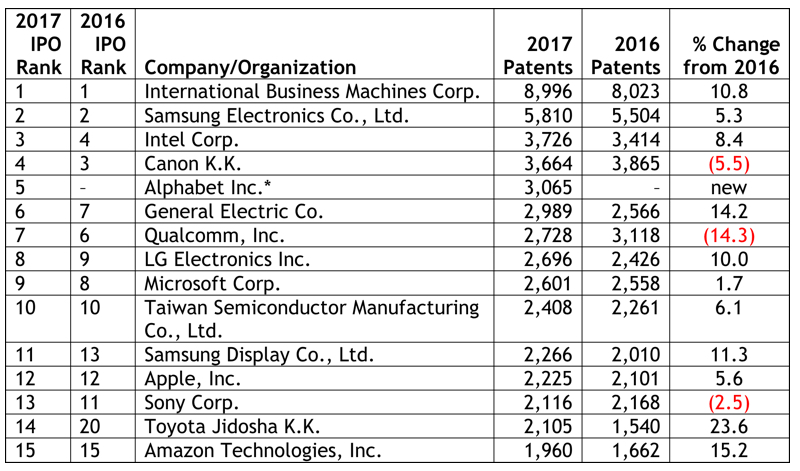
    The IPO compiled its list by counting the number of utility patents granted during 2017 that listed an organization or a subsidiary as the owner on the printed patent.  The IPO notes that patents that were granted to two or more organizations jointly were attributed to the organization listed first on the patent.  The IPO also noted that 318,829 patents were issued in 2017, which was an increase from the 303,051 patents that issued in 2016.  The top fifteen companies on the IPO Top 300 are listed below (click on table to expand):

    Top 15
    Toshiba Corp. was the only company to fall out of the Top 15 in 2017.  Toshiba Corp., which dropped to 16th in 2017, was replaced in the Top 15 by Toyota Jidosha K.K., which ranked 20th in 2016.

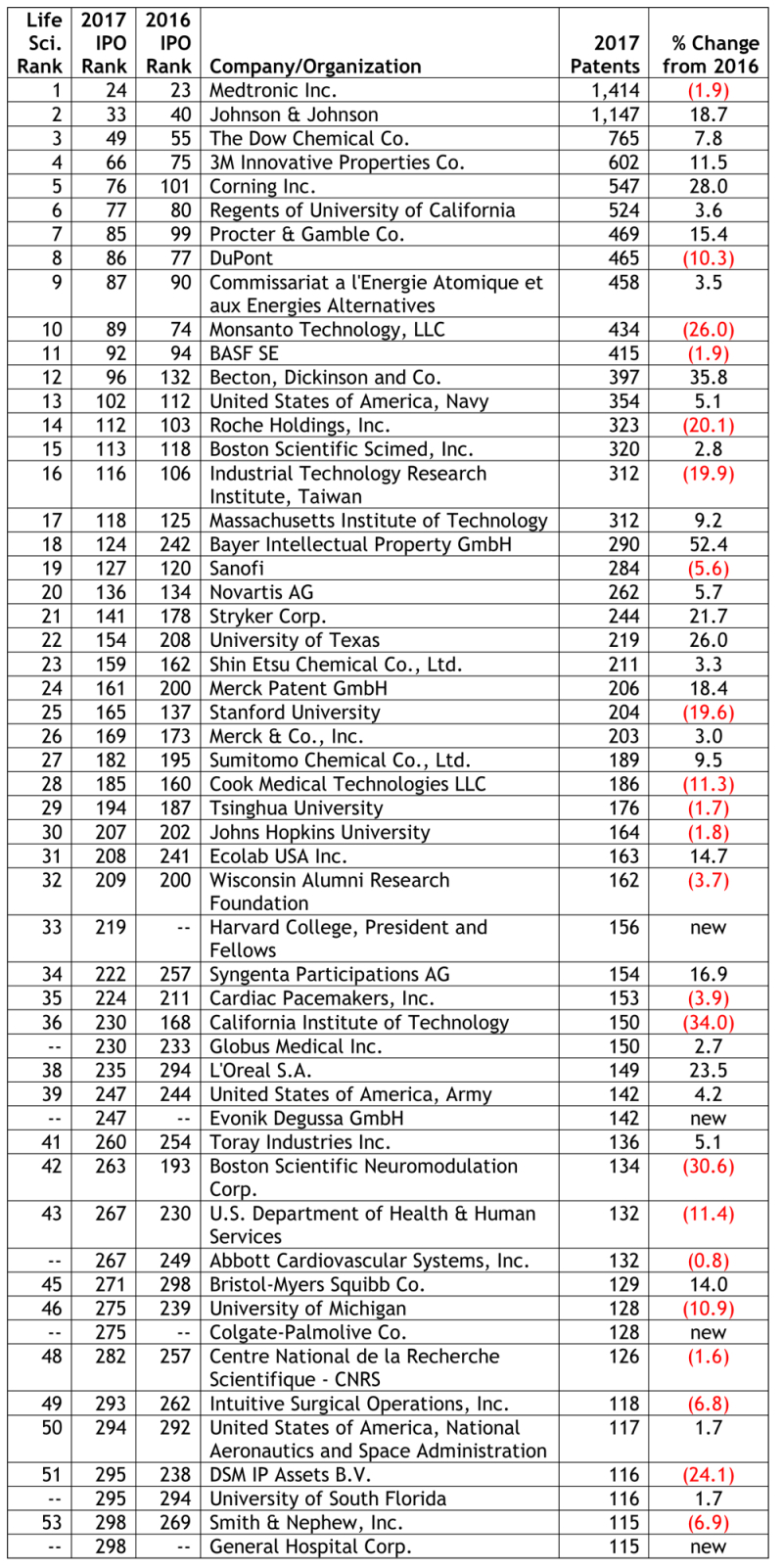
    As in past years, Patent Docs used the IPO's list of top patent holders to compile a list of the top "life sciences" companies and organizations receiving U.S. patents in 2017.  Each organization's IPO top 300 ranking for 2017 is indicated in the "2017 IPO Rank" column; the IPO top 300 ranking for 2016 (if available) is indicated in the "2016 IPO Rank" column; and the change in number of patents from 2016 is indicated in "% Change from 2016."  The Life Sciences Top 54 is listed below (click on table to expand):

    Top LS
    Please note that some of the companies and organizations listed above may be involved in work outside the life sciences sector, and therefore, a portion of the patents granted to these companies and organizations may be directed to other than life sciences-related inventions.  In addition, our list includes medical device companies.

    For additional information regarding this topic, please see:

    • "IPO Releases List of Top 300 Patent Holders for 2016," June 14, 2017
    • "IPO Releases List of Top 300 Patent Holders for 2014," July 1, 2015
    • "IPO Releases List of Top 300 Patent Holders for 2013," July 7, 2014
    • "IPO Releases List of Top 300 Patent Holders for 2012," June 24, 2013
    • "Another Look at IPO Top 300 and Life Sciences Top 53," June 11, 2012
    • "IPO Releases List of Top 300 Patent Holders for 2011," June 7, 2012
    • "IPO Releases List of Top 300 Patent Holders for 2010," June 30, 2011
    • "IPO Releases List of Top 300 Patent Holders for 2009," May 26, 2010
    • "IPO Releases List of Top 300 Patent Holders for 2008," May 14, 2009
    • "IPO Releases List of Top 300 Patent Holders," May 22, 2008
    • "IPO Posts List of Top 300 Patent Holders," April 20, 2007

  • By Bryan Helwig

    USPTO SealAbout the PTAB Life Sciences Report:  We will periodically report on developments at the PTAB involving life sciences patents.

    ABS Global, Inc. v. XY, LLC

    PTAB Petition:  IPR2018-01224; filed June 08, 2018.  View Petition here.

    Patent at Issue:  U.S. Patent No. 9,365,822, entitled ″System and method for sorting cells,″ describes an improved flow cytometer system particularly adapted to use for sex-selected sperm sorting including enhanced sheath fluid and other strategies which minimize stress on the sperm cells.  Improved collection systems and techniques for the process are described so that commercial applications of sperm samples as well as the resulting animals may be achieved.

    Background:  U.S. Patent No. 5,135,759 describes and claims the practice of collecting, processing and using processed bovine sperm to inseminate cows utilizing advances in flow cytometry systems.  This allows breeders to preferentially breed one sex of animal.  Petitioner contends that claim 11 of the ′822 patent differs from the examples in the ′759 patent in a single respect — it recites that the "sheath" and "collector" fluids "include[] a citric acid."  Petitioner also contends that adapting the scheme to use citric-acid containing sheath and collection would have been obvious well before 1997.  Petitioner therefore contends that claim 11 should be cancelled.

    Related Matters:
    • The ′822 patent is the subject of litigation in the U.S. District Court for the District of Wisconsin (17-cv-00466).
    • The ′822 patent is also the subject of pending litigation in the U.S. District Court for the District of Colorado, XY, LLC v. Trans Ova Genetics, LC (1:17-cv-00944).


    Merck Sharp & Dohme Corp. v. GlaxoSmithKline Biologicals SA

    PTAB Petition:  IPR2018-01229; filed June 11, 2018.  View Petition here.

    Patent at Issue:  U.S. Patent No. 8,753,645, entitled "Conjugation process of bacterial polysaccharides to carrier proteins," describes a process of conjugation of bacterial saccharides including Streptococcus pneumoniae and Haemophilus influenzae saccharides by reductive amination.  Merck Sharp & Dohme Corp. requested inter partes review of independent claim 1 and dependent claims 2-11 of the ′645 patent as anticipated and/or obvious under 35 U.S.C. §§ 102 or 103.

    Background:  Conjugates of bacterial saccharides to proteins are commonly-used components of vaccines.  The challenged claims are directed to processes for making conjugates of a particular S. pneumoniae bacterial saccharide, 23F.  Petitioner noted that the very same 23F "glycoconjugates" were well-known long before the alleged invention of the ′645 patent and featured in Pfizer's commercial Prevnar® vaccine.  Specifically, Petitioner notes that persons of ordinary skill in the art used reductive animnation to attach S. pneumoniae bacterial saccharides — including 23F — to proteins for decades before the ′645 patent.  Petitioner further contends that the claimed range of periodate in the ′645 patent does not produce unexpected results when compared to periodate outside of the range.

    Related Matters:
    • Petitioner concurrently filed IPR2018-01234 against U.S. Patent No. 9,265,839, entitled ″Conjugation process of bacterial polysaccharides to carrier proteins,″ which describes a process for conjugation of bacterial saccharides including Streptococcus pneumoniae and Haemophilus influenzae saccharides by reductive amination.  Petitioner challenges that independent claim 1 and dependent claims 2-10 are anticipated and/or obvious under 35 U.S.C. §§ 102 or 103.  View Petition here.
    • Petitioner concurrently filed IPR2018-01236 against independent claim 1 and dependent claims 2-11 of the ′645 patent as obvious under 35 U.S.C. § 103.  View Petition here.
    • Petitioner concurrently filed IPR2018-01237 against independent claim 1 and dependent claims 2-10 of the ′839 patent as obvious under 35 U.S.C. § 103.  View Petition here.


    Alnylam Pharmaceuticals, Inc. v. Silence Therapeutics GmbH

    PTAB Petition:  PGR2018-00067; filed June 11, 2018.  View Petition here.

    Patent at Issue:  U.S. Patent No. 9,758,784, entitled "Interfering RNA molecules," describes a ribonucleic acid comprising a double stranded structure whereby the double-stranded structure comprises a first strand and a second strand, whereby the first strand comprises a first stretch of contiguous nucleotides and whereby said first stretch is at least partially complementary to a target nucleic acid, and the second strand comprises a second stretch of contiguous nucleotides whereby said second stretch is at least partially identical to a target nucleic acid, and whereby the double stranded structure is blunt ended.

    Background:  Petitioners assert that the ′784 patent purports to cover an enormous, potentially unlimited, genus of structurally diverse small interfering RNA molecules, and therefore contend that the scope of the ′784 patent claims is far broader than any invention described in or enabled by the patent.  Petitioners also contend that the '784 patent claims are so broad that they cover modifications and genetic targets that have yet to be discovered.


    Pfizer Inc. v. Hoffmann-La Roche Inc.

    PTAB Petition:  IPR2018-01219; filed June 14, 2018.  View Petition here.

    Patent at Issue:  U.S. Patent No. 8,314,225, entitledHeavy chain mutant leading to improved immunoglobulin production,″ describes methods and nucleic acids useful in the production of immunoglobulins in mammalian cells.

    Background:  Petioner requested inter partes review of claims 1-5, 10-12, and 20 the ′225 patent.  Petitioner asserts the claims are unpatentable as anticipated and/or rendered obvious by U.S. Patent Application Publication No. 2002/0160006, International Publication No. WO 2007/068429, and U.S. Patent Application Publication No. 2006/0292152.

    Related Matters:
    Genentech, Inc. and City of Hope v. Sandoz, Inc., No. 17-13507 (D. N.J.)
    Genentech, Inc. and City of Hope v. Pfizer Inc., No. 17-1672 (D. Del.)
    • Re-examination Control No. 90/014,063


    Mylan Technologies Inc. v. Noven Pharmaceuticals, Inc.

    PTAB Petition:  IPR2018-00173; filed December 4, 2017.  View Petition here.

    Institution of inter partes review; entered June 12, 2018.  View Decision here.
    Panel:  Administrative Patent Judges Susan L. C. Mitchell, James T. Moore, and Kristi L.R. Sawert

    Patent at Issue:  U.S. Patent 9,724,310, entitled ″Transdermal estrogen device and delivery,″ claims a transdermal drug delivery systems for the transdermal administration of estrogen, comprising a polymer matrix and estrogen.  Methods of making and using such systems also are described.

    Background:  Mylan Technologies, Inc. requested inter partes review of claims 1–15 of the ′310 patent.  Noven Pharmaceuticals, Inc. filed a Preliminary Response.  Petitioner failed to show sufficiently for purposes of institution that cited art teaches a transdermal therapeutic system having an estradiolflux within the range recited in claim 1.  Further, because claims 2, 8, and 10–15 depend from claim 1 and require an estradiol flux within the range of about 0.0125 to about 0.05 mg/cm2/day, Petitioner also failed to show sufficiently for purposes of institution that it would prevail in its assertion that the prior art anticipates those claims.  Applying the precedent of SAS Inst., Inc. v. Iancu, (138 S. Ct. 1348, 1355–56 (2018)), and upon consideration of the information presented in the Petition and the Preliminary Response, the Petition was denied and the IPR not instituted.

    Related Matters:
    Noven Pharmaceuticals, Inc. v. Alvogen PineBrook LLC, No. 1:17-cv-01429-LPS (D. Del.).
    • Petitioner also petitioned for inter partes review of U.S. Patent 9,730,900, IPR2018-00174.  The Petition was denied.  View Decision here.
    • Petitioner stated that the '310 and the '900 patents both claim the benefit of U.S. Patent No. 8,231,906.
    • Petioner identified both pending and terminated litigations involving the ′906 patent:
        • Noven Pharmaceuticals Inc. v. Mylan Technologies Inc., No. 1:15-cv-00328 (D. Del.) (terminated);
        • Noven Pharmaceuticals Inc. v. Mylan Technologies Inc., 1:15-cv-00069 (N.D. W.V.) (terminated);
        • Noven Pharmaceuticals Inc. v. Actavis Laboratories UT, Inc., Nos. 1:15-cv-00249-LPS and 1:16-cv-00465-LPS (D. Del.) (pending);
        • Alvogen Pine Brook LLC v. Noven Pharmaceuticals, Inc., No. 1:16-cv-00395-LPS (D. Del.) (pending).


    Initiative for Medicines, Access & Knowledge (I-MAK), Inc. v. Gilead Pharmasset LLC

    PTAB Petition:  IPR2018-00103; filed October 25, 2017.  View Petition here.

    Institution of inter partes review; entered June 13, 2018.  View Decision here.
    Panel:  Administrative Patent Judges Erica A. Franklin, Lora M. Green, and Richard J. Smith

    Patent at Issue:  U.S. Patent No. 7,429,572, entitled "Modified fluorinated nucleoside analogues," describes and claims compositions and methods of treating a Flaviviridae infection, including hepatitis C virus, West Nile Virus, yellow fever virus, and a rhinovirus infection in a host, including animals, and especially humans, using a (2'R)-2'-deoxy-2'-fluoro-2'-C-methyl nucleosides, or a pharmaceutically acceptable salt or prodrug thereof.

    Background:  Initiative for Medicines, Access & Knowledge, Inc. filed a Petition requesting inter partes review of claims 1‒19 of the ′572 patent.  Gilead Pharmasset LLC filed a Preliminary Response to the Petition.  Petitioner asserted that the ′572 patent claims pharmaceutical compounds that were already published by the United States Government years before Patent Owner applied for the ′572 patent.  In addition, Petitioner contended that other scientists also publicly identified the pharmaceutical compounds claimed by the ′572 before Patent Owner applied for the ′572 patent. Upon considering the Petition and the Preliminary Response, the panel held that Petitioner has not demonstrated a reasonable likelihood that it would prevail in showing the unpatentability of any of the challenged claims.  Institution of inter partes review for any challenged claim of the ′572 patent was denied.

    Related Matters
    • Patent Owner identified U.S. Patent Application No. 12/878,262, now U.S. Patent No. 8,415,322, as well as U.S. Patent Application No. 11/854,218, which is pending.
    • IPR 2018-00123: Initiative for Medicines, Access & Knowledge (I-MAK), Inc. requested inter partes review of claims 1 and 2 of U.S. Patent No. 8,735,372.  Gilead Pharmasset LLC filed a Preliminary Response.  The ′372 patent is directed to a method of treating a human infected by hepatitis C virus comprising administering both an NS5a inhibitor and a prodrug of a nucleoside derivative.  The Petitioner did not show a reasonable likelihood that it would prevail in establishing the unpatentability of any challenged claim.  The panel denied institution of inter partes review.  View the Decision here.


    Novartis Pharmaceuticals Corp. v. Plexxikon Inc.

    PTAB Petition:  IPR2018-01287; filed June 18, 2018.  View petition here.

    Patent at issue:  U.S. Patent No. 9,469,640, entitled ″Compounds and Methods for Kinase Modulation, and Indications Therefor," describes disease indications which are amenable to treatment by modulation of kinase activity by the compounds of the present invention.

    Background:  Petitioner challenges claims 1, 2, 4-6, 9, 11 and 12 of the ′640 patent.  The ′640 patent claims priority to U.S. Application No. 12/669,450 (PCT/US2008/070124), filed on July 16, 2008, through a series of three continuation applications (all abandoned), and claims earliest priority to U.S. Provisional Application No. 60/959,907.  Petitioner asserted that the challenged claims are not entitled to the benefit of the July 16, 2008 filing date or the earlier provisional application because U.S. Application No. 12/669,450 does not satisfy the written description and enablement requirements of 35 U.S.C. § 112 (pre-AIA).

    Related Matters:
    • The ′640 patent is asserted in Plexxikon Inc. v. Novartis Pharmaceuticals Corp., No. 4:17-cv-04405 (N.D. Cal).
    • A petition for Post-Grant Review of U.S. Patent No. 9,844,539 ("the '539 patent) is being filed concurrently with the IPR.  The ′539 patent is in the same patent family as the ʼ640 patent and is also asserted in the above referenced district court action.
    • U.S. Application No. 15/656,990 is currently pending before the Office and claims priority to the application that issued as the ′640 patent.


    Merck Sharp & Dohme Corp. v. Microspherix LLC

    PTAB Petition:  IPR2018-01288; filed June 18, 2018.  View Petition here.

    Patent at issue:  U.S. Patent No. 6,514,193 claims a method for administering a therapeutically active component including a non-radioactive drug to a target tissue in a subject.

    Background:  Petitioners requested inter partes review and cancellation of claims 1-2 of the ′193 patent, asserting that the method is both anticipated and rendered obvious by the prior art.  Petitioners contend the ′193 patent does not purport to improve on prior art implantation devices, and instead, the '193 patent states that its seeds are designed to be implanted "with the needles used in many conventional brachytherapy strand implantation devices."

    Related Matters:
    • Petitioners have filed IPR petitions 2018-00393, -00402, and -00602 for three related patents.


    Samsung Bioepis Co. v. Genentech, Inc.

    PTAB Petition:  IPR2018-00192; filed November 30, 2017.  View Petition here.

    Denial of inter partes review; entered June 18, 2018.  View decision here.
    Panel:  Administrative Patent Judges Christopher G. Paulraj, Robert A. Pollock, and Zhenyu Yang

    Patent at Issue:  U.S. Patent No. 7,846,441, entitled "Treatment with Anti-ERBB2 Antibodies," concerns the treatment of disorders characterized by the overexpression of ErbB2.  More specifically, the invention concerns the treatment of human patients susceptible to or diagnosed with cancer overexpressing ErbB2 with a combination of an anti-ErbB2 antibody and a chemotherapeutic agent other than an anthracycline, e.g., doxorubicin or epirubicin.

    Background:  Petitioner requested inter partes review of claims 1–14 of the ′441 patent.  Patent Owner, Genentech, Inc., filed a Preliminary Response to the Petition.  Samsung Bioepis Co. argued that claims 1–14 of the ′441 patent would have been obvious over the combination of (1) Lottery in view of Hayes and/or Baselga ′96, and Gelmon, and (2) Baselga ′96 in view of Baselga ′94 and Gelmon.  Patent Owner contended that the Petition should be denied under 35 U.S.C. § 325(d) "in view of the previously-instituted IPRs based upon Baselga ′96, which are at an advanced stage."  Patent Owner's argument was persuasive.  Institution of inter partes review was denied.  The panel cited Harmonic Inc. v. Avid Tech, Inc., 815 F.3d 1356, 1367 (Fed. Cir. 2016) (explaining that under § 314(a), "the PTO is permitted, but never compelled, to institute an IPR proceeding").  Under 35 U.S.C. § 325(d), in determining whether to institute inter partes review, the PTAB "may take into account whether, and reject the petition or request because, the same or substantially the same prior art or arguments previously were presented to the Office."

    Related Matters:
    • IPR2017-00731: Instituted.  Pfizer filed a petition, challenging claims 1–14 of the ′441 patent.  Institution was originally denied, but later granted after Pfizer's request for reconsideration.  View the Decision here.
    • IPR2017-02063: Instituted.  Pfizer filed a second petition together with a motion to join Celltrion in IPR2017-01121.  Joinder was granted.  View the Decision here.
    • IPR2018-00016: Denied.  A concurrently issued decision and third petition filed by Pfizer, challenging the same claims of the '441 patent.  View the Decision here.
    • IPR2017-00737: Instituted.  Pfizer and Celltrion challenged certain claims of U.S. Patent No. 7,892,549, a patent in the same family as the '441 patent.  View the Decision here.
    • IPR2017-01960: Instituted.  Filed by Petitioner Bioepis, together with a motion to join Pfizer in IPR2017-00737.  The joinder motion was granted.  View the Decision here.
    • The oral hearings for IPR2017-00731, -00737, -01121, -01122, and -01960 were held on May 18, 2018.
    • According to the parties, the '441 patent is also the subject of Genentech, Inc. v. Pfizer, Inc., No. 1:17-cv-01672 (D. Del.), Celltrion, Inc. v. Genentech, Inc., No. 3-18-cv-00274 (N.D. Cal.), and Genentech, Inc. v. Celltrion, Inc., No. 1-18-cv-00095 (D. Del.).


    Agilent Technologies, Inc. v. Thermo Fisher Scientific Inc.

    PTAB Petition:  IPR2018-00297; filed December 13, 2017.  View petition here.

    Institution of inter partes review; entered June 18, 2018.  View decision here.
    Panel:  Administrative Patent Judges Michael R. Zecher, John F. Horvath, and Daniel J. Galligan

    Patent at Issue:  U.S. Patent No. RE54,553, entitled ″Mass Spectrometer and Mass Filters Thereof.″  The ′553 patent generally relates to a method for improving the operational characteristics of mass spectrometers, particularly those with quadrupole mass filter arrangements.  The ′553 patent purportedly addresses an issue where dielectric material is deposited on the rods thereby reducing the mass resolving power or transmission of the mass spectrometer that in some instances renders the mass spectrometer useless.

    Background:  Agilent Technologies, Inc. petitioned for for inter partes review of claims 1–66 of the ′553 patent.  Patent Owner filed a Preliminary Response along with a statutory disclaimer pursuant to 35 U.S.C. § 253(a) and 37 C.F.R. § 1.321(a) that disclaims claims 1–31 and 36–61.  Consequently, only claims 32–35 and 62–66 remained for consideration.  Taking into account the arguments presented in Thermo's Preliminary Response, the panel concluded that the information presented in the Petition established that there is a reasonable likelihood that Agilent would prevail in challenging at least one of claims 32–35 and 62–66 of the ′553 patent as unpatentable under 35 U.S.C. §§ 102(b) or 103(a) and an inter partes review as to these claims of the '553 patent was instituted.

    Related Matters:
    • The parties represent that the ′553 patent is at issue in a district court case Thermo Fisher Scientific Inc. v. Agilent Technologies, Inc. (D. Del.).
    • In addition to this Petition, Agilent filed three other petitions challenging the patentability of all the claims in the following two patents owned by Thermo:  (1) U.S. Patent No. 7,230,232 (IPR2018-00299); and (2) U.S. Patent No. RE45,386 E (IPR2018-00298 and IPR2018-00313).
    • IPR2018-00299:  Agilent filed a Petition requesting inter partes review of claims 1–34 of the ′232 patent.  Thermo filed a Preliminary Response.  The court instituted an inter partes review as to claims 1–34 of the ′232 patent.  View the Decision here.
    • IPR2018-00298:  Agilent filed a Petition requesting an inter partes review of claims 1–8, 10, 12–20, 22, 23, and 25–50 the ′386 patent.  Thermo filed a Preliminary Response.  Petitioner demonstrated a reasonable likelihood that it would prevail in showing the unpatentability of at least one challenged claim of the ′386 patent.  Accordingly, an inter partes review of all challenged claims on all challenged grounds was instituted.  View the Decision here.
    • IPR2018-00313:  Agilent requested inter partes review of claims 1, 5–11, 13–21, 23, 24, 28–35, and 37–50 the ′386 patent.  Thermo disclaimed claims 9, 11, 21, and 24 and filed a Preliminary Response.  Consequently, only claims 1, 5–8, 10, 13–20, 23, 28–35, and 37–50 remained for consideration.  Petitioner demonstrated a reasonable likelihood that it would prevail in showing the unpatentability of at least one challenged claim of the ′386 patent.  Accordingly, inter partes review of all challenged claims on all challenged grounds was instituted.  View the Decision here.

  • Cloud Computing Claims Deemed Patent-Ineligible

    By James Korenchan

    District Court for the District of DelawareThis month, in an infringement case against Defendant Amazon, Judge Stark of the U.S. District Court for the District of Delaware ruled that Plaintiff Kaavo Inc.'s cloud computing claims are patent-ineligible under 35 U.S.C. § 101.  In related cases dating back to 2016, the Court ordered that the asserted independent claims be found patent-ineligible, as well as one of the dependent claims.  The Court later ordered limited discovery, claim construction, and summary judgement briefing with respect to the eligibility of the remaining dependent claims.  Kaavo then moved for reconsideration of the Court's Order invalidating all of the asserted independent claims and the one dependent claim, whereas Amazon moved for summary judgement.  The Court denied both motions without prejudice and instead ordered new briefing to allow for consideration of the § 101 issues in light of Federal Circuit patent-eligibility decisions since early 2016.  Renewals of both motions were at issue in this latest decision, in which the Court granted Amazon's renewed motion for summary judgement of invalidity of the remaining dependent claims and denied Kaavo's renewed motion to reconsider.

    The patent at issue, U.S. Patent No. 8,271,974 (the '974 patent), entitled "Cloud Computing Lifecycle Management for N-tier Applications," is directed to managing a cloud computing environment, where the cloud environment is used for running a software application (e.g., a web-portal, a word processing program, an inventory management program, a database management service, etc.).  The patent describes a cloud environment as an environment in which cloud providers can provide users with access to resources such as datacenters and/or other IT-related capabilities.  More particularly, the patent describes that a cloud environment can be an "N-tier environment," which refers to logical groupings of components based on their functionality, examples of which include a "presentation tier," an "application tier (e.g., a logic or business logic tier)," and a "database tier."  Notably absent from the patent is a description of the improvements and advantages that the claimed invention provides — an absence that worked heavily against Kaavo in this case.

    The Independent Claims and Dependent Claim 12

    First, the Court addressed Kaavo's motion for reconsideration of the asserted independent claims and dependent claim 12.  A representative independent claim of the '974 patent is as follows:

    1.  A method for managing a cloud computing environment for use by a software application comprising:
        determining a requested initial cloud environment based on user-defined provisioning information, where the requested initial cloud environment is not yet instantiated and is an N-tier computing environment;
        sending an initialization event based on the requested initial cloud environment, where the initialization event is configured to cause an initial cloud environment configuration to be made available to an application;
        sending application data that is configured to cause the application to begin execution in the initial cloud environment configuration;
        receiving monitoring environment data that represents a current cloud environment state;
        determining a requested adjusted cloud environment based on the monitoring environment data, where the requested adjusted cloud environment is an N-tier computing environment; and
        sending a cloud environment adjustment event based on the requested adjusted cloud environment, where the cloud environment adjustment event is configured to cause an adjusted cloud environment configuration to be made available to the application.

    And dependent claim 12 is as follows:

    12.  The method of claim 1, where the determining a requested initial cloud environment is performed using a processor, a hardware circuit, or an integrated circuit.

    In its motion, Kaavo argued that the Federal Circuit decisions in Enfish, McRO, BASCOM, Visual Memory, Core Wireless Licensing, Berkheimer, and Aatrix — all of which had not yet been issued when the Court deemed the independent claims invalid under § 101 — support a finding that the independent claims are directed to an improvement of the functioning of computers and improve existing technology and are thus patent-eligible.  In part, Kaavo argued that cloud computing is a "fairly recent" development and differs from conventional computing technology.

    But the Court was not convinced, briefly highlighting the improvements provided by "the self-referential table in Enfish, the computer memory system in Visual Memory, and the user interface Core Wireless," and noting that neither the claims nor the specification in this case indicate the presence of any improvement sufficient to support a finding of validity.  Thus, the Court maintained that the independent claims are directed to the abstract idea of setting up and managing a cloud computing environment.

    The Court did not specifically address dependent claim 12 in prong one, nor did the Court specifically address McRO, BASCOM, Aatrix, and Berkheimer.  (Though the Court cited Berkheimer elsewhere in the decision: "[w]hen there is no genuine issue of material fact regarding whether the claim element or claimed combination is well-understood, routine, [and] conventional to a skilled artisan in the relevant field, this issue can be decided on summary judgment as a matter of law.")

    The Remaining Dependent Claims

    The Court identified the following additional limitations as representative of all the remaining dependent claims:

    • forecasting an optimal cloud environment for future use with the application based on monitoring environment data (claim 5)

    • forecasting a future cost associated with executing the application based on monitoring environment data (claim 6)

    • the user-defined provisioning information is determined using a needs analysis algorithm and a user input received from a user interface (claim 8)

    • the user-defined provisioning information comprises geographic data (claim 9)

    • receiving security information, determining a requested security action based on the security information, and sending a security event based on the requested security action (claim 11).

    Addressing prong one of Alice, the Court stated that each of these dependent claims broadly recite functional goals of the claimed cloud environment, but that the patent does not describe the technical details of how to achieve the functional goals in a non-abstract way.

    Claims 5 and 6, for instance, each recite a type of forecasting.  The patent generally describes forecasting as being performed using techniques such as "neural networks, time-series algorithms, and regression analysis," but the patent does not provide an algorithm or any additional details as to how forecasting is performed.  With regard to claims 8 and 9, the patent does not describe any algorithm or other manner in which to determine "user-defined provisioning information."  (Note: The Court found "need analysis algorithm" to be indefinite in claim construction.)  And for claim 11, the patent does not provide details as to how security information is received, how a security action is determined, or how a security event is sent.  The Court also noted that the patent mentions various modules for performing operations related to the dependent claims, but the claims do not require use of the modules.

    The Court concluded its prong one analysis by reiterating that the dependent claims do not provide improvements to computer functionality and that the patent does not describe such improvements.  Kaavo's arguments to the contrary relied on expert opinion, but the expert opinion in turn relied on the cloud computing context of the invalid independent claims and was thus insufficient to create a genuine issue of material fact.

    The Court's prong two analysis was much the same as prong one in that the Court highlighted the lack of specificity in the claims and specification:

    For instance, Claims 5 and 6 do not specify how the forecasting is performed, what monitoring data is used, or how it is used; any generic algorithm, neural network, or regression analysis could be used.  Claim 8 does not limit the method to any specific algorithm or user interface; any generic algorithm or user interface could be used.  Claim 9 does not teach how the geographic data is created or determined, or what type of data is required; any generic method or data could be used.  Claim 11 does not limit how the security information is collected, how the security action is determined, or how the security event is used; any generic method could be used.  Plaintiff has not cited to any portion of the specification that fills any of these gaps.

    The post-Alice eligibility landscape can be tumultuous, but it is consistently important that a patent recites and describes sufficient details as to how the invention provides non-abstract, innovative technological improvements.

    Kaavo Inc. v. Amazon.com, Inc. (D. Del. 2018)
    Memorandum Opinion by District Judge Stark

  • CalendarJuly 5, 2018 – "Post-Sale Restrictions: Protecting Patented Products After Lexmark" (Strafford) – 1:00 to 2:30 pm (EDT)

    July 10, 2018 – "Improving Access to Global Patent Data" (U.S. Patent and Trademark Office) – 12:00 to 1:00 pm (ET)

    July 11-12, 2018 – "Advanced Patent Prosecution Workshop 2018: Claim Drafting & Amendment Writing" (Practising Law Institute) – New York, NY

    July 17, 2018 – "Drafting and Defending Software Patents to Survive Section 101 and AIA Challenges — Anticipating and Minimizing the Risk of 101, 103 Rejections, Recent Court Guidance" (Strafford) – 1:00 to 2:30 pm (EDT)

    July 17, 2018 – Technology Center (TC) 2600 Customer Partnership Meeting (Rocky Mountain Regional Office, U.S. Patent and Trademark Office) – 8:15 am to 3:00 pm (MT), Denver, CO

    July 17, 2018 – "Biotech/pharma subject-matter — Patentability at the EPO and how to avoid pitfalls for US based applicants" (Oppedahl Patent Law Firm LLC) – 7:30 to 9:30 am (MT)

    July 17-18, 2018 – Post-Grant PTO Proceedings Conference (American Conference Institute) – Washington, D.C.

    July 18-20, 2018 – Patent Fundamentals Bootcamp 2018: An Introduction to Patent Drafting, Prosecution, and Litigation (Practising Law Institute) – San Francisco, CA

    July 19, 2018 – "Labeling and Induced Infringement in Pharma Patent Litigation and Protecting IP Rights" (Strafford) – 1:00 to 2:30 pm (EDT)

    July 25-27, 2018 – Women Leaders in Life Sciences Law conference (American Conference Institute) – Boston, MA

    August 16-17, 2018 – "Advanced Patent Prosecution Workshop 2018: Claim Drafting & Amendment Writing" (Practising Law Institute) – San Francisco, CA

    September 21, 2018 – "USPTO Post-Grant Patent Trials 2018: Change & Recalibration" (Practising Law Institute) – New York & Groupcasts in Philadelphia, Indianapolis, New Brunswick, NJ, Pittsburgh, and Mechanicsburg, PA

    September 27-28, 2018 – "Advanced Patent Prosecution Workshop 2018: Claim Drafting & Amendment Writing" (Practising Law Institute) – Chicago, IL

  • USPTO SealThe U.S. Patent and Trademark Office will be offering the next webinar in its Patent Quality Chat webinar series from 12:00 to 1:00 pm (ET) on July 10, 2018.  In the latest webinar, entitled "Improving Access to Global Patent Data," Nelson Yang, Acting Director of International Patent Business Solutions in the Office of International Patent Cooperation of the U.S. Patent and Trademark Office, and Jocelyn Ram, Patent Business Analyst in the Office of International Patent Cooperation, will provide an overview of the Global Dossier concept and how the IP5 Offices (USPTO, EPO, JPO, KIPO, and SIPO) have been working together to provide additional services and functionalities.  In particular, the new service, Citation List, will be highlighted to demonstrate its capabilities in prior art searching.

    Additional information regarding this webinar can be found here.  Instructions for viewing the webinar and additional information regarding the Patent Quality Chat webinar series can be found on the USPTO's Patent Quality Chat webpage.