• Claims for Keyword-Based Navigation of Hierarchically-Structured Data Found Abstract But Survive Motion to Dismiss

    By James Korenchan —
    District Court for the District of DelawarePlaintiff Guada Technologies, LLC ("Guada") sued Defendant Vice Media, LLC ("Vice Media"), alleging infringement at least claim 1 of U.S. Patent No. 7,231,379 ("the '379 patent").  Vice Media then filed a motion to dismiss.  Last week, Judge Richard G. Andrews of the U.S. District Court for the District of Delaware ruled that the claims are directed to an abstract idea under 35 U.S.C. § 101, but that a factual issue remains as to whether the claims provide an inventive concept.

    The '379 patent, entitled "Navigation in a hierarchical structured transaction processing system," relates at a high level to navigating through a hierarchical network of "choices" (e.g., transactions, or operations where information is accessed) to accomplish a goal.  In such a network, choices are arranged as nodes in a graph structure.  As an illustrative example, Figure 3 of the '379 patent is shown below, which is in the context of airline reservations.
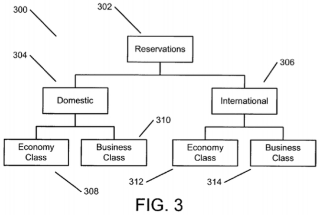
    FIG.3
    In this example, the high-level choice to make a reservation is shown in the graph at the top of a hierarchy of nodes.  As shown, for instance, the choices to reserve a domestic flight or an international flight are distinct nodes in the graph that branch from the reservation node.  Other choices (i.e., flight classes) are then shown as nodes branching from the domestic flight and international flight nodes.

    The background of the patent notes that it can be difficult to efficiently navigate through a graph of choices to reach a goal, particularly when there are many choices involved in doing so.  In addition, the patent notes the disadvantages in how existing graphs and associated systems often require direct path traversal through a hierarchy.  That is, such systems do not allow a user to jump from one node to another unless the two nodes are connected as part of the same path through the graph.  The patent thus aims to provide more efficient navigation through a series of choices in a network of nodes by using keywords to allow a user to jump from one node to a non-connected node.  In the context of this invention, a "keyword" for a choice is the most important word and serves as a shorthand way of referring to a node.  As a simple example, if the node for a choice to make a reservation is "Would you like to make a reservation?", the keyword could be "reservation" (or "Reservations," as shown in Figure 3).

    The '379 patent includes two independent claims of similar scope.  As a representative example, claim 1 is provided as follows:

    1.  A method performed in a system having multiple navigable nodes interconnected in a hierarchical arrangement comprising:
        at a first node, receiving an input from a user of the system, the input containing at least one word identifiable with at least one keyword from among multiple keywords,
        identifying at least one node, other than the first node, that is not directly connected to the first node but is associated with the at least one keyword, and
        jumping to the at least one node.

    Abstract Idea

    Guada argued that the invention solves existing problems in the art by not restricting user movement through a decisional network to adjacent nodes or starting over at a top node.  And in oral arguments, Guada analogized the claims to those in McRO, asserting that the claims amount to computer improvement.  However, Guada provided little substance to its McRO position:

    Plaintiff argues that the claims here provide "implementation details," which are not "purely functional," but rather amount to computer improvement.  First, argues Plaintiff, the "receiving an input" claim limitation "requires a specific user . . . who provides the input, provides the location where the input is received . . . , and what the input is . . . ."  Second, argues Plaintiff, the "identifying at least one node . . . associated with the at least one keyword" limitation requires "nodes associated with keywords."  Plaintiff argues that "nodes" in "the ordinary setup of a hierarchically arranged decision network" are "not associated with keywords."  Third, argues Plaintiff, the "jumping" limitation "requires the system to directly traverse from one node/vertex to another node/vertex that is not directly connected."

    (citations omitted).

    In response, Vice Media cited CyberSource, noting that the claimed "nodes" and "interconnections" are not tangible objects and that the steps of each method claim can be performed mentally or with pen and paper.  Even the concept of a hierarchical arrangement of nodes, Vice Media argued, is an abstract idea from mathematical graph theory.

    The Court agreed with Vice Media, stating that the '379 patent provides no information as to how the "implementation details" allegedly provided by the claims improve computer functionality or even a computerized data set.  Rather, the claims related to a "generic automation of a once-manual method."  The Court also noted that keywords do not necessarily invoke computer functionality.  For at least these reasons, the Court deemed all seven claims of the '379 patent to be directed to an abstract idea.

    Guada also argued that claim construction issues precluded a grant of the motion to dismiss and proposed its own constructions to remedy those issues, but neither rendered the claims non-abstract.  First, Guada argued that limitations in the preamble of each independent claim refer to "a computerized system of multiple nodes interconnected in a hierarchically arranged decisional network in which a user provides inputs or responses at each node to navigate through adjacent nodes in the hierarchical arrangement."  But the Court stated that the construction at best places the claim into a more specific technological environment.  Guada also provided specific constructions for the "jumping" limitations — most notably of which being that the jumping limitation is an action required by the system, not the user.  But the Court stated that this merely amounts to automating "the mental process of jumping from one node to another."

    Inventive Concept

    In its Alice prong two contentions, Guada argued that the claims recite two alleged inventive concepts.  First, Guada argued that that "jumping" limitation is inventive because navigation in prior art hierarchical networks was not done the way that the patent purports.  Second, Guada argued that using keywords to jump from node to node is inventive.  Vice Media argued in response that both of these concepts were well-known at the time the patent was filed (November 2002), but provided no citation in support and thus did not provide the clear and convincing evidence of ineligibility required by Berkheimer.

    As a result, the Court denied Vice Media's motion to dismiss and solidified this decision as another example of the increased difficulty in invalidating patents post-Berkheimer.  Vice Media will have to improve its contentions and actually provide evidence at the summary judgment stage.

    Guada Technologies LLC v. Vice Media, LLC (D. Del. 2018)
    Memorandum Opinion by District Judge Andrews

  • By Kevin E. Noonan —

    Iancu  AndreiU.S. Patent and Trademark Office Director Andrew Iancu gave the introductory keynote address at the 46th Annual Meeting of the Intellectual Property Owners (IPO) Association on Monday, and his talk provided the prospect of a Patent Office administration dedicated, as former Solicitor Nancy Linck advocated several years ago at a Biotechnology Innovation Organization annual meeting, to adopt policies aimed at helping the courts (including the Supreme Court) come to the correct decisions regarding questions such as patent subject matter eligibility.

    While discussing other aspects of the Office's policymaking (including improvements in the Trademark Office and participation in the Music Modernization Act) and infrastructure efforts (noting the "legacy" nature of the Office's IT infrastructure and the week-long outage of the Electronic Filing System and Patent Application Information Retrieval portal a few weeks ago), the bulk of Director Iancu's remarks had to do with subject matter eligibility.  The Director noted (and quoted) Federal Circuit judges to the effect that subject matter eligibility was an uncertain area of the law that needed change.  The Director noted the efforts of IPO, and the American Intellectual Property Lawyers Association (AIPLA) in proposing draft legislation to remove the uncertainty in the law (stemming unmentioned from Supreme Court cases of dubious sagacity).  But Director Iancu noted that legislation can "take[] a long time" and the results cannot be certain.

    "[T]he USPTO cannot wait," he said, noting that there are "thousands of examiners who struggle with these issues on a daily basis" and who "need additional guidance now" (as well as "patent applicants, patent owners, and the public").

    He then harkened back to Judge Giles Sutherland Rich and his "prescient" thoughts of almost 40 years ago, when in In re Bergy the Judge noted that there was an "unfortunate . . . though clear commingling of distinct statutory provisions which are conceptually unrelated, namely, those pertaining to the categories of invention in §101 which may be patentable, and to the conditions for patentability demanded by the statute . . . ."  Restating the point, Director Iancu asked:

    How can a claim be novel enough to pass 102 and nonobvious enough to pass 103, yet lack an "inventive concept" and therefore fail 101?  Or, how can a claim be concrete enough so that one of skill in the art can make it without undue experimentation, and pass 112, yet abstract enough to fail 101?  How can something concrete be abstract?

    These are not simple problems, insofar as they "confound the most sophisticated practitioners in our patent system" because "[p]eople simply don't know how to draw these distinctions."  Echoing many, the Director advocated using the other statutory sections (specifically, §§ 102, 103, and 112) as more appropriate tools for preventing unpatentable (in contradistinction to patent-ineligible) claims from being allowed.

    The appropriateness of these statutory sections is illustrated by "decades of case law from the courts and millions of examinations at the PTO" to "guide us in our 102, 103, and 112 analyses."  The Director characterized that "the genius of the 1952 Patent Act" was that it provided categories of patent-eligible subject matter.  The problem, according to Director Iancu (and in this sentiment he is not alone) is that recent case law "mushes them all up again."  This "may [indeed, demonstrably does] lead to distorted legal conclusions," according to the Director, stating dramatically:  "And it has.  And it must end."

    How to achieve this goal so fervently to be hoped?  The Director proposes going back to Judge Rich, "and keep[ing] rejections in their own distinct [statutory] lanes."  The standard the Director proposes is that, "[i]f the claims can be fixed by slightly different claiming, by narrower claiming, or by more definite claiming, this is likely a 'conditions' problem—not a subject matter problem."  He recognizes that some things, like gravity or DNA, are not patent eligible — he is not an extremist or absolutist.  But he proposes to provide categories of patent ineligible subject matter like the statute provides patent eligible subject matter categories.

    His discussion of providing more certain and defined (cabined, dare we say?) categories of ineligible subject matter focused on abstract ideas, which he believes is "the issue needing most attention."  To that end, the Director announced that "at the USPTO we are contemplating revised guidance to help categorize the exceptions—and indeed to name them—and instruct examiners on how to apply them."  He then explained his vision:

    [T]he contemplated guidance would do two primary things:  First, it would categorize the exceptions based on a synthesis of the case law to date.  And second, if a claim does recite a categorized exception, we would instruct examiners to decide if it is "directed to" that exception by determining whether such exception is integrated into a practical application.  These two clarifications would help drive more predictability back into the analysis while remaining true to the case law that gave rise to these judicial exceptions in the first place.

    This calculus would provide categories of patent-ineligible subject matter that satisfy the criterion set forth by the Supreme Court:  the "basic tools of scientific and technological work."  These include examples such as "gravity, electromagnetism, DNA"; "fundamental mathematics like calculus, geometry, or arithmetic per se"; "basic 'methods of organizing human activity,' such as fundamental economic practices like market hedging and escrow transactions"; and "pure mental processes such as forming a judgment or observation . . . by itself, something performed solely in the human mind."

    Despite the Supreme Court having been "interpreting this statute for the past 200 years or so," the Director recognizes that the Court has only provided a "limited number of examples" of subject matter that encompasses the "basic tools of scientific and technological work."  The Director finds that what constitutes "natural phenomena" or "laws of nature" present less difficulty in defining their metes and bounds than abstract ideas.  To address this question, the PTO is performing "a thorough review of the relevant case law helps us draw more clear lines," "stud[ying] every relevant case in detail."  As a consequence, the Director informed his audience that "the proposed PTO guidance would synthesize "abstract ideas" as falling into the following three categories:

    • Mathematical concepts like mathematical relationships, formulas, and calculations
    • Certain methods of organizing human interactions, such as fundamental economic practices commercial and legal interactions; managing relationships or interactions between people; and advertising, marketing, and sales activities
    • Mental processes, which are concepts performed in the human mind, such as forming an observation, evaluation, judgment, or opinion.

    Under the new guidance, Examiners would first look at whether the claims were directed to one of the four statutory categories.  If yes, the Examiner would then "check to see if the claims recite matter within one of the judicial exceptions," categorized as set forth in the Director's talk; he said this was the Office's "new approach."  What seems to be the actual new approach was his next statement:  "[i]f the claims at issue do not recite subject matter falling into one of these categories [of patent-ineligible subject matter], then the 101 analysis is essentially concluded and the claim is eligible."  The Director predicted that "[t]his alone would resolve a significant number of cases currently confounding our system" because "[i]f an examiner does not find matter within the disallowed categories, he or she can move on."

    However, if the subject matter falls within a patent-ineligible subject matter category, then (but only then) must the Examiner move on to consider "whether the claims are 'directed to' those categories."  What the Director believes this means, and what the new guidance will specify, is "that Supreme Court jurisprudence taken together effectively allows claims that include otherwise excluded matter as long as that matter is integrated into a practical application."  "The line, in other words, delineates mere principles, on one hand, from practical applications of such principles, on the other," according to the Director's description of the new guidance.  This methodology is supported, according to the Director, by Supreme Court precedent including Le Roy v. Tathem (1853), and Diamond v. Diehr (1980), and even Mayo v. Prometheus (which the Director cited for the teaching that "applications of such concepts to a new and useful end . . . remain eligible for patent protection" ).  In practice, the Director says that this means that "if the claim integrates the exception into a practical application, then the claim is not 'directed to' the prohibited matter[, ]passes 101 and the eligibility analysis would conclude."

    If this is not the case, then the Examiner must move on to step 2 of the Mayo/Alice test to determine whether the "something more" in the claim is conventional, routine or well-understood according to the Berkheimer memo already set forth by the Office.  The difference with current practice, according to the Director, is that "the first step of our analysis does not include questions about 'conventionality,'" meaning that "it does not matter if the 'integration' steps are arguably 'conventional'; as long as the integration is into a practical application, then the 101 analysis is concluded."  The benefits of this change:  it "helps to ensure that there is a meaningful dividing line between 101 and 102/103 analysis," wherein "[a] fully 'conventional' yet patent-eligible claim may still be unpatentable as obvious [under §103]."  The Director also noted that this analysis would also permit claims that are overbroad or "functionally-stated or result-oriented" could be examined under Section 112, and that "USPTO examiners know, and will receive further guidance and training on, how to apply well-defined Section 112 principles."  Under the Director's proposed guidance:

    [T]he examination does not conclude merely because we overcome Section 101; we must still examine for patentability under sections 102, 103 and 112.  And so for claims that pass 101 because they do not articulate matter in a defined category, or that integrate the matter into a practical application, we can rest assured that other sections of the code should still prevent a patent if the claim is not inventive or is merely on a non-enabled or undescribed or indefinite idea.

    In sum, the proposed guidance for Section 101, which addresses step 1 of Alice, would explain that eligibility rejections are to be applied only to claims that recite subject matter within the defined categories of judicial exceptions.  And even then, a rejection would only be applied if the claim does not integrate the recited exception into a practical application.  This provides significantly more clarity for the great bulk of cases.

    Charitably, the Director asserts that "we have gotten ourselves into a rut when it comes to Section 101 analysis" and that the proposed new guidance "is trying to navigate our examiners out of that rut given the current statute and judicial precedent."  He concluded with his hope that "other authorities will join in helping us get out of the rut, at least by keeping rejections in their lane and by clearly categorizing the subject matter of any exception" and warning that it may take some time before the guidance is finalized.

    Despite the hope Director Iancu's remarks may have engendered, within them lie a major disadvantage of the U.S. patent system.  During the twenty-year life of a patent there will be at least two and perhaps many more changes in administration.  The past 18 years have seen Directors as varied as Rogan, Dudas, Kappos, Lee, and Iancu, each not just imposing their own nuance to the Office but in almost every case changing the standards under which patents were granted (and more recently, re-examined).  This intrinsic uncertainty makes it a certainty that for every Director Kappos or (perhaps) Iancu we will have a Director Dudas or Lee.  Uncertainty makes investment more difficult and risky and at best undervalues and at worst inhibits development of new technologies.  During times when there is a consensus that patents encourage innovation, the effects of a new Director historically have been minimal.  But when, as is the case with so many policy debates, the fundamental soundness of strong patent policy is debated on the grounds that patents are an impediment to innovation or that "efficient infringement" is good business practice, there is a risk that the changing tides of patent policy will contravene the constitutional purpose to "promote progress of the useful arts."  Director Iancu promises to promote the yin of pro-patent policy; but what will be the consequence when the next director promotes the yang?

  • By Michael Borella —

    Machine learning is more than just a buzzword.  It represents a fundamental shift in how problems are solved across industries and lines of business.  In the near future, a machine learning library may become a standard part of all operating systems, just like TCP/IP and database technologies have in the past.

    For the majority of the existence of computers, programmers wrote functions that were designed to take some input and produce a desired output.  Or, if i represents the input and o represents the output, the goal of the programmer was to develop a function f such that o=f(i).

    Machine learning inverts this paradigm to some extent.  A data set (which in practice usually needs to be quite extensive) of mappings between inputs and their respective outputs is obtained.  This data set is fed into a machine learning algorithm (e.g., a neural network, decision tree, support vector machine, etc.) which trains a model to "learn" a function that produces the mappings with a reasonably high accuracy.  In other words, if you give the computer a large enough set of inputs and outputs, it finds f for you.  And this function may even be able to produce the correct output for input that it has not seen during training.

    The programmer (who has now earned the snazzy title of "data scientist") prepares the mappings, selects and tunes the machine learning algorithm, and evaluates the resulting model's performance.  Once the model is sufficiently accurate on test data, it can be deployed for production use.

    The number of patent application filings related to artificial intelligence (of which machine learning is the hottest subset) has been growing dramatically in the past several years, especially in the U.S.  But so has the legal uncertainty of certain types of software and business method inventions due to the Supreme Court's rulings in Bilski v. Kappos, Mayo Collaborative Services v. Prometheus Labs., Inc., and Alice Corp. v. CLS Bank Int'l.  So a natural question to ask is what does the patent-eligibility landscape look like for machine learning inventions?  Not unlike all questions regarding patent-eligibility, there are no easy answers.

    But first, let's dig in to the nuances of the case law.  In Alice, the Supreme Court set forth a two-part test to determine whether claims are directed to patent-eligible subject matter under 35 U.S.C. § 101.  One must first decide whether the claim at hand is directed to a judicially-excluded law of nature, a natural phenomenon, or an abstract idea.  If so, then one must further decide whether any element or combination of elements in the claim is sufficient to ensure that the claim amounts to significantly more than the judicial exclusion.  But generic computer implementation of an otherwise abstract process does not qualify as "significantly more," nor will elements that are well-understood, routine, and conventional lift the claim over the § 101 hurdle.

    The Federal Circuit has not been a paragon of consistency across its § 101 cases.  For instance, Electric Power Group v. Alstom S.A. has been interpreted as holding that claims directed to no more than gathering, processing, and outputting data are ineligible.  On the other hand, in Enfish LLC v. Microsoft Corp., the Court found that a database arrangement that provided improvements over traditional relational databases met the § 101 requirements.  Likewise, in McRO, Inc. v. Bandai Namco Games America Inc., claims to software displaying lip synchronization and facial expressions of animated characters were eligible because they used a rule-based approach that was different from manual animation techniques.

    Clearly, it is advantageous for claims related to machine learning inventions to be more than Electric Power Group's gathering, processing, and outputting of data.  But, at its core, that is what machine learning is all about.  Training a model takes in data, crunches it, and produces a program as output.  Using a model also involves taking input data, running it through the model, and obtaining output data as a result.  Thus, a naïve approach to claiming machine learning procedures may lead to § 101 difficulties.

    To date, the Federal Circuit has not considered the patent-eligibility of machine learning claims.  The closest opportunity the Court had was in 2014's I/P Engine, Inc. v. AOL, Inc.  But in that case the claims were directed to non-specific ways of conducting a search for one user based on relevant search results found for other users.  While the patentee pointed out that its specification described use of a neural network to carry out the invention, the Court (in a footnote) dismissed this disclosure since the claims were not limited to such techniques.

    In the district courts, there is relatively little to report.  Most relevant decisions to date, such as Kaavo Inc. v. Amazon.com, Inc. (D. Del. 2018), eResearchTechnology, Inc. v. CRF, Inc. (W.D. Penn 2016), and Neochloris, Inc. v. Emerson Process Mgmt. LLLP (N.D. Ill. 2015) are similar to I/P Engine in that the claims and/or the specification do not explicitly detail specific aspects of machine learning.

    In Blue Spike, LLC v. Google Inc. (N.D. Cal. 2015), the claims were similarly non-specific to machine learning.  The patentee argued against the abstractness of inventions mirroring human perception and analysis on a computer, cautioning that a restrictive approach could render future breakthroughs in artificial intelligence technology unpatentable.  The Court remained focused on the breadth of the claims, stating that "[t]he mere fact that the claims may cover a computer implementation that surpasses in scope or complexity what a human mind is capable of accomplishing is irrelevant where the claims are not limited to such complex activities, but also encompass more basic approaches."

    District Court for the Northern District of CaliforniaOne case that provides a more substantive discussion is PurePredictive, Inc. v. H2O.AI, Inc. (N.D. Cal. 2017), and therefore is worthy of our attention.  PurePredictive sued H2O.AI, alleging infringement of U.S. Patent No. 8,880,446.  H2O.AI filed a motion to dismiss on the grounds that the claims of the '446 patent were invalid under § 101.

    The invention at was described in the '446 patent as "an apparatus, system, method, and computer program product to generate a predictive ensemble in an automated manner . . . regardless of the particular field or application, with little or no input from a user or expert."  In this context, an "ensemble" is a set of machine learning models that can be operated in series or in parallel, with the goal of doing so being to provide better results than the output of any one individual model.

    Claim 14 of the patent recites:

    A method for a predictive analysis factory, the method comprising:
        pseudo-randomly generating a plurality of learned functions based on training data without prior knowledge regarding suitability of the generated learned functions for the training data, the training data received for forming a predictive ensemble customized for the training data;
        evaluating the plurality of learned functions using test data to generate evaluation metadata indicating an effectiveness of different learned functions at making predictions based on different subsets of test data; and
        forming the predictive ensemble comprising a subset of multiple learned functions from the plurality of learned functions, the subset of multiple learned functions selected and combined based on the evaluation metadata the predictive ensemble comprising a rule set synthesized from the evaluation metadata to direct different subsets of the workload data through different learned functions of the multiple learned functions based on the evaluation metadata.

    The Court summarized the claim as consisting of three steps:  "First, it receives data and generates 'learned functions,' or, for example, regressions from that data[, then] it evaluates the effectiveness of those learned functions at making accurate predictions based on the test data[, and then] it selects the most effective learned functions and creates a rule set for additional data input."

    The Court applied the Alice test starting with part one.  H2O.AI took the position that the patent was "an attempt to monopolize the use of basic mathematical manipulations without reference to any specific implementation, application, purpose, or use."  PurePredictive disagreed, stating that the invention solved "a specific problem in and [made] improvements to computer-related technology," and argued that the claims were analogous to those of Enfish and McRO.

    The Court leaned heavily on FairWarning IP, LLC v. Iatric Systems, Inc. as the most relevant precedent.  Similar to Electric Power Group, FairWarning involved claims that (in the view of the Federal Circuit) amounted to no more than "collecting and analyzing information to detect misuse and notifying a user when misuse is detected" and did not improve a technological process.

    In light of this holding, the Court stated that "[t]he method of the predictive analytics factory is directed towards collecting and analyzing information."  Particularly, "[t]he first step, generating learned functions or regressions from data—the basic mathematical process of, for example, regression modeling, or running data through an algorithm—is not a patentable concept."  Further, the next two steps were "mathematical processes that not only could be performed by humans but also go to the general abstract concept of predictive analytics rather than any specific application."

    PurePredictive argued that it would be impossible for a human to carry out the claimed invention.  But the Court found that this point held little weight, noting that "just because a computer can make calculations more quickly than a human does not render a method patent eligible."  The Court also stated that "[t]he patent specification's description of this process as a 'brute force, trial-and-error approach,' reinforces that this process is merely the running of data through a machine."  Regarding Enfish and McRO, the Court concluded that the claimed invention did not improve the functionality of computers or computer-related technology, and instead just used computers as a tool.

    Moving on to part two of Alice, PurePredictive attempted to make analogies between its claims and those found to provide "significantly more" in DDR Holdings, LLC v. Hotels.com, L.P. and BASCOM Glob. Internet Servs., Inc. v. AT&T Mobility LLC.  Particularly, it contended that the claimed ensemble technique "do[es] not need extensive tuning and customization" and is "applicable regardless of the particular field or application."  But the Court disagreed because, unlike DDR Holdings, the claims address a broad scope of problems rather than being focused on solving a specific technical problem.  Furthermore, unlike BASCOM, the claims did not describe a specific physical architecture and instead was focused on software modules.

    As a consequence, the claims failed both parts of the Alice test, were ruled ineligible under § 101, and therefore held invalid.

    While this case is a useful data point, it reinforces the old saying that "bad facts make bad law."  The claims are indeed quite broad and not directed to solving a specific problem or making a particular technical improvement.  Prior to Alice and its progeny, this was unlikely to trigger issues under § 101, but now it does more often than not.

    Still, it should surprise no one that machine learning claims are treated like any other type of software claim in the § 101 analysis.  While one could posit that the whole point of machine learning is to train a computer to do something that a human can't do (or is impractical for a human to do) in a way that a reasonable person would not do it, that is not enough to avoid Alice pitfalls.  Machine learning claims can potentially be even more vulnerable to § 101 challenges when the claims recite only data manipulation and do not provide a well-defined technological need or advantage.

    Therefore, like other types of software inventions, those involving machine learning should be focused.  Some example claiming strategies involve reciting specific types of data associations, detailing the training phase and/or the structure of the model, and placing the model within the context of a larger system.  Until we hear more from the district courts — and hopefully from the Federal Circuit as well — moving forward with these best practices is the recommended approach.

  • MBHB Logo 2McDonnell Boehnen Hulbert & Berghoff LLP and Patent Docs will be hosting a CLE program on Biopharma Patent Law from 9:30 am to 1:00 pm on October 24, 2018 at the Boston Marriott Cambridge in Cambridge, MA.  MBHB attorneys and Patent Docs authors Kevin Noonan and Donald Zuhn, and MBHB attorneys Josh Rich, Lisa Hillman, Sarah Fendrick, John Conour, and Nate Chongsiriwatana will provide presentations on the following topics:

    • Updates on Subject Matter Eligibility Analysis
    • Patenting Repurposed Drugs
    • Antibody Patenting after Amgen v. Sanofi
    • The State of Biotech Patenting: Challenges
    • Maximizing Patent Term for Products Subject to Regulatory Review
    • Impact of Secondary Patents on Market Exclusivity
    • Strategies for Post-Grant Proceedings for Generics and Biosimilars

    There is no registration fee for the program.  However, because space is limited, those interested in attending the program must register by contacting Susan Hall at hall@mbhb.com.

  • CalendarSeptember 23-25, 2018 – Annual Meeting (Intellectual Property Owners Association) – Chicago, IL

    September 24, 2018 – Biotechnology/chemical/pharmaceutical (BCP) customer partnership meeting (U.S. Patent and Trademark Office) – Alexandria, VA

    September 26, 2018 – "IP Audit Checklist: Best Practices to Identify, Protect, Monetize and Enforce University IP Assets" (Technology Transfer Tactics) – 1:00 pm to 2:00 pm (ET)

    September 26, 2018 – "European and Canadian Patent Practices" (Intellectual Property Law Association of Chicago Patents-International Committee) – 11:45 am to 1:00 pm (CT), Chicago, IL

    September 27, 2018 – "Using Broadest Reasonable Interpretation to Your Advantage in Patent Prosecution — Establishing Scope of Claims, Avoiding Sect. 112(f), Preserving Enforceability" (Strafford) – 1:00 to 2:30 pm (EDT)

    September 27-28, 2018 – "Advanced Patent Prosecution Workshop 2018: Claim Drafting & Amendment Writing" (Practising Law Institute) – Chicago, IL

    September 27-28, 2018 – FDA Boot Camp (American Conference Institute) – Boston, MA

    October 2, 2018 – "Advice of Counsel Defense in Patent Litigation and Protecting Attorney-Client Privilege — Limiting Scope of Discovery, Safeguarding Confidential Communications and Information" (Strafford) – 1:00 to 2:30 pm (EDT)

    October 2-3, 2018 – Paragraph IV Disputes master symposium (American Conference Institute) – Chicago, IL

    October 3, 2018 – "2018 Bench & Bar® in Dialogue: Federal Circuit Court Visit!" (Federal Circuit Bar Association) – 2:00 pm to 9:00 pm (CT), Chicago, IL

    October 4, 2018 – "Patent Litigation in Japan and Germany," German Patent and Trade Mark Office, Munich, Germany

    October 4, 2018 – "Biosimilars in the Antitrust Spotlight: Patent Litigation and Settlement" (Intellectual Property Owners Association) – 2:00 to 3:00 pm (ET)

    October 11, 2018 – "Patent Term Adjustments and Extensions: Leveraging Recent Decisions and USPTO Rule Changes" (Strafford) – 1:00 to 2:30 pm (EDT)

    October 12, 2018 – "Standard Essential Patents: What Every IP Attorney and In-house Counsel Should Know" (John Marshall Law School Center for Intellectual Property, Information & Privacy Law) – 9:00 am to 4:30 pm, Chicago, IL

    October 16, 2018 – "Negotiating IP Rights in Industry Sponsored Research Agreements — Structuring Ownership, Licensing, Assignment, Confidentiality, Publication and Use Provisions" (Strafford) – 1:00 to 2:30 pm (EDT)

    October 16-18, 2018 – PCT Seminar (Oppedahl Patent Law Firm LLC) – Redwood City, CA

    October 24, 2018 – Biopharma Patent Law (McDonnell Boehnen Hulbert & Berghoff LLP and Patent Docs) – 9:30 am to 1:00 pm, Cambridge, MA

  • IPO #2The Intellectual Property Owners Association (IPO) will offer a one-hour webinar entitled "Biosimilars in the Antitrust Spotlight: Patent Litigation and Settlement" on October 4, 2018 from 2:00 to 3:00 pm (ET).  Nicholas Mitrokostas of Goodwin Procter LLP, Richard Mortimer of Anaylsis Group, and Michael Perry of Baker Botts LLP will discuss:

    • The likely shape of settlements in patent litigation between innovator biologic companies and biosimilar aspirants
    • In light of FTC challenges to a series of contemporaneous business deals including patent settlements, the future of non-cash forms of compensation
    • As multiple patents in biosimilar infringement litigation can be asserted in staggered waves over time, whether “at-risk” entry is more or less likely than for traditional generic drugs

    The registration fee for the webinar is $135 (government and academic rates are available upon request).  Those interested in registering for the webinar can do so here.

  • Oppedahl Patent Law Firm LLC will be offering an in-person PCT Seminar on October 16-18, 2018 in Redwood City, CA.  Carl Oppedahl of Oppedahl Patent Law Firm LLC will address the following:

    I.  Strategic topics:

    • Whether to use PCT or Paris Convention.
    • Choosing wisely when picking a Receiving Office.
    • Choosing wisely when picking an International Searching Authority.
    • Deciding whether or not to file a Demand.
    • Deciding whether or not to file an Article 19 Amendment.
    • Helping the applicant figure out where to enter the national/regional phase.

    II.  Profession practice topics:

    • Malpractice avoidance — the importance of making use of PCT-SAFE or ePCT to file a PCT application.
    • Drafting a PCT application so as to reduce problems in other patent offices.
    • Making strategic choices to maximize possible benefits from the Patent Prosecution Highway.
    • Choosing between US national phase entry or US bypass continuation.
    • Comparing various filing scenarios (PCT first, running a US case in parallel) and their effects on patent term and filing costs.

    III.  Skills and tasks:

    • Filing a PCT application.
    • How and where to file a 92bis request.
    • How and where to file a Demand and Article 34 amendment.
    • How and where to file an Article 19 amendment.
    • Checking the status and contents of a PCT application in ePCT (similar to Private PAIR).
    • Entry into US national phase.
    • Bypass continuation.
    • Docketing of PCT.

    The registration fee for the webcast is $699.  Those interested in registering for the webinar, can do so here.

  • Strafford #1Strafford will be offering a webinar entitled "Patent Term Adjustments and Extensions: Leveraging Recent Decisions and USPTO Rule Changes" on October 11, 2018 from 1:00 to 2:30 pm (EDT).  Thomas L. Irving, Jill K. MacAlpine, and Charles E. Van Horn of Finnegan Henderson Farabow Garrett & Dunner will guide IP counsel in calculating patent term adjustments, interplay with patent term extensions, examine recent court treatment, and offer approaches for preserving rights and maximizing patent term adjustments and patent term extensions.  The webinar will review the following issues:

    • What are the lessons from the recent Federal Circuit decisions regarding the patent term calculation?
    • How will the recent changes for the USPTO alter the landscape for PTA and PTE practice?
    • What best practices should patent applicants take to preserve rights and maximize PTA and PTE?

    The registration fee for the webcast is $297.  Those interested in registering for the webinar, can do so here.

  • JMLSThe John Marshall Law School Center for Intellectual Property, Information & Privacy Law will be hosting an IP Executive Seminar on "Standard Essential Patents: What Every IP Attorney and In-house Counsel Should Know" from 9:00 am to 4:30 pm on October 12, 2018 in Chicago, IL.  The program, which will be presented by Graham Bell of Cubicibuc Ltd., David L. Cohen of David L. Cohen, P.C./Kidon IP Corp., and Hon. Randall R. Rader (ret.), former Chief Judge of the U.S. Court of Appeals for the Federal Circuit, will consist of the following sessions:

    • Standard-Setting: Origins, Benefits, and Challenges
    • Standard Setting Organizations (SSOs) and the Patent Wars
    • Royalties and Injunctions
    • Panel Discussion: Trends and Predictions

    Additional information about the program can be found here.  Those interested in registering for the conference online can do so here; the registration fee is $245 (general admission) and JMLS students, staff, and faculty can apply for free registration.

  • Strafford #1Strafford will be offering a webinar entitled "Negotiating IP Rights in Industry Sponsored Research Agreements — Structuring Ownership, Licensing, Assignment, Confidentiality, Publication and Use Provisions" on October 16, 2018 from 1:00 to 2:30 pm (EDT).  Jeffrey D. Morton of Snell & Wilmer will guide counsel on negotiating and structuring industry sponsored research agreements (SRAs) to allocate IP ownership, outline challenges of SRAs with nonprofit organizations, and discuss key provisions of the SRA to protect IP rights and avoid unintended consequences.  The webinar will review the following issues:

    • What are the primary considerations for counsel when negotiating the SRA?
    • What are best practices for addressing IP ownership and rights in an SRA?
    • What challenges do multiple licenses create and how can counsel overcome those challenges?

    The registration fee for the webcast is $297.  Those interested in registering for the webinar, can do so here.