• By David Puleo* and Anthony D. Sabatelli** —

    FDATypically, we think of patents as the main tool that allows for product exclusivity in the pharmaceutical industry.  However, exclusivity has a regulatory component.  For example, a new drug product cannot be marketed until it has undergone review and approval by the U.S. Food and Drug Administration (FDA) or other foreign counterpart.  Probably the most familiar regulatory exclusivity is the five years given upon approval of a new drug application (NDA) during which no generic drug application can be filed.[1]  This regulatory exclusivity is a valuable asset, so much so in fact that it is often desirable to accelerate the drug approval process.  An untapped asset that has arisen out of this framework is the priority review voucher (PRV).  A helpful summary on PRVs was recently published in a piece from the Regulatory Affairs Professional Society.

    PRVs were first proposed in 2006 by faculty at Duke University to incentivize the development of drug therapies, specifically citing the unmet medical need for treatments against tropical diseases.[2]  One year later, the FDA implemented the Priority Review Voucher Program, which allows for expedited review of those drugs treating rare or unmet diseases.  The first program, which was created under the FDA Amendments Act of 2007, encouraged development of treatments for disease on the FDA list of tropical diseases, which includes tuberculosis, malaria, and cholera, to name a few.  The FDA also has PRV programs for Rare Pediatric Diseases (RPD) as well as for Medical Countermeasures.  Interestingly, these vouchers can either be used by the company that originally purchased them or can be re-sold to other companies and, thus, are seen as a valuable asset.  The first PRV re-sold for $67M in 2014; the most expensive was sold by United Therapeutics (UT) to AbbVie for $350M.  These prices are dizzying, considering that the FDA fees for the initial drug application filers are just north of $2M.  Despite this, vouchers have become coveted property.

    However, it appears that the value of PRVs has been declining in recent years.  Recently, Kyowa Hakko Kirin and partner Ultragenyx sold an RPD PRV to an undisclosed party for for $80.6 million, 3-4 fold less than the aforementioned UT-AbbVie deal.  However, it is not readily apparent why the value is decreasing.  One reason could be that the FDA has been issuing an increased number of PRVs.  Lawmakers see the added value in how PRVs drive innovation and treatments for unmet diseases; their opinions could have contributed to this trend.  It is uncertain whether this trend will continue.  Nonetheless, PRVs are an important part of a company's portfolio and are still a valuable bargaining chip and exclusivity asset in the tool box of the pharmaceutical company.

    [1] See 21 U.S.C. § 355(c)(3)(E)(ii) of this section of the U.S. Code relating to New Drugs.  The situation is more complex and other regulatory provisions apply, but the point being made is that the FDA provides for various exclusivity periods for small molecule drugs.  Analogous periods of exclusivity are provided under provisions for the Regulation of Biological Products at 42 U.S.C. § 262.

    [2] See the seminal paper proposing PRVs can be found here.

    * David Puleo is Technology Specialist with Dilworth IP
    ** Dr. Sabatelli is a Partner with Dilworth IP

  • By Kevin E. Noonan

    Ulrich (Uli) Laemmli, an illustrious professor of biochemistry and molecular biology, developer of SDS (sodium dodecyl sulfate)-polyacrylamide electrophoresis (PAGE) for separating proteins, and responsible for identifying the "scaffold" structure of human chromosomes, was fond of saying (when he was a professor at Princeton) that in biological research it was helpful (if not essential) to "look for the mutant."  Difficulties in following this advice productively include the (low) frequency with which mutants arise, the fact that most such mutants lose or compromise the function(s) of the encoded proteins, and that conventional methods for producing mutants are as likely as not to be lethal to cells (either due to mutants of the protein of interest or other proteins that are mutated in passing).  So-called "targeted" mutations produced, in its most au courant version, by CRISPR-Cas9 (wherein CRISPR is an acronym for Clustered Regularly lnterspaced Short Palindromic Repeats) require knowledge of the site to be mutagenized and hence comprise only a limited subset of targets for productive mutagenesis.

    Figure 1
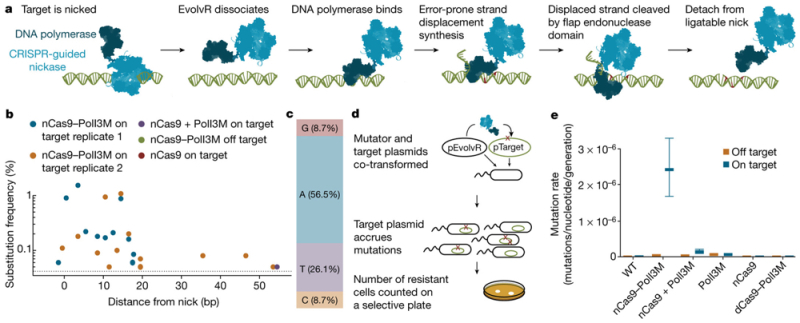
    A group of researchers* from Berkeley have used a modified version of Cas9 (nCas9, bearing a D10A mutation that produces "nicks" in target DNA) to produce a system they term EvolvR for dramatically (7,700,000-fold) increasing in vivo mutagenesis, as reported in the scientific journal Nature in a Letter entitled "CRISPR-guided DNA polymerases enable diversification of all nucleotides in a tunable window."  This is illustrated in E. coli bacteria for producing cells resistant to the antibiotic streptomycin.  The modified nCas9 is fused to the amino terminus of a fidelity-reduced variant (D424A, I709N, A759R) of E. coli DNA polymerase I.  The plasmid encoding this construct also encoded a guide DNA (gDNA) to target a second plasmid containing a homologous gene sequence.  These model experiments showed mutations (of all expected types) arising within a 17 nucleotide window 3' of the nick site, consistent according to these authors with the known 15-20 nucleotide processivity of the polymerase, as illustrated below.  There were also a low frequency of 5' mutations that the authors speculated may have been due to the polymerase's 3'-5' exonuclease activity.  Also tested was a reversion assay, wherein the target plasmid encoded a streptomycin resistance gene bearing a nonsense mutation.  Against a measured background mutation rate of 10-10 mutations/nucleotide/ generation, consistent with E. coli mutation rates, introducing the EvolvR plasmid into these cells "markedly increased the mutation rate at the targeted locus 24,500-fold over the wild type while increasing the global mutation rate 120-fold over the wild type," which the authors state is similar to other mutagenesis methods used in E. coli.

    Figure 2
    Mutation rates using this system were further enhanced by making additional mutations in nCas-9 (K848A, K1003A, R1060A); these mutations had been suggested in the art to "lower the non-specific DNA affinity of Cas-9."  These plasmids "increased the global mutation rate 223-fold compared to wild-type cells (1.9–fold greater than nCas9–PolI3M), yet elevated the mutation rate at the targeted locus by 212,000-fold (8.7-fold greater than nCas9–PolI3M)."  The mutagenesis rate was further increased to the maximum reported (7,700,000-fold) by further modifications (D424, I709N, F742Y, A759R, and P796H) to the polymerase portion of the fusion protein.  Alternative polymerases (from the bacteriophage Phi129) did not achieve this high a mutation rate, nor was inserting the thioreductase-binding domain of bacteriophage T7 DNA polymerase into the PolI sequence as effective (although this change did increase the reach of mutation rate in the target DNA).  Other refinements included removing internal ribosome binding sites in the PolI sequence to reduce (4.14-fold) "off-target" mutagenesis.

    The authors also report the ability to target separate DNA target sequences, although they note that when those targets are within 110 bp of each other, the nicking activity should be directed to the same strand to avoid lethality.

    The paper ends with the following hopes for future applications of the technology:

    EvolvR offers the first example of continuous targeted diversification of all nucleotides at user-defined loci, which will be useful for evolving protein structure and function, mapping protein–protein and protein–drug interactions, investigating the non-coding genome, engineering industrially relevant microbes and tracking the lineage of cell populations that cannot tolerate double-stranded breaks.  As a guiding principle for using this tool, our data suggest that 1µl saturated E. coli culture expressing enCas9–PolI3M–TBD for 16h contains all single substitutions in the 60-nucleotide window with more than tenfold coverage.  Future work towards adapting EvolvR for use in cells possessing low transformation efficiency, as well as increasing the mutation rate and window length of EvolvR mutagenesis, would enable new forward genetic applications.

    *Shakked O. Halperin, Connor J. Tou, Eric B. Wong, Cyrus Modavi, David V. Schaffer & John E. Dueber

  • By Michael Borella

    Federal Circuit SealAlmost two years ago, we covered a dispute in the Southern District of New York (which began in the Eastern District of Texas) involving plaintiff AlphaCap, a non-practicing entity that aggressively asserted its patents against a number of targets, including Gust.  In short, when Gust didn't quickly settle, AlphaCap offered to dismiss its claims.  But Gust wanted AlphaCap to pay its attorneys' fees or assign AlphaCap the patents.  After some back-and-forth between the parties, the District Court dismissed the case but awarded Gust attorneys' fees under 35 U.S.C. § 285.  Gutride Safier LLP, attorneys for AlphaCap, were held jointly and severally liable for these fees and costs under 28 U.S.C. § 1927.

    Notably, the District Court stated that the case was "exceptional" under § 285 because the Supreme Court's Alice Corp. v. CLS Bank Int'l opinion "gave AlphaCap clear notice that the AlphaCap Patents could not survive scrutiny under 35 U.S.C. § 101."  The basis of this conclusion was that "the claims were directed to crowdfunding, a fundamental economic concept and way of organizing human activity, and that this was an abstract idea."  The District Court further held that "the claims did not include an inventive concept sufficient to render the abstract ideas patent eligible under Alice."

    Regarding § 1927, the District Court found Gutride to have acted unreasonably and in bad faith during the dispute, because it was unwilling to recommend settlement "despite knowing that Alice doomed the claims and stating that the case was 'not worth litigating'."

    Gutride brought this appeal to the Federal Circuit solely on the issue of its liability for the attorneys' fees.  Judge Linn wrote the opinion of the Court and was joined by Judge Hughes.  Judge Wallach dissented.

    The Majority Opinion

    28 U.S.C. § 1927 states:

    Any attorney or other person admitted to conduct cases in any court of the United States or any Territory thereof who so multiplies the proceedings in any case unreasonably and vexatiously may be required by the court to satisfy personally the excess costs, expenses, and attorneys' fees reasonably incurred because of such conduct.

    Applying the law of the Second Circuit, a successful motion under § 1927 requires that: (i) the case was "entirely without color", and (ii) was "brought in bad faith—that is, motivated by improper purposes such as harassment or delay."  These determinations require a court to "provide a high degree of specificity in the factual findings."

    Addressing the first prong, the Gutride referenced the "unsettled state of the law following the decision in Alice" as evidence that its case had color.  Gust responded by contending that "the § 101 law post-Alice was settled, because all cases dealing with abstract ideas in patents cited the two-step Alice framework," and that "the claims here were not even questionably patent eligible."

    The Federal Circuit agreed with Gutride, noting that there was a "relative paucity of § 101 cases that were decided by this court between Alice and AlphaCap's complaint in Texas."  Indeed, several of the Federal Circuit's own cases from this time period "recognized the uncertainty in the application of Alice."  The Court further observed that "[w]hen the applicable law is unsettled, attorneys may not be sanctioned merely for making reasonable arguments for interpreting the law."  Instead, "it is particularly important to allow attorneys the latitude necessary to challenge and thus solidify the legal rules without the chill of direct economic sanctions."  Also, according to the Court, Gutride made a colorable argument that the claims met the requirements of § 101 due to being analogous to DDR Holdings, LLC v. Hotels.com L.P., while Gust's analogy between the claims and those found ineligible in another Southern District of New York case was unpersuasive.  Finally, the Court strongly disagreed with Gust that the mere existence of the two-step Alice framework implied that § 101 law was settled, and found the District Court's patent-eligibility analysis to be conclusory.

    When applying the second prong, the District Court concluded that Gutride's actions constituted bad faith based on three grounds: (i) "Gutride knew that AlphaCap's patents were not patent eligible after Alice, and initiated the litigation anyway to extract a nuisance settlement"; (ii) Gutride's opposition to transferring the case to the Southern District of New York; and (iii) "Gutride's failure to end the case through settlement, dismissal, or a covenant not to sue."

    Regarding Gutride's alleged knowledge that the patents were not eligible, the District Court put a fair amount of weight on Gutride's statement that "the case is 'not worth litigating'."  But the Federal Circuit viewed this statement as a negotiating position, noting that "[i]n the context of advocating for settlement with the opposing party to settle, this is an inoffensive assertion that the calculus favors settlement, not an admission that the patents were invalid."

    With respect to the nuisance settlement, the Federal Circuit was more sympathetic.  It acknowledged that "AlphaCap bears relatively little risk and cost in filing its infringement actions, as compared with the relatively high costs incurred by defendants to defend the lawsuit."  Thus, by "encouraging quick settlements at values far below the cost of defending an infringement action on the merits, AlphaCap was able to obtain not insignificant revenues without having to test the merits of its position."  Nonetheless, the Court found that "Rule 11, with its procedural safeguards, already addresses attorneys' complicity in the filing of frivolous and improper litigation" and that "§ 1927 only applies to actions that result in unreasonable and vexatious multiplication of proceedings."  Consequently, the Court ruled with Gutride on this issue.

    The Court also sided with Gutride regarding its resistance to the transfer.  Driving this conclusion was the fact that the Eastern District of Texas was a proper venue, that Gust had agreed to venue discovery, and because "at least some third-party users were found to reside in the Eastern District of Texas."  Supporting these points, the Court observed that "an attorney need not bring a case in the most convenient forum, but only a proper forum."

    Finally, the Court also agreed with Gutride that failure to settle is not evidence of bad faith.  Notably, "[t]he decision to settle or grant a covenant not to sue is wholly committed to clients, not their attorneys."  Thus, Gutride could not be held liable for its client's decision.

    For these reasons, the Court sided with Gutride and reversed the award of fees under § 1927.

    Judge Wallach's Dissent

    Writing in dissent, Judge Wallach faulted the majority for reversing the District Court.  A significant part of Judge Wallach's beef was based on the § 101 issues.  He disagreed that the law regarding patent-eligibility was unsettled, stating it was that "the framework with which we have consistently assessed patent eligibility under § 101 since its rendering."

    Attacking the claims, Judge Wallach found them "directed to data organization and use of customizable profiles to facilitate patronage," which in his view were clearly abstract ideas.  While the majority found that § 101 jurisprudence as a whole was evolving, Judge Wallach stated that no claims similar to AlphaCap's were determined eligible by the Federal Circuit during the litigation.  In his words:

    The Asserted Claims merely recite a series of steps for storing and organizing investment data that could all be performed by humans without a computer, and Gutride's attempt to assert otherwise was frivolous given that the abstract idea here is not meaningfully different from the ideas found to be abstract in other cases before the Supreme Court and our court involving methods of organizing human activity.

    He also found additional elements lacking an inventive concept under Alice, as they were all involving conventional and generic terms.  Thus, with respect to § 101 as a whole, Judge Wallach concluded that "[t]he Patents-in-Suit clearly do not fall in that interstitial area where doubt may reasonably exist."  Judge Wallach was silent regarding the fact that he and the majority coming to two different conclusions when applying Alice to the claims suggests that the law surrounding § 101 is still unsettled.

    Determining that the District Court did not abuse its discretion in finding that AlphaCap's case lacked a colorable basis, Judge Wallach moved on to bad faith.

    Particularly, he found no flaw in the District Court's assessment of Gutride being "motivated by improper purposes such as harassment or delay."  He did not address the majority's position that Rule 11 controlled, and instead found "we must holistically consider Gutride's entire course of conduct in order to determine if it acted in bad faith by delaying dismissal of its suit, when it had knowledge of the suit's frivolous nature."  Further, he found that the "not worth litigating" statement occurred early enough in the case that Gutride could have pushed to settle the dispute much earlier.  Judge Wallach saw this as a "bad faith attempt to multiply the proceedings."

    Turning to venue, Judge Wallach pointed to evidence that Gutride claimed that Gust had ties to the Eastern District of Texas, could not establish that said ties existed, and only after discovery was able to show that Gust had some users in the district.  This, apparently, was enough for Gutride to fail the bad faith sniff test.

    Consequently, Judge Wallach would have affirmed the District Court.

    Analysis

    Regarding overly-aggressive litigation and the venue issue, Gutride may have indeed pushed the envelope.  On whether its conduct rises to the level of bad faith, the majority was probably correct to err on the side of caution.  Judge Wallach, on the other hand, gave more deference to the District Court.

    But the majority was clearly correct to conclude that § 101 jurisprudence was too murky during the time of the litigation (early 2015 – late 2016) to conclude that AlphaCap's case was without color.

    In 2015, the Federal Circuit found no claims patent-eligible under § 101.  But this does not imply that all business method and software claims involving data manipulation were categorically ineligible — it merely suggests that the Court did not hear a case with claims that passed the test.  Also, not long prior to this time frame, there were multiple federal judges commenting on the record that Alice was hard to apply in practice.  Judge Wu of the U.S. District Court for the Central District of California criticized Alice for setting forth an "I know it when I see it" test.  Judge Pfaelzer, a colleague of Judge Wu, wrote that the Supreme Court's patent-eligibility cases "often confuse more than they clarify [and] appear to contradict each other on important issues."

    More recently, Judge Wallach's Federal Circuit colleague, Judge Plager, wrote that the post-Alice §101 inquiry "renders it near impossible to know with any certainty whether the invention is or is not patent eligible."  And these are just a few examples of judicial confusion.  There are more.  The law was not settled during the case, and is even less settled now.

    Thus, it is hard to agree with Judge Wallach.  Moreover, with a § 101 challenge being routinely raised against any asserted software or business method patent, the impact of penalizing plaintiffs and their attorneys for exercising such a patent would be to shut off nearly all software or business method litigation.

    That is not to say that bad actors should not be punished.  But contending that § 101 is settled law to do so is absurd.  The only thing settled about patent-eligibility in the last four years is that it is unsettled.

    Gust, Inc. v. AlphaCap Ventures, LLC (Fed. Cir. 2018)
    Panel: Circuit Judges Wallach, Linn, and Hughes
    Opinion by Circuit Judge Linn; dissenting opinion by Circuit Judge Wallach

  • CalendarOctober 2, 2018 – "Advice of Counsel Defense in Patent Litigation and Protecting Attorney-Client Privilege — Limiting Scope of Discovery, Safeguarding Confidential Communications and Information" (Strafford) – 1:00 to 2:30 pm (EDT)

    October 2-3, 2018 – Paragraph IV Disputes master symposium (American Conference Institute) – Chicago, IL

    October 3, 2018 – "2018 Bench & Bar® in Dialogue: Federal Circuit Court Visit!" (Federal Circuit Bar Association) – 2:00 pm to 9:00 pm (CT), Chicago, IL

    October 4, 2018 – "Patent Litigation in Japan and Germany," German Patent and Trade Mark Office, Munich, Germany

    October 4, 2018 – "Biosimilars in the Antitrust Spotlight: Patent Litigation and Settlement" (Intellectual Property Owners Association) – 2:00 to 3:00 pm (ET)

    October 11, 2018 – "Patent Term Adjustments and Extensions: Leveraging Recent Decisions and USPTO Rule Changes" (Strafford) – 1:00 to 2:30 pm (EDT)

    October 12, 2018 – "Standard Essential Patents: What Every IP Attorney and In-house Counsel Should Know" (John Marshall Law School Center for Intellectual Property, Information & Privacy Law) – 9:00 am to 4:30 pm, Chicago, IL

    October 16, 2018 – "Negotiating IP Rights in Industry Sponsored Research Agreements — Structuring Ownership, Licensing, Assignment, Confidentiality, Publication and Use Provisions" (Strafford) – 1:00 to 2:30 pm (EDT)

    October 16-18, 2018 – PCT Seminar (Oppedahl Patent Law Firm LLC) – Redwood City, CA

    October 23, 2018 – "The State of 'Printed Publication' Prior Art Case Law: Practical Considerations for Patent Holders and Patent Challengers" (Strafford) – 1:00 to 2:30 pm (EDT)

    October 24, 2018 – Biopharma Patent Law (McDonnell Boehnen Hulbert & Berghoff LLP and Patent Docs) – 9:30 am to 1:00 pm, Cambridge, MA

    October 24, 2018 – "Preparing 'Diagnose & Treat' Patent Claims to be Valid and Enforceable" (Technology Transfer Tactics) – 1:00 to 2:00 pm (ET)

    October 24, 2018 – "Crisis Management for IP Lawyers & Their Clients — Trade Secrets and Reputation Risk Management" (Intellectual Property Law Association of Chicago Trade Secret and Unfair Competition Committee) – 3:00 to 4:00 pm (CT), Chicago, IL

  • Strafford #1Strafford will be offering a webinar entitled "The State of 'Printed Publication' Prior Art Case Law: Practical Considerations for Patent Holders and Patent Challengers" on October 23, 2018 from 1:00 to 2:30 pm (EDT).  Jason S. Angell of Hopkins & Carley and Emily J. Greb of Perkins Coie will provide an in-depth discussion for counsel on the history and current state of the law regarding when a non-patent prior art reference qualifies as a "printed publication" for purposes of an invalidity challenge; will discuss recent Federal Circuit, district court, and PTAB decisions and the emerging guidance for assessing whether a reference is sufficiently "publicly accessible" to be considered a "printed publication" under 35 U.S.C. § 102; and will also review strategic approaches for demonstrating or disputing that a reference qualifies as printed publication prior art.  The webinar will review the following issues:

    • How is the court evaluating public accessibility standards and evidence? How are these decisions influencing federal courts and the PTAB?
    • What lessons can patent counsel draw from recent decisions when assessing print publications as prior art?
    • What role to “confidentiality expectations” or restrictions on dissemination play in the public accessibility analysis?

    The registration fee for the webcast is $297.  Those interested in registering for the webinar, can do so here.

  • Technology Transfer Tactics will be offering a webinar entitled "Preparing 'Diagnose & Treat' Patent Claims to be Valid and Enforceable" on October 24, 2018 from 1:00 to 2:00 pm (ET).  Charles R. Macedo, Alan D. Miller, and Brian J. Amos will address the following topics:

    • State of the law on patent-eligibility and divided infringement
    • Review of recent cases involving single and two-actor method claims, including:
        – Cleveland Clinic Foundation v. True Health Diagnostics LLC
        – Eli Lilly & Co. v. Teva Parenteral Medicines Inc.
        – Vanda Pharmaceuticals Inc. v. West-Ward Pharmaceuticals
    • Sample form of claims that straddle patent-eligibility and divided infringement concerns
    • USPTO guidance and examples
    • Strategies for increasing likelihood of obtaining meaningful patent protection from the USPTO
    • Dealing with concerns of potential licensees

    The registration fee for the webinar is $197.  Those interested in registering for the webinar, can do so here.

    Technology Transfer Tactics

  • IPLACThe Intellectual Property Law Association of Chicago (IPLAC) Trade Secret and Unfair Competition Committee will be presenting a presentation by Bruce Hennes of Hennes Communications entitled "Crisis Management for IP Lawyers & Their Clients — Trade Secrets and Reputation Risk Management" on October 24, 2018 from 3:00 to 4:00 pm (CT) at the Union League Club in Chicago, IL.  The presentation will focus on a highly-strategic approach to crisis management and crisis communications for a wide variety of situations, offering methods to establish and maintain "control of the message," enabling attorneys to help their firms and clients move messages forward or mount a defense against an outraged public, unhappy customers or a sudden press onslaught.

    The registration fee for the presentation is $20 (IPLAC members), $5 (students), or $25 (non-members).  Those interested in registering for event can do so here.

  • Federal Circuit Distinguishes Obviousness between Apparatus and Method Claims

    By Aaron Gin –

    Federal Circuit SealOn September 13, 2018, the Federal Circuit affirmed three final written decisions of the U.S. Patent Trial and Appeal Board that held unpatentable various claims of U.S. Patent No. 6,091,940, owned by ParkerVision.  The '940 patent, entitled "Method and System for Frequency Up-Conversion," relates to the frequency conversion of low-frequency baseband signals to higher-frequency (e.g., radio frequency or RF) signals.

    Qualcomm filed three petitions for inter partes review challenging the '940 patent.  The PTAB's (and later the Federal Circuit's) analysis split along whether the claims were apparatus or method claims.  Claim 21 was representative of the apparatus at issue:

    21.  An apparatus for frequency up-conversion, comprising:
        a pulse shaping module to receive an oscillating signal and to output a shaped string of pulses that is a function of said oscillating signal;
        a switch module to receive said shaped string of pulses and a bias signal, wherein said shaped string of pulses causes said switch module to gate said bias signal and thereby generate a periodic signal having a plurality of harmonics, said bias signal being a function of an information signal, said periodic signal having an amplitude that is a function of said bias signal; and
        a filter coupled to said switch module to isolate one or more desired harmonics of said plurality of harmonics.

    Claim 25 was representative of the method at issue:

    25.  A method of communicating, comprising the steps of:
        (1) shaping an oscillating signal to create a string of pulses that is a function of said oscillating signal;
        (2) gating a reference signal at a rate that is a function of said string of pulses to create a periodic signal having a plurality of harmonics, said reference signal being a function of an information signal, and at least one of said plurality of harmonics being a desired harmonic; and
        (3) outputting said periodic signal, said periodic signal having an amplitude that is a function of said reference signal.

    In two of the three petitions, Qualcomm asserted that the challenged apparatus and method claims would have been obvious in view of three references — Nozawa, Philips, and Maas (the Nozawa IPRs).  In the third petition, Qualcomm asserted that the apparatus claims would have been obvious in view of Maas and two additional references — Krauss and Ariie (the Ariie IPR).  The Board instituted review with regard to all three petitions.

    ParkerVision filed patent owner responses.  With regard to the Nozawa IPRs, the patent owner argued that the petitions failed to identify any teaching that expressly disclosed a periodic signal containing "integer multiples" of any frequency, as required by the claims' "harmonics" limitation.  ParkerVision also argued that Qualcomm's own expert had described a periodic signal with only one integer-multiple harmonic, as opposed to the claimed "plurality" of such harmonics.  Finally, the patent owner argued that the Ariie IPR failed to prove how Ariie's field effect transistor is a "switch" and did not describe how Ariie's oscillating signal "gates" that switch, as required by the claims.

    Qualcomm filed reply briefs that argued, among other points, that basic math confirms that for many input frequencies, Nozawa's mixer will generate the required "integer multiple" harmonics.  Furthermore, petitioner argued that persons of ordinary skill in the art would have recognized that Krauss' rectangular waveform would have caused Ariie's FET to act as a gate or switch.

    On March 7, 2017, the Board issued three final decisions, each finding that the challenged apparatus claims would have been obvious.  However, with regard to the Nozawa IPRs, the Board found that Qualcomm had impermissibly changed its theory of unpatentability as to the method claims.  As such, the Board found that Qualcomm did not provide any evidence as to why a person of ordinary skill would have selected operating conditions that would cause Nozawa to generate a plurality of integer-multiple harmonics.  However, the Board agreed with Qualcomm as to the Ariie IPR, stating that the rectangular wave of Krauss would drive the Ariie FET as a switch.

    ParkerVision appealed, arguing that the Board erred in holding the apparatus claims unpatentable.  Qualcomm also cross-appealed, arguing that the Board erred in upholding the patentability of the method claims.

    On appeal, ParkerVision argued that the Board erred by basing its patentability decisions on theories and evidence that Qualcomm did not present in its petitions.  Also, ParkerVision contended that the Board's unpatentability determination as to the apparatus claims was based on an untimely and erroneous construction of the underlying claim language.

    The panel, which included Judges O'Malley, Reyna, and Taranto, was unmoved by ParkerVision's position, saying that it was undisputed that Nozawa's device would necessarily product a periodic signal containing integer multiples of the fundamental frequency under some, albeit not all, conditions.  The Board recalled Hewlett Packard Co. v. Bausch & Lomb Inc., 909 F.2d 1464, 1468 (Fed. Cir. 1990), stating, "[a]pparatus claims cover what a device is, not what a device does."  Specifically, with regard to the apparatus claims, Judge O'Malley, writing for the Panel, stated:

    A prior art reference may anticipate or render obvious an apparatus claim – depending on the claim language – if the reference discloses an apparatus that is reasonably capable of operating so as to meet the claim limitations, even if it does not meet the claim limitations in all modes of operation.

    The panel treated the method claims of the '940 patent in a wholly different manner, stating that Qualcomm failed to "present evidence and argument that a person of ordinary skill would have been motivated to operate Nozawa in a manner that satisfied the 'plurality of harmonics' limitation."  Furthermore, Qualcomm did not advance any position whether Nozawa's device would actually output a periodic signal with a plurality of integer-multiple harmonics.  Namely, the panel reiterated InTouch Techs. Inc. v. VGO Commc'ns, Inc., 751 F.3d 1327, 1346-1347 (Fed. Cir. 2014), that parties seeking to invalidate method patents must show that a skilled artisan would have been motivated to combine the teachings of the prior art references to achieve the claimed invention, and that the skilled artisan would have had a reasonable expectation of success in doing so.  Instead, the panel wrote, "Qualcomm's petitions and accompanying expert testimony solely concerned whether the fundamental frequency itself is included in the meaning of 'harmonics.'"

    In other words, with respect to apparatus claims, the Federal Circuit stated that if a prior art reference discloses an apparatus that is reasonably capable of operating as claimed, that reference could anticipate or render obvious the claims at issue.  Additionally, when considering method claims, a reference is properly asserted, under 35 U.S.C. §§ 102 & 103, when there is a clear motivation to combine the references and a demonstrated expectation of success by a skilled artisan.

    ParkerVision, Inc. v. Qualcomm Inc. (Fed. Cir. 2018)
    Panel: Circuit Judges O'Malley, Reyna, and Taranto
    Opinion by Circuit Judge O'Malley

  • Claims for Keyword-Based Navigation of Hierarchically-Structured Data Found Abstract But Survive Motion to Dismiss

    By James Korenchan

    District Court for the District of DelawarePlaintiff Guada Technologies, LLC ("Guada") sued Defendant Vice Media, LLC ("Vice Media"), alleging infringement at least claim 1 of U.S. Patent No. 7,231,379 ("the '379 patent").  Vice Media then filed a motion to dismiss.  Last week, Judge Richard G. Andrews of the U.S. District Court for the District of Delaware ruled that the claims are directed to an abstract idea under 35 U.S.C. § 101, but that a factual issue remains as to whether the claims provide an inventive concept.

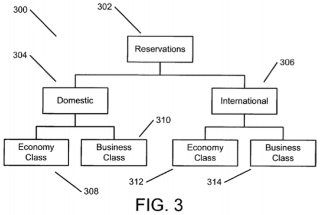
    The '379 patent, entitled "Navigation in a hierarchical structured transaction processing system," relates at a high level to navigating through a hierarchical network of "choices" (e.g., transactions, or operations where information is accessed) to accomplish a goal.  In such a network, choices are arranged as nodes in a graph structure.  As an illustrative example, Figure 3 of the '379 patent is shown below, which is in the context of airline reservations.

    FIG.3
    In this example, the high-level choice to make a reservation is shown in the graph at the top of a hierarchy of nodes.  As shown, for instance, the choices to reserve a domestic flight or an international flight are distinct nodes in the graph that branch from the reservation node.  Other choices (i.e., flight classes) are then shown as nodes branching from the domestic flight and international flight nodes.

    The background of the patent notes that it can be difficult to efficiently navigate through a graph of choices to reach a goal, particularly when there are many choices involved in doing so.  In addition, the patent notes the disadvantages in how existing graphs and associated systems often require direct path traversal through a hierarchy.  That is, such systems do not allow a user to jump from one node to another unless the two nodes are connected as part of the same path through the graph.  The patent thus aims to provide more efficient navigation through a series of choices in a network of nodes by using keywords to allow a user to jump from one node to a non-connected node.  In the context of this invention, a "keyword" for a choice is the most important word and serves as a shorthand way of referring to a node.  As a simple example, if the node for a choice to make a reservation is "Would you like to make a reservation?", the keyword could be "reservation" (or "Reservations," as shown in Figure 3).

    The '379 patent includes two independent claims of similar scope.  As a representative example, claim 1 is provided as follows:

    1.  A method performed in a system having multiple navigable nodes interconnected in a hierarchical arrangement comprising:
        at a first node, receiving an input from a user of the system, the input containing at least one word identifiable with at least one keyword from among multiple keywords,
        identifying at least one node, other than the first node, that is not directly connected to the first node but is associated with the at least one keyword, and
        jumping to the at least one node.

    Abstract Idea

    Guada argued that the invention solves existing problems in the art by not restricting user movement through a decisional network to adjacent nodes or starting over at a top node.  And in oral arguments, Guada analogized the claims to those in McRO, asserting that the claims amount to computer improvement.  However, Guada provided little substance to its McRO position:

    Plaintiff argues that the claims here provide "implementation details," which are not "purely functional," but rather amount to computer improvement.  First, argues Plaintiff, the "receiving an input" claim limitation "requires a specific user . . . who provides the input, provides the location where the input is received . . . , and what the input is . . . ."  Second, argues Plaintiff, the "identifying at least one node . . . associated with the at least one keyword" limitation requires "nodes associated with keywords."  Plaintiff argues that "nodes" in "the ordinary setup of a hierarchically arranged decision network" are "not associated with keywords."  Third, argues Plaintiff, the "jumping" limitation "requires the system to directly traverse from one node/vertex to another node/vertex that is not directly connected."

    (citations omitted).

    In response, Vice Media cited CyberSource, noting that the claimed "nodes" and "interconnections" are not tangible objects and that the steps of each method claim can be performed mentally or with pen and paper.  Even the concept of a hierarchical arrangement of nodes, Vice Media argued, is an abstract idea from mathematical graph theory.

    The Court agreed with Vice Media, stating that the '379 patent provides no information as to how the "implementation details" allegedly provided by the claims improve computer functionality or even a computerized data set.  Rather, the claims related to a "generic automation of a once-manual method."  The Court also noted that keywords do not necessarily invoke computer functionality.  For at least these reasons, the Court deemed all seven claims of the '379 patent to be directed to an abstract idea.

    Guada also argued that claim construction issues precluded a grant of the motion to dismiss and proposed its own constructions to remedy those issues, but neither rendered the claims non-abstract.  First, Guada argued that limitations in the preamble of each independent claim refer to "a computerized system of multiple nodes interconnected in a hierarchically arranged decisional network in which a user provides inputs or responses at each node to navigate through adjacent nodes in the hierarchical arrangement."  But the Court stated that the construction at best places the claim into a more specific technological environment.  Guada also provided specific constructions for the "jumping" limitations — most notably of which being that the jumping limitation is an action required by the system, not the user.  But the Court stated that this merely amounts to automating "the mental process of jumping from one node to another."

    Inventive Concept

    In its Alice prong two contentions, Guada argued that the claims recite two alleged inventive concepts.  First, Guada argued that that "jumping" limitation is inventive because navigation in prior art hierarchical networks was not done the way that the patent purports.  Second, Guada argued that using keywords to jump from node to node is inventive.  Vice Media argued in response that both of these concepts were well-known at the time the patent was filed (November 2002), but provided no citation in support and thus did not provide the clear and convincing evidence of ineligibility required by Berkheimer.

    As a result, the Court denied Vice Media's motion to dismiss and solidified this decision as another example of the increased difficulty in invalidating patents post-Berkheimer.  Vice Media will have to improve its contentions and actually provide evidence at the summary judgment stage.

    Guada Technologies LLC v. Vice Media, LLC (D. Del. 2018)
    Memorandum Opinion by District Judge Andrews

  • By Kevin E. Noonan

    Iancu  AndreiU.S. Patent and Trademark Office Director Andrew Iancu gave the introductory keynote address at the 46th Annual Meeting of the Intellectual Property Owners (IPO) Association on Monday, and his talk provided the prospect of a Patent Office administration dedicated, as former Solicitor Nancy Linck advocated several years ago at a Biotechnology Innovation Organization annual meeting, to adopt policies aimed at helping the courts (including the Supreme Court) come to the correct decisions regarding questions such as patent subject matter eligibility.

    While discussing other aspects of the Office's policymaking (including improvements in the Trademark Office and participation in the Music Modernization Act) and infrastructure efforts (noting the "legacy" nature of the Office's IT infrastructure and the week-long outage of the Electronic Filing System and Patent Application Information Retrieval portal a few weeks ago), the bulk of Director Iancu's remarks had to do with subject matter eligibility.  The Director noted (and quoted) Federal Circuit judges to the effect that subject matter eligibility was an uncertain area of the law that needed change.  The Director noted the efforts of IPO, and the American Intellectual Property Lawyers Association (AIPLA) in proposing draft legislation to remove the uncertainty in the law (stemming unmentioned from Supreme Court cases of dubious sagacity).  But Director Iancu noted that legislation can "take[] a long time" and the results cannot be certain.

    "[T]he USPTO cannot wait," he said, noting that there are "thousands of examiners who struggle with these issues on a daily basis" and who "need additional guidance now" (as well as "patent applicants, patent owners, and the public").

    He then harkened back to Judge Giles Sutherland Rich and his "prescient" thoughts of almost 40 years ago, when in In re Bergy the Judge noted that there was an "unfortunate . . . though clear commingling of distinct statutory provisions which are conceptually unrelated, namely, those pertaining to the categories of invention in §101 which may be patentable, and to the conditions for patentability demanded by the statute . . . ."  Restating the point, Director Iancu asked:

    How can a claim be novel enough to pass 102 and nonobvious enough to pass 103, yet lack an "inventive concept" and therefore fail 101?  Or, how can a claim be concrete enough so that one of skill in the art can make it without undue experimentation, and pass 112, yet abstract enough to fail 101?  How can something concrete be abstract?

    These are not simple problems, insofar as they "confound the most sophisticated practitioners in our patent system" because "[p]eople simply don't know how to draw these distinctions."  Echoing many, the Director advocated using the other statutory sections (specifically, §§ 102, 103, and 112) as more appropriate tools for preventing unpatentable (in contradistinction to patent-ineligible) claims from being allowed.

    The appropriateness of these statutory sections is illustrated by "decades of case law from the courts and millions of examinations at the PTO" to "guide us in our 102, 103, and 112 analyses."  The Director characterized that "the genius of the 1952 Patent Act" was that it provided categories of patent-eligible subject matter.  The problem, according to Director Iancu (and in this sentiment he is not alone) is that recent case law "mushes them all up again."  This "may [indeed, demonstrably does] lead to distorted legal conclusions," according to the Director, stating dramatically:  "And it has.  And it must end."

    How to achieve this goal so fervently to be hoped?  The Director proposes going back to Judge Rich, "and keep[ing] rejections in their own distinct [statutory] lanes."  The standard the Director proposes is that, "[i]f the claims can be fixed by slightly different claiming, by narrower claiming, or by more definite claiming, this is likely a 'conditions' problem—not a subject matter problem."  He recognizes that some things, like gravity or DNA, are not patent eligible — he is not an extremist or absolutist.  But he proposes to provide categories of patent ineligible subject matter like the statute provides patent eligible subject matter categories.

    His discussion of providing more certain and defined (cabined, dare we say?) categories of ineligible subject matter focused on abstract ideas, which he believes is "the issue needing most attention."  To that end, the Director announced that "at the USPTO we are contemplating revised guidance to help categorize the exceptions—and indeed to name them—and instruct examiners on how to apply them."  He then explained his vision:

    [T]he contemplated guidance would do two primary things:  First, it would categorize the exceptions based on a synthesis of the case law to date.  And second, if a claim does recite a categorized exception, we would instruct examiners to decide if it is "directed to" that exception by determining whether such exception is integrated into a practical application.  These two clarifications would help drive more predictability back into the analysis while remaining true to the case law that gave rise to these judicial exceptions in the first place.

    This calculus would provide categories of patent-ineligible subject matter that satisfy the criterion set forth by the Supreme Court:  the "basic tools of scientific and technological work."  These include examples such as "gravity, electromagnetism, DNA"; "fundamental mathematics like calculus, geometry, or arithmetic per se"; "basic 'methods of organizing human activity,' such as fundamental economic practices like market hedging and escrow transactions"; and "pure mental processes such as forming a judgment or observation . . . by itself, something performed solely in the human mind."

    Despite the Supreme Court having been "interpreting this statute for the past 200 years or so," the Director recognizes that the Court has only provided a "limited number of examples" of subject matter that encompasses the "basic tools of scientific and technological work."  The Director finds that what constitutes "natural phenomena" or "laws of nature" present less difficulty in defining their metes and bounds than abstract ideas.  To address this question, the PTO is performing "a thorough review of the relevant case law helps us draw more clear lines," "stud[ying] every relevant case in detail."  As a consequence, the Director informed his audience that "the proposed PTO guidance would synthesize "abstract ideas" as falling into the following three categories:

    • Mathematical concepts like mathematical relationships, formulas, and calculations
    • Certain methods of organizing human interactions, such as fundamental economic practices commercial and legal interactions; managing relationships or interactions between people; and advertising, marketing, and sales activities
    • Mental processes, which are concepts performed in the human mind, such as forming an observation, evaluation, judgment, or opinion.

    Under the new guidance, Examiners would first look at whether the claims were directed to one of the four statutory categories.  If yes, the Examiner would then "check to see if the claims recite matter within one of the judicial exceptions," categorized as set forth in the Director's talk; he said this was the Office's "new approach."  What seems to be the actual new approach was his next statement:  "[i]f the claims at issue do not recite subject matter falling into one of these categories [of patent-ineligible subject matter], then the 101 analysis is essentially concluded and the claim is eligible."  The Director predicted that "[t]his alone would resolve a significant number of cases currently confounding our system" because "[i]f an examiner does not find matter within the disallowed categories, he or she can move on."

    However, if the subject matter falls within a patent-ineligible subject matter category, then (but only then) must the Examiner move on to consider "whether the claims are 'directed to' those categories."  What the Director believes this means, and what the new guidance will specify, is "that Supreme Court jurisprudence taken together effectively allows claims that include otherwise excluded matter as long as that matter is integrated into a practical application."  "The line, in other words, delineates mere principles, on one hand, from practical applications of such principles, on the other," according to the Director's description of the new guidance.  This methodology is supported, according to the Director, by Supreme Court precedent including Le Roy v. Tathem (1853), and Diamond v. Diehr (1980), and even Mayo v. Prometheus (which the Director cited for the teaching that "applications of such concepts to a new and useful end . . . remain eligible for patent protection" ).  In practice, the Director says that this means that "if the claim integrates the exception into a practical application, then the claim is not 'directed to' the prohibited matter[, ]passes 101 and the eligibility analysis would conclude."

    If this is not the case, then the Examiner must move on to step 2 of the Mayo/Alice test to determine whether the "something more" in the claim is conventional, routine or well-understood according to the Berkheimer memo already set forth by the Office.  The difference with current practice, according to the Director, is that "the first step of our analysis does not include questions about 'conventionality,'" meaning that "it does not matter if the 'integration' steps are arguably 'conventional'; as long as the integration is into a practical application, then the 101 analysis is concluded."  The benefits of this change:  it "helps to ensure that there is a meaningful dividing line between 101 and 102/103 analysis," wherein "[a] fully 'conventional' yet patent-eligible claim may still be unpatentable as obvious [under §103]."  The Director also noted that this analysis would also permit claims that are overbroad or "functionally-stated or result-oriented" could be examined under Section 112, and that "USPTO examiners know, and will receive further guidance and training on, how to apply well-defined Section 112 principles."  Under the Director's proposed guidance:

    [T]he examination does not conclude merely because we overcome Section 101; we must still examine for patentability under sections 102, 103 and 112.  And so for claims that pass 101 because they do not articulate matter in a defined category, or that integrate the matter into a practical application, we can rest assured that other sections of the code should still prevent a patent if the claim is not inventive or is merely on a non-enabled or undescribed or indefinite idea.

    In sum, the proposed guidance for Section 101, which addresses step 1 of Alice, would explain that eligibility rejections are to be applied only to claims that recite subject matter within the defined categories of judicial exceptions.  And even then, a rejection would only be applied if the claim does not integrate the recited exception into a practical application.  This provides significantly more clarity for the great bulk of cases.

    Charitably, the Director asserts that "we have gotten ourselves into a rut when it comes to Section 101 analysis" and that the proposed new guidance "is trying to navigate our examiners out of that rut given the current statute and judicial precedent."  He concluded with his hope that "other authorities will join in helping us get out of the rut, at least by keeping rejections in their lane and by clearly categorizing the subject matter of any exception" and warning that it may take some time before the guidance is finalized.

    Despite the hope Director Iancu's remarks may have engendered, within them lie a major disadvantage of the U.S. patent system.  During the twenty-year life of a patent there will be at least two and perhaps many more changes in administration.  The past 18 years have seen Directors as varied as Rogan, Dudas, Kappos, Lee, and Iancu, each not just imposing their own nuance to the Office but in almost every case changing the standards under which patents were granted (and more recently, re-examined).  This intrinsic uncertainty makes it a certainty that for every Director Kappos or (perhaps) Iancu we will have a Director Dudas or Lee.  Uncertainty makes investment more difficult and risky and at best undervalues and at worst inhibits development of new technologies.  During times when there is a consensus that patents encourage innovation, the effects of a new Director historically have been minimal.  But when, as is the case with so many policy debates, the fundamental soundness of strong patent policy is debated on the grounds that patents are an impediment to innovation or that "efficient infringement" is good business practice, there is a risk that the changing tides of patent policy will contravene the constitutional purpose to "promote progress of the useful arts."  Director Iancu promises to promote the yin of pro-patent policy; but what will be the consequence when the next director promotes the yang?