• By Kevin E. Noonan —
    Growth is one of the defining properties of being biologically alive, and the biology of growth involves both cellular proliferation and differentiation from stem cells to one or a plurality of differentiated cells making up a bodily tissue.  Examples range from regeneration of an arm in starfish (and in the related sea cucumber, the ability to propel its gastrointestinal tract to distract a predator) through phylogeny to the capacity of human liver to regrow after resection.  Even normal development involves production of new tissues, and in some species both aspects of this biological phenomenon can be appreciated.  For example, deer grow and regrow antlers, which can account for 28% of the animal's body weight, and their regrowth rates are so rapid that deer can produce 10 kg or more over 2-3 months.  Deer antlers and human bone, while showing very different growth rates (2 cm/day for deer antler, 2 cm/yr for femoral growth during puberty) and other features have in common intramembranous and endochondrial modes of ossification, and this similarity prompted a research group* to undertake a study comparing the pattern of expressed genes in deer antlers and human bone.  The results of this study, entitled "Identifying deer antler uhrf1 proliferation and s100a10 mineralization genes using comparative RNA-seq," were published on October 31 in Stem Cell Research and Therapy.

    Due to difficulties in elucidating the genes involved in antler production in the past, these researchers initiated their study by isolating reserve mesenchymal (RM) cells from fallow deer and human mesenchymal stem cells (hMSCs) and comparing RNA expression patterns in cultures of both cell types.  RM cells were chosen for the study because they expressed robust amounts of alkaline phosphatase (ALP) when contacted with bone morphogenic protein 2 (BMP-2) when assayed using immunofluorescence staining.  Cell growth for RM and hMSCs cultures were determined, and RM cells yielded 1.1-4.5 x 10⁵ cells after six day's growth in culture with a doubling time of 17.9-24.7 h and hMSCs yielded 1.2-3.9 x 10⁴ cells after six days in culture (10-fold fewer cells) and a doubling time of 37.8-60.1 h.  Differentiation studies showed RM cells differentiated into chondrocytes and osteocytes rather than adipocytes (the predominant differentiated cell type for hESCs).  In the presence of BMP-2, RM cells expressed ALP as well as osteocalcin, osteoblast-specific factor 1 and runt-related transcription factor, consistent with the results of the differentiation studies.  RM cells were also preferentially stained with Alizarin Red S in mineralization studies (1702.2.ug/mL) compared with hESCs (98.0 ug/mL).  These and other comparison of RM and hESCs supported the use of these two cell types for further studies of gene expression related to antler and bone growth in these two species.

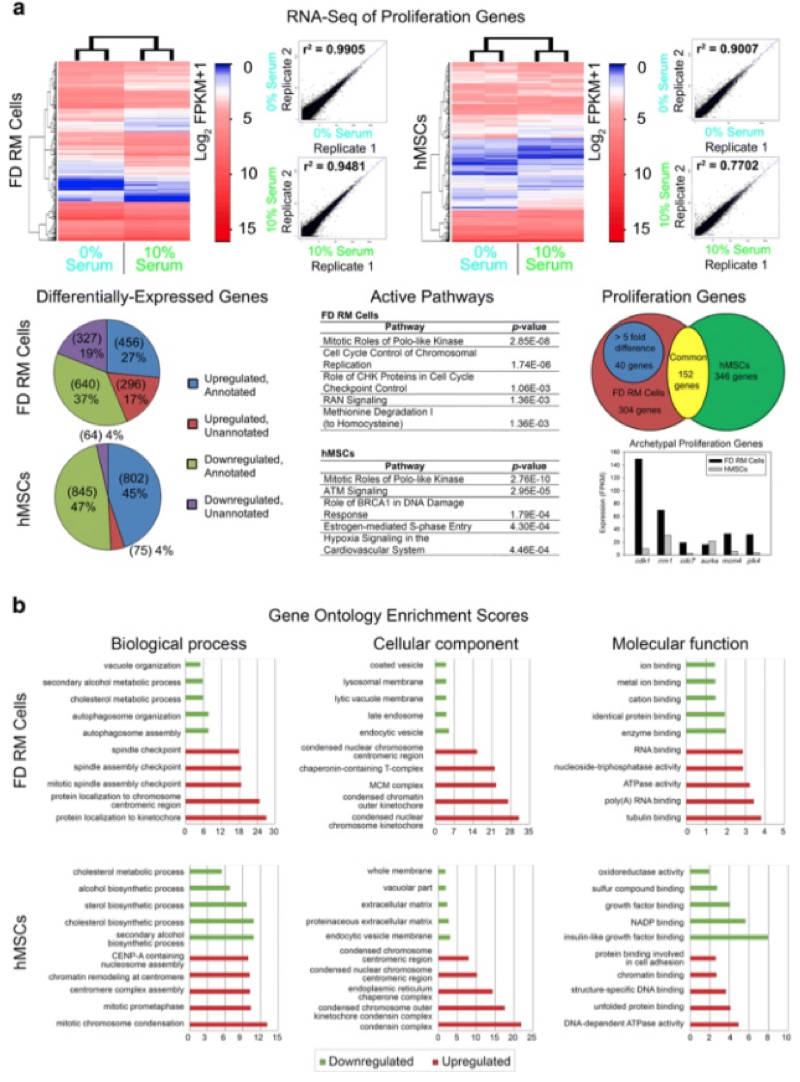
    Comparator RM and hMSCs cultures were assayed using RNA-seq methodology, which permits the complement of expressed RNA species in a cell to be determined and compared using a next-generation sequencing (NGS) approach:

    Image 1
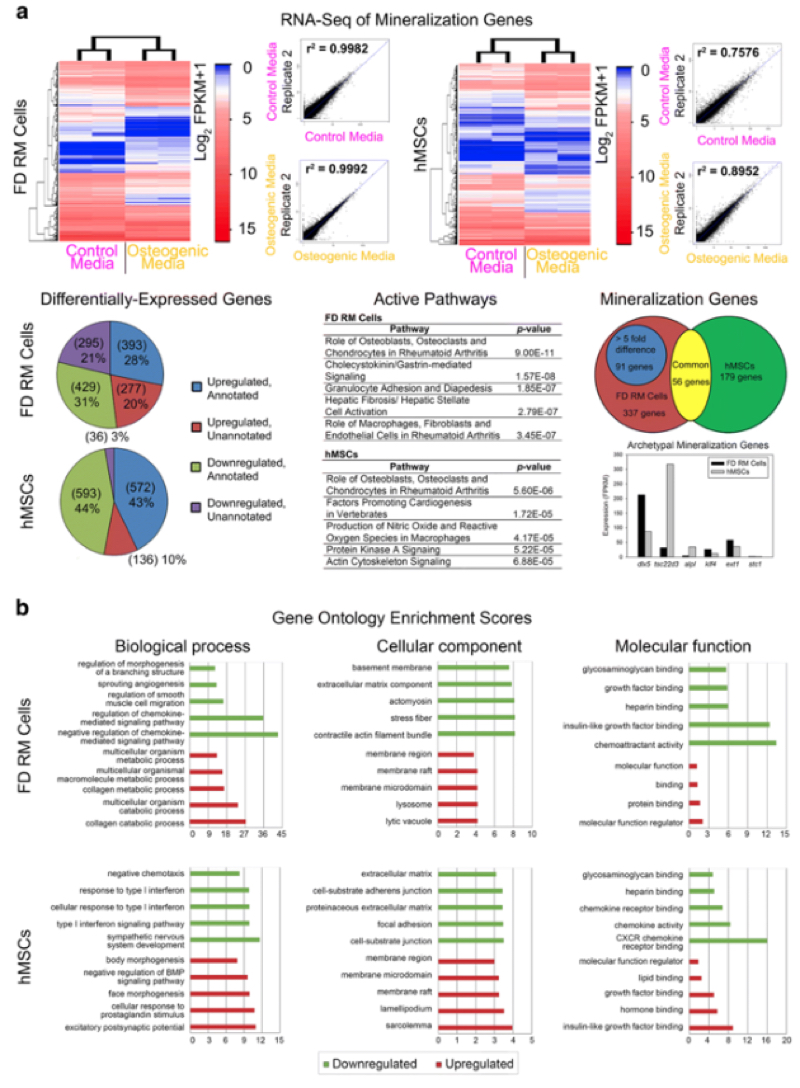
    The results of these studies showed similar patterns of activation of proliferation-associated genes in both cell types, including cdk1, rrm1, cdc7, aurka, and plk4.  Under conditions expected to promote mineralization both cells types showed "similar activation of osteogenic-associated pathways such as roles of osteoblasts, osteoclasts, and chondrocytes in rheumatoid arthritis as well as the expression of typical osteogenic genes such as dlx5, tsc22d3, alpl, klf4, ext1, and stc1."  Overall, these researchers identified 40 proliferation and 91 mineralization candidate genes from these two species:

    Image 2 Image 3
    These results were verified by immunofluorescence, gene over-expression and gene knockdown studies, using FD-derived proliferation candidate gene uhrf1 gene and mineralization candidate gene s100a10.  These results were consistent with the purported role in antler growth and regeneration suggested by gene expression patterns identified in in vitro cultured RM cells.

    The authors of this study suggest that "[t]he approach developed here may be broadly applied towards studying another biological phenomenon, and the genes identified with this approach will not only advance our understanding of mammalian bone regeneration but also offer promising therapeutic strategies for bone tissue engineering."  In addition, they speculate that "a similar comparison strategy can be applied to almost any tissue for identifying the contributions of uniquely expressed genes to a phenomenon of interest."  These sentiments are supported by the results set forth in this paper, where a previously intractable biological problem (identification of genes associated with deer antler growth) was successfully addressed using the combination of in vitro biological and RNA-seq approaches set forth herein.

    *Dai Fei Elmer Ker, Dan Wang, Rashmi Sharma, Bin Zhang, Ben Passarelli, Norma Nef, Chunyi Li, William Maloney,Stephen Quake and Yunzhi Peter Yang

  • By Kevin E. Noonan —

    Federal Circuit SealHaving a court grant a preliminary injunction is frequently an important strategic victory for a patent plaintiff in an infringement suit.  The injunction not only eliminates a revenue stream for the accused infringer but also imposes other requirements (such as burdensome efforts to remove the alleged infringing article from the stream of commerce) that can (and indeed, are intended to) pressure the defendant to consider settlement.  But in order for a plaintiff to obtain an injunction, she must show a likelihood of prevailing on the merits, and in Indivior Inc. v. Dr. Reddy's Laboratories, S.A., the Federal Circuit recently found the District Court erred in finding such a likelihood, based on the patentee having disclaimed embodiments that encompassed the accused infringing article.

    The case arose in ANDA litigation over Indivior's suboxone film product Suboxone®, a rapidly dissolving film formulation of two active ingredients:  buprenorphine, which decreases a patient's need for opioids, and naloxone, which deters abuse; it is the leading treatment for opioid dependency according to the Federal Circuit opinion.  The challenge for such formulations is drug content uniformity, i.e., having the ingredients homogeneously distributed in the films, which are produced from larger sheets that are cut into individual dosage units based on a particular size and shape to provide the appropriate dose of each drug.  U.S. Patent Nos. 9,931,305 and 8,603,514 (which have identical specifications) cover Indivior's product (the '305 patent being the only patent at issue in the case), which disclose methods for mixing the drugs with a polymer, casting the mixture to produce a wet film, and then "controllably drying the film to produce a solid sheet having less than ten percent variance in active ingredient throughout any given area."  Relevant to the issues before the Court, prior art methods (involving drying the films by applying warm air to only the top surface) were inadequate to achieve content uniformity, with films produced in this manner having a "rippled" surface.  The invention overcame these limitations by "applying heat to the bottom of the film, introducing controlled microwaves, controlling the air flow above and beneath the film, and employing furnace filters."

    The parties had engaged in ANDA litigation involving the '514 patent brought in the District of Delaware; claim 62 of this patent in informative:

    62.  A drug delivery composition comprising:
        (i) a cast film comprising a flowable water-soluble or water swellable film-forming matrix comprising one or more so substantially water soluble or water swellable polymers; and a desired amount of at least one active;
        wherein said matrix has a viscosity sufficient to aid in substantially maintaining non-self-aggregating uniformity of the active in the matrix;
        (ii) a particulate active substantially uniformly stationed in the matrix; and
        (iii) a taste-masking agent selected from the group consisting of flavors, sweeteners, flavor enhancers, and combinations thereof to provide taste- masking of the active;
        wherein the particulate active has a particle size of 200 microns or less and said flowable water-soluble or water swellable film-forming matrix is capable of being dried without loss of substantial uniformity in the stationing of said particulate active therein; and
        wherein the uniformity subsequent to casting and drying of the matrix is measured by substantially equally sized individual unit doses which do not vary by more than 10% of said desired amount of said at least one active.

    The District Court held that Indivior had disclaimed (indeed, disparaged) conventional air drying methods in these claims, and on this basis construed "dried" (and "drying") to exclude embodiments that only used "conventional convection air drying from the top."  The District Court found that Dr. Reddy's did not infringe the claims of the '514 patent (a decision on appeal to the Federal Circuit).

    Reacting to this decision, Indivior amended claims in a pending application that matured into the '305 patent that replaced "dried" and "drying" with "continuously" and "continuously cast," as illustrated in claim 26 of the '305 patent:

    26.  A drug delivery composition comprising:
        (i) a continuously cast film produced on a manufacturing line comprising a flowable water-soluble or water swellable film-forming matrix comprising one or more substantially water soluble or water swellable polymers; and at least one active;
        wherein said matrix has a viscosity sufficient to aid in substantially maintaining non-self- aggregating uniformity of the active in the matrix;
        (ii) a particulate active substantially uniformly stationed in the matrix; and
        (iii) a taste-masking agent selected from the group consisting of flavors, sweeteners, flavor enhancers, and combinations thereof to provide taste- masking of the active;
        wherein the particulate active has a particle size of 200 microns or less and said flowable water-soluble or water swellable film-forming matrix is capable of being continuously cast on the manufacturing line without loss of substantial uniformity in the stationing of said particulate active therein; and
        wherein said uniformity of the continuously cast film is measured by substantially equally sized individual unit doses cut from the continuously cast film which do not vary by more than 10% of a desired amount of said at least one active.

    Indivior brought this ANDA suit against Dr. Reddy's in New Jersey based on the '305 patent claims; nevertheless, Dr. Reddy's launched at risk after the FDA approved its ANDA.  Indivior petitioned the District Court for a temporary restraining order (TRO) and a preliminary injunction (PI), both of which were granted (the TRO after a telephone conference between the parties and the Court, and the PI after a hearing).  As part of the District Court's determinations in support of granting the PI, the Court held that Indivior was likely to succeed on the merits that Dr. Reddy's product infringed the '305 patent claims and that those claims were not invalid nor unenforceable.  In construing the scope of the asserted '305 patent claims, the New Jersey Court declined to apply the Delaware Court's reasoning that Indivior's specification disclaimed embodiments encompassing Dr. Reddy's product, based in part on the '305 patent claim not reciting a "drying" limitation.  This different construction also supported the New Jersey Court's decision that a PI (and Indivior's lawsuit) was not barred under the doctrine of claim preclusion.  This appeal followed.

    The Federal Circuit reversed, in an opinion by Judge Stoll joined by Judge Lourie; Judge Newman filed a dissenting opinion.  The majority held that the District Court had abused its discretion in granting the PI, because in their view the '305 patent specification disclaimed conventional air-drying methods (such as those used by Dr. Reddy's) for producing such films.  This conclusion was supported by "remarks in the specification," specifically that such conventional methods did not solve the content uniformity problems in prior art drying methods.  Disclaimer (or, put another way, disavowal) requires that a specification be express ("make clear" that the inventor intends to disclaim part of the scope of a claim that would otherwise encompass certain embodiments based on the plain meaning of claim terms).  This must be more than merely expressing a patentee's preference with regard to certain features; characteristic of effective disclaimers are instances where "'the specification goes well beyond expressing the patentee's preference . . . [including, for example,] repeated derogatory statements about [a particular embodiment]," citing Openwave Sys., Inc. v. Apple Inc., 808 F.3d 509, 513 (Fed. Cir. 2015) (quoting Chicago Bd. Options Exch., Inc. v. Int'l Sec. Exch., LLC, 677 F.3d 1361, 1372 (Fed. Cir. 2012)).

    In this case (and in direct analogy to the Openwave Systems case and SciMed Life Sys., Inc. v. Advanced Cardiovascular Sys., Inc., 242 F.3d 1337, 1343–44 (Fed. Cir. 2001), "the '305 patent is 'rife with remarks that disparage, and therefore, disclaim' solely using conventional top air drying to form films," according to the majority opinion.  The opinion cited disclosure in the specification that "conventional drying methods themselves are unable to provide uniform films" and that such methods "produce a 'ripple effect' that results in 'an uneven, and therefore non-uniform film.'"  The opinion also cites two specific examples in the specification that illustrate the advantage of avoiding conventional top-only air drying in favor of the claimed methods that employed other drying geometries and methodologies; the opinion recites several portions of the specification to illustrate its points.

    The majority rejected Indivior's argument that these statements in the specification were not relevant to construing the asserted '305 patent claims because these claims did not recite "drying" or "dried."  The majority held that the substitute language, "continuously cast film," implicated the disclaimer of conventional drying because drying was part of the disclosed methods for producing a continuously cast film.  And the opinion states that "[t]he specification makes clear that a film produced using only conventional top air drying cannot satisfy the claim limitations."

    The majority also rejected Indivior's argument that "it is improper to import drying, a process limitation, into the '305 patent's composition claims because there is an absence of 'specific process language.'"  While acknowledging that "[a]s a general rule, product claims are not limited to the method of manufacture disclosed in the specification," citing Vanguard Prod. Corp. v. Parker Hannifin Corp., 234 F.3d 1370, 1372 (Fed. Cir. 2000), "process steps can be treated as part of a product claim if the patentee has made clear that the process steps are an essential part of the claimed invention," citing Andersen Corp. v. Fiber Composites, LLC, 474 F.3d 1361, 1375 (Fed. Cir. 2007).  That is the case here, in the majority's opinion, because a "continuously cast film" requires a process for achieving the end product.  The '305 patent discloses only an irrelevant extrusion method and a wet casting method, the product of which must be dried ("combining a polymer and a polar solvent, forming the combination into a film, and drying the film in a controlled manner").  Analogous to the Anderson case, the majority found that "Indivior's patent specification makes clear that the drying process is an essential part of the '305 claimed invention" in order to achieve content uniformity, which an expressly recited limitation in the '305 patent claims.

    In addition, the majority found that Indivior was barred by the claim preclusion doctrine because the '305 patent claims were patentably indistinct from the '514 patent claims held before the Delaware District Court not to be infringed by Dr. Reddy's products (a decision that follows inexorably from the majority's holding that replacing "dried" and "drying" with "continuously cast" did not distinguish the claims of the '305 patent from the earlier-asserted claims of the '514 patent).  Finally, the majority held that Indivior's filing a terminal disclaimer provided a "strong clue" that these claims were not patentably distinct.

    Judge Newman dissented.  In her opinion, the factors surrounding the District Court's grant of the PI (that "Dr. Reddy's Laboratories[] could readily be made whole by monetary payment if the injunction was imposed in error," that "Indivior could not recover its reputation and market share if the injunction was erroneously denied," and that Indivior had posted a $72 million bond protecting Dr. Reddy's from any adverse monetary consequences) were sufficient for the Court not to disturb the District Court's determination.  Judge Newman's opinion is based on the equitable nature of grant of a preliminary injunction, which requires appellate review on the propriety of a District Court's equitable discretion.  Here, Judge Newman chided her brethren for focusing on the substantive merits of Indivior's patent infringement allegations, supported by a decision of a different district court, "on a different patent with different claims" (and that is on appeal to the Federal Circuit), rather than on the equitable considerations in the case.

    Judge Newman was also not persuaded on the question of whether there was specification disclaimer.  In her view, the majority improperly imported a process limitation into a claim for a formulation:

    My colleagues select the drying method claimed in a different patent (the '514 parent patent) and place that limitation in the claims of the '305 patent, although the patentee expressly amended the '305 claims to remove the drying method.  My colleagues give the amended '305 claims identical scope to the claims of the '514 patent, the patent previously litigated in Delaware.  My colleagues then conclude that the '305 claims would have the same infringement position as the '514 claims were found to have in Delaware.  This is improper.  It is improper for a court to rewrite a product claim to contain a process limitation from the specification—here contained in a preferred but not sole embodiment—for it confounds the roles of the specification and the claims.  See Raytheon, 724 F.2d at 957.  "[I]f we once begin to include elements not mentioned in the claim, in order to limit such claim . . . , we should never know where to stop."  Phillips, 415 F.3d at 1312 (omission in original) (quoting McCarty v. Lehigh Valley R.R. Co., 160 U.S. 110, 116 (1895)) [citation to the record omitted].

    Judge Newman saw nothing improper in the amendments to the claims that ultimately granted as the '305 patent, replacing "dried" and "drying" with "continuously" and "continuously cast."  To her, these amendments broadened the scope of the claim so as not to be limited to any particular film-casting (or drying) method.

    Finally, Judge Newman disagreed with the majority on the issue of claim preclusion.  Citing precedent, she contended that it is improper to infer an admission from an applicant filing a terminal disclaimer; see, Ventana Medical Systems, Inc. v. Biogenex Laboratories, Inc., 473 F.3d 1173, 1184 n.4 (Fed. Cir. 2006).  Moreover, the status of the Delaware District Court's decision (being on appeal), raises the specter of the Court deciding Indivior's suit should be dismissed on issue preclusion grounds over a decision that might itself be overturned, citing Butler v. Eaton, 141 U.S. 240, 242–44 (1891), Levi Strauss & Co. v. Abercrombie & Fitch Trading Co., 719 F.3d 1367, 1372 (Fed. Cir. 2013), and 18A Charles A. Wright, et al., Federal Practice and Procedure § 4433 (2d ed. 2002).

    Finally, Judge Newman objected to the majority's refusal to consider the District Court's reasoning on the other equitable factors involved in a preliminary injunction determination:

    It is well settled that the granting of a temporary injunction, pending final hearing, is within the sound discretion of the trial court; and that, upon appeal, an order granting such an injunction will not be disturbed unless contrary to some rule of equity, or the result of improvident exercise of judicial discretion [citing Deckert v. Independence Shares Corp., 311 U.S. 282, 290 (1940)].

    Indivior Inc. v. Dr. Reddy's Laboratories, S.A. (Fed. Cir. 2018)
    Nonprecedential disposition
    Panel: Circuit Judges Newman, Lourie, and Stoll
    Opinion by Circuit Judge Stoll; dissenting opinion by Circuit Judge Newman

  • By Kevin E. Noonan —

    Federal Circuit SealA certain amount of comment has recently been evinced from the patent bar by the voicing from several members of the Federal Circuit, including the Chief Judge, of their dismay over the number of patent cases coming to the Court.  In particular, this increase in the patent case census in Court is due in not some small degree to the number of cases arising from decisions by the Patent Trial and Appeal Board (PTAB) that the Court is tasked with reviewing regarding the validity vel non of patents from the various post-grant review proceedings (the largest number of which arise from inter partes reviews, IPRs).  Perhaps in reaction to its dismay, the Court in several cases has remanded PTAB decisions based on failure of the Board to properly support their decisions to be amenable to appellate review; see, for example, Securus Tech v. Global Tel*Link (Fed. Cir. 2017) (IPR2014-01278) (Pat. No. 7,860,222); Ultratec v. CaptionCall and Matal (Fed. Cir. 2017).  This basis for eschewing review has been much more rare in district court appeals but arose last week in the Court's decision in Tris Pharma Inc. v. Actavis Laboratories FL, Inc.

    The case arose in ANDA litigation regarding Quillivant XR®, an extended release methylphenidate (MPH) formulation for the treatment of Attention Deficit Hyperactive Disorder (ADHD).  The District Court found the asserted claims of U.S. Patent Nos. 8,465,765 ('765 patent), 8,563,033 ('033 patent), 8,778,390 ('390 patent), 8,956,649 ('649 patent), and 9,040,083 ('083 patent) were invalid as being obvious under 35 U.S.C. § 103.  As explained in the opinion, MPH is a widely used psychostimulant that has been used for treating ADHD since the 1950's.  Both immediate-release (IR) and extended-release (ER) formulations of the drug were also known in the art, and sustained-release (SR) formulations were developed more recently to overcome drawbacks of both IR and ER formulations.  Unfortunately, prior art SR formulations were disadvantageous for having slow onset action properties.  The claimed invention was a combination formulation comprising an IR component and an SR component that showed "a 45-minute therapeutic onset and 12 hours of therapeutic effect."

    Asserted claim 6 (dependent on claim 1) was at issue in the litigation and is representative:

    1.  A methylphenidate aqueous extended release oral suspension comprising (1) an immediate release methylphenidate component, (2) a sustained release methylphenidate component comprising a water-insoluble, water-permeable, pH-independent, barrier coated methylphenidate-ion exchange resin complex, and (3) water, wherein said suspension has a pH of about 3.5 to about 5 and said suspension provides a single mean average plasma concentration peak for methylphenidate and a therapeutically effective plasma profile for methylphenidate for about 12 hours.

    6.  The suspension according to claim 1, wherein the suspension has a pharmacokinetic profile in which the single mean plasma concentration peak for d-methylphenidate has an area under the curve (AUC)0-∞ of about 114 ng-hr/mL to about 180 ng-hr/mL, Cmax of about 11 ng/mL to about 17 ng/mL, Tmax of about 4 hours to about 5.25 hours and T1/2 of about 5 hours to about 7 hours following a single oral administration of an aqueous suspension at a dose equivalent to 60 mg racemic methylphenidate HCl in adults.

    The prior art considered by the District Court included several commercially available, extended-release MPH formulations (Concerta®, Daytrana®, Focalin XR®, Metadate CD®, and Ritalin LA®), U.S. Patent Application Publication No. 2010/0260844, and certain scientific publications.  The commercial products all exhibited various pharmacokinetic and pharmacodynamics properties regarding a single or multiple PK peak profile, initial onset time and total duration.  The '844 patent publication disclosed "a formulation of MPH that provides a rapid onset of action within 1 to 1.5 hours, a single Tmax of 5.5 to 7.5 hours, and a therapeutic duration of about 12 to 14 hours."  Actavis relied on the '844 application in combination with Concerta®, Daytrana®, and Metadate CD® as teaching "a single mean peak PK profile, exhibiting an early onset of action, and exhibiting an extended duration of effect" that would have suggested to the skilled worker the early onset and extended duration formulation in the asserted claims.  Tris Pharma argued to the contrary that the prior at taught combinations of IR and ER MPH formulations that resulted in a bimodal PK profile.  This feature of combined IR and ER MPH formulations was designed to "mimic the peaks and valleys of multiple immediate release dosing regimens" which was not a feature of the claimed invention.  In addition, the commercially available formulations showed a later Tmax that was important to achieve the longer duration.

    The District Court disagreed (too cryptically, according to the Court's opinion) stating that "'[w]hile [it] believe[d] Tris'[s] evidence regarding the second generation products [wa]s persuasive, it [wa]s not dispositive on the obviousness inquiry.'"  The District Court also found that the '844 application taught "an oral form of MPH with a long duration of action, rapid onset, and a single mean peak PK profile" and thus the skilled worker would have been motivated to produce the claimed formulations despite these formulations in the application had not in fact been made.  The opinion also notes that the District Court relied on Actavis's expert's testimony regarding how a skilled worker would have interpreted the cited art and the meaning of specific terms and relationships between the features recited in the claims.  Finally, the District Court rejected Tris Pharma's assertion of unexpected results, long-felt need, commercial success, and copying.  The Court's opinion did not find that Tris Pharma had performed the requisite comparison experiments to show the results were unexpected, and that the existence of some of the commercially available formulations (specifically, Concerta®, Metadate CD®, and Ritalin LA®) rebutted long-felt need based on Tris Pharma's own expert testimony.  The District Court also found only modest commercial success and that evidence of copying was "not compelling."  This appeal followed.

    The Federal Circuit vacated the District Court's decision and remanded, in an opinion by Judge Chen, joined by Judges Newman and O'Malley.  The opinion is based on Fed. R. Civ. P. 52(a)(1), which stated that "[i]n an action tried on the facts without a jury or with an advisory jury, the court must find the facts specially and state its conclusions of law separately."  Citing Gechter v. Davidson, 116 F.3d 1454, 1457 (Fed. Cir. 1997), the opinion notes that "[w]hen the opinion explaining the decision lacks adequate fact-findings, meaningful review is not possible, frustrating the very purpose of appellate review as well as this court's compliance with its statutory mandate."  And fact finding is adequate only when "they are sufficiently comprehensive and pertinent to the issue to form a basis for the decision," citing Medtronic, Inc. v. Daig Corp., 789 F.2d 903, 906 (Fed. Cir. 1986) (quoting Loctite Corp. v. Ultraseal Ltd., 781 F.2d 861, 873 (Fed. Cir. 1985)).  These considerations are important in this case because the paucity of the District Court's fact-finding made it impossible for the panel to properly assess the correctness of its legal conclusion of obviousness.  Specifically, the panel found it incapable of evaluating Tris Pharma's three arguments on appeal.  First, "that a skilled artisan would not have reasonably expected to successfully combine the claimed single mean peak PK profile with the claimed 45-minute onset of action and 12-hour duration of effect (PD characteristics) because the PK-PD relationship was unknown."  Second, "that the district court failed to address why the combination of an early Tmax and a 12-hour duration of effect would have been obvious."  Third, that "the district court mistakenly disregarded Tris's evidence of unexpected results based on a belief that Tris's experts did not compare the claimed invention to the closest prior art."  The panel opinion summarizes these deficiencies as follows:

    [T]he district court failed to make the necessary factual findings and provide sufficient analysis of the parties' arguments to permit effective appellate review.  Specifically, the district court's opinion merely recites the parties' arguments but fails to explain or identify which arguments it credits or rejects.  We thus cannot reach the merits of whether the Quillivant XR® formulation would have been obvious over the prior art.  Rather, we identify gaps in the district court's opinion and remand for the district court to conduct further fact-findings and detailed analysis consistent with this opinion.

    For example, regarding the obviousness of producing an MPH formulation having the characteristics of a single mean peak profile, 45-minute onset, and 12-hour duration, the Federal Circuit found that the District Court's opinion was devoid of adequate fact finding to support the conclusion that formulations having these properties would have been obvious.  For example, although the District Court found that the prior art would provide the skilled worker with an expectation that "a single mean peak PK profile could provide for rapid onset of action and extended duration of effect" it "never articulated which prior art references do so and how."  Even when asserting the factual bases for its opinion, the panel stated that "it is unclear if these statements amount to actual fact-findings as opposed to a mere recounting of Actavis's arguments."  The panel also found "holes" in the District Court's opinion, for example, "the district court never made explicit findings that Daytrana®, Concerta®, Metadate CD®, and/or the '844 application] also teach a 45-minute onset of action or 12-hour duration of effect."  The panel opinion also characterized certain portions of the District Court's opinion as being "vague" and "imprecise[]" regarding "central, disputes issues on appeal."

    The Court's opinion also criticized the District Court for not addressing "why a skilled artisan would have been motivated to use a single mean peak PK profile to achieve a formulation with a 45-minute onset of action and/or a 12- hour duration of effect with a reasonable expectation of success," particularly with regard to arguments both parties made on appeal.  And:

    Without the requisite factual findings and adequate explanation for such findings, we cannot affirm the district court's conclusion that a formulation with (1) a single mean peak PK profile, (2) 45-minute onset of action, and (3) 12-hour duration of effect would have been obvious over the prior art.  We thus vacate those portions of the district court's opinion and remand those issues to the district court for specific factual findings [citations omitted].

    The Federal Circuit found similar deficiencies in the District Court's opinion regarding issues related to the relationship between "early Tmax and [the] 12-hour duration of effect."  The District Court's opinion on these elements was "very cursory," according to the Federal Circuit, and "[t]he entirety of the district court's discussion of Tmax appears amounts to a mere recitation of Actavis's experts' testimony regarding how (1) Tmax does not control the onset or duration of effect and (2) Tmax ranges in the prior art formulations overlap with the claimed Tmax range of 3.6 to 5.78 hours (factoring in the district court's construction of "about")."

    Turning to the District Court's treatment of the objective indicia of non-obviousness, the Federal Circuit agreed with Tris Pharma that the District Court did not compare the properties of Tris Pharma's claimed invention with the prior art with regard to whether the invention showed unexpected results.  Regarding long-felt but unmet need the Federal Circuit criticized the District Court for finding prior art products each having properties of "(1) a liquid MPH product that does not require swallowing a tablet; (2) a 45-minute onset of action; and (3) 12-hour duration of effect" but did not find a product having all three of these properties.

    Based on all these deficiencies the Federal Circuit remanded to the District Court for "further fact-finding."  Whether an increased frequency of these types of decisions based on Rule 52(a) in appeals from District Court opinions by a beleaguered Federal Circuit remains to be seen.

    Tris Pharma, Inc. v. Actavis Laboratories FL, Inc. (Fed. Cir. 2018)
    Nonprecedential disposition
    Panel: Circuit Judges Newman, O'Malley, and Chen
    Opinion by Circuit Judge Chen

  • By Michael Borella —

    Introduction

    It seems like everyone is talking about artificial intelligence, especially the subset thereof referred to as machine learning.  While some of the discussion is cast in terms of politically-stirred angst about human jobs being replaced by robots or algorithms, a more informed and rational dialog would also set forth machine learning as a platform for the next great breakthroughs in science, technology, medicine, and lifestyle.  Regardless of rhetorical positioning, machine learning represents a fundamental shift in how problems are solved across industries and lines of business.  In the near future, a machine learning library may become a standard part of all computers, just like networking and database technologies have in the past.

    For the majority of the existence of computers, programmers wrote functions that were designed to take some input and produce a desired output.  Machine learning inverts this paradigm.  A data set (which in practice usually needs to be quite extensive) of mappings between inputs and their respective desired outputs is obtained.  This data set is fed into a machine learning algorithm (e.g., a neural network, decision tree, support vector machine, etc.) which trains a model to "learn" a function that produces the mappings with a reasonably high accuracy.  In other words, if you give the computer a large enough set of inputs and outputs, it finds the function for you.  And this function may even be able to produce the correct output for input that it has not seen during training.  The programmer (who has now earned the snazzy title of "data scientist") prepares the mappings, selects and tunes the machine learning algorithm, and evaluates the resulting model's performance.  Once the model is sufficiently accurate on test data, it can be deployed for production use.

    Such models are already in use today — they suggest what products you might want to purchase, and movies and music that you might find interesting.  They also silently improve the quality of photos taken from your digital camera, help security screeners at airports and sports stadiums, detect financial fraud, and improve your online search results.  And the real-world applicability of machine learning has yet to peak.

    Naturally, innovators in machine learning, like innovators in any other industry sector, seek to protect their work with patents.  Indeed, the number of patent application filings related to artificial intelligence and machine learning has been growing dramatically in the past several years, especially in the U.S.  Nonetheless, inventors, applicants, and even patent attorneys have often struggled to adopt a claiming strategy for inventions incorporating machine learning.

    Not surprisingly, the strategy to be taken when drafting such claims depends on the character of the invention and how machine learning is incorporated therein.  Thus, there is no one particular "silver bullet" approach.  Use of just a small number of guidelines, however, can help you focus your claim drafting approach in a direction that may bear the most fruit for your clients.

    In short, these guidelines involve looking to several areas where innovation is most likely to occur in machine learning inventions:  (i) the structure of the model, (ii) the training process, (iii) input data preparation, (iv) input data mapping to the model, and (v) post-processing and interpretation of output data from the model.  Along with these five "positive" rules are two "negative" rules of what not to do:  (i) do not mix the training phase and the execution phase in the same claim, and (ii) be careful with inventions that are no more than just conventionally applying an existing model to existing data.

    Each will be addressed in turn.  But throughout this discussion, it is important to remember that details matter.  Like claims to most inventions, claims to a machine learning process must specify enough detail for the reviewer (e.g., patent examiner or judge) to be able to determine that the invention as claimed is substantial enough for patenting.  High-level or vague claims are unlikely to meet the requirements of novelty and non-obviousness, much less subject-matter eligibility.

    Claim the structure of the model

    When the invention involves a new or unusual model structure, this aspect may be a candidate for claiming.  For example, is a neural network with a particular pattern of layers or number of neurons per layer key to providing a desirable result?  Or are multiple neural networks used in parallel or tandem?  Taking this point one step further, the best known solutions for some problems involve ensembles of two or more models.  If your problem is well-addressed by an ensemble, and the structure of the ensemble is new, that might be the starting point of a claim.

    Claim the training process

    Especially when an unconventional model is used, the training of this model may be unconventional as well.  This provides another avenue for claiming.  For instance, are parts of the model trained with specific subsets of the input data?  Or is the model trained in phases?  Does the training employ a clever form of parallel processing in order to reduce training time?  Regardless, if the execution of the trained model (i.e., its application to input data) is carried out in an orthodox manner, the training might be more easily protected and should be carefully considered.  On the other hand, detecting an infringing training phase might be difficult once the training is complete and the model is commercially deployed.

    Claim the input data preparation

    Data scientists spend a surprising amount of time preparing their data for introduction to a model.  Real-world data is messy and often needs to be normalized, transformed, have outliers removed, or otherwise processed so that its characteristics can help the model produce quality results.  Often, this is a trial-and-error procedure, with the data scientist attempting several approaches before finding one that is satisfactory.  For instance, some natural language processing models might be utilize word counts, but common words such as "and", "the", "it", and so on may be removed from these counts in order to force the model to focus of the words with a contextual meaning closer to that of the problem being addressed.

    Claim the input mapping to the model

    Once you have chosen your model and prepared your data, you have to map the input data to the model's input.  This is frequently an inherent process, as the model and input data preparation are selected to work together.  Nonetheless, this mapping can be of interest.  For example, a neural network that classifies sections of black and white images might have 64 inputs, one for each pixel in an 8×8 patch of an image.  The individual inputs may be numbers representing the intensity (brightness) of the respective pixels.  To the extent that such a mapping is innovative, it is fodder for a claim.

    Claim the post-processing and interpretation of the output data

    Just because a model provides a result, even a desirable result, that does not mean that the overall machine learning pipeline is over.  In some cases, the raw output of a model has to be transformed, normalized, or run through another algorithm to provide useful output data.  In other cases, and as hinted at above, the output of one model may be used (with or without intermediate processing) as input to another model.  For certain classes of models, part of the model itself is the output — perhaps a particular layer of a neural network that encodes a semantic meaning of the input.

    Do not mix the training phase and the execution phase in the same claim

    A machine learning model is first trained and then deployed for production use.  Thus, it is likely that the entity performing the training and the entity executing the model are different.  Accordingly, combining steps or elements directed to both training and execution in a claim can result in divided infringement of the claim by these entities.  Instead, draft separate independent claims for the training and execution phases.  In cases where the execution phase does not seem to have enough substance to stand alone, the details of the training phase can be provided in passive clauses (e.g., "wherein the model was trained by comparing random pixel inputs to ground-truth image classifications . . .").

    Don't claim conventionally applying an existing model to existing data

    As with any type of technology, some solutions are less patentable than others.  If the invention at hand applies an off-the-shelf model to a known data set in a non-specific manner, and none of the above "positive" rules are pertinent, then the machine learning aspects might not be where to focus your claiming efforts.  While machine learning is new, the general concept of applying any generic model to a data set is likely to be considered obvious, at least.  Instead, look to other aspects of the invention for protectable innovation.

    Conclusion

    While machine learning will almost certainly remain an active area of patenting in the coming years, the path to obtaining meaningful protection for machine learning inventions is scattered with pitfalls.  While the above guidelines are not exhaustive, following them will avoid most of the elementary traps.

    And finally, a note to patent agents and attorneys attempting to break into machine learning — do your homework.  Do not treat machine learning as a black box technique that can be added to claims as an afterthought.  Instead, educate yourself in how and why machine learning works.  Read papers and books, watch videos, take a course, do some programming — use whatever means are available.  Doing so will dramatically enhance your ability to draft meaningful claims (and other parts of patent applications) that employ these technologies.

  • CalendarNovember 27, 2018 – "Patent Claim and Specification Drafting and Prosecution — Avoiding Traps That Lead to Royalty Free Licensing of Patented Technology" (Strafford) – 1:00 to 2:30 pm (EST)

    November 28, 2018 – "Ch-Ch-Changes: Updates to the PTAB's Patent Trial Practice Guide for AIA Proceedings" (Federal Circuit Bar Association PTAB/TTAB Committee) – 3:00 pm to 4:00 pm (EST)

    November 29, 2018 – "Privity at the PTAB since RPX" (Intellectual Property Owners Association) – 2:00 to 3:00 pm (ET)

    December 3, 2018 – "Phillips Construction in PTAB Trials: Strategies for Petitioners and Patent Owners" (Federal Circuit Bar Association PTAB/TTAB Committee) – 3:00 pm to 4:00 pm (EST)

    December 4, 2018 – "Conflicts in Patent Prosecution: Avoiding the Ethical Pitfalls — Minimizing Risks of Malpractice Liability and Ethics Sanctions" (Strafford) – 1:00 to 2:30 pm (EST)

    December 4, 2018 – Post-argument discussion on Helsinn Healthcare S.A. v. Teva Pharmaceuticals USA Inc. (American University Washington College of Law Program on Information Justice & Intellectual Property) – 4:00 pm (Eastern), Washington, DC

    December 6, 2018 – "Apportioning Patent Damages: Analysis, Calculations for Multi-Component Products, Impact of Claim Scope — Implications of Apportionment for Patent Drafting, Licensing and Enforcement" (Strafford) – 1:00 to 2:30 pm (EST).

    December 11, 2018 – "Patent Eligibility Post-Alice: Navigating the Nuances, Guidance From the Federal Circuit, the PTAB, and the USPTO" (Strafford) – 1:00 to 2:30 pm (EST)

  • IPO #2The Intellectual Property Owners Association (IPO) will offer a one-hour webinar entitled "Privity at the PTAB since RPX" on November 29, 2018 from 2:00 to 3:00 pm (ET).  Gasper LaRosa of Jones Day, Brian Murphy of Haug Partners LLP, and Dorothy Whelan, Fish & Richardson, PC will analyze the case law, and the resulting changes in PTAB practice, since the Federal Circuit's decision in Applications in Internet Time (AIT) v. RPX, which found that the PTAB took an "impermissibly shallow" look at evidence presented by the patent owner about the relationship between the petitioner and another party.  The panel will analyze and discuss:

    • The eventual boundaries of the "clear beneficiary" test for determining real-parties-in-interest, including whether joint defense groups will be impacted;
    • The PTAB's new approach to granting discovery before institution, and how this offers patent owners a not-to-be-missed opportunity; and
    • The PTAB's recent flexibility in sometimes allowing a petitioner to choose between naming additional RPIs to win institution or risking non-institution by contesting the need to do so.

    The registration fee for the webinar is $135 (government and academic rates are available upon request).  Those interested in registering for the webinar can do so here.

  • Strafford #1Strafford will be offering a webinar entitled "Conflicts in Patent Prosecution: Avoiding the Ethical Pitfalls — Minimizing Risks of Malpractice Liability and Ethics Sanctions" on December 4, 2018 from 1:00 to 2:30 pm (EST).  David C. Hricik of Taylor English Duma, Amy E. Richardson of Harris Wiltshire & Grannis, and Sandra P. Thompson of Finlayson Toffer Roosevelt & Lilly will guide IP counsel on the conflicts issues that often arise in patent prosecutions, and will outline best practices to identify and address the risks—and to minimize conflicts that can lead to malpractice liability and ethical violations.  The webinar will review the following issues:

    • What policies and practices should counsel have in place to identify potential conflicts in patent prosecutions?
    • What steps can patent prosecutors take to minimize the risk of subject matter conflicts?
    • How should patent counsel respond after identifying conflicts?

    The registration fee for the webcast is $297.  Those interested in registering for the webinar, can do so here.

  • Washington College of LawAs part of its ongoing Supreme Court series, the American University Washington College of Law Program on Information Justice & Intellectual Property will be hosting a post-argument discussion on the Helsinn Healthcare S.A. v. Teva Pharmaceuticals USA Inc. case beginning at 4:00 pm (Eastern) on December 4, 2018 at the American University Washington College of Law in Washington, DC.

    Additional information about the post-argument discussion, including registration/CLE information, can be found here.

  • Strafford #1Strafford will be offering a webinar entitled "Apportioning Patent Damages: Analysis, Calculations for Multi-Component Products, Impact of Claim Scope — Implications of Apportionment for Patent Drafting, Licensing and Enforcement" on December 6, 2018 from 1:00 to 2:30 pm (EST).  Timothy P. McAnulty and Jeffrey C. Totten of Finnegan Henderson Farabow Garrett & Dunner will guide patent counsel on apportionment of patent damages, review how the courts have treated the issue of damages apportionment, discuss the damages analysis as well as calculating damages for multi-component products, and also consider how apportionment is affected by claim scope and the impact on patent drafting, licensing and enforcement.  The webinar will review the following issues:

    • How does the claim scope impact apportionment?
    • How can counsel draft patent claims to maximize the value of the invention?
    • What litigation strategies can companies and their counsel employ to improve their damages analysis?

    The registration fee for the webcast is $297.  Those interested in registering for the webinar, can do so here.

  • Strafford #1Strafford will be offering a webinar entitled "Patent Eligibility Post-Alice: Navigating the Nuances, Guidance From the Federal Circuit, the PTAB, and the USPTO" on December 11, 2018 from 1:00 to 2:30 pm (EST).  Michael L. Kiklis of Bass Berry & Sims and Stephen G. Kunin of Maier & Maier will examine recent decisions applying the Supreme Court's decision in Alice Corp. v. CLS Bank on patent eligibility, and discuss the guidance from these opinions and offer best practices for addressing patent eligibility issues.  The webinar will review the following issues:

    • How are the courts applying the framework for patent eligibility created in Alice Corp.?
    • How can patent litigation defendants take advantage of the guidance for §101 challenges?
    • What are best practices for patent counsel to demonstrate patent eligibility?
    • How can patent counsel address subject eligibility rejections made by patent examiners?

    The registration fee for the webcast is $297.  Those interested in registering for the webinar, can do so here.