• Strafford #1Strafford will be offering a webinar entitled "New EU Guidelines for Patenting AI and Machine Learning Technologies: Comparison With U.S. Approach — Navigating EPO and USPTO Rules to Maximize Patent Protection" on January 8, 2019 from 1:00 to 2:30 pm (EST).  Aliza G. Carrano and Susan Y. Tull of Finnegan Henderson Farabow Garrett & Dunner will guide patent practitioners in overcoming the challenges when seeking patent protection for artificial intelligence (AI) or machine learning (ML) inventions, and examine the new guidelines from the European Patent Office (EPO) and compare the EU approach with the U.S. approach.  The webinar will review the following issues:

    • What are the hurdles for patent counsel to demonstrate an AI invention to be patentable in the EU?
    • How does the EPO treat patent applications for AI and ML technologies differently than the USPTO?
    • What best practices can patent counsel employ to maximize patent protection for AI and ML technologies?
    • What are the data rights and privacy concerns that patent counsel should be aware of related to AI and ML technologies?

    The registration fee for the webcast is $347.  Those interested in registering for the webinar, can do so here.

  • By Brittany Knight* and Anthony Sabatelli** —

    Software is a generic term to refer to a collection of data or executing code used by a computer to implement arithmetic operations or logical operations.  Back in 1936, Allen Turing, in his landmark paper On Computable Numbers proposed the capable use of instructions (i.e., software) to execute functions through his Turing Machine, an early precursor of the general purpose computer[1].  Today the modern computer is instrumental for complex computations, data analytics, high-powered graphing, simulations, and so on.  Although, the development and use of software for these computer functions has become mainstream, determining the patent eligibility of software inventions under 35 U.S.C. § 101 has been less intuitive.

    In the wake of the now famous Mayo and Alice decisions, patent subject eligibility is determined through a 2-step inquiry.  The first step asks whether, the patent claim is directed to a natural phenomenon, biological process, or abstract idea.  Software is generally categorized as being "abstract" because it does not fulfill the more concrete criteria for being a "thing":  i.e., a process, machine, manufacture, or composition of matter.  Because software claims often fail the first step of the Mayo/Alice inquiry, the inquiry is next directed to the second part, which determines whether the patent claims add "significantly more" to bring them back within the fold of eligibility.  However, meeting this second step has proven challenging in the court of law when it comes to determining patent eligibility of modern computational tools.

    The recent Federal Circuit case of BSG Tech LLC v. BuySeasons, Inc. reiterates these challenges, but also what is needed to overcome them.  BSG Tech sued BuySeasons for infringement on claims for the use of "self-evolving generic indexing of information" (U.S. Patent Nos. 6,035,294, 6,243,699, and 6,195,652).  Indexing software is used to organize and search information based on various parameters and values.  The problem, BSG Tech points out in their '294 patent is that current indexing methods are incapable of sorting through the enormous amount of information available on the internet in an efficient and accurate way.  For instance, if one wants to search for a specific website one most likely would need to know part of the URL unless the subject for the webpage is otherwise included in the web address.  Otherwise, one may choose to search by keywords.  However, keyword searching can restrict the search to subjects indexed by that keyword (e.g., searching for "red" car would provide only cars that were identified as "red" and not magenta or crimson cars).  Additionally, a search for red Mercedes™ might also retrieve irrelevant information such as "a story about a woman named Mercedes wearing a red dress."  To combat this issue of specificity, online stores often use hierarchal indexing to narrow searches based subject themed drop-down menu selection (e.g., All, Books, History, Military, strategy, The Art of War by Sun Tzu).  And yet, applying these current "generic" indexing to large databases or searching the internet would require a substantial amount of effort and cost not to mention, a massive list of search parameters since search criteria can vary greatly by subject matter (i.e., make and model are more appropriate for vehicle searches rather than houses or history books).

    Therefore, BSG Tech's '294 patent proposes a "self-evolving generic indexing of information" that would permit users to access search parameters based on what other users may have previously conducted.  BSG argues this method allows users of varying degrees of knowledge to improve search parameters for the benefit of everyone across the network.  As an example, users may access historical usage which would provide the frequency of parameters and values used previously by other users to index different subjects.  BSG asserts that their new software provides a significant improvement over current prior art databases.  However, the Court concluded that these improvements lacked novelty and did not actually add "significant more."  Although, the definition of "significantly more" is technically a "question of law," the idea is that the claims provide more than conventional or routine standard.

    Although BSG described the use of "summary comparison" or "relative historical" as guiding parameters in their indexing software, the Court viewed "increasingly narrowing classifications" as inadequate grounds for inventive concept or as a significant improvement upon the current standard.  In the past, other cases have had more success arguing the validity of their "abstract idea."  In Enfish LLC vs. Microsoft Corp., the Court overturned the District Court's decision that Enfish LLC's claims for a "self-referential table" was patent ineligible (U.S. Patent Nos. 6,151,604 and 6,163,775).  For background, Enfish established a logical model that allowed users to create data tables based on a "self-referential" system where by all individual data pieces could be referenced to each other within the same table.  In the conventional relational database each entry was referenced individually by type and not as a collective whole.  The difference with this case was that Enfish made an effective argument that their claims made significant improvements over the generic method which required individual tables for each comparison of data.  Instead, their method allowed users to (1) create one table to input and reference data which (2) increased the efficacy for data storage and (3) data retrieval.  It was later determined, with the overturn of the District Court's decision, that the claims instead described an inventive strategy for indexing information that improved upon the current functionality of computers and is therefore, not directed to an abstract idea.

    Determining the eligibility of patents is not as strong and fast a rule when it comes to abstract lines crossing into concrete means.  With the case of software programs, improving upon a computational machine to facilitate a function may revolutionize an industry, manufacturing of a substance, or provide the ability to accurately measure simultaneous variables at once to execute a process.  With BSG, if their product has significant utility like presented in Enfish, their invention of "self-evolving generic indexing of information" may have had a shot at being perceived as more than just an abstract entity and instead, a marketable way for multiple users, across a network, to augment a reference database.  However, the claims were seen as an insignificant improvement on conventional indexing standards and denied patent eligibility.  Perhaps the speed to which software has been incorporated into our daily lives surpasses our current ability to conceptualize the validity of abstract inventions unless they are presented with concrete strategies.  The Mayo/Alice test is clearly not fully evolved.

    [1] Turing, A. M. (1937), On Computable Numbers, with an Application to the Entscheidungsproblem. Proceedings of the London Mathematical Society, s2-42: 230-265. doi:10.1112/plms/s2-42.1.230

    * Brittany Knight is a Ph.D. Candidate in the Biomedical Sciences Ph.D. Program in the Neuroscience Department at the University of Connecticut.  Prior to attending the University of Connecticut, Brittany obtained her B.S. in Psychology and a minor in Biology with Global Honors with Distinction from Lock Haven University of Pennsylvania.
    ** Dr. Sabatelli is a Partner with Dilworth IP

  • By Donald Zuhn

    Federal Circuit SealToday, in In re Tropp, the Federal Circuit vacated and remanded a decision by the U.S. Patent and Trademark Office's Patent Trial and Appeal Board affirming the Examiner's rejection of claims 29-53 of U.S. Application No. 13/412,233 for lack of sufficient written description under 35 U.S.C. § 112.  In vacating the Board's determination, the Court found that the Board had erred in its analysis.

    The claims of the '233 application are directed to a set of locks for securing luggage and methods of using that set of locks, wherein the locks have two components:  a combination lock portion for use by travelers, and a master key portion for use by a luggage-screening entity, and wherein the set of locks has at least two subsets with a different number of dials on the combination lock portion.

    Representative claim 29 recites:

    29.  A set of locks for securing travelers' luggage while facilitating an entity’s authorized luggage-screening of luggage that the travelers have locked with said locks, without breaking the locks or the luggage, wherein the set comprises at least a first subset and a second subset each comprising plural locks, each lock in each of the first and second subsets having a combination lock portion for use by the travelers to lock and unlock the lock and in addition having a master key portion for use by the luggage-screening entity to unlock and re-lock the lock while the combination lock portion of the same lock remains in a locked state, wherein the same master key unlocks the master key portion of each lock in the first and second subsets, and different locks of the first and second subsets have combination lock portions with different plural numbers of dials, wherein:

    the master portion of each lock in the first and second subsets of locks is configured for the same master key to unlock and re-lock the lock for the authorized luggage-screening independently of a locked state of the combination lock portion of the same lock;

    the combination lock portion of each lock in the first and second subsets of locks is configured to unlock and re-lock the lock independently of a locked state of the master key portion of the same lock, using respective different combination dial settings of the plural number of dials as selected by of for the travelers;

    each lock of a first subset of plural locks and a second subset of plural locks of the locks in the set has two or more combination lock dials; the number of dials in each lock of the first subset differs from the number of dials in each lock of the second subset; and

    each lock in the set has the same prominent indicia configured to uniquely differentiate the locks of the set from locks that are not configured for the luggage-screening entity to unlock and re-lock with the same master key for said authorized luggage-screening by said entity.

    The '223 application is a continuation of U.S. Application No. 10/756,531, which is a continuation-in-part of U.S. Application No. 10/706,500.  Both the '223 and '500 applications describe:

    [A] special lock having a combination lock portion and having a master key lock, the master key lock portion for receiving a master key that can open the master key lock portion of any special lock of this type, the special lock designed to be applied to an individual piece of airline luggage.

    However, the '223 application (but not the '500 application) also discloses that "[t]he phrase 'any special lock of this type' is intended to include special locks having a multiplicity of sub-types, such as different sizes, different manufacturing designs or styles, etc."

    Before the Board, the Appellant relied on the language only found in the '233 application.  The Board, however, determined that the specification failed to provide sufficient written description support for the claims because it did not describe a "set of locks" with various "subsets," and only described a single special lock with different embodiments.

    In vacating the Board's decision, the Federal Circuit noted that the Board's entire discussion of the additional language found only in the '233 application was contained in a footnote in the Board's decision that reads as follows:

    Priority Application 10/756,531, now US 8,145,576, does describe "'any special lock of this type' is intended to include special locks having a multiplicity of sub-types, such as different sizes, different manufacturing designs or styles, etc."  (Col. 4, ll. 21-24), but Application 10/756,531 is a [continuation-in-part] of US'537.  We find this description constitutes at least part of the added new matter of the continuation-in-part application.

    The Appellant argued that the footnote demonstrated that the Board had disregarded the additional language because it mistakenly concluded that the additional language constituted new matter.  Although the Court found the footnote to be confusing "at best," it determined that the Appellant's "interpretation is the most plausible one" for the Board's decision, and the Court pointed out that "[e]ven if [the additional language] is new matter, the language in the '233 application as filed is relevant to assessing compliance with the written description requirement."  The Court concluded that the Board failed to consider the additional language in its written description analysis, and therefore erred in its analysis.  The Court therefore vacated the Board's decision and remanded for consideration of written description in light of the entire '233 specification.

    In re Tropp (Fed. Cir. 2018)
    Nonprecedential disposition
    Panel: Chief Judge Prost and Circuit Judges Clevenger and Moore
    Opinion by Circuit Judge Moore

  • By Kevin E. Noonan

    Federal Circuit SealOn Friday, December 7th, the Federal Circuit handed down two opinions concerning the proper application of the judicially created doctrine of obviousness-type double patenting (OTDP).  The first, Novartis AG v. Ezra Ventures LLC (Fed. Cir. 2018), set forth the narrow, albeit important, holding that a terminal disclaimer, or loss of term for a later-expiring patent based on an earlier-expiring patent in relation to which the later-expiring patent recited patentably indistinct claims, did not include extension of term pursuant to the provisions of 35 U.S.C § 156.  The Court held that, insofar as patent term extension under § 156 was a statutory grant, and loss of term under OTDP was a judicially created doctrine, the statutory grant was not trumped by OTDP.

    The second case decided by the Federal Circuit that day, Novartis Pharmaceuticals Corp. v. Breckenridge Pharmaceutical Inc., provided the Court with the opportunity to decide whether the operation of the OTDP doctrine was the same for two patents that were granted under U.S. patent law after the term of a U.S. patent was changed from 17 years from the grant date to 20 years from the earliest claimed priority date under the Uruguay Round Agreements Act of 1994 (URAA), compared with circumstances where one patent is subject to pre-URAA term and the other to the post-URAA term.

    The case arose in ANDA litigation concerning Novartis's Zortress® and Afinitor® drugs (active ingredient: everolimus), used to treat cancer and prevent rejection in kidney and liver transplantations.  Before the District Court, Breckenridge Pharmaceutical challenged the validity of Orange Book-listed patent in suit (to the compound), U.S. Patent No. 5,665,772, based on obviousness-type double patenting.  The invalidating reference, Novartis's U.S. Patent No. 6,440,990 (directed to methods of treatment using pharmaceutical compositions of the claimed compound), was filed after but issued before the '772 patent (a fact pattern akin to that before the Court in Gilead Sciences Inc. v. Natco Pharma Ltd.); the relationship between the two Novartis patents is illustrated below:

    Image 1
    This pattern is in contrast to the relationship between the two patents in the Gilead decision, a difference important to the Federal Circuit's decision here:
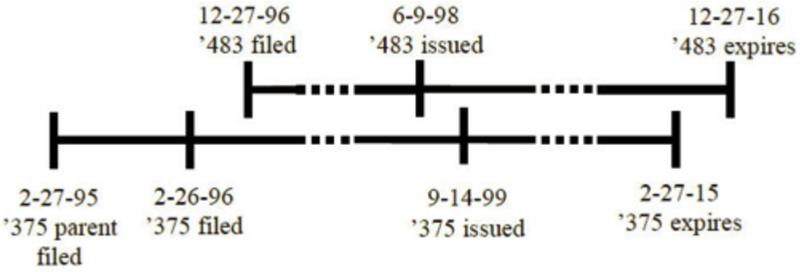
    Image 2
    Despite these differences, the District Court, relying on the rubric from Gilead that "a later-filed but earlier-expiring patent can serve as a double patenting reference for an earlier-filed but later-expiring patent," invalidated the '772 patent claims under OTDP over the '990 patent claims.  As explained in the opinion, the District Court also relied on decisions by district courts following Gilead, including Janssen Biotech Inc. v. Celltrion Healthcare Co., 210 F. Supp. 3d 278 (D. Mass. 2016); MLC Intellectual Property, LLC v. Micron Technology, Inc., 2016 WL 4192009 (N.D. Cal. Aug. 9, 2016); and DDB Technologies, LLC v. Fox Sports Interactive Media, LLC, 2014 WL 12167628 (W.D. Tex. May 15, 2014), in support of its decision.  The District Court rejected four arguments asserted by Novartis attempting to distinguish Gilead.  First, that grant of the '990 patent did not affect the expiration date of the '772 patent; the Court held that "it was Novartis's choice to file the '990 patent, and the harm to the public lies in the inability to practice the invention claimed in the '990 patent once it expired."  Second, that Novartis had not engaged in any gamesmanship which was the basis for the Gilead court's concerns; the Court held that gamesmanship was not required to violate proscription against OTDP under Gilead (or AbbVie, Inc. v. Mathilda & Terence Kennedy Institute of Rheumatology Trust, 764 F.3d 1366 (Fed. Cir. 2014)).  Third, that allowing the earlier-expiring, post-URAA patent to be an OTDP reference against a later-expiring, pre-URAA patent would impermissibly shorten the statutorily mandated 17-year term of the pre-URAA patent; the Court found that Novartis had courted that risk by filing the earlier-expiring patent having patentably indistinct claims.  Finally, that the patent term extension Novartis had obtained for the '772 patent "immunized" the patent from a double patenting challenge; the Court found no precedent for this contention and noted that the question was not at issue.  The parties having stipulated to infringement and that the '772 patent claims would be invalid for OTDP if the '990 was a proper OTDP reference, the District Court entered judgment that the '772 patent was invalid and this appeal followed.

    The Federal Circuit reversed, in an opinion by Judge Chen joined by Chief Judge Prost and Judge Wallach.  The panel held that their decision in Gilead did not control in this instance, because the difference between how the patents were related to one another with respect to whether their expiration dates made a difference in how the doctrine of OTDP should be applied.  According to the opinion:

    [T]he correct framework here is to apply the traditional obviousness-type double patenting practices extant in the pre-URAA era to the pre-URAA '772 patent and look to the '772 patent's issuance date as the reference point for obviousness-type double patenting.

    Under their analysis, "because a change in patent term law should not truncate the term statutorily assigned to the pre-URAA '772 patent," the '990 patent "cannot properly be used as an OTDP reference."

    One aspect of this decision useful for the bar is the careful explication of how courts have "applied the principles of obviousness-type double patenting for over a century to restrict a patent owner's patents on an invention and obvious variants to one 17-year patent term," particularly with regard to the issuance dates of earlier- and later-expiring patents.  Gilead, according to the opinion, represents a realization by the Court:

    [T]hat the change in patent term law under the URAA altered the analytical inquiry for double patenting; issuance dates of post-URAA patents did not serve as reliable stand-ins for the expiration date of the patent as is true for pre-URAA patents, and the proper reference point for an obviousness-type double patenting inquiry is the expiration date of the patent in question.

    The circumstances before the Court here are not the same and Gilead does not control, according to the opinion ("Gilead addressed a question that is not applicable here").  And the opinion characterizes the Court's Gilead opinion as being dependent upon the changes that arose post-URAA, because patent issue dates no longer "served as a reliable stand-in for the date that really mattered — patent expiration."  This is because, as in the Gilead case, "a patent that issues first does not [necessarily] expire first."  The relationship of the earlier- and later-expiring patents before the Court here also does not have the potential negative consequences the Court cautioned against in Gilead, such as the opportunity for patentees to engage in gamesmanship regarding patent application and issue dates, and the potential that a difference of even one day in issue date could change the relationship in an OTDP-determining way.

    The panel also concluded that the Court's AbbVie decision did not control the outcome.  The relationship of the earlier- (U.S. Patent No. 7,846,422) and later- (U.S. Patent No. 6,270,766) expiring patents (both having post-URAA filing dates) in that case was as follows:

    Image 3
    The AbbVie situation is "a prime example of the post-URAA scenario [the Court] contemplated in Gilead," according to the opinion (noting that, as in Gilead, the effective filing date (EFD) of the '422 patent represents applicant choice, because it did not have the same EFD of the '766 patent).  That factor was not at play regarding the Novartis patents and thus AbbVie does not control the outcome here.

    The Federal Circuit also found support (and solace) for its decision in the choice Congress made in the URAA transition statute, which gave applicants a patent term that was "the greater of" 17 years from issue date or 20 years from the effective filing date.  Thus evinced a choice by Congress for patentees "to enjoy the maximum possible term available for their resulting patents under either patent term regime."  Breckenridge's position, that OTDP could be used to "truncate any portion of the statutorily assigned term of a pre-URAA patent that extends beyond the term of a post-URAA patent would be inconsistent" with this Congressional choice.  The panel also believes the outcome here is consistent with the "core principle underlying the double patenting doctrine:  giving one invention and nonobvious variants of that invention the same patent term."  Stating its rationale succinctly, the Court said:

    The key purpose of obviousness-type double patenting is to prevent a patent owner from extending the exclusivity rights over his invention beyond a full patent term.  We saw this impermissible practice in Gilead and in AbbVie, where the patent owners claimed different effective filing dates for different patents to extend the life of patent exclusivity.  Gilead[.]  Here, critically, Novartis did not seek to extend its patent rights over its everolimus invention beyond one patent term, in this case, 17 years from issuance of the '772 patent.  Had the law not changed, regardless of whether Novartis obtained the '990 patent, the '772 patent would have expired on September 9, 2014 (September 9, 2019 with the patent term extension).  The fact that the law for the term of a patent changed, resulting in the later-issued '990 patent having an earlier expiration date than it would have pre-URAA should not affect the '772 patent's statutorily-granted 17-year patent term.  Rather than Novartis receiving a windfall with a 17-year term for its '772 patent, its '990 patent's term was truncated by the intervening change in law.  To find that obviousness-type double patenting applies here because a post-URAA patent expires earlier would abrogate Novartis's right to enjoy one full patent term on its invention (citations omitted).

    Novartis Pharmaceuticals Corp. v. Breckenridge Pharmaceutical Inc. (Fed. Cir. 2018)
    Panel: Chief Judge Prost and Circuit Judges Wallach and Chen
    Opinion by Circuit Judge Chen

  • By Michael Borella

    District Court for the Nothern District of TexasWe wrote about this case six months ago, regarding InvestPic's appeal to the Federal Circuit over having its patent invalided under 35 U.S.C. § 101 in the Northern District of Texas.  InvestPic did not get the outcome it was looking for.  Here, the case is back in the District Court to consider SAP's motion for recovery of attorney's fees.  As we will see, InvestPic ended up not only with its patent invalidated, but also owing a large chunk of money to SAP.

    SAP was originally granted attorney's fees in 2017, after the District Court ruled, on the pleadings, that InvestPic's U.S. Patent No. 6,349,291 was invalid under § 101.  As noted above, InvestPic appealed and lost.

    The 2017 Proceedings

    In the 2017 ruling, the District Court wrote:

    A district court may find that a patent case is exceptional and award attorney fees to a prevailing party.  35 U.S.C. § 285.  A case is exceptional if it stands out from other cases with respect to the substantive strength of a party's litigating position considering both the governing law and the facts of the case or if the case stands out in the unreasonable manner in which the case was litigated.

    Notably, district courts have discretion when determining whether a case is exceptional and are to consider the totality of the circumstances rather than any bright-line rule.

    Regarding InvestPic's litigation position, the District Court observed that the patent was duly issued by the USPTO and therefore presumed valid.  The District Court read into Judge Mayer's concurrence in the Ultramercial v. Hulu case to note that this presumption of validity might not apply to a patent that is challenged under § 101.  But it went on to state that "a patent owner should be entitled to rely on the fact that the claims were reviewed and approved by the USPTO and should be allowed to attempt to enforce his or her patent whether this is done by demand for licensing or by enforcement of patent rights in a court."  Thus, in the District Court's view, just because claims were found lacking under § 101 does not automatically make a case exceptional.

    But in this case, "Investpic was specifically warned by the USPTO, in an opinion issued in connection with a post grant review, that it looked very unlikely that these claims were directed toward patentable subject matter and very likely that the claims were invalid."  Despite the fact that the USPTO did not actually address the § 101 issue and only invited InvestPic to submit the patent for such a review, the District Court concluded that this "created a serious cloud on the . . . claims."

    Thus, the District Court concluded that the USPTO's warning, in combination with InvestPic's not taking any action on it and continuing to assert the patent, resulted in a weak litigating position.

    Regarding the manner in which InvestPic litigated the patent, the District Court took a dim view toward the owners of InvestPic using a front company to engage with SAP salespeople and to learn about the allegedly infringing products.  Notably, "[the owners] held themselves out to be only employees of Regulus and failed to disclose their relationship with InvestPic and their interest in the outcome of this lawsuit."  This, according to the District Court, amounted to conducting "self help discovery under a pretense," and also rose to the level of unreasonable litigation conduct.

    Accordingly, the District Court granted SAP's motion for attorney's fees.

    The 2018 Proceedings

    This proceeding, however, was put on hold by the Federal Circuit appeal.  Now back in the District Court, an order granting much of what SAP requested was issued on December 4, 2018.

    SAP requested a total of $939,306.61, which did not include any time from attorneys and staff that worked less than 10 hours on the case.  But this amount included time that SAP's attorney spent on a petition for covered business method review which was never filed.  The District Court declined to award fees for the petition.

    Also, the District Court found that the rates charged by SAP's attorneys ("$745.00 – $1,175.00 per hour for partners to $405.00 – $650.00 per hour for associates") were excessive.  In particular, the majority of the partner's rates were above the 90th percentile for Texas, and the District Court found no evidence to justify the rates being so high.  Accordingly, the District Court reduced all partner rates by 35% and all associate rates by 15%.  Based on these adjustments, the total amount actually awarded was $679,420.46.

    Analysis

    Focusing just on the patent-eligibility issues for the moment, here we have a successful attempt to obtain attorney's fees based on a supposedly weak litigating position under § 101.  Sure, InvestPic's owners engaged in shady practices.  That may have been enough to award attorney's fees alone.

    But the District Court's reliance on a USPTO warning (not an actual USPTO decision or rejection, but just a warning) may be extreme.  Since Alice v. CLS Bank, just about any patent involving software or a business method can have its validity challenged under § 101.  Further, the USPTO is not a final or a consistent arbiter of what is or is not patent-eligible.  If anything, the USPTO applies the law in a markedly erratic fashion, with much discretion granted to the personal opinions of primary examiners and PTAB judges.  Thus, relying on an unofficial or provisional observation of the USPTO to find a case exceptional is a rather unusual step.

    To further drive home this point, not even the federal courts have been able to crack the § 101 egg.  It is well-known that multiple federal judges have commented on the record that Alice was hard to apply in practice.  Judge Wu of the United States District Court for the Central District of California criticized Alice for setting forth an "I know it when I see it" test.  Judge Pfaelzer, a colleague of Judge Wu, wrote that the Supreme Court's patent-eligibility cases "often confuse more than they clarify [and] appear to contradict each other on important issues."  More recently, the Federal Circuit's Judge Plager, wrote that the post-Alice §101 inquiry "renders it near impossible to know with any certainty whether the invention is or is not patent eligible."  And these are just a few examples of judicial confusion.  There are more.

    Just a few months ago, the Federal Circuit ruled 2-1 that § 101 jurisprudence was too murky to be used as the basis of an attorney's fees award.  While the facts between that case and this one differ, the law does not.

  • By Kevin E. Noonan

    Federal Circuit SealIn Novartis AG v. Ezra Ventures LLC, the Federal Circuit addressed a narrow but important question regarding its jurisprudence on the issue of obviousness-type double patenting (OTPD).  That question was whether its decision in Gilead Sciences Inc. v. Natco Pharma Ltd., which established that a first patent filed earlier than a second patent but that issued later, could be used to invalidate the second patent on OTDP grounds, if the reason the later-expiring patent was later-expiring was due to Patent Term Extension under 35 U.S.C. § 156.

    To recap, the Gilead Court decided that a later-issued but earlier-expiring patent could be used to establish OTDP over the later-expiring patent, as illustrated here:

    Image 1
    In rendering its decision, the Gilead panel held that the intervening change in U.S. patent term occasioned by ratification of the GATT-TRIPS agreement did not influence its decision.  Rather, the panel grounded its decision on the "bedrock" principle that the public had a right to practice an invention (and its obvious variants) once a patent on that invention had expired.  Important to the instant Novartis decision, the Gilead panel also voiced its concern that holding to the contrary in that case could raise the possibility of "significant gamesmanship" regarding patent term depending on when related applications were filed and when they were allowed to issue.  The Gilead decision has been applied to mean that the relevant dates for considering OTDP are the expiration dates of the later and earlier-expiring patents, and whether the claims in the later-expiring patent were mere obvious variants of the earlier-expiring claims.

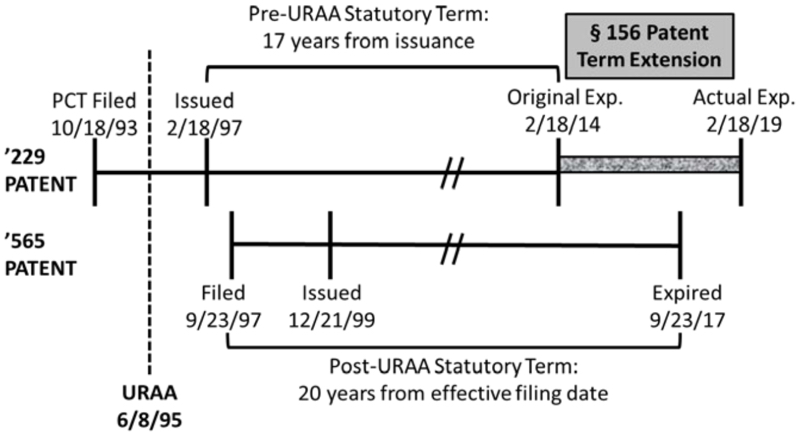
    The Novartis case arose in ANDA litigation brought by Novartis against Ezra Ventures over its multiple sclerosis drug Gilenya® over Orange Book-listed U.S. Patent No. 5,604,229.  As explained in the opinion, claims of the '229 patent encompassed fingolimod, the active ingredient in Gilenya®.  The '229 patent was filed prior to the GATT-TRIPS changes in U.S. patent law, and thus had a patent term calculated as 17 years after issuance (in this case, corresponding to February 18, 2014).  In addition, Novartis had been granted five years of Patent Term Extension under § 156, thus expiring on February 18, 2019.

    Novartis owned another patent, U.S. Patent No. 6,004,565 that claims methods for administering fingolimod; this patent was filed after the U.S. changed how patent term was calculated under the GATT-TRIPS agreement and thus expired September 23, 2017 (20 years from its filing date).  The filing and expiration dates of the '229 and '565 patents are related as illustrated below:

    Image 2
    Before the District Court, Ezra Ventures filed a motion to dismiss (that the Court denied) under Fed. R. Civ. Pro. 12(c) for judgment on the pleadings, on three grounds.  First, that extension of the '229 patent "de facto also extends the life of the '565 patent, and thereby violates § 156(c)(4)'s requirement that only 'one patent be extended.'"  Second, that this extension "violates the 'bedrock principle' that the public may practice an expired patent."  And third, that the '565 patent "renders the '229 patent invalid for statutory- and obviousness-type double patenting because Novartis's '229 patent claims are not patentably distinct from its '565 patent claims."  With regard to the argument that this is an impermissible extension in violation of § 156(c)(4), the District Court held that "de facto" extension as argued here was inconsistent with the meaning of the extension statute.  In addition, the lower court relied on the Federal Circuit's decision in Merck & Co. v. Hi-Tech Pharmacal Co., 482 F.3d 1317 (Fed. Cir. 2007), that the term of a terminally disclaimed patent can be extended under § 156, which "de facto" extends the term of that patent over the term of the patent over which it has been terminally disclaimed.  Thereafter, Ezra Ventures stipulated infringement and withdrew its defenses, and the District Court entered final judgment against Ezra Ventures, clearing the procedural path for this appeal.

    The Federal Circuit affirmed, in an opinion by Judge Chen joined by Judges Moore and Hughes.  The panel first addressed Ezra Venture's argument that extension of the '229 patent by Patent Term Extension also (improperly) extended the term of the '565 patent.  As an initial matter, the opinion notes that "nothing in the statute restricts the patent owner's choice for patent term extension among those patents whose terms have been partially consumed by the regulatory review process," despite it not being uncommon for a patented drug to also be the subject of patents on "a product, a method of using that product, and/or a method of manufacturing the product."  The panel agreed with the District Court that Congress did not choose language that would preclude extension of a patent on a drug product because it also "effectively" extends the patent, for example, on a method of using that drug product.  Here, only one patent term was extended — the '229 patent — and this satisfies the statutory mandate and does not violate § 156(c)(4).

    Next the Federal Circuit considered the "interaction" between § 156 and OTDP.  In what the panel states is "a logical extension" of its holding in Merck & Co. v. Hi-Tech Pharmacal Co., the Court held here that OTDP does not invalidate extension of the patent term under § 156.  After explicating the Court's basis for its Merck opinion (inter alia, the plain meaning of the § 156 and the differences in statutory language between § 156 and § 154, the patent term adjustment statute, which cannot extend the term of a terminally disclaimed patent) the opinion notes that the Merck decision involved just the issue raised here:  that a terminally disclaimed patent can still receive the benefit of a patent term extension under § 156.  Accordingly, extension of the term of the '229 patent past the expiration date of the '565 patent was not improper.

    It is when the opinion turns to "Ezra's policy concerns" that the panel took the opportunity to set forth its reasoning on the question of the function of the OTDP doctrine.  Citing Proctor & Gamble Co. v. Teva Pharm. USA, Inc., 566 F.3d 989, 999 (Fed. Cir. 2009), the opinion states that the instant situation "does not raise the traditional concern with obviousness-type double patenting of a patent owner 'extending his exclusive rights to an invention through claims in a later-filed patent that are not patentably distinct from claims in the earlier filed patent.'"  The opinion then distinguishes the policy considerations at play here with more recent OTDP decisions of the Court, particularly Gilead Sciences, Inc. v. Natco Pharma Ltd., specifically referring to that Court's concerns with gamesmanship not present here.

    The other distinction between the situation in Gilead and the one here is whether the differences in the relationship between the patents (patents filed pre- and post-URAA here, in contrast to having two post-URAA patents in Gilead) are addressed in the opinion accompanying this one, Novartis Pharmaceuticals Corp. v. Breckenridge Pharmaceutical.  That case will be the subject of a later post.

    Novartis AG v. Ezra Ventures LLC (Fed. Cir. 2018)
    Panel: Circuit Judges Moore, Chen, and Hughes
    Opinion by Circuit Judge Chen

  • CalendarDecember 11, 2018 – "Patent Eligibility Post-Alice: Navigating the Nuances, Guidance From the Federal Circuit, the PTAB, and the USPTO" (Strafford) – 1:00 to 2:30 pm (EST)

    December 11, 2018 – "Enforcing Patents: Global Strategies and Tactics" (Intellectual Property Owners Association) – 2:00 to 3:00 pm (ET)

    December 11, 2018 – "Customer Perceptions of Patent Quality and New Customer Experience (CX) Initiative" (U.S. Patent and Trademark Office) – 12:00 to 1:00 pm (ET)

    December 13, 2018 – "Nuts & Bolts of the Federal Circuit's Rules" (Federal Circuit Bar Association Rules Committee) – 1:00 pm to 2:00 pm (EST)

    December 13, 2018 – "Protecting IP Rights in Joint Development Agreements and Strategic Alliances — Structuring JDAs to Apportion Contributed, Joint and Derivative IP; Planning for Involuntary Early Endings; Avoiding Unintended Consequences" (Strafford) – 1:00 to 2:30 pm (EST)

    December 18, 2018 – "Navigating the USPTO Examiner Count System and Other USPTO Programs" (Strafford) – 1:00 to 2:30 pm (EST)

    December 20, 2018 – "Antibody Patenting After Amgen v. Sandoz: U.S. and European Perspectives — Meeting Written Description and Obviousness Requirements" (Strafford) – 1:00 to 2:30 pm (EST)

  • IPO #2The Intellectual Property Owners Association (IPO) will offer a one-hour webinar entitled "Enforcing Patents: Global Strategies and Tactics" on December 11, 2018 from 2:00 to 3:00 pm (ET).  Steven Carlson of Robins Kaplan LLP, Johannes Heselberger on Bardehle Pagenberg Partnerschaft MbB, and Boris Teksler of Conversant Intellectual Property Management Inc. will discuss:

    • The decisions necessary before launching foreign litigation
    • Important differences between legal systems
    • Using foreign litigation to encourage global settlement
    • The reality of what it takes to enforce an injunction in Germany
    • Whether European decisions make any impact on U.S. courts
    • The risk that foreign litigation could backfire in the U.S.

    The registration fee for the webinar is $135 (government and academic rates are available upon request).  Those interested in registering for the webinar can do so here.

  • Strafford #1Strafford will be offering a webinar entitled "Navigating the USPTO Examiner Count System and Other USPTO Programs" on December 18, 2018 from 1:00 to 2:30 pm (EST).  Adriana L. Burgy, Christopher C. Johns, and Kai Rajan of Finnegan Henderson Farabow Garrett & Dunner will provide guidance on leveraging the U.S. Patent & Trademark Office (USPTO) Examiner Count System to prosecute patents more effectively, provide insight into the count system, and offer strategies for interacting with patent examiners.  The webinar will review the following issues:
    • What impact does the number of claims in the application have on the quality of examination in the first office action?
    • How can patent counsel use the incentives of the count system to the client’s advantage?
    • How and when should patent counsel interact with examiners for effective and efficient prosecution?

    The registration fee for the webcast is $347.  Those interested in registering for the webinar, can do so here.

  • USPTO SealThe U.S. Patent and Trademark Office will be offering the next webinar in its Patent Quality Chat webinar series from 12:00 to 1:00 pm (ET) on December 11, 2018.  In the latest webinar, entitled "Customer Perceptions of Patent Quality and New Customer Experience (CX) Initiative," Marty Rater, Chief Statistician for Patent Quality; Michael Easdale, Statistician, Office of Patent Quality Assurance (OPQA); and David Fitzpatrick, Statistician, Office of Patent Quality Assurance (OPQA) will discuss how the USPTO measures and monitors customer perceptions of patent examination quality, and about the Office’s new initiative related to customer experience. The panel will also discuss the most recent findings from the semi-annual external quality survey and how that information is used in conjunction with the Office’s internal quality review program.

    Additional information regarding this webinar, including instructions for viewing the webinar, can be found here.