 The authors and contributors of Patent Docs wish their readers and families a Happy Holidays. Publication of Patent Docs will resume on December 26th.

Patent Law Weblog
recent posts
- Reasons for the PTAB’s Priority Determination in Broad’s Favor (Perhaps)
- Mexico Publishes Amendments to Intellectual Property Law
- PTAB (Again) Awards Priority of Invention to Broad in Interference No. 106,115
- Argentina Repeals Pharmaceutical Patent Examination Guidelines
- USPTO Moves to Protect Design Rights for Digital Innovations
about
-
-
By Donald Zuhn —
 Practitioners who have been putting off migrating their current PKI digital certificates to their USPTO.gov accounts or sponsoring support staff received an early holiday gift from the U.S. Patent and Trademark Office on Friday (in addition to the Office's designation of Christmas Eve as a "Federal holiday within the District of Columbia"), when the Office announced via a Patent Alert e-mail that it was delaying the date on which PKI certificates would be retired. USPTO Director Andrei Iancu had informed stakeholders in November that "[u]se of PKI certificates may no longer be available after December 31, 2018" (see "USPTO Director Issues Notice on New Authentication System for EFS-Web and Private PAIR"). In the Office's latest word on PKI certificate retirement, however, it has now indicated that "EFS-Web and Private PAIR users will no longer be able to authenticate using PKI certificates as of February 15."
Although the reprieve was not entirely unexpected, if you have delayed creating a USPTO.gov account, migrating your current PKI digital certificate to your USPTO.gov account, or sponsoring support staff, it may be a good idea to make those tasks part of your New Year's resolutions. As the Office indicated in October, the new authentication system for accessing the EFS-Web and Private PAIR is safer and simpler than the old system, allowing for access to multiple USPTO systems with one consolidated sign-in, eliminating the need to share credentials by providing practitioners and their support staff with their own USPTO.gov accounts, and helping resolve browser compatibility issues (see "USPTO Moving to New Authentication System for EFS-Web and Private PAIR"). The Office has noted that the new system will provide users with access to the EFS-Web and Private PAIR until the full release of Patent Center, the next generation tool that will replace the EFS-Web and Private PAIR in 2020.
The Office also announced the release of a migration tool in October, which allows existing PKI digital certificate holders to link their USPTO.gov accounts to their current PKI digital certificates. To migrate an existing PKI digital certificate, users must have a USPTO.gov account. Users who need to create a USPTO.gov account can do so by following the steps under the "Create a USPTO.gov Account" tab at the Office's authentication change webpage. Once a USPTO.gov account has been created, users can follow the steps under the "Migrate your PKI Certificate" tab at the Office's authentication change webpage (or refer to the Guide for Migration) to link that account to their PKI certificate. The Office notes that users should allow 1–2 business days after the migration steps are finished for the migration process to be completed. Once the process is completed, users will be able to sign into the EFS-Web or Private PAIR using their USPTO.gov account. Users should use the following new links to sign into the EFS-Web or Private PAIR using their USPRTO.gov accounts:
EFS-Web:
https://efs-my.uspto.gov/EFSWebUIRegistered/EFSWebRegisteredPrivate PAIR:
https://ppair-my.uspto.gov/pair/PrivatePairAdditional information regarding the new authentication process can be found in the Office's Patent Electronic System Access Document. This resource includes information about USPTO.gov accounts; two-step authentication; signing in and signing out from USPTO systems; Patent Electronic Access roles for practitioners, support staff, and inventors; suspension of accounts; authorization; authentication steps; the sponsorship process (by which practitioners can grant or remove sponsorship for support staff individuals to work under their direction and control); and the Office's verification policy and identity proofing of sponsored support staff. With respect to identity proofing, the Office has stated that "[e]ach practitioner will be responsible for verifying the identity of the person using any sponsored support Staff account."
When announcing the new authentication system in October, the Office cautioned practitioners that migration to link USPTO.gov accounts to PKI certificates should be completed by the end of October (although practitioners can still do so using the migration tool) and that sponsorship of support staff should be completed by the end of November (again, practitioners can still do so using the sponsorship tool that was released on November 1). With respect to sponsorship, the Office has emphasized that practitioners no longer have to share their credentials, and in fact, will no longer be permitted to share accounts with support staff, who will need to establish their own USPTO.gov accounts in order to access the EFS-Web Registered and Private PAIR. USPTO.gov accounts will be used as the first step to log into EFS-Web Registered and Private PAIR. The second step of the two-step authentication system will require users to choose to receive an e-mail or phone call which will provide a 6-digit code that is to be entered along with their USPTO.gov password (or use an authenticator app on their mobile phone to provide the additional secure verification). The Office's sponsorship tool, which allows practitioners to grant or remove sponsorship for support staff individuals (under the direction and control of sponsoring practitioners) to work on their behalf, can be accessed here.
Practitioners should familiarize themselves with the identify verification (or proofing) requirements of the new authentication system. Under the identity proofing and enrollment process, the identity evidence and attributes of users of the Office's Patent Electronic System are collected, uniquely resolved to a single identity within a given population or context, then validated and verified. Current PKI certificate holders who migrate their PKI certificates using the migration tool will be considered to have met the identity proofing requirements. However, for support staff being sponsored by practitioners, sponsoring practitioners are "responsible for proofing the identity of the person being sponsored," and "[e]ach sponsoring practitioner will establish a procedure for identity proofing sponsored users and maintain a record of that procedure." Additional details regarding identity verification requirements can be found in the Office's Patent Electronic System Access Document.
Users requiring assistance to create a USPTO.gov account should call the USPTO Contact Center (UCC) at 800-786-9199. Users requiring assistance with migration should contact the Patent Electronic Business Center at ebc@uspto.gov or 866-217-9197. Questions or comments related to the new authentication method may be sent to eMod@uspto.gov. The Office has also been offering several informational sessions on authentication changes; a schedule of upcoming sessions (including three in January and four more in February) can be found at the "Information sessions" tab at the Office's authentication change webpage. A list of Frequently Asked Questions (FAQs) about the authentication change for EFS-Web and Private PAIR can be found here.
-
By Donald Zuhn —
 As reported by numerous media outlets (see "Partial government shutdown likely to continue until after Christmas"), the U.S. Senate adjourned this afternoon without coming to an agreement on a continuing resolution to fund the United States Government. The government shutdown is the third shutdown of the federal government this year. While the shutdown could end as soon as Monday, when the Senate has a pro forma session scheduled, the shutdown could continue past the next actual session of the Senate on Thursday, December 27. The shutdown is the result of a debate over $5.7 billion dollars in funding for a border wall.
Regardless of when the shutdown ends, however, the U.S. Patent and Trademark Office has indicated in a short notice posted on its website that the Office will remain "open for business as normal" — at least during the first "few weeks" of the shutdown (were the shutdown to last that long). The USPTO is able to stay open because of its "access to prior-year fee collections."
The entire notice is reproduced below:
USPTO operating status during government shutdown
In the event that parts of the federal government experience a lapse of appropriated funding, the USPTO remains open for business as normal. This is possible because the agency has access to prior-year fee collections, which enables the USPTO to continue normal operations for a few weeks. Should the USPTO exhaust these funds before a partial government shutdown comes to an end, the agency would have to shut down at that time, although a small staff would continue to work to accept new applications and maintain IT infrastructure, among other functions.
Further information regarding any adjustments to the USPTO’s operating status will be posted on the USPTO website and delivered to the news media.
We will monitor and report on the USPTO's operating status as the government shutdown continues.
With this shutdown once again focusing the patent community's attention on the USPTO's operating status, experienced practitioners have probably been reminding their less tenured colleagues that the USPTO will be open on Monday, December 24. Ordinarily, that would be true, as the USPTO is normally closed only on federal holidays, which includes Christmas Day, but not Christmas Eve.
This year, however, the USPTO will also be closed on December 24 because of the official closing of federal government offices in Washington, DC on December 24. The Christmas Eve closing is the result of an executive order issued by President Trump on Tuesday, in which the President ordered "[a]ll executive departments and agencies of the Federal Government . . . closed and their employees excused from duty on Monday, December 24, 2018, the day before Christmas Day." The President also indicated in the order that "[t]he heads of executive departments and agencies may determine that certain offices and installations of their organizations, or parts thereof, must remain open and that certain employees must report for duty on December 24, 2018, for reasons of national security, defense, or other public need."
On Friday, the USPTO issued a notice stating that:
In view of the official closing of the Federal Government offices in the Washington, D.C. metropolitan area, including the United States Patent and Trademark Office (USPTO), on Monday, December 24, 2018, the USPTO will consider Monday, December 24, 2018, to be a 'Federal holiday within the District of Columbia' under 35 U.S.C. § 21 and 37 C.F.R. §§ 1.6, 1.7, 1.9, 2.2(d), 2.195, and 2.196.
Because Christmas Day is already a federal holiday, the result of the USPTO's notice is that:
[A]ny action or fee due on Monday, December 24, 2018, or Tuesday, December 25, 2018, will be deemed as timely for the purposes of, e.g., 15 U.S.C. §§ 1051(d), 1058, 1059, 1062(b), 1063, 1064, 1126(d), and 1141k, or 35 U.S.C. §§ 119, 120, 133, and 151, if the action is taken, or the fee paid, on the next succeeding business day on which the USPTO is open, that is, Wednesday, December 26, 2018 (37 C.F.R. §§ 1.7(a) and 2.196), no later than 11:59 pm EST.
Thus, applicants and practitioners can — for this year at least — wait until December 26 to take actions that would otherwise be due on December 24.
-
By Kevin E. Noonan —
The plague, that variety of human ailments caused by the Yersinia pestis bacteria, is mythic in human history, a nightmare disease carried by fleas infesting rats, a species that is omnipresent in human civilizations. Its spread in earlier times was a nascent harbinger of the much more global spread of disease today, due to the greater reach of modern transportation compared with, inter alia, sailing ships and overland caravans. The precise nature and pattern of earlier outbreaks is relatively unknown, however, and their routes of transmission somewhat speculative. In view of the consequences of a plague pandemic today (despite the existence of antibiotics, still a risk due to supply chain weaknesses and other factors) this lack of knowledge is relevant to understanding and forestalling modern global public health risks.
A group of international researchers* recently addressed these questions, in a paper entitled "Integrative approach using Yersinia pestis genomes to revisit the historical landscape of plague during the Medieval Period" published in the Proceedings of the National Academy of Sciences. As explained in the paper, there have been three great plague pandemics in human history. The first started during the reign of the Emperor Justinian in 541-542 CE and lasted until the eighth century in Europe (the subject of William Rosen's book, Justinian's Flea: The First Great Plague and the End of the Roman Empire). The second, and most famous, was the Black Death that lasted for a much shorter time in Western Europe (1346-1353) but killed at least 30% of the population on the continent. The most recent outbreak, beginning in 1772 and ongoing today, is limited to Yunnan Province in China. The persistence of plague is due to its nature as an infection of animals other than humans (a zoonosis) that sometimes "spills over" into human populations. (Similar etiologies exist in other less dramatic diseases, for example, sleeping sickness transmitted by the tsetse fly and endemic in African ungulate populations.) The animal populations that constitute "plague reservoirs" are well known today; this paper endeavors to reconstruct the sources of the Black Death plague pandemic.
The evidence adduced by these researchers come from genomic DNA sequencing of five ancient plague genomes recovered from human teeth of plague victims from four archeological sites: Abbadia San Salvatore (BSS) (Italy), Saint-Laurent-de-la-Cabrerisse (SLC) (France), Bergen op Zoom (BER) (The Netherlands), and Oslo (OSL) (Norway), all dated from the 14th Century.
Sequencing was also performed from samples dating from the Justinian epidemic as well as modern Y. pestis samples; DNA from a related bacteria, Yersinia pseudotuberculosis, was used for outgroup comparison. In total, comparison of 126 modern Y. pestis genomes with 15 ancient genomes from the Bronze Age and the First and the Second Pandemics resulted in 2,826 polymorphic sites, further characterized as comprising 1,456 nonsynonymous SNPs, 625 synonymous SNPs, and 745 intergenic SNPs.These genetic comparisons, coupled with historical and epidemiologic data, suggested that plague outbreaks during the Second Pandemic (Black Death) were the result of "independent introductions on the fur trade routes, a complex network of interconnected maritime, riverine, and overland routes into Western Europe," consistent with the modern lack of a zoonotic reservoir on the continent. Russian fur sources (Novgorod) had by the 14th Century penetrated the European fur trade by membership in the Hanseatic League of trade centers. Also implicated was development of a "new" mainland fur trading route, "connecting Sarai, Tana, and Caffa" and then on to the Black Sea, illustrated in this figure:
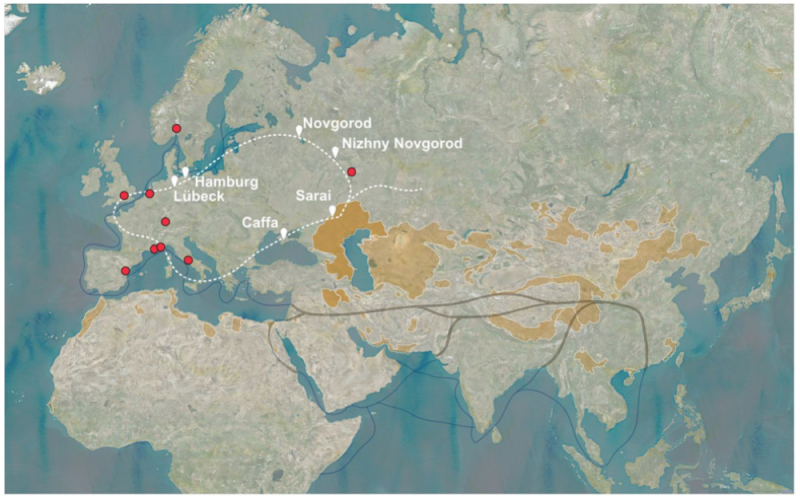
This model is supported by patterns of SNP inheritance from geographically separated Y. pestis isolates. The contemporary Arab historian (himself a plague victim), Ibn al-Ward, suggested that the plague arrived from merchants returning from the Crimea with furs from regions near the Caspian Sea, which are known today to harbor plague reservoir populations. The authors summarize their findings thusly:Overall, evidence from different disciplines increasingly suggests successive and independent introductions of plague to Western Europe via the transport of infected individuals and goods on trade routes during the Second Plague Pandemic. By analyzing five ancient genomes from the Second Plague Pandemic, adding them to the established Y. pestis phylogeny, and evaluating them with a historical background, our study aimed to answer some of the most debated questions on plague in Western Europe during the Second Plague Pandemic. All things considered, the hypothesis that Y. pestis reached Europe through multiple introductions during the Middle Ages through different routes, including the fur trade, appears very plausible, at least during the Second Plague Pandemic.
As with many other examples (The Domestication History of Apples Revealed by Genomic Analysis; Genetic Assessment of Squash Genomes in Related Species; Silver Birch Genetics Explained), this paper illustrates how combining genetic analysis with other disciplines can shed light on historical occurrences having important consequences today.
*Amine Namouchi, Meriam Guellil, Oliver Kersten, Stephanie Hänsch, Claudio Ottoni, Boris V. Schmid, Elsa Pacciani, Luisa Quaglia, Marco Vermunt, Egil L. Bauer, Michael Derrick, Anne Ø. Jensen, Sacha Kacki, Samuel K. Cohn Jr., Nils C. Stenseth, and Barbara Bramanti
-
By Kevin E. Noonan —
 The Supreme Court changed the calculus on what conduct satisfies the "exceptional case" criteria for awarding attorney's fees under 35 U.S.C. § 285 in its Octane Fitness, LLC v. ICON Health & Fitness Inc. and Highmark Inc. v. Allcare Health Mgmt. Sys., Inc. decisions. Under this clarifying precedent, the standard for finding an exceptional case in patent law was based on judicial discretion: district courts should exercise this discretion considering the totality of the circumstances and "in light of the considerations' underlying the grant of that discretion." Since these decisions, prevailing parties have increasingly sought and district courts have increasingly granted motions for finding a case exceptional and awarded attorneys' fees and other sanctions on this basis. Last Friday, the Federal Circuit rendered an opinion, in Spineology, Inc. v. Wright Medical Technology, Inc. seeking to rein in the more vigorous assertions of the exceptional case doctrine under these Supreme Court precedents.
The case arose in litigation over Reissue Patent No. RE42,757, arising from U.S. Patent No. 6,383,188, and directed to an "expandable reamer" used, according to the opinion, in orthopedic surgical procedures. During claim construction, each party proposed a meaning for the claim term "body" as used in asserted claim 15:
15. An expandable reamer for use in bone and related tissue in a mammal comprising:
an elongated hollow body having a proximal end and a distal end, sized and configured to engage bone and related tissue in the mammal;
an elongated blade carrier having a proximal end and a distal end, the blade carrier disposed within the body;
a set of blades pivotally attached proximate the distal end of the blade carriers; the set of blades having at least a first retracted position relative to the body, the body having a maximum cross-sectional diameter transverse to a longitudinal axis of the body that is substantially at least as large as a maximum cross-sectional diameter of the blades in the first retracted position, and a second fully expanded position having a diameter greater than the maximum cross-sectional diameter of the body; and
an manually actuated activation mechanism that moves the set of blades from the first retracted position to the second fully expanded position and any expanded position therebetween.The District Court did not adopt either party's proposed meaning in its claim construction order. Thereafter, the parties filed cross-motions for summary judgment on infringement and the District Court ruled in defendant Wright Technology's favor (a decision affirmed by the Federal Circuit in an earlier appeal). In granting Wright's motion, the District Court adopted Wright's definition of the term "body" in the claims. This decision prompted Wright to seek attorneys' fees, contending that the case was exceptional based on plaintiff's construction of the term "body," damages theories asserted (but never pursued because the case was decided on summary judgment) and "litigation conduct." The District Court did not grant the motion, holding that Spineology's claim construction and its damages theories were "not so meritless" as to warrant a finding that this was an exceptional case, and that "[n]othing about this case stands out from others with respect to the substantive strength of Spineology's litigating position or the manner in which the case was litigated."
The Federal Circuit affirmed, in an opinion by Judge Moore joined by Chief Judge Prost and Judge Dyk. In citing the standard of review, abuse of discretion, the Court acknowledged the high bar Wright was required to clear to convince an appellate court to overturn the decision below. With regard to Wright's first argument, that Spineology's proposed definition for the term "body" was so unreasonable as to be meritless and thus pursuing it after the District Court declined to adopt it, the opinion punctures it with three words: "[w]e are unpersuaded." The panel cites to SFA Sys., LLC v. Newegg Inc., 793 F.3d 1344, 1348 (Fed. Cir. 2015), for the principle that "[a] party's position . . . ultimately need not be correct for them not to 'stand[] out'," and states that "Wright cannot fairly criticize Spineology for continuing to pursue a construction not adopted by the district court in the claim construction order, since the district court declined to adopt Wright's proposed construction as well."
Turning to Spineology's damages assertions, the panel notes that this ground is brought even though there was no trial and thus no "consideration of or rulings on damages." The bases for Wright's contentions were Spineology's expert report on damages, its "lost profits analysis offered by Spineology's expert" (which allegedly "improperly calculate[d] the sales Spineology would have made "but for" Wright's infringement"), and the expert's reasonable royalties analysis for "improperly relying on the entire market value rule ("EMVR") and employing a flawed royalty rate." Once again, the panel was not persuaded. First, the opinion notes that "[t]his court has affirmed lost profit awards based on a wide variety of reconstruction theories," citing Versata Software, Inc. v. SAP Am., Inc., 717 F.3d 1255, 1263–64 (Fed. Cir. 2013), and characterizes Spineology's damages arguments as "colorable" with regard to their expert's reliance on the EMVR, citing Interactive Pictures Corp. v. Infinite Pictures, Inc., 274 F.3d 1371, 1384–86 (Fed. Cir. 2001). While recognizing that these arguments might not have prevailed at trial, the opinion first states that "a strong or even correct litigating position is not the standard by which we assess exceptionality," citing Stone Basket Innovs., LLC v. Cook Med. LLC, 892 F.3d 1175, 1180 (Fed. Cir. 2018), and that the District Court stated that it would not have found Spineology's damages arguments to be "so meritless as to render the case exceptional" even if it had excluded their expert's testimony. "On this record," the Federal Circuit states, "where the district court never reached the parties' damages arguments, we are in no position to upend its determination that [the expert's] analysis was not meritless" (emphasis in opinion). The panel goes on to say that:
Wright asks this court to basically decide the damages issues mooted by summary judgment in order to determine whether it ought to obtain attorney fees for the entire litigation. This we will not do. We will not force the district court, on a motion for attorney fees, to conduct the trial it never had . . . and we—an appellate court—will certainly not conduct that trial in the first instance.
Then the opinion issues a pointed warning against this sort of appeal:
A district court need not, as Wright seems to urge, litigate to resolution every issue mooted by summary judgment to rule on a motion for attorney fees. And we need not, as Wright requests, get into the weeds on issues the district court never reached. . . . We see no error in the district court's determination that, on this record, the case was not exceptional, and we caution future litigants to tread carefully in their complaints about district courts not doing enough.
Finally, with regard to the litigation (mis)conduct basis for Wright's appeal, in addition to being unpersuaded the Federal Circuit takes its own admonition against "get[ting] into the weeds" by relying on the District Court's better understanding of the issues, saying that the District Court is in a better position to make these determinations (citing similar language in the Highmark case). The panel also rejected Wright's request to remand for further argument on the "totality of the circumstances," saying that it sees no evidence of abuse of discretion by the District Court, and that "[t]he district court 'had no obligation to write an opinion that reveals [its] assessment of every consideration,' and remand is unnecessary to obtain one," citing Univ. of Utah v. Max-Planck-Gesellschaft, 851 F.3d 1317, 1323 (Fed. Cir. 2017).
The opinion put the rhetorical cherry on top of its holding by awarding costs to Spineology. Whether this case remains an outlier or warning for trial counsel to take heed of the need to plead carefully regarding an award of attorneys' fees and determination of exceptional case status remains to be seen, but district courts will certainly appreciate the extent to which the prudent exercise of their discretion remains tantamount before the Federal Circuit on these questions.
Spineology, Inc. v. Wright Medical Technology, Inc. (Fed. Cir. 2018)
Panel: Chief Judge Prost and Circuit Judges Dyk and Moore
Opinion by Circuit Judge Moore -
By Michael Borella —
Opening scene . . . our intrepid patent attorney arrives early at her office for a productive day at work. With morning coffee sitting next to her monitor, she opens her email. She finds a few messages from clients and colleagues, as well as a new office action from the USPTO. Curious, she opens the Office action and scans through it, only to find that it contains yet another 35 U.S.C. § 101 rejection applying the dreaded Electric Power Group LLC v. Alstom S.A. decision.
—
When it first came down from the Federal Circuit, many patent attorneys just shrugged about the case. It was just another § 101 opinion that found claims patent-ineligible. It didn't seem to break much in the way of new ground. But in Electric Power Group, Judge Taranto wrote that the claimed invention was directed to an unpatentable abstract idea because it merely involved "a process of gathering and analyzing information of a specified content, then displaying the results." A few short weeks later, USPTO examiners were using this language to contend that virtually any invention that involves input, processing, and output was similarly abstract. And more than two years later, Electric Power Group remains the proverbial big hammer that makes software claims look like nails.
Why has Electric Power Group had such a large and lasting impact? And how should our patent attorney craft her response in order to be well-positioned to overcome the rejection?
Starting with the former question, let's look at the representative claim that was under dispute in that case:
A method of detecting events on an interconnected electric power grid in real time over a wide area and automatically analyzing the events on the interconnected electric power grid, the method comprising:
receiving a plurality of data streams, each of the data streams comprising sub-second, time stamped synchronized phasor measurements wherein the measurements in each stream are collected in real time at geographically distinct points over the wide area of the interconnected electric power grid, the wide area comprising at least two elements from among control areas, transmission companies, utilities, regional reliability coordinators, and reliability jurisdictions;
receiving data from other power system data sources, the other power system data sources comprising at least one of transmission maps, power plant locations, EMS/SCADA systems;
receiving data from a plurality of non-grid data sources;
detecting and analyzing events in real-time from the plurality of data streams from the wide area based on at least one of limits, sensitivities and rates of change for one or more measurements from the data streams and dynamic stability metrics derived from analysis of the measurements from the data streams including at least one of frequency instability, voltages, power flows, phase angles, damping, and oscillation modes, derived from the phasor measurements and the other power system data sources in which the metrics are indicative of events, grid stress, and/or grid instability, over the wide area;
displaying the event analysis results and diagnoses of events and associated ones of the metrics from different categories of data and the derived metrics in visuals, tables, charts, or combinations thereof, the data comprising at least one of monitoring data, tracking data, historical data, prediction data, and summary data;
displaying concurrent visualization of measurements from the data streams and the dynamic stability metrics directed to the wide area of the interconnected electric power grid;
accumulating and updating the measurements from the data streams and the dynamic stability metrics, grid data, and non-grid data in real time as to wide area and local area portions of the interconnected electric power grid; and
deriving a composite indicator of reliability that is an indicator of power grid vulnerability and is derived from a combination of one or more real time measurements or computations of measurements from the data streams and the dynamic stability metrics covering the wide area as well as non-power grid data received from the non-grid data source.Though lengthy, this claim is broader than it initially appears due to its use of the disjunctive at several points. Nonetheless, it looks narrow at first blush.
As alluded to above, Judge Taranto characterized the claims as focused on "collecting information, analyzing it, and displaying certain results of the collection and analysis." For each of these three steps, he cited to precedent that found similar claim elements to be abstract. He further determined that there was nothing non-abstract in the combination thereof.
This particular choice of language is problematic for software-based inventions. All a computer can do is receive input, process data, and provide output. Thus, if the thrust of an invention is on a particularly innovative way of doing such receiving, processing, and outputting, it is all too easy for the USPTO to make an analogy to Electric Power Group in order to contend that the associated claims are nothing more than an abstract idea. And examiners have taken an expansive view of the case.
Nonetheless, hope is not lost for our patent attorney or for the rest of us. A careful reading of Electric Power Group itself suggests how one should rebut such a rejection.
The claims in Electric Power Group were found to be ineligible under § 101 for two main reasons: (i) the claims were focused entirely on the gathering, processing, and displaying information with no technical improvement thereof, and (ii) the claims were not limited to a specific solution to a problem but instead claimed the result.
In particular, Judge Taranto wrote:
Here, the claims are clearly focused on the combination of those abstract-idea processes. The advance they purport to make is a process of gathering and analyzing information of a specified content, then displaying the results, and not any particular assertedly inventive technology for performing those functions. They are therefore directed to an abstract idea.
Agreeing with the opinion of the District Court that had initially invalidated the claims, he added:
[T]he court reasoned, "there is a critical difference between patenting a particular concrete solution to a problem and attempting to patent the abstract idea of a solution to the problem in general." Electric Power Group's asserted claims, the court observed, do the latter: rather than claiming "some specific way of enabling a computer to monitor data from multiple sources across an electric power grid," some "particular implementation," they "purport to monopolize every potential solution to the problem"—any way of effectively monitoring multiple sources on a power grid. Whereas patenting a particular solution "would incentivize further innovation in the form of alternative methods for achieving the same result," the court concluded, allowing claims like Electric Power Group's claims here would "inhibit innovation by prohibiting other inventors from developing their own solutions to the problem without first licensing the abstract idea.
These observations provide the roadmap for a response. To the extent possible, which will vary based on the claims at hand, one should argue that one's claims suffer from neither of the enumerated deficiencies. It is particularly beneficial to be able to assert that the claims under consideration involve a highly-specific set of operations that provide a clear technical benefit (e.g., faster processing, less memory utilization, the ability to carry out tasks that were previously unworkable, etc.). Thus, one can state that the claims go well beyond merely gathering, processing, and displaying information and instead involve a particularly inventive technical improvement to a specific device or field.
It is also helpful to be able to state that the claims do not recite just an aspirational goal or a desired outcome. Instead, the claims should be focused on solving a particular technical problem and recite discrete steps that can be taken to obtain this solution.
But beyond these two points, both of which can be used to rebut an Electric Power Group rejection, it is important to know that claims that are directed to receiving input, processing, and providing output are not per se ineligible under § 101. Notably, just a few weeks after Electric Power Group the Federal Circuit also decided McRO, Inc. v. Bandai Namco Games America Inc.
In McRO, the disputed invention was directed to generating animations of facial expressions that match a given sequence of phonemes. This was accomplished through the application of morph weights to points on an animated face based on the timing of phoneme sub-sequences. The invention of McRO was carried out entirely in software operating on a general-purpose computer — and essentially consisted of receiving, processing and displaying data.
The Federal Circuit found that the claims were not abstract because they represented a technical improvement and there was "no evidence that the process previously used by animators is the same as the process required by the claims." Thus, the McRO claims were distinguished from the patent-ineligible claims of Alice Corp. v. CLS Bank Int'l, Parker v. Flook, and Bilski v. Kappos, cases in which the invention being claimed was performed by computer in the same way it had previously been carried out. Notably, the rule-based claims of McRO could be carried out manually. And yet, the Court found the claims eligible because they recited an unconventional procedure that had not previously been carried out manually.
Clearly, the McRO panel was aware of Electric Power Group — Judge Taranto joined the unanimous opinion of McRO. Thus, McRO stands for the principle that inventions involving nothing more than software operating on a general purpose computer can be patent-eligible. This goes a long way toward de-clawing and reducing the scope of Electric Power Group.
Thus, one should argue that the claimed invention is analogous to the eligible claims of McRO — a software-based improvement that is limited to the practical application of a specific set of operations that require computer implementation. Any presence of data gathering processing, and output in the claims is not dispositive. Instead, the USPTO must consider the advance provided by the invention as a whole. And it is particularly compelling if there is nothing in the record that even suggests that the invention was previously performed manually.
—
Our patent attorney rolls her eyes and smiles, knowing what arguments and claim amendments can effectively rebut the dreaded Electric Power Group rejection. She dockets the response for handling and goes on to enjoy her coffee, secure in the knowledge that she's got this one.
-
By David Boundy* —
 Last week, the U.S. Patent and Trademark Office's Patent Trial and Appeal Board issued a request for briefing in Proppant Express Investments, LLC v. Oren Technologies, LLC, IPR2018-00914, paper no. 24 (PTAB Dec. 3, 2018) (see Revised Order). Proppant initiates a rulemaking to formulate new rules on joinder of parties and claims in PTAB inter partes review proceedings. However, Proppant purports to substitute a "request for briefing" for the statutorily-required Notice of Proposed Rulemaking. Proppant requests briefing on the following three questions, relating to joinder of new issues and new parties into a PTAB IPR trial proceeding:
1. Under 35 U.S.C. § 315(c) may a petitioner be joined to a proceeding in which it is already a party?
2. Does 35 U.S.C. § 315(c) permit joinder of new issues into an existing proceeding?
3. Does the existence of a time bar under 35 U.S.C. § 315(b), or any other relevant facts, have any impact on the first two questions?I have written an article entitled "A Cautionary Note to the PTAB: Proppant, Joinder, and PTAB's Rulemaking-by-Adjudication—How to Avoid Brazen Defiance of the APA and a Rerun of Aqua Products." Proppant sets the PTAB down a path almost identical to that at issue in last year's decision by the Federal Circuit, Aqua Products, Inc. v. Matal, 872 F.3d 1290, 124 USPQ2d 1257 (Fed. Cir. 2017). Recall that in Aqua Products, the en banc Federal Circuit set aside a rule that the PTAB had promulgated by precedential decision, with none of the incidents for statutory rulemaking. Of the nine Federal Circuit judges that reached the issue, seven agreed on a simple principle: "[t]he Patent Office cannot effect an end-run around [the APA] by conducting rulemaking through adjudication."
My article notes several remarkable features of Proppant:
* Proppant seems to be setting up near-identical facts, perhaps with an eye to setting up a challenge or rematch on the Federal Circuit's Aqua decision. The rationale for the PTAB to retest the law, and distinctions from Aqua, are unclear. The article considers several possible theories, and shows how each reflects a misunderstanding of law.
* The PTAB gave no notice of Proppant, other than a "nothing special" order in PTABE2E—no notice in the Federal Register (as required by statute), no notice via email to those that had signed up for notice via the PTAB's email list, no mention on the PTAB's "precedential and informative decisions" page, no mention on the "Patent Trial and Appeal Board Alerts" widget on the MyUSPTO web page. The only mechanism by which the public gained any notice was the Patently-O blog. A blog is not a substitute for a statutory requirement. Again, it's not clear what the PTAB's goal might be in neglecting to give statutorily-required notice.
* Proppant gives the public only 25 days to comment. The amicus brief processes at ABA, AIPLA, IPO, etc run well over 30 days. The implausibility of the 25-day briefing period is further exacerbated because it runs December 3 to 28, which means several days are carved out for Christmas, and everyone has gotten a late start because of the PTO's failure to provide meaningful notice. Executive Order 12,866 suggests that 60 days should be the norm. Perhaps a rule that arises from Proppant will be covered by the Paperwork Reduction Act, in which case 60 days for public comment is required. It's not clear whether Proppant is designed to obtain public input, or to shut it down.
* By sidestepping the statutorily-required Notice of Proposed Rulemaking in the Federal Register, the PTO sidesteps the Administrative Procedure Act, the Paperwork Reduction Act, the Regulatory Flexibility Act, and a number of executive orders that are designed to help agencies consider and act in the public interest.
* The PTAB's procedural lapses could have been prevented had the PTO implemented suggestions it received in past notice-and-comment periods. Notice-and-comment letters that could have improved the PTO's regulatory process have selectively "disappeared" from the PTO's web site.
My article shows that lapses of administrative law are not confined to Gil Hyatt (a petition for rehearing of Hyatt v. PTO is currently pending, as discussed on Patently-O (see "Agency Bad Guidance Practices at the Patent and Trademark Office: a Billion Dollar Problem"), nor are lapses confined to individual examiners.
The article offers suggestions for parties appearing before the PTAB, when they face an adverse ruling based on an invalidly-promulgated rule, and for the PTAB to adjust its rulemaking processes to avoid another Aqua Products loss.
Other articles that might interest the reader include:
* David Boundy, The PTAB is Not an Article III Court, Part 1: A Primer on Federal Agency Rule Making, ABA Landslide 10:2, pp. 9-13, 51-57 (Nov-Dec. 2017) (avaiable here or here) gives an overview of the law of rulemaking, including a taxonomy of various terms like "substantive," "procedural," "interpretative," and "legislative." At the March 2018 Federal Circuit Judicial Conference, Judge Plager recommended this article to the entire patent bar.
* David Boundy and Andrew B. Freistein, The PTAB Is Not an Article III Court, Part 2: Aqua Products v. Matal as a Case Study in Administrative Law, ABA Landslide 10:5, pp. 44-51, 64 (May-Jun. 2018) (available here). As the title suggests, this article takes an in-depth look at the failures of rulemaking law that underlay Aqua. Proppant seems to be headed down almost exactly the same path as in Aqua, so this article might help the PTAB avoid a similar outcome.
* David Boundy, The PTAB is Not an Article III Court, Part 3: Precedential and Informative Decisions, forthcoming in AIPLA Quarterly Journal (available here) explains exactly what the PTAB can do and can't by precedential or informative decision, and gives some examples of proper and improper "precedential" and "informative" designations. Again, the general principles in this article may be helpful to the Proppant panel.
* David Boundy is a partner at Cambridge Technology Law. He may be reached at DBoundy@CambridgeTechLaw.com.
-
 December 18, 2018 – "Navigating the USPTO Examiner Count System and Other USPTO Programs" (Strafford) – 1:00 to 2:30 pm (EST)
December 20, 2018 – "Antibody Patenting After Amgen v. Sandoz: U.S. and European Perspectives — Meeting Written Description and Obviousness Requirements" (Strafford) – 1:00 to 2:30 pm (EST)
January 8, 2019 – "New EU Guidelines for Patenting AI and Machine Learning Technologies: Comparison With U.S. Approach — Navigating EPO and USPTO Rules to Maximize Patent Protection" (Strafford) – 1:00 to 2:30 pm (EST).
January 10, 2019 – "Maximizing Patent Prosecution Opportunities in Europe: Tactics for Counsel When Drafting U.S.-Origin Applications — Navigating Differing USPTO and EPO Legal Standards While Maintaining U.S. Patent Strategy" (Strafford) – 1:00 to 2:30 pm (EST)
January 16, 2019 – "Top Patent Law Stories of 2018" (McDonnell Boehnen Hulbert & Berghoff LLP) – 10:00 am to 11:15 am (CT)
-
 McDonnell Boehnen Hulbert & Berghoff LLP will be offering a live webinar on the "Top Patent Law Stories of 2018" on January 16, 2019 from 10:00 am to 11:15 am (CT). Since 2007, the Patent Docs weblog has presented an annual, end-of-the-year review of the top stories in patent law. In this presentation, Patent Docs co-authors Donald Zuhn, Kevin Noonan, and Michael Borella will take a look back at the top patent stories of 2018, many of which will likely impact patent applicants and practitioners in the coming year.
While there is no fee to participate, attendees must register in advance. Those wishing to register can do so here. CLE credit is pending for the states of California, Illinois, New Jersey, New York, North Carolina, and Virginia.
-
 Strafford will be offering a webinar entitled "Maximizing Patent Prosecution Opportunities in Europe: Tactics for Counsel When Drafting U.S.-Origin Applications — Navigating Differing USPTO and EPO Legal Standards While Maintaining U.S. Patent Strategy" on January 10, 2019 from 1:00 to 2:30 pm (EST). Rebecca M. McNeill of McNeill Baur and Jens Viktor Nørgaard of HØIBERG will guide patent counsel in drafting U.S.-origin patent applications to maximize prosecution opportunities in both the U.S. and Europe, and offer best practices for U.S. patent application drafters to protect inventions in Europe without sacrificing U.S. strategy. The webinar will review the following issues:
• What are the considerations for patent counsel drafting U.S. applications when global patent protection is anticipated or desired?
• What are the significant differences between the U.S. and European approaches to patent applications?
• What steps should counsel take when drafting U.S. patent applications to maximize protection in Europe?The registration fee for the webcast is $347. Those interested in registering for the webinar, can do so here.
 Patent Docs