• Foley & LardnerFoley & Lardner will be offering a webinar entitled "Recent Developments You Should Know About Patent Subject Matter Eligibility" on February 8, 2019 from 12:00 to 1:00 pm (CT).  Paul Hunter, Courtenay Brinckerhoff, and Daniel Rose of Foley & Lardner LLP discuss best practices for preparation and prosecution in view of the 2019 Revised Patent Subject Matter Eligibility Guidance, and address the following topics:

    • Key Takeaways and Evaluating the 2019 Revised Patent Subject Matter Eligibility Guidance
    • Section 101—Understanding Steps 2A and 2B
    • Prosecution Strategies for Obtaining Valuable Patents Under New Guidance
    • Patenting Machine Learning and AI Innovations: Strengthen Your Claims to Avoid Rejection
    • Medical Device, Pharmaceutical, and Personalized Medicine Perspectives
    • Potential Effects on Federal Circuit Decisions

    While there is no cost to participate in the program, advance registration is required.  Those interested in attending the webinar can register here.

  • Strafford #1Strafford will be offering a webinar entitled "Patent Claim and Specification Drafting and Prosecution — Avoiding Traps That Lead to Royalty Free Licensing of Patented Technology" on January 29, 2019 from 1:00 to 2:30 pm (EST).  Thomas L. Irving, Mark J. Feldstein, and Anthony M. Gutowski of Finnegan Henderson Farabow Garrett & Dunner will guide patent counsel on the impact of case law on daily U.S. patent practice, offer best practices of sound principles to prepare and prosecute patent applications to avoid traps for the unwary or careless claim terminology and untoward language in the specification, and also give real-world examples of "worst" practices that have led to the destruction of U.S. patent rights.  The webinar will review the following issues:

    • How can a single word in claim language and/or specification lead to the demise of U.S. patent rights?
    • How do Federal Circuit and PTAB decisions impact drafting claims and specifications?
    • What steps can counsel take to avoid careless claim terminology and careless mistakes in the specification?

    The registration fee for the webcast is $297.  Those interested in registering for the webinar, can do so here.

  • By Michael Borella

    USPTO SealOn January 7, 2019, the U.S. Patent and Trademark Office published updated examination guidance, instructing the examining corps and the PTAB how they should apply 35 U.S.C. § 101.  On the same day, the USPTO also published the latest in its series of examples of how this application of the § 101 inquiry should be carried out.  This latest set, encompassing Examples 37-42, apply the updated guidance (Examples 1-36 were previously published over the last four years and apply previous versions of the guidance).  Our analyses of Examples 37, 38, 39, and 40 were recently posted.

    The USPTO emphasizes that these examples are "hypothetical and only intended to be illustrative of the claim analysis" under the updated guidance.  Furthermore, the examples "should be interpreted based on the fact patterns set forth below as other fact patterns may have different eligibility outcomes."  In other words, even if an applicant's claim recites similar language and functionality as that of one of the examples, that does not mean the applicant's claim is patent-eligible.

    The updated guidance modified only part of the § 101 analysis (step 2A in the USPTO's parlance).  As set forth in Alice Corp. v. CLS Bank Int'l, this step involves determining whether a claim is directed to a judicial exception, such as an abstract idea.  If not, then no § 101 rejection can be made.

    The updated guidance breaks step 2A into a pair of sub-steps:

    • In sub-step 2A(i), one is to determine whether the claim recites a judicial exception, such as an abstract idea. Abstract ideas are now limited to three categories: mathematical concepts, certain methods of organizing human activity, and mental processes.  If there is no exception recited, the claim is eligible.

    • If the claim recites such an exception, then in sub-step 2A(ii) one is to determine further "whether the recited judicial exception is integrated into a practical application of that exception."  If so, the claim is eligible.

    If the claim fails to establish its eligibility in step 2A, the second part of the § 101 analysis (step 2B) is applied to determine whether any element or combination of elements in the claim is sufficient to ensure that the claim amounts to significantly more than the judicial exception.  If this is the case, the claim is patent-eligible under § 101.  If not, it can be rejected.

    Example 41

    Example 41 relates to cryptographic communication.  The background provided by the USPTO is as follows (abbreviated to focus on key aspects):

    It is critical that data being sent from a sender to a recipient is unable to be intercepted and understood by an intermediate source.  In addition, authentication of the source of the message must be ensured along with the verification of and security of the message content.  Various cryptographic encoding and decoding methods are available to assist with these security and authentication needs.  However, many of them require expensive encoding and decoding hardware as well as a secure way of sharing the private key used to encrypt and decrypt the message.

    The invention improves upon prior methods for establishing cryptographic communications because by using only the variables [n=p*q] and e (which are publicly known), a plaintext can be encrypted by anyone.  The variables p and q are [prime numbers and] only known by the owner of the decryption key d and are used to generate the decryption key (private key d is not claimed below).  Thus, the security of the cipher relies on the difficulty of factoring large integers by computers, and there is no known efficient algorithm to recover the plaintext given the ciphertext and the public information (n, e).

    The claim of Example 41 recites:

    A method for establishing cryptographic communications between a first computer terminal and a second computer terminal comprising:
        receiving a plaintext word signal at the first computer terminal;
        transforming the plaintext word signal to one or more message block word signals MA;
        encoding each of the message block word signals MA to produce a ciphertext word signal CA, whereby CA=MAe (mod n);
            where CA is a number representative of an encoded form of message word MA;
            where MA corresponds to a number representative of a message and 0 ≤ MA ≤ n-1;
            where n is a composite number of the form n=p*q;
            where p and q are prime numbers;
            where e is a number relatively prime to (p-1)*(q-1); and
        transmitting the ciphertext word signal CA to the second computer terminal over a communication channel.

    Applying the first sub-step of 2A, the USPTO states that this claim recites a mathematical concept.  Particularly, "the encoding step is determined to recite a mathematical concept because the claim explicitly recites a mathematical formula or calculation."

    Moving on to the second sub-step of 2A, the USPTO finds that the additional elements integrate this mathematical concept into a practical application thereof.  The USPTO states that "the combination of additional elements use the mathematical formulas and calculations in a specific manner that sufficiently limits the use of the mathematical concepts to the practical application of transmitting the ciphertext word signal to a computer terminal over a communication channel."  According to the USPTO, the claimed invention secures communications "so that a ciphertext word signal can be transmitted between computers of people who do not know each other or who have not shared a private key between them in advance of the message being transmitted, where the security of the cipher relies on the difficulty of factoring large integers by computers."

    Accordingly, the claim is not directed to an abstract idea, which renders it patent-eligible under step 2A.  No step 2B analysis need take place.

    Example 42

    Example 42 relates to transmission of notifications when medical records are updated.  The background provided by the USPTO is as follows (again, abbreviated to focus on key aspects):

    Patients with chronic or undiagnosed illnesses often must visit several different medical providers for diagnosis and treatment.  These physicians may be physically separate from each other and unaware of each other.  During a visit, each medical provider records information about the patient's condition in their own local patient records.  These records are often stored locally on a computer in a non-standard format selected by whichever hardware or software platform is in use in the medical provider's local office.  It is difficult for medical providers to share updated information about a patient's condition with other health care providers using current patient management systems, due to the above challenges.

    To solve this problem, applicant has invented a network-based patient management method that collects, converts and consolidates patient information from various physicians and health-care providers into a standardized format, stores it in network-based storage devices, and generates messages notifying health care providers or patients whenever that information is updated.

    Claim 1 of Example 41 recites:

    A method comprising:
        a) storing information in a standardized format about a patient's condition in a plurality of network-based non-transitory storage devices having a collection of medical records stored thereon;
        b) providing remote access to users over a network so any one of the users can update the information about the patient's condition in the collection of medical records in real time through a graphical user interface, wherein the one of the users provides the updated information in a non-standardized format dependent on the hardware and software platform used by the one of the users;
        c) converting, by a content server, the non-standardized updated information into the standardized format,
        d) storing the standardized updated information about the patient's condition in the collection of medical records in the standardized format;
        e) automatically generating a message containing the updated information about the patient's condition by the content server whenever updated information has been stored; and
        f) transmitting the message to all of the users over the computer network in real time, so that each user has immediate access to up-to-date patient information.

    Applying the first sub-step of 2A, the USPTO states that this claim recites a method of organizing human activity.  Notably, the method "allows for users to access patients' medical records and receive updated patient information in real time from other users which is a method of managing interactions between people."  Therefore, the claim 1 recites an abstract idea.

    Moving on to the second sub-step of 2A, the USPTO finds that the claim integrates its additional elements into a practical application of this abstract idea.  The USPTO writes that "the additional elements recite a specific improvement over prior art systems by allowing remote users to share information in real time in a standardized format regardless of the format in which the information was input by the user."  Therefore, the claim is not directed to an abstract idea and thus patent-eligible.  No step 2B analysis need take place.

    Claim 2 of Example 41 recites:

    A method comprising:
        a) storing information about a patient's condition in a plurality of network-based non-transitory storage devices having a collection of medical records stored thereon;
        b) providing access, by a content server, to users so that any one of the users can update the information about the patient's condition in the collection of medical records, and;
        c) storing the updated information about the patient's condition in the collection of medical records in the plurality of network-based non-transitory storage devices.

    In addition to being less detailed than claim 1, claim 2 also fails to recite that the medical records are converted to a standard format or that updates are transmitted in real time to other users.

    Applying the first sub-step of 2A, the USPTO states that claim 2 recites a method of organizing human activity, largely based on the same grounds as claim 1.  The USPTO notes that "[t]he mere nominal recitation of a generic content server and generic network-based storage devices does not take the claim out of the methods of organizing human interactions grouping."  Thus, the claim recites an abstract idea.

    For the second sub-step of 2A, the USPTO concludes that the additional elements do not integrate this abstract idea into a practical application thereof.  Particularly, "[t]he claimed computer components are recited at a high level of generality and are merely invoked as tools to perform an existing medical records update process," and "[s]imply implementing the abstract idea on a generic computer is not a practical application of the abstract idea."

    Moving on to step 2B, the USPTO states that "the claim as a whole merely describes how to generally apply the concept of updating medical records in a computer environment."  Since this does not add significantly more to the abstract idea, the claim lacks an inventive concept and is ultimately ineligible.

    Analysis

    After reviewing Examples 41 and 42, one has to wonder if the Office's approach in the Revised Guidance can be rectified with how examiners have been applying the Electric Power Group v. Alstom S.A. case.  For those of you who have not yet experienced the distinct pleasure of a rejection based on Electric Power Group, some examiners and/or art units have taken the position that it stands for the notion that any collecting of data, processing of that data, and providing of a result of the processing (all abstract ideas) is virtually per se ineligible.  While this expansive view of Electric Power Group is rebuttable, it does tend to cover the essence of many computer-implemented inventions.

    Both of the examples herein would have been candidates for an Electric Power Group rejection.  But two of these three claims are not directed to an abstract idea, according to the USPTO's new view of the world.  Will the courts agree?  Probably not.  Thus, applicants must proceed with caution and try to draft claims that will satisfy the Alice test (to the extent doing so in any reliable fashion is possible), not just the USPTO's version thereof.

    To sum up this series of articles on Revised Guidance, the USPTO should be commended for attempting to bring some clarity and consistency to an area of the law that has so far resisted such efforts.  But the new prongs of step 2A open new cans of worms, and it remains to be seen whether the USPTO can apply its own test in a harmonious manner.

  • PTAB Affirms Patent Eligibility of Claims for Playing Dice Game

    By James Korenchan

    In a decision issued last month, the Patent Trial and Appeal Board of the U.S. Patent and Trademark Office reversed the final rejection of all pending claims in U.S. Application No. 14/207,507.  Claims 2-7 were rejected under 35 U.S.C. § 101 as directed to patent-ineligible subject matter and claims 1-22 under 35 U.S.C. § 103.  This post focuses on the § 101 decision.

    The claims at issue are generally directed to a dice game, which the application refers to as "Rainbow Dice."  In particular, the game utilizes even number sided polyhedrons as dice, such as two-sided, four-sided, or twenty-sided die, where each side is of a different color.  Bets are then placed on the various color-combinations that are possible outcomes from rolling a set of one or more of such dice.  The game is played on a table similar to, but still different from, a Craps table.  The table has two sides, each corresponding to a different betting category: single roll and multiple roll.  Various bets can then be placed based on the predicted colors and/or values of the rolled dice.  The patent application touts the game as easy to learn, quick to play and administer, and capable of providing sufficient returns for players, all while retaining a desirable house advantage.

    Representative claim 2 recites:

    2.  A method of playing a dice game comprising:
        presenting a gaming table comprising a first side and a second side, said first side of said gaming table comprises:
            a first section containing a plurality of color combinations,
            a second section containing a plurality of color combinations wherein each combination contains one color and one blank,
            a third section containing two blanks for colors that are the same,
            a fourth section containing a plurality of color combinations that are less than the number of color combinations in said first section;
        said second side of said gaming table comprises:
            a first section containing the same color combinations as in said first side's fourth section;
            a second section containing a plurality of color combinations each of which comprises a combination with identical colors;
            a third section containing a plurality of color combinations other than those in said second side's first section;
        receiving a plurality of wagers on said first side or said second side of said gaming table;
        presenting a set of regular, non-standard, polyhedron dice comprising a plurality of identical die, each said die having an even number of faces and each said die having different color on each of its said faces;
        wherein said first side and said second side contain pre-determined color combinations associated with rolling said pre-determined color combinations using said set of dice and wherein said pre-determined color combinations are assigned odds for wagering on the outcome of a roll of said set of dice;
        rolling said set of dice to expose a top face of each said die;
        identifying colors exposed on the top face of each said die after said rolling of said set of dice; and
        resolving wagers placed in sections of said gaming table solely based on combinations of said colors exposed on said top surface of each said die.

    Figure 4 of the patent application is as follows and is a helpful representation of the recited gaming table:

    Fig. 4
    In rejecting claims 2-7 under § 101, the Examiner indicated that the claims are directed to the abstract idea of playing a game and contain no additional elements that elevate the claims to a level of patent eligibility.  The Board's opinion, which was quite short, did not address the Examiner's conclusion on step one of the Alice test and instead focused on step two.

    In the briefing, the Appellant primarily argued that the claims set forth an inventive concept because they involve using a non-standard set of die having colored markings.  The Appellant also pointed to the Federal Circuit's decision in 2016's In re Smith, in which the Court expressed in dicta the notion that claims directed to conducting a card game using a non-standard deck of cards could potentially meet the requirements under § 101.  (In that case, the Court found that claims directed to rules of wagering on a card game were patent ineligible, likening those claims to the exchange of financial obligations found ineligible in Alice and Bilski v. Kappos.)

    The Board agreed with the Appellant, echoing the non-standard aspect of the claimed dice game and concluding that the claims recite an inventive concept:

    Craps and other well-known dice games are typically played with six-sided dice where each side is marked with a numbered indicia, from one to six, usually in the form of a number of dots.  Unless and until we receive additional and further guidance from the Federal Circuit on Section 101 as it applies to game method claims, Appellant's non-standard use of color and geometric forms in lieu of conventional number/dot indicia is sufficient to set forth an inventive concept under step two of the Alice analysis.  Given the diversity of subject matter that arises in Section 101 cases, particularly gaming cases, and pending further guidance from the Federal Circuit, our holding here should be limited to the specific facts of this case.

    The Board's comments on awaiting further guidance from the Federal Circuit are amusing because this decision happened to be issued on the same day as the Federal Circuit's In re Marco Guldenaar Holding B.V. decision, in which the Federal Circuit struck down dice game claims under § 101.  In that case, the Federal Circuit relied heavily on In re Smith as well, holding that the claims were directed to the abstract idea of rules for playing a dice game and had no limitations sufficient for transforming the abstract idea into patent-eligible subject matter.  In particular, the Court stated that "[t]he claims here recite the steps of placing a wager, rolling the dice, and paying a payout amount if at least one wagered outcome occurs—none of which Appellant on appeal disputes is conventional, either alone or in combination," and thus, under step two of Alice, "the claimed activities here are purely conventional and are insufficient to recite an inventive concept."  Notably, the Court also applied the printed matter doctrine and observed that the printed indicia on each die were not functionally related to the substrate of the die.

    However, even if this Board had considered the Federal Circuit's reasoning in that case, it might not have swayed the Board in the other direction.  In contrast to the Court's application of the printed matter doctrine, the Board observed in this decision (albeit in its reversal of the § 103 rejections) that "there is a functional relationship between the colored indicia, the respective faces of the dice, and the outcome of playing the game."  The claims here are also narrower than those in Federal Circuit case.  In addition to reciting non-standard dice colors and geometries, these claims also recite a specific gaming table tailored to these dice and specific rules for playing the game.

    While resolving wagers based on the colors and color combinations of the rolled dice per the claimed game is arguably akin to resolving wagers based on markings on standard dice such as in Craps, the claims here do not recite conventional dice or conventional rules for playing and wagering.  Still, it would be interesting to see how the Federal Circuit might have addressed the patent eligibility of these claims.

    Panel: Administrative Patent Judges Capp, Hill, and Warner
    Decision on Appeal by Administrative Patent Judge Warner

  • By Kevin E. Noonan

    Supreme Court Building #1"Pigs fly!"  "Hell has frozen over!"  Or less dramatically, "Supreme Court affirms Federal Circuit decision!" all would be apt subtitles for any article discussing the Supreme Court's decision today in Helsinn v. Teva.  The question before the Court was whether Congress intended by passing the Smith-Leahy America Invents Act (AIA) to change the status of "secret" sales so as not to trigger the on-sale bar of revised Section 102 by adding the phrase "or otherwise known to the public" (the Federal Circuit held it had not done so, at least not effectively).  The Supreme Court agreed.

    The decision is short (9 pages, with the legal basis of the Court's opinion starting at page 5), unanimous (9-0), handed down less than seven weeks after oral argument, and authored by Justice Thomas, who often writes patent law decisions that are not particularly contentious or for which one Justice does not have a particular interest.  By way of reminder regarding the factual predicate of the case, it arose over ANDA litigation regarding Teva's intention to market a generic version of Helsinn's intravenous formulations of palonosetron used to reduce chemotherapy-induced nausea and vomiting ("CINV").  There were four patents-in-suit:  U.S. Patent Nos. 7,947,7247,947,7257,960,424, and 8,598,219; only the '219 patent was allowed and granted under the AIA changes in U.S. patent law.

    A prior art patent (U.S. Patent No. 5,202,333) taught that palonosetron was useful for treating CINV; the patents-in-suit were directed to novel formulations comprising "unexpectedly low concentrations of palonosetron."  Claim 2 of the '725 patent is representative of the pre-AIA patents-in-suit:

    2.  A pharmaceutically stable solution for reducing emesis or reducing the likelihood of emesis comprising:
        a)  0.05 mg/mL palonosetron hydrochloride, based on the weight of the free base, in a sterile injectable aqueous carrier at a pH of from 4.5 to 5.5;
        b)  from 0.005 mg/mL to 1.0 mg/mL EDTA; and
        c)  mannitol in an amount sufficient to tonicify said solution, in a concentration of from about 10 mg/ml to about 80 mg/ml.

    Claim 1 is representative of the '219 patent (post-AIA):

    1.  A pharmaceutical single-use, unit-dose formulation for intravenous administration to a human to reduce the likelihood of cancer chemotherapy- induced nausea and vomiting, comprising a 5 mL sterile aqueous isotonic solution, said solution comprising:
        palonosetron hydrochloride in an amount of 0.25 mg based on the weight of its free base;
        from 0.005 mg/mL to 1.0 mg/mL EDTA; and
        from 10 mg/mL to about 80 mg/mL mannitol,
        wherein said formulation is stable at 24 months when stored at room temperature.

    It is undisputed that each asserted claim covers the 0.25 mg dose of palonosetron.  Helsinn entered into a contract for supplying the claimed formulation prior to critical date, but contingent on FDA approval (which was not obtained until after the critical date).

    The District Court found a sale or offer for sale prior to the critical date, but that the invention was not ready for patenting with regard to the pre-AIA patents, and that the AIA had changed the on-sale bar to require a public sale or offer for sale.  Although the existence of the agreement and its terms were publicly known, the parties had not disclosed the 0.25 mg palonosetron dose before the critical date.  The District Court thus rejected Teva's invalidity contentions based on the § 102(b) on-sale bar.

    The Federal Circuit reversed, in an opinion by Judge Dyk joined by Judges Mayer and Moore.  Using the framework set forth by the Court in Medicines Co. v. Hospira, the panel found that the invention was "on sale" prior to the critical date by applying "the law of contracts as generally understood" and "those activities that would be understood to be commercial sales and offers for sale 'in the commercial community.'"  Under this analysis, the Court had little difficulty deciding that there had been a sale before the critical date.  The contingent nature of FDA approval did not refute this conclusion, the Court saying that commercial practice, exemplified by provisions of the Uniform Commercial Code, contemplate "purported present sale of future goods . . . [which] operates as a contract to sell," UCC § 2– 105(2), and that "[a] contract for sale that includes a condition precedent is a valid and enforceable contract," citing BG Grp., PLC v. Republic of Argentina, 134 S. Ct. 1198, 1207 (2014).  The opinion also cited the Court's own precedent regarding the existence of a sale despite the presence of conditions precedent to commercial transfer of goods, such as Enzo Biochem, Inc. v. Gen-Probe, Inc., 424 F.3d 1276 (Fed. Cir. 2005), and C.R. Bard, Inc. v. M3 Sys., Inc., 157 F.3d 1340 (Fed. Cir. 1998).

    The Court also rejected Helsinn's contention that the AIA changed the on-sale bar calculus to limit its application to public sales.  Noting that confidential sales did not per se prevent application of the on-sale bar prior to enactment of the AIA (citing, inter aliaIn re Caveney, 761 F.2d 671, 673–74 (Fed. Cir. 1985)), the opinion rejected arguments by Helsinn and amici (including the U.S. government) that the AIA changed the law, which were based almost exclusively on statements from the Congressional record (which were directed not to on-sale activities but to public use).  It did not help Helsinn's argument in this regard that the panel identified Supreme Court precedent directly contrary to their position, i.e., Pennock v. Dialogue, 27 U.S. (2 Pet.) 1, 19 (1829).  Accordingly, the opinion states that "[w]e conclude that, after the AIA, if the existence of the sale is public, the details of the invention need not be publicly disclosed in the terms of sale" and thus invalidity of the '219 patent was not properly determined by the District Court.

    With regard to the question of whether the invention claimed in the patents in suit was "ready for patenting" prior to the critical date, the panel decided that it was, based on the invention having been reduced to practice before the critical date.  This decision depended, in part, on the parties' stipulation that "they would contest ready for patenting 'only with respect to the limitations and intended uses of "reducing emesis or reducing the likelihood of emesis" and '"to reduce the likelihood of cancer chemotherapy-induced nausea and vomiting" of the asserted claims' and not "'for any other reason.'"  The panel noted that its case law distinguished the standard needed to show reduction to practice with regard to whether a pharmaceutical invention would work for its intended purpose and the standard for FDA approval of a new drug, citing Scott v. Finney, 34 F.3d 1058, 1063–64 (Fed. Cir. 1994).  Specifically, the standard is that the invention "works for its intended purpose 'beyond a probability of failure' but not 'beyond a possibility of failure.'"  The Federal Circuit found the District Court erred by applying the FDA standard rather than the proper patent standard in making its (erroneous) determination that the invention was not "ready for patenting" before the critical date.  This conclusion was supported by Helsinn's own documents (including portions of the patents' prosecution histories), pre-litigation statements and testimony.  And the opinion noted that, if the standard applied by the District Court was correct, Helsinn could not have filed a valid application prior to the critical date, and "[s]uch a standard would preclude the filing of meritorious patent applications in a wide variety of circumstances."

    The Supreme Court granted certiorari to consider the following Question Presented:

    Whether, under the Leahy-Smith America Invents Act, an inventor's sale of an invention to a third party that is obligated to keep the invention confidential qualifies as prior art for purposes of determining the patentability of the invention.

    The Court recognized that it had "never addressed the precise question presented in this case," but voiced its opinion that "our precedents suggest that a sale or offer of sale need not make an invention available to the public."  The Court based its decision on the well-established principle that, under prior versions of Section 102, held that "secret sales" could trigger the on-sale bar.  These cases were as recent as Pfaff v. Wells Electronics, Inc., 525 U.S. 55, 67 (1998) and as ancient as a trio of 19th Century cases (Consolidated Fruit-Jar Co. v. Wright, 94 U.S. 92, 94 (1877); Smith & Griggs Mfg. Co. v. Sprague, 123 U.S. 249, 257 (1887); Elizabeth v. Pavement Co., 97 U.S. 126, 136 (1878)) (although to be honest these cases stand for the proposition that a sale triggers the bar and not the issue of whether the sale was secret or public).  The opinion credits the Federal Circuit (saying without apparent irony that that Court has 'exclusive jurisdiction' over patent appeals, 28 U.S.C. §1295(a)") with making "explicit what was implicit in our precedent" with regard to the on-sale bar, citing Special Devices, Inc. v. OEA, Inc., 270 F. 3d 1353, 1357 (2001), and Woodland Trust v. Flowertree Nursery, Inc., 148 F. 3d 1368, 1370 (1998), in support of its conclusion.

    Based on this various precedent, the Court was able to reach the conclusion that Congress did not change what activities raised the on-sale bar which includes secret sales, because there was insufficient evident of that intent, citing Shapiro v. United States, 335 U.S. 1, 16 (1948).  The Court relied expressly on the Solicitor General's argument that "if 'on sale' had a settled meaning before the AIA was adopted, then adding the phrase 'or otherwise available to the public' to the statute 'would be a fairly oblique way of attempting to overturn' that 'settled body of law.'"  In reaching this conclusion the Court rejected Helsinn's argument, based on the "associated-words canon" of legislative intent and Federal Maritime Comm'n v. Seatrain Lines, Inc., 411 U.S. 726 (1973), and Paroline v. United States, 572 U.S. 434 (2014), that the effect of construing the statute as Teva advanced (and the Court accepted) would read the amended words out of the statute.  The opinion points out that the catch-all phrase "otherwise available to the public" is better interpreted to capture "material that does not fit neatly into the statute's enumerated categories but is nevertheless meant to be covered"; "on-sale" having a defined meaning the Court declines to encompass its proscriptions into what constitutes being on-sale.

    The Court also, as is its wont, waxed somewhat philosophical regarding the limitations on Congressional authority for patenting (reproduced here as a sage reminder of the underpinnings of much of the Court's patent jurisprudence):

    The United States Constitution authorizes Congress "[t]o promote the Progress of Science and useful Arts, by securing for limited Times to Authors and Inventors the exclusive Right to their respective Writings and Discoveries."  Art. 1, §8, cl. 8.  Under this grant of authority, Congress has crafted a federal patent system that encourages "the creation and disclosure of new, useful, and nonobvious advances in technology and design" by granting inventors "the exclusive right to practice the invention for a period of years."  Bonito Boats, Inc. v. Thunder Craft Boats, Inc., 489 U.S. 141, 151 (1989).

    To further the goal of "motivating innovation and enlightenment" while also "avoiding monopolies that unnecessarily stifle competition," Pfaff, 525 U.S., at 63, Congress has imposed several conditions on the "limited opportunity to obtain a property right in an idea," Bonito Boats, supra, at 149.  One such condition is the on-sale bar, which reflects Congress' "reluctance to allow an inventor to remove existing knowledge from public use" by obtaining a patent covering that knowledge. Pfaff, supra, at 64; see also Pennock v. Dialogue, 2 Pet. 1, 19 (1829) (explaining that "it would materially retard the progress of science and the useful arts" to allow an inventor to "sell his invention publicly" and later "take out a patent" and "exclude the public from any farther use than what should be derived under it").

    Congressman Lamar Smith, the Chairman of the Committee on the Judiciary of the U.S. House of Representatives during the pendency of the AIA, and the lead sponsor of the bill in the House, filed an amicus brief to the Court explaining Congressional intent, which was unpersuasive to the Court.

    The Court's language left the door slightly ajar for a future litigant to distinguish this decision on different facts (for example, where there was no disclosure that the agreement existed, for example); the Court was uncharacteristically cautious in its language ("a commercial sale to a third party who is required to keep the invention confidential may place the invention 'on sale' under the AIA" (emphasis added)).  Congress, if sufficiently aggrieved by the Court's dismissal of Congressman Smith's amicus brief explaining Congressional intent, could decide to include an express provision into the statute overturning this decision.  But it is clear that only something that express will be enough to convince the Court that their own and the Federal Circuit's extensive jurisprudence has in fact been discarded by the changes to U.S. patent law occasioned by passage of the AIA.

    Helsinn Healthcare S. A. v. Teva Pharmaceuticals USA, Inc. (2019)
    Opinion by Justice Thomas

  • By Kevin E. Noonan

    Federal Circuit SealThe Federal Circuit recently reviewed yet another decision by the Patent Trial and Appeal Board (PTAB) of the U.S. Patent and Trademark Office in Amerigen Pharmaceuticals Ltd. v. UCB Pharma GmbH, and once again reviewed whether a failed petitioner in an inter partes review (IPR) proceeding had standing to appeal an adverse judgment.

    The issues arose in an IPR by Petitioner Amerigen involving claims 1-5 and 21-24 of U.S. Patent No. 6,858,650, which the PTAB found to be non-obvious over the art cited in the petition.  The challenged claims of the '650 patent are directed to prodrug forms of 3,3-diphenylpropylamines, notably fesoterpdone:

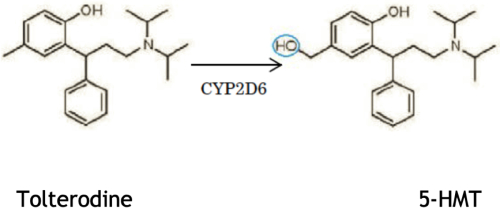
    Image 1marketed by UCB as Tovoaz® for treating urinary incontinence.  The positions noted by blue circles in the depiction of the chemical compound shown above are the sites where the chemical has been (the 2-position) or could be (the 5-position) derivatized to form a prodrug, defined as an inactive form of the drug that must metabolized after administration to a patient for the drug to have a biological effect.  The active compound, 5-hydroxymethyl tolterodine, is itself a metabolite of an older drug, tolterodine which is sold as Detrol® for anti-urinary incontinence effects:

    Image 2
    Fesoterodine, in contrast, differs from 5-HMT in having an isobutyryl ester in place of the hydroxyl group at the 2-position.  This modification raised the core issue regarding patentability before the PTAB and the Federal Circuit:  would it have been obvious to make this substitution to create an inactive prodrug requiring metabolic conversion to product the active 5-HMT in vivo?

    The Petitioner asserted two grounds of obviousness:  the first, over the combination of the Detrol® label; a scientific publication to Postlind et al. disclosing metabolism of tolterodine to 5-HMT; a treatise disclosing design of prodrugs (Bungaard); a PCT application naming Bungaard as an inventor (the '459 PCT): a separate scientific publication to Byrnne et al. further directed to metabolism of tolterodine to 5-HMT; and another scientific publication to Berge et al., disclosing preparation of pharmaceutical salts.  The second asserted obviousness ground combined Byrnne, Bungaard, '459 PCT, and another PCT application to Johansson (the '337 PCT).  The PTAB found that neither of these asserted combinations satisfied Petitioner's burden of showing the '650 patent claim were obvious, and Amerigen appealed.

    The Federal Circuit affirmed, in an opinion by Judge Lourie joined by Judges Chen and Stoll.  Before reaching the substantive patentability issues, the panel first addressed argument from UCB that Amerigen did not have standing to pursue the appeal.  This argument was based on a decision in ANDA litigation that Amerigen failed to show the '650 patent was invalid and thus the FDA would not approve Amerigen's ANDA for a generic version of Tovoaz® until the '650 patent expired.  As a consequence, according to UCB's argument, Amerigen could not be subject to infringement liability and thus could not suffer injury sufficient to support standing in the appeal.  Amerigen countered by noting that invalidation of the '650 patent by the Federal Circuit reversing the PTAB would "advance the launch of its product" and that the continued viability of the '650 patent created a concrete injury sufficient to confer standing under Article III.

    The opinion recites the canonical requirements for standing (an appellant must have "(1) suffered an injury in fact, (2) that is fairly traceable to the challenged conduct of the defendant, and (3) that is likely to be redressed by a favorable judicial decision," citing Spokeo, Inc. v. Robins, 136 S. Ct. 1540, 1547 (2016)) and held that Amerigen satisfied these requirements.  It was not disputed that launch of Amerigen's generic product was blocked by the continued vitality of the '650 patent and that a decision invalidating the patent (by the PTAB or the Court) would "advance [the] drug's launch."  The opinion explains that the '650 patent is listed in the FDA's "Orange Book" and that UCB would have the obligation of delisting this patent if the Court reversed the Board's decision in the IPR.  In that case, the predicate basis for Amerigen's Paragraph III certification would be lifted and Amerigen would be able to begin marketing its drug upon expiration of UCB's other listed patents; this will occur about three years before the expiration date of the '650 patent.  This constitutes a "concrete, economic interest" in Amerigen selling its tentatively approved drug (wherein all approval requirements except UCB's patent have been satisfied) according to the opinion.  The panel cited Apotex, Inc. v. Daiichi Sankyo, Inc., 781 F.3d 1356, 1359–61 (Fed. Cir. 2015), in support of its decision here, where the Court had held that listing of a patent in the Orange Book could create a controversy "of sufficient immediacy and reality" to satisfy Article III standing requirements.  The opinion did not credit UCB's argument that the issue was controlled by the Federal Circuit's decision in Janssen Pharmaceutica, N.V. v. Apotex, Inc., 540 F.3d 1353 (Fed. Cir. 2008), noting that the Janssen decision involved considerations relating to the Hatch-Waxman Act that were not shared by the IPR provisions of the America Invents Act (which provided much more broadly for parties to challenge granted U.S. patents).

    Turning to the substantive grounds of the PTAB's decision that Amerigen did not satisfy its burden of showing the challenged claims of the '650 patent were obviousness, the Federal Circuit parsed these references into three general categories:  first (the Detrol Label, Postlind, and Brynne), those references related to tolterodine, its metabolism, and pharmacokinetics; second (Bundgaard and the '459 PCT), references related to designing prodrugs; and third (Berge and the '337 PCT), related to pharmaceutical salts.  The first set of references, according to the Federal Circuit, taught that there was a subset of the patient populations that were poor metabolizers and that did not effectively activate tolterodine to 5-HMT, but that this distinction did not particularly reduce the efficacy of the drug.  The second set, in discussing generally prodrugs and their production, discussed the use of esters to as "common prodrug substituents."  Finally, the third set of references discussed pharmaceutical salts and particularly fumarate salts like fesoterodine.  The panel noted that the PTAB found that one having ordinary skill in the art would have chosen 5-HMT as a lead compound for further development.  But based on expert testimony the Board found that the skilled worker would not have modified 5-HMT by esterifying the 2-position hydroxyl group with isobutyrate.  This decision was based on disagreement between the parties (and their experts) regarding whether 5-HMT was not sufficiently lipophilic and thus would have decreased bioavailability.  One basis upon which the PTAB credited Patent Owner UCB's expert over Amerigen's expert on this issue was that UCB's expert applied the "Rule of 5" found in a prior art reference directing that a skilled worker assess bioavailability under these criteria:

    If:
    (1) there are more than 5 hydrogen-bond donors;
    (2) there are more than 10 hydrogen-bond acceptors;
    (3) the molecular weight is greater than 500; and
    (4) the calculated log P is greater than 5

    then a compound can be expected to have a "bioavailability problem."  5-HMT did not evince expected reduced bioavailability using the Rule of 5, and thus the PTAB credited UCB's expert's testimony on this issue (which Amerigen's expert did not rebut).

    Having made this determination, the Board held that a skilled person would not have esterified the 2-position of 5-HMT to solve a bioavailability problem that she would not recognize existed in the prior art.  In addition, Petitioner had not produced evidence that 5-HMT esterified at the 2-position would be inactive (i.e., actually be a prodrug).  The Board also found that even if a skilled worker would have been motivated to modify 5-HMT, expert testimony supported a conclusion that producing such a prodrug would not have been "a matter of routine optimization," at least in part due to the "many possible molecular modifications of 5-HMT consistent with a prodrug design."  While there were a number of possible embodiments of esterified 5-HMT (including esterifying the hydroxyl group at the 5-position), even if the universe of esters were limited to alkyl esters of six carbons or fewer at the 2-position there would be 86 possible compounds and testing each one would not have been routine.

    In affirming the PTAB's decision the Federal Circuit noted its limited basis for review regarding the Board's factual determinations under In re Gartside, 203 F.3d 1305, 1316 (Fed. Cir. 2000).  Almost the entirety of the panel's decision focused on the substantial evidence relied upon by the Board in making its nonobviousness determination, culminating in the statement that "[i]t was Amerigen's burden to show that the 'prior art would have suggested making the specific molecular modifications necessary to achieve the claimed invention,'" citing Takeda Chem. Indus., Ltd. v. Alapharm Pty., Ltd., 492 F.3d 1350, 1356 (Fed. Cir. 2007) (emphasis added) (quoting In re Deuel, 51 F.3d 1552, 1558 (Fed. Cir. 1995)).  Under the facts before the Court, there was no basis for reversing the PTAB's decision and the panel declined to do so.

    Amerigen Pharmaceuticals Ltd. v. UCB Pharma GmbH (Fed. Cir. 2019)
    Panel: Circuit Judges Lourie, Chen, and Stoll
    Opinion by Circuit Judge Lourie

  • By Michael Borella

    USPTO SealOn January 7, 2019, the U.S. Patent and Trademark Office published updated examination guidance, instructing the examining corps and the PTAB how they should apply 35 U.S.C. § 101.  On the same day, the USPTO also published the latest in its series of examples of how this application of the § 101 inquiry should be carried out.  This latest set, encompassing Examples 37-42, apply the updated guidance (Examples 1-36 were previously published over the last four years and apply previous versions of the guidance).  Our analyses of Examples 37, 38, and 39 were recently posted.

    The USPTO emphasizes that these examples are "hypothetical and only intended to be illustrative of the claim analysis" under the updated guidance.  Furthermore, the examples "should be interpreted based on the fact patterns set forth below as other fact patterns may have different eligibility outcomes."  In other words, even if an applicant's claim recites similar language and functionality as that of one of the examples, that does not mean the applicant's claim is patent-eligible.

    The updated guidance modified only part of the § 101 analysis (step 2A in the USPTO's parlance).  As set forth in Alice Corp. v. CLS Bank Int'l, this step involves determining whether a claim is directed to a judicial exception, such as an abstract idea.  If not, then no § 101 rejection can be made.

    The updated guidance breaks step 2A into a pair of sub-steps:

    • In sub-step 2A(i), one is to determine whether the claim recites a judicial exception, such as an abstract idea. Abstract ideas are now limited to three categories: mathematical concepts, certain methods of organizing human activity, and mental processes.  If there is no exception recited, the claim is eligible.

    • If the claim recites such an exception, then in sub-step 2A(ii) one is to determine further "whether the recited judicial exception is integrated into a practical application of that exception."  If so, the claim is eligible.

    If the claim fails to establish its eligibility in step 2A, the second part of the § 101 analysis (step 2B) is applied to determine whether any element or combination of elements in the claim is sufficient to ensure that the claim amounts to significantly more than the judicial exception.  If this is the case, the claim is patent-eligible under § 101.  If not, it can be rejected.

    Background

    Example 40 relates to adaptive monitoring of network traffic.  The background provided by the USPTO is as follows (abbreviated to focus on key aspects):

    In a typical setup, a NetFlow exporter generates and exports network traffic statistics (in the form of NetFlow records) to at least one NetFlow collector that analyzes the statistics.  Because NetFlow records are very large, the continual generation and export of NetFlow records in such a setup substantially increases the traffic volume on the network, which hinders network performance.  Moreover, continual analysis of the network is not always necessary when the network is performing under normal conditions.

    Applicant's invention addresses this issue by varying the amount of network data collected based on monitored events in the network.  That is, the system will only collect NetFlow protocol data and export a NetFlow record when abnormal network conditions are detected.  In practice, during normal network conditions, a network appliance collects network data [which] could include network delay, packet loss, or jitter.  Periodically, the network data is compared to a predefined quality threshold.  If this network data is greater than the predefined quality threshold, an abnormal condition is detected.  When an abnormal condition is present, the system begins collecting NetFlow protocol data, which can later be used for analyzing the abnormal condition.

    Claim 1

    Claim 1 of Example 40 recites:

    A method for adaptive monitoring of traffic data through a network appliance connected between computing devices in a network, the method comprising:
        collecting, by the network appliance, traffic data relating to the network traffic passing through the network appliance, the traffic data comprising at least one of network delay, packet loss, or jitter;
        comparing, by the network appliance, at least one of the collected traffic data to a predefined threshold; and
        collecting additional traffic data relating to the network traffic when the collected traffic data is greater than the predefined threshold, the additional traffic data comprising Netflow protocol data.

    Applying the first sub-step of 2A, the USPTO states that this claim recites a mental process.  Particularly, "the limitation of comparing at least one of the collected traffic data to a predefined threshold . . . as drafted, is a process that, under its broadest reasonable interpretation, covers performance of the limitation in the mind but for the recitation of generic computer components" and "[t]he mere nominal recitation of a generic network appliance does not take the claim limitation out of the mental processes grouping."

    Moving on to the second sub-step of 2A, the USPTO finds that the additional elements integrate this mental process into a practical application thereof.  The USPTO writes "[a]lthough each of the collecting steps analyzed individually may be viewed as mere pre- or post-solution activity, the claim as a whole is directed to a particular improvement in collecting traffic data."  That is, collection of additional Netflow data occurs only when there is an abnormal condition.  This "avoids excess traffic volume on the network and hindrance of network performance" and therefore "provides a specific improvement over prior systems."

    Accordingly, claim 1 is not directed to an abstract idea, which renders it patent-eligible under step 2A.  No step 2B analysis need take place.

    Claim 2

    Claim 2 of Example 40 recites:

    A method for monitoring of traffic data through a network appliance connected between computing devices in a network, the method comprising:
        collecting, by the network appliance, traffic data relating to the network traffic passing through the network appliance, the traffic data comprising at least one of network delay, packet loss, or jitter; and
        comparing, by the network appliance, at least one of the collected traffic data to a predefined threshold.

    Thus, claim 2 is essentially the same as claim 1, but omits the collecting of additional traffic data.

    Applying the first sub-step of 2A, the USPTO states that claim 2 recites a mental process, largely on the same grounds as stated above for claim 1 — that the comparing step can be performed in one's mind but for the recitation of a generic network appliance.

    But when the inquiry moves to the second sub-step of 2A, the USPTO takes the position that this claim fails to integrate the mental process into a practical application.  Particularly, the USPTO finds that the collecting step is recited at a high level of generality, and "amounts to mere data gathering, which is a form of insignificant extra-solution activity."  The USPTO further indicates that "[t]he combination of these additional elements is no more than mere instructions to apply the exception using a generic computer component (the network appliance)."  Thus, the claim fails the second sub-step of 2A.

    Applying step 2B, the USPTO rapidly dismisses the additional elements as well-understood, routine, and conventional.  The USPTO notes that "a conclusion that an additional element is insignificant extra-solution activity in Step 2A should be re-evaluated in Step 2B."  Based on the background of the example, the network appliance is a generic computer component.  Therefore, even under Berkheimer v. HP, the additional elements do not provide significantly more than the abstract idea, and the claim is ineligible.

    Analysis

    Not unlike Example 37, Example 40 stands for the counter-intuitive position that a mental process is not a mental process.  A claim that, as recited, cannot be wholly carried out in the mind can still fall under that category.  This can potentially lead to interesting application of the USPTO's test, because it allows consideration of the conventionality of certain devices under the first sub-step of 2A but not the second sub-step.  Put another way, what is stopping an examiner from declaring all hardware in a claim generic and then concluding that a claim is reciting a mental process?

    The USPTO also seems to be using the second sub-step as a way of carrying out the analysis of step 2B without consideration of whether elements are well-understood, routine, or conventional.  In this example and others, claims are found eligible under the second sub-step because they recite an improvement to a technology.  The same consideration would be applied under step 2B, though well-understood, routine, or conventional elements can be discounted unless the combination thereof leads to the improvement.

    This renders the USPTO's test somewhat out of synch with that of the courts.  For instance, the eligible claims from Diamond v. Diehr would be found as such under step 2B by a court's Alice analysis, but could be found eligible under step 2A by the USPTO.  The same could be said about the eligible claims of DDR Holdings v. Hotels.com and BASCOM v. AT&T Mobility.

    Thus, it would have been nice for the USPTO to provide a detailed example of a claim that would fail the second sub-step of 2A but pass step 2B.  While the updated guidance contemplates such a possibility, Examples 37-42 do not include such a claim.

  • CalendarJanuary 22, 2019 – "Biologics and Biosimilars: FDA Initiatives and Guidance, Approvals and Exclusivity, Patent Prosecution, Litigation" (Strafford) – 1:00 to 2:30 pm (EST)

    January 22, 2019 – European patent prosecution & litigation webinars with focus on UK, Germany, and EPO & CJEU (D Young & Co) – 1:00 pm, 2:30 pm, and 3:30 pm (GMT)

    January 23, 2019 – "Section 101: Revised USPTO Guidance on Patent Eligibility" (Intellectual Property Owners Association) – 2:00 to 3:00 pm (ET)

    January 24, 2019 – "Drafting and Defending Software Patents: Meeting Sections 102, 103 and 112 Requirements" (Strafford) – 1:00 to 2:30 pm (EST)

  • IPO #2The Intellectual Property Owners Association (IPO) will offer a one-hour webinar entitled "Section 101: Revised USPTO Guidance on Patent Eligibility" on January 23, 2019 from 2:00 to 3:00 pm (ET).  Robert Bahr, Deputy Commissioner for Patent Examination Policy, U.S. Patent and Trademark Office; Gary Ganzi of Evoqua Water Technologies; and Michelle Holoubek of Sterne, Kessler, Goldstein & Fox, PLLC will analyze the USPTO's revised guidance on patent eligibility that was issued earlier this month — and discuss how the Office is expected apply the U.S. Supreme Court's Alice/Mayo test for subject matter eligibility going forward.  the panel will explore:

    • What some see as remaining ambiguities in the guidance, such as the determination of what constitutes a "practical application"
    • Arguments that could be made to examiners based on the new guidance
    • How to best make a request to file supplemental briefing to show how claims are compliant with the new guidance
    • The challenges the USPTO faces in interpreting Federal Circuit case law on this topic

    The registration fee for the webinar is $135 (government and academic rates are available upon request).  Those interested in registering for the webinar can do so here.

  • By Joseph Herndon

    Federal Circuit SealThe Federal Circuit recently issued a decision further clarifying the Patent Trial and Appeal Board's (PTAB) ability to invalidate claims on reconsideration even when the claims were not addressed in the final written decision.  In the analysis below, we review only the procedural question of the PTAB's ability to address claims on reconsideration.

    In this case, the PTAB issued a final written decision ruling certain claims of AC Technologies S.A.'s U.S. Patent No. 7,904,680 unpatentable.  Then, on reconsideration, the PTAB invalidated the remaining claims based on a ground of unpatentability raised by Amazon.com, Inc. and Blizzard Entertainment, Inc. (collectively, "Amazon") in their petition but not addressed in the final written decision.

    AC appealed to the Federal Circuit, arguing that the Board exceeded its authority and deprived it of fair process by belatedly considering this ground.

    As analyzed below, the Federal Circuit disagreed with AC, and found that precedent mandates that the Board consider all grounds of unpatentability raised in an instituted petition.

    The IPR

    Amazon challenged the '680 patent in an IPR.  It based its unpatentability arguments on a single prior art reference:  "Dynamic Replication on the Internet," by Dr. Michael Rabinovich.  Amazon's petition for IPR presented three grounds.

    • Ground 1: Amazon argued that if "computer unit" in the claims were construed narrowly and mapped to Rabinovich's client, Rabinovich rendered all claims of the '680 patent obvious.

    • Ground 2 and Ground 3: Amazon argued that if "computer unit" were instead construed broadly and mapped to Rabinovich's host, it anticipated some claims (Ground 2) and rendered remaining claims 2, 4, and 6 obvious (Ground 3).

    At institution, the Board adopted the broad construction of "computer unit" and then instituted review of Grounds 1 and 2.

    With respect to Ground 3, the Board stated that it had "addressed Petitioner's contentions in our analysis above of Ground 1 and determined that Petitioner has established a reasonable likelihood of showing that claims 2, 4, and 6 are unpatentable as obvious over Rabinovich under our construction of 'computer unit.'  As a result, this ground is moot."

    The Board concluded by instituting review of whether all claims of the '680 patent would have been obvious over Rabinovich and whether some claims were anticipated by Rabinovich.

    The IPR then proceeded.  In its final written decision, the Board found that Rabinovich anticipated every claim except claims 2, 4, and 6.  The Board's final decision did not address whether claims 2, 4, and 6 would have been obvious if the host in Rabinovich were treated as the "computer unit," as Amazon had asserted in Ground 3.

    Pointing to that omission, Amazon promptly moved for reconsideration.  Despite AC's protest that Ground 3 had never been part of the IPR, the Board determined that it should reach the challenge.  With the Board's permission, both parties submitted additional arguments, expert declarations, and supporting exhibits.  AC urged that under the Board's claim constructions, the claims permitted only ad hoc wireless networks, with which Rabinovich would have been incompatible.  But the Board determined that nothing in the claims or the specification limited the claimed wireless network to a particular type of network, and it held that Amazon had proven claims 2, 4, and 6 unpatentable.

    Appeal

    On Appeal to the Federal Circuit, AC argued that the Board erred procedurally when it invalidated claims 2, 4, and 6 based on a ground that it did not institute in its institution decision.  AC claims that in doing so, the Board exceeded its statutory authority and fell short of the requirements of due process.

    However, the Supreme Court recently clarified that institution is "a binary choice—either institute review or don't" in SAS Inst. Inc. v. Iancu, 138 S. Ct. 1348, 1355 (2018).  If the Board institutes an IPR, it must issue a final written decision addressing all claims challenged by the petitioner.

    Further, the Federal Circuit has since held that if the Board institutes an IPR, it must similarly address all grounds of unpatentability raised by the petitioner.  See Adidas AG v. Nike, Inc., 894 F.3d 1256, 1258 (Fed. Cir. 2018).

    This precedent was found to foreclose AC's argument that the Board exceeded its statutory authority when it reconsidered its final written decision and addressed non-instituted Ground 3.  Indeed, it would have violated the statutory scheme had the Board not done so.

    The Federal Circuit also recognized that SAS did not displace the Board's responsibility to comply with due process, and that due process dictates that parties before the Board must receive adequate notice of the issues the Board will decide as well as an opportunity to be heard on those issues.

    The Federal Circuit found no due process violation occurred here.  As AC admits, after the Board decided to accept Amazon's rehearing request and consider Ground 3, it permitted AC to take discovery and submit additional briefing and evidence on that ground.  Though AC did not receive a hearing specific to Ground 3, it never requested one.  Had AC desired a hearing, it should have made a request before the Board.  Other cases follow this guideline, such as finding no due process violation where a party had notice and an opportunity to be heard and failed to request surreply or rehearing to address the issue.  See, e.g., Intellectual Ventures II LLC v. Ericsson Inc., 686 F. App'x 900, 905–06 (Fed. Cir. 2017).

    The Federal Circuit also reviewed AC's challenge specific to the unpatentability of the claims (not addressed in this analysis here), and found the Board's decision to be based on substantial evidence.  Thus, the Federal Circuit affirmed the Board's decision.

    AC Technologies S.A. v. Amazon.com, Inc. (Fed. Cir. 2019)
    Panel:  Circuit Judges Moore, Schall, and Stoll
    Opinion by Circuit Judge Stoll