• The following article was reprinted with permission from Sargent & Krahn.

    ChileRecently, the Chilean Government submitted to Congress a Law Bill modifying the Industrial Property Law, the National Institute of Industrial Property Law as well as minor modifications to the Criminal Procedure Law.

    The Proposed Bill intends to update the corresponding legislation of trademarks, patents, industrial designs and drawings, trade secrets, geographical indications and appellations of origin, among other matters.

    The Bill is currently before Congress and it is expected to be approved in a relatively expedient manner.

    EXECUTIVE SUMMARY

    The most relevant amendments and changes proposed by this Bill are the following:

    1.  Trademarks:
    Non-use and genericide trademark cancelation action.
    Three dimensional and scent trademarks will be allowed.
    Limitation to the rights conferred to trademark holders when said trademarks are names, pseudonyms or geographical locations.
    Commercial and industrial establishment trademarks will now be registered in classes 35 and 40 respectively.
    Graphic representation of trademarks will not be required for registration.
    Set of comprehensive regulation of collective and certification trademarks.
    Enhances the description of trademark counterfeit.

    2.  Patents:
    • Allows for provisional patent applications.
    New exceptions to patent holder's exclusive rights.
    Patent ownership action.
    Modifications to Term Adjustment and Term Extensions.

    3.  Others:
    Trade secret definition now mirrors that of the TRIPS agreement.
    Allows for the National Institute of Industrial Property (INAPI) to become a party in proceedings before higher Courts.
    Industrial design and drawing deposit system as well as extending their validity term.
    Modifies regulation for geographical indications and appellations of origin.

    I.  TRADEMARKS

        1.  Non-use and genericide cancelation actions:

    If the Bill is approved as proposed then trademarks in Chile will be subject to non-use cancelation actions for the first time.  The grounds for this action will be if the trademark has not been used in a real and effective manner within the national territory within five years of the registration date or if the use was suspended for 5 years.  The transition rule establishes that for trademarks registered prior to the enactment of the law; the use requirement will start upon its renewal.

    Additionally, the Bill establishes the cancelation of a trademark if the holder has provoked or allowed for said trademark to become the usual designation of the product or service it distinguishes (genericide).  The trademark holder can prevent this from occurring by using the corresponding indications that it is a registered trademark on the products or services.

    These cancelations do not operate ex officio and must be filed by a third party.  Also, a third party will be able to a file non-use cancelation action when filing a defense writ against a third party opposition.

        2.  Three dimensional trademarks and scent trademarks:

    The Bill allows for three dimensional and scent trademarks.

        3.  Limitation to the rights conferred to trademark holders:

    Trademark holders cannot exclude a person from using their name or pseudonym or that of their predecessors in commerce, unless said name, pseudonym or that of their predecessor induces consumers into error or confusion.

    The Bill also establishes that trademarks that include geographical names or expressions related to the genre, nature, origin, nationality, weight, quality, value, or other descriptive expressions cannot prevent the use of said expressions when they are used to identify or inform consumers precisely about said genre, nature, origin, nationality, weight, quality, value, etc, unless they induce consumers into error or confusion.

        4.  Commercial and industrial establishment trademarks will now be registered in classes 35 and 40 respectively:

    The Bill establishes amendments that eliminate the Chilean categories of trademarks to distinguish commercial and industrial establishments.  Current trademarks that distinguish commercial establishments will have to be renewed in class 35 while trademarks that distinguish industrial establishments will have to be renewed in class 40.  This will simplify the registration and will reduce the official fees that currently apply for the registration and renewal of the referred trademarks.

        5.  Graphic representation of trademarks will not be required for registration:

    In line with the TRIPS agreement the Bill eliminates the requirement of graphic representation for registration and states that trademarks that cannot be represented in the registration must allow the authorities and the public to clearly and precisely determine the protection granted to the holders.

        6.  Set of comprehensive regulation of Collective and Certification trademarks:

    The current regulation for these trademarks has proven to be deficient and the Bill thus introduces a new definition of certification trademarks and that the holders of said trademarks must authorize its use to anybody whose products or services comply with the conditions set out in the certifications trademarks by-laws.  Additionally, the Bill clarifies its authority to object the By-Laws of collective and certifications trademarks.

        7.  Enhances the description of trademark counterfeit:

    The Bill establishes sanctions against trademark counterfeits (they were previously regulated in the criminal code in a somewhat erratic manner), elevating the monetary fines in comparison with normal criminal trademark infringement cases as well as not requiring that the infringer act with "willful intent".  Additionally, in the case that a trademark counterfeit is proven, the plaintiff will have the option to request a lump sum of damages to be determined by the judge and that cannot be higher than around 140.000 USD.

    II.  PATENTS

        1.  Provisional patent application:

    The Bill will allow for the possibility of filing a provisional patent application without complying with the filing of all the required documents before INAPI.  The provisional application does have to pay the corresponding government filing fees and will be in place for 12 months, at which time the applicant must file all the corresponding documents (claims, specifications, drawings, technical sheet).  The provisional patent will have to include a written document in Spanish or English that describes the invention in a clear and complete manner in such a way that it allows for an expert to reproduce the invention.  The priority date of the final application will be the date of the provisional application.

        2.  Reduction of the deadline to request the reinstatement of a patent application:

    The Bill reduces the deadline to request a reinstatement of a patent application from 120 working days to 60 working days.

        3.  New exceptions to patent exclusivity rights: The Bill establish five new exceptions to a patents exclusivity rights and they are the following:

    • Private and non-commercial acts.
    • Research exception.
    • Preparation of medicines under medical prescription for individual cases.
    • The use, on board of ships of other countries, of means constituting the object of the patent in the hull of the ship, in the machines, rigs, apparatus and other accessories, when said ships temporarily or accidentally enter the waters of Chilean territory, with the reservation that said means are used exclusively for the needs of the ship.
    • The use of means constituting the subject matter of the patent in the construction or operation of air or land locomotion apparatus of other countries or of accessories to such apparatus, when these temporarily or accidentally enter Chilean territory.

        4.  Ownership action:

    The Bill allows for the legitimate inventor to request the assignment of a patent and the corresponding damages from the non-legitimate patent holder.  This action has to be filed within five years from the registration date and will follow the procedural rules of a summary trial before a civil judge.  This amendment solves a current problem in Chile which is that the legitimate inventor only has the ability to file a cancelation action (and thus eventually end up canceling the corresponding patent).

        5.  Modifications to Term Adjustment and Term Extensions:

    The Bill reduces the deadline to file for a term adjustment and a term extension request from 6 months to sixty working days.  Additionally, the Bill establishes a 5 year cap on the amount of time that can be adjusted or extended by the Industrial Property Court.  The Bill also defines that when the Examiner accepts the appointment is when the examination is requested in order to trigger the option to request a term adjustment after only three years of prosecution from said date.

        6.  Inventions in service:

    The Bill establishes that inventions in service cases will be of the competence of ordinary justice courts and the summary procedure will be applied.

        7.  Prior filing date and raise in government fees:

    The Bill will allow to file a patent application even if the corresponding government fees have not been paid.  The applicant will have to proceed with this payment within 30 days or the application will be declared abandoned.

    Additionally, the Bill establishes that if a patent application dossier exceeds 50 pages, the corresponding government fee will be raised by approximately 100 USD for every additional 20 pages.

    The Bill also allows that the applicant of a patent, industrial design, utility model, choose the government fee payment deadline for the second half of the corresponding privilege, permitting the payment on an annual basis after the first 5 or 10 year fractions have lapsed.

    III.  INDUSTRIAL DESIGNS AND DRAWINGS

        1.  Deposit System and abbreviated procedures:

    This amendment resembles the European Design system and allows for the applicant of an industrial design or drawing to request an abbreviated deposit procedure for the application.  This procedure eliminates the Substantive Examination Reports, but the holder will have to request said Report if he wants to file criminal infringement actions.

        2.  Extension of the validity term of industrial designs and drawings:

    The Bill extends the duration of the validity term of industrial designs and drawings to 15 years (currently 10 years).

    IV.  TRADE SECRETS

        1.  Trade secret definition now mirrors that of the TRIPS agreement:

    The Bill establishes amendments to the current definition of a trade secret and expands the concept thus bringing it in line with the definition of the TRIPS agreements

    V.  GEOGRAPHICAL INDICATIONS AND APPELATIONS OF ORIGIN

        1.  Definitions:

    The Bill modifies the definition of geographical indications as well as that of appellations of origin.  In the case of geographical indications, it allows for this recognition to exist if at least one of the stages of protection or manufacture of the product is executed in the corresponding country, region or locality.  In the case of the appellations of origin, it allows for the recognition to be granted if some of the raw materials come from other geographical territories complying with certain specific additional requirements.

        2.  New non-registration grounds:

    Three new non-registration grounds for geographical indications and appellations of origin are included, and they are:

    • Graphic, phonetic and conceptual similarities that may cause consumer confusion with a previously applied for or registered distinctive sign.
    Graphic, phonetic or conceptual similarities that can cause confusion with a non-registered distinctive sign that is being used in a real and effective manner within the national territory for the same or related goods.
    • That constitute the complete or partial reproduction, imitation, or translation of a trademark, appellation of origin, or geographical indication that is well known in Chile in the corresponding consuming public, as long as said use will cause consumer confusion.

        3.  Cancelation action:

    The Bill allows for a cancelation action to be filed when the product is no longer manufactured in the protected zone or when the product no longer complies with the conditions that allowed for its recognition. There is no statute of limitation for these actions.

    VI.  OTHERS

        1.  Manner of serving resolutions by INAPI to the parties:

    The Bill introduces modifications regarding the manner in which certain resolutions of INAPI are served to the interested parties.  For example, oppositions will be served to the applicant in an electronic manner (as well as office actions if there was an opposition).

        2.  Modification of the deadline to pay government rights and renewals:

    The Bill introduces an amendment that the government fees for the second half of the validity term can either be paid upfront in total or on an annual basis.  Additionally, the Bill establishes that the government fees for a trademark renewal must be paid together with the filing of the renewal request as well as allowing a trademark to be renewed within six months of the end of its validity term (currently 30 days).

        3.  INAPI becoming a party to procedures triggered by recourses filed against their decisions:

    INAPI will be able to become a party in recourses filed against their decisions, i.e., before the Industrial Property Court and eventually the Supreme Court.
  • By Donald Zuhn –-

    Federal Circuit SealLast June, the Supreme Court determined that $93.4 million in lost foreign profits awarded to WesternGeco L.L.C. for infringement under 35 U.S.C. § 271(f)(2) was a permissible domestic application of 35 U.S.C. § 284, and the Court therefore reversed the Federal Circuit's reversal of the award of lost profits damages and remanded the case (see "WesternGeco LLC v. ION Geophysical Corp. (2018)").  Earlier this month, the Federal Circuit decided, given the intervening invalidation of four of the five asserted patent claims by the U.S. Patent and Trademark Office's Patent Trial and Appeal Board, to remand the case back to the District Court for further proceedings on the lost profits award.

    The dispute between the parties began when WesternGeco filed suit against ION Geophysical Corp. for infringement of claims 18, 19, and 23 of U.S. Patent No. 7,293,520; claim 15 of U.S. Patent No. 7,162,967; claim 15 of U.S. Patent No. 7,080,607; and claim 14 of U.S. Patent No. 6,691,038.  The patents relate to marine seismic surveys for discovering oil and gas deposits beneath the ocean floor.  Both WesternGeco and ION manufacture devices for steering streamers in marine seismic surveys; WesternGeco does not sell its device, but uses it to perform surveys abroad, and ION does not perform surveys, but sells its device to customers who perform surveys abroad.  At trial, ION was found to have infringed the asserted claims under 35 U.S.C. §§ 271(f)(1) and (2), and WesternGeco was awarded a reasonable royalty of $12.5 million and lost profits of $93.4 million.  The lost profits damages were based on the loss of ten surveys abroad, which WesternGeco argued it would have won but for ION's sales to WesternGeco's competitors.

    On appeal, the Federal Circuit reversed the lost profits award as being based on an unauthorized extraterritorial application of the patent laws.  WesternGeco petitioned for certiorari, which the Supreme Court granted, and the Court vacated the Federal Circuit's decision and remanded for further proceedings consistent with the Supreme Court's decision in Halo Elecs., Inc. v. Pulse Elecs., Inc., 136 S. Ct. 1923 (2016).  On remand, the Federal Circuit again reversed the lost profits award, vacated the District Court's denial of enhanced damages, and remanded to the District Court for further consideration in light of Halo.  On remand, the District Court awarded WesternGeco $5 million in enhanced damages.  The parties then stipulated to the reasonable royalty amount, which ION paid, and agreed not to appeal the enhanced damages award, but did not stipulate to the lost profits award.  WesternGeco again petitioned for certiorari, requesting review of the Federal Circuit's decision on lost profits.  The Supreme Court again granted the petition, reversed the Federal Circuit's decision on lost profits, and remanded the case back to the Federal Circuit.

    In a parallel proceeding before the PTAB, the Board determined that four of the six asserted patent claims (i.e., all but claim 23 of the '520 patent and claim 14 of the '038 patent) we unpatentable.  While the case above was pending in the Supreme Court, the Federal Circuit separately affirmed the PTAB's decision.  Of the two remaining claims, it is uncontested that only claim 23 of the '520 patent can support WesternGeco's lost profits award.

    On remand from the Supreme Court again, ION challenged the fully paid and satisfied reasonable royalty award as well as the lost profits award based on the PTAB's subsequent invalidation of four of the six asserted patent claims.  With respect to the reasonable royalty award, ION argued that the calculation of the reasonable royalty would be affected by the invalidation of claims and sought a new trial, citing Fresenius USA, Inc. v. Baxter International, Inc., 721 F.3d 1330 (Fed. Cir. 2013), as holding that a judgment cannot be final for purposes of intervening patent invalidations if any part of the litigation remains pending, and that the lost profits award was still being litigated.  In rejecting ION's challenge to the reasonable royalty award, the Federal Circuit disagreed with ION's interpretation of Fresenius, noting instead that "Fresenius made clear that it does not allow reopening of a satisfied and unappealable final judgment."  In particular, the Federal Circuit pointed out that "ION and WesternGeco entered into a compromise agreement resolving all of the issues in the case except for the lost profits award," and that "ION cannot now reopen the agreed and fully paid unappealable final judgment on the reasonable royalty based on the subsequent invalidation of a subset of asserted patent claims."

    With respect to the lost profits award, ION first argued that the District Court erred when it denied ION's renewed motion for judgment as a matter of law on the theory that WesternGeco was not entitled to lost profits because ION and WesternGeco are not "direct competitors" (since ION only sells devices and WesternGeco only sells surveys).  The Federal Circuit, however, was not persuaded by ION's argument, noting that "WesternGeco's and ION's devices competed by performing the same types of functions for surveys," and that "there was sufficient evidence in the record for the jury to conclude that the products did compete."

    ION also argued that the lost profits award could not be sustained because of the intervening invalidation of four of the five asserted claims supporting the award.  The Federal Circuit noted that the jury found all of the asserted claims to be infringed and made a single lost profits award, but that the jury instructions and verdict form did not instruct the jury to award damages based separately on infringement of each of the asserted claims.  The Federal Circuit also noted that WesternGeco did not cite to any specific testimony that infringement of claim 23 of the '520 patent was necessary to perform the ten surveys that WesternGeco had contended it lost.  The Federal Circuit indicated that to sustain the lost profits award, the record must establish that there was no dispute that the technology covered by claim 23 of the '520 patent, independent of the technology covered by the invalidated claims, was required to perform the surveys at issue.  Pointing out that the District Court was in a better position to consider the issue in the first instance, the Federal Circuit remanded to the District Court to determine whether a new trial on lost profit damages is required, stating that "[t]he district court may deny a new trial on lost profits if, but only if, it concludes that WesternGeco established at trial with undisputed evidence that '520 patent claim 23 covers technology necessary to perform the surveys upon which the lost profits award is based."

    The Federal Circuit concluded by reinstating sections I, II, and IV of its decision in WesternGeco I and sections I and II of its decision in WesternGeco II, determining that those sections were not affected by either the initial vacatur and remand from the Supreme Court or the Supreme Court's subsequent decision in WesternGeco III, and affirming-in-part, vacating-in-part, and remanding.

    WesternGeco L.L.C. v. ION Geophysical Corp. (Fed. Cir. 2019)
    Panel: Circuit Judges Dyk, Wallach, and Hughes
    Opinion by Circuit Judge Dyk

  • By Kevin E. Noonan

    Federal Circuit SealElevation to Chief Judge in a U.S. Court of Appeals, particularly in the Federal Circuit, is frequently accompanied by an apparent mandate to place an imprimatur on the Court's decisions.  This pattern has been shown consistently in this appellate court, from Chief Judge Markey through Chief Judges Michel and Rader.  Now it is Chief Judge Prost's turn, as illustrated by her decision in Amgen v. Sanofi, overturning application of the written description precedent of Noelle v. Ledermann as being inconsistent with the Court's en banc opinion in Ariad v. Eli Lilly & Co. This week she did not prevail in convincing her brethren of the correctness of her opinion and thus provided a dissent, in Barry v. Medtronic, Inc., relating to the application of the public use and on-sale bars to patentability and its relationship to the experimental use exception to applying these bars.

    The case arose in patent infringement litigation by Dr. Mark Barry, a sole inventor, for infringement by Medtronic of his invention as claimed in U.S. Patent Nos. 7,760,358 and 8,361,121.  The invention was directed to a device and method for correcting spinal column deviation conditions; claims 4 and 5 of the '358 patent asserted in the litigation depend from independent claim 1:

    1.  A method for aligning vertebrae in the amelioration of aberrant spinal column deviation conditions comprising the steps of:
        selecting a first set of pedicle screws, said pedicle screws each having a threaded shank segment and a head segment;
        selecting a first pedicle screw cluster derotation tool, said first pedicle screw cluster derotation tool having first handle means and a first group of pedicle screw engagement members which are mechanically linked with said first handle means, each pedicle screw engagement member being configured for engaging with, and transmitting manipulative forces applied to said first handle means to said head segment of each pedicle screw of said first set of pedicle screws,
        implanting each pedicle screw in a pedicle region of each of a first group of multiple vertebrae of a spinal column which exhibits an aberrant spinal column deviation condition;
        engaging each pedicle screw engagement member respectively with said head segment of each pedicle screw of said first set of pedicle screws; and
        applying manipulative force to said first handle means in a manner for simultaneously engaging said first group of pedicle screw engagement members and first set of pedicle screws and thereby in a single motion simultaneously rotating said vertebrae of said first group of multiple vertebrae in which said pedicle screws are implanted to achieve an amelioration of an aberrant spinal column deviation condition;
        selecting a first length of a spinal rod member; wherein one or more of said pedicle screws of said first set of pedicle screws each includes:
            a spinal rod conduit formed substantially transverse of the length of said pedicle screw and sized and shaped for receiving passage of said spinal rod member therethrough; and
            spinal rod engagement means for securing said pedicle screw and said spinal rod member, when extending through said spinal rod conduit, in a substantially fixed relative position and orientation;
        extending said first length of said spinal rod member through said spinal rod conduits of one or more of said pedicle screws of said first set of pedicle screws; and
        after applying said manipulative force to said first handle means, actuating said spinal rod engagement means to secure said vertebrae in their respective and relative positions and orientations as achieved through application of said manipulative force thereto.

    Further limitations add a step "requiring a second set of pedicle screws and a second derotation tool with a second group of engagement members and a second 'handle means'" (claim 2); and steps requiring a second handle rod (claim 3): steps for applying a "manipulative force" to the first and second handle means, carried out substantially simultaneously to cooperatively achieve an amelioration of an aberrant spinal column deviation condition" in claim 4, dependent on claim 3); and claim 5 dependent on claim 2.  Claims 2-4 of the '121 patent are directed to "systems":

    2.  A system for aligning vertebrae in the amelioration of aberrant spinal column deviation conditions comprising:
        a first set of pedicle screws, each pedicle screw having a threaded shank segment and a head segment; and
        a first pedicle screw cluster derotation tool, said first pedicle screw cluster derotation tool having a first handle means for facilitating simultaneous application of manipulative forces to said first set of pedicle screws and a first group of three or more pedicle screw engagement members which are mechanically linked with said first handle means, said first handle means having a handle linked to each pedicle screw engagement member of the first group of three or more pedicle screw engagement members and a linking member to join together the handles linked to the pedicle screw engagement members, wherein the handle means is configured to move simultaneously each pedicle screw engagement member; wherein each pedicle screw engagement member is configured to en- gage respectively with said head segment of each pedicle screw of said first set of pedicle screws; and wherein each pedicle screw engagement member is configured to transmit manipulative forces applied to said first handle means to said head segment of each pedicle screw of said first set of pedicle screws;
        a second set of pedicle screws, each pedicle screw having a threaded shank segment and a head segment;
        a second pedicle screw cluster derotation tool, said second pedicle screw cluster derotation tool having a second handle means for facilitating simultaneous application of manipulative forces to said second set of pedicle screws and a second group of three or more pedicle screw engagement members which are mechanically linked with said second handle means, said second handle means having a handle linked to each pedicle screw engagement member of the second group of three or more pedicle screw engagement members and a handle linking member to join together the handles linked to the pedicle screw engagement members, wherein the handle means is configured to move simultaneously each pedicle screw engagement member; wherein each pedicle screw engagement member is configured to engage respectively with said head segment of each pedicle screw of said second set of pedicle screws; and wherein each pedicle screw engagement member is configured to transmit manipulative forces applied to said second handle means to said head segment of each pedicle screw of said second set of pedicle screws;
        a cross-linking member that links the first handle means to the second handle means . . . .

    The cross-linking member element in the '121 patent was distinguished as an advance to the claims of the '358 patent.

    The history of the invention and how it was disclosed and ultimately protected by patent forms the predicate facts for the dispute on appeal.  Named inventor Barry, an orthopedic surgeon, began development of his invention while working with a sales representative for DePuy, a medical device company.  During this time he also discussed his ideas with a representative from another medical device company, SpineVision.  After developing the tool, Dr. Barry used it in three back surgeries performed over a three-month period on patients having "the three most common types of scoliosis-caused spinal deviation conditions that surgeons typically see."  After a three-month post-operative convalescence for the last of these patients, Dr. Barry prepared an abstract for presentation at a scientific meeting and within one year filed a patent application that eventually matured into the patents-in-suit.  These activities were thus within the one-year grace period applied under 35 U.S.C. § 102(b) prior to amendment of the Patent Act under the Leahy-Smith America Invents Act.

    Following introduction of an infringing product by Medtronic, Barry sued and a jury found in his favor and awarded $15,095,970 for infringement of the '358 patent and $2,625,210 for infringement of the '121 patent; each of these amounts was increased by 20% by the trial court.  The jury rejected Medtronic's defenses of public use, on-sale, and prior invention.  This appeal followed, involving Medtronic's defenses of invalidity under § 102(b) and § 102(g), inequitable conduct, induced infringement, and damages.

    The Federal Circuit affirmed, in a decision by Judge Taranto joined by Judge Moore; Chief Judge Prost provided a strong dissent (in part) regarding the public use and on-sale bar defenses.  On the public use defense, the majority first recited the standard, that the invention must have been in public use and "ready for patenting" more than one year before a patent's filing date.  The Court majority found that the invention was not "ready for patenting" based on Dr. Barry's testimony that he did not know that the claimed method and system had worked for their intended purpose until after the results of the third patient surgery could be evaluated three months after the surgery.  The panel majority also found that Dr. Barry's use, while not burdened by explicit confidentiality agreements with the patient or surgical staff and (on facts persuasive to Chief Judge Prost in dissent) fully paid for by the patient at Dr. Barry's "customary rates," was negated by the character of the use as experimental use, which "serve[d] as a negation of the statutory bars," citing Polara Eng'g Inc v. Campbell Co., 894 F.3d 1339, 1348 (Fed. Cir. 2018).  The majority affirmed in part based on the standard of review, wherein Judges Taranto and Moore found substantial evidence for the jury's finding that the claimed invention was not "ready for patenting" prior to the critical date.  Specifically, "there is substantial evidence that Dr. Barry's invention was not ready for patenting until January 2004 because the final follow-up from the October surgery was reasonably needed for the determination that the invention worked for its intended purpose," according to the panel majority.

    The majority held that Medtronic had not satisfied its burden of showing that the claimed invention had been reduced to practice, i.e., that he had "(1) constructed an embodiment or performed a process that met all the limitations and (2) determined that the invention would work for its intended purpose," citing In re Omeprazole Patent Litig., 536 F.3d 1361, 1373 (Fed. Cir. 2008).  Prong two of this test made evidence of satisfaction of prong one insufficient (including, inter alia, evidence of prior drawings of the invention disclosed by Dr. Barry to third parties).  Here, the panel majority held that the jury was reasonable in concluding that the invention had not been shown to "work for its intended purpose" until after completion and followup of surgeries on three patients "who fairly reflected the real-world range of application of the inventive method" (based on evidence and testimony from both plaintiff and defendant's witnesses).  And the panel further rejected any requirements in the claims for reciting the "intended purpose," based on conventional claim drafting standards ("one typical way of claiming is simply to define the physical steps of the process, or the physical elements of a product, without building functional or purpose language into the claim limitations at all," citing In re Schreiber, 128 F.3d 1473, 1478 (Fed. Cir. 1997)), as well as Supreme Court (Corona Cord Tire Co. v. Dovan Chemical Corp., 276 U.S. 358, 383 (1928)) and the Federal Circuit's own precedent (TP Laboratories, Inc. v. Professional Positioners, Inc., 724 F.2d 965 (Fed. Cir. 1984); Manville Sales Corp. v. Paramount Sys., Inc., 917 F.2d 544, 549 (Fed. Cir. 1990); Honeywell Int'l Inc. v. Universal Avionics Systems Corp., 488 F.3d 982 (Fed. Cir. 2007); Polara Eng'g Inc v. Campbell Co., 894 F.3d 1339, 1348 (Fed. Cir. 2018)).

    The panel majority also held that Medtronic had not established that the invention was in public use prior to the critical date, and in any event its use fell within the experimental use exception.  This conclusion was based on the following facts:  Dr. Barry was the only person to perform the surgeries, and thus had not "relinquished control of his invention" (Egbert v. Lippmann, 104 U.S. 333, 335 (1881)); the evidence showed that the people present in the operating theater did not have a clear view of the operation; and that these people were all bound by at least an implied duty of confidentiality.  Regarding commercial exploitation, while the panel majority acknowledged Dr. Barry's compensation, it rejected the conclusion that this amounted to commercial exploitation sufficient to amount to public use.  This conclusion was based on Dr. Barry's activities satisfying the standards for experimental use as set forth, inter alia, in Clock Spring, L.P. v. Wrapmaster, Inc., 560 F.3d 1317, 1327 (Fed. Cir. 2009):

    (1) the necessity for public testing, (2) the amount of control over the experiment retained by the inventor, (3) the nature of the invention, (4) the length of the test period, (5) whether payment was made, (6) whether there was a secrecy obligation, (7) whether records of the experiment were kept, (8) who conducted the experiment, (9) the degree of commercial exploitation during testing, (10) whether the invention reasonably requires evaluation under actual conditions of use, (11) whether testing was systematically performed, (12) whether the inventor continually monitored the invention during testing, and (13) the nature of contacts made with potential customers.

    Finally, the panel majority distinguished two earlier cases where experimental use was not found (Sinskey v. Pharmacia Ophthalmics, Inc., 982 F.2d 494 (Fed. Cir. 1992), and LaBounty Mfg., Inc. v. U.S. Int'l Trade Comm'n, 958 F.2d 1066, 1072 (Fed. Cir. 1992)) on their facts (including non-relinquishment of the invention and that other members of the surgical team were aware that the use was experimental).

    Turning to the on-sale bar, the panel majority held that their finding that Dr. Barry's use was an experimental use negated the on-sale bar as it had the public use bar, and applied its reasoning for the public use question to decide that the invention was not "ready for patenting" and thus did not satisfy the second prong of the test enunciated by the Supreme Court in Pfaff v. Wells Elecs., Inc., 525 U.S. 55, 67 (1998).  The panel majority upheld the jury's determination that the '358 and '121 patents were not invalid under § 102(b) on this basis (as well as rejecting Medtronic's' objection to jury instructions regarding what constituted "experimental use").

    Finally, the panel majority affirmed the jury's determination that the asserted claims were not invalid under § 102(g) because Medtronic failed to establish earlier invention by another, and affirmed the District Court's decision that Dr. Barry had not engaged in inequitable conduct (based on an erroneous description of a Figure in the common patent specifications) because there was no evidence of an intent to deceive.  And the majority found "substantial evidence" that Medtronic induced infringement of the surgeons using its infringing systems and methods.

    Chief Judge Prost's dissent was predicated on her view that the panel majority had misapplied the law regarding both the public use and on-sale bars under pre-AIA § 102(b); her disagreement was limited to the panel majority's decision regarding the '358 patent.  For Chief Judge Prost "the facts are simple":

    More than one year before filing for the '358 patent, Dr. Barry successfully performed his claimed surgical method on three different patients, charging each his normal fee.  Dr. Barry's method was thus prima facie "on sale" or in "public use" before the critical date under 35 U.S.C. § 102(b).

    And the crux of her argument is that Dr. Barry's self-serving testimony (that he did not appreciate that his claimed method worked as intended until three months after the last of the three surgeries) was inconsistent with his appreciation, as a surgeon, that "his method worked as of a surgery's completion."  She focuses her argument (as she understands is the dispositive issue) on the "ready for patenting" prong.  (In a footnote she also states that she "see[s] no material difference between the two bars in this case or in the way that evidence of experimental use would affect their application.)  For Chief Judge Prost, Dr. Barry's practice of the three surgeries for his usual fee establishes that the invention claimed in the '358 patent was on sale prior to the critical date, and that only evidence of experimental use can negate this conclusion.  She is convinced that the invention was reduced to practice by at least the completion date of the second surgery, which was also prior to the critical date.  Thus, Chief Judge Prost's view of the evidence is that Medtronic established invalidity as a matter of law under the on-sale bar.

    The basis for her disagreement with her brethren ultimately rests on her belief that the claimed method was reduced to practice as soon as Dr. Barry achieved correction of the spinal abnormalities on the surgical table and her rejection of the evidence that he could only appreciate reduction to practice after sufficient patient convalescence had occurred for him to conclude that the surgical adjustment had sufficient permanence to satisfy the criterion of "ameliorating" the abnormality as recited in the asserted claims.

    Part of the Chief Judge's disagreement also rests on her determination that Dr. Barry's invention was "ready for patenting" after the second surgery, because he had shown that the spinal deformity could be surgically corrected in two patients (and thus established that the method was of general utility).  She writes:

    There was at least some amelioration of those conditions by the end of the surgeries.  At this point, Dr. Barry could have satisfied the enablement and written-description requirements of § 112 and credibly claimed utility under § 101.

    She cites Alcon Research Ltd. v. Barr Labs., Inc., 745 F.3d 1180, 1189–90 (Fed. Cir. 2014), for the principles that "a patent does not need to guarantee that the invention works for a claim to be enabled" and that "[t]here is no requirement that the disclosure contain either examples or an actual reduction to practice."  Chief Judge Prost finds error in the majority's conclusions because it focused on reduction to practice rather than whether the invention was ready for patenting, a broader palate that she believes was satisfied on the facts below.  She identifies the error on the majority's conception of what the "intended purpose" of this invention was and finds prior case law "regrettably, confusing" and that "threatens to render superfluous a substantial body of law starting with the Supreme Court's seminal City of Elizabeth case."  As explicated in her dissent, Chief Judge Prost contends that the intended purpose was the narrow one of repositioning the spine to correct a deformity (rather than achieving a result that "cured" the patient of the symptoms of having the deformity).  She finds no support for this outcome (cure) in the specification or claims (although it is reasonable to presume that an inventive method that did not achieve this outcome would fail to satisfy at least the utility requirements of § 101).  While she acknowledges that the majority identify a "common-sense approach to identifying the intended purpose [that] is rooted in the preamble claim language as well as the specification," she asserts that she is "unpersuaded" because concepts like follow-up time are not found in the claims or specification of the '358 patent.

    The question of whether an invention is reduced to practice would appear to be one fraught with an understanding of how that phrase would be interpreted by one having ordinary skill in the art.  And while the ultimate question of reduction to practice is a legal one, it is based on such significant underlying factual determinations that the substantial evidence standard would in most cases make it difficult for a court (on post-trial motions) or reviewing court on appeal to overturn a jury's fact findings.  But this is the root of what Chief Judge Prost seems to be arguing in setting out her position.  Her doctrinal analysis is focused on these differences between being "ready for patenting" and "reduced to practice."

    For the experimental use exception she recites ancient decisions, notably Smith & Griggs Manufacturing Co. v. Sprague, 123 U.S. 249, 264 (1887), for the principle that the patentee, once either bar has been established, has the burden of establishing experimental use by clear and convincing evidence.  Having found on the facts below that Medtronic established both prongs of the on-sale bar had been satisfied, it is unsurprising that she also considers inadequate Dr. Barry's evidence supporting experimental use.  More importantly, Chief Judge Prost identifies copious Federal Circuit precedent she believes improperly fails to recognize the heightened burden her understanding of precedent imposes on a patentee wanting to establish the experimental use exception.  And the evidence adduced and credited by the District Court and panel majority in her view lacks objectivity, being limited to the inventor's "after-the-fact, litigation-inspired testimony."  At least some of her criticism of this testimony and evidence has a "damned if you do damned if you don't" flavor:

    I cannot see how charging one's normal fee makes the sale look like anything other than a normal sale.  Had Dr. Barry charged a premium, a claim of experimental purpose would be difficult to maintain.  Had he charged less, it might suggest experimental purpose—or it might not [citations omitted].

    The case has the usual amount of sniping, in footnotes, between the majority and the dissent.  One such statement, however, encapsulates the basic grounds for disagreement between the two opinions (or at least the reasoning underlying them):

    The dissent proposes several changes to the legal standards stated in governing case law, such as a change to impose a (high) burden of persuasion on the patent owner to establish experimental use.  Medtronic has not argued for such changes.  We follow existing case law.

    Unrecorded but not out of the question would be a simple repost from the Chief Judge:  "For now."  Having already revised how the written description requirement is applied to antibodies in Amgen v. Sanofi, the only question seems to be whether Chief Judge Prost will have a case that gives her an opportunity to revise the on-sale and public use bars in accordance with the principles and reasoning set out in her dissent.

    Barry v. Medtronic, Inc. (Fed. Cir. 2019)
    Panel:  Chief Judge Prost and Circuit JudgesMoore and Taranto
    Opinion by Circuit Judge Taranto; dissenting in part opinion by Chief Judge Prost

  • By Brittany Knight* and Anthony Sabatelli** —

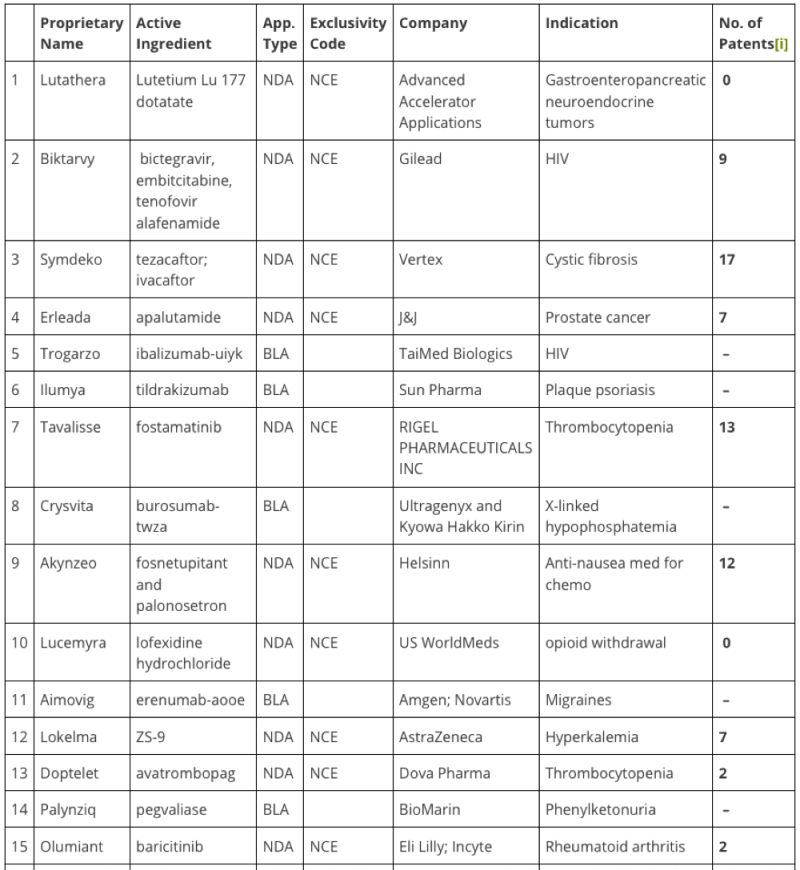
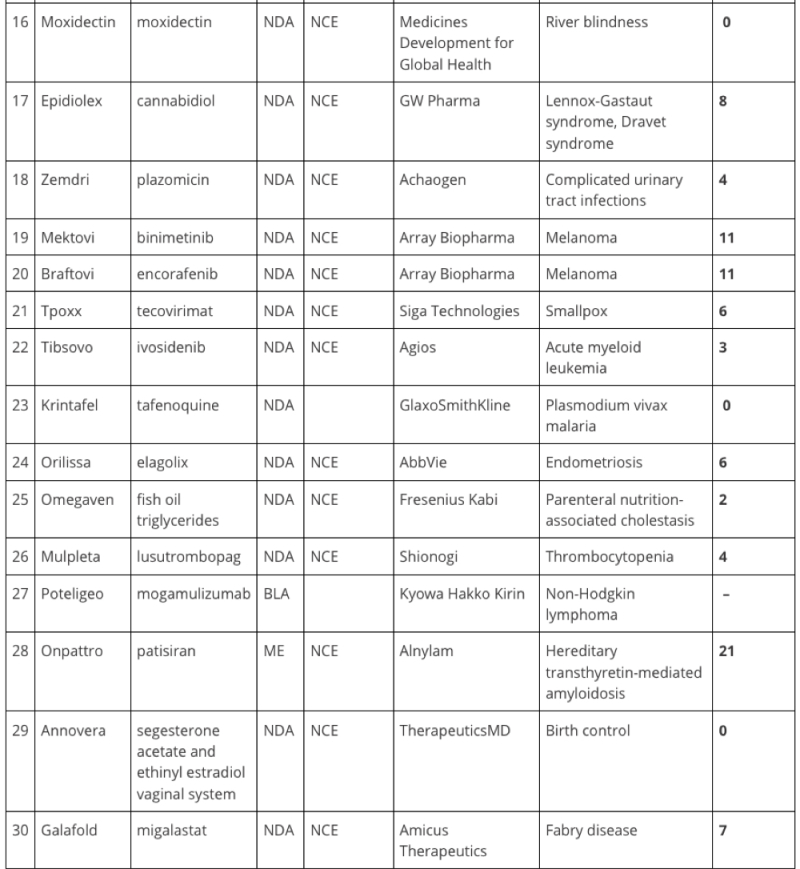
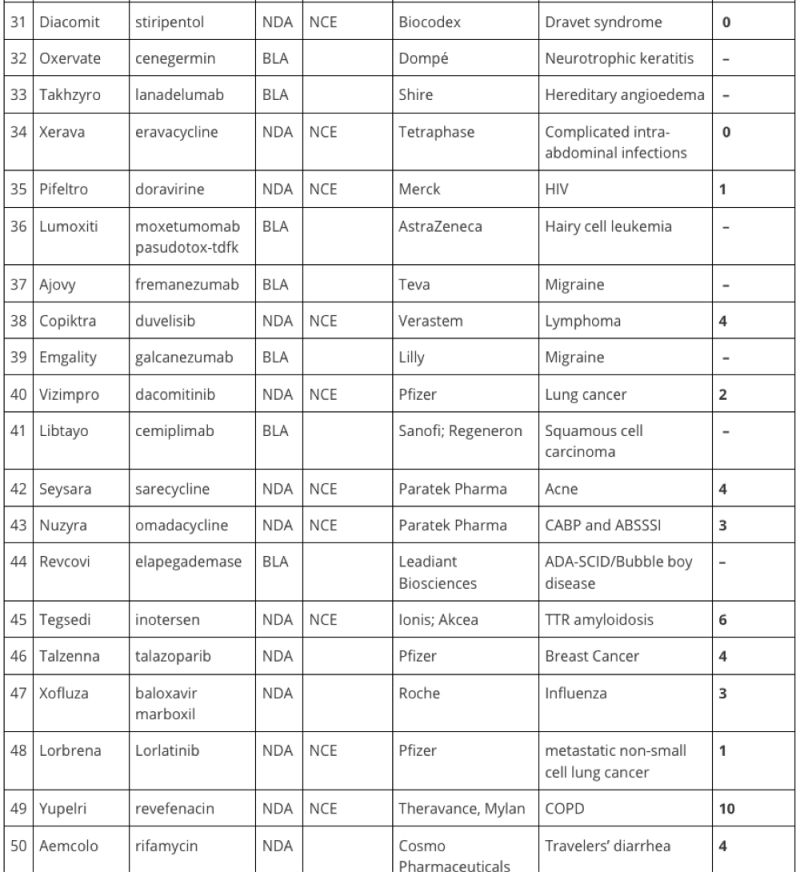
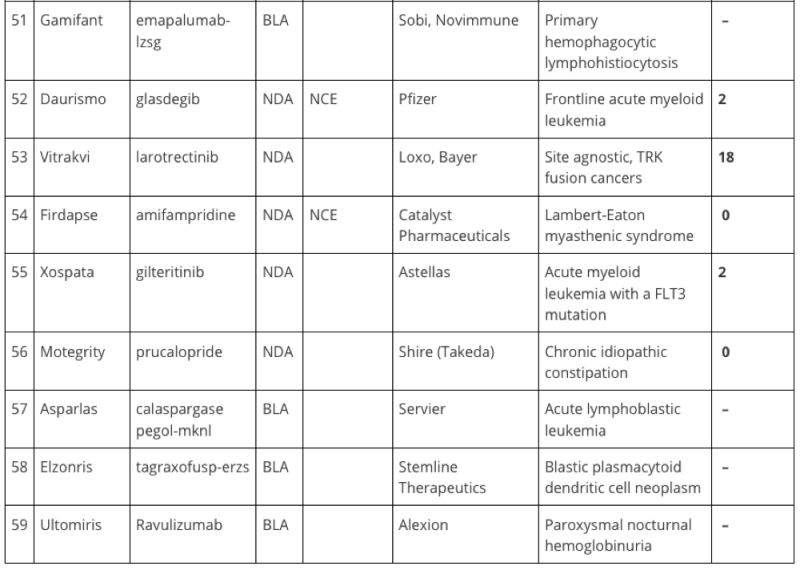
    FDAThe past year was a big year for FDA approved new drugs and biologics — 59 in fact, compared to 46 in 2017 and a mere 22 in 2016.  From the published list of approvals on the FDA website Novel Drug Approvals for 2018, we compiled data on the listed patents associated with these drugs.  As a whole, the 59 drugs included 42 "conventional", i.e., small molecule drugs, of which 35 were new chemical entities (NCEs approved via a New Drug Application or NDA), and 17 were biological molecules (approved via a Biological License Application or BLA).  For background, "conventional" drugs are small (i.e., generally under 1000 molecular weight), synthetically manufactured chemical entities that are chemically and molecularly well-characterized.  Currently, these drugs make up the majority of approved drugs.  Information regarding patents and exclusivity for these "conventional" drugs is referenced in the Approved Drug Products with Therapeutic Equivalence Evaluations, also known as the 'Orange Book'[i].

    On the other hand, biological molecules or 'biologics' are a newer class of drugs that are either produced in living organisms or contain biological materials.  Compared to their small molecule chemical counterparts, biologics are not as easily characterized.  Examples of biologics include, vaccines, gene therapies, cellular biologics, and recombinant proteins.  More limited information regarding biologic drug products can be located in the 'Lists of Licensed Biological Products with Reference Product Exclusivity and Biosimilarity or Interchangeability Evaluations', also known as the 'Purple Book'[ii].  However, since this book was established in 2014, information regarding pertinent patent and exclusivity of biologics remains a challenge to access.  Although the Purple book is still relatively new, the FDA should consider including this patent information in the future.  In the table below, each of the 59 approved drugs are listed and for each of the 42 conventional drugs we compiled the listed patents.

    In summary, a total of 216 patents are listed for the 42 approved conventional drugs.  Nine of these drugs have no listed patents.  This turns out to average just over 5 patents per drug.  With the most listed patents — a whopping 21 — is Alnylam's drug Onpattro (active ingredient – patisiran) for the treatment of hereditary transthyretin-mediated amyloidosis or Familial amyloid polyneuropathy (FAP).  FAP is a fatal neurodegenerative disease that affects approximately 50,000 people worldwide.  Second highest with 18 patents was Vitrakvi (larotrectinib) by Loxo and Bayer to treat TRK fusion-related cancers.  TRK fusion proteins are known to promote tumor formation in a variety of cancers that affect adults and children.  And in third place, with 17 associated patents, is Vertex's Symdeko (tezacaftor; ivacaftor) for the treatment of Cystic fibrosis.

    In addition, 2018 was also noteworthy for the approval of GW Pharma's Epidiolex (cannabidiol), a cannabis-related drug (with 8 patents listed).  This was an exciting and perhaps controversial approval considering the stigmas, public policy considerations, and current laws regarding marijuana in the United States.  Late last year, Surgeon General Jerome Adams asked the U.S. government to reconsider the classification of marijuana.  Currently, as it stands marijuana is a schedule I drug with no currently acceptable medical use with high likelihood for abuse.  However, the potential health and economic benefits associated with cannabis have yet to wait upon these impending changes to national policy.  Additionally, it will be interesting to follow future R&D and intellectual property trends as more approvals are likely to follow in the cannabinoid area in the future.  Nevertheless, it was interesting to see the relatively large number of patents listed for Epidiolex.

    Summary Table of 2018 Drug Approvals
    Note: Drugs are delineated by their approval via New Drug Application (NDA) or Biologics License Application (BLA)

    Table 1a Table 1b Table 1c Table 1d

    [i] The first print copy of Approved Drug Products with Therapeutic Equivalence Evaluations was published around Halloween in 1980, thus inspiring the orange cover and the nickname.

    [ii] Since "Orange" became a single-color nickname for Approved Drug Products with Therapeutic Equivalence Evaluations, the FDA named the book of licensure for biological molecules as the Purple Book.  Ironically, this is not a book of conventional sorts and it does not have a Purple cover.

    [iii] Patent information for drugs approved via a Biologics License Application (BLA) is not included in the table.

    * Brittany Knight is a Ph.D. Candidate in the Biomedical Sciences Ph.D. Program in the Neuroscience Department at the University of Connecticut.  Prior to attending the University of Connecticut, Brittany obtained her B.S. in Psychology and a minor in Biology with Global Honors with Distinction from Lock Haven University of Pennsylvania.
    ** Dr. Sabatelli is a Partner with Dilworth IP

  • CalendarJanuary 22, 2019 – "Biologics and Biosimilars: FDA Initiatives and Guidance, Approvals and Exclusivity, Patent Prosecution, Litigation" (Strafford) – 1:00 to 2:30 pm (EST)

    January 22, 2019 – European patent prosecution & litigation webinars with focus on UK, Germany, and EPO & CJEU (D Young & Co) – 1:00 pm, 2:30 pm, and 3:30 pm (GMT)

    January 23, 2019 – "Section 101: Revised USPTO Guidance on Patent Eligibility" (Intellectual Property Owners Association) – 2:00 to 3:00 pm (ET)

    January 24, 2019 – "Drafting and Defending Software Patents: Meeting Sections 102, 103 and 112 Requirements" (Strafford) – 1:00 to 2:30 pm (EST)

    January 29, 2019 – "Patent Claim and Specification Drafting and Prosecution — Avoiding Traps That Lead to Royalty Free Licensing of Patented Technology" (Strafford) – 1:00 to 2:30 pm (EST)

    January 31, 2019 – "Summary Judgment After Berkheimer" (Intellectual Property Owners Association) – 2:00 to 3:00 pm (ET)

    January 31, 2019 – "Blocking Patents: Impact of Acorda Therapeutics on Obviousness Analysis — Non-Obviousness and Commercial Success, Cross Licensing, Searches" (Strafford) – 1:00 to 2:30 pm (EST)

    February 5, 2019 – "Restoration – Are You Taking Enough Care?" (J A Kemp) – 15:30 to 16:30 pm (Greenwich Mean Time)\

    February 7, 2019 – "Patents and Export Control Compliance: Managing Risk and Avoiding Unintentional Violations — Minimizing Export Control Liability in Patent Application Preparation, Development and Analysis of Innovation, and Licensing" (Strafford) – 1:00 to 2:30 pm (EST)

    February 8, 2019 – "Recent Developments You Should Know About Patent Subject Matter Eligibility" (Foley & Lardner) – 12:00 to 1:00 pm (CT)

  • IPO #2The Intellectual Property Owners Association (IPO) will offer a one-hour webinar entitled "Summary Judgment After Berkheimer" on January 31, 2019 from 2:00 to 3:00 pm (ET).  Chris Hughes of Cadwalader Wickersham & Taft LLP, Frank Nuzzi of Siemens Corp., and Jonathan Waldrop of Kasowitz Benson Torres & Friedman, LLP will examine what's been happening at district courts since Berkheimer v HP Inc. and extract lessons for both plaintiffs and defendants.  The panel will consider and analyze:

    • Cases referencing Berkheimer where early 35 U.S.C. § 101 challenges were granted, such as iSentium v. Bloomberg Fin. (S.D.N.Y.)
    Finjan, Inc. v. Juniper Network, Inc. (N.D. Cal.), where the court ordered the section 101 invalidity defense be decided at trial, but the ultimate jury instructions and verdict form did not address Section 101
    Data Engine v. Google (D.Del), where the court granted a motion for judgment on the pleadings, but was reversed-in-part by the Federal Circuit
    • When, in trial proceedings, it's best to pose, or to resist, a § 101 challenge
    • The distinctive approach taken by some judges in the Eastern District of Texas

    The registration fee for the webinar is $135 (government and academic rates are available upon request).  Those interested in registering for the webinar can do so here.

  • By Donald Zuhn –-

    Federal Circuit SealLast week, in Supernus Pharmaceuticals, Inc. v. Iancu, the Federal Circuit reversed the entry of summary judgment by the District Court for the Eastern District of Virginia, which concluded that the U.S. Patent and Trademark Office had not erred in calculating the Patent Term Adjustment (PTA) for U.S. Patent No. 8,747,897.  The '897 patent, which is directed to an oral osmotic pharmaceutical dosage form of treprostinil, is owned by Appellant Supernus Pharmaceuticals, Inc. and exclusively licensed by Appellant United Therapeutics Corp.

    During prosecution of U.S. Application No. 11/412,100, which issued as the '897 patent, the Examiner issued a final Office Action, and Supernus responded by filing a Request for Continued Examination (RCE).  After filing the RCE, Supernus was notified that an opposition had been filed in related European Patent No. EP 2 010 189 (which had issued from a European application corresponding to an International application that claimed priority from the '100 application).  One hundred days after the European Patent Office's notification of the opposition, Supernus filed a supplemental Information Disclosure Statement (IDS) citing the Notice of Opposition and other documents concerning the opposition.  The USPTO ultimately issued the '100 application as the '897 patent, determining that the '897 patent was entitled to 1,260 days of PTA.  The Office's PTA determination included an assessment of 886 days of applicant delay, of which 646 days were assessed for the time between the filing of the RCE and the submission of the supplemental IDS.  Supernus filed a request for Reconsideration of Patent Term Adjustment, arguing that the Office should have applied 37 C.F.R. § 1.704(c)(6) in this instance rather than 37 C.F.R. § 1.704(c)(8).  The Office, however, rejected Supernus' request, concluding that § 1.704(c)(8) applied and that the 646-day reduction in PTA was proper.

    Supernus challenged the Office's PTA determination in the Eastern District of Virginia, arguing, in part, that § 1.704(c)(8) is arbitrary, capricious, and contrary to the PTA statute, and contending that it was entitled to at least 546 of the 646 days of PTA reduction (i.e., the period of time between the filing of the RCE and the EPO notification of opposition).  The District Court granted summary judgment in favor of the USPTO, finding that the USPTO did not err in the PTA calculation for the '897 patent and that the Federal Circuit's decision in Gilead Sciences, Inc. v. Lee foreclosed, as a matter of law, Supernus' argument that § 1.704(c)(8) is arbitrary, capricious, and otherwise contrary to the PTA statute.

    In reversing the District Court's grant of summary judgment in favor of the USPTO, the Federal Circuit began by concluding that its decision in Gilead did not foreclose Supernus' argument that § 1.704(c)(8) is arbitrary, capricious, and otherwise contrary to the PTA statute because "Gilead ruled only that the regulation reasonably drew no line between actual and potential delay," and "did not hold the regulation was reasonable in reducing PTA for periods during which there was no failure to engage in reasonable efforts to conclude prosecution."  The Court noted that in Gilead, a supplemental IDS could have been filed at the same time that Gilead filed a response to a restriction requirement (rather than 57 days after the response had been filed), but in the instant case, "there were no efforts that [Supernus] could have taken in the period of time during the preceding 546 days [i.e., between the filing of the RCE and the EPO notification of opposition]."  The Court therefore concluded that "[b]ecause Gilead involved different facts and a different legal question, Gilead is not controlling in this action."

    The Federal Circuit next turned to the question of statutory interpretation by the USPTO, which required the Court to apply the two-step framework established in Chevron U.S.A. Inc. v. Nat. Res. Def. Council, Inc., 467 U.S. 837 (1984).  The first step of that analysis requires a court to "ask whether the statute's plain terms 'directly addres[s] the precise question at issue,'" citing Nat'l Cable & Telecomms. Ass'n v. Brand X Internet Servs., 545 U.S. 967, 986 (2005).  According to the opinion, "[t]he precise question at issue in this case is whether the USPTO may reduce PTA by a period that exceeds the 'time during which the applicant failed to engage in reasonable efforts to conclude prosecution,'" citing 35 U.S.C. § 154(b)(2)(C)(i).  Section 154(b)(2)(C)(i) specifies that the period of adjustment of patent term "shall be reduced by a period equal to the period of time during which the applicant failed to engage in reasonable efforts to conclude prosecution of the application" (emphasis in opinion).

    With respect to § 154(b)(2)(C)(i), the Federal Circuit found that "the pertinent language of the PTA statute is plain, clear, and conclusive," and therefore held that "the USPTO may not count as applicant delay a period of time during which there was no action that the applicant could take to conclude prosecution of the patent."  In particular, the Court stated that:

    A plain reading of the statute shows that Congress imposed two limitations on the amount of time that the USPTO can use as applicant delay for purposes of reducing PTA.  First, the statute expressly requires that any reduction to PTA be equal to the period of time during which an applicant fails to engage in reasonable efforts.  Second, the statute expressly ties reduction of the PTA to the specific time period during which the applicant failed to engage in reasonable efforts [emphasis in opinion].

    As a result, "the statutory period of PTA reduction must be the same number of days as the period from the beginning to the end of the applicant's failure to engage in reasonable efforts to conclude prosecution," and "[t]he USPTO cannot . . . count as applicant delay any period of time during which there were no efforts in which the applicant could have engaged to conclude prosecution of the patent."

    The Court concluded that "Congress expressly granted the USPTO authority to determine what constitutes reasonable efforts, but the USPTO lacks any authority to exceed the statutory 'equal to' limitation by including the 546-day time period during which it does not contend that Supernus failed to undertake reasonable efforts to conclude prosecution."  The Court therefore found the USPTO's PTA reduction in this case to be inconsistent with the PTA statute, accorded no deference to the USPTO's application of the regulations at issue in the circumstances of this case, and reversed and remanded the District Court's summary judgment order.

    Supernus Pharmaceuticals, Inc. v. Iancu (Fed. Cir. 2019)
    Panel: Circuit Judges Dyk, Schall, and Reyna
    Opinion by Circuit Judge Reyna

  • Strafford #1Strafford will be offering a webinar entitled "Blocking Patents: Impact of Acorda Therapeutics on Obviousness Analysis — Non-Obviousness and Commercial Success, Cross Licensing, Searches" on January 31, 2019 from 1:00 to 2:30 pm (EST).  Mark Kachner of Knobbe Martens, Sarah A. Kagan of Banner & Witcoff, and Patent Docs author Kevin E. Noonan of McDonnell Boehnen Hulbert & Berghoff will discuss the expanded doctrine of blocking patents, the Acorda decision and secondary considerations, and also address how the decision impacts the obviousness analyses, licensing, and invalidity/validity/opposition searches.  The webinar will review the following issues:

    • How does the Acorda decision change the playing field for blocking patents?
    • What impact does the expanded doctrine of blocking patents have on the obviousness analysis?
    • What steps can patent counsel take to overcome the notion of the hypothetical researcher whose concern about infringing on a prior patent would deter him/her from commercial success?

    The registration fee for the webcast is $297.  Those interested in registering for the webinar, can do so here.

  • J A KempJ A Kemp will be offering a webinar entitled "Restoration – Are You Taking Enough Care?" on February 5, 2019 from 15:30 to 16:30 pm (Greenwich Mean Time).  Toby Hopkin of J A Kemp will discuss the due care standard for restoring patent rights in Europe and elsewhere when a deadline related to a patent or patent application has been missed.  The webinar will address the following topics:

    • Who needs to take due care?
    • How much care counts as due care?
    • Examples of scenarios that do and don’t merit restoration
    • Practical implications for the systems and procedures that you use

    Those wishing to register can do so here.

  • Strafford #1Strafford will be offering a webinar entitled "Patents and Export Control Compliance: Managing Risk and Avoiding Unintentional Violations — Minimizing Export Control Liability in Patent Application Preparation, Development and Analysis of Innovation, and Licensing" on February 7, 2019 from 1:00 to 2:30 pm (EST).  David G. Henry of Gray Reed & McGraw and Edward J. Radlo of Radlo IP Law Group will provide guidance for patent and other counsel on navigating the intersection of patents and export control laws. The panel will examine the challenges facing patent owners, when and where export control issues arise, and related licensing issues. The panel will offer best practices for complying with export control laws.  The webinar will review the following issues:

    • What export control compliance challenges do patent owners and applicants face?
    • When do export violations arise in the patent context?
    • What are the best practices for counsel to patent owners for compliance with ITAR and EAR requirements?

    The registration fee for the webcast is $297.  Those interested in registering for the webinar, can do so here.