• MBHB Logo 2McDonnell Boehnen Hulbert & Berghoff LLP will be offering a live webinar entitled "New Developments in Patent-Eligibility with a Focus on the Abstract Idea Exception" on February 20, 2019 from 10:00 am to 11:15 am (CT).  In this presentation, MBHB attorney and Patent Docs author Michael Borella will provide an up-to-date overview of recent 35 U.S.C. Section 101 happenings, with topics including:

    • An overview of the important Section 101 case law from 2018, including the impact of Berkheimer v. HP
    How to rebut specific types of Section 101 invalidity contentions
    • A discussion of claim drafting to survive Section 101 scrutiny, focusing on machine learning as an example
    • How recent initiatives by Director Andrei Iancu might or might not change how the USPTO views Section 101, including the USPTO's January update to its patent-eligibility examination guidelines

    While there is no fee to participate, attendees must register in advance.  Those wishing to register can do so here.  CLE credit is pending for the states of California, Illinois, New Jersey, New York, North Carolina, and Virginia.

  • LexisNexisLexisNexis will be offering a webinar on "The Next Billion-Dollar Acquisition in Pharma — A Forward-Looking Patent Analysis on Bristol-Myers Squibb Acquiring Celgene" on February 11, 2019 at 2:00 pm (ET).  Gene Quinn of IPWatchdog and Kevin Noonan of Patent Docs will take a look at the recently announced merger between Bristol-Myers Squibb and Celgene, including what the combined company will look like from a patent perspective, and what competition regulators are likely to be interested in questioning about this acquisition.

    Those interested in registering for the webinar, can do so here.

  • Strafford #1Strafford will be offering a webinar entitled "Section 112 Issues in IPR Proceedings: Using Section 112 as a Sword or a Shield — Addressing Section 112 Issues in IPR Petitions, Establishing Priority or Earlier Critical Date of Asserted Reference, and More" on February 14, 2019 from 1:00 to 2:30 pm (EST).  Jonathan R. Bowser of Unified Patents and Roger H. Lee of Buchanan Ingersoll & Rooney will provide guidance on Section 112 issues that arise during an inter partes review (IPR) proceeding, address the PTAB's response to assertions that claims do not comply with § 112, discuss related claim construction issues, and offer best practices for handling § 112 issues in IPRs.  The webinar will review the following issues:

    • How has the PTAB responded to assertions made by IPR petitioners that claims do not comply with Section 112?
    • What must patent owners show to establish priority to an earlier application or antedate an asserted reference?
    • What must IPR petitioners show to meet the claim construction requirements for means-plus-function claims under Section 112(f)/sixth paragraph?
    • How does the PTAB weigh prior determinations concerning priority made during prosecution or a patent challenged in an IPR?

    The registration fee for the webcast is $347.  Those interested in registering for the webinar, can do so here.

  • Strafford #1Strafford will be offering a webinar entitled "Biotech Patents and Section 101 Rejections: Meeting Patent Eligibility Requirements — Leveraging Recent Decisions and USPTO Guidance to Overcome Rejections" on February 12, 2019 from 1:00 to 2:30 pm (EST).  Amanda K. Murphy, Steven P. O'Connor, Sanya Sukduang, and Sara A. Leiman of Finnegan Henderson Farabow Garrett & Dunner will guide patent counsel for overcoming § 101 rejections for biotech patents, review recent case law and USPTO guidance on § 101 patent eligibility, and offer strategies to address § 101 rejections.  The webinar will review the following issues:

    • The impact of the Mayo, Myriad, and Ariosa decisions on recent USPTO and Federal Circuit decisions addressing § 101 rejections for biotech and other technological patents
    • Problems with the USPTO guidance documents and examiner training
    • Potential strategies to overcome § 101 rejection
    • Robust patent specification and claim drafting tips

    The registration fee for the webcast is $347.  Those interested in registering for the webinar, can do so here.

  • Strafford #1Strafford will be offering a webinar entitled "Conducting and Analyzing Prior Art Searches — Strategies for Validity, Patentability, Infringement, FTO and State-of-the-Art Searches" on February 27, 2019 from 1:00 to 2:30 pm (EST).  Thomas L. Irving and Christopher C. Johns of Finnegan Henderson Farabow Garrett & Dunner, Kim Jordahl of KSJLaw, and Stephanie Curcio of Legalicity will guide patent counsel on structuring and conducting prior art searches, discuss reporting of search results and offer best practices for analyzing prior art searches to maximize patent protection.  The webinar will review the following issues:

    • What are the critical considerations when determining what, when and where to search?
    • What are the critical components of an effective search strategy, analytical process and follow-up steps to ensure a successful patent application?

    The registration fee for the webcast is $347.  Those interested in registering for the webinar, can do so here.

  • Strafford #1Strafford will be offering a webinar entitled "Infringement of IP Rights in Augmented and Virtual Reality — Protecting and Monitoring Trademarks, Right of Publicity, Copyrights" on February 21, 2019 from 1:00 to 2:30 pm (EST).  J Alexia Bedat of Klaris Law, Kimberly Culp of Carr McClellan, and James G. Gatto of Sheppard Mullin Richter & Hampton will guide counsel on intellectual property infringement issues that arise in augmented reality (AR) and virtual reality (VR); discuss steps that IP owners can take to monitor and police use of their marks, copyrights, and images; and discuss what game developers, creators, and owners can do to mitigate the risk of infringing on real-world IP rights.  The webinar will review the following issues:

    • What monitoring programs should real-world IP owners and counsel put in place to protect IP rights from being infringed in AR and VR?
    • What other steps can IP owners take to prevent infringement of their IP rights in AR and VR?
    • What are the hurdles to protecting IP in augmented and virtual worlds?

    The registration fee for the webcast is $347.  Those interested in registering for the webinar, can do so here.

  • By Kevin E. Noonan

    Federal Circuit SealThe Federal Circuit has on several occasions taken the opportunity to address (and in doing so, flesh out) the requirements for Article III standing to appeal an adverse determination in a post-grant review proceeding (post-grant review, inter partes review, and covered business method patent review) against a Petitioner (loss of patent claims typically provides sufficient injury for a Patent Owner to have standing).  See, for example, Consumer Watchdog v. Wisconsin Alumni Research Foundation; Phigenix, Inc. v. ImmunoGen, Inc.; E. I. du Pont de Nemours & Co. v. Synvina C.V.; and most recently, Amerigen Pharmaceuticals Ltd. v. UCB Pharma GmbH.  But the Court has not had a clearer factual basis for deciding that a failed Petitioner did not have standing under Article III than in Momenta Pharmaceuticals v. Bristol-Myers Squibb, decided today.

    The case involved a inter partes review (IPR) brought by Momenta against all claims of U.S. Patent No. 8,476,239 having claims reciting "specific fluid formulations of the protein molecule CTLA4Ig (cytotoxic T-lymphocyte associated protein 4 immunoglobulin)."  These formulations were used to treat, inter alia, rheumatoid arthritis, having the generic name abatacept and sold by BMS as Orencia®.  The PTAB instituted but sustained the patentability of all claims.  This appeal followed.

    However, certain additional facts outside the basis for the PTAB's decision were relevant to the decision reached by the panel.  While not needing to establish standing to petition for IPR, Momenta at that time was pursuing research for the development of a biosimilar version of Orencia®.  However, during the course of the IPR trial, Momenta's biosimilar candidate failed clinical testing and was withdrawn by Momenta from FDA review.  BMS moved to dismiss the appeal on the grounds that these actions deprived Momenta of standing, insofar as there was no prospect of injury if Momenta was not pursuing its biosimilar.  The Court heard argument on the motion as well as the merits and retired to confer.

    While conferring, Momenta brought two other facts to the Court's attention.  First, on October 18, 2018 (after oral argument), Momenta filed a Letter to the Court (permitted under Fed. R. App. P. 28(j)) along with a press release, informing the Court that Momenta had "has initiated discussions with its collaboration partner, Mylan, to exit its participation in the development of its other five biosimilar programs including M834, a proposed biosimilar to ORENCIA® . . . ."  This prompted the Court to issue an Order to Show Cause (on October 23rd) why the Court should not dismiss the appeal.  Ten days later Momenta responded that:

    As of today, the companies continue to be jointly responsible under that agreement for product development and for sharing the costs of that development, which are substantial.  And because of BMS's patent and the Board's decision upholding it, Momenta and its partner Mylan still face the same fork in the road about the commercial formulation for their biosimilar product—they must decide whether to proceed with the current formulation or switch to a more expensive and potentially less commercially viable option.  That decision and the costs associated with it still turn on the outcome of this appeal.

    Momenta's response was supported by a declaration from its Chief Business Officer that the parties had not reached a decision whether to terminate the Orencia® biosimilar development program.  In addition, Momenta asserted its "economic interest" in any Orencia® biosimilar that might be developed by Mylan, which included "potential right to royalties."  A little more than a month later, on December 10th, Momenta filed another letter with the Court, informing the panel of a Preliminary Prospectus Supplement and Form 8-K filed with the Securities and Exchange Commission four days before, which notified the SEC and prospective investors that:

    We have elected to terminate our collaboration agreement with Mylan with respect to the development of . . . M834, a proposed biosimilar to ORENCIA® . . . .  On November 19, 2018, we delivered a formal notice of this partial termination to Mylan, as provided in the collaboration agreement.

    Momenta made no response to BMS's further argument that the appeal was mooted by these developments, nor did the company withdraw its appeal.

    Judge Newman rendered the Court's decision, joined by Judges Dyk and Chen.  Calling the "constitutional limitation of federal-court jurisdiction to actual cases or controversies" the most fundamental principle defining the judiciary's proper role, citing Raines v. Byrd, 521 U.S. 811, 818 (1997), the opinion addressed Momenta's argument that the requirement for standing for judicial review of agency decisions was "relaxed" relative to district court litigation.  These requirements are that an appellant must have "(1) suffered an injury in fact, (2) that is fairly traceable to the challenged conduct of the defendant, and (3) that is likely to be redressed by a favorable judicial decision."  Spokeo, Inc. v. Robins, 136 S. Ct. 1540, 1547 (2016)).  The panel recognized that some relaxation has been recognized, for example in Lujan v. Defenders of Wildlife, 504 U.S. 555 (1992) and Massachusetts v. E.P.A., 549 U.S. 497, 517–18 (2007).  Indeed, the Supreme Court has held that "[p]arties that initiate the [Inter Partes Review] proceeding need not have a concrete stake in the outcome; indeed, they may lack constitutional standing" in Cuozzo Speed Technologies, LLC v. Lee, 136 S. Ct. 2131, 2143–44 (2016).

    But that relaxation does not extend to the requirement of "injury in fact," which is a hard floor of Article III jurisdiction that cannot be removed by statute, citing Summers v. Earth Island Institute, 555 U.S. 488 (2009).  The basis for this "hard floor, according to the opinion, is that without it courts would be reduced to writing advisory opinions.  Congress does not have the power to do so by statute, as recognized in Consumer Watchdog v. Wis. Alumni Research Found. and Gladstone, Realtors v. Village of Bellwood, 441 U.S. 91, 100 (1979).  Under the facts as they had developed, Momenta was unable to show "'an invasion of a legally protected interest' that is 'actual or imminent, not conjectural or hypothetical'" as required under the Supreme Court's Lujan decision.

    Momenta's alternative argument, that the estoppel provisions of IPR proceedings under 35 U.S.C. § 315(e), were similarly unavailing in the face of evidence that Momenta was not longer engaging in activity that could lead to infringement liability.  The argument that Momenta might be injured "at some future time" if Mylan developed an Orencia® biosimilar from the sale of which Momenta would be entitled to royalties was too attenuated to provide injury-in-fact, the opinion citing Clapper v. Amnesty Int'l USA, 568 U.S. 398, 414 n.5 (2013), that a plaintiff "cannot rely on speculation about the unfettered choices made by independent actors" not before the court.  Momenta's position was contrary to several Federal Circuit decisions on standing for appealing PTAB decisions, including Consumer Watchdog, Phigenix, Inc. v. Immunogen, Inc., and RPX Corp. v. ChanBond LLC, No. 17–2346, ECF 39 (Fed. Cir. Jan. 17, 2018).  In cases where lacking a product on the market was not enough to preclude Article III standing, the petitioner had "concrete plans for future activity that creates a substantial risk of future infringement," JTEKT Corp. v. GKN Automotive Ltd., 898 F.3d 1217, 1220–21 (Fed. Cir. 2018), or the parties were "direct competitors and were in commercial dispute" and the petitioners faced "a significant risk of patent infringement in their demonstration plant that was entering into operation," E.I. DuPont de Nemours & Co. v. Synvina C.V., 904 F.3d 996, 1005 (Fed. Cir. 2018).  None of these facts were present here.

    And while recognizing that "[s]tanding and mootness may not be coextensive in all cases," none of the exceptions ("when the issue has avoided review and is likely to be repeated, or when the defendant voluntarily ceased the challenged activity and the plaintiff seeks to preserve its win") applied here.  Accordingly, the Court dismissed the appeal as moot.

    Momenta Pharmaceuticals, Inc. v, Bristol-Myers Squibb Co. (Fed. Cir. 2019)
    Panel: Circuit Judges Newman, Dyk, and Chen
    Opinion by Circuit Judge Newman

  • By Donald Zuhn –-

    CoverLast week, the U.S. Patent and Trademark Office released its FY 2018 Performance and Accountability Report.  In describing the USPTO's strategic and performance-planning framework, the 2018 Report notes that the Office issued its 2014-2018 Strategic Plan in 2014, and that the Plan "demonstrates the progress made to date by building on the tangible successes of recent years with a focus on achieving the USPTO's vision as a global IP leader by:

    • Establishing progress toward optimal pendency and quality levels for both patents and trademarks that will enable the USPTO to operate efficiently and effectively within the expectations of the IP community;
    • Administering effectively the provisions of the AIA;
    • Continuing to transform the USPTO with next-generation technology and services;
    • Maintaining a strong and diverse leadership team, agile management structure, and a diverse and engaged cadre of employees in achieving the agency's mission and vision;
    • Continuing to work with other government agencies, Congress, and the USPTO's global partners to establish IP systems that benefit innovation, create jobs, and lead to strong economies around the world; and
    • Recruiting and retaining the highest quality employees to accomplish the agency's important work."

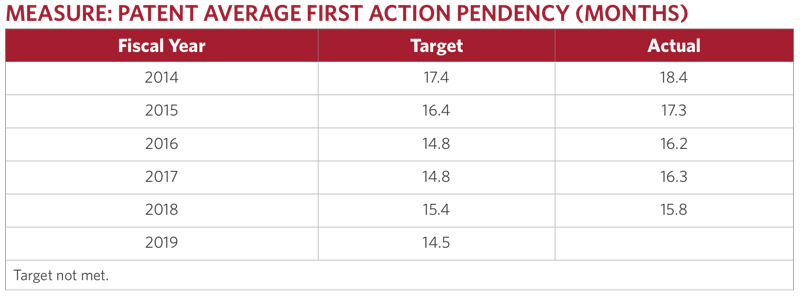
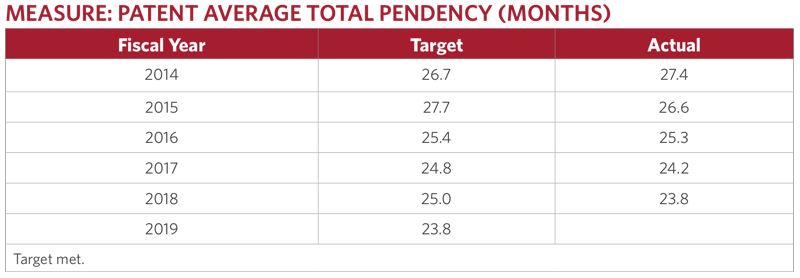
    The 2018 Report specifies ten key performance outcome measures for which the Office has developed annual performance targets.  According to the Report, the Office exceeded its annual performance targets for nine of the ten performance measures.  Two of the ten measures fall within the Office's first strategic goal, which concerns optimizing patent quality and timeliness.  In particular, average first action pendency was 15.8 months (higher than the 15.4-month target, but lower than the 16.3-month average first action pendency of FY 2017), and average total pendency was 23.8 months (lower than the 25.0-month target and lower than the 24.2-month average total pendency of FY 2017).

    Table 3 of the Report provides data for the patent-related performance targets for FY 2014 to FY 2018 (click on any table to expand):

    Table 3_Strategic Goals
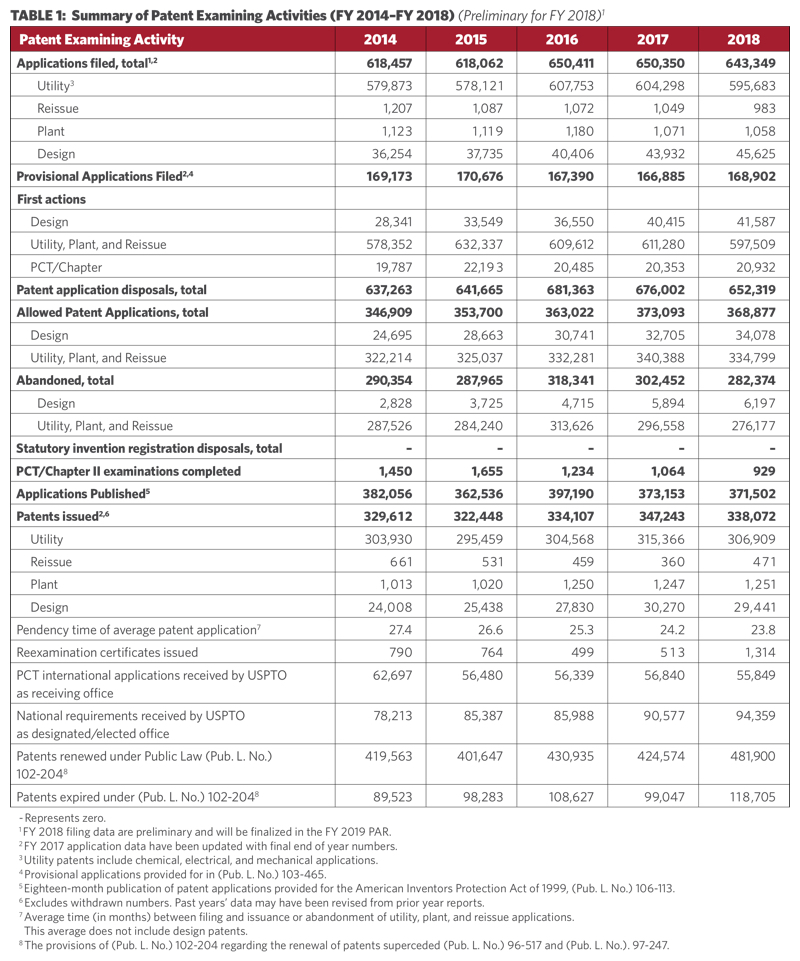
    The Report also notes that the number of applications filed decreased from 650,350 in FY 2017 to 643,349 in FY 2018, which constituted a 1.1% decrease in filings (see Table 1 below).  This followed a very slight decrease in application filings in FY 2017 and a 5.2% increase in application filings in FY 2016.

    Table 1_Patent Examining Activities
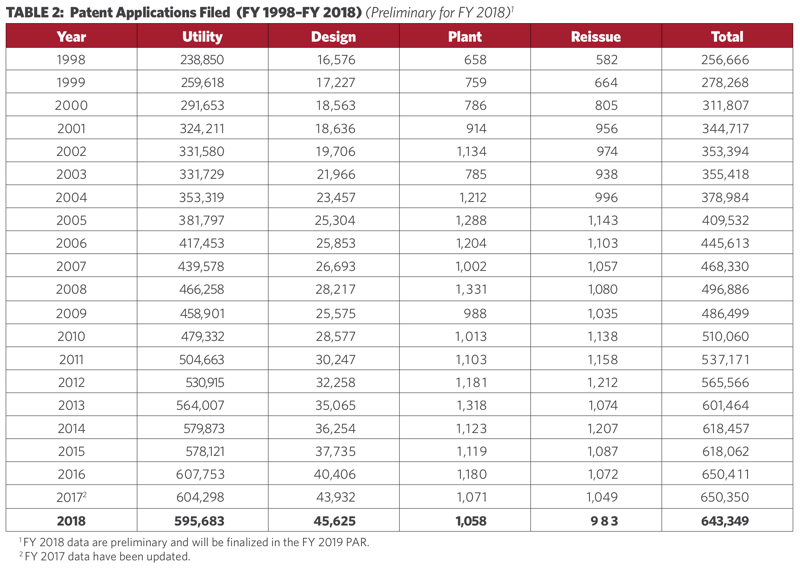
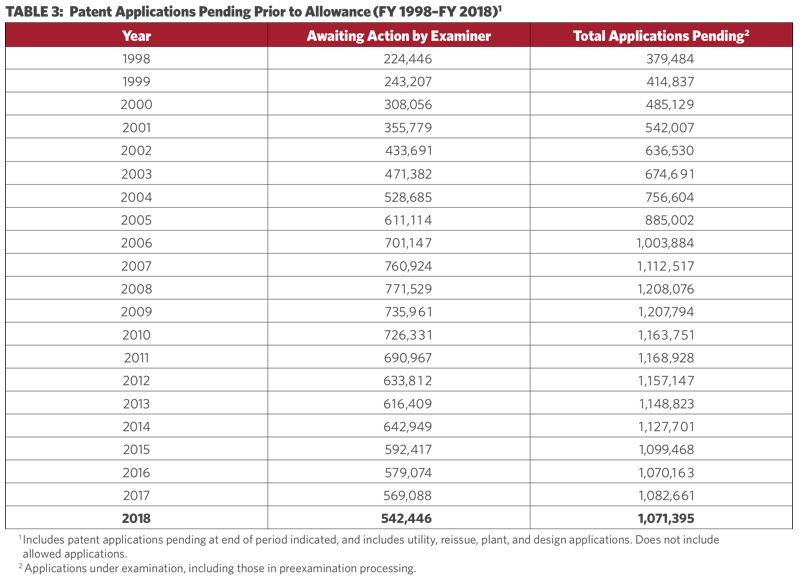
    The Report also indicates that while the Office accepted more than 600,000 patent applications for the sixth straight year and topped 500,000 applications for the ninth consecutive year (see Table 2 below), it was able to reduce the number of applications awaiting action from 569,088 in FY 2017 to 542,446 in FY 2018 (see Table 3 below).  The total number of pending applications also decreased from 1,082,661 in FY 2017 to 1,071,395 in FY 2018.  It was the Office's fourth consecutive reduction in number of applications awaiting action, but first drop in total number of pending applications since the Office's streak of consecutive reductions in total number of pending applications was snapped at five in FY 2017.

    Table 2_Applications Filed
    Table 3_Applications Pending
    After increasing from 304,568 utility patent issuances in FY 2016 to 315,366 in FY 2017, patent issuances once again dropped in FY 2018, falling to 306,909 (see Table 6 below).

    Table 6_Patents Issued
    As noted above, the results for first action and total pendency were mixed, with first action pendency coming in above the Office's target, and total pendency coming in below the Office's target (see Tables 4 and 5 below).  And as usual, the goals for the current fiscal year present even tougher challenges:  for first action pendency, the annual performance target drops from 15.4 months for FY 2018 (which the Office failed to meet) to 14.5 months for FY 2019, and for total pendency, the annual performance target drops from 25.0 months in FY 2018 (which the Office met) to 23.8 months in FY 2019.

    Table 4_Pendency
    Table 5_Pendency
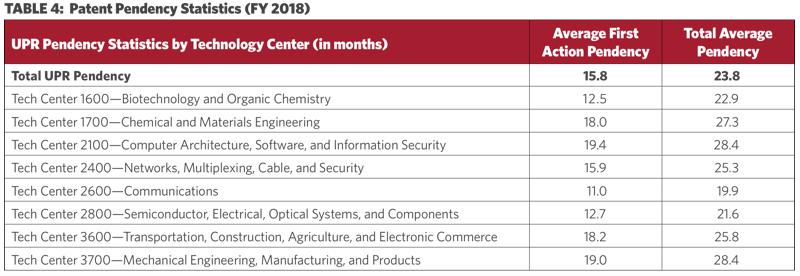
    When comparing pendency statistics by Technology Center, Tech Center 2600 (communications) produced the best average first action pendency (11.0 months), with Tech Center 1600 (biotechnology and organic chemistry) following in second (12.5 months), and Tech Center 2100 (computer architecture, software, and information security) produced the worst average first action pendency (19.4 months) (see Table 4 below).  As for total average pendency, Tech Center 2600 also produced the best total average pendency (19.9 months), with Tech Center 2800 (semiconductor, electrical, optical systems, and components) following in second (21.6 months), and Tech Center 3700 (mechanical engineering, manufacturing, and products) and Tech Center 2100 (computer architecture, software, and information security) producing the worst total average pendency (28.4 months).

    Table 4_Technology Center

    For additional information regarding this and other related topics, please see:

    • "USPTO Releases Performance and Accountability Report for FY 2016," February 6, 2017
    • "USPTO Issues Performance and Accountability Report for FY 2015," March 3, 2016
    • "USPTO Issues Performance and Accountability Report for FY 2014," April 7, 2015
    • "USPTO Releases Performance and Accountability Report for FY 2013," January 9, 2014
    • "USPTO Releases Performance and Accountability Report for FY 2012," November 28, 2012
    • "USPTO Releases Performance and Accountability Report for FY 2011," November 30, 2011
    • "USPTO Releases 2010 Performance and Accountability Report," November 17, 2010
    • "USPTO Announces 'Highest Performance Levels in Agency's History' in 2008," November 18, 2008
    • "USPTO Announces 'Record Breaking' 2007 Performance," November 15, 2007
    • "Patent Office Announces Record-Breaking Year," December 27, 2006

  • By Charlotte Teall

    UK Supreme CourtThe long-awaited UK Supreme Court decision concerning Warner-Lambert's Lyrica® patent was handed down in December.  In summary, the Supreme Court dismissed Warner-Lambert's appeal and upheld that the patent did not sufficiently disclose the claimed medical uses, i.e., all pain including peripheral and neuropathic pain.  They also found that the claims were not even sufficient in respect of neuropathic pain in dependent claim 3.  They also found that even if the claims had been found valid, they would not have been infringed by Actavis and Mylan's activities, and that the post-trial amendment to try to limit the claims to the treatment of peripheral neuropathic pain was an abuse of process.

    The Supreme Court is known for being pro-patentee, but this decision was a departure from that and appears, at first glance, to set the bar higher for medical use claims.  This decision provides important guidance on the role of plausibility in the test for sufficiency and how infringement of European Swiss-type claims (the old medical use claim format) is assessed in the UK.

    Background

    Claim 1 of the patent is directed towards pregabalin for the treatment of pain using a European Swiss-type claim.  Dependent claim 3 was limited to the treatment of neuropathic pain.

    It was known that neuropathic pain can be categorised into peripheral and central neuropathic pain.  The patent only exemplified the use of pregabalin in a rat model, which the Court of Appeal viewed only to be linked to peripheral neuropathic pain.  It was later confirmed (after the filing date) that pregabalin is effective in treating both peripheral and central neuropathic pain.  Actavis manufactures Lecaent, a pregabalin generic and brought proceedings for revocation along with Mylan in the UK.

    Warner-Lambert then brought UK infringement proceedings against Actavis later that year.  The High Court at first instance ruled that claims 1 and 3 were insufficient, and even if valid, were not infringed.  The Court of Appeal upheld these findings and also found that a post-trial amendment filed by Warner-Lambert after the High Court decision to limit the claim 3 to the treatment of peripheral neuropathic pain was an abuse of process.

    The role of plausibility in the test for sufficiency

    Sufficiency requires that the patent discloses the invention clearly and completely enough for it to be performed by the skilled person — essentially, in return for a patent the patentee needs to give a full public disclosure of their invention.  The case law has developed over the years to categorise sufficiency into two main types:

    1.  Enablement — the patent must enable the skilled person to carry out the invention.  This aspect of sufficiency was recently dealt with by the UK Court of Appeal in Regeneron v Kymab where they found that the patent was enabled and sufficiently disclosed despite the methods provided in the application being unworkable at the time of the invention.  The Court of Appeal afforded the skilled person with considerable time and expertise to find a workable method in that case.  Thus, an unworkable method is not an immediate bar to patentability in respect of the enablement aspect of sufficiency.

    2.  Entire scope — the patent must also enable the skilled person to work the invention across its entire scope without an undue burden.  It must also be plausible to a skilled person for the data provided in the application, that the invention would work across its entire scope, e.g., in the case of a broad medical use claim to a class of diseases, if the drug's mechanism of action is applicable to that broad class of diseases.  The Warner-Lambert case dealt with this aspect of sufficiency.

    In recent years, the EPO has raised an increasing number of plausibility objections to the claims concerning this second aspect of sufficiency with some decisions seemingly raising the threshold for plausibility (e.g., the Dasatinib decision – T0488/16).

    In the Warner-Lambert case, the Court of Appeal found that it was implausible that pregabalin would be effective at treating any type of pain (claim 1) or central neuropathic pain (in respect of claim 3) based on the data in the application showing a mouse model of inflammatory pain.  The treatment of peripheral neuropathic pain was found plausible because there was a sufficient unifying mechanistic link between inflammatory pain and peripheral neuropathic pain because both types of pain have a central sensitisation component.  The Court noted that while the data was not predictive, it at least rendered its efficacy in treating that type of claim as plausible.

    The Supreme Court paid close attention to the EPO Board of Appeal decision T609/02 (Salk Institute) and held by a slim majority that the disclosure supported claims so far as they extend to inflammatory pain but not to any kind of neuropathic pain.  Interestingly, dependent claim 2 was directed to the treatment of inflammatory pain, but does not appear to have been asserted.  In T609/02, the EPO Board of Appeal held that the specification must disclose the suitability of the drug for the claimed therapeutic application.  Clinical trials were not deemed necessary but a mere assertion of efficacy was not enough.  In vitro data that provides a direct link to the disease in question is also sufficient.

    Warner-Lambert argued that it is necessary to disclose reasons why the claimed effect is plausible only when the skilled person reading the patent would be sceptical about it in the absence of such a disclosure (so-called negative plausibility).  Lord Sumption in the Supreme Court disagreed because it would mean that if nothing was known either for or against the claimed therapeutic effect, no disclosure need be made in support of it.  Thus, the specification must disclose some reason for supposing that the implied assertion of efficacy in the claim is true (so-called positive plausibility).  However, not all the Supreme Court judges agreed with this approach.

    On the aspect of plausibility across the whole scope of the claim, Lord Sumption in the Supreme Court viewed that where a feature of a claim is an assertion of therapeutic efficacy for a given condition, a monopoly is being claimed for the process of manufacturing the compound for the treatment of that condition.  This does not mean that it must work for all patients suffering from that condition, or work on every occasion when it is applied by way of treatment.  But, it does mean that where the condition identified embraces a number of different pathologies, and the claim is construed as asserting efficacy of the product for each of them, the assertion must be plausible in relation to them all.  While this appears a straightforward test, it has difficulties particularly for diseases having potentially many distinct (and as yet potentially unknown) underlying mechanisms of pathology.

    It is important to note that the Warner Lambert case involved a second medical use claim and the Supreme Court appeared to restrict the plausibility test to second medical use claims.  Thus, it remains to be seen how a first medical use claim might fare before the Supreme Court.

    In assessing the plausibility of the Warner-Lambert claims, the Supreme Court disagreed with the Court of Appeal that the specification sufficiently disclosed the use of pregabalin for the treatment of peripheral neuropathic pain.  Thus, while the Court of Appeal had found that the use of pregabalin for the treatment of peripheral neuropathic pain (but not central neuropathic pain) was sufficiently disclosed, the Supreme Court disagreed and found that the use of pregabalin for any type (peripheral or central) of neuropathic pain was not sufficiently disclosed.

    The Supreme Court reasoned that the rat models used to obtain the data provided in the specification were only relevant to inflammatory pain.  Inflammatory pain is an immune-pathology resulting from an activation and dysregulation of the immune system, whereas neuropathic pain occurs following dysfunction or injury of nerve fibres and is characterised by the lack of conversion of nociceptive stimuli into electrical impulses, which can be caused by an altered sensitivity of the peripheral and central nervous system or by damage of the peripheral nerve tissue.

    The patentee argued that peripheral neuropathic pain and inflammation are unified by "central sensitisation", which is the process by which chronic pain signals in the periphery (from inflammatory or neurological causes) sensitize the CNS to pain, leading to pain hypersensitivity.  Thus, the data in the application using models of inflammatory pain was relevant to peripheral neuropathic pain via this unifying principle.

    However, the Lord Sumption argued that just because central sensitisation may be involved in both peripheral neuropathic pain and inflammatory pain, does not prove that they have a common metabolic mechanism.  Lord Sumption further reasoned that the specification must disclose some reason for supposing that the implied assertion of efficacy in the claim is true.  They reasoned that the specification said nothing about neuropathic pain of any kind.  Also, the specification did not refer to central sensitisation as a mechanism of action of the drug, so there was nothing to suggest, even as a hypothesis, that pregabalin works with peripheral neuropathic pain by blocking central sensitisation.  Also, while the specification provided mouse models that could be used to test for efficacy of the drug in peripheral neuropathic pain, it did not directly suggest doing so.

    This test seems to go beyond that applied by the EPO in requiring there to be an explicit disclosure of a mechanism of action of a claimed therapeutic effect that is predictive across the claim scope.  The EPO would likely view that if it was known that the mouse models in the specification could be used to test for efficacy of the drug in peripheral neuropathic pain, then the therapeutic effect is derivable from the specification and sufficiently disclosed.  The patentee should, however, be careful about any claim amendment to a disease category for which there is little mention in the specification.

    It is also worth noting that Lord Hodge and Lord Mance also of the Supreme Court disagreed with the approach taken by Lord Sumption, viewing it as imposing too high a threshold and imposing a burden on the patentee which the EPO Board of Appeal case law does not justify.  Therefore, despite the negative decision, the test for sufficiency in the UK appears far from settled since it is difficult to reconcile the differing views of the Judges in the Supreme Court.

    Abuse of process

    The Supreme Court also agreed with the lower courts that Warner-Lambert's post-trial amendment limiting claim 3 to peripheral neuropathic pain was an abuse of process.  Therefore, it is important that any claim amendments are put forward as early in the proceedings as possible to avoid them being disallowed for an abuse of process.  In any case, it is unlikely that this amendment would have saved their case in this instance in view of the Supreme Court's position on sufficiency.

    Infringement of Swiss-type claims

    The action for infringement was brought on the basis of claim 1 and 3.  The Court of Appeal found these claims to both lack sufficiency, but Lord Justice Floyd still considered the issue of infringement in obiter, particularly the proper interpretation of Swiss-form medical use claims.  Lord Justice Floyd particularly provided a clear test by which infringement of Swiss-type claims by a generic could be assessed.  The court should assess whether the alleged infringer knew or could foresee that at least some of the prescriptions written generically for the claimed drug for the claimed indication would in fact be fulfilled with the generic.  The absence of the claimed indication from the label ("skinny label") could not "conceivably be sufficient to negative the intention" and so would result in infringement.  Instead, where the manufacturer has "taken all reasonable steps within his power to prevent the consequences occurring", this would be sufficient to negative the intention and not result in infringement.

    Warner-Lambert also appealed this point to the Supreme Court.  The Supreme Court dismissed by majority Warner-Lambert's appeal on this point.  Particularly, Lord Sumption, together with Lord Reed, Lord Hodge and Lord Briggs, found that if claims 1 and 3 had been valid, they would not have been infringed, but differed in their reasons.  Lord Sumption and Lord Reed agreed that the intention of the alleged infringer is irrelevant and that the sole criterion of infringement is whether the product as it emerges from the manufacturing process, including any labelling or accompanying leaflet, is presented as suitable for the uses which enjoy patent protection.  Lord Hodge and Lord Briggs preferred the view of Mr Justice Arnold at first instance that the test is whether the alleged infringer subjectively intended to target the patent-protected market.

    Therefore, the Court of Appeal's test was not followed.  As with the issue of sufficiency, despite the negative decision, the test for infringement of Swiss-type medial use claims in the UK appears far from settled since it is difficult to reconcile the differing views of the Judges in the Supreme Court.

    Summary

    In summary, Warner-Lambert's patent claims 1 and 3 were found invalid for lack of sufficiency, and even if they were valid, were found not infringed.  This is despite pregabalin being confirmed to be effective in treating both central and peripheral neuropathic pain, and becoming a blockbuster drug.

    It will remain to be seen in future case law how the UK-IPO and UK Courts interpret and follow this decision.  Since the Judges in the Supreme Court could not reach agreement on the test for sufficiency and infringement in respect of Swiss-type claims, this will not be an easy job.  However, it does mean that there is scope for arguing that the test of Lord Sumption, particularly in respect of sufficiency is too strict and not in line with EPO Board of Appeal case law.

    This article was reprinted with permission from Forresters.

  • By Donald Zuhn –-

    Federal Circuit SealLast week, in In re Ikeda Food Research Co., the Federal Circuit affirmed a decision by the U.S. Patent and Trademark Office Patent Trial and Appeal Board affirming the Examiner's rejection in an ex parte reexamination of claims 22 and 23 of U.S. Application No. 12/851,668 for obviousness.  On appeal before the Board, the challenged claims were found obvious in view of three references:  European Patent Application Publication No. 0 094 161 ("Senior") and U.S. Patent Nos. 6,656,702 ("Yugawa A") and 6,059,946 ("Yugawa B").

    Claim 22 of the '668 application recites (with emphasis in the opinion):

    A biosensor for measuring glucose, comprising:
        an electrode system comprising an action electrode and a counter electrode; and
        an enzymatic reaction layer in contact with the action electrode and/or the counter electrode, the enzymatic reaction layer comprising an electron acceptor and a soluble [f]lavin compound-binding glucose dehydrogenase, which has enzymatic activity to glucose comprising catalyzing a reaction for oxidizing glucose in the presence of the electron acceptor,
        wherein enzymatic activity to maltose in the enzymatic reaction layer is 5% or less relative to the enzymatic activity to glucose;
        wherein the biosensor can quantify glucose concentrations ranging from 4.5 mM to 30 mM.

    According to the opinion:

    The '668 application purports to improve upon the prior art by claiming use of, inter alia, a specific enzyme: a "flavin"-dependent GDH ("FAD-GDH") designated as Enzyme Commission ("E.C.") 1.1.99.10, whose "relative reactivity" (or "substrate specificity"), was found to exhibit "high activity" on glucose, and "low activity" on the seventeen other substrates tested, including maltose.

    In the ex parte reexamination of the '668 application, the Examiner rejected claims 22 and 23 in view of the combination of Senior, which discloses a qualitative procedure for determining blood glucose concentration using a FAD-GDH enzyme derived from a strain of A. orzyae, which like the FAD-GDH enzyme described in the '668 application (which was isolated from a different microorganism) is designated E.C. 1.1.99.10, and Yugawa A and B, which disclose a biosensor.  (The opinion explains that E.C. numbers, which are promulgated by the Enzyme Commission, provide a common classification scheme for enzymes based on the chemical reactions they catalyze, and notes that "Ikeda's counsel does not dispute that enzymes with the same E.C. number have the same substrate specificity 'for purposes of this appeal.'")

    The Board affirmed the Examiner's rejection, determining that even though Senior did not expressly disclose the low-maltose activity limitation of claim 22 of the '668 application, the enzyme preparation disclosed in Senior inherently contains the same enzymatic specificity for glucose relative to maltose as the challenged claims in the '668 application.  More particularly, the Board concluded that it was reasonable to infer the FAD-GDH enzymes disclosed in Senior and the '668 application have the same low substrate specificity for glucose relative to maltose because both Senior and the '668 application classify the FAD-GDH enzymes in their enzyme preparations as E.C. 1.1.99.10.

    On appeal before the Federal Circuit, Ikeda argued that the Board erred by relying upon inherency to supply the necessary low-maltose activity claim element in making its obviousness determination, by improperly shifting the evidentiary burden to Ikeda, and by discounting the objective indicia of nonobviousness, specifically that of a long-felt need.  With respect to its first argument, Ikeda contended that because Senior's enzyme preparation was contaminated with about 7,000 times more protein than the '668 application's preparation, those impurities caused Senior's preparation to "differ[] vastly" from the '668 application's preparation in how it reacts with maltose.  The Federal Circuit, however, disagreed with Ikeda's argument, finding that "[s]ubstantial evidence supports the PTAB's conclusion that Senior's FAD-GDH enzyme preparation inherently discloses the Challenged Claims' low-maltose activity limitation."  In particular, the opinion states that "[a]lthough Senior does not directly address glucose specificity or maltose, Senior's FAD-GDH enzyme, prepared from 'A[.] oryzae,' has the same 'E.C. 1.1.99.10' classification number as the '668 application's FAD-GDH enzyme, even though each FAD-GDH enzyme is produced from a different microorganism, i.e., from 'A. Terreus'" [citations omitted].  The opinion concludes that "it was reasonable for the PTAB to conclude that both Senior and the '668 application characterize their microbe-derived preparations as having identical enzymatic activity, which necessarily includes having the same substrate specificity" (emphasis in opinion), adding that:

    The PTAB had a reasonable basis to conclude that because Senior discloses the use of the FAD-GDH enzyme described in the '668 application, classified under E.C. 1.1.99.10, the claimed low "5% or less" activity against maltose relative to glucose in the reaction layer is inherently disclosed in Senior's enzyme preparation.

    The Federal Circuit also rejected the argument that the Board improperly shifted the evidentiary burden to Ikeda, citing In re Best, 562 F.2d 1252, 1255 (CCPA 1997), for the proposition that "the fairness of shifting the burden 'is evidenced by the [US]PTO's inability to manufacture products or to obtain and compare prior art products.'"  The Court therefore concluded that "we see no reason to call into question the PTAB's finding 'that the 'possible presence of contaminants' in Senior's enzyme preparation [does not] render the claimed biosensor non-obvious.'"

    Finally, with respect to Ikeda's argument that the Board discounted the objective indicia of nonobviousness, especially that of a long-felt need, the Federal Circuit disagreed that the Board erred by not crediting Ikeda's evidence of long-felt need for a GDH enzyme with no separate cofactor.  The Court noted that because claim 22 employs the transitional phrase "comprising" in its preamble, the claim "does not exclude biosensors that employ a cofactor" (emphasis in opinion).  Therefore, because claims 22 and 23 encompass biosensors that use cofactors, "it follows that they do not satisfy Ikeda's alleged need for dehydrogenase-based glucose sensors that do not rely on a cofactor."  Rejecting all of Ikeda's arguments, the Federal Circuit therefore affirmed the decision of the Patent Trial and Appeal Board.

    In re Ikeda Food Research Co. (Fed. Cir. 2019)
    Nonprecedential disposition
    Panel: Circuit Judges Wallach, Taranto, and Hughes
    Opinion by Circuit Judge Wallach