• USPTO SealThe U.S. Patent and Trademark Office will be holding a customer partnership meeting of Technology Center 2600 from 8:30 am to 4:00 pm (EST) on March 5, 2019.  The agenda for the meeting is as follows:

    • Meet and greet — 8:30 am – 9:00 am
    • Recent Examiner Training 102/103 (parts 1 and 2) – 9:00 am – 10:15 am
    • Morning break — 10:15 am – 10:30 am
    • Recent Examiner Training 102/103 (part 3 –workshop) — 10:30 am – 11:30 am
    • State of TC improvements – Quality/Pendency — 11:30 am – 12:00 pm
    • Lunch — 12:00 pm – 1:30 pm
    • TC search — 1:30 pm – 2:00 pm
    • Recent Examiner Training – 101 training — 2:00 pm – 3:15 pm
    • Afternoon break — 3:15 pm – 3:30 pm
    • TC Directors Open panel — 3:30 pm – 4:00 pm

    The meeting will be held in the USPTO's Madison Auditorium, North, 600 Dulany Street, Alexandria, VA.  Those wishing to attend the meeting can register here.  Additional information regarding the customer partnership meeting, including how to participate via WebEx, can be found here.

  • Federal Circuit Bar AssociationThe Federal Circuit Bar Association (FCBA) PTAB/TTAB Committee Committee will be offering a webcast entitled "Life After SAS and Oil States: What Has Changed and Where Do We Go from Here?" on February 21, 2019 from 3:00 pm to 4:00 pm (EST).  Jason Romrell of Finnegan, Henderson, Farabow, Garrett & Dunner LLP will moderate a panel consisting of Christopher Geyer, Associate General Counsel, Appian; Jonathan Stroud of Unified Patents, Inc.; Benjamin Hickman, Associate Solicitor, U.S. Patent and Trademark Office; and Andrew Trask of Williams & Connolly, LLP.  The panel will explore recent developments for estoppel, institution, stays, remands, and constitutional challenges in the wake of SAS and Oil States.

    The webinar is complimentary for FCBA members, $100 for government, academic, or retired practitioners, or $175 for private practitioners.  Those interested in registering for the webcast, can do so here.

  • Technology Transfer Tactics will be offering a webinar entitled "The USPTO's Updated Guidance on Section 101: Adjusting Your IP Evaluations for Maximum Protection" on March 5, 2019 from 1:00 pm to 2:00 pm (ET).  Tyson Benson of Harness, Dickey & Pierce, PLC will address adjustments that should be made to IP evaluations in light of the new 101 guidance, and how to best prepare applications for maximum patent protection.  The presentation will also cover the following topics:

    • Provide an in-depth analysis of the updated examination guidance
    • Demonstrate how technology transfer offices should evaluate their invention disclosures in light of the updated examination guidance
    • Reveal how the examiners and tribunals are handling patent applications based on the updated examination guidance

    The registration fee for the webinar is $197.  Those interested in registering for the webinar, can do so here.

    Technology Transfer Tactics

  • Strafford #1Strafford will be offering a webinar entitled "New EU Guidelines for Patenting AI and Machine Learning Technologies: Comparison With U.S. Approach — Navigating EPO and USPTO Rules to Maximize Patent Protection" on February 26, 2019 from 1:00 to 2:30 pm (EST).  Aliza G. Carrano and Susan Y. Tull of Finnegan Henderson Farabow Garrett & Dunner will guide patent practitioners in overcoming the challenges when seeking patent protection for artificial intelligence (AI) or machine learning (ML) inventions, examine the new guidelines from the European Patent Office (EPO), and compare the EU approach with the U.S. approach.  The webinar will review the following issues:

    • What are the hurdles for patent counsel to demonstrate an AI invention to be patentable in the EU?
    • How does the EPO treat patent applications for AI and ML technologies differently than the USPTO?
    • What best practices can patent counsel employ to maximize patent protection for AI and ML technologies?
    • What are the data rights and privacy concerns that patent counsel should be aware of related to AI and ML technologies?

    The registration fee for the webcast is $347.  Those interested in registering for the webinar, can do so here.

  • By Kevin E. Noonan

    Federal Circuit SealEarlier this month, the Federal Circuit affirmed a decision by the Patent Trial and Appeal Board (PTAB) that the claims of U.S. Reissue Patent No. RE38,551 challenged in inter partes review were not unpatentable for obviousness, in Mylan Pharmaceuticals Inc. v. Research Corporation Technologies, Inc.

    The claims of the '551 reissue patent were directed to compounds for treating epilepsy (as well as other central nervous system disorders).  The compounds have the generic structure:

    Ar-CH2NH-C(O)-HC(CH2Q)-NH-C(O)-Q1

    where Ar is a phenyl group optionally substituted with a halo group; Q is a lower alkoxy substituent; and Q1 is methyl.  This compound is chiral and the claims encompass enantiomeric embodiments and pharmaceutical compositions thereof.  A specific embodiment claimed in challenged claims 8-13 the '551 reissue patent is (R)-N-benzyl-2-acetamido-3-methoxypropionamide having the trade name lacosamide.  Petitioners Mylan Pharmaceuticals, Breckenridge Pharmaceutical, and Alembic Pharmaceutical (a fourth company, Argentum Pharmaceuticals, filed the initial petition in which the other three joined and took the lead; each of the joining Petitioners had been sued for infringement in ANDA litigation more than a year before their petitions were filed Argentum did not join in the appeal) pursued the IPR on two grounds asserting obviousness.  The first ground relied on a scientific publication to Kohn (the Kohn reference) and a treatise on drug design by Silverman (the Silverman treatise).  The second ground combined these references with U.S. Patent No. 5,378,729 (the '729 patent).  Petitioners' argument was based on "a lead compound analysis," where Petitioners identified the Kohn reference as disclosing a lead compound (R,S)-2-acetamido-N-benzyl-2-methylacetamide:

    CH3C(O)C-NH-N(X)C*-(CO)-NH-CH2-Ph

    derivatized by introduction of the X component, which is "a functionalized nitrogen, oxygen, or sulfur substituent."  The Kohn reference disclosed that these compounds had an effectiveness for treating convulsions in mice.  The reference taught that the most potent compound contained a functionalized oxygen atom two atoms removed from the alpha carbon (designated with an asterisk in the formula above).  Petitioners relied upon Silverman for the motivation to modify this compound to produce lacosamide based on the drug development approach termed bioisosterism, purported in the reference to be useful for attenuating toxicity or modifying bioactivity.  Here this drug development tool was purportedly relevant for groups having the same number of valence electrons but (perhaps) different atoms, such as -CH2-, -NH-, -O-, -S- and -Se-.  The '729 patent, was directed to antiepileptyic compounds including racemic N-benzyl 2-acetamido-3-methoxypropionamide.

    Despite being sufficiently persuaded to initiate an IPR on these grounds, the Board refused to provide a Final Written Decision that the claims were in fact unpatentable for obviousness.  The Board was unpersuaded by the reasons asserted by Petitioner under Ground 1 for modifying the lead compound: "(1) that the methoxyamino moiety was not a common moiety in compounds that result in commercial pharmaceutical compounds and (2) that the methoxyamino moiety may present synthetic and stability problems."  The skilled worker would have been motivated to substitute a -CH2– group for the -NH- group in the lead compound.  Moreover, the Kohn reference had disclosed a 10-fold higher anticonvulsant activity when a compound having an -NH2 group was substituted with a compound having a -CH2OCH3 moiety.  The Board disagreed, based on disclosure in the Kohn reference that "compounds [] without a methoxyamino or nitrogen-containing moiety at the α-carbon had reduced activity."  In addition, the Board accepted Patent Owner's evidence that "an ordinary artisan would have understood the methoxyamino moiety to confer significant activity to the compound and that substitution of nitrogen for carbon would have led to a significantly different conformation and biological activity."  The bioisosterism teachings of Silverman did not cure these deficiencies, according to the Board, because the was "a lack of 'specific evidence suggesting an ordinary artisan would have understood that modifying the methoxyamino group of [the lead compound] would have reduced that compound's toxicity."

    The Federal Circuit's affirmance was written by Judge Lourie joined by Judges Bryson and Wallach and first addressed the issue of standing, wherein all the appellants had joined the IPR more than one year after being sued by Patent Owner under 35 U.S.C. § 319.  The panel held that the Board had exercised its discretion to permit joinder (permitted under 35 U.S.C. § 315(c)) and the absence of Petitioner Argentium (which would have lacked standing to bring this appeal for lack of Article III standing) vitiates the remaining Petitioners' capacity to pursue the appeal.  (Interestingly, these parties apparently agreed that Argentium would not have had standing to appeal.)  The Court agreed with the remaining Petitioners that, once joined under § 319, they that had "an express, statutory right to appeal."  The Court made its determination under the "zone of interests" standard (which the Court assesses under "traditional principles of statutory interpretation, asking not 'whether in our judgment Congress should have authorized [the appeal], but whether Congress in fact did so,'" citing Lexmark Int'l, Inc. v. Static Control Components, Inc., 572 U.S. 118, 128 (2014).  Using these rubrics, the Court found support in the plain language of § 315, which contemplates joining as a party "any person who properly files a petition under section 311" (emphasis in opinion).  Combined with the provisions of § 319, granting parties the right to appeal, it was an easy exercise in statutory interpretation for the Court to find standing.

    Turning to the merits, the panel accepted without analysis whether the compound disclosed in the Kohn reference was properly considered a lead compound.  Performing its review under that assumption, the Court (after reciting the parties' competing arguments) found that the Board's decision was supported by substantial evidence.  This finding was enough by itself for the Federal Circuit to affirm the PTAB's decision under In re Gartside, 203 F.3d 1305, 1316 (Fed. Cir. 2000), the Court's decision implementing the Supreme Court's apportionment of deference due the PTO under Dickinson v. Zurko, 527 U.S. 150 (1999).  The Court held that substantial evidence supported the Board's determination that "compounds without a methoxyamino or nitrogen-containing group at the α- carbon had reduced activity" and that making he substitution would have resulted in a conformational change that "may have affected interaction with receptors and altered biological activity."  The panel also deferred to the Board's crediting RCT's expert over Petitioners' expert with regard to differences between the three-dimensional structure of the lead compound and racemic lacosamide, citing Yorkey v. Diab, 601 F.3d 1279, 1284 (Fed. Cir. 2010).  And the opinion noted that the Board:

    [W]as entitled to reject bioisosterism as a basis for a motivation to modify compound 3l.  While Silverman does disclose that that bioisosterism may be useful to attenuate toxicity in a lead compound, the record does not indicate why bioisosterism would have been used to modify compound 3l in particular, which already had a high potency and low toxicity, and why methylene was a natural isostere of methoxyamino.

    Finally, the opinion rejected Petitioners' contention, at oral argument (and rebuttal at that, timing that seemed to annoy the Court), that the Court should remand the case to the PTAB in view of the Supreme Court's intervening decision in SAS Institute, Inc. v. Iancu, 138 S. Ct. 1348 (2018), finding that issue to have been waived as in PGS Geophysical AS v. Iancu, 891 F.3d 1354, 1362–63 (Fed. Cir. 2018), due to untimeliness.

    In addition to the SAS aspect, this case illustrates the capacity of the PTAB to enter a decision, after oral argument and Patent Owner's opportunity to present evidence, contrary to the decision to institute.  This makes invalidation much less of a foregone conclusion in IPRs, which must be seen by Patent Owners as a welcome development.

    Mylan Pharmaceuticals Inc. v. Research Corporation Technologies, Inc. (Fed. Cir. 2019)
    Panel: Circuit Judges Lourie, Bryson, and Wallach
    Opinion by Circuit Judge Lourie

  • By Donald Zuhn

    USPTO SealIn a Patent Alert e-mail distributed earlier today, the U.S. Patent and Trademark Office announced that "[d]ue to recent technical issues, the PKI authentication and migration deadlines associated with the authentication change for EFS-Web and Private PAIR are no longer applicable until further notice."  The Office had announced in late December that the initial December 31, 2018 deadline for the retirement of PKI certificates was being postponed until February 15, 2019.  The Office has not yet set a new deadline for retirement of PKI certificates.

    Although authentication using both USPTO.gov accounts and PKI certificates continues to be operational, the Office is encouraging customers to use their USPTO.gov accounts to authenticate in preparation for the upcoming changes.  The Office notes that "[a]t this time, most users have successfully migrated and are using their USPTO.gov accounts to access EFS-Web and Private PAIR."  However, if you have delayed creating a USPTO.gov account, migrating your current PKI digital certificate to your USPTO.gov account, or sponsoring support staff, it may be a good idea to handle those tasks before the Office announces a new deadline for retiring PKI certificates.

    As the Office indicated in October, the new authentication system for accessing the EFS-Web and Private PAIR is safer and simpler than the old system, allowing for access to multiple USPTO systems with one consolidated sign-in, eliminating the need to share credentials by providing practitioners and their support staff with their own USPTO.gov accounts, and helping resolve browser compatibility issues (see "USPTO Moving to New Authentication System for EFS-Web and Private PAIR").  The Office has noted that the new system will provide users with access to the EFS-Web and Private PAIR until the full release of Patent Center, the next generation tool that will replace the EFS-Web and Private PAIR in 2020.

    The Office also announced the release of a migration tool in October, which allows existing PKI digital certificate holders to link their USPTO.gov accounts to their current PKI digital certificates.  To migrate an existing PKI digital certificate, users must have a USPTO.gov account.  Users who need to create a USPTO.gov account can do so by following the steps under the "Create a USPTO.gov Account" tab at the Office's authentication change webpage.  Once a USPTO.gov account has been created, users can follow the steps under the "Migrate your PKI Certificate" tab at the Office's authentication change webpage (or refer to the Guide for Migration) to link that account to their PKI certificate.  The Office notes that users should allow 1–2 business days after the migration steps are finished for the migration process to be completed.  Once the process is completed, users will be able to sign into the EFS-Web or Private PAIR using their USPTO.gov account.  Users should use the following new links to sign into the EFS-Web or Private PAIR using their USPRTO.gov accounts:

    EFS-Web:
    https://efs-my.uspto.gov/EFSWebUIRegistered/EFSWebRegistered

    Private PAIR:
    https://ppair-my.uspto.gov/pair/PrivatePair

    Additional information regarding the new authentication process can be found in the Office's Patent Electronic System Access Document.  This resource includes information about USPTO.gov accounts; two-step authentication; signing in and signing out from USPTO systems; Patent Electronic Access roles for practitioners, support staff, and inventors; suspension of accounts; authorization; authentication steps; the sponsorship process (by which practitioners can grant or remove sponsorship for support staff individuals to work under their direction and control); and the Office's verification policy and identity proofing of sponsored support staff.  With respect to identity proofing, the Office has stated that "[e]ach practitioner will be responsible for verifying the identity of the person using any sponsored support Staff account."

    When announcing the new authentication system in October, the Office cautioned practitioners that migration to link USPTO.gov accounts to PKI certificates should be completed by the end of October (although practitioners can still do so using the migration tool) and that sponsorship of support staff should be completed by the end of November (again, practitioners can still do so using the sponsorship tool that was released on November 1).  With respect to sponsorship, the Office has emphasized that practitioners no longer have to share their credentials, and in fact, will no longer be permitted to share accounts with support staff, who will need to establish their own USPTO.gov accounts in order to access the EFS-Web Registered and Private PAIR.  USPTO.gov accounts will be used as the first step to log into EFS-Web Registered and Private PAIR.  The second step of the two-step authentication system will require users to choose to receive an e-mail or phone call which will provide a 6-digit code that is to be entered along with their USPTO.gov password (or use an authenticator app on their mobile phone to provide the additional secure verification).  The Office's sponsorship tool, which allows practitioners to grant or remove sponsorship for support staff individuals (under the direction and control of sponsoring practitioners) to work on their behalf, can be accessed here.

    Practitioners should familiarize themselves with the identify verification (or proofing) requirements of the new authentication system.  Under the identity proofing and enrollment process, the identity evidence and attributes of users of the Office's Patent Electronic System are collected, uniquely resolved to a single identity within a given population or context, then validated and verified.  Current PKI certificate holders who migrate their PKI certificates using the migration tool will be considered to have met the identity proofing requirements.  However, for support staff being sponsored by practitioners, sponsoring practitioners are "responsible for proofing the identity of the person being sponsored," and "[e]ach sponsoring practitioner will establish a procedure for identity proofing sponsored users and maintain a record of that procedure."  Additional details regarding identity verification requirements can be found in the Office's Patent Electronic System Access Document.

    Users requiring assistance to create a USPTO.gov account should call the USPTO Contact Center (UCC) at 800-786-9199.  Users requiring assistance with migration should contact the Patent Electronic Business Center at ebc@uspto.gov or 866-217-9197.  Questions or comments related to the new authentication method may be sent to eMod@uspto.gov.  A list of Frequently Asked Questions (FAQs) about the authentication change for EFS-Web and Private PAIR can be found here.

  • By Donald Zuhn –-

    Federal Circuit SealLast week, in Athena Diagnostics, Inc. v. Mayo Collaborative Services, LLC, the Federal Circuit affirmed the decision by the District Court for the District of Massachusetts, holding claims 6-9 of U.S. Patent No. 7,267,820 invalid under 35 U.S.C. § 101.  The Federal Circuit also affirmed the District Court's dismissal under Fed. R. Civ. P. 12(b)(6) of a complaint filed by Athena Diagnostics, Inc., Oxford University Innovation Ltd., and the Max-Planck-Gesellschaft zur Forderung der Wissenschaften E.V. against Mayo Collaborative Services, LLC for infringement of the '820 patent.

    Athena Diagnostics is the exclusive licensee of the '820 patent, which is directed to methods for diagnosing neurological disorders by detecting antibodies to a protein called muscle-specific tyrosine kinase (MuSK).  Athena markets a test called FMUSK that functions by evaluating those antibodies.  After Mayo developed two competing tests, Athena filed suit against Mayo for infringement of the '820 patent, and Mayo moved to dismiss under Rule 12(b)(6), arguing that the asserted claims of the '820 patent were invalid under § 101 for claiming patent ineligible subject matter.  The District Court granted Mayo's motion, and Athena appealed for a determination of whether claims 6-9 are patent eligible under § 101.

    The '820 patent notes that about 80% of patients with Myasthenia gravis (MG) produce acetylcholine receptor autoantibodies, and that the remaining 20% do not.  The named inventors of the '820 patent discovered that many of the 20% of MG patients without acetylcholine receptor autoantibodies instead generate autoantibodies to MuSK.  The '820 patent discloses and claims methods of diagnosing neurological disorders such as MG by detecting autoantibodies that bind to a MuSK epitope.  The '820 patent contains only one independent claim, which, while not at issue in the case, recites:

    1.  A method for diagnosing neurotransmission or developmental disorders related to muscle specific tyrosine kinase (MuSK) in a mammal comprising the step of detecting in a bodily fluid of said mammal autoantibodies to an epitope of muscle specific tyrosine kinase (MuSK).

    Claims 6-9, which were at issue in the case, recite:

    6.  A method according to claim 3 whereby the intensity of the signal from the anti-human IgG antibody is indicative of the relative amount of the anti-MuSK autoantibody in the bodily fluid when compared to a positive and negative control reading.

    7. A method according to claim 1, comprising contacting MuSK or an epitope or antigenic determinant thereof having a suitable label thereon, with said bodily fluid, immunoprecipitating any antibody/MuSK complex or antibody/MuSK epitope or antigenic determinant complex from said bodily fluid and monitoring for said label on any of said antibody/MuSK complex or antibody/MuSK epitope or antigen determinant complex, wherein the presence of said label is indicative of said mammal is suffering from said neurotransmission or developmental disorder related to muscle specific tyrosine kinase (MuSK).

    8.  A method according to claim 7 wherein said label is a radioactive label.

    9.  A method according to claim 8 wherein said label is 125I.

    In affirming the District Court's determination that claims 6-9 are invalid under § 101, Judge Lourie, joined by Judge Stoll (with Judge Newman dissenting) begins by noting that "[u]nder the law as set forth by the Supreme Court, § 101, while broad, 'contains an important implicit exception,'" namely that laws of nature, natural phenomena, and abstract ideas are not patentable, citing Mayo Collaborative Services v. Prometheus Laboratories, Inc., 566 U.S. 66, 70 (2012) (quoting Diamond v. Diehr, 450 U.S. 175, 185 (1981)).  The panel majority also notes that while "[l]aws of nature are not patentable, . . . applications of such laws may be patentable," and sets forth the Supreme Court's two-part test for "distinguish[ing] claims to patent-eligible applications of laws of nature from claims that impermissibly tie up such laws":

    First, we examine whether the claims are "directed to" a law of nature.  If they are, then we proceed to the second inquiry, where we ask whether the limitations of the claim apart from the law of nature, considered individually and as an ordered combination, "'transform the nature of the claim' into a patent-eligible application" [citations omitted].

    On appeal, Athena argued that claims 7-9 are patent eligible because they recite innovative, specific, and concrete steps that do not preempt a natural law and are directed to a new laboratory technique that makes use of man-made molecules.  Mayo responded that the asserted claims are directed to a natural law, namely, the correlation between naturally-occurring MuSK autoantibodies and MuSK-related neurological diseases like MG, that the remaining steps apart from the natural law are standard immunoassay techniques that still leave the claims directed to a natural law, and that it makes no difference with respect to patent eligibility whether the claimed diagnostic method uses man-made materials.  The panel majority "ultimately agree[d] with Mayo that, under Mayo, the claims are directed to a natural law," and that in the instant case, the natural law "is the correlation between the presence of naturally-occurring MuSK autoantibodies in bodily fluid and MuSK related neurological diseases like MG."  With regard to Athena's argument that the claimed methods make use of man-made molecules, the opinion "reaffirm[s] that use of a man-made molecule in a method claim employing standard techniques to detect or observe a natural law may still leave the claim directed to a natural law."

    Before turning to step two of the Mayo/Alice test, the panel majority took a moment "to note the difference between the claims before us here, which recite a natural law and conventional means for detecting it, and applications of natural laws, which are patent-eligible," specifically citing the Court's decision in Vanda Pharm. Inc. v. West-Ward Pharm. Int'l Ltd., 887 F.3d 1117 (Fed. Cir. 2018).  In particular, the opinion points out that "[c]laiming a natural cause of an ailment and well-known means of observing it is not eligible for patent because such a claim in effect only encompasses the natural law itself," and notes that "claiming a new treatment for an ailment, albeit using a natural law, is not claiming the natural law."  The panel majority also includes a lengthy footnote in response to Judge Newman's dissent:

    The dissent states much that one can agree with from the standpoint of policy, and history, including that "the public interest is poorly served by adding disincentive to the development of new diagnostic methods."  We would add further that, in our view, providing patent protection to novel and non-obvious diagnostic methods would promote the progress of science and useful arts.  But, whether or not we as individual judges might agree or not that these claims only recite a natural law, . . . the Supreme Court has effectively told us in Mayo that correlations between the presence of a biological material and a disease are laws of nature, and "[p]urely 'conventional or obvious' '[pre]-solution activity' is normally not sufficient to transform an unpatentable law of nature into a patent-eligible application of such a law," . . . .  Our precedent leaves no room for a different outcome here [citations omitted].

    With regard to step two of the Mayo/Alice test, Athena argued that the claims provide an inventive concept, namely, an innovative sequence of steps involving man-made molecules, and that the existence of factual disputes precluded dismissal under Rule 12(b)(6).  Mayo countered that the claims lack an inventive concept because the specification describes the steps for detecting MuSK autoantibodies as standard techniques in the art, and that no factual issues precluded dismissal under Rule 12(b)(6).  The panel majority agreed with Mayo that "the steps of the claims not drawn to ineligible subject matter, whether viewed individually or as an ordered combination, only require standard techniques to be applied in a standard way."  In response to Athena's assertion that the claimed steps were unconventional because they had not been applied to detect MuSK autoantibodies prior to Athena’s discovery of the correlation between MuSK autoantibodies and MG, the panel majority concludes that "we cannot hold that performing standard techniques in a standard way to observe a newly discovered natural law provides an inventive concept."

    Following its analysis of claims 7-9, the panel majority next considers claim 6, noting that while the former claims recite a radioimmunoassay, the latter recites an ELISA method.  Noting that Athena did not make any particularized arguments regarding claim 6 at trial, the panel majority "agree[d] with Mayo that Athena waived its arguments specific to claim 6 by not making them before the district court," adding that "[e]ven if we had reached the issue, we would hold claim 6 ineligible."  Finding that "claims 6–9 of the '820 patent recite only a natural law together with conventional steps to detect that law," and therefore are patent ineligible under § 101, the panel majority affirmed the judgment of the District Court.

    In a dissent that runs a little more than fourteen pages (five and a half pages less than the majority opinion), Judge Newman begins by declaring that "[t]he court again departs from the cautious restraints in the Supreme Court's Mayo/Alice application of laws of nature and abstract ideas," adding that "[t]his court's decisions on the patent-ineligibility of diagnostic methods are not consistent, and my colleagues today enlarge the inconsistencies and exacerbate the judge-made disincentives to development of new diagnostic methods, with no public benefit."  She contends that "[t]he '820 inventors did not patent their scientific discovery of MuSK autoantibodies," but rather "applied this discovery to create a new method of diagnosis, for a previously undiagnosable neurological condition."

    Judge Newman argues that the majority's "analysis of patent-eligibility is incorrect," noting that "[e]ligibility is determined for the claim considered as a whole, including all its elements and limitations," and cites Diehr, 450 U.S. at 188, for the proposition that "[i]t is inappropriate to dissect the claims into old and new elements and then to ignore the presence of the old elements in the analysis."  She points out, therefore, that "[i]t is incorrect to excise from the claims any steps that are performed by conventional procedures," asserting that "[t]his is misconstruction of claims, and misapplication of Section 101."  With respect to the claims at issue, Judge Newman concludes that:

    Applied to the '820 patent, the claimed method is a new method of diagnosing Myasthenia Gravis.  After eliminating the "conventional" procedures, my colleagues rule that this new method is a "law of nature."  However, these inventors are not claiming the scientific fact of a newly described autoantibody; they are claiming a new multi-step diagnostic method.  This is not a law of nature, but a man-made reaction sequence employing new components in a new combination to perform a new diagnostic procedure.

    Judge Newman also contends that "Section 101 does not exclude new methods of diagnosis of human ailments."

    The dissent concludes with a discussion of the amici curiae briefs (five of which were submitted for the Court's consideration).  Noting that "[t]his court's decisions have not been consistent," Judge Newman declares that "[a]mici curiae point out that the public interest is poorly served by adding disincentive to the development of new diagnostic methods," asserting that "[t]his is a severe criticism; and when presented by the entire industry, and stressed by thoughtful scholars, it warrants judicial attention."  In particular, she argues that "[t]he judicial obligation is to provide stable, consistent application of statute and precedent, to implement the legislative purpose."  Judge Newman concludes by stating that:

    [F]or procedures that require extensive development and federal approval, unpredictability of patent support is a disincentive to development of new diagnostic methods.  The loser is the afflicted public, for diagnostic methods that are not developed benefit no one.


    Athena Diagnostics, Inc. v. Mayo Collaborative Services, LLC (Fed. Cir. 2019)
    Panel: Circuit Judges Newman, Lourie, and Stoll
    Opinion by Circuit Judge Lourie; dissenting opinion by Circuit Judge Newman

  • By Brian Pattengale* and Anthony D. Sabatelli** —

    Recent data from NOAA, the National Oceanic and Atmospheric Administration, indicates that current atmospheric carbon dioxide (CO2) levels are at 409 ppm as of October 2018.  This is a 36% increase from the highest historical CO2 level,1 and is increasingly being attributed to human activity, namely fossil fuel combustion in power generation, transportation, and industrial processes.

    A myriad of issues stem from high CO2 levels, including global warming (1.6 ˚F in the past 35 years), rising sea levels (8 inches in the last century), glacial retreat, and ocean acidification (30% increase in acidity).2 No matter what one's position is on the debate over the cause-and-effect of human-activity induced climate change, the issue at hand centers around responsible fossil fuel stewardship and controlling CO2 emissions.  One strategy is to reduce fossil fuel use by implementing alternative energy sources such as solar, which will be the focus of a future article.  This article will serve as an overview of how industrial, academic, and governmental efforts are aiming to tackle the issue of rising CO2 levels, as evidenced by their footprints in the recent patent literature.  Particularly, these efforts can be broadly categorized as either CO2 capture methods or CO2 sequestration/conversion methods.  The former is the focus of this article, the latter will be the focus of a future article.

    While there are multiple methods for incorporating CO2 capture into the fossil-fuel based power generation processes currently utilized, the approach that is most amenable to existing infrastructure is a post-combustion approach where the flue gas exiting a coal or natural-gas fired power plant, consisting primarily of CO2 and water vapor, is subjected to a CO2 capture process.  Currently, this is most frequently performed using aqueous solutions of chemical compounds with amine functionalities, such as monoethanolamine, in a CO2 capture unit, also known as a CO2 scrubber.  During the operation of a CO2 scrubber, post-combustion flue gas is sent through an adsorption column that contains the lean amine solution, where lean indicates low CO2 content.  The lean amine undergoes a reversible chemical reaction with CO2, resulting in the formation of rich amines, which are composed primarily of carbamate or bicarbonate.3 Rich amines are then transferred to a desorber system that converts rich amines back to lean amines via competitive water adsorption using steam.  This process releases CO2, which can be collected for later conversion steps.

    CO2 capture methods have been commercialized and implemented in power plants around the world.5 One prominent example is the Cansolv system from Cansolv Technologies Inc., a sister company of Shell Oil Company.  Issued US 7,056,482 B2 relates to one of Cansolv's processes with specific details regarding the mixture of amines utilized, specific properties of the amines, such as the pKa of the amine moeities (a chemical property that is related to proton affinity), and the conditions under which such a system is operable.  There are further claims that mention specific oxidation inhibitors to protect the amines from degradation by molecular oxygen in the air, as well as methods to capture SO2 or NOx, other toxic contaminants in flue gas.

    In addition to improving these already utilized technologies, other efforts have focused on the development and application of new classes of materials to act as CO2 adsorbers.  One such class of materials being developed by an ExxonMobil affiliate (US 2018/0250652 A1 & US 2018/0250653 A1) are composed of an aluminum oxide support with silicon-modification and an alkali metal salt.  The system is reported to improve the overall efficiency of CO2 capture by reducing the amount of steam needed during the desorption step.  An additional application (US 2018/0250654 A1) was filed claiming that the calcination temperature, a heating step in the synthesis of the CO2 sorbent material, has a significant effect on CO2 adsorption ability.

    In largely academic environments, a relatively new class of materials is being targeted for CO2 adsorption and separation applications, namely metal-organic frameworks (MOFs).  These materials are solid phase and are microporous, meaning that they have typically nanometer-scale pores throughout the material, giving them massive internal surface area and the opportunity to adsorb gasses.  Besides casual references to MOFs as a possible sorbent material in the patent literature, scientists are pursuing patents for the application of specific MOF materials to CO2 capture.  While many of these examples are in the application stage, they paint a promising future for the emergence of new types of CO2 adsorption materials.

    All of the previous examples focused on CO2 capture from flue gas, which contains up to 10% CO2, whereas the atmosphere contains only 0.04%.6 From a chemical perspective, it is exceedingly difficult to achieve efficient reaction yield when one of the reactants is at extremely low concentration.  Because CO2 capture relies on a reversible chemical process, it follows that performing CO2 capture from atmospheric air with low CO2 concentration is difficult.  Despite this challenge, scientists are developing and commercializing processes that are capable of CO2 capture from air.  These include Global Thermostat LLC, Carbon Engineering, and Climeworks, among others.  Using these technologies to capture carbon from both flue gas and air, it may be possible for power plants to achieve negative CO2 emissions, an important first step in remedying the high CO2 levels in our atmosphere.

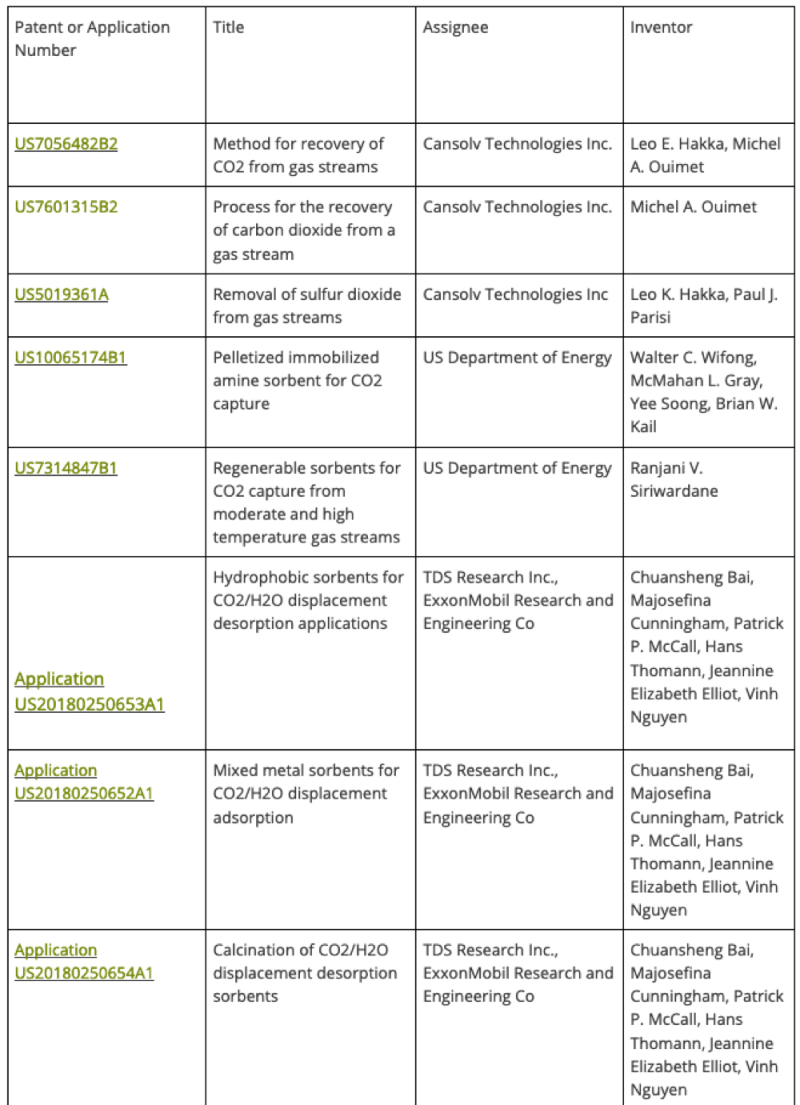
    The table below highlights patents and published applications related to CO2 capture technologies.

    Table 1a Table 1b Table 1c

    * Brian Pattengale is a Postdoctoral Associate in the Energy Sciences Institute at Yale University, where he is investigating the photodynamic properties of emerging materials and their catalytic/photocatalytic applications to reactions such as water splitting or carbon dioxide reduction.  Prior to his position at Yale, Brian obtained his Ph.D. in Physical/Materials Chemistry at Marquette University, where he published numerous papers using ultrafast transient absorption and synchrotron X-ray absorption spectroscopies to study functional light absorbing and photocatalytic materials.
    ** Dr. Sabatelli is Patent Counsel with Wiggin and Dana LLP

    1 https://climate.nasa.gov/vital-signs/carbon-dioxide/ — image

    2 https://climate.nasa.gov/evidence/

    3 https://pubs.acs.org/doi/pdf/10.1021/am507465f – co2 capture review

    4 shell cansolv https://www.shell.com/business-customers/global-solutions/gas-processing-licensing/licensed-technologies/shell-cansolv-gas-absorption-solutions/cansolv-co2-capture-system.html

    5 Cebrucean, D.; Cebrucean V. and Ioana Ionel. "CO2 Capture and Storage from Fossil Fuel Power Plants" 2014, 63, 18-26

    6 https://www.nytimes.com/2018/02/28/climate/remove-co2-from-air.html

  • By Donald Zuhn –-

    Doggett  LloydA bill introduced in the House last July by Rep. Lloyd Doggett (D-TX) (at right), which could adversely impact pharmaceutical manufacturers holding drug patents, is starting to draw the attention of those outside the patent community.  Last week, National Public Radio reported on the bill (H.R. 6505), entitled the "Medicare Negotiation and Competitive Licensing Act of 2018," which would "require the Secretary of Health and Human Services to negotiate prices of prescription drugs furnished under part D of the Medicare program."  In particular, the Secretary would negotiate with pharmaceutical manufacturers the prices (including discounts, rebates, and other price concessions) of prescription drugs during a negotiated price period.  In conducting such negotiations, the bill sets out six factors that the Secretary shall take into account when negotiating such drug prices:

    • The comparative clinical effectiveness and cost effectiveness, when available from an impartial source, of such drug.
    • The budgetary impact of providing coverage of such drug.
    • The number of similarly effective drugs or alternative treatment regimens for each approved use of such drug.
    • The associated financial burden on patients that utilize such drug.
    • The associated unmet patient need for such drug.
    • The total revenues from global sales obtained by the manufacturer for such drug.

    One provision of the bill on which pharmaceutical manufacturers have likely focused states that:

    [I]n the case that the Secretary is unable to successfully negotiate an appropriate price for a covered part D drug for a negotiated price period, the Secretary shall authorize the use of any patent, clinical trial data, or other exclusivity granted by the Federal government with respect to such drug as the Secretary determines appropriate for purposes of manufacturing such drug for sale under a prescription drug plan or MA–PD plan.

    The bill requires "[a]ny entity making use of a competitive license to use patent, clinical trial data, or other exclusivity [to] provide to the manufacturer holding such exclusivity reasonable compensation," and sets forth the following factors for use by the Secretary in determining such "reasonable compensation":

    • The risk-adjusted value of any Federal government subsidies and investments in research and development used to support the development of such drug.
    • The risk-adjusted value of any investment made by such manufacturer in the research and development of such drug.
    • The impact of the price, including license compensation payments, on meeting the medical need of all patients.
    • The relationship between the price of such drug, including compensation payments, and the health benefits of such drug.
    • Other relevant factors determined appropriate by the Secretary to provide reasonable compensation.

    The bills, which currently has 104 co-sponsors (all of whom are Democrats), was referred to both the House Energy and Commerce Subcommittee on Health and House Ways and Means Subcommittee on Health.  NPR reported that a related bill would soon be introduced in the Senate by Sen. Sherrod Brown (D-OH).