• MBHB Logo 2McDonnell Boehnen Hulbert & Berghoff LLP will be offering a live webinar entitled "The Evolving Provenance of Obviousness-type Double Patenting" on March 19, 2019 from 10:00 am to 11:15 am (CT).  In this presentation, MBHB attorney and Patent Docs author Kevin Noonan and MBHB attorney Sarah Fendrick will explore the evolving provenance of obviousness-type double patenting in addressing the following topics:

    • Traditional confines of the doctrine
    • Federal Circuit expansion in Sun Pharma and Gilead
    Retrenchment in Breckenridge Pharma and Ezra Ventures
    • Future prospects

    While there is no fee to participate, attendees must register in advance.  Those wishing to register can do so here.  CLE credit is pending for the states of California, Illinois, New Jersey, New York, North Carolina, and Virginia.

  • Federal Circuit Bar AssociationThe Federal Circuit Bar Association will be hosting a program entitled "Key Issues Shaping the US IP Landscape" from 10:00 am to 6:00 pm (EST) on March 21, 2019 at the Army and Navy Club in Washington, DC.  Representatives from the judicial, legislative, and administrative communities will explore challenges confronting the IP profession and more during the program.

    Additional information regarding the program, including an agenda and list of speakers, can be found here.  Those interested in registering for the conference can do so here; the registration fee is $550 (FCBA Members) or $850 (non-members).

  • JMLSThe John Marshall Law School Center for Intellectual Property, Information & Privacy Law will be hosting an IP Executive Seminar on "Federal Circuit Practice & Procedure" from 9:00 am to 4:30 pm on March 21-22, 2019 in Chicago, IL.  The program, which will be presented by Donald Dunner of Finnegan, Henderson, Farabow, Garrett & Dunner, LLP, will offer a comprehensive study of the U.S. Court of Appeals for the Federal Circuit (CAFC) and its jurisdiction over patent cases from the perspective of an appellate practitioner.  The course will cover litigation strategies and the process of guiding a client through an appeal.

    Additional information about the program can be found here.  Those interested in registering for the conference online can do so here; the registration fee is $345 (general admission) and JMLS students, staff, and faculty can apply for free registration.

  • IPLACThe Intellectual Property Law Association of Chicago (IPLAC) Biotech Committee will be presenting a panel discussion entitled "IP for Agriculture and Plants" on March 14, 2019 from 12:00 pm to 1:00 pm (CT) at the offices of Taft Stettinius & Hollister LLP in Chicago, IL.  The panel includes Audrey Charles, Patent Agent and Trademark Administrator, Ball Horticultural Company; Diana Horvath of 2Blades Foundation; and Laura Labeots of Husch Blackwell, LLP.

    There is no registration fee for the discussion.  Those interested in registering for event can do so here.

  • Strafford #1Strafford will be offering a webinar entitled "Drafting Software Patents to Survive Section 101 and AIA Challenges — Anticipating and Minimizing the Risk of 101, 103 Rejections, Recent Court Guidance" on March 20, 2019 from 1:00 to 2:30 pm (EDT).  Michael L. Kiklis of Bass Berry & Sims and Stephen G. Kunin of Maier & Maier will guide patent practitioners on how to draft their patent applications to overcome both Section 101 and AIA challenges. This panel has decades of experience in Section 101 and has represented patent owners numerous times in AIA reviews.  The webinar will review the following issues:

    • What are the hurdles for patent counsel to demonstrate a software-related claim is not abstract?
    • In the event an abstract idea is identified, how can patent practitioners pass Alice's step two?
    • What guidance have the courts provided in recent decisions concerning patent eligibility for software-related inventions?
    • What best practices should counsel use to help software-related inventions survive AIA challenges?

    The registration fee for the webcast is $347.  Those interested in registering for the webinar, can do so here.

  • IPLACThe Intellectual Property Law Association of Chicago (IPLAC) International Patent Committee will be presenting a program entitled "Japanese Patent Practice-Specialty Areas" on March 19, 2019 from 11:45 am to 1:00 pm (CT) at DePaul College of Law in Chicago, IL.  Part 1 of the program will address "How to pursue an invention directed to a method for treating a human body in Japan," and Part 2 of the program address the "JPO's Examination Guidelines on Internet of Things and Artificial Intelligence."  Each part of the program will include a discussion of the JPO's Examination Guidelines, comparison of JP practice with U.S. practice from a point of view of the examination guidelines, and a discussion of how to draft specification/claims in conformity with JP practice.

    The registration fee for the presentation is $20 (non-members), $10 (IPLAC members), or free (students).  Those interested in registering for event can do so here.

  • By Kevin E. Noonan

    Rosa_chinensis_1795A rose may be a rose may be a rose (to paraphrase Gertrude Stein) but genetically roses (like many plant species) are wickedly complex.  The genus Rosa comprises about 200 species, although only 8-20 species are thought to have contributed to modern rose cultivars.  Rose genomic complexity is expressed, inter alia, in their chromosome structures, which is a genetic patchwork of sequences from a large number of cultivars, and as with many plants a significant percentage of Rosa species (about half) are polyploid.  The evolutionary history of these species has involved reticulate evolution, interspecific hybridization, introgression and polyploidization, which has contributed to the genetic variability and chromosome structure.  This provides broad phenotypic variability, in flower size, color, fragrance, medicinal properties, and other features selected for not (just) naturally but by generations of plant breeders.  For example, one of the first hybrids, "La France," produced in Europe beginning in the 18th Century, combined "growth vigor" characteristic of European rose varieties with the propensity for current blooming characteristic of Chinese roses (as well as color and scent signatures).  And this genetic complexity has made determining the rose genomic DNA sequence particularly difficult, despite its relatively small size (560 Mb).

    Last spring (appropriately) a team of scientists* revealed the first compilation of the rose genome in a paper published in Nature Genetics entitled "The Rosa genome provides new insights into the domestication of modern roses."  Relevant to the genetic mosaicism referenced above, these authors needed to produce a "homozygous" genotype from one of the heterozygous diploid rose progenitors, Rosa chinensis "Old Blush," in order to produce a reliable genomic rose sequence.  Upon sequencing, these scientists were able to produce 7 "pseudo chromosomes" corresponding to a homozygous genome; in nature roses have 7, 14, 28, 35, or 42 chromosomes.  The sequenced data suggested there are 36,377 protein-coding genes and almost 4,000 long noncoding RNA sequences in the rose genome.  Transposable elements comprised almost 68% of the rose genome, with long terminal repeat retrotransposons representing about half of these sequences.  Comparisons between related species permitted these researchers to identify an ancestral karyotype having 9 protochromosomes and 8,861 protogenes, with the ancestral strawberry and rose genomes were modeled into 8 protochromosomes comprising 13,060 protogenes, produced by two ancestral chromosomes fusions and one chromosome fission; the authors report that the strawberry ancestral genome experienced an extra fusion resulting in the modern genome, where the rose genome experienced one fission and two fusions, independently of strawberry.

    Turning to modern rose cultivars, sequencing detected "discrete levels of variant density along the genomes of hybrid cultivars" that could "reflect different introgression histories."  Three ancestral pools of diversity representing combinations of Cinnamomeae, Synstylae and Chinenses cultivar genomes could be found in various of the mosaic chromosomes detected by their sequencing results.  These results then were extended to identify candidate genes that may be involved in recurrent blooming (contributed by the Rosa chinensis ancestor.  One of these genetic events is "insertion of a [transposable element] in TFL1 (RoKSN), a repressor of floral transition responsive to activation by gibberellic acid," considered according to these authors as a major determinant in recurrent blooming and having arisen in Rosa chinensis cultivarsThe authors also report that two candidates for s second, recently detected locus associated with recurrent blooming, as being either "transcription factor SPT [] which is known to control flowering in Arabidopsis" and "DOG1, which is known to modify flowering by acting on miR156."

    Finally, these authors report "[d]ata mining of the rose genome combined with in-depth biochemical and molecular analyses of volatile organic compounds permitted identification of at least 22 biosynthetic steps in the terpene pathway that have not been characterized in the rose, two of which have not previously been characterized in other species."  These studies result in a proposal that negative regulation by microRNA mi156 of repressor of anthocyanin biosynthesis (SPL9) provides a regulatory hub that "orchestrates the coordination of production of both colored anthocyanins and certain terpenes," as illustrated in Figure 3 of the paper (click on image to enlarge):

    Figure 3
    The paper concludes by noting both the scientific benefits of the study and its practical implications:

    The very high-quality rose genome sequence reported in this study, combined with an expert annotation of the main pathways of interest for the rose . . . provides new insights into the genome dynamics of this woody ornamental and offer a basis to disentangle the seemingly mandatory trait associations or exclusions.  Furthermore, access to candidate genes, such as those involved in abscisic acid synthesis and signaling, paves the way for improving rose quality with better water-use efficiency and increased vase life.  Breeding for other characteristics such as increased resistance to pathogens should also benefit from these data and may lead to decreased use of pesticides.

    The rose is one of the most commonly cultivated ornamental plants anywhere in the world, making understanding of rose genetics economically as well as scientifically important.

    • Olivier Raymond, Jérémy Just, Marion Verdenaud, Philippe Vergne, Sébastien Carrère, Judit Szécsi, Léa François, Annick Dubois, Antoine Larrieu, Lauriane Perrier, Priscilla Villand, Claudia Bardoux, Véronique Boltz, Teva Vernoux, Michiel Vandenbussche & Mohammed Bendahmane** from the Laboratoire Reproduction et Développement des Plantes, Univ Lyon, ENS de Lyon, UCB Lyon 1, CNRS, INRA, Lyon, France; Jérôme Gouzy, Hélène Badouin & Ludovic Cottret from LIPM, Université de Toulouse, INRA, CNRS, Castanet-Tolosan, France; Hélène Badouin from Univ Lyon, Université Lyon 1, CNRS, Laboratoire de Biométrie et Biologie Evolutive UMR5558, Villeurbanne, France; Marion Verdenaud, David Latrasse, Magali Perez, Adnane Boualem, Abdelhafid Bendahmane & Moussa Benhamed from the Institute of Plant Sciences Paris-Saclay (IPS2), CNRS, INRA, University Paris-Sud, University of Evry, University Paris-Diderot, Sorbonne Paris-Cite, University of Paris-Saclay, Orsay, France; Arnaud Lemainque, Arnaud Couloux, Jean-Marc Aury, Mohammed-Amin Madoui, Karine Labadie & Patrick Wincker from CEA–Institut de Biologie François Jacob, Genoscope, Evry, France; Sandrine Moja, Jean-Claude Caissard & Sylvie Baudino from Univ Lyon, UJM-Saint-Etienne, CNRS, Saint-Etienne, France; Nathalie Choisne & Hadi Quesneville from UR1164–Research Unit in Genomics-Info, INRA, Université Paris-Saclay, Versailles, France; Caroline Pont & Jérôme Salse from INRA/UBP UMR 1095 Genetics, Diversity and Ecophysiology of Cereals, Clermont-Ferrand, France; Xiaopeng Fu from Key Laboratory of Horticultural Plant Biology, College of Horticulture & Forestry Sciences, Huazhong Agricultural University, Wuhan, China; Shu-Hua Yang from Institute of Vegetables and Flowers, Chinese Academy of Agricultural Sciences, Beijing, China; Florence Piola from Univ Lyon, Université Claude Bernard Lyon 1, CNRS, ENTPE, UMR5023 LEHNA, Villeurbanne, France; Benjamin Govetto, Yoan Labrousse & Manuel Le Bris from Aix Marseille Université, Avignon Université, CNRS, IRD, IMBE, Institut Méditerranéen de Biodiversité et d'Ecologie, Marseille, France; Céline Lopez-Roques from INRA, US 1426, GeT-PlaGe, Genotoul, Castanet-Tolosan, France; Pascal Heitzler from Institut de Biologie Moléculaire des Plantes, CNRS, UPR 2357, Strasbourg, France; Chang Liu from Center for Molecular Biology (ZMBP), University of Tübingen, Tübingen, Germany; and Patrick Wincker from CNRS, Université d'Evry, UMR 8030, Evry, France.
      ** Corresponding author
  • By Josh Rich

    Supreme Court Building #1On the same day that the Supreme Court decided what the term "full costs" means under the Copyright Act,[1] it granted certiorari to consider what "all the expenses of [a district court review] proceeding" means under the Patent Act in Iancu v. NantKwest, Inc.  Specifically, according to the question presented by the U.S. Patent and Trademark Office, the Supreme Court agreed to resolve "[w]hether the phrase '[a]ll the expenses of the proceedings' in 35 U.S.C. 145 encompasses the personnel expenses the USPTO incurs when its employees, including attorneys, defend the agency in Section 145 litigation."

    Section 145 provides one of two routes for review of an adverse PTAB decision in a prosecution appeal.  In contrast to § 141, which is a direct appeal to the Federal Circuit with traditional deference to the Office's decision, § 145 permits an aggrieved applicant to present new evidence for de novo review in a District Court.  The statute provides that cost for that "[a]ll the expenses of the proceedings shall be paid by the applicant."  As we have reported in prior posts, the decisions in the NantKwest case bounced back and forth between finding that "expenses" includes attorney's fees and that it does not.  First, the District Court found that "expenses" did not include Patent Office attorney's fees.  On appeal, a panel of the Federal Circuit found that the term did include these expenses, over a dissent from Judge Stoll.[2]  But, sua sponte, the Federal Circuit granted review en banc[3] and reversed the panel holding with a 7-4 decision written by Judge Stoll.[4]

    In petitioning for certiorari, the USPTO argued that the en banc Federal Circuit decision was incorrectly decided; in addition, the Office raised three points as to why the Court should review specifically this decision.

    In arguing that the case below had been wrongly decided, the Office leaned heavily on two key sources: the 1836 Patent Act immediately prior to the enactment of § 145's predecessor and Shammas v. Focarino, 784 F.3d 219 (4th Cir. 2015), which involved applying an expense provision of the Lanham Act substantively identical to that of § 145.

    The 1836 Act referred to a "patent fund" used "for the payment of salaries of the officers and clerks herein provided for, and all other expenses of the Patent Office."[5]  Certain contemporaneous dictionaries (as well as current ones) also reflected that expenses can include the cost of labor.  But the Patent Office's course of conduct over the next 170 years did not reflect such an understanding of the meaning for "expenses."  The Office characterized its actions as exercising its discretion not to pursue attorney's fees — even for two years after the enactment of the AIA — but the truth is that it never asserted that it was entitled to such fees until the NantKwest case.

    The Shammas decision provided a contemporary insight into the meaning of § 145's "expenses" provision. The Lanham Act has a de novo review provision that was intentionally modeled on § 145; indeed, it originally referenced § 145's expenses provision rather than having its own.  The Fourth Circuit found that the Lanham Act provision included attorney's fees as part of the USPTO's expenses under that provision.

    In addition to these substantive arguments for review, the USPTO raised three other points as to why the Court should review this case.  First, the decision below was decided by the Federal Circuit en banc.  As a result, it would be binding on any subsequent trial court or Federal Circuit panel without further close consideration of the issue.  Thus, this case presented a unique final opportunity to consider a carefully reasoned decision on the particular point at issue.  Second, the NantKwest decision created a circuit split over two nearly identical statutory provisions in light of the Fourth Circuit's Shammas decision.  Third, the decision would have "significant practical consequences" for the USPTO in § 145 proceedings.  The greatest expense for the Office in such proceedings is often the salaries of the personnel (especially attorneys) working on the matter.  While the cost of those salaries may not be overwhelming in the face of the entire budget of the USPTO, they are significant — in this case, over $78,000 — and it would arguably be more consistent with the statutory intent to have the § 145 appellant bear them than pass them on to other patent applicants.

    NantKwest responded to the petition and argued that the case below, rather than the Shammas case, was correctly decided.[6]  The strong presumption in U.S. courts, unlike for example British courts, is that every party will bear its own attorney's fees regardless of the outcome of the case — a presumption known as the American Rule.  The Supreme Court has repeatedly held that a statute must specifically and explicitly provide for the allowance of attorneys' fees if it is intended to deviate from the American Rule.  NantKwest argued that the Federal Circuit was correct in finding that § 145 did not reflect a specific and explicit exception to the Rule, and therefore did not intend to hold an applicant liable for the USPTO's attorneys' fees.

    NantKwest relied on a case decided between Shammas and the decision below, Baker Botts L.L.P. v. ASARCO LLC, 135 S. Ct. 2158 (2015).  According to NantKwest, not only did Baker Botts reflect the Supreme Court's rejection of the Shammas case's decision to ignore the American Rule in considering the Lanham Act analogue to § 145's expenses provision, it alleviated any risk of a circuit split — because Shammas was pre-Baker Botts and allegedly wrongly decided under the Supreme Court case, it should simply be ignored as having been incorrectly decided.  NantKwest also argued that cases involving statutes that allow non-prevailing parties to recover attorneys' fees start with the presumption of the American Rule and work from there; only by ignoring rather than expressly overcoming the American Rule, however, had Shammas and the panel below reached the decision that "expenses" should include attorneys' fees.

    Ultimately, the Supreme Court found the Office's arguments sufficiently meritorious — and the case compelling enough — to decide the question.  Unfortunately, certiorari was granted too late on the Court's calendar to have the case heard this term.  Thus, we will have to wait until at least October to get an answer as to what constitutes "expenses" under § 145.

    [1] See Rimini Street, Inc. v. Oracle USA, Inc., No. 17-1625, __ U.S. __ (Mar. 4, 2019).
    [2] https://www.patentdocs.org/2017/06/nantkwest-inc-v-matal-fed-cir-2017.html
    [3] https://www.patentdocs.org/2017/08/federal-circuit-orders-rehearing-en-banc-in-nantkwest-v-matal.html
    [4] https://www.patentdocs.org/2018/07/nantkwest-inc-v-iancu-fed-cir-2018-en-banc.html
    [5] See Act of July 4, 1836, ch. 357. §9, 5 Stat. 121 (emphasis added).
    [6] An interesting quirk in the case is that NantKwest is represented by Director Iancu's old law firm, Irell & Manella.

  • By Brian Pattengale* and Anthony D. Sabatelli** —

    Lowering carbon dioxide (CO2) levels in our atmosphere is one of the most important challenges to be overcome in the next century.  While fossil-fuel fired plants produce a visible smoke consisting almost entirely of water vapor, the invisible CO2 released along with it is the real concern.  In a previous article, we highlighted the IP aspects of carbon capture technologies and the chemistry that is involved in the various processes (see "Rising Carbon Dioxide Levels: Capture Methods & Patent Trends").  Industrially, CO2 is most predominantly used as an inert gas in various chemical and manufacturing processes, as a propellant, or to make dry ice which is the solid form of CO2.1 All of these applications simply end up releasing CO2 into the atmosphere, negating the effects of capture.  In order to achieve the goal of lowering CO2 emissions, captured CO2 must be either stored permanently or chemically converted into another substance.  These two distinct processes, known as sequestration and conversion, respectively, are both potentially viable, and even profitable processes.  Entrepreneurial ventures are already bringing carbon-conscious products to market that consume CO2 during their manufacturing.  The developments and intellectual property associated with CO2 sequestration and conversion are the focus herein.

    Carbon Sequestration

    CO2 sequestration, broadly defined, is the process of permanently storing CO2.  One of the first industrial examples of CO2 sequestration is the Sleipner gas field off the coast of Norway.  This is a natural gas field with a high CO2 content of 9%.  This high level of CO2 is nearly four times the Norwegian government emission limit of 2.5%, which if exceeded, would trigger large carbon emission fee penalties for the operator, Statoil Petroluem.  To comply with this limit, the CO2 was pumped into the Utsira formation, which is a saline aquifer in the North Sea that was identified as a possible reservoir.2 From its inauguration in 1996 to 2008, the CO2 sequestration efforts at Sleipner resulted in the storage of 10 million tons of CO2.  The operation is still ongoing.Statoil Petroleum holds patents related to methods for storing carbon dioxide in geologic formations (US9586759B2 & US9815626B2).

    While storing CO2 in geologic formations is evidently a viable option for CO2 sequestration, scientists have been exploring other methods.  These technologies rely on storing CO2 in a chemical form that is stable, easy to store, and can support a high CO2 density.  A recent patent application (US20170274318A1) describes a process that uses ammonia to capture gaseous CO2 to form an aqueous ammonium carbonate solution.  This aqueous carbonate is then subjected to an ion exchange reaction with a cation, such as sodium or potassium under conditions that form a solid carbonate.  Following the exchange reaction, the CO2 sequestering carbonate is recovered, and the ammonia is regenerated to be reused for the capture cycle.  The sodium carbonate, potassium carbonate, or other carbonates are then stored.  Notably, these carbonates are also industrially useful for making glass, water softening, and other various uses.

    Another patent application to ExxonMobil Research and Engineering Co (US20180229178A1) describes a process for sequestering CO2 as a clathrate.  A clathrate is a crystal host that traps a molecular guest inside of its structure — sort of a "molecular cage".  In the described process, the CO2 is trapped under pressure in a network of water molecules.  The application also describes various chemical additives or "promoter molecules" to facilitate forming and stabilizing the clathrate.  It is then encapsulated in a molecular barrier that prevents CO2 escape.  The barrier-encapsulated clathrate containing the captive CO2 can then be deposited on the sea floor at depths of over 100 meters, where the pressure ensures the stability of the clathrate.  This method could provide a feasible option in offshore locations where geologic reservoirs are unavailable for sequestration.

    Carbon Conversion

    In the above sequestration examples, CO2 is stored permanently in either a reservoir or converted to a different chemical form from which CO2 can be released, if desired.  In contrast, carbon conversion can be delineated as converting it into a new product by decreasing the oxidation state of carbon successively until a desired stable product is reached.  This process if often referred to as CO2 reduction.  Products of CO2 reduction include formaldehyde, methanol, methane, ethylene, and ethanol, amongst others.  In addition to consuming CO2, the products produced are value-added products that are of industrial, pharmaceutical, or other uses.  Reduction of CO2 is often achieved using electrolysis, which is a widely used process in industry that produces products such as aluminum, sodium hydroxide, or electroplated layers.  Electrolysis requires electricity, which is currently produced primarily by fossil fuel combustion.  There is, however, opportunity to develop solar-powered CO2 electrolysis systems that would not re-contribute to carbon pollution.

    CO2 electrolysis is not currently prevalent in industry because it is difficult to perform, and it is challenging to control which reduction product is obtained (i.e., the reaction is not usually selective to a single product).  In addition, a common byproduct of CO2 electrolysis is hydrogen gas, particularly when non-selective catalysts are used.  Scientists are therefore working to develop new catalysts that reduce CO2 efficiently and achieve selectivity, which is defined as the ability to form one of the specific products listed above without forming the others or byproducts such as hydrogen gas.  In the following examples, there is a focus on electrocatalytic systems of different design/catalyst composition and factors that affect selectivity.

    The least challenging reaction is the reduction of CO2 to CO.  Toyota Motor Corp. patented a CO2 reduction system employing an anodized silver electrode as the catalyst (US9435042B2).  It was found that anodization time greatly affected the CO selectivity, where longer time is reported to give a more selective electrode, reaching approximately 70% CO.  Toshiba Corp has filed an application for an analogous system that employs a molecular catalyst species known as a metalloporphyrin as the electrocatalyst material (US20180066370A1), reaching 60% CO selectivity.  Another system was reported by Toshiba consisting of gold particles synthesized in a specific manner that reaches >90% selectivity for CO (US20170073825A1).

    Catalysts that form further products typically form a mixture of products containing CO and other products due to the complexities of the reactions involved, however any appreciable efficiency and selectivity for a complicated product is of interest in the field.  Panasonic reports a system composed of crystalline copper phthalocyanine, a molecular species, that produces predominantly ethylene (C2H4) at 40% efficiency (US20180142365A1).  Researchers at the California Institute of Technology discovered that a selectivity-determining layer composed primarily of organic molecules can be added to electrodes to tune the selectivity, where 41% selectivity for ethylene was reached (US20180291515A1).

    Some additional systems aim to utilize the machinery within cells and microorganisms to perform CO2 transformation, requiring careful interfacing of gas and reactant feedstocks with the bioreactor system.  An example (US10131924B2) requires the addition of an organic intermediate compound that is combined with CO2 to form more complex products.  Perhaps the most impressive system to date in this category splits water using H2 and O2, and then H2 is combined with CO2 by a bacterial species that, all together, exceeds the efficiency of natural photosynthesis (US20180265898A1).

    Finally, it is worth noting that CO2 transformation has become more than a research venture, with entrepreneurs seeking to bring some exciting technologies to market.  Novomer developed a process to combine CO2 with epoxides to form polymers, useful plastic materials (US8247520B2).  Another company, Liquid Light, holds many patents related to CO2 reduction technologies and is backed by investors such as BP Ventures and The Coca-Cola Company, the latter of which is interested in a precursor for plant-based plastic bottles.4 ­ Catalytic Innovations, a startup focused on CO2 transformation and oxidation catalysis, has recently applied to patent a process for efficiently converting CO2 to alcohols such as ethanol (WO2018071818A9).  The ethanol produced will be consumer-grade and will be used in products such as perfume and spirits.5

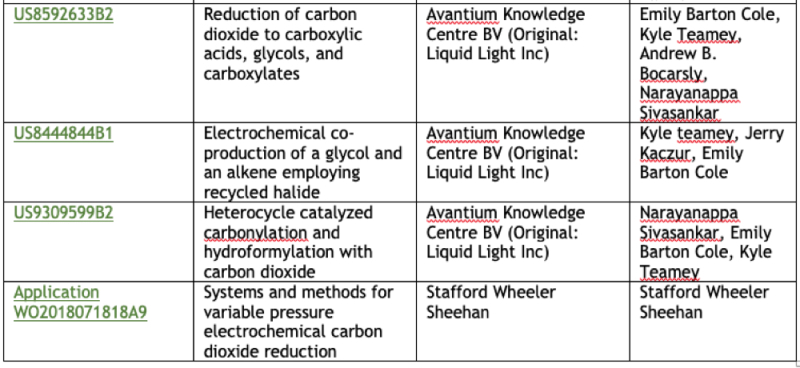
    The table below highlights patents and published applications related to CO2 sequestration and conversion technologies.
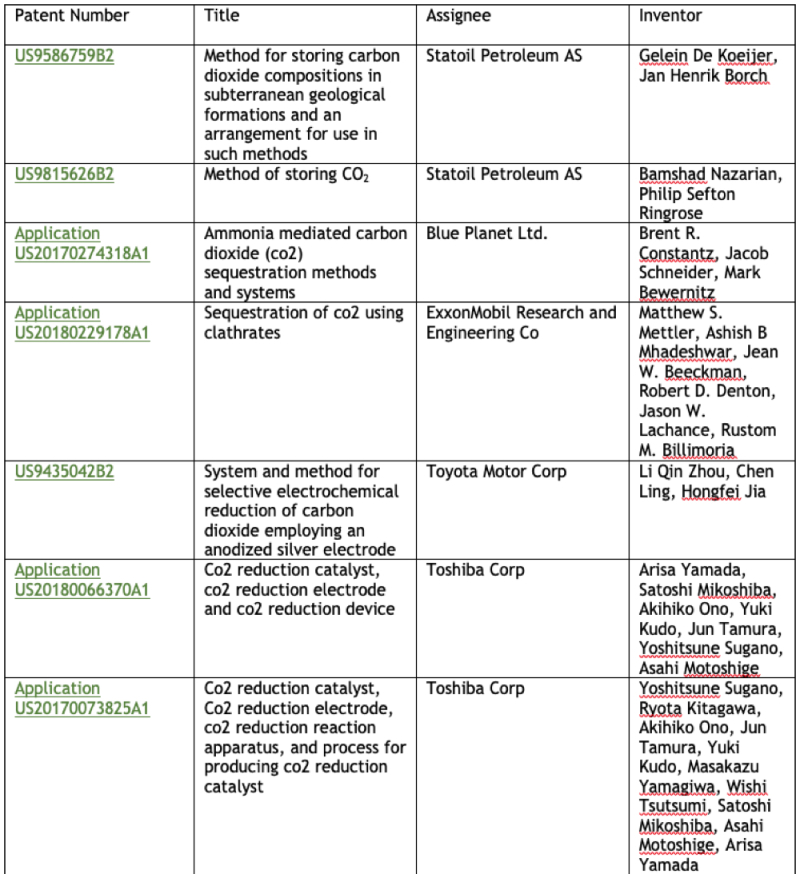
    Table 1a Table 1b Table 1c

    * Brian Pattengale is a Postdoctoral Associate in the Energy Sciences Institute at Yale University, where he is investigating the photodynamic properties of emerging materials and their catalytic/photocatalytic applications to reactions such as water splitting or carbon dioxide reduction.  Prior to his position at Yale, Brian obtained his Ph.D. in Physical/Materials Chemistry at Marquette University, where he published numerous papers using ultrafast transient absorption and synchrotron X-ray absorption spectroscopies to study functional light absorbing and photocatalytic materials.
    ** Dr. Sabatelli is Patent Counsel with Wiggin and Dana LLP


    1
    http://www.uigi.com/carbondioxide.html

    2 Schepper, S.D.; Mangerud, Gunn. Norwegian Journal of Geology. 2017, 97, 305.

    3 Akervoll, I; Lindeberg, E; Lackner A. Energy Procedia. 2009, 1, 2557-2564.

    4 https://llchemical.com/news/liquid-light-signs-agreement-further-advance-its-cosub2sub-chemicals-technology/

    5 https://www.americaninno.com/rhodeisland/rhode-island-startup/catalytic-innovations-aims-to-create-carbon-negative-consumer-products/

  • CalendarMarch 5, 2019 – Customer partnership meeting of Technology Center 2600 (U.S. Patent and Trademark Office) – 8:30 am to 4:00 pm (EST), USPTO's Madison Auditorium, North, Alexandria, VA

    March 5, 2019 – "The USPTO's Updated Guidance on Section 101: Adjusting Your IP Evaluations for Maximum Protection" (Technology Transfer Tactics) – 1:00 pm to 2:00 pm (ET)

    March 5, 2019 – "Celebrating Women in Innovation" (U.S. Patent and Trademark Office) – 4:00 pm to 5:30 pm (ET), Alexandria, VA

    March 5, 2019 – "The Impact of Recent Cases Addressing Patent Term: Insights for Patent Prosecution and Litigation" (Intellectual Property Owners Association) – 2:00 to 3:00 pm (ET)

    March 5, 2019 – "The Chinese Intellectual Property Framework — Structural Changes" (Pracitising Law Institute) – 1:00 to 2:00 pm (ET)

    March 7, 2019 – "Functional Claiming for Mechanical and Electrical Arts — Surviving 112(f) and Disclosing Functional Basis to Meet Heightened Standard of Review" (Strafford) – 1:00 to 2:30 pm (EST).

    March 12, 2019 – "Practical Tips on Patent Prosecution in India and China" (J A Kemp) – 3:30 to 4:30 pm (GMT)

    March 12, 2019 – Customer partnership meeting of Technology Center 2800, Semiconductor/Memory Workgroup and Printing/Measuring and Testing Workgroup (U.S. Patent and Trademark Office) – 12:00 pm to 4:30 pm (EDT)

    March 14, 2019 – "Obvious-Type Double Patenting and PTEs After Breckenridge Pharmaceutical and Ezra Ventures LLC Decisions" (Strafford) – 1:00 to 2:30 pm (EDT)