• By Kevin E. Noonan —

    Durum wheat, Triticum turgidum L. ssp. durum (Desf.) Husn., used principally for pasta production, was derived from wild emmer wheat, T. turgidum ssp. dicoccoides (Körn. ex Asch. & Graebn.) Thell. from domesticated emmer wheat, T. turgidum ssp. dicoccum (Schrank ex Schübl.) Thell. about 10,000 years ago in the Fertile Crescent.  Domesticated wheat became established as a human food source 1,500-2,000 years ago, characterized by an initial domestication phase followed by continued evolution through further domestication and selective breeding.

    This week, a group* of international researchers disclosed the genome DNA sequence of domesticate Durum wheat in a paper entitled "Durum wheat genome highlights past domestication signatures and future improvement targets" and published in Nature Genetics.  The paper reports elucidation of the 10.45 Gigabase genome from durum wheat cultivar Svevo and identified regions of the wheat genome selected for by thousands of years of selective breeding by humans.  For example, a region on chromosome 5B carries a locus of a metal transporter (TdHMA3-B1) having a non-functional variant associated with cadmium accumulation and characteristic of Durum cultivars and not found in wild emmer wheat.  The durum wheat genome is illustrated in the paper as follows:
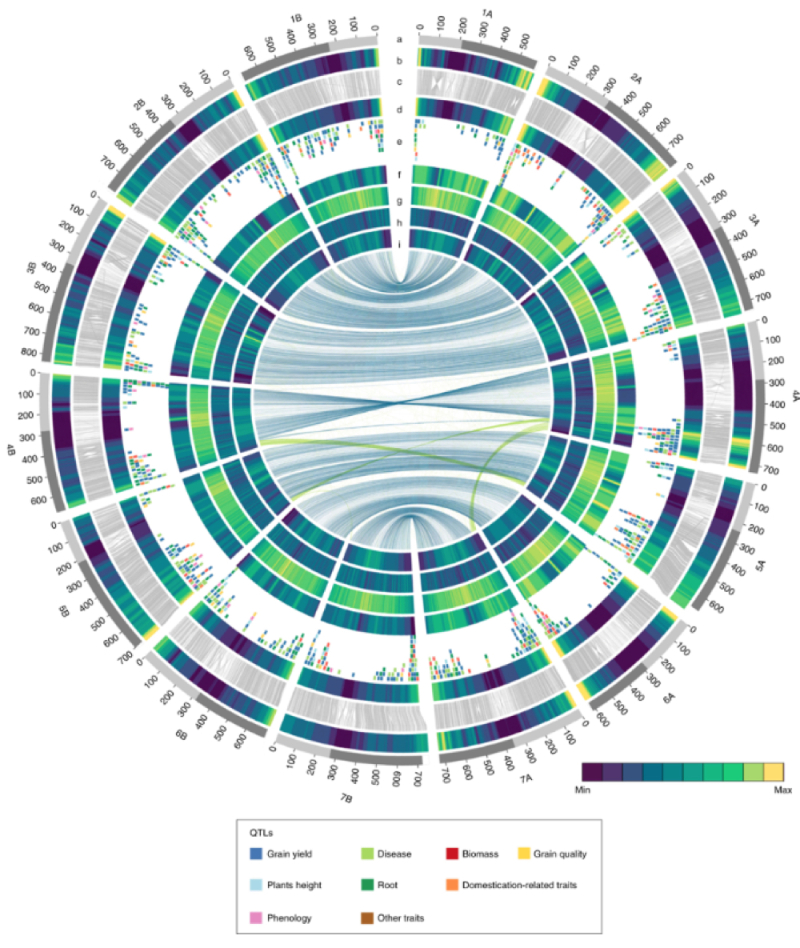
    Image 2The genome is segregated into 14 chromosomes, designated 1A/1B through 7A/7B in the Figure.  The distal regions of these chromosomes, representing about 22% of the genome, are highly recombinogenic according to the authors, as illustrated by high-density single nucleotide polymorphism (SNP) maps, showing an almost linear relationship between physical and genetic distance as ascertained by recombination.  The pericentromeric regions, on the other hand, show almost no recombination and represent about 44% of the genome.  Analysis disclosed 66,559 "high confidence (HC)" genes, with about 91% of these being detected as expressed in assembled gene expression data sets; these relationships are illustrated in Supplementary Figure 1 from the paper:
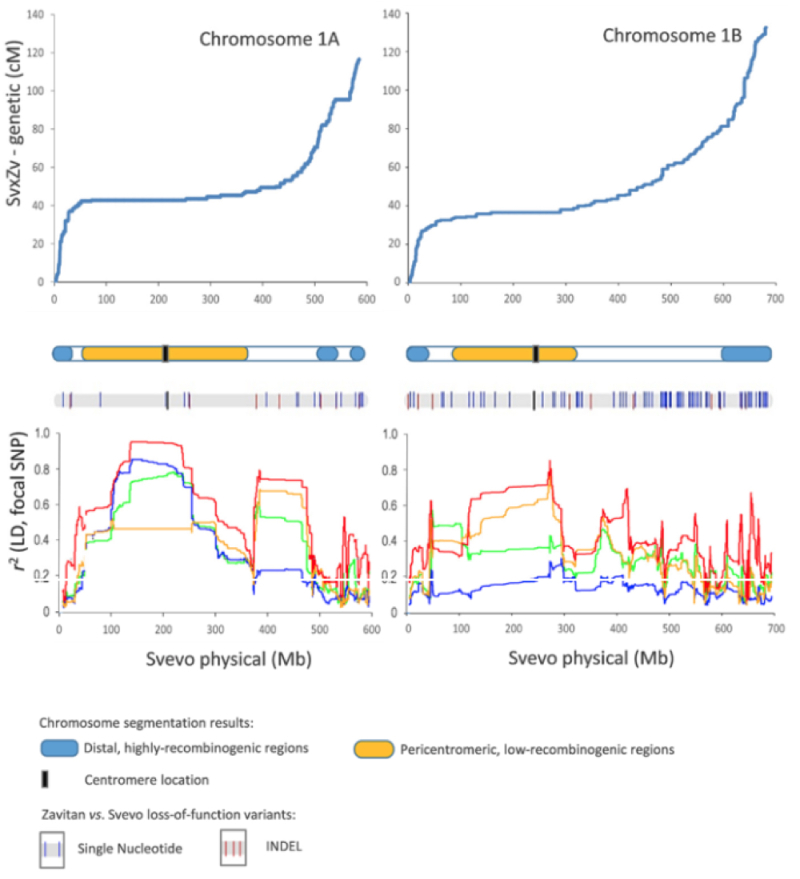
    Image 3The periocentric regions also showed a diminution in diversity that arose during domestication from wild emmer wheat to domesticated durum emmer wheat, particularly associated with chromosomes 2A, 4A, 4B, 5A, 5B, 6A, and 6B.  As disclosed in the paper, "several reductions in diversity (75 with diversity reduction index > 2) were specifically associated with breeding of modern durum cultivars, including some associated with disease resistance (for example, Sr13; ref. 29 and Lr14; ref. 30) and grain yellow pigment content loci (for example, Psy-B1; ref. 31)."

    Comparison between the Durum wheat genome and the progenitor wild emmer wheat genome showed strong overall synteny and high degree of similarity in total HC gene number (66,559 vs. 67,182).  LTR-Retrotransposon insertion sites were also found to be syntenic, resulting from the relatively short time since divergence of these cultivars.  Analysis of related gene clustering showed 36,434 "unigene" groups, 28,794 of which (79%) belonged to clusters having at least two members and 21% (7,640) being single genes.

    In particular, the paper describes a candidate gene, Cdu-B1, located on chromosome 5B associated with differences in cadmium (Cd) accumulation in durum wheat.  High throughput sequencing and comparison between genomic regions associated with this gene identified a region of increased sequence variation that was determined to encode a metal transporter, TdHMA3-B1; these experiments are illustrated in Supplementary Figure 6:

    Image 4

    Alleles of the TdHMA3-B1 gene were found to discriminate between low- and high-Cd accumulating wheat genotypes, as illustrated in Supplementary Figure 7:

    Image 5The extensive genetic comparisons (set forth predominantly in the Supplementary datasets) provided the bases for the authors' conclusions:

    Access to the fully annotated genome sequence in combination with the wealth of genotypic, genetic mapping and gene expression data provides great potential for future innovation for the wheat scientific community and the breeding sector.  Gene discovery, quantitative trait loci (QTL) cloning and the precision of genomics-assisted breeding to enhance grain quality and quantity of pasta wheat will benefit from the resources presented here.  Furthermore, the durum sequence provides a fundamental tool to more effectively bridge and harness the allelic diversity present in wheat ancestors most of which remains largely untapped.

    * Marco Maccaferri, Danara Ormanbekova, Elisabetta Frascaroli, Simona Corneti, Silvio Salvi & Roberto Tuberosa, Department of Agricultural and Food Sciences, University of Bologna, Bologna, Italy; Marco Maccaferri, Pasquale De Vita, Daniela Marone, Nicola Pecchioni & Anna M. Mastrangelo, Research Centre for Cereal and Industrial Crops, Foggia, Italy; Neil S. Harris, Kevin Y. H. Liang & Gregory J. Taylor, Department of Biological Sciences, University of Alberta, Edmonton, Alberta, Canada; Sven O. Twardziok, Heidrun Gundlach, Manuel Spannagl, Danara Ormanbekova, Thomas Lux, Verena M. Prade & Klaus F. X. Mayer, Helmholtz Zentrum München, Plant Genome and Systems Biology, Neuherberg, Germany; Raj K. Pasam, Reem Joukhadar & Matthew J. Hayden, Agriculture Victoria, Agribio Centre for AgriBioscience, Bundoora, Victoria, Australia; Sara G. Milner, Axel Himmelbach, Martin Mascher & Nils Stein, Leibniz Institute of Plant Genetics and Crop Plant Research, Gatersleben, Germany; Martin Mascher, German Centre for Integrative Biodiversity Research Halle-Jena-Leipzig, Leipzig, Germany; Paolo Bagnaresi, Primetta Faccioli, Francesca Desiderio, Caterina Marè, Cristina Crosatti, Erica Mica, Elisabetta Mazzucotelli & Luigi Cattivelli, Research Centre for Genomics and Bioinformatics, Fiorenzuola d'Arda, Italy; Paolo Cozzi, Massimiliano Lauria, Barbara Lazzari, Alessandra Stella & Aldo Ceriotti, National Research Council—Institute of Agricultural Biology and Biotechnology, Milano, Italy; Andrea Manconi, Matteo Gnocchi, Marco Moscatelli & Luciano Milanesi, National Research Council—Institute of Biomedical Technologies, Segrate, Italy; Raz Avni, Jasline Deek & Assaf Distelfeld, School of Plant Sciences and Food Security, Tel Aviv University, Tel Aviv, Israel; Sezgi Biyiklioglu & Hikmet Budak, Montana State University, Bozeman, MT, USA; Gabriella Sonnante, National Research Council—Institute of Biosciences and Bioresources, Bari, Italy; Hakan Özkan, Çukurova University, Faculty of Agriculture, Department of Field Crops, Adana, Turkey; Benjamin Kilian, Global Crop Diversity Trust, Bonn, Germany; Reem Joukhadar, Department of Animal, Plant and Soil Sciences, La Trobe University, Bundoora, Victoria, Australia; Domenica Nigro, Department of Soil, Plant and Food Sciences, University of Bari Aldo Moro, Bari, Italy; Agata Gadaleta, Department of Agricultural and Environmental Science, University of Bari Aldo Moro, Bari, Italy; Shiaoman Chao, Justin D. Faris & Steven S. Xu, United States Department of Agriculture, Agricultural Research Service, Edward T. Schafer Agricultural Research Center, Fargo, ND, USA; Arthur T. O. Melo & Iago Hale, Department of Agriculture, Nutrition, and Food Systems, University of New Hampshire, Durham, NH, USA; Mike Pumphrey, Department of Crop and Soil Sciences, Washington State University, Pullman, WA, USA; Krystalee Wiebe, Jennifer Ens, Ron P. MacLachlan, John M. Clarke, Sean Walkowiak & Curtis J. Pozniak, Crop Development Centre and Department of Plant Sciences, University of Saskatchewan, Saskatoon, Saskatchewan, Canada; Andrew G. Sharpe & Chu Shin Koh, Global Institute for Food Security, University of Saskatchewan, Saskatoon, Saskatchewan, Canada; Ron Knox, Swift Current Research and Development Centre, Agriculture and Agri-Food Canada, Swift Current, Saskatchewan, Canada; Anna M. Mastrangelo, Research Centre for Cereal and Industrial Crops, Bergamo, Italy; Matthew J. Hayden, School of Applied Systems Biology, La Trobe University, Bundoora, Victoria, Australia; and Klaus F. X. Mayer, School of Life Sciences Weihenstephan, Technical University Munich, Freising, Germany


  • CalendarApril 16, 2019 – "Trade Secrets Litigation 2019: Developments from the Trial Courts to the Supreme Court" (McDonnell Boehnen Hulbert & Berghoff LLP) – 10:00 am to 11:15 am (CT)

    April 18, 2019 – "Antibody Patenting: U.S. and Asian Perspectives" (Strafford) – 1:00 to 2:30 pm (EDT)

    April 18, 2019 – Chicago Regional Seminar (Elijah J. McCoy Midwest Regional Office, U.S. Patent and Trademark Office) – 12:30 to 5:00 pm (CT), Northwestern University Pritzker School of Law, Chicago, IL

    April 22, 2019 – "A conversation with Shawn Springs" (U.S. Patent and Trademark Office) – 11:00 am to noon, Alexandria, VA

    April 29-30, 2019 – Paragraph IV Disputes master symposium (American Conference Institute) – New York, NY

    April 23, 2019 – "Recent Developments in Biopharma Patent Law" (McDonnell Boehnen Hulbert & Berghoff LLP and Patent Docs) – 9:30 am to 1:30 pm, San Diego, CA (Hyatt Regency La Jolla at Aventine)

    April 23, 2019 – "From Boston & Beyond: Local and Global Implications of Recent Changes in Patent Practice" (Federal Circuit Bar Association) – 1:00 pm to 4:30 pm (EST), Suffolk University School of Law, Boston, MA

    April 23, 2019 – "Drafting Patent Applications for AI Systems — Overcoming Patent Eligibility, Inventorship, and Enablement Challenges and Avoiding Rejections" (Strafford) – 1:00 to 2:30 pm (EDT)

    April 24, 2019 – "Recent Developments in Biopharma Patent Law" (McDonnell Boehnen Hulbert & Berghoff LLP and Patent Docs) – 9:30 am to 1:30 pm, Burlingame, CA (Hyatt Regency San Francisco Airport)

    April 25, 2019 – "Drug Substance Patents: FDA Guidance, Protecting Composition-of-Matter Patents, Drafting Solid Form Claims" (Strafford) – 1:00 to 2:30 pm (EDT)

    April 29, 2019 – USPTO World Intellectual Property Day Celebration (U.S. Patent and Trademark Office, World Intellectual Property Organization, American Intellectual Property Law Association, U.S. Chamber of Commerce Global IP Center, International Trademark Association, American Bar Association's Section on Intellectual Property Law, and Intellectual Property Owners Association) – 4:00 to 6:30 pm, Rayburn House Office Building Foyer, Washington, DC

    May 16-17, 2019 – Advanced Summit on Life Sciences Patents (American Conference Institute) – New York, NY

  • MBHB Logo 2McDonnell Boehnen Hulbert & Berghoff LLP and Patent Docs will be hosting two onsite CLE programs on "Recent Developments in Biopharma Patent Law" from 9:30 am to 1:30 pm (PT) on April 23, 2019 in San Diego, CA and on April 24, 2019 in Burlingame, CA.  MBHB attorneys and Patent Docs authors Kevin Noonan and Donald Zuhn, and MBHB attorneys Josh Rich, Lisa Hillman, Sarah Fendrick, John Conour, Nate Chongsiriwatana, and Nicole Grimm will provide presentations on the following topics:

    • Updates on Subject Matter Eligibility Analysis
    • Patenting Repurposed Drugs
    • Antibody Patenting after Amgen v. Sanofi
    •
    The State of Biotech Patenting: Challenges
    • Maximizing Patent Term for Products Subject to Regulatory Review
    • Impact of Secondary Patents on Market Exclusivity
    • Considerations for Biotech Cannabis Patents
    • Strategies for Post-Grant Proceedings for Generics and Biosimilars

    There is no registration fee for the program.  However, because space is limited, those interested in attending the program must register by contacting Susan Hall at hall@mbhb.com.  When registering, please note at which location you plan to attend:  San Diego (Hyatt Regency La Jolla at Aventine) or Burlingame (Hyatt Regency San Francisco Airport).

  • USPTO SealThe U.S. Patent and Trademark Office will be holding two events on April 22 and April 29 to celebrate World IP Day and this year's theme of "Reach for the Gold: IP and Sports."

    The first event, to be held from 11:00 am to noon on April 22 at the USPTO headquarters, will be "A conversation with Shawn Springs," in which former professional football player and entrepreneur Shawn Springs and Deputy Director of the USPTO Laura Peter will discuss Mr. Spring's company Windpact, which uses his patented Crash Cloud technology in football helmets to protect players from severe head injuries.  The technology has applications in a variety of sports, as well as in the automotive industry and military sector.  The event will also be livestreamed.

    Additional information regarding this event can be found here.

    The second event, to be held from 4:00 to 6:30 pm on April 29 in the Rayburn House Office Building Foyer, will celebrate World Intellectual Property Day.  Keynote speaker Dr. Phil Wagner, CEO of Sparta Science, will demonstrate his company's force plate technology, which helps predict injury risks for athletes.  Other speakers will include Deputy Director of the USPTO Laura Peter, Deputy Director General of the World Intellectual Property Organization John Sandage, and members of Congress.  The event will be co-sponsored by the World Intellectual Property Organization (WIPO), the American Intellectual Property Law Association (AIPLA), the U.S. Chamber of Commerce Global IP Center (GIPC), the International Trademark Association (INTA), the American Bar Association's Section on Intellectual Property Law (ABA-IPL), and the Intellectual Property Owners Association (IPO).

    Additional information regarding this event can be found here.

  • USPTO SealThe Elijah J. McCoy Midwest Regional Office of the U.S. Patent and Trademark Office will be holding a Chicago Regional Seminar on April 18, 2019 from 12:30 to 5:00 pm (CT) at the Northwestern University Pritzker School of Law in Chicago, IL.  The seminar agenda includes the following:

    • USPTO Update
    • Patent Quality Update including Federal Register notices 35 USC 101 and 112
    • Patent Application Readiness
    • 101 Panel
    • Ethics and Processional Practice

    There is no registration fee for the seminar.  However, those interested in registering for event can do so here.

  • Strafford #1Strafford will be offering a webinar entitled "Drug Substance Patents: FDA Guidance, Protecting Composition-of-Matter Patents, Drafting Solid Form Claims" on April 25, 2019 from 1:00 to 2:30 pm (EDT).  Eyal H. Barash of Barash Law and Steef Boerrigter of SSCI will guide patent counsel on solid form patents, how to patent them, and challenges that are in the process, and will also discuss implications of the current cocrystal guidance by the FDA and provide a survey of, and lessons from, cases relating to solid form patents.  The webinar will review the following issues:

    • A brief scientific introduction to solid forms
    • What are the critical patentability issues when preparing solid form patents?
    • How are pharmaceutical companies using solid form patents?
    • What is different about claiming solid form patents concerning "organic chemistry" claims in other composition-of-matter patents?
    • What impact does the FDA guidance on cocrystals have on patenting composition of matter?

    The registration fee for the webcast is $347.  Those interested in registering for the webinar, can do so here.

  • Federal Circuit Bar AssociationThe Federal Circuit Bar Association (FCBA) will be offering a CLE program entitled "From Boston & Beyond: Local and Global Implications of Recent Changes in Patent Practice" on April 23, 2019 from 1:00 pm to 4:30 pm (EST) at the Suffolk University School of Law in Boston, MA.  The program will include presentations on the following topics:

    • Hot Topics: Updates on Venue, Patentable Subject Matter, and Injunction Law
    • Strategies for Managing the Interplay of ITC, DC, PTAB, and CAFC

    Featured speakers include the Honorable Jimmie V/ Reyna, Circuit Judge, U.S. Court of Appeals for the Federal Circuit and the Honorable Richard G. Stearns, District Judge, U.S, District Court for the District of Massachusetts

    The registration fee for the program is $145 (BPLA members), $285 (non-members), or free (FCBA members).  Those interested in registering for the program, can do so here.  Additional information regarding the program can be found here.

  • Strafford #1Strafford will be offering a webinar entitled "Drafting Patent Applications for AI Systems — Overcoming Patent Eligibility, Inventorship, and Enablement Challenges and Avoiding Rejections" on April 23, 2019 from 1:00 to 2:30 pm (EDT).  Elliot C. Cook, Susan Y. Tull, and Cory C. Bell of Finnegan Henderson Farabow Garrett & Dunner will guide patent practitioners on overcoming the challenges, including patent eligibility and enablement, when seeking patent protection for AI systems, and also discuss what can be done to anticipate and minimize the risks of Section 101 or Section 112 rejections.  The webinar will review the following issues:

    • What hurdles must patent counsel overcome to demonstrate inventorship with AI systems?
    • How can patent counsel meet the requirements under Sections 101 and 112 in AI systems patent applications?
    • What steps should patent counsel take to minimize the likelihood of Section 101 or Section 112 rejections?

    The registration fee for the webcast is $347.  Those interested in registering for the webinar, can do so here.

  • By Sherry M. Knowles —

    Federal Circuit SealAthena Diagnostics filed a Petition for Rehearing of the CAFC decision in Athena Diagnostics v. Mayo on April 8, 2019.  Amicus Briefs are due April 22, 2019.  Patent Docs has reported on this decision, which continues to apply U.S. Supreme Court-created common law to the analysis of 35 U.S.C. § 101.

    Knowles IP Strategies LLC (Sherry M. Knowles) and AddyHart (Meredith Addy) intend to file an Amicus Brief in support of neither party but requesting that the CAFC carry out its constitutional duty to apply strict statutory construction of the literal words of 35 U.S.C. § 101 to decide the case (see "Unconstitutional Application of 35 U.S.C. § 101 by the U.S. Supreme Court," 18 J. Marshall Rev. Intell. Prop. L. 144 (2018), which was discussed and can be accessed here).

    As with other recent CAFC and U.S. Supreme Court cases on patent eligibility, the Athena decision omits an appropriate analysis of the wording of the statute it is applying ("Whoever invents or discovers"), and its opinion is inconsistent with the wording of the statute.  Instead, it applies judicial exceptions to the statute, which have been created by the U.S. Supreme Court as elaborated in its new common law on the subject.  However, as recently well stated by the U.S. Supreme Court in Henry Schein, Inc. v. Archer & White, Inc. (No. 17-1272; January 8, 2019):  "This Court may not engraft its own exceptions onto the statutory text".

    If your institution or company or you are interested in joining this brief, please send a request to amicus@kipsllc.com by April 17, 2019.  The U.S. Constitution is not self-enforcing.  The people and institutions of the United States must demand it.

  • By Donald Zuhn —

    Federal Circuit SealLast month, in Colas Solutions, Inc. v. Blacklidge Emulsions, Inc., the Federal Circuit affirmed determinations by the U.S. Patent and Trademark Office Patent Trial and Appeal Board in two inter partes reviews that certain claims of U.S. Patent Nos. 7,503,724 and 7,918,624 are not unpatentable in view of the prior art of record.  In particular, the Board found that Colas Solutions, Inc. had failed to establish obviousness based on inherency, and that Colas' alternative obviousness theory was not timely presented.

    The '724 and '624 patents, which are directed to a method of applying a specific asphalt emulsion coating, known as a "tack coat," to a road surface, are assigned to Blacklidge Emulsions, Inc.  The claimed invention involves a method of bonding layers of asphalt using a tack coat that has a surface that resists adhering to vehicle tires but still functions as an adhesive for subsequent layers of pavement.  The claims require that the tack coat has a specific range of "softening points," which is the temperature at which an asphalt composition becomes soft and flowable.

    Colas filed petitions for inter partes review of the '724 and '624 patents, arguing that the claims were obvious in view of Bardesi et al., "A Novel Generation of Tack Coat Emulsions to Avoid Adhesion to Tyres," Third World Congress on Emulsions ("Bardesi"), which Colas contended met the "softening point" element of each claim.  While Bardesi does not expressly disclose softening points for any of its asphalts, it discloses "pen values" (i.e., penetration value), which measures the distance in dmm (tenths of a millimeter) that a standard needle, under a standard loading, will penetrate a sample in a given time under known temperature conditions.  Colas argued that based on the pen values disclosed in Bardesi, the reference inherently discloses the softening point limitation, supporting its argument with testimony from its expert, who opined that asphalt having a hardness of 20-pen or below, which Bardesi specifically teaches, will necessarily have a softening point greater than that recited in the claims.  In reaching this conclusion, Colas' expert relied on the Pfeifer equation to calculate potential softening points for the asphalts disclosed in Bardesi.

    Blacklidge responded by arguing that the calculations of Colas' expert were flawed, noting that Blacklidge's own expert applied the Pfieffer equation and arrived at different potential softening points for the asphalts disclosed in Bardesi.  In its reply, Colas conceded that its expert had made a mathematical mistake and that Blacklidge's expert's calculations were accurate.  Colas, however, argued that its expert's calculations still established that "most 10/20 pen asphalts, and certainly the better quality 10/20 pen asphalts" disclosed in Bardesi would have softening points that were encompassed by the claims of Blacklidge's patents, and also contended that "a prima facie case of obviousness still exists when the ranges of a claimed composition overlap the ranges disclosed in prior art."

    The Board issued final written decisions concluding that Colas had not shown by a preponderance of the evidence that any of the challenged claims in either patent would have been obvious in view of the prior art.  With respect to Colas' inherency theory, the Board noted that in order to rely on inherency to establish the existence of a claim limitation in the prior art in an obviousness analysis, the limitation at issue must necessarily be present, or be the natural result of the combination of elements explicitly disclosed by the prior art.  In the instant case, the Board noted that Colas had conceded that not all 10-pen and 20-pen asphalts have a softening points required to meet the claims.  With respect to Colas' alternative theory based on overlapping ranges, the Board found that the new theory had been waived because it had not been included in Colas' petitions (the Board also determined that the new theory was unsupported by the evidence).  The Board therefore determined that Colas had failed to establish that the challenged claims of the '724 and '624 patents were obvious in view of the cited references.

    On appeal, Colas focused solely on the Board's rejection of its alternative theory of overlapping ranges, arguing that the Board erred by declining to consider that theory.  The Federal Circuit, however, agreed with the Board that Colas' alternative theory had been waived.  In finding that Colas' theory was waived, the Federal Circuit noted that a review of Colas' petitions confirmed that inherency was Colas' only theory for the disputed claim element concerning softening points.  The Court stated that "[t]he untimeliness of Colas's alternative theory is self-evident," noting that "Colas fails to point to a single line of its original Petition articulating this theory."  The Court explained that:

    In sum, inherency was an all or nothing theory.  Colas's Petition and its evidence were tailored to prove inherency.  That theory failed.  Colas's belated attempt to stretch that evidence to fit its alternative "overlapping ranges" theory only underscores that this theory was an afterthought raised for the first time in its Reply.  Thus, the Board correctly concluded the theory was waived.

    In response to Colas' contention that Blacklidge opened the door to Colas' alternative theory in its Response, the Federal Circuit declared that this was "[n]ot so," pointing out that "[e]ven a cursory review of the record shows that Blacklidge's Response simply pointed out the flaws in the underlying evidence supporting Colas's inherency theory."  As for Colas' argument that the Board and Blacklidge were aware of Colas' broader theory that the claimed ranges of softening points would have been obvious to one of skill in the art, the Court indicated that "[t]his argument misconstrues the record," explaining that:

    [H]ad Colas adequately articulated such a theory, it would not need to rely on Blacklidge's statements.  Colas should be able to point to its location in the Petition.  It cannot do so.

    The Federal Circuit concluded by noting that "Colas jettisoned its inherency theory and introduced a brand-new theory of 'overlapping ranges' to explain why one of ordinary skill would find the disputed element taught by Bardesi," finding that "[u]nder such circumstances, the Board does not abuse its discretion in declining to consider such untimely theories."  The Court therefore affirmed the Board's final written decisions finding the challenged claims to be not obvious in view of the prior art.

    Colas Solutions, Inc. v. Blacklidge Emulsions, Inc. (Fed. Cir. 2019)
    Nonprecedential disposition
    Panel: Chief Judge Prost and Circuit Judges O'Malley and Hughes
    Opinion by Chief Judge Prost