• Technology Transfer Tactics will be offering a webinar entitled "The Supreme Court Ruling in Helsinn v. Teva: Impact on Prior Art and Patent Eligibility for University Innovations" on March 26, 2019 from 1:00 pm to 2:00 pm (ET).  Charles R. Macedo and Brian J. Amos of Amster, Rothstein and Ebenstein will discuss on-sale and public use bars, prior art rulings under both AIA and pre-AIA law, and how you can minimize risk of patent infringement and invalidity claims.  The presentation will cover the following topics:

    • What happened in Helsinn v. Teva, and what does it mean for on-sale bars
    • What impact will Helsinn have on other types of "secret" prior art
    • Best practices Technology Transfer Offices should consider to avoid adverse consequences of Helsinn
    What events to docket when entering into pre-patent application agreements

    The registration fee for the webinar is $197.  Those interested in registering for the webinar, can do so here.

    Technology Transfer Tactics

  • Strafford #1Strafford will be offering a webinar entitled "Developing a Life Sciences Patent Portfolio — Prosecution, Orange Book /Purple Book Listing, IP Acquisitions, Licensing, Collaborations, and More " on March 28, 2019 from 1:00 to 2:30 pm (EDT).  Shana K. Cyr, Amanda K. Murphy, and Steven P. O'Connor of Finnegan Henderson Farabow Garrett & Dunner will guide patent counsel on developing a life sciences patent portfolio, and examine key considerations and strategies counsel should employ to build the company's patent portfolio and protect its IP.  The webinar will review the following issues:

    • What considerations should IP counsel keep in mind when building a life sciences patent portfolio?
    • What role can an Orange Book listing playing in strengthening the patent portfolio?
    • What strategies should counsel employ to ensure a strong patent portfolio?

    The registration fee for the webcast is $347.  Those interested in registering for the webinar, can do so here.

  • ACIAmerican Conference Institute (ACI) will be holding its 13th Annual Paragraph IV Disputes master symposium on April 29-30, 2019 in New York City.

    The conference will offer presentations on the following topics:

    • The state of Paragraph IV litigation and its impact on the pharmaceutical industry
    • Uniform claim construction: panacea or peril?
    Helsinn and its effects on ANDA litigation
    • Costs and consequences of determining venue after TC Heartland
    • District court judges' roundtable
    • Perspectives on FDA patent initiatives from brand and generic perspectives
    • Antitrust developments concerning branded and generic drugs
    • PTAB APJs discuss practice, policy, and procedure regarding drug patent validity
    • Secondary considerations regarding blocking patents post-Acorda
    • Evolving induced infringement analysis
    • Ethical practice of Paragraph IV litigation

    The conference will offer "A View from the Federal Circuit" from Hon. Kathleen M. O'Malley, Federal Circuit judge, interviewed by Hon. Mary Pat Thynge, Chief Magistrate Judge from the District of Delaware.  A representative from the FTC will discuss antitrust developments in disputes between brand and generic drug makers.

    Concurrent advanced tracks will be offered on "The Business of Pharmaceutical Patent Litigation: A Global Approach"; "The Practice of Pharmaceutical Litigation," in two parts; and from the ACI Hatch-Waxman Advisory Board, a presentation on the "Three C's: Cost, Competency, and Communication."  There will be a Town Hall presentation from a panel of magistrate judges, and presentations on "New Developments in Market Access and Exclusivities."

    In addition, two post-conference workshops will be offered on May 1, 2019.  The first, entitled "Working Group on Biosimilars for the Hatch-Waxman Litigator" will be offered from 8:30 am to 12:00 pm, and the second, entitled "Parallel Proceedings Master Class" will be offered from 1:00 to 4:30 pm.

    A complete brochure for this conference, including an agenda, detailed descriptions of conference sessions, list of speakers, and registration form can be obtained here.

    The registration fee is $2,295 (conference alone) or $3,495 (conference and both workshops).  Patent Docs readers are entitled to a 10% discount off of registration using discount code P10-999-PTD19.  Those interested in registering for the conference can do so here, by e-mailing CustomerService@AmericanConference.com, or by calling 1-888-224-2480.

    Patent Docs is a media partner of ACI's Paragraph IV Disputes Master Symposium.

  • IPO #2The Intellectual Property Owners Association (IPO) will offer a one-hour webinar entitled "SEPs and the Autos: Lessons for the Internet of Things" on March 21, 2019 from 2:00 to 3:00 pm (ET).  Jorge Contreras of the University of Utah School of Law, Bill Harmon of Uber, and Luke McLeroy of Avanci will focus on important and evolving legal concepts that inform negotiations in this area, as well practical ideas for improving approaches to licensing discussions.  The panel will consider and analyze:

    • Can SEP owners vary royalties based on device characteristics, or the level in the distribution chain, and remain compliant with FRAND?
    • How to establish a FRAND royalty in a new market with no comparable licenses
    • The strengths and weaknesses of patent pool solutions
    • The possible use of third-party experts to opine on the essentiality of patents included in standards
    • How negotiation issues between SEP owners and carmakers differ from issues involving smartphones
    • Other lessons applicable to the IOT

    The registration fee for the webinar is $135 (government and academic rates are available upon request).  Those interested in registering for the webinar can do so here.

  • By Kevin E. Noonan

    USPTO SealThe U.S. Patent and Trademark Office today announced a new pilot program relating to motions to amend in post-grant review proceedings (post-grant review, inter partes review, and covered business methods reviews) under the Leahy-Smith America Invents Act.  As set forth in the announcement:

    The pilot program provides patent owners with two options not previously available.  The first option is that a patent owner may choose to receive preliminary guidance from the Board on its motion to amend.  The second option is that a patent owner may choose to file a revised motion to amend after receiving petitioner's opposition to the original motion to amend and/or after receiving the PTAB's preliminary guidance (if requested).  If a patent owner does not elect either of those options, the motion to amend practice is essentially unchanged from current practice.

    The Notice will be published in the Federal Register tomorrow, March 15th (with the preliminary final notice being available today).  Pursuant to the provisions of the Administrative Procedures Act, the public was given the opportunity to provide comments, and the Office reports that it received 49 such comments, from individuals, organizations, and corporations, and adopted some directed to the amount of time a patent owner will have "for certain filings or evidence."

    The pilot program applies to all AIA trials instituted on or after March 15, 2019, and the Office intends to reassess the program within about a year (and of course the notice states that the Office can terminate the program at any time, modify it or continue it with or without modifications depending on feedback (presumably from both APJs and the public) and effectiveness (however that will be assessed).

    The notice emphasizes that little will change for patent owners who do not take advantage of the two new avenues for such motions, except that a patent owner will have six weeks to file a reply after receiving an opposition to an original motion to amend (instead of one month), and a petitioner will likewise have six weeks rather than one month to file a sur-reply in response to a reply (as will a patent owner, regardless of whether she files a motion to amend), as set forth in a revised version of the timeline the Office promulgated previously (see "PTO Publishes Draft Altered Procedures for Amendments in AIA Proceedings"):

    REVISED MOTION TO AMEND TIMELINE

    Timeline
    With regard to the first new provision, the opportunity for the patent owner to receive a preliminary opinion by the PTAB regarding whether the proposed amendments satisfy the statutory requirements, the PTO noted that the majority of the comments received were in favor of this provision, and the majority of the commenters were in favor of the further opportunity provided in these revised rules for the patent owner to provide a revised motion (presumably to overcome any objections or concerns raised in the Board's preliminary guidance).  As envisioned in these new rules, any such revised motion can include substitute claims, argument, or evidence (including declarations and portions of deposition transcripts for such declarants) but cannot incorporate by reference anything submitted in the original motion to amend.  But "revised [motion to amend] must provide amendments, arguments, and/or evidence in a manner that is responsive to issues raised in the preliminary guidance and/or petitioner's opposition."  And the notice further states that the Board will issue a preliminary guidance four weeks after a patent owner files a motion to amend.  The guidance can be provided to the parties in written form or orally, for example, in a conference call) but will in all cases be "relatively brief" and will not be a binding decision nor final agency action; accordingly, guidances are not subject to a request for rehearing or appeal to the Federal Circuit.

    The pilot program integrates revised motions to amend within the regulatory landscape by considering Board guidance to be "good cause" for a revised motion to be filed, pursuant to 37 C.F.R. § 42.121(c) and § 42.221(c).

    Finally, the notice discusses proposals in comments that the Board should enlist examiners' assistance in determining whether substitute claims in a motion to amend satisfy the requirements of the statute.  The Board has such discretion, for example, when the petitioner decides not to further participate in an AIA trial after institution.

    The last comment and response provide an intriguing glimpse into the (future) possibility of using reissue and reexamination proceedings as an "alternative" to claim amendments in an AIA trial:

    Comment 11: In response to the October 2018 RFC, the Office received a number of comments and questions relating to reissue or reexamination as an alternative vehicle for claim amendments.  The comments included requests for clarification regarding existing reissue and reexamination procedures at the Office.

    Response: In response to these comments and questions, in a future notice, the Office will separately provide information regarding existing reissue and reexamination options for patent owners, including procedures for options after a petitioner files an AIA petition challenging claims of the same patent, after the Board institutes a trial, and after the Board issues a final written decision.

    The notice directs inquiries to Melissa Haapala, Acting Vice Chief Administrative Patent Judge, or Jessica Kaiser, Lead Administrative Patent Judge, by telephone at (571) 272-9797.

  • By Kevin E. Noonan

    USPTO SealToday, the U.S. Patent and Trademark Office's Patent Trial and Appeal Board announced that it had updated its Motion to Amend Study to include all trials under the post-grant review proceedings enacted in the Leahy-Smith America Invents Act (AIA) through the end of Fiscal Year 2018 (which ended on September 30, 2018).  The original study included data through April 30, 2016. At that time, only two motions to amend had been granted outright, with another four granted-in-part.  This study was updated last year with data through May 31, 2017.  At that time, two additional motions to amend had been granted outright, with an additional four granted-in-part.  The last study included no new motions to amend granted outright, but there were two more that have been granted-in-part.  At the date of the last study release (January 12, 2018), a total of fourteen motions to amend had been granted at least in part as of September 30, 2017 (out of a total of 275 completed trials in which a motion to amend was filed).  The Office has also released tabulated data on all 326 completed trials.

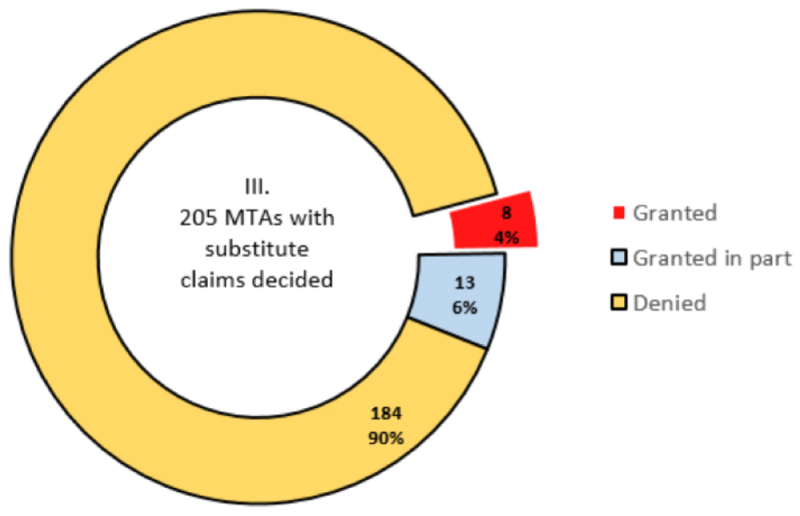
    The current study reports that there have been a total of 4,269 trials (post-grant review, inter partes review, and covered business method patent reviews) in which Motions to Amend under 35 U.S.C. § 316(d) (8%) have been filed.  In those trials, 6% were granted as being directed to cancelled claims, and 11% have been mooted by PTAB decision that the original claims were patentable.  In 20% of these cases, the parties settled, requested adverse judgment, or the proceedings were dismissed, leaving 205 trials (63%) where the motions to amend were decided by the PTAB.  The study also notes that motions to amend have been filed in 90 of the 670 pending trials (13%).

    At this juncture the statistics become less encouraging:

    Image 1

    90% of these motions were denied, and in another 6% they were denied in part.  Most of the grounds for denying the motions were statutory (89%); the vast majority of these (45%) were denied under § 102 and/or § 103, but about 20% were denied on other statutory grounds (§ 101 and § 112) and in almost 30% of the decisions the Board had multiple grounds for denying the motion.

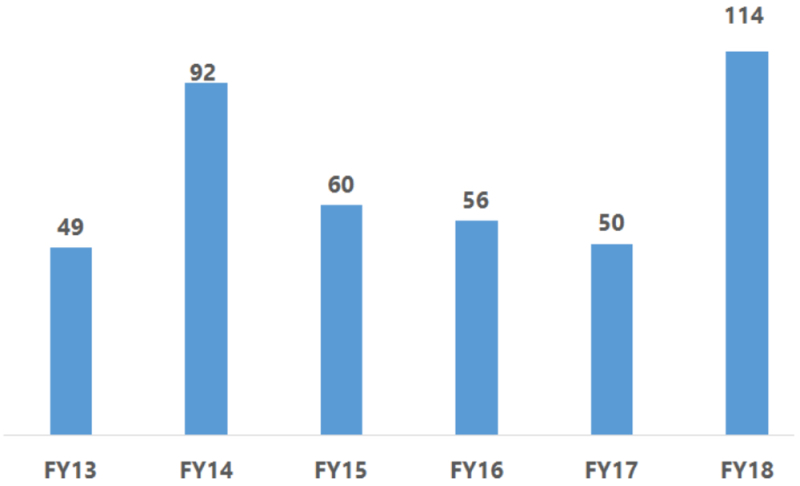
    Not surprisingly, the number of trials having motions to amend had increased after the Federal Circuit rendered its decision in Aqua Products, Inc. v. Matal (keeping in mind that the Aqua Products decision was handed down on October 4, 2017, just after the close of the 2017 Fiscal Year):

    Image 2
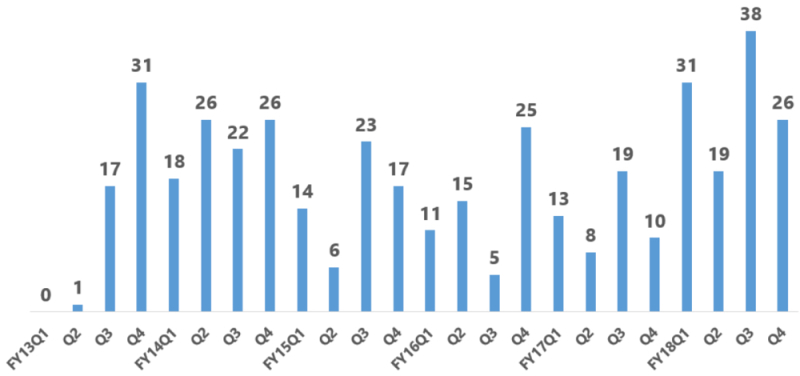
    (with the relatively high number of motions filed in FY2014 no doubt reflecting the naive belief that they were intended to be given fair consideration under § 318(d) of the AIA).  The historical record presented in quarters makes the trend (and the effect of Aqua Products) even more pronounced:

    Image 3
    Still, the frequency with which the Board has granted motions to amend, even after Aqua Products, is low and much lower than should be expected in view of the statutory language that provides for them:

    (d) Amendment of the Patent.—

    (1) In general.—During an inter partes review instituted under this chapter, the patent owner may file 1 motion to amend the patent in 1 or more of the following ways:

    (A) Cancel any challenged patent claim.

    (B) For each challenged claim, propose a reasonable number of substitute claims.

    (2) Additional motions.—

    Additional motions to amend may be permitted upon the joint request of the petitioner and the patent owner to materially advance the settlement of a proceeding under section 317, or as permitted by regulations prescribed by the Director.

    (3) Scope of claims.—

    An amendment under this subsection may not enlarge the scope of the claims of the patent or introduce new matter.

    This language is at least permissive and there is reason to believe Congress intended these post-grant review proceedings to be remedial in nature, permitting both petitioners and patent owners to correct improvidently granted patents and cabin claims to their proper scope.  That of course has not happened, in large part because the Office has prioritized the statutory mandate of resolving these proceedings within twelve months of their institution.  The Office has taken the position that this timeframe does not permit the type of examination scrutiny that would permit large scale "motion to amend" practice.  As a result, a provision intended to protect patentee's rights by not letting linger proceedings that throw into question a patents validity (and thus value to investors, etc.) has become but one feature of a regime that invalidates questionably large portions of the patents subjected to it.  (After all, it should be surprising to all by the most anti-patent zealots that the Office seems to do such a poor job of patent examination.)  And it is equally surprising that patent owners subjected to AIA's palette of post-grant review proceedings don't seem to be able to craft an amended claim that satisfies the statutory provisions (or said another way, that can so easily be thwarted by petitioners, who bear the burden of showing the amended claims to be unpatentable), particularly with the knowledge of the prior art adduced by petitioners and their success at having the PTAB institute the proceedings in the first place.

    The trend of motion to amend filings is encouraging (taking a silver-lining approach) but until the statistics show patent owners have a reasonable opportunity to have their amendments entered (and obtaining valid claims albeit of limited scope), studies like this one just show how far the AIA post-grant review regime still needs to go to achieve outcomes fair to petitioners, patent owners, and the public.

  • By Kevin E. Noonan

    University of CaliforniaThe U.S. Patent and Trademark Office today granted U.S. Patent 10,227,611 to Jennifer Doudna, Martin Jinek, Krzysztof Chylinski, and Emmanuelle Charpentier, the patent entitled "Methods and compositions for RNA-directed target DNA modification and for RNA-directed modulation of transcription" and assigned to the Regents of the University of California, the University of Vienna and Emmanuelle Charpentier herself. Claim 1 is representative:

    1.  A method of modifying a target DNA molecule in a cell, the method comprising contacting a target DNA molecule inside of a cell with: (a) a Cas9 protein; and (b) a single molecule DNA-targeting RNA comprising, in 5' to 3' order: (i) a targeter-RNA that hybridizes with a target sequence of the target DNA molecule, (ii) a nucleotide linker; and (iii) an activator-RNA that hybridizes with the targeter-RNA to form a double-stranded RNA duplex, wherein (a) forms a complex with (b) and the target DNA molecule is modified.

    As it turns out, this is the third patent granted to these inventors; an application allowed several months ago (see "Whither CRISPR? University of California/Berkeley Granted Another CRISPR Patent") has not issued due to formalities deficiencies according to a paper sent to the inventors on February 26th.  The earliest patent in this family, U.S. Patent No. 10,000,772, is limited to bacterial cells:

    1.  A method of modifying a target DNA molecule, the method comprising: contacting a target DNA molecule having a target sequence with a complex comprising: (a) a Cas9 protein; and (b) a DNA-targeting RNA comprising: (i) a targeter-RNA that hybridizes with the target sequence, and (ii) an activator-RNA that hybridizes with the targeter-RNA to form a double-stranded RNA (dsRNA) duplex of a protein-binding segment, wherein the activator-RNA hybridizes with the targeter-RNA to form a total of 10 to 15 base pairs, wherein said contacting takes place outside of a bacterial cell and outside of an archaeal cell, thereby resulting in modification of the target DNA molecule.

    The Office's reasoning for allowing the '611 patent parallels that for allowed U.S. Patent Application Publication No. US 2014/0068797 A1, to the extent that these claims were found patentable over prior art because the three RNA species (targeter-RNA, nucleotide linker, and activator-RNA) are covalently linked which does not occur in nature.  Claim 165 is representative of the claims allowed but not yet granted in the '797 publication:

    165.  A method of cleaving a nucleic acid comprising contacting a target DNA molecule having a target sequence with an engineered and/or non-naturally-occurring Type II Clustered Regularly Interspaced Short Palindromic Repeats (CRISPR)-CRISPR associated (Cas) (CRISPR-Cas) system comprising
        a) a Cas9 protein; and
        b) a single molecule DNA-targeting RNA comprising
            i) a targeter-RNA that hybridizes with the target sequence, and
            ii) an activator-RNA that hybridizes with the targeter-RNA to form a double-stranded RNA duplex of a protein-binding segment,
        wherein the activator-RNA and the targeter-RNA are covalently linked to one another with intervening nucleotides,
        wherein the single molecule DNA-targeting RNA forms a complex with the Cas9protein,
        whereby the single molecule DNA-targeting RNA targets the target sequence, and the Cas9 protein cleaves the target DNA molecule.

    And the Office granted U.S. Patent No. 10,113,167 on October 29, 2018, reciting this representative claim:

    1.  A non-naturally occurring DNA-targeting RNA, or a nucleic acid encoding the non-naturally occurring DNA-targeting RNA, wherein the non-naturally occurring DNA-targeting RNA comprises: (a) a targeter-RNA comprising: (i) a first nucleotide sequence that is complementary to a target sequence of a target DNA molecule, and (ii) a second nucleotide sequence that hybridizes with an activator-RNA, wherein the first and second nucleotide sequences are heterologous to one another; and (b) the activator-RNA, which hybridizes with the second nucleotide sequence of the targeter-RNA to form a double-stranded RNA (dsRNA) duplex of a protein-binding segment, wherein the activator-RNA hybridizes with the targeter-RNA to form a total of 8 to 15 base pairs, wherein the non-naturally occurring DNA-targeting RNA is capable of forming a complex with a Cas9 polypeptide and targeting the complex to the target sequence of the target DNA molecule.

    The Reasons for Allowance in the '611 patent make note of the scope of these claims (all cell types) compared with prior patented methods to the Broad Institute (limited to eukaryotic cells), supporting the apprehension that potential developers of CRISPR technology will need to license California's patents as well as the Broad's to practice CRISPR in eukaryotic cells.  This will undoubtedly complicate how the technology develops, as well as making it more expensive and difficult to bring to market.

    Several other pending applications have claims in condition for allowance but have had prosecution suspended pending PTAB consideration of whether to declare one or more additional interferences; these include:

    • U.S. Application No. 15/435,233, filed on 2-16-2017, which claims the benefit of U.S. Application No. 15/138,604;
    • U.S. Application No. 15/925,544, filed on 3-19-2018, which claims the benefit of U.S. Application No. 15/138,604;
    • U.S. Application No. 15/947,700, filed on 4-6-2018, which claims the benefit of U.S. Application No. 15/138,604;
    • U.S. Application No. 15/947,718, filed on 4-6-2018, which claims the benefit of U.S. Application No. 15/138,604;
    • U.S. Application No. 15/981,808, filed on 5-16-2018, which claims the benefit of U.S. Application No. 15/138,604; and
    • U.S. Application No. 15/981,809, filed on 5-16-2018, which claims the benefit of U.S. Application No. 15/138,604.

    Applicants have petitioned the Office to permit these claims to come to issue on the grounds that there is no interference-in-fact between these claims and the claims of the Broad patent estate, but the Office is insisting on following procedures to permit a PTAB APJ to render a decision in due course.

    Finally these applications are in the initial stages of prosecution on the merits:

    • U.S. Application No. 16/136,159, filed on 9-19-2018, which claims the benefit of U.S. Application No. 15/138,604 — subject to a restriction requirement issued on February 27th; and
    • U.S. Application No. 16/136,165, filed on 9-19-2018, which claims the benefit of U.S. Application No. 15/138,604 — subject to a restriction requirement issued on January 30th.

    These pending applications have not published and thus are not available on PAIR:

    • 16/201,836 filed on 11-27-2018 claims the benefit of U.S. Application No. 13/842,859
    • 16/201,848 filed on 11-27-2018 claims the benefit of U.S. Application No. 13/842,859
    • 16/201,853 filed on 11-27-2018 claims the benefit of U.S. Application No. 13/842,859
    • 16/201,855 filed on 11-27-2018 claims the benefit of U.S. Application No. 13/842,859
    • 16/201,862 filed on 11-27-2018 claims the benefit of U.S. Application No. 13/842,859
    • 16/201,865 filed on 11-27-2018 claims the benefit of U.S. Application No. 13/842,859
    • 16/276,343 filed on 02-14-2019 claims the benefit of U.S. Application No. 13/842,859
    • 16/276,348 filed on 02-14-2019 claims the benefit of U.S. Application No. 13/842,859
    • 16/276,352 filed on 02-14-2019 claims the benefit of U.S. Application No. 13/842,859
    • 16/276,356 filed on 02-14-2019 claims the benefit of U.S. Application No. 13/842,859
    • 16/276,361 filed on 02-14-2019 claims the benefit of U.S. Application No. 13/842,859
    • 16/276,365 filed on 02-14-2019 claims the benefit of U.S. Application No. 13/842,859
    • 16/276,368 filed on 02-14-2019 claims the benefit of U.S. Application No. 13/842,859
    • 16/276,374 filed on 02-14-2019 claims the benefit of U.S. Application No. 13/842,859 and
    • 16/277,090 filed on 02-15-2019 claims the benefit of U.S. Application No. 13/842,859

  • By Kevin E. Noonan

    Federal Circuit SealPatent law is known for its several challenges in sufficiently capturing an invention, tangible in form and substance, in words with all their limitations.  Patent law is known for being littered with traps for the unwary.  And patent law is replete with instances where claims are found unpatentable because they can fairly be construed to encompass disclosure in the prior art.  All these features of patent law are present in one form or another in the Federal Circuit's decision handed down today in In re Qapsule Technologies, Inc.

    The claims at issue in this appeal from the Patent Trial and Appeal Board (PTAB) decision affirming rejection are represented by rejected claim 1:

    1.  A synthetic capsule construct for providing a protected chemical milieu, the construct comprising:
        a shell having a plurality of shell proteins, said plurality of shell proteins being assembled with one another for forming said shell and defining an enclosure therein, each of said shell proteins, when assembled for forming said shell, having an interior surface facing inwardly toward said enclosure and an exterior surface facing outwardly away from said enclosure, said shell serving to restrict permeability to and from said enclosure for providing the protected chemical milieu therein, said shell proteins being recombinant;
        a cargo protein, said cargo protein being recombinant and optionally including a peptide tag; and
        a bifunctional polynucleotide having both a first aptameric activity for binding said cargo protein and a second aptameric activity for retaining said bifunctional polynucleotide within said enclosure by assembly with the interior surface of said shell protein,
        said bifunctional polynucleotide being non-naturally occurring; said bifunctional polynucleotide serving to link said cargo protein within said enclosure for providing the said cargo protein with the protected chemical milieu therein.

    (Where the bold, italicized terms are identified in the Court's opinion as being relevant to the issues discussed therein.)

    Procedurally before the Board Applicants overcame grounds of rejection under §§ 102 and 103 over references not discussed in the opinion, but (improvidently, as it turned out) when faced with new grounds of rejection from the PTAB decided not to reopen prosecution but to request rehearing under 37 C.F.R. § 41.50(B)(2).  When that proved unavailing this appeal followed.  The new grounds of rejection disclosed the following:

    Imagewhich the discerning will recognized to be an influenza virus (a recombinant one, as it turns out).  The Board was able to map the limitations in the claims to this structure (wherein the M1 protein is a "shell protein," mutated viral protein PB1 satisfied the "cargo protein" limitation, and the interaction between the viral RNA and both the M1 protein and PB1 protein as part of the "mutated" (and thus "non-naturally occurring") viral RNPs constituted the "bifunctional polynucleotide" limitation.  Finally, the Board rejected Applicant's argument that the reference did not disclose "recombinant" proteins as an attempt to impose a process limitation (how the proteins were made) on a product claim.  Having found all the recited elements disclosed in this recombinant influenza virus, the Board affirmed its own determination that the Perez reference "inherently" anticipated the claimed invention.

    The Federal Circuit affirmed, in an opinion by Judge Newman joined by Judges Chen and Stoll.  The panel recognized that Applicant had the burden to overcome the deference the Federal Circuit is compelled to give the PTO on fact questions (such as anticipation) and accordingly found that the Board had adduced sufficient evidence to support its rejection of these claims under § 102.  Specifically, the Court rejected several distinctions drawn by Applicant because they were not affirmatively recited (despite being negative limitations).  For example, to Applicant's argument that viral assembly as disclosed in the cited art requires viral ribonucleoproteins (RNPs), the Court notes that the claims recite that the claimed synthetic capsule construct "comprises" the recited elements (and in other limitations recites the open claim language "having") and thus does not exclude embodiments that include such RNPs.  Accordingly, "it does not affect the Board's ground of rejection that Qapsule has purportedly created a capsule that will assemble in the presence of only a shell protein, cargo protein, and bifunctional polynucleotide, . . . for representative claim 1 is not so limited," and the panel held that the Board's conclusion was supported by substantial evidence.  Similarly, the Court found unpersuasive other aspects of the recombinant influenza virus disclosed in the Perez reference not recited in the rejected claims (the viral lipid envelope, the other proteins comprising the virus) using the same reasoning, as well as arguments related to the different functions of the claimed construct and the prior art virus.  These distinctions did not persuade the panel because "unclaimed functional distinctions or uses are insufficient to overcome anticipation," and, in the only faint glimmer of hope provided to Qapsule in the opinion, "[i]t is not before us to decide whether further specificity in the claims might distinguish these references."

    It is not without some irony that the specification recites a great number of sources of shell and capsid proteins and viruses that produce them:

    • [0008] Another preferred embodiment selects the shell protein from a group consisting of capsid proteins, coat proteins, and envelope proteins. In particular, the shell protein may be Qβ capsid protein; alternatively, the shell protein may be of a type derived from a single-stranded RNA virus, for example, icosahedral virus, bromovirus, comoviruses, nodavirus, picornavirus, tombusviruses, levivirus, or tymovirus. In another preferred embodiment, the shell protein is of a type derived from a double-stranded RNA virus, for example, birnavirus and reovirus. In another preferred embodiment, the shell protein is of a type derived from a double-stranded DNA virus, for example, parvovirus, microvirus, podovirus, or polyomavirus.

    • [0083] However, capsid proteins from other bacteriophages and viruses may be employed assembling synthetic capsule constructs. The bifunctional polynucleotide employed with an alternative capsid protein employs an aptamer obtained from or adapted to assemble with such virus or bacteriophage shell proteins. Bifunctional polynucleotide employable with capsids from single-stranded RNA viruses and bacteriophages are single-stranded RNA. Exemplary single-stranded RNA viruses having assemblable shell proteins employable with the present invention are as follows

    • [0084] Non-icosahedral viruses (rod-shaped or other shapes) tobacco mosaic virus.
    • [0085] Bromoviruses: alfalfa mosaic virus, brome mosaic virus, cowpea chlorotic mottle virus, cucumber mosaic virus, tomato aspermy virus.

    • [0086] Comoviruses: bean pod mottle virus, cowpea mosaic virus, tobacco ringspot virus.
    • [0087] Nodaviruses: black beetle virus, pariacoto virus.
    • [0088] Picornaviruses: coxsackievirus, echovirus, foot and mouth disease virus, rhinovirus 14, poliovirus.
    • [0089] Tombusviruses: artichoke mottled crinkle virus, red clover necrotic mosaic virus, tomato bushy stunt virus.
    • [0090] Leviviruses: bacteriophages MS2, FR, GA, PP7.
    • [0091] Tymoviruses: physalis mottle virus, desmodium yellow mottle virus, turnip yellow mosaic virus.

    • [0092] Shell proteins from virus particles that package double-stranded RNA can also be employed. However, their bifunctional polynucleotides will employ a single-stranded aptamer to bind/assemble with shell proteins. Exemplary double-stranded RNA viruses having assemblable shell proteins employable with the present invention are as follows:

    • [0093] Birnaviruses: infectious pancreatic necrosis virus, infectious bursal disease virus.
    • [0094] Reoviruses: reovirus, rice dwarf virus.

    • [0095] Shell proteins from virus particles that package DNA can also be employed. These are constructed in the same way, by expression in cells using plasmids that drive the synthesis of both the shell protein and pieces of DNA (usually single-stranded) that associate with the protein and get packaged inside. Exemplary DNA viruses having assemblable shell proteins employable with the present invention are as follows:

    • [0096] Parvoviruses: adeno-associated virus, canine parvovirus, feline panleukopenia virus, porcine parvovirus.
    • [0097] Microviruses: bacteriophages phi-x 174, G4, alpha-3.
    • [0098] Podoviruses: bacteriophages P22, T7, epsilon 15.
    • [0099]Polyomavirus: SV40, Murine polyomavirus, Merkel cell virus.

    And yet influenza virus (indeed, any paramyxovirus) is not disclosed.  It is possible that Qapsule will pursue claims having a scope that can better differentiate claimed embodiments supported by its disclosure from prior art recombinant virus, if only for claims withdrawn pursuant to a restriction requirement.  But the procedural history of this case and the PTAB's and Federal Circuit's decisions on the merits provide yet another cautionary tale of the difficulties and uncertainties occasioned by the patenting process.

    In re Qapsule Technologies, Inc. (Fed. Cir. 2019)
    Nonprecedential disposition
    Panel: Circuit Judges Newman, Chen, and Stoll
    Opinion by Circuit Judge Newman

  • By Donald Zuhn

    District Court for the District of OregonLast month, in Ni-Q, LLC v. Prolacta Bioscience, Inc., District Judge Michael H. Simon of the U.S. District Court for the District of Oregon granted a motion for summary judgment filed by Plaintiff Ni-Q, LLC that the asserted claims of U.S. Patent No. 8,628,921, which is assigned to Defendant Prolacta Bioscience, Inc. ("Prolacta"), are invalid under 35 U.S.C. § 101 for failure to claim patent-eligible subject matter.  The District Court also determined on summary judgment that Ni-Q did not infringe the asserted claims of the '921 patent, even if those claims had been found valid.  We previously reported on this case in 2017 when the District Court denied Ni-Q's motion for judgment on the pleadings under Rule 12(c) of the Federal Rules of Civil Procedure that the claims of the '921 patent were invalid under 35 U.S.C. § 101 for failure to claim patent-eligible subject matter.

    Ni-Q had initiated the dispute between the parties by filing a complaint for declaratory judgment of noninfringement and invalidity of the '921 patent, as well as alleging a violation of the Oregon Unlawful Trade Practices Act.  Prolacta responded by filing a counterclaim against Ni-Q for money damages and injunctive relief, asserting that Ni-Q had infringed claims 1, 2, and 9 of the '921 patent.

    The '921 patent, which is entitled "Methods for testing milk," is directed to methods for testing mammary fluid (including milk) to establish or confirm the identity of the donor of the mammary fluid.  Independent claim 1 recites (emphasis in opinion):

    1.  A method for determining whether a donated mammary fluid was obtained from a specific subject, the method comprising:
        (a) testing a donated biological sample from the specific subject to obtain at least one reference identity marker profile for at least one marker;
        (b) testing a sample of the donated mammary fluid to obtain at least one identity marker profile for the at least one marker in step (a);
        (c) comparing the identity marker profiles, wherein a match between the identity marker profiles indicates that the mammary fluid was obtained from the specific subject; and
        (d) processing the donated mammary fluid whose identity marker profile has been matched with a reference identity marker profile, wherein the processed donated mammary fluid comprises a human protein constituent of 11-20 mg/mL; a human fat constituent of 35-55 mg/mL; and a human carbohydrate constituent of 70-120 mg/mL.

    Prolacta receives human milk from donors and processes it to make fortifier and other products for use in feeding premature and other medically fragile infants.  Ni-Q is also engaged in the procurement, production, and sale of human milk-based products for use in feeding premature infants.

    In construing the claims, the parties stipulated and the District Court adopted that the term "wherein a match" means "a determination that the marker(s) in the biological sample and donated fluid or milk are the same and that there are no additional unmatched marker(s)."  The District Court also construed the term "processing" to mean:  "One or more of the following: filtering, heat-treating, separating into cream and skim, adding cream to the skim, or pasteurizing."  Following the District Court's construction of the claims, Ni-Q filed a motion for partial summary judgment, arguing that in view of the Court's claim construction, claims 1, 2, 4, 6-9, and 11 of the '921 patent were invalid under 35 U.S.C. § 101 for being directed to patent-eligible subject matter, and that it did not infringe the claims of the '921 patent because it did not perform all of the steps of the asserted claims.

    With respect to the issue of validity, Ni-Q argued that the asserted claims were invalid under 35 U.S.C. § 101 because they are directed to a patent-ineligible natural law with no inventive concept to transform the natural law into patent-eligible subject matter.  More specifically, Ni-Q argued that the presence of identity markers such as DNA and proteins in a woman's tissue or milk is natural, and the nutritional levels required by the patent occur naturally.  Prolacta responded by asserting that the claims are directed to producing safer milk that is standardized with optimal nutritional values, contending that the claimed method recites steps for selecting for processing safe milk from health-screened donors and manufacturing a nutrient-enhanced human milk product.

    With respect to the first step of Alice/Mayo framework, the District Court agreed with Ni-Q that "the asserted claims are directed to the laws of nature," and that "[t]he presence of identity markers such as DNA in a woman's mammary fluid and other biological tissue is natural."  The Court explained that "[a]lthough the patent describes the human action of testing the original reference sample and the mammary fluid sample and comparing them, that does not convert the claim to patent-eligible subject matter," adding that "[t]he relationship of the markers in the samples exists naturally."  The Court determined that "Claim 1 merely describes the natural law that two different biological samples from the same individual contain the same identity markers and thus can be tested and compared."

    The District Court found Prolacta's argument that the claims are directed to producing safer milk that is standardized with optimal nutritional value to be unpersuasive, pointing out that the steps recited in claim 1 "require no step, method, or process relating to safety or the health screening of donors," but rather "merely require testing a reference sample of a donor, testing a sample of the donated mammary fluid, comparing the two test results, and processing only the mammary fluid when the two tests match," and noting that "[t]here is nothing in Claim 1 . . . that requires testing the donor for disease or drug use or anything else relating to health or safety."  According to the Court, claim 1 "is about identification—it does not suggest that its goal or purpose relates to safety or health concerns."  The Court also found to be unavailing Prolacta's argument that claim 1 covers a method of standardizing optimal nutrient level, noting that claim 1 "does not require that nutrient levels of donated mammary fluid be altered," but instead "merely requires that after processing is complete, the mammary fluid consist of wide-ranging levels of nutrients that, as conceded by Prolacta, are naturally found in human breast milk."  In finding that "Claim 1 . . . is impermissibly directed to a patent-ineligible subject," the Court concluded that:

    Claim 1 is a broad claim that is not limited to a particular application of natural law.  It is not limited to commercial human breast milk production, to certain processing that alter the makeup of the breast milk, or to testing breast milk donors for viruses, bacteria, drugs, or other health issues and then ensuring that later-donated milk matches the originally-screened donor.  Indeed, it purports to cover any use where: (1) a donor has donated a reference sample and mammary fluid that are tested for a match; (2) if there is a match, the donated mammary fluid is processed using any of the five types of processing; and (3) after processing, the mammary fluid contains the identified nutrient ranges.  Because these nutrient ranges are found naturally in breast milk, the claim's covered use could include, for example, researchers who are testing the efficacy of DNA comparisons between breast milk and other biological samples and in so doing heat-treat or pasteurize the milk.

    With respect to the second step of the Alice/Mayo analytic framework, Ni-Q argued that Prolacta's comparison of DNA to match the reference sample to the donated mammary fluid was not new or inventive, and that because processing can include pasteurization, that is also not a new or innovative step.  Prolacta responded that three aspects of the claims are new or inventive: (1) applying DNA analysis to mammary fluid; (2) selecting mammary fluid for processing based on a matching processing that ensured the donated fluid was from a specific subject, thereby eliminating the risk of communicable diseases in donated milk; and (3) requiring the recited nutrient ranges.

    The District Court rejected Prolacta's second and third arguments, stating that "the elimination of health concerns and communicable diseases in processed milk is not contained in any of the asserted claims (and therefore cannot provide an inventive concept) and the required nutrient ranges may not require any processing other than pasteurization of donated milk, which is not new or inventive."  The Court also took issue with Prolacta's first argument, noting that "nothing in the claims requires screening of the donor," and therefore, that Prolacta's "new application" — i.e., the genetic link between screened donors and donated milk and excluding milk containing DNA from unknown and unscreened donors –- "is not the application in the claims."  The Court also noted that the claims "do not require the matching be through maternal DNA," and that "[a]ny identity marker will suffice."  The Court therefore concluded that "the claims add no new or inventive concept not already known in the art," and that "[c]onsidering the steps 'as an ordered combination adds nothing to the laws of nature that is not already present when the steps are considered separately,'" quoting Mayo Collaborative Servs. v. Prometheus Labs., Inc., 566 U.S. 66, 79 (2012).  Thus, the Court found the claims to also "fail at step two" of the Alice/Mayo framework.

    Turning to the issue of infringement, Ni-Q asserted that it does not perform the "wherein a match" step of the asserted claims and therefore did not literally infringe the '921 patent or infringe the '921 patent under the doctrine of equivalents.  In particular, Ni-Q asserted that in view of the District Court's claim construction, the "wherein a match" step requires a determination that there are no additional unmatched markers between the biological sample and the donated fluid or milk, and that it never determined that there were no additional unmatched markers.  The Court again agreed with Ni-Q, finding that "the '921 Patent requires a determination that the milk processed had no additional unmatched markers," and determining that "because Ni-Q processed the milk and did not make that determination before processing, Ni-Q did not infringe the patent" (emphasis in opinion).  The District Court also concluded that Ni-Q did not infringe the '921 patent under the doctrine of equivalents because "[t]he purpose of the second step of the 'wherein a match' requirement—making sure there are 'no unmatched markers'—is to prevent contamination from unscreened donors," and "Ni-Q does nothing equivalent to that step to prevent contamination from other donors."

    The District Court therefore granted Ni-Q's motion for summary judgement, finding that there were no genuine issues of material fact, the asserted claims of the '921 patent are invalid under 35 U.S.C. § 101, and that Ni-Q did not infringe the asserted claims even if they were valid.

    Ni-Q, LLC v. Prolacta Bioscience, Inc. (D. Or. 2019)
    Opinion and Order by District Judge Simon

  • CalendarMarch 12, 2019 – "Practical Tips on Patent Prosecution in India and China" (J A Kemp) – 3:30 to 4:30 pm (GMT)

    March 12, 2019 – Customer partnership meeting of Technology Center 2800, Semiconductor/Memory Workgroup and Printing/Measuring and Testing Workgroup (U.S. Patent and Trademark Office) – 12:00 pm to 4:30 pm (EDT)

    March 14, 2019 – "Obvious-Type Double Patenting and PTEs After Breckenridge Pharmaceutical and Ezra Ventures LLC Decisions" (Strafford) – 1:00 to 2:30 pm (EDT)

    March 14, 2019 – "IP for Agriculture and Plants" (Intellectual Property Law Association of Chicago (IPLAC) Biotech Committee) – 12:00 pm to 1:00 pm (CT), Chicago, IL

    March 19, 2019 – "The Evolving Provenance of Obviousness-type Double Patenting" (McDonnell Boehnen Hulbert & Berghoff LLP) – 10:00 am to 11:15 am (CT)

    March 19, 2019 – "Japanese Patent Practice-Specialty Areas" (Intellectual Property Law Association of Chicago (IPLAC) International Patent Committee) – 11:45 am to 1:00 pm (CT), Chicago, IL

    March 20, 2019 – "Drafting Software Patents to Survive Section 101 and AIA Challenges — Anticipating and Minimizing the Risk of 101, 103 Rejections, Recent Court Guidance" (Strafford) – 1:00 to 2:30 pm (EDT)

    March 21, 2019 – "Key Issues Shaping the US IP Landscape" (Federal Circuit Bar Association) – 10:00 am to 6:00 pm (EST), Washington, DC

    March 21-22, 2019 – "Federal Circuit Practice & Procedure" (John Marshall Law School Center for Intellectual Property, Information & Privacy Law) – 9:00 am to 4:30 pm, Chicago, IL.