• IPO #2The Intellectual Property Owners Association (IPO) will offer a one-hour webinar entitled "IPR Estoppel One Year After SAS" on April 25, 2019 from 2:00 to 3:00 pm (ET).  Grantland Drutchas of McDonnell Boehnen Hulbert & Berghoff LLP; James Hietala of Intellectual Ventures Management, LLC; and Eliot Williams of Baker Botts LLP will address how district courts have applied IPR estoppel in the year since SAS v. Iancu was decided, and will not only highlight recent cases, but will also provide tactics for both plaintiffs and defendants to make arguments about the proper scope of IPR estoppel in district court litigation.  The panel will address the following topics:

    • SiOnyx v. Hamamatsu Photonics (D. Mass.) and the principle that "after SAS [a narrow view of AIA estoppel] cannot be correct";
    Oil-Dri Corp. of America v. Nestle Purina Co. (N.D. Ill.) and the increasing importance of on-sale prior art that can be used in district court, but that could not have been raised in the IPR; and
    • The pending Federal Circuit appeal in BTG International Ltd. v. Amneal Pharmaceuticals LLC and whether the America Invents Act stops patent challengers who won at the PTAB from pursuing their winning arguments in court.

    The registration fee for the webinar is $135 (government and academic rates are available upon request).  Those interested in registering for the webinar can do so here.

  • D Young & CoD Young & Co will be offering its next European biotech patent law update on April 30, 2019.  The webinar will be offered at three times: 4:00 am, 7:00 am, and 12:00 pm (EDT).  D Young & Co European Patent Attorneys Simon O'Brien and Matthew Caines will provide an essential update and live Q&A on EPO biotechnology case law.

    While there is no fee to participate, attendees must register in advance.  Those wishing to register can do so here.

  • Strafford #1Strafford will be offering a webinar entitled "Patent Inventorship: Best Practices for Determination and Correction — Distinguishing Between Inventor and Contributor; Navigating Joint Inventorship, Disclosure of Ownership, Real Party in Interest" on May 2, 2019 from 1:00 to 2:30 pm (EDT).  Jill K. MacAlpine and Amanda K. Murphy of Finnegan Henderson Farabow Garrett & Dunner will guide patent counsel on identifying and determining inventorship, offer best practices for correcting errors regarding inventorship, and provide perspectives gained from working with the AIA since its passage and outline lessons from recent court decisions.  The webinar will review the following issues:

    • What key information does counsel need to determine inventorship?
    • What are the steps for counsel when inventorship must be corrected?
    • What is the AIA's impact on an inventorship determination?

    The registration fee for the webcast is $347.  Those interested in registering for the webinar, can do so here.

  • J A KempJ A Kemp will be offering a webinar entitled "Inventive Step for Computer Implemented Inventions at the EPO" on April 30, 2019 from 3:30 to 4:30 pm GMT (Greenwich Mean Time).  John Leeming of J A Kemp will discuss the latest EPO case law on separating the technical from the non-technical and inventive step issues arising in specific areas of technology, such as machine learning and simulation.  The webinar will address the following topics:

    • The "notional business person" and her role in examining claims
    • Effective arguments for inventive step
    • Machine learning inventions
    • Inventions using blockchains or distributed ledgers
    • Simulation and modelling, including the recent referral to the Enlarged Board of Appeal

    Those wishing to register can do so here.

  • Strafford #1Strafford will be offering a webinar entitled "Patent Infringement After Duncan Parking Technologies — Doctrine of Equivalents, Too-Narrow Claim Construction, and Prosecution Impact on Litigation Outcomes" on April 30, 2019 from 1:00 to 2:30 pm (EDT).  Thomas L. Irving, Adriana L. Burgy, Mark J. Feldstein, and Doris Johnson Hines of Finnegan Henderson Farabow Garrett & Dunner will guide patent counsel regarding the impact of recent court decisions and the guidance they provide on direct, induced and contributory infringement, claim construction, literal infringement, doctrine of equivalents infringement, including hypothetical claims, and even the reverse doctrine of equivalents, and offer their experiences and practical approaches for addressing claim construction and infringement issues.  The webinar will review the following issues:

    • What guidance can be drawn from recent court decisions for claim construction?
    • What pitfalls to avoid do the cases identify?
    • What best practices can practitioners use for claim construction of varying scope as applied now under the same standard in the district courts and PTAB post-grant proceedings?

    The registration fee for the webcast is $347.  Those interested in registering for the webinar, can do so here.

  • By Donald Zuhn

    District Court for the District of DelawareLast week, in Novartis Pharmaceuticals Corp. v. Par Pharmaceutical Inc., District Judge Richard G. Andrews of the U.S. District Court for the District of Delaware granted a Motion for Estoppel under 35 U.S.C. § 315(e)(2) filed by Novartis Pharmaceuticals Corp.  Defendant Par Pharmaceutical Inc. had taken no position on the estoppel issue.

    The dispute between the parties began when Novartis filed three suits against Par (as well as related suits against Breckenridge Pharmaceutical, Inc. and West-Ward Pharmaceutical Corp.), with the parties agreeing that the validity of the patent at issue, U.S. Patent No. 5,665,772, would be tried only once.  Defendants challenged the validity of claims 1-3, 7, and 10 of the '772 patent, arguing that the claims were obvious in view of 27 references.

    While litigation was pending, Par challenged claims 1-3 and 8-10 of the '772 patent in an inter partes review proceeding.  After the U.S. Patent and Trademark Office Patent Trial and Appeal Board instituted Par's IPR, the other Defendants filed four additional IPR petitions challenging the '772 patent, along with motions to join Par's IPR.  The Board instituted two of the four additional IPRs and joined them with Par's IPR.  The Board declined to institute and join IPRs challenging claim 7 of the '772 patent because claim 7 had been omitted from Par's IPR.

    In March 2017, the District Court determined that the asserted claims of the '772 patent were invalid for obviousness-type double patenting, but did not address Defendants' obviousness defenses or counterclaims, and the District Court's decision was appealed.  The Federal Circuit reversed the District Court's finding of obviousness-type double patenting in Novartis Pharmaceuticals Corp. v. Breckenridge Pharmaceutical Inc., 909 F.3d 1355, 1367 (Fed. Cir. 2018).  Prior to the Federal Circuit's reversal, the Board issued a final written decision in Par's IPR upholding the patentability of claims 1-3 and 8-10 of the '772 patent.

    Following the Board decision and appeal, the District Court asked the parties to file a status report summarizing the issues that still needed to be addressed in litigation.  Novartis suggested that 35 U.S.C. § 315(e)(2) would possibly estop Defendants' obviousness defenses and counterclaims based on the Board's final written decision, and the District Court issued an order requesting briefing from Novartis on estoppel and from Defendants on obviousness.  Following that order, the suits involving Breckenridge and West-Ward were dismissed by joint stipulation, and Novartis filed its Motion for Estoppel under 35 U.S.C. § 315(e)(2).  In addition to taking no position on the estoppel issue, Par also declined to file a brief on obviousness, stating that it believed that a decision could be rendered based on the briefing and testimony already submitted to the Court.

    In considering Novartis' motion, the Court noted that § 315(e)(2) provides that:

    The petitioner in an inter partes review of a claim in a patent under this chapter that results in a final written decision under section 318(a) . . . may not assert in either a civil action arising in whole or in part under section 1338 of title 28 . . . that the claim is invalid on any ground that the petitioner raised or reasonably could have raised during that inter parties review.

    While pointing out that the Federal Circuit has not directly addressed the issue of whether estoppel applies to prior art references that were not raised in the IPR proceeding, the District Court listed a number of decisions in which a majority of District Courts had determined that IPR estoppel applies to any prior art reference that reasonably could have been raised, even if not actually raised, in an IPR proceeding (including decisions in the District of Delaware, the Eastern District of New York, the Eastern District of Wisconsin, and the Eastern District of Texas).  The Court also noted that:

    [T]he general purpose of the statute as well as the statutory language indicate that the most plausible interpretation is that any prior art that the IPR petitioner could have raised in the proceeding is estopped if there is a final written decision from the PTAB that the challenged claims are valid.

    In addition, the Court pointed out that "one of the policy objectives behind the introduction of IPR proceedings was an intention to conserve judicial resources," adding that "[a]llowing an IPR petitioner to have two bites at the apple by holding back certain obviousness combinations runs counter to both the clear language and purpose behind § 315."  Despite Breckenridge's argument that IPR estoppel should not apply after a district court has held trial, the Court indicated that it did "not think the application of IPR estoppel is dependent on the order in which certain events occur," and stated that "[t]he plain language of the statute does not indicate that Congress intended for there to be a time limitation upon the estoppel effect of a final written decision of an IPR."

    On the issue of whether estoppel should apply to the 27 references put forward by Defendants at trial, Novartis argued that the 27 references all "could reasonably have been raised" in the IPR proceeding because they were used in the September 2016 trial which occurred before the reply due date in the IPR.  The District Court therefore determined that Defendants were precluded from pursuing a § 103 invalidity argument as to claims 1-3 and 8-10 of the '772 patent.  However, because no IPR was instituted as to claim 7 of the '772 patent, the Court determined that IPR estoppel did not apply for this claim.  Nevertheless, Novartis had withdrawn its infringement contention as to claim 7 and had agreed to provide Par with a covenant not to sue on that claim.  The Court therefore granted Novartis' Motion for Estoppel with respect to claims 1-3 and 8-10 of the '772 patent.

    Novartis Pharmaceuticals Corp. v. Par Pharmaceutical Inc. (D. Del. 2019)
    Memorandum Order by District Judge Andrews

  • By Kevin E. Noonan

    Washington - Capitol #6Over the past six years, since the Supreme Court handed down its decision in Mayo Collaborative Services, Inc. v. Prometheus Laboratories, it has become more and more evident that correction of the path embarked upon by the USPTO, the district courts, and the Federal Circuit could only occur if Congress changed the law of patent subject matter eligibility.  Recently Senator Thom Tillis (R-NC), Chair of the Senate Judiciary Subcommittee on Intellectual Property, and Senator Chris Coons (D-DE), Ranking Member, have been holding meetings with stakeholders in an attempt to craft such revisions in a way that would garner sufficient political consensus for passage (what would happen if it crossed President Trump's desk is anyone's guess, but one challenge at a time).

    Today these Senators, joined by Representative Doug Collins (R-GA-9), Ranking Member of the House Judiciary Committee, and Representatives Hank Johnson (D-GA-4), and Steve Stivers (R-OH-15), released a "bipartisan, bicameral framework on Section 101 patent reform."  The need is acute, according to Chairman Coons:

    Today, U.S. patent law discourages innovation in some of the most critical areas of technology, including artificial intelligence, medical diagnostics, and personalized medicine.  That's why Senator Tillis and I launched this effort to improve U.S. patent law based on input from those impacted most.  I am grateful for the engagement of all stakeholders participating in our roundtables, as well as the bipartisan and collaborative efforts of colleagues in both the Senate and the House.  I look forward to continuing to receive feedback as we craft a legislative solution that encourages innovation.

    The framework has the following provisions:

    • Keep existing statutory categories of process, machine, manufacture, or composition of matter, or any useful improvement thereof.

    • Eliminate, within the eligibility requirement, that any invention or discovery be both "new and useful."  Instead, simply require that the invention meet existing statutory utility requirements.

    • Define, in a closed list, exclusive categories of statutory subject matter which alone should not be eligible for patent protection.  The sole list of exclusions might include the following categories, for example:

    ▪ Fundamental scientific principles;

    ▪ Products that exist solely and exclusively in nature;

    ▪ Pure mathematical formulas;

    ▪ Economic or commercial principles;

    ▪ Mental activities.

    • Create a "practical application" test to ensure that the statutorily ineligible subject matter is construed narrowly.

    • Ensure that simply reciting generic technical language or generic functional language does not salvage an otherwise ineligible claim.

    • Statutorily abrogate judicially created exceptions to patent eligible subject matter in favor of exclusive statutory categories of ineligible subject matter.

    • Make clear that eligibility is determined by considering each and every element of the claim as a whole and without regard to considerations properly addressed by 102, 103 and 112.

    While a "work in progress," the framework contains several of the provisions proposed by IPLAC, AIPLA, IPO, and the ABA-IPL section.  But this proposal provides for frank abrogation of the judicial exceptions, a stratagem within Congress's purview but perhaps one not particularly well advised.  The judicial exceptions (occasional effects not to the contrary) are not judicial whims: the Court firmly believes that they are necessary to prevent Congress from exceeding its Constitutional authority under Article I, Section 8, clause 8.  This is consistent with their role in our system of government, and at best the consequence of any such abrogation will be that it is ignored in practice, and at worst it could motivate the Court to recite even more stringent and strictly applied limitations on Congress's power to grant patents.  The Court's forays into patent policy making have been unfortunate to say the least; anything that encourages these tendencies is unlikely to end well for U.S. innovation.  Instead, it may be more productive to recognize, if not acknowledge, the basis for the judicial exceptions and try to introduce into the patent statute more circumscribed, exact, and defined recitations of these principles in ways that might cabin the Court's application to a greater extent than is possible under current law.

  • By Kevin E. Noonan

    Supreme Court Building #2Today, the U.S. Supreme Court denied a petition for writ of certiorari by the St. Regis Mohawk Indian Tribe on the question (answered in the negative by the Patent Trial and Appeal Board and the Federal Circuit) of whether tribal sovereign immunity could protect the tribe from being named as a party in an inter partes review (IPR) proceeding after Allergan assigned to the tribe its patents in IPR.

    To briefly recap, the issue arose over IPR Nos. IPR2016-01127, IPR2016-01128, IPR2016-01129, IPR2016-01130, IPR2016-01131, and IPR2016-01132 (and parallel IPRs filed by Petitioners Teva Pharmaceuticals USA, Inc. and Akorn, Inc., which had been joined with Mylan's IPRs) instituted against U.S. Patent Nos. 8,685,9308,629,1118,642,5568,633,1628,648,048, and 9,248,191, respectively.  After the PTAB instituted IPRs against these six patents owned by Allergan and directed to its Restasis® product, Allergan assigned its rights in the patents to the Tribe in return for a license (see "Allergan Avails Itself of Sovereign Immunity").  The Tribe argued unsuccessfully before the Board that as rightful owner of the patents, the Board lost jurisdiction based on tribal sovereign immunity (see "Mohawk Nation Exercises Sovereign Immunity in Inter Partes Review").  The Board held that, as an issue of first impression, the Tribe had not borne its burden of showing it was entitled to the requested relief, and that the nature of the license left all substantive patent rights with Allergan, and thus that the company could amply represent the Tribe's rights even in its absence (see "PTAB Denies St. Regis Mohawk Tribe's Motion to Terminate IPRs based on Sovereign Immunity").

    The Federal Circuit affirmed, in an opinion by Judge Moore joined by Judges Dyk and Reyna.  The opinion acknowledged the existence of tribal sovereign immunity affirmed by the Supreme Court, including Santa Clara Pueblo v. Martinez, 436 U.S. 49, 58 (1978), and Okla. Tax Comm'n v. Citizen Band Potawatomi Indian Tribe of Okla., 498 U.S. 505, 509 (1991), but held that the immunity "does not extend to actions brought by the federal government," citing E.E.O.C. v. Karuk Tribe Hous. Auth., 260 F.3d 1071, 1075 (9th Cir. 2001), and United States v. Red Lake Band of Chippewa Indians, 827 F.2d 380, 383 (8th Cir. 1987).  In particular, tribal sovereign immunity "does not apply where the federal government acting through an agency engages in an investigative action or pursues an adjudicatory agency action" according to the opinion, citing Pauma v. NLRB, 888 F.3d 1066 (9th Cir. 2018), and Fed. Power Comm'n v. Tuscarora Indian Nation, 362 U.S. 99, 122 (1960), as well as Karuk Tribe Hous. Auth.  But this exception to tribal sovereign immunity does not constitute a "blanket rule" regarding the application of tribal sovereign immunity according to the Federal Circuit, as illustrated by Fed. Maritime Comm'n v. S.C. State Ports Auth., 535 U.S. 743, 754–56 (2002).

    Applying the Supreme Court's recent decisions in Oil States Energy Services v. Greene's Energy Group, LLC, 138 S. Ct. 1365 (2018), and SAS Institute Inc. v. Iancu, 138 S. Ct. 1348 (2018), the Federal Circuit concluded that there were sufficient similarities between IPRs and administrative agency proceedings (here, wherein the USPTO reconsiders the propriety of granting the challenged patents) and sufficient differences from more adjudicatory proceedings (including the "broad" and "complete discretion" vested in the Director on whether to institute an IPR, the absence of any requirement that either party continue to participate once an IPR has been instituted, and procedural differences relating to, inter alia, evidentiary and discovery rules) for tribal sovereign immunity not to apply.  The "government's central role" in IPRs and the Director's unreviewable discretion (rather than the insistence of a private party) in deciding whether to institute IPR proceedings were considerations leading to the panel's conclusion that "IPR is more like an agency enforcement action than a civil suit brought by a private party" and tribal sovereign immunity could not shield the Tribe from the IPRs.

    In its certiorari petition, the Tribe argued, inter alia, that the Federal Circuit's decision was contrary to the Court's characterization of IPR proceedings as being directed by the petitioner in SAS — while the Director has absolute discretion regarding whether to institute an IPR, the petitioner decides what claims to challenge and what grounds to pursue ("the petitioner's petition, not the Director's discretion, . . . guide[s] the life of the litigation"), and that the Director was not empowered to initiate an IPR sua sponte as reasons why IPRs are not akin to agency action.

    Respondent Mylan, in addition to emphasizing the policy reasons for rejecting the purportedly improper assignment from Allergan to the Tribe invoked those considerations to challenge whether this case was an appropriate vehicle for the Court to consider the question.  The Tribe did not (could not) rebut these assertions as to the facts, and relied on arguments from amici regarding why the Supreme Court should not be persuaded against granting the writ on that basis.

    It is foolish to speculate why the Supreme Court denied the Tribe's petition.  But it is certainly the case that whatever the Court decided, if it had taken up the matter Congress could (and there is ample evidence they would) abrogate tribal sovereign immunity by statute.  Or perhaps it might simply be that the Court is aware that there are cases on State sovereign immunity (Ericsson v. University of Minnesota) and others (Gensetix, Inc. v. Baylor College of Medicine) that may raise the issue of sovereign immunity in IPR proceedings on more frankly constitutional grounds, and the Court would rather spend its time considering the question on those grounds.  But this decision puts to rest whether a patentee can avoid IPR proceedings by invoking tribal sovereign immunity:  a patentee cannot.

  • By Kevin E. Noonan

    Durum wheat, Triticum turgidum L. ssp. durum (Desf.) Husn., used principally for pasta production, was derived from wild emmer wheat, T. turgidum ssp. dicoccoides (Körn. ex Asch. & Graebn.) Thell. from domesticated emmer wheat, T. turgidum ssp. dicoccum (Schrank ex Schübl.) Thell. about 10,000 years ago in the Fertile Crescent.  Domesticated wheat became established as a human food source 1,500-2,000 years ago, characterized by an initial domestication phase followed by continued evolution through further domestication and selective breeding.

    This week, a group* of international researchers disclosed the genome DNA sequence of domesticate Durum wheat in a paper entitled "Durum wheat genome highlights past domestication signatures and future improvement targets" and published in Nature Genetics.  The paper reports elucidation of the 10.45 Gigabase genome from durum wheat cultivar Svevo and identified regions of the wheat genome selected for by thousands of years of selective breeding by humans.  For example, a region on chromosome 5B carries a locus of a metal transporter (TdHMA3-B1) having a non-functional variant associated with cadmium accumulation and characteristic of Durum cultivars and not found in wild emmer wheat.  The durum wheat genome is illustrated in the paper as follows:
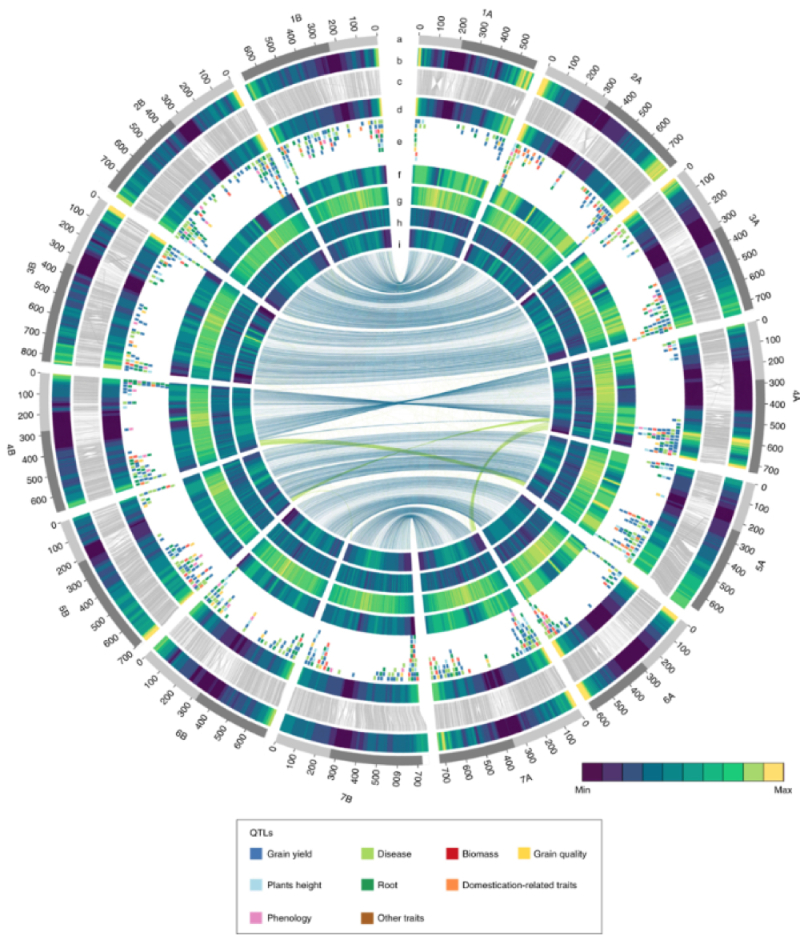
    Image 2The genome is segregated into 14 chromosomes, designated 1A/1B through 7A/7B in the Figure.  The distal regions of these chromosomes, representing about 22% of the genome, are highly recombinogenic according to the authors, as illustrated by high-density single nucleotide polymorphism (SNP) maps, showing an almost linear relationship between physical and genetic distance as ascertained by recombination.  The pericentromeric regions, on the other hand, show almost no recombination and represent about 44% of the genome.  Analysis disclosed 66,559 "high confidence (HC)" genes, with about 91% of these being detected as expressed in assembled gene expression data sets; these relationships are illustrated in Supplementary Figure 1 from the paper:
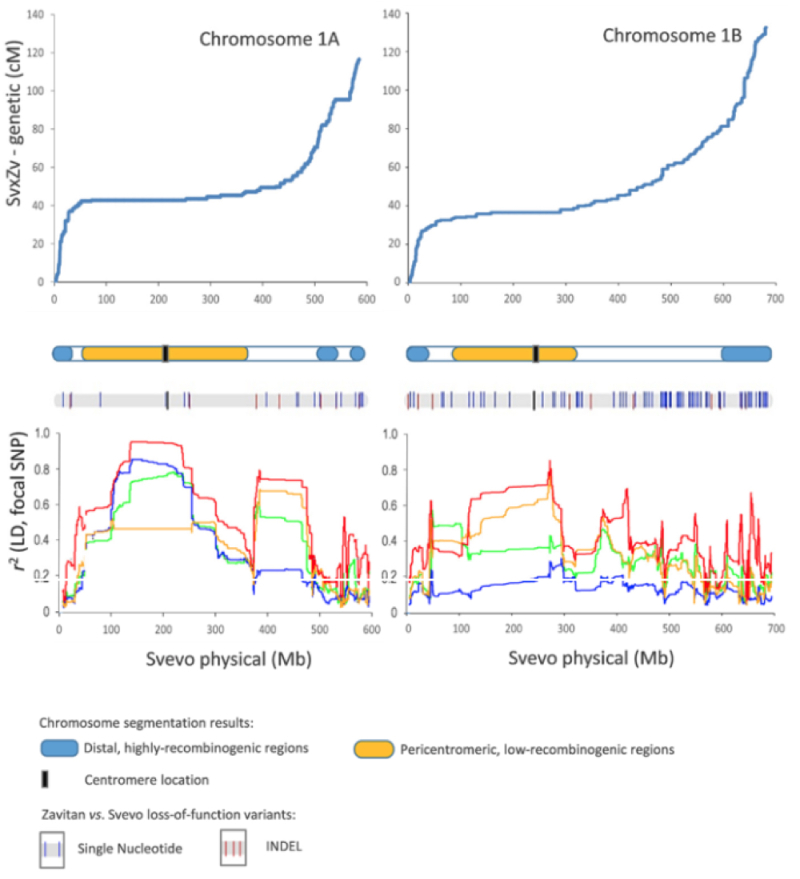
    Image 3The periocentric regions also showed a diminution in diversity that arose during domestication from wild emmer wheat to domesticated durum emmer wheat, particularly associated with chromosomes 2A, 4A, 4B, 5A, 5B, 6A, and 6B.  As disclosed in the paper, "several reductions in diversity (75 with diversity reduction index > 2) were specifically associated with breeding of modern durum cultivars, including some associated with disease resistance (for example, Sr13; ref. 29 and Lr14; ref. 30) and grain yellow pigment content loci (for example, Psy-B1; ref. 31)."

    Comparison between the Durum wheat genome and the progenitor wild emmer wheat genome showed strong overall synteny and high degree of similarity in total HC gene number (66,559 vs. 67,182).  LTR-Retrotransposon insertion sites were also found to be syntenic, resulting from the relatively short time since divergence of these cultivars.  Analysis of related gene clustering showed 36,434 "unigene" groups, 28,794 of which (79%) belonged to clusters having at least two members and 21% (7,640) being single genes.

    In particular, the paper describes a candidate gene, Cdu-B1, located on chromosome 5B associated with differences in cadmium (Cd) accumulation in durum wheat.  High throughput sequencing and comparison between genomic regions associated with this gene identified a region of increased sequence variation that was determined to encode a metal transporter, TdHMA3-B1; these experiments are illustrated in Supplementary Figure 6:

    Image 4

    Alleles of the TdHMA3-B1 gene were found to discriminate between low- and high-Cd accumulating wheat genotypes, as illustrated in Supplementary Figure 7:

    Image 5The extensive genetic comparisons (set forth predominantly in the Supplementary datasets) provided the bases for the authors' conclusions:

    Access to the fully annotated genome sequence in combination with the wealth of genotypic, genetic mapping and gene expression data provides great potential for future innovation for the wheat scientific community and the breeding sector.  Gene discovery, quantitative trait loci (QTL) cloning and the precision of genomics-assisted breeding to enhance grain quality and quantity of pasta wheat will benefit from the resources presented here.  Furthermore, the durum sequence provides a fundamental tool to more effectively bridge and harness the allelic diversity present in wheat ancestors most of which remains largely untapped.

    * Marco Maccaferri, Danara Ormanbekova, Elisabetta Frascaroli, Simona Corneti, Silvio Salvi & Roberto Tuberosa, Department of Agricultural and Food Sciences, University of Bologna, Bologna, Italy; Marco Maccaferri, Pasquale De Vita, Daniela Marone, Nicola Pecchioni & Anna M. Mastrangelo, Research Centre for Cereal and Industrial Crops, Foggia, Italy; Neil S. Harris, Kevin Y. H. Liang & Gregory J. Taylor, Department of Biological Sciences, University of Alberta, Edmonton, Alberta, Canada; Sven O. Twardziok, Heidrun Gundlach, Manuel Spannagl, Danara Ormanbekova, Thomas Lux, Verena M. Prade & Klaus F. X. Mayer, Helmholtz Zentrum München, Plant Genome and Systems Biology, Neuherberg, Germany; Raj K. Pasam, Reem Joukhadar & Matthew J. Hayden, Agriculture Victoria, Agribio Centre for AgriBioscience, Bundoora, Victoria, Australia; Sara G. Milner, Axel Himmelbach, Martin Mascher & Nils Stein, Leibniz Institute of Plant Genetics and Crop Plant Research, Gatersleben, Germany; Martin Mascher, German Centre for Integrative Biodiversity Research Halle-Jena-Leipzig, Leipzig, Germany; Paolo Bagnaresi, Primetta Faccioli, Francesca Desiderio, Caterina Marè, Cristina Crosatti, Erica Mica, Elisabetta Mazzucotelli & Luigi Cattivelli, Research Centre for Genomics and Bioinformatics, Fiorenzuola d'Arda, Italy; Paolo Cozzi, Massimiliano Lauria, Barbara Lazzari, Alessandra Stella & Aldo Ceriotti, National Research Council—Institute of Agricultural Biology and Biotechnology, Milano, Italy; Andrea Manconi, Matteo Gnocchi, Marco Moscatelli & Luciano Milanesi, National Research Council—Institute of Biomedical Technologies, Segrate, Italy; Raz Avni, Jasline Deek & Assaf Distelfeld, School of Plant Sciences and Food Security, Tel Aviv University, Tel Aviv, Israel; Sezgi Biyiklioglu & Hikmet Budak, Montana State University, Bozeman, MT, USA; Gabriella Sonnante, National Research Council—Institute of Biosciences and Bioresources, Bari, Italy; Hakan Özkan, Çukurova University, Faculty of Agriculture, Department of Field Crops, Adana, Turkey; Benjamin Kilian, Global Crop Diversity Trust, Bonn, Germany; Reem Joukhadar, Department of Animal, Plant and Soil Sciences, La Trobe University, Bundoora, Victoria, Australia; Domenica Nigro, Department of Soil, Plant and Food Sciences, University of Bari Aldo Moro, Bari, Italy; Agata Gadaleta, Department of Agricultural and Environmental Science, University of Bari Aldo Moro, Bari, Italy; Shiaoman Chao, Justin D. Faris & Steven S. Xu, United States Department of Agriculture, Agricultural Research Service, Edward T. Schafer Agricultural Research Center, Fargo, ND, USA; Arthur T. O. Melo & Iago Hale, Department of Agriculture, Nutrition, and Food Systems, University of New Hampshire, Durham, NH, USA; Mike Pumphrey, Department of Crop and Soil Sciences, Washington State University, Pullman, WA, USA; Krystalee Wiebe, Jennifer Ens, Ron P. MacLachlan, John M. Clarke, Sean Walkowiak & Curtis J. Pozniak, Crop Development Centre and Department of Plant Sciences, University of Saskatchewan, Saskatoon, Saskatchewan, Canada; Andrew G. Sharpe & Chu Shin Koh, Global Institute for Food Security, University of Saskatchewan, Saskatoon, Saskatchewan, Canada; Ron Knox, Swift Current Research and Development Centre, Agriculture and Agri-Food Canada, Swift Current, Saskatchewan, Canada; Anna M. Mastrangelo, Research Centre for Cereal and Industrial Crops, Bergamo, Italy; Matthew J. Hayden, School of Applied Systems Biology, La Trobe University, Bundoora, Victoria, Australia; and Klaus F. X. Mayer, School of Life Sciences Weihenstephan, Technical University Munich, Freising, Germany


  • CalendarApril 16, 2019 – "Trade Secrets Litigation 2019: Developments from the Trial Courts to the Supreme Court" (McDonnell Boehnen Hulbert & Berghoff LLP) – 10:00 am to 11:15 am (CT)

    April 18, 2019 – "Antibody Patenting: U.S. and Asian Perspectives" (Strafford) – 1:00 to 2:30 pm (EDT)

    April 18, 2019 – Chicago Regional Seminar (Elijah J. McCoy Midwest Regional Office, U.S. Patent and Trademark Office) – 12:30 to 5:00 pm (CT), Northwestern University Pritzker School of Law, Chicago, IL

    April 22, 2019 – "A conversation with Shawn Springs" (U.S. Patent and Trademark Office) – 11:00 am to noon, Alexandria, VA

    April 29-30, 2019 – Paragraph IV Disputes master symposium (American Conference Institute) – New York, NY

    April 23, 2019 – "Recent Developments in Biopharma Patent Law" (McDonnell Boehnen Hulbert & Berghoff LLP and Patent Docs) – 9:30 am to 1:30 pm, San Diego, CA (Hyatt Regency La Jolla at Aventine)

    April 23, 2019 – "From Boston & Beyond: Local and Global Implications of Recent Changes in Patent Practice" (Federal Circuit Bar Association) – 1:00 pm to 4:30 pm (EST), Suffolk University School of Law, Boston, MA

    April 23, 2019 – "Drafting Patent Applications for AI Systems — Overcoming Patent Eligibility, Inventorship, and Enablement Challenges and Avoiding Rejections" (Strafford) – 1:00 to 2:30 pm (EDT)

    April 24, 2019 – "Recent Developments in Biopharma Patent Law" (McDonnell Boehnen Hulbert & Berghoff LLP and Patent Docs) – 9:30 am to 1:30 pm, Burlingame, CA (Hyatt Regency San Francisco Airport)

    April 25, 2019 – "Drug Substance Patents: FDA Guidance, Protecting Composition-of-Matter Patents, Drafting Solid Form Claims" (Strafford) – 1:00 to 2:30 pm (EDT)

    April 29, 2019 – USPTO World Intellectual Property Day Celebration (U.S. Patent and Trademark Office, World Intellectual Property Organization, American Intellectual Property Law Association, U.S. Chamber of Commerce Global IP Center, International Trademark Association, American Bar Association's Section on Intellectual Property Law, and Intellectual Property Owners Association) – 4:00 to 6:30 pm, Rayburn House Office Building Foyer, Washington, DC

    May 16-17, 2019 – Advanced Summit on Life Sciences Patents (American Conference Institute) – New York, NY