• By Kevin E. Noonan –

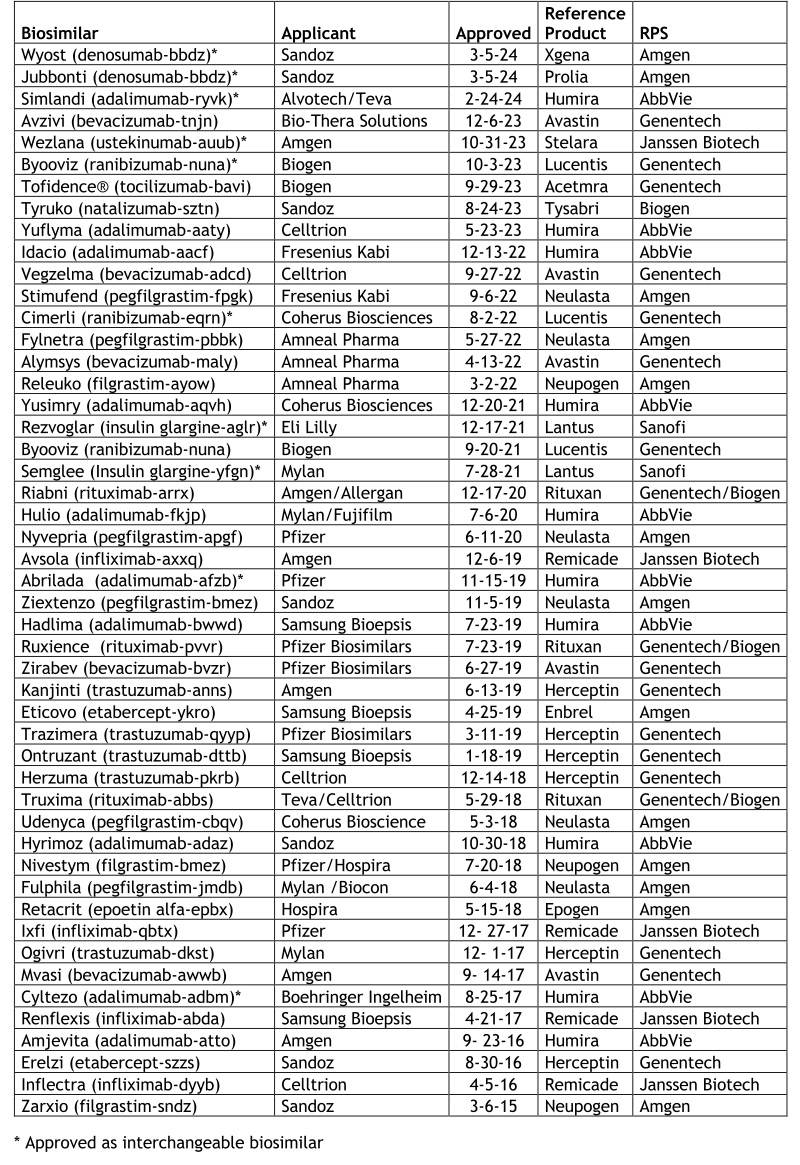
    FDAAfter taking most of a decade to approve its first interchangeable biosimilar (Semglee (insulin glargine-yfgn), the U.S. Food and Drug Administration has approved three interchangeable biosimilars since the beginning of this year.

    The first of these is simlandi (adalimumab-ryvk), approved on February 24th, made by Alvotech and Teva Pharmaceuticals, and interchangeable with Humira).  The biosimilar, a TNF alpha inhibitor, was approved to be provided as a single-dose autoinjector delivering 40 mg/0.4 mL, for treating  plaque psoriasis, Crohn's disease, ulcerative colitis, rheumatoid arthritis, juvenile idiopathic arthritis, psoriatic arthritis, ankylosing spondylitis, hidradenitis suppurativa, and uveitis.

    The FDA also approved on March 5th two interchangeable biosimilars from Sandoz for a pair of Amgen biologic drugs:  Jubbonti (denosumab-bbdz), interchangeable for Prolia (denosumab), and Wyost (denosumab-bbdz), interchangeable for Xgeva (denosumb).  Jubbonti was approved for increasing bone mass in men and women (inter alia due to chemotherapeutic treatment for prostate cancer (men) and breast cancer (women), for osteoporosis (induced by glucocorticoid treatment or otherwise) in men and women, and for preventing fracture in post-menopausal women with osteoporosis.  Wyost was approved for treating patients with multiple myeloma and solid tumor bone metastases, giant cell bone tumors, and treatment of hypercalcemia of malignancy refractory to bisphosphonate therapy.

    Both Prolia and Jubbonti have a boxed warning for increased risk of severe hypocalcemia (low blood calcium levels) in patients with advanced chronic kidney disease taking osteoporosis medicine.

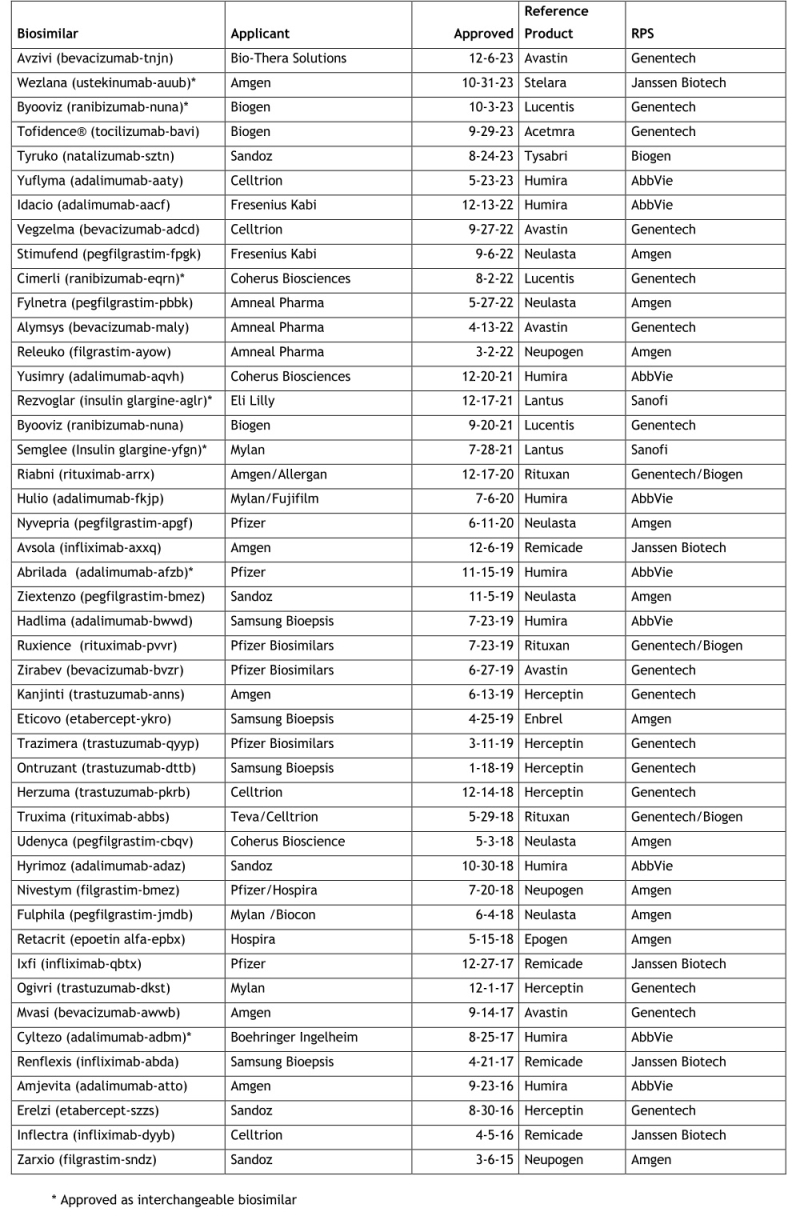
    With these approvals, there are a total of 48 biosimilars (and 10 interchangeable biosimilars) approved by the FDA since Zarxio was approved in March 2015.

    Table

  • By Joshua Rich and Michael Borella

    MicrosoftLike OpenAI before it, Microsoft has sought to dismiss portions of the lawsuit the New York Times has brought against it over ChatGPT.  While raising some of the same arguments, Microsoft takes a more traditional path with its motion relying on the facts pled in the Times's complaint.  However, it also relies on an extended analogy to the VCR (and the Supreme Court's "Betamax" decision) to suggest a framework for the court's analysis.

    New York TimesMicrosoft's brief opens with a "Preliminary Statement" about the Motion Picture Association of America's resistance to the VCR in the 1980s and the "all-out effort by television and movie producers to stop a groundbreaking new technology."  Those efforts ultimately gave rise to the Supreme Court's "Betamax" decision,[1] in which the closely-divided Court decided that Sony did not contributorily infringe copyright because the ability to "time shift" when a television program was watched constituted a non-infringing fair use of a VCR.

    But Microsoft characterizes it as an attempt by existing media to throttle a disruptive technological advance in the crib, just as it accuses the Times of doing for large language models (LLMs) here.  It boldly asserts "copyright law is no more an obstacle to the LLM than it was to the VCR (or the player piano, copy machine, personal computer, internet, or search engine)," despite the key issue — whether the use of the Times's copyrighted works to train the ChatGPT LLM is a transformative or fair use — not being raised or argued in the motion.

    Instead of the central issue of transformative use, which Microsoft says it will "show on summary judgment," citing the Authors Guild v. Google case[2] relating to digitization of printed books and Google v. Oracle case[3] regarding use of Java APIs, Microsoft's motion to dismiss raises three of the four issues raised in OpenAI's motion to dismiss.  In doing so, however, Microsoft sticks closely to the facts alleged in the Times's complaint.  That is, after the extensive Preliminary Statement related to issues that will be raised later in the case, Microsoft presents a very typical factual background and argument.

    First, Microsoft argues that the Times's contributory infringement claim fails as a matter of law because the Times was not able to identify an end user that was directly infringing its copyrights.  Microsoft argues that the contributory infringement "claim is therefore the exact one the Supreme Court rejected when it blessed the VCR."  That, of course, is not true.  ChatGPT provides the end user with the data that includes copyrighted works in the LLP; in contrast, a VCR is content-agnostic.  That is, OpenAI chose the works that it used to train the LLM and provide response to end user prompts on ChatGPT, whereas Sony did not dictate what end users were taping on VCRs.  Furthermore, the VCR did not require training on a massive corpus of copyrighted works in order to even exist.

    Nonetheless, Microsoft's argument may succeed because of how the Times has pled its contributory infringement claim.  Rather than arguing that Microsoft encouraged end users to obtain copyrighted works, the Times argued that Microsoft materially contributes to end user infringement by offering products that it knows are capable of distributing infringing works. The argument is a bit tenuous because the Times did not identify an infringing end user or that Microsoft knew the end user was infringing.  The Times may argue that it could not have provided that information because the information passes only between ChatGPT and the end user.  We will have to see how the Times responds to the motion.

    Second, Microsoft argues that the Times failed to state a claim under the Digital Millennium Copyright Act (DMCA) because it failed to identify that Microsoft had removed any specific copyright management information (CMI) from a Times work before distributing that work.  Just as with the contributory infringement count, Microsoft argues that the Times did not identify any specific article reproduced or CMI removed.  That appears to be true at this juncture.  Again, however, this information is not easily available (if at all) to the Times.  Further, Microsoft argues that it had an honest belief that training the LLM was a non-infringing fair use.  The court may choose to allow the Times to take discovery to determine if it can find instances of Microsoft removing the CMI from works reproduced by ChatGPT, whether in training or final output.

    Finally, Microsoft argues that the state law misappropriation claim is preempted by the Copyright Act.  Traditionally, courts have accorded the Copyright Act broad preemptive effect.  Unless the information is highly time-sensitive "hot news," courts have been loath to find that copyright infringement is not a sufficient (and sole) remedy.  That does not seem to be the case with ChatGPT — it does not provide information based on Times articles immediately, only after the LLM has been taught on articles.  Thus, the Times's misappropriation count seems the most likely one to be dismissed.

    Like OpenAI, Microsoft is using its motion to dismiss as more than just a vehicle to get rid of certain counts.  Instead, it is seeking to create a framework for the case analogous to the Betamax case in addition to arguing for the dismissal of three counts of the complaint.  By doing so in a traditional brief format, it may obtain better results than OpenAI.  Nonetheless, Microsoft's VCR analogy to LLMs is shaky when placed under scrutiny and seems to be a ploy to leverage Hollywood's overblown and ultimately misplaced reaction to early home recording.

    [1] Sony Corp. of America v. Universal City Studios, Inc., 464 U.S. 417 (1984).

    [2] Authors Guild v. Google Inc., 804 F.3d 202 (2d Cir. 2015).

    [3] Google LLC v. Oracle Am., Inc., 141 S.Ct. 1183 (2021).

  •     By Joshua Rich and Michael Borella

    OpenAIIn response to the lawsuit the New York Times has filed against it, OpenAI has sought to dismiss portions of the complaint.[1]  But instead of filing a traditional motion to dismiss that argues that the allegations of the complaint are insufficient to support legal liability, OpenAI went on the offensive.  It sought to recast the case by including an extensive factual background that went far beyond — and sometimes is incompatible with — the allegations of the complaint.  In short, the motion to dismiss seems more like an attempt to influence the public view of the Times case, rather than an effort to narrow the scope of the dispute.

    New York TimesOn December 27, 2023, the Times filed its lawsuit against Microsoft Corp.; OpenAI, Inc.; and related companies in the U.S. District Court for the Southern District of New York, alleging that those companies have improperly trained large language models (LLMs) on the Times's copyrighted works, and that the defendants then deployed these models for public use.  The Times's complaint includes counts of direct copyright infringement, vicarious copyright infringement, contributory copyright infringement, violations of the Digital Millennium Copyright Act (DMCA), unfair competition by misappropriation, and trademark dilution.  As we have discussed earlier, a notable aspect of the complaint is its specificity — particularly, it provides several examples of the ChatGPT LLM being able to reproduce Times articles almost verbatim.

    On February 26, 2024, OpenAI responded with a motion to dismiss the claims of contributory copyright infringement (Count IV), DMCA violations (Count V), and unfair competition (Count VI).  OpenAI also seeks to have portions of the direct and contributory copyright infringement claims that occurred outside of the statute of limitations dismissed as time-barred.

    OpenAI's motion to dismiss is noteworthy for a number of reasons.  Motions to dismiss generally follow a well-trodden path of reciting the factual averments of the complaint, then arguing that those facts, even in the best of circumstances for the plaintiff, do not form the basis of an actionable claim.  That is because the court's standard in reviewing a motion to dismiss is to assume the truth of all of the facts in a well-pled complaint and all reasonable inferences drawn from those facts.  The court will then dismiss the complaint (or parts of it) only if those facts do not form a plausible basis for the claims asserted or if there is some legal bar to the claims that is apparent without any fact finding.  OpenAI did not take that approach.

    Instead, OpenAI ranged far afield factually, not limiting itself to the factual averments of the complaint.  In an attempt to do so without drawing the judge's ire, it sought to invoke several of the loopholes that allow the consideration of information outside the express language of a complaint, stretching the exceptions until they would swallow the basic rules on motions to dismiss.  So in the end, the motion's factual background section itself may draw the judge's wrath for a transparent attempt to circumvent the basic rules of motions to dismiss.

    Indeed, the factual background section of the motion to dismiss reads more like a press release than a legal pleading in that it introduces new factual allegations, argues that the facts alleged in the complaint are incorrect, suggests affirmative defenses, and contains an overblown self-serving assessment of the company's importance.[2]  But OpenAI actually flat-out admits the most basic premise of the complaint:  that it copied the Times's work and used it to teach the ChatGPT LLM (albeit more than three years ago). That fourteen-page exposition on the history of ChatGPT then bears little, if any, relationship to the four substantive arguments raised in the second half of the motion.

    In its first substantive argument, OpenAI plainly asserts that any direct copyright infringement that "occurred more than three years ago" should be dismissed because it is time-barred under the statute of limitations set forth in 17 U.S.C. § 507(b).[3]  However, three years is not necessarily three calendar years; federal courts follow the "discovery rule" that begins the three-year clock when the plaintiff discovers, or reasonably should have discovered, the infringement as opposed to the date of actual infringement.  It is likely that the Times will respond by saying that it did not know — and could not reasonably know — of OpenAI's infringement until it could query ChatGPT.

    OpenAI states that the Times' copyright infringement position is based on OpenAI's use of the WebText database — which contains Times works — to train an early version of GPT (the LLM underlying ChatGPT), and that this training took place more than three years ago.  That is really much more of a misappropriation model of wrongdoing than copyright infringement; OpenAI clearly made a copy of the Times's articles when it first copied them, but it arguably continues to do so every time it creates a derivative work based on those articles.  In addition, OpenAI does little to address why it apparently believes that the Times knew or should have known of these activities.  Further, OpenAI does not specifically address a related allegation in the complaint regarding another database containing Times works that was used to train GPT, Common Crawl.[4]

    Regardless of when OpenAI began using any of these databases, it is well understood that newer versions of GPT are likely to have been trained and retrained on the same or similar sources.  As implied by OpenAI's own website, further ingestion of the Times's works may have occurred during some or all training procedures that have led to numerous iterations of ChatGPT.  Indeed, OpenAI no longer publicly identifies its training data sources or training procedures.  Thus, it is hard to understand how the Times should reasonably have known about all of these possible copying events.  And more fundamentally, OpenAI provides the court with no guidance on how to narrow the case and tease apart the time-barred original infringement and unbarred creation of derivative works in a simple manner.

    Second, OpenAI argues that the Times has failed to state a claim for contributory copyright infringement.  Such a claim requires that the plaintiff allege that the defendant knew or had reason to know of copyright infringement of another and that the defendant actually has knowingly induced, caused, or materially contributed to this infringement.  In the complaint, the Times alleged that:

    Defendants knew or had reason to know of the direct infringement by end-users because Defendants undertake extensive efforts in developing, testing, and troubleshooting their LLM models and GPT-based products.  Defendants are fully aware that their GPT-based products are capable of distributing unlicensed copies or derivatives of copyrighted Times Works.

    Here, OpenAI makes two points.  The first is that the Times' allegations are too generalized and contemplates only the mere possibility of infringement by OpenAI's end users.  That is, there is no concrete end-user direct infringer to which OpenAI's inducement can be tied.  Of course, information about end users' prompts and the result returned would be in OpenAI's hands (if anyone's), not the Times.  The second point, which is rather specious, is that any such contributory infringement would violate OpenAI's terms of use.  It is a curious argument because it does not deny that it may have violated the law, but only that end users may have violated their contractual obligations to OpenAI if they follow OpenAI's lead.  To the extent that OpenAI is contending that it just held the door open and its end users walked through on their own accord, such an angle is unlikely to be persuasive.

    Third, in seeking to establish a DMCA violation, the Times alleged that ChatGPT removed "one or more forms of copyright-management information in each of The Times's infringed works, including: copyright notice, title and other identifying information, terms and conditions of use, and identifying numbers or symbols referring to the copyright-management information."  OpenAI responds by, among other things, stating that the Times' allegations do not include the specific copyright-management information that was included in each work, and thus paint with too broad of a brush.  Here, OpenAI has some recent authority on its side, as the judges in parallel cases of Andersen v. Stability AI Ltd. and Tremblay v. OpenAI, Inc. have set the pleading bar to require a higher level of specificity for analogous LLM infringement claims under the DMCA.  It remains to be seen how the Times will seek to distinguish those cases.

    Finally, with regard to unfair competition by misappropriation, the Times essentially alleged that OpenAI's use of the Times' content results in a loss of revenue for the Times.  The argument, made in more detail in the complaint, is based on the Times's concern that integration of GPT into a search engine (here, Microsoft's Bing) will obviate the need for readers to subscribe to the Times or visit its website.  In other words, instead of referring users to the Times, the search engine will generate a result that incorporates aspects of the Times's works without giving the Times money or credit.

    OpenAI's response here is more traditional than its other arguments:  that such state law claims are preempted by the Copyright Act. That argument is well-established in precedent and relies only on legal arguments (not any factual information) and is thus more likely to succeed than the other, more novel arguments.  OpenAI also addresses one of the complaint's specific example of alleged misappropriation relating to the Times' Wirecutter product recommendations (as source of revenue for the Times).  Specifically, OpenAI analogizes the Wirecutter recommendations to compilations of stock recommendations that were found not to be misappropriation in a previous case.  In a nutshell, OpenAI argues because that the Wirecutter recommendations are not being sold by OpenAI as its own work and the Times did not obtain the recommendations through "efforts akin to reporting," the allegations fail the misappropriation test.  That portion of the argument is less likely to succeed because it would force the judge to delve into the factual similarities and differences.

    OpenAI's motion to dismiss seems like it is more of an attempt to convince credulous reporters[5] (and, by extension, the public) of the justice if its ways.  It refuses to accept the Times's characterization of the facts and instead provides its own history and arguments.  But those assertions are not closely tied to the legal arguments OpenAI makes.  So at best, OpenAI is seeking to give the judge a roadmap to what he will see later; at worst, it is a cynical ploy to win over hearts and minds outside of court.  The legal arguments in the motion to dismiss, in contrast, are written in a more traditional manner but have varying likelihoods of success.  We will know more soon, when the Times responds. 

    [1] Microsoft has now also moved to dismiss portions of the Complaint, with a far more traditional approach.  We will review that motion in a forthcoming post.

    [2] For example, "OpenAI was founded in 2015 to advance digital intelligence in the way that is most likely to benefit humanity as a whole," and "The new GPT-3 model was by far the most powerful language model ever created."  While the GPT family is indeed a very powerful set of large language models, this assertion should be taken with more than a lost shaker of salt.  A standard response employed for years by high tech companies accused of IP theft amounts to "Don't stop us bro, we're innovating."  This response is often made as those companies are raking in huge profits or setting up an environment in which they can do so.

    [3] Notably, Microsoft does not make this argument.

    [4] OpenAI contends that prior to the three-year period, "it was common knowledge that WebText2 and Common Crawl included numerous articles published by the Times."  That assertion is not drawn from the complaint.

    [5] To be fair, few reporters are trained in the law well enough to distinguish between the standard for summary judgment and dismissal. Even some lawyers get it wrong.

  • By Michael Borella

    USPTO SealOn February 27, 2024, the U.S. Patent and Trademark Office published its Updated Guidance for Making a Proper Determination of Obviousness ("Guidance") in the Federal Register.  The stated goal of the Guidance is:

    To provide a review of the flexible approach to determining obviousness that is required by KSR Int'l Co. v. Teleflex Inc. (KSR).  The focus of this document is on post-KSR precedential cases of the United States Court of Appeals for the Federal Circuit (Federal Circuit), to provide further clarification for decision-makers on how the Supreme Court's directives should be applied.

    At first blush, the Guidance appears to be merely restating the law and one might be inclined to think that it is much ado about nothing.  However, the Guidance is notable for what it does not cover and may actually lead to its intended audience (mainly examiners and PTAB judges) being more likely to find claims obvious and raising the bar on applicant rebuttals of obviousness contentions.

    Put another way, the Guidance sets forth a number of legal principles that could result in examiners believing that they should issue more obviousness rejections.  But it does not acknowledge or even mention that examiners commonly and frequently misapply the law and facts when doing so.  Thus, the Guidance is — at best — one-sided in this regard and may result in more time and expense for applicants.

    The Guidance states that it "is based on the Office's current understanding of the law and is believed to comport with the binding precedent of the Supreme Court and the Federal Circuit . . . [and] is meant to be consistent with the Office's present examination policy."  It is expected that the Guidance will be incorporated into an updated version of the Manual of Patent Examining Procedure (M.P.E.P.).

    One tangential point that the Guidance notes is that the America Invents Act (AIA) changed "the time focus of the obviousness inquiry from 'at the time the invention was made' to 'before the effective filing date of the claimed invention.'"  The Guidance instructs USPTO personnel to "interpret references to 'at the time of invention' in KSR . . . as if they referred to the statutory time focus under the AIA."  Presumably, USPTO personnel should do the same with any use of the term "at the time of the invention" in other cases and in Applicants' comments for purposes of consistency, though such a directive is not made.  Nonetheless, this seems to be a minor clarification that is unlikely to lead to a substantive change in examination.

    The Guidance goes on to reiterate that KSR affirmed that the factors set forth in Graham v. John Deere Co. still control the obviousness inquiry.  These factors require that "differences between the prior art and the claims at issue are to be ascertained; and the level of ordinary skill in the pertinent art resolved."  Here, the USPTO missed an opportunity to advise examiners to explicitly state their interpretation of the differences (which sometimes is missing in obviousness rejections) and their understanding of the level of ordinary skill in the art (which is almost never mentioned in obviousness rejections).

    More substantively, the main theme of the Guidance is that KSR set forth a flexible rather than robotic obviousness test.  The Guidance states that this flexibility has two aspects, "first with regard to the proper understanding of the scope of the prior art, and second with regard to appropriate reasons to modify the prior art."

    On these points, the Guidance asserts that "a proper understanding of the prior art extends to all that the art reasonably suggests, and is not limited to its articulated teachings regarding how to solve the particular technological problem with which the art was primarily concerned."  This requires understanding the prior art "in a flexible manner that credits the common sense and common knowledge of a [person having ordinary skill in the art (PHOSITA)]."

    According to the Guidance this means that "[a]n argument that the prior art lacks a specific teaching will not be sufficient to overcome an obviousness rejection when the allegedly missing teaching would have been understood by a PHOSITA—by way of common sense, common knowledge generally, or common knowledge in the relevant art."  The Guidance goes on to give examples from the case law that reject a rigid approach to obviousness and properly combine prior art elements without an express teaching to do so.

    The problem here is that the Guidance is silent as to how an examiner is supposed to determine the understanding of a PHOSITA or even the proper level of ordinary skill in the art.  As noted above, such determinations are rarely made explicit in office actions.  And, even when they are explicit, the rationale provided by examiners is often conclusory with little or no supportive reasoning.

    The Guidance goes on to note that "the flexible approach to obviousness encompasses not only how to understand the scope of prior art, but also how to provide a reasoned explanation to support a conclusion that claims would have been obvious."  Thus, there are "numerous possible sources that may, either implicitly or explicitly, provide reasons to combine or modify, the prior art to determine that a claimed invention would have been obvious."  As a notable example, a so-called "universal" type of improvement to improve system performance may exist "even absent any hint of suggestion in the references themselves."

    The concern with this language is that examiners will use it to justify poorly-reasoned, hand-waving contentions involving uses, modifications, and combinations of prior art.  These concerns are somewhat addressed by the Guidance reiterating that "a proper obviousness rejection still requires the decision-maker to provide adequate analysis based on evidentiary support."  In other words, "Office personnel are required to provide a clear articulation of their reasoning, grounded in relevant facts, when making a determination that a claim would have been obvious."  Having said that, it is rare for said personnel to admit that their articulations have not been clear and the guidance provides little criteria for determining whether an obviousness rejection meets this requirement.

    Along similar lines, the Guidance states that "[i]f objective indicia of nonobviousness are properly before the examiner, such as by way of incorporation into the written description as filed or submission of an evidentiary declaration after the filing date, the examiner must consider those indicia, even before the issuance of a first Office action."  While a well-drafted patent application may point out differences between the claimed invention and the prior art known to the applicant, it is not clear in examination procedures whether and to what extent such statements have been considered by examiners.  There currently is no requirement for examiners to make such considerations on the record.

    Other issues addressed by the Guidance include the use of common sense by a PHOSITA and how to evaluate the weight of expert opinions.

    Notably missing from the Guidance is any example of what a sufficient obviousness rejection would look like in practice.  It would have been helpful for the USPTO to provide examples of properly-reasoned as well as improperly-reasoned obviousness rejections.  As it stands, such details are not present, which may incentivize examiners to continue taking short cuts.

    At the very least, the Guidance should have called out a few of the most common and problematic types of examiner errors.  These include <ctrl>-F rejections (the examiner finds the words of the claims in prior art references and does not consider that the words may have multiple meanings or are used in a different context), overreliance on broadest reasonable interpretation (the examiner ignores how a claim term is used in the claim and/or defined in the specification), low-effort rejections of dependent claims (the examiner uses the same references to reject all dependent claims even if those references do not teach the specific elements of those claims), the Where's Waldo rejection (the examiner essentially cites an entire reference — perhaps dozens of pages long — and merely tells the applicant that the claim element in question is "in there somewhere"), the "expert" examiner (the examiner claims, without any evidentiary support, that the claim element would be well-known to a PHOSITA because the examiner considers themself an expert in the field), and the ghost claim element (an element that is explicitly recited in a claim that the examiner completely and utterly fails to address).  These are just a few examples.

    The point is that the USPTO needs to crack down on examiners taking liberty with lazy examination practices.  Along with the Guidance's discussion of the flexibility the obviousness analysis should be a further and more detailed discussion of how to apply it properly.

    Another aspect missing from the Guidance is an acknowledgement that there is a line of Federal Circuit cases that put a fence around overly broad motivations to combine prior art references.  Notably, in Belden Inc. v. Berk-Tek LLC, the Court wrote that "obviousness concerns whether a skilled artisan not only could have made but would have been motivated to make the combinations or modifications of prior art to arrive at the claimed invention" (emphasis added).  Similar language can be found in Personal Web Techs., LLC v. Apple, Inc. and In re NuVasive, Inc. in other words, it is not enough for an examiner to contend that references X and Y could be theoretically combined in some fashion.  Instead, the prima facie burden on the examiner is to establish that a PHOSITA would have been motivated to combine references X and Y in a manner that results what is being claimed by the applicant.

    In short, nobody is perfect.  Examiners are human.  Most are not attorneys.  They will make mistakes when applying the law of obviousness.  The USPTO, however, seems content to stick its head in the sand regarding some of the more common and egregious examiner errors that can be found in obviousness rejections without even looking that hard.

    If nothing else, the USPTO should be looking closely at examiners who have very high or very low allowance rates in comparison to their art unit or technical center peers as ones that potentially are misapplying the law of obviousness.  The USPTO should also be looking at examiners who are frequently reversed during any stage of the appeals process (e.g., on a pre-appeal brief or PTAB decision) as also potentially misapplying this law.  These individuals should be targeted for additional training on how and how not to employ the obviousness inquiry.

  • By Kevin E. Noonan –

    Federal Circuit SealThe Federal Circuit's In re Cellect decision has caused a great deal of commentary and proposals to avoid its consequences, including changing prosecution strategies and filing prospective, precautionary terminal disclaimers (see "Overcoming the Consequences of In re Cellect") to reimbue predictability regarding patent term to patent portfolio prosecution (as well as there being a pending certiorari petition before the Supreme Court).  While understandable reactions, the reality (provided it is appreciated) may be much simpler:  a proper understanding and resulting application of the patent term adjustment statute.

    That reality is clearcut:  the text, history, and structure of 35 U.S.C. § 154(b) make clear that obviousness-type double patenting (ODP) shall not cut short the patent term adjustment (PTA) of a parent patent over a child patent if the child is still pending when the parent is granted, but instead is relevant only in situations where the earlier patent is from a different (albeit related) patent family.

    The language of the statute, 35 U.S.C. § 154(b)(2)(B), is unambiguous.  The statute states that:  "No patent the term of which has been disclaimed beyond a specified date may be adjusted under this section beyond the expiration date specified in the disclaimer."   As noted by Federal Circuit in In re Cellect, terminal disclaimers and ODP are "inextricably intertwined," because "[t]erminal disclaimers are almost always filed to overcome an ODP rejection" and they are "two sides of the same coin."  In re Cellect, LLC, 81 F.4th 1216, 1228 (Fed. Cir. 2023).  Therefore, 35 U.S.C. § 154(b)(2)(B) is clearly directed to the application of ODP in the context of PTA, and requires that (1) the terminal disclaimer must be filed (or at least could have been filed, if a mistake has been made by the USPTO for not requiring such filing) before the PTA determination, which occurs at the time of the patent grant and (2) the terminal disclaimer must rely on a "specified" expiration date.  Accordingly, the statute is controlling, because when the statute "speaks directly" to the area of law, a court-made doctrine (such as ODP) cannot serve to subtract or add to what has already been legislatively prescribed.  See SCA Hygiene Prod. Aktiebolag v. First Quality Baby Prod., LLC, 580 U.S. 328, 335 (2017).

    In a typical parent-versus-child situation where the child application is still pending when the parent is granted, a terminal disclaimer cannot be properly filed in the parent over the child, because the claims in the child application can subsequently change during prosecution, making the ODP assessment based thereon impractical if not impossible.  The "provisional" ODP practice at the USPTO has never been approved by (or fully challenged in) court to prevent the grant of a parent application over a child application that is pending and has not been allowed.  See In re Mott, 539 F.2d 1291 (CCPA 1976); In re Wetterau, 356 F.2d 556 (CCPA 1966).  Indeed, according to M.P.E.P. § 804 "[i]f a provisional nonstatutory double patenting rejection is the only rejection remaining in an application having the earlier patent term filing date, the examiner should withdraw the rejection in the application having the earlier patent term filing date and permit that application to issue as a patent, thereby converting the provisional nonstatutory double patenting rejection in the other application into a nonstatutory double patenting rejection upon issuance of the patent."  This practice implicitly recognizes (and avoids) the temporal distortions created in application of ODP by the Federal Circuit's Cellect decision.

    Supporting this statutory construction basis for challenging the Court's interpretation is the fact that a pending child application does not have a "specified" expiration date as required by the statutory language.  Merriam-Webster defines "specified" as "to name or state explicitly or in detail."  A pending application cannot have a "specified" expiration date if its prosecution is still ongoing, because it is unpredictable whether future PTA events arising during continued prosecution will change the eventual expiration date.  In practice, the USPTO has never specified, or attempted to specify, the expiration date of a pending patent application.

    This typical patent-versus-child situation is different from the situation where the parent patent in a line of related patents and applications is found obvious over an already-granted, commonly owned patent from a different family.  In such a scenario, a terminal disclaimer is required in the parent patent over the already-granted patent from the different family.  Pursuant to the governing statute 35 U.S.C. § 154(b)(2)(B), the PTA of the parent patent would be cut short or lost entirely by the terminal disclaimer, depending on how much PTA would go beyond the expiration date of the already-granted patent from the different family.

    This interpretation of 35 U.S.C. § 154(b)(2)(B) is supported by legislative history, showing that Congress considered ODP in the context of PTA multiple times and each time Congress deliberately prescribed the conditions under which ODP can cut short PTA.  Congress first introduced PTA through the Uruguay Round Agreements Act in 1994 for three types of administrative delays:  (1) delays caused by secrecy orders, (2) delays caused by interference, or (3) delays caused by appellate review.  See 35 U.S.C. § 154(b)(1)-(2) (1994).  The 1994 version of Section 154(b) also prescribed the specific conditions under which ODP could limit PTA (albeit not yet formally referred to as such but in retrospect PTA in all but name).  Specifically, the 1994 version of the statute prevented PTA for patents "subject to a terminal disclaimer due to the issue of another patent claiming subject matter that is not patentably distinct from that under appellate review."  Id. § 154(b)(2) (1994) (emphasis added).  This reference to terminal disclaimers and "not patentably distinct" made clear that Congress considered ODP in establishing PTA in this consequence and in remedy of the distortions in term caused by adoption of the GATT/TRIPS changes in U.S. patent law.  Congress also decided to limit this ODP-cutting effect to PTAs associated with appellate review delays, but not PTAs associated with interference or secrecy order delays.  Importantly, this specific choice by Congress in 1994 also prevented the application of ODP to the parent PTA over the child where the child was not "issued" when the parent was under appellate review.

    In 1999, Congress changed the PTA provisions to the current language by enacting the Patent Term Guarantee Act of 1999 to "guarantee" a diligent applicant a minimum 17-year effective patent term.  See 145 Cong. Rec. H6944 (1999) (Rep. Dana Rohrabacher) ("This approach essentially gives back to the nondilatory patent holder . . . a guaranteed 17 year patent term."); 145 Cong. Rec. S13258-13259 (1999) (Sen. Orrin Hatch and Patrick Leahy) ("[T]he bill will guarantee a minimum 17-year patent term for diligent applicants . . ."); H.R. Rep. No. 106-287, 48-49 (1999) (Sen. Trent Lott) ("Title III . . . includes a new provision guaranteeing diligent applicants at least a 17-year term . . . .").  Congress's intent to provide such guarantees is clear, wherein subsection 154(b)(1) is itself entitled "Patent term guarantees," and the subsection uses the term "guarantee" or "guarantees" four separate times.  A "guarantee," as Congress well knew, is an "assurance" or an "undertaking with respect to (a contract, performance of a legal act, etc.) that it will be duly carried out."  These Congressionally mandated guarantees are abolished by the Court's Cellect decision, after having been brought into serious question in earlier cases decided by the Court.

    These intentions were not effected by Congress without regard to ODP, which was considered in the context of PTA in the statutory language of the 1999 revision.  Section 154(b)(2)(B) states:  "(B) Disclaimed term.  No patent the term of which has been disclaimed beyond a specified date may be adjusted under this section beyond the expiration date specified in the disclaimer."  35 U.S.C. § 154(b)(2)(B) (emphases added).  The terms "has been disclaimed" (past tense) and "specified date" (see Merriam-Webster definition above) show that ODP would apply in the context of PTA only when (1) a terminal disclaimer has already been filed before the PTA determination and (2) the reference expiration date used in the terminal disclaimer must be "specified" (not simply an unascertainable expiration date of a pending application without knowing whether any future PTA event would occur that will change the eventual expiration data).

    In addition, there is no meaningful policy reason to apply the ODP-cutting effect to the parent PTA in a typical parent-versus-child situation in view of the overarching legislative intent to ensure a minimum 17-year effective patent term.  In practice, this statutory choice is consistent with the legislative intent to "guarantee" a minimum 17-year effective patent term.  A child application is generally filed and granted later, which makes the effective patent term of a child patent necessarily shorter than that of the parent, assuming no USPTO delay in both cases.  A child application is also generally examined much faster than the parent, thereby less likely to incur more USPTO delays than the parent.  This also leads to less effective patent term for the child than the parent.  Therefore, in a patent family, only the parent typically is capable of receiving a minimum 17-year effective patent term.

    Properly construed, the text, history and structure of Section 154(b) make clear that ODP does not apply to the PTA of a parent over a child if the child is still pending when the parent is granted.  While it is rather late in the day for these realities to matter, the potential (however unlikely) that the Supreme Court will consider the question of the effect of ODP on PTA should be well within the Court's interest in determining whether the Federal Circuit has once again erred in interpreting U.S. patent law (see Bilski v. Kappos and KSR Int'l. Co. v. Teleflex, Inc., for example), despite its recognized "special expertise" (Warner Jenkinson Co. v. Hilton-Davis Chemical Co.) and needs the Court's correction.

    *Hat tip to colleagues who contributed thoughts and perspectives on these issues.

  • By Michael Borella

    New York TimesOn December 27, 2023, The New York Times Company ("The Times") sued several OpenAI entities and their stakeholder Microsoft ("OpenAI") in the Southern District of New York for copyright infringement, vicarious copyright infringement, contributory copyright infringement, violation of the Digital Millennium Copyright Act (DMCA), unfair competition, and trademark dilution (complaint).  Unlike other high profile copyright actions brought against OpenAI (e.g., by the Author's Guild, Julian Sancton et al., Michael Chabon et al., Sarah Silverman et al., Paul Tremblay and Mona Awad, et al.), The Times' allegations exhibit a remarkable degree of specify.  This will make it difficult for OpenAI to establish that (i) its generative AI models were not trained on copyrighted content of The Times, and (ii) that OpenAI was engaging in fair use if and when it did so.

    The complaint centers around OpenAI's large language model (LLM) chatbot, ChatGPT.  As described by The Times:

    An LLM works by predicting words that are likely to follow a given string of text based on the potentially billions of examples used to train it . . . .  LLMs encode the information from the training corpus that they use to make these predictions as numbers called "parameters."  There are approximately 1.76 trillion parameters in the GPT-4 LLM.  The process of setting the values for an LLM's parameters is called "training."  It involves storing encoded copies of the training works in computer memory, repeatedly passing them through the model with words masked out, and adjusting the parameters to minimize the difference between the masked-out words and the words that the model predicts to fill them in.  After being trained on a general corpus, models may be further subject to "finetuning" by, for example, performing additional rounds of training using specific types of works to better mimic their content or style, or providing them with human feedback to reinforce desired or suppress undesired behaviors.

    Once trained, LLMs may be provided with information specific to a use case or subject matter in order to "ground" their outputs.  For example, an LLM may be asked to generate a text output based on specific external data, such as a document, provided as context.  Using this method, Defendants' synthetic search applications: (1) receive an input, such as a question; (2) retrieve relevant documents related to the input prior to generating a response; (3) combine the original input with the retrieved documents in order to provide context; and (4) provide the combined data to an LLM, which generates a natural-language response.

    Put another way, the parameters of an LLM like ChatGPT can be thought of as a compressed amalgam of its training data, represented in a way that preserves the wording, grammar, and semantic meaning of the original works.  When queried, ChatGPT produces output consistent with this compressed representation.

    Based on publicly available information, The Times alleges that a relatively large portion of the content used to train various versions of GPT were from its web site, an estimated millions of individual works.  Further, and even more compelling, The Times provides numerous samples of ChatGPT being able to generate near verbatim copies of its articles. One such example is reproduced below:
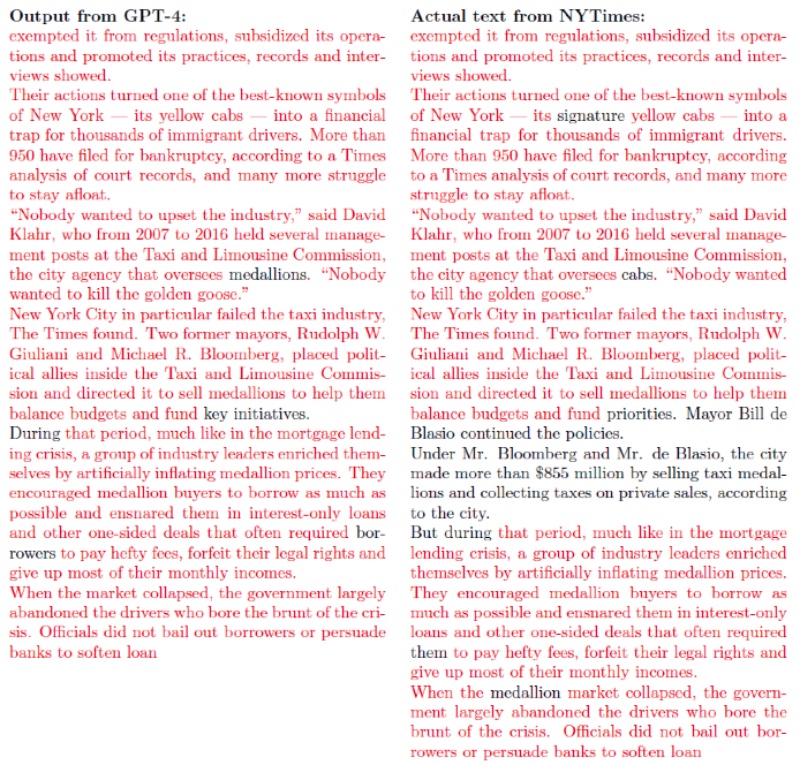
    Image

    This comparison is stunning.  The Times alleges that it got ChatGPT to produce the output with "minimal prompting" but did not provide a specific prompt or series of prompts that it used to do so.[1]  The output suggests that prominent training data that is emphasized in the training process can be represented in a nearly-uncompressed fashion in the resulting model.  Thus, even if it is hard to point to exactly where the "copy" of an article resides amongst the 1.76 trillion parameters, the existence of such a copy should not be in question.

    OpenAI responded publicly to the complaint in a January 8, 2024 blog post, stating that:

    Memorization is a rare failure of the learning process that we are continually making progress on, but it's more common when particular content appears more than once in training data, like if pieces of it appear on lots of different public websites.  So we have measures in place to limit inadvertent memorization and prevent regurgitation in model outputs.  We also expect our users to act responsibly; intentionally manipulating our models to regurgitate is not an appropriate use of our technology and is against our terms of use.

    Interestingly, the regurgitations The New York Times induced appear to be from years-old articles that have proliferated on multiple third-party websites.  It seems they intentionally manipulated prompts, often including lengthy excerpts of articles, in order to get our model to regurgitate.  Even when using such prompts, our models don't typically behave the way The New York Times insinuates, which suggests they either instructed the model to regurgitate or cherry-picked their examples from many attempts.

    This is a strange response.  It is essentially admitting to copying The Times' articles in question, but makes the non-legal arguments of "Hey, it was just a bug," and "The Times had to work hard and manipulated our model."  Like saying "the dog ate my homework," neither of these excuses are likely to hold up under scrutiny.

    Why is OpenAI seemingly shooting itself in the foot regarding actual copying?  Because it is putting all of its eggs in the fair use basket.

    Fair use is an affirmative defense written into the copyright statute that allows limited use of copyrighted material without permission from the copyright holder.  It recognizes that rigid copyright laws can stifle dissemination of knowledge.  Therefore, it attempts to balance copyright holders' interests in their creative works with the public's interest in the advancement of knowledge and education.  Thus, the fair use doctrine acknowledges that not all uses of copyrighted material harm the copyright owner and that some uses can be beneficial to society at large.

    Even so, OpenAI has a long and uncertain road ahead of it.  Fair use is a notoriously malleable four-factor test that can be applied inconsistently from court to court.  Furthermore, the interpretive contours of the test have evolved since its first appearance in the statute almost 50 years ago.  Even the U.S. Copyright Office admits that "[fair use] fact patterns and the legal application have evolved over time . . . ."[2]

    Predicting the outcome of a fair use dispute is often a fool's errand, even for those well-versed in copyright law.  For example, the Supreme Court recently found fair use in the copying of 11,500 lines of computer code but not in the artistic reproduction of a photograph.[3]  The outcome of a case can ride on which fair use factors the judge or judges find to be most relevant to the facts of the case and how they interpret these factors.

    Fair use might not be a legal sniff test but it comes close.  Nonetheless, let's take a look at each of the factors in order to understand the difficulties that OpenAI might run into when relying on this defense.

    (1) The purpose and character of the use, including whether such use is of a commercial nature or is for nonprofit educational purposes.

    Courts often view unlicensed copying for nonprofit education or noncommercial purposes as more likely to be fair use than those that are for commercial gain.  In doing so, courts look to whether the use is transformative, in that it changes the original work in some manner, adding new expression or meaning, and does not just replace the original use.

    OpenAI runs a for-profit business and charges for end-user access to its models.  Further, the examples provided by The Times are much closer to verbatim copying than any type of transformative use.  Therefore, this factor weighs against OpenAI.

    (2) The nature of the copyrighted work.

    This factor examines how closely the use of the work aligns with copyright's goal of promoting creativity.  So, using something that requires a lot of creativity, like a book, film, or music, might not strongly back up a fair use claim compared to using something based on facts, like a technical paper or a news report.

    Here, OpenAI has an angle as The Times produces a great deal of news reporting and cannot claim a copyright over basic facts.  However, The Times' content includes many detailed articles explaining events and other facts in its writers' ostensibly creative voices.  Moreover, investigative reporting is the uncovering and tying together of facts, which requires creative effort.  At best, this factor is neutral for OpenAI.

    (3) The amount and substantiality of the portion used in relation to the copyrighted work as a whole.

    In considering this factor, courts examine how much and what part of the copyrighted work is used.  If a significant portion is used, it is less likely to be seen as fair use.  Using a smaller piece makes fair use more probable, though copying even a minute portion of a work might not qualify as fair use if it includes a critical or central part thereof.

    This factor also weighs against OpenAI if we take as given The Times' allegations and evidence of almost-exact reproduction of its works.

    (4) The effect of the use upon the potential market for or value of the copyrighted work.

    This fourth factor may end up being the most important.  The inquiry is whether the unauthorized use negatively affects the market for the copyright owner's original work.  Courts look at whether the use decreases sales relating to the original work or has the potential to cause significant damage to its market if such use were to become common.

    OpenAI will have a tough time establishing that it is not effectively free-riding off of The Times' investment in journalism.  Especially since GPT-4 is being integrated into its minority owner Microsoft's Bing search engine.  Once this integration matures, Bing will generate answers to search queries, and might not even link back to web sites (like that of The Times) from which it gleaned the underlying information used to formulate its answers.  This could be devastating blow to The Times' revenue, as the company relies on subscriptions that allow users unlimited access to paywalled articles going back decades as well as advertising to these users.

    To reiterate, fair use analyses are unpredictable.  Judges can place virtually all of their emphasis on as little as one factor.  Still, it is hard to imagine a scenario in which OpenAI wins a fair use dispute if the facts cited in the complaint hold up.  A more likely result is that The Times and OpenAI quietly settle before such a decision is made.

    [1] Trying to get the current versions of ChatGPT to produce this or any article from The Times is quite difficult and may not be possible.  This may be due to OpenAI recently putting in place guardrails that prevent the model from producing near-verbatim output.

    [2] https://www.copyright.gov/fair-use/

    [3] See Google LLC v. Oracle Am., Inc., 141 S. Ct. 1183 (2021) and Andy Warhol Found. for the Visual Arts, Inc. v. Goldsmith, 143 S. Ct. 1258 (2023).


  • By Kevin E. Noonan –

    District Court for the District of DelawareA consequence (predominantly negative) of the Supreme Court's recent foray into defining (however inadequately) the contours of patent-eligible subject matter is to give the district courts (and to a somewhat lesser extent, the Patent and Trademark Office) free rein to apply any Supreme Court precedent (no matter how archaic, ill-defined or incoherently reasoned) in invalidating claims on Section 101 grounds.  This tendency was exhibited in the district court invalidation of the Sequenom patent portfolio (Ariosa Inc. v. Sequenom, Inc.), and has arisen, phoenix-like in a decision in the District Court of Delaware, based on of all things, Funk Bros. Seed Co. v. Kalo Inoculant Co. (see RegenexBio Inc. v. Sarepta Therapeutics Inc., Civil Action No. 20-1226 RGA).

    The case arose over Sarepta's use of an adeno-associated virus variant disclosed and claimed in RegenxBio's U.S. Patent No. 10,526,617* to make a gene therapy product to treat Duchenne's muscular dystrophy.  The '617 patent considered claim 1 to be representative:

    1.  A cultured host cell containing a recombinant nucleic acid molecule encoding an AAV vp1 capsid protein having a sequence comprising amino acids 1 to 738 of SEQ ID NO: 81 (AAVrh.10) or a sequence at least 95% identical to the full length of amino acids 1 to 738 of SEQ ID NO: 81, wherein the recombinant nucleic acid molecule further comprises a heterologous non-AAV sequence.

    The District Court considered the parties' arguments regarding subject matter eligibility by applying the tests enunciated in Mayo Collaborative Services v. Prometheus Laboratories, Inc. as further explicated in Alice Corp. v. CLS Bank International.  According to the District Court, Defendants asserted that the claims were directed to "naturally occurring rh.10 sequences," which were not patent eligible thereby, and further that the claims "monopolize" the use of these sequences in cultured host cells "for any research or commercial application" (perhaps supplying all the motivation the court needed for invalidating them).  Having "established" satisfaction of step 1 of the Mayo/Alice test as being directed to naturally occurring sequences, the District Court accepted that under step 2 of that test, the skilled worker would have had "all the tools needed to make and use cultured host cells containing nucleic acids encoding the full scope of the claimed capsid proteins."  (This argument echoes the rationale  enunciated successfully in In re Kubin, and unsuccessfully in In re Bell and In re Deuel, that having a method for making something was equivalent to having the composition itself, in the obviousness context.)  Generically, Defendants argued that "cultured host cells, recombinant nucleic acid molecules, heterologous non-AAV sequences" and other components were all well-known and hence fail step 2 of the test, illustrating the lessons of Sequenom and other instances where broad claiming and disclosure are used against a patentee in the eligibility context.  Defendants concluded their argument (and the District Court seemed to accept it) by asserting that the combination of the elements do not add an "inventive concept" that amounts to the requisite (and undefined) "significantly more" needed to confer eligibility in the face of the naturally occurring rh.10 sequences themselves.

    Plaintiffs argued that the proper test was the "markedly different" test, satisfied here by the claim elements considered as a whole, i.e., the recombinant host cells that  was not naturally occurring and indeed were "structurally and functionally different."  Defendants limited their counter argument, according to the opinion, on the straw man that the rh.10 sequences were not themselves markedly different, rather than the recombinant cell that is the proper subject of the claim.

    The District Court's rationale centered on whether the resulting cell represented a "change" from what occurred in nature, concluding it did not.  Relying on Funk Bros., the District Court opined that "taking 'two sequences from two different organisms and put[ting] them together' is no different than taking two strains of bacteria and mixing them together."  According to the opinion, the inventors here "have not changed any of the claimed invention's naturally occurring components" and "[w]ithout some change, the mere fact that the '617 patent's inventors combined natural products  and put them in a host cell does not make the invention patentable [(sic, patent eligible)] under §101" (ignoring that the combination is itself a change in the properties of the cell transformed into a recombinant cell).

    The remainder of the District Court's analysis under step 2 followed the familiar regimen of selecting statements in the '617 patent specification relating to ways of producing the components of the claimed invention to illustrate the "well-known, routine, and conventional" nature thereof in support of the District Court's non-eligibility conclusion (as well as a short detour regarding whether use of the claimed invention for gene therapy, as used by Defendants, would make a difference, the District Court concluding that it would not).

    The analysis applied by the District Court exemplifies how the complicated "framework" set forth under the Supreme Court tests in Mayo and Alice can (and in this case did) encourage courts to lose the forest for the trees.  This is illustrated by the District Court's reliance on Funk Bros., wherein the combination of two naturally occurring species of bacteria was held to be ineligible for patenting.  The difference, of course, is there was no change in either species of bacteria in that case.  In this case, the cells have been transformed by introduction of the AAV vector ("a recombinant nucleic acid molecule," per se non-naturally occurring) that further comprises "a heterologous non-AAV sequence," which combination does not occur in nature and is "a non-naturally occurring manufacture or composition of matter and a product of human ingenuity 'having a distinctive name, character and use'" under Chakrabarty.  The District Court founders on the specifically recited AAV sequence (encoding AAV vp1 capsid protein) being itself naturally occurring, another example of a court cherry-picking the elements of a claim despite avowing to be considering the claim "as a whole," as the District Court does here (Defendants encouraging such foundering by their arguments set forth in the opinion.)

    Ironically, the District Court's decision is contrary to Justice Thomas's opinion in AMP v. Myriad Genetics, which it purports to apply.  Specifically the opinion states:

    [T]his case does not involve patents on new applications of knowledge about the BRCA1 and BRCA2 genes.  Judge Bryson aptly noted that, "[a]s the first party with knowledge of the [BRCA1 and BRCA2] sequences, Myriad was in an excellent position to claim applications of that knowledge. Many of its unchallenged claims are  limited to such applications" [emphasis in opinion].

    The meaning of Funk Bros. is similarly misunderstood (albeit a misunderstanding shared by most in view of the sparse nature of Justice Douglas's language in the Court's opinion).  As explained by Justice Frankfurter's concurring opinion:

    Insofar as the court below concluded that the packaging of a particular mixture of compatible strains is an invention and as such patentable, I agree, provided not only that a new and useful property results from their combination, but also that the particular strains are identifiable and adequately identified.  I do not find that Bond's combination of strains satisfies these requirements.  The strains by which Bond secured compatibility are not identified and are identifiable only by their compatibility.  . . .  [The patentee] appears to claim that since he was the originator of the idea that there might be mutually compatible strains and had practically demonstrated that some such strains exist, everyone else is forbidden to use a combination of strains whether they are or are not identical with the combinations that Bond selected and packaged together.  It was this claim that, as I understand it, the District Court found not to be patentable, but which, if valid, had been infringed.  . . .  The consequences of such a conclusion call for its rejection.  Its acceptance would require, for instance in the field of alloys, that if one discovered a particular mixture of metals, which when alloyed had some particular desirable properties, he could patent not merely this particular mixture but the idea of alloying metals for this purpose, and thus exclude everyone else from contriving some other combination of metals which, when alloyed, had the same desirable properties.  In patenting an alloy, I assume that both the qualities of the product and its specific composition would need to be specified.  The strains that Bond put together in the product which he patented can be specified only by the properties of the mixture.

    The careless, improvident, and unnecessary resurrection of Funk Bros. in the Supreme Court's Myriad decision, indicating the Court's desire to re-impose its own jurisprudence over that developed by the Federal Circuit, thus bears fruit here.  As noted by a former Solicitor General, the Federal Circuit spent 30 years "quietly walking away from" Supreme Court decisions it found to have been wrongly reasoned or decided, but the consequence of the correction is shown in this case, where such a decision is used in the broader context of subject matter eligibility to invalidate heretofore conventionally eligible claims.

    It should also be noted that co-plaintiff in this case is the University of Pennsylvania, which along with the Biden administration's equally ill-considered effort to warp the march-in rights provisions of the Bayh-Dole Act into a basis for the government to set drug prices threatens to throw a spanner into the engine of innovation (at least for biotechnology and pharmaceuticals).  The Twentieth Century gave us all an object lesson in governmental overreach in managing an economy and those whose inventive efforts provide the basis for real-world advances in technology, the economy, and citizens' lives.  One would think (incorrectly, it would seem) that lesson having been learned the hard way would inform governmental actions in the Twenty-First century.

    * The '617 patent had an earliest priority date of November 12, 2002 and thus expired on November 12, 2022.

  • By Aaron Gin and Michael Borella –

    USPTO SealOn February 12, 2024, the U.S. Patent and Trademark Office released detailed guidance regarding inventorship of inventions created with the assistance of artificial intelligence (AI).  The guidance, signed by Kathi Vidal, Under Secretary of Commerce for Intellectual Property and Director of the USPTO, is scheduled to be published in the Federal Register on February 13, 2024.  The guidance focuses on how inventorship should be determined in U.S. patents and patent applications when AI, including generative AI, plays a role in the conception and/or reduction to practice of a given invention.

    The 27-page document demonstrates the Patent Office's effort to navigate the challenges AI poses to traditional notions of inventorship and creativity, and comes in response to AI-specific requests for public comment, public listening sessions, and President Joe Biden's "Executive Order on the Safe, Secure, and Trustworthy Development and Use of Artificial Intelligence."

    At the heart of the USPTO's guidance is the principle that AI systems, even when they have a role in facilitating or contributing to the creation of inventions, cannot themselves be named as inventors on patent applications.  Instead, only natural persons—humans—are capable of inventing under U.S. law, consistent with Thaler v. Vidal, 43 F.4th 1207 (Fed. Cir. 2022).  Thaler makes clear that "the AI system's contribution is not inventorship, even if the AI system's contributions were instrumental in the creation of the invention."  Id.

    Accordingly, the guidance firmly states that inventors as well as joint inventors named on U.S. patents and patent applications must be natural persons.  Specifically, the guidance provides that "based on the holding in Thaler that an 'individual' must mean a natural person, it is clear that a 'joint inventor' or 'coinventor' must also be a natural person."  Furthermore, patent applications that name a machine (e.g., an AI) on an Application Data Sheet, an inventor's oath or declaration, or a substitute statement as either an inventor or a joint inventor will be considered to have improper inventorship.

    Interestingly, the guidance acknowledges that AI systems could perform acts that, if performed by a human, could constitute inventorship under existing U.S. patent law.  Furthermore, in the scenario where an AI could otherwise be considered an inventor, the inability to list the AI as an inventor or joint inventor does not inherently render the invention unpatentable.

    Detailed principles and examples are provided to assist in determining when a human's contribution to an AI-assisted invention is significant enough to warrant inventorship.  Namely, the guidance reiterates the factors of Pannu v. Iolab Corp., 155 F.3d 1344 (Fed. Cir. 1998), which include that each inventor must:

    (1) contribute in some significant manner to the conception of the invention;

    (2) make a contribution to the claimed invention that is not insignificant in quality, when that contribution is measured against the dimension of the full invention; and

    (3) do more than merely explain to the real inventors well-known concepts and/or the current state of the art.

    The guidance also delves into the public policy of the U.S. patent system.  Specifically, it outlines the importance of a human contribution in the innovation process, because "the patent system is designed to encourage human ingenuity," citing the IP Clause of the Constitution and the legislative history of the 1952 Patent Act ("Inventions eligible for patenting 'include anything under the sun made by man.'") Graham v. John Deere Co., 383 U.S. 1, 9 (1966).

    The USPTO highlights some "guiding principles" in determining AI-assisted inventorship, which include:

    (1) A natural person's use of an AI system in creating an AI-assisted invention does not negate the person's contributions as an inventor.  Rather, the natural person can be listed as the inventor or joint inventor if the natural person contributes significantly to the AI-assisted invention;

    (2) Merely recognizing a problem or having a general goal or research plan to pursue does not rise to the level of conception.  A natural person who only presents a problem to an AI system may not be a proper inventor or joint inventor of an invention identified from the output of the AI system.  However, a significant contribution could be shown by the way the person constructs the prompt in view of a specific problem to elicit a particular solution from the AI system;

    (3) Reducing an invention to practice alone is not a significant contribution that rises to the level of inventorship.  Therefore, a natural person who merely recognizes and appreciates the output of an AI system as an invention, particularly when the properties and utility of the output are apparent to those of ordinary skill, is not necessarily an inventor.  However, a person who takes the output of an AI system and makes a significant contribution to the output to create an invention may be a proper inventor.  Alternatively, in certain situations, a person who conducts a successful experiment using the AI system's output could demonstrate that the person provided a significant contribution to the invention even if that person is unable to establish conception until the invention has been reduced to practice;

    (4) A natural person who develops an essential building block from which the claimed invention is derived may be considered to have provided a significant contribution to the conception of the claimed invention even though the person was not present for or a participant in each activity that led to the conception of the claimed invention.  In some situations, the natural person(s) who designs, builds, or trains an AI system in view of a specific problem to elicit a particular solution could be an inventor, where the designing, building, or training of the AI system is a significant contribution to the invention created with the AI system; and

    (5) Maintaining "intellectual domination" over an AI system does not, on its own, make a person an inventor of any inventions created through the use of the AI system.  Therefore, a person simply owning or overseeing an AI system that is used in the creation of an invention, without providing a significant contribution to the conception of the invention, does not make that person an inventor.

    The guidance applies to utility patents, plant patents, design patents, and corresponding applications.

    The guidance also states that the duty of disclosure and the duty of reasonable inquiry both apply to the question of proper inventorship.  This will incentivize inventors and their representatives to be forthcoming about the contributions that humans and/or AI systems may have had with respect to the conception of inventions.  Moreover, the guidance notes that examiners and other USPTO employees may make requests for information regarding inventorship when such an individual "has a reasonable basis to conclude that one or more named inventors may not have contributed significantly to the claimed subject matter."

    Nonetheless, further rounds of USPTO guidance may be released "as appropriate."  These may discuss the impact of AI on other aspects of patent practice, including subject matter eligibility, obviousness, and enablement.

    By emphasizing human contribution and providing specific principles and examples, the guidance gives the clearest picture yet available from the USPTO regarding its policies and practices at the intersection between AI and inventorship.

    For additional information, please see:

    Unpublished Version of USPTO Inventorship Guidance
    Executive Order on the Safe, Secure, and Trustworthy Development and Use of Artificial Intelligence

  • By Kevin E. Noonan –

    Federal Circuit SealOne of the most notable consequences (intended or not, for good or ill) of the Leahy-Smith America Invents Act (AIA) has been the possibility (now likelihood, if only in frequency) that the decisions of the Patent Trial and Appeal Board and district courts will be different (typically to the detriment of patent holders).  This outcome Is at least in part the result of differences in the burdens of proof between the two fora, specifically the preponderance of the evidence before the Board and the clear and convincing evidence in court.  These circumstances have raised concerns (most notably by now-suspended, Federal Circuit Judge Pauline Newman) regarding the constitutional propriety of an Article I court being able to overrule an Article III court on separation of powers grounds (see "XY, LLC v. Trans Ova Generics, L.C. (Fed. Cir. 2018)").  Another example of such an outcome arose in the Federal Circuit's affirmance of the PTAB decision that the claims of an asserted patent that had already been held not invalid in litigation were invalidated by the Board, in United Therapeutics Corp. v. Liquidia Technologies, Inc.

    The case arose in litigation between NDA holder United Therapeutics Corp. ("UTC") and Liquidia, who filed its own NDA (under § 505(b)(2) of the Food, Drug, and Cosmetic Act).  Both regulatory approval applications were directed towards inhaled formulations of treprostinil for treating pulmonary hypertension (UTC's Tyvaso®, Liquidia's Yutrepia™).  UTC asserted two Orange Book-listed patents, U.S. Patent Nos. 9,593,066 and 10,716,793 in the litigation.  The District Court found that the '066 patent claims were invalid albeit infringed and are not at issue here.  For the '793 patent, the District Court found the asserted claims not to be invalid and that Liquidia's competing product would infringe (having not yet obtained FDA approval), and enjoined Liquidia from marketing its version of the drug until after expiration of the '793 patent (expected on May 14, 2027).  However the District Court noted that Liquidia had challenged the validity of the '793 patent in an ongoing IPR (No. IPR2021-00406) and that, should the PTAB hold the asserted claims of this patent to be invalid Liquidia would be able to seek having the injunction lifted (for further details, see "United Therapeutics Corp. v. Liquidia Technologies, Inc. (Fed. Cir. 2023)").

    All claims of the '793 patent were challenged in the IPR, with claim 1 being representative:

    1.  A method of treating pulmonary hypertension comprising administering by inhalation to a human suffering from pulmonary hypertension a therapeutically effective single event dose of a formulation comprising treprostinil or a pharmaceutically acceptable salt thereof with an inhalation device, wherein the therapeutically effective single event dose comprises from 15 micrograms to 90 micrograms of treprostinil or a pharmaceutically acceptable salt thereof delivered in 1 to 3 breaths.

    The opinion also sets forth relevant dependent claims 4, 6, and 7:

    4.  The method of claim 1, wherein the inhalation device is a dry powder inhaler.

    6.  The method of claim 4, wherein the formulation is a powder.

    7.  The method of claim 6, wherein the powder comprises particles less than 5 micrometers in diameter.

    Liquidia's IPR petition asserted obviousness of all '793 claims based on U.S. Patent No. 6,521,212 ("the '212 patent") in combination with two scientific abstracts to Voswinckle (termed "JESC" and "JAHA").  The '212 patent described methods for delivering benzindene prostaglandins (of which treprostinil sodium is one) by inhalation to treat pulmonary hypertension, while the Voswinckle references described studies using various amounts of treprostinil (16, 32, 48, and 64 μg/mL) (JESC) and wherein patients in the study were administered the drug in three breaths (JAHA).  UTC responded to Liquidia's obviousness allegation by challenging the status of the Voswinckle references as prior art.  The basis for this assertion was that Liquidia had not established that the Voswinckle references were printed publications under pre-AIA 35 U.S.C. § 102(b).  Liquidia relied upon the Voswinckle references having been stored in libraries but it had not (according to UTC) shown that "both [had] been available at the library and sufficiently indexed or categorized by priority date" (see In re Hall, 781 F.3d 897, 898–99 (Fed. Cir. 1986)).  In rejecting this challenge, the Board noted that each of the Voswinckle references were presented at a public conference attended by 20,000 people (including "scientists, physicians, and nurses, as well as journalists") (emphasis in opinion).  In addition, the Board recognized that the Voswinckle references were cited in other documents available to the public prior to the '793 priority date.  On these bases the Board concluded that the combination of the Voswinckle references and the '212 patent rendered obvious the invention claimed in the '793 patent.  The Board also held that the objective indicia asserted by UTC ("unexpected results, copying, and long-felt and unmet need") did not overcome their prima facie obviousness determination.

    UTC petitioned for rehearing (including an appeal to the PTO's Precedential Opinion Panel) on the question of whether the Voswinckle references were prior art.  While the Panel did not deign to review the decision, it did direct the Board to reconsider because in its judgment the Board had failed to determine whether the "other publications" (identified as "research aids") that purportedly disclosed the Voswinckle references had themselves had been available to the public before the critical date.  In addition, the Panel determined that the Board had not "adequately addressed" whether the Voswinckle references "were publicly accessible by way of their presentation and/or inclusion in distributed materials, such as at a conference or library."  The Board dutifully reconsidered the evidence and maintained its decision that the references were prior art.  Admitting it had not recognized that the research aids had not been publicly available before the priority date, the Board nevertheless found that the Voswinckle references had been distributed at conferences prior to that date (including in an "abstract book" provided to attendees).  Having dispensed with any deficiencies in its reasoning on this issue, the Board held the asserted claims of the '793 patent to be invalid for obviousness and UTC appealed.

    The Federal Circuit affirmed in an opinion by Judge Lourie joined by Judges Prost and Reyna.  With regard to the prior art status of the Voswinckle references, the Court first addressed whether the Board's analysis "improperly exceeded the prior art theories set forth in Liquidia's petition" under 35 U.S.C. § 312(a)(3) as interpreted by the Supreme Court in SAS Inst. Inc. v. Iancu, 138 S. Ct. 1348, 1357 (2018).  UTC argued that the Board's reasoning regarding the prior art patency of the Voswinckle references that depended on their inclusion of the abstract books at conferences exceeded Liquidia's arguments in its petition.  The panel held that Liquidia's position in its petition was that the Voswinckle references were prior art because they had been publicly disclosed, and that the Board properly found Liquidia's later arguments in its Reply to be timely under the statute because they were asserted "in direct response" to UTC's contrary arguments first raised in its Response.  This reasoning was not an abuse of discretion, according to the panel, under inter alia Anacor Pharms., Inc. v. Iancu, 889 F.3d 1372, 1380–82 (Fed. Cir. 2018), because Liquidia's arguments in its Reply were not inconsistent with its position in its Petition (i.e., that the Voswinckle references were prior art under pre-AIA 35 U.S.C. § 102(b)).

    The panel also agreed with the Board's substantive determination that the Voswinckle references were prior art.  UTC argued that the Board's reasoning regarding the references was entirely "hypothetical" and only supported by "conclusory expert testimony."  In this regard, the Court rejected UTC's assertion that "evidence of actual existence or dissemination" was required, saying this was "not the proper standard" (emphasis in brief).  Rather, the opinion asserts that "[o]ur cases have consistently held that the standard for public accessibility is whether a person of ordinary skill in the art could, after exercising reasonable diligence, access a reference," citing Samsung Elecs. Co. v. Infobridge Pte. Ltd., 929 F.3d 1363, 1374 (Fed. Cir. 2019) (emphasis in brief).  But once such public accessibility has been established "there is no requirement to show that particular members of the public actually received the information," according to the opinion citing Jazz Pharms., Inc. v. Amneal Pharms., LLC, 895 F.3d 1347, 1356 (Fed. Cir. 2018), quoting Constant v. Adv. Micro-Devices, Inc., 848 F.2d 1560, 1569 (Fed. Cir. 1988) (emphasis added).  On this basis, the panel held that the Board relied on substantial evidence that the Voswinckle references were prior art.

    Turning to the ultimate question of obvious for sole independent claim 1, the Court held that the Board had relied on substantial evidence in concluding that, while no one reference explicitly taught the recited administered range of a therapeutically effective single event dose that comprises from 15 micrograms to 90 micrograms of treprostinil, the skilled worker would have understood that the JESC reference disclosed solutions within this range.  This reference taught administration of treprostinil in various concentrations (16, 32, 48, and 64 μg/mL) but did not disclose explicitly recited administered dosage volumes.  However, according to the Federal Circuit the Board properly relied on expert testimony regarding such volumes (ranging from at least 1 mL and up to 5 mL of solution), which would deliver 16–80, 32–160, 48–240, or 64–320 μg, each of which contained a value falling within the dose recited in claim 1.  The panel considered UTC's challenges to these calculations on technical grounds, finding that the Board had heard and rejected these same arguments.  Accordingly, the panel accepted the Board's conclusions to be supported by substantial evidence on the obviousness question.

    Regarding the objective indicia of non-obviousness, the panel found that the Board's rejection of UTC's arguments was also supported by substantial evidence (noting that UTC's assertions regarding unexpected results were included in "only a single paragraph in UTC's opening brief, [which] borders on waiver").  On the merits the Court held that UTC provided assertions but not evidence of any such unexpected results.

    Finally, the Federal Circuit upheld the Board's obviousness determination of dependent claims 4, 6, and 7.  UTC's arguments regarding these claims were that the recitation therein of dry power administration of treprostinil was a "separated invention" not disclosed in any of the asserted prior art references.  Thus, UTC argued that the Board failed to explain how the ordinarily skilled worker would have had any reasonable expectation of success in administering treprostinil as a dry powder.  The panel first held that UTC had waived this argument because it had not raised it (at least in this form) before the Board.  And on the merits, the panel held that as with independent claim 1 the Board's decision on these dependent claims was supported by substantial evidence (including the unrebutted testimony of Liquidia's experts) and thus affirmed.

    United Therapeutics Corp. v. Liquidia Technologies, Inc. (Fed. Cir. 2023)
    Nonprecedential disposition
    Panel: Circuit Judges Lourie, Prost, and Reyna
    Opinion by Circuit Judge Lourie

  • By Kevin E. Noonan –

    FDAOn October 3, 2023, the U.S. Food and Drug Administration (FDA) announced approval of Biogen's Byooviz (ranibizumab-nuna) as an interchangeable biosimilar to Genentech's Lucentis (ranibizumab injection).  The drug was approved for intravitreal injection for the following indications:

    • Neovascular (Wet) Age-Related Macular Degeneration (AMD),
    • Macular Edema Following Retinal Vein Occlusion (RVO), and
    • Myopic Choroidal Neovascularization (mCNV).

    Byooviz and Lucentis share administration route, dose (0.5 mg), and formulation (10 mg/mL).  Byooviz had been previously approved as a biosimilar on September 20, 2021.

    On December 6, 2023, the FDA approved Bio-Thera Solution's Avzivi (bevacizumab-tnjn) as a biosimilar to Genentech's Avastin (bevacizumab).  This drug was approved for treatment of colorectal cancer, non-small cell lung cancer, glioblastoma, renal cell carcinoma, cervical cancer, and epithelial ovarian, fallopian tube, or primary peritoneal cancer.  The biosimilar is available as 100 mg/4 mL (25 mg/mL) or 400 mg/16 mL (25 mg/mL) injections in a single-dose vial.

    These approvals bring to 45 the number of approved biosimilar products of which seven are interchangeable.

    Table