• By Kevin E. Noonan

    University of California-BerkleyLast Tuesday, the U.S. Patent and Trademark Office granted (at long last) to the University of California/Berkeley, the University of Vienna, and inventor Emmanuelle Charpentier a patent corresponding to the application-in-interference with the Broad's patent estate, as U.S. Patent No. 10,266,850, to its CRISPR technology (where CRISPR is an acronym for Clustered Regularly lnterspaced Short Palindromic Repeats).  The interference between the Broad Institute and the University of California/Berkeley over patents directed to CRISPR technology has been in the spotlight over the past few years (see "CRISPR Interference Declared"; "PTAB Decides CRISPR Interference — No interference-in-fact"; "PTAB Decides CRISPR Interference in Favor of Broad Institute — Their Reasoning"; "University of California/Berkeley Appeals Adverse CRISPR Decision by PTAB"; and "Berkeley Files Opening Brief in CRISPR Appeal"); the claims granted in the '850 patent correspond to those patentably distinct from the Broad's claims.

    The claims issued to Berkeley et al. as U.S. Patent No. 10,266,850 include the following:

    1.  A method of cleaving a nucleic acid comprising contacting a target DNA molecule having a target sequence with an engineered and/or non-naturally-occurring Type II Clustered Regularly Interspaced Short Palindromic Repeats (CRISPR)-CRISPR associated (Cas) (CRISPR-Cas) system comprising a) a Cas9 protein; and b) a single molecule DNA-targeting RNA comprising i) a targeter-RNA that hybridizes with the target sequence, and ii) an activator-RNA that hybridizes with the targeter-RNA to form a double-stranded RNA duplex of a protein-binding segment, wherein the activator-RNA and the targeter-RNA are covalently linked to one another with intervening nucleotides, wherein the single molecule DNA-targeting RNA forms a complex with the Cas9 protein, whereby the single molecule DNA-targeting RNA targets the target sequence, and the Cas9 protein cleaves the target DNA molecule.

    2.  An engineered and/or non-naturally-occurring Type II Clustered Regularly Interspaced Short Palindromic Repeats (CRISPR)-CRISPR associated (Cas) (CRISPR-Cas) system comprising a Cas9 protein or a nucleic acid comprising a nucleotide sequence encoding the Cas9 protein, and a single molecule DNA-targeting RNA or a nucleic acid comprising a nucleotide sequence encoding the single molecule DNA-targeting RNA; wherein the single molecule DNA-targeting RNA comprises i) a targeter-RNA that is capable of hybridizing with a target sequence in a target DNA molecule, and ii) an activator-RNA that is capable of hybridizing with the targeter-RNA to form a double-stranded RNA duplex of a protein-binding segment, wherein the activator-RNA and the targeter-RNA are covalently linked to one another with intervening nucleotides, and wherein the single molecule DNA-targeting RNA is capable of forming a complex with the Cas9 protein, whereby hybridization of the targeter-RNA to the target sequence is capable of targeting the Cas9 protein to the target DNA molecule.

    4.  A method of cleaving or editing a target DNA molecule or modulating transcription of at least one gene encoded thereon, the method comprising contacting a target DNA molecule having a target sequence with an engineered and/or non-naturally-occurring Type II Clustered Regularly Interspaced Short Palindromic Repeats (CRISPR)-CRISPR associated (Cas) (CRISPR-Cas) system comprising: a) a single molecule DNA-targeting RNA comprising i) a targeter-RNA that hybridizes with the target sequence, and ii) an activator-RNA that hybridizes with the targeter-RNA to form a double-stranded RNA duplex of a protein-binding segment, wherein the targeter-RNA and the activator-RNA are covalently linked to one another with intervening nucleotides; and b) a Cas9 protein, wherein the single molecule DNA-targeting RNA forms a complex with the Cas9 protein, thereby targeting the Cas9 protein to the target DNA molecule, whereby said target DNA molecule is cleaved or edited or transcription of at least one gene encoded by the target DNA molecule is modulated.

    40.  An engineered and/or non-naturally occurring Type II Clustered Regularly Interspaced Short Palindromic Repeats (CRISPR)-CRISPR associated (Cas) (CRISPR-Cas) system comprising a) a Cas9 protein, or a nucleic acid comprising a nucleotide sequence encoding said Cas9 protein; and b) a single molecule DNA-targeting RNA, or a nucleic acid comprising a nucleotide sequence encoding said single molecule DNA-targeting RNA; wherein the single molecule DNA-targeting RNA comprises: i) a targeter-RNA that is capable of hybridizing with a target sequence in a target DNA molecule, and ii) an activator-RNA that is capable of hybridizing with the targeter-RNA to form a double-stranded RNA duplex of a protein-binding segment, wherein the activator-RNA and the targeter-RNA are covalently linked to one another with intervening nucleotides; and wherein the single molecule DNA-targeting RNA is capable of forming a complex with the Cas9 protein, thereby targeting the Cas9 protein to the target DNA molecule, whereby said system is capable of cleaving or editing the target DNA molecule or modulating transcription of at least one gene encoded by the target DNA molecule.

    Berkeley, Vienna, and Charpentier have had three previous patents granted in its CRISPR portfolio (see "Whither CRISPR? University of California/Berkeley Granted Another CRISPR Patent" for a summary of the previously granted patents).  Like the other granted patents, the newly issued '850 patent claims are not limited to the type of cell in which the CRISPR reaction occurs (nor, indeed, are limited to any cell at all).  The subject matter eligibility of the claimed RNA molecules is presumably supported by limitations to "non-naturally occurring" (reminiscent of limiting transgenic animals to "non-human" embodiments) as well as by including the limitation "wherein the activator-RNA and the targeter-RNA are covalently linked to one another with intervening nucleotides," rendering them altered from how they are found in nature.

    While the Broad was successful in getting the Federal Circuit to affirm the PTAB's decision that there was no interference-in-fact between the parties' claims (see "Regents of the University of California v. Broad Institute, Inc. (Fed. Cir. 2018): Federal Circuit Affirms PTAB in Appeal of CRISPR Interference") and there have been reports of the outcomes of other skirmishes between the parties in the meantime (see "The CRISPR Chronicles — Broad Institute Wins One and Loses One"), questions remain about how the rights to this technology will be apportioned between the parties, and how useful, reliable patent licenses will be granted to permit robust development and fulfillment of the many promises of CRISPR in a wide variety of genetic contexts.  The patent situation remains somewhat murky, at least with regard to which entity, or both, or another, will ultimately have sufficiently strong or comprehensive patent protection to give licensees confidence in their rights to develop CRISPR technology to fulfill its great promise.

  • CalendarApril 29, 2019 – USPTO World Intellectual Property Day Celebration (U.S. Patent and Trademark Office, World Intellectual Property Organization, American Intellectual Property Law Association, U.S. Chamber of Commerce Global IP Center, International Trademark Association, American Bar Association's Section on Intellectual Property Law, and Intellectual Property Owners Association) – 4:00 to 6:30 pm, Rayburn House Office Building Foyer, Washington, DC

    April 30, 2019 – Customer partnership meeting of TC 3600 and TC 3700 (U.S. Patent and Trademark Office and American Intellectual Property Law Association) – 8:45 am to 5:00 pm (EDT), Alexandria, VA

    April 30, 2019 – European biotech patent law update (D Young & Co) – 4:00 am, 7:00 am, and 12:00 pm (EDT)

    April 30, 2019 – "Inventive Step for Computer Implemented Inventions at the EPO" (J A Kemp) – 3:30 to 4:30 pm GMT (Greenwich Mean Time)

    April 30, 2019 – "Patent Infringement After Duncan Parking Technologies — Doctrine of Equivalents, Too-Narrow Claim Construction, and Prosecution Impact on Litigation Outcomes" (Strafford) – 1:00 to 2:30 pm (EDT)

    May 2, 2019 – "Patent Inventorship: Best Practices for Determination and Correction — Distinguishing Between Inventor and Contributor; Navigating Joint Inventorship, Disclosure of Ownership, Real Party in Interest" (Strafford) – 1:00 to 2:30 pm (EDT)

    May 7-9, 2019 – Patent Fundamentals Bootcamp 2019: An Introduction to Patent Drafting, Prosecution, and Litigation (Practising Law Institute) – Chicago, IL

    May 10, 2019 – "ITC Practice—What Every IP Attorney and In-House Counsel Should Know" (John Marshall Law School Center for Intellectual Property, Information & Privacy Law) – 9:00 am to 4:30 pm, Chicago, IL

    May 16-17, 2019 – Advanced Summit on Life Sciences Patents (American Conference Institute) – New York, NY

    June 12-14, 2019 – Patent Fundamentals Bootcamp 2019: An Introduction to Patent Drafting, Prosecution, and Litigation (Practising Law Institute) – Chicago, IL

    July 17-19, 2019 – Patent Fundamentals Bootcamp 2019: An Introduction to Patent Drafting, Prosecution, and Litigation (Practising Law Institute) – San Francisco, CA

  • PLI #1Practising Law Institute (PLI) will be holding its Patent Fundamentals Bootcamp 2019: An Introduction to Patent Drafting, Prosecution, and Litigation on May 7-9, 2019 in Chicago, IL, on June 12-14, 2019 in New York, NY, and on July 17-19, 2019 in San Francisco, CA.  The three-day program features lectures each morning followed by clinic sessions in the afternoon where classroom problems and solutions will be furnished.  Both the lectures and clinics follow the patent application process — from invention disclosure and patent preparation (Day 1), through prosecution, issuance and beyond (Day 2) to litigation/claim analysis (Day 3).  Attendees will:

    • Learn how to prepare a patent application that satisfies the statutory requirements for patentability and distinctly claims the subject matter that the applicant regards as the invention with an eye towards successful prosecution and enforcement;
    • Understand how to prosecute an application to obtain allowance of an enforceable patent;
    • Learn how to interview an Examiner;
    • Discover effective uses of reissues, supplemental examination procedures, reexamination, inter partes review, post-grant review, and other post-issuance proceedings;
    • Determine best practices to anticipate patent litigation issues during the patent prosecution process;
    • Get helpful approaches on patent opinion drafting; and
    • Learn how to prepare infringement/invalidity claim charts for litigation.

    PLI faculty will offer presentations on the following topics:

    • Taking a Patent Invention Disclosure
    • Preparation of a Patent Application
    • The Basics of Patent Claim Drafting
    • Clinic I: Patent Claim Drafting
    • Review of Patent Model Claims
    • An Overview of Patent Prosecution
    • Conducting the Examiner Interview
    • Clinic II: Patent Amendment Writing
    • Patent Prosecutor Ethics
    • Patent Litigation Issues
    • Clinic III: Preparing a Patent Claim Chart
    • Patent Claim Chart Review

    A program schedule and list of speakers for each of the locations can be found herePatent Docs author Kevin Noonan will be serving as Chicago co-chair and Patent Docs author Donald Zuhn will be presenting on day 1 at the Chicago seminar.

    The registration fee for the conference is $2,195.  Those interested in registering for the conference can do so at the PLI website.

  • JMLSThe John Marshall Law School Center for Intellectual Property, Information & Privacy Law will be hosting an IP Executive Seminar on "ITC Practice—What Every IP Attorney and In-House Counsel Should Know" from 9:00 am to 4:30 pm on May 10, 2019 in Chicago, IL.  The program, which will be presented by Theodore R. Essex of Hogan Lovells, who served for a decade as a U.S. International Trade Commission (ITC) judge, will consist of two sessions:

    • Session I — Covering the ITC's role in adjudication and enforcement of IP rights; Section 337 of the Tariff Act of 1930 and important amendments relating to IP matters; the organization of the ITC, including Commissioners, Administrative Law Judges, and the Office of Unfair Import Investigations; litigation at the ITC — from institution of an investigation to post-hearing phases.
    • Session II — Covering importation, domestic industry, and injury; remedies and the role of U.S. Customs; and key cases from the ITC and U.S. Court of Appeals for the Federal Circuit.

    Additional information about the program can be found here.  Those interested in registering for the conference online can do so here; the registration fee is $295 (general admission) and JMLS students, staff, and faculty can apply for free registration.

  • By Kevin E. Noonan

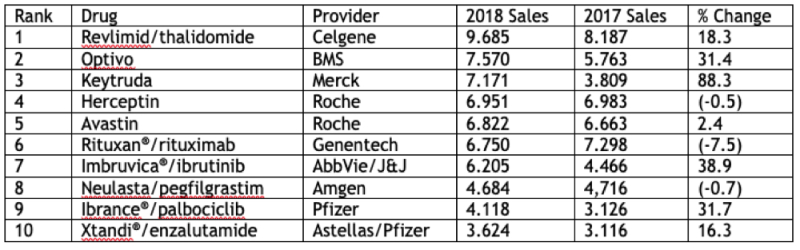
    GENRising drug prices is an issue that everyone from the President to both Houses of Congress (Democrats and Republicans), Wall Street, and Main Street can agree must be alleviated, and perhaps the most expensive drugs are those that treat cancer.  This reality is a combination of the severity of the disease and the nature of the drugs, which are generally biologic drugs characterized by structural complexity, production difficulties, and high cost of regulatory approval.  As reported in Genetic Engineering News, the trend of increasing drug prices continued in 2018 among most of the top ten highest selling cancer drugs currently on the market.

    The basis for the information disclosed in GEN is a report from IQVIA™ Institute for Human Data Science entitled Global Oncology Drug Trends 2018, which showed that cancer treatment costs average over $150,000 on 2017 with total spend in the U.S. in these drugs of almost $50 billion (compared with a total of $60 billion for the rest of the world).  The situation may get even worse, with cancer drug prices expected to double again by 2022 in the U.S. and there being an equivalent percentage rise (10-13% annually) in the rest of the world.

    Details of these drugs are provided in the table below.

    TableNote: 2018 Sales and 2017 Sales are in billions.

  • By Donald Zuhn

    ColoradoLast week, in United Cannabis Corp. v. Pure Hemp Collective Inc., District Judge William J. Martinez of the U.S. District Court for the District of Colorado issued an order denying a motion for partial summary judgment filed by Defendant Pure Hemp Collective Inc., finding that Pure Hemp was not entitled to summary judgment on the record.  Pure Hemp had filed an Early Motion for Partial Summary Judgement, arguing that the asserted claims of U.S. Patent No. 9,730,911, which is owned by United Cannabis Corp. ("UCANN"), were invalid under 35 U.S.C. § 101 (claims 10, 12, 14, 20–22, 25, 27, 28, 31, and 33 of the '911 patent) or 35 U.S.C. § 112(e) (claim 31).

    UCANN had initiated the dispute between the parties by filing a complaint against Pure Hemp for infringement of claims 10, 12, 14, 20–22, 25, 27, 28, 31, and 33 of the '911 patent.  Pure Hemp responded by filing its motion for partial summary judgment, contending that all of the asserted claims were invalid.

    The '911 patent, which is entitled "Cannabis extracts and methods of preparing and using same," is directed to liquid cannabinoid formulations.  Claims 10, 20, and 25 (the independent claims asserted in UCANN's complaint) recite:

    10.  A liquid cannabinoid formulation, wherein at least 95% of the total cannabinoids is cannabidiol (CBD).

    20.  A liquid cannabinoid formulation, wherein at least 95% of the total cannabinoids are THC [tetrahydrocannabinol] and CBD.

    25.  A liquid cannabinoid formulation, wherein at least 95% of the total cannabinoids are CBD, cannabinol (CBN) and THC.

    Asserted claim 31 also recites:

    31.  The formulation of any one of the proceeding claims, wherein the formulation is infused in a medium chain triglyceride (MCT).

    Judge Martinez began his Order by describing the two-part patent eligibility inquiry set forth by the Supreme Court in Alice Corp. Pty. v. CLS Bank Int'l, 573 U.S. 208, 216 (2014):

    "[D]istinguishing patents that claim laws of nature, natural phenomena, and abstract ideas from those that claim patent-eligible applications of those concepts" first requires a court to "determine whether the claims at issue are directed to one of those patent-ineligible concepts."  Id. at 217.  If the answer is no, the inquiry ends; but if the answer is yes, a court must then determine whether the claims in question nonetheless offer "an inventive concept—i.e., an element or combination of elements that is sufficient to ensure that the patent in practice amounts to significantly more than a patent upon the ineligible concept itself."  Id. at 217–18 (internal quotation marks omitted; alterations incorporated).

    Judge Martinez then "summarize[ed] certain Supreme Court and Federal Circuit decisions in which those courts have examined questions of patentability in roughly similar contexts," including Funk Brothers Seed Co. v. Kalo Inoculant Co., 333 U.S. 127 (1948); Diamond v. Chakrabarty, 447 U.S. 303 (1980); Mayo Collaborative Services v. Prometheus Laboratories, Inc., 566 U.S. 66 (2012); and Ariosa Diagnostics, Inc. v. Sequenom, Inc., 788 F.3d 1371 (Fed. Cir. 2015).  After providing summaries of the above cases, Judge Martinez offered his comments on the Alice test, stating that:

    [T]he proper application of the Supreme Court's Alice standard is an evolving and sometimes hazy area of law.  Deciding whether a patent claim is "directed to" a law of nature is not as straightforward as the Supreme Court makes it sound in Alice itself.  Moreover, the Federal Circuit itself has remarked on the difficulty, at times, of distinguishing the first Alice inquiry from the second, see, e.g., Elec. Power Grp., LLC v. Alstom S.A., 830 F.3d 1350, 1353 (Fed. Cir. 2016); or distinguishing the two Alice inquiries (comprising a patentability analysis rooted in 35 U.S.C. § 101) from other common inquiries such as anticipation and obviousness (which are rooted in 35 U.S.C. §§ 102–03), see, e.g., Rapid Litig. Mgmt. Ltd. v. CellzDirect, Inc., 827 F.3d 1042, 1052 & n.2 (Fed. Cir. 2016).

    However, after applying the Alice test to the asserted claims, Judge Martinez determined that "[d]espite the potential ambiguities [of the Alice test], the Court is convinced under the current state of the case law that the challenged claims of the 911 Patent are not directed at unpatentable subject matter."  With respect to the first Alice inquiry, Pure Hemp had argued that the asserted claims are "directed to" the patent ineligible natural phenomenon of the specified chemical compounds (cannabinoids, terpenes, and flavonoids).  UCANN had countered that "the claims are not directed to laws of nature or natural phenomena because they claim human-modified liquid formulations that require converting solid cannabinoids into a different state with markedly different physiological characteristics" (citation omitted).

    The Court was persuaded by UCANN's argument that the claims are directed to human-modified liquid formulations, and did not feel the need to address the second part of UCANN's argument (i.e., that the claimed liquid formulations had been converted into a different state having markedly different physiological effects).  Judge Martinez explained that:

    Pure Hemp has failed to establish beyond genuine dispute that a liquefied version of cannabinoids and related chemicals at the concentrations specified in the 911 Patent is anything like a natural phenomenon.  It may be true, as Pure Hemp insists, that cannabinoids in nature can take the form of a resin; that a resin can be highly viscous; that a highly viscous substance may at times be considered a liquid; and therefore it is logically possible that cannabinoids in nature might appear in a form that could, in some sense, be deemed a "liquid."  . . .  Even accepting as much, the 911 Patent specifies threshold concentrations of cannabinoids and related chemicals.  Pure Hemp nowhere claims that these precise concentrations, or anything close to them, occur in liquid form in nature.  Accordingly, UCANN's claims are not restatements of "the handiwork of nature," Funk Brothers, 333 U.S. at 131, "but [UCANN's] own [handiwork]," Chakrabarty, 447 U.S. at 310.

    While noting that "the Court sees reason to question whether the 911 Patent claims anything novel, useful, or nonobvious," with respect to the Alice inquiry, the Court determined that "the 911 Patent is not 'directed to' an unpatentable law of nature, a natural phenomenon, or an abstract idea," but "is instead 'directed to' a non-naturally occurring delivery method of naturally occurring chemicals in (as far as the record reveals) non-naturally occurring proportions and concentrations."  Finding that the asserted claims did not fail at step one of the Alice inquiry, the Court determined that it did not need to address step two.

    As for claim 31, Pure Hemp argued that this claim was invalid for depending from a multiple dependent claim when claim 31 is itself a multiple dependent claim (i.e., claim 31 depends from "any preceding claim" — following UCANN's correction of the claim — and claim 9 depends from claim 1 or 5, and claim 24 depends from claim 16 or 20).  Judge Martinez noted, however, that UCANN had disclaimed claim 9 and 24, and cited Guinn v. Kopf, 96 F.3d 1419, 1422 (Fed. Cir. 1996), for the proposition that "[a] statutory disclaimer under 35 U.S.C. § 253 has the effect of canceling the claims from the patent and the patent is viewed as though the disclaimed claims had never existed in the patent."  While noting that "[o]ne would expect that this would end the argument as to Claim 31," the Order points out that Pure Hemp insisted in its reply brief that the Court could still declare claim 31 to be invalid for depending from multiple dependent claims, even though those multiple dependent claims are now deemed to be nonexistent.  To support its argument, Pure Hemp relied on Rembrandt Wireless Technologies, LP v. Samsung Electronics Co., 853 F.3d 1370 (sFed. Cir. 2017), in which the patentee had disclaimed one of two claims in order to seek damages that would have been otherwise prohibited by a failure to mark its products.  Pure Hemp argued that the same public notice concerns raised in Rembrandt Wireless undergird the requirements of 35 U.S.C. § 112(e) with respect to multiple dependencies, and therefore contended that there must be "clear public notice" of invalidity.  Judge Martinez, however, noted that Pure Hemp's argument was circular, since "Claim 31 is not invalid anymore, at least not on account of the multiple dependency problem that existed before UCANN's disclaimer," finding that "there is neither a good reason nor a statutory basis to declare Claim 31 invalid, even though it previously depended on multiple dependent claims."

    Rejecting both of Pure Hemp's invalidity arguments, the District Court denied Pure Hemp's Early Motion for Partial Summary Judgment.

    United Cannabis Corp. v. Pure Hemp Collective Inc. (D. Colo. 2019)
    Order Denying Defendant's Early Motion for Partial Summary Judgment by District Judge Martinez

  • By Kevin E. Noonan

    Washington - Capitol #3A great deal of faith has recently been given to Congress by the patent community, spurred by efforts to solve the conundrums in patent law created by several recent Supreme Court decisions (and aided and abetted by the U.S. Patent and Trademark Office, district courts, and the Federal Circuit).  Last week, Congress provided ample evidence that a degree of caution (if not a grain of salt) should arise regarding anything Congress does with the introduction by Senator Bill Cassidy (R-LA) (along with several "co-conspirators") of three bills ostensibly aimed at "solving" the problem of "excessively high" prescription drug prices.  A gastroenterologist before standing for elective office, Senator Cassidy's sympathies (if not prejudices) are both evident and understandable.  But as policies, they are ill conceived and unlikely to have anything more than a cosmetic effect.

    The bill proposing the most extensive changes, entitled "Reforming Evergreening and Manipulation that Extends Drug Years Act'' (or the ''REMEDY Act,'' showing that clever acronyms for legislation is a trope that has outlived whatever cleverness it ever had), would be better called the "Launch at Risk Act."  The changes proposed in Section 505(c)(3)(C) of the Food, Drug, and Cosmetic Act (codified at 21 U.S.C. 355) read as follows (in italics):

    If the applicant made a certification described in clause (iv) of subsection (b)(2)(A) [colloquially known as a "Paragraph IV Certification"], the approval shall be made effective immediately unless, in the case of a certification with respect to a patent that claims a drug substance (and not in the case of a certification with respect to a patent that claims a drug product or method of use for a drug, except that, in the case of a patent that claims a drug substance and a drug product or method of use, this subparagraph shall apply, but only to the extent the  patent claims a drug substance), before the expiration of 45 days after the date on which the notice described in subsection (b)(3) is received, an action is brought for infringement of the patent that is the subject of the certification and for which information was submitted to the Secretary under paragraph (2) or subsection (b)(1) before the date on which the application (excluding an amendment or supplement to the application) was submitted.

    Also proposed is amendment to Section 505(j)(5)(B)(iii) of the FDCA:

    (iii)  If the applicant made a certification described in subclause (IV) of paragraph (2)(A)(vii), the approval shall be made effective immediately unless, in the case of a certification with respect to a patent that claims a drug substance (and not in the case of a certification with respect to a patent that claims a drug product or method of use for a drug, except that, in the case of a patent that claims a drug substance and a drug product or method of use, this clause shall apply, but only to the extent the patent claims a drug substance), before the expiration of 45 days after the date on which the notice described in paragraph (2)(B) is received, an action is brought for infringement of the patent that is the subject of the certification and for which information was submitted to the Secretary under subsection (b)(1) or (c)(2) before the date on which the application (excluding an amendment or supplement to the application), which the Secretary later determines to be substantially complete, was submitted.

    If enacted into law, a patent-holding, branded drug maker would only be able to have the benefit of the 30-month stay enshrined in these provisions of the Hatch-Waxman Act for patents claiming a drug substance itself, but not formulations or methods of treatment using a patented, branded drug under an NDA.  An ANDA applicant could have FDA approve its generic drug and to enter the marketplace with no further ado.

    Of course, this is the classic "launch at risk" scenario, and the generic drug maker would risk not only an injunction preventing marketing of its generic drug until any patent to formulation or method of treatment has expired, but also treble damages for willful infringement.  This scenario may be much less attractive to actual generic drug companies than Senator Cassidy and his co-sponsors believe it will be.

    The bill would also amend Section 505(j)(7)(A) by adding the following language:

    (iv) In the case of a listed drug for which the list under clause (i) includes a patent that claims the drug or a use for such drug, and where the Under Secretary of Commerce for Intellectual Property and Director of the United States Patent and Trademark Office has cancelled any claim of the patent relating to such drug or such use pursuant to a determination by the Patent Trial and Appeal Board in an inter partes review conducted under chapter 31 of title 35, United States Code, or a post-grant review conducted under chapter 32 of that title, and any such cancellation, if appealed, has been upheld upon appeal, the holder of the applicable approved application shall notify the Secretary of such cancellation, and the revisions required under clause (iii) shall include striking the patent from the list with respect to such drug.

    And finally the bill would amend Section 505(j)(5)(B)(iv)(I) regarding the 180-day exclusivity period:

    This subclause shall apply even if a patent is stricken from the list under paragraph (7)(A), pursuant to the second sentence of clause (iii) of such paragraph, provided that, at the time that the first applicant submitted an application under this subsection containing a certification described in paragraph (2)(A)(vii)(IV), the patent that was the subject of such certification was included in such list with respect to the listed drug.

    These revisions are cosmetic insofar as they merely bring the statute into conformity with the changes proposed for Sections 505(c)(3)(C) and 505(j)(5)(B)(iii) and thus bear little further discussion.

    Two other bills have been formally introduced by Senator Cassidy's colleagues joined by him.  One, introduced by Senator Cory Gardner (R-CO) and Jeanne Shaheen (D-NH) and Senator Cassidy, is entitled "Ensuring Timely Access to Generics Act," and proposes changes to Section 505(q)(1) in order enable the Secretary to reject a citizen petition directed merely to delaying generic drug entry:

    (E) Denial based on intent to delay

    (i) IN GENERAL.—If the Secretary determines that a petition or a supplement to the petition was submitted with the primary purpose of delaying the approval of an application and the petition does not on its face raise valid scientific or regulatory issues, the Secretary may deny the petition at any point based on such determination. The Secretary may issue guidance to describe the factors that will be used to determine under this subparagraph whether a petition is submitted with the primary purpose of delaying the approval of an application.

    (ii) FACTORS.—In determining whether a petition was submitted with the primary purpose of delaying the approval of an application, the Secretary shall consider—

    (I) whether it appears, based on the date that relevant information relied upon in the petition became known to the petitioner (or reasonably should have been known to the petitioner), as certified by the petitioner in accordance with subparagraph (H), that the petitioner has taken an unreasonable length of time to submit the petition;

    (II) whether the petitioner has submitted multiple or serial petitions raising issues that reasonably could have been known to the petitioner at the time of submission of the earlier petition or petitions;

    (III) whether the petition was submitted close in time to a known, first date upon which an application under subsection (b)(2) of this section or section 351(k) of the Public Health Service Act could be approved;

    (IV) whether the petition was submitted without any data or information in support of the scientific positions set forth in the petition;

    (V) whether the petition raises the same or substantially similar issues as a prior petition to which the Secretary has responded substantively already, particularly if the subsequent submission follows the earlier response closely in time;

    (VI) whether the petition concerns standards for approval of a drug for which the Secretary has provided an opportunity for public input, such as draft or final product-specific guidance applicable petitioner has not provided comment other than through the petition;

    (VII) whether the petition requests that other applicants meet standards for testing, data, or labeling for a drug that are more onerous or rigorous than the standards applicable to, as applicable, the listed drug, reference product, or petitioner's version of the same drug;

    (VIII) the history of the petitioner with the Food and Drug Administration, such as whether the petitioner has a history of submitting petitions that the Secretary has determined were submitted with the primary purpose of delay; and

    (IX) other relevant considerations, as the Secretary may describe in guidance.''; and

    (C) by adding at the end the following:

    (iii) PUBLIC AVAILABILITY.—The Secretary shall publish on the internet  website of the Food and Drug Administration a list of any petitions that the Secretary determines were submitted for the primary purpose of delaying the approval of an application.

    (iv) REFERRAL TO THE FEDERAL TRADE COMMISSION.—The Secretary shall establish procedures for referring to the Federal Trade Commission any petition or supplement to a petition that the Secretary determines was submitted with the primary purpose of delaying approval of an application. Such procedures shall include notification to the petitioner and an opportunity for the petitioner to respond to the Secretary prior to referral to the Federal Trade Commission.''; and

    (2) by adding at the end the following:

    (J) TIMELINE FOR SUBMITTING PETITIONS.—The Secretary may establish a time period after the relevant information relied upon in a petition became known to the petitioner (or reasonably should have been known to a petitioner), as certified by the petitioner in accordance with subparagraph (H), and any petition that is submitted after such time period has passed shall be summarily denied.

    The bill tracks a draft Guidance released by FDA last year representing the agency's attempt to address the perceived problem with frivolous citizen petitions.  The significance and effect of such changes may depend on how much one considers branded drug makers are filing frivolous citizen petitions (or that they are having substantive effects) and whether the changes would pass constitutional muster on free speech and right to petition the Federal government for redress of grievances grounds.

    The other bill, introduced by Senator Tina Smith (D-MN), is entitled the ''Protecting Access to Biosimilars Act" and is directed to changes in the BPCIA under Section 351(k)(7) of the Public Health Service Act (codified at (42 U.S.C. § 262(k)(7)).  The bill proposes these changes to the statutory language:

    (D) DEEMED LICENSES.—

    (i) NO ADDITIONAL EXCLUSIVITY THROUGH DEEMING.—An approved application that is deemed to be a license for a biological product under this section pursuant to section 7002(e)(4) of the Biologics Price Competition and Innovation Act of 2009 shall not be treated as having been first licensed under subsection (a) for purposes of subparagraphs (A) and (B).

    (ii) LIMITATION ON EXCLUSIVITY APPLIES TO ANY REFERENCE PRODUCT.—

    Subparagraph (C) shall apply to any reference product, without regard to whether—

    (I) such product was first licensed under subsection (a); or

    (II) the approved application for such product was deemed to be a license for a biological product as described in clause (i).

    Paradoxically this bill has the highest chance of passage, according to Ryan Davis at IP Law 360 (subscription required) as being directed to insulin, which has been licensed under the FDCA since the 1930's but is slated to come under the auspices of the BPCIA in 2020.  According to Mr. Davis, this bill is intended to prevent this change from bestowing on a biologic drug-classified insulins a 12-year exclusivity under the BPCIA.  As with the Timely Act, the effect enactment of this bill into law would have depends on the magnitude of the problem that prompted its introduction.

    As has been said in other contexts, political posturing is in vogue and particularly posturing regarding prescription drug prices.  It is unclear whether any of these proposed changes in the law will remedy any real problems that underlie high drug prices.  Bills like these only address part of those problems but at the cost of addressing systemic issues with drug pricing not as amenable to quick or simple changes in existing law.

  • CalendarApril 22, 2019 – "A conversation with Shawn Springs" (U.S. Patent and Trademark Office) – 11:00 am to noon, Alexandria, VA

    April 29-30, 2019 – Paragraph IV Disputes master symposium (American Conference Institute) – New York, NY

    April 23, 2019 – "Recent Developments in Biopharma Patent Law" (McDonnell Boehnen Hulbert & Berghoff LLP and Patent Docs) – 9:30 am to 1:30 pm, San Diego, CA (Hyatt Regency La Jolla at Aventine)

    April 23, 2019 – "From Boston & Beyond: Local and Global Implications of Recent Changes in Patent Practice" (Federal Circuit Bar Association) – 1:00 pm to 4:30 pm (EST), Suffolk University School of Law, Boston, MA

    April 23, 2019 – "Drafting Patent Applications for AI Systems — Overcoming Patent Eligibility, Inventorship, and Enablement Challenges and Avoiding Rejections" (Strafford) – 1:00 to 2:30 pm (EDT)

    April 24, 2019 – "Recent Developments in Biopharma Patent Law" (McDonnell Boehnen Hulbert & Berghoff LLP and Patent Docs) – 9:30 am to 1:30 pm, Burlingame, CA (Hyatt Regency San Francisco Airport)

    April 25, 2019 – "Drug Substance Patents: FDA Guidance, Protecting Composition-of-Matter Patents, Drafting Solid Form Claims" (Strafford) – 1:00 to 2:30 pm (EDT)

    April 25, 2019 – "IPR Estoppel One Year After SAS" (Intellectual Property Owners Association) – 2:00 to 3:00 pm (ET).

    April 29, 2019 – USPTO World Intellectual Property Day Celebration (U.S. Patent and Trademark Office, World Intellectual Property Organization, American Intellectual Property Law Association, U.S. Chamber of Commerce Global IP Center, International Trademark Association, American Bar Association's Section on Intellectual Property Law, and Intellectual Property Owners Association) – 4:00 to 6:30 pm, Rayburn House Office Building Foyer, Washington, DC

    April 30, 2019 – Customer partnership meeting of TC 3600 and TC 3700 (U.S. Patent and Trademark Office and American Intellectual Property Law Association) – 8:45 am to 5:00 pm (EDT), Alexandria, VA

    April 30, 2019 – European biotech patent law update (D Young & Co) – 4:00 am, 7:00 am, and 12:00 pm (EDT)

    April 30, 2019 – "Inventive Step for Computer Implemented Inventions at the EPO" (J A Kemp) – 3:30 to 4:30 pm GMT (Greenwich Mean Time)

    April 30, 2019 – "Patent Infringement After Duncan Parking Technologies — Doctrine of Equivalents, Too-Narrow Claim Construction, and Prosecution Impact on Litigation Outcomes" (Strafford) – 1:00 to 2:30 pm (EDT)

    May 2, 2019 – "Patent Inventorship: Best Practices for Determination and Correction — Distinguishing Between Inventor and Contributor; Navigating Joint Inventorship, Disclosure of Ownership, Real Party in Interest" (Strafford) – 1:00 to 2:30 pm (EDT)

    May 16-17, 2019 – Advanced Summit on Life Sciences Patents (American Conference Institute) – New York, NY

  • MBHB Logo 2McDonnell Boehnen Hulbert & Berghoff LLP and Patent Docs will be hosting two onsite CLE programs on "Recent Developments in Biopharma Patent Law" from 9:30 am to 1:30 pm (PT) on April 23, 2019 in San Diego, CA and on April 24, 2019 in Burlingame, CA.  MBHB attorneys and Patent Docs authors Kevin Noonan and Donald Zuhn, and MBHB attorneys Josh Rich, Lisa Hillman, Sarah Fendrick, John Conour, Nate Chongsiriwatana, and Nicole Grimm will provide presentations on the following topics:

    • Updates on Subject Matter Eligibility Analysis
    • Patenting Repurposed Drugs
    • Antibody Patenting after Amgen v. Sanofi
    The State of Biotech Patenting: Challenges
    • Maximizing Patent Term for Products Subject to Regulatory Review
    • Impact of Secondary Patents on Market Exclusivity
    • Considerations for Biotech Cannabis Patents
    • Strategies for Post-Grant Proceedings for Generics and Biosimilars

    There is no registration fee for the program.  However, because space is limited, those interested in attending the program must register by contacting Susan Hall at hall@mbhb.com.  When registering, please note at which location you plan to attend:  San Diego (Hyatt Regency La Jolla at Aventine) or Burlingame (Hyatt Regency San Francisco Airport).

  • USPTO SealThe U.S. Patent and Trademark Office will be holding a customer partnership meeting of Technology Center 3600 (Transportation, Electronic Commerce, Construction, Agriculture, Licensing, and Review) and Technology Center 3700 (Mechanical Engineering, Manufacturing, and Products), together with the American Intellectual Property Law Association (AIPLA), from 8:45 am to 5:00 pm (EDT) on April 30, 2019 at the USPTO Headquarters in Alexandria, VA.  The agenda for the meeting is as follows:

    • Opening remarks by USPTO Director Andrei Iancu
    • Japan Patent Office Director General Masanori Katsura – Patent Examination Department (Mechanical Technology)
    • Functional language training at the USPTO
    • Intended use and purely functional limitations
    • Means-plus-function limitations applied to mechanical devices
    • Industry presentations
    • Presentation regarding the revised 101 guidance

    Those wishing to attend the meeting can register here.  The USPTO notes that registrations will be honored on a first-come, first-served basis according to the time and date of receipt of each request, but that in order to ensure a broad cross-section of attendees, the USPTO reserves the right to limit the number of attendees from any single organization or law firm, and therefore, organizations and law firms must designate their official representatives.  Additional information regarding the customer partnership meeting can be found here.