• By Joshua Rich

    Federal Circuit SealEvery patent must include a written description of the invention sufficient to enable a person of ordinary skill in the art to make and use the invention.  A broadening reissue under 35 U.S.C. § 251 must meet a more exacting standard:  the claimed invention must be clearly and unequivocally disclosed in the original patent to justify grant of broadened claims.  The Forum US case illustrated the difference, where the Federal Circuit affirmed the District Court's grant of summary judgment of invalidity due to failure to comply with the reissue statute.

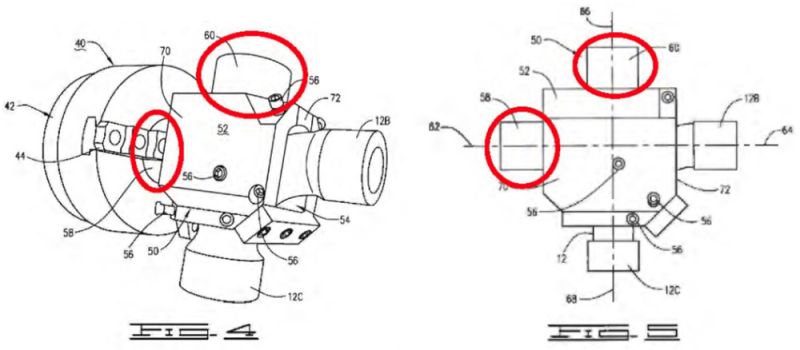
    Flow Valve owned U.S. Patent No. 8,215,213, directed to supporting assemblies used in the machining of pipefittings.  The supporting assemblies would allow a machinist to manipulate the orientation and position of the pipefittings quickly and easily, expediting the use of various tools on the pipefittings.  As disclosed in the specification (both figures and text), the supporting assemblies included arbors along the axes of the pipe fitting for engagement of a machine, such as a lathe, that would turn the pipefitting for machining.  Two figures from the '213 patent illustrate the arbors (circled in red):

    Image
    The '213 patent also claimed inventions expressly with arbors as part of the supporting assembly.  Claim 1, representative of the thirteen issued claims, covered:

        A workpiece machining implement comprising:
        a workpiece supporting assembly comprising:
        a body member having an internal workpiece channel, the body member having a plurality of body openings communicating with the internal workpiece channel;
        means supported by the body member for positioning a workpiece in the internal workpiece channel so that extending workpiece portions of the workpiece extend from selected ones of the body openings;
        a plurality of arbors supported by the body member, each arbor having an axis coincident with a datum axis of one of the extending workpiece portions; and
        means for rotating the workpiece supporting assembly about the axis of a selected one of the arbors.

    '213 patent (emphasis added).  Flow Valve had sued Forum US for patent infringement on the '213 patent, and Forum US changed its design to eliminate arbors.  While that initial suit was pending, Flow Valve sought broadening reissue of the '213 patent and drafted claims to cover Forum US's new design.[1]  Specifically, Flow Valve sought — and obtained — additional claims 14-20 in U.S. Patent No. RE45,878 that did not require arbors as part of the supporting assemblies.  Claim 14 covers:

    A workpiece supporting assembly for securing an elbow during a machining process that is performed on the elbow by operation of a workpiece machining implement, the workpiece supporting assembly comprising:
        a body having an internal surface defining a channel, the internal surface sized to receive a medial portion of the elbow when the elbow is operably disposed in the channel; and
        a support that is selectively positionable to secure the elbow in the workpiece supporting assembly, the body pivotable to a first pivoted position, the body sized so that a first end of the elbow extends from the channel and beyond the body so the first end of the elbow is presentable to the workpiece machining implement for performing the machining process, the body pivotable to a second position and sized so that a second end of the elbow extends from the channel beyond the body so the second end of the elbow is presentable to the workpiece machining implement for performing the machining process.

    Rather than waiting for Flow Valve to sue it on the '878 reissue patent, Forum US brought a declaratory judgment suit arguing, among other things, that the new reissue claims were invalid for lack of compliance with § 251.[2]  Section 251 provides:

    Whenever any patent is, through error, deemed wholly or partly inoperative or invalid, by reason of a defective specification or drawing, or by reason of the patentee claiming more or less than he had a right to claim in the patent, the Director shall, on the surrender of such patent and the payment of the fee required by law, reissue the patent for the invention disclosed in the original patent, and in accordance with a new and amended application, for the unexpired part of the term of the original patent.  No new matter shall be introduced into the application for reissue.

    Specifically, Forum US argued that the reissue claims were not "for the invention disclosed in the original patent" and moved for summary judgment on that basis.  Flow Valve responded, based on an expert declaration, that a person of ordinary skill in the art would understand that the patent disclosed multiple inventions, including embodiments with and without arbors.  This gambit didn't work; the District Court granted Forum US's motion for summary judgment, invalidating claims 14 through 20, because "no matter what a person of ordinary skill would recognize, the specification of the original patent must clearly and unequivocally disclose the newly claimed invention in order to satisfy the original patent rule."[3]

    Upon appeal, the Federal Circuit reviewed the District Court's decision de novo, but employed the same reasoning in affirming the decision.  The Court relied on two cases — both cited by the District Court — separated by over seven decades:  U.S. Indus. Chems., Inc. v. Carbide & Carbon Chems. Corp., 315 U.S. 668 (1942), and Antares Pharma, Inc. v. Medac Pharma Inc., 771 F.3d 1354 (Fed. Cir. 2014).  The two cases stand for the same proposition, that for broadening reissue claims "it is not enough that an invention might have been claimed in the original patent because it was suggested or indicated in the specification."[4]  Instead, the face of the patent itself must show that what is covered by the reissue claims was intended to have been covered by the original patent.  As phrased by Antares, the original patent "must clearly and unequivocally disclose the newly claimed invention as a separate invention."[5]

    Here, there was really no question that the broader reissue claims were not clearly and unequivocally disclosed in the original patent.  The original patent did not disclose an embodiment of the invention without an arbor.  Similarly, the abstract and summary of the invention described the invention as having a plurality of arbors.  For that reason, Flow Valve had relied on an expert declaration regarding what "a worker of ordinary skill would understand."  But while such a declaration might be sufficient to satisfy the written description requirement, it does not help illuminate the text of the original patent.  Simply put, the specification did not "clearly and unequivocally disclose the newly claimed invention as a separate invention," and the reissue claims failed the original patent requirement.

    The Forum US case is yet another reminder of the value of expert patent prosecution counsel.  Flow Valve might have been able to pursue its claims in a continuation application, if it had one pending (which experienced counsel would likely have suggested).  In doing so, it would not have had to meet the additional requirements of a broadening reissue.  But not knowing the quirky rules of reissue, including the original patent requirement, can prove fatal to the same claims if they do not appear clearly to be part of the invention in the original patent.

    Forum US, Inc. v. Flow Valve, LLC (Fed. Cir. 2019)
    Panel: Circuit Judges Reyna, Schall, and Hughes
    Opinion by Circuit Judge Reyna

    [1] See Forum US, Inc. v. Flow Valve, LLC, Civil Action No. 5:17-cv-00495-F (W.D. Okla.), Dkt. # 1 (Complaint).
    [2] Id.
    [3] Id., Dkt. #45, p. 10.
    [4] Indus. Chems., 315 U.S. at 676.
    [5] Antares, 771 F.3d at 1362.

  • By Joshua Rich

    Federal Circuit SealIn this case, the question ultimately answered by the Federal Circuit was a straightforward question of statutory interpretation:  in determining whether a party is time-barred from filing a petition for inter partes review because a privy of that party or the real party in interest was served with a complaint alleging infringement of the challenged patent, at what point in time should privity or party interests be determined?  But the route to that answer — and maybe even the answer itself — was strongly influenced by the unusual facts of the case.  As a result, to prevent possible gamesmanship, the Federal Circuit decided that the litigation-related time bar remains a possibility at least until the U.S. Patent and Trademark Office decides whether to institute inter partes review.

    Power Integrations owns U.S. Patent Nos. 6,212,079 and 8,115,457, among others.  Fairchild Semiconductor filed two ex parte reexamination proceedings challenging claims of the '079 patent in 2005 and 2006; the U.S. Patent and Trademark Office confirmed the patentability of the claims in September 2009.  Two months later, in November 2009, Power Integrations sued Fairchild for infringement of the '079 patent and the '457 patent (and one other patent not at issue here).  In March 2014, a jury found that Fairchild infringed claims of the '079 patent (but no claims of the '457 patent), and that the infringed claims were not invalid.  The jury awarded $105 million in damages.  Fairchild moved post-trial for a new trial on damages, the District Court granted the motion, and the jury on re-trial awarded damages of $139.8 million.[1]  Fairchild appealed on both liability and damages; the Federal Circuit affirmed the finding of infringement but vacated the damages award because the entire market value rule should not have been applied and remanded the case for further proceedings.

    Just prior to the damages re-trial, in November 2015, Semiconductor Components (which did business as ON Semiconductor) agreed to merge with Fairchild.  The Fairchild-ON merger did not close quickly.  Instead, in March 2016, ON filed a petition for inter partes review of claims of the '079 patent (including all of the claims that had been found infringed by Fairchild).  Five months later, ON filed an IPR petition related to the '457 patent.  The Fairchild-ON merger then closed just four days before the IPR related to the '079 patent was instituted on September 23, 2016.

    In its Preliminary Responses and Patent Owner's Responses in the IPRs directed to the '079 and '457 patents, Power Integrations argued that ON's petitions were time-barred by 35 U.S.C. § 315(b).  Section 315(b) provides:

    An inter partes review may not be instituted if the petition requesting the proceeding is filed more than 1 year after the date on which the petitioner, real party in interest, or privy of the petitioner is served with a complaint alleging infringement of the patent.  The time limitation set forth in the preceding sentence shall not apply to a request for joinder under subsection (c).

    35 U.S.C. § 315(b) (emphasis added).  Power Integrations argued that Fairchild and ON were in privity when the petitions were filed because of the announced merger, and that Fairchild had been served in an earlier lawsuit more than one year before the filing of the petitions (indeed, it was served more than one year prior to the enactment of the America Invents Act, which created IPRs).  The only issue was whether privity existed; the Patent Trial and Appeal Board found upon institution that Fairchild's lack of control and involvement in the filing of the petition outweighed the announced (and by then, closed) merger.  Power Integrations also argued that ON was acting as Fairchild's proxy, but the PTAB found ON had its own interest arising out of the pending multi-billion-dollar merger with Fairchild.  Finally, in the Patent Owner's Response, Power Integrations argued that the closing of the merger prior to institution meant that the petitions should be time-barred.  But the PTAB, relying on a pair of earlier nonprecedential opinions, found that the facts as of the date of filing would control the time bar inquiry, not facts that developed later.

    In both IPRs (the one related to the '079 patent and the one related to the '457 patent), the PTAB issued a final written decision in which all of the challenged claims were found unpatentable.  It therefore cancelled all of the challenged claims, including all of the claims of the '079 patent underlying the verdict against Fairchild.  Power Integrations appealed the PTAB's decision in the IPR relating to the '079 patent, but not the IPR relating to the '457 patent.

    Upon appeal, ON filed a motion to preclude review of the PTAB's § 315(b) decision in the appeal of the decision related to the '079 patent because the same issue had been conclusively determined between the parties when Power Integrations chose not to appeal the PTAB's decision in the IPR related to the '457 patent.  Issue preclusion usually prevents review of an issue when the issue has been actually litigated and determined by a valid final judgment and the determination is essential to the judgment, regardless of whether the claim is the same or different.  There are exceptions to the general rule, however, including where there is a lack of opportunity or incentive to obtain a full and fair adjudication of the issue earlier.  As the Supreme Court has said, "[i]ssue preclusion may be inapt if 'the amount in controversy in the first action [was] so small in relation to the amount in controversy in the second that preclusion would be plainly unfair.'"[2]

    The Federal Circuit found that issue preclusion would normally apply to the § 315(b) question before it, but that the exception for lack of incentive to appeal should apply in this case.  The '079 patent was the basis for the Fairchild verdict worth over $100 million; the '457 patent was not.  Notably, however, in reaching the decision finding this case would be appropriately excepted from issue preclusion, the Court considered that Fairchild had merged and considered the timing of the merger itself — issues which would appear irrelevant to the questions appropriate for determining incentive to appeal.  Further, the Court did not note (and therefore appeared not to consider) that Power Integrations had asserted the '457 patent in the same lawsuit in which it obtained the nine-figure verdict, but had just been unsuccessful.  Regardless, in these very specific circumstances,[3] the Federal Circuit panel found that issue preclusion would not apply.

    Addressing the merits, the Federal Circuit rejected the PTAB's interpretation of § 315(b) and found that the time-bar should not be limited to the circumstances at the time the petition was filed.  The Court focused on the fact that the statute says that an IPR "may not be instituted," and interpreted that as an indication that any privity and real party in interest relationships that arise before institution — even if after filing of the petition — should be considered.  The statute does not say that a petition cannot be filed, but instead that it may not instituted.  In addition to the language of the statute, the Court relied upon its own prior decisions as suggesting that § 315(b) was focused upon institution.  But just as importantly, it considered general common law preclusion principles.[4]

    Under common law issue preclusion cases, "[c]ourts have repeatedly found privity where, a suit begins, a nonparty acquires assets of a defendant-infringer."[5]  Essentially, if a third party were able to acquire rights but avoid the implications of a final judgment related to those rights, it might multiply litigation and prevent a final judgment from being litigated.  That is especially true for IPRs, where a privy might be able to benefit from a final written decision without acting timely or incurring the estoppel penalties that serve as a quid pro quo for invoking the IPR process.  Therefore, the Court rejected the analogy to jurisdiction, for which federal courts apply a "time-of-filing" rule.  The Court also rejected deferring to the U.S. Patent and Trademark Office's interpretation of § 315(b) because the language of the applicable regulation merely parroted the language of the statute.

    Notably, while the Federal Circuit panel (Chief Judge Prost and Judges Reyna and Stoll) held that privity can be determined at least as late as the time of institution, it left open the possibility that later events could be relevant to the determination of privity.[6]  Of course, the reasoning of the opinion — based on the express language of the statute — would be contrary to an extension of the time bar to any time after institution of review.  But given the extreme circumstances of the Power Integrations case, the Federal Circuit did not want to cut off the possibility that privity would not have applied if the Fairchild-ON merger had closed five days later.  Thus, it is possible that post-institution facts could still be relevant to determining whether an IPR is time-barred, in addition to the certainty that all pre-institution circumstances are to be considered.

    Power Integrations, Inc. v. Semiconductor Components Industries, LLC (Fed. Cir. 2019)
    Panel: Chief Judge Prost and Circuit Judges Reyna and Stoll
    Opinion by Chief Judge Prost

    [1] Be careful what you ask for — the second jury applied the entire market value rule, which was the basis for increased damages.

    [2] B & B Hardware, Inc. v. Hargis Indus., Inc., 135 S. Ct. 1293, 1309 (2015) (alteration in original) (quoting Restatement (Second) of Judgments §  28 cmt. j).

    [3] The decision went so far as to say, "[w]e have no occasion to consider the preclusive effect of IPR decisions in circumstances different than presented in this case."  Slip Op. at 11 n. 6.

    [4] To link the issue to common law preclusion principles, the Federal Circuit panel cited jurisprudence and legislative history that indicated that "privity" and "real party in interest" should be defined in line with common law principles.  But that really does not support such a link — the terms can be defined based on the common law without importing common law principles for every aspect of the statute, and no case or portion of the legislative history indicates such a link.  It would have been more intellectually rigorous to have relied on common law principles without seeking to rely on the tenuous bridge the definitions of privity and real party in interest.

    [5] Slip Op. at 16 (quoting Kloster Speedsteel AB v. Crucible Inc., 793 F.2d 1565, 1583 (Fed. Cir. 1986) (emphasis added), overruled on other grounds by Knorr-Bremse Systeme Fuer Nutzfahrzeuge GmbH v. Dana Corp., 383 F.3d 1337 (Fed. Cir. 2004) (en banc)).

    [6] See Slip Op. at 14 n. 8.

  • By Kevin E. Noonan

    The coming of the genomic age has made popular genetic explanations of traits (behavioral as well as structural) in plants, animals, and humans (see, e.g., "Genomic Sequence of Strawberry Determined"; "Silver Birch Genetics Explained"; "Genome Structure of the American Cockroach"; "Finding Nemo's Genome"; "Dolphin Genes Show Relationships between Large Brains and Energy Metabolism Similar to Humans and Elephants"; "A Complete Diploid Human Genome Reveals Some Surprises").  Because of their importance (economically, historically, and emotionally), dogs have been a common target of such studies (see, e.g., "The Genetic Basis of Coat Variation in Dogs"; "Leg Length Variation in Dogs and its Relevance to Human Mutations"; "From Toy Poodle to Rottweiler: Why Is Fido So Small (or Large)?").  But evolution is not just genomics; evolutionary studies have existed ever since Darwin, and observational biology, of animal behavior, phenotypes that reflect underlying genotypes, and elucidation of characteristics and traits that are more than their genetic determinants, have been used for decades prior to genomics for the study of the history behind development of certain traits.

    The Panda' ThumbThis week, a multidisciplinary research team* published a paper, entitled "Evolution of facial muscle anatomy in dogs" in the Proceedings of the National Academy of Sciences USA.  The focus of the study was the differences in facial expressions between dogs and wolves that have evolved since dogs were domesticated from ancestral gray wolves 33,000 years ago.  The particular facial expression is termed "AU101", which is "a specific facial muscle movement around the eyes ([]inner eyebrow raise) [that] seems to be particularly attractive to humans.  The movement makes the eyes appear bigger, hence more infant-like and potentially more appealing to humans.  This inner brow raise also resembles a facial movement humans produce when they are sad, potentially eliciting a nurturing response from humans (Waller et al., 2013, Paedomorphic facial expressions give dogs a selective advantage, PLoS One 8, e82686).  Juvenilia has been known in other contexts to be attractive to humans; Stephen Jay Gould, the noted Harvard evolutionary biologist, published a paper ("A Biological Homage to Mickey Mouse," in The Panda's Thumb (W. W. Norton & Company, New York, 1980) showing the gradual softening of Mickey Mouse's features to be more appealing, and a long-term study of fox domestication found retention of juvenile features as a reliable trait as the foxes became more tame around humans (see "Red Fox Genome Sheds Light on Domesticated Dogs (and Maybe Humans)").  The facial feature in question is this one:

    Puppy
    As explained in the paper, "[t]he AU101 movement causes the eyes of the dogs to appear larger, giving the face a more paedomorphic, infant-like appearance, and also resembles a movement that humans produce when they are sad" (P. Ekman, W. V. Friesen, J. C. Hager Facial Action Coding System: The Manual (Network Information Research, Salt Lake City, UT, 2002)).  The authors' (and others') hypothesis is that these adaptations elicited caregiving from humans, resulting in a selective advantage.  There is some modern evidence supporting this theory; for example, dogs that expressed this facial movement were more likely to be rehomed from shelters.  There is also some support for the notion that this type of facial expression may be important in dog-human communication.

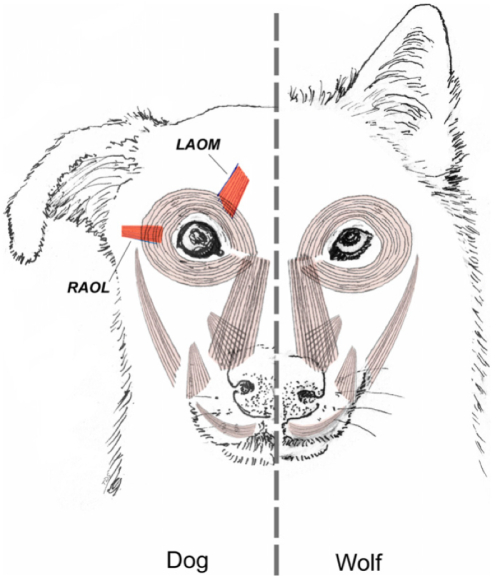
    The authors describe the results of their comparative anatomical studies between domesticated dogs (Canis familiaris) and gray wolves (Canis lupus).  These results included facial dissection and comparison of dogs and wolves and then the authors quantified wolves' and dogs' AU101 facial movements for frequency and intensity during social interactions.  Generally, the facial musculature is the same between the two species, except for the area around the eye.  In dogs, the levator anguli oculi medialis muscle (LAOM) was "routinely" present, whereas in wolves there were fewer muscle fibers and much more connective tissue in this area.  In addition, wolves "sometimes" had a tendon where the LAOM was expected to be, and as a consequence the wolf was much less able to form expressions around the eyes than the dog.  The authors specifically noted that "wolves have less ability to raise the inner corner of their brows independent of eye squinting relaxation—the anatomical basis for the difference in expression of the AU101 movement."

    These differences in musculature were correlated with the frequency of AU101 movement in studies where dogs and wolves were observed interacting with humans.  The authors concluded that these differences were caused by selective pressure imposed during domestication.

    Dog-Wolf

    The authors were express regarding the significance of their observations:

    Dogs were shaped during the course of domestication both in their behavior and in their anatomical features.  Here we show that domestication transformed the facial muscle anatomy of dogs specifically for facial communication with humans.  A muscle responsible for raising the inner eyebrow intensely is uniformly present in dogs but not in wolves.  Behavioral data show that dogs also produce the eyebrow movement significantly more often and with higher intensity than wolves do, with highest-intensity movements produced exclusively by dogs. Interestingly, this movement increases paedomorphism and resembles an expression humans produce when sad, so its production in dogs may trigger a nurturing response.  We hypothesize that dogs' expressive eyebrows are the result of selection based on humans' preferences.

    And they concluded that:

    Overall, the data suggest that selection—perhaps mainly unconscious—during social interactions can create selection pressures on the facial muscle anatomy in dogs strong enough for additional muscles to evolve.  This opens up interesting questions for future research, such as questions on other domestic species like cats and domestic horses and also breed differences in dogs as well as questions on the kind of selection pressure necessary for this to emerge.  One highly relevant question in this regard would be whether selection for tameness alone might create the same scenario.  Here the domesticated silver foxes . . . would be relevant and interesting model taxa.

    Observational biology was once the hallmark of the discipline, when it was termed natural history.  Theodeous Dobzhansky once famously explained to a graduate student perplexed by the complexity of polytene chromosomes in Drosophila melanogaster and having a difficulty in recognizing characteristic patterns that he did so the same way he recognized the different faces of the members of his laboratory.  While the power of modern genetic analysis has provided deep explanations of everything from the genetic basis for (some) disease to the development of related populations of the human family (see David Reich, Who We Are and How We Got Here: Ancient DNA and the New Science of the Human Past), we would do well to remember that, as Darwin said:

    There is grandeur in this view of life, with its several powers, having been originally breathed by the Creator into a few forms or into one; and that, whilst this planet has gone cycling on according to the fixed law of gravity, from so simple a beginning endless forms most beautiful and most wonderful have been and are being evolved.

    * Authors from the Centre for Comparative and Evolutionary Psychology, Department of Psychology, University of Portsmouth, United Kingdom; the Department of Anatomy, Howard University College of Medicine; the Department of Biological Sciences, North Carolina State University; and the Department of Physical Therapy, Duquesne University.

  • By Kevin E. Noonan

    Washington - Capitol #3On May 9th, Senators John Corbyn (R-TX) and Richard Blumenthal (D-CT), joined by co-sponsors Shelley Moore Capito (R-WV), Patty Murray (D-WA), Rick Scott (R-FL), John Kennedy (R-LA), and Josh Hawley (R-MO), introduced a bill, S-1416, in the Senate directed towards yet another scheme to address high drug prices.  Entitled the "Affordable Prescriptions for Patients Act of 2019" (blessedly, a title not amenable to catchy acronyms), the bill amends the Federal Trade Commission Act to empower the FTC to police and punish behaviors by drug suppliers that these Senators deem to be anticompetitive.

    The Bill provides a number of definitions and prohibitions (prohibited conduct), the most relevant of which are these:

    Sec. 27(a)(11) Definition:

    (11) PATENT THICKETING.—

    (A) IN GENERAL.—The term 'patent thicketing' means an action taken to limit competition by a patentee with respect to a drug approved under section 505(c) of the Federal Food, Drug, and Cosmetic Act (21 U.S.C. 355(c)) or a biological product licensed under section 351(a) of the Public Health Service Act (42 U.S.C. 262(a)) in which—

    (i) (I) the patentee obtains patents in the same patent family or patent portfolio—

    (aa) that claim the drug or biological product or a use of the drug or biological product, a form of the drug or biological product, a method of use of the drug or biological product, or a method of manufacture of a drug or biological product; and

    (bb) whose effective filing date does not precede the date of filing the application under section 505(b) of the Federal Food, Drug, and Cosmetic Act (21 U.S.C. 355(b)) or section 351(a) of the Public Health Service Act (42 U.S.C. 262(a)); or

        (II) the underlying composition of matter patent is found invalid and the patentee     obtains patents in the same patent family or patent portfolio that claim the drug or     biological product or a use of the drug or biological product, a form of the drug or     biological product, a method of use of the drug or biological product, or a method     of manufacture of the drug or biological product;

    (ii) an abbreviated new drug application referencing such approved drug or a biosimilar biological product license application referencing such licensed biological product could not be marketed without practicing one or more of the inventions claimed in the additional patents described in subclause (I) or (II) of clause (i); and

    (iii) the Commission determines that the patentee improperly limited competition by obtaining patents described in subclause (I) or (II) of clause (i).

    (B) FACTORS TO CONSIDER.—The Commission may establish that an action described in subparagraph (A) improperly limits competition if the Commission establishes a reasonable number of the following factors in a manner that is sufficient to demonstrate anticompetitive intent:

    (i) The additional patents described in subparagraph (A)(i) (referred to in this subparagraph as the 'additional patents') stem from few patent families.

    (ii) The additional patents have common specifications.

    (iii) The additional patents did not issue on an application with respect to which a requirement for restriction under section 121 of title 35, United States Code, has been made, or on an application filed as a result of such a requirement.

    (iv) The additional patents have overlapping or identical claims.

    (v) The additional patents have been granted to the patentee on formulations or compositions of the product and not used.

    (vi) One or more of the additional patents have been invalidated in an inter partes review conducted under chapter 31 of title 35, United States Code, or a post-grant proceeding conducted under chapter 32 of that title.

    (vii) Litigation with applicants under section 351(k) of the Public Health Service Act has been extended based on the additional patents.

    (viii) The applications with respect to the additional patents described in subclause (I) or (II) of subparagraph (A)(i) are submitted not more than 36 months before the expiration of the underlying composition of matter patent.

    (ix) A public or internal statement, a shareholder call, or another demonstration of purpose that the patentee intended to use the number of patents or length of extended patent protection in order to unduly limit competition.

    It is informative to consider the conduct that does not fall within the scope of this definition (illustrate in italics in the text of the bill above.)  This conduct includes any application that has an earliest effective filing date prior to submission of an IND/NDA or BLA, i.e., those applications related to the discovery and development of "a drug or biological product or a use of the drug or biological product, a form of the drug or biological product, a method of use of the drug or biological product, or a method of manufacture of a drug or biological product."  It also excludes any drugs whose composition of matter patents have not been invalidated by a post-grant review proceeding pursuant to the Leahy-Smith America Invents Act.  (This requirement is paralleled by a separate subparagraph wherein one or more of these patents have been invalidated in inter partes or post-grant review.)  Divisional applications also do not fall within the scope of this definition, and patents that support a determination of wrong-doing must have overlapping or identical claims (implicating obviousness-type double patenting (if "overlapping" is read to mean "patentably indistinct") or statutory double patenting, which should be a rare occurrence).  Only patents filed no earlier than 36 months before expiry of the "base" (composition of matter) patent fall within this definition, and (perhaps most importantly) there needs to be evidence that any such patent was filed for the now-improper purpose of extending patent protection.

    Sec. 27(b)(1) Prohibitions:

    (1) PATENT THICKETING.—

    (A) PRIMA FACIE.—Except as provided in subparagraph (B), an action by a drug manufacturer that constitutes patent thicketing shall be considered to be an unfair method of competition in or affecting commerce in violation of section 5(a).

    (B) REBUTTAL.—

    (i) IN GENERAL.—Subject to subparagraph (C), an action that constitutes patent thicketing shall not be considered to be an unfair method of competition in or affecting commerce in violation of section 5(a) if the manufacturer described in that paragraph demonstrates to the Commission or a district court of the United States, as applicable, by a preponderance of the evidence in a proceeding initiated by the Commission under subsection (c)(1)(A), or in a suit brought under subparagraph (B) or (C) of subsection (c)(1), that the anticompetitive effects of the action do not outweigh the pro-competitive effects of the action.

    (ii) EVIDENCE.—In making a demonstration under clause (i) that the anticompetitive effects of patent thicketing do not outweigh the pro-competitive effects of that behavior, a manufacturer described in subparagraph (A)—

    (I) may present evidence that—

    (aa) the inventions claimed in the additional patents described in subclauses (I) and (II) of subsection (a)(11)(A)(i) resulted in—

    (AA) clinically meaningful and significant therapeutic or safety benefits;

    (BB) significantly improved product purity or potency;

    (CC) significant gained efficiencies in manufacturing; or

    (DD) other improved product attributes having substantial benefits for consumers or patients;

    (bb) a generic drug or biosimilar biological product could be marketed commercially without incorporating the improvements claimed in the additional patents described in item (aa); or

    (cc) for each of the later filed patents, the manufacturer had substantial financial reason, apart from the financial effects of reduced competition, to file each of the patents; and

    (II) in making a demonstration under subclause (I), shall submit to the Commission or the court, as applicable, all research and development, manufacturing, marketing, and other costs associated with approval of the original drug under section 505(c) of the Federal Food, Drug, and Cosmetic Act (21 U.S.C. 355(c)) or licensure of the original biological product under section 351(a) of the Public Health Service Act (42 U.S.C. 262(a)), which—

    (aa) shall include—

    (AA) any documents relating to the costs and benefits of the later filed patents with respect to patients who use the drug; and

    (BB) any applications for patents that were filed and rejected; and

    (bb) shall not be construed to limit the information that the Commission or the court, as applicable, may otherwise obtain in any proceeding or action instituted with respect to a violation of this section.

    (C) RESPONSE.—The Commission may rebut any evidence presented by a drug manufacturer under subparagraph (B) by establishing by a preponderance of the evidence that the harm to consumers from the action that is the subject of that presentation is greater than the benefits to consumers from that action.

    * The "competition window" is defined in the bill as "the date that is the earlier of [] 8 years before any patent or marketing exclusivity (under the Food, Drug and Cosmetic Act) expires or the date on which the first abbreviated new drug application (ANDA) is filed, and the later of 180 days after the first ANDA is filed and one year after the date the generic drug named in that ANDA goes on the market; or the date that is the earlier of [] 6 years before any patent or marketing exclusivity (under the BPCIA) with respect to a reference product expires and the date on which the first abbreviated biologic license application (aBLA) is filed, and the later of 180 days after the date on which the first biosimilar application that references the drug and the date that is one year after such a biosimilar product enters the marketplace.

    (2) PRODUCT HOPPING.—

    (A) PRIMA FACIE.—Except as provided in subparagraph (B), any of the following actions by a manufacturer of a reference product or listed drug shall be considered to be an unfair method of competition in or affecting commerce in violation of section 5(a):

    (i) If, during the period beginning on the date on which the manufacturer of the reference drug receives notice that an applicant has submitted to the Commissioner of Food and Drugs an abbreviated new drug application or biosimilar biological product license application and ending on the date that is 180 days after the date on which that generic drug or biosimilar biological product first enters, or could enter, the market, or is denied—

    (I) upon the request of the manufacturer of the listed drug or reference product, the Commissioner of Food and Drugs—

    (aa) withdraws the approval of the application for the listed drug or reference product; or

    (bb) places the listed drug or reference product on the discontinued products list; or

    (II) the manufacturer of the listed drug or reference product announces discontinuance of, or intent to withdraw, the application for the reference product.

    (ii) The manufacturer of a previously approved drug or biological product markets or sells a follow-on product during the competition window.*

    (B) REBUTTAL.—

    (i) IN GENERAL.—Subject to subparagraph (C), an action described in subparagraph (A) shall not be considered to be an unfair method of competition in or affecting commerce if—

    (I) with respect to an action described in subparagraph (A)(i), the manufacturer of the listed drug or reference product demonstrates to the Commission or a district court of the United States, as applicable, by a preponderance of the evidence in a proceeding initiated by the Commission under subsection (c)(1)(A), or in a suit brought under subparagraph (B) or (C) of subsection (c)(1), that the manufacturer removed such drug from the market for significant and documented safety reasons; or

    (II) with respect to an action described in subparagraph (A)(ii)—

    (aa) the manufacturer demonstrates to the Commission or a district court of the United States, as applicable, by a preponderance of the evidence in a proceeding initiated by the Commission under subsection (c)(1)(A), or in a suit brought under subparagraph (B) or (C) of subsection (c)(1), that—

    (AA) the follow-on product described in such subparagraph (A)(ii) (referred to in this subclause as the 'follow-on product') provides a clinically meaningful and significant additional health benefit to the target population beyond that provided by the previously approved drug or biological product;

    (BB) the follow-on product was the available means that was least likely to reduce competition; and

    (CC) the manufacturer had substantive financial reasons, apart from the financial effects of reduced competition, to introduce the follow-on product to the market; and

    (bb) in making the demonstration required under item (aa), the manufacturer provides to the Commission—

    (AA) all research and development, manufacturing, marketing, and other related costs associated with the drug or biological product previously approved under section 505(c) of the Federal Food, Drug, and Cosmetic Act (21 U.S.C. 355(c)) or section 351(a) of the Public Health Service Act (42 U.S.C. 262(a)) and the follow-on product, including all documents, memos, or other business documents that explain, mention, or otherwise justify the decision of the manufacturer to develop and manufacture the follow-on product; and

    (BB) the revenue obtained by the manufacturer with respect to the drug or biological product previously approved under section 505(c) of the Federal Food, Drug, and Cosmetic Act (21 U.S.C. 355(c)) or section 351(a) of the Public Health Service Act (42 U.S.C. 262(a)) and the expected revenue of the manufacturer with respect to the previously approved drug or biological product and the follow-on product.

    The bill also provides that the FTC can rebut any such showing by the drug manufacturer provided that the harm to consumers is greater than the benefits or that the "primary purpose" of the manufacturer was "to block or otherwise hinder the entry into the market of a generic drug or biosimilar biological product" (which suggests the need to establish a mens rea in this regard).

    With regard to putative patent thicketing, this portion of the bill is draconian, proscribing patent thicketing as being prima facie noncompetitive behavior and presumptive violations of the FTC Act, with the drug maker bearing the burden of rebutting the allegation.  Keeping in mind that the FTC will be empowered to bring these actions, these provisions encourage "fishing expeditions" by zealous bureaucrats, politically motivated by the popularity of efforts to reduce drug prices and garner the political benefits of being seen to be pursuing these ends (which makes this a strange statute for Republicans to be supporting, much less co-sponsoring).  The anti-product hopping provisions seem both more targeted to apparent anticompetitive behavior and to require acts having the appearance of bad faith or sharp practice and provide the drug maker with the opportunity to establish the good faith basis for its activities.

    The bill provides equally draconian penalties in Section 27(c) relating to enforcement.  The Commission can institute a proceeding under Section 5(b) of the FTC Act, against any drug manufacturer that the Commission has reason to believe has violated, is violating, or will violate the provisions of the act once it becomes law (provoking shades of future crime ala Minority Report), and penalties can include "any" penalty under Section 5(b), as well as injunctions including permanent injunctions (which, gratefully, require the imprimatur of a U.S. District Court).  Judicial review is limited to the Court of Appeals for the District of Columbia Circuit or the Court of Appeals in the Circuit in which the "ultimate parent entity" of the manufacturer is incorporated, as of the date the manufacturer 1) obtains the "underlying" composition of matter patent, or 2) files an NDA or BLA on the molecule that is the subject of the proceedings (but not the Federal Circuit, despite the focus on patents in the bill; perhaps the Senators agree with former 7th Circuit Chief Judge Wood).  The bill also provides for "equitable" remedies, including disgorgement of any "unjust enrichment" and restitution, each such penalty being limited to a period of 5 years after the latest date of such unjust enrichment.

    The bill expressly recites that its provisions in no way "shall modify, impair, limit, or supersede" application of the antitrust laws under the Clayton Act (15 U.S.C. § 12(a)) or the FTC Act (15 U.S.C. § 45) with regard to unfair competition, and that the FTC is empowered to establish rules to carry out the provisions of the bill should it be enacted into law.  The provisions of the bill can be applied to any activity or conduct that arises "on or after" the date of enactment.

    The legislative drug pricing bandwagon is getting bigger and more crowded, with some proverbial "strange bedfellows" coming together to address the problem.  Whether they can overcome their other differences and distractions to pass this bill into law in these times remains to be seen.  But one indication of the seriousness of the Senate in passing this bill is that the Judiciary Committee has scheduled the bill to be marked up next week, along with S. 440, which as introduced last year restricting tribal sovereign immunity in response to Allergan's assignment and relicensing of its Restasis®-protecting patents to the St. Regis Mohawk Tribe.  Whether either of these bills make it to the Senate floor may be a good indicator of whether bipartisan efforts to reduce drug prices are enough.

  • By Michael Borella

    USPTO SealOn June 11, 2019, the U.S. Patent and Trademark Office held a public presentation — a patent quality chat — regarding the interpretation of computer-implemented claims using functional language under 35 U.S.C. § 112.  Mostly, this presentation was an overview of the USPTO's January 7, 2019 Federal Register notice on the same topic.  But, there is a growing likelihood that Congress will strengthen § 112 in an attempt to disambiguate § 101 (see the recent Senate Subcommittee on Intellectual Property testimony and the current draft bill).  While most of the presentation was a reiteration of existing law and USPTO practice, taking another look at the current state of § 112 and where it may be going for computer-implemented inventions is a worthwhile effort.

    The presentation begins with an acknowledgement that the Federal Circuit has raised issues with broad, functional claiming of software technologies without adequate support in the context of both § 112 and § 101.  The USPTO's position is that these problems can be addressed by properly applying § 112.

    Claim Construction during Prosecution

    To identify claim limitations that invoke § 112(f), examiners are required to apply the three-prong analysis set forth in MPEP § 2181(I):

    (A) the claim limitation uses the term "means" or "step" or a term used as a substitute for "means" that is a generic placeholder (also called a nonce term or a non-structural term having no specific structural meaning) for performing the claimed function;

    (B) the term "means" or "step" or the generic placeholder is modified by functional language, typically, but not always linked by the transition word "for" (e.g., "means for") or another linking word or phrase, such as "configured to" or "so that"; and

    (C) the term "means" or "step" or the generic placeholder is not modified by sufficient structure, material, or acts for performing the claimed function.

    When a limitation uses the term "means" coupled with functional language, there is a rebuttable presumption that § 112(f) applies.  This presumption can be overcome if the claim also includes structure necessary to perform the functional element.  Conversely, when a limitation does not use the term "means" there is a rebuttable presumption that § 112(f) does not apply.  In Williamson v. Citrix Online, LLC, the Federal Circuit held that this presumption is overcome when "the claim term fails to recite sufficiently definite structure or else recites function without reciting sufficient structure for performing that function."

    Functional limitations that do not use the term "means" often have a generic placeholders instead, such as "mechanism for," "module for," "device for," "unit for," "component for," "element for," "member for," "apparatus for," "machine for," or "system for."  The USPTO makes it clear that there is no fixed list of these generic placeholders and that each limitation is to be evaluated on the basis of its own language.

    Broadest Reasonable Interpretation of a Limitation that Invokes § 112(f)

    Once an examiner determines that a limitation invokes § 112(f), the examiner is to further determine the broadest reasonable interpretation (BRI) of the limitation.  According to the presentation, this is "the structure, material, or act described in the specification as performing the entire claimed function and equivalents to the disclosed structure, material, or act."  Thus, the examiner must look to the specification in order to properly determine the BRI.

    Computer-Implemented Limitations under § 112(f)

    Many software claims are functional in nature with these functions being carried out by a general purpose processor or generic computer hardware.  This structure is not enough to meet the § 112(f) requirements.  Instead, the specification must disclose an algorithm for performing the functional feature.  In accordance with MPEP § 2181(II)(B), an algorithm is typically "a finite sequence of steps for solving a logical or mathematical problem or performing a task," and the applicant "may express the algorithm in any understandable terms including as a mathematical formula, in prose, in a flow chart, or in any other manner that provides sufficient structure."  In other words, the applicant must avoid purely functional claiming without the specification explaining how the hardware carries out the functional limitations.

    If no algorithm is disclosed or the disclosed algorithm is insufficient to perform the claimed function, then the claim is indefinite under § 112(b) and lacks written description (and possibly enablement) under § 112(a).  Notably, whether a disclosed algorithm meets this requirement is based on "what one of ordinary skill in the art would understand as sufficient to define the structure and make the boundaries of the claim understandable."  Further, one cannot avoid disclosing an algorithm by arguing that a person of such ordinary skill would be able to implement an algorithm to perform the functional limitation.

    Written Description and Enablement of Computer-Implemented Inventions

    Regardless of whether § 112(f) is invoked, examiners must still carry out a separate § 112(a) evaluation.  In this inquiry, the examiner determines whether the specification includes a sufficient written description of the claimed invention.  Notably, the specification must include more than just a result achieved by the claims.  How much and what detail is required will vary from technology to technology and the level of detail in the claims.  For instance, "[i]nformation that is well known in the art need not be described in detail in the specification."  Moreover, if a genus is claimed, "disclosure of the species must be sufficient to convey to one skilled in the art that the inventor possessed the subject matter of the genus."  But the level and extent of this disclosure will also vary from technology to technology as well as with the breadth of the genus.  For results-oriented computer-implemented limitations, this means that the specification should describe how these limitations are achieved and not just what is achieved.

    Regarding enablement, the specification must teach one of skill in the art how to practice the entirety of the claimed invention without undue experimentation.  When the specification does not support the full scope of a claim, the claim lacks enablement.  Thus, the test from In re Wands still applies, and the specification does not have to disclose features well known in the art.  The presentation indicates that "[t]his is of particular importance with respect to computer-implemented inventions due to the high level of skill in the art and the similarly high level of predictability in generating programs to achieve an intended result without undue experimentation."

    Analysis

    It is likely that Congress will try to clear at least part of the § 101 morass by heightening the § 112(f) and § 112(a) provisions regarding the level of disclosure required for software claims.  Thus, applicants should be wary of the potential pitfalls to come.

    Of course, some would argue that functional claiming should never be used, because claims invoking § 112(f) only cover the corresponding structure, material, or acts described in the specification and equivalents thereof.  But, functional claiming is virtually impossible to avoid when protecting certain types of computer-implemented technologies, especially under Williamson and the draft bill.  Therefore, any functional claim element should be accompanied by at least a brief description of an algorithm that can be used to carry out the function.  Even if the function is basic (e.g., receiving data, sorting a list of numbers, or displaying an image on a graphical user interface) a short discussion of at least one way (preferable two or three ways) of achieving these goals should be included in the specification.  If the invention includes an unconventional way of practicing the limitation, this should be described in more detail (and claimed as well).

    Results-oriented claims, on the other hand, should be avoided when possible.  For instance, the limitation "training a neural network to recognized handwritten numbers" is results-oriented, even if multiple algorithms for doing so are known.  Outcomes can vary based on the arrangement of the neural network, the type of training data used, and how the training takes place.  Therefore, to provide a reasonably definite claim, the applicant should address each of these issues.  Here, I am not suggesting that such a limitation is indefinite without this degree of disclosure, but instead recommending that one err on the side of caution with results-oriented claims.  In contrast, the limitation "sorting a list of words so that they are in alphabetical order" could probably be accompanied by no more than a mention, in the specification, of a few well-known sorting algorithms.

    One thing that the applicant does not have much control over is how an examiner or a judge will evaluate the level of ordinary skill in the art.  Even if computer-implemented inventions may effectively require a high level of skill for the ordinary practitioner, this is ultimately a subjective evaluation.  Again, it is advisable to add at least some supplementary description of each claim limitation even if that limitation is well-known in the art.  In this way, such disclosure can be a fallback position in the event that the examiner or judge finds that the level of skill in the art is lower than one might expect.

  • By Michael Borella

    Senate Committee RoomOn June 4, 5, and 11, the Senate Subcommittee on Intellectual Property held hearings on its recent proposal to revise 35 U.S.C. § 101, and in particular the current draft bill to do so.  Chairman Tillis and Ranking Member Coons (with an occasional third senator in the room) heard testimony from 45 individuals representing a broad swathe of patent expertise including industry executives and groups, inventors, a former Federal Circuit judge, former U.S. Patent and Trademark Office officials, and law professors.  Notably absent were representatives of high-tech companies, though a software industry association representing many of these organizations sent an envoy.

    The motivation behind the bill and these hearings was the widespread understanding that a series of Supreme Court decisions in the last decade (most recently Alice Corp. v. CLS Bank Int'l) had "made a hash" of patent eligibility.  The intent behind the draft bill was to offer clarity with regard to what technologies and scientific discoveries are eligible for patenting.

    To that end, the draft bill effectively abrogates the Supreme Court's § 101 test, eliminates judicial exceptions to eligibility, draws a strict line between the inquiries of §§ 101, 102, 103, and 112, and would result in virtually any invention that "provides specific and practical utility in any field of technology through human intervention" being eligible.  The draft bill also changes § 112(f) in a fashion that appears to codify the holding of Williamson v. Citrix Online, LLC regarding the interpretation of functional claim language.

    Needless to say, the seven-plus hours of hearings brought forth several kernels of disagreement between those who favor the wording of the draft bill, those who believe that § 101 is working just fine as it is, and those somewhere in the middle.  Rather than provide a blow-by-blow analysis, a summary of highlights (admittedly incomplete) follows:

    • The majority of witnesses agreed that § 101 is currently in a state of crisis and that the Alice test is too hard for patent examiners, judges, attorneys, and innovators to apply consistently or cogently in practice.

    • A number of witnesses noted that the current state of the law has reduced the number of lawsuits from bad actors (e.g., non-practicing entities) who engage in licensing campaigns by aggressively asserting patents with overly-broad, vague claims. Since these patents can be invalidated under § 101 on the pleadings in many cases, the cost of being a patent defendant has dramatically decreased.

    • Several witnesses also raised the issue that the U.S. could lose its leadership positions in artificial intelligence, quantum computing, diagnostic methods, and genetics if inventions in these fields were not eligible in this country while being more easily patentable in Europe and China.

    • Concern was raised about the patenting of human genes in their natural state, which was eventually shot down by Senator Tillis.  He and Senator Coons made it clear that doing so was not a goal of the legislation.

    • Opinions were provided from parties on both sides of the endless debate regarding the effects of patents on drug prices, presenting studies that support their diametrically opposed positions.

    • The general consensus was that diagnostic methods were virtually unpatentable under today's law and that this was having a deleterious impact on that industry.

    • The "practical utility" language of the draft bill was criticized as still being too vague in practice and an invitation for the judiciary to re-apply the Alice test in a slightly different form.

    • The Senators and the witnesses discussed whether the bill could encourage the courts to be able to accelerate the adjudication of patents that seem to lack merit on their face, but how to do this remained undecided.  It was pointed out that Congress telling the district courts how to manage their dockets could be a separation of powers violation.

    • The changes to § 112(f), which effectively require more detailed disclosure to support functional claim language, were generally viewed positively but with some trepidation.  Some were of the opinion that the changes do not go far enough to prevent vague claim language from appearing in patents, while others were concerned about how making § 112(f) any more strict would impact the length and complexity of specifications for computer-implemented inventions.

    • One proposal briefly discussed was to allow § 101 challenges in the USPTO's Inter-Partes Review (IPR) proceedings.  This would address at least some of the apprehension over the cost of defending a patent suit.

    • The best line of the hearings came from Robert Armitage, an intellectual property consultant, who made an analogy between to solving the problem of "bad patents" with the current § 101 and solving the housing crisis with the bubonic plague.

    • Senators Tillis and Coons are knowledgeable about the issues at hand and were engaged throughout.

    So where is the legislation going to go from here?  The Senators seemed swayed by the end of the third day that they had perhaps gone too far in eliminating the judicial exceptions, and indicated that they would introduce some version thereof back into the next iteration of the bill.  Senator Coons also supported a stronger experimental use and research exception to provide a safe harbor for basic research.

    Additionally, there seems to be consensus that § 112, rather than § 101, should be used to address claim breadth.  How this will make its way into the bill is unclear, though it appears that functional claim language will attain disfavored nation status.

    A wildcard is how the Senators will attempt to handle the issue of abusive litigation.  They repeatedly asked the witnesses to suggest ways of tamping down on lawsuits brought with subpar patents without using § 101, but there were few concrete suggestions.

    The Senators aim to provide a revised bill this summer.  Assuming no other revisions from the Subcommittee, this bill would have to survive review of the full Senate and also be passed by the House of Representatives.  Given the earnestness with which Senators Tillis and Coons are addressing this issue, there is a reasonable chance that the bill will move forward quickly.  Or, viewing the matter a tad more cynically, this is one of the few issues with bipartisan support in our current Congress.  Thus, it may be a way for that body to show at least some legislative accomplishments.  In any event, stay tuned.

  • By Kevin E. Noonan

    Federal Circuit SealThe Federal Circuit handed down its decision in Regents of the University of Minnesota v. LSI Corp. on Friday, and perhaps not surprisingly (in view of its decision last summer in Saint Regis Mohawk Tribe v. Mylan Pharmaceuticals Inc.), held that State sovereign immunity does not preclude institution of inter partes review proceedings before the Patent Trial and Appeal Board (PTAB) of the U.S. Patent and Trademark Office.  The panel decision was extensive and the Court relied heavily on its St. Regis decision's reasoning, but in doing so, likely increased the chances (to near certainty) of Supreme Court review sometime next year.

    To recap, the Regents of the University of Minnesota, an "arm of the state," sued separately LSI Corp. (a semiconductor chipmaker) and customers of Ericsson Inc. (a telecommunications company that intervened on its customers' behalf) for infringement of U.S. Patent Nos. 5,859,601 ('601 patent; LSI)) and 7,251,768 ('768 patent), 7,292,647 (RE45,230 patent), 8,588,317 ('317 patent), 8,718,185 ('185 patent), and 8,774,309 ('309 patent; Ericsson), and each defendant separately filed inter partes review (IPR) petitions against each asserted patent.  Before the Board instituted the IPRs, the University of Minnesota filed a motion to dismiss on State sovereign immunity grounds.  The PTAB, in an expanded panel, ruled that while State sovereign immunity applied, Minnesota had waived the immunity by filing suit.  This was a parsimonious, limited decision that, if merely affirmed by the Federal Circuit, likely would not have roiled patent jurisprudence waters, would have smacked of fairness (and provided a simple dichotomy between immune and non-immune situations), would have immunized States from political pestering from gadflies, and would have avoided what is almost certain to be Supreme Court scrutiny.

    Alas, like the proverbial moth drawn inexorably to the flame that will consume it (or, if recent patent jurisprudence is a guide, at least singe it a little) this panel (in a decision by Judge Dyk joined by Judges Wallach and Hughes) opined that State sovereign immunity did not immunize Minnesota from IPR proceedings for the same reasons that tribal sovereign immunity did not preclude IPR proceedings involving the St. Regis Mohawk Indian Tribe in last summer's decision.  The opinion notes that the Supreme Court did not grant certiorari in that case, perhaps believing the Court would similarly decline to consider the question in this case.  This outcome is not very likely, in view of the significant differences between the subordinate sovereignty that Indian Tribes enjoy compared to the constitutional enshrinement of State sovereign immunity in the Eleventh Amendment.

    The opinion sets forth the history of Congress's enactments relating to reconsideration of granted patents, from ex parte reexamination enacted in 1980, to inter partes reexamination in 1999, and finally to the palette of post-grant proceedings (post-grant review, inter partes review, and covered business methods review) enacted into law as part of the Leahy-Smith America Invents Act in 2011.  The opinion recites the need for such proceedings, based on the increasing number of patent applications filed (from 100,000 in 1980 to 650,000 in 2018) and the relatively low amount of time examiners have to perform their review, concluding that "in light of the USPTO's constrained resources and the absence of material outside input during the initial examination, it is inevitable that there are patents granted in error."  (The issue isn't that some patents are granted in error, of course; the mantra since about 2000 is that there are too many such patents, and in this portion of the opinion, the Court's sentiments could be substituted for those of groups like the Electronic Frontier Foundation.)  There is little need for this disquisition, of course: whether or not robust post-grant review proceedings are warranted is under the purview of Congress, and its decision is clear under the AIA.  (And despite a 650% increase in the number of applications filed per year, Congress in the 31 years between 1980 and 2011 only addressed the issue, and ineffectively so according to the Court, until enacting the AIA.)  The opinion also detours from the question before it to remind the reader that in England the Privy Counsel could reconsider the validity of granted patents.  While true, English patent law is only marginally relevant to American patent law, and our law did without an executive branch reconsideration statute between 1790 and 1980, further bringing the relevance of the Privy Counsel into question here.  This portion of the opinion ends with a detailed discussion of IPR procedures under the statute; after eighteen pages of a twenty-nine-page opinion, the Court finally gets to a discussion of State sovereign immunity.

    This portion begins with the greatest weakness of the Minnesota's (and its amici's) argument: neither ex parte not inter partes reexamination are barred by state sovereign immunity.  The opinion correctly notes that while the Eleventh Amendment provides a measure of immunity against suit to the States, "the sovereign immunity of the States neither derives from nor is limited by, the terms of the Eleventh Amendment," citing Alden v. Maine, 527 U.S. 706, 713 (1999), and Seminole Tribe of Fla. v. Florida, 517 U.S. 44, 54 (1996).  More specifically, "'[t]he preeminent purpose of state sovereign immunity is to accord States the dignity that is consistent with their status as sovereign entities,' while collaterally 'serv[ing] the important function of shielding state treasuries,'" citing Fed. Mar. Comm'n v. S.C. State Ports Auth., 535 U.S. 743, 760, 765 (2002) — the case that has been at the center of arguments for all parties in this and the St. Regis litigations, albeit each party reading this precedent in their own favor.  The exception to State sovereign immunity, according to the opinion, is for suits brought by the United States, which includes agency proceedings (this is the source of the panel's decision that State sovereign immunity no more excludes an "arm of the state" from being involved in an IPR than does tribal sovereign immunity according to the Court's St. Regis decision).  Citing FMC, the panel states that "sovereign immunity does not bar an agency from bringing an enforcement action against the state 'upon its own initiative or upon information supplied by a private party.'"

    As in St Regis (as well as Oil States Energy Servs., LLC v. Green's Energy Grp., LLC, 138 S. Ct. 1365 (2018)), the question for the panel came down to whether an IPR is a proceeding brought by an individual having sufficient similarity to Article III proceedings (and thus where State sovereign immunity should apply) or an administrative agency action as in FMC, where it should not.  In providing its opinion, the Court explicated its reasons in the St. Regis decision, and that decision's basis for finding IPRs to be agency decisions in the Supreme Court's decision in Cuozzo Speed Techs., LLC v. Lee, 136 S. Ct. 2131 (2016).  The factors that convinced the Federal Circuit that IPRs are sufficiently akin to agency proceedings (and not adjudications between individual petitioners and patent holders) in its St. Regis decision were applied here to decide that State sovereign immunity also did not preclude subjecting patents owned by a State from IPRs.  The panel set out these factors as follows:

    1.  The Director, acting as a "politically appointed executive branch official" is responsible for instituting an IPR, not the private party petitioner.  The Director's decision to institute is plenary and is not subject to judicial review.

    2.  The PTAB can continue an IPR even if the third party petitioner decides not to participate in the IPR once it has been instituted.

    3.  IPRs are procedurally distinct from civil litigation (including the formally correct but in practice infrequent capacity for the patent holder to amend claims.

    The Court made the distinction that the PTO merely "harness[es] third parties for the agency to evaluate whether a prior grant of a public franchise was wrong," which it calls "a feature carried over from inter partes reexamination."  This characterization enabled the panel to analogize IPRs to the administrative proceedings at the heart of those in the FMC case and thus its decision that sovereign immunity does not shield the University of Minnesota from IPR proceedings in this case.

    The Court also bolstered the basis for its opinion with the "public rights" grounds for the Supreme Court's decision in Oil States, stating "[w]e interpret the Court's language in Oil States as concluding that IPR is an adjudication of public rights, and therefore able to be resolved in a non-Article III forum, because it is in key respects a proceeding between the United States and the patent owner.  In this way, these proceedings are not barred by state sovereign immunity since sovereign immunity does not bar proceedings brought by the United States," again citing FMC.

    The panel completed its consideration of the University's position in discussing whether the Hans presumption should apply ("that state sovereign immunity applies to proceedings, such as IPR, that were 'anomalous and unheard of when the Constitution was adopted'"), Hans v. Louisiana, 134 U.S. 1, 18 (1890).  The opinion disagrees, based in part on the putative understanding of the Founders that "'a patent system could include a practice of granting patents subject to potential cancellation in the executive proceeding of the Privy Council' (i.e., that the executive could provide a forum for resolving questions of patent validity)," citing Oil States, anomalously under circumstances where the Founders expressly did not include this practice.

    Having based its decision that State sovereign immunity did not bar IPRs against State-owned patents expressly on its decision in St Regis that tribal sovereign immunity did not do so, the panel then provides "additional views" which comprise additional grounds for its opinion not contained in the opinion itself (although these grounds were enunciated in concurring opinions to the PTAB's decision).  The basis for these views is that IPRs constitute proceedings in rem (against the patent) rather than in personam (against the patent holder) and thus sovereign immunities do not apply.  This distinction is useful analytically because "precedent has drawn a distinction between in rem and in personam jurisdiction, even when the underlying proceedings are, for the most part, identical," citing Tenn. Student Assistance Corp. v. Hood, 541 U.S. 440, 453 (2004).  In other words, the distinction is categorical, and by making it, the Court can reach its conclusion without any of the messier factual arguments raised by the University (or any other, perhaps different circumstances that other universities or "arms of the state" might assert in future cases).  In rem proceedings do not "'subject[] a State to the coercive process of judicial tribunals at the instance of private parties,' which [would] constitute[] an affront to a state's dignity," citing Seminole Tribe of Fla. v. Florida, 517 U.S. 44, 58 (1996), and do not require establishing personal jurisdiction over a state or its officers.  The views section distinguishes IPRs from instances where the Supreme Court has held in rem proceedings to be subject to sovereign immunity (typically instances involving real property (e.g., "land patents") or a State's ability to regulate within its borders).  The views assert that patents and IPR proceedings are more akin to proceedings in bankruptcy, which are in rem and not subject to State sovereign immunity.  Tennessee Student Assistance Corp. v. Hood, 541 U.S. 440 (2004):

    Just as with a bankruptcy proceeding to discharge a debt, IPR is an in rem proceeding that is not premised on obtaining jurisdiction over a state or its officers.  The Board's jurisdiction is premised on the res (i.e., the patent).  A person files a "petition to institute an inter partes review of the patent."  35 U.S.C. § 311(a) (emphasis added).  As in bankruptcy, a petitioner for IPR "does not seek monetary damages or any affirmative relief from a State by seeking to [have a patent reviewed in IPR]; nor does he subject an unwilling State to a coercive judicial process."  Hood, 541 U.S. at 450.  "[IPR] does not make any binding determination regarding 'the liability of [one party to another] under the law as defined.'"  Oil States, 138 S. Ct. at 1378 (quoting Crowell v. Benson, 285 U.S. 22, 51 (1932)).  The petitioner only seeks to have the agency reconsider a previous grant of a patent, and the only relief the Board can offer is the revocation of erroneously granted patent claims.  IPR ultimately terminates only with a certificate that either cancels erroneously granted patent claims, confirms claims determined to be patentable, or incorporates newly amended claims determined to be patentable.  35 U.S.C. § 318(b).  No monetary or other relief against the patent owner is authorized or provided.

    The views conclude that "we see no reason why the exercise of the executive's historically well-recognized ability to reconsider a grant of a public franchise in an in rem proceeding 'is more threatening to state sovereignty than the exercise of" an Article III court's bankruptcy in rem jurisdiction,'" which supports on other grounds the panel's decision that State sovereign immunity does not shield the University of Minnesota from IPR proceedings.

    Every State in the Union has one or more (and in larger states, several) state universities that, like the University of Minnesota, are "arms of the state."  Since enactment of the Bayh-Dole Act in 1980, Federally funded research at these universities (which comprises the overwhelming majority of such research) has resulted in robust patent portfolios that are actively licensed and hence valuable and attractive targets for challenge by IPRs.  These States constitute an active constituency certain to make their views on this decision known to the Supreme Court when Minnesota, almost certainly, petitions for certiorari.  The Question Presented will be one that addresses a fundamental question of the States' status as a sovereign entity under the Constitution, and as such is unlikely not to pique the Court's interest.  Add to that the Court's recent penchant for taking patent cases and that the decision is from the Federal Circuit, and it is extremely unlikely that the Court will not grant cert, and in about twelve months we will learn whether State sovereign immunity extends to IPR proceedings before the PTAB.

    Regents of the University of Minnesota v. LSI Corp. (Fed. Cir. 2019)
    Panel: Circuit Judges Dyk, Wallach, and Hughes
    Opinion by Circuit Judge Dyk; additional views by Circuit Judges Dyk, Wallach, and Hughes

  • CalendarJune 12-14, 2019 – Patent Fundamentals Bootcamp 2019: An Introduction to Patent Drafting, Prosecution, and Litigation (Practising Law Institute) – Chicago, IL

    July 17-19, 2019 – Patent Fundamentals Bootcamp 2019: An Introduction to Patent Drafting, Prosecution, and Litigation (Practising Law Institute) – San Francisco, CA

    June 18, 2019 – "Doctrine of Equivalents: Tips for Plaintiffs, Defendants, and Patent Prosecutors" (Intellectual Property Owners Association) – 2:00 to 3:00 pm (ET)

  • IPO #2The Intellectual Property Owners Association (IPO) will offer a one-hour webinar entitled "Doctrine of Equivalents: Tips for Plaintiffs, Defendants, and Patent Prosecutors" on June 18, 2019 from 2:00 to 3:00 pm (ET).  Brian Coggio of Fish & Richardson, Mark Feldstein of Finnegan, and Sailesh Patel of Schiff Hardin will provide insights regarding the doctrine of equivalents (DOE) for litigators, and also highlight prosecution pitfalls that can lessen the chance of the patentee proving infringement by the DOE in the future.  The panel will analyze decisions including Duncan Parking Technologies, Inc. v. IPS Group, Inc., Enzo Biochem Inc. v. Applera Corp., Mylan Institutional LLC v. Aurobindo Pharma Ltd., and discuss:

    • How limitations on DOE play a role, and difficulties plaintiffs face in making a case for the DOE;
    • Trying to find vitality in the DOE, such as by successfully applying the "function/result/way" or the "insubstantial difference" test; an
    • The danger to successful plaintiffs from the "ensnarement" doctrine, which has seen increased application and can play out as a trial within a trial.

    The registration fee for the webinar is $135 (government and academic rates are available upon request).  Those interested in registering for the webinar can do so here.

  • By Donald Zuhn

    Federal Circuit SealEarlier this year, in U.S. Water Services, Inc. v. Novozymes A/S, the Federal Circuit reversed a decision by the U.S. District Court for the Western District of Wisconsin, partially granting judgment as a matter of law in favor of Defendants-Appellees Novozymes A/S and Novozymes North America, Inc. that claims 1, 6, and 12 of U.S. Patent No. 8,415,137 and claims 1, 2, 5, 7–9, and 18–20 of U.S. Patent No. 8,609,399 were invalid as inherently anticipated.  In reversing and remanding the District Court, the Federal Circuit determined that Novozymes did not meet its burden at trial of showing that the prior art inherently anticipates the asserted claims.

    The dispute between the parties began when Plaintiffs-Appellants U.S. Water Services, Inc. and Roy Johnson filed suit against Novozymes for infringement of the asserted claims of the '137 and '399 patents.  A jury determined that the asserted claims were not inherently anticipated by International Publication No. WO 01/62947 A1 ("Veit").  Novozymes responded by moving for judgment as a matter of law, which the District Court granted, and U.S. Water Services then appealed.

    The '137 and '399 patents, which share a common specification as continuations of an earlier-filed application, are directed to methods for reducing the formation of deposits of phytic acid salts and phytates on equipment used during ethanol production.  Representative claim 1 of the '137 patent recites:

    1.  A method of reducing formation of insoluble deposits of phytic acid or salts of phytic acid on surfaces in a fuel ethanol-processing equipment, the method comprising:
        adding phytase to an ethanol processing fluid in the equipment containing phytic acid or salts of phytic acid under conditions suitable for converting the insoluble phytic acid or phytic acid salts to soluble products; thereby reducing the formation of deposits of insoluble phytic acid or phytic acid salts on surfaces in the equipment; wherein the equipment in which deposit formation is reduced comprises a beer column, and
        wherein the pH of the ethanol processing fluid in the beer column is 4.5 or higher during production of ethanol.

    The opinion notes that phytase is an enzyme that is capable of breaking down phytic acid found in plant material.

    Veit describes a process for producing ethanol, and in particular, discloses the addition of phytase during the fermentation step (or a combined or simultaneous fermentation and saccharification step) of ethanol production that may result in the increase in the fermentation and ethanol yields.  In the lone experiment disclosed in Example 1 of Veit, the addition of phytase is shown to improve the fermentation process; the experiment was conducted in a 500 mL bottle in which phytase was added during the pre-saccharification reaction (i.e., prior to fermentation).

    At trial, the jury determined that Novozymes had not proven by clear and convincing evidence that Veit anticipates the asserted claims by inherently disclosing the requirement of reducing the formation of insoluble deposits of phytic acid or salts of phytic acid.  The jury also determined that Novozymes infringed the asserted claims, and awarded damages of $7,582,966 to U.S. Water Services.  Novozymes moved for judgment as a matter of law, arguing that Veit inherently anticipates the asserted claims because Example 1 shows that in the absence of any phytate, no deposits of phytate can form.  The District Court granted Novozymes' motion, finding that Veit inherently disclosed using phytase to reduce phytate deposits because Veit's fermentation test expressly disclosed conditions sufficient to break down all the phytic acid present in the ethanol fluid, which would have prevented phytate deposits from forming on ethanol processing equipment.

    On appeal, U.S. Water Services argued that the District Court erred because Novozymes failed to show that a rational jury could have found that Example 1 inherently anticipateds the asserted claims since the asserted claims require a reduction of phytate deposits on surfaces on ethanol processing equipment.  The Federal Circuit agreed with U.S. Water Services, finding that:

    The District Court erred in ruling as a matter of law that Veit inherently anticipates the Asserted Claims.  The Asserted Claims require the reduction of phytic acid deposits in specific locations of an ethanol plant such as on the "heat transfer equipment" or in the "beer column."  . . .  By contrast, Veit does not disclose any examples using phytase to reduce phytic acid deposits in an ethanol plant, but rather describes in Example 1 an experiment in a laboratory bottle.

    In particular, the opinion notes that in Veit, the phytase is not added into fermentation, but rather is added into a saccharification step, which differs from the reaction specified in the asserted claims.  The opinion indicates that "[e]nzymes that may be effective at saccharification's temperatures may be ineffective at the lower temperatures required during fermentation," and therefore concludes that "Veit's addition of phytase at the pre-saccharification stage cannot disclose the reduction of phytic acid deposits on ethanol processing plant equipment as required by the Asserted Claims."  The Federal Circuit also noted that:

    [U]nlike the stated limitations for reducing deposits found in the Asserted Claims, Example 1 [of Veit] does not provide any conditions necessary to determine whether any deposit on equipment is formed during the experiment, nor does it provide any specific variables that impact phytase in a way that will always reduce deposits in the plant equipment.

    The Federal Circuit therefore determined that there was "substantial evidence to support the jury finding that Example 1 only discloses the possibility of reducing phytic acid concentration below detection levels, which is not legally sufficient to demonstrate inherent anticipation" (emphasis in opinion).  Citing Hansgirg v. Kemmer, 102 F.2d 212, 214 (CCPA 1939), for the proposition that "[i]nherency . . . may not be established by probabilities or possibilities," the Court explained that:

    Because Example 1 is silent as to whether its Protocol would reduce phytate fouling in the "beer column" or "heat transfer equipment" and Novozymes did not provide evidence that Example 1 satisfies all the required constraints in the Asserted Claims, Veit does not disclose whether any deposits would have formed when using Example 1's Protocol in a fuel ethanol plant.

    The Federal Circuit therefore found that Novozymes did not meet its burden at trial of showing by clear and convincing evidence that Example 1 would always eliminate phytic acid deposits under the conditions required by the asserted claims, that a jury could have reasonably found that Veit does not inherently anticipate the asserted claims, and that the District Court erred in overturning the jury's verdict.  The Federal Circuit thus reversed and remanded the District Court's decision partially granting judgment as a matter of law in favor of Novozymes.

    U.S. Water Services, Inc. v. Novozymes A/S (Fed. Cir. 2019)
    Nonprecedential disposition
    Panel: Circuit Judges Moore, Wallach, and Taranto
    Opinion by Circuit Judge Wallach