• USPTO SealThe U.S. Patent and Trademark Office will be holding a customer partnership meeting of Technology Center 2800, related to examination of circuits and optics, from 11:30 am to 4:30 pm (ET) on August 15, 2019.  The meeting will include discussions of the following topics:

    • Quality
    • TC 2800 Quality Initiatives
    • Appeal and Pre-Appeal
    • Interview Practice for Productive Prosecution
    • Clarity Round Table
    • Question and Answer Panel

    The meeting will be held at the USPTO's Clara Barton Auditorium, 600 Dulany Street, Alexandria, VA.  Those wishing to attend the meeting can register here.  Additional information regarding the customer partnership meeting, including how to participate via WebEx, can be found here.

  • ACIAmerican Conference Institute (ACI) will be holding its 7th Annual Paragraph IV Disputes Master Symposium on October 3-4, 2019 in Chicago IL.  The conference will offer presentations on the following topics:

    • A "Town Hall" Q&A Session — with industry leaders regarding what in-house counsel want from outside lawyers in Hatch-Waxman litigation
    • Analysis of Hatch-Waxman Reform Proposals
    The Effects of Recent FDA Initiatives on Generic Drug Access and ANDA Litigation
    • Written Description and Subject Matter Eligibility challenges in Paragraph IV Litigation
    • Doctrine of Equivalents and its Effect on Hatch-Waxman Litigation
    • Magistrate Judge Town Hall on Role of Magistrates in Paragraph IV Proceedings
    • View from the Bench on trends, settlements, and timing from District Court Judge Chesler (D.N.J.)
    • Breakfast with three PTAB Judges
    • The Interplay between District Court ANDA Litigation and IPRs before the PTAB
    • FTC Keynote: Antitrust Developments Concerning Brands & Generics
    • Practical Strategies and Tactics for Effective Settlement Negotiations
    • The Global Approach to Pharmaceutical Patent Litigation
    • Understanding the Federal Circuit's "Blocking Patent" Doctrine post Acorda
    • "Unique" Pleadings Requirements for Rule 12(b) and 12(c) Motions in Hatch-Waxman Actions
    • Ethics: The Ethical Practice of Paragraph IV Litigation: New Developments Impacting Professional Responsibility in the Hatch-Waxman Arena

    In addition, two post-conference workshops will be offered on October 2, 2019.  The first, entitled "The Three C's: An Intimate Discussion on the Expectations of In-house Counsel from their Law Firm Partners" by the Hatch-Waxman Series Advisory Board will be offered from 9:00 am to 12:00 pm, and the second, entitled "Working Group on Biosimilars for the Hatch-Waxman Litigator" will be offered from 1:00 to 4:30 pm.

    The agenda for the Paragraph IV Disputes Master Symposium can be found here.  More information regarding the workshops can be found here and here.  A complete brochure for this conference, including an agenda, detailed descriptions of conference sessions, list of speakers, and registration form can be obtained here.

    The registration fee for the conference alone is $2,195 (or a special $1,595 in-house rate for pharmaceutical), or $3,295 ($2,695) for the conference and both workshops if registered before July 26th.  Patent Docs readers are entitled to a 10% discount off of registration using discount code D10-815-815DX01.  Those interested in registering for the conference can do so here, by e-mailing CustomerService@AmericanConference.com, or by calling 1-888-224-2480.

    Patent Docs is a media partner of ACI's 7th Annual Paragraph IV Disputes Master Symposium.

  • By Kevin E. Noonan

    Federal Circuit SealThere has been much commentary, some of it incendiary, regarding whether the Court of Appeals for the Federal Circuit is fulfilling its responsibilities under its enabling statute or failing to provide the proper pro-patent perspective in its response and implantation of the Supreme Court's jurisprudence regarding subject matter eligibility under 35 U.S.C. § 101.  The problem is illustrated by the comments provided by two members of the Court, Judges Lourie and O'Malley, in their concurrence and dissent, respectively, with the Court's per curiam denial of en banc review in Athena Diagnostics Inc. v. Mayo Collaborative Services, LLC.

    Judge Lourie voices the view, first enunciated by Judge Linn in Ariosa Diagnostics, Inc. v. Sequenom, Inc., that as an inferior appellate court, its hands are tied by the Supreme Court's decisions in Mayo Collaborative Services v. Prometheus Laboratories, Inc., Alice Corp. Pty. Ltd. v. CLS Bank Int'l, and Association for Molecular Pathology v. Myriad Genetics, Inc.:

    If I could write on a clean slate, I would write as an exception to patent eligibility, as respects natural laws, only claims directed to the natural law itself, e.g., E=mc2, F=ma, Boyle's Law, Maxwell's Equations, etc.  I would not exclude uses or detection of natural laws.  The laws of anticipation, obviousness, indefiniteness, and written description provide other filters to determine what is patentable.  . . .  But we do not write here on a clean slate; we are bound by Supreme Court precedent.

    This view is apparently shared by seven of the Court's twelve members.  Judge O'Malley enunciates the countervailing view regarding what the Court should do to change this state of affairs, stating her opinion that the Court has gone astray in slavishly and too stringently applying the Supreme Court's precedent to unnecessarily restrict the scope of what is eligible (particularly with regard to diagnostic method claims, including the ones at issue before the Court in Athena):

    I agree with all my dissenting colleagues that our precedent applies the Supreme Court's holding in Mayo Collaborative Services v. Prometheus Laboratories, Inc., 566 U.S. 66 (2012) too broadly.  I write separately, however, because I believe that confusion and disagreements over patent eligibility have been engendered by the fact that the Supreme Court has ignored Congress's direction to the courts to apply 35 U.S.C. sections 101, et seq ("Patent Act") as written.  Specifically, the Supreme Court has instructed federal courts to read into Section 101 an "inventive concept" requirement—a baffling standard that Congress removed when it amended the Patent Act in 1952.  I encourage Congress to amend the Patent Act once more to clarify that it meant what it said in 1952.

    It is clear that Congress is the ultimate (or perhaps only) solution.  But if Judge O'Malley identifies the Federal Circuit's complicity in engendering the current situation, Judge Newman in dissent enumerates the Court's application of Supreme Court precedent to diagnostic method claims, all of these decisions invalidated the patents at issue:

    1. In re BRCA1- & BRCA2-Based Hereditary Cancer Test Patent Litigation, 774 F.3d 755 (Fed. Cir. 2014).  The claimed invention is a method for screening for genes linked to inherited breast and ovarian cancer, by analyzing for certain mutations in the DNA.  The court held the claims ineligible under section 101 as directed to a law of nature, and also held that identifying genetic mutations is an ineligible abstract idea.

    2. Ariosa Diagnostics, Inc. v. Sequenom, Inc., 788 F.3d 1371 (Fed. Cir. 2015).  The claimed invention is a method for detecting paternally-inherited fetal abnormalities by analyzing the blood or serum of a pregnant female.  The court held the claims ineligible under section 101, while recognizing that "detecting cffDNA in maternal plasma or serum that before was discarded as waste material is a positive and valuable contribution to science."  Id. at 1380.

    3. Genetic Technologies Ltd. v. Merial L.L.C., 818 F.3d 1369 (Fed. Cir. 2016).  The claimed invention is a method for detecting a coding region of DNA based on its relationship to non-coding regions, by amplifying genomic DNA with a primer spanning a non-coding sequence in genetic linkage to an allele to be detected.  The court stated that "the patent claim focuses on a newly discovered fact about human biology," id. at 1376, and that this is a law of nature and is ineligible subject matter under section 101.

    4. Cleveland Clinic Foundation v. True Health Diagnostics LLC, 859 F.3d 1352 (Fed. Cir. 2017).  The claimed invention is a method for diagnosing risk of cardiovascular disease by analyzing for the enzyme myeloperoxidase ("MPO").  The court held that even though prior methods for detecting MPO were inferior, the discovery of how to directly analyze for MPO, and discovery of the relation to the risk of cardiovascular disease, although "groundbreaking, 'even such valuable contributions can fall short of statutory patentable subject matter.'"  Id. at 1363 (quoting Ariosa, 788 F.3d at 1380).

    5. Roche Molecular Systems, Inc. v. CEPHEID, 905 F.3d 1363 (Fed. Cir. 2018).  The claimed invention is a method for detecting the pathogenic bacterium Mycobacterium tuberculosis ("MTB"), based on nucleotide content and a novel method of analysis.  The court stated that the method is new, unobvious, and "both faster and more accurate than the traditional MTB detection methods," id. at 1366, but held that the method is ineligible under section 101.

    6. Cleveland Clinic Foundation v. True Health Diagnostics LLC, 760 F. App'x 1013 (Fed. Cir. 2019).  The claimed invention is the novel immunoassay to detect the correlation between blood MPO levels and cardiovascular disease.  The court held that the claims are for a law of nature and ineligible under section 101.

    (Including Athena there are seven such cases.) (Conversely, as Judge Newman notes in her dissent, the Federal Circuit has repeatedly affirmed eligibility of "method of treatment" claims, in Rapid Litigation Management Ltd. v. CellzDirect, Inc.; Vanda Pharmaceuticals Inc. v. West-Ward Pharmaceuticals International Ltd.; Natural Alternatives Int'l, Inc. v. Creative Compounds, LLC; and Endo Pharmaceuticals Inc. v. Teva Pharmaceuticals USA, Inc.)

    Both Judge Moore (writing in dissent) and Judge Chen (concurring) also recognize the problematic nature of the Court's jurisprudence on patent eligibility.  And each agree with Judge O'Malley that Congress alone can address the issue, Judge Moore stating that:

    In the wake of Mayo, we have painted with a broad brush, suggesting that improved diagnostic techniques are not patent eligible.  Mayo did not go so far, and given the import of diagnostic techniques, we should reconsider this case and clarify our precedent.  Because my colleagues have declined to do so, there are no more options at this court for diagnostic patents.  My colleagues' refusal deflates the Amici's hopeful suggestion that our precedent leaves the eligibility of a diagnostic claim in front of the Federal Circuit "uncertain."  It is no longer uncertain.  Since Mayo, every diagnostic claim to come before this court has been held ineligible.  While we believe that such claims should be eligible for patent protection, the majority of this court has definitively concluded that the Supreme Court prevents us from so holding. No need to waste resources with additional en banc requests.

    For those keeping score, it appears that all (or almost all) of the members of the Court believe that their patent eligibility cases have been wrongly decided.  Chief Judge Prost, joined by Judges Lourie, Dyk, Reyna, Hughes, Taranto, and Chen believe the Court's hands are tied by Supreme Court precedent, while Judges Newman, Moore, O'Malley, Wallach, and Stoll believe the Federal Circuit has the basis to distinguish Supreme precedent and hold these claims (or at least claims 7-9 of Athena's claims at issue) are patent eligible.

    Judge O'Malley provides an additional avenue for Congressional intervention, related to the Supreme Court's resurrection of the "inventive concept" trope many believed was relegated to the dustbin of history by Section 103 in Giles Sutherland Rich's revision resulting in the 1952 Patent Act.  She provides an alternative to Senator Tillis' and Coons' proposed statutory abrogation of the judicial exceptions (which raises its own issues on Congressional authority and the Supreme Court's oversight on ultra vires legislative actions).  Judge O'Malley's suggestion is direct:

    Had the Supreme Court not disregarded Congress's wishes for a second time [by introducing "inventive concept" into its Section 101 calculus], perhaps the outcome in this case would be different.  . . .  Indeed, claims directed to uses of natural laws rather than the natural laws themselves would be eligible under § 101 as written.  Because the Supreme Court judicially revived the invention requirement and continues to apply it despite express abrogation, I dissent to encourage Congress to clarify that there should be no such requirement read into § 101; to clarify that concepts of novelty and "invention" are to be assessed via application of other provisions of the Patent Act Congress designed for that purpose.

    The issue for the Federal Circuit is not just that their views are so fractured, but that the dissension between the Judges regarding whether they should simply apply Supreme Court precedent (even incorrectly) until such time as the Supreme Court deign to address the issue, or whether their "special expertise" and Congressional mandate creates a responsibility to distinguish the Supreme Court's precedent when it does not properly apply, at least to provide incentive to the Supreme Court to provide (in its view) the correct interpretation of what is and what is not patent eligible.  In at least the view of five of the judges (and many in the patent bar) the Federal Circuit has failed in exercising it responsibility, to the extent that many openly speculate whether we need the Federal Circuit at all.

  • By Kevin E. Noonan

    Federal Circuit SealLast month, the Federal Circuit affirmed decisions from four separate trials in the District of Delaware involving seven different defendants regarding validity and infringement of patents directed to an opioid addiction treatment in Indivior Inc. v. Dr. Reddy's Laboratories, S.A.

    The case arose in ANDA litigation over Indivior's suboxone film product Suboxone®, a rapidly dissolving film formulation of two active ingredients:  buprenorphine, which decreases a patient's need for opioids, and naloxone, which deters abuse.  The challenge for such formulations is drug content uniformity, i.e., having the ingredients homogeneously distributed in the films, which are produced from larger sheets that are cut into individual dosage units based on a particular size and shape to provide the appropriate dose of each drug.  U.S. Patent Nos. 8,017,150, 8,603,514, and 8,900,497, licensed by Indivior from Aquestive Therapeutics, Inc., disclose methods for mixing the drugs with a polymer, casting the mixture to produce a wet film, and then "controllably drying the film to produce a solid sheet having less than ten percent variance in active ingredient throughout any given area."  Relevant to the issues before the Court, prior art methods (involving drying the films by applying warm air to only the top surface) were inadequate to achieve content uniformity, with films produced in this manner having a "rippled" surface.  The invention overcame these limitations by "applying heat to the bottom of the film, introducing controlled microwaves, controlling the air flow above and beneath the film, and employing furnace filters."  A fourth patent, U.S. Patent No. 8,475,832, claims film formulations per se and is owned by Indivior.

    The specification of the '514 patent disclosed that "drug content uniformity is required by regulatory authorities yet difficult to achieve in practice because of problems in manufacturing the films" and "[m]ultiple factors in the film-making process can affect uniformity."  According to the claims of the '514 patent, "(1) the viscosity of the matrix must be "sufficient to aid in substantially maintaining non-self-aggregating uniformity" of the active ingredients (the "viscosity limitation"); and (2) the matrix must be "capable of being dried without loss of substantial uniformity of the active [ingredients]" (the "drying limitation").  The specification further discloses that "using conventional drying methods, which apply hot air to the top of the film, produces nonuniform films."  To overcome these issues, "the specification discloses controlled drying processes that differ from conventional techniques" that include "controlled bottom drying or controlled microwave drying."  The '150 patent is directed to uniform pharmaceutical films themselves and components thereof.

    Indivior brought suit against Dr. Reddy's Laboratories (S.A and Inc. entities); Watson Laboratories Inc.; Actavis Laboratories UT, Inc.; Teva Pharmaceuticals USA Inc.; Par Pharmaceuticals, Inc.; Intelgenx Technologies Corp.; and Alvogen Pine Brook, LLC.  The parties had engaged in ANDA litigation involving the '514, '497, and 150 patents brought in the District of Delaware.  Claim 62 of the '514 patent and claim 1 of the '150 patent are informative:

    62.  A drug delivery composition comprising:
        (i) a cast film comprising a flowable water-soluble or water swellable film-forming matrix comprising one or more so substantially water soluble or water swellable polymers; and a desired amount of at least one active;
        wherein said matrix has a viscosity sufficient to aid in substantially maintaining non-self-aggregating uniformity of the active in the matrix;
        (ii) a particulate active substantially uniformly stationed in the matrix; and
        (iii) a taste-masking agent selected from the group consisting of flavors, sweeteners, flavor enhancers, and combinations thereof to provide taste- masking of the active;
        wherein the particulate active has a particle size of 200 microns or less and said flowable water-soluble or water swellable film-forming matrix is capable of being dried without loss of substantial uniformity in the stationing of said particulate active therein; and
        wherein the uniformity subsequent to casting and drying of the matrix is measured by substantially equally sized individual unit doses which do not vary by more than 10% of said desired amount of said at least one active.

    1.  A mucosally-adhesive water-soluble film product comprising:
        an analgesic opiate pharmaceutical active; and
        at least one water-soluble polymer component consisting of polyethylene oxide in combination with a hydrophilic cellulosic polymer;
        wherein:
            the water-soluble polymer component comprises greater than 75% polyethylene oxide and up to 25% hydrophilic cellulosic polymer;
            the polyethylene oxide comprises one or more low molecular weight polyethylene oxides and one or more higher molecular weight polyethylene oxides, the molecular weight of the low molecular weight polyethylene oxide being in the range 100,000 to 300,000 and the molecular weight of the higher molecular weight polyethylene oxide being in the range 600,000 to 900,000; and
            the polyethylene oxide of low molecular weight comprises about 60% or more in the polymer component.

    Indivior accused Dr. Reddy's Labs of infringing the '514 and '150 patents, and both Dr. Reddy's Labs and Watson of infringing the '497 patent; Watson of infringing the '514 and '832 patents; and Alvogen of infringing the '514 and '497 patents.  (In a footnote, the opinion identifies the '514 patent claims asserted by Indivior against the various defendants:  claims 62–65, 69, 71, and 73 against Dr. Reddy's Labs; claims 62, 64, 65, 69, and 73 against Watson; and claims 62, 63, 65, 69, 71, and 73 against Alvogen.)

    In four bench trials the District Court found the '514, '497, and '150 patents were not invalid for obviousness and the '514 patent was not invalid for indefiniteness.  Regarding infringement, the Court found Watson infringed the '514 patent under 35 U.S.C. § 271(e)(2), but that Dr. Reddy's Laboratories did not infringe the '514 patent nor the '150 patent, and Alvogen Pine Brook did not infringe the '514 patent.  Finally, the District Court found claims 15-19 of the '832 patent to be invalid.  (The Patent Trial and Appeal Board held claims 15–19 unpatentable as anticipated and obvious in a separate, parallel inter partes review proceeding.)

    The Federal Circuit affirmed all the District Court's determinations but vacated invalidation of claims 15-19 of the '872 patent as moot in view of the PTAB's IPR decision, in a decision by Judge Lourie joined by Judge Newman; Judge Mayer dissented based on his differing reading of the references asserted by Defendants against both the ‘514 and ‘150 patents.  The opinion sets forth its basis for affirming the District Court's finding of non-infringement of the '514 patent by Dr. Reddy's Laboratories and Alvogen based on claim construction of the drying limitation.  In both cases, the District Court construed the drying limitation of the '514 patent claims to mean "dried without solely employing conventional convection air drying from the top," and further that patentee's specification disclaimed (indeed, disparaged; see "Indivior Inc. v. Dr. Reddy's Laboratories, S.A. (Fed. Cir. 2018)") conventional convection air drying from the top surface of the film.  Similarly, the Court found that Alvogen's film manufacturing process dries the films primarily from the top and does not satisfy the drying limitation recited in the '514 patent claims.  Finding that Defendants used conventional convection air drying from the top surface of the film, the District Court found that Defendants did not infringe and the Federal Circuit affirmed.

    Regarding the District Court's determination that Watson infringed the '514 patent, the Federal Circuit held that the District Court did not abuse its discretion when it properly refused to reopen its judgment under Federal Rule of Civil Procedure 59.  Watson had amended its ANDA to eliminate bottom heating sources, but had not requested construction of the drying limitation in the claims of the '514 patent.  On these facts, the Federal Circuit found "no manifest injustice" in the District Court's decision despite the different outcomes for two generic versions of Indivior's patented films.  Separate trials had utilized separate strategies:  Dr. Reddy's Labs and Watson challenged the drying limitation in one case, but Watson did not in the other, and this justified the disparate outcomes regarding infringement.  The Federal Circuit opinion noted that "it is neither unusual nor unjust for a party to be bound by its litigation decisions, particularly here where Watson was fully aware of but did not request the claim construction it now seeks."  In addition, accepting the broader construction of this term strengthened Watson's invalidity position but at the expense of its noninfringement case.  On the merits, the District Court found that the viscosity of Watson's generic films fell "squarely within the most preferred range identified in the '514 patent."  The Federal Circuit found no clear error in this determination and affirmed.

    Regarding infringement of the '150 patent claims under Indivior's doctrine of equivalents contentions, the opinion notes that claim 1 of the '150 patent recites a pharmaceutical film with: (1) "at least one water-soluble polymer component consisting of polyethylene oxide [PEO] in combination with a hydrophilic cellulosic polymer [HCP]"; wherein (2) "the water-soluble polymer component comprises greater than 75% [PEO] and up to 25% [HCP]"; (3) the PEO comprises at least one L-PEO and at least one H-PEO; and (4) the L-PEO "comprises about 60% or more in the polymer component."  It was undisputed that Dr. Reddy's Labs substituted polyvinyl pyrrolidone for hydrophilic cellulosic polymer, and the District Court held that Indivior could not capture these formulations under the doctrine of equivalents because embodiments of the claimed films comprising PVP were disclosed in the '150 patent specification but not claimed.  Hence these embodiments were dedicated to the public according to the District Court, citing Johnson & Johnston Assocs. Inc. v. R.E. Serv. Co., 285 F.3d 1046, 1054 (Fed. Cir. 2002) (en banc).  The Federal Circuit found no clear error in this determination and affirmed.

    Turning to Defendants' various invalidity contentions, the Federal Circuit affirmed the District Court's finding that the claims of the '514 patent were not indefinite.  The basis for Watson's indefiniteness contention focused on the claim term "cast film comprising a flowable water-soluble or water swellable film-forming matrix" because the film is not "flowable" in its final dosage form.  Watson's position was that the recited property needed to be possessed by accused infringing article, but the District Court disagreed and analogized to the Gemtron Corp. v. Saint-Gobain Corp., 572 F.3d 1371, 1375–76 (Fed. Cir. 2009) case, where the claimed property was only present during assembly.  The Federal Circuit characterized as nonsensical the argument (which Watson and Teva advanced at trial) that the finished film product needed to be flowable to fall within the scope of the claim.  The Federal Circuit agreed with the District Court that "a product claim may recite elements 'in the state in which they exist during manufacture, before the final product exists'" and thus the claims were not indefinite.

    The Court also affirmed the District Court's decision that the claims of the '514 patent were not obvious.  Dr. Reddy's Labs asserted three prior art references at trial:  U.S. Patent Nos. 4,849,246 ("Schmidt"), 6,552,024 ("Chen"), and 5,881,476 ("Strobush").  The '246 patent discloses methods for making pharmaceutical films but Indivior proffered persuasive expert testimony that the uniformity of the film not assessed.  The '024 patent taught top-air drying pharmaceutical films.  And the '476 patent taught methods for drying non-pharmaceutical films without introducing "mottle."  The District Court found insufficient motivation to combine these references on two grounds.  First, there was no evidence that the '246 and '024 patents disclosed uniform drug content as a property of the disclosed films (a property required of the claimed invention), and second, the status of pharmaceutical films was "nascent."  In addition, the Court noted that there was even less motivation to combine the '476 patent because this reference did not disclose not a pharmaceutical film.  Finally, Indivior asserted evidence of secondary considerations that supported its nonobviousness position.

    The Federal Circuit found no clear error on these facts.  It found Dr. Reddy's Labs' arguments disputing the level of skill in the art used by the District Court to be "nitpicking," and that the District Court properly relied on expert testimony regarding the relationship between "mottle" in the prior art and uniformity as recited in the '514 patent claims.  The assertion by Dr. Reddy's Labs of the skilled artisan's expectation of success was undercut, in the Court's view, by the "multiple factors throughout the manufacturing process that contribute to the uniformity of pharmaceutical films, that adjusting the various factors would have been unintuitive, and that the field was still emergent at the time of invention."  The Federal Circuit found no clear error in District Court's finding regarding the totality of the evidence for these facts and affirmed the nonobviousness of the '514 patent claims.

    Finally the Federal Circuit affirmed the District Court's determination that Watson had not established by clear and convincing evidence that the claims of the '150 patent were obvious.  This determination rested on whether the '150 patent was entitled to the priority date of the earlier-filed U.S. Provisional Patent Application No. 60/473,902, i.e., whether that application satisfied the disclosure requirements of 35 U.S.C. § 112 for the '150 patent claims.  The District Court held that the priority claim was proper (and thus the '150 patent claims were not obvious), relying expressly on the following disclosure in the '902 application:

    For instance, certain film properties, such as fast dissolution rates and high tear resistance, may be attained by combining small amounts of high molecular weight PEOs with larger amounts of lower molecular weight PE[O]s.  Desirably, such compositions contain about 60% or greater levels of the lower molecular weight PEO in the PEO-blend polymer component.

    To balance the properties of adhesion prevention, fast dissolution rate, and good tear resistance, desirable film compositions may include about 50% to 75% low molecular weight PEO, optionally combined with a small amount of a high molecular weight PEO, with the remainder of the polymer component containing a hydrophilic cellulosic polymer (HPC or HPMC).

    The Federal Circuit found no clear error in this determination by the District Court because "the application discloses that a polymer component with 60% L-PEO has desirable properties and that the remainder of the component may include H-PEO and HCP," consistent with '150 patent claims.

    Indivior Inc. v. Dr. Reddy's Laboratories, S.A. (Fed. Cir. 2019)
    Panel: Circuit Judges Newman, Mayer, and Lourie
    Opinion by Circuit Judge Lourie; dissenting opinion by Circuit Judge Mayer

  • By Kevin E. Noonan

    Federal Circuit SealThe Federal Circuit continued its explication of the circumstances wherein an inter partes review petition is time-barred under 35 U.S.C. § 315(b) in Mayne Pharma Int'l v. Merck Sharp & Dohme Corp., decided earlier this month, and as a bonus, illustrated how including disclosure in a specification for completeness and expanded claim scope can result in an invalidated claim when that scope unnecessarily encompasses the prior art.

    The case arose as an appeal from the decision of the Patent Trial and Appeal Board (PTAB) in inter partes review of U.S. Patent No. 6,881,745 that claims 2, 6, and 9-14 are invalid as anticipated or obvious.  The '745 patent claims pharmaceutical formulations of azole antifungal drugs having the distinguishing feature that they are almost insoluble in water.  This limits their therapeutic effectiveness because it results in poor bioavailability inter alia due to low absorption.  The claims of the '745 patent are directed to formulations having improved bioavailability; claim 9 is representative:

    A pharmaceutical composition, consisting essentially of:
        about 100 mg of an azole antifungal drug; and
        one or more polymer[s] having acidic functional groups; and
        optionally one or more additional ingredients selected from the group consisting of a disintegrant, a diluent, a filler, an inert solid carrier, an inert solid matrix, a lubricant, a glidant, a colouring agent, a pigment, a flavour, water, ammonia, an alkaline agent, and methylene chloride,
        wherein in vivo the composition provides a mean CMAX of at least 100 ng/ml, after administration in the fasted state.

    (where the italicized claim terms are relevant for the issues before the Court).  Claims 6, 12, 13, and 14 further require a mean area under the curve (AUC) value of at least 800 ng-h/ml.  Although the Board instituted on three grounds, Mayne Pharma cancelled claims 1, 3, 5, and 6, rendering one of the grounds moot.  The remaining grounds decided by the PTAB were: 1) that claims 2, 6, 9, 11, 12, and 14 were anticipated by a scientific journal article to Kai, and 2) that these claims and claims 10 and 13 were obvious over the combination of Kai with two additional references (PCT Publication No. WO 98/00113 and European Patent Application No. EP 1027866).  Mayne appealed, arguing: 1) that the PTAB had erred because the IPR was time barred under § 315(b), and 2) by not limiting the claims to non-toxic embodiments of the claimed formulations.

    The Federal Circuit affirmed, in an opinion by Judge Lourie, joined by Judges Dyk and O'Malley.  The circumstances surrounding Mayne Pharma's assertion of the § 315(b) time bar were that the real party in interest was Merck & Co. instead of Merck Sharp & Dohme Corp. (relevant because of earlier litigation outside the one-year limit for instituting an IPR after a complaint alleging patent infringement lawsuit has been served).  Mayne Pharma raised this issue throughout the proceedings before the PTAB, starting at the institution phase and throughout the review proceedings.  The Board eventually acquiesced, but refused to change the petition filing date, on the grounds that this would both "promote[] the core functions" from the PTAB Trial Practice Guide as well as "serv[ing] the interests of justice."  Mayne Pharma argued that the PTAB's own rules, specifically 37 C.F.R. § 42.104, permitted amendments to the petition without penalty regarding the filing date only for "clerical or typographical mistakes," which was not the case here.  Merck argued that the issue was beyond the scope of Federal Circuit review under § 314(d) and consistent with the Supreme Court's decision in Cuozzo Speed Technologies, LLC v. Lee, 136 S. Ct. 2131 (2016).  In the alternative, Merck argued that the Board ruled within the scope of its discretion in deciding not to alter the petition filing date when adding MCI as the real party in interest.  The issue is sufficiently important to the PTAB that the PTO intervened in the appeal in support of Merck's position.

    The panel decided that there was no need to address the appealability issue because the § 314(d) bar is not a jurisdictional issue.  And in any event, the panel opined that the Board "committed no reversible error" and thus appealability is not an issue.  On the merits, the Federal Circuit made reference to the Trial Practice Guide for the purpose of identifying the real party in interest, which is to "identify[] conflicts and assure[] proper application of statutory estoppel."  The Board properly found (according to the panel opinion) that there was no evidence of "bad faith, or prejudice to a patent owner caused by the delay," or "intentional concealment, . . . bad faith on MSD's part, [an] attempt to circumvent the estoppel rules, or any other material benefit to it in its delay," permitting amendment to the identify of the real party in interest was "in the interest of justice under § 42.5(c)(3)."  After citing the provisions of the Leahy-Smith America Invents Act granting the PTO the discretion to promulgate rules to effectuate Congressional intent regarding inter partes review, and the principles regarding proper judicial deference to administrative agency rulemaking pursuant to Chevron, U.S.A., Inc. v. Natural Resources Defense Council, Inc., 467 U.S. 837 (1984), the panel affirmed the Board's decision based on the "interests of justice."  These interests would not be promoted, in the Court's opinion, by "unwinding the proceedings" and reversing the Board's decision.  And the Court further found that the primacy of § 42.104(c) purported by Mayne Pharma in support of reversing the Board was inconsistent with the Board having expressly determined that a petitioner could change the real party in interest without changing the petition filing date in Elekta Inc. v. Varian Med. Sys., Inc., No. IPR 2015-01401, 2015 WL 9898990, at *5 (P.T.A.B. Dec. 31, 2015), and Lumentum Holdings, Inc. v. Capella Photonics, Inc., No. IPR2015-00739, 2016 WL 2736005, at *3 (P.T.A.B. Mar. 4, 2016), as well as the Court's own precedent, citing Wi-Fi One, LLC v. Broadcom Corp., 878 F.3d 1364 (Fed. Cir. 2018).

    Turning to the merits of the Board's invalidation decision, the panel noted that the Board had given the claims their broadest reasonable interpretation regarding the term "pharmaceutical composition."  Specifically, under this construction the Board considered both toxic and substantially non-toxic embodiments of azole antifungal drugs.  Mayne argued that their proffered construction was consistent with the parameters for the claimed formulations set forth in the "wherein" clauses of the challenged claims (referring to the pharmacokinetic characteristics of the claimed formulations in humans).  The Board had based its construction on the presence in the specification of toxic azole antifungal drugs such as saperconazole as well as (relatively) non-toxic azole antifungal drugs such as itraconazole.  And the "wherein" clauses were not limiting because their effect on claim scope was to limit the claims to "in vivo" applications, which could encompass administration to animals as well as human beings.

    Applying this construction to Merck's anticipation and obviousness contentions, the Board found that Kai disclosed all the elements of the claimed formulation as administered to beagle dogs.  Regarding the obviousness case, the Board found sufficient motivation to combine the cited references, and a reasonable expectation of success.  Finally, the Board considered and rejected secondary considerations of non-obviousness asserted by Mayne Pharma.

    The Federal Circuit also affirmed this portion of the Board's decision, applying the substantial evidence standard to the factual portions of the decision and reviewing claim construction de novo.  The panel agreed that the claims were not limited to non-toxic azole antifungal formulations, despite the modifier in the claims that these were "pharmaceutical" compositions based on (in hindsight, ill-advised) language in the specification.  In view of this language, and the panel's understanding that "few pharmaceuticals are free of toxic effects in some circumstances and dosages," the Federal Circuit found no basis to import a limitation of non-toxicity into the claim.  The opinion also credits the Board's understanding that extrinsic evidence supports the Board's construction.  Similarly, the panel affirmed the Board's construction not to be limited to administration to humans, in the face of a rather creative argument by Mayne Pharma that "in vivo" applies to plants as well as animals, and the pharmacokinetic properties recited in the claims are "irrelevant" to plants.  The Board's construction was consistent with the broadest reasonable interpretation of these claims, according to the opinion, based again on the express language in the specification.  The correctness of the Board's claim construction being the only bases for error asserted by Mayne Pharma, the Federal Circuit affirmed the Board's invalidation of the claims of the '745 patent.

    Mayne Pharma Int'l v. Merck Sharp & Dohme Corp. (Fed. Cir. 2019)
    Panel: Circuit Judges Lourie, Dyk, and O'Malley
    Opinion by Circuit Judge Lourie

  • Patent Claims for Digital Camera Are Not Patent Eligible

    By Joseph Herndon

    District Court for the Northern District of CaliforniaIn two related actions in the U.S. District Court for the Northern District of California brought by Yanbin Yu and Zhongxuan Zhang (patentee), Apple Inc. and Samsung Electronics Co., Ltd. were sued for infringement of U.S. Patent No. 6,611,289, entitled "Digital Cameras Using Multiple Sensors with Multiple Lenses".  The dispute is over use of dual-lens cameras in cell phones.  Yu alleged that the dual-lens cameras in Apple and Samsung cell phones infringe the '289 patent.

    Apple moved to dismiss for patent ineligibility under 35 U.S.C. § 101, and Samsung joined the motion.  In Defendants' view, the asserted claims cannot be patented because they "are directed to the abstract idea of creating an image by using one image to enhance another image," without any saving inventive concept.  The Court agreed and dismissed the complaints.

    The '289 Patent

    The '289 patent issued August 26, 2003, and is directed to improving digital photos that were said to lack resolution and dynamic color range of traditional film images.  The patent claims an invention of a digital camera capable of producing high resolution images with better colors and details in a greater range through an arrangement of multiple image sensors, lenses, and a processor to produce high quality and film-like true color digital images.

    Claim 1 is representative and recites:

    1.  An improved digital camera comprising:
        a first and second image sensor closely positioned with respect to a common plane, said second image sensor sensitive to a full region of visible color spectrum;
        two lenses, each being mounted in front of one of said two image sensors;
        said first image sensor producing a first image and said second image sensor producing a second image;
        an analog-to-digital converting circuitry coupled to said first and said second image sensor and digitizing said first and said second intensity images to produce correspondingly a first digital image and a second digital image;
        an image memory, coupled to said analog-to-digital converting circuitry, for storing said first digital image and said second digital image; and
        a digital image processor, coupled to said image memory and receiving said first digital image and said second digital image, producing a resultant digital image from said first digital image enhanced with said second digital image.

    Patent Ineligibility under Section 101

    For the merits of the Section 101 issue, the scope of patentable subject matter includes "any new and useful process, machine, manufacture, or composition of matter, or any new and useful improvement thereof."  35 U.S.C. § 101.  But, of course, abstract ideas are specific exceptions to § 101's broad patent-eligibility principles.  According to Alice, Courts must distinguish between patents that claim the building blocks' of human ingenuity and those that integrate the building blocks into something more, because overbroad patent protection would risk disproportionately tying up the use of the underlying ideas.

    Applying the two-step analysis of Alice, the District Court first determined whether the claims at issue are directed to a patent-ineligible concept such as an abstract idea.

    Claim 1 recites a digital camera, comprising "[1] a first and a second image sensor closely positioned with respect to a common plane . . . [2] two lenses . . . [3] said first image sensor producing a first image and said second image sensor producing a second image . . . [4] an analog-to-digital converting circuitry coupled to said first and said second image sensor . . . [5] an image memory . . . and [6] a digital image processor . . . producing a resultant digital image from said first digital image enhanced with said second digital image."

    The Court concluded that this plain language makes clear that claim 1 is drawn to the abstract idea of taking two pictures and using those pictures to enhance each other in some way.  The Court stated that since the earliest years of the photographic medium, those having skill in the art have used multiple exposures, or the combining of multiple images, to enhance images.

    From a patent attorney's viewpoint, however, if the issue is that it has been known for some time to use multiple exposures, surely that issue would be better addressed under 35 U.S.C. § 102 or 35 U.S.C. § 103 as a prior art issue, and not as a patent eligibility issue.  But I digress.

    Next, the Court noted that the claims here are defined only in terms of their functions.  For support of this statement, the Court noted that the '289 patent does not require special hardware or software, but instead, describes that "there is a great need for a generic solution that makes digital cameras capable of producing high resolution images without enormously incurring the cost of photosensitive chips with multimillion photocells."

    This is an odd statement by the Court, however, since the claim explicitly recites structure of the camera (e.g., a first and second image sensor closely positioned with respect to a common plane, . . . two lenses, each being mounted in front of one of said two image sensors), so the claim in fact is not "only" defined in terms of function.

    The patentee attempted to equate Thales Visionix Inc. v. United States, 850 F.3d 1343 (Fed. Cir. 2017), to the present case.  Thales upheld a patent that dealt with an arrangement of sensors, and Yu contends the result should be the same here because the '289 patent similarly instructs a "particular configuration" of sensors.  The Court, however, found that Thales is distinguishable because its patent-in-suit stated why and how the "particular configuration" of sensors contributed to an advancement over the prior art.  In contrast, the only configuration to which "benefits and advantages" are attributed in the specification in the '289 patent is the mere use of multiple lenses and sensors.

    The Court noted that the '289 patent expressly eschews any special hardware or software in favor of a "generic solution," and other components in the claim are described at a high level and lack detail (the analog-to-digital circuitry is described simply as "digitiz[ing] the output signals"; the image processor is described functionally as "[u]sing a set of digital image processes embedded in a digital signal processing chip, images . . . are processed . . . and subsequently produce high quality and film-like true color digital images.").

    Thus, it would appear that the Court found the claim directed to an abstract idea due to lack of a detailed description having a technical effect.  This is generally a European requirement or standard, and is not a requirement in the U.S.  The claim clearly recites structure or a configuration of tangible components, and it would seem that the claim should have been found to have satisfied step 1.

    Since the Court found the patent to be directed to a patent-ineligible concept under step 1, the Court turned to the second step in Alice to look for an "'inventive concept'—i.e., an element or combination of elements that is sufficient to ensure that the patent in practice amounts to significantly more than a patent upon the ineligible concept itself."

    The Court found that there were no allegations that the asserted combination and arrangement of "well-understood, routine and conventional" digital camera components goes beyond the abstract idea of using multiple images to enhance one image.  The Court stated that once the abstract idea is removed from the claim, all that is left here is the "conventional technology" of a digital camera, such as image sensors, lenses, circuitry, memory, and a processor being used in conventional ways.

    Thus, the Court found that because the '289 patent is directed to an abstract idea and does not add an inventive concept, the patent was directed to ineligible patent subject matter and the complaints were dismissed.  Since the motion was decided at this early stage, the Court dismissed the complaints with leave to file amended complaints with more detail.

    Yu v. Apple Inc. (N.D. Cal. 2019)
    Order Re Motion to Dismiss by District Judge Donato

  • By Kevin E. Noonan

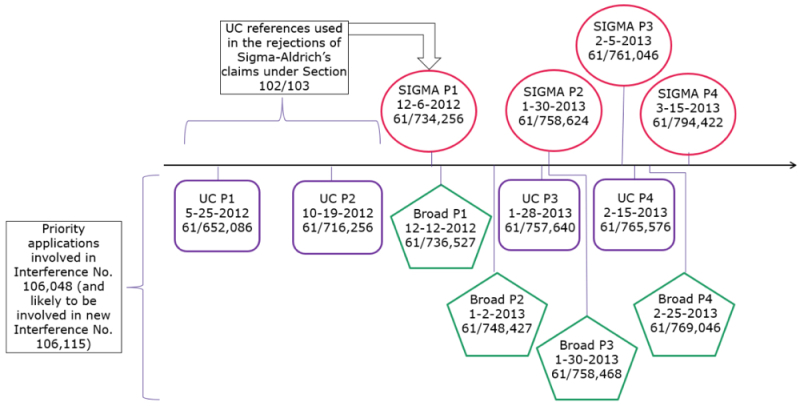
    Sigma-AldrichOn Friday, Sigma-Aldrich filed a self-described "extraordinary" petition to the Director of the U.S. Patent and Trademark Office (under 37 C.F.R. §§ 1.181-1.183) and the Chief Judge of the PTAB (under 37 C.F.R. § 41.3 and § 41.103), asking that the USPTO declare an interference between itself and the University of California, Berkeley "parallel" to the one recently declared between Berkeley and the Broad Institute and its companion institutions (see "CRISPR Battle Joined Again").

    The petition is extraordinary because Sigma's claims are not in condition for allowance, which is a prerequisite for the Office declaring an interference.  The basis for Sigma's prayer for extraordinary relief is that the Examiner reviewing its pending applications, U.S. Application Nos. 15/188,911, 15/188,924, and 15/456,204, has refused to find that two Berkeley provisional applications (U.S. Application Nos. 61/652,086 and 61/716,256) do not anticipate nor render obvious its claims to applications of CRISPR in eukaryotic cells, despite determinations to the contrary with regard to Broad et al. patents having later priority dates by the Patent Trial and Appeal Board (see "PTAB Decides CRISPR Interference — No interference-in-fact" and "PTAB Decides CRISPR Interference in Favor of Broad Institute — Their Reasoning") and Federal Circuit (see "Regents of the University of California v. Broad Institute, Inc. (Fed. Cir. 2018)").  The very similar claims in Sigma's three pending applications read as follows:

    U.S. Application No. 15/188,911:

    1.  A method for integrating an exogenous sequence into a chromosomal sequence of a eukaryotic cell, the method comprising:
        a) introducing into the eukaryotic cell (i) at least one RNA-guided endonuclease comprising at least one nuclear localization signal or codon-optimized nucleic acid encoding at least one RNA-guided endonuclease comprising at least one nuclear localization signal, wherein the at least one RNA-guided endonuclease is a clustered regularly interspersed short palindromic repeats (CRISPR)/CRISPR associated (Cas) (CRISPR-Cas) type II system protein and the CRISPR-Cas type II system protein is a Cas9 protein, (ii) at least one guide RNA or DNA encoding at least one guide RNA, and (iii) at least one donor polynucleotide comprising the exogenous sequence; and
        b) culturing the eukaryotic cell such that the at least one guide RNA guides the at least one RNA-guided endonuclease to a target site in the chromosomal sequence where the RNA-guided endonuclease introduces a double-stranded break, the target site in the chromosomal sequence is immediately followed by a protospacer adjacent motif (PAM), and repair of the double-stranded break by a DNA repair process leads to integration of the exogenous sequence into the chromosomal sequence.

    U.S. Application No. 15/188,924:

    1.  A method for modifying a chromosomal sequence in a eukaryotic cell, the method comprising:
        a) introducing into the eukaryotic cell (i) at least one RNA-guided endonuclease comprising at least one nuclear localization signal or codon-optimized nucleic acid encoding at least one RNA-guided endonuclease comprising at least one nuclear localization signal, wherein the at least one RNA-guided endonuclease is a clustered regularly interspersed short palindromic repeats (CRISPR)/CRISPR associated (Cas) (CRISPR-Cas) type II system protein and the CRISPR-Cas type II system protein is a Cas9 protein, (ii) at least one guide RNA or DNA encoding at least one guide RNA, and, optionally, (iii) at least one donor polynucleotide; and
        b) culturing the eukaryotic cell such that the at least one guide RNA guides the at least one RNA-guided endonuclease to a target site in the chromosomal sequence where the RNA-guided endonuclease introduces a double-stranded break, the target site in the chromosomal sequence is immediately followed by a protospacer adjacent motif (PAM), and repair of the double-stranded break by a DNA repair process leads to modification of the chromosomal sequence.

    U.S. Application No. 15/456,204:

    1.  A method for modifying a chromosomal sequence in a eukaryotic cell by integrating a donor sequence, the method comprising introducing into the eukaryotic cell: (i) a Clustered Regularly Interspersed Short Palindromic Repeats (CRISPR)/CRISPR-associated (Cas) (CRISPR-Cas) type II protein linked to at least one nuclear localization signal (NLS) or a nucleic acid encoding the CRISPR-Cas type II protein linked to at least one NLS, wherein the CRISPR-Cas type II protein is a Cas9 protein, and the nucleic acid encoding the CRISPR-Cas type II protein is codon optimized for expression in the eukaryotic cell; (ii) a guide RNA or DNA encoding the guide RNA, wherein the guide RNA comprises a first region that is complementary to a target site in the chromosomal sequence that is immediately followed by a protospacer adjacent motif, and a second region that interacts with the CRISPR-Cas type II protein; and (iii) a donor polynucleotide comprising the donor sequence;
        wherein the guide RNA guides the CRISPR-Cas type II protein to the target site in the chromosomal sequence, the CRISPR-Cas type II protein introduces a double stranded break at the target site, and repair of the double-stranded break by a DNA repair process leads to integration or exchange of the donor sequence into the chromosomal sequence.

    The relationship between patents and applications owned by Berkeley, the Broad, and Sigma are set forth in Figure 1 of the petition graphically as follows:

    Image
    The Examiner (who is the same Examiner responsible for allowing Berkeley's patents), according to the petition, has provided no legal justification for refusing to acknowledge what Sigma contends is the precedential value of the decisions in the earlier interference.  Sigma's position is that if the Doudna et al. provisional applications did not provide sufficient support to find the Broad's claims obvious (in an interference context) they cannot support a determination of obviousness in ex parte patent prosecution involving Sigma's applications.  Sigma further alleges that the evidence adduced in its ex parte examination of the three identified pending applications is "even more extensive" than the record in the earlier Berkeley/Broad interference; here, Sigma asserts that it has provided "multiple declarations from prominent experts explaining in even greater detail why (a) UC's disclosure of CRISPR-Cas9 in a prokaryotic environment does not render obvious Sigma-Aldrich's CRISPR-Cas9 eukaryotic claims, and (b) UC's provisional applications (UC P1 and UC P2) do not enable or adequately describe use of CRISPR-Cas9 in eukaryotic cells."

    According to the petition, the Examiner merely responds that their evidence is "unpersuasive" in refusing to recognize the allowability of their pending claims (in the latest Office Action, in the '911 application, Sigma asserts that this phrase or its equivalent was repeated "over 70 times").  (It is only fair to the Examiner to note that there was an in-person interview between Sigma's representatives and "the Examiner, her Supervisory Patent Examiner, two Interference Practice Specialists, and the Group Art Unit Director" that did not resolve the issue in Sigma's favor.)  Sigma-Aldrich argues that "[f]or the effective administration of justice, efficiencies of the USPTO and the parties, conservation of considerable valuable resources, and the public interest" the new interference should be declared (between Berkeley and Sigma in their petition; it is difficult to see the USPTO not including the Broad et al. patents in any such interference).  The alternative, according to the petition, would be appeal to the PTAB over the obviousness rejection and, if need be, further appeal to the Federal Circuit.

    Confident of its position, Sigma contends that this would be contrary to the Director's recent pronouncements (albeit in a different context) regarding there being a "level playing field" for all applicants and other parties; this portion of the petition waxes wroth regarding the "palpable" unfairness to Sigma and that "[i]n today's highly charged political environment, certainly the Director and CAPJ are sensitive to criticism leveled at the Agency regarding issues of fairness and equity."  In addition, Sigma notes that it would be "grossly inefficient" for the USPTO to conduct the current interference between Berkeley and the Broad and then have to conduct a further interference between Sigma and either or both of the other parties.  Finally, the petition notes the public interest in resolving the priority and ownership disputes between the several parties to prevent inhibiting development of the technology due to uncertainties regarding licensing and freedom to operate issues.

    Should the Director and/or Chief Judge grant Sigma its requested relief, it is likely that the current interference will be redeclared naming all three parties, the patents and applications currently in interference, and the Sigma-Aldrich applications (with their attendant priority claims).  The interfering subject matter has been set forth in alternate counts, corresponding either as claim 18 of the Broad's U.S. Patent No. 8,697,359 (dependent on claim 15), which taken together recites the following invention:

    An engineered, programmable, non-naturally occurring Type II CRISPR-Cas system comprising a Cas9 protein and at least one guide RNA that targets and hybridizes to a target sequence of a DNA molecule in a eukaryotic cell, wherein the DNA molecule encodes and the eukaryotic cell expresses at least one gene product and the Cas9 protein cleaves the DNA molecules, whereby expression of the at least one gene product is altered; and, wherein the Cas9 protein and the guide RNA do not naturally occur togetherwherein the guide RNAs comprise a guide sequence fused to a tracr sequence.

    (where the underlined portion recites the relevant language from claim 18) and claim 156 of Berkeley's U.S. Patent Application No. 15/981,807:

    A eukaryotic cell comprising a target DNA molecule and an engineered and/or non-naturally occurring Type II Clustered Regularly Interspaced Short Palindromic Repeats (CRISPR)-— CRISPR associated (Cas) (CRISPR-Cas) system comprising
        a) a Cas9 protein, or a nucleic acid comprising a nucleotide sequence encoding said Cas9 protein; and
        b) a single molecule DNA-targeting RNA, or a nucleic acid comprising a nucleotide sequence encoding said single molecule DNA-targeting RNA; wherein the single molecule DNA-targeting RNA comprises:
            i) a targeter-RNA that is capable of hybridizing with a target sequence in the target DNA molecule, and
            ii) an activator-RNA that is capable of hybridizing with the targeter-RNA to form a double-stranded RNA duplex of a protein- binding segment,
        wherein the activator-RNA and the targeter-RNA are covalently linked to one another with intervening nucleotides; and
        wherein the single molecule DNA-targeting RNA is capable of forming a complex with the Cas9 protein, thereby targeting the Cas9 protein to the target DNA molecule, whereby said system is capable of cleaving or editing the target DNA molecule or modulating transcription of at least one gene encoded by the target DNA molecule.

    There is no time frame for the petition to be considered much less granted, but as Sigma notes, the latest Berkeley-Broad interference is in the earliest stage; the parties must submit their proposed motions to the Board by July 30th and a teleconference between the Board and the parties is scheduled for August 5th.  None of these dates is written in stone, of course, and the Director or the Board could postpone progress in the pending interference to consider Sigma's request.  That would be the logical course; whether it is the Office's course remains to be seen.

  • CalendarJuly 23, 2019 – Commemoration of 50th anniversary of moon landing (U.S. Patent and Trademark Office) – 2:00 pm to 4:30 pm (ET), USPTO headquarters, Alexandria, VA

    July 25, 2019 – "Winning at §112: The Language of Patents" (IPWatchdog) – 12:00 pm EDT

  • USPTO SealThe U.S. Patent and Trademark Office will be hosting an event to commemorate the 50th anniversary of the moon landing on July 23, 2019, from 2:00 pm to 4:30 pm (ET) at the USPTO headquarters, 600 Dulany Street, Alexandria, VA.  The event will also focus on space innovation, technology transfer from the Apollo missions, and an overview of the current administration's policy on space exploration and space commerce.  Featured speakers at the event will include:

    • Secretary of Commerce Wilbur Ross
    • NASA Administrator Jim Bridenstine
    • Under Secretary of Commerce for Intellectual Property and Director of the USPTO Andrei Iancu
    • Director of the Office of Space Commerce Kevin O'Connell
    • Deputy Under Secretary of Commerce for Intellectual Property and Deputy Director of the USPTO Laura Peter
    • Former Associate Director, Satellite Servicing Capabilities Office, NASA and National Inventors Hall of Fame inductee Frank Cepollina
    • Astronaut Kathryn Sullivan
    • Astronaut Paul Richards
    • VP and General Manager of Strategic Operations of Ball Aerospace Debra Facktor
    • CEO of NanoRacks Jeffrey Manber
    • Founder and Chief Strategy Officer of Slingshot Aerospace Melanie Stricklan

    Additional information regarding the event can be found here.  Those interested in registering for the event, can do so here.  The event can be viewed here or here.

  • IPWatchdogIPWatchdog will be offering a webinar entitled "Winning at §112: The Language of Patents" on July 25, 2019, at 12:00 pm EDT.  Gene Quinn will discuss what the future may look like in light of possible § 112 reforms, best practices for today, and tools to help attendees mitigate filing errors before they happen.

    Those interested in registering for the webinar, can do so here.