• ACIAmerican Conference Institute (ACI) will be holding is 15th Annual Summit on Biosimilars & Innovator Biologics: Legal, Regulatory, and Commercial Strategies for the Innovator and Biosimilars Marketplace on June 20-21, 2024 at the New York City Bar Association.  Conference Co-Chairs are Deidre Parsons, Senior Director, Public Policy & Governmental Relations, Alnylam Therapeutics; Harshika Sarbajna, Vice President Commercial and Head Global, Alvotech; and Paki Banky, Director, Senior IP Counsel, IP Lead Cell and Gene at Novartis.

    Conference attendees will hear from Administrative Patent Judges the Honorable Jacqueline Bonilla, Deputy Chief; the Honorable Linda Horner; and the Honorable Grace Obermann, as well as Supervisory Patent Examiner Vanessa Ford and Laurel Goldberg, Regulatory Counsel, CDER, Food and Drug Administration.

    ACI faculty will offer presentations on the Biden Administration's initiatives on drugs and pricing strategies; an investors' roundtable on biosimilar valuation; the impact and insights for the future from Humira biosimilar launches; IPRs and policies and practices before the PTAB; and diversity, equity and inclusion in this industry, among others.

    An agenda for the conference can be found here, including a complete brochure for this conference, detailed descriptions of conference sessions, list of speakers, and registration form.  The registration fee is $2,395 for registration and payment by Mary 24, 2024; and $2,595 for payment by June 20th.  Patent Docs readers are entitled to a 10% discount off registration using discount code D10-999-PD24.  Those interested in registering for the conference can do so here, by emailing CustomerService@AmericanConference.com, or by calling 1-888-224-2480.

    Patent Docs is a media partner of ACI's 15th Annual Summit on Biosimilars.

  • ACIAmerican Conference Institute (ACI) will be holding its 22nd Advanced Summit on Life Sciences May 29-30, 2024 at the Fairfield Inn & Suites Manhattan Times Square South, New York, NY.

    This year's conference co-chairs include MJ Edwards (Senior Associate General Counsel, Patent Prosecution Team Lead, Gilead Sciences Inc.), Nicole Woods (Vice President, Assistant General Patent Counsel, Eli Lilly and Company), and Mercedes Meyer (Partner, Banner Witcoff LLP).

    This year's event highlights deep dives into the best regulatory and IP strategies for protecting digital health therapies and inventions created with the assistance of AI and machine learning, establishing sound and successful protocols to procure and enforce life sciences patents in the U.S. and internationally and much more.

    An agenda for the conference can be found here, including a complete brochure for this conference, detailed descriptions of conference sessions, list of speakers, and registration form.  The registration fee for the conference is $2,595.  Patent Docs readers are entitled to a 10% discount off of registration using discount code D10-999-PD24.  Those interested in registering for the conference can do so here, by e-mailing CustomerService@AmericanConference.com, or by calling 1-888-224-2480.

    Patent Docs is a media partner of ACI's 22nd Advanced Summit on Life Sciences.

  • ACIThe American Conference Institute (ACI) will be presenting its 20th Annual Paragraph IV Disputes Conference on April 25-26, 2024 in New York City.  As in the past, this curated program will not only address "hot" topics but also will put the issues within the context of pre-suit considerations, case filings, final adjudication, and every step in between.

    This year's conference co-chairs include Andrei Iancu (Partner, Sullivan & Cromwell LLP and former Director of the USPTO), Brian Malkin (Associate General Counsel, Teva Pharmaceuticals), and Mira Mulvaney (Assistant General Patent Counsel, IP Litigation, Eli Lilly & Company).

    The conference will be honored by the presence of the Honorable Pauline Newman and former Chief Judge the Honorable Randall Rader from the Federal Circuit, as well as the Honorable Judge Stanley R. Chester from the District Court of New Jersey and Magistrate judge the Honorable Tonianne J. Bongiovanni and the Honorable Sherry R. Fallon.

    Joining participants will be Hatch-Waxman litigators, in-house advisers, Chief IP and senior IP/Patent counsel from leading brand name and generic pharmaceutical companies, who will discuss, debate, and analyze the latest trends, decisions, legislative and regulatory advancements affecting Hatch-Waxman litigation.

    The brochure, agenda, and registration information can be found here.  ACI can be contacted by e-mail at  customerservice@americanconference.com and by telephone at 1-888-224-2480.

    Patent Docs readers can save 10% by using promo code: D10-999-PD24.

  • By Kevin E. Noonan –

    Federal Circuit SealA fractured affirmance of a district court decision to dismiss an infringement action under 35 U.S.C. § 271(e)(1) was the occasion for the Federal Circuit to illustrate the continued debate over the scope of the safe harbor enacted as part of the Hatch-Waxman Act in Edwards Lifesciences Corp. v. Meril Life Sciences Pvt.

    The case arose over a brief (one week) importation of two transcatheter heart valve systems (Class III medical devices, subject to regulatory approval by FDA) by Meril in conjunction with attendance by their representatives at a medical conference.  These representatives were instructed not to engage in any sales activities for U.S sales (and indeed their activities did not include any ex-U.S. sales either) nor did the infringing article ever leave the bag in which they were carried.  The purported purpose of Meril's attendance at the medical conference was to attract interest from doctors who would be willing to be involved in clinical trials required by the FDA for regulatory approval of the devices, which involved displays and presentations regarding those devices.  The opinion notes that Meril had performed clinical trials in India and obtained approval for its devices in that country as well as obtained CE certification for marketing in Europe.  Further evidence before the District Court showed that Meril had begun work on a premarket submission and planning for a three-arm clinical trial that could be part of future submissions to FDA, had contacted FDA regarding such trials, and had worked with a medical device consulting company (CardioMed LLC) to assist in preparing its premarket submission documents.

    Based on these activities, Edwards filed suit against Meril for patent infringement, i.e., importing the devices into the U.S. without a license.  The District Court granted summary judgment in favor of Meril based on their activities falling within the scope of the § 271(e)(1) safe harbor, and this appeal followed.

    The Federal Circuit affirmed, in an opinion by Judge Stoll joined by Judge Cunningham; Judge Lourie dissented.  The majority opinion was based on the broad scope of the safe harbor tailored by the Supreme Court in Eli Lilly & Co. v. Medtronic, Inc., 496 U.S. 661, 670–71, 674 (1990) (which expanded the safe harbor to include medical devices like the ones Meril imported into the U.S.), and Merck KGaA v. Integra Lifesciences I, Ltd., 545 U.S. 193, 202 (2005) (which held that it "provides a wide berth for the use of patented [inventions] in activities related to the federal regulatory process"), as it has been further developed by several Federal Circuit cases (which Judge Lourie maintained in his dissent had been, at least in part, wrongly decided).  The majority emphasized the scope of the application of the statute, to include "all uses of patented inventions that are reasonably related to the development and submission of any information under the [FDA]," that this scope was not limited in when the activities occurred, and that it applied "even if the information is never ultimately submitted to the FDA" under Merck.  The majority opinion sets forth the Federal Circuit's explication of the evolution of the doctrine at its hands, illustrated by three cases:  AbTox, Inc. v. Exitron Corp., 122 F.3d 1019, 1027 (Fed. Cir. 1997); Momenta Pharm., Inc. v. Teva Pharm. USA Inc., 809 F.3d 610, 619 (Fed. Cir. 2015); and Amgen Inc. v. Hospira, Inc., 944 F.3d 1327, 1338 (Fed. Cir. 2019), which merit brief consideration here as characterized by the majority.

    "Starting with Abtox," the opinion asserts that the statute "does not look to the underlying purposes or attendant consequences of the activity . . . as long as the use is reasonably related to FDA approval."  This statutory construction is supported, according to the majority, because the language therein is that otherwise infringing acts were in the safe harbor provided they were performed "'solely for uses reasonably related to' FDA approval" (emphasis in opinion; this emphasis on uses rather than the solely requirement is the major philosophical distinction between the majority and Judge Lourie in dissent).  The rationale asserted by the Court in Abtox was that "intent or alternative uses" were "irrelevant" to the invocation of § 271(e)(1) because "the statutory language allows [defendant] to use its data from the tests for more than FDA approval," citing Telectronics Pacing Sys., Inc. v. Ventritex, Inc., 982 F.2d 1520, 1524–25 (Fed. Cir. 1992).  Turning to Momenta, the majority asserts that activities such as "routine record retention" associated with "post-approval, commercial production" was not protected under § 271(e)(1).  Finally, in Amgen the Court affirmed jury instructions to the effect that "additional underlying purposes [for alleged safe harbor activity] do not matter as long as [defendant] proved that the manufacture of any given batch of drug substance was reasonably related to developing information for FDA submission" under circumstances where 7 of 21 otherwise infringing batches were found to fall under the safe harbor because they were used for "pre-approval inspection" while the others, used for "various types of [commercial] testing" did not.

    With regard to the term "solely" in the statute, the majority states that it modifies the phrase "for uses," and thus that "the safe harbor is available only for acts or uses that bear a reasonable relation to the development and submission of information to the FDA," relying on Merck.  Importantly, the majority went on to say that the statute does not require "that the use must only be reasonably related to the development and submission of information to the FDA" (emphasis in opinion, and somewhat ironic insofar as "solely" and "only" are synonymous).

    Using this explication as prelude, the majority determined that "the relevant inquiry is not why Meril imported the two transcatheter heart valve systems, or how Meril used the imported transcatheter heart valve systems, but whether the act of importation was for a use reasonably related to submitting information to the FDA" (emphases again in the opinion).  Accordingly, the majority affirmed the District Court grant of summary judgment in view of the undisputed facts (set forth above).

    The majority rejected Edwards's three arguments on appeal.  First, Edwards argued that there were genuine issues of material fact disregarded by the District Court, that the actions of Meril's representatives were commercially driven.  The majority rejected this contention in light of the evidence that the representatives were expressly told not to pursue commercial goals for U.S. sales and while they were under no such strictures regarding non-U.S. sales no such sales-directed activity occurred.  That the representatives did not bring their devices with them to dinners and other activities with clinical scientists to be recruited to direct clinical trials was also not probative to the majority of intent outside the scope of the safe harbor.  The majority also rejected Edwards's contention that Meril's disregard of some of the advice given by its FDA consultant and guidance from FDA was evidence that Meril did not intend to enter clinical trials for FDA submission, finding no basis in the undisputed evidence before the District Court.  In an interesting twist of emphasis, the majority rejected Edwards's arguments because, in their view, "no reasonably minded juror" would have inferred that "Meril's sole purpose for importing [its devices] was to support its commercial sales efforts, and the importation was wholly unrelated to recruiting clinical investigators and wholly unrelated to any FDA submission," turning the question of "sole" purpose on its rhetorical head (emphasis in opinion).

    The majority also rejected Edwards's second argument, that Meril's failure to use the imported devices stripped them from the protection of the safe harbor as a matter of law because the District Court "deem[ed] Meril's intent irrelevant in the absence of evidence of a protected use."  This argument failed for two reasons, according to the majority:  first, that there was nothing in the statute that required such a use to provide safe harbor protection and that importation itself was so eligible (as the District Court held).  Second, and relevant to the dissent's position, the majority asserted that:

    [O]ur interpretation of § 271(e)(1) applies the safe harbor regardless of the defendant's intent or purpose behind the otherwise infringing act (citing Amgen, 944 F.3d at 1338–39; and AbTox, 122 F.3d at 1030).  Nothing in our jurisprudence suggests that the availability of the safe harbor turns on the party's subjective intent behind an act.  And that remains true regardless of whether there are additional uses by defendant.

    Finally, Edwards argued that the District Court had improperly relied on declaration evidence from one of Meril's representatives, which argument the majority rejected because the District Court relied on other evidentiary bases for its decision.

    Judge Lourie's dissent went straight to the point:

    I [dissent] because the majority perpetuates the failure of this court and others to recognize the meaning of the word "solely" in interpreting § 271(e)(1).  The majority also errs in following the error of AbTox, Inc. v. Exitron Corp., 122 F.3d 1019 (Fed. Cir.), opinion amended on reh'g, 131 F.3d 1009 (Fed. Cir. 1997), and its progeny that the purposes of the infringing act do not matter in evaluating the safe harbor.

    I believe that "solely" creates a safe harbor only for uses, sales, and importations that solely are for, as the statute says, development of information for the FDA.  The purpose of the infringing act is meaningful and important to determining the safe harbor.  And attempts to tie the word "solely" to be modifying one or another subsequent term does not change that meaning.

    Judge Lourie recognized that the District Court "reasonably followed" these earlier decisions and that the error was in the Court's earlier safe harbor precedent, due to their decisions having given "short shrift" to the word "solely" in the statute.  Using the proper interpretation of that statute, Meril's activities would have raised a genuine issue of material fact (precluding summary judgment) regarding whether importing the devices was "solely for uses reasonably related to the development and submission of information" (emphasis in dissent).  In view of the legislative history and intent of the Hatch-Waxman Act (wherein the safe harbor abrogated the Court's decision in Roche Prods., Inc. v. Bolar Pharm. Co., 733 F.2d 858, 861 (Fed. Cir. 1984), rendering infringing any activity prior to patent expiry), Judge Lourie opines that "[t]he word 'solely' was included in the statute to ensure that infringing activity that was performed for purposes other than the development and submission of information under a federal law regulating drugs would not be exempt" (citing portions of that legislative history).  Relying on the Oxford English Dictionary, Judge Lourie distinguished the meaning of "solely" ("a single person (or thing); without any other as an associate, partner, sharer, etc.; alone; occasionally, without aid or assistance" or "[a]part from or unaccompanied by others; solitary") from "partially," "slightly," "jointly," or have "any other ambiguous meaning."  Judge Lourie also noted that it was well recognized by commentators at the time that the legislative history precluded the safe harbor from "permit[ting] the commercial sale of a patented drug by the party using the drug to develop [federal regulatory] information," i.e., commercial sales were not exempt even if they resulted in such information (the Judge further stating that importation was similar prohibited unless the exemption applied).

    The consequence of the Federal Circuit's improper interpretation of the statute, according to the dissent, was that by following it "the district court here wholly ignored the presence of the word 'solely' in the statute," noting that the word was completely absent from the District Court's analysis and holding, something that "was not merely a harmless omission."  Judge Lourie called out in particular the statement, relegated to a footnote in the District Court's opinion, that "[b]ecause intent and alternative uses are not relevant to the application of the safe harbor once it is determined that the allegedly infringing acts were reasonably related to FDA approval, the Court need not reach the issue of Meril's alleged commercial intent," which cited AbTox and Amgen for support of this principle.  Judge Lourie sets forth in this regard his own explication of Abtox, Momenta, and Amgen (as well as Telectronics Pacing Systems) in assessing the responsibility for this error to properly be placed at the Federal Circuit's doorstep.  In this analysis, he noted instances where the word "solely" did not appear in the Court's reasoning (Telectronics), where intent was specifically disregarded (Abtox, which stated that the safe harbor "does not look to the underlying purposes or attendant consequences of the activity . . . , as long as the use is reasonably related to FDA approval"), Momenta (which expanded the scope of the safe harbor), and Amgen.  To be sure, Judge Lourie found at least the impetus for this trend in the Supreme Court's expansive interpretation of the statute in Merck (wherein the Court included activities resulting in experimental evidence that was not for whatever reason submitted to FDA), but asserts that the Court's decision did not mandate the disregard of the statutory restrictions imposed by the word "solely" that the Federal Circuit's case law had sanctioned.  In particular, Judge Lourie finds support in the Merck decision for his thesis regarding the error in Federal Circuit's interpretation, wherein the Court stated that "[b]asic scientific research on a particular compound, performed without the intent to develop a particular drug or a reasonable belief that the compound will cause the [desired physiological effect], is surely not 'reasonably related to the development and submission of information' to the FDA."

    Judge Lourie's remedy is en banc review, to permit the full Federal Circuit to reconsider its precedent.  While it is somewhat remarkable that such a fundamental interpretation of the statute is necessary forty years after enactment it is consistent with a judicial philosophy generally in favor of interpreting narrowly exemptions to patent law protections for innovators.  Whether Judge's Lourie's brethren recognize the distinctions he has drawn shall be seen.

    Edwards Lifesciences Corp. v. Meril Life Sciences Pvt. Ltd. (Fed. Cir. 2024)
    Panel: Circuit Judges Lourie, Stoll, and Cunningham
    Opinion by Circuit Judge Stoll; dissenting opinion by Circuit Judge Lourie

  • By Joshua Rich

    USPTO SealIn a Federal Register notice dated March 29, 2024, the U.S. Patent and Trademark Office is updating the required method for serving it with a notice of appeal to the U.S. Court of Appeals for the Federal Circuit, a notice of election to proceed by civil action in district court, or a request for extension of time to file a notice of appeal or commence a civil action.  Previously, all such notices or requests had to be served by mail.  Under the new rule, the notices and requests are to be served by email (with Priority Mail as a failsafe if email is not feasible.

    The new rule requires a party to serve an email address in the Office of the General Counsel to be posted on the USPTO website.  If that cannot be done, the party can serve the Office of the Solicitor.

    While this seems like a small change (and it is), it has some clear benefits for practitioners.  First, it modernizes practice to bring it more in line with the more streamlined process used in litigation.  That is, litigators are accustomed to serving opposing parties by email rather than snail mail.  Second, the USPTO will accord the service copy with a time-stamped receipt date which serves as proof of receipt of service of the notice.  This prevents any potential concern that the service copy "got lost in the mail."  But potentially most importantly, this procedure is just easier — no printing copies, trips to the Post Office, or other hassle.

  • By Kevin E. Noonan –

    Federal Circuit SealLast week, the Federal Circuit handed down a pair of non-precedential decisions affirming the Patent Trial and Appeal Board (PTAB) in inter partes review (IPR) proceedings.  This post concerns the decision in Cardiovalve Ltd. v. Edwards Lifesciences Corp., which has as its most significant aspect an unnecessary untethering of obviousness with evidence regarding the skill and inventiveness of the person of ordinary skill in the art under KSR International Co. v. Teleflex Inc.

    The case arose with Edwards's challenge of claims 1-3, 5, 6, and 8-11 of Cardiovalve's U.S. Patent No. 10,226,341 directed to an apparatus for implanting a prosthetic heart valve in a patient in need thereof. Claim 1 was considered representative by the panel:

    1.  Apparatus for use at a native valve of a subject, the native valve including at least a first native leaflet and a second native leaflet, the apparatus comprising:
        an implant, comprising:
        an annular portion, being configured to be placed against an upstream side of the native valve, and having an inner perimeter that defines an opening, and
        at least one leaflet clip:
            
    (i) coupled to the annular portion,
            (ii) comprising:
                at least two clip arms, movable with respect to each other to open and close the clip; and a clip-controller interface, the clip-controller interface being coupled to at least one of the clip arms, and
            (iii) configured:
                to be coupled to a portion of the first native leaflet by the clip arms being brought together to close around the first native leaflet,
                to be coupled to a portion of the second native leaflet by the clip arms being brought together to close around the second native leaflet, and
                to hold together the portion of the first leaflet and the portion of the second leaflet; and
            a delivery apparatus, configured to deliver the implant to the native valve, and comprising at least one clip controller, the at least one clip controller being reversibly couplable to the clip-controller interface, and configured to facilitate opening and closing of the clip, and the delivery apparatus being intracorporeally decouplable from the implant.
        wherein the bold, italicized language is relevant to the issues before the Court.

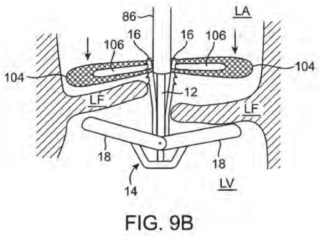
    The prior art cited in the IPR petition, U.S. Patent No. 7,635,329, in support of Edwards's obviousness contentions, disclosed a device for stabilizing valve leaflets illustrated in Figure 9B of this patent:

    Image
    where the "device, 14, [that] includes two proximal elements, 16, and two distal elements, 18, [is] configured such that a proximal and distal element pair, when brought together, form a clip that grasps a heart valve leaflet, LF, from the top and bottom [and wherein the] fixation device also includes flaps, 104, which restrict upward motion of the leaflets to better enable the proximal and distal elements to grasp the leaflets."  Also noted in the opinion is that "[o]nce the leaflets have been grasped, the flaps . . . may be removed . . . or may be left behind to assist in holding the leaflets" (emphasis in opinion).  Before the Board, Cardiovalve conceded that all the limitations recited in its claims were disclosed in the '329 patent except that the device comprise "at least one leaflet clip" "coupled to the annular portion" of the device.  The Board found that the pairs of proximal and distal elements disclosed in the '329 patent together constitute a "leaflet clip" as disclosed and claimed in the '341 patent, that the flaps "constitute or contain" an "annular portion, and further that any direct or indirect attachment is a "coupling."  Based on these conclusions, the Board found the challenged claims of the '341 to be obvious, and this appeal followed.

    The Federal Circuit affirmed in a decision by Judge Taranto joined by Judges Chen and Stoll.  Cardiovalve's sole argument on appeal was that the Board erred in concluding that it would have been obvious to attach, "either directly or indirectly, [the flaps] disclosed in the '329 patent" to its proximal and distal elements."  The opinion notes that the Board applied the seminal teaching from KSR that:

    When there is a design need or market pressure to solve a problem and there are a finite number of identified, predictable solutions, a [relevant artisan] has good reason to pursue the known options within his or her technical grasp.  If this leads to the anticipated success, it is likely the product not of innovation but of ordinary skill and common sense.  In that instance the fact that a combination was obvious to try might show that it was obvious under § 103.

    The panel held that the Board had substantial evidence for its conclusion that Edwards satisfied these requirements.  The panel's reasoning was that the disclosure in the '329 patent that the flaps could be "left behind" necessitated that they be attached to something fixed either to the device disclosed therein or to heart tissue, which provided a "finite number of predictable options."  The Board also relied on Edwards's expert witness regarding why the skilled artisan would know to attach the flaps to the device and why such an attachment would be expected to succeed, thus providing the reasonable expectation of success required by KSR (something Cardiovalve did not challenge).  And the fact that there might have been a small number of other alternatives, as argued by Cardiovalve, did not rebut the Board's determination that the one consistent with the invention claimed in the '341 patent was obvious.

    The one interesting aspect of the decision, and one that has garnered comment, was the panel's rejection of Cardiovalve's argument that recitation of the "known options" in the cited passage of the KSR opinion should be limited to what was actually known in the prior art.  (Indeed, it was the genius of Giles Rich and PJ Federico to tether obviousness under Section 103 to the prior art in ways that a century of Supreme Court precedent never did, leaving a determination of invalidity under what philosophically was obvious to the "flash of genius" and other inchoate and unpredictable standards.)  The Federal Circuit's basis for negating this requirement on the prior art was that the requirement was "nowhere articulated in KSR, and adopting it would be inconsistent with the Supreme Court's rejection in KSR of a rigid demand for the steps in an obviousness analysis to be proved by prior-art documents, to the exclusion of the knowledge and skill of the relevant artisan."  And the Court refused to recognize such a requirement in its own precedent, abjuring such existing precedent cited by Cardiovalve (specifically, Uber Technologies, Inc. v. X One, Inc., 957 F.3d 1334, 1339–40 (Fed. Cir. 2020); and Bayer Schering Pharma AG v. Barr Laboratories, Inc., 575 F.3d 1341, 1350 (Fed. Cir. 2009); indeed, this reasoning smacks not a little of being equivalent to stating that just because the Court had reasoned correctly in the past did not necessitate continuing to do so).  Of course there is nothing in KSR's averments regarding the basis for making an obviousness determination based on the knowledge and skill of the prior art artisan that does away with the requirement for evidence that the alternatives relied upon to make that determination would have been understood by the worker of ordinary skill at the time the invention was made and not simply presumed to have existed (being the epitome of hindsight, which KSR also warns against).

    The remainder of the panel's reasoning for its decision merely begs the question, i.e., assumes the conclusion, based on Edwards's argument that "a relevant artisan would have found it obvious to attach Goldfarb's flaps to its fixation device (and therefore indirectly to its proximal and distal elements), because the flaps, if left behind, had to be attached somewhere and this was an obvious location."  In the Court's application of the cited portion of the KSR decision the opinion states that "when a relevant artisan would have recognized a problem, a consideration of whether only a small number of solutions existed is a natural part of an evaluation of whether a patent-claimed solution would have been obvious.  The Board's undertaking such consideration here was therefore a legitimate exercise of its duty to evaluate whether Edwards was right or wrong about the position Edwards consistently maintained—that attachment to the implant would have been obvious" (the relevance of the italicized language being itself questionable).  The questionable nature of this basis for affirming the Board's decision is even more unfortunate because the opinion contains an ample basis for affirmance, whereby "the Board actually found reasons for a relevant artisan to choose the Edwards-urged solution over the alternative(s)—at the least, greater simplicity," reliance on which would have avoided disturbing dicta in what was otherwise (and fortunately) just another non-precedential opinion by the Court.

    Cardiovalve Ltd. v. Edwards Lifesciences Corp. (Fed. Cir. 2024)
    Nonprecedential disposition
    Panel: Circuit Judges Taranto, Chen, and Stoll
    Opinion by Circuit Judge Taranto

  • By Kevin E. Noonan –

    Federal Circuit SealLast week the Federal Circuit handed down a pair of non-precedential decisions affirming the Patent Trial and Appeal Board (PTAB) in inter partes review (IPR) proceedings.  This post concerns the decision in Medtronic, Inc. v. Teleflex Life Sciences Ltd.

    The case arose in two IPR proceedings involving U.S. Patent No. 8,142,413, owned by Teleflex and related to methods for using a coaxial guide catheter in interventional cardiology procedures.  Claims 1, 2, 4, 5, and 7-14 were challenged by Medtronic for being unpatentable for anticipation* or obviousness; claim 1 was considered to be representative by the Court in this appeal:

    A method of providing backup support for an interventional cardiology device [ICD]
        for use in the coronary vasculature, the [ICD] being adapted to be passed through a standard guide catheter, the standard guide catheter having continuous lumen extending for a predefined length from a proximal end at a hemostatic valve
        to a distal end adapted to be placed in a branch artery, the continuous lumen of the guide catheter having a circular cross-sectional inner diameter sized such that [ICDs] are insertable into and through the lumen, the method comprising:
            [1.a] inserting the standard guide catheter into a first artery over a guidewire, the standard guide catheter having a distal end;
            [1.b] positioning the distal end of the standard guide catheter in a branch artery that branches off from the first artery;
            [1.c] inserting a flexible tip portion of a coaxial guide catheter defining a tubular structure having a circular cross-section and a length that is shorter than the predefined length of the continuous lumen of the standard guide catheter, into the continuous lumen of the standard guide catheter, and,
            [1.d] further inserting a substantially rigid portion that is proximal of, operably connected to, and more rigid along a longitudinal axis than the flexible tip portion, into the continuous lumen of the standard guide catheter, the substantially rigid portion defining a rail structure without a lumen and having a maximal cross-sectional dimension at a proximal portion that is smaller than the cross-sectional outer diameter of the flexible tip portion and having a length that, when combined with the length of the flexible distal tip portion, defines a total length of the device along the longitudinal axis that is longer than the length of the continuous lumen of the guide catheter;
            [1.e] advancing a distal portion of the flexible tip portion distally beyond the distal end of the standard guide catheter and into the second artery such that the distal portion extends into the second artery and such that at least a portion of the proximal portion of the substantially rigid portion extends proximally through the hemostatic valve;
        and
            [1.f] inserting the [ICD] into and through the continuous lumen of the standard guide catheter alongside of the substantially rigid portion and advancing the [ICD] through and beyond a lumen of the flexible tip portion into contact with or past a lesion in the second artery.

    wherein the italicized language in step 1.f is relevant to the issues before the Court.  (The opinion reduces the steps from the complexity of the claim language to the following shorthand regarding the ordered and simplified steps:

    1.a: inserting the standard guide catheter;
    1.b: positioning the standard guide catheter;
    1.c: inserting a coaxial guide catheter;
    1.d: inserting a substantially rigid portion;
    1.e: advancing the flexible tip portion;
    1.f: inserting and advancing the ICD.)

    The opinion explains that the claimed method relates to introducing a catheter into coronary arteries through the aorta, and the occasional difficulties arising from "tough lesions"(including stenosis and chronic arterial occlusion) therein which make such introductions difficult and problematic, which are addressed in the claims by using a combination of a guide catheter and a coaxial guide catheter.  The coaxial guide catheter comprises "a tip portion, a reinforced portion, and a substantially rigid portion," with the tip being distal (inserted further into the artery) to the rigid portion.  This arrangement is illustrated by Figs. 8 and 9:

    Figures 8 & 9
    with the following explanation from the '413 patent:

    In operation, a guide catheter 56 is inserted into a major blood vessel in the body such as aortic arch 58 over guidewire 64 and the distal end 68 of guide catheter 56 is brought into proximity of ostium 60 of a smaller branch blood vessel, such as coronary artery 62, that it is desired to enter.  Coaxial guide catheter 12, with tapered inner catheter 14, is inserted through guide catheter 56 and over guidewire 64.  Guide catheter 56, guidewire 64, coaxial guide catheter 12, and tapered inner catheter 14 are manipulated to insert tapered inner catheter tip 42 into the ostium 60 of the blood vessel that branches off from the major blood vessel.  The bump tip 22 of coaxial guide catheter 12 is inserted with tapered inner catheter tip 42 well into ostium 60 of coronary artery 62 or other blood vessel until bump tip 22 of coaxial guide catheter 12 achieves a deep-seated position.  Tapered inner catheter 14 is then withdrawn from the lumen of coaxial guide catheter 12.  An interventional cardiology treatment device such as a catheter bearing a stent or a balloon (not shown) is then inserted through the lumen of coaxial guide catheter 12 which remains inside guide catheter 56.

    Medtronic challenged these claims in the '413 patent over U.S. Patent No. 7,736,355 (for anticipation) and 7,604,612 (for obviousness, in combination with the '355 patent) in a first IPR and for obviousness over U.S. Patent No. 5,439,445 taken alone or in combination with U.S. Patent Application Publication No. US 2004/0010280.  In rendering its Final Written Decision that the challenged claims were non-obvious over any of these combinations of the asserted prior art, the PTAB construed claim 1 to require that the steps be performed in the recited order.  In both IPRs, the Board further held in its non-obviousness determination that the skilled worker would not have been motivated to combine either set of references.

    The Federal Circuit affirmed, in an opinion by Judge Prost, joined by Judges Lourie and Chen.  Regarding the Board's claim construction, the panel affirmed the construction that "inserting the ICD can occur only after advancing the flexible tip portion")(emphasis in opinion); Medtronic advanced a broader interpretation for simultaneous insertion of the ICD and coaxial guide catheter.  The Court reviewed the Board's interpretation of the claim language and support therefor in the specification in arriving at its conclusion.  The relevant portion of the claim language was in 1.e (advancing the flexible tip portion) and 1.f (inserting and advancing the ICD), according to the opinion, which indicates that the tip is  advanced before the ICD if (as the Court affirms) in the proper "in order" recitation of the claimed method steps.  As stated in the opinion, "when the current step of a method claim refers to a previous step using the definite article 'the,' the claim language indicates that the previous step occurs sequentially before the current step," citing Wi-Lan, Inc. v. Apple Inc., 811 F.3d 455, 462 (Fed. Cir. 2016) (although qualifying this principle as not being "an ironclad rule").  This interpretation is further supported by the panel's consideration of the "physical requirements of the substantially rigid portion," in light of the arrangements of the elements (with the tip being "distal" and the rigid portion being "proximal" and that they are "operably connected").  Further recitation of the timing of the insertions also support this interpretation according to the opinion ("the logic of claim 1 suggests that the inserting and advancing the ICD step must occur after advancing the flexible tip portion").  Disclosure in the specification is also consistent with this construction, according to the Court, because it also discloses "an ordered performance of the recited steps in claim 1" as well as the advantages of doing so.

    While characterizing Medtronic's construction to the contrary as being "plausible" "in a vacuum," the panel rejects it because Teleflex's construction as adopted by the Board is consistent with the context of the claim language and specification, citing Trs. of Columbia Univ. v. Symantec Corp., 811 F.3d 1359, 1363 (Fed. Cir. 2016).  Medtronic's acquiescence to the requirement for the other steps in the method of claim 1 to be performed in the recited order suggests to the panel that this order should not be interpreted any differently for steps 1.e and 1.f, analogous to the circumstances in Mformation Techs., Inc. v. Rsch. in Motion Ltd., 764 F.3d 1392, 1398 (Fed. Cir. 2014).  And cases that have found disparate step order to be a proper interpretation were cases where such an interpretation was expressly supported by the specification, such as Niazi Licensing Corp. v. St. Jude Med. S.C., Inc., 30 F.4th 1339, 1351–53 (Fed. Cir. 2022), or based on claim differentiation, see Baldwin Graphic Sys., Inc. v. Siebert, Inc., 512 F.3d 1338, 1345 (Fed. Cir. 2008).  Nor were Medtronic's distinctions based on additional recitations in dependent claims 6, 10, and 11 persuasive, the panel stating that the argument "has no support in our reasoning here or the logic and grammar of the claims."

    Regarding the Board's finding that the skilled artisan would not have had a reason to combine the '355 and '612 patents, the panel applied the substantial evidence standard of review for what are factual questions supporting the Board's legal determination of non-obviousness.  According to the opinion, the '355 patent discloses an "intravascular foreign matter suction assembly" for removing foreign matter from a blood vessel, whereas the '612 patent discloses emboli protection devices.  The Court rejected Medtronic's assertion of error because, first the Board had expressly considered Medtronic's proposed motivations to combine and its conclusions were supported by substantial evidence; second, the Board compared Medtronic's evidence in favor of a reason to combine the references with Teleflex's contrary evidence and found the latter evidence more persuasive, based in part on expert testimony cited extensively in the Court's opinion; and third, that the Board had not contravened the Supreme Court's decision in KSR International Co. v. Teleflex Inc., 550 U.S. 398, 418–19 (2007), the panel finding that the Board had not improperly applied the "teaching, suggestion, or motivation test" in arriving at its non-obviousness determination.

    Turning to the Board's determination that the '445 patent considered alone did not support Medtronic's obviousness challenge, the opinion sets forth the teachings of this patent to be a support catheter (corresponding to the coaxial guide catheter of claim 1) that "protects the fragile balloon of a balloon catheter" (corresponding to the ICD) as that balloon catheter passes through a guide catheter.  The Board determined that the '445 patent had no disclosure of the requirement in claim 1 that the ICD was advanced after advancing the flexible tip portion.  The panel countered Medtronic's assertion of error by noting the "narrow presentation of the evidence" supporting Medtronic's contentions in this regard, including only one paragraph from the '445 patent plus certain expert testimony in support of Medtronic's position.  The Court also found that Medtronic's evidence in support of its position before the Board was wanting, citing Netflix, Inc. v. DivX, LLC, 84 F.4th 1371, 1377 (Fed. Cir. 2023), for the principle that "the Board should also not have to decode a petition to locate additional arguments beyond the ones clearly made."  Also supporting the Board's findings, in the Court's view, was that this argument relied alone on the disclosures of the '445 patent plus the understanding and "ordinary creativity" of the skilled worker, which the Board found insufficient to support an obviousness determination.

    Finally, the Court turned to the Board's determination that the combination of the '445 patent and '280 application did not render obvious the challenged claims.  In this regard the panel understood the '280 application to disclose "an emboli protection system that occludes blood flow" by deploying a filter to catch dislodged emboli.  The Board rejected this combination for supporting obviousness because, inter alia, "[the] sealing device [disclosed in the '280 application] is withdrawn before inserting a treatment device like a stent or a balloon because occluding blood flow, which sealing device . . . does, is undesirable," a characterization supported by Teleflex's expert testimony that "occluding blood flow is undesirable, and therefore teaches that the guide seal is deployed only during deployment of the filter and not during the subsequent delivery of [ICDs] such as balloons and stents."  This understanding of the consequences of the combination "undermined what Medtronic['s interpretation] proposed – keeping [the] sealing device . . . in [the] guide catheter . . . during the insertion of a treatment device like [the '445]'s balloon catheter."  The panel rejected Medtronic's argument that the Board had not considered the proposed combination, finding that the Board had done so and come to a contrary conclusion supported by substantial evidence.  The panel held that the Board also properly considered the consequences of the combination of the references and concluded, "in light of the drawbacks of Medtronic's proposed combination" that the skilled worker would not have combined these references as Medtronic contended.

    * The Board's decision that the asserted prior art reference did not anticipate the challenged claims was not appealed.

    Medtronic, Inc. v. Teleflex Life Sciences Ltd. (Fed. Cir. 2024)
    Nonprecedential disposition
    Panel: Circuit Judges Lourie, Prost, and Chen
    Opinion by Circuit Judge Prost

  • By Joshua Rich

    MicrosoftAs discussed in our earlier post, Microsoft opened its motion to dismiss portions of the New York Times's OpenAI case pled against it with an extended analogy to the Betamax case.  It argued that the Times was acting like the Motion Picture Association of America in crying wolf over the death of its industry in light of the development of a new technology.[1]  But no analogy is perfect, and the Times opened its opposition to the motion to dismiss by noting the distinctions between an LLM and a VCR.

    New York TimesThe Times's opposition starts with an unambiguous distinction shot across the bow based on the evidence that was cited in the complaint, citing the Betamax case in support of the proposition that "A VCR is not preloaded with millions of programs that can be played back if prompted with an opening scene" while "Defendants' AI models can display works that were copied to train them with the right prompt."  It then notes that VCRs do not generate programming that competes with movies, but ChatGPT returns results that copy and summarize the Times's works (that it asserts users would otherwise obtain from the Times itself).  So the Times concludes, "If VCRs had been built with movies to make movies that compete with movies, or if Sony oversaw the VCR's infringing users, [the Betamax case] would have gone the other way."

    The Times then answers Microsoft's accusation that it is standing in the way of technological progress.  The Times offers a solution that is easy to describe, if not to execute:  just teach the LLM on non-copyrighted works.  And it drops a PR bomb of its own in doing so, saying rather than doing so, "Microsoft—the richest company in the world—claims that it was entitled to take what it wanted for free."  Turning Microsoft's rhetoric back on itself, the Times argues that respecting copyright and building an LLM without infringing "will promote a future where both GenAI developers and publishers can flourish."[2]

    If nothing else, the introduction serves as a valuable reminder to litigators to consider what the other side might do with an analogy you offer.  Microsoft built the logic and righteousness of its case on an analogy, but appears not to have thought about how the analogy could be turned on its head to rebut its own position.  In the end, the judge is likely to focus on the facts of ChatGPT — not the analogy to a VCR — and ignore the rhetorical fireworks back and forth.

    When it gets to the legal arguments, the Times notes that the issues are almost identical to those raised by OpenAI (save for OpenAI's limitations argument, which Microsoft did not raise), and the Times response is essentially the same.  One difference between the Times's two responses, however, is that the Times repeatedly argued that OpenAI's case citations were inappropriate, whereas it argues that Microsoft may be correct but they relate to later stages of the case, whether on summary judgment or post-trial.  The basic argument is still the same:  the Times should be permitted to take discovery to support its claims, not cut off on a motion to dismiss.

    First, the Times starts its argument against Microsoft's attempt to obtain dismissal of the contributory copyright infringement count by noting that six of the eight cases Microsoft relies on were decided later in the case.  The Times then notes that it pled averments of the elements of the claim disputed by Microsoft; while it did not cite evidence, that is generally not required in federal court pleadings.  As with its response to the OpenAI motion to dismiss, the Times does go beyond the pleadings to cite articles that would support the averments of the complaint, but the judge is not likely to require amendment of the complaint to show proof of the plausibility of the factual allegations.  Furthermore, in a situation like this where most (if not all) of the evidence of is in a defendant's hands — especially evidence of intent — a judge would be loathe to allow that defendant to prevail without permitting the plaintiff to investigate through discovery.

    Second, the Times repeats basically the same arguments about violations of the Digital Millennium Copyright Act as it raised against OpenAI.  While Microsoft (and OpenAI) focuses on how removal of copyright management information does not facilitate third-party infringement, the Times argues the stripping of CMI during training of the LLM and synthetic search retrieval conceals Microsoft's (and OpenAI's) own infringement.  That is, the Times argues Microsoft seeks to focus on the wrong actor and act of infringement for the DMCA violations and that Microsoft's own knowledge of those violations is where the judge should look.  Again, the Times argues it has pled Microsoft's knowledge and should be allowed to take discovery to support its allegations.  As with the contributory copyright infringement claim, the court is likely to allow it to do so.

    Finally, the Times addresses its "hot news" state law misappropriation claim by basically focusing on the fact that its pleadings are sufficient, not on whether it will ultimately prevail. It provides scant argument or details beyond a recitation of the allegations of the complaint and notation that Microsoft relies on cases decided at later stages of the case.  Again, as we suggested in our discussion of OpenAI's motion to dismiss, the Times's misappropriation claim is likely to survive the Microsoft motion to dismiss, but may not survive summary judgment.

    [1] The first sentence of Microsoft's brief reads, "'The VCR is to the American film producer and the American public as the Boston strangler is to the woman home alone,' warned Jack Valenti, then head of the Motion Picture Association of America, in his 1982 testimony to the House of Representatives."

    [2] The Times cites Andy Warhol Found. for the Visual Arts, Inc. v. Goldsmith, 598 U.S. 508 (2023) and A&M Recs., Inc. v. Napster, Inc., 239 F.3d 1004 (9th Cir. 2001) as support for its argument.  Neither case is really on point, which Microsoft likely will point out in its reply.

    For additional information regarding this topic, please see:

    • "The New York Times Calls Out OpenAI on Its Motion to Dismiss," March 18, 2024
    • "Microsoft's Motion to Dismiss NY Times Lawsuit over ChatGPT: How is ChatGPT Like a VCR?" March 7, 2024
    • "OpenAI's Motion to Dismiss NY Times Lawsuit over ChatGPT: Do They Want to Win or Influence Public Opinion?" March 5, 2024
    • "The New York Times Case against OpenAI is Different. Here's Why." February 19, 2024
    • "An Analogy for the Current Wave of AI Copyright Lawsuits," November 12, 2023

  • By Joshua Rich and Michael Borella

    New York TimesResponding to the OpenAI brief that read more like a press release than a traditional motion to dismiss, the New York Times attacked OpenAI's approach from the very first sentence, calling the factual background of OpenAI's brief "grandstanding about issues on which it hasn't moved."  The Times echoed the concern we raised in our post on OpenAI's motion to dismiss, that the motion "introduces no fewer than 19 extrinsic documents, none of which can be properly considered on a motion to dismiss, in a submission that for nearly 10 pages reads more like spin than a legal brief."

    But none of that stopped the Times from responding to some of the factual arguments or introducing new documents.  Clearly, the Times was most concerned by the public relations value of the accusation that it "hacked" OpenAI to fabricate a copyright lawsuit.  Without citation to the factual record, the Times spends much of its introduction on refuting that claim, which wasn't a basis for the legal arguments in OpenAI's motion.  Then, when it actually gets down to addressing OpenAI's arguments, it props up the contributory copyright infringement claim with a citation to a Gizmodo post and a Wired article rather than relying on the allegations of its complaint.  So while OpenAI is a far worse offender in refusing to focus on the legal issues and the facts of the complaint, the Times was not above employing a similar strategy.

    When it got around to addressing the merits of the arguments in OpenAI's motion, the Times argued clearly and forcefully.  Those arguments suggest that the challenged counts of the complaint are likely to survive dismissal, even if they are vulnerable on the ultimate merits.

    OpenAIFirst, OpenAI had argued that a copyright infringement claim against the teaching of its large language model (LLM) was time-barred by the statute of limitations.  The Times raised two counters.  First, even if the statute of limitations might otherwise bar such claims for the initial training of the OpenAI model, it would not apply to the dataset used for development of more recent models of GPT 3.5 and GPT4, the LLM that underlies ChatGPT.  That is, the Times views the LLMs as different versions that each constitute a copying of the Times's articles rather than consecutive iterations of the same work.

    That distinction plays into the Times's second argument — that it cannot be charged with constructive knowledge of OpenAI's alleged infringement, especially because it would have been quite difficult to investigate prior to the launch of ChatGPT.  A copyright owner is not barred from asserting claims that arise before the statute of limitations if (1) it had not discovered the infringement, and (2) it could not have, with due diligence, discovered the infringement. Only with the launch — and prompting — of ChatGPT was the Times able to definitively determine that the OpenAI LLM had been trained with Times articles.  At least, that is a strong argument for avoiding dismissal at this phase of the dispute.  We will see what discovery reveals about the Times's actual or constructive knowledge down the road.

    Second, OpenAI had argued that the Times's contributory copyright infringement count should be dismissed because the Times had not identified a specific direct act of infringement.  The Times started by attacking OpenAI's argument head-on, asserting that case law suggests that a plaintiff is not required to identify specific infringements to state a claim for contributory copyright infringement.  The Times next argued that public reports show that members of the public have used ChatGPT to circumvent paywalls and obtain copyrighted Times articles, hinting that discovery would show that there is a factual basis for contributory infringement.  Even more fundamentally, the Times had alerted OpenAI to the threat of contributory infringement and, according to the complaint, OpenAI chose to do nothing to stop that infringement. Each of those bases should preserve the contributory infringement claim.

    Third, OpenAI had challenged the Times's Digital Millennium Copyright Act over the lack of evidence of removing copyright management information.  Among other things, the Times accuses OpenAI of removing copyright notices and links to terms of service from articles when teaching its LLM and not including them in output provided in response to user prompts.  The Times disputed the legal arguments that OpenAI made and also the factual claims about what had been removed from the Times's articles.  Again, it is likely that the Times's arguments will be persuasive and discovery will proceed.

    Finally, and perhaps most tenuously, the Times argues against OpenAI's motion to dismiss its state court misappropriation claim.  The Times's arguments are likely strong enough to preserve its claim for now, but its arguments highlight just how far this situation is from the past cases in which a misappropriation claim has not been preempted by copyright law.  In those cases, a party reported "hot news" that would diminish in value if the reporting were delayed by minutes or hours.  Here, the Times is attempting to apply the same doctrinal framework to Wirecutter reviews and reports that may be delayed weeks or months from the time they appear in the newspaper or on the Times website (and, for that matter, weeks or months after the products are received for review.  Again, the Times appears to be on the better side of the law on dismissal, but likely will have a far greater challenge on summary judgment.  That is, unless it can show that expeditious reporting of such reviews is necessary for their value, the Times is likely to lose on this count.

  • By Kevin E. Noonan –

    Federal Circuit SealLast week, the Federal Circuit handed down its opinion in Pfizer Inc. v. Sanofi Pasteur Inc., affirming the Patent Trial and Appeal Board's (PTAB) determination that all claims of U.S. Patent No. 9,492,559 challenged in five inter partes review (IPR) proceedings were obvious.  In light of the Office's promulgation of Guidance to the examining corps as well as PTAB judges of the "increased flexibility" in obviousness determinations mandated by the Supreme Court's decision in KSR v. Teleflex and the Federal Circuit's application of that mandate since the Court's decision, the instant decision (by both the PTAB and the Court) is informative if not necessarily illustrative.

    The claims of the '559 patent are directed to "immunogenic compositions" (used in vaccines) against Streptococcus pneumoniae capsular saccharide antigens.  Of the 45 claims challenged in these IPRs three were set forth in the opinion as being representative:

    1.  An immunogenic composition comprising a Streptococcus pneumoniae serotype 22F glycoconjugate, wherein the glycoconjugate has a molecular weight of between 1000 kDa and 12,500 kDa and comprises an isolated capsular polysaccharide from S. pneumoniae serotype 22F and a carrier protein, and wherein a ratio (w/w) of the polysaccharide to the carrier protein is between 0.4 and 2.

    3.  The immunogenic composition of claim 1, wherein the composition further comprises a S. pneumoniae serotype 15B glycoconjugate and a S. pneumoniae serotype 33F glycoconjugate.

    4.  The immunogenic composition of claim 3, wherein the composition further comprises a S. pneumoniae serotype 12F glycoconjugate, a S. pneumoniae serotype 10A glycoconjugate, a S. pneumoniae serotype 11A glycoconjugate and a S. pneumoniae serotype 8 glycoconjugate.

    Claim 1 recites the claimed compositions most broadly (directed to the serotype 22F glycoconjugate having a range of specific molecular weights) and the two dependent claims recite in addition combinations of two (claim 3) or 4 (claims 4) additional serotype-specific glycoconjugates.  Challengers Merck Sharp & Dohme Corp. and Sanofi Pasteur Inc. and SK Chemicals Co., Ltd. based their obviousness challenges on a combination of prior art:  PCT Patent Application Publication No. 2007/071711 ("GSK-711") and U.S. Patent Application Publication No. 2011/0195086 ("Merck-086"), wherein the opinion notes that GSK-711 was directed to vaccines against S. pneumoniae comprising "'capsular saccharide antigens (preferably conjugated), wherein the saccharides are derived from at least ten serotypes of S. pneumoniae,' which may include an 'S. pneumoniae saccharide conjugate of 22F,'" while Merck-086 disclosed "'multivalent immunogenic composition[s] having 15 distinct polysaccharide-protein conjugates' in which an S. pneumoniae serotype, including 22F, is conjugated to a carrier protein."

    In addition to these obviousness determinations, the Board denied Pfizer's contingent motions to amend (as not proposing patentable substitute claims).  This appeal also followed a denial by the Director of Pfizer's request for Director Review on remand from the Federal Circuit's earlier decision in the wake of United States v. Arthrex, Inc.

    The Federal Circuit affirmed the Board's finding that claims 1-45 of the '559 patent were obvious and denial of some (as to claims 46, 47, and 50-52) but not others (claims 48 and 49) of Pfizer's proposed substitute claims, remanding with regard to these claims.  The basis for Pfizer's appeal of the Board's obviousness determination was that neither cited reference disclosed the range recited in independent claim 1 ("wherein the glycoconjugate has a molecular weight of between 1000 kDa and 12,500 kDa").  The panel rejected this argument, applying the rubric from OSI Pharms., LLC v. Apotex Inc., 939 F.3d 1375, 1382 (Fed. Cir. 2019) (quoting Regents of Univ. of Cal. v. Broad Inst., Inc., 903 F.3d 1286, 1291 (Fed. Cir. 2018)) that "[a]n obviousness determination requires finding that a person of ordinary skill in the art would have been motivated to combine or modify the teachings in the prior art and would have had a reasonable expectation of success in doing so."  In the Board's view (agreed to by the Federal Circuit), the limitation at issue was a "result-effective variable" and under the "result effective variable doctrine" the skilled artisan "would have been motivated to optimize to provide a conjugate having improved stability and good immune response," based on inter alia E.I. DuPont de Nemours & Co. v. Synvina C.V.  This doctrine depends on the "common sense" of the skilled worker, who would have been motivated not by any specific prior art teaching but generally to "discover the optimum or workable ranges by routine experimentation" (a concept at the heart of the Supreme Court's KSR decision and embodied in the recent Office Guidance, that the person of ordinary skill in the art is not "an automaton").  While typically arising in cases where a claimed numerical range overlaps with a prior art range (see, Genentech, Inc. v. Hospira, Inc.) the opinion asserts that the result-effective variable doctrine is not limited to such instances, and the Court held that the Board was correct in determining whether this variable range, while not expressly recited in the cited prior art, would be a parameter that the skilled worker would be motivated to optimize.  In addition, the opinion notes that the cited references disclosed the molecular weights of the expressly recited 22F serotype as well as 14 other S. pneumoniae serotypes in support of the Board's conclusion (thereby also inherently providing an overlapping molecular weight range for these serotypes and the benefits thereof).  Nor was there anything unknown in the prior art regarding conjugation methods or carrier protein-conjugated polysaccharide antigens according to the opinion, and Pfizer's contrary evidence that whether such conjugates were unexpected must be determined on a case-by-case basis was not persuasive to the panel.  Being dependent on the existence of substantial evidence the Court held that the Board's application of this reasoning for determining that the claims were obvious was not in error and affirmed.

    Turning to dependent claims 3 and 4 the Federal Circuit rejected Pfizer's argument (considered and rejected by the Board) that the factual evidence was insufficient to support an obviousness determination because the prior art did not exemplify competence of the other recited carrier protein-conjugated polysaccharide antigens as immunogenic compositions.  Unpredictability, according to the opinion, is not the standard because "the expectation of success need only be reasonable, not absolute," citing Pfizer, Inc. v. Apotex, Inc. (emphasis in opinion).  In addition, these specific polysaccharide antigens (in forms not conjugated to proteins) were known to be immunogenic in the prior art (for example, being encompassed as part of commercially available pneumococcal vaccines such as PNEUMOVAX®).  This reasoning and expert testimony was persuasive to the Board and to the panel that "the person of ordinary skill in the art would have reasonably expected that the claimed glycoconjugates could be incorporated into a vaccine 'while maintaining the immunogenicity to all serotypes in the composition.'"

    The opinion considers the Board's denial of Pfizer's motions to amend (to substitute claims for the challenged claims) under the Administrative Procedures Act standard of whether this decision was "arbitrary, capricious, an abuse of discretion, or otherwise not in accordance with law," citing 5 U.S.C. § 706(2)(A).  The opinion sets forth proposed substitute claims 46, 48 and 49 in this regard:

    46.  An immunogenic composition comprising:
        a Streptococcus pneumoniae serotype 22F glycoconjugate, wherein the 22F glycoconjugate has a molecular weight of between 1000 kDa and 12,500 kDa and comprises an isolated capsular polysaccharide from S. pneumoniae serotype 22F and a CRM197 carrier protein, and wherein a ratio (w/w) of the polysaccharide to the carrier protein is between 0.4 and 2;
        glycoconjugates from S. pneumoniae serotypes 1, 3, 4, 5, 6A, 6B, 7F, 9V, 14, 18C, 19A, 19F, and 23F all individually conjugated to CRM197;
        an aluminum salt adjuvant; and
        wherein the composition exhibits more than a 2-log increase above baseline in serum IgG levels in New Zealand White Rabbits across all serotypes in the composition following administration of two equal doses of the composition in the form of an initial dose and a booster dose.

    48.  The immunogenic composition of claim 1 46, wherein the composition further comprises a S. pneumoniae serotype 15B glycoconjugate and a S. pneumoniae serotype 33F glycoconjugate, wherein said serotypes 15B and 33F are all individually conjugated to CRM197.

    49.  The immunogenic composition of claim 3 48, wherein the composition further comprises a S. pneumoniae serotype 12F glycoconjugate, a S. pneumoniae serotype 10A glycoconjugate, a S. pneumoniae serotype 11A glycoconjugate and a S. pneumoniae serotype 8 glycoconjugate, wherein said serotypes 12F, 10A, 11A and 8 are all individually conjugated to CRM197.

    (Where additions underlined and deletions struck through.)

    The Federal Circuit affirmed that proposed claim 46 would have been obvious in light of the cited prior art (including U.S. Patent Publication No. 2012/0237542) and "the knowledge of a person of ordinary skill in the art."  The specific teachings of the art (being found in the '542 application) included (the same) thirteen serotypes recited in the proposed claims, combined with the teachings of GSK-711 and Merck-086 regarding the 22F serotype in support of obviousness.  The panel responds to Pfizer's assertion that the combination of the art did not disclose successful production of an immunogenic composition having a 2-log increase in serum IgG by reciting the aphorism that "an expectation of success need only be reasonable, not absolute" from Pfizer, Inc. v. Apotex, Inc. (emphasis in opinion), because here, according to the opinion, the cited art "clearly demonstrated that the claimed 2-log IgG increase could be achieved across various serotypes in a multivalent compositions."  For claim 46, the panel agreed that the Board's denial of Pfizer's motion to amend was supported by substantial evidence.

    Not so for claims 48 and 49, however.  The difference for these claims is the limitation that the greater than 2-log increase must be exhibited "across all serotypes within the claimed composition" (emphasis in opinion).  The panel found no explanation in the record for why the Board came to the same conclusion regarding obviousness for these claims that it had for claim 46, and "it is hornbook law" that an administrative agency "must provide a 'reasoned basis' for their actions that is sufficient to permit meaningful judicial review."  See In re Theripion.  On this basis the Federal Circuit remanded for further consideration by the Board.

    Finally, the Federal Circuit affirmed the Director's decision not to review the Board's decision in the face of Pfizer's argument that the entire Director Review procedure violates the APA for not being "promulgated through notice-and-comment rulemaking" because the Office has changed its webpage "multiple times since it was created."  In earlier cases, the Court had held that this argument could be successfully made only if an appellant showed "prejudicial error," which Pfizer did not do here according to the opinion.

    Pfizer Inc. v. Sanofi Pasteur Inc. (Fed. Cir. 2024)
    Panel: Circuit Judges Lourie, Bryson, and Stark
    Opinion by Circuit Judge Lourie