• By Michael Borella

    Federal Circuit SealMyMail is the holder of U.S. Patent Nos. 8,275,863 and 9,021,070, both directed to "methods of modifying toolbars that are displayed on Internet-connected devices such as personal computers."  MyMail initially asserted these patents against ooVoo and IAC Search & Media, Inc. in the Eastern District of Texas.  After the Supreme Court's decision in TC Heartland LLC v. Kraft Foods Group Brands LLC came down, the parties agreed to shift venues to the Northern District of California.  Judge Lucy Koh was assigned to this case.

    As an example of the claims under dispute, claim 1 of the '863 patent, recites:

    A method for dynamically modifying a toolbar, the method comprising:
        displaying the toolbar, at a user Internet device, that includes one or more toolbar buttons, the toolbar defined by toolbar data stored in one or more toolbar-defining databases, the toolbar data comprising a plurality of toolbar button attributes associated with the one or more toolbar buttons of the toolbar, wherein at least one of the plurality of toolbar button attributes identifies a function to be performed by a specific toolbar button upon actuation of the specific toolbar button;
        invoking, from the user Internet device without user intervention, communication of information associated with the one or more toolbar-defining databases to a server associated with a network address;
        receiving, at the server, the information associated with the one or more toolbar-defining databases;
        determining, based on the information associated with the one or more toolbar-defining databases, that the user Internet device should receive updated toolbar data;
        receiving, at the user Internet device, the updated toolbar data in response to determining that the user Internet device should receive the updated toolbar data;
        initiating, at the user Internet device and without user interaction, an operation to update the toolbar data in accordance with the received updated toolbar data;
        updating the toolbar data at the user Internet device based on the operation and in accordance with the updated toolbar data, thereby updating the toolbar data, the updating comprising at least one member of a group comprising (a) and (b):
            (a) updating the toolbar data to include at least one new attribute of the toolbar data to change the toolbar by adding a toolbar button to the toolbar; and
            (b) updating the toolbar data to modify an attribute of at least one of the one or more toolbar buttons of the toolbar; and
        displaying at the user Internet device the toolbar as defined by the updated toolbar data,
        wherein the information associated with the toolbar data includes at least one member of a group comprising a revision level, version, time, date, user ID, account owner ID, PAP ID, IP address, session keys, billing data, name, address, account information, connection history, procedures performed by a user, group ID, e-mail address, e-mail ID, e-mail password, residential address, and phone number.

    Once in the Northern District of California, ooVoo and IAC filed Rule 12(c) motions on the pleadings, contending that the MyMail patents were "directed to patent-ineligible subject matter under 35 U.S.C. § 101."  MyMail countered, noting that an earlier proceeding in the Eastern District of Texas had construed the claim term "toolbar" in such a fashion that rendered the claims patent-eligible.  But Judge Koh did not adopt this construction, nor did she construe any claims or even address the parties' claim construction contentions.  Instead she applied the two-part test from Alice Corp. v. CLS Bank Int'l on the plain language of the claims.

    The Alice test is used to determine whether claims are eligible for patenting under § 101.  One must first decide whether the claim at hand involves a judicially-excluded law of nature, a natural phenomenon, or an abstract idea.  If so, then one must further decide whether any element or combination of elements in the claim is sufficient to ensure that the claim amounts to significantly more than the judicial exclusion.  But elements or combinations of elements that are well-understood, routine, and conventional will not lift the claim over the § 101 hurdle.  While this inquiry is generally carried out as a matter of law, factual issues can come into play when determining whether something is well-understood, routine, and conventional.

    Applying the test, Judge Koh found that the claims are "directed to a process for updating toolbar software over a network without user intervention."  Comparing this summary of the invention to those of claims found to be abstract in other cases, Judge Koh concluded that "because they fall within the category of gathering and processing information and recite a process comprised of transmitting data, analyzing data, and generating a response to transmitted data" they are directed to an abstract idea.

    For part two of Alice, Judge Koh observed that "the claims recite generic, conventional components, such as 'Internet-connected computers and servers,' and that the specification confirmed that toolbars, which are the subject of the invention, were already in widespread use."  She further wrote that "adding or changing a button on the toolbar based on data stored in a toolbar-defining database is routine and conventional."

    Therefore, she concluded that the claims failed the test and were ineligible under § 101.  MyMail appealed.  Judge Reyna wrote the majority opinion and was joined by Judge O'Malley.  Judge Lourie dissented.

    Reviewing the appeal, the Federal Circuit noted that "[p]atent eligibility may be determined on a Rule 12(c) motion, but only when there are no factual allegations that, if taken as true, prevent resolving the eligibility question as a matter of law."  Furthermore, based on the ruling in Aatrix Software, Inc. v. Green Shades Software, Inc., "if the parties raise a claim construction dispute at the Rule 12(c) stage, the district court must either adopt the non-moving party's constructions or resolve the dispute to whatever extent is needed to conduct the § 101 analysis."

    As noted above, the parties did have a claim construction dispute before the District Court.  Particularly, MyMail encouraged Judge Koh to adopt the Eastern District of Texas's construction of the term "toolbar" to mean a "button bar that can be dynamically changed or updated via a Pinger process or a MOT script."  The specification defines a Pinger process to be:

    [A]n entity that acts transparently as a "services" coordinator to provide and/or administer the following:  1. Heartbeat service to help maintain network connectivity with a client.  2. Authentication services that securely authenticate client access to email, commerce, and other public and private network servers and services.  3. Update services that can perform client software, database, and maintenance services during periods of inactivity.

    MyMail contended that, under this construction, the claimed invention involved "a particular technological process for improving an exclusively computer-oriented device."  ooVoo and IAC countered that this construction was erroneous.

    The Federal Circuit ruled that the District Court's failure to either adopt this construction or to construe the term itself was an error under Aatrix.  But the Federal Circuit declined to construe the term, noting that doing so could conflate "de novo review with an independent analysis."  Additionally, the Federal Circuit explained that "[w]hile in some circumstances an appeal may present a record sufficiently developed to enable construction . . . we do not find such a record here."  Moreover, the Court wrote that "to the extent ooVoo and IAC ask us to determine in the first instance patent eligibility of the MyMail patent claims under MyMail's proposed construction, we decline to do so."

    Accordingly, the Federal Circuit remanded the case back to the District Court so that the claim construction dispute and its impact on the § 101 ruling can be reviewed.

    Writing in dissent, Judge Lourie (who has been no friend of software patents over the years) opined that "the claims at issue are clearly abstract, regardless of claim construction."  Relying on Electric Power Group, LLC v. Alstom S.A. — which essentially held that "the analysis, transmission, and display of information are, in themselves, abstract ideas" — Judge Lourie would have found the MyMail claims similarly abstract.

    Particularly, he found that the claim's breadth "cover any toolbar modification, on any of the multitudes of Internet-connected devices, using generic servers and Internet functionality."  Judge Lourie further asserted that the "toolbar" as construed — involving a Pinger process — was immaterial.  He wrote that:

    [T]he specification is clear that neither the unclaimed pinger process nor the unclaimed MOT script can be the inventive concept.  The pinger process itself is not disclosed as the invention, but instead is functionality "assumed to be part of the access service provider."  Its teaching on the "MOT script" is no more enlightening.

    Ultimately, Judge Lourie found that the Pinger process was no more than:

    [T]he idea of programming a generic computer to send certain data (the user's current toolbar software version) to a predetermined server at regular intervals in a conventional manner, and then having the server return certain data (updated toolbar software) in a conventional manner, when the server determines the user's toolbar version is out of date.

    As a consequence, he would have found the claims invalid under § 101.

    This case stands for the unremarkable notion that one should understand what a claim means before declaring it too abstract for patenting.  Much ink has been spilled in the last five years decrying the Alice test's proclivity to facilitate invalidation of patents without considering the actual claim language at hand, much less the full extent of the invention.  Berkheimer v. HP and Aatrix limited this tendency by requiring that the Alice test can involve factual issues that need to be resolved prior to carrying out the test.  Here, the Court adds some color to those cases by highlighting a circumstance under which a district court must conduct at least some attempt at claim construction prior to applying Alice.

    Judge Lourie's dissent, on the other hand, provides yet another example of how § 101 can be used in a conclusory fashion, or at least with questionable reasoning.  Updating computer software is neither abstract nor an idea.  But between the Supreme Court's and Federal Circuit's wrestling with patent-eligibility over the last several years, we now have a legal regime that has deviated so far from actual engineering logic that remotely-controllable electric vehicle chargers, image compression techniques, and playing a short ad before a user watches an online video fall under the legal fiction of the abstract idea.

    Whether MyMail's claims are innovative is another story.  Maybe they will ultimately fail under § 101 (or § 102 or § 103 for that matter).  Nonetheless, the Federal Circuit has correctly determined that invalidating patents on grounds of subject matter requires a clear understanding of the nature of that subject matter.

    MyMail, Ltd. v. ooVoo, LLC (Fed. Cir. 2019)
    Panel: Circuit Judges Lourie, O'Malley, and Reyna
    Opinion by Circuit Judge Reyna; dissenting opinion by Circuit Judge Lourie

  • By James Korenchan

    District_Court_for_the_Eastern_District_of_North_CarolinaIn August 2018, Plaintiffs Ubisoft Entertainment, S.A. and Ubisoft, Inc. (collectively, "Ubisoft") sued Defendant Yousician Oy ("Yousician"), alleging that Yousician's software products infringed Ubisoft's U.S. Patent No. 9,839,852 (the '852 patent).  In November 2018, Yousician moved to dismiss on grounds that the claims of the patent are directed to patent-ineligible subject matter under 35 U.S.C. § 101.  On August 9, 2019, Judge Louise W. Flanagan of the U.S. District Court for the Eastern District of North Carolina granted the motion and dismissed Ubisoft's complaint.

    The '852 patent is generally related to Ubisoft's music video game, Rocksmith®, which is an interactive game designed to help users learn how to play guitar, such as by allowing users to play guitar along with visual learning aids displayed on a screen and providing users with useful feedback and statistics based on their performance.  More particularly, the claims of the '852 patent relate to a computer program that receives signals from a guitar device while a user is playing a song, assesses the user's performance  of the song, and determines a portion of the song where the user can improve the performance.  Once the program determines where the user can improve, the program changes a difficulty level of the fingering notations for the determined portion of the song (e.g., changing a frequency or speed at which the notations are presented) and generates a "mini-game" targeted to improving the user's performance of the determined portion.  As an example, the mini-game might prompt the user to play the determined portion (or the entire song) without missing a note or without the aid of the displayed fingering notations.

    Claim 1 is provided as follows as a representative example:

    1.  A non-transitory computer readable storage medium with a computer program stored thereon, wherein the computer program is operable to present an interactive game for playing a song on a guitar, wherein the computer program instructs one or more processors to perform the steps of:
        presenting, on a display device, a plurality of fingering notations corresponding to the song to be played by a user;
        receiving, from a guitar input device, an analog or digital audio signal when the guitar is played by the user, wherein the received signal corresponds to the song played by the user;
        assessing a performance of the song as played by the user, based on the assessed performance, determining a portion of the performance that should be improved;
        based on the assessed performance and the determined portion of the performance that should be improved, selectively changing a difficulty level of at least a portion of the presented plurality of fingering notations corresponding to the song; and
        generating at least one mini-game different from the game for the song being played targeted to improving the user's skills associated with the performance of the determined portion.

    The '852 patent criticizes conventional techniques (e.g., CDs, video tapes, music teachers/books) for learning how to play musical instruments as limited in their quality of instruction and the manners in which they present information.  As such, the '852 patent purports to improve on existing techniques with an "interactive method and system" that provides an integrated learning approach as well as audio and visual feedback.  Specifically, Ubisoft alleges that the claimed invention improves over the prior art by assessing a user's performance for improvement, selectively changing the difficulty level of the song based on the assessment, and generating a different game target to improve the user's skills based on the assessment.

    Abstract Idea

    Regarding step one of the Alice test, the Court asserted that the '852 patent is directed toward the abstract idea of teaching guitar by evaluating a user's performance and generating appropriate exercises to improve that performance.  According to the Court, a "typical music teacher" performs the steps of claim 1 when teaching a musical instrument.

    In reaching its abstract idea conclusion, the Court found the Federal Circuit's 2016 decision in Apple Inc. v. Ameranth, Inc. to be instructive.  The patents in Ameranth were related to a computerized menu for ordering food.  The Federal Circuit struck down the claims of those patents as patent ineligible, asserting that the claims did not involve a way of programming or designing the software to create menus, but instead "merely claim[ed] the resulting systems" for a practice that has historically been done verbally.

    Here, the Court asserted that the '852 patent merely claims the resulting systems for evaluating a user's performance and generating appropriate exercises.  More particularly, the Court asserted that the '852 patent merely adds a computer to well-established, real world activities that have been historically performed by music teachers and does not claim or describe details as to how the video game software assesses the user's performance, targets a particular portion of the performance, and generates a mini-game targeted towards improving the user's skill with regard to that portion.  Without such details, the Court found the claims to be more akin to those in Electric Power Group — namely, those directed to "collecting information, analyzing it, and displaying certain results of the collection and analysis" without a claimed technological improvement.  And, to explain why no technological improvement was present, the Court cited to the '852 patent's specification:

    [T]he '852 patent's specification does not describe an improvement regarding operating computers and states instead "[t]he invention may be applied as a standalone game engine system or as a component of an integrated software solution," and that "the processes presented herein are not inherently related to any particular computer, processing device, article or other apparatus."

    The Court thus concluded that the claims are directed toward an abstract idea.

    Inventive Concept

    Turning to step two of the Alice test, the Court found no additional element or combination of elements in the claims that elevated the claim beyond, in its view, wholly generic computer implementation of established teaching methods.  The Court highlighted what it believed to be the "only arguable inventive concept" in the claims:  the limitation of changing the difficulty level of a song responsive to the assessment of the user's performance, such as in real time while the song is being played.  Indeed, Ubisoft had argued that a human music teacher cannot selectively change a difficulty level of the same song that the user was playing in the manner recited by the claims.  But after further examination, the Court ultimately found the concept to be "vague and lacking innovation" in the sense that the claims and specification did not explain how the difficulty level feature (and, likewise, the targeted mini-game generation feature) would be accomplished in a level of detail beyond what a music teacher would normally do (e.g., changing a frequency or speed of the presented fingering notations, breaking the song into sections having different difficulties).

    Ubisoft also argued that the dependent claims of the '852 patent further emphasize the improvements that the claimed invention provides to existing approaches, but the Court dismissed the claims as substituting a generic computer for a human teacher, instead distinguishing them from the types of improvements to computer technology identified by the Federal Circuit over the past three years in Ancora Techs., Inc. v. HTC Am., Inc.; Enfish, LLC v. Microsoft Corp.; Data Engine Techs LLC v. Google LLC; and others.  Ubisoft also found no help in the prosecution history of the '852 patent, as the Court paid no heed to the Examiner's previous decision of patent eligibility and noted that the mini-game generation feature — the one feature the Examiner hadn't found in the prior art — was not a technological improvement or an advance in computer function.

    Lastly, the Court dismissed Ubisoft's arguments that Yousician failed to prove that the recited steps in the claims are well-understood, routine, and conventional.

    Thus, the Court concluded that the claims were patent-ineligible and granted Yousician's motion to dismiss.

    Ubisoft Entertainment, S.A. v. Yousician Oy (E.D.N.C.)
    Order by District Judge Louise W. Flanagan

  • By Kevin E. Noonan

    Federal Circuit SealThe Federal Circuit again reviewed a determination of infringement under the doctrine of equivalents, in this instance by the International Trade Commission (ITC), again finding that one of the Supreme Court's exceptions to the preclusive effects of prosecution history estoppel (the "tangential relationship" test) applied, and affirmed the ITC's finding of infringement under the doctrine.

    Ajinomoto petitioned the International Trade Commission (ITC) under Section 337 (19 U.S.C. § 1337) for an exclusion order against CJ Cheiljedang for importing animal feed-grade L-tryptophan amino acid products produced by several different strains of Escherichia coli and that infringed Ajinomoto's U.S. Patent No. 7,666,655.  The relevant claim of the '655 patent (claim 20) is directed to methods for "producing an aromatic L-amino acid, which comprises cultivating the bacterium according to any one of claims 9–12, 13, 14, 15–18, or 19."  With regard to the claimed bacteria, claims 9 and 15 are relevant to the Commission's (and the Court's) decision:

    9.  A recombinant Escherichia coli bacterium, which has the ability to accumulate aromatic L-amino acid in a medium, wherein the aromatic L-amino acid production by said bacterium is enhanced by enhancing activity of a protein in a cell of said bacterium beyond the levels observed in a wild-type of said bacterium,
        [1] and in which said protein consists of the amino acid sequence of SEQ ID NO: 2
        [2] and said protein has the activity to make the bacterium resistant to L-phenylalanine, fluorophenylalanine or 5[-]fluoro-DL-tryptophan,
        [3] wherein the activity of the protein is enhanced by [3a] transformation of the bacterium with a DNA encoding the protein to express the protein in the bacterium, [3b] by replacing the native promoter which precedes the DNA on the chromosome of the bacterium with a more potent promoter, [3c] or by introduction of multiple copies of the DNA encoding said protein into the chromosome of said bacterium to express the protein in said bacterium.

    (Boldface numbers were added by the Court in the opinion.)  Claim 15 differs from claim 9 with regard to the protein limitation [1], wherein the protein is limited by nucleotide sequence encoding the amino acid sequence rather claim being limited by the amino acid sequence per se; important to the Court's decision is that claim 15 limits the species of nucleotide sequences to those that hybridize to the sequence corresponding to the amino acid sequence under specified hybridization conditions.

    The claimed bacteria have been genetically engineered to increase L-aromatic amino acid production by fermentation, and in particular production of L-tryptophan.  The basis for this increased production depends on an E. coli gene, yddG, that encodes the YddG protein.  This protein is an aromatic amino acid transporter that causes the bacteria to excrete these amino acids into the culture medium.  This is achieved in one of three ways: either by introducing (via plasmid transduction) additional copies of the gene into the bacteria ([3a]); integrating additional copies of this gene into the bacterial chromosome ([3b]); or using a transcriptionally "stronger" promoter to express the endogenous yddG gene ([3c]).

    After an investigation, the Commission found that there were three groups of E. coli strains that CJ used to make the imported product:

    "[E]arlier strains" [that] contained both the native E. coli yddG gene and the native E. coli yddG promoter, except that the first nucleotide of the promoter was changed through chemical mutagenesis, resulting in a stronger promoter . . . a first "later strain," which contained two copies of a yddG gene: (1) the native E. coli yddG gene with the native E. coli yddG promoter; and (2) a non-E. coli yddG gene with two promoters—(2a) a native non-E. coli yddG promoter and (2b) an rmf promoter . . . [and a second] 'later strain" which also contained two copies of a yddG gene: (1) the native E. coli yddG gene with the native E. coli yddG promoter; and (2) a codon-randomized non-E. coli yddG gene with two promoters—(2a) an rmf promoter and (2b) an rhtB promoter[; the latter two of these strains first having been used after Ajinomoto brought its complaint].

    The Administrative Law Judge made a final initial determination where the phrase "re-placing the native promoter . . . with a more potent promoter" was construed to mean "removing the native upstream region of the yddG gene and inserting one of a class of promoters that controls expression of a different gene."  Under this construction, the ALJ held that the claims of the '655 patent were invalid for failure to satisfy the written description requirement of 35 U.S.C. § 112(a) and that the imported products did not infringe the '655 patent claims, either literally or under the doctrine of equivalents.  The full Commission reviewed this decision, affirming the ALJ's claim construction and determination of noninfringement of the imported products made by the earlier strain, and reversing as to the invalidity determination and infringement for products made using the later strains under the doctrine of equivalents.  An exclusion order as to the latter two products ensued and this appeal followed.

    The Federal Circuit affirmed the Commission's decision in an opinion by Judge Taranto joined in full by Judge Moore; Judge Dyk concurred in part and dissented in part.  Beginning with the Commission's claim construction, the panel unanimously affirmed that construction and rejected Ajinomoto's argument that the term "encompasses mutagenesis of individual nucleotides within the native promoter" rather than being limited to replacement of the native promoter with a "stronger" one.  The Court found that this construction was supported by the ordinary and customary meaning of the claim language (using as examples of "replacing" an object "a laptop computer, a bicycle, a sail-boat, a blender," comprising an interesting Markush group).  The opinion asserts that "context matters, stating that "[i]n many contexts, one would not refer to swapping out one small component of a larger unit as 'replacing' the unit or as providing a 'substitute' for the unit, even though the net result is a differently constituted larger unit."  This interpretation is consistent with the disclosure in the specification of the '655 patent, which tellingly does not recite the term "replacing" but does recite the word "substituting," (even reciting in an express example that the promoters were substituted), which the Court held was consistent with the Commission's construction of the phrase.  And nothing in the prosecution history was to the contrary.  The opinion recapped the course of prosecution and amendments and argument relevant to the construction, saying that even though patent applicants may have restricted the scope of their claims to a greater extent than necessary, "there is no principle of patent law that the scope of a surrender of subject matter during prosecution is limited to what is absolutely necessary to avoid a prior art reference that was the basis for an examiner's rejection," citing Norian Corp. v. Stryker Corp., 432 F.3d 1356, 1361 (Fed. Cir. 2005), and Biogen Idec, Inc. v. GlaxoSmithKline LLC, 713 F.3d 1090, 1095–96 (Fed. Cir. 2013), for the proposition that this principle applies to rejections under § 112.  Accordingly, the Court affirmed the Commission's construction.

    Turning to the Commission's infringement determinations, the panel agreed that imported product made from CJ's earlier strain did not infringe (either literally or under the doctrine of equivalents) but split on whether product made using either of the later strains infringed under the doctrine of equivalents.  With regard to the second of the two later strains, the Commission had found that "the YddG protein encoded by the codon-randomized non-E. coli yddG gene of this strain is an equivalent of SEQ ID NO:2" recited in claim 9.  CJ challenged this ruling on two grounds:  that the amendments made during prosecution raised an estoppel against infringement under the doctrine of equivalents; and that the protein expressed in CJ's second strain failed to satisfy the "structure-way-result" rationale for infringement under the doctrine.  Citing Festo Corp. v. Shoketsu Kinzoku Kogyo Kabushiki Co., 535 U.S. 722, 740 (2002), the majority recognized three exceptions to the scope of prosecution history estoppel, with the second of these (that "the rationale underlying the amendment may bear no more than a tangential relation to the equivalent in question") was dispositive to the issue before the Court.  The basis for the majority's view is that during prosecution, patentees made an amendment to distinguish over prior art the narrowed the scope of the claim from alternatives to the protein having an amino acid sequence identified as SEQ ID NO: 2 that differed by "deletion, substitution, insertion, or addition of several amino acids."  The amendment changed the claim language to recite instead "a protein which comprises an amino acid sequence that is encoded by a nucleotide sequence that hybridizes with the nucleotide sequence of SEQ ID NO:1 under stringent conditions."  The majority considered the circumstances "unusual" because "the original claim provided two alternatives; only the second was modified by amendment; and only the first is asserted as the basis for infringement by CJ's second later strain."  The standard to apply to determine whether the "tangential relationship" test is adequate to rebut the estoppel "focuses on the patentee's objectively apparent reason for the narrowing amendment."  The majority held that Ajinomoto had satisfied this standard:

    The objectively evident rationale for the amendment was to limit the set of proteins within the claim's scope so that it no longer included the prior-art E. coli YfiK protein and, more generally, no longer allowed as wide a range of amino acid alterations (hence changes in the protein) as original alternative (B), which had allowed "deletion, substitution, insertion or addition of one or several amino acids in the amino acid sequence shown in SEQ ID NO: 2."  . . .  The reason for the amendment had nothing to do with choosing among several DNA sequences in the redundant genetic code that correspond to the same protein.  Indeed, it is undisputed that the non-E. coli YddG protein produced without codon randomization remains within the literal claim scope even after the amendment and that the non-E. coli YddG protein is identical whether produced from the codon randomized or the noncodon-randomized version of the non-E. coli yddG gene.

    Accordingly, the reason for the narrowing amendment — limiting the amino-acid makeup of the proteins included in one of the alternatives covered by the claim — is unrelated to differences among the several DNA sequences that encode a given protein.

    Regarding CJ's second ground of appeal, the majority further found that the non-E. coli YddG protein of CJ's second later strain satisfied the "structure-way-result" test for infringement under the doctrine of equivalents compared to the claimed E. coli YddG protein.  This conclusion was supported by expert testimony as to the function of the two proteins (as "'export protein[s] that actively export[] aromatic L-amino acids and aromatic L-amino acid analogs' out of the bacterial cell"), as was the "way" prong of the test (based on the 85-95% identical structure of the two proteins) and the result (that the consequence of the biochemical activity of each protein was for L-tryptophan to accumulate extracellularly).  The majority also rejected CJ's contention that its strains did not become "resistant" to L-tryptophan (i.e., could grow in its absence) based on CJ 's own fermentation evidence.  The majority found no error in any of these conclusions and thus affirmed the Commission's conclusion that product produced by CJ's two later bacterial strains infringed under the doctrine of equivalents.

    Finally, the panel unanimously held that asserted claim 20 of the '655 patent was not invalid for failure to satisfy the written description requirement.  The panel found that patentees had disclosed a "representative number" of stronger promoters (four, exactly:  PL promoter of lambda phage, the lac promoter, the trp promoter, and the trc promoter) and the person of ordinary skill would be cognizant of other members of this group from, inter alia, prior art disclosures thereof.  "[T]he genus of more potent promoters was already well explored in the relevant art by the time of the '655 patent's invention.  In these circumstances, the Commission permissibly found in the specification, read in light of the background knowledge in the art, a representative number of species for the genus of more potent promoters," according to the panel.

    Judge Dyk's dissent was limited to the application of the tangential relationship exception to preclude prosecution history estoppel from negating infringement under the doctrine of equivalents.  For Judge Dyk, the amendments to the claims of the '655 patent had a direct relationship to the elements at issue (non-E. coli YddG protein of CJ's second later strain) and thus L-tryptophan produced by either of CJ's later two bacterial strains did not infringe under the doctrine of equivalents.

    Ajinomoto Co. v. International Trade Commission (Fed. Cir. 2019)
    Panel: Circuit Judges Dyk, Moore, and Taranto
    Opinion by Circuit Judge Taranto; opinion concurring in part and dissenting in part by Circuit Judge Dyk

  • By Kevin E. Noonan

    Federal Circuit SealIn its decision in a consolidated appeal, Eli Lilly & Co. v. Hospira, Inc. and Eli Lilly & Co. v. Dr. Reddy's Laboratories, Ltd., the Federal Circuit had the occasion to apply the Supreme Court's distinction regarding the limits of prosecution history estoppel on the doctrine of equivalents, regarding the effects on the estoppel of amendments made that are only tangentially related to patentability.  In this case, this doctrine salvaged a decision in favor of the patentee Eli Lilly in both cases, keeping generic versions of Lilly's patented drug from FDA approval until Lilly's Orange Book-listed patent have expired.

    The cases arose in ANDA litigation over Lilly's U.S. Patent No. 7,772,209 directed to "improved" methods for administering its anticancer drug Alimta® (pemetrexed disodium), a frequent target for generic drugmakers and the accompanying litigation (the opinion notes in a footnote that "[t]his is the fourth appeal we have decided concerning Alimta® and the third specifically concerning the '209  patent").  The drug itself, an antifolate metabolic inhibitor of thymidylate synthase, inhibits cell growth (normal and malignant) by interfering with production of DNA precursors and hence inhibiting replication.  The anticancer efficacy for this drug (like many anticancer drugs) relies on the greater replicative activity of cancer cells compared with normal cells.

    Pemetrexed, and its disodium salt, is not a new drug, being disclosed and claimed in U.S. Patent No. 5,344,932, and Lilly's licensed U.S. Patent No. 4,997,838, that disclosed a large genus of structurally related compounds that encompass pemetrexed but did not disclose the molecule.  This reference also taught that "pharmaceutically acceptable bases," such as "alkali metals, alkali earth metals, non-toxic metals, ammonium, and substituted ammonium" could be prepared from the disclosed antifolate inhibitors.

    Lilly's own investigations showed that Alimta® administration is nevertheless associated with significant side-effects, including "severe hematologic and immunologic side effects, resulting in infections, nausea, rashes, and even some deaths," which are not uncommon with antifolates according to the '209 patent specification.  The '209 patent claims methods for pemetrexed administration supplemented with folic acid and a methylmalonic acid-lowering agent (including, e.g.,vitamin B12), "improved" to the extent that these side effects are reduced.  Claim 12 is representative:

    12.  An improved method for administering pemetrexed disodium to a patient in need of chemotherapeutic treatment, wherein the improvement comprises:
        a) administration of between about 350 μg and about 1000 μg of folic acid prior to the first administration of pemetrexed disodium;
        b) administration of about 500 μg to about 1500 μg of vitamin B12, prior to the first administration of pemetrexed disodium; and
        c) administration of pemetrexed disodium.

    In a parent application to the '209 patent, broader claims directed to methods for reducing antifolate toxicity recited administration of a broad class of antifolates with methylmalonic acid lowering agents with or without folic acid.  These claims were rejected as being anticipated by an earlier prior art reference or for being obvious over a combination of references.  In response, Lilly amended the rejected claims to pemetrexed disodium and argued that the asserted art either did not recite the pemetrexed disodium or, for overcoming the obviousness rejection, that the art did not suggest vitamin supplementation.

    The defendants in ANDA litigation did not request FDA approval for pemetrexed disodium but for a different salt — the ditromethamine salt -– and argued to the agency that "their choice of the tromethamine cation was immaterial because pemetrexed dissociates from its counterion in solution" and that this salt was known to be safe for pharmaceutical use.  At trial against Dr. Reddy's Laboratories, the District Court construed the term "administration of pemetrexed disodium" to mean "liquid administration of pemetrexed disodium," which "is accomplished by dissolving the solid compound pemetrexed disodium into solution."  Using this construction, the District Court denied defendant's motion for summary judgment of noninfringement on the ground that Lilly was not precluded by prosecution history estoppel to assert that Dr. Reddy's ditromethamine pemetrexed salt was an equivalent to Lilly's claimed disodium salt.  The Court reasoned that the amendment made during the earlier prosecution was only tangentially related to the differences in these salts, the amendment being made to distinguish different antifolate species and not different salt forms thereof.  The Court also rejected defendant's "dedication to the public" argument with regard to the earlier known antifolate compounds disclosed in the '838 patent because that patent disclosed a large genus comprising thousands of compounds.

    In litigation with Hospira, Eli Lilly argued both literal infringement as well as infringement under the doctrine of equivalents, based on Hospira's label that permitted pemetrexed ditromethamine to be reconstituted in saline.  Hospira conceded (subject to appeal) that its product would infringe, and the District Court granted summary judgment against Hospira on both literal infringement and infringement under the doctrine of equivalents.

    The Federal Circuit reversed-in-part and affirmed-in-part, in an opinion by Judge Lourie joined by Judges Moore and Taranto.  Regarding literal infringement, the Court held that:

    It was clearly erroneous for the district court to hold that the "administration of pemetrexed disodium" step was met because Hospira's pemetrexed ditromethamine product will be dissolved in saline before administration.  A solution of pemetrexed and chloride anions and tromethamine and sodium cations cannot be deemed pemetrexed disodium simply because some assortment of the ions in the solution consists of pemetrexed and two sodium cations.  As Lilly acknowledges throughout its brief, pemetrexed disodium is a salt.  . . .  Once diluted, the salt's crystalline structure dissolves, and the individual ions dissociate.  . . .  In other words, pemetrexed disodium no longer exists once dissolved in solution, and, as a corollary, a different salt of pemetrexed dissolved in saline is not pemetrexed disodium [citations to the record omitted].

    Because Hospira did not administer pemetrexed disodium, the panel reversed the District Court's finding of literal infringement.

    Turning to the doctrine of equivalents, the opinion immediately cites Festo Corp. v. Shoketsu Kinzoku Kogyo Kabushki Co., 535 U.S. 722, 733 (2002), in support of the principle that "[f]ew propositions of patent law have been so consistently sustained by the Supreme Court as the doctrine of equivalents."  Having evinced the due measure of obeisance to the Court's jurisprudence, the panel then notes (somewhat in its own defense) that "the Supreme Court has also acknowledged that the doctrine of equivalents, 'when applied broadly, conflicts with the definitional and public-notice functions of the statutory claiming requirement,'" citing Warner-Jenkinson Co. v. Hilton Davis Chem. Co., 520 U.S. 17, 40 (1997), and that Federal Circuit law "emphasized . . . that the doctrine of equivalents is 'the exception, however, not the rule,' and not merely 'the second prong of every infringement charge, regularly available to extend protection beyond the scope of the claims,'" citing London v. Carson Pirie Scott & Co., 946 F.2d 1534, 1538 (Fed. Cir. 1991).  In particular, countervailing doctrines that properly cabin the doctrine of equivalents are those of prosecution history estoppel and dedication of disclosed but not claimed embodiments to the public.

    With regard to prosecution history estoppel, under Festo the question is whether the amendments made in the earlier patent from which the '209 patent claims priority were made for reasons related to patentability and do not fall within Supreme Court-recognized exceptions.  As set forth on the opinion, Lilly did not dispute that its amendments satisfied the fundamental requirements of behavior that raises the estoppel:  that "the amendment in question was both narrowing and made for a substantial reason relating to patentability."  Nevertheless, Lilly relied on the exception that the rationale for its amendments "[bore] no more than a tangential relation to the equivalent in question," citing Festo.  Hospira and Dr. Reddy's Laboratories colorfully argued that "the tangential exception is not a patentee's-buyer's-remorse exception" and that the tangential relationship exception should be construed narrowly.  The Federal Circuit held that appellants had advanced a "too rigid" application of prosecution history estoppel.  The Court agreed with the District Court's assessment that Lilly had narrowed the claims of the earlier, related application to overcome rejection based on treatment with methotrexate, and that "the particular type of salt to which pemetrexed is complexed relates only tenuously to the reason for the narrowing amendment," which was to avoid prior art directed to methotrexate administration.

    Regarding prosecution of the '209 patent, the panel found no basis for Hospira's argument that claims were amended to recite pemetrexed disodium to avoid prior art asserted during that prosecution.  Reiterating the "remorse" theme, Dr. Reddy's Laboratories "insists" that Federal Circuit case law has established that "an applicant's remorse at ceding more claim scope than necessary is not a reason for the tangential exception to apply, citing Lucent Techs., Inc. v. Gateway, Inc., 525 F.3d 1200, 1218 (Fed. Cir. 2008), and Schwarz Pharma, Inc. v. Paddock Labs., Inc., 504 F.3d 1371, 1377 (Fed. Cir. 2007).  The panel countered that the exception itself "only exists because applicants over-narrow their claims during prosecution" and that "the reason for an amendment, where the tangential exception is invoked, cannot be determined without reference to the context in which it was made, including the prior art that might have given rise to the amendment in the first place."  According to the panel, "[w]e do not demand perfection from patent prosecutors, and neither does the Supreme Court (citing Festo).  Lilly's burden was to show that pemetrexed ditromethamine was 'peripheral, or not directly relevant, to its amendment . . . [a]nd as we concluded above, Lilly has done so."  Finally, the panel refused to adopt Dr. Reddy's position as a bright-line rule, stating that "such a bright-line rule is both contrary to the equitable nature of prosecution history estoppel, [citing Festo], and inconsistent with the equitable spirit that animates the doctrine of equivalents, citing Graver Tank & Mfg. Co. v. Linde Air Prods. Co., 339 U.S. 605, 608 (1950).

    While the question of "whether prosecution history estoppel applies to bar a doctrine of equivalents claim is a question of law, . . . citing Regents of Univ. of Cal. v. Dakocytomation Cal., Inc., 517 F.3d 1364, 1371 (Fed. Cir. 2008) (citing Pharmacia & Upjohn Co. v. Mylan Pharm., Inc., 170 F.3d 1373, 1376 (Fed. Cir. 1999)," the decision in this case depends critically on the facts surrounding the amendments and the reasons for them.  In a footnote, the opinion states that:

    [I]n applying the Supreme Court's framework, we find the analogies to other cases less helpful than a direct consideration of the specific record of this case and what it shows about the reason for amendment and the relation of that reason to the asserted equivalent.  This case-specific focus, within the governing framework, comports with the equitable nature of prosecution history estoppel.

    The panel completes its analysis by rejecting Dr. Reddy's Laboratories' argument that the "disclosure-dedication" rule, Johnson & Johnston Assocs. Inc. v. R.E. Serv. Co., 285 F.3d 1046, 1054 (Fed. Cir. 2002) (en banc), prevented Lilly from asserting its claims under the doctrine of equivalents.  The Federal Circuit agreed with Lilly that this doctrine does not apply where, as here, the patent does not disclose the specific embodiment at issue (here, pemetrexed ditromethamine) and thus could not have dedicated it to the public.  Despite reference to earlier disclosure comprising about 50 antifolate compounds (none of them pemetrexed) and disclosure related to pharmaceutically acceptable salts thereof (but not ditromethamine), in the absence of express disclosure of pemetrexed ditromethamine "we see no reason why a skilled artisan would set out on DRL's winding path to cobble together pemetrexed ditromethamine" and thus held that the dedication-disclaimer rule did not preclude Lilly from asserting infringement under the doctrine of equivalents.

    And on the merits, the Federal Circuit found no clear error in the District Court's determination that the methods for treating pemetrexed ditromethamine claimed by defendants was equivalent to Lilly's claimed methods for administering pemetrexed disodium.  Thus, the Federal Circuit affirmed the District Court's grant in each case of summary judgment of infringement under the doctrine of equivalents.

    Eli Lilly & Co. v. Hospira, Inc. (Fed. Cir. 2019)
    Panel: Circuit Judges Lourie, Moore, and Taranto
    Opinion by Circuit Judge Lourie

  • By Donald Zuhn

    Federal Circuit SealLast month, in Amgen Inc. v. Coherus BioSciences Inc., the Federal Circuit affirmed a decision by the U.S. District Court for the District of Delaware dismissing a complaint filed by Amgen Inc. and Amgen Manufacturing Ltd. against Coherus BioSciences Inc. for failure to state a claim.  Amgen had filed suit against Coherus for infringement of U.S. Patent No. 8,273,707.

    The '707 patent is directed to methods of purifying proteins using hydrophobic interaction chromatography ("HIC"), in which a solid, hydrophobic matrix is used to separate proteins on the basis of hydrophobic interactions between the hydrophobic moieties of the protein and insoluble, immobilized hydrophobic groups on the matrix.  The process disclosed in the '707 patent increases an HIC column's dynamic capacity, which is the maximum amount of protein in a solution which can be loaded onto a column without significant leakage (or breakthrough) of the protein into the solution phase before elution.  Prior art HIC columns used buffers with higher salt concentrations to increase dynamic capacity, but such methods also resulted in protein instability, increased viscosity of a solution, increased formation of aggregates, protein loss due to dilution and filtration of the protein after elution from the column, and reduced protein purity.  According to the '707 patent, the claimed process "provides combinations of salts useful for increasing the dynamic capacity of an HIC column compared with the dynamic capacity of the column using separate salts alone."  Representative claim 1 recites:

    1.  A process for purifying a protein on a hydrophobic interaction chromatography column such that the dynamic capacity of the column is increased for the protein comprising
        mixing a preparation containing the protein with a combination of a first salt and a second salt,
        loading the mixture onto a hydrophobic inter-action chromatography column, and eluting the protein,
        wherein the first and second salts are selected from the group consisting of citrate and sulfate, cit-rate and acetate, and sulfate and acetate, respectively, and
        wherein the concentration of each of the first salt and the second salt in the mixture is between about 0.1 M and about 1.0.

    During prosecution of the application that issued as the '707 patent, the Examiner rejected the claims as obvious in view of U.S. Patent No. 5,231,178 ("Holtz").  Amgen responded to the rejection by arguing that Holtz neither taught nor suggested using combinations of salts nor the particular salts recited in the claims.  Amgen also noted that the claimed invention was directed to increasing the dynamic capacity of an HIC column, and that Holtz did not teach dynamic capacity.  In addition, Amgen provided a declaration from one of the inventors stating that using a sulfate/citrate or sulfate/acetate salt combination resulted in substantial increases in the dynamic capacity of a HIC column as compared to using a single salt.  After the Examiner again rejected the claims, Amgen reiterated that Holtz does not disclose a combination of salts and does not disclose enhancing the dynamic capacity of an HIC column, and also pointed out that "merely adding a second salt" would not result in the invention.  The Examiner thereafter allowed the claims.

    In 2016, Coherus filed an abbreviated Biologic License Application ("aBLA") seeking FDA approval to market a biosimilar version of Amgen's pegfilgrastim product Neulasta.  After exchanging information pursuant to the Biologics Price Competition and Innovation Act ("BPCIA"), the parties determined that the '707 patent should be included in Amgen's infringement suit against Coherus.  In particular, the aBLA filed by Coherus indicates that its pegfilgrastim manufacturing process utilizes several chromatography steps, one of which involves a chromatography buffer containing a salt combination, albeit not one of the combinations specifically recited in the claims.

    Based on Coherus' aBLA, Amgen filed suit against Coherus alleging infringement of the '707 patent under the doctrine of equivalents.  Coherus responded by moving to dismiss Amgen's complaint under Fed. R. Civ. P. 12(b)(6).  Noting that Amgen had distinguished Holtz by arguing that the reference did not disclose "one of the particular, recited combinations of salts," a magistrate judge recommended that Coherus' motion be granted because "prosecution history estoppel bars Amgen from now attempting to reassert surrendered ground involving other combinations of salts."  The District Court adopted the magistrate judge's recommendation and granted Coherus' motion to dismiss.  Amgen appealed the dismissal to the Federal Circuit.

    In affirming the District Court's dismissal of Amgen's complaint, the Federal Circuit found that "during prosecution of the '707 patent, Amgen clearly and unmistakably surrendered salt combinations other than the particular combinations recited in the claims," and determined that "[p]rosecution history estoppel thus bars Amgen from succeeding on its infringement claim under the doctrine of equivalents."  Amgen, however, argued that during prosecution it had distinguished Holtz on the basis that this reference failed to disclose increasing dynamic capacity and failed to disclose any salt combinations at all.  The Federal Circuit noted that:

    Amgen asserted three bases for distinguishing Holtz: (1) "[n]o combinations of salts [are] taught nor suggested in the Holtz et al. patent"; (2) "nor [are] the particular combinations of salts recited in the pending claims taught nor suggested in [Holtz],"; and (3) "[t]here is no description or suggestion in Holtz et al. for the use of any combination of salts to increase the dynamic capacity of a HIC."

    Citing PODS, Inc. v. Porta Stor, Inc., 484 F.3d 1359, 1367 (Fed. Cir. 2007), the Federal Circuit also noted that "where a patent applicant sets forth multiple bases to distinguish between its invention and the cited prior art, the separate arguments [can] create separate estoppels as long as the prior art was not distinguished based on the combination of these various grounds."  The Court concluded that "Amgen did not rely on the combination of its asserted grounds to distinguish Holtz," and that "while Amgen did assert multiple reasons for why Holtz is distinguishable, our precedent instructs that estoppel can attach to each argument."  The Court therefore determined that in the instant case, "prosecution history estoppel applies to the 'particular combinations' ground regardless of the other two arguments Amgen made."

    Amgen also argued that prosecution history should not apply in the instant case because the response filed prior to allowance of the claims did not contain the argument that Holtz failed to disclose the particular claimed salt combinations.  Explaining that "[t]here is no requirement that argument-based estoppel apply only to arguments made in the most recent submission before allowance," the Federal Circuit stated that "[w]e see nothing in Amgen's final submission that disavows the clear and unmistakable surrender of unclaimed salt combinations made in Amgen's [earlier] response."  The Federal Circuit therefore determined that the District Court did not err in determining that prosecution history estoppel barred Amgen from succeeding on its infringement claim under the doctrine of equivalents, and affirmed the District Court's order dismissing Amgen's complaint for failure to state a claim.

    Amgen Inc. v. Coherus BioSciences Inc. (Fed. Cir. 2019)
    Panel: Circuit Judges Reyna, Hughes, and Stoll
    Opinion by Circuit Judge Stoll

  • CalendarAugust 15, 2019 – Technology Center 2800 customer partnership meeting (U.S. Patent and Trademark Office) – 11:30 am to 4:30 pm (ET) on 

    August 20, 2019 – "Section 101 Reform: Prospects and Pitfalls" (McDonnell Boehnen Hulbert & Berghoff LLP) – 10:00 am to 11:15 am (CT)

    August 29, 2019 – "How Late Is Too Late? Setting the Timeline for Patent Protection" (Fitch Even) – 12:00 to 1:00 pm (EDT)

    October 3-4, 2019 – Paragraph IV Disputes Master Symposium (American Conference Institute) – Chicago IL

  • Fitch EvenFitch Even will be offering a webinar entitled "How Late Is Too Late? Setting the Timeline for Patent Protection" on August 29, 2019 from 12:00 to 1:00 pm (EDT).  Mark A. Borsos and Vincent R. Meyer of Fitch Even will explore considerations affecting the timing of patent filings and what to do if an inventor's prior actions have potentially put their patent rights in jeopardy, and will also discuss the following:

    • Supreme Court and Federal Circuit decisions regarding statutory bars
    • When an invention is "ready for patenting"
    • Potential scenarios that could endanger patent rights
    • Factors that may weigh for and against patentability once an invention has been disclosed or offered for sale
    • Strategies for coordinating patent filings with development efforts

    While there is no cost to participate in the program, advance registration is required.  Those interested in attending the webinar can register here.

  • By Kevin E. Noonan

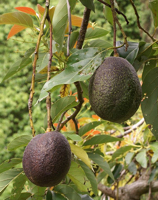
    Persea_americana_fruit_2The avocado, having gained popularity (at least in the U.S.) as a convenient (and delicious) vehicle for consuming otherwise not particularly healthful corn chips, has more recently been hailed as a "superfood" when consumed in diets as a healthy form of fat.  Recently, the avocado joined the ranks of other plants important for human nutrition (see, for example, "Genomic Sequence of Strawberry Determined"; "Genetic Analyses of Sweet Potato Genome Sheds Light on Speciation and Global Dispersion Patterns"; "Durum Wheat Genome Revealed"; and "Genetic Assessment of Squash Genomes in Related Species") in having the sequence of its genome determined, with concomitant explication of its evolutionary history and relationship to other members of the plant kingdom.

    This achievement was reported in the Proceedings of the National Academy of Sciences USA, in a paper entitled "The avocado genome informs deep angiosperm phylogeny, highlights introgressive hybridization, and reveals pathogen-influenced gene space adaptation" (https://doi.org/10.1073/pnas.1822129116) by an international group of researchers.*  The avocado, Persea americana, is a member of the Lauraceae family, otherwise known for the spices cinnamon, bay leaves, and sassafras (gumbo filé).  Avocadoes anciently diverged from other angiosperms, and their magnoliid clade comprises 11,000 total species, which the authors assert is "minuscule in comparison to the dominant eudicot and monocot flowering plant lineages, comprising about 285,000 species combined."  Conventional genetic analyses had not established the avocados' phylogenetic position relative to eudicots and monocots.

    The predominant avocado is the Mexican avocado, P. americana var. drymifolia, comprising three varieties:  the Mexican, Guatemalan, and West Indian varieties.  Familiar to many afficianados is the Hass cultivar, which is a hybrid between the Guatemalan and Mexican races and is typically grafted onto Mexican race rootstock.  Worldwide, 90% of cultivated avocado corresponds to the cultivar Hass; surprisingly, the Hass cultivar is of recent (20th century) origin.

    The authors sequenced Hass and Mexican cultivars as reference genomes, and resequenced three other cutivars (vars. drymifolia, guatemalensis, and americana), as well as wild avocados of the West Indian variety (P. america1na var. costaricensis), and Persea shiedeana (the edible coyo), a species that is relatively closely related to P. americana.  The avocado genome comprises 12 chromosomes, and these authors report that the genome size of P. americana var. drymifolia is 920 Mb in size, while the P. americana Hass cultivar has a 912.6 Mb estimated genome size.  Analysis of protein coding sequences was based on a comparison with protein sequences from the following angiosperm species:  Sorghum bicolor (33,032 proteins), Vitis vinifera (26,343 proteins), Solanum lycopersicum (34,727 proteins), and Arabidopsis thaliana (27,416 proteins).  These authors reported an estimated number of protein-coding genes in each genome:  22,441 protein-coding genes from the Mexican genome and 24,616 protein-coding genes from the Hass cultivar genome.

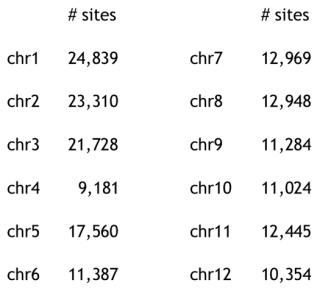
    Turning to genome structure, the authors used principal component analysis of genome-wide single nucleotide polymorphisms (SNPs) to show relative uniformity in Costa Rican/West Indian/Guatemalan cultivars but strong heterogeneity within the Mexican subpopulation.  The paper reported 5,050 SNP markers, distributed as follows:

    Table

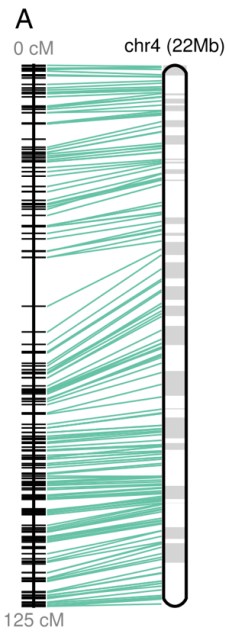
    Figure 2AResults of these analyses of the Hass cultivar were intermediate between the Guatemalan and Mexican subpopulations, which was in agreement with the hybrid nature of this variety.  Also consistent with the recent appearance of the Hass cultivar, its genome showed significant (39%) introgression of DNA having Guatamalan variety structure into a Mexican genomic background.  Haas cultivar Chromosome 4 illustrates these analyses, demonstrating that a "huge" Guatemalan block, which could encompass an entire chromosomal arm, is present in the Hass genome.  Figure 2A (at right) in the article illustrates a 22 megabase (Mb) stretch of DNA on chromosome 4 exemplifyng genomic introgression from the Guatemalan avocado race (var. guatemalensis) into a Mexican (var. drymifolia) genetic background.

    The authors further report that the relatively long length of this Guatemalan-derived block is uninterrupted by recombination, reflecting the extremely recent hybrid origin of the cultivar.

    Further, genomic analysis revealed evidence of two "ancient" polyploidy events, which the authors report are lineage-specific and both postdate the divergence of the avocado from common ancestry with other angiosperm species.  Avocado divergence from other species appears to have occurred from 7.4 to 3.8 million years ago.  Unfortunately, these relationships could not be unambiguously resolved because the outcome varied with the way the analysis was performed.  Based on comparison of protein sequences, for example, avocado was resolved as a sister to monocots plus eudicots (i.e., branching occurred before their divergence from each other), whereas from analysis of coding sequences avocado was placed as sister to monocots only.

    The authors also reported the phenotypic effects of genome structure, specifically the occurrence of tandem duplications, on gene expression related to potentially important metabolic responses.  Enrichment of tandem duplications was found in chromosomal regions that the authors contend could be related to recent adaptation against fungal pathogens.  On the other hand, ancient polyploid duplicates were enriched with "transcriptional regulatory functions reflective of core physiological and developmental processes" (specifically, "among 2,433 total polyploid duplicates, regulation of transcription, DNA-templated was significantly overrepresented by 352 genes").  Transcriptional activity in tandem duplicates was found to increase following anthracnose infection, the authors positing that some of the up-regulated genes could be related to defense responses.  These included genes involved in phenylpropanoid biosynthesis and closely related pathways that are significantly enriched among tandem duplicates.  The authors further state:

    This functional enrichment in a long-lived tree may have evolved in response to pathogen infection, including Colletotrichum (anthracnose) and Phytophthora cinnamomi (avocado root rot), both of which are reported to activate the phenylpropanoid biosynthetic pathways in avocado.  . . .  Several . . . functional enrichments among avocado tandems (for example, 1,3-beta-D-glucan synthase activity and regulation of cell shape) relate to callose synthase activity, a recently discovered avocado defense mechanism against P. cinnamomi.  Other significantly enriched [metabolic pathways] include phenylpropanoid metabolic process, lignin biosynthetic process, and UDP-glycosyltransferase activity, categories directly or closely related to phenylpropanoid biosynthesis.  The lignin functional enrichment, for example, includes diverse tandemly duplicated genes involved in many pathway-interrelated processes, including homologs of both biosynthetic and regulatory genes encoding hydroxycinnamoyl-CoA shikimate/quinate hydroxycinnamoyl transferase (HCT), cinnamyl alcohol dehydrogenase 5 (CAD5), laccase 17 (LAC17), caffeate o-methyltransferase 1 (COMT1), peroxidase 52 (PRX52), NAC domain containing protein 12 (NAC012), and NAC secondary wall thickening promoting factor 1 (NST1).  As could be expected from the above, the [metabolic pathways] involved in defense response and defense response to fungus are significantly enriched among tandem duplicates, as has been discovered for other plant genomes, and involving many different gene families and responses.  Tandem O-methyltransferases homologous to COMT1 may also contribute to synthesis of the phenylpropanoid derivative and insecticide estragole, which is largely responsible for the anise-like leaf scent and fruit taste of many avocado cultivars, particularly of the Mexican race.  Another relevant enriched . . . category among tandems is ethylene-activated signaling pathway, which annotates many different transcription factor duplicates.  Ethylene signaling factors such as ERF1 (represented by 2 homologs) are heavily involved in pathogen-induced responses, including to infection by Colletotrichum and other necrotrophic fungi.  Also identified are 3 homologs of EIN3, a transcription factor that initiates downstream ethylene responses, including fruit ripening.  Avocado fruit matures on the tree in a process that involves ethylene synthesis and signaling, while it does not ripen until harvested—a desirable trait that allows growers to delay harvesting for several months.

    The authors characterize tandem duplicates as "evolutionarily recent 'tuning knobs' in the genome adaptive landscape[]" of the avocado species:

    [M]ost tandem duplicates in the genome are expected to be of more recent origin, having been generated by ongoing gene birth–death–innovation processes that operate in all eukaryotic genomes.  As such, sub- or neofunctionalized tandem duplicates that survive the usual fate of duplicated genes—pseudogenization—should be enriched in functions that fine-tune a given species' recent selective environment.  In the case of avocado, response to fungal pathogens is precisely reflected in its tandemly duplicated gene complement.

    The authors conclude their report with a concise explanation of its significance:

    Our genomes of Mexican and Hass avocados provide the requisite resources for genome-wide association studies to identify important traits among natural avocado genetic diversity present in Mesoamerica, to develop genome-assisted breeding and genetic modification efforts crucial for the improvement of this long-life-cycle crop, to fight threatening avocado diseases, and to optimize growth and desirable phenotypic traits.

    * Martha Rendón-Anayaa,b,1,
    Enrique Ibarra-Laclettea,c,1,
    Alfonso Méndez-Bravoa,d,
    Tianying Lane,
    Chunfang Zhengf,
    Lorenzo Carretero-Pauletg,
    Claudia Anahí Perez-Torresa,c,
    Alejandra Chacón-Lópeza,
    Gustavo Hernandez-Guzmána,h,i,
    Tien-Hao Change,
    Kimberly M. Farre,
    Brad Barbazukj,
    Srikar Chamalak,
    Marek Mutwill,
    Devendra Shivharel,
    David Alvarez-Poncem,
    Neena Mittern,
    Alice Haywardn,
    Stephen Fletchern,
    Julio Rozaso,p,
    Alejandro Sánchez Graciao,p,
    David Kuhnq,
    Alejandro F. Barrientos-Priegor,
    Jarkko Salojärvil,
    Pablo Librados,t,
    David Sankofff,
    Alfredo Herrera-Estrellaa,
    Victor A. Alberte,l,2, and
    Luis Herrera-Estrellaa,u,2

    aUnidad de Genomica Avanzada/Langebio, Centro de Investigación y de Estudios Avanzados, Irapuato 36821, México; bDepartment of Plant Biology, Uppsala BioCenter, Swedish University of Agricultural Sciences, SE-750 07 Uppsala, Sweden; cRed de Estudios Moleculares Avanzados, Instituto de Ecología A.C., 91070 Xalapa, México; dEscuela Nacional de Estudios Superiores, Laboratorio Nacional de Análisis y Síntesis Ecológica, Universidad Nacional Autónoma de México, 58190 Morelia, México; eDepartment of Biological Sciences, University at Buffalo, Buffalo, NY 14260; fDepartment of Mathematics and Statistics, University of Ottawa, Ottawa, ON, Canada K1N 6N5; gCenter for Plant Systems Biology, Vlaams Instituut voor Biotechnologie (VIB), University of Ghent, 9052 Ghent, Belgium; hDepartamento de Alimentos, Universidad de Guanajuato, 36500 Irapuato, México; iDivisión de Ciencias de la Vida, Universidad de Guanajuato, 36500 Irapuato, México; jDepartment of Biology, University of Florida, Gainesville, FL 32611; kDepartment of Pathology, Immunology and Laboratory Medicine, University of Florida, Gainesville, FL 32610; lSchool of Biological Sciences, Nanyang Technological University, Singapore 637551; mDepartment of Biology, University of Nevada, Reno, NV 89557; nCentre for Horticultural Science, Queensland Alliance for Agriculture and Food Innovation, The University of Queensland, St. Lucia, QLD 4072, Australia; oDepartament de Genètica, Microbiologia i Estadística, Universitat de Barcelona, 08007 Barcelona, Spain; pInstitut de Recerca de la Biodiversitat, Universitat de Barcelona, 08007 Barcelona, Spain; qSubtropical Horticulture Research Station, Agricultural Research Service, US Department of Agriculture, Miami, FL 33158; rPosgrado en Horticultura, Departamento de Fitotecnia, Universidad Autónoma Chapingo, 56230 Texcoco, México; sCentre for GeoGenetics, Natural History Museum of Denmark, 1017 Copenhagen, Denmark; tLaboratoire d'Anthropobiologie Moléculaire et d'Imagerie de Synthèse, CNRS Unité Mixte de Recherche 5288, Université de Toulouse, Université Paul Sabatier, 31330 Toulouse, France; uDepartment of Plant and Soil Science, Texas Tech University, Lubbock, TX 79409

    Image of Avocados (Persea americana) by B.navez, from the Wikimedia Commons under the Creative Commons Attribution-Share Alike 3.0 Unported, 2.5 Generic, 2.0 Generic and 1.0 Generic license.

  • Life Sciences Top 49

    By Donald Zuhn

    IPO #2Last month, the Intellectual Property Owners Association (IPO) announced the release of its 36th annual list of the top 300 organizations receiving U.S. utility patents (see "Top 300 Organizations Granted U.S. Patents in 2018").  Patent Docs Readers may recall that the U.S. Patent and Trademark Office stopped releasing its annual list of top patent recipients in 2006 in order to "discourag[e] any perception that we believe more is better."

    The IPO compiled its list by counting the number of utility patents granted during 2018 that listed an organization or a subsidiary as the owner on the printed patent.  The IPO notes that patents that were granted to two or more organizations jointly were attributed to the organization listed first on the patent.  The IPO also noted that 307,759  patents were issued in 2018, which was an decrease from the 318,829 patents that issued in 2017.  The top fifteen companies on the IPO Top 300 are listed below (click on table to expand):

    Top 15
    Samsung Display Co., Ltd.; Sony Corp.; and Amazon Technologies, Inc. fell out of the Top 15 in 2018.  Samsung Display Co., Ltd. dropped from 11th to 17th; Sony Corp. dropped from 13th to 18th; and Amazon Technologies, Inc. dropped from 15th to 16th in 2018.  Jumping into the Top 15 were Dell Technologies; Ford Global Technologies, LLC; and United Technologies Corp.

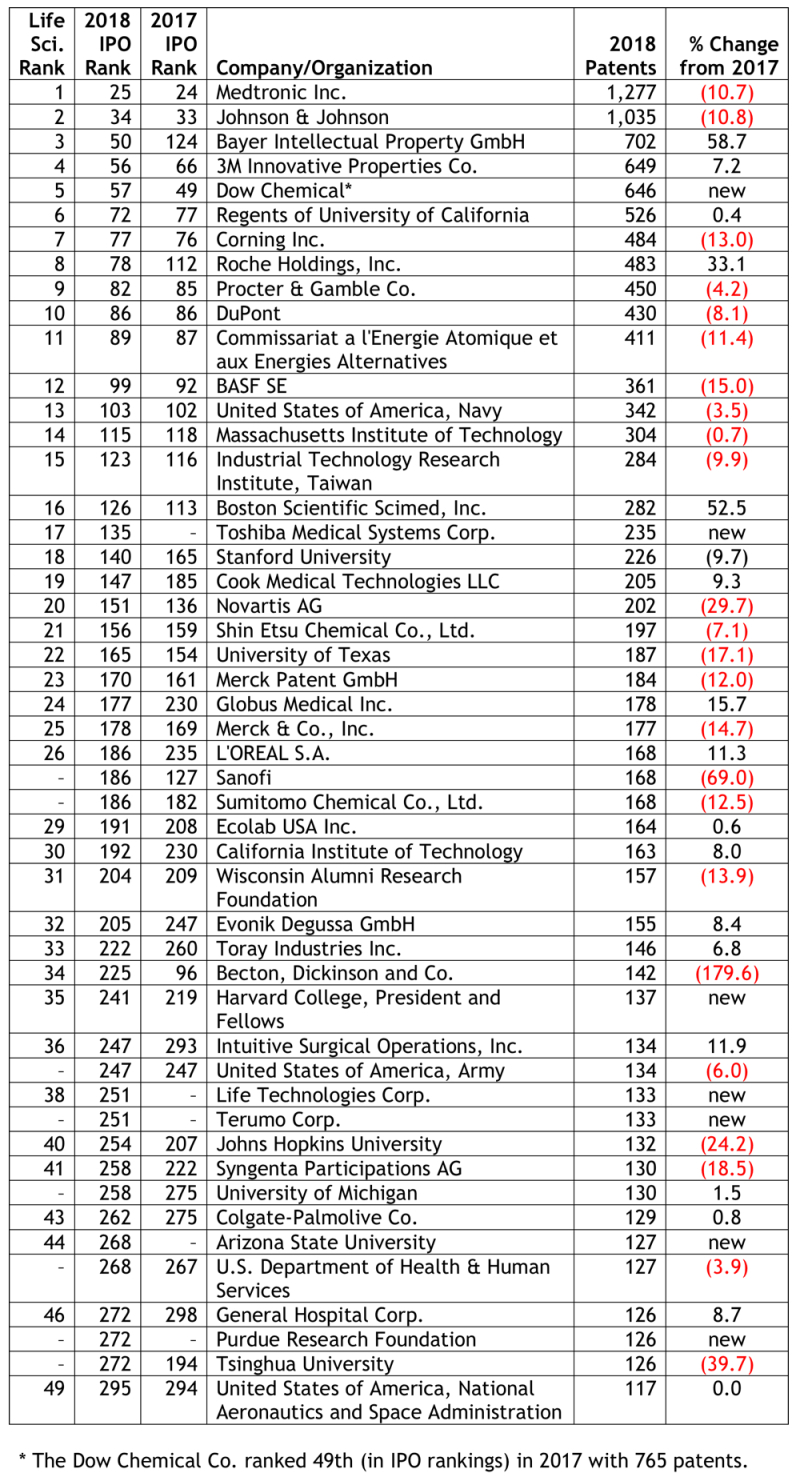
    As in past years, Patent Docs used the IPO's list of top patent holders to compile a list of the top "life sciences" companies and organizations receiving U.S. utility patents in 2018.  Each organization's IPO top 300 ranking for 2018 is indicated in the "2018 IPO Rank" column; the IPO top 300 ranking for 2017 (if available) is indicated in the "2017 IPO Rank" column; and the change in number of patents from 2017 is indicated in "% Change from 2017."  The Life Sciences Top 49 is listed below (click on table to expand):

    LS Top 49

    Please note that some of the companies and organizations listed above may be involved in work outside the life sciences sector, and therefore, a portion of the patents granted to these companies and organizations may be directed to other than life sciences-related inventions.  In addition, our list includes medical device companies.

    For additional information regarding this topic, please see:

    • "IPO Releases List of Top 300 Patent Holders for 2017," July 4, 2018
    • "IPO Releases List of Top 300 Patent Holders for 2016," June 14, 2017
    • "IPO Releases List of Top 300 Patent Holders for 2014," July 1, 2015
    • "IPO Releases List of Top 300 Patent Holders for 2013," July 7, 2014
    • "IPO Releases List of Top 300 Patent Holders for 2012," June 24, 2013
    • "Another Look at IPO Top 300 and Life Sciences Top 53," June 11, 2012
    • "IPO Releases List of Top 300 Patent Holders for 2011," June 7, 2012
    • "IPO Releases List of Top 300 Patent Holders for 2010," June 30, 2011
    • "IPO Releases List of Top 300 Patent Holders for 2009," May 26, 2010
    • "IPO Releases List of Top 300 Patent Holders for 2008," May 14, 2009
    • "IPO Releases List of Top 300 Patent Holders," May 22, 2008
    • "IPO Posts List of Top 300 Patent Holders," April 20, 2007

  •     By Grant Shoebridge* —

    Australia Coat of ArmsIn July 1969, as a young boy, I watched in awe, along with the rest of world, as the United States of America put two men on the moon.  Years later in 2011, the then Prime Minister of Australia, Julia Gillard, stood before U.S. Congress and recalled the same moon-landing memory and with acquiescence wept that "Americans could do anything!"  Today, the U.S. seems to have entered, what was once described in an episode of Seinfeld as, "Bizzaro world" — Donald Trump is in the White House and, even more astonishingly, researchers are unable to protect what have been described judicially as "truly meritorious" and "ground breaking" innovations in the diagnostics and personal medicine space.  Today, it is Australia that reigns supreme over the U.S., as the Federal Court in Sequenom, Inc. v Ariosa Diagnostics, Inc. [2019] FCA 1011 (27 June 2019) confirmed that a non-invasive method of detecting fetal characteristics and abnormalities is patent eligible subject matter in Australia!

    Background

    The inventors of the patent-in-suit, Australian Patent No 727919, in the name of Sequenom, Inc., discovered that the cell-free fractions of a pregnant woman's blood contain surprisingly large amounts of cell-free fetal DNA (cffDNA).  Traditionally, this portion of the plasma or serum was discarded as medical waste.  This pioneering discovery led to the development of the claimed non-invasive method to determine fetal characteristics and abnormalities, such as Down syndrome.  Ariosa Diagnostics Inc, who sought to revoke Sequenom's Patent, conducts and licenses others to conduct a non-invasive prenatal diagnosis test, marketed under the name "Harmony", which Sequenom claims infringes their patent.

    The significance of the Australian Sequenom decision has been fueled by the corresponding U.S. case where the claims of Sequenom's patent were found to be patent ineligible because they were held to be directed to naturally-occurring matter.  The ensuing detrimental impact on U.S. diagnostics industry has subsequently resulted in a proposal for changes to the patentable subject matter legislation, which is currently being considered by US Congress.

    Issues and findings

    Under Australian law, patent eligibility is guided by the principles of the High Court's decision in National Research Development Corporation v Commissioner of Patents('NRDC') [1959] HCA 67.  In that landmark decision, it was held that subject matter was considered patent eligible if it was "an artificially created state of affairs" having "economic significance".

    Ariosa's case relied heavily on the approach that proved successful in the U.S., namely that the claims cover a mere discovery, that being the presence of cffDNA, which can be detected in the plasma or serum of pregnant women, and that the end result of each claim is not an artificially created state of affairs.  Ariosa further submitted that the claims involve nothing more than the use of well-known techniques to detect cffDNA in maternal blood.

    Ariosa also suggested that the Court should follow the U.S. position, which they suggested was in harmony with the Australian Myriad decision.  Judge Beach's response was an emphatic, "I hardly think so".  In fact, in considering the Australian High Court Myriad decision, Beach J emphasised the difference between the gene product claims considered in Myriad and the method defined in the claims of Sequenom's patent.  In particular, he stated that "in nature, the presence of cffDNA in the maternal blood has not and cannot be detected without human action.  Accordingly, unlike the claims considered in Myriad, the invention claimed adds to human knowledge and involves the suggestion of an act to be done which results in a new result, or a new process".

    The Court also agreed with Sequenom that the substance of the claimed method is distinct to simply the identification of a natural phenomenon, namely the presence of cffDNA in maternal blood.  This, the Judge said, is made clear by the patent specification, which explains that the invention offers a new approach for non-invasive prenatal diagnosis, which only occurs through human intervention and provides a significant advantage over existing fetal DNA detection methods, thus producing a result possessing economic utility.

    Consistency with foreign law

    Given the intense spotlight that has illuminated patentability issues in the U.S. for diagnostic methods in recent times, the consistency of the Australian decision and the corresponding UK proceedings between Ariosa and Sequenom (Illumina, Inc v Premaitha Health Plc[2017] EWHC 2930), will likely go unnoticed.  Those, however, looking for controversy in the conflicting Australian/U.S. findings should look no further than Judge Beach's swatting away of the issue by stating that the conclusion reached in the U.S. decision is problematic because of the U.S. Court's dissection of the claims into their constituent parts, which is contrary to Australia's NRDC and Myriad decisions — end of story.

    Conclusions

    This decision, and the recent decision in Meat & Livestock Australia Limited v Cargill, Inc [2018] FCA 51, make it clear that claims directed to practical applications of naturally-occurring phenomena, including gene sequences, used in methods of diagnosis and prognosis are patent eligible subject matter in Australia.  This will come as a welcome relief to the diagnostics and personal medicine industry and can be considered as "one small step" forward for Australian patent law but also, hopefully, "one giant leap" that influences beneficial change to the patent eligibility laws in the U.S.

    * Dr. Shoebridge is a Principal with Shelston IP.