• By Michael Anderson and Michael Borella —

    August 27, 1890
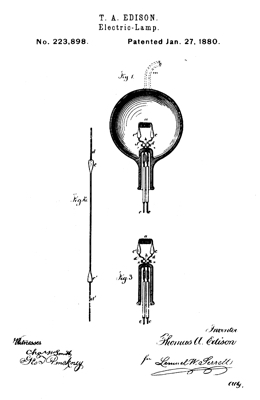
    US0223898A FIG. 1-3WASHINGTON D.C.  The ups and downs of Mr. Thomas A. Edison's inventions related to electrical lighting continue.  After his U.S. Patent No. 223,898 for an "Electric Lamp" was found to be valid in the Circuit Court of the Western District of Pennsylvania, the case was appealed to the Federal Circuit.  Oral arguments were held this Spring and the decision of the Court came down last week, invalidating Mr. Edison's claims.

    The Court (a panel of three appellate judges) applied curious reasoning.  They began by describing what they referred to as "laws of nature" and "natural phenomena" — properties of nature that exist independently of the human experience — one of which was the basis of the invention:

    Incandescence is a form of thermal radiation that results from heating a body to the point that it produces visible light.  Virtually all solids and liquids exhibit incandescence if a proper amount of heat is applied, as described in Lardner's 1833 Treatise on Heat.  Indeed, light from the sun is generated from incandescence.  Thus, incandescence is a natural law; that is, a phenomenon that is produced by nature and not the hand of humankind.

    The Court went on to explain that, to be patentable, an invention based on a natural phenomenon must include an inventive concept that is not "well-understood, routine, and conventional" and that provides "significantly more" than the excluded phenomenon itself.  Otherwise, one could patent "what should be in the public domain and free for all to use as they see fit."  Ultimately, the Court found that Mr. Edison's patent did not meet this requirement and was therefore an improper attempt to obtain a patent on an effect of the world we live in rather than an inventive modification thereof.

    The claims of the '898 patent recite:

    1.  An electric lamp for giving light by incandescence, consisting of a filament carbon of high resistance, made as described, and secured to metallic wires, as set forth.

    2.  The combination of carbon filaments with a receiver made entirely of glass and conductors passing through the glass, and horn which receiver the air is exhausted, for the purposes set forth.

    3.  A carbon filament or strip coiled and connected to electric conductors so that only a portion of the surface of such carbon conductors shall be exposed for radiating light, as set forth.

    4.  The method herein described of securing the platina contact-wires to the carbon filament and carbonixin of the whole in a closed chamber, substantially as set forth.

    Based on their broad language, the Court rapidly concluded that "the claims clearly involve a laws of nature, namely that of generating incandescence by heating a resistive wire through conduction of electricity."  Justifying this decision, the Court wrote, "[p]henomena of nature, though just discovered, are not patentable, as they are basic and fundamental to ongoing scientific and technological work, and monopolization of such central principles through the grant of a patent might tend to impede innovation rather than promote it."

    The Court made analogies to other discoveries of natural laws, and noted that "Newton could not have patented his celebrated discovery of law of gravity nor could Pythagoras have patented his theorem regarding relationship between the side lengths of a right triangle . . . [l]ikewise, we cannot affirm the validity of a patent on a fundamental process of the physical universe that likely existed well before the Earth itself."

    Having establishing that Mr. Edison's claims are directed to a natural phenomenon, the Court addressed the follow-on question of whether those claims were drawn narrowly and to an unconventional application thereof.  The Court observed that, "[t]o transform an unpatentable law of nature into a patent-eligible application of such a law, one must do more than simply state the law of nature while adding the words 'apply it.'"  Such a claim, in the Court's view, would just be "a clever drafting exercise designed to monopolize the law of nature itself."

    Thus, the Court considered the language of the claims, looking for the aforementioned inventive concept in the additional elements.  In doing so, it determined that these elements encompassed "metallic wires, glass, and a closed chamber," but that each was in routine use by experimenters at the time of Edison's invention.

    The Court observed that the claimed metallic wires are conventional means for conducting electricity, and that it is routine to perform laboratory tests inside a chamber to prevent reactions from being contaminated by the outside world.  Moreover, performing such a well-understood process in a controlled environment is a fundamental basis of experimentation.  The extension of the laboratory testing conditions to an end product by sealing a glass chamber containing the "filament of high resistance" is nothing more than a conventional application of such laboratory conditions.  As examples of the well-understood nature of the additional elements, the Court pointed to the 1761 work of Ebenezer Kinnersley in heating metallic wires to incandescence, the Belgian Marcellin Jobard who produced an incandescent light bulb in 1838 using a vacuum chamber, as well as the Russian Alexander Lodygin who, in 1872, demonstrated an incandescent light bulb in a glass enclosure.

    Moreover, Mr. Edison stated in his patent that others have already been able to produce light through incandescence:

    Heretofore light by incandescence has been obtained from rods of carbon of one to four ohms resistance, placed in closed vessels, in which the atmospheric air has been replaced by gasses that do not combine chemically with the carbon.

    Mr. Edison went on to state that "[t]he leading-wires have always been large, so that their resistance shall be many times less than the burner."  Because incandescence through one to four ohm resistance filaments was known, the Court observed that the basic application of the scientific principles of Ohm's and Joule's laws dictates that a higher-resistance filament would simply cause a reduction of the current required to cause incandescence.  Therefore, based on these scientific principles, smaller wires and less power would be needed for incandescence.  Thus, in the Court's view, Mr. Edison has conceded both that incandescence from carbonized elements in closed vessels and that the claimed structure and ratios of resistances between wires and filaments were already known.

    Particularly, Mr. Edison does not claim that he created a new apparatus.  Indeed, "Mr. Edison did not invent the claimed electric light structure, nor was he the first to observe the physical phenomena of incandescence."  Instead, "Mr. Edison simply uses well-known components for their intended use according to the principles dictated by established laws of electronics."

    Thus, the Court found that "[t]hese conventional components, all generic, are unable to transform the claimed invention into significantly more than the natural phenomenon."  Furthermore, "when considered in combination, these elements add nothing beyond the elements individually, and the combination of elements fails to improve the functioning of an electronic bulb beyond what is expected by laws of nature."

    Mr. Edison argued that because "the particular laws of nature that the claims embody are narrow and specific, the patents should be upheld."  But the Court disagreed, stating that "[a] patent upon a narrow law of nature may not inhibit future research as seriously as would a patent upon Newton's discoveries, but the creative value of Mr. Edison's discovery is also considerably smaller."  Moreover, "even a narrow law of nature can serve to inhibit future research."

    The Court concluded, "[f]or these reasons, we hold that the patent claims at issue here effectively encompass the underlying laws of nature themselves and are consequently invalid."

  • IPO #2The Intellectual Property Owners Association (IPO) Open Source, Software Related Inventions, and Trade Secrets Committees will offer a one-hour webinar entitled "IP Protection for Data" on October 23, 2019, from 2:00 to 3:00 pm (ET).  Brian Adams of Qualcomm Technologies, Inc., Ken Corsello of IBM, and Sameer Vadera of Kilpatrick Townsend & Stockton LLP will address the different ways that data and databases are protected under U.S. law, including the benefits and disadvantages of different IP frameworks such as copyright and trade secrets, and contrast them with data protection laws outside the U.S.  The panel will also discuss the use of contracts to protect data and recent court decisions explaining the scope of IP protection for data and databases.  The future of data will also be discussed, including the open data movement, in which advocates promote the application of open source software principles to the collection and distribution of data.

    The registration fee for the webinar is $135 (IPO member) or $150 (non-member) (government and academic rates are available upon request).  Those interested in registering for the webinar can do so here.

  • By Michael Borella —

    USPTO SealEarly today, the U.S. Patent and Trademark Office released an update to its January 2019 Subject Matter Eligibility Guidance.  Unlike the January Guidance, which represented a significant change in how the USPTO applies § 101 in examination and PTAB proceedings, this October Update is primarily an effort to clarify issues brought up by public comments on the January Guidance.  While not exactly much ado about nothing, the October Update provides few changes to USPTO's stance on § 101.

    The October Update discusses five areas of § 101 analysis and procedure in detail, and is accompanied by four new hypothetical § 101 examples, an index of all such examples published since early 2015, and an updated spreadsheet of § 101 court cases.  The October Update itself is discussed below, with emphasis on the abstract idea judicial exclusion, and the new examples will be covered in future articles.

    The backdrop to the § 101 guidance is 2014's Alice Corp. vs. CLS Bank Int'l Supreme Court holding.  Therein, the Court set forth a two-part test to determine whether claims are directed to patent-eligible subject matter under § 101.  These parts are denoted by the USPTO as steps 2A and 2B, respectively (step 1 is to determine whether the claimed invention is one of the four statutory categories of subject matter set forth in § 101, and is rarely at issue in practice).

    Under step 2A, one must decide whether the claim at hand involves a judicially-excluded law of nature, a natural phenomenon, or an abstract idea.  If so, then under step 2B one further decides whether any element or combination of elements in the claim is sufficient to ensure that the claim amounts to significantly more than the judicial exclusion.  Elements or combinations of elements that are well-understood, routine, and conventional will not lift the claim over the § 101 hurdle.  While this inquiry is generally carried out as a matter of law, factual issues can come into play when determining whether something is well-understood, routine, and conventional.

    The January Guidance breaks the first part of the Alice test into two sub-steps (let's call them 2A(i) and 2A(ii) for purposes of clarity).  In the former, one determines whether the claim recites a judicial exception, such as an abstract idea.  In the latter, one determines further "whether the recited judicial exception is integrated into a practical application of that exception."

    To focus the analysis, the January Guidance indicates that, under step 2A(i), all abstract ideas should fall into one of three categories:  mathematical concepts, certain methods of organizing human activity, and mental processes.  Think of these as the "Three M's" — math, money, and mental steps.

    If the analysis moves on to sub-step 2A(ii), the one determines "whether the claim as a whole integrates the recited judicial exception into a practical application of the exception."  Such a claim "will apply, rely on, or use the judicial exception in a manner that imposes a meaningful limit on the judicial exception, such that the claim is more than a drafting effort designed to monopolize the judicial exception."

    And now, on to the guts of the October Update

    When Does a Claim Recite a Judicial Exception?

    Given the use of the vague term "recite" in step 2A(i), it is not surprising that some have taken issue with how this sub-step is to be applied in practice.  The USPTO attempts to clarify what it meant in the January Guidance:

    [A] claim recites a judicial exception when the judicial exception is "set forth" or "described" in the claim.  While the terms "set forth" and "describe" are thus both equated with "recite," their different language is intended to indicate that there are two ways in which an exception can be recited in a claim.  For instance, the claims in Diamond v. Diehr clearly stated a mathematical equation in the repetitively calculating step, such that the claims "set forth" an identifiable judicial exception, but the claims in Alice Corp. v. CLS Bank, "described" the concept of intermediated settlement without ever explicitly using the words "intermediated" or "settlement."

    The USPTO goes on to state that multiple judicial exceptions can be recited in a claim, and if they are of different types (e.g., an abstract idea and a law of nature), then MPEP 2106.05(II) controls ("If . . . the claim clearly recites a plurality of discrete exceptions, then for purposes of examination efficiency, examiners should select one of the exceptions and conduct the eligibility analysis for that selected exception.").  For multiple abstract ideas recited by the same claim (e.g., a mental process and a mathematical concept), the USPTO strongly recommends that these exceptions also be analyzed together.

    The Grouping of Abstract Ideas

    As noted above, the January Guidance places all abstract ideas into one of three categories (with rare exceptions).  The October Update further clarifies the scope of these categories.

    Regarding mathematical concepts, the USPTO writes:

    When determining whether a claim recites a mathematical concept (i.e., mathematical relationships, mathematical formulas or equations, and mathematical calculations), examiners should consider whether the claim recites a mathematical concept or merely includes limitations that are based on or involve a mathematical concept.  A claim does not recite a mathematical concept (i.e., the claim limitations do not fall within the mathematical concept grouping), if it is only based on or involves a mathematical concept.  For example, a limitation that is merely based on or involves a mathematical concept described in the specification may not be sufficient to fall into this grouping, provided the mathematical concept itself is not recited in the claim.  (Emphasis added.)

    Applying this determination involves some rather thin bacon slicing, and was illustrated in § 101 example 38.  We have previously discussed how the USPTO's analysis of example 38 provided more questions than answers and needed clarification.  Unfortunately, the October Update does not address the problems with example 38, and even suggests the opposite outcome.

    The USPTO does clarify, however, that "[a] mathematical relationship may be expressed in words or using mathematical symbols."  The same holds for mathematical formulas or equations and mathematical calculations.  Particularly, "a claim does not have to recite the word 'calculating' in order to be considered a mathematical calculation . . . a step of 'determining' a variable or number using mathematical methods or 'performing' a mathematical operation may also be considered mathematical calculations."

    Regarding certain methods of organizing human activity, the USPTO indicates that "not all methods of organizing human activity are abstract ideas (e.g., a defined set of steps for combining particular ingredients to create a drug formulation is not a certain method of organizing human activity)."  Nonetheless, this category has proven to be used quite expansively by examiners.  While the USPTO indicates that "this grouping is limited to activity that falls within the enumerated sub-groupings of fundamental economic principles or practices, commercial or legal interactions, managing personal behavior, and relationships or interactions between people, and is not to be expanded beyond these enumerated sub-groupings," this definition remains broad.  The USPTO goes on to provide examples of these sub-groupings, but there are no surprises therein.

    Regarding mental processes, the USPTO's definition thereof reflects a legal fiction set forth by the Federal Circuit.  Notably, "claims do recite a mental process when they contain limitations that can practically be performed in the human mind, including for example, observations, evaluations, judgments, and opinions," but "[c]laims can recite a mental process even if they are claimed as being performed on a computer."  The justification for this non-literal interpretation is that "[t]he courts have found claims requiring a generic computer or nominally reciting a generic computer may still recite a mental process even though the claim limitations are not performed entirely in the human mind."

    Nonetheless, "[c]laims do not recite a mental process when they do not contain limitations that can practically be performed in the human mind, for instance when the human mind is not equipped to perform the claim limitations."  Examples include "calculating an absolute position of a GPS receiver and an absolute time of reception of satellite signals," "detecting suspicious activity by using network monitors and analyzing network packets," "a specific data encryption method for computer communication involving a several-step manipulation of data," and "rendering a halftone image of a digital image by comparing, pixel by pixel, the digital image against a blue noise mask."

    The distinction between mental and non-mental processes under this rubric is that "merely using a computer as a tool to perform the [otherwise mental] concept" fails to lift an invention out of the mental realm, and examiners are encouraged to look to the applicant's specification in order to make this determination.  Furthermore, "[t]he use of a physical aid (i.e., the pen and paper) to help perform a mental step (e.g., a mathematical calculation) does not negate the mental nature of this limitation."

    When is a Judicial Exception Integrated into a Practical Application?

    In practice, we have found that most § 101 disputes with the USPTO examiners or PTAB turns on sub-step 2A(ii) — is the claimed invention integrating a judicial exception into a practical application?  While the USPTO writes many words about this issue in the October Update, little new is said.  As before, the USPTO is looking for the integration to be an improvement to the functioning of a computer or another technology.  It is important to understand that a device or system must be improved — an invention that uses technology to improve how humans perform (e.g., a data analysis system that does little more than crunch numbers to recommend a course of action to be taken by a person) is likely going to fail at this sub-step.

    The USPTO reiterates that the applicant's specification "must describe the invention such that the improvement would be apparent to one of ordinary skill in the art" and not in a conclusory manner.  Further, "the claim itself [must] reflect[] the disclosed improvement," but need not explicitly recite the improvement.

    The October Update, however, does clarify that "the 'improvements' analysis in Step 2A determines whether the claim pertains to an improvement to the functioning of a computer or to another technology without reference to what is well-understood, routine, conventional activity."  But this is followed by the somewhat confusing statement that "the claimed invention may integrate the judicial exception into a practical application by demonstrating that it improves the relevant existing technology although it may not be an improvement over well-understood, routine, conventional activity."  (Emphasis added.)  The distinction here is not perfectly clear and the USPTO does not expound further upon it.

    Nonetheless, the USPTO does prescribe that:

    [T]he Prong Two analysis considers the claim as a whole.  That is, the limitations containing the judicial exception as well as the additional elements in the claim besides the judicial exception need to be evaluated together to determine whether the claim integrates the judicial exception into a practical application.  The additional limitations should not be evaluated in a vacuum, completely separate from the recited judicial exception.  Instead, the analysis should take into consideration all the claim limitations and how those limitations interact and impact each other when evaluating whether the exception is integrated into a practical application.

    This language is welcome and likely to be a point that applicants repeat to examiners during § 101 discussions.

    The Prima Facie Case

    The USPTO received comments on the January Guidance suggesting that it re-emphasize the examiner's burden of establishing the ineligibility of claims under § 101.  The October Update does so, but with a pair of caveats.

    In short, the USPTO states that an examiner should "identify the judicial exception . . . by referring to what is recited . . . in the claim and explaining why it is considered to be an exception."  Notably, "[f]or abstract ideas, the rejection should explain why a specific limitation(s) recited in the claim falls within one of the enumerated groupings of abstract ideas."  Then, the examiner "should identify any additional elements recited in the claim beyond the judicial exception and evaluate the integration of the judicial exception into a practical application."  This involves "explain[ing] why the additional elements, taken individually and in combination, do not result in the claim, as a whole, amounting to significantly more than the exception."

    The first of the aforementioned caveats is that neither the January Guidance nor the October Update address the problem of conclusory § 101 rejections.  These are unfortunately common, and when challenged, examiners that issue conclusory rejections often write more words defending their non-analysis than explaining why the claims are rejected.  The second is that the October Update should have reiterated that examiners need to evaluate the patent eligibility of all dependent claims separately.  Far too often an examiner will provide detailed reasoning for rejecting an independent claim and then reject all dependent claims in a single sentence.  Examiners need to be educated that doing so is an improper burden shifting that requires that wrongly places the onus on the applicant to first establish the eligibility of the claims.

    Educating the Examining Corps

    The USPTO concludes the October Update with a discussion of how it is helping examiners obtain cognizance of the § 101 guidance.  This involves publishing the examples (including new interpretations of examples published before the January Guidance), examiner training, and a reiteration that examiners are expected to follow the January Guidance.

    But this section — and the October Update as a whole — ends with a point of irony.  The USPTO states that:

    [E]very applicant whose claims have been twice rejected, may appeal from the decision of the examiner to the Patent Trial and Appeal Board, and an applicant may rely upon the 2019 PEG in support of his or her argument that a rejection under § 101 is in error.  It is the rejection under § 101, and not any alleged failure to comply with the 2019 PEG, that is reviewed by the Patent Trial and Appeal Board.

    The PTAB is much more likely than examiners to base its § 101 reasoning on a combination of the January Guidance and relevant case law.  Thus, appealing an examiner's rejection may effectively require arguing the case law as well as the January Guidance that supposedly replaces it.

  • By Kevin E. Noonan —

    Federal Circuit SealThe Federal Circuit earlier this week affirmed a District Court's decision invalidating almost all of the claims asserted against an ANDA filer, in HZNP Medicines LLC v. Actavis Laboratories UT, Inc.  Nevertheless, because a claim was held invalid and infringed, the proposed generic compound is delayed from coming to market.

    The case arose as ANDA litigation over HZNP Medicines' osteoarthritis drug, PENNSAID® 2%.  After Actavis (nee Watson Labs) sent HZNP its Paragraph IV letter HZNP filed suit (asserting somewhat prolixically) twelve Orange Book-listed patents:  U.S. Patent Nos. 8,217,078; 9,132,110; 8,618,164; 9,168,304; 9,168,305; 8,546,450; 9,101,591; 8,563,613; 9,220,784; 8,871,809; 8,252,838; and 9,066,913.  These patents formed two groups as considered by the Federal Circuit:  the first group comprising the '450, '078, '110, and '164 patents, directed to methods of using diclofenac formulations for treating osteoarthritis, particularly in the knee.  Claim 10 of the '450 patent was deemed illustrative:

    10.  A method for applying topical agents to a knee of a patient with pain, said method comprising:
        applying a first medication consisting of a topical diclofenac preparation to an area of the knee of said patient to treat osteoarthritis of the knee of said patient, wherein the topical diclofenac preparation comprises a therapeutically effective amount of a diclofenac salt and 40–50% w/w dimethyl sulfoxide;
        waiting for the treated area to dry;
        subsequently applying a sunscreen, or an insect repellant to said treated area after said treated area is dry, wherein said step of applying a first medication does not enhance the systemic absorption of the subsequently applied sunscreen, or insect repellant; and
        wherein said subsequent application occurs during a course of treatment of said patient with said topical diclofenac preparation.

    The remaining asserted patents (the '838, '591, '304, '305, '784, '613, '809, and '913 patents) constituted the second group; claim 49 of the '838 patent is illustrative of what is claimed in these patents:

    49.  A topical formulation consisting essentially of:
        1–2% w/w diclofenac sodium;
        40–50% w/w DMSO;
        23–29% w/w ethanol;
        10–12% w/w propylene glycol;
        hydroxypropyl cellulose; and
        water to make 100% w/w, wherein the topical formulation has a viscosity of 500–5000 centipoise.

    The District Court found all but one of the asserted claims to be invalid for indefiniteness based on its construction of three claim terms:

    • "the topical formulations produced less than 1% of impurity A after 6 months at 25 and 60% humidity" was indefinite for failing to provide any definition for "impurity A";
    • "the formulation degrades by less than 1% over 6 months" was indefinite because there were no means specified for evaluating indefiniteness; and
    • (most curiously) "consisting essentially of" was indefinite because "the parties disputed what were "basic and essential" properties of the claimed formulations and thus the scope of what additional components could be added in excess of the recited elements was indefinite.

    With regard to the District Court's assessment of the "basic and essential" properties of the claimed formulations, the Court recognized five properties:  "(1) better drying time; (2) higher viscosity; (3) increased transdermal flux; (4) greater pharmacokinetic absorption; and (5) favorable stability."  The Court limited its determination to the first, "better drying time" property, and found it to be indefinite because the specification set forth two methods for measuring this property gave inconsistent results.  This persuaded the District Court that the skilled worker would not know which measurement method to use, which precluded the skilled artisan from having the "reasonable certainty" required under Nautilus, Inc. v. Biosig Instruments, Inc., 572 U.S. 898, 910 (2014), for the "consisting essentially of" term to be indefinite.  In response to HZNP's motion for reconsideration (which the District Court denied), the Court further found the "favorable stability" property to be indefinite because "the specification failed to provide the requisite guidance" for deterring stability.

    Consequently, the District Court granted summary judgment of noninfringement, either literal or for inducement, in favor of Actavis.  The basis for this decision regarding inducement was a comparison of HZNP'S and Actavis' formulation label.  While HZNP's claimed method required the practice of three steps ("(1) application of the medication to knee, (2) waiting for the area to dry, and (3) application of sunscreen, insect repellant, or a second topical medication"), the labels differed because "Horizon's claimed method requires application of a second topical agent whereas [both] the [HZNP and Actavis] label merely permits, without encouraging, post-product application of sunscreen, insect repellant, or a second topical medication."

    The parties went to trial on the sole remaining claim, claim 12 of the '913 patent, reciting a method of treatment comprising administering the claimed formulation twice daily.  Actavis stipulated that if valid its ANDA product would infringe, but argued the claim was obvious.  The prior art Actavis relied upon was HZNP's earlier PENNSAID® 1.5% product, which Actavis asserted had deficiencies known in the prior art ("frequent application and vulnerability to run-off") and the changes HZNP made in the formulation would have been reasonably expected to address these known deficiencies (and that the changed components were also known in the art, being merely "obvious optimizations of result-effective variables that produced a predictable result").  The District Court agreed with HZNP, that "the field of topical pharmaceutical formulations is complex and unpredictable" and that the litany of changes required to change the 1.5% formulation to the claimed 2.0% formulation would not have been obvious.  The parties appealed.

    The Federal Circuit affirmed, in an opinion by Judge Reyna joined by Chief Judge Prost; Judge Newman concurred-in-part and dissented-in-part.  Regarding the judgment of invalidity for indefiniteness, the majority agreed that HZNP's failure to identify "impurity A" was fatal to the invalidated claims, rejecting HZNP's argument that the skilled worker would have understood, from sources like pharmacopeias, the identity of this impurity from how diclofenac was known to degrade under the conditions set forth in the specification.  Relying on the claim language, the majority found no basis for assuming that the skilled worker would have identified impurity A as being a diclofenac degradation product to the exclusion of other sources of this impurity in the formulation.  The extrinsic evidence was properly considered by the District Court to be unavailing, according to Judge Reyna and the Chief Judge, because the specification merely disclosed the results of the analytical methods but did rely on the data present in pharmacopeias to identify the impurity.  The District Court and the majority here linked its finding that "impurity A' was indefinite to support the further finding that the term "degrades" was indefinite ("Since "impurity A" is indefinite, it logically follows that another term, such as the "degrades" term, which relies on "impurity A" for its construction, must also be indefinite.")

    The panel majority's explanation of why it affirmed the District Court's finding that "consisting essentially of" was indefinite was more involved.  While recognizing that this transition phrase "has a distinct meaning within our jurisprudence," the majority also agreed with the District Court that the indefiniteness question implicates the nature of the "basic and novel" properties of the formulation consisting of the expressly recited components; the phrase permits the claims to encompass formulations "consisting of only the specified materials and those that do not materially affect the basic and novel properties of the claimed invention."  Using the specification as a guide, the majority agreed that the District Court properly identified five basic and novel properties.  The majority then concluded that the indefiniteness standard enunciated by the Nautilis Court properly applied to those properties, rejecting HZNP's contention that the standard applied only to the elements recited in the claims:

    By using the phrase "consisting essentially of" in the claims, the inventor in this case incorporated into the scope of the claims an evaluation of the basic and novel properties.  The use of "consisting essentially of" implicates not only the items listed after the phrase, but also those steps (in a process claim) or ingredients (in a composition claim) that do not materially affect the basic and novel properties of the invention.  Having used the phrase "consisting essentially of," and thereby incorporated unlisted ingredients or steps that do not materially affect the basic and novel properties of the invention, a drafter cannot later escape the definiteness requirement by arguing that the basic and novel properties of the invention are in the specification, not the claims.  Indeed, this contravenes the legal meaning associated with the phrase "consisting essentially of."  And a holding to the contrary would promote the innovation-discouraging "zone of uncertainty" that the Supreme Court has warned against.

    The majority then set forth a discussion illustrating the distinctions between applying these principles in claim construction and the ultimate question of infringement, concluding that the Court's jurisprudence directs "courts evaluating claims that use the phrase "consisting essentially of" may ascertain the basic and novel properties of the invention at the claim construction stage, and then consider if the intrinsic evidence establishes what constitutes a material alteration of those properties."  Here, the majority held that the District Court properly applied these rubrics in coming to the conclusion that the term "consisting essentially of" was indefinite based on the "basic and novel" feature of better drying time.

    Coming to questions of infringement, the panel majority affirmed the District Court's holding that practice of Actavis' product according to its label did not induce infringement.  Inducement here would require the instruction in Actavis' label to perform the three distinct steps, whereas the District Court held, and the Federal Circuit majority agreed that, only the first step, applying the inventive formulation, was required to be performed.

    Finally, regarding the District Court's holding that Actavis had not shown by clear and convincing evidence that claim 12 of the '913 patent was obvious, the majority here found no clear error in the District Court's reliance on expert testimony regarding the differences between the 1.5% and claimed 2% varieties of PENNSAID® and affirmed.

    Judge Newman's dissent was based on the majority's indefiniteness determinations regarding the transition phrase "consisting essentially of" and whether the Actavis label induced infringement, characterizing the majority's opinion in the former to be "departures from long-established law and long-understood practice" and in the latter to be "contrary to statute and precedent."  With regard to the majority's decision regarding the term "consisting essentially of," Judge Newman believes the majority's decision to be "not correct as a matter of claim construction, it is not the law of patenting novel compositions, and it is not the correct application of section 112(b)."  Judge Newman faults the majority for incorporating method steps (better drying time) or properties (increased stability) into indefiniteness determinations of composition of matter claims.  And Judge Newman does not believe that Actavis established invalidity by clear and convincing evidence.  But the Judge's principal concern was that the majority's decision will "cast countless patents into uncertainty."  Finally, the Judge believes that the possibility that some patients may not follow Actavis' label instructions is not a proper basis for absolving them from infringement liability.

    HZNP Medicines LLC v. Actavis Laboratories UT, Inc. (Fed. Cir. 2019)
    Panel: Chief Judge Prost and Circuit Judges Newman and Reyna
    Opinion by Circuit Judge Reyna; opinion concurring in part and dissenting in part by Circuit Judge Newman

  • By Kevin E. Noonan —

    Federal Circuit SealOne person's attempt at judicial economy can be another person's impermissible shortcut, and when it arises in the context of a summary judgment motion of noninfringement, it can amount to legal (or at least procedural) error on appeal.  Such is the case in NeuroGrafix v. Brainlab, Inc., decided last week by the Federal Circuit in the context of multidistrict litigation over magnetic image resonance (MRI) technology.

    The case at bar arose when NeuroGrafix sued Brainlab for infringement of U.S. Patent No. 5,560,360; because NeuroGrafix concomitantly sued several other entities using (or producing) MRI technology, the cases were consolidated in the District of Massachusetts for pretrial activities.  The '360 patent is directed to "methods and systems for creating detailed images of neural tissues by using diffusion tensor imaging (DTI)" (a particular application of MRI technology).  As explained in the opinion, certain biological tissues behave differentially with regard to water diffusion.  Water diffusion in white matter in brain, for example, is anisotropic, meaning that diffusion along one axis (the long axis of an axon) is easier than diffusion along the cross-sectional axis.  Gray matter is isotropic; water diffusion rates cannot be distinguished based on direction.  These differences provide the basis for the claimed invention, wherein "pulsed magnetic field gradients are applied in two orthogonal (perpendicular) directions in a region containing the nerve tissues for which a precise image is sought."  In some tissues the directions to be interrogated are known from the nature of the tissue, while in others informative perpendicular directional pairs are determined empirically.  The differences noted above between isotropic and anisotropic tissues (or portions of tissues) "can be identified and visually differentiated from the surrounding structures by determining the areas of greater relative anisotropy."

    This technology was claimed in representative claim 36 of the '360 patent:

    36.  A method of utilizing magnetic resonance to determine the shape and position of a structure, said method including the steps of:
        (a) exposing a region to a magnetic polarizing field including a predetermined arrangement of diffusion-weighted gradients, the region including a selected structure that exhibits diffusion anisotropy and other structures that do not exhibit diffusion anisotropy;
        (b) exposing the region to an electromagnetic excitation field;
        (c) for each of said diffusion-weighted gradients, sensing a resonant response of the region to the excitation field and the polarizing field including the diffusion-weighted gradient and producing an output indicative of the resonant response; and
        (d) vector processing said outputs to generate data representative of anisotropic diffusion exhibited by said selected structure in the region, regardless of the alignment of said diffusion weighted gradients with respect to the orientation of said selected structure; and
        (e) processing said data representative of anisotropic diffusion to generate a data set describing the shape and position of said selected structure in the region, said data set distinguishing said selected structure from other structures in the region that do not exhibit diffusion anisotropy.

    NeuroGrafix sued based on direct infringement (35 U.S.C. § 271(a)) and inducement of infringement (35 U.S.C. § 271(b)), and Brainlab counterclaimed for a declaratory judgment of invalidity.  After consolidation, the Massachusetts Court granted-in-part Brainlab's motion for summary judgment that NeuroGrafix was estopped by an earlier settlement agreement with one of Brainlab's suppliers (Siemens) and for NeuroGrafix's literal infringement allegations against individual medical practitioners, for failure to provide any of the exemplary medical practitioner defendants had actually used Brainlab's products.  After NeuroGrafix's unsuccessful attempt to amend its complaint to name Brainlab as a literal infringer, the Massachusetts Court granted Brainlab's second summary judgment motion of noninfringement "that users of the software do not commit direct infringement and therefore Brainlab could not be liable for induced infringement."  The basis for the purported lack of literal infringement was that users of Brainlab's product do not satisfy the "selected structure" limitation and the "do not exhibit the diffusion anisotropy" limitation.  With regard to the former limitation, Brainlab argued that the process of "selection" meant that a user knows the "existence and location" of whatever structure was interrogated before practicing the other limitations of the claimed methods.  Brainlab's product was not used in this way, according to its motion, but rather its software "automatically generates all tracts that intersect a certain volume, like a tumor, if they meet certain criteria," and those tracts "are not visible until after [its] software has been run."  Brainlab also argued that this limitation applied only to peripheral nerves, while its software was limited in application to brain.  Finally with regard to the anisotropy limitation, its construction required zero diffusion anisotropy which is not a property of gray matter in the human brain upon which its MRI-based methods were directed.

    These arguments convinced the MDL Court, which granted summary judgment, although rejecting all of Brainlab's arguments.  Instead, the Court determined Brainlab was entitled to summary judgment because NeuroGrafix had not shown any evidence that users used the software in an infringing matter (there being "nothing in the record showing that either Brainlab or any of its customers actually uses [its software] in the manner hypothesized by Neuro[G]rafix").  The Court also held that it was possible to use Brainlab's software in ways that did or did not infringe.  Finally, the Court (albeit in a footnote) held that Brainlab did not induce infringement (outside Brainlab's "no induced infringement without literal infringement" argument) because NeuroGrafix had not provided evidence to permit the Court to infer "an affirmative intent to infringe."

    NeuroGrafix moved for reconsideration before the MDL Court as well as the District Court after remand to consider Brainlab's counterclaim of invalidity.  That District Court (Northern District of Illinois) denied the motion, dismissed Brainlab's counterclaim, and entered judgment.  This appeal followed.

    The Federal Circuit reversed, in an opinion by Judge Taranto joined by Judges Newman and O'Malley.  The basis for this decision was essentially procedural:  the MDL Court had granted summary judgment for NeuroGrafix's purported evidentiary failures under circumstances where NeuroGrafix, as non-movant, had no burden to produce evidence because Brainlab argued its software was incapable of infringing (based on its construction of the "selected structure" limitation).  The opinion cites the several iterations of this argument in Brainlab's motion, arguments, and expert testimony.  In opposition, NeuroGrafix had argued that Brainlab's software could be practiced in an infringing manner, asserting Brainlab's advertisements, and the MDL Court eventually agreed that Brainlab's software could be used in an infringing and non-infringing manner.  "That showing was sufficient for NeuroGrafix to defeat summary judgment," according to the Federal Circuit's opinion, because it raised a genuine issue of material fact and "[e]vidence of actual infringing uses" were not necessary.  After all, the opinion recites, "[a] court cannot grant summary judgment on a ground that was neither asserted by the movant nor made the subject of judicial action under Rule 56(f) that gave the nonmovant proper notice of the ground and of the obligation 'to come forward with all of her evidence,'" citing Celotex Corp. v. Catrett, 477 U.S. 317, 326 (1986).  "The MDL court's ruling was contrary to those basic principles in that it granted summary judgment against NeuroGrafix for its failure to come forward with evidence to answer a non-infringement ground that had not been asserted and of which it had not been given proper notice," according to the opinion.

    That the Court's grounds for reaching this decision are substantially procedural is further evidenced by it mentioning, in the next judicial breath, that NeuroGrafix cannot sustain a claim for literal infringement based merely on Brainlab's software being "capable of" infringing; NeuroGrafix must establish uses of the software that actually infringes," according to the opinion.  As for the MDL court (and the impermissibility of judicial economy as the basis for its decision), the opinion states:

    [T]he motion being considered by the district court in this case was one structured and limited by the movant.  The court was not free to look down the road and consider what the non-movant might need to establish to survive a differently structured, well-supported motion.

    For similar reasons, the opinion disapproved the MDL Court's "apparent holding that Brainlab's advertisements and manual do not induce infringement as a matter of law."  Brainlab's argument, that "Brainlab cannot induce infringement of the asserted claims of the '360 patent" because "[a]bsent direct infringement, there can be no induced infringement" does not support the MDL Court's conclusion that "the relevant Brainlab materials merely suggested that an infringing use was possible rather than instructing how to use the software in an infringing manner," according to the panel, and "[t]o the extent that this conclusion was an independent basis for the MDL court's grant of summary judgment," the Federal Circuit reversed the lower court's summary judgment grant.

    But while the judicial economy sauce may not be proper for the MDL Court goose, it is perfectly appropriate for the Federal Circuit gander with regard to the proper construction of the claim term "selected structure."  The judicial logic to this dichotomy is supported by the logic that, ultimately the question can come before the Court for de novo review so the question might as well be decided now.  Based on the evidence before it (and in the absence of any claim construction below), the panel concluded that "to 'select[] [a] structure' is simply to choose it as a subject for placement into the claimed process that starts with exposing a region to a magnetic field, proceeds to sensing a resonant response, and continues as claimed."  The Court based this construction on the plain meaning of the claim, the use of the term "select" in the specification, and the Court's perception of how the MDL Court considered the meaning of this term in rejecting Brainlab's argument that the selected structure needed to be known beforehand.  While laboring on this construction, the opinion also rejects claim construction arguments asserted by both parties.  For Brainlab, the panel rejected the argument that "tracks all fibers in an area cannot perform the method, because the tracking is not limited to a particular selected structure" as being inconsistent with the plain meaning of claim 36.  For NeuroGrafix, the panel rejected its "always infringes" contention that "selected structure" is equivalent to "region," which the opinion states "is the polar opposite of Brainlab's never-infringes contention, and [] is equally wrong" and "contradicts the claim language" because claim 36 uses these terms distinctly differently.

    NeuroGrafix v. Brainlab, Inc. (Fed. Cir. 2019)
    Panel: Circuit Judges Newman, O'Malley, and Taranto
    Opinion by Circuit Judge Taranto

    Additional Disclaimer: MBHB represented NeuroGrafix before the U.S. District Court for the Northern District of Illinois.  To the extent that this case summary contains any opinions, the opinions would be of Dr. Noonan and not NeuroGrafix or MBHB.

  • By Donald Zuhn —

    Federal Circuit SealEarlier this month, in Aker Biomarine Antarctic AS v. Rimfrost AS, the Federal Circuit affirmed two final written decisions by the U.S. Patent and Trademark Office Patent Trial and Appeal Board finding claims 1-19 of U.S. Patent No. 9,028,877 and claims 1-20 of 9,078,905 to be unpatentable as obvious.  The '877 and '905 patents, which concern bioeffective krill oil, are assigned to Aker Biomarine Antarctic AS.

    According to the patents, krill oil can be useful for "decreasing cholesterol, inhibiting platelet adhesion, inhibiting artery plaque formation, preventing hyper-tension, controlling arthritis symptoms, preventing skin cancer, enhancing transdermal transport, reducing . . . pre-menstrual symptoms or controlling blood glucose levels in a patient."  However, the patents also disclose that antarctic krill is challenging to use to produce krill oil because lipases degrade the oil during storage and transport.  Antarctic krill are small, swimming crustaceans found in the Antarctic waters of the Southern Ocean.  The '877 patent claims a method of producing krill oil and encapsulating it, and the '905 patent claims encapsulated krill oil of various compositions.  Claim 1 of the '877 patent, which the opinion indicates is exemplary, recites:

    1.  A method of production of krill oil comprising:
        a)  providing krill;
        b)  treating said krill to denature lipases and phospholipases in said krill to provide a denatured krill product; and
        c)  extracting oil from said denatured krill product with a polar solvent to provide a krill oil with from about 3% to about 10% w/w ether phospholipids; from about 27% to 50% w/w non-ether phospholipids so that the amount of total phospholipids in said krill oil is from about 30% to 60% w/w; and from about 20% to 50% w/w triglycerides, wherein said steps a and b are performed on a ship.

    Claim 12 of the '905 patent, which the opinion indicates is exemplary, recites:

    12.  Encapsulated krill oil comprising:
        a capsule containing an effective amount of krill oil, said krill oil comprising from about 3% to about 10% w/w ether phospholipids; from about 27% to 50% w/w non-ether phospholipids so that the amount of total phospholipids in the composition is from about 30% to 60% w/w; and from about 20% to 50% w/w triglycerides.

    Rimfrost AS petitioned for inter partes review of both patents, and the Board determined that claims 1–19 of the '877 patent and claims 1–20 of the '905 patent would have been obvious in view of U.S. Patent Application Publication No. US 2010/0143571 ("Brievik"), International Publication No. WO 2007/123424 ("Catchpole"), and Fricke et al., Lipid, Sterol and Fatty Acid Composition of Antarctic Krill (Euphausia superba Dana), 19 LIPIDS 821 (1984) ("Fricke 1984") (with respect to claim limitations requiring treating the krill with heat to denature lipases and extracting the krill oil with a polar solvent), or Catchpole and Fricke 1984 (with respect to compositions, wherein Catchpole was relied on for disclosing the total, ether, and non-ether phospholipid parameters recited in the claims, and Fricke 1984 was relied on for disclosing the triglyceride levels recited in the claims).  Before the Board, Aker disputed whether a person of skill would have been motivated to combine the references with a reasonable expectation of success and whether the prior art taught away from using krill oil to treat inflammatory conditions. The Board rejected those arguments and found the claims to be unpatentable as obvious.  Aker appealed.

    On appeal, Aker argued that a person of skill would not have been motivated to combine the asserted references, and with regard to the '905 patent, challenged the Board's finding that the prior art did not teach away from using krill oil to treat inflammatory conditions.  With respect to its first argument, Aker contended that because the krill oils analyzed in the references were obtained using different starting materials and extraction methods, a person of skill in the art would not have combined the teachings of the references.  In support of its argument, Aker pointed to the testimony of its expert, who opined that a person of skill in the art would have thought it was "not scientifically valid" to choose lipid components from multiple references, and that Rimfrost's expert admitted that the ether phospholipid content of Fricke 1984's krill oil was at most 1.5% (as opposed to "from about 3% to about 10%" as recited in Aker's claims).

    The Federal Circuit disagreed with Aker's first argument, however, finding that the Board's decision was supported by substantial evidence.  In particular, the Court indicated that "[a]fter weighing the evidence, the Board found that the lipid components of krill oil can be extracted using any number of suitable solvents, that the proportions of the components could be varied in predictable ways, and that the resulting extracts could be blended to produce a final krill oil product."  While Aker asked the Court to credit the testimony of its expert over that of Rimfrost's expert, the Court determined that the Board was well within its discretion to credit Rimfrost's expert.  With respect to Aker's argument that Rimfrost's expert admitted that the ether phospholipid content of Fricke 1984's krill oil was at most 1.5%, the Court indicated that it was "not persuaded that the Board relied on Fricke 1984's ether phospholipid content for its obviousness holding," finding instead, that "the Board relied on those values from Catchpole and combined them with the triglyceride content in Fricke 1984."

    Regarding Aker's second argument that the prior art did not teach away from using krill oil to treat inflammatory conditions, the Court again disagreed, finding that the Board's decision was supported by substantial evidence.  Although Aker cited Tanaka et al., 59 BIOSCI. BIOTECH. BIOCHEM. 1389 (1995), for the proposition that the art was concerned with the presence of ether phospholipids in foodstuffs such as krill oil, the Court explained that:

    Here, perhaps most probative is the fact that, at the time of the invention, encapsulated krill oil was on sale and generally recognized as safe.  Given that krill oil with ether phospholipids was on sale and, absent any evidence suggesting that the capsules were somehow pro-inflammatory or dangerous, the Board's finding that the art did not teach away from supplements containing krill oil is certainly supported by substantial evidence.

    Finding the decisions of the Board holding claims 1–19 of the '877 patent and claims 1–20 of the '905 patent unpatentable as obvious to be supported by substantial evidence, the Court therefore affirmed the Board's decisions.

    Aker Biomarine Antarctic AS v. Rimfrost AS (Fed. Cir. 2019)
    Nonprecedential disposition
    Panel: Circuit Judges Lourie, Plager, and Taranto
    Opinion by Circuit Judge Lourie

  • By Aaron Gin —

    USPTO SealThe public comment period regarding patenting of artificial intelligence (AI), which was scheduled to close on October 11, 2019, has been extended until November 8, 2019.  In a Notice posted August 27, 2019, USPTO Director Iancu sought public input on issues relating to AI-based inventions in an effort to determine whether further AI-specific guidance should be provided to the Examiner corps.

    The Notice centered around twelve questions involving topics ranging from AI patent policy to whether new forms of intellectual property protection are needed.  The questions are summarized as follows:

    1.  What are the main elements of an AI-based invention?

    2.  What are the different ways that a natural person can contribute to conception of an AI invention and be considered a proper inventor?

    3.  Do current patent laws regarding inventorship need to be revised to take into account inventions where an entity or entities other than a natural person contributed to the conception of an invention?

    4.  Should an entity other than a natural person, or company to which a natural person assigns an invention, be able to own a patent on the AI invention?

    5.  Are there any patent eligibility considerations unique to AI inventions?

    6.  Are there any disclosure-related considerations unique to AI inventions? Does there need to be a change in the level of detail an applicant must provide in order to comply with the written description requirement, particularly for deep-learning systems that may have a large number of hidden layers with weights that evolve during the learning/training process without human intervention or knowledge?

    7.  How can AI-based patent applications best comply with the enablement requirement, particularly given the unpredictability of certain AI systems?

    8.  Does AI impact the level of a person of ordinary skill in the art? If so, how? For example: Should assessment of the level of ordinary skill in the art reflect the capability possessed by the AI itself?

    9.  Are there any prior art considerations unique to AI inventions?

    10.  Are there any new forms of intellectual property protections that are needed for AI inventions, such as data protection?

    11.  Are there any other issues pertinent to patenting AI inventions that the USPTO should examine?

    12.  Are there any relevant policies or practices from other major patent agencies that may help inform the USPTO's policies and practices regarding patenting of AI inventions?

    Responses to the request for public comment could lead to new and/or revised examining guidance (and practices) at the PTO.  In the Notice, Director Iancu stated that such new guidance could help "promote the reliability and predictability" of patenting AI inventions.

    Notably, the USPTO appears to be trying to understand whether current patent laws should be revised to take into account inventions where "an entity or entities other than a natural person" contributed to the conception of an invention.  That is:  for inventions arising, at least in part, through AI (e.g., machine learning systems), can or should the AI be eligible to be named as an inventor or an applicant?

    In a blog post on the USPTO "Director's Forum," Deputy Director of the USPTO Laura Peter remarked that comments from the public regarding this Notice will allow the USPTO to "continue to ensure the appropriate balance in the administration of our IP system," and consider "if new legal rights are needed in the wake of more advanced AI."

    Written comments can be provided by email to AIPartnership@uspto.gov during the period for comment, originally slated to end October 11, 2019, but which has been extended to November 8, 2019.  Written comments will be made available for public inspection.

    For additional information regarding this and other related topics, please see:

    • Request for Comments on Patenting Artificial Intelligence Inventions (FR Doc. 2019-18443)
    • Laura Peter, "USPTO announces Federal Register Notice on artificial intelligence patent issues," Director's Forum: A Blog from USPTO's Leadership, August 26, 2019.
    • Aaron Gin, "Intelligent Machines – Engines of Intellectual Property Creation?" Snippets, Spring 2018

  • By Donald Zuhn —

    USPTO SealEarlier today, the U.S. Patent and Trademark Office announced via an e-mail to its stakeholders and in a post on the Director's Form Blog that the Office had achieved its long-term goals of reducing first action pendency to less than 15 months and reducing total pendency to less than 24 months for the 2019 fiscal year (see chart below).  The Office noted that it averaged 14.7 months for first action pendency and 23.8 months for total pendency for the fiscal year, which ended on September 30, which "marks the USPTO's lowest first action pendency since January 2002, despite total application filings nearly doubling in that time, from 353,000 in FY 2002 to 667,000 in FY 2019."

    Pendency
    In its FY 2018 Performance and Accountability Report, the Office had established targets of 14.5 months for first action pendency and 23.8 months for total pendency (see "USPTO Releases Performance and Accountability Report for FY 2018").  For FY2018, the Office had achieved an average first action pendency of 15.8 months and an average total pendency of 23.8 months.

    In announcing that the Office had met its goals to reduce patent examination pendency, the Office indicated that at the same time, it had "maintained and indeed improved the quality of our examination."  The Office also noted that the efforts of its employees on increasing efficiencies to accelerate the overall patent examination process had resulted in, for example, a decrease in the average processing time for an amendment filed in a patent application from 26.2 days to 6.8 days.

    The Office pointed out that it will now "redouble our efforts to optimize pendency using considered analytics that make sense," including improving how cases are routed to examiners and how examination time is allocated to examiners.  With respect to first action pendency, the Office will now "strive to meet in as many cases as possible the time frames outlined by the patent term adjustment statute (35 U.S.C. 154b)," which means issuing a first office action in no more than 14 months.

  • By Kevin E. Noonan —

    Federal Circuit SealLast week, the Federal Circuit overturned an obviousness determination in an inter partes review by the Patent Trial and Appeal Board in OSI Pharmaceuticals LLC v. Apotex Inc.  The Court also reaffirmed its holdings in earlier-decided cases that applying the IPR portion of the Leahy-Smith America Invents Act to patents arising from applications filed before enactment of the AIA is not unconstitutional.

    The challenged patent, U.S. Patent No. 6,900,221, was listed in the Orange Book for OSI's cancer treatment Tarceva® (erlotinib), an epidermal growth factor receptor (EGFR) inhibitor used in the treatment of non-small cell lung cancer (NSCLC).  The opinion explains that NSCLC was the leading cause of cancer deaths in 2001, amounting to greater than one million cases.  At that time, chemotherapy was the standard therapy but was limited by the toxicity of most cancer chemotherapeutic agents, which showed little specificity in killing normal as well as cancer cells.

    Efforts during the timeframe of the earliest claimed priority date of the '221 patent were directed to EGFR inhibitors, but (importantly for the Court's decision) the opinion notes that "many of these [EGFR inhibitors] failed in clinical trials."  One reason for these negative outcomes, according to the opinion, is that "[c]ancer treatment is highly unpredictable" and that while some promising compounds were effective in vitro, such successes were "a poor proxy for how effective that drug actually was in treating cancer in vivo (i.e., in the body)" (the opinion citing several reasons for these results).  The opinion also recites the regulatory hurdles prospective drugs much overcome, and that "[a] great majority of therapies for NSCLC failed in clinical trials" (including the 1,631 new drugs for treating NSCLC between 1990 and 2005, and the mere 7 that were approved by the FDA, one of which was OSI's erlotinib).

    Before the Patent Trial and Appeal Board, Petitioner challenged claims 44-46 and 53 of the '221 patent for being unpatentable as obvious:

    44.  A method for the treatment of NSCLC (non small cell lung cancer), pediatric malignancies, cervical and other tumors caused or promoted by human papilloma virus (H[P]V), Barrett's esophagus (pre-malignant syndrome), or neoplastic cutaneous diseases in a mammal comprising administering to said mammal a therapeutically effective amount of a pharmaceutical composition comprised of at least one of N-(3-ethynylphenyl)-6,7-bis(2-methoxyethoxy)-4-quinazolinamine, or pharmaceutically acceptable salts thereof in anhydrous or hydrate forms, and a carrier.

    45.  The method of claim 44, wherein the treatment further comprises a palliative or neo-adjuvant/adjuvant monotherapy.

    46.  The method of claim 44, wherein the treatment further comprises blocking epidermal growth factor receptors (EGFR).

    53.  The method of claim 44 for the treatment of non-small cell lung cancer (NSCLC).

    The asserted prior art disclosed "a class of '4-(substituted phenylamino)quinazoline derivatives which are useful in the treatment of hyperproliferative diseases, such as cancers, in mammals" (Schnur); a scientific review article summarizing studies related to cell signaling mechanisms and molecules like EGFR involved therein with regard to malignant tumors (Gibbs); and OSI's 10-K filing with the Security and Exchange Commission.  Schnur discloses 105 different compounds including erlotinib (a "preferred" compound) and that this compound could be used as a treatment for cancers of many tissues, including lung (but not specifically NSCLC).  Gibbs discloses that erlotinib was in clinical development, with "good anti-cancer activity in preclinical models."  The Gibbs reference discloses other references that did not reference erlotinib for use in treating NSCLC and had no data regarding the use of erlotinib for treating NSCLC.  OSI's 10-K discloses the company's efforts to obtain FDA approval of erlotinib for treating NSCLC (as well as several other tumor types).  This disclosure was limited to Phase I and Phase II clinical trials and there were no clinical trial data in the document.

    The Board held that "a person of ordinary skill 'would have combined Gibbs or OSI 10-K with Schnur and had a reasonable expectation of success of achieving the invention of challenged claims 44 and 53.'"  Specifically, the Board found that all the limitations of claims 44 and 53 were disclosed in the Schnur reference except treatment of NSCLC with erlotinib, and this element of the claims was disclosed in OSI's 10-K or in the Gibbs disclosure that erlotinib "appear[s] to have good anti-cancer activity in preclinical models, with an acceptable therapeutic index particularly in patients with non-small cell lung cancer" (albeit without any disclosure of clinical data to support these activities).  The Board entered judgment in the IPR that claims 44-46 and 53 were invalid for obviousness, and OSI appealed.

    The Federal Circuit reversed, in an opinion by Judge Stoll, joined by Judges Newman and Taranto.  While acknowledging that the Board's factual findings were due deferential, "substantial evidence" review, citing Dickinson v. Zurko, 527 U.S. 150, 162 (1999), "'[m]ere speculation' is not substantial evidence," citing Intellectual Ventures I LLC v. Motorola Mobility LLC, 870 F.3d 1320, 1331 (Fed. Cir. 2017).  The panel used the district court standard to illustrate that "substantial evidence is not a fixed quantum of evidence, and may only be determined with respect to the standard of proof," citing Eli Lilly & Co. v. Aradigm Corp., 376 F.3d 1352, 1363 (Fed. Cir. 2004) (although the relevance to the issue before the Court is not immediately apparent).  Nevertheless, the opinion states that "[t]he same point logically applies to review of the Board's finding," citing In re Hotels.com, L.P., 573 F.3d 1300, 1302 (Fed. Cir. 2009).

    Applying these standards, the panel held that the Board's finding was not supported by substantial evidence because:

    As an initial matter, in reaching its conclusion, the Board misinterpreted the asserted references to teach more than substantial evidence supports.  When the references are properly read, the Board's finding that the asserted references provide a reasonable expectation of success also is not supported by substantial evidence.  To be clear, the claims require only treatment of a mammal with erlotinib—efficacy in humans is not required.  But the asserted references do not disclose any data or other information about erlotinib's efficacy in treating NSCLC.  The record does not contain any clinical (human) data or pre-clinical (animal) data.  It does not even include in vitro (test tube) data regarding erlotinib's effect on NSCLC.  At the same time, it is undisputed that NSCLC treatment was highly unpredictable with an over 99.5% rate of failure for drugs entering Phase II clinical studies.  On this record, we are not persuaded that a reasonable factfinder could conclude that a person of ordinary skill would have reasonably expected success based on the combination of Schnur and Gibbs or Schnur and OSI's 10-K.

    The opinion then sets out, for each reference, the deficiencies in the Board's understanding of the references and why alone or in combination they don't support an obviousness determination by substantial evidence.  Gibbs, according to the panel, is merely a reference article with no independent data of its own, and the data of others it does disclose does not include data showing that erlotinib could be used to treat NSCLC.  The references cited by Gibbs (who submitted a declaration in support of patentee during the IPR) that disclosed erlotinib did not disclose its use for treating NCSLC and the references disclosing NSCLC treatments did not disclose erlotinib, according to the opinion.

    Turning to the question of whether the cited art would provide the required reasonable expectation of success, the panel held that "properly read" the cited art did not.  Regarding the combination of the Schnur and Gibbs references, "the asserted references do not disclose any information about erlotinib's efficacy in treating NSCLC in a mammal" according to the Court.  The Schnur reference "fails to disclose any in vitro or in vivo efficacy data for erlotinib or otherwise suggest the use of erlotinib to treat NSCLC" and Gibbs, "[p]roperly read in context,[] discloses only that erlotinib inhibits the EGFR and has good anti-cancer activity in some cancers, not including NSCLC."  The absence of any data "or other promising information regarding erlotinib's efficacy in treating NSCLC," combined with the "highly unpredictable nature of treating NCSLC" precluded in the Court's view these references from providing the skilled worker with a reasonable expectation of success regarding the claimed inventive methods.

    With regard to the combination of the Schnur reference and OSI's 10-K document, the Court found fault with the Board's reliance on the existence of Phase I and Phase II clinical trials in the 10-K document, again without any data or reference to data showing that erlotinib could successfully treat NSCLC.  The panel also placed the Board's reliance on the 10-K statements in the context of the failure of 1,630 putative EGFR-directed anti-cancer compounds (a 99.5% failure rate), and faulted the Board for not considering this evidence when weighing the reasonableness of any likelihood for success the 10-K disclosed information would have had on the skilled artisan.  "These references provide no more than hope—and hope that a potentially promising drug will treat a particular cancer is not enough to create a reasonable expectation of success in a highly unpredictable art such as this" according to the opinion.

    The United States intervened over OSI's other grounds for appeal, questioning the constitutionality of subjecting to inter partes review proceedings patents arising from applications filed before passage of the Leahy-Smith America Invents Act.  The opinion notes that only after oral argument in this case did the Federal Circuit decide that applying IPR to pre-AIA patents is not a constitutional violation, in Celgene Corp. v. Peter, 931 F.3d 1342, 1362 (Fed. Cir. 2019); and Arthrex, Inc. v. Smith & Nephew, Inc., No. 2018-1584, 2019 WL 3938271, at *7 (Fed. Cir. Aug. 21, 2019).  In the face of this precedent, OSI conceded and the panel entered judgment in accordance with its earlier decisions that applying the IPR statute to pre-AIA patents is not unconstitutional.

    OSI Pharmaceuticals, LLC v. Apotex Inc. (Fed Cir. 2019)
    Panel: Circuit Judges Newman, Taranto, and Stoll
    Opinion by Circuit Judge Stoll

  • By Joshua Rich —

    Supreme Court Building #1On the first day of the 2019-20 term, the Supreme Court heard oral argument in Peter v. NantKwest, Inc.,[1] a case raising the question of whether a patent applicant should be responsible to pay all of the PTO's attorneys' fees in a § 145 "appeal"; it did not go well for the government.  With the Supreme Court's new procedures, the Deputy Solicitor General arguing the case was able to set forth the three main points of the government's case in two uninterrupted minutes.  After that, he was barraged by pointed questions.  Morgan Chu of Irell & Manella, arguing for NantKwest, faced less difficult questions and was better able to turn them to his advantage.  Ultimately, the argument left the impression that the Justices are very skeptical of the government's desire to recover attorneys' fees as "expenses" of a  § 145 action regardless of whether the applicant prevails.

    The NantKwest case arose after a patent applicant lost an argument at the Patent Trial and Appeal Board.  A dissatisfied applicant has two options after an adverse PTAB decision:  a routine appeal of the agency decision to the Federal Circuit under the Administrative Procedure Act under 35 U.S.C. § 141, or a civil action the U.S. District Court for the Eastern District of Virginia under 35 U.S.C. § 145.  The § 145 action allows for fulsome discovery, introduction of new evidence, and de novo review of the decision.  However, it requires that "[a]ll of the expenses of the proceeding shall be paid by the applicant."  35 U.S.C. § 145.

    Since the enactment of the statute in 1839, the PTO has required patent applicants to pay certain costs arising from a § 145 action, such as travel expenses, expert fees, and document reproduction.  For the first time in 170 years, however, the PTO demanded that NantKwest pay its attorneys' fees from the § 145 appeal.  The District Court rejected the PTO's demand but, on appeal, a split panel of the Federal Circuit agreed that NantKwest should be liable for the PTO's attorneys' fees regardless of the outcome of the appeal.  The full Federal Circuit then reheard the decision en banc and rejected the panel's decision.  The Supreme Court granted certiorari exclusively on the issue of whether the statute's requirement that the applicant pay "all of the expenses" meant that it would be required to pay attorneys' fees, win or lose.

    During oral argument, the PTO spelled out three arguments to support its position.  First, the term "expenses" unambiguously includes costs, but is necessarily broader than the legal term of art "costs," and therefore may include fees.  Second, Congress has directed that the PTO cover fees that are sufficient to cover its operating costs (including the personnel fees it incurs, such as agency solicitors) and § 145 can be part of the fee schedule that approximates the costs of various actions "in a rough and ready way."  Third, applicants have § 141 available as an alternative means of review of an adverse decision (without any obligation to pay the PTO's personnel fees), and therefore something more would be expected of applicants pursuing review under § 145.

    The Justices then jumped on the Deputy Solicitor General in rapid, bipartisan succession.  First, Justice Ginsburg established that § 145 and the parallel trademark provision being considered as part of the same argument are the only provisions in the entirety of the Federal Code in which the government has suggested the term "expenses" alone would include attorneys' fees.[2]  Then, Justice Kavanaugh raised a question to make sure that this was the only statute under which attorneys' fees could be awarded to the government as a losing (non-prevailing) party, which the Justice described as a "radical departure."  In its defense, the PTO argued that while it would be unusual for an adversarial proceeding involving the government, it wouldn't be unusual when compared to other aspects of patent prosecution in which the Office charges various fees.  But that led Justice Gorsuch to pounce on the issue and ask what more the PTO could charge — "The electric bill?  The sewage bill?  Other things that were required in order to be able to litigate these cases?"[3]  And again, the Office had little response:  such costs might be part of the fully burdened rate for personnel costs, but might also be considered in patent applications generally.  More fundamentally, the PTO had no response for why it hadn't attempted to collect attorneys' fees for 170 years.  Both Justice Breyer and Justice Gorsuch were quite troubled by the long practice of not seeking to recoup fees.  And they seem less than satisfied by the Deputy Solicitor General's attempt to shorten the time until only 2011, when the PTO became self-funding by statute (which nonetheless involved a delay before seeking fees).

    Like the PTO, NantKwest raised three basic arguments.  First, the "American Rule" is a bedrock principle of U.S. litigation, creating a strong presumption that parties bear their own fees in the absence of a clear statement to the contrary.  Second, this is a radical departure from the American Rule in which a party can be held liable for the opposite party's attorneys' fees not only if it loses — a rare, but not unprecedented departure from the American Rule — but also if it prevails.  Third, there are 3,274 Federal statutes that use the term "expenses" without discussing attorneys' fees, and none of them, except the two at issue here, even arguably would include attorneys' fees within their scope.

    The Chief Justice started the questioning by asking why this wasn't analogous to a very costly filing fee, as is seen with certain agency filings.  NantKwest refused to take the bait and instead insisted that this was an adversarial litigation in which the PTO was seeking attorneys' fees as part of the litigation, not a filing fee, which necessarily implicated the American Rule.  Justice Ginsburg, who had earlier betrayed her leanings, asked if there were any words other than explicitly calling for attorneys' fees that would do.  Mr. Chu offered some other options to show that there were no "magic words" required.  In response to questions from Justices Sotomayor, Kagan, and Kavanaugh, he made it clear that the statute would have to provide some indication that attorneys' fees were intended (not just personnel costs) because the American Rule is such a strong presumption.  He discussed what expenses beyond costs might be included in the statutory recovery, always distinguishing attorneys' fees.  Mr. Chu then seemed to enlist Justices Breyer[4] and Alito on his side, both by arguing the strength of the American Rule and pointing out the extensive length of consistent practice of the PTO not seeking attorneys' fees under § 145.  Finally, he pointed out that the case would likely affect other statutory provisions that discuss "expenses" without reference to attorneys' fees, including provisions relating to customs forfeitures and taxpayers' property.

    On rebuttal, the Deputy Solicitor General attempted to lessen the importance of the long practice of foregoing fees by calling "an atmospherically unhelpful point," but asserting that it didn't fall within any recognized doctrinal category.  He then pointed out that NantKwest had argued about what might or might not be covered, but had failed to propound any test that could be applied in future cases to determine what expenses would be recoverable.  However, the PTO's practice itself hadn't been consistent:  sometimes it charged for travel, sometimes it didn't; sometimes it charged for printing; sometimes it didn't.

    All in all, the Justices' questions put the PTO in a difficult position, while NantKwest was able to parry the blows easily.  Given the thrust of the argument, it would be surprising if the PTO were to prevail on the recovery of attorneys' fees under § 145; indeed, it would be surprising if even two or three of the justices did not apply the American Rule once again.

    [1] The case has been known as NantKwest, Inc. v. Matal and NantKwest, Inc. v. Iancu.  See https://www.patentdocs.org/2017/06/nantkwest-inc-v-matal-fed-cir-2017.html and https://www.patentdocs.org/2018/07/nantkwest-inc-v-iancu-fed-cir-2018-en-banc.html for a more extensive discussion of the history of the case.

    [2] Ultimately, Justice Ginsburg made it clear that she simply wasn't buying the government's argument, saying, "I can see the argument, Mr. — Mr. Stewart, that the word 'expenses' could include attorneys' fees, but I don't understand the argument that expenses alone must include attorneys' fees."

    [3] Perhaps farcically, Chief Justice Roberts asked if the government would be sending NantKwest a bill for the Supreme Court argument.  While the Deputy Solicitor denied it, the question pointed out that there wasn't as clear a division between § 141 and § 145 as the government might like.

    [4] In a bit of a surreal exchange, Justice Breyer created a predicate for another question with the following exchange:

    JUSTICE BREYER: Is — you probably, I'm just looking at your resume here, have experience in this patent area.  Is that true?

    CHU: Yes.

    It was more than a bit of an understatement to say that Morgan Chu "probably" has experience in the patent area.