• IPO #2The Intellectual Property Owners Association (IPO) will offer a one-hour webinar entitled "Inherency In Anticipation and Obviousness" on September 12, 2019 from 2:00 to 3:00 pm (ET).  Mark Feldstein of Finnegan, Paul Steadman of DLA Piper, and Robert Greene Sterne of Sterne Kessler Goldstein & Fox  will address how to avoid pitfalls in district court litigation and PTAB proceedings involving inherency, and also provide important tips for patent prosecution.

    The registration fee for the webinar is $135 (IPO member) or $150 (non-member) (government and academic rates are available upon request).  Those interested in registering for the webinar can do so here.

  • By Kevin E. Noonan

    Federal Circuit SealThe late Gilda Radner's character, Emily Latella, would consistently misapprehend something ("violins on television," "saving Soviet jewelry"), give a guest editorial on Weekend Update, and when corrected would say "Never mind!"  While rare, all courts have such "never mind" moments, and the latest one for the Federal Circuit occurred in Amgen Inc. v. Sandoz Inc. earlier this year, regarding the doctrine of equivalents, which the Court corrected yesterday on Amgen's petition for rehearing regarding the panel opinion.

    The case involved biosimilar litigation over Amgen's Neupogen® product (filgrastim), "a recombinant analog of granulocyte-colony stimulating factor ('G-CSF'), a naturally-occurring human glycoprotein that stimulates the production of neutrophils and stem cells and their release into the bloodstream" used to treat neutropenia inter alia, in patients undergoing cancer chemotherapy.  Amgen asserted two patents (after a tortured procedural course involving the proper application of the "patent dance" provisions of the Biologic Price Control and Innovation Act (42 U.S.C. § 262(l) (see "Gotta Dance? Apparently Not — A Biosimilar Update"; "Amgen v. Sandoz"; "Federal Circuit Decides Amgen v. Sandoz (in an opinion that will make neither party happy)"; and "Sandoz Inc. v. Amgen Inc. (2017)")), those patents being U.S. Patent Nos. 6,162,427 and 8,940,878.  The District Court construed the claims in such a way that Amgen conceded that Sandoz did not infringe, and Amgen appealed.

    The Federal Circuit affirmed, in an opinion by Judge Lourie joined by Judges O'Malley and Reyna.  There was nothing remarkable about the opinion, which agreed with the District Court's claim construction and that Sandoz did not literally infringe under that interpretation of the scope and meaning of the claims.  Where the opinion got interesting (and where the en banc court felt the need to grant in part Amgen's petition to rehear the case) was when the panel dismissed Amgen's argument that infringement could be found under the doctrine of equivalents by stating:

    The doctrine of equivalents applies only in exceptional cases and is not "simply the second prong of every infringement charge, regularly available to extend protection beyond the scope of the claims" [italics added].

    Citing its pre-Warner Jenkinson precedent in London v. Carson Pirie Scott & Co., 946 F.2d 1534, 1538 (Fed. Cir. 1991).

    Amgen took issue with this statement, and in its petition for rehearing en banc reminded the Court that the term "exceptional" has a specific meaning in the statute, as explicated in another context (35 U.S.C. § 285) by the Supreme Court in Octane Fitness, LLC v. ICON Health & Fitness, Inc. and Highmark Inc. v. Allcare Health Mgmt. Sys., Inc. Earlier this week the Court issued an order where this portion of the opinion was modified to read:

    The doctrine of equivalents applies only in exceptional cases and is not "simply the second prong of every infringement charge, regularly available to extend protection beyond the scope of the claims."

    Prudence suggests the Court would have done itself a better service if it had struck the entire sentence, because the sentiment remains that the doctrine is not "readily available to extend protection beyond the scope of the claims."  Indeed, the doctrine is readily available to extent protection beyond the literal scope of the claims is warranted; if the Court wants to know why it should be readily evident by now that the reason is that the Supreme Court has said so, in Winans v. Denmead, 56 U.S. 330 (1854); Seymour v. Osbourne, 78 U.S. 516 (1870); Graver Tank & Mfg. Co. v. Linde Air Prod. Co. 339 U.S. 605 (1950); Warner-Jenkinson v. Hilton Davis Chemical Co., 520 U.S. 17 (1997); and Festo Corp. v. Shoketsu Kinzoku Kogyo Kabushiki Co., 535 U.S. 722 (2002).  This judicial sentiment to the contrary by the Federal Circuit is reminiscent of language that arguably was at least in part responsible for energizing the Supreme Court to review more closely the Federal Circuit's stewardship of the Court's patent jurisprudence (inter alia, in Warner-Jenkinson and Festo) and we all see where that has gotten us (see, e.g., "The Proper Role of the Federal Circuit").

    What is particularly disheartening is that this was a precedential decision, available for review by the entire Court.  Whilst comprising just 6 words in a 16-page opinion, it is unfortunate that the impact of those 6 words was unappreciated (or worse, that concerns about them were disregarded) by the members of the Court.  The precedential value (or risk) of these words in the decision is (for the time being) past, but the circumstances under which they arose in the first place may remain with the patent community for some time.

  • By Kevin E. Noonan

    Federal Circuit SealAlbert Einstein once famously (albeit perhaps apocryphally) said that "[c]ompound interest is the most powerful force in the universe."  Not to contradict the creator of 20th Century physics, but it is just as likely that the most powerful force in the universe is the power of unintended consequences.  The Federal Circuit illustrated this power in its recent decision in iNo Therapeutics LLC v. Praxair Distribution Inc. with regard to Justice Breyer's exhortation, in his Mayo Collaborative Serv. Inc. v. Prometheus Laboratories opinion, regarding the need to beware of "interpreting patent statutes in ways that make patent eligibility 'depend simply on the draftsman's art' without reference to the 'principles un­derlying the prohibition against patents for [natural laws],'" citing Flook v. Parker.

    Plaintiffs iNO Therapeutics, LLC, Mallinckrodt Hospital Products Inc., and Mallinckrodt Hospital Products IP Inc. asserted U.S. Patent Nos. 8,282,966; 8,293,284; 8,795,741; 8,431,163; and 8,846,112, which the opinion "collectively [termed the] 'heart failure patents' or 'HF patents'" against Praxair Distribution Inc. and Praxair Inc.  Plaintiffs also asserted U.S. Patent Nos. 8,573,209; 8,776,794; 8,776,795; 9,265,911; and 9,295,802 which the opinion "collectively [termed the] 'delivery system infrared patents' or 'DSIR patents'" and which were directed to devices for administering nitric oxide gas.  As explained in the opinion, inhaled nitric oxide (iNO) gas had been "used to treat infants experiencing hypoxic respiratory failure" since at least the early 1990's.  However, in certain cases this treatment results in increased pulmonary edema for infants having a congenital defect, left ventricular hypertrophy.  The patents-in-suit were directed to methods and a gas delivery device to ameliorate this side-effect, as exemplified by the following claims:

    The '741 patent:

    1.  A method of treating patients who are candidates for inhaled nitric oxide treatment, which method reduces the risk that inhalation of nitric oxide gas will induce an increase in pulmonary capillary wedge pressure (PCWP) leading to pulmonary edema in neonatal patients with hypoxic respiratory failure, the method comprising:
        (a) identifying a plurality of term or near-term neonatal patients who have hypoxic respiratory failure and are candidates for 20 ppm inhaled nitric oxide treatment;
        (b) determining that a first patient of the plurality does not have left ventricular dysfunction;
        (c) determining that a second patient of the plurality has left ventricular dysfunction, so is at particular risk of increased PCWP leading to pulmonary edema upon treatment with inhaled nitric oxide;
        (d) administering 20 ppm inhaled nitric oxide treatment to the first patient; and
        (e) excluding the second patient from treatment with inhaled nitric oxide, based on the determination that the second patient has left ventricular dysfunction, so is at particular risk of increased PCWP leading to pulmonary edema upon treatment with inhaled nitric oxide.

    The '794 patent:

    1.  A gas delivery device comprising:
        a gas source to provide therapy gas comprising nitric oxide;
        a valve attachable to the gas source, the valve including an inlet and an outlet in fluid communication and a valve actuator to open or close the valve to allow the gas through the valve to a control module that delivers the therapy gas comprising nitric oxide in an amount effective to treat or prevent hypoxic respiratory failure; and
        a circuit including:
        a memory to store gas data comprising one or more of gas identification, gas expiration date and gas concentration; and
        a processor and a transceiver in communication with the memory to send and receive signals to communicate the gas data to the control module that controls gas delivery to a subject and to verify one or more of the gas identification, the gas concentration and that the gas is not expired.

    (where the italicized limitations are relevant to the Court's decision).  The opinion also notes that the Court had earlier affirmed the PTAB's invalidation of the '112 patent in inter partes review (see "Praxair Distribution, Inc. v. Mallinckrodt Hospital Products IP Ltd. (Fed. Cir. 2018)").

    The District Court held the claims of the HF patents to be directed to patent-ineligible subject matter under 35 U.S.C. § 101, and that Praxair did not infringe the claims of the DSIR patents.  Mallinckrodt appealed.

    The Federal Circuit affirmed-in-part, vacated-in-part, and remanded, in an opinion by Chief Judge Prost joined by Judge Dyk; Judge Newman concurred in part and dissented in part (but the thrust of her opinion dissented from the majority's routine and now conventional, but not capable of being well-understood, affirmance that the claims were not eligible for patenting under § 101).  The Court applied its now well-worn (and unnecessarily expansive) interpretation of the Supreme Court's Mayo/Alice test in affirming the District Court.  Dissecting the claims in furtherance of its patent-invalidating efforts, the panel majority first states that:

    It is undisputed that treatment of infants experiencing hypoxic respiratory failure with iNO gas has existed for decades.  The inventors observed an adverse event that iNO gas causes for certain patients.  The patent claim does no more than add an instruction to withhold iNO treatment from the identified patients; it does not recite giving any affirmative treatment for the iNO-excluded group, and so it covers a method in which, for the iNO-excluded patients, the body's natural processes are simply allowed to take place.  Consequently, the claim here is directed to the natural phenomenon.  The claim, apart from the natural phenomenon itself, involves only well-understood, routine, and conventional steps.  For the reasons below, claim 1 of the '741 patent fails to recite eligible subject matter.

    What follows is the majority's justification for this conclusion.  The natural phenomenon is "undisputed" (because the majority defines it as such), the majority saying "[a] neonate patient's body will react to iNO gas in a certain way depending on whether or not the patient has a congenital heart condition called LVD," followed by a recitation of the consequences thereof.  The panel majority then parsed the claim language to find that the claims are "directed to" an observation of the natural phenomenon they have defined, because the exclusion (from treatment) step "merely restates the natural law" (nature it seems providing a caregiver who can give the gas as well as knowing without benefit of the invention when to refrain from giving it).  According to the majority:

    Properly understood, this added step [characterized by Mallinckrodt as an "exclusion" step] is simply an instruction not to act.  In effect, the claim is directed to detecting the presence of LVD in a patient and then doing nothing but leaving the natural processes taking place in the body alone for the group of LVD patients.  Accordingly, the claim is directed to the natural phenomenon.

    And to avoid any correspondence with Vanda Pharmaceuticals Inc. v. West-Ward Pharmaceuticals International Ltd., 887 F.3d 1117 (Fed. Cir. 2018), the majority asserted:

    Indeed, Mallinckrodt cannot dispute that the patented method does not propose a new way of treating LVD patients that leverages this discovery (e.g., by titrating the iNO dose).  Instead, the claim simply requires that the patient not be treated with iNO.  This is significant because a claim not to treat—i.e., not to disturb these naturally-occurring physiological processes within the LVD patient's body—risks monopolizing the natural processes themselves.

    And returning to the opinion's theme:

    A closer look at the claim language as a whole confirms that the focus of the invention is not on a new way of actually treating the underlying condition of hypoxic respiratory failure.  Nor does it recite a way of reducing the risk of pulmonary edema while providing some level of treatment to those patients.  Rather, the focus of the invention is screening for a particular adverse condition that, once identified, requires iNO treatment be withheld.  A treatment step of administering a prior art dosage is also present.  But that step is plainly not the focus of the claimed invention.  Mallinckrodt concedes this step is not innovative.  Mallinckrodt does not point to "any innovation other than its [purported] discovery of the natural law," citing Athena Diagnostics, Inc. v. Mayo Collaborative Servs., LLC, 915 F.3d 743, 750 (Fed. Cir. 2019).

    The opinion also cites Nat. Alternatives Int'l, Inc. v. Creative Compounds, LLC, 918 F.3d 1338 (Fed. Cir. 2019), and Endo Pharm. Inc. v. Teva Pharm. USA, Inc., 919 F.3d 1347 (Fed. Cir. 2019), in support of the majority's distinction between these claims and what it considers "method of treatment" claims.  The panel further distinguished these claims from the patent-eligible claims in Rapid Litigation Management Ltd. v. CellzDirect, Inc., 827 F.3d 1042 (Fed. Cir. 2016) (a decision also written by the Chief), again on the grounds of "a careful reading of the claim language" in those claims and these.

    With regard to the second step of the Mayo/Alice test, the panel majority rejected Mallinckrodt's argument that the claims possess an "inventive concept."  Following their wont, the majority found nothing sufficiently novel to warrant satisfaction of the second step inquiry.  It is a tribute to the essential blurring of statutory lines engendered by Justice Breyer's Mayo decision (but much less understandable or forgivable when the nation's "patent court" does so) that the discussion revolves expressly on lack of novelty in performing the eligibility analysis ("This would be quite a different case if the inventors had invented a new way of titrating the dose" and, citing the District Court (which doesn't take a putatively specialized appellate court to do), "Plaintiffs cannot seriously contend that it is a new practice to exclude certain patients from treatment with a drug when those patients are at an increased risk of experiencing negative side effects from the drug").  Understandably, the majority took frank recourse to what they perceive to be the parallels between these claims and the claims in Mayo to support their decision.  And the majority characterized as a "red herring" Mallinckrodt's contentions that their claims do not entirely preempt the putative natural phenomenon, surprising in view of the role preemption plays in justifying the Supreme Court's eligibility requirements in the first place.

    The majority's consideration of infringement of the DSIR patents is more legally conventional, involving Mallinckrodt's disagreement with the District Court's construction of the term "verify" in the phrase "verify one or more of the gas identification, the gas concentration and that the gas is not expired."  The majority correctly noted that the District Court didn't formally construe the word, giving it its plain and ordinary meaning.  The opinion characterizes this argument as Mallinckrodt "attempt[ing] to undo its loss on infringement by redrawing the metes and bounds of the claim" and finds this effort "unavailing."

    Providing one basis for Judge Newman to agree with her colleagues, the opinion reversed a "technical error" by the District Court and remanded for correction of the Court's "clerical error" (specifically, issuing a "blanket" judgment on all the claims of the asserted patents rather than limiting it to the asserted claims).

    Judge Newman's dissent is directed to the eligibility portion of the decision.  In her view, the inventors observed a natural phenomenon and then developed a treatment method that took advantage of that observation to avoid adverse events.  "The method that is described and claimed does not exist in nature; it was designed by and is administered by humans" in her view.  Procedurally, Judge Newman faults her colleagues because:

    The majority improperly separates the claims into old and new steps, describes some claim steps as a "natural phenomenon" and some steps as "well-understood, routine, and conventional steps," and avoids the requirement that a claimed invention is considered as a whole.

    And "[t]oday's change of law adds to the inconsistency and unpredictability of this area of patent-supported innovation."  In Judge Newman's view "the majority's ruling conflicts with extensive precedent" (which she extensively cites) as well as "the national interest":

    The majority [states that] "we emphasize the narrowness of our holding today, which is limited to the particular claims at issue and is driven by the particular circumstances here."  This disclaimer appears at the end of a lengthy exposition, whose wide-ranging pronouncements of law and policy are not tied to narrow circumstances or claims.  The persistent theme of the majority's analysis is that if a claim contains limitations that concern human physiology, ineligibility arises under section 101, whether or not the claimed method of medical treatment meets the requirement of patentability.

    The majority's broad pronouncement of ineligibility of medical treatment that relates to human physiology not only contravenes precedent, but contravenes the national interest in achieving new methods of medical treatment with the assistance of the patent incentive.

    Reaching back more than two centuries, Judge Newman reminds her colleagues that patents do not function to "impede scientific and technologic advance," citing Whittemore v. Cutter, 29 F. Cas. 1120, 1121 (C.C.D. Mass. 1813), based on common law and statutory research exemptions, citing her dissent in Integra Lifesciences I, Ltd. v. Merck KGaA, 331 F.3d 860, 875 (Fed. Cir. 2003), and Giles Sutherland Rich in Principles of Patentability, 28 Geo. Wash. L. Rev. 393, 400 (1960) ("It should never be forgotten that patented inventions are published and become a part of the technical literature.  This publication itself promotes progress in the useful arts and it is the prospect of patent rights which induces disclosure and the issuance of the patent which makes it available.")

    Returning to the majority's blessedly non-precedential opinion, it will bring cold comfort to patent-divested patentees, as well as being somewhat ironic that the upshot of the opinion leads patent prosecutors to the inevitable conclusion that the Federal Circuit is counseling exactly what Justice Breyer cautioned against in Mayo, that we should beware of the clever draftsman who attempts (or worse, succeeds) in obtaining claims that are enforceable and pass the patent eligibility test that the Federal Circuit has crafted, based predominantly on such claim-drafting cleverness.  This is not the first time that this has been the outcome of the Federal Circuit's patent eligibility jurisprudence.  For example, in In re Roslyn, Judge Dyk's opinion held patent-ineligible claims to Dolly the sheep which was, after all, just a sheep (notwithstanding being a sheep unlike any sheep that had ever lived).  But a careful review of that opinion leads ineluctably to the conclusion that, had the draftsman been clever enough (or prescient enough to realize before the fact the quantum and quality of cleverness required) to have claimed a flock of genetically identical sheep, the Court's objections to patent ineligibility would have perforce fallen, because it would be undeniable that flocks of genetically identical sheep do not occur in nature.  This state of affairs is frankly Byzantine and antithetical to Congress's purpose (uniformity and predictability in U.S. patent law) for creating the Federal Circuit, as well as being contrary to the principles of clarity and the creation of "bright line rules" that arguably prompted the Supreme Court to begin its heightened scrutiny of the Court and its opinions (if not philosophy).  The Federal Circuit's current path is contrary to the idea that patent claims should be readily understandable to well-intended business people and frank (or in current parlance, "efficient") infringers alike and also contrary to the Founders' attitudes regarding patenting as a way to encourage disclosure of new inventions for the public good.  Having such a path will give little relief to those who have lost patent rights under the current regime, but at least it provides a way for inventors to obtain patent-eligible claims no matter what other branches of government do in addressing this issue.  Innovation, especially in the diagnostic and life sciences arts, requires no more and is entitled to no less.

    iNO Therapeutics LLC v. Praxair Distribution Inc. (Fed. Cir. 2019)
    Nonprecedential disposition
    Panel: Chief Judge Prost and Circuit Judges Newman and Dyk
    Opinion by Chief Judge Prost; opinion concurring in part and dissenting in part by Circuit Judge Newman

  • By Michael Borella

    June 23, 1880

    US0174465A_p1WASHINGTON D.C.  In a unanimous panel ruling, the Federal Circuit invalidated a patent owned by Salem, Massachusetts inventor A. G. Bell.  On February 14, 1876, Mr. Bell was granted Letters Patent No. 174,465 to an "Improvement in Telegraphy."  This patent was challenged in various proceedings by Mr. Elisha Gray of Highland Park, Illinois as allegedly entailing subject matter ineligible for patenting.  In a long-awaited ruling, the Federal Circuit held that Mr. Bell's claims were directed to an abstract idea without significantly more and therefore invalid.

    The claims of the '465 patent recite:

    1.  A system of telegraphy in which the receiver is set in vibration by the employment undulatory currents of electricity, substantially as set forth.

    2.  The combination, substantially as set forth, of a permanent magnet or other body capable of inductive action, with a closed circuit, so that the vibration of the one shall occasion electrical undulations in the other, or in itself, and this I claim, whether the permanent magnet beset in vibration in the neighborhood of the conducting-wire form simultaneously be set in vibration in each others neighborhood.

    3.  The method of producing undulations in a continuous voltaic current by the vibration or motion of bodies capable of inductive action, or by the vibration or motion of the conducting-wire itself, in the neighborhood of such bodies, as set forth.

    4.  The method of producing undulations in a continuous voltaic circuit by gradually increasing and diminishing the resistance of the circuit, or by gradually increasing and diminishing the power of the battery, as set forth.

    5.  The method of, and apparatus for, transmitting vocal or other sounds telegraphically, as herein described, by causing electrical undulations, similar in form to the vibrations of the air accompanying the said vocal or other sound, substantially as set forth.

    The Court began its analysis by inferring the scope of the claimed invention.  To do so, it considered the specification of the '465 patent, writing "[o]ur cases have found the specification helpful in illuminating whether a claim is truly focused on an ineligible abstract idea or significantly more than just that."  To that point, the Court observed that:

    The eligibility inquiry may involve looking to the specification to understand the problem facing the inventor and, ultimately, what the patent describes as the invention.  The problem identified by Mr. Bell, as stated in the specification, is that intermittent electrical currents sent along a telegraphic wire become effectively continuous when subjected to numerous transmissions of different rates of vibration, making this technique unsuitable for accurately transmitting sounds.  Mr. Bell's solution is to represent sounds by transmitting undulatory currents instead, which are physical phenomenon mathematically similar to sinusoidal motions of air caused by these sounds.

    The Court then found that "looking at the problem identified, as well as the way the inventor describes the invention, the specification suggests that the invention is nothing more than the abstract idea of communicating sounds over a wire."  The Court noted that humans have communicated audibly since time immemorial — that such vocalization was a fundamental aspect of and long prevalent in the human experience.  Further, the use of various types of audible and non-audible waveforms for communication over a distance — such as those involved in or generated by drumming, shouting, signal fires, mirrors, semaphores, and so-called optical telegraphs — have been used for centuries, if not millennia.

    Notably, the Court made an analogy between Mr. Bell's claims and those found invalid by the Supreme Court in O'Reilly v. Morse.  Mr. Morse's invention was directed to using electromagnetism to telegraphically transmit intelligible signals, and was found to be an abstraction — an "idea" rather than a practical application thereof.  In that case, the Justices expressed concern that Mr. Morse's broad claims would cover any possible application of communicating at a distance via electromagnetism.  Similar to those of Morse, Mr. Bell's claims are sufficiently broad enough to be directed to a principle ("all solutions for attaining a desired result") rather than a specific implementation of that principle ("a specific embodiment that produces the desired result in a particular fashion").

    While the Court acknowledged that Mr. Bell described such communication in the context of telegraphy using undulatory currents, "[t]he prohibition against patenting abstract ideas cannot be circumvented by attempting to limit the use of the idea to a particular technological environment."  Again, the language of the claims supported the Court's determination, as they were "recited at such a high level of generality that the claimed scope encompasses representing sounds of all types with electrical undulations."  In support of this determination, the Court pointed to the specification where Mr. Bell wrote "I desire here to remark that there are many other uses to which these instruments may be put, such as the simultaneous transmission of musical notes, differing in loudness as well as in pitch, and the telegraphic transmission of noises or sounds of any kind."

    Thus, the Court concluded that "the claims clearly involve an abstract idea — namely, the abstract idea of transmitting representations of sounds over a telegraphic wire."

    Moving on to the next step of the patent eligibility inquiry, the Court sought to determine whether the additional elements of the claims included an "inventive concept" that would limit their coverage to be significantly more than the abstraction therein.  The Court explained this step as involving "consideration of the additional elements of the claim both individually and as an ordered combination to determine whether these elements transform the nature of the claim into a patent-eligible application."  Such additional elements cannot be "well-understood, routine, or conventional articles previously known in the relevant art."  Thus, "transformation into a patent-eligible application requires more than simply stating the abstract idea while adding the words 'apply it.'"

    The Court determined that the additional claim elements above and beyond those reciting the abstract idea were "a receiver, a telegraphic line, and various mechanisms for generating electrical undulations in said line."  But each of these elements fell under the "well-understood, routine, or conventional" rubric.  The Court quickly observed that receivers and telegraphic lines have been used in communication systems for decades, and included those of Mr. Morse.

    Moreover, the Court noted that not all of the claims explicitly recited mechanisms for generating electrical undulations, and that Mr. Bell had made admissions in the specification that any such mechanisms were already known.  For example, Mr. Bell disclosed that it was well-understood that a permanent magnet could be used for this purpose:

    It has long been known that when a permanent magnet is caused to approach the pole of an electro-magnet a current of electricity is induced in the coils of the latter, and that when it is made to recede a current of opposite polarity to the first appears upon the wire.  When, therefore, a permanent magnet is caused to vibrate in front of the pole of an electromagnet an undulatory current of electricity is induced in the coils of the electro-magnet.

    Mr. Bell went on to state that:

    There are many ways of producing undulatory currents of electricity, dependent for effect upon the vibrations or motions of bodies capable of inductive action.  A few of the methods that may be employed I shall here specify.  When a wire, through which a continuous current of electricity is passing, is caused to vibrate in the neighborhood of another wire, an undulatory current of electricity is induced in the latter.  When a cylinder, upon which are arranged bar magnets, is made to rotate in front of the pole of an electromagnet, an undulatory current of electricity is induced in the coils of the electro-magnet.

    In the Court's view, these additional elements were, by Mr. Bell's own admission, pre-existing articles.  Further, they were merely being used "for their intended purpose with no improvement made thereto."  Indeed, "Mr. Bell did not invent electro-magnets, wires, or cylinders of bar magnets, nor was he the first to observe that these items can induce undulatory currents."  Particularly, "electromagnetic induction had been discovered by the Englishman Michael Faraday nearly half a century ago, and was a well-understood phenomenon at the time of the patent's filing."

    Therefore, the Court found that "[t]hese conventional components, all recited functionally at a high level and in a generic way, are no better equipped to save the claims from abstractness."  Furthermore, "when considered as an ordered combination, these elements add nothing that is not already present when looking at the elements taken individually . . . [t]here is no indication that the combination of elements improves the functioning of a receiver, the wires, or any magnets used in various claims."

    Consequently, the Federal Circuit concluded that the '465 patent was invalid due to being directed to patent-ineligible subject matter, and Mr. Bell has lost exclusive rights to his invention.

  • CalendarSeptember 9, 2019 – "The Evolving Patent Eligibility of Life Sciences Method Claims" (Practising Law Institute) – 11:00 am to noon (EDT)

    September 17, 2019 – "Best Practices for Patenting Chemical and Material Compositions" (McDonnell Boehnen Hulbert & Berghoff LLP) – 10:00 am to 11:15 am (CT)

    September 17, 2019 – "A Primer on the Laws of Cannabis, Marijuana and CBD" (Loeb & Loeb LLP) – 1:00 to 2:00 pm (ET)

    September 19, 2019 – "Trending Issues in Trade Secrets: 2019" (U.S. Patent and Trademark Office) – 9:00 am to 3:30 pm (ET), Alexandria, VA

    September 20, 2019 – "Hot Topics in IP 2019" (Federal Circuit Bar Association) – 11:30 am to 4:30 pm (ET), Wilmington, DE

    September 21, 2019 – Supreme Court IP Review (SCIPR) (Program in Intellectual Property Law, Center for Empirical Studies of Intellectual Property, and Institute on the Supreme Court of the United States at the Chicago-Kent College of Law) – 8:30 am to 5:30 pm (Central), Chicago, IL

    October 3-4, 2019 – Paragraph IV Disputes Master Symposium (American Conference Institute) – Chicago IL

  • USPTO SealThe U.S. Patent and Trademark Office will be holding a program on "Trending Issues in Trade Secrets: 2019" from 9:00 am to 3:30 pm (ET) on September 19, 2019 at the USPTO's Clara Barton Auditorium in Alexandria, VA.  Five panels will bring together experts from government, academia, the courts, and the private sector for in-depth discussions of:

    • Patents or trade secrets—what is trending?
    • Issues in criminal prosecutions
    • Notable trade secret prosecutions
    • Views from the federal bench
    • Advising clients in criminal trade secret matters

    Additional information regarding the program can be found here.  The program will also be available for viewing remotely via LiveStream, with a link to be posted on the USPTOP website prior to the event.  There is no registration fee for the program.  Those interested in registering for the conference can do so here.

  • Chicago-Kent College of LawThe Program in Intellectual Property Law, Center for Empirical Studies of Intellectual Property, and Institute on the Supreme Court of the United States at the Chicago-Kent College of Law will be holding its tenth annual Supreme Court IP Review (SCIPR) on September 21, 2019 from 8:30 am to 5:30 pm (Central) at the IIT Downtown Campus – Chicago-Kent College of Law in Chicago, IL.  Among the sessions being offered at the conference are:

    • Review of Copyright and Trademark Cases
    • Review of Patent Cases
    • Analytics and Preview of 2019 Term
    • Supreme Court IP Review Address — Donald B. Verrilli, Jr., Partner, Munger Tolles & Olson, 46th Solicitor General of the United States
    • Supreme Court IP Cases: The Views of Advocates
    • The Views of Former Supreme Court Clerks
    • Taking Stock of IP Cases at SCOTUS in the Past Decade

    A complete agenda for the conference, including a list of sessions and speakers can be found here.

    The registration fee for the program is $150 (attorneys and general public guest, including Chicago-Kent alumni) or $60 (outside academics).  There is no fee for Chicago-Kent faculty, current Chicago-Kent students, and current students of other law schools.  Those interested in registering for event can do so here.

  • Fcbalogo
    The Federal Circuit Bar Association (FCBA) will be offering a CLE program on "Hot Topics in IP 2019" on September 20, 2019 from 11:30 am to 4:30 pm (ET) at the Hotel Du Pont in Wilmington, DE.  The program will include presentations on the following topics:

    • Don't Be Abstract: Section 101 Through the Legislative Lens
    • Excellence in Persuasion: Advocacy from a Judicial Perspective
    • Read the Signs: Supreme Court Decisions This Term and Next

    Additional information regarding the program can be found here.  The registration fee for the program is $275 (BPLA members) or $295 (non-members).  Those interested in registering for the program, can do so here.

  • By Kevin E. Noonan

    USPTO SealOn Monday, the Patent Trial and Appeal Board (PTAB) issued an Order deciding which of the parties' (University of California/Berkeley, the University of Vienna, and Emmanuelle Charpentier, Junior Party, abbreviated to "CVC" throughout, and The Broad Institute, Massachusetts Institute of Technology, and Harvard University, Senior Party) proposed motions it will deign to consider in the first (appropriately called "motions") phase of the newly declared interference regarding priority of invention to CRISPR technology.  The Board also and separately redeclared the interference and by doing so avoided considering one of CVC's motions (that arrived at Berkeley's desired outcome nevertheless).

    To recap, late last month the parties submitted to the PTAB their proposed motions for the initial phase of the interference.  As is typically the case in these submissions, each party filed motions to place them in the best procedural position for the main event in the interference, a determination of who deserved priority to CRISPR, specifically embodiments of the technology for use in eukaryotic cells.

    As a reminder, an interference proceeds in two stages.  The first stage involves the parties presenting motions that can modify the count, have certain claims declared outside the scope of the count (or vice versa), seek to establish an earlier priority date, and ask for a finding that their opponents' claims are invalid under any of the provisions of the patent statute.  If these motions are not decided in a way that would disqualify one or both parties, then the interference will move to a second stage, where the Junior Party (CVC, unless it can establish an earlier priority filing date) will present its proofs of conception and reduction to practice and the Senior Party will be permitted to oppose.  The Senior Party is under no obligation to present proofs earlier than its earliest filing date unless the Junior Party evinces evidence of (at least) earlier conception.  In practice, the parties can both be expected to submit their priority evidence.

    Turning to the Board's decision, their Order considered the Broad's motions first.  The Broad's motions were predicated on their contention that this interference is "barred by res judicata, collateral estoppel, and law of the case" over the earlier-concluded interference (No. 106,048).  The Broad's Motion 1 under 37 C.F.R. §§ 41.121(a)(1)(iii) and 41.208(a)(1) is for judgment based on interference estoppel, citing MPEP § 2308.03(b):  "A judgment of no interference-in-fact bars any further interference between the same parties for claims to the same invention as the count of the interference"; the Broad asked that this motion be expedited. Motion 2 under 37 C.F.R. §§ 41.121(a)(1)(iii) and 41.208(a)(1) is related, for judgment based on CVC's failure to add a claim in the '048 interference reciting the linkage limitation, citing Woods v. Tsuchiya, 745 F.2d 1571, 1582 (Fed. Cir. 1985), and Ex parte Aoki, No. 2012-010117, 2015 WL 3827164 (P.T.A.B. June 15, 2015), for support.  The Broad further requested the Board issue a Notice to Show Cause (considered by the Board to be Motion 3) why this interference is not precluded by judgment in the earlier '048 interference, based on the "showing" that CVC cannot antedate actual reduction to practice of applying CRISPR to eukaryotic cells in view of evidence of record in the '048 interference (CVC "cannot win on the merits" according to this portion of the Broad's argument).

    The Board GRANTED authorization for the Broad to file one motion based on these various theories of estoppel, but because the Board realized that a decision in the Broad's favor would be dispositive (and perhaps indicating an inclination to agree with the Broad's position) the Board designated this motion to be expedited, setting a date of September 20th for the Broad to file its motion.  CVC will be able to file an opposition only if the Board authorizes it after the Board has reviewed the Broad's motion.

    The Broad's Motion 4 (contingent) under 37 C.F.R. §§ 41.121(a)(1)(i) and 41.208(a)(2) and Motion 5 (contingent) under 37 C.F.R. 1 §§ 41.121(a)(1)(i) and 41.208(a)(2) asks the Board to substitute the count with an alternative count that would be "broad enough to cover Broad's best proofs," specifically:

    Proposed Count 2 (Motion 4)

    A method comprising:
        introducing into, or expressing in, a eukaryotic cell having a DNA molecule,
        (I) a Cas9 protein or a nucleotide sequence encoding the Cas9 protein, and
        (II) RNA or a nucleotide sequence encoding the RNA, the RNA comprising:
            (a) a targeter-RNA or a first RNA, the first RNA comprising a first ribonucleotide sequence and a second ribonucleotide sequence, and
            (b) an activator-RNA or a second RNA,
        wherein (II) (a) and (II) (b) are fused to one another or are covalently linked to one another with intervening nucleotides; and
        wherein, in the eukaryotic cell, the activator-RNA or the second RNA form an RNA duplex with the targeter-RNA or the second ribonucleotide sequence, and the targeter-RNA or the first ribonucleotide sequence directs the Cas9 protein to a target sequence of the DNA molecule, and the DNA molecule is cleaved or edited or at least one product of 20 the DNA molecule is altered.

    Proposed Count 3 (Motion 5):

    A method, in a eukaryotic cell, of cleaving or editing a target DNA molecule, or altering expression of at least one product encoded by the target DNA molecule, the method comprising:
        contacting, in a eukaryotic cell, a target DNA molecule having a target sequence with an engineered and/or non-naturally-occurring Type II Clustered 8 Regularly Interspaced Short Palindromic Repeats (CRISPR)-CRISPR associated 9 (Cas) (CRISPR-Cas) system comprising:
        a) a Cas9 protein,
    and
        b) RNA comprising
            i) a targeter-RNA that is capable of hybridizing with the target sequence of the DNA molecule or a first RNA comprising (A) a first sequence capable of hybridizing with the target sequence of the DNA molecule and (B) a second sequence; and
            ii) an activator-RNA that is capable of hybridizing to the targeter-RNA to form an RNA duplex in the eukaryotic cell or a second RNA comprising a tracr sequence that is capable of hybridizing to the second sequence to form an RNA duplex in the eukaryotic cell,
        wherein, in the eukaryotic cell, the targeter-RNA or the first sequence directs the Cas9 protein to the target sequence and the DNA molecule is cleaved or edited or at least one product of the DNA molecule is altered.

    The Board GRANTED the Broad authorization to file one motion to substitute one of the proposed counts, that "describes the interfering subject matter and sets the scope of admissible proofs in a way that is just to both parties."  The Board directed the Broad to ¶208.2 of the Standing Order for the requirements of motions to substitute a count.

    Motion 6 through Motion 9, all under 37 C.F.R. §§ 41.121(a)(1)(iii) and 41.208(a)(2) ask the Board to designate most of the Broad's claims as not corresponding to any or various permutations of the counts, in an effort to limit the Broad's exposure to losing their claims.

    The Board GRANTED the Broad authorization to file one motion addressing whether these various claims correspond to the count.

    Motion 10 under 37 C.F.R. §§ 41.121(a)(1)(ii) and 41.208(a)(3) requests priority benefit of the Broad's prior applications, having an earliest priority date of December 12, 2012; in view of the extensiveness of the list the Broad requests "at least" 35 pages for its motion and brief.

    The Board GRANTED the Broad authorization to file one motion for priority benefit to one of these provisional applications.  The Order also specifies the nature and form of the evidence (detailed claim charts) the Board wishes to see in support of this motion, absent any argument regarding the priority claim (although the claim charts do will not count against the page limit).  The Board did not grant the Broad's request for additional pages over the page limit (25 pages; ¶121.2 of the Standing Order).

    Motion 11 under 37 C.F.R. §§ 41.121(a)(1)(iii) and 41.208(a)(1) seeks judgment against CVC on the grounds that the CVC claims are unpatentable for failure to satisfy the written description and/or enablement requirements of 35 U.S.C. § 112(a) and under 35 U.S.C. § 102(a) and/or 35 U.S.C. § 102(e) and 35 U.S.C. § 103, based on "the PTAB's binding finding that a POSA in 2012 would require the results of successful eukaryotic experiments to have a reasonable expectation of success that CRISPR-Cas9 could be made to work in eukaryotic cells, and given that D1 and D2 indisputably fail to disclose any eukaryotic experiments," and citing numerous scientific references (including Broad references).

    The Board DENIED authorization to file this motion "because it will not further the inquiry into priority of invention of the count" and "because even if decided in favor of the Broad, would not be dispositive of the interference" because the invalidity grounds asserted in the proposed motion did not encompass all CVC's claims-in-interference.  The portion of the motion directed to the prior art is DEFERRED because these issues are likely to overlap with the priority issues to be determined in the priority phase, according to the Board.

    Motion 12 under 37 C.F.R. §§ 41.121(a)(3) asks the Board to require CVC to keep the Broad and the Board apprised of any notice of allowance in any pending, related applications.

    The Board DENIED authorization to file this motion, but (in boldface type) notified the parties that "both parties are required to file a notice with the Board if a notice of allowance is issued for claims that share the priority chain of the currently involved claims."  The Order also notes that the other requests regarding CVC's applications are moot in view of the redeclaration, including these applications within the scope of the interference.

    The Broad's final motion, for priority, is DEFERRED because it will only be relevant if the parties reach the priority phase.

    With regard to CVC's Motions, Motion 1 is an "expedited" miscellaneous motion under 37 C.F.R. § 41.121(a)(3) for benefit of an earlier non-provisional application and for the Board to redeclare the interference with CVC as the Senior party.  The basis for this motion is that the specification of the applications-in-interference have an identical specification to CVC's USSN 13/842,859, filed 3/15/2013 (pre-AIA).  CVC asked the Board to take these actions sua sponte because identical specifications are entitled to priority under 35 U.S.C. § 120.  CVC's Motion 2 requests benefit of priority to earlier provisional and non-provisional applications.

    The Board GRANTED authorization to file one motion that will not be expedited, and the Board refused to grant priority sua sponte.  As with the Broad's motion, the Board will grant priority to only one of the asserted priority applications (and the Board cautions that it does not need arguments regarding applications for which the Board has accorded priority benefit).  Also, the Board expressly did not authorize any increase in the page limit for this motion.

    Motion 3, under 37 C.F.R. § 41.121(a)(1), asks the Board to treat the Broad's claims under the changes in the law effected by the Leahy-Smith America Invents Act with regard to Section 102 and 103 of the Patent Act, and for judgment that these claims are unpatentable under 35 U.S.C. § 103 over U.S. Patent Application Publication No. 2016/0298138.  Motion 4 asks for judgment of unpatentability if the Broad applications and patents are entitled to pre-AIA treatment, under 35 U.S.C. § 103 over US 2016/0298138 to Sigma in view of extensive prior art contained in the Appendix.

    The Board DEFERRED authorization of these motions until the priority phase because, as above, resolution of these issues would not be dispositive, and because the Board will still need to decide the priority issue under 35 U.S.C. §102(g).

    Motion 5, under 37 C.F.R. § 41.121(a)(1) asks for judgment of unpatentability under 35 U.S.C. § 102(f) or (if post-AIA) 35 U.S.C. § 115(a) for "failure to name all inventors of the alleged invention.

    The Board DEFERRED authorization of these motions until the priority phase because "the facts of inventorship may overlap with the facts of priority."

    Motion 6 under 37 C.F.R. § 41.121(a)(1) asks for the Board to find the Broad liable for inequitable conduct.

    The Board DENIED authorization for CVC to file this motion, on the basis that it is premature, and these issues may overlap with issues arising during the priority phase.  The Order does permit CVC to request authorization for this motion at the conclusion of the priority phase.

    Motion 7 is a miscellaneous motion under 37 C.F.R. § 41.121(a)(3) to add CVC's U.S. Application Nos. 16/276,361; 16/276,365; 16/276,368; and 16/276,374 to the interference.

    The Board DENIED authorization to file this motion on the grounds it is moot because the Board redeclared the interference and included these applications.

    Like the Broad, CVC asked authorization to file a motion for priority, which the Board DEFERRED because it will only be relevant if the parties reach the priority phase.

    The Board also authorized CVC to file a miscellaneous motion that its Priority Statement be filed under seal.  The Board set an expedited schedule to be filed September 5th and, as with the Broad's expedited motion no opposition is authorized unless the Board deems it necessary.  The Order cautions that the interference and CVC's applications are publicly accessible and suggests that only "personal information" would likely be permitted to be redacted or filed under seal.

    The Order also specifies that the parties should consolidate arguments rather than ask for extra pages in their briefs.  Statements of material facts also are not waived and will be included in these page limits but claim charts will not.

    The Order concludes with the schedule of the motions for each party as follows (with the caveat that while the deadlines for Time Periods 1-6 can be changed by stipulation neither Time Period 7 nor the default Oral Argument date can be changed):

    TIME PERIOD 1                                                              October 4, 2019
    File motions
    File priority statements
    (but serve one business day later)

    TIME PERIOD 2                                                              October 25, 2019
    File responsive motions to motions
    filed in TIME PERIOD 1

    TIME PERIOD 3                                                              December 6, 2019
    File oppositions to all motions

    TIME PERIOD 4                                                              January 17, 2020
    File all replies

    TIME PERIOD 5                                                              February 28, 2020
    File request for oral argument
    File motions to exclude evidence
    File observations

    TIME PERIOD 6                                                              March 20, 2020
    File oppositions to motions to exclude
    File response to observations

    TIME PERIOD 7                                                              April 3, 2020
    File replies to oppositions to
    motions to exclude

    DEFAULT ORAL ARGUMENT DATE                                    TBD

    Separately, the Board redeclared the interference to add four of CVC's pending applications to the interference.  There are no other changes to the declaration; the Broad and its co-owners remain Senior Party and CVC remains Junior Party (although as the Board noted in its accompanying Order this could change depending on the outcome of the motions the parties are authorized to file), nor were there any other changes in the patents and applications in interference, the accorded priority benefits nor the claims for each party corresponding to the count (i.e., substantially all of them).  As the interference has been set out the Board seems ready to address all remaining issues between the parties to produced (subject to appeal) a final determination of who owns CRISPR.

    Except, of course, for Sigma-Aldrich's claims, which are unmentioned both in the redeclared interference, the Board's Order or the conference call between the parties and the Board earlier this month.

  • By Kevin E. Noonan

    Federal Circuit SealThe Federal Circuit applied the constitutional principle under Article III that there must be a case or controversy for a federal court to enter judgment (in this case, of invalidity) in ANDA litigation that can be vitiated by a statutory disclaimer of patent claims prior to judgment.  The Court also applied principles of chemical obviousness and its "lead compound" analysis to affirm the District Court's determination that Defendants had not shown that claims in a related patent-in-suit were obvious.

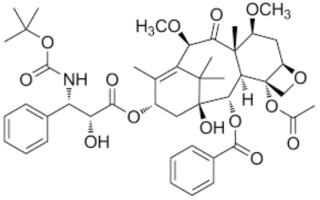
    The case arose in ANDA litigation involving Sanofi's Jevtana® (cabazitaxel), having the structure:

    Image 1
    where the methoxy groups at the C7 and C10 positions distinguished cabazitaxel from prior art docetaxel, which had hydroxyl groups at these positions.  At trial, Sanofi initially asserted claims 7, 11, 14-16, 21, 26, and 30 of Orange Book-listed U.S. Patent No. 8,972,592, which claims methods for treating drug-resistant prostate cancer with cabazitaxel, and U.S. Patent No. 5,847,170, which claims the compound itself as well as pharmaceutical compositions thereof:

    Claim 1:

    1.  4α-Acetoxy-2α-benzoyloxy-5β,20-epoxy-1β-hy-droxy-7β,10β-dimethoxy-9-oxo-11-taxen-13α-yl(2R,3S)-3-tert-butoxycarbonylamino-2-hydroxy-3-phenylpropionate.

    Claim 2:

    2.  A pharmaceutical composition comprising at least the product according to claim 1 in combination with one or more pharmaceutically acceptable diluents or adjuvants and optionally one or more compatible and pharmacologically active compounds.

    The opinion set forth the developmental history of cabazitaxel:

    Cabazitaxel was the product of a multi-year research program aimed at identifying taxane analogs with better activity than docetaxel in resistant tumors.  By making substitutions at multiple positions on docetaxel with various functional groups, Sanofi scientists synthesized several hundred compounds and tested their activities.  Of this group, cabazitaxel was one of two compounds that entered into human studies.  It obtained FDA approval in 2010.

    While ANDA litigation was proceeding, the Patent Trial and Appeal Board (PTAB) invalidated all asserted claims of the '592 patent for obviousness.  Facing denial of its motion to amend in the IPR, Sanofi filed a statutory disclaimer of claims 7, 11, 14-16, and 26.  (In a footnote, the opinion notes that the Federal Circuit thereafter vacated the Board's decision and remanded for consideration regarding Sanofi's motion to amend during the IPR, which remains pending.)  Despite this, the District Court entered judgment against all claims of the '592 patent that had been raised at trial for being invalid for obviousness; separately the Court entered judgment that Defendants had failed to show claims 1 and 2 of the '170 patent were invalid for obviousness.

    The Federal Circuit vacated the District Court's decision regarding disclaimed claims 7, 11, 14-16, and 26 of the '592 patent because no case or controversy existed at the time the Court issued its opinion, and affirmed the District Court with regard to the '170 patent, in an opinion by Judge Lourie joined by Judges Moore and Taranto.  On appeal, Defendants argued that the possibility that Sanofi would be able to amend the claims in IPR maintains a case or controversy with regard to "future" issue or claim preclusion defenses in possible future litigation between the parties.  The Federal Circuit agreed with Sanofi that the statutory disclaimer removed the "case or controversy" requirement under Article III of the Constitution.  This requirement, the Court asserts, must be "'real and substantial' and 'admi[t] of specific relief through a decree of a conclusive character, as distinguished from an opinion advising what the law would be upon a hypothetical state of facts,'" citing MedImmune, Inc. v. Genentech, Inc., 549 U.S. 118, 127 (2007) (alteration in original) (quoting Aetna Life Ins. Co. v. Haworth, 300 U.S. 227, 240–41 (1937)).  The requirement is "highly similar" to the standing requirement, which is that "a plaintiff must 'present an injury that is concrete, particularized, and actual or imminent; fairly traceable to the defendant's challenged behavior; and likely to be redressed by a favorable ruling,'" citing Dep't of Commerce v. New York, 139 S. Ct. 2551, 2565 (2019) (quoting Davis v. Fed. Election Comm'n, 554 U.S. 724, 733 (2008)).  Finally, the opinion states that the "actual controversy must be extant at all stages of review, not merely at the time the complaint is filed," citing Steffel v. Thompson, 415 U.S. 452, 459 n.10 (1974) (emphasis added).  Applying these principles to the facts, the Court had little difficulty arriving at the conclusion that, at the time the District Court entered its judgment there was no controversy with regard to these claims, which Sanofi had disclaimed (which left the '592 patent "as though the disclaimed claim(s) had 'never existed,'" citing Genetics Inst., LLC v. Novartis Vaccines & Diagnostics, Inc., 655 F.3d 1291, 1299 (Fed. Cir. 2011) (quoting Vectra Fitness, Inc. v. TNWK Corp., 162 F.3d 1379, 1383 (Fed. Cir. 1998)).

    The panel rejected Defendants' allegation that they would lose the possibility of the issue preclusion defense "should Sanofi obtain amended claims and assert them against Defendants."  This is not sufficient to satisfy the case or controversy requirement, according to the opinion, first because the relevance of the disclaimed claims to a future issue preclusion defense was speculative, and second, the Defendants failed to establish that the District Court judgment pertaining to the disclaimed claims "is material to a possible future suit."  And the panel refused Defendants' invitation to provide an advisory opinion on "the claim preclusion arguments that they intend to make . . . should Sanofi secure amended claims at the Board and then assert them against Defendants."

    Turning to the District Court's decision that Defendants had not shown by clear and convincing evidence that claims 1 and 2 of the '170 patent were invalid for obviousness, the panel relied on the Court's decision in Takeda Chem. Indus., Ltd. v. Alphapharm Pty., Ltd., that a challenger must "identify some reason that would have led a chemist to modify a known compound in a particular manner to establish prima facie obviousness of a new claimed compound."  492 F.3d 1350, 1357 (Fed. Cir. 2007).  The opinion reviewed the District Court's "extensive [factual] findings" based on the testimony of "seven witnesses and seventeen prior art references" in arriving at its conclusion that the District Court had not erred.  This analysis centered on the question of the motivation and rationale of the skilled worker to modify prior art docetaxel by simultaneously replacing hydroxyl groups with methoxy compounds at positions C7 and C10.  Defendants argued that this modification would be motivated to increase the lipophilicity of docetaxel to interfere with its binding by P-glycoprotein (Pgp), a plasma membrane-associated protein pump that rendered cells resistant to cytotoxic drugs (like docetaxel) by extruding these compounds from the cell.  The panel credited the District Court's determination that the prior art cited in support of increased lipophilicity as a way to decrease Pgp extrusion did not disclose taxanes or show any relationship between lipophilicity and Pgp extrusion for taxanes.  Concerning Defendants' assertion of prior art related to possible substitution positions in the canonical taxane structure, the panel agreed with the District Court's characterization that Defendant had cherry-picked the data in the cited references to reach the pattern of substituents exhibited by cabazitaxel and thus rejected them.  Secondary considerations (commercial success, failure of others) also supported the District Court's decision that Defendants had not established obviousness of claims 1 and 2 of the '170 patent by clear and convincing evidence.

    The Federal Circuit also rejected Defendants' argument in their declaratory judgment counterclaims that "a skilled artisan would have: (1) been motivated to modify docetaxel to reduce Pgp-related drug resistance; (2) knew that this could be accomplished by increasing lipophilicity of the C7 and C10 positions; and (3) determined that methoxy substitutions were the 'smallest, most conservative' modification to achieve that goal" as the product of hindsight.  The panel reviewed the District Court's assessment of the asserted prior art, the deficiencies of this art and Defendants' arguments and reached the conclusion that these arguments were the product of hindsight.

    Sanofi-Aventis U.S., LLC v. Fresenius Kabi USA, LLC (Fed. Cir. 2019)
    Panel: Circuit Judges Lourie, Moore, and Taranto
    Opinion by Circuit Judge Lourie