• By Kevin E. Noonan

    Federal Circuit SealA question of sovereign immunity, which has come before the Federal Circuit in many guises of late (Saint Regis Mohawk Tribe v. Mylan Pharmaceuticals Inc.; Regents of the University of Minnesota v. LSI Corp.), arose again in Board of Regents of the University of Texas System v. Boston Scientific Corp. earlier this month.  And as has happened thus far in this spate of these cases, the Court did not recognize the immunity as advanced by the State, in this case asserted over the question of proper venue.

    The case arose when the University of Texas sued Boston Scientific for infringing U.S. Patent Nos. 6,596,296 and 7,033,603 directed to implantable drug-releasing biodegradable fibers.  These fibers are useful, inter alia, for producing implantable stents impregnated with therapeutic agents.  The University of Texas (UT) filed suit in the Western District of Texas, and Boston Scientific successfully moved to transfer the lawsuit to the District of Delaware.  It was undisputed that Boston Scientific is a Delaware corporation having its principle place of business in Massachusetts.  Moreover, the corporation "does not own or lease any property or maintain a business address in the Western District of Texas," and its 46 employees all worked from home.  Under settled Supreme Court (TC Heartland LLC v. Kraft Foods Group Brands LLC) and Federal Circuit law (In re Cray Inc.), venue was clearly improper in Texas.  The University argued that, to the contrary, as a sovereign (because it was an "arm of the State") it could not be haled into court in a different state by a citizen of another state:

    Venue is proper in the Western District of Texas because UT is an arm of the State of Texas, has the same sovereign immunity as the State of Texas, it would offend the dignity of the State to require it to pursue persons who have harmed the State out- side the territory of Texas, and the State of Texas cannot be compelled to respond to any counter-claims, whether compulsory or not, outside its territory due to the Eleventh Amendment.

    The Texas District Court transferred the case to Delaware, and the Delaware District Court, disagreeing with the University's position denied the University's motion to transfer the case back to the Western District of Texas.  Texas appealed the transfer order.

    The Federal Circuit affirmed, in a decision by Judge Stoll, joined by Chief Judge Prost and Judge Reyna.  The Court first opined on whether it had jurisdiction to consider the University's appeal under 28 U.S.C. § 1295(a)(1), because "[t]ransfer orders are interlocutory and generally cannot be appealed immediately."  With a combination of legal and practical reasoning, the Court found jurisdiction was proper, concluding that "this case falls within the small class of orders excepted from the final judgment rule by the collateral order doctrine," citing Amgen Inc. v. Hospira, Inc., 866 F.3d 1355, 1358–59 (Fed. Cir. 2017).  The Court said that it could accept for review a decision that "finally determine[s] claims of right separable from, and collateral to, rights asserted in the action, too important to be denied review and too independent of the cause itself to require that appellate consideration be deferred until the whole case is adjudicated," citing Puerto Rico Aqueduct & Sewer Auth. v. Metcalf & Eddy, Inc., 506 U.S. 139, 142 (1993), in which the Supreme Court held that an order denying a claim of sovereign immunity falls within the scope of the collateral order doctrine (although in Puerto Rico, the sovereign was a defendant whereas here Texas is a plaintiff).  All of these requirements were fulfilled in this case, according to the opinion:  the transfer order was conclusive, the issue (sovereign immunity) was "important," and the order is "effectively unreviewable on appeal from a final judgment."

    The panel then turned to the University's arguments on the merits:  first, that "U.S. Constitution's Original Jurisdiction Clause ensures that a State cannot be forced to sue in a court located in another State"; second, that "the Eleventh Amendment confirms that a State is entitled to control where it litigates against a private party"; and third "that it did not consent to jurisdiction or waive its sovereignty rights in Delaware, and that the patent venue statute does not abrogate those rights."  There was no dispute, between the parties or the courts, that the University of Texas is an arm of the state and entitled to the same sovereign rights as the State of Texas itself.  Nevertheless, the panel disagreed with the University's assertion that "a State has the right to sue a private party in any forum as long as personal jurisdiction requirements are met" when the State is a plaintiff.  Moreover, the panel held that "nothing in the U.S. Constitution's Original Jurisdiction Clause or in UT's other asserted authorities . . . supports the proposition that a State has the right to bypass federal venue rules when it engages in patent litigation as a plaintiff."  The Eleventh Amendment applies to suits brought against a state, not by a state according to the opinion, the panel citing Regents of the Univ. of Cal. v. Eli Lilly & Co., 119 F.3d 1559, 1565 (Fed. Cir. 1997), and supported in its reasoning by United States v. Peters, 9 U.S. (5 Cranch) 115 (1809) (Marshall, C.J.); Gunter v. Atl. Coast Line R.R. Co., 200 U.S. 273, 284 (1906); and Lapides v. Bd. of Regents of Univ. Sys. of Ga., 535 U.S. 613, 619 (2002).  The Court also rejected the University's argument that "State sovereign immunity—a complementary attribute of state sovereignty—confirms that only the state can dictate where it litigates its property rights" because none of the cases the University cited in support were instances where the State was a plaintiff.

    With regard to the University's original jurisdiction argument, the panel noted that the Constitution provided original but not exclusive jurisdiction to the Supreme Court in cases where a State is a party, codified under 28 U.S.C. § 1251(b)(3).  The panel appreciated that the University was asserting not only that "(a) it has a Constitution-rooted right to avoid out-of-state venues, but also that (b) it has an affirmative right to sue in a federal district court that Congress has deemed unavailable."  The Court disagreed with the University's reading of cases it asserted in support of these propositions — Ames v. Kansas, 111 U.S. 449 (1884); Georgia v. Pennsylvania Railroad Co., 324 U.S. 439 (1945); and Ohio v. Wyandotte Chemicals Corp., 401 U.S. 493 (1971) — saying that they were not read in context.  In particular, the panel held that Ames decided that "lower federal courts can exercise jurisdiction over suits filed by a State against a non-State," i.e., that States can sue in lower Federal courts in addition to the Supreme Court (not that sovereign immunity gives a State the right to sue or be sued in its own state fora).

    Finally, the panel rejected the University's argument that its right to sue in the forum of its choice was one of the "inherent powers of a state sovereign."  The basis of this determination was that when a State voluntarily invokes federal jurisdiction (as here, in a patent case), then "[i]t logically follows that the State must then abide by federal rules and procedures—including venue rules—like any other plaintiff" and "it would be 'anomalous or inconsistent' for [the University] to both invoke federal question jurisdiction and then to assert sovereignty to defeat federal jurisdiction."  And the panel further found the University's arguments that it had not waived immunity to be haled before the Delaware court does not apply when the State is a plaintiff.

    Board of Regents of the University of Texas System v. Boston Scientific Corp. (Fed. Cir. 2019)
    Panel: Chief Judge Prost and Circuit Judges Reyna and Stoll
    Opinion by Circuit Judge Stoll
  • By Donald Zuhn

    Federal Circuit SealOn Monday, in Mayo Foundation for Medical Education and Research v. Iancu, the Federal Circuit affirmed a decision by the U.S. District Court for the Eastern District of Virginia affirming a determination by the U.S. Patent and Trademark Office regarding the Patent Term Adjustment for U.S. Patent No. 8,981,063.  In affirming the District Court, a divided panel concluded that the USPTO's interpretation of "any time consumed by continued examination of the application requested by the applicant under section 132(b)" in 35 U.S.C. § 154(b)(1)(B)(i) was correct.

    The '063 patent, which relates to antibodies for treating disease conditions characterized by immunosuppression (such as cancer, AIDS, and certain congenital immune deficiencies), issued from U.S. Application No. 12/421,310.  During prosecution of the '310 application, the Examiner invited Mayo to make a priority showing with respect to U.S. Patent 7,635,757, and Mayo responded by filing a Request for Continued Examination, arguing that it has priority of invention over the '757 patent, and suggesting an interference.  Mayo then filed a supplemental amendment cancelling claims that the Examiner had indicated would not correspond to the count in the impending interference; some of the cancelled claims had been previously withdrawn in response to a restriction requirement, and the Examiner advised Mayo that, for the purposes of eventual PTA calculation, claims not relevant to the impending interference should be removed.  The cancelled claims were pursued in a separate continuation application, which issued as U.S. Patent 8,460,927.

    An interference was subsequently declared between the '310 application and the '757 patent, with the Board ultimately awarding priority to Mayo's '310 application and cancelling the claims in the '757 patent.  The Board then returned the '310 application to the Examiner, who issued an Office Action rejecting the claims for non-statutory double patenting in view of the '927 patent.  Mayo responded by arguing that the claims of the '310 application and '927 patent were patentably distinct, and the Examiner withdrew the rejection and mailed a Notice of Allowance.

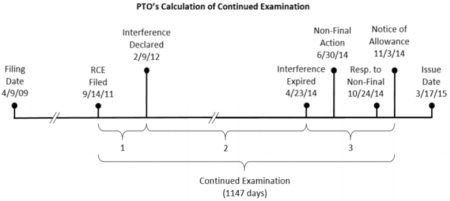
    On appeal, Mayo provided the following timeline for prosecution of the '310 application:

    Timeline
    The appeal concerned the third bracketed time period of 194 days.  After the '063 patent had issued, Mayo, dissatisfied with the USPTO's PTA determination, requested a redetermination of PTA, arguing that the Examiner's sua sponte reopening of prosecution after termination of the interference did not constitute time consumed by continued examination of the application requested by the applicant under 35 U.S.C. § 154(b)(1)(B)(i) (i.e., "RCE time").  The USPTO disagreed, asserting that the RCE time did not end when the interference was declared, but rather ended when the Notice of Allowance was mailed.  Mayo requested reconsideration, the USPTO denied Mayo's request, and Mayo appealed to the Eastern District of Virginia.

    Before the District Court, Mayo argued that a declaration of an interference terminates RCE time for the purposes of calculating B Delay (i.e., which entitles the applicant to PTA for each day the application is pending beyond three years).  In support of its argument, Mayo asserted that Novartis AG v. Lee, 740 F.3d 593 (Fed. Cir. 2014), stood for the proposition that continued examination ends once the claims are "deemed allowable," and not necessarily on the date the Notice of Allowance is mailed, and that a declaration of interference (which requires that an application "otherwise be in condition for allowance") is tantamount to a Notice of Allowance.  Mayo also asserted that the Examiner's reopening of examination after remand from the Board is time attributable to the PTO, not the applicant, because Mayo never requested examination after remand.  The District Court rejected Mayo's arguments and affirmed the USPTO's PTA determination, and Mayo appealed to the Federal Circuit.

    Before the Federal Circuit, Mayo argued that it never "requested" examination after the Board's remand following termination of the interference, and that under USPTO regulations, an interference cannot be declared unless at least some claims are deemed allowable but for the outcome of the interference.  The USPTO countered that a declaration of an interference does not close prosecution on the merits, and that examination may continue afterward.  The USPTO also argued that as a practical matter, Mayo's suggestion that the Court look to the time when the claims are deemed allowable, as opposed to the mailing of a Notice of Allowance would turn PTA calculations into a "wildly impractical" and "hotly contested factual inquiry in nearly every PTA case."

    In an opinion authored by Judge Lourie and joined by Judge Dyk, with Judge Newman dissenting, the majority agreed with the USPTO, affirming the District Court's decision affirming the USPTO's PTA determination.  In response to Mayo's argument that a declaration of interference is tantamount to a Notice of Allowance, the opinion notes that "[w]hile the PTO's regulations do indicate that at least one claim in an application should be in condition for allowance before an interference is declared, . . . the regulations also explicitly contemplate that the Board may recommend further action by the examiner, including issuing a rejection" (citation omitted), and therefore, "the PTO's regulations as a whole do not indicate that a declaration of an interference is tantamount to a Notice of Allowance."  The majority also disagreed with Mayo's interpretation of Novartis, stating that "Mayo only gets to its conclusion by placing more weight on the term 'requested'—a word having little more than clerical significance on a fair reading of the statute—than it can reasonably bear."  In particular, the opinion indicates that "[n]othing in § 132(b) implies that an RCE entitles the applicant to a special form of examination, where the claims must be allowed once the grounds of rejection presented in the Final Rejection are resolved; nor does the statute imply that continued examination is no longer requested by the applicant once the PTO issues a new ground of rejection."  According to the majority, "Mayo requested continued examination, and that is what it received, both before and after the interference proceeding."  The majority therefore held that "where an RCE has previously been filed, the time between termination of an interference and the date of mailing of the Notice of Allowance is 'time consumed by continued examination of the application requested by the applicant under section 132(b)' pursuant to 35 U.S.C. § 154(b)(1)(B)(i)," and affirmed the District Court.

    Judge Newman, writing in dissent, contended that the majority's holding "does not comport with the statutory provisions and precedent, and is contrary to the purpose of term adjustment," adding that the post-interference examination period "plainly is examination delay due to PTO procedures."  With regard to the Court's holding in Novartis, Judge Newman explained that:

    Novartis held that "'examination' presumptively ends at allowance, when prosecution is closed and there is no further examination on the merits in the absence of a special reopening."  . . .  Novartis did not relate to ongoing or continuing prosecution or any activity before mailing of the notice of allowance.  Novartis was concerned only with the "time from allowance to issuance."

    According to Judge Newman, "[h]ere the post-interference examination was PTO activity, part of the examination procedure before issuance of the notice of allowance," which "plainly is within the purpose of the term adjustment statute."

    Mayo Foundation for Medical Education and Research v. Iancu (Fed. Cir. 2019)
    Panel: Circuit Judges Newman, Lourie, and Dyk
    Opinion by Circuit Judge Lourie; dissenting opinion by Circuit Judge Newman

  • By Kevin E. Noonan

    University of MinnesotaNot unexpectedly, the State of Minnesota, as sovereign of the Regents of the University of Minnesota, filed on Thursday its petition to Supreme Court for certiorari.  The State contends that the Federal Circuit erred in deciding that the university, as an "arm of the state," could not assert sovereign immunity against LSI in its attempt to have the Patent Trial and Appeal Board institute inter partes review against university-owned patents.  The State's Question Presented was succinct:

    Whether the inter partes review proceedings brought by private respondents against the University of Minnesota in this case are barred by sovereign immunity.

    The State made several arguments in support of its petition.  Not surprisingly, the State's main argument is based on a case used by both parties below, Fed. Mar. Comm'n v. S.C. State Ports Auth., 535 U.S. 743, 761 (2002).  In the State's view, this case mandates that "[s]tates and state entities, including the University of Minnesota, have sovereign immunity to suits by private parties before courts and 'court-like administrative tribunals.'"  Minnesota specifically contends that inter partes review (IPR) are the type of adversarial proceedings that the Eleventh Amendment to the U.S. Constitution was intends to fall within the scope of sovereign immunity, giving the Several States the prerogative to avoid suit by private parties.  The State also contends that the distinctions used by the Federal Circuit "do not withstand scrutiny," that the issue is sufficiently important to warrant review and this case is an "excellent" vehicle to do so.

    In many ways this is a quintessential Supreme Court case, having to do with State sovereignty as it existed before the states ratified the Constitution (Minnesota having done so much later than the Original States) and the extent to which and how that sovereignty survived formation of the Union.  See, e.g., Alden v. Maine, 527 U.S. 706, 713 (1999).  Minnesota raises a policy issue at the beginning of its brief:  the University is a land-grant university that "invest[s] billions of dollars in public funds into research that results in valuable patents, the revenues from which are reinvested in the States' research and educational programs" (thus implicating the State's sovereignty in supporting this research and pursuing patent protection in the public interest).  The State's brief acknowledges waiver of its sovereign immunity under circumstances where is asserts its patents against infringers, blunting the argument that the State was trying to "eat its cake and have it too.

    The issue is not whether the university's patents can be challenged, because the State has asserted these patents against Respondent in district court litigation.  The issue, according to the brief, is that the State has the constitutional right to choose the forum before which its patents are put at issue.  This position is contrary to the Federal Circuit's blanket determination (begging for Supreme Court review) that IPRs are not subject to any sort of sovereign immunity, based on the appellate court's decision in St. Regis Mohawk Tribe v. Mylan Pharmaceuticals Inc.  The significance of the Federal Circuit's decision (and the need for the Supreme Court to grant the university's cert. petition) is put forth starkly in the brief:

    The Federal Circuit's decision is indisputably consequential.  It injures the sovereignty of every State and subjects public universities to a new and increasingly invoked form of litigation without their consent.  Those disputes implicate billions of dollars' worth of intellectual property rights at the center of some of the most important sectors of our economy.  It is unsurprising, then, that state universities and fourteen States filed amicus briefs below attesting to the importance of the question presented here and its impact on state funding for scientific research.  The Department of Justice's amicus brief likewise professed that the issue has "cross-cutting significance for the federal government."

    The brief enumerates the five ways a patent can be challenged: as a defense in patent infringement or in a declaratory judgment action before a district court; and in ex parte reexamination, the former inter partes reexamination, and in the current inter partes review.  Inter partes review is different from the other types of challenges that can or could have been brought before the Patent Office because, according to the brief, Congress intended inter partes review proceedings to "convert[] inter partes reexamination from an examinational to an adjudicative proceeding," citing the legislative history H.R. Rep. No. 112-98, pt. 1, at 46-47 (2011).  Relying on the Supreme Court's decision in SAS Inst. Inc. v. Iancu, 138 S. Ct. 1348, 1353 (2018), the brief enumerates all the ways the Court has appreciated IPRs to be litigation-like.  The brief then turns to the historical recognition of a State's "'residuary and inviolable sovereignty'" the Founders intended to persist (citing the Federal Circuit's own citation of The Federalist No. 39, at 245 (James Madison) and that this immunity extends to "arms of the state" including state universities, citing Raygor v. Regents of the Univ. of Minn., 534 U.S. 533, 535-36 (2002).  And Congress has but a limited right to abrogate this immunity, Fla. Prepaid Postsecondary Educ. Expense Bd. v. Coll. Sav. Bank, 527 U.S. 627 (1999), which has not been asserted in this case.  The point is not whether a State can be sued, but where (i.e., what forum or tribunal), under Pennhurst State Sch. & Hosp. v. Halderman, 465 U.S. 89, 99 (1984).  The Board disagreed that a State could assert its sovereign immunity from IPR proceedings once it had asserted its patents against accused infringers, holding that assertion constituted waiver both in the district court and before the PTAB.  And the Federal Circuit relied on its St. Regis decision in holding that sovereign immunity does not apply to IPR proceedings for States any more than it did for Indian tribes (despite the difference in scope of these immunities).  The basis for that decision, and the principle of law that Minnesota is basing its petition upon, is that "IPR is more like an agency enforcement action than a civil suit brought by a private party" at least in part because "even if the petitioner or patent owner elects not to participate during IPR, the Board can continue to a final written decision."

    Minnesota's arguments focus on the conflict between the Federal Circuit's decision and Supreme Court precedent, including Fed. Mar. Comm'n v. S.C. State Ports Auth., 535 U.S. 743, 760-61 (2002) (FMC), and its recent decision in Return Mail, Inc. v. U.S. Postal Serv., 139 S. Ct. 1853, 1866 (2019) (which was not yet decided during the case below).  As it had done before the PTAB and the Federal Circuit, the State's argument is that IPRs are too akin to adversarial proceedings for State sovereign immunity not to apply, and the brief lays out those similarities and analogizes them to FMC.  Moreover, "[m]ore important than the sheer number of parallels to civil litigation was the fact that the administrative proceedings inflicted precisely the harms sovereign immunity is intended to prevent" according to the State's brief, comprising an affront to the State's sovereign dignity.  The similarities between IPRs and litigation is based on the Court's own statements in SAS.

    Turning to the distinctions made by the Federal Circuit, the brief points out the inconsistencies in its reasoning.  As recognized by the Court in SAS, Congress did not intend IPRs to be merely another form of agency actions, for example, like ex parte reexamination where the PTAB "plays the role of the superior sovereign" but rather opted for a party-directed, adversarial process," citing the legislative history of the Leahy-Smith America Invents Act in support of this argument.  H.R. Rep. No. 112-98, pt. 1, at 46-47 (2011).  The brief uses this distinction to differentiate IPRs from ex parte reexamination (necessary because the existence of ex parte reexamination has been persuasive, both before the Federal Circuit and the Supreme Court, to reach the conclusion that patents are a governmental grant (readily rescinded under appropriate circumstances) rather than a property right).  Oil States Energy Services, LLC. v. Greene's Energy Group, LLC (2018).  In discussing the IPR initiation proceedings, the brief asserts that "[e]nduring even the preliminary proceeding is the kind of costly indignity from which sovereign immunity is intended to shield the States."  Analogizing this situation with declaratory judgment actions, the brief states that "even the Federal Circuit recognizes that states are immune from declaratory judgment actions despite this discretion [i.e., the court's discretion whether to initiate a declaratory judgment action]," citing Tegic Commc'ns Corp. v. Bd. of Regents of the Univ. of Tex. Sys., 458 F.3d 1335, 1339-40 (2006).

    Turning to specifics, the brief notes that "nothing about the Board's power to approve or decline institution can erase the fact that 'Congress chose to structure a process in which it's the petitioner, not the Director, who gets to define the contours of the proceeding,"' citing SAS.  "[T]he petitioner is master of its complaint and normally entitled to judgment on all of the claims it raises," according to SAS as in civil litigation, nor is the Board able to consider grounds of unpatentability of its own or consider whether the claims are novel or obvious on the basis of any art or argument other than what is raised by the IPR petitioner, by statute and rule.  35 U.S.C. § 316; 37 C.F.R. §§ 42.51-.53, 42.63-.65.  The indignities Minnesota complains of arise at IPR initiation according to the brief, making the fact that the Board can maintain an IPR, once instituted, much less significant (particularly because of the Federal Circuit's reliance on this ability).

    The brief also challenges the Federal Circuit's reasoning that Minnesota had surrendered its sovereign immunity because patents are granted by the U.S. government, against which States have waived their immunity, based on the Court's FMC decision.  "A suit falls within the scope of States' consent to suit by the United States only if the suit 'is commenced and prosecuted against a State in the name of the United States by those who are entrusted with the constitutional duty to "take Care that the Laws be faithfully executed,"'" citing Alden.  And the "plan of the [constitutional] convention" involved State's consent to be sued by the United States in federal court (indeed, limited to the Supreme Court), not agency tribunal according to the brief, citing Franchise Tax Bd. v. Hyatt, 139 S. Ct. 1485, 1495 (2019).

    Finally, the brief addresses the argument that IPRs are proceedings in rem.  Even if correct, this isn't dispositive, according to the brief, and the Court itself has held to the contrary.  Minnesota disagrees with the very premise, stating that IPRs are in personam proceedings not proceedings in rem, citing Return Mail.  The "essential feature" of in rem proceedings, that they are "one against the world," is missing in IPRs according to the brief.  The brief illustrates this point in the case where the Board decides that the petitioner has not established that the challenged claims are invalid:

    That judgment does not settle the question finally and for everyone.  It bars only the petitioner from making the same claim in future proceedings.  35 U.S.C. § 315(e).  The rest of the world is free to raise the same challenge to the patent before the PTAB or a court, see id., and others frequently do.

    Also notable about the Federal Circuit's argument in this regard is that "the panel was unable to identify any other case in which a dispute over entitlement to a patent or other government franchise has been treated as an in rem proceeding for any purpose, much less as a ground for setting aside sovereign immunity."

    Minnesota implores the Court to grant its cert petition because "[t]he PTAB, the Department of Justice, and the States have acknowledged the broad importance of the question presented."  The reality is that "[s]tate universities are issued thousands of patents every year, and many hold portfolios that generate millions of dollars in much-needed revenues for the States and their educational institutions."  Challenging patents, including university patents, by IPR proceedings "ha[s] become increasingly common" and is "made particularly attractive to infringement defendants by their lower standard of proof for unpatentability."  And because IPRs tend to be filed attendant to a State bringing a patent infringement suit, the challenged patents will be the State's "most important patents" because they are "the ones valuable enough to warrant the cost of bringing infringement litigation."  Returning to its constitutional theme, the brief asserts that:

    Sovereign immunity is a critical element of the Constitution's structural protection of liberty through the division of power between States and the Federal Government.  See Alden, 527 U.S. at 751.  The Federal Circuit's disregard for that essential feature of the constitutional order in the patent context is bad enough.  But if left unreviewed, the precedent established here will provide a template for further incursions on States' immunity and evasion of the constitutional limits on Congress's powers of abrogation.

    This case is "an excellent vehicle" for the Court to consider the question.  In view of the Court's refusal to grant cert in the St. Regis case, "no further percolation [of the issue] can be expected"; if the Court does not consider the question here it will not get another opportunity, according to Minnesota's brief

    It is reasonable to believe that Minnesota should have no reason to fear that the Court will not be receptive.  The Court has granted cert in several cases involving the PTAB and IPR proceedings that have far less constitutional implications than this one.  Questions involving Federalism, states' rights, and the extent to which State sovereignty can be abrogated by the Federal government should be like mother's milk to the Court; while it is foolhardy to make any predictions, failure to grant cert would be an uncharacteristic and surprising action by the Court.

  • CalendarSeptember 17, 2019 – "Best Practices for Patenting Chemical and Material Compositions" (McDonnell Boehnen Hulbert & Berghoff LLP) – 10:00 am to 11:15 am (CT)

    September 17, 2019 – "A Primer on the Laws of Cannabis, Marijuana and CBD" (Loeb & Loeb LLP) – 1:00 to 2:00 pm (ET)

    September 19, 2019 – "Trending Issues in Trade Secrets: 2019" (U.S. Patent and Trademark Office) – 9:00 am to 3:30 pm (ET), Alexandria, VA

    September 19, 2019 – "Federal Circuit v. USPTO: Chevron Deference?" (Intellectual Property Owners Association) – 2:00 to 3:00 pm (ET)

    September 20, 2019 – "Hot Topics in IP 2019" (Federal Circuit Bar Association) – 11:30 am to 4:30 pm (ET), Wilmington, DE

    September 21, 2019 – Supreme Court IP Review (SCIPR) (Program in Intellectual Property Law, Center for Empirical Studies of Intellectual Property, and Institute on the Supreme Court of the United States at the Chicago-Kent College of Law) – 8:30 am to 5:30 pm (Central), Chicago, IL

    October 3-4, 2019 – Paragraph IV Disputes Master Symposium (American Conference Institute) – Chicago IL

  • IPO #2The Intellectual Property Owners Association (IPO) will offer a one-hour webinar entitled "Federal Circuit v. USPTO: Chevron Deference?" on September 19, 2019 from 2:00 to 3:00 pm (ET).  Gregory Castanias of Jones Day; Hon. Randall Rader, former Chief Judge of the U.S. Court of Appeals for the Federal Circuit; and John Whealan, Dean for Intellectual Property Law Studies at George Washington University, and former Solicitor of the USPTO will predict how the issue of deference to the USPTO in Facebook v. Windy City Innovations will play out and explore the implications.

    The registration fee for the webinar is $135 (IPO member) or $150 (non-member) (government and academic rates are available upon request).  Those interested in registering for the webinar can do so here.

  • By Donald Zuhn

    USPTO SealIn a notice published in the Federal Register (84 Fed. Reg. 45907) last week, the U.S. Patent and Trademark Office issued an interim rule in which it increased the limit on the number of prioritized (Track I) examination requests that may be accepted in a fiscal year from 10,000 to 12,000.  The increase in accepted requests took effect on September 3, 2019.

    The Office implemented the prioritized examination provisions of the Leahy-Smith America Invents Act in September 2011 (see "USPTO Implements Prioritized Examination Track under AIA").  The AIA had set forth a prioritized examination fee of $4,800 (since reduced to $4,000), which applicants must pay in addition to filing, search, and examination fees (including any applicable excess claims and application size fees) and processing and publication fees (the prioritized examination fee for small entities is reduced by 50%).  In addition, the AIA specified that to be eligible for prioritized examination, an application must contain (or be amended to contain) no more than 4 independent claims and no more than 30 total claims.  The AIA also limited the number of requests for prioritized examination that the Director may accept to 10,000 per fiscal year.

    When originally implementing prioritized examination, the Office noted that it would accord prioritized examination applications special status and place them on the examiner's special docket, and that the following actions taken by the applicant would terminate prioritized examination:

    • Filing a request for continued examination (RCE);
    • Filing a petition for an extension of time to file a reply;
    • Filing a request for a suspension of action; or
    • Filing an amendment that results in more than four independent claims, more than thirty total claims, or a multiple dependent claim.

    The Office also noted that to participate in the Track I program, applicants had to fulfill the following requirements:

    • File a new original utility or plant nonprovisional application under 35 U.S.C. § 111(a) (the procedure does not apply to international, design, reissue, or provisional applications, or reexamination proceedings, but can be used for continuing applications);
    • File an application that is complete under 37 C.F.R. § 1.51(b), including the oath or declaration, and payment of the filing, search, and examination fees, any applicable excess claims fee, and any applicable application size fee at the time of filing;
    • File the application via the Office's electronic filing system (EFS-Web);
    • The application cannot contain more than four independent claims and thirty total claims or any multiple dependent claims;
    • Request prioritized examination (preferably by using Form PTO/SB/424); and
    • Pay the required fees for requesting prioritized examination at the time of filing (i.e., the prioritized examination fee set forth in 37 C.F.R. § 1.17(c), the processing fee set forth in 37 C.F.R. § 1.17(i), and the publication fee set forth in 37 C.F.R. § 1.18(d)).

    In March 2014, the Office published an interim rule indicating that the time periods for meeting certain requirements for filing a request for Track I prioritized examination could be expanded while maintaining the Office's ability to timely examine the patent application (see "USPTO to Permit Delay in Meeting Certain Prioritized Examination Requirements").  The requirements for which the time periods were expanded were:  the submission, upon filing, of an inventor's oath or declaration and all required fees, as well as an application containing no more than four independent claims, thirty total claims, and no multiple dependent claims.  In particular, the Office changed the rules to (1) postpone the requirement to file an inventor's oath or declaration if an application data sheet meeting the conditions specified in 37 CFR 1.53(f)(3)(i) is present upon filing, (2) provide a non-extendable one-month period (following notification of noncompliance from the Office) to file an amendment to cancel any independent claims in excess of four, any total claims in excess of thirty, or any multiple dependent claim, and (3) no longer require the payment of excess claims fees or the application size fee upon filing.

    In its latest notice, the Office notes that the number of requests for prioritized examination has increased steadily over the last few years to the point that the limit of 10,000 requests for prioritized examination that may be accepted in any fiscal year will be reached if the limit is not increased.  The Office also notes that the number of applications accepted for prioritized examination will remain a small fraction of the approximately 650,000 applications and requests for continued examination that the Office examines per fiscal year.  Thus, the Office has determined that the Track I program may be further expanded to permit more applications to undergo prioritized examination while maintaining the ability to timely examine all prioritized applications.

    The Office is accepting written comments regarding the most recent interim rule until November 4, 2019.  Comments can be sent by e-mail addressed to AD39.comments@uspto.gov; submitted by regular mail addressed to:  Mail Stop Comments—Patents, Commissioner for Patents, P.O. Box 1450, Alexandria, VA 22313–1450, marked to the attention of Kery Fries, Senior Legal Advisor, Office of Patent Legal Administration; or sent via the Federal eRulemaking Portal website (http://www.regulations.gov).

  • By Kevin E. Noonan

    University of California-BerkleyIn their Order of August 26th, the Patent Trial and Appeal Board authorized the University of California/Berkeley, University of Vienna, and Emmanuelle Charpentier, Junior Party (abbreviated "CVC") to file a miscellaneous motion that its Priority Statement be filed under seal.  The Board set an expedited schedule to be filed September 5th and withheld authorizing the Broad to file an opposition until it considered CVC's motion.

    Last week, CVC filed its motion, and this week the Board authorized the Broad to file an opposition.  CVC's motion begins, as it must under PTAB Rules (37 C.F.R. § 42.54), with a section on the precise relief requested.  This relief is to be able to file its Priority Statement under seal under the terms of a protective order filed with the motion.  The protective order is limited to "45 days until after judgment, or indefinitely, as circumstances dictate."  CVC also contemplates the 45 days to provide an opportunity to file a motion to expunge.  In the alternative, CVC requests the Board to enter the protective order until after the Board enters a scheduling order for the priority phase (which the motion contemplates would permit CVC to file a renewed motion to seal or motion to expunge, e.g. if the count is changed, depending on the status of the proceedings at that time.)

    CVC's argument is that "CVC's priority statement in this case will contain sensitive research and development information that CVC has otherwise kept confidential."  The importance to CVC of keeping its priority statement confidential is that "CVC has several third-party competitors in the field of CRISPR-Cas9 gene editing technology," including Harvard College (USSN 15/042,573), General Hospital Corp. (USSN 14/211,117), ToolGen (USSN 14/685,568), Vilnius University (USSN 16/148,783) and, seemingly most importantly, Sigma-Aldrich (USSNs 15/188,911; 15/188,924; and 15/456,204), which CVC notes "has petitioned the Office to declare an interference between Sigma-Aldrich's pending applications and CVC's involved applications" (see "Sigma-Aldrich Wants Its Piece of CRISPR Pie").  CVC sets forth the significance of these competitors and the sensitivity of their priority statement by saying:

    If CVC's priority statement is made publicly available, then the access that these third parties will have to CVC's confidential research and development information will prejudice CVC in any potential interferences that are declared between CVC and these parties.  Typically, parties to an interference must submit their priority statements without knowledge of the opposing party's alleged dates.  . . .  This ensures that the allegations in the priority statements are not tainted by hindsight, and increases the likelihood that they correspond to dates that the parties may attempt to prove.  A party that has advance notice of its opponent's priority allegations may use that imbalance of information to its advantage, either in influencing the scope of the count or crafting its own allegations.  That leads not only to unfair leverage in settlement negotiations, and but also increases the costs of the proceedings to both the parties and the Patent Office.  Moreover, that undermines the purpose of the priority statement, viz., "to obtain from each party an honest statement of the essential facts and dates upon which they may have to rely to prove priority of invention." [citations omitted]

    CVC supports its motion by noting that its motion and protective order "compl[y] with all applicable rules and regulations" (citing specifically 37 C.F.R. § 42.54(a)(7) and 37 C.F.R. § 41.204) as well as the lifting of the protective order 45 days after judgment in inter partes review, post-grant review, and covered business method patent reviews (and analogizing these proceedings to interference practice).  CVC also points out to the Board that the proposed protective order is the "default" order provided in the Federal Register Vol. 77, No. 157 (August 14, 2012) Rules and Regulations at 48760; Appendix B and 37 C.F.R. § 42.54.

    CVC's more significant arguments in support of its motion involved the "substantial risk of prejudice" it would suffer if its priority statement was not kept confidential.  CVC emphasized in its motion that parties filed their priority statements in ignorance of the opposing party's dates of conception and reduction to practice or whether the opposing party's priority allegations will antedate a reference.  Such ignorance "ensures that priority statements are based on a party's perceptions of its own proofs, untainted by the hindsight of its opponent's positions" according to CVC's argument.  CVC once again in this section of its motion raises the risk it could face (presumably in future interferences) from Sigma-Aldrich or ToolGen or Vilnius University, each of which have patent applications pending having a priority date "within about ten months" of CVC's priority date.  Also meriting a mention were licensing agreements between some of these competitors and The Broad, which warrants a protective order and not just a decision by the PTAB not to make the priority statement on the Interference Web Portal.  "Where a party has the advantage of knowing the alleged dates of conception and reduction to practice of its opponent, it can allege earlier dates, giving it not only an upper hand in the proceeding, but undermining the integrity and purpose of the priority statement process" according to CVC, citing 37 C.F.R. § 41.204(a)(3).  And this concern is not hypothetical or speculative according to CVC, in view of public statements by some of its competitors that pending claims in their patent applications constitute interfering subject matter (and indeed, in Sigma-Aldrich's case, a motion filed to expedite the PTO's determination that such claims are in condition for allowance so that an interference declaration can be contemplated).

    CVC also contends that granting its motion and imposing a protective order would not prejudice the public, particularly because the Board authorized the Broad to file a motion to substitute the count, raising the possibility that "CVC will have revealed its preliminary assessment of bases for entitlement to a judgment on priority for a count that is never adjudicated."

    Finally, CVC contends that imposing its protective order would not prejudice the Broad.  CVC is perfectly content with the Board imposing a protective order on both CVC's and the Broad's priority statements.  CVC argues that the Broad has provided no allegation of prejudice, and its only basis (during the teleconference between the Board and the parties) for opposing CVC's protective order was "an internal 'policy of public disclosure'" and that the parties' priority statements were not tiled under seal in the earlier interference between the parties (Interference No. 106,048.  To this CVC states that:

    Broad's claim of an internal policy of public disclosure may govern its behavior regarding its own information, but there is no reason that so-called policy should entitle Broad to publicize the confidential research and development information of its opponents.  The Broad's policy should be given no weight or relevance by the Board in its decision.  Moreover, while CVC did not file a motion to seal its priority statement in the '048 Interference, the Board did not make the priority statements in that case publicly available, and CVC did not expect that Broad would publish CVC's confidential information.  Additionally, that Interference involved a different count, and took place against a different competitive landscape.  That Interference has little relevance to the disposition of this motion other than to highlight that Broad previously made public CVC's confidential information.  . . .  CVC has identified an interest in protecting the information in its priority statement, and identified a risk of publication.  There is therefore no basis to deny CVC's motion.

    The Board issued an order authorizing the Broad to file its opposition motion to CVC's motion for a protective order, due September 20th.  In addition the parties entered a stipulation changing the times for Time Periods 1 through 6, as follows:

    TIME PERIOD 1                                                  October 4, 2019
    File motions                                                     October 14, 2019
    File priority statements
    (but serve one business day later)

    TIME PERIOD 2                                                  October 25, 2019
    File responsive motions to motions                    November 7, 2019
    filed in TIME PERIOD 1

    TIME PERIOD 3                                                  December 6, 2019
    File oppositions to all motions                           January 9, 2020

    TIME PERIOD 4                                                  January 17, 2020
    File all replies                                                  March 5, 2020

    TIME PERIOD 5                                                  February 28, 2020
    File request for oral argument                           March 16, 2020
    File motions to exclude evidence
    File observations

    TIME PERIOD 6                                                   March 20, 2020
    File oppositions to motions to exclude                March 26, 2020
    File response to observations

    TIME PERIOD 7                                                    April 3, 2020
    File replies to oppositions to
    motions to exclude

    DEFAULT ORAL ARGUMENT DATE                         TBD

  • By Kevin E. Noonan

    Senate SealIt would be understandable to have the impression that Congress is considering patent eligibility reform as the major (or even sole) patent-related legislation this session (see "Biotech Prospects for Patent Reform"; "What We Learned at Patent Reform Hearings"; "Senators Tillis and Coons Release Statement on Recent Patent Reform Hearings"; "Senate Subcommittee on Intellectual Property Holds Hearings on Proposed Revisions to 35 U.S.C. § 101"; "Senate Proposal for Section 101 Reform: Effect on Biotech/Pharma Inventions"; "Congress Proposes Draft Bill to Change 35 U.S.C. § 101"; and "Congress Releases Framework for Section 101 Reform").  That impression would be incorrect (see "FTC to the Rescue Regarding High Drug Prices and Patents"; "Even More Ill-Conceived Remedies from Congress Regarding Prescription Drug Costs"; "More Ill-conceived Remedies from Congress Regarding Prescription Drug Costs"; and "A Solution in Search of a Problem").  Another effort coming from the Subcommittee for Intellectual Property of the Senate Judiciary Committee (Sen. Tillis (R-NC), Chair, and Sen. Coons (D-DE), Ranking member) is the STRONGER Act (see "The STRONGER Patents Act of 2019: Weakening Post-Grant Proceedings"), a somewhat controversial attempt to mitigate the perceived inequities created by the Leahy-Smith America Invents Act.

    The Subcommittee is holding hearings at 2:30 pm (ET) on Wednesday, September 11th in the Dirksen Senate Office Building, with a panel of witnesses comprising legal academics and patent counsel from (predominantly) high-tech industry representatives.  The hearings will be available for later viewing on the Subcommittee's website.

    It is impossible (not to say foolhardy) to try to predict the fate of this or any of the patent-related bills percolating in the House of Representatives as well as the Senate.  While conventional wisdom counsels that Congressional consideration of patenting matters is both consistent with its proper role (after all, the Patent Clause is in Article I of the Constitution) and a welcome relief from judicial fiat regarding patents, the STRONGER Act (and the perceived need for it) just as strongly suggests that the patent community sometimes needs to be careful about what it collectively wishes for; after all, the AIA was the culmination of more than a decade of Congressional efforts to reform U.S. patent law and these efforts have had not entirely welcome consequences.  As always, the best advice for patent-savvy citizens is to contact your Congressional representatives, in each House.  At least you will know you did your part to change U.S. patent law for the better.

  • By Kevin E. Noonan

    Federal Circuit SealLate last month, the Federal Circuit affirmed a District Court grant of a preliminary injunction based on claim construction involving the effect of two "wherein" clauses in Allergan Sales, LLC v. Sandoz, Inc.

    The litigation involved Allegan's U.S. Patent Nos. 9,770,453, 9,907,801, and 9,907,802, which are directed to the ophthalmic drug Combigan®.  As explained in the opinion, the claimed invention is "topical ophthalmic use of brimonidine in combination with timolol . . . for treatment of glaucoma or ocular hypertension . . . preferably formulated as 0.01 to 0.5 percent by weight brimonidine and 0.1 to 1.0 percent by weight timolol solution in water at a pH of 4.5 to 8.0, e.g. about 6.9," where the formulation described in the claims is Combigan® and generic versions of it.  Claim 1 of the '453 patent is representative:

    A method of treating a patient with glaucoma or ocular hypertension comprising topically administering twice daily to an affected eye a single composition comprising 0.2% w/v brimonidine tartrate and 0.68% w/v timolol maleate, wherein the method is as effective as the administration of 0.2% w/v brimonidine tartrate monotherapy three times per day and wherein the method reduces the incidence of one o[r] more adverse events selected from the group consisting of conjunctival hyperemia, oral dryness, eye pruritus, allergic conjunctivitis, foreign body sensation, conjunctival folliculosis, and somnolence when compared to the administration of 0.2% w/v brimonidine tartrate monotherapy three times daily.

    At issue were the two "wherein" clauses italicized in the claim.  According to the Federal Circuit, these clauses found support in Example II of the common specification between these related patents.

    The District Court construed each of the wherein clauses as being limiting, i.e., that they were "material to patentability and express the inventive aspect of the claimed invention."  This aspect was the ability of Combigan® to reduce frequency of administration from three times (TID) to twice (BID) per day without a reduction in efficacy and with a decrease in adverse side effects.  Sandoz argued that these clauses were merely a statement of intended results and were not so limiting, inter alia, because the only affirmative steps recited in the claim were to administer the drug formulation.  Under the District Court's construction, the Court held that Allergan had shown a reasonable likelihood of success in showing infringement by Sandoz' generic product, and granted the injunction.  This appeal followed.

    The Federal Circuit affirmed in an opinion by Judge Wallach, joined by Chief Judge Prost and Judge Newman; the Chief Judge also wrote a concurring opinion.  Regarding claim construction, the panel reviewed the plain meaning of the claim language, the specification, and the prosecution history; because the District Court did not consider extrinsic evidence their review was de novo.  While the opinion notes "some overlap" between the language of the wherein clauses and the results set forth in the specification of administering the formulation, the panel opined that proper claim construction requires the claim language to be considered in view of the specification as a whole, citing Sinorgchem Co., Shandong v. Int'l Trade Comm'n, 511 F.3d 1132, 1145 (Fed. Cir. 2007), and Trs. of Columbia Univ. v. Symantec Corp., 811 F.3d 1359, 1363 (Fed. Cir. 2016).  The specification describes experimental comparative results of the formulation administered according to the asserted claims on the patents-in-suit and the prior art, demonstrating the disclosed formulation to be "superior."   In the Court's view, "the specification demonstrates that Allergan believed the increased efficacy and safety of the claimed methods to be material to patentability."  The panel found evidence of similar reliance on these superior properties in the prosecution history, the opinion citing specific passages where patentee argued that the claims were patentably distinct from the prior art based on the properties recited in the wherein clauses.  Finally, the opinion states that the Examiner relied on the distinctions found in the wherein clauses to find the claims "novel and non-obvious over the prior art."  Accordingly, the Federal Circuit affirmed the District Court's claim construction and the grant of summary judgment, explaining in a footnote that the parties agreed the correctness of that decision would "stand or fall" on the claim construction issue.

    The Chief Judge wrote separately in concurrence because while agreeing with the panel decision her reasoning regarding the limiting nature of the "wherein" clauses took a different logical path.  She characterized the posture of the case as being "unusual," due to the reliance by all on the claim construction issue.  The Chief Judge found no fault with the panel's application of the claim construction rubrics established by case law that she says constitute "a well-established set of legal standards governing claim construction," and also stating that "the majority has already ably articulated those standards in detail."  To this able articulation, the Chief Judge added "one narrow but crucial point" that bears consideration in her view.  And that is that the plain meaning of the language of the claims, which is mentioned almost summarily in the main opinion, "on its face confirms that these clauses give meaning and purpose to the other manipulative steps of claim 1."  The Chief Judge then makes her case that the claim, written in "open" claim language ("comprising") has no basis for limiting the combination of components, expressly recited or encompassed by "comprising," with any language other than the "wherein" clauses:

    Without the "wherein" clauses, the only other limitation guiding the physician is that the drug is administered "twice" per day.  . . .  Sandoz provides no basis for us to conclude with any certainty that the safety and efficacy requirements of the "wherein" clauses would always result from two doses of (1) any formulation of the combination at (2) any interval in a 24-hour period.

    The Chief Judge used these circumstances to conclude that in these claims the "wherein" clauses bear the burden of limiting the formulations and administration of those formulations to those that satisfy the limitations recited in the "wherein" clauses (which is an operable definition of what a claim limitation does).  She also found that these clauses each recite with specificity and particularity what is required to satisfy them, in contrast with wherein clauses in other contexts that operate (as Sandoz unsuccessfully argued here) merely to recite an intended result.  And as in the main opinion, the Chief Judge found these conclusions are supported by both the specification and the prosecution history.

    The Chief Judge ends her concurring opinion with a discussion of the role of claim language in the claim construction exercise:

    As it is, claim construction can be difficult.  For instance, litigants often encounter uncertainty over whether a claim's preamble is limiting or not.  I see no reason to inject further uncertainty into the notice provided by the body of a claim.  Given the specificity, clarity, and material limits the "wherein" clauses add to the scope of claim 1 on their face, Sandoz's position deserves rigorous scrutiny from the start.  We should not begin with the presumption that text in the body of the claim may be meaningless and can only be saved by clear statements in the specification or prosecution history.

    For Chief Judge Prost, the name of the game is the language of the claim, and resort to the specification and prosecution history is only taken to ensure that the claim language has been properly interpreted.

    Allergan Sales, LLC v. Sandoz, Inc. (Fed. Cir. 2019)
    Panel: Chief Judge Prost and Circuit Judges Newman and Wallach
    Opinion by Circuit Judge Wallach; concurring opinion by Chief Judge Prost

  • CalendarSeptember 9, 2019 – "The Evolving Patent Eligibility of Life Sciences Method Claims" (Practising Law Institute) – 11:00 am to noon (EDT)

    September 12, 2019 – "Inherency In Anticipation and Obviousness" (Intellectual Property Owners Association) – 2:00 to 3:00 pm (ET)

    September 17, 2019 – "Best Practices for Patenting Chemical and Material Compositions" (McDonnell Boehnen Hulbert & Berghoff LLP) – 10:00 am to 11:15 am (CT)

    September 17, 2019 – "A Primer on the Laws of Cannabis, Marijuana and CBD" (Loeb & Loeb LLP) – 1:00 to 2:00 pm (ET)

    September 19, 2019 – "Trending Issues in Trade Secrets: 2019" (U.S. Patent and Trademark Office) – 9:00 am to 3:30 pm (ET), Alexandria, VA

    September 20, 2019 – "Hot Topics in IP 2019" (Federal Circuit Bar Association) – 11:30 am to 4:30 pm (ET), Wilmington, DE

    September 21, 2019 – Supreme Court IP Review (SCIPR) (Program in Intellectual Property Law, Center for Empirical Studies of Intellectual Property, and Institute on the Supreme Court of the United States at the Chicago-Kent College of Law) – 8:30 am to 5:30 pm (Central), Chicago, IL

    October 3-4, 2019 – Paragraph IV Disputes Master Symposium (American Conference Institute) – Chicago IL