• By Daniel Boehnen

    Department of Health & Human ServicesLast month, the United States government, acting on behalf of its Department of Health and Human Services (HHS), filed suit in Delaware against Gilead Sciences, Inc. and Gilead Sciences Ireland UC for infringing four patents covering inventions developed by scientists at the Centers for Disease Control and Prevention.  The patents all cover methods for a type of medical regimen known as "pre-exposure prophylaxis" (PrEP) for the prevention of HIV.  More specifically, each of the four patents'  claims recite:

    • A process for protecting a primate host from a self-replicating infection by an immunodeficiency retrovirus comprising . . . .

    • A process for inhibiting establishment of a human immunodeficiency virus self-replicating infection of human immunodeficiency virus infection in a human comprising . . . .

    Gilead SciencesThe lawsuit is highly noteworthy for many reasons.  It is very unusual — not unheard of, but very unusual — for the U.S. government, acting as a patent owner, to sue a company for patent infringement.  Second, the Complaint is extremely detailed in explaining the history of events leading to the invention as well as the history of interaction between HHS and Gilead leading to the filing of the Complaint.  Third, it does not take much reading between the lines to see that one of the government's goals is to make the PrEP regimen as readily available and cost effective in the U.S. as it already is in many European and other countries, with Gilead being alleged as a primary roadblock in that path.

    Gilead is of course well-known for discovering Truvada® (a fixed dose combination of tenofovir disoproxil fumarate (TDF) and emtricitabine (FTC)) as well as Descovy® (a combination of FTC and tenofovir alafenamide fumarate (TAF)).  Truvada® and Descovy® are regularly used in treating active HIV infections with the goal of reducing the active virus load to undetectable levels.  The Complaint notes that Gilead's patents on these products expire in 2021.

    The Complaint explains that the CDC developed innovative pre-clinical models that proved to be keys in testing and proving the CDC scientists' concepts in the claimed inventions.

    Still further, the Complaint goes to significant length to explain that Gilead provided absolutely no support in developing the inventions, aside from providing certain drug compounds under an MTA.  Indeed, the Complaint addresses and squarely shoots down Gilead's public statement claiming credit for the development of the PrEP regimine.

    The Complaint notes the significant benefits achieved by Truvada® and Descovy® for treating established HIV infections, but focuses on the efforts that were being made in the 1990s and 2000s to discover a way to prevent HIV infection from becoming established.  In particular, the Complaint provides a great summary of the substantial — yet unsuccessful — R&D that had been and was being undertaken to develop a vaccine and/or post-exposure prophylaxis treatment of HIV prior to the invention, as well as the reasons why PrEP was then-deemed unachievable.  In this respect, the Complaint is like a great survey article on the history of HIV treatment research, but the document is written in a much more readable manner than most survey articles.

  • ThanksgivingThe authors and contributors of Patent Docs wish their readers and families a Happy Thanksgiving.  Publication of Patent Docs will resume on November 30th.

  • By Kevin E. Noonan

    Federal Circuit Seal"Everything you say can be held against you" is a trope in crime shows from the U.S., Australia, New Zealand, the UK, and Ireland (stated in various ways), and a recent decision by the Federal Circuit regarding preclusion of infringement under the doctrine of equivalents by prosecution history estoppel is an excellent example of the same principle in patent law.

    The lawsuit that gave rise to the Court's decision in Pharma Tech Solutions, Inc. v. Lifescan, Inc. involved Pharma Tech's assertion of U.S. Patent Nos. 6,153,069 and 6,413,411, which were directed to blood glucose monitoring systems.  As explained in the opinion:

    To test blood glucose, an individual typically draws blood by pricking a finger, placing the blood on the end of a test strip, and placing the test strip into a meter.  The test strip contains a pair of electrodes, including a working electrode and a second electrode.  The working electrode is coated with an enzyme that oxidizes glucose in the blood sample.  Following an incubation period, the meter (1) applies a known electric potential across the electrodes, creating a diffusion limiting electric current (referred to as the "Cottrell current") through the sample; and (2) measures Cottrell current.  A proportional relationship exists between the measured current and blood glucose concentration.  Based on this proportional relationship, a microprocessor in the meter converts the measured electric current to a blood glucose level and then reports the blood glucose level to the user.

    The distinction from prior art monitoring systems embodied in the claims is illustrated by the italicized portion of claim 1 of the '069 patent:

    1.  An apparatus for measuring compounds in a sample fluid, comprising:
        a) a housing having an access opening therethrough;
        b) a sample cell receivable into said access opening of said housing, said sample cell being composed of;
            (i) a first electrode which acts as a working electrode;
            (ii) a second electrode which acts to fix the system potential and provide opposing current flow with respect to said first electrode, said second electrode being made of the same electrically conducting material as said first electrode, and being operatively associated with said first electrode, the ratio of the surface area of said second electrode to the surface area of said first electrode being 1:1 or less;
            (iii) at least one non-conducting layer member having an opening therethrough, said at least one non-conducting layer member being disposed in contact with at least one of said first and second electrodes and being sealed against at least one of said first and second electrodes to form a known electrode area within said opening such that said opening forms a well to receive the sample fluid and to allow a user of said apparatus to place the sample fluid in said known electrode area in contact with said first electrode and said second electrode;
        c) means for applying an electrical potential to both said first electrode and said second electrode;
        d) means for creating an electrical circuit between said first electrode and said second electrode through the sample fluid;
        e) means for measuring a first Cottrell current reading through the sample fluid at a first predetermined time after the electrical potential is applied and for obtaining at least one additional Cottrell current reading through the sample fluid, the at least one additional Cottrell current reading occurring at a second predetermined time following the first predetermined time;
        f) microprocessor means for converting the first Cottrell current reading into a first analyte concentration measurement using a calibration slope and an intercept specific for the first Cottrell current measurement, for converting the at least one additional Cottrell current reading into an additional analyte concentration using a calibration slope and an intercept specific for the at least one additional Cottrell current measurement, and for comparing the first analyte concentration measurement with the at least one additional concentration measurement to confirm that they are within a prescribed percentage of each other; and
        g) means for visually displaying the results of said analyte concentration measurements.

    Thus, rather than measuring the induced Cottrell current readings and comparing them, the microprocessor converts these current readings to glucose concentrations and compares them.

    Lifescan's accursed infringing article, sold as the OneTouch® Ultra® system, operates by measuring current produced in the presence of blood on the test strip in two working electrodes during a five-second "countdown period," and then conducts a "Current Difference Test" (as a control that the values are within proscribed limits), followed by calculating total final current (that is then correlated with blood glucose concentration).  As stated in the opinion:

    It is undisputed that Lifescan's meters neither convert multiple Cottrell current readings to analyte concentration measurements nor compare multiple analyte concentration measurements.  Pharma Tech agrees that the accused products therefore do not literally infringe the claim.  But Pharma Tech asserts that "an analyte measurement can be expressed as a current at a given time or as a concentration" and, thus, the accused device infringes under the doctrine of equivalents.

    The opinion sets forth certain aspects of the prosecution history, wherein the italicized portion of the claim set forth above was added by amendment in response to rejection over certain prior art references (specifically U.S. Patent No. 5,385,846 (Kuhn), U.S. Patent No. 5,288,636 (Pollmann), and U.S. Patent No. 5,108,564 (Szuminsky)).  These amendments were accompanied by argument, wherein the applicant relied on the feature of converting the Cottrell current readings to analyte (i.e., blood glucose) concentrations which were then compared with one another.  These amendments were not completely availing for patentability, because the Examiner asserted two additional prior art references (U.S. Patent No. 5,508,171 (Walling) and U.S. Patent No. 5,243,516 (White)) for obviousness, which the applicant distinguished based on the "converting" and "comparing" language introduced into the claims in the previously presented amendment.  After somewhat protracted argument along these lines, the applicant was finally able to have the '069 patent grant; the '411 patent granted shortly thereafter.

    The District Court granted Life Scan summary judgment that prosecution history estoppel prevented Pharma Tech from showing infringement under the doctrine of equivalents (Pharma Tech dismissed its literal infringement claims).  In doing so, the Court held that both amendment-based and argument-based estoppel arose by Pharma Tech's amendments and arguments, and rejected plaintiff's argument that estoppel did not arise because the amendments and arguments were only tangentially related to patentability, pursuant to Festo Corp. v. Shoketsu Kinzoku Kogyo Kabushiki Co., 344 F.3d 1359, 1369 (Fed. Cir. 2003). This appeal followed.

    The Federal Circuit affirmed, in an opinion by Judge Stoll, joined by Judges Moore and Reyna.  The opinion sets forth the parameters of "amendment-based" estoppel (that the amendment was narrowing for purposes of establishing patentability over the prior art) and "argument-based" estoppel (surrender of claim scope by arguments made to the Patent Office), finding both species of estoppel on the record before it.  Under Festo, a presumption arises when an applicant submits a narrowing amendment to overcome a rejection for unpatentability.  That presumption can be overcome one of three ways, according to the Court:  "(1) the equivalent was "unforeseeable at the time of the application"; (2) "the rationale underlying the amendment may bear no more than a tangential relation to the equivalent in question"; or (3) "there may be some other reason suggesting that the patentee could not reasonably be expected to have described the insubstantial substitute in question," citing Festo at 740-1.  Here, Pharma Tech argued tangentiality, unsuccessfully.

    With regard to argument-based estoppel, "the prosecution history must evince a clear and unmistakable surrender of subject matter" according to the opinion, citing Conoco, Inc. v. Energy & Envtl. Int'l, L.C., 460 F.3d 1349, 1364 (Fed. Cir. 2006) (quoting Deering Precision Instruments, L.L.C. v. Vector Distribution Sys., Inc., 347 F.3d 1314, 1326 (Fed. Cir. 2003)).  The Court set forth the policy bases for this estoppel, stating that "[c]lear assertions made during prosecution in support of patentability, whether or not actually required to secure allowance of the claim, may also create an estoppel . . . because [t]he relevant inquiry is whether a competitor would reasonably believe that the applicant had surrendered the relevant subject matter," citing PODS, Inc. v. Porta Stor, Inc., 484 F.3d 1359, 1368 (Fed. Cir. 2007).

    The Federal Circuit held that both types of estoppel precluded Pharma Tech from a finding of infringement under the doctrine of equivalents.  Regarding amendment-based estoppel, the opinion states that, prior to amendment Pharma Tech's claim "was broad enough to cover any bioelectrical blood glucose monitoring system" and afterwards, the claim was limited to systems that converted Cottrell current readings to analyte concentrations that were compared to one another.  Accordingly, "[t]he applicants thus presumptively surrendered any bioelectrical blood glucose monitoring systems that do not convert a plurality of current readings into analyte concentration measurements and compare the resulting analyte concentration measurements."  The "equivalent" asserted by Pharma Tech to ensnare Lifescan's accused infringing article — "the functionality of a system that (a) measures current at two different times, (b) compares the current[s] to ensure they are within a prescribed percentage and (c) converts the current readings into a glucose concentration" — "falls squarely within the territory between the original claim and the amended claim" in the panel's view.  In order for Pharma Tech to overcome the presumption that the amendments estopped them from (successfully) asserting this equivalent, its burden was to show that the amendment was only tangentially related to patentability.  Pharma Tech failed to make this showing, according to the opinion, because "the inventors clearly and unambiguously distinguished their invention over the prior art based on the converting and comparing limitations added by [their] amendment."  The opinion cites the "consistent[] assert[ions]" (expressly cited in the opinion) by the patent applicant that their amendment overcame the asserted prior art in support for their conclusion regarding amendment-based estoppel.  And to Pharma Tech's argument that their amendment (under the Court's reading) surrendered more claim scope than necessary to establish patentability, the opinion states that this doesn't establish tangentiality, citing Int'l Rectifier Corp. v. IXYS Corp., 515 F.3d 1353, 1359 (Fed. Cir. 2008) (quoting Schwarz Pharma, Inc. v. Paddock Labs., Inc., 504 F.3d 1371, 1377 (Fed. Cir. 2007)) that "'[t]he fact that the inventors may have thought after the fact that they could have relied on other distinctions in order to defend their claims is irrelevant' to discerning the objective reason for their amendment."

    As for argument-based estoppel, the opinion states that Pharma Tech failed to show that the facts before the panel were sufficiently analogous to cases where the estoppel was not found to absolve these claims from this species of estoppel.  Specifically, the opinion rejects Pharma Tech's attempted reliance on Insituform Technologies, Inc. v. CAT Contracting, Inc., 385 F.3d 1360 (Fed. Cir. 2004).  In that case, the Federal Circuit was able to find that there was "no indication in the prosecution history of any relationship between the narrowing amendment" and the asserted equivalent.  Here, in contrast, the Court found ample evidence that the amendments and arguments had more than a tangential relationship to patentability.  Similarly, the panel distinguished these facts from the situations arising in recent Federal Circuit decisions regarding the scope of estoppel, including Eli Lilly & Co. v. Hospira, Inc., 933 F.3d 1320, 1332 (Fed. Cir. 2019) and Ajinomoto Co. v. Int'l Trade Comm'n, 932 F.3d 1342, 1355 (Fed. Cir. 2019).

    The outcome here illustrates the difficulty (if not impossibility) of predicting future design-around efforts by others, and how prudent prosecution practices include maintaining pending applications to give a patentee the flexibility to pursue claims that will be literally infringed by even the most clever competitors.

    Pharma Tech Solutions, Inc. v. Lifescan, Inc. (Fed. Cir. 2019)
    Panel: Circuit Judges Moore, Reyna, and Stoll
    Opinion by Circuit Judge Stoll

  • By Donald Zuhn

    Federal Circuit SealToday, in Merck Sharp & Dohme Corp. v. Wyeth LLC, the Federal Circuit vacated and remanded two final written decisions by the U.S. Patent and Trademark Office Patent Trial and Appeal Board finding claim 18 of U.S. Patent No. 8,562,999 to be nonobvious.  The '999 patent, which is directed to formulations for stabilizing polysaccharide-protein conjugate vaccines, is assigned to Wyeth LLC.

    Polysaccharide-protein conjugate vaccines are derived from capsular polysaccharides present on the surface of certain disease-causing bacteria.  These capsular polysaccharides can be used by the human immune system to detect different serotypes (or strains) of a bacterial species.  Polysaccharide vaccines can be monovalent (comprising a single serotype) or multivalent (comprising multiple serotypes).  Because such capsular polysaccharides may have low immunogenicity, it is desirable to enhance the effectiveness of vaccines comprising such polysaccharides by conjugating the polysaccharides to a carrier protein with high immunogenicity.  As the '999 patent explains, however, polysaccharide-protein conjugate vaccines aggregate when exposed to silicone oil, which is commonly used as a lubricant in vaccine storage containers.  The '999 patent describes a formulation that inhibits silicone-induced aggregation by suspending the polysaccharide-protein conjugate in a mixture of a pH-buffered saline solution and an aluminum salt.  Claim 1 of the '999 patent (the sole independent claim) recites:

    1.  A formulation comprising (i) a pH buffered saline solution, wherein the buffer has a pKa of about 3.5 to about 7.5, (ii) an aluminum salt and (iii) one or more polysaccharide-protein conjugates, wherein the formulation is comprised in a siliconized container means and inhibits aggregation induced by the siliconized container means.

    Claim 18 of the '999 patent recites:

    18.  The formulation of claim 1, wherein the one or more polysaccharide-protein conjugate comprises an S. pneumoniae serotype 4 polysaccharide conjugated to a CRM197 polypeptide, an S. pneumoniae serotype 6B polysaccharide conjugated to a CRM197 polypeptide, an S. pneumoniae serotype 9V polysaccharide conjugated to a CRM197 polypeptide, an S. pneumoniae serotype 14 polysaccharide conjugated to a CRM197 polypeptide, an S. pneumoniae serotype 18C polysaccharide conjugated to a CRM197 polypeptide, an S. pneumoniae serotype 19F polysaccharide conjugated to a CRM197 polypeptide, an S. pneumoniae serotype 23F polysaccharide conjugated to a CRM197 polypeptide, an S. pneumoniae serotype 1 polysaccharide conjugated to a CRM197 polypeptide, an S. pneumoniae serotype 3 polysaccharide conjugated to a CRM197 polypeptide, an S. pneumoniae serotype 5 polysaccharide conjugated to a CRM197 polypeptide, an S. pneumoniae serotype 6A polysaccharide conjugated to a CRM197 polypeptide, an S. pneumoniae serotype 7F polysaccharide conjugated to a CRM197 polypeptide and an S. pneumoniae serotype 19A polysaccharide conjugated to a CRM197 polypeptide.

    Thus, claim 18 is directed to a formulation comprising thirteen different S. pneumoniae serotype polysaccharides conjugated to a CRM197 polypeptide.

    Merck Sharp & Dohme Corp. petitioned for inter partes review of claims 1–6, 10, 11, 14, and 17–20 of the '999 patent.  The Board instituted review of all challenged claims in two parallel proceedings:  IPR2017-00378, in which claim 1 was challenged as obvious in view of International Publication No. WO 03/009869 ("Chiron"); Smith, Siliconization of Parenteral Drug Packaging Components (1988) ("Smith"); and International Publication No. WO 2004/071439 ("Elan"), and IPR2017-00380, in which claim 1 was challenged as obvious in view of Chiron and Annex I of the European Medicines Agency's European Public Assessment Report for Prevenar ("Prevenar").  In each proceeding, Merck challenged claim 18 as obvious in view of the above references in combination with Peña et al., 24 Pediatrika 47 (2004) ("Peña"), which discloses a study involving a 13-valent conjugate, but does not disclose conjugating the polysaccharides with the CRM197 protein as recited in claim 18.  In both proceedings, the Board found all of the challenged claims except claim 18 to be unpatentable as obvious.

    Merck appealed the Board's decisions as to claim 18, arguing that the Board failed to provide a reasoned basis for upholding claim 18.  As discussed in the Federal Circuit's opinion, "[t]he Board's decision rests on its finding that the study discussed in Peña did not show that 'a formulation comprising each of the thirteen known serotypes conjugated to a CRM197 [protein] . . . was even considered, tried and successful.'"  However, the Court notes that:

    Standing alone, this finding is insufficient to support a lack of motivation or a reasonable expectation of success.  Obviousness, unlike anticipation, does not require a prior art successful formulation.  See Par Pharm., 773 F.3d at 1198.  Here, there was conflicting evidence as to motivation and reasonable expectation of success—evidence not discussed by the Board.

    That conflicting evidence included the testimony of Merck's expert, who testified that a skilled artisan would have found it obvious to select the thirteen conjugates recited in Peña, each conjugated to CRM197, for a polysaccharide-protein conjugate vaccine, and Wyeth's expert, who testified that Peña would not have lead a skilled artisan to conclude that the 7-valent conjugate vaccine of Prevenar could be expanded to the 13-valent pneumococcal polysaccharide single-carrier CRM197 conjugate vaccine of claim 18 with a reasonable expectation of success.  According to the panel, the parties' differences concerned whether a skilled artisan would have been dissuaded from using a single carrier protein, such as CRM197, for a 13-valent pneumococcal polysaccharide conjugate vaccine due to "immune interference," a phenomenon that may result in decreased immunogenicity in multivalent vaccines with a sole carrier protein.

    Although Merck argued that the immune interference issue is irrelevant, the Court disagreed, stating that "this issue is relevant to whether a skilled artisan would have been motivated to conjugate the 13 serotypes with CRM197 as a sole carrier protein."  In vacating and remanding the Board's decisions, the panel indicated that "the Board simply did not address the evidence as to whether someone skilled in the art would have been motivated to combine the 13 serotypes into a CRM197 conjugate or whether the potential loss of immunogenicity would have dissuaded someone skilled in the art from making such a combination," and concluded that "the Board’s decision is too cryptic to survive judicial review."  The Federal Circuit therefore vacated the Board's obviousness findings with respect to claim 18, and remanded for further consideration of the parties' arguments and evidence as to the motivation to combine, reasonable expectation of success, and other issues such as secondary considerations.

    Merck Sharp & Dohme Corp. v. Wyeth LLC (Fed. Cir. 2019)
    Nonprecedential disposition
    Panel: Chief Judge Prost and Circuit Judges Dyk and Wallach
    Opinion by Circuit Judge Dyk

  • By Kevin E. Noonan

    USPTO SealPart of every interference are a variety of housekeeping matters which, while not dispositive, are important to recognize for their effects (or potential effects) on the proceedings.  Some are simple matters:  for example, on October 28th, the Board granted the Broad's request for authorization to file a Reply to CVC's (the University of California, Berkeley; the University of Vienna; and Emmanuelle Charpentier) opposition to the Broad's Substantive Motion No. 1 (which the Broad filed on November 4th), and CVC filed its revised protective order on November 7th, pursuant to the Board's earlier authorization.

    More recently, the Board issued an Order denying CVC relief requested on two grounds.  First, CVC requested authorization to file a sur-reply to Broad's reply to CVC's opposition to Broad's Motion No. 1.  The Board denied this motion for now, saying that it could reconsider after it had had the opportunity to review the Broad's motion, CVC's Opposition, and the Broad's Reply.  This result logically followed from the grounds CVC asserted in support of its sur-reply request, including that the Broad in its reply had mischaracterized CVC's arguments in its Opposition.

    The Board also denied CVC's request for a conference call to compel Broad to produce a witness for cross-examination.  The Order referred to the opportunity for CVC to file a Motion to Exclude Evidence at Time Period 5, which would dispose of the matter.  In noting this opportunity, the Board certainly sent a message to the Broad that the testimony of this witness could be put in jeopardy should it continue to resist.

    Also on the issue of depositions, the Board on November 22nd issued an Order mediating a dispute between the parties on the amount of time each party will get for deposition.  The witnesses for each party are as follows:

    Broad witnesses, relied upon for Motion Nos. 2, 3, and 4:

    • Seeger        161 pg declaration (Exhibit 3401)
    • Beaker        48 pg declaration (Ex. 3403)

    CVC witness, relied upon for Motions 1 and 2:

    • Peterson        first declaration 169 pg (Ex. 4036)
                            second declaration 153 pg (Ex. 4189)

    The parties agreed that the Broad will make each witness available for seven hours of deposition, for a total of fourteen hours.  The Broad wanted twelve hours to depose CVC's witness and CVC objected, requesting the Board grant the Broad seven hours equal to the time each of the Broad's witnesses would sit for deposition.  The Board ordered that each party would have the same amount of time for deposition without regard to the number of witnesses.  The Board's reasoning was that the Broad was not responsible for CVC's choice to put forth one witness and, for seemingly practical reasons, the number of pages for CVC's lone declarant exceeded by about 100 pages the combined declarations of the Broad's two witnesses.

    Finally, for now, on November 20th CVC provided an updated Notice of Related Proceedings, informing the Board and the Broad of the following newly granted patents (as well as additional pending applications), none of which are involved in this interference:

    10,301,651 (USSN 14/685,504); 10,227,611 (USSN 14/042,782); 10,407,697 (USSN 15/435,233);  allowance of USSN 15/803,424; 10,385,360 (USSN 15/925,544); 10,421,980 (USSN 16/033,002); 10,415,061 (USSN 16/033,005); 10,308,961 (USSN 16/033,016); 10,358,658 (USSN 16/201,836); 10,337,029 (USSN 16/201,848); 10,351,878 (USSN 16/201,855); 10,400,253 (USSN 16/276,343); 10,428,352 (USSN 16/276,348); 10,443,076 (USSN 16/276,356); 10,487,341 (USSN 16/277,090); allowance of USSN 16/380,758;  allowance of USSN 16/380,781; AND allowance of USSN 16/382,093.

  • By Kevin E. Noonan

    Broad InstituteOn October 14th, Senior Party the Broad Institute (joined by Harvard University and MIT) filed several authorized motions in Interference No. 106,115, including Substantive Motion No. 2 and No. 3, against Junior Party the University of California, Berkeley; the University of Vienna; and Emmanuelle Charpentier; collectively, "CVC."  In its Motion No. 4, the Broad asks the U.S. Patent and Trademark Office Patent Trial and Appeal Board for priority to U.S. Provisional Application No. 61/736,527 to Zhang (termed "Zhang B1" in the motion), pursuant to 37 C.F.R. §§ 41.121(a)(1)(ii) and 41.208(a)(3) and Standing Order ¶ 208.4.1.

    The brief begins by setting forth the standard for obtaining the relief requested:  "a party need only show a constructive reduction to practice—an enabled written description—of a single species within the count," citing Hunt v. Treppschuh, 523 F.2d 1386, 1389 (CCPA 1975); Weil v. Fritz, 572 F.2d 856, 865 n.16 (CCPA 1978); and Falkner v. Inglis, 448 F.3d 1357, 1362 (Fed. Cir. 2006).  For completeness, the brief sets forth the standard for constructive reduction to practice under 37 C.F.R. § 41.201.  According to the Broad, Zhang B1 "provides working examples and embodiments that meet each and every limitation of both halves of Count 1" and thus evinces to the skilled worker possession of an embodiment within the scope of the Count.

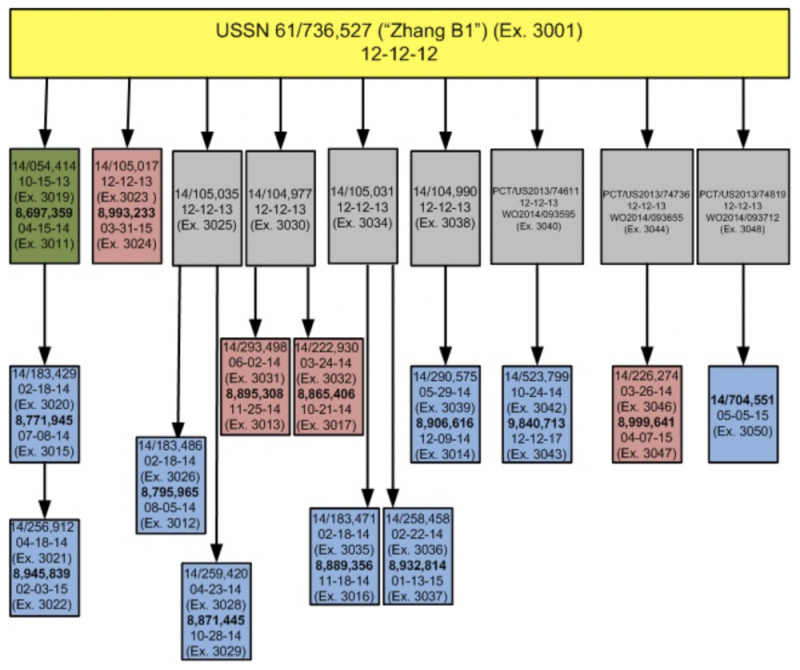
    The brief includes a schematic of the relationship between Zhang B1 and the multiple patents and applications claiming priority thereto:

    2019-11-18 Image
    These priority relationships are claimed in each link in the priority chain, according to the Broad, with reference to more than a dozen facts set forth in the Appendix of material facts.  While admitting that the priority claim is set forth in each in "boilerplate language" (perhaps anticipating CVC's objection), the brief asserts that "[t]he PTAB has held that such 'boilerplate language' . . . broadly stating without further qualification that the earlier-filed patents are 'incorporated by reference,' is sufficient in view of Federal Circuit precedent to incorporate the disclosure of at least the [earlier filed] patent into each later-filed patent," citing Symantec Corp. v Finjan, Inc., 2016 WL 1081973 (IPR2015-01897 (PTAB February 26, 2016)) (citing Harari v Lee, 656 F. 3d 1331, 1335 (Fed. Cir. 2011).  Further support is asserted by the Broad because Example 1 from Zhang B1 is explicitly disclosed in Broad's involved U.S. Patent Nos. 8,771,945; 8,795,965; 8,871,445; 8,889,356; 8,932,814; 8,945,839; 8,906,616 and 9,840,713, as well as the Broad's involved U.S. Patent Application No. 14/704,551.  Other patents in the priority chain incorporate Zhang B1 by reference.  The brief then asserts that the priority claim in each case complied with the requirements of 35 U.S.C. § 120.

    Turning to Example 1 of Zhang B1, the brief sets forth the argument for Zhang B1 satisfying the requirements for constructive reduction to practice, including the level of one of ordinary skill in the art and how Example 1 would be understood by such a person (in detail).  According to the Broad, "Zhang B1 sufficiently teaches, describes and enables each embodiment such that [a person having ordinary skill in the art would be able to use each embodiment successfully, without undue experimentation, and hence provides systems, cells, and methods falling within the scope of Count 1."  The brief characterizes as "the Broad half of the Count" the alternative recited in the Broad patent used as the exemplar of the Count and recites with reference to the specification the disclosure in Zhang B1 disclosing these elements.  The brief supports these explications of the Zhang B1 disclosure with expert affidavit testimony.  The brief then sets forth disclosure in Zhang B1 of the elements defined by the "CVC half of the Count," the alternative recited in the CVC application used as the exemplar of the Count.

    The brief then turns to enablement, focused on the "working examples" of CRISPR-Cas9 set forth in Zhang B1, including disclosure of utility in eukaryotic cells for the disclosed technology.

    Accordingly, the brief asks the Board to grant priority to Zhang B1, giving the Broad a presumptive priority date of December 12, 2012.

  • CalendarDecember 2, 2019 – "Cross-Border Trends, Tactics and Strategic Insights: What European and U.S. Lawyers Should Each Know About Litigating Abroad" (Practising Law Institute) – London

    December 5, 2019 – Intellectual Property Law Educational Program (Clyde & Co and McDonnell Boehnen Hulbert & Berghoff LLP) – 6:15 pm to 7:00 pm, London

  • MBHB Logo 2Clyde & Co and McDonnell Boehnen Hulbert & Berghoff LLP will be hosting an onsite program from 6:15 pm to 7:00 pm on December 5, 2019 at Central Working (4th floor) in London (80 Wood Lane, White City, London W12 0BZ).  The program, which will take place in conjunction with I-HUB at Imperial College London, will offer presentations on the following topics:

    • Patenting In the USA: Is There Anything Patent Eligible? — Paul Tully and Kevin Noonan of McDonnell Boehnen Hulbert & Berghoff LLP
    • Outstanding Benefit & Inventor Compensation — Ralph Cox

    A welcome reception will precede the program and a cocktail reception will follow the program.

    Clyde & CoThere is no registration fee for the program.  However, those interested in attending the program must register by contacting Susan Hall at hall@mbhb.com.  By registering for this event, attendees agree to Clyde & Co and MBHB processing their personal data for the purposes of facilitating the event.  Additional information about the event can be found here.

  • By Kevin E. Noonan

    Broad InstituteOn October 14th, Senior Party the Broad Institute (joined by Harvard University and MIT) filed several authorized motions, including Substantive Motion No. 3 (to designate claims as not corresponding to the count), against Junior Party the University of California, Berkeley; the University of Vienna; and Emmanuelle Charpentier; collectively, "CVC."  In its Motion No. 3, the Broad asks the Patent Trial and Appeal Board to designate some of its claims as not corresponding to the Count in Interference No. 106,115 as declared.

    It should be appreciated that this Motion No. 3 is part and parcel of the Broad's motions to remake the contours of the interference, along with Motion No. 2 (to substitute the Count) and Motion No. 4 (to be awarded benefit of priority to USSN 61/736,527).  In this Motion No. 3, the Broad reiterates the arguments made in Motion No. 2, that there are two embodiments of CRISPR, one involving single-molecule RNA guide RNA (which the Broad argues here is not recited in the claims it wants the Board to designate as not corresponding to the Count) and further that certain of the Broad's claims directed to "SaCas9" systems that require two or more NLSs do not correspond to the Count.

    The brief parsed the Broad's claims into three categories of claims that do not correspond to the Count, depending on how the Board rules on Substantive Motions Nos. 1 and 2:

    • USP 8,865,406 – Claims 1-30 (all); 8,871,445 – Claims 1-30 (all); USP 8,889,356 – Claims 1-30 (all); USP 8,932,814 – Claims 1-30 (all); USP 8,945,839 – Claims 1-28 (all); USP 8,993,233 – Claims 1-43 (all); USP 8,999,641 – Claims 1-28 (all); USP 8,697,359 – Claims 1-3, 5-10, 12-17, and 19-20; USP 8,771,945 – Claims 1-4 and 6-29; USP 8,895,308 – Claims 1-9 and 11-28; USP 8,906,616 – Claims 1, 3-4, 6-30; USP 9,840,713 – Claims 1-7, 10-15, 17-26, and 28-41; and U.S. Patent Application No. 14/704,551: in the event that the Board denies both Motions No. 1 and 2

    • USP 8,865,406 – Claims 1-30 (all) and USP 8,895,308 – Claims 1-30 (all): in any event, claims reciting Ca9 from Staphylococcus aureus

    • USP 8,871,445 – Claims 1-30 (all); USP 8,932,814 – Claims 1-30 (all); USP 8,993,233 – Claim 7; USSN 14/704,551 – Claims 9-11: clams reciting two or mote nuclear localization signal

    And what would remain, should the Board grant this motion:

    • U.S. Patent No. 8,697,359, claims 4, 11, and 18; U.S. Patent No. 8,795,965, claims 1-30 (all); U.S. Patent No. 8,771,945, claim 5; U.S. Patent No. 8,906,616, claims 2 and 5; and U.S. Patent No. 9,840,713, claims 8-9, 16, and 27

    Regarding the first set of claims the Broad asserts do not correspond to Count No. 1 (which the Broad admits "includes the vast majority of [its] Involved Claims"), the Broad argues that the Count of the interference as declared is directed to "single-molecule guide RNA molecule"-comprising embodiments and the claims it has asked the Board to designate as not corresponding to the Count do not encompass these embodiments.  The brief sets forth the Broad's understanding that, should the Board deny the Broad's Substantive Motions Nos. 1 and 2, then the interference will involve priority to such single-molecule guide RNA embodiments as a separate, patentable invention over claims that encompass both single-molecule and dual molecule embodiments.  Thus, the Broad argues that its claims limited to dual-molecule embodiments do not correspond to the Count and the Board should so designate.

    The brief cites for support for its motion CVC's statements (erroneously termed "Remarks provoking this Interference"; the interference was declared sua sponte by the Board not provoked by CVC) that CVC's generic claims "should not be included in an interference involving [its single-guide RNA claims], because those other claims are generic with respect to the guide RNA and are thus directed to a separately patentable invention."  Under PTAB Rule 207(b), the Board provides relief to an inventor of a generic claim facing a specific count to move, as the Broad has done here, for their generic claims to be designated as not corresponding to the Count.  The Broad asserts as reasons/justifications for de-designating certain (most) of its claims:

    • Count 1 is limited to the single-molecule invention, and would not be determining priority to generic, non-limited RNA embodiments of CRISPR, "violating" the "'primary purpose of an interference'" to make a priority determination of "each of the common [patentably distinct] inventions claimed by the parties,'" citing Godtfredsen v. Banner, 598 F. 2d 589, 592 (C.C.P.A. 1979).  The brief takes the opportunity to reiterate the unfairness of this outcome in view of the nature of their invention, e.g., a "breakthrough invention that revolutionized gene editing was the successful engineering of CRISPR-Cas9 systems for use in eukaryotic cells."

    • There can be no interfering subject matter between the single-molecule RNA "invention" and generic, non-limited RNA CRISPR embodiments.  Under these circumstances, the brief argues a two-count interference should be declared with each invention to reiterate its allegation that CVC had made a strategic decision not to present claims to eukaryotic embodiments of CRISPR in the earlier, '048 interference.

    • It would be unfair to put all the Broad's claims at risk under these circumstances because it would "t[ie] its hand to its best generic RNA proofs," which the brief characterizes as being "particularly egregious given that Broad could have relied on its best proofs during the 048 Interference, when the Count properly reflected the scope of the parties' claims."

    Next, the Broad argues that its claims to SaCas9 embodiments and to claims requiring two or more nuclear localization sequences (NLS's) do not correspond to Count 1.  The Broad argues that these embodiments were not disclosed in the prior art and "provides a surprising combination of benefits not taught or suggested by the art" for both types of embodiments.

    The brief then sets forth the Broad's characterization of the person of ordinary skill in the art, the properties and characterization of single- and dual-molecule RNA embodiments of CRISPR, a hagiography regarding the Broad's "pioneering eukaryotic CRISPR-Css9 work in 2011-2012" directed to dual-molecule RNA embodiments thereof, setting forth figures from contemporaneous grant proposals
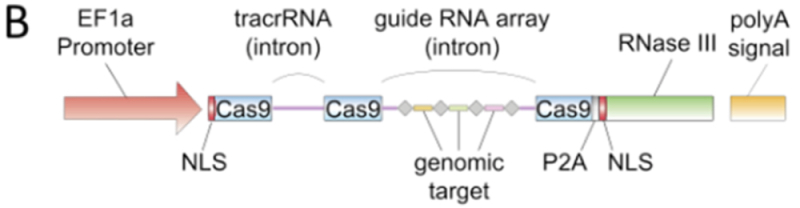
    Image 1
    and scientific papers, and the "Zhang B1" provisional USSN 61/736,527

    Image 2
    illustrating its reduction to practice of these embodiments of the invention.

    The brief then reiterates the history of the '048 Interference, the PTAB's decision, and the Federal Circuit's affirmance of there being no interference-in-fact between the claims in that interference.  Those claims were limited to eukaryotic cell embodiments for the Broad and unlimited with regard to target cell for CVC's claims; the brief notes that CVC provoked the claim to single-molecule CRISPR embodiments.  Following these events, CVC pursued claims to "generic/non-limited, single-molecule, and dual-molecule RNA" CRISPR embodiments.  This is followed by the Broad's continued inaccuracy in characterizing the interference as being "provoked" by CVC (in fact, the PTAB declared the interference sua sponte).  The brief accurately cites CVC's arguments to the PTAB that single-molecule RNA CRISPR was patentably distinct from dual-molecule RNA embodiments.

    Section V of the brief sets forth its arguments based on these facts, that certain of its claims should not correspond to Count 1.  Citing 37 C.F.R. § 41.207 et seq., the brief asserts that the proper way to address the presumption regarding patentability must be addressed (as here) by filing a motion to designate claims as not corresponding to the count.  And:

    In the situation with a two-count interference – with a generic count and a separate species count – such a motion would be often be deferred until the priority phase and dismissed "unless there were a split award on priority, in which case proof that the generic invention antedates the priority proofs for the lost species count would likely justify relief."

    But here the PTAB has not declared a two-count interference, and according to the brief, the first interference satisfied the question of priority to the "generic" invention (and once again CVC should not be heard to complain about the consequences of their strategic choices in the Broad's view).

    The brief argues that the PTAB's failure to grant the motion "would conflict with the primary purpose of interferences" (awarding priority to the first to invent a patentable invention, wherein defining that patentable invention is the question before the Board as set forth in the Broad's motions in this interference).  While the Count is directed to single-molecule RNA embodiments of CRISPR technology, the Broad's claims-in-interference encompass dual-molecule RNA embodiments as well (which the brief includes in its definition of the "generic, non-limited RNA invention").  The brief cites Godtfredsen (in which the court rejected a priority award to multiple species comprising a Markush group count in an instance where there were three patentably distinct inventions, because "the party who proved the earliest date of invention as to any one of the members of the group would be awarded priority as to the entire count") and Theeuwes v. Bogentoft, 2 U.S.P.Q.2d 1378 (B.P.A.I. 1986) (where there were two patentable inventions and the Board found it anomalous that party could be awarded priority a count covering species A and B while proving priority to species B alone) in support of its argument, and cites Ex Parte Hardman, 142 U.S.P.Q. (BNA) ¶ 329 (July 28, 1964), as an instance where the Board held a genus claim unpatentable over a species disclaimed in an earlier interference (finding it inequitable to find otherwise).  The brief ties this precedent to the claims in this interference it had moved to dedesignate, on the grounds that "Dr. Zhang succeeded with both dual and single molecule RNA systems" and "[t]hus, it would be entirely inappropriate to award priority to the broad invention of eukaryotic CRISPR systems to a party who made a species invention long after the break."  The remainder of the Broad's argument in this regard expound on the purported unfairness in determining priority to the claims it had moved to dedesignate based on Count 1.

    The brief then supplements with greater specificity the distinctions between "generic, non-limited RNA" embodiments of CRISPR claimed in the claims the Broad moves to dedesignate and the single-molecule RNA embodiments encompassed in the Count, particularly with regard to definitions for "guide RNA," tracr RNA," and other species comprising various permutations of CRISPR technology, in contrast to CVC's interpretation of these terms in the claims.

    Finally, the brief reiterates the Broad's arguments regarding claims reciting SaCas9 and species comprising more than 2 NLS's as not corresponding to the Count.  For the former species, the brief asserts that:

    As of 2012, there were more than 600 bacterial Cas9 orthologs.  MF 29; Ex. 3226, Ran et al., In vivo genome editing using Staphylococcus aureus Cas9, 520 Nature 186-191 (2015), 1; Ex. 3401, Seeger ¶¶ 6.5, 6.13.  Broad is unaware of any prior art suggesting the use of, or providing reasons for the selection of, SaCas9 in a CRISPR system adapted for use in eukaryotes.  Indeed, CVC, in its Opposition to a similar motion in the 048 Interference, did not point to any such prior art either.  Ex. 3115, Paper 689 (Opp. to 048 Mot. 5).  Where, as here, the prior art choices are vast, the prior art must provide some reason to make the selection in order to find obviousness.  Ortho-McNeil Pharm., Inc. v. Mylan Labs., Inc., 520 F. 3d 1358, 1364 (Fed. Cir. 2008).  Here, the prior art fails to provide, or even suggest, a reason to select SaCas9.

    The brief similarly argues that the art did not suggest embodiments comprising more than two NLSs in CRISPR systems, and that its claims directed to such embodiments should be found not to correspond to the Count on that basis:

    The prior art lacked disclosure of advantages for two or more NLS(s) demonstrates that the use of two or more NLSs and there is no teaching, suggestion, motivation or reason in the prior art that would have caused a POSA to use two or more NLSs.  . . .  Therefore, claims including a limitation requiring two or more NLSs should be designated as not corresponding to Count 1.

  • By Michael Borella

    Federal Circuit SealKoninklijke KPN N.V. (KPN) sued Gemalto M2M GmbH (Gemalto) and several other parties in the District of Delaware for infringement of its U.S. Patent No. 6,212,662.  The defendants moved for dismissal under Rule 12(c), contending that the asserted claims lacked subject matter eligibility.  The District Court judge granted the motion.  KPN appealed.

    The Invention

    The '662 patent involves checksums, which are calculations performed over blocks of data that result in a short (e.g., 16, 32, or 64 bit) code.  These calculations may be a simple exclusive or operation, a more complicated cyclic redundancy check, or a hash function.  Virtually all data transmitted on a network, wired or wireless, is accompanied by a checksum.  In most cases, the transmitter calculates the checksum, appends the code to the blocks of data to be sent, and then sends the block and code.  The receiver calculates its own version of the checksum over the blocks of data.  If this matches the transmitted code, then the receiver can be reasonably assured that the blocks of data were not corrupted (e.g., due to random noise) during the transmission.  But checksums are not perfect, and occasionally a corrupt block can produce the same code as if it were error free.

    The inventors of the '662 patent observed that checksums often fail in the presence of certain types of systematic errors — non-random errors that repeat from block to block.  For instance, "[i]f a fixed [checksum] generating function produced defective check data for a transmission that was corrupted with a given systematic error (e.g., first and fourth bit is erroneous in every data transmission), that fixed generating function would likely continue to produce the same defective check data every time that systematic error appeared."  In these cases, the systematic error will not be detected by the checksum.

    The '662 patent involves "var[ying] the way check data is generated from time to time so that the same defective check data does not continue to be produced for the same type of persistent systematic error."  This variability dramatically decreases the probability that a receiver will not detect repetitive errors after validating the checksum.  One of the ways that the generation of check data can be varied is "through permutation, which interchanges the bit position in a data block."

    The Claims

    Of the claims invalidated, only 2, 3, and 4 were under appeal.  Claim 2 depends from claim 1, and claims 3 and 4 depend from 2, so all are shown below.

    1.  A device for producing error checking based on original data provided in blocks with each block having plural bits in a particular ordered sequence, comprising:
        a generating device configured to generate check data; and
        a varying device configured to vary original data prior to supplying said original data to the generating device as varied data;
        wherein said varying device includes a per-mutating device configured to perform a permutation of bit position relative to said particular ordered sequence for at least some of the bits in each of said blocks making up said original data without reordering any blocks of original data.

    2.  The device according to claim 1, wherein the varying device is further configured to modify the permutation in time.

    3.  The device according to claim 2, wherein the varying is further configured to modify the per-mutation based on the original data.

    4.  The device according to claim 3, wherein the permutating device includes a table in which subsequent permutations are stored.

    The Patent-Eligibility Test

    The two-part test from Alice Corp. v. CLS Bank Int'l is used to determine whether claims are eligible for patenting under 35 U.S.C. § 101.  One must first decide whether the claim at hand involves a judicially-excluded law of nature, a natural phenomenon, or an abstract idea.  If so, then one must further decide whether any element or combination of elements in the claim is sufficient to ensure that the claim amounts to significantly more than the judicial exclusion.  But, elements or combinations of elements that are well-understood, routine, and conventional will not lift the claim over the § 101 hurdle.  While this inquiry is generally carried out as a matter of law, factual issues can come into play when determining whether something is well-understood, routine, and conventional.

    The District Court Proceedings

    The District Court found the claims to be directed to an abstract idea at step one of Alice because "they do not say how data is re-ordered, how to use reordered data, how to generate additional data, how to use additional data, or even that any data is transmitted," and for the dependent claims, "they do not say how the permutations are modified in time or modified based on the data."  The claims failed at step two of Alice, according to the District Court, because the "purported inventive concept was not captured in the claims."

    The Federal Circuit Decision

    On review, the Federal Circuit reversed the District Court.  Explaining the Alice framework, the Court wrote that "[i]n cases involving software innovations, [the step one] inquiry often turns on whether the claims focus on the specific asserted improvement in computer capabilities or, instead, on a process that qualifies as an abstract idea for which computers are invoked merely as a tool."  The Court further noted that "[s]ince Alice, we have found software inventions to be patent-eligible where they have made non-abstract improvements to existing technological processes and computer technology."  Moreover, these improvements must be specific — "[a]n improved result, without more stated in the claim, is not enough to confer eligibility to an otherwise abstract idea . . . [t]o be patent-eligible, the claims must recite a specific means or method that solves a problem in an existing technological process."

    With respect to claims 2-4, the Court found them patent-eligible "because they are directed to a non-abstract improvement in an existing technological process . . . [b]y requiring that the permutation applied to original data be modified in time, claim 2 . . . recites a specific implementation of varying the way check data is generated that improves the ability of prior art error detection systems to detect systematic errors."  This results in "a new way of generating check data that enables the detection of persistent systematic errors in data transmissions that prior art systems were previously not equipped to detect."

    The defendants argued that the claims were abstract because they "fail to recite a last application step that uses the generated check data to actually perform error detection," and thus lacked a concrete application.  The Court took a different view, stating that "[a] claim that is directed to improving the functionality of one tool (e.g., error checking device) that is part of an existing system (e.g., data transmission error detection system) does not necessarily need to recite how that tool is applied in the overall system (e.g., perform error detection) in order to constitute a technological improvement that is patent-eligible."  Further, "the more relevant inquiry is whether the claims in this patent focus on a specific means or method that improves the relevant technology or are instead directed to a result or effect that itself is the abstract idea and merely invoke processes and machinery."  Notably, the claimed modification of the permutation in time was a "specific solution for accomplishing [the] goal—i.e., by varying the way check data is generated by modifying the permutation applied to different data blocks."

    The Court went on to distinguish the present claims over those found ineligible in Digitech Image Technologies, LLC v. Electronics for Imaging, Inc., RecogniCorp, LLC v. Nintendo Co., Two-Way Media Ltd. v. Comcast Cable Communications, LLC, and Intellectual Ventures I LLC v. Capital One Financial Corp.  The critical point for the Court was that "[w]hile the patents in these cases may have claimed an improved result in a technical field, the claims failed to recite a specific enough solution to make the asserted technological improvement concrete."  In contrast, claims 2-4 "specifically recite how this permutation is used (i.e., modifying the permutation applied to different data blocks), and this specific implementation is a key insight to enabling prior art error detection systems to catch previously undetectable systematic errors."

    As a consequence, the claims are not abstract under step one of Alice, step two was not considered, and the Federal Circuit reversed the District Court.  The moral of this story is that a claim specifically reciting a particular technical improvement over the prior art, where the improvement is described as such in the specification, is better equipped to survive a § 101 challenge than a claim lacking either of these qualities.  Of course, the amount detail in the claimed technical improvement required to reach this level of specificity remains an open question.

    Koninklijke KPN N.V. v. Gemalto M2M GmbH (Fed. Cir. 2019)
    Panel: Circuit Judges Dyk, Chen, and Stoll
    Opinion by Circuit Judge Chen