• By Kevin E. Noonan —
    Federal Circuit SealThe patent marking statute, codified at 35 U.S.C. § 287(a) appears straightforward:

    Patentees, and persons making, offering for sale, or selling within the United States any patented article for or under them, or importing any patented article into the United States, may give notice to the public that the same is patented, either by fixing thereon the word "patent" or the abbreviation "pat.", together with the number of the patent, or by fixing thereon the word "patent" or the abbreviation "pat." together with an address of a posting on the Internet, accessible to the public without charge for accessing the address, that associates the patented article with the number of the patent, or when, from the character of the article, this can not be done, by fixing to it, or to the package wherein one or more of them is contained, a label containing a like notice.  In the event of failure so to mark, no damages shall be recovered by the patentee in any action for infringement, except on proof that the infringer was notified of the infringement and continued to infringe thereafter, in which event damages may be recovered only for infringement occurring after such notice.  Filing of an action for infringement shall constitute such notice.

    Applying the statute to circumstances can be more complicated when the patented invention is a component of an article in commerce, which was the case in Arctic Cat Inc. v. Bombardier Recreational Products Inc., decided last week by the Federal Circuit, limiting the amount of damages due from an infringer based on this section of the Patent statute.

    The case arose over infringement of Arctic Cat's U.S. Patent Nos. 6,793,545 and 6,568,969 by Bombardier, the patents directed to steering systems in personal watercraft (PWC) such as jet skis.  Arctic Cat ceased selling PWC in favor of a licensing agreement with Honda.  This licensing agreement had contained a provision requiring Honda to mark all licensed products sold with appropriate patent numbers, but this provision was not included in the final agreement between the parties.  It was undisputed that Arctic Cat failed to monitor whether Honda was properly marking but not when Honda stopped neglecting this responsibility and began to mark; Arctic Cat asserted September 6, 2013 as the latest date when Honda sold unmarked items while Bombardier alleged Honda sold unmarked PWCs as late as 2018.

    A jury found the asserted patents to be infringed and not invalid, and awarded damages calculated from October 16, 2008 (a date 6 years before Arctic Cat filed suit and a little less than five years before Arctic Cat agreed Honda stopped selling unmarked items).  The jury also found that Bombardier's infringement was willful.  In an earlier appeal, Arctic Cat Inc. v. Bombardier Recreational Prods. Inc., 876 F.3d 1350 (Fed. Cir. 2017), the Federal Circuit affirmed the jury's willfulness determination by vacating and remanding on the marking issue for putting the burden on Bombardier to show that unmarked articles did not practice the claimed invention.  Rather, according to that panel, "once an alleged infringer identifies products that it believes are unmarked patented articles subject to the notice requirements of § 287, the patentee bears the burden of proving that the identified products do not practice the claimed invention."  On remand (the subject of this appeal), Arctic Cat moved for summary judgment that it was entitled to "pre-complaint" damages, and that § 287 "did not apply after the time that it alleges Honda stopped selling unmarked products." "More ambitiously," as characterized by the panel opinion, Arctic Cat asserted that the jury's willfulness determination constituted notice and hence it was entitled to the entire period when Bombardier was selling PWCs that infringed the patents in suit under § 286, which constituted a time period when Honda was undisputedly selling unmarked items.  The District Court disagreed and limited the damages awarded not to include damages for pre-complaint sales.

    The Federal Circuit affirmed, in an opinion by Judge Lourie joined by Judges Moore and Stoll.  The opinion set forth the principles behind the restriction of damages embodied in § 287, that while a patentee who does not make or sell a patented article can obtain damages for any infringing article, even without notice, when a patentee makes or sells and fails to mark, she cannot collect damages until she either provides actual notice or sues the accused infringer.  This amounted to cure of the neglect of not marking, but it also provides definitive boundaries on when damages can be obtained for infringing activity and when the statute provides that damages cannot be so obtained — all based on patent marking.  The circumstances in this case were somewhat of an anomaly ("a discontinuous situation") because "unmarked products were sold, such that Arctic Cat could not receive damages before providing notice, but the sales of unmarked products allegedly stopped for a period of time prior to the filing of Arctic Cat's complaint."  As a consequence, the question the Court perceived was presented is "whether the cessation of sales of unmarked products excuses noncompliance with the notice requirement of § 287 such that a patentee may recover damages for the period after sales of unmarked products ceased but before the filing of a suit for infringement," a question having an answer for this panel of "no."

    The panel rejected Arctic Cat's statutory interpretation dependent on the statute being written in the present tense, so that ceasing sales of unmarked product would be sufficient to cure.  This comes from the language of the statute according to the opinion, which while casting a patentee's conduct in the present tense, the consequences of failing to mark are not limited in time.  The statutory language "prohibits a patentee from receiving any damages in a subsequent action for infringement after a failure to mark, rather than merely a reduced amount of damages in proportion to the amount of time the patentee was actually practicing the asserted patent" according to the opinion (emphasis added).  The statute imposes an obligation to mark when the patentee (or in this case, its licensee) begins to sell the patented article.  Succinctly, the opinion captures the equities of these responsibilities saying:

    The notice requirement to which a patentee is subjected cannot be switched on and off as the patentee or licensee starts and stops making or selling its product.  After all, even after a patentee ceases sales of unmarked products, nothing precludes the patentee from resuming sales or authorizing a licensee to do so.  In the meantime, unmarked products remain on the market, incorrectly indicating to the public that there is no patent, while no corrective action has been taken by the patentee.  Confusion and uncertainty may result.  Thus, once a patentee begins making or selling a patented article, the notice requirement attaches, and the obligation imposed by § 287 is discharged only by providing actual or constructive notice.

    The panel also found this interpretation to be consistent with the purpose of the statute:  "(1) helping to avoid innocent infringement; (2) encouraging patentees to give public notice that the article is patented; and (3) aiding the public to identify whether an article is patented," citing Nike, Inc. v. Wal-Mart Stores, Inc., 138 F.3d 1437, 1443 (Fed. Cir. 1998), whereas Arctic Cat's interpretation "would undermine those objectives" because it would allow a patentee "to allow a patentee to mislead others that they are free to make and sell an article that is actually patented, but nonetheless allow the patentee to recover damages without undertaking any corrective action."

    The Court also rejected Arctic Cat's argument that a finding of willfulness was enough to establish actual notice, not least because "Arctic Cat acknowledges, as it must, that this argument is foreclosed by our precedent" citing Amsted Indus. Inc. v. Buckeye Steel Castings Co., 24 F.3d 178, 187 (Fed. Cir. 1994), and relying on Am. Med. Sys., Inc. v. Med. Eng'g Corp., 6 F.3d 1523, 1537 n.18 (Fed. Cir. 1993).  The distinction drawn by the panel is that "willfulness turns on the knowledge of an infringer, [while] § 287 is directed to the conduct of the patentee" and "[k]nowledge by the infringer is not enough.  Actual notice under § 287 requires performance by the patentee."  Accordingly, the opinion affirmed the District Court's denial of pre-complaint damages.

    Arctic Cat Inc. v. Bombardier Recreational Products Inc. (Fed. Cir. 2020)
    Panel: Circuit Judges Lourie, Moore, and Stoll
    Opinion by Circuit Judge Lourie

  • By Bryan Helwig —

    USPTO SealAbout the PTAB Life Sciences Report:  We will periodically report on developments at the PTAB involving life sciences patents.

    Abbott Laboratories v. Edwards Lifesciences Corp.

    PTAB Petition:  IPR2020-00480; filed January 28, 2020.  View Petition here.

    Patent at Issue:  U.S. Patent No. 6,719,767, ″Device and a method for treatment of atrioventricular regurgitation," describes a less invasive based mitral-valve clip method for treating "mitral insufficiency" instead of traditional open-heart surgery.  Petitioner requests institution of IPR, seeking cancellation of claims 1-3, 5, and 14 of the ′767 patent as unpatentable under 35 U.S.C. §§ 102 and 103.

    Background:  Petitioner alleges that the challenged claims recite a clip that can be delivered with a catheter passing through a patient's blood vessels and used to repair the mitral valve in the heart, rather than via open-heart surgery.  Petitioner notes that Abbott's subsidiary, Evalve, had already developed and patented several such clips.  Specifically, Abbott's prior art U.S. Patent No. 6,629,534 describes clips for catheter-based mitral valve repair.  Petitioner alleges that the clips in the prior art and the '767 patent are nearly identical, other than the position of the crossbars.


    Glaxosmithkline Consumer Healthcare Holdings (US) LLC v. Cipla Ltd.

    PTAB Petition:  IPR2018-0368; filed January 31, 2020.  View Petition here.

    Patent at Issue:  U.S. Patent No. 8,163,723, "Combination of azelastine and steroids," is directed at a pharmaceutical product comprising azelastine and a steroid, in a form suitable for nasal or ocular administration.  The '723 patent provides a method of prophylaxis or treatment in a mammal where anti-histamines and/or one or more steroids is indicated.  Petitioner challenges claims 1-218 of the ′723 patent as unpatentable under 35 U.S.C. § 103.

    Background:  The claims are directed to methods of using formulations comprising azelastine and fluticasone.  Petitioner alleges that nasal sprays comprising each of these ingredients were known in the prior art and approved by the FDA as safe and effective for allergic rhinitis.  Petitioner also alleges that co-formulation of the two ingredients into a single formulation, and the benefits of such co-formulations, were also known in the prior art, and that combining the teachings of the prior art to arrive at the claimed invention would have been obvious to one of skill in the art.


    Mylan Laboratories Ltd. v. Janssen Pharmaceutica NV

    PTAB Petition:  IPR2020-00440; filed February 7, 2020.  View Petition here.

    Patent at Issue:  U.S. Patent No. 9,439,906, "Dosing regimen associated with long acting injectable paliperidone esters," is directed at a method of treating patients in need of treatment with long acting injectable paliperidone palmitate formulations.  Petitioner challenges claims 1-21 of the '906 patent as unpatentable under 35 U.S.C. § 103.

    Background:  The ′906 patent claims a dosing regimen for administering paliperidone palmitate to a psychiatric patient in need of treatment for schizophrenia, schizoaffective disorder, or schizophreniform disorder.  Petitioner alleges that the claims of the '906 patent are the result of routine optimization of dosing amounts of paliperidone palmitate reported in the prior art.  More specifically, Petitioner alleges that dosing regimens and dosages can be found in the prior art.  Petitioner also alleges that the dosage on each day would have been guided by well-known principle involving injectable depot formulations.


    NanoCellect Biomedical, Inc. v. Cytonome/ST, LLC

    PTAB Petition:  IPR2020-00549; filed February 11, 2020.  View Petition here.

    Patent at Issue:  U.S. Patent No. 10,029,263, "Method and apparatus for sorting particles," is directed at a method and apparatus for the sorting of particles in a suspension, where the input flow path of a sorting module can be split into several output channels.  The claims are further directed at a particle sorting system in which a plurality of sorting modules are interconnected to increase particle throughput.  NanoCellect challenges claims 1, 5-6, 8, 15, and 16 as obvious under 35 U.S.C. § 103.

    Background:  The '263 patent claims a microfludic system for sorting particles.  Petitioner alleges that the claimed combination of elements was already disclosed in a prior art reference.  Further, Petitioner alleges that by the priority date cytometers, including sorters using heater electrodes and piezoelectric actuators for cell sorting, were widely available, and functioning microfluidic devices were also known.

  • CalendarFebruary 26, 2020 – "Blocking Patents in Prosecution Strategy and Corporate IP Strategy after Acorda" (Intellectual Property Owners Association) – 2:00 to 3:00 pm (ET)

    March 5, 2020 – "Enhancing Diversity & Inclusion in IP Law and Beyond" (Federal Circuit Bar Association) – 3:00 pm to 5:30 pm (ET), Washington, DC

    March 11, 2020 – Patent Litigation Seminar (New Jersey Intellectual Property Law Association) – 12:00 to 5:30 pm, Iselin, NJ

    March 11, 2020 – "Navigating USPTO Pilot Programs" (McDonnell Boehnen Hulbert & Berghoff LLP) – 10:00 am to 11:15 am (CT)

    March 12, 2020 – "Opposition Practice at the EPO" (J A Kemp) – 15:30 to 16:30 pm GMT (Greenwich Mean Time)

    March 13, 2020 – "Digital Platforms: Innovation, Antitrust, Privacy & the Internet of Things" (The UIC John Marshall Law School) – 8:45 am to 4:30 pm, Chicago, IL

    April 27-28, 2020 – Paragraph IV Disputes Master Symposium (American Conference Institute) – New York, NY

    May 20-21, 2020 – Advanced Summit on Life Sciences Patents (American Conference Institute) – New York, NY

  • NJIPLAThe New Jersey Intellectual Property Law Association (NJIPLA) will be holding a Patent Litigation Seminar from 12:00 to 5:30 pm on March 11, 2020 in Iselin, NJ.  The seminar will offer presentations on the following topics:

    • Patent Cases at the Supreme Court: From Petitions to CVSGs to Arguments, and Everything in Between
    • Written Description and Enablement Issues in Pharma/Bio Patents — Latest Developments
    • Willful Infringement: Acts of Piracy
    • A Behind the Scenes Look at a Supreme Court Argument and a Biotech Jury Trial: A Conversation with Morgan Chu, Irell & Manella LLP
    • Diagnosing what Ails Patent Eligibility: Can this Problem be Solved? – to be presented by Patent Docs author Donald Zuhn of McDonnell Boehnen Hulbert & Berghoff LLP
    • Recent Developments in Inducement and Divided Infringement

    Additional information regarding the seminar, including a complete agenda and list of speakers, can be found here.  The registration fee for the seminar is $185 (member), $230 (non-member), $105 (in-house counsel/government employee member) $130 (in-house counsel/government employee non-member), or $45 (students).  Those interested in registering for the seminar can do so here.

  • J A KempJ A Kemp will be offering a webinar entitled "Opposition Practice at the EPO" on March 12, 2020 from 15:30 to 16:30 pm GMT (Greenwich Mean Time).  Sarah Roques and Ravi Srinivasan of J A Kemp will consider opposition practice, including how to set up an attacking opposition, and also highlight strategies for defence, including setting up the case in prosecution and formulating a strategy for amendment during opposition.  The webinar will also address the following topics:

    • Grounds of opposition and approaches to setting up an opposition statement
    • Good defence starts in prosecution
    • Claim amendments — auxiliary requests in opposition
    • Overall strategies for attack and defence, to maintain flexibility on appeal
    • The role of experiments: what supporting data can usefully be filed, and when should it be provided
    • Oral proceedings at the EPO

    Those wishing to register can do so here.

  • UIC JMLSThe UIC John Marshall Law School is holding a conference entitled "Digital Platforms: Innovation, Antitrust, Privacy & the Internet of Things" on March 13, 2020 from 8:45 am to 4:30 pm.  According to the announcement:

    Online platforms have become a focal point for many in the United States as well as in key jurisdictions around the world.  Governments and legal advisors are struggling to understand the issues and implications these platforms raise, particularly in the areas of intellectual property, privacy, and antitrust law and practice.  This Conference brings together top experts in government, industry, practice, and academia to share their cutting-edge insights on these issues as well as where things are headed.  It will feature highly interactive sessions and opportunities to speak directly to these experts to have questions answered.  It is the only event of its kind in the Midwest and one that is not to be missed.

    The program will be held at UIC John Marshall Law School in Chicago, IL.  The school is offering 6.25 hours of CLE credit (pending approval).  The fees for the conference are:  General Registration: $195; In-house/Nonprofits/Small Firms: $95; Government: Free, Limited scholarships available for 2017–2019 JMLS graduates, non-UIC students, academics; and needs-based attendees, Free for: UIC Students, Faculty, Adjunct Professors, Staff, and IP Center Advisory Board Members.

    Additional information can be found here.

  • ACIAmerican Conference Institute (ACI) will be holding its 18th Advanced Summit on Life Sciences Patents conference on May 20-21, 2020 in New York, NY.

    The conference will offer presentations on the following topics:

    • PTAB Keynote from Hon. Jacqueline Bonilla
    • Written Description and Enablement Requirements for Small Molecule Patenting in U.S., Europe, and China
    • Written Description and Enablement Requirements for Antibody Patenting in U.S. and Europe
    • Section 101: Exploring the Realities of the New PTO guidance
    • Navigating the Evolving Obviousness-type Double Patenting Landscape
    • Inherency and Obviousness: Anticipating What's Next Around the World
    • Comparing and Contrasting Licensing Agreements in U.S. and Europe 
    • Doctrine of Equivalence Analysis: Understanding how the Latest DoE Decisions will Impact Future Trends in Patent Law Protection in the U.S., Europe, and Asia 
    • Social Contracting: Understanding Its Impact on Patent Portfolio Design
    • Exploring the Future of Patent Protection Through Artificial Intelligence 
    • Ethical Obligations in Prosecution

    In addition, two pre-conference workshops will be offered on May 19, 2020.  The first, entitled "Masterclass on Drafting Life Sciences Patent Applications in the U.S., Europe and Asia," will be offered from 9:00 am to 12:30 pm, and the second, entitled "Working Group on Developing Effective Patent Filing Strategies for Combination Products," will be offered from 1:30 to 5:00 pm.

    The registration fee for the conference alone is $2,095 (by March 15th) or $2,195 (by April 3rd).  The workshops carry an additional fee of $600 apiece.  Patent Docs readers are entitled to a 10% discount off of registration using discount code D10-762-762CX09.  Those interested in registering for the conference can do so here, by e-mailing CustomerService@AmericanConference.com, or by calling 1-888-224-2480.

    Patent Docs is a media partner of ACI's 18th Advanced Summit on Life Sciences Patents Conference.

  • By Kevin E. Noonan —

    University of California-BerkleyOn January 9th, Junior Party the University of California, Berkeley; the University of Vienna; and Emmanuelle Charpentier (collectively, "CVC") filed its motion in opposition to Senior Party the Broad Institute (joined by Harvard University and MIT) Substantive Motion No. 4 asking the Patent Trial and Appeal Board (PTAB) for priority to U.S. Provisional Application No. 61/736,527 to Zhang (termed "Zhang B1" in the motion), pursuant to 37 C.F.R. § 41.121(a)(1)(ii) and § 41.208(a)(3) and Standing Order ¶ 208.4.1.

    The Broad's brief began by setting forth the standard for obtaining the relief requested:  "a party need only show a constructive reduction to practice—an enabled written description—of a single species within the count," citing Hunt v. Treppschuh, 523 F.2d 1386, 1389 (CCPA 1975); Weil v. Fritz, 572 F.2d 856, 865 n.16 (CCPA 1978); and Falkner v. Inglis, 448 F.3d 1357, 1362 (Fed. Cir. 2006).  According to the Broad, Zhang B1 "provides working examples and embodiments that meet each and every limitation of both halves of Count 1" and thus evinces to the skilled worker possession of an embodiment within the scope of the Count.

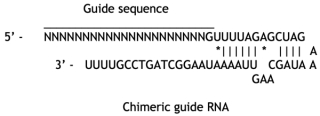
    CVC's argument in opposition is succinct:  the basis for the Broad's constructive reduction to practice "relies exclusively on a 'chimeric guide RNA' that a [person of ordinary skill in the art or] POSA could not have made and used in a cell without undue experimentation."  This argument focuses (as the Broad did in its brief) on "Embodiment 17" (E17), wherein a chimeric guide RNA is expressed by a cell comprising both U and T bases:

    Image
    But there is no evidence that a chimeric guide RNA could be made inside a cell wherein T bases are incorporated using an RNA polymerase at specific positions, and thus embodiments of comprising such chimeric guide RNA would not have been enabled as of the December 12, 2012 filing date of the Zhang B1 provisional application.

    The brief sets forth an explication of the technical and scientific basis for their non-enablement argument, particularly the biology behind RNA production using RNA polymerase III.  CVC's brief further asserts that it is the Broad's burden to show that the Zhang B1 provisional application enables at least one embodiment of a claim that corresponds to the Count, under 37 C.F.R. 41.201, Falkner v. Inglis, 448 F.3d 1357, 1363 (Fed. Cir. 2006) and In re Wands, 858 F.2d 731, 737 (Fed. Cir. 1988); in the interference context Fontijn v. Okamoto, 518 F.2d 610, 617 (CCPA 1975), and Yasuko Kawai v. Metlesics, 480 F.2d 880 (CCPA 1973).  CVC argues that the Broad relied in its brief solely on the E17 embodiment, which comprises a chimeric guide RNA comprising T residues as set forth above.  In view of the brief's technical arguments, CVC's position is that the Broad cannot satisfy enablement for E17 embodiment for the Zhang B1 provisional application and thus the Board should deny the motion.  The brief further argues that the Broad cannot assert that the presence of T instead of U residues was an error (e.g., a typographical error that could be corrected by a Certificate of Correction). According to CVC's brief, "[c]orrection is only permissible where 'the correction is not subject to reasonable debate . . . .'" citing Novo Indust. V. Micro Molds Corp., 350 F.3d 1348, 1357 (Fed. Cir. 2003), and moreover the Broad is prohibited from making changes that "are radical in their nature and constitute a departure from the invention originally disclosed," citing In re Oda, 443 F.2d. 1200, 1204 (CCPA 1971).  CVC's brief argues that any such correction would be "subject to reasonable debate" and would constitute changes that would constitute a departure from the invention originally disclosed."  Under the circumstances before the Board in this instance, CVC argues that the Board should deny the Broad's Substantive Motion No. 4.

  • By Kevin E. Noonan —

    FDAThe prevailing attitude in many quarters is that the Biologics Price Competition and Innovation Act (BPCIA) has not facilitated approval of drugs biosimilar to reference biologic drug products with sufficient alacrity and has not reduced biologic drug prices that was the hope and justification for its enactment.  For example, on February 3rd, the Federal Trade Commission and Food and Drug Administration issued a Joint Statement aimed at advancing competition in the biologic drug market.  Earlier, the FDA itself had issued a Biosimilars Action Plan (BAP) providing specific goals to accelerate biosimilars competition, and the Trump Administration was reported to be considering a reduction of the 12-year exclusivity period for reference biologic drug products.  Congress has not been silent (albeit has not passed any biologic drug legislation either), its members introducing bills such as the Biologic Patent Transparency Act (see "A Solution in Search of a Problem") and raising questions regarding settlements between biologic drug suppliers and biosimilar drug makers (see "Senators Ask FTC to Investigate Biosimilar Litigation Settlement Agreement").

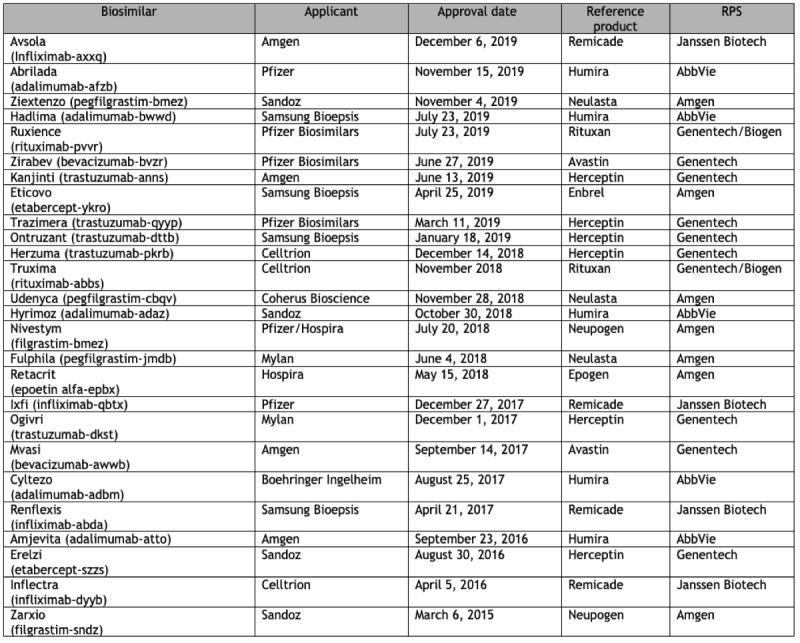
    With this backdrop the FDA recently released a synopsis of the cumulative state of biosimilar drug approval to date, amounting to 26 approved biosimilar drugs (click on table to enlarge):

    Table
    While encouraging, some sobering statistics are evident from this information.  First, there have been a select few drugs that have been "targets" for competitors to make biosimilar versions, including Herceptin® (trastuzumab) (6 biosimilar versions); Humira® (5 biosimilar versions); Remicade® (infliximab) (4 biosimilar versions); Neupogen®/Neulasta® (filgrastim and pegfilgrastim, respectively) (2 and 3 biosimilar versions, respectively); Avastin® (bevacizumab) (2 biosimilar versions); Rituxan® (rituximab) (2 biosimilar version); Enbrel® (etabercept) (1 biosimilar version); and Epogen® (epoetin alfa) (1 biosimilar version).  Part of the reason is that all of these drugs were approved prior to the enactment of the BPCIA and are outside the 12-year exclusivity period.  In addition, these drugs were previously approved in Europe, and biosimilar applicants have benefited from FDA's decision to permit them to use in the U.S. comparative information and data between the reference product and the biosimilar submitted to the European authorities.

    The biosimilar pipeline has 74 programs for 38 different reference products pending at the FDA, according to Dr. Sarah Yim, Acting Director of FDA's Office of Therapeutic Biologics and Biosimilars (although at least some of these are directed to the nine reference products for which FDA has already approved one or more biosimilars.  This raises the question:  at what point will the market saturate for any reference product, and will competition continue to decrease costs despite the belief that price reductions of more than 25-30% will be inhibited due to the expense of producing a biosimilar drug and obtaining regulatory approval?  And other biologic drugs will (eventually) exhaust the 12 years of market exclusivity under the BPCIA).  Despite Congressional and public impatience, the pace of biosimilar approval is increasing and this trend can be expected to continue.

  • By Kevin E. Noonan —

    Washington - Capitol #5There is a belief in some quarters that the most significant barrier to patent subject matter eligibility reform is an implacable opposition by companies in the high tech sector because those companies are convinced that the recent Supreme Court precedent (Bilski/Mayo/Alice) as interpreted by the Federal Circuit has resulted in a diminution in lawsuits by so-called "patent trolls," non-practicing entities who accumulate patents to be asserted against these companies.  Sitting in yet another patent conference, surrounded by some of the most erudite members of the patent community (judges and former judges, PTO officials current and past, distinguished patent lawyers and company IP counsel), discussing the current (parlous) state of affairs regarding patent subject matter eligibility and the inability (Federal Circuit, Congress) or unwillingness (Supreme Court) to find a solution, it is impossible not to think that the way the issue has been addressed is, at best, insufficient.  If indeed the issue cannot be resolved politically between the high tech and biotech/pharma shareholders, then it seems evident that this issue — the attachment to the status quo by the high tech community because it serves their interests — must be resolved before any solution to the problem for all other technologies becomes possible.

    Past experience may provide an avenue for such a resolution.  In the 1990's, patent law was faced with claims directed to methods for performing eye surgery.  The patent, U.S. Patent No. 5,080,111 to Dr. Pallin, was being asserted (Pallin v. Singer, 1996 WL 274407 (D. Vt., Mar. 28, 1996)) against medical doctors and eye clinics and prompted swift Congressional action.  The measure that ultimately passed, introduced by Senator Bill Frist of Tennessee (himself a physician) was codified as 35 U.S.C. § 287(c):

    35 U.S.C. 287 Limitation on damages and other remedies; marking and notice.

    * * *

    (c)(1) With respect to a medical practitioner's performance of a medical activity that constitutes an infringement under section 271(a) or (b) of this title, the provisions of sections 281, 283, 284, and 285 of this title shall not apply against the medical practitioner or against a related health care entity with respect to such medical activity.

     * * *

        (3) This subsection does not apply to the activities of any person, or employee or agent of such person (regardless of whether such person is a tax exempt organization under section 501(c) of the Internal Revenue Code), who is engaged in the commercial development, manufacture, sale, importation, or distribution of a machine, manufacture, or composition of matter or the provision of pharmacy or clinical laboratory services (other than clinical laboratory services provided in a physician's office), where such activities are:
            (A) directly related to the commercial development, manufacture, sale, importation, or distribution of a machine, manufacture, or composition of matter or the provision of pharmacy or clinical laboratory services (other than clinical laboratory services provided in a physician's office), and
            (B) regulated under the Federal Food, Drug, and Cosmetic Act, the Public Health Service Act, or the Clinical Laboratories Improvement Act.

    The policy justification for the bill was, as eloquently expressed by Senator Frist, because "innovations in surgical and medical procedures do not require the midwifery of patent law."  As enacted, the bill reflects a carefully crafted ("narrowly tailored") balance between the concerns of the medical community and the patent community at large, particularly the biotechnology community.  For example, "biotechnology patents" are expressly excluded from the exemption; such patents are defined (under 35 U.S.C. § 103(b)) as "a process of genetically altering of inducing a single or multi-celled organism" or "cell fusion procedures yielding a cell line that expresses a specific protein" or "methods of using a product produced" by the above processes.  Also not exempt are individuals involved in the commercialization of "a machine, manufacture, or composition of matter" related to a medical activity.

    If indeed one of the major impediments to patent subject matter eligibility reform today is the concerns of the high tech community that the current state of the law is what has reduced the plague of patent troll litigation against them (regardless of the justification for these concerns), perhaps Congress should consider amending the patent statute to contain a similar exclusion for such alleged troll activity:

    It shall not be an act of infringement under section 271(a) or (b) of this title, and the provisions of sections 281, 283, 284, and 285 of this title shall not apply, to practice of a method claim wherein any limitation of said claim is recited and defined solely by its function, unless the method is practiced using a structural component corresponding to that function that is expressly disclosed in the patent specification, or equivalents thereof.

    While not providing a blanket license to infringe such a statutory provision would go far along the path of immunizing the targets of "troll"-asserted patent litigation.  It would limit the scope of infringement for claims reciting functional limitations to the express contribution disclosed in the specification, or equivalents thereof (analytics for which are available for assessing the scope of claims reciting limitations falling within the scope of 35 U.S.C. § 112(f)).  It would provide an avenue for such claims to be practiced without infringement liability merely by exercising the marginal creativity needed to employ a step in the method using structural components not recited in the specification and different enough in structure not to be an equivalent to what the specification expressly discloses.  It would also provide statutory protection from infringement that would bring a measure of certainty to companies who purportedly find themselves as deep-pocket targets of non-practicing patentees or patent assertion entities.

    Of course, nothing involving patent subject matter eligibility law is certain or easy.  But eliminating the complaints of one set of shareholders in such a way might clear the path for Congress to address the concerns of other members of the patenting community, where additional creative stratagems might be productively employed.  Like Rome, patent subject matter eligibility will not be built in a day, but by taking a step-by-step approach perhaps it may be possible in our lifetimes.