• UIC JMLSThe UIC John Marshall Law School is holding a conference entitled "Digital Platforms: Innovation, Antitrust, Privacy & the Internet of Things" on March 13, 2020 from 8:45 am to 4:30 pm.  According to the announcement:

    Online platforms have become a focal point for many in the United States as well as in key jurisdictions around the world.  Governments and legal advisors are struggling to understand the issues and implications these platforms raise, particularly in the areas of intellectual property, privacy, and antitrust law and practice.  This Conference brings together top experts in government, industry, practice, and academia to share their cutting-edge insights on these issues as well as where things are headed.  It will feature highly interactive sessions and opportunities to speak directly to these experts to have questions answered.  It is the only event of its kind in the Midwest and one that is not to be missed.

    The program will be held at UIC John Marshall Law School in Chicago, IL.  The school is offering 6.25 hours of CLE credit (pending approval).  The fees for the conference are:  General Registration: $195; In-house/Nonprofits/Small Firms: $95; Government: Free, Limited scholarships available for 2017–2019 JMLS graduates, non-UIC students, academics; and needs-based attendees, Free for: UIC Students, Faculty, Adjunct Professors, Staff, and IP Center Advisory Board Members.

    Additional information can be found here.

  • ACIAmerican Conference Institute (ACI) will be holding its 18th Advanced Summit on Life Sciences Patents conference on May 20-21, 2020 in New York, NY.

    The conference will offer presentations on the following topics:

    • PTAB Keynote from Hon. Jacqueline Bonilla
    • Written Description and Enablement Requirements for Small Molecule Patenting in U.S., Europe, and China
    • Written Description and Enablement Requirements for Antibody Patenting in U.S. and Europe
    • Section 101: Exploring the Realities of the New PTO guidance
    • Navigating the Evolving Obviousness-type Double Patenting Landscape
    • Inherency and Obviousness: Anticipating What's Next Around the World
    • Comparing and Contrasting Licensing Agreements in U.S. and Europe 
    • Doctrine of Equivalence Analysis: Understanding how the Latest DoE Decisions will Impact Future Trends in Patent Law Protection in the U.S., Europe, and Asia 
    • Social Contracting: Understanding Its Impact on Patent Portfolio Design
    • Exploring the Future of Patent Protection Through Artificial Intelligence 
    • Ethical Obligations in Prosecution

    In addition, two pre-conference workshops will be offered on May 19, 2020.  The first, entitled "Masterclass on Drafting Life Sciences Patent Applications in the U.S., Europe and Asia," will be offered from 9:00 am to 12:30 pm, and the second, entitled "Working Group on Developing Effective Patent Filing Strategies for Combination Products," will be offered from 1:30 to 5:00 pm.

    The registration fee for the conference alone is $2,095 (by March 15th) or $2,195 (by April 3rd).  The workshops carry an additional fee of $600 apiece.  Patent Docs readers are entitled to a 10% discount off of registration using discount code D10-762-762CX09.  Those interested in registering for the conference can do so here, by e-mailing CustomerService@AmericanConference.com, or by calling 1-888-224-2480.

    Patent Docs is a media partner of ACI's 18th Advanced Summit on Life Sciences Patents Conference.

  • By Kevin E. Noonan

    University of California-BerkleyOn January 9th, Junior Party the University of California, Berkeley; the University of Vienna; and Emmanuelle Charpentier (collectively, "CVC") filed its motion in opposition to Senior Party the Broad Institute (joined by Harvard University and MIT) Substantive Motion No. 4 asking the Patent Trial and Appeal Board (PTAB) for priority to U.S. Provisional Application No. 61/736,527 to Zhang (termed "Zhang B1" in the motion), pursuant to 37 C.F.R. § 41.121(a)(1)(ii) and § 41.208(a)(3) and Standing Order ¶ 208.4.1.

    The Broad's brief began by setting forth the standard for obtaining the relief requested:  "a party need only show a constructive reduction to practice—an enabled written description—of a single species within the count," citing Hunt v. Treppschuh, 523 F.2d 1386, 1389 (CCPA 1975); Weil v. Fritz, 572 F.2d 856, 865 n.16 (CCPA 1978); and Falkner v. Inglis, 448 F.3d 1357, 1362 (Fed. Cir. 2006).  According to the Broad, Zhang B1 "provides working examples and embodiments that meet each and every limitation of both halves of Count 1" and thus evinces to the skilled worker possession of an embodiment within the scope of the Count.

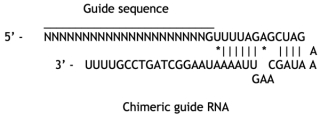
    CVC's argument in opposition is succinct:  the basis for the Broad's constructive reduction to practice "relies exclusively on a 'chimeric guide RNA' that a [person of ordinary skill in the art or] POSA could not have made and used in a cell without undue experimentation."  This argument focuses (as the Broad did in its brief) on "Embodiment 17" (E17), wherein a chimeric guide RNA is expressed by a cell comprising both U and T bases:

    Image
    But there is no evidence that a chimeric guide RNA could be made inside a cell wherein T bases are incorporated using an RNA polymerase at specific positions, and thus embodiments of comprising such chimeric guide RNA would not have been enabled as of the December 12, 2012 filing date of the Zhang B1 provisional application.

    The brief sets forth an explication of the technical and scientific basis for their non-enablement argument, particularly the biology behind RNA production using RNA polymerase III.  CVC's brief further asserts that it is the Broad's burden to show that the Zhang B1 provisional application enables at least one embodiment of a claim that corresponds to the Count, under 37 C.F.R. 41.201, Falkner v. Inglis, 448 F.3d 1357, 1363 (Fed. Cir. 2006) and In re Wands, 858 F.2d 731, 737 (Fed. Cir. 1988); in the interference context Fontijn v. Okamoto, 518 F.2d 610, 617 (CCPA 1975), and Yasuko Kawai v. Metlesics, 480 F.2d 880 (CCPA 1973).  CVC argues that the Broad relied in its brief solely on the E17 embodiment, which comprises a chimeric guide RNA comprising T residues as set forth above.  In view of the brief's technical arguments, CVC's position is that the Broad cannot satisfy enablement for E17 embodiment for the Zhang B1 provisional application and thus the Board should deny the motion.  The brief further argues that the Broad cannot assert that the presence of T instead of U residues was an error (e.g., a typographical error that could be corrected by a Certificate of Correction). According to CVC's brief, "[c]orrection is only permissible where 'the correction is not subject to reasonable debate . . . .'" citing Novo Indust. V. Micro Molds Corp., 350 F.3d 1348, 1357 (Fed. Cir. 2003), and moreover the Broad is prohibited from making changes that "are radical in their nature and constitute a departure from the invention originally disclosed," citing In re Oda, 443 F.2d. 1200, 1204 (CCPA 1971).  CVC's brief argues that any such correction would be "subject to reasonable debate" and would constitute changes that would constitute a departure from the invention originally disclosed."  Under the circumstances before the Board in this instance, CVC argues that the Board should deny the Broad's Substantive Motion No. 4.

  • By Kevin E. Noonan

    FDAThe prevailing attitude in many quarters is that the Biologics Price Competition and Innovation Act (BPCIA) has not facilitated approval of drugs biosimilar to reference biologic drug products with sufficient alacrity and has not reduced biologic drug prices that was the hope and justification for its enactment.  For example, on February 3rd, the Federal Trade Commission and Food and Drug Administration issued a Joint Statement aimed at advancing competition in the biologic drug market.  Earlier, the FDA itself had issued a Biosimilars Action Plan (BAP) providing specific goals to accelerate biosimilars competition, and the Trump Administration was reported to be considering a reduction of the 12-year exclusivity period for reference biologic drug products.  Congress has not been silent (albeit has not passed any biologic drug legislation either), its members introducing bills such as the Biologic Patent Transparency Act (see "A Solution in Search of a Problem") and raising questions regarding settlements between biologic drug suppliers and biosimilar drug makers (see "Senators Ask FTC to Investigate Biosimilar Litigation Settlement Agreement").

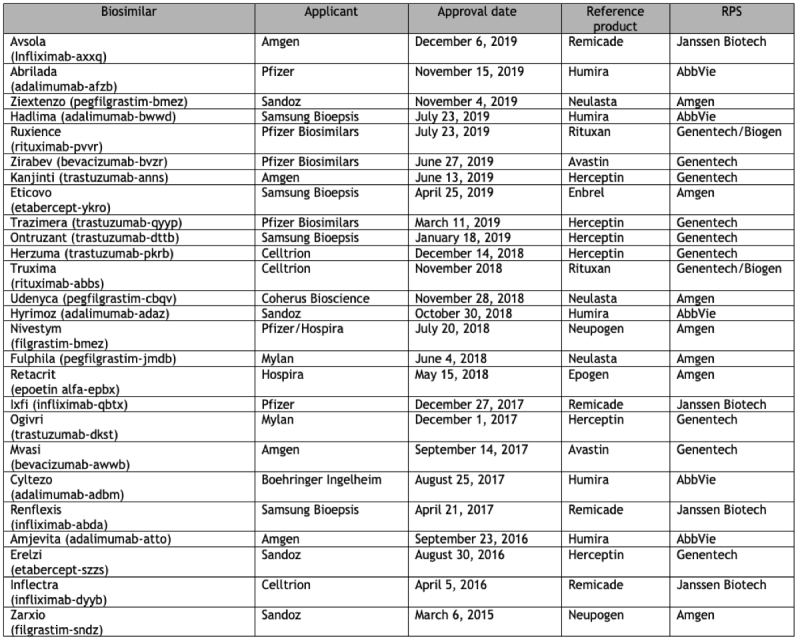
    With this backdrop the FDA recently released a synopsis of the cumulative state of biosimilar drug approval to date, amounting to 26 approved biosimilar drugs (click on table to enlarge):

    Table
    While encouraging, some sobering statistics are evident from this information.  First, there have been a select few drugs that have been "targets" for competitors to make biosimilar versions, including Herceptin® (trastuzumab) (6 biosimilar versions); Humira® (5 biosimilar versions); Remicade® (infliximab) (4 biosimilar versions); Neupogen®/Neulasta® (filgrastim and pegfilgrastim, respectively) (2 and 3 biosimilar versions, respectively); Avastin® (bevacizumab) (2 biosimilar versions); Rituxan® (rituximab) (2 biosimilar version); Enbrel® (etabercept) (1 biosimilar version); and Epogen® (epoetin alfa) (1 biosimilar version).  Part of the reason is that all of these drugs were approved prior to the enactment of the BPCIA and are outside the 12-year exclusivity period.  In addition, these drugs were previously approved in Europe, and biosimilar applicants have benefited from FDA's decision to permit them to use in the U.S. comparative information and data between the reference product and the biosimilar submitted to the European authorities.

    The biosimilar pipeline has 74 programs for 38 different reference products pending at the FDA, according to Dr. Sarah Yim, Acting Director of FDA's Office of Therapeutic Biologics and Biosimilars (although at least some of these are directed to the nine reference products for which FDA has already approved one or more biosimilars.  This raises the question:  at what point will the market saturate for any reference product, and will competition continue to decrease costs despite the belief that price reductions of more than 25-30% will be inhibited due to the expense of producing a biosimilar drug and obtaining regulatory approval?  And other biologic drugs will (eventually) exhaust the 12 years of market exclusivity under the BPCIA).  Despite Congressional and public impatience, the pace of biosimilar approval is increasing and this trend can be expected to continue.

  • By Kevin E. Noonan

    Washington - Capitol #5There is a belief in some quarters that the most significant barrier to patent subject matter eligibility reform is an implacable opposition by companies in the high tech sector because those companies are convinced that the recent Supreme Court precedent (Bilski/Mayo/Alice) as interpreted by the Federal Circuit has resulted in a diminution in lawsuits by so-called "patent trolls," non-practicing entities who accumulate patents to be asserted against these companies.  Sitting in yet another patent conference, surrounded by some of the most erudite members of the patent community (judges and former judges, PTO officials current and past, distinguished patent lawyers and company IP counsel), discussing the current (parlous) state of affairs regarding patent subject matter eligibility and the inability (Federal Circuit, Congress) or unwillingness (Supreme Court) to find a solution, it is impossible not to think that the way the issue has been addressed is, at best, insufficient.  If indeed the issue cannot be resolved politically between the high tech and biotech/pharma shareholders, then it seems evident that this issue — the attachment to the status quo by the high tech community because it serves their interests — must be resolved before any solution to the problem for all other technologies becomes possible.

    Past experience may provide an avenue for such a resolution.  In the 1990's, patent law was faced with claims directed to methods for performing eye surgery.  The patent, U.S. Patent No. 5,080,111 to Dr. Pallin, was being asserted (Pallin v. Singer, 1996 WL 274407 (D. Vt., Mar. 28, 1996)) against medical doctors and eye clinics and prompted swift Congressional action.  The measure that ultimately passed, introduced by Senator Bill Frist of Tennessee (himself a physician) was codified as 35 U.S.C. § 287(c):

    35 U.S.C. 287 Limitation on damages and other remedies; marking and notice.

    * * *

    (c)(1) With respect to a medical practitioner's performance of a medical activity that constitutes an infringement under section 271(a) or (b) of this title, the provisions of sections 281, 283, 284, and 285 of this title shall not apply against the medical practitioner or against a related health care entity with respect to such medical activity.

     * * *

        (3) This subsection does not apply to the activities of any person, or employee or agent of such person (regardless of whether such person is a tax exempt organization under section 501(c) of the Internal Revenue Code), who is engaged in the commercial development, manufacture, sale, importation, or distribution of a machine, manufacture, or composition of matter or the provision of pharmacy or clinical laboratory services (other than clinical laboratory services provided in a physician's office), where such activities are:
            (A) directly related to the commercial development, manufacture, sale, importation, or distribution of a machine, manufacture, or composition of matter or the provision of pharmacy or clinical laboratory services (other than clinical laboratory services provided in a physician's office), and
            (B) regulated under the Federal Food, Drug, and Cosmetic Act, the Public Health Service Act, or the Clinical Laboratories Improvement Act.

    The policy justification for the bill was, as eloquently expressed by Senator Frist, because "innovations in surgical and medical procedures do not require the midwifery of patent law."  As enacted, the bill reflects a carefully crafted ("narrowly tailored") balance between the concerns of the medical community and the patent community at large, particularly the biotechnology community.  For example, "biotechnology patents" are expressly excluded from the exemption; such patents are defined (under 35 U.S.C. § 103(b)) as "a process of genetically altering of inducing a single or multi-celled organism" or "cell fusion procedures yielding a cell line that expresses a specific protein" or "methods of using a product produced" by the above processes.  Also not exempt are individuals involved in the commercialization of "a machine, manufacture, or composition of matter" related to a medical activity.

    If indeed one of the major impediments to patent subject matter eligibility reform today is the concerns of the high tech community that the current state of the law is what has reduced the plague of patent troll litigation against them (regardless of the justification for these concerns), perhaps Congress should consider amending the patent statute to contain a similar exclusion for such alleged troll activity:

    It shall not be an act of infringement under section 271(a) or (b) of this title, and the provisions of sections 281, 283, 284, and 285 of this title shall not apply, to practice of a method claim wherein any limitation of said claim is recited and defined solely by its function, unless the method is practiced using a structural component corresponding to that function that is expressly disclosed in the patent specification, or equivalents thereof.

    While not providing a blanket license to infringe such a statutory provision would go far along the path of immunizing the targets of "troll"-asserted patent litigation.  It would limit the scope of infringement for claims reciting functional limitations to the express contribution disclosed in the specification, or equivalents thereof (analytics for which are available for assessing the scope of claims reciting limitations falling within the scope of 35 U.S.C. § 112(f)).  It would provide an avenue for such claims to be practiced without infringement liability merely by exercising the marginal creativity needed to employ a step in the method using structural components not recited in the specification and different enough in structure not to be an equivalent to what the specification expressly discloses.  It would also provide statutory protection from infringement that would bring a measure of certainty to companies who purportedly find themselves as deep-pocket targets of non-practicing patentees or patent assertion entities.

    Of course, nothing involving patent subject matter eligibility law is certain or easy.  But eliminating the complaints of one set of shareholders in such a way might clear the path for Congress to address the concerns of other members of the patenting community, where additional creative stratagems might be productively employed.  Like Rome, patent subject matter eligibility will not be built in a day, but by taking a step-by-step approach perhaps it may be possible in our lifetimes.

  •     By Bryan Helwig

    Gavel_2About Life Sciences Court Report:  We will periodically report on recently filed biotech and pharma litigation.


    Allergan USA, Inc. v. Prollenium US Inc.

    1-20-cv-00104; filed January 23, 2020 in the District Court of Delaware

    • Plaintiffs: Allergan USA, Inc. and Allergan Industrie SAS
    • Defendants: Prollenium Medical Technologies Inc. and Prollenium US Inc.

    Claim: Infringement of U.S. Patent Nos.:

    10,391,202: Hyaluronic acid-based gels including lidocaine
    10,485,896: Hyaluronic acid-based gels including lidocaine

    Synopsis:  Allergan asserts infringement of the '202 and '896 patents.  Allergen develops, manufacturers, and distributes dermal filler products including JUVEDÉRM® Ultra XC, JUVEDÉRM® Ultra Plus XC, and JUVEDÉRM® VOLUMA® XC.  Prollenium makes, uses, sells, offers to sell, and/or imports into the United States Revanesse® Versa+TM, a dermal filler.  Allergen asserts that Revanesse® Versa+TM infringes one of more claims of the '202 and '896 patents.

    View the complaint here.


    Relypsa, Inc. v. Alkem Laboratories Ltd.
    1-20-cv-00106; filed January 23, 2020 in the District Court of Delaware

    • Plaintiffs: Relypsa, Inc. and Vifor (International) Ltd.
    • Defendant(s): Alkem Laboratories, Ltd. And Ascent Pharmaceuticals, Inc.

    Claim: Infringement of U.S. Patent Nos.:

    8,147,873 Methods and compositions for treatment of ion imbalances
    8,337,824 Linear polyol stabilized polyfluoroacrylate compositions
    9,492,476 Potassium-binding agents for treating hypertension and hyperkalemia
    9,925,212 Potassium-binding agents for treating hypertension and hyperkalemia

    Synopsis:  Relypsa asserts infringement of the '873, '824, '476, and '212 patents.  Relypsa is the holder of approved NDA No. 205739 for patiromer sorbitex calcium powder for oral suspension sold under the trade name VELTASSA®, a potassium binder indicated for the treatment of hyperkalemia.  Relypsa submitted ANDA No. 214075 seeking approval to engage in commercial manufacture, use, offer for sale, sale, and/or importation of patiromer sorbitex as generic versions of VELTASSA®.

    View the complaint here.

    Amgen Inc. v. Bionpharma Inc.
    1-20-cv-00105; filed January 23, 2020 in the District Court of Delaware

    • Plaintiffs: Amgen Inc. and Les Laboratoires Servier
    • Defendant: Bionpharma, Inc.

    Claim: Infringement of U.S. Patent Nos.:

    7,361,649: -crystalline form of ivabradine hydrochloride, a process for its preparation and pharmaceutical compositions containing it
    7,361,650 -crystalline form of ivabradine hydrochloride, a process for its preparation and pharmaceutical compositions containing it
    7,867,996 -crystalline form of ivabradine hydrochloride, a process for its preparation and pharmaceutical compositions containing it
    7,879,842 Beta-crystalline form of ivabradine hydrochloride, a process for its preparation and pharmaceutical compositions containing it

    Synoposis:  Amgen asserts infringement of the '649, '650, '996, and '842 patents.  Amgen is the holder of approved NDA 20-6143 for Corlanor® (ivabradine) for the treatment of certain cases of chronic heart failure.  Amgen asserts that the method of manufacture, and/or their use of Corlanor® are covered by one or more claims of the Patents-in Suit.  Cadila submitted ANDA No. 213276 seeking approval to market generic Corlanor®.

    View the complaint here.

    Janssen Products, LP v. Zydus Pharmaceuticals (USA) Inc.
    3-20-cv-00787; filed January 23, 2020 in the District Court of New Jersey

    • Plaintiffs: Janssen Products, LP and Janssen Sciences Ireland UC
    • Defendants: Cadila Healthcare Limited d/b/a Zydus Cadila and Zydus Pharmaceuticals (USA) Inc.

    Claim: Infringement of U.S. Patent Nos.:

    7,126,015 Method for the preparation of hexahydro-furo-[2,3-b]furan-3-ol
    7,595,408 Methods for the preparation of (3R,3aS,6aR) hexahydro-furo[2,3-b]furan-3-ol
    7,700,645 Pseudopolymorphic forms of a HIV protease inhibitor
    8,518,987 Pseudopolymorphic forms of a HIV protease inhibitor

    Synoposis:  Jassen Products asserts infringement of the '015, '408, '645, and '987 patents.  Jassen is the holder of approved NDA 21-976 for PREZISTA® for the treatment of HIV.  Zydus submitted ANDA No. 214085 seeking approval to make substantial and meaningful preparations to import into the United States and/or offer to sell, and/or use generic versions of PREZISTA®.

    View the complaint here.

    Amgen Inc. v. Multiple Defendants (separate cases)
    Several cases filed on January 24, 2020 in the District Court of Delaware

    • Plaintiffs: Amgen Inc. and Les Laboratoires Servier
    • Defendants: Annora Pharma Private Ltd., Hetero Labs Ltd., Hetero USA, Inc., and Centaur Pharmaceuticals Private Ltd.

    Claim: Infringement of U.S. Patent Nos.:

    7,361,649: -crystalline form of ivabradine hydrochloride, a process for its preparation and pharmaceutical compositions containing it
    7,361,650 -crystalline form of ivabradine hydrochloride, a process for its preparation and pharmaceutical compositions containing it
    7,867,996 -crystalline form of ivabradine hydrochloride, a process for its preparation and pharmaceutical compositions containing it
    7,879,842 Beta-crystalline form of ivabradine hydrochloride, a process for its preparation and pharmaceutical compositions containing it

    Synoposis:  Amgen asserts infringement of the '649, '650, '996, and '842 patents.  Amgen is the holder of approved NDA 20-6143 for Corlanor® (ivabradine) for the treatment of certain cases of chronic heart failure.  Amgen asserts that the method of manufacture, and/or their use of Corlanor® are covered by one or more claims of the Patents-in Suit.  Defendants submitted ANDAs seeking approval to manufacture, import into the United States, market, and sell generic Corlanor®.

    Novartis Pharmaceuticals Corp. v. Apotex Inc.
    1-20-cv-000133; filed January 28, 2020 in the District Court of Delaware

    • Plaintiff: Novartis Pharmaceuticals Corp.
    • Defendants: Apotex Inc., Bionpharma Inc., Cadila Healthcare Ltd. d/b/a Zydus Cadila, Emcure Pharmaceuticals Ltd., Ezra Ventures, LLC, Glenmark Pharmaceuticals Inc. USA f/k/a Glenmark Generics Inc. USA, Glenmark Pharmaceuticals Ltd. f/k/a Glenmark Generics Ltd., HEC Pharm Co., Ltd., HEC Pharm USA Inc., Heritage Pharmaceuticals Inc., Hetero Labs Ltd. Unit-V, Hetero Labs Ltd., Hetero USA, Inc., Prinston Pharmaceutical Inc., Strides Global Pharma Private Ltd., Strides Pharma Inc., Zydus Pharmaceuticals (USA) Inc.

    Claim: Infringement of U.S. Patent No.:

    10,543,179 Dosage regimen of an S1P receptor modulator

    Synopsis:  Novartis asserts infringement of the '179 patent.  Novartis is the holder of approved NDA No. 022257 for GILENYA® (fingolimod) Capsules, a sphingosine 1-phosphate receptor (S1PR) modulator for the treatment of relapsing forms of multiple sclerosis (MS).  Novartis has pending litigation against the parties for infringement of U.S. Patent No. 9,187,405.  Novartis alleges that the the defendants continues to make, substantial preparation to engage in the commercial manufacture, use, offer to sell, or sale generic versions of Novartis’s GILENYA® Capsules.

    View the complaint here.


    Sucampo GmbH f/k/a Sucampo AG v. Zydus Pharmaceuticals (USA) Inc.
    1-20-cv-00936; filed January 28, 2020 in the District Court of New Jersey

    • Plaintiffs: Sucampo GmbH f/k/a Sucampo AG, Sucampo Pharma Americas LLC, Sucampo Pharma, LLC, Sucampo Pharmaceuticals, Inc., Takeda Pharmaceutical Co. Ltd., Takeda Pharmaceuticals America, Inc., Takeda Pharmaceuticals USA, Inc.
    • Defendant: Zydus Pharmaceuticals (USA) Inc.

    Claim: Infringement of U.S. Patent Nos.:

    7,795,312 Method for treating abdominal discomfort
    8,026,393 Soft-gelatin capsule formulation
    8,338,639 Soft-gelatin capsule formulation
    8,748,481 Method for treating gastrointestinal disorder
    8,779,187 Soft-gelatin capsule formulationMethods of treatment and pharmaceutical composition

    Synopsis:  Sucampo asserts infringement of the '312, '393, '639, '481, and '187 patents.  Sucampo is the holder of NDA No. 021908, lubiprostone capsules, both marketed in the United States under the trade name AMITIZA® for the treatment of chronic idiopathic constipation in adults and the treatment of opioid-induced constipation in adult patients with chronic, non-cancer pain.  Zydus submitted ANDA No. 2141313 seeking approval to commercially manufacture, use, market, or sell generic lubiprostone capsules.

    View the complaint here.


    Amgen Inc. v. MSN Pharmaceuticals, Inc.
    1-20-cv-00137; filed January 29, 2020 in the District Court of Delaware

    • Plaintiffs: Amgen Inc. and Les Laboratoires Servier
    • Defendants: MSN PPharmaceuticals, Inc. and MSN Laboratories Private Ltd.

    Claim: Infringement of U.S. Patent Nos.:

    7,361,649: -crystalline form of ivabradine hydrochloride, a process for its preparation and pharmaceutical compositions containing it
    7,361,650 -crystalline form of ivabradine hydrochloride, a process for its preparation and pharmaceutical compositions containing it
    7,867,996 -crystalline form of ivabradine hydrochloride, a process for its preparation and pharmaceutical compositions containing it
    7,879,842 Beta-crystalline form of ivabradine hydrochloride, a process for its preparation and pharmaceutical compositions containing it

    Synopsis:  Amgen asserts infringement of the '649, '650, '996, and '842 patents.  Amgen is the holder of approved NDA 20-6143 for Corlanor® (ivabradine) for the treatment of certain cases of chronic heart failure.  Amgen asserts that the method of manufacture, and/or their use of Corlanor® are covered by one or more claims of the Patents-in Suit.  Defendants submitted ANDA 213483 seeking approval to manufacture, import into the United States, market, and sell generic Corlanor®.

    View the complaint here.

  • CalendarFebruary 18, 2020 – "Patent Eligibility and Section 101 Update" (McDonnell Boehnen Hulbert & Berghoff LLP) – 10:00 am to 11:15 am (CT)

    February 19, 2020 – "Application readiness: Assessing incoming applications" (U.S. Patent and Trademark Office) – 12:00 to 1:00 pm (ET)

    February 20, 2020 – "Blocking Patents in Litigation after Acorda: What's Acorda's Impact Inside and Outside of Pharma?" (Intellectual Property Owners Association) – 2:00 to 3:00 pm (ET)

    February 26, 2020 – "Blocking Patents in Prosecution Strategy and Corporate IP Strategy after Acorda" (Intellectual Property Owners Association) – 2:00 to 3:00 pm (ET)

    March 5, 2020 – "Enhancing Diversity & Inclusion in IP Law and Beyond" (Federal Circuit Bar Association) – 3:00 pm to 5:30 pm (ET), Washington, DC

    March 11, 2020 – "Navigating USPTO Pilot Programs" (McDonnell Boehnen Hulbert & Berghoff LLP) – 10:00 am to 11:15 am (CT)

    April 27-28, 2020 – Paragraph IV Disputes Master Symposium (American Conference Institute) – New York, NY

  • ACIAmerican Conference Institute (ACI) will be holding its 14th Annual Paragraph IV Disputes master symposium on April 27-28, 2020 in New York City.

    The conference will offer presentations on the following topics:

    • Strategic Legal and Economic Guidance in View of Regulatory and Jurisprudential Developments
    • Assessing the Limitations and Prospects of Obviousness-Type Double Patenting
    • The Continuing §101 Saga: Seeking Clarity from the PTO and the Courts on Subject Matter Eligibility
    • The Doctrine of Equivalents: Analyzing the Effects of Recent Federal Circuit Decisions on Litigation Strategies
    • A Matter of Constitutionality: The PTAB Appointment Clause and the Increased Responsibility of AIA Trials
    • PTAB APJs discuss practice, policy, and procedure
    • Comparing and Contrasting the Similarities and Differences Driving Efficiencies in Hatch-Waxman and BPCIA Litigation
    • FDA Think Tank on the Latest Regulatory Developments Impacting Hatch-Waxman
    • Ethics and New Developments impacting Professional Responsibility in the Hatch-Waxman Arena

    The conference will offer "A View from the Federal Circuit" from Hon. Kathleen M. O'Malley, Federal Circuit judge, interviewed by Hon. Mary Pat Thynge, Chief Magistrate Judge from the District of Delaware.  Marcus H. Meier from the FTC will discuss antitrust developments in disputes between brand and generic drug makers.  And there will be a "Morning Roll Call" with district court judges from some of the liveliest PIV jurisdictions.

    Concurrent advanced tracks will be offered on "Understanding and Harnessing the Nuances of Local Rules"; "Effectively Managing Global Patent Litigation"; "Evaluating the Effectiveness of Summary Judgment in Different Venues"; "Practical Strategies and Tactics for Effective Settlement Negotiation"; Appreciating the Magistrate Judge's Role in Settlement Discussions"; "Devising Strategies for Proving Infringement and Defending Validity"; "Advanced Pleadings Drafting: Choosing Claims and Defenses Wisely"; "Selecting and Effectively Using Expert Witnesses in Pharmaceutical Patent Litigation"; and "Diversity and Inclusion, Incorporation and Implementation: A Guide for Creating a Successfuk IOP Team."  There will be a Town Hall presentation from a panel of magistrate judges, and presentations on "New Developments in Market Access and Exclusivities."

    In addition, two post-conference workshops will be offered on April 29, 2020.  The first, entitled "Think Tank on State and Federal Pharmaceutical IP Antitrust Initiatives: Patent Settlements, Reverse Payments, and Emerging Legislation" will be offered from 8:30 am to 11:30 am, and the second, entitled "Working Group on IPR Strategies and Parallel Proceedings: Devising Winning Strategies for IPR Best Practices and Navigating Dual Forums in Hatch-Waxman Litigation" will be offered from 12:30 to 4:00 pm.

    A complete brochure for this conference, including an agenda, detailed descriptions of conference sessions, list of speakers, and registration form can be obtained here.

    The registration fee is $2,295 (conference alone) or $3,295 (conference and both workshops) for registration before March 8, 2020. The workshops are $600 apiece, and there is a special in-house All Access Pass for $2,795.  Patent Docs readers are entitled to a 10% discount off of registration using discount code D10-896-896CX03.  Those interested in registering for the conference can do so here, by e-mailing CustomerService@AmericanConference.com, or by calling 1-888-224-2480.

    Patent Docs is a media partner of ACI's Paragraph IV Disputes Master Symposium.

  • MBHB Logo 2McDonnell Boehnen Hulbert & Berghoff LLP will be offering a live webinar entitled "Navigating USPTO Pilot Programs" on March 11, 2020 from 10:00 am to 11:15 am (CT).  In this presentation, MBHB attorneys Lawrence Aaronson and Brett Scott will present a survey of various USPTO pilot programs, some less known than others, but all useful in the right circumstances, and discuss the ins and outs of each program and present some practical prosecution tips and insights.  Pilot programs that will be covered in the webinar include:

    • First Action Interview Pilot Program
    • After Final Consider Pilot Program 2.0
    • Pre-Appeal Brief Request and Conference Pilot Program
    • Expedited Patent Appeal Pilot Program
    • Quick Path IDS Pilot Program
    • Ombudsman Pilot Program
    • Motions to Amend Pilot Program (AIA)
    • Trademark Post-Registration Audit Pilot Program

    The webinar will also briefly touch on other USPTO pilot programs, including some more rare programs and some discontinued programs.

    While there is no fee to participate, attendees must register in advance.  Those wishing to register can do so here.  CLE credit is pending for the states of California, Illinois, New Jersey, New York, North Carolina, and Virginia.

  • Federal Circuit Bar Association_2The Federal Circuit Bar Association (FCBA) will be offering a CLE program on "Enhancing Diversity & Inclusion in IP Law and Beyond" on March 5, 2020 from 3:00 pm to 5:30 pm (ET) at The Army and Navy Club in Washington, DC.  The program will include two panels:  a Pipeline Panel will explore how a focus on inclusion can develop the next generation of legal leaders, and a Partnership Panel will delve into how legal departments and law firms can partner to enhance diversity in the profession.

    The registration fee for the program is $100 (BPLA members), $300 (non-members), or free (judges).  Additional information regarding the program, including an agenda and list of panelists, can be found here.