• IAMIPBC Talking Heads, Richardson Oliver Insights, and iam will be offering a free webinar entitled "Marketing and selling patents in the current environment – hear from the experts" on May 6, 2020 starting at 11:00 am (EDT).  The webinar will address the identification, packaging, and pricing of patents, including the following topics:

    • What is selling?
    • Setting price
    • Selecting patents for sale
    • Packaging and presenting patents
    • Closing

    Those interested in registering for the webinar, can do so here.

  • Impact of COVID-19 Pandemic on Patent Offices and Federal Courts — April 30 UPDATE

    By Donald Zuhn –-

    USPTO SealIn a notice posted on its website on Tuesday, the U.S. Patent and Trademark Office announced that it was further extending the time to file certain patent-related documents and to pay certain required fees.  As with the initial extensions announced by the Office on March 31, 2020 (see "USPTO Announces Extension of Certain Patent Deadlines"), the additional extensions are the result of the temporary authority provided to the USPTO by the Coronavirus Aid, Relief, and Economic Security Act (CARES Act), which was signed by President Trump on March 27, 2020.  The additional extensions apply to deadlines for the filing of certain patent-related documents or payment of certain required fees that would have been otherwise due between March 27 and May 31, 2020, and which can now be extended to June 1, 2020.  In announcing the additional extensions, the Office noted that it would continue to evaluate the evolving situation around COVID-19 and the impact of the pandemic on its operations and stakeholders.

    The Office provides more specific details regarding the additional patent-related extensions in a "Notice of Extended Waiver of Patent-Related Timing Deadlines under the Coronavirus Aid, Relief, and Economic Security Act and Other Relief Available to Patent Applicants and Patentees" ("April 28 Notice"), which the Office noted superseded the following previously issued notices:

    • "Notice of Waiver of Patent-Related Timing Deadlines under the Coronavirus Aid, Relief, and Economic Security Act," dated March 31, 2020 ("March 31 Notice"; see "USPTO Announces Extension of Certain Patent Deadlines"); and

    • "Relief Available to Patent and Trademark Applicants, Patentees and Trademark Owners Affected by the Coronavirus Outbreak," dated March 16, 2020 ("March 16 Notice"; see "Impact of COVID-19 Pandemic on Patent Offices and Federal Courts — UPDATED").

    In the April 28 Notice, the Office explains that pursuant to § 12004 of the CARES Act, the Office is further extending the time to file certain patent-related documents or fees which otherwise would have been due on or after March 27, 2020 (and up to May 31, 2020).  The April 28 Notice also provides clarification regarding the relief available for patent applicants or patent owners who were unable to timely submit a filing or payment in reply to an Office communication due to the COVID-19 outbreak, which resulted in an application being held abandoned or a reexamination prosecution terminated or limited.

    As in the March 31 Notice, the April 28 Notice explains that as a result of the President's declaration on March 13, 2020, of a national emergency under the National Emergencies Act due to the COVID-19 outbreak, and pursuant to the CARES Act:

    The Director of the USPTO has determined that the emergency has prejudiced the rights of applicants, patent owners, or others appearing before the USPTO in patent matters, and has prevented applicants, patent owners, or others appearing before the USPTO in patent matters from filing a document or fee with the Office.  Among other things, the spread of the virus has significantly disrupted the operations of numerous businesses, law firms, and inventors.  Small businesses and independent inventors, who frequently have less access to capital and for whom patent-related fees may constitute a more significant expense, may face particular difficulties.

    Thus, the April 28 Notice states that "a person who is unable to meet patent-related timing deadlines due to the COVID-19 outbreak may be eligible for a waiver of certain deadlines."  The April 28 Notice sets forth the deadlines for which relief may be obtained:

    i.  reply to an Office notice issued during pre-examination processing by a small or micro entity;
    ii.  reply to an Office notice or action issued during examination or patent publication processing;
    iii. issue fee;
    iv.  notice of appeal under 35 U.S.C. § 134 and 37 C.F.R. § 41.31;
    v.  appeal brief under 37 C.F.R. § 41.37;
    vi.  reply brief under 37 C.F.R. § 41.41;
    vii.  appeal forwarding fee under 37 C.F.R. § 41.45;
    viii.  request for an oral hearing before the Patent Trial and Appeal Board (PTAB) under 37 C.F.R. § 41.47;
    ix.  response to a substitute examiner's answer under 37 C.F.R. § 41.50(a)(2);
    x.  amendment when reopening prosecution in response to, or request for rehearing of, a PTAB decision designated as including a new ground of rejection under 37 C.F.R. § 41.50(b);
    xi.  maintenance fee, filed by a small or micro entity; or
    xii.  request for rehearing of a PTAB decision under 37 C.F.R. § 41.52;
    xiii. request for rehearing of a PTAB decision under 37 C.F.R. §§ 41.125(c) or 41.127(d); or
    xiv.  petition to the Chief Judge under 37 C.F.R. § 41.3

    (Items xiii and xiv, which were separately addressed in the March 31 Notice, have been added to the list of applicable deadlines set forth in the April 28 Notice.)

    Only the deadlines that are set forth above, and which occur on March 27, 2020 to May 31, 2020, will be entitled to relief under the April 28 Notice (the March 31 Notice covered deadlines occurring on March 27, 2020 to April 30, 2020).  In contrast with the March 31 Notice, which provided a 30-day extension from the initial date on which a reply or fee was due, the April 28 Notice states that:

    [Applicable replies or fees] due between, and inclusive of both, March 27, 2020, and May 31, 2020, will be considered timely if filed on or before June 1, 2020, provided that the filing or payment is accompanied by a statement that the delay in filing or payment was due to the COVID-19 outbreak as defined in [the Notice].

    As in the March 31 Notice, the April 28 Notice defines a delay in filing or payment as being "due to the COVID-19 outbreak":

    [I]f a practitioner, applicant, patent owner, petitioner, third party requester, inventor, or other person associated with the filing or fee was personally affected by the COVID-19 outbreak, including, without limitation, through office closures, cash flow interruptions, inaccessibility of files or other materials, travel delays, personal or family illness, or similar circumstances, such that the outbreak materially interfered with timely filing or payment.

    With respect to the deadlines set forth in the Notice, the Office points out that an Office notice issued during pre-examination processing (item i) includes, for example, a Notice of Omitted Items, Notice to File Corrected Application Papers, Notice of Incomplete Application, Notice to Comply with Nucleotide Sequence Requirements, Notice to File Missing Parts of Application, and Notification of Missing Requirements; that an Office notice or action issued during examination (item ii) includes, for example, an Office action (either final or non-final) and Notice of Non-Compliant Amendment; and that an Office notice or action issued during patent publication processing (item ii) includes, for example, a Notice to File Corrected Application Papers issued by the Office of Data Management.

    As in the March 31 Notice, the Office's April 28 Notice also provides additional relief before the PTAB.  In particular, upon a request to the USPTO affirming that a filing that was due on March 27, 2020 to April 30, 2020 which was or may be delayed due to the COVID-19 outbreak as defined in the Notice (see above), the PTAB shall provide a 30-day extension of time for a patent owner preliminary response in a trial proceeding under 37 C.F.R. §§ 42.107 or 42.207, or any related responsive filings.  The April 28 Notice also indicates that for relief sought after April 30, 2020 — and for any other situations not covered in the Notice — relief should be requested by contacting the PTAB at 571-272-9797 or by e-mail at Trials@uspto.gov (for AIA trials), PTAB_Appeals_Suggestions@uspto.gov (for PTAB appeals), or InterferenceTrialSection@uspto.gov (for interferences).  With respect to the PTAB, the Notice also indicates that in the event that the USPTO extends a deadline for a patent owner preliminary response or any related responsive filings, the PTAB may also extend the deadlines provided in 35 U.S.C. §§ 314(b) and 324(c).

    The April 28 Notice also states that the Office will continue to provide relief in the form of a waiver of the petition fee for the revival of applications (and reexamination proceedings), as initially set forth in the Office's March 16 Notice, but will limit this relief to applications and reexamination proceedings that became abandoned (or terminated or limited) on or before May 31, 2020, as a result of the COVID-19 outbreak.  Thus:

    For patent applicants or patent owners who, because of the COVID-19 outbreak, were unable to timely submit a filing or payment in reply to an Office communication having a due date of May 31, 2020, or earlier (when taking into account all available extensions of time under 37 C.F.R. § 1.136(a)), such that the application became abandoned or the reexamination prosecution became terminated or limited, the USPTO will waive the petition fee in 37 C.F.R. § 1.17(m) when the patent applicant or patent owner files the reply with a petition under 37 C.F.R. § 1.137(a) and a statement that the delay in filing or payment was due to the COVID-19 outbreak as defined in [the Notice; see above].  See 35 U.S.C. § 41(a)(7).  The inclusion of the statement that the delay in filing or payment was due to the COVID-19 outbreak will be treated as a request for sua sponte waiver of the petition fee under 37 C.F.R. § 1.17(m).

    As in the March 31 Notice, the Office's April 28 Notice also states that "[a]s the USPTO remains open for the filing of documents and fees, the waiver set forth in this notice is available only if the delay was due to the COVID-19 outbreak" as defined in the Notice.

    Finally, the April 28 Notice includes a reminder that in addition to the relief provided in the Notice, the Office had previously waived the requirements for an original handwritten signature for certain correspondence with the Office of Enrollment and Discipline and certain payments by credit card (see "Impact of COVID-19 Pandemic on Patent Offices and Federal Courts – April 2 UPDATE").

    Patent-related inquiries regarding the April 28 Notice can be directed by e-mail to Covid19PatentsRelief@uspto.gov or by telephone to the Office of Patent Legal Administration at 571-272-7704 or 571-272-7703 for reexamination.  PTAB-related inquiries regarding the April 28 Notice can be directed by e-mail to Trials@uspto.gov for AIA trials, to PTAB_Appeals_Suggestions@uspto.gov for PTAB appeals, or to InterferenceTrialSection@uspto.gov for interferences, or by telephone to 571-272-9797.

    The Office also announced extensions of time for filing certain trademark-related documents and to pay certain required trademark-related fees.  Details regarding those extensions can be found here.


    Patent Docs
    will continue to monitor and report on patent-related developments related to the COVID-19 pandemic.  In addition, we encourage our readers to let us know about developments related to the COVID-19 pandemic at other patent offices.

    For additional information regarding this and other related topics, please see:

    • "Impact of COVID-19 Pandemic on Patent Offices and Federal Courts – April 12 UPDATE," April 12, 2020
    • "USPTO Answers FAQs on Extension of Patent Deadlines under CARES Act," April 6, 2020
    • "Impact of COVID-19 Pandemic on Patent Offices and Federal Courts – April 2 UPDATE," April 2, 2020
    • "USPTO Announces Extension of Certain Patent Deadlines," March 31, 2020
    • "Impact of COVID-19 Pandemic on Patent Offices and Federal Courts — March 29 UPDATE," March 29, 2020
    • "Impact of COVID-19 Pandemic on Patent Offices and Federal Courts — March 26 UPDATE," March 26, 2020
    • "Impact of COVID-19 Pandemic on Patent Offices and Federal Courts — March 19 UPDATE," March 19, 2020
    • "Impact of COVID-19 Pandemic on Patent Offices and Federal Courts — March 18 UPDATE," March 18, 2020
    • "Impact of COVID-19 Pandemic on Patent Offices and Federal Courts — March 17 UPDATE," March 17, 2020
    • "Impact of COVID-19 Pandemic on Patent Offices and Federal Courts – UPDATED," March 16, 2020
    • "Impact of COVID-19 Pandemic on Patent Offices and Federal Courts," March 15, 2020

  • By Kevin E. Noonan

    Broad InstituteOn April 20th, the Patent Trial and Appeal Board (PTAB) set oral argument in Interference No. 106,115, between Senior Party The Broad Institute, Harvard University, and the Massachusetts Institute of Technology (collectively, "Broad") and Junior Party the University of California/Berkeley, the University of Vienna, and Emmanuelle Charpentier (collectively, "CVC") to proceed on Monday, May 18th at 10:30 am EDT.

    University of California-BerkleyThe hearing will be conducted by telephone and (at least at present) all motions will be the subject of the hearing.  For those keeping track, CVC has pending Substantive Motions 1 and 2 (see "PTAB Redeclares CRISPR Interference and Grants Leave for Some (But Not All) of Parties' Proposed Motions") and Miscellaneous Motion No. 2 (to exclude certain Broad evidence), while the Broad has pending Substantive Motions No. 1 (no interference-in-fact), No. 2 (to Substitute the Count), No. 3 (to de-designate claims as not corresponding to Count 1), and No. 4 (for priority to Zhang B1 provisional application).

    There is an opportunity for members of the public to listen to the hearing:

    Members of the public may request to listen in on this oral hearing.  If resources are available, the Board generally expects to grant such requests.  If either party objects to the Board granting such requests, for example, because confidential information may be discussed, the party must notify the Board by contacting PTABHearings@uspto.gov at least five (5) business days prior to the oral hearing date.

    Patent Docs will continue to monitor and report on developments as they arise.

  • By Kevin E. Noonan

    Federal Circuit SealIn 1984, Senator Orrin Hatch (R-UT) and Rep. Henry Waxman (D-CA) shepherded a grand legislative compromise through Congress that balanced the rights and solved inefficient regulatory consequences for both branded and generic drug makers.  Forever known as the Hatch-Waxman Act (formally, the Drug Price Competition and Patent Term Restoration Act), certain of the provisions created a safe harbor for generic drugs to be tested for purposes related to regulatory approval without incurring infringement liability (codified at 35 U.S.C. § 271(e)(1)) as well as a pathway for generic drug makers to challenge patents listed by branded drug makers as being non-infringed, invalid, or unenforceable and litigation (ANDA litigation) to resolve these allegations (codified at codified at 35 U.S.C. § 271(e)(2)).  For branded drug makers, the Act provided for extension of patent term (PTE) to make up for regulatory delay in obtaining marketing approval (codified at 35 U.S.C. § 156 et seq.).  Litigation has ensued robustly under § 271(e)(2) and PTE's obtained by numerous branded drugs in the 35+ years since enactment of the Hatch-Waxman Act, but the proper application of the Act with regard to PTE provisions continues to be litigated, most recently in Biogen Int'l v. Banner Life Sciences LLC (ANDA litigation is almost a patent law specialty, for good or ill; see "Yet Another Study Suggesting Changes in Hatch-Waxman Regime").

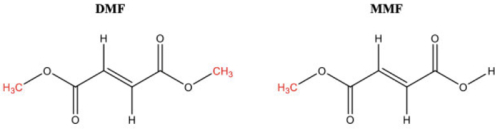
    The case arose in an infringement action by Biogen asserting U.S. Patent No. 7,619,001 against Banner over Banner's application under 21 U.S.C. § 355(b)(2) (a § 505(b)(2) application) for its generic version of Biogen's Tecfidera® (dimethylfumarate), a drug for treating multiple sclerosis.  As set forth in the Federal Circuit's opinion, DMF is metabolized to the monomethyl form (MMF), as illustrated in this figure:

    Image
    Claim 1 of the '001 patent was considered representative by the Court:

    1.  A method of treating multiple sclerosis comprising administering, to a patient in need of treatment for multiple sclerosis, an amount of a pharmaceutical preparation effective for treating multiple sclerosis, the pharmaceutical preparation comprising
    at least one excipient or at least one carrier or at least one combination thereof; and
    dimethyl fumarate, methyl hydrogen fumarate, or a combination thereof.

    Importantly for the issues before the Court, Banner obtained its approval for the monomethyl form, which would be infringing as being recited in the '001 patent claims if and only if the '001 was entitled to extension of term for this drug.  As set forth in more detail below in the context of the Federal Circuit opinion, PTE is limited to claims that encompass the approved drug and extended claims can be asserted only against infringement for drugs subject to FDA approval.

    The District Court granted Banner's motion to dismiss under Fed. R. Civ. P. 12(c) on the grounds that the PTE did not apply to Banner's product because, while encompassed by the '001 patent claims, those claims were not entitled to PTE because MMF was not the drug approved by the FDA for which Biogen was entitled to PTE for regulatory delay.  The District Court rejected Biogen's argument that, for method claims, the extension applied to any approved drug that fell within the scope of the claim.  This appeal followed.

    The Federal Circuit affirmed, in an opinion by Judge Lourie joined by Judges Moore and Chen.  The Court based its affirmance on its interpretation of the statute, specifically that "the scope of a patent term extension under 35 U.S.C. § 156 only includes the active ingredient of an approved product, or an ester or salt of that active ingredient, and the product at issue does not fall within one of those categories."  The issue for the Court was the proper interpretation of § 156(f), which "defines "product" as "the active ingredient of . . . a new drug . . . including any salt or ester of the active ingredient."  § 156(f)(2)(A).

    Biogen in arguing against the District Court's decision cites Pfizer Inc. v. Dr. Reddy's Labs., Ltd., 359 F.3d 1361 (Fed. Cir. 2004) for the proposition that "product" encompasses "the de-esterified form [here, MMF], particularly where 'a later applicant's patentably indistinct drug product . . . relies on the patentee's clinical data'" (which was the case for Banner's application under § 505(b)(2)).  Biogen contended the term "active ingredient" meant "active moiety" and the proper interpretation was not governed by Glaxo Ops. UK Ltd. v. Quigg, 894 F.2d 392, 395 (Fed. Cir. 1990), which Banner argued excluded de-esterified forms of an active ingredient.

    The Federal Circuit rejected both parties' recourse to case law and relied on the plain meaning of the statute.  According to the Court, the term "active ingredient" has a specific definition as "any component that is intended to furnish pharmacological activity or other direct effect," citing 21 C.F.R. § 210.3(b)(7).  It also "must be present in the drug product when administered," citing Hoechst-Roussel Pharm., Inc. v. Lehman, 109 F.3d 756, 759 n.3 (Fed. Cir. 1997), and is itself defined by what the FDA approved and is specified on the drug label under 21 U.S.C. § 352(e)(1)(A)(ii); 21 C.F.R. § 201.100(b)(4).

    Here, MMF is not the approved product and is not specified on the label, and thus Banner's activities (which would have been infringing before expiry of the unextended term of the patent) were not infringing because, as to its embodiments, the '001 patent had expired.

    Interestingly, while the statute expressly encompasses esters in the definition of an active ingredient, de-esterified active ingredients like MMF are not.  Thus the Federal Circuit established a well-defined (perhaps arising to a "bright line") rule that:

    All these precedents, and now this case, rest on the same holding: the term "product," defined in § 156(f) as the "active ingredient . . . including any salt or ester of the active ingredient," has a plain and ordinary meaning that is not coextensive with "active moiety."  It encompasses the active ingredient that exists in the product as administered and as approved—as specified by the FDA and designated on the product's label—or changes to that active ingredient which serve only to make it a salt or an ester.  It does not encompass a metabolite of the active ingredient or its deesterified form.

    Biogen Int'l v. Banner Life Sciences LLC (Fed. Cir. 2020)
    Panel: Circuit Judges Lourie, Moore, and Chen
    Opinion by Circuit Judge Lourie

  • By Joshua Rich

    Supreme Court Building #2The Computer Fraud and Abuse Act ("CFAA") is a Federal criminal statute intended to protect government and other "protected computers" from hacking.  Among other things, the CFAA serves as the basis for punishing anyone who "intentionally accesses a computer without authorization or exceeds authorized access, and thereby obtains . . . information from any protected computer."[1]  But the provision on exceeding authorized access has been extremely controversial, in part because it allows private companies to shape the contours of criminal law through their terms of service.  That controversy has led to a split between the Federal circuit courts on the breadth of the provision, one that the Supreme Court has now agreed to decide through Van Buren v. United States, 940 F.3d 1192 (11th Cir. 2019), cert. granted, __ U.S. __ (2020).

    In enacting the CFAA in 1986, Congress sought to address the scourge of hackers who had become able to "trespass into" public and private computer systems.  The Act, codified at 18 U.S.C. § 1030, included provisions that would protect against "outside" hackers (those who access a computer without authorization) and "inside" hackers (those who exceed authorized access).  The CFAA prohibits hackers from accessing government computers, computers used by banking institutions, and "protected computers."  Under § 1030(e)(2)(B), however, the term "protected computer" includes any computer "which is used in or affecting interstate or foreign commerce or communication, including a computer located outside the United States that is used in a manner that affects interstate or foreign commerce or communication of the United States" — today, any computer linked to the internet.  And the term "exceeds authorized access" means "to access a computer with authorization and to use such access to obtain or alter information in the computer that the accesser is not entitled so to obtain or alter."[2]

    The U.S. Courts of Appeals have split on whether a person "exceeds authorized access" if he or she is entitled to access under certain conditions (for example, within their scope of employment), but instead accesses that information for an improper purpose.  In the Second, Fourth, and Ninth Circuits, obtaining the information for an improper use would not constitute a violation of the CFAA.[3]  In the First, Fifth, Seventh, and Eleventh Circuits, however, there are circumstances under which it may be.[4]  Thus, in some states, accessing information for an improper purpose is a crime; in others, it isn't.  The Supreme Court's decision will remedy that split.

    The "exceeds authorized access" provision is notorious as well because of its part in the death of Aaron Swartz.  Mr. Swartz, a coding savant who was one of the founders of Reddit, was a long-time believer in open access to information on the internet.  He first downloaded and made public for free 2.7 million documents from PACER, the Federal court filing system that normally charges per page.  The Administrative Office of the United States Courts expressed concern that his actions exceed his authorized access.  Emboldened by an FBI investigation that led to no criminal charges, Mr. Swartz went to MIT — which prided itself on its open campus — and used the school's network to access JSTOR (a digital repository to which he had access as a research fellow at Harvard University) and download hundreds of thousands of academic journal articles with the intent to make them freely available.  This time, JSTOR complained that his actions exceeded his authorization under its terms of service and Mr. Swartz was criminally charged.  Mr. Swartz was indicted on thirteen counts (including ten under the CFAA) and threatened with 50 years imprisonment in what was later seen as "overcharging" and overzealous prosecution.  After the U.S. Attorney refused to budge from a requirement that Mr. Swartz serve time in prison, he died by suicide.

    The Van Buren case that the Supreme Court chose to review involves a clear violation of the "exceeds authorized access" provision, if that provision covers situations in which the accesser is entitled to access the information but does so for an improper purpose, and a sordid situation to boot.  Nathan Van Buren was a sergeant on the police force of Cumming, Georgia, a small town in the exurbs of Atlanta.  Van Buren met Andrew Albo, a widower in his sixties who took an unseemly interest in young women — including underage girls and prostitutes — when he was arresting Albo for providing alcohol to a minor.  Van Buren was in financial distress and saw an opportunity to shake Albo down.  Van Buren asked Albo for a "loan" of over $15,000 for fictitious medical expenses; Albo recorded the request and went to the Forsyth County Sheriff's Office, who involved the FBI.  The FBI set up a sting:  Albo would tell Van Buren that he had met a woman at a strip club and wanted to make sure she was not a police officer, and would provide Van Buren with money in exchange.  Ultimately, Van Buren "ran" the license plate numbers that Albo had gotten from the FBI in the Georgia Bureau of Investigation's Georgia Crime Information Center ("GCIC").  As a police officer, Van Buren was empowered to search the GCIC for official business, but not for personal reasons.

    After Van Buren ran the plate numbers in the GCIC, the FBI and GBI showed up at his home.  He admitted that he had made up the story about medical expenses, had received money from Albo, ran the license plate search in the GCIC, and knew that what he was doing was wrong.  He claimed the money from Albo was a "gift," but when asked if he received anything in exchange for the search, answered, "I mean he did give me $1,000."  Van Buren was then indicted, tried, and convicted on one count of honest-services wire fraud and one count of felony computer fraud under the CFAA.  Upon appeal, the U.S. Court of Appeals for the Eleventh Circuit vacated the honest-services conviction based on improper jury instructions and remanded that count for re-trial.  On the CFAA count, the Eleventh Circuit upheld the conviction, even over a challenge that the CFAA did not encompass misuse of a computer by a person who had authority to access it for other reasons.

    In addressing Van Buren's appeal on the CFAA count, the Eleventh Circuit noted that while the appeal was styled as an attack on the sufficiency of the evidence, it was actually a request to overrule the Eleventh Circuit's precedent in United States v. Rodriguez, 628 F.3d 1258 (11th Cir. 2010).  In that case, the defendant had been an employee of the Social Security Administration ("SSA") who accessed the SSA database to find personal information (including the addresses) of his ex-wife, an ex-girlfriend, the ex-girlfriend's father, former co-workers and their family members, and numerous other acquaintances.  Rodriguez argued that he had not violated the CFAA because "he accessed only databases he was authorized to use," even if for improper purposes.  He argued that the Eleventh Circuit should follow the Fifth and Ninth Circuit decisions, but the Eleventh Circuit disagreed with their interpretation of the language of the statute.  The Van Buren court noted that other courts had disagreed with the Rodriguez decision, but it was constrained by the prior-precedent rule to follow the prior Eleventh Circuit holding.  Thus, it applied the Rodriguez decision's holding and found that permitted access that was made for an impermissible purpose violated the CFAA.

    The question the Supreme Court has been asked to resolve is quite simple:  "Whether a person who is authorized to access information on a computer for certain purposes violates Section 1030(a)(2) of the Computer Fraud and Abuse Act if he accesses the same information for an improper purpose."  The implications, however, are quite far-reaching.  The CFAA is both a civil and a criminal statute.  On one hand, there should be law — and preferably, a Federal law — that prohibits police officers from taking advantage of their positions to obtain information for corrupt purposes.  On the other hand, making any improper use of a computer a violation of the CFAA will encompass anyone using their work computer to check sports scores, shop online, or look for a new job.  It doesn't seem appropriate that such minor (and common) dalliances should be potentially subject to either criminal or civil liability.  But while such a charge would not arise under current DOJ Guidelines and is unlikely for an employer to raise, it is at least a potential outcome that has been raised by certain appellate courts and could result from the Court's consideration of the proper scope of the CFAA.

    [1] 18 U.S.C. § 1030(a)(2)(C).

    [2] 18 U.S.C. § 1030(e)(6).

    [3] See United States v. Valle, 807 F.3d 508 (2d Cir. 2015); WEC Carolina Energy Sols. LLC v. Miller, 687 F.3d 199 (4th Cir. 2012); United States v. Nosal, 676 F.3d 854 (9th Cir. 2012) (en banc).

    [4] See EF Cultural Travel BV v. Explorica, Inc., 274 F.3d 577 (1st Cir. 2001); United States v. John, 597 F.3d 263 (5th Cir. 2010), cert. denied, 568 U.S. 1163 (2013); Int'l Airport Ctrs., L.L.C. v. Citrin, 440 F.3d 418 (7th Cir. 2006); United States v. Rodriguez, 628 F.3d 1258 (11th Cir. 2010).  The CFAA questions in EF Cutural Travel and Citrin arose in civil cases, not in the criminal context.

  • By Michael Borella

    USPTO SealIn a post-truth world, it is more tempting than ever to evaluate data based on gut instinct, intuition, and anecdotal evidence.  It is thus refreshing when results of a robust statistical analysis are published, even if the response to the ultimate outcome is, "Yeah, we knew that."

    Case in point, patent eligibility.  Most patent practitioners are likely to agree that the Supreme Court's Alice Corp. v. CLS Bank decision made it more likely to receive 35 U.S.C. § 101 rejections during prosecution before the U.S. Patent and Trademark Office (USPTO).  Many of these practitioners would also likely concede that Alice made it less predictable as to whether a given claimed invention would run into eligibility issues.  These same practitioners would probably concur that the Federal Circuit's Berkheimer v. HP case as well as the USPTO's 2019 patent eligibility guidance (PEG) made it less likely to receive such a rejection and resulted in the eligibility inquiry being more predictable.

    But most of this is anecdotal.  It is easy to find data supporting the premise that § 101 rejection rates went up after Alice and down after each of Berkheimer and the PEG.  But does this data withstand a rigorous examination?  Thanks to the USPTO's economists, the answer is yes.

    Last week the U.S. Patent and Trademark Office published a study of how the patent eligibility landscape has changed within its art units over the last six years, with emphasis on the inflection points of Alice, Berkheimer, and the PEG.

    Methodology

    The USPTO identified Alice-affected technologies by considering patents litigated in the Supreme Court and Federal Circuit for which eligibility was at issue.  The USPTO's U.S. Patent Classifications for the associated applications were used to identify the Alice-affected technologies, and all other U.S. Patent Classifications were used as the control group.

    Two main metrics were considered — percentage of first-action § 101 rejections and § 101 examination uncertainty.  The former is a simple quotient of first-action § 101 rejections over all first office actions in the Alice-affected technology areas within a defined time period.  The latter is a bit more complicated.  First, the rate of first-action § 101 rejections for each examiner is determined over the time period.  Then, the variance of these per-examiner rates was calculated.  The § 101 examination uncertainty metric was the average of these variances.[1]  Similar metrics were found for the control group.

    The Alice Decision

    In Alice, the Supreme Court set forth a two-part test to determine whether claims are directed to patent-eligible subject matter under § 101.  One must first decide whether the claim at hand involves a judicially-excluded law of nature, a natural phenomenon, or an abstract idea.  If so, then one must further decide whether any element or combination of elements in the claim is sufficient to ensure that the claim amounts to significantly more than the judicial exclusion.  But, elements or combinations of elements that are well-understood, routine, and conventional will not lift the claim over the § 101 hurdle.

    From the data, it is clear that Alice had a statistically significant impact on § 101 rejections.  In the Alice-affected technology areas, the likelihood of receiving a first-action § 101 rejection increased by 31% in the 18 months following the opinion's publication.  Also, Alice increased the § 101 examination uncertainty metric by 26% in these technology areas during the same period.

    The Berkheimer Decision

    While the Alice two-part inquiry is generally carried out as a matter of law, factual issues can come into play when determining whether something is well-understood, routine, and conventional.  Berkheimer stands for the notion that when such factual issues are present, a patent application cannot be found ineligible without further review.

    Berkheimer resulted in the first-action § 101 rejection rate in the Alice-affected technology areas dropping from about 35% during March of 2018 to about 28% in early January of 2019.  Further, the uncertainty metric also fell from about 0.12 (its highest point since Alice) to about 0.9 in this time frame.  As a point of reference, in the months before Alice, the uncertainty metric was slightly below 0.9.

    The PEG

    In a nutshell, the PEG breaks the first part of the Alice test into two sub-steps.  In the former, one determines whether the claim recites a judicial exception, such as an abstract idea.  In the latter, one determines further "whether the recited judicial exception is integrated into a practical application of that exception."  To focus the analysis, the PEG indicates that all abstract ideas should fall into one of three categories:  mathematical concepts, certain methods of organizing human activity, and mental processes.  Think of these as the "Three M's" — math, money, and mental steps.

    Similar to Berkheimer, the PEG reduced both the first-action § 101 rejection rate and the uncertainty metric.  The first-action § 101 rejection rate fell steeply in the Alice-affected technology areas, from about 28% to about 18%.  The uncertainty metric dropped from about 0.9 to about 0.5, the latter its lowest point in the decade since Bilski v. KapposThus, the overall impact of the PEG was greater than that of Berkheimer.

    Analysis

    Given the lack of surprising results in this study, it is tempting to just yawn and say, "So what?"  To some extent, doing so would not be unwarranted — the PEG caused a huge reduction in § 101 rejections and uncertainty — but the Federal Circuit has explicitly stated that it is not bound by the USPTO's guidance.  The USPTO can pat itself on the back for its efforts in providing more consistent and predictable examination with the PEG, but that ultimately may not matter when the federal courts will apply a less patent-friendly test when determining whether to invalidate patents that the USPTO granted.

    But perhaps the most telling aspect of the study is not the data, but instead in the casual way that the authors describe the uncertainty surrounding § 101 and its potential impact on the economy.  Particularly, they take it as given that Alice "created uncertainty in the business and legal communities" and that "[a]mbiguity in the language . . . and in the scope of technologies involving abstract ideas made it difficult to predict how and where the standard would be applied."

    These statements reflect those of federal judges, former federal judges, certain members of Congress, the inventor community, patent professionals, and (of course) USPTO Director Iancu.  There is widespread consensus that Alice's unclear language is problematic and has made it riskier for small and medium-sized businesses to invest to protect their inventions.  Under Alice, patent applications can be rejected (and granted patents can be invalidated) based on subjective and conclusory reasoning.  But perhaps Alice is yet another cynical by-product of the post-truth narrative, where opinions and gut feelings trump objective facts.

    [1] It is not clear from the study whether this average was weighted by the number of first actions per examiner.  Arguably, it should have been so that more active examiners had more influence over the metric than less active examiners.

  • IPO #2The Intellectual Property Owners Association (IPO) will offer a one-hour webinar entitled "Latin American Patent Practice: An Overview and A Look at Recent Developments" on April 30, 2020, from 12:00 to 1:00 pm (ET).  Federico Aulmann of Obligado & Cia, Ricardo Nunes of Daniel Law, and Carlos Olarte of OlarteMoure will focus on three key Latin American jurisdictions:  Argentina, Brazil, and Colombia, and cover characteristics of their patent systems, practice tips for patent prosecution and litigation, and recent developments that will impact patent practice.  The panel will address the following issues:

    • The patent prosecution systems in these three countries
    • Expediting examination, including through Patent Prosecution Highway options
    • Various aspects of litigation and damages
    • The availability of preliminary injunctions
    • Recent developments, such as implications of COVID-19 and compulsory licensing measures

    The registration fee for the webinar is $135 (IPO member) or $150 (non-member) (government and academic rates are available upon request).  Those interested in registering for the webinar can do so here.

  • IPO #2The Intellectual Property Owners Association (IPO) will offer a one-hour webinar entitled "Remote IP Advocacy During COVID-19" on April 29, 2020, from 12:00 to 1:00 pm (ET).  Erika Arner of Finnegan, Henderson, Farabow, Garrett & Dunner, LLP will moderate a panel consisting of Pam Crocker of That Vanguard Group, Inc.; Jon Fallon of High 5 Games; and Greg Gramenopolous of Finnegan, Henderson, Farabow, Garrett & Dunner, LLP will provide tips and insights for effective remote advocacy and for IP during COVID-19.

    There is no registration fee for IPO members for this webcast (the fee for non-members is $150).  Additional information regarding the webcast can be found here.

  • Morningside IPMorningside IP and IPWatchdog will be offering a webinar on "COVID-19's Impact on IP in 2020 & Beyond" on April 30, 2020 starting at 12:00 pm (EDT).  Carlo Cotrone of Techtronic Industries North America (TTI), Kirk Goodwin of Whirlpool, and Gene Quinn of IPWatchdog will discuss the ramifications of COVID-19 on IP moving forward, what the immediate future looks like for law firms and corporations, and the ways in which patent filing strategies will be impacted.  Additional information regarding the webinar can be found here.

    There is no registration fee for this webinar.  However, those interested in registering for the webinar, should do so here.

  • By Kevin E. Noonan

    University of California-BerkleyOn April 17th, CVC filed its Reply to Broad's Opposition (filed on April 9th) to CVC's Miscellaneous Motion No. 2 to Exclude Evidence filed (on April 2nd), in Interference No 106,115 between Senior Party The Broad Institute, Harvard University, and the Massachusetts Institute of Technology (collectively, "Broad") and Junior Party the University of California/Berkeley, the University of Vienna, and Emmanuelle Charpentier (collectively, "CVC").

    In its brief in support of its Miscellaneous Motion No. 2, CVC argued that four prior art references should not be considered by the Board because they were not cited in any of Broad's papers; declarations from several individuals, including some of Broad's inventors, are inadmissible as hearsay because these individuals had not been made available for deposition; and certain expert testimony fails the Supreme Court's Daubert test for expert testimony admissibility.

    Broad opposed, and its brief made two broad points.  First, Broad characterized the evidence objected to as hearsay was submitted merely as a "proffer" to the Board that set forth Broad's arguments to be submitted during the Priority Phase, and that Broad asserted that CVC made similar proffers relying on purported hearsay during the '048 Interference.  Broad asserted it proffer exception to the hearsay rule for the Sanjana, Lambowitz, and Zhang declarations, as well as the Cong 2013 reference and that CVC's hearsay objections "are, at best, premature."  Not surprisingly Broad defended the competence of its expert Dr. Mirkin, noting that his expertise is relevant to eukaryotic applications of CRISPR technology, specifically having to do with technology for introducing proteins and nucleic acids into eukaryotic cells.

    In its Reply, CVC argues that Broad had not rebutted CVC's hearsay arguments and challenges the authority Broad cited, Byrn v. Aronhime, Patent Inf. 105,384 (McK), Paper 64 at 12:17-20 (PTAB Sept. 20, 2006), as being directed to the narrow context of a motion to change a count.  While not acquiescing that its hearsay arguments might not be persuasive regarding Broad's Motion No. 2, CVC maintained that hearsay precluded the Board from considering this evidence for Broad's Motion No. 3 and Motion No. 4, or Broad's Oppositions to CVC's Motion No. 1 and Motion No. 2 (for the benefit of priority).  CVC supports its arguments with citations from Broad's Motions No. 3 and 4 and how Broad asserted the evidence CVC objected to in its Miscellaneous Motion No. 2 in support of its Substantive Motions and Oppositions to CVC's Substantive Motions.  CVC argues that "[n]othing in the statutes, rules, or case law authorizes a movant to rely on inadmissible evidence to support Motions and Oppositions related to priority benefit or de-designating claims.  To the contrary, motions must be supported by evidence, and the admissibility of that evidence may be challenged in a motion to exclude," citing SO ¶¶ 121.4.1; 152.2.1; 155.2.2.  Moreover, CVC argues that the evidence it objects to was offered for the truth of the matter asserted and thus inadmissible hearsay and not, as Broad argues merely a proffer of the evidence Broad might prove.

    CVC also rebuts Broad's "tit-for-tat" argument that CVC itself had relied on similar evidence in the earlier Interference No. 106,048, by distinguishing that evidence as "a proffer of CVC's best proofs to support a motion to change the count," citing Univ. of S. Calif. v. DePuy Spine, Inc., Patent Interference 105,653, Paper 169 (PTAB 2013).  CVC also asserts that unlike its allegations against Broad in its brief in support of its Miscellaneous Motion to Exclude, its affiant was made available for deposition.

    With regard to Broad's expert, CVC characterizes Broad's statements in its Opposition brief as overstating Dr. Mirkin's expertise.  The brief reiterates the differences in Dr. Mirkin's area(s) of expertise ("Broad has failed to show that Dr. Mirkin's experience with gold and silver nanoparticles somehow makes him an expert on the technical issues relevant to CVC's priority benefit") and lack of specific expertise in CRISPR technology:

    Dr. Mirkin's CV and cross-examination testimony demonstrate he has no specialized expertise regarding CRISPR systems or gene editing.  Tellingly, he has never even published a single paper on CRISPR systems, or even used CRISPR himself.  At deposition, Dr. Mirkin could not answer basic questions about how CRISPR-Cas9 systems actually function in eukaryotic cells.

    For these reasons CVC reiterates its argument that Dr. Mirkin's testimony should be excluded.