• UIC John Marshall's Center for Intellectual Property, Information & Privacy Law will be offering its Annual Ethics in the Practice of IP Law Seminar — for the first time as an online webinar — on June 5, 2020 from noon to 3:45 pm (CDT).  The program will cover a variety of topics on ethics and professionalism that are relevant to IP lawyers.  Attendees will learn about the types of ethical issues that arise in daily practice, as well as fundamental principles, rules, and insights to help them handle these issues.  This year's program focuses on patent law issues and features two mental health presentations.

    The Seminar is approved for 3.25 Hours of Professional Responsibility including 1 Hour of Mental Health/Substance Abuse by the Illinois MCLE Board.  Attorneys who need CLE from other states are welcome to apply to their jurisdictions on their own.  The extension of CLE credit is subject to each state's approval.

    The registration fee is $40 (general registration) or free (government attendees, UIC students, faculty, adjunct professors, staff, and IP Center advisory board members).  Additional information regarding the program can be found here.

    Ethics logo 2

  • By Kevin E. Noonan

    Supreme Court Building #2In the Supreme Court's recent clarifying campaign through the Federal Circuit's U.S. patent law jurisprudence, one section of the statute, 35 U.S.C. §112(a) has been noticeably left unscathed.  Indeed, avoidance of this statutory section continues a pattern that has existed since the 1952 Patent Act was enacted.  It is not for lack of petitions for certiorari, which have included during the Court's denials in Amgen v. Sanofi; Janssen Biotech, Inc. v. Abbott Laboratories; CoreValve Inc. v. Edwards Lifesciences AG; and Ariad v. Eli Lilly & Co.  Last week, the Court's refusal to consider this section recurred with its denial of certiorari in Actavis Laboratories FL, Inc. v. Nalproprion Pharmaceuticals, Inc.

    To recap, the case arose in ANDA litigation over Nalproprion Pharma's Contrave® extended-release tablets of the combination of naltrexone hydrochloride and buproprion hydrochloride, for treatment of obesity, as claimed in Orange Book-listed U.S. Patent Nos. 7,375,1117,462,626; and 8,916,195.  The District Court found that Defendant Actavis had not established that one claim (claim 11) of the '195 patent was invalid for failure to satisfy the written description requirement of 35 U.S.C. § 112(a) with regard to the claim limitation reciting USP dissolution methods ("USP1" versus "USP2"):

    Claim 11 of the '195 patent:

    A method of treating overweight or obesity having reduced adverse effects comprising orally administering daily about 32 mg of naltrexone and about 360 mg of bupropion, or pharmaceutically acceptable salts thereof, to a person in need thereof, wherein the bupropion or pharmaceutically acceptable salt thereof is administered as a sustained release formulation, wherein the naltrexone or pharmaceutically acceptable salt thereof is ad- ministered as a sustained release formulation, and wherein said sustained release formulation of naltrexone has an in vitro naltrexone dissolution pro- file in a dissolution test of USP Apparatus 2 Paddle Method at 100 rpm in a dissolution medium of water at 37° C. of:
        a) between 39% and 70% of naltrexone re- leased in one hour;
        b) between 62% and 90% of naltrexone re- leased in two hours; and
        c) at least 99% in 8 hours;
        wherein about 16 mg of said sustained re- lease formulation of naltrexone or a pharmaceutically acceptable salt thereof is administered twice daily, and about 180 mg of said sustained release formulation of bupropion or a pharmaceutically acceptable salt thereof is administered twice daily.

    The claims expressly recited the USP 2 Paddle Method, but Actavis argued that the specification disclosed only the UPS 1 Basket Method.  The District Court based its decision on the skilled worker not having a doubt that the inventors had possession of the invention based on the nature of the dissolution method disclosed in the specification.  The Court held that disclosure of a "substantially equivalent method" was sufficient to satisfy the requirement.

    The Federal Circuit, in an opinion by Judge Lourie, joined by Judge Wallach, affirmed the District Court on its written description determination over Chief Judge Prost's dissent.  The majority's written description decision was based in part on the "peculiarity" of the structure of claim 11, which is directed to a method for treating obesity using specific amounts of the two drugs and reciting the method for determining the dissolution profile of what the majority termed "resultant in vitro parameters," which were not the "operative steps to treat overweight or obesity."  The majority found no clear error in the District Court's holding that "irrespective of the method of measurement used, the specification shows that the inventors possessed the invention of treating overweight or obesity with naltrexone and bupropion in particular amounts and adequately described it."  The majority noted that this determination by the District Court was supported by more credible testimony from Nalproprion Pharma's expert and "untrustworthy, self-serving statements by Actavis's expert."  The majority stated that it refused to disturb the District Court's weighing of witness credibility in the performance of its "fact-finding function."  The majority further recognized (in the face of the Chief Judge's dissent) that "[w]hile as a general matter written description may not be satisfied by so-called equivalent disclosure," under these facts the District Court had not clearly erred.

    The Chief Judge's dissent on the written description question was based on the majority's reliance on "substantially equivalent disclosure" to support claim language not having clear and explicit support in the specification.  The Chief Judge characterized the majority's decision as "add[ing] what appears to me to be a new rule to this court's long-standing written description jurisprudence."  She set forth three reasons for her disagreement with the majority:

    First, the USP 2 clause is limiting.  Second, the majority's "substantially equivalent" rule is inconsistent with this court's precedent.  Third, the district court clearly erred in finding that the '195 patent's written description includes a disclosure "substantially equivalent" to USP 2.

    Important to the Chief Judge's reasoning, inter alia, were arguments from the prosecution history where the patentee appeared to rely on the dissolution profile (and the manner of determining it) to distinguish the claims from the prior art.  The Chief also disagreed with the District Court's (and the majority's) disregard for Defendant's expert testimony and found his assertion that the USP1 an USP2 methods would not have produced the same dissolution profile results to have been relevant to the written description issue before each court.

    In its certiorari petition, Actavis submitted this Question Presented:

    Whether § 112 requires a patent's specification to contain a written description of all of the limitations of a patent's claims, not just a "substantially equivalent" disclosure.

    Actavis argued that the statutory requirement for a written description was "straightforward" and meant what it said:  that the specification was required to set forth a written description of "the invention" (emphasis on petition), which, of course, is what is claimed.  Actavis contended that the Federal Circuit majority had broken with "longstanding precedent, [and] adopted a new rule: now disclosing something 'substantially equivalent' can suffice."  This inquiry is "amorphous" and contrary to the statutory language and (of necessity) Federal Circuit precedent.  Almost pandering to Supreme Court prejudices, the petition argued that "[r]equiring a patent to contain sufficient written description support ensures that a patent-holder cannot assert a broader monopoly than what 'the inventor actually invented,'" citing Ariad Pharm., Inc. v. Eli Lilly & Co., 598 F.3d 1336, 1351 (Fed. Cir. 2010) (en banc), and that "[a]n adequate written description is also necessary 'to inform the public during the life of the patent of the limits of the monopoly asserted, so that it may be known which features may be safely used or manufactured without a license and which may not,'" citing Permutit Co. v. Graver Corp., 284 U.S. 52, 60 (1931).

    According to Actavis, this decision, if permitted to stand (which is has been), overturns the certainty provided by the Federal Circuit's prior precedent on Section 112(a), substituting a "substantially equivalent" standard for one where "an obvious variant of that which is disclosed in the specification," which was previously excluded, can now suffice, citing Lockwood v. Am. Airlines, Inc., 107 F.3d 1565, 1572 (Fed. Cir. 1997).  In addition to the doctrinal error Actavis asserts, the petition also maintains that the decision "disrupt[s] the settled expectations of the inventing community" that the Supreme Court (somewhat ironically) advised against in Festo Corp. v. Shoketsu Kinzoku Kogyo Kabushiki Co., 535 U.S. 722, 739 (2002).  And on a practical level, Actavis reminded the Court that this case is an excellent vehicle for review, wherein only one claim is at issue, there is no dispute on the facts, and the alternative outcome would permit Actavis to "bring its generic to market forthwith, instead of being blocked for another full decade."

    The petition reminded the Court of the fundamental basis ("a bedrock principle") of the written description requirement, having been part of U.S. patent law "practically since the Founding," setting forth an explication of the history of this requirement to support its statement.  The importance of properly applying the requirement includes that "it ensures that an inventor does not claim patent protection for something broader than what he or she has invented by the time of filing the patent application, exemplified in the Court's decisions including O'Reilly v. Morse, 56 U.S. (15 How.) 62 (1853), and Federal Circuit decisions including Vas-Cath Inc. v. Mahurkar, 935 F.2d 1555, 1561 (Fed. Cir. 1991), and Agilent Techs., Inc. v. Affymetrix, Inc., 567 F.3d 1366, 1379 (Fed. Cir. 2009).  A second benefit of the requirement is to the public, wherein "the description effectuates the patent bargain: what the inventor claims, and secures a monopoly over, he or she must describe," citing Gill v. Wells, 89 U.S. (22 Wall.) 1, 25-26 (1874) and Ariad.

    "The decision below creates a new rule that hopelessly muddies what previously was clear and cannot be reconciled with the court of appeals' previous decisions" according to Actavis's petition.  These decisions cited in the petition include Lockwood; Regents of the Univ. of Cal. v. Eli Lilly & Co., 119 F.3d 1559, 1566 (Fed. Cir. 1997); Lucent Techs., Inc. v. Gateway, Inc., 543 F.3d 710 (Fed. Cir. 2008); PowerOasis, Inc. v. TMobile USA, Inc., 522 F.3d 1299, 1306 (Fed. Cir. 2008); ICU Medical, Inc. v. Alaris Medical Systems, Inc., 558 F.3d 1368 (Fed. Cir. 2009); Vas-Cath; and D Three Enters., LLC v. SunModo Corp., 890 F.3d 1042, 1052 (Fed. Cir. 2018).  This is not the same as imposing an in haec verba requirement according to Actavis; the panel majority's error Actavis emphasized that the Federal Circuit departed from years of consistent decisions to the contrary by "accepting a disclosure that was 'substantially equivalent'—i.e., different but close enough."

    Actavis also challenged the basis for the majority's decision — that the disputed, assertedly unsupported claim term — did not related to a "operative claim step."  There is no basis in the statutory language for this distinction, Actavis argued, nor in "this Court's clear precedent," citing Supreme Court precedent in  Limelight Networks, Inc. v. Akamai Techs., Inc., 572 U.S. 915, 921 (2014); Warner-Jenkinson, Inc. v. Hilton Davis Chem. Co., 520 U.S. 17, 29 (1997); and Water-Meter Co. v. Desper, 101 U.S. 332, 337 (1880), and the Federal Circuit (and its predecessor Court, the C.C.P.A.) in In re Sabatino, 480 F.2d 911, 913 (C.C.P.A. 1973); Exxon Chem. Patents, Inc. v. Lubrizol Corp., 64 F.3d 1553, 1557 (Fed. Cir. 1995); and Nidec Motor Corp. v. Zhongshan Broad Ocean Motor Co., 851 F.3d 1270, 1273 (Fed. Cir. 2017).

    And yet, to no avail.  Whether the Federal Circuit's decision below will lead to the dire consequences envisioned by Petitioners or is cabined by the facts and circumstances of the case before the Federal Circuit is uncertain.  But what seems certain is that the Supreme Court has not been, and perhaps cannot be, presented with a case that has been able to overcome a seeming institutional reticence against deciding questions presented regarding Section 112(a).


  • Claims for an Interactive 3D Virtual Environment Found Patent Ineligible

    By James Korenchan

    District Court for the Northern District of CaliforniaIn the field of computer gaming, the U.S. District Court for the Northern District of California recently granted Defendants' Rule 12 motion alleging that claims 1, 3, and 6 of U.S. Patent No. 8,228,325 (the '325 Patent) are invalid as claiming patent-ineligible subject matter under 35 U.S.C. § 101.  Plaintiff Barbaro Technologies, LLC (hereinafter "Barbaro") had contended that the video games Ingress and Pokémon Go, developed and published by Defendant Niantic, Inc. (hereinafter "Niantic"), infringed these claims.  The suit also involves U.S. Patent No. 7,373,377, of which the '325 Patent is a divisional.  However, Niantic's motion only addressed the claims of the '325 Patent.

    The '325 Patent claims a computer system for providing a "three-dimensional virtual thematic environment" (abbreviated in the opinion and hereinafter as "3D VTE").  The background of the '325 Patent notes that "virtual environments, especially those present on the internet, for example, have not provided the user with a real world experience."  The '325 Patent thus aims to integrate audio, video, 2D/3D technology, and other applications or services (e.g., "mini-applications," as the '325 Patent calls them, such as word processing programs or email programs) in order to provide a virtual and real world experience to users.  More particularly, the '325 Patent describes that the 3D VTE can be a gaming environment, geographic environment, or other theme of environment in which and with which a software application can simulate real-world interaction.  For example, a user can select a city to visit and the software will integrate real-world data (e.g., satellite and street view images, 2D/3D graphics) into a 3D VTE resembling the city that the user can navigate and interact with, such as in a third or first person view.  For instance, a user might travel down a street in the simulated city and "enter" a bookstore by clicking a mouse on the virtual representation of the bookstore.  The '325 Patent lists numerous examples of real-time and real-world data that can be integrated into 3D VTEs, such as sports scores, film, news, and a "real-world geographic location of a user."

    The claims at issue in this case are reproduced below:

    1.  A computer system for providing a virtual thematic environment, comprising:
        at least one memory having at least one program comprising the steps of:

    retrieving information for utilization with a three-dimensional virtual thematic environment, from external sources over the internet, said information including a real-world geographic location of a user within said three-dimensional virtual thematic environment; and

    integrating said information into the three-dimensional virtual thematic environment, such that the three-dimensional virtual thematic environment includes said real-world geographic location displayed to the user as said three-dimensional virtual thematic environment;

        wherein the user interacts with the three-dimensional virtual thematic environment as a simulated real-world interaction, depending on the user's geographical three-dimensional movement through the three-dimensional virtual thematic environment; and
        at least one processor for running the program.

    3.  The system according to claim 1, wherein said information includes real-time information.

    6.  The system according to claim 1, further comprising: displaying said information to a user in a mini-application within the virtual thematic environment.

    In Alice Corp. v. CLS Bank Int'l, the Supreme Court set forth a two-part test for determining whether a claim is directed to patent-eligible subject matter under § 101.  First, it must be determined whether the claim involves a judicially-excluded law of nature, a natural phenomenon, or an abstract idea.  If so, it must be determined whether the claim recites an inventive concept — that is, an element or combination of elements that is sufficient to ensure that the claim is significantly more than the judicial exclusion.  But generic computer implementation of an otherwise abstract process does not qualify as significantly more, nor does an element or combination of elements that is well-understood, routine, and conventional.

    In applying the first part of the Alice test, the District Court deemed claim 1 to be directed to an abstract idea of removing the disconnect between the user in the real-world and a VTE.  As noted above, and as argued by Barbaro, the prior art virtual environments allegedly did not provide users with real-world experiences, and thus the '325 Patent improves over these environments by providing a way to integrate AV, 2D/3D technology, etc. to maximize a real-world experience for users, thereby effectively removing the disconnect between the real-world user and the 3D VTE.  Barbaro also argued that its claims are analogous to those in Federal Circuit cases such as Enfish, LLC v. Microsoft Corp.

    The Court was not convinced, instead asserting that the claimed computer system, memory, and processor are "standard" components, and that "[t]he claims demonstrate the improvement offered by the '325 Patent is directed at a result—integrating the real and virtual worlds—rather than at any particular method of achieving it."  The Court noted that the claimed computer system, memory, and processor are "standard" components, and that the claimed steps can be performed using any combination of existing technologies.  Neither the claims nor the patent specification, in the Court's view, elaborated on how to integrate real-world information into the 3D VTE.  In particular, the Court said:

    [T]he claims of the '325 Patent are not directed to the means or method of the claimed invention. They are focused on the result: allowing the user to "interact[] with the [3D VTE] as a simulated real-world interaction, depending on the user's geographical three dimensional movement through the [3D VTE]."  '325 Patent at 42: 53–56.  The specification of the '325 Patent recites dozens of embodiments of the claimed result, accomplished by a variety of existing technologies, as discussed above, but does not purport to make any improvements to them.

    The Court also distinguished the asserted claims over those in Enfish and other cases.  The Court pointed out that, in Enfish for instance, the court found that the claims about a database management system were not directed to any form of storing tabular data, but rather to a specific self-referential table.  The Court here further noted that, unlike the specific sensor configuration/method and the specific improvements to computer memory claimed in Thales Visionix Inc. v. United States and Visual Memory LLV v. NVIDIA Corp., respectively, the claimed invention here provided no such improvement to computer technology or specific configuration/method for achieving its desired result.

    Instead, the Court analogized the asserted claims to Federal Circuit cases pointed to by Niantic, such as Electric Power Group, LLC v. Alstom S.A., In re Morsa (finding claims for customizing information based on user information and other specific data to be abstract), and Move, Inc. v. Real Estate All. Ltd. (finding claims about displaying real estate properties based on a user-selected area of a map were directed to an abstract idea of collecting, organizing, manipulating, and displaying data and were "devoid of any implementation details").

    The Court concluded its part one analysis stating that the claims are directed to an abstract idea because "computers are simply invoked as a tool for solving a problem that has predated them: integrating real-world information about a user into a virtual model."

    Regarding part two of the Alice test, Barbaro had argued that integrating real-world information into a virtual world such as a video game solves a uniquely technical problem.  But the Court was quick to note that the concept of building models of real-world locations, and integrating the user's location or a user avatar into such models "long predates computers," and that the framing of Barbaro's argument "ignores the fact that computer games were not the original virtual worlds" (emphasis in original).  And as we've seen before in § 101 cases, this Court found the lack of technological details in the claims and specification — that is, any details beyond mere instructions to apply a "pre-Internet abstract idea" using generic computer components — to be fatal to the claims' validity.

    Thus, the Court found the asserted claims to be patent ineligible under § 101.

    Barbaro Technologies, LLC v. Niantic, Inc. (N.D. Cal. 2020)
    Order Granting Motion for Judgment on the Pleadings by District Judge Seeborg

  • Impact of COVID-19 Pandemic on Patent Offices and Federal Courts – May 27 UPDATE

    By Donald Zuhn –-

    USPTO SealIn a notice posted on its website earlier today, the U.S. Patent and Trademark Office announced that it was further extending the time to file certain patent-related documents and to pay certain required fees, but only for certain types of entities.  As with the initial extensions announced by the Office on March 31, 2020 (see "USPTO Announces Extension of Certain Patent Deadlines") and the extension of those deadlines announced by the Office on April 28, 2020 (see "USPTO Announces Further Extension of Certain Patent Deadlines"), the additional extensions are the result of the temporary authority provided to the USPTO by the Coronavirus Aid, Relief, and Economic Security Act (CARES Act), which was signed by President Trump on March 27, 2020.

    According to the Office's latest notice, the additional extensions apply to deadlines for the filing of certain patent-related documents or payment of certain required fees — as described in the Office's April 28, 2020 notice — that would have been otherwise due between March 27 and June 1, 2020, which "will now be deemed timely filed if filed by July 1, 2020."  However, the Office's latest notice makes it clear that the additional extensions are "[f]or small and micro entities only" (emphasis added).  For large entities, the Office's notice states that after May 31, 2020 (the ending date of the Office's April 28, 2020 extension), large entities "should seek relief on a case-by-case basis, through the filing of a petition for an extension of time or a petition to revive, accompanied by any required fee."  In announcing the additional extensions for small and micro entities, the Office stated that it "recognizes that the COVID-19 pandemic continues to impose various hardships, especially on small businesses and individual inventors, and will continue to evaluate the evolving situation around the COVID-19 outbreak and the impact on the USPTO's operations and stakeholders."

    The Office's most recent notice also states that for all entities, the Office will continue to provide relief in the form of a waiver of the petition fee for the revival of applications (and reexamination proceedings).  This relief has now been extended to applications and reexamination proceedings that became, or will become, abandoned (or terminated or limited) on or before June 30, 2020, as a result of the COVID-19 outbreak.  Applicants will still have to file a statement with their petition to revive indicating that the delay in filing or payment was due to the COVID-19 outbreak as defined in the April 28 Notice.

    The Office's latest notice also reminds applicants and patentees that "extensions of time under 37 CFR § 1.136 are available for filing replies to Office actions and notices issued during patent processing or examination . . . and petitions under 37 CFR § 1.378 to accept a delayed maintenance payment are available if a maintenance fee has not been paid by its due date."

    Patent-related inquiries regarding the Office's latest notice can be directed by e-mail to Covid19PatentsRelief@uspto.gov or by telephone to the Office of Patent Legal Administration at 571-272-7704 or 571-272-7703 for reexamination.

    Patent Docs will continue to monitor and report on patent-related developments related to the COVID-19 pandemic.  In addition, we encourage our readers to let us know about developments related to the COVID-19 pandemic at other patent offices.

    For additional information regarding this and other related topics, please see:

    • "USPTO Announces COVID-19 Prioritized Examination Pilot Program," May 18, 2020
    • "USPTO Announces Further Extension of Certain Patent Deadlines," April 30, 2020
    • "Impact of COVID-19 Pandemic on Patent Offices and Federal Courts – April 12 UPDATE," April 12, 2020
    • "USPTO Answers FAQs on Extension of Patent Deadlines under CARES Act," April 6, 2020
    • "Impact of COVID-19 Pandemic on Patent Offices and Federal Courts – April 2 UPDATE," April 2, 2020
    • "USPTO Announces Extension of Certain Patent Deadlines," March 31, 2020
    • "Impact of COVID-19 Pandemic on Patent Offices and Federal Courts — March 29 UPDATE," March 29, 2020
    • "Impact of COVID-19 Pandemic on Patent Offices and Federal Courts — March 26 UPDATE," March 26, 2020
    • "Impact of COVID-19 Pandemic on Patent Offices and Federal Courts — March 19 UPDATE," March 19, 2020
    • "Impact of COVID-19 Pandemic on Patent Offices and Federal Courts — March 18 UPDATE," March 18, 2020
    • "Impact of COVID-19 Pandemic on Patent Offices and Federal Courts — March 17 UPDATE," March 17, 2020
    • "Impact of COVID-19 Pandemic on Patent Offices and Federal Courts – UPDATED," March 16, 2020
    • "Impact of COVID-19 Pandemic on Patent Offices and Federal Courts," March 15, 2020

  • By Kevin E. Noonan

    The human tendency to identify with tribes of "like" humans (related by family, place of origin, or religion, among other bases) was perverted during the Twentieth Century (and in some places remains so today) into the idea of "purity" along racial lines.  The foolishness of this thinking, insofar as it is based on genetic relatedness, has been debunked recently by a wealth of scientific evidence, explicated thoroughly in David Reich's book, Who We Are and How We Got Here: Ancient DNA and the New Science of the Human Past.

    These researches have not reached any sort of completion, and last week, a group of authors* published a paper in Cell entitled "Paleolithic to Bronze Age Siberians Reveal Connections with First Americans and across Eurasia" which sets forth further genetic evidence of the relationship between Bronze Age Siberian populations and early North Americans (as well as evidence of Yersinia pestis co-migration with its human hosts).

    Prior work had shown the existence of an Ancient North Eurasian (ANE) (24,000 yo individual) showing a genomic ancestry "widespread" across Siberia during the Paleolithic (extending until ~8,500 BCE); the contributions of this genomic pattern can be found in both present-day Eurasians and Native Americans.  There is extensive genetic, anthropological, and historical evidence that Siberia was the source of multiple migrations into North America that resulted in colonization and population of both North and South American beginning 25,000 – 20,000 years ago, millennia before European colonization in the second millennium A.D.  This prior work did not definitively establish the Siberian population or populations responsible for these migrations.  This uncertainty is complicated by the cultural and genetic changes associated with population movements during the transition from the Neolithic to the Bronze Age, particularly from the steppes in Easter Eurasia which the authors characterize as being "largely unexplored."

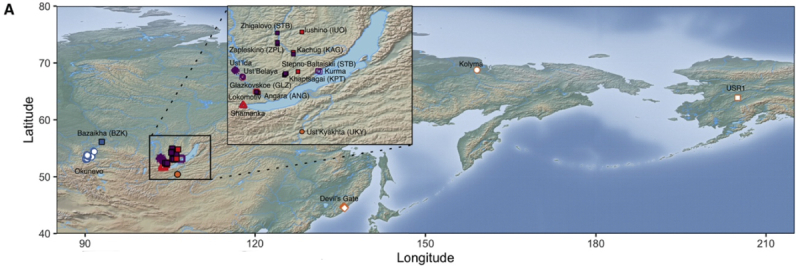
    Here, these researchers performed genome-wide analysis from 19 Upper Paleolithic to Early Bronze Age unrelated individuals (4 females, 15 males) from the Lake Bailal region in Siberia.  In addition, analysis of Y. pestis found associated with the tested human samples, which evidence supports migration from the western steppes as contributing to these Siberian populations.  These 19 samples included one from an Upper Paleolithic person (dated from 14,050-13,077 before the present day, BP); four individuals from the Early Neolithic (7,320  – 6,500 BP); and 14 late Neolithic individuals (4,830 – 3,570 BP) from ten different archeological sites:

    Image A
    The DNA used in these studies were from teeth and portions of temporal bone prepared as single-stranded and double-stranded libraries that were subject to shotgun sequencing.  Endogenous DNA amounts ranged from 0.12-50.54%; these libraries were enriched for human DNA (there being some contaminating non-human DNA almost always in such libraries) using human-specific SNPs targeting comprising 1.24 million variable sites and then sequenced to provide 0.04X – 2.07X coverage of the human genome.  "Pseudo-haploid" genotypes were determined by random sampling of a single allele at each position in the pseudo-haploid genotype, covering 34,000 – 886,000 SNPs.  Further, these authors report performing "deep" shotgun sequencing of 8 individuals with "high endogenous DNA levels" (defined as 12-51%) and finally refined these individuals' diploid genotypes by comparison of 386,000 – 518,000 SNPs to the Human Origins dataset and with 3,014 modern (present day) genotypes and 453 ancient human DNA samples.

    The genetic background of the individuals was assessed by Principle  Component Analysis, which revealed admixture of genotypes from Northeast Asian ancestry from the Russian Far East and ANE ancestry from Upper Paleolithic Siberian individuals.  Finer resolution population analysis showed that the genetic profiles of the individuals in this study comprised "a mixture of three major components that were mostly enriched in ANE-related individuals, northeast Asians, and central Siberians."  There was no inbreeding found in any of these individuals, although "runs of homozygosity" analysis suggested a smaller population size in Mesolithic northeastern Siberia.

    "Outgroup" statistics of the genetic information derived from these 19 individuals showed a "close genetic affinity with Native American and Beringian (i.e., from populations settled around the Bering Strait) populations," with differences most likely due to genetic drift in Native American populations from the ancestral ANE genotype.  In addition, "aside from the first wave migrating into the Americas through Beringia, the admixture modeling suggests that the source of the Native American ancestry was more broadly spread across Siberia during the Upper Paleolithic."  The data were also consistent with "this basal Native American group experienced multiple genetic contacts with northeast Asian populations giving rise to distinct ancient Siberian populations."

    With regard to the Siberian populations per se, the results of the genetic analyses set forth in this paper suggested a more prolonged period of population mixing in the Lake Bailal area, "between local groups and northeast Asian-related populations" occurring during the early Neolithic period.  And illustrating the granularity of the information that can be obtained from such studies, the authors report that one individual appears to have migrated from the Angara River Valley to the Lake Bailal region prior to being 7 years of age, based on the levels of 87Sr/86Sr in his teeth.

    Turning to the evidence of Y. pestis infection and its relevance to the population studies described in this paper, the authors reference prior research results showing such infections in Europe and central Asia between the Middle Neolithic period and the Bronze Age, spanning ~4,900 – 3,500 BP.  Two of the individuals (estimated to have lived 4,556 and 4,430 BP) studied by these authors had evidence of Y. pestis infection.  Genetic comparisons found the most similarity to a genome from the Baltic Sea, which was anomalous because these individuals were shown to be "genetic outliers" having relatively less steppe population-derived ancestry (which had been previously associated with Y. pestis infection).  The authors assert their data to provide the first "evidence for the presence of human Y. pestis infections in the Lake Baikal region during the Early Bronze Age," which is the eastern-most appearance of the disease in this time period.

    The authors provide several conclusions and interpretations of this information and analysis.  First, they contend that their data is evidence for "multiple population turnovers [having taken] place in the Lake Baikal region from the Upper Paleolithic to the Bronze Age periods as a dynamic variation of ANE and NEA ancestry proportions," and not a "complete replacement of the ANE-related ancestry by an East Asian gene pool," as had been previously suggested.  Rather, their data is consistent with there having been "a prolonged gene flow between NEA- and ANE-related ancestries throughout the eighth to the sixth millennium BP."

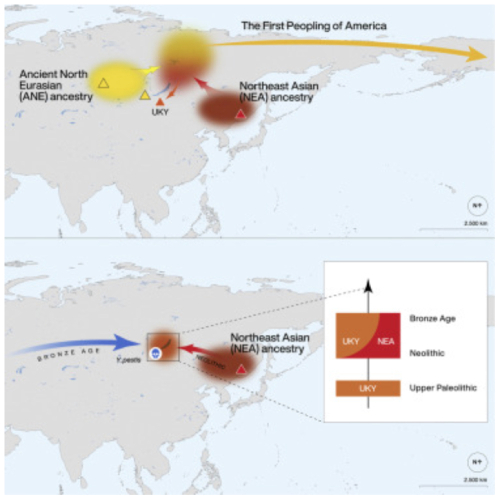
    Second, these genetic analyses provided evidence that non-Arctic Native Americans had a "strong genetic connection" with Upper Paleolithic Siberians, based on the genetic comparisons and similarities between "Native Americans, the 14,000-year-old southern Siberian . . . individual and the 9,800-year-old northeastern Siberian . . . individual," who appear to all have been descendants of "the same admixed population that carried both ANE and NEA ancestries [and] was likely widespread across Siberia during the Upper Paleolithic and experienced frequent genetic contacts with northeast Asian-related populations."  But rather than providing a definitive source of Native American ancestry from these groups, the authors state that while "our result[s] challenges the hypothesis that this basal Native American ancestry formed in northeastern Siberia,"[f]urther genetic evidence from Upper Paleolithic Siberian groups will be necessary to describe where and when exactly the ancestral gene pool of Native Americans came together."  These migrations are shown graphically in the paper:

    Image 2
    There evidence does show, in these authors' opinion, that there was "genetic contact between southern Siberia and the western steppe during the Early Bronze Age, based on both human and pathogen DNA data, which suggests a high mobility across Eurasia."  And the pathogen genetic data "may rather be indicative of a century- or decade-long process that lead to the bacterium's long-distance spread," which "most parsimoniously suggests that Y. pestis spread into this region within the context of . . . steppe expansions during the fifth millennium BP."

    The authors conclude the paper by stating that:

    [O]ur study describes dynamic changes in the population structure of the Lake Baikal region and reveals a widespread occurrence of the genetic ancestry that gave rise to the First People of the Americas in Upper Paleolithic Siberia.  In addition, we provide evidence of high human mobility across the Eurasian steppe revealing new insights about the spread of Y. pestis during the fifth millennium BP.

    * He Yu, Maria A. Spyrou, Marina Karapetian, Svetlana Shnaider, Rita Radzevičiūtė, Kathrin Nägele, Gunnar U. Neumann, Sandra Penske, Jana Zech, Mary Lucas, Petrus LeRoux, Patrick Roberts, Galina Pavlenok, Cosimo Posth, Choongwon Jeong (corresponding author), and Johannes Krause (corresponding author)

    Affiliations:  Max Planck Institute for Science of Human History; Siberian Branch Russian Academy of Sciences; University of Cape Town, South Africa; and Moscow State University

  • Life Sciences "Top 53"

    By Donald Zuhn

    IPO #2Last week, the Intellectual Property Owners Association (IPO) and Harrity Analytics announced the release of the 37th annual list of the top 300 organizations receiving U.S. utility patents (see "Top 300 Organizations Granted U.S. Patents in 2019").  Patent Docs readers may recall that the U.S. Patent and Trademark Office stopped releasing its annual list of top patent recipients in 2006 in order to "discourag[e] any perception that we believe more is better."

    HarrityThis year, the report was compiled in collaboration with Harrity Analytics, based on data obtained from the U.S. Patent and Trademark Office.  The IPO and Harrity Analytics noted that patents reported on the 2019 list are utility patents granted during the 2019 calendar year that listed the organization or a subsidiary as the owner on the printed patent document.  Harrity Analytics then used organization and subsidiary data provided to two independent third-party data providers and reviewed over 200,000 assignments to attribute ownership to the correct organizations, where applicable.  The report notes that patents that were granted to two or more organizations jointly are attributed to each organization separately, and that companies for which patents were granted to subsidiaries are combined with patents granted to the parent.

    The IPO and Harrity Analytics also noted that 354,507 patents were issued in 2019, which was a 15.2% increase from the 307,759 patents that issued in 2018.  The top fifteen companies on the IPO Top 300 are listed below (click on table to expand):

    2019 Top 15
    Dell, Qualcomm, and Taiwan Semiconductor Manufacturing fell out of the Top 15 in 2019.  Dell dropped from 12th to 16th, Qualcomm dropped from 10th to 17th, and Taiwan Semiconductor Manufacturing dropped from 8th to 18th in 2019.  Jumping into the Top 15 were Huawei (19th to 7th), Sony (18th to 11th), and Amazon (16th to 15th).

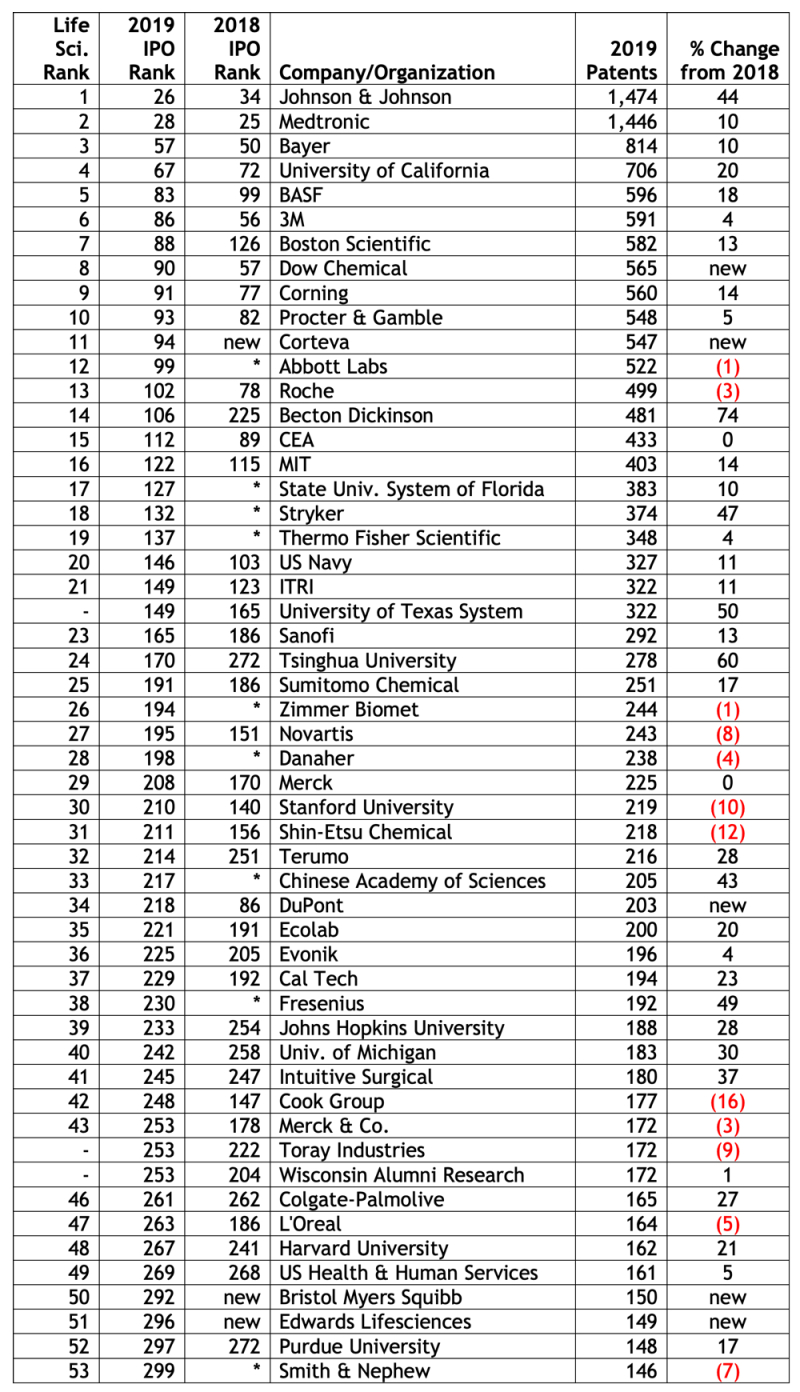
    As in past years, Patent Docs used the IPO's list of top patent holders to compile a list of the top "life sciences" companies and organizations receiving U.S. utility patents in 2019.  Each organization's IPO top 300 ranking for 2019 is indicated in the "2019 IPO Rank" column; the IPO top 300 ranking for 2018 (if available) is indicated in the "2018 IPO Rank" column; and the change in number of patents from 2018 is indicated in "% Change from 2018."  The Life Sciences Top 53 is listed below (click on table to expand):

    2019 Top 50
    Please note that some of the companies and organizations listed above may be involved in work outside the life sciences sector, and therefore, a portion of the patents granted to these companies and organizations may be directed to other than life sciences-related inventions.  Our list also includes medical device companies.  In addition, the report indicates that the data for 2019 for each individual organization could be affected by mergers, acquisitions, divestitures, inconsistent treatment of subsidiaries in 2018 and 2019, and many other factors.  Thus, while nine members of the Life Sciences Top 53 were not listed in the 2018 Top 300, they were not listed by the IPO and Harrity Analytics in the 2019 Top 300 as "new" additions to the list.  These nine companies and organizations are indicated in the table above by an asterisk ("*") in the 2018 IPO Rank column to distinguish them from new additions to the list (listed as "new" in the same column).

    For additional information regarding this topic, please see:

    • "IPO Releases List of Top 300 Patent Holders for 2018," August 7, 2019
    • "IPO Releases List of Top 300 Patent Holders for 2017," July 4, 2018
    • "IPO Releases List of Top 300 Patent Holders for 2016," June 14, 2017
    • "IPO Releases List of Top 300 Patent Holders for 2014," July 1, 2015
    • "IPO Releases List of Top 300 Patent Holders for 2013," July 7, 2014
    • "IPO Releases List of Top 300 Patent Holders for 2012," June 24, 2013
    • "Another Look at IPO Top 300 and Life Sciences Top 53," June 11, 2012
    • "IPO Releases List of Top 300 Patent Holders for 2011," June 7, 2012
    • "IPO Releases List of Top 300 Patent Holders for 2010," June 30, 2011
    • "IPO Releases List of Top 300 Patent Holders for 2009," May 26, 2010
    • "IPO Releases List of Top 300 Patent Holders for 2008," May 14, 2009
    • "IPO Releases List of Top 300 Patent Holders," May 22, 2008
    • "IPO Posts List of Top 300 Patent Holders," April 20, 2007

  • CalendarMay 26, 2020 – "Innovation and Incentive Systems" (Federal Circuit Bar Association) – 11:00 am to 12:00 pm (EST)

    May 26, 2020 – "Licensing and Collaborations: Common Pitfalls and Best Practice" (Lexology Webinars, iam, and Potter Clarkson) – 11:00 am to 12:00 pm (EDT)

    May 26, 2020 – "Modern Patent Research: Capitalizing on Information Across Your Organization" (Derwent and IPWatchdog) – 12:00 pm (EDT)

    May 26, 2020 – "Trade Secret Litigation 101: What All Attorneys Should Know as Employees Work from Home and Jobless Claims Continue to Rise" (Federal Bar Association and MyLawCLE) – 3:00 to 4:00 pm (ET)

    May 27, 2020 – "Key findings from the IAM Benchmarking Survey 2020" (IPBC Talking Heads and iam) – 11:00 am to 12:00 pm (EDT)

    May 27, 2020 – "Innovating Our Way Through the Coronavirus Pandemic" (KPMG and Schwegman Lundberg & Woessner) – 1:00 to 2:00 pm (CT)

    May 28, 2020 – "How to Develop and Maintain a World Class Patent Portfolio" (LexisNexis and IPWatchdog) – 12:00 pm (ET)

    May 28, 2020 – "Artificial Intelligence: Challenges and Opportunities" (Federal Circuit Bar Association) – 1:00 to 2:00 pm (EST)

  • Federal Circuit Bar Association_2The Federal Circuit Bar Association (FCBA) will be offering a remote program entitled "Artificial Intelligence: Challenges and Opportunities" on May 28, 2020 from 1:00 to 2:00 pm (EST).  Patrick Keane of Buchanan Ingersoll & Rooney PC will moderate a panel consisting of Uren Chen of Qualcomm Inc.; Ron Dimock of Gowling WLG; Laura Sheridan of Google LLC; and Coke Stewart, Acting Chief of Staff and Senior Policy Advisor, U.S. Patent and Trademark Office.  The panel will discuss the role of Al as Industrial Revolution 4.0 unfolds, including the key challenges and opportunities presented by Al within the tech community, how the legal community is evolving in response, particularly with regard to issues of inventorship, patentability, and enforcement, and the role of Al in the current COVID crisis.

    The webinar is complimentary for FCBA members and students, $25 for government and students, or $75 for private practitioners.  Those interested in registering for the program, can do so here.

  • LexisNexisLexisNexis and IPWatchdog will be offering a webinar entitled "How to Develop and Maintain a World Class Patent Portfolio" on May 28, 2020 at 12:00 pm (ET).  Gene Quinn of IPWatchdog, Prof. James Gerard Conley of Kellogg School of Management at Northwestern University, Prof. Holger Ernst of WHU – Otto Beisheim School of Management, Jens Bördin of Konsert Strategy & IP, and Marco Richter of PatentSight – LexisNexis will discuss how to implement processes in organizations to develop and maintain such a world-class patent portfolio, as well as the requirements for software applications that are capable to provide the required insights into innovation and give examples of how smart tools can be utilized to maintain world class patent portfolios.

    There is no registration fee for this webinar.  However, those interested in registering for the webinar, should do so here.

  • KPMGKPMG and Schwegman Lundberg & Woessner will be offering a webinar entitled "Innovating Our Way Through the Coronavirus Pandemic" on May 27, 2020 from 1:00 to 2:00 pm (CT).  Amol Gavankar of KPMG, Piers Blewett of Schwegman Lundberg & Woessner, Jim Sulciner of Sulciner Group, and François deVilliers of Schwegman Lundberg & Woessner will discuss practical steps for sparking innovation, harvesting IP, and optimizing R&D tax credit.

    While there is no cost to participate in the program, those interested in attending the webinar can register here.