• Ninth Circuit Overturns District Court Judge Lucy Koh's Decision That Qualcomm's Licensing and Chip Sales Practices Are Antitrust Violations

    By Kevin E. Noonan

    9th CircuitThe Federal Trade Commission has a history of taking positions and aggressively pursuing them, despite getting reversed (sometimes continually) by Circuit Courts (see "Reverse Payments in Generic Drug Settlements"), although occasionally finding an ally in the Supreme Court (see "Federal Trade Commission v. Actavis, Inc. (2013)").  Most recently, the FTC has waged a campaign against chipmakers involved in the cell phone industry, and their most spectacular victory was in convincing U.S. District Court Judge Lucy Koh (Northern District of California) to impose a worldwide injunction against Qualcomm.  That victory was short-lived, however, with the Ninth Circuit ruling on Tuesday that Qualcomm's business practices, while aggressive did not rise to antitrust violations.  (The result may have been telegraphed by the Court in granting a stay on the injunction, where it said that the "district court's order and injunction [was] either 'a trailblazing application of the antitrust laws' or 'an improper excursion beyond the outer limits of the Sherman Act.'")

    As set forth in the opinion, Qualcomm has been successful in making chips used in code division multiple access ("CDMA") and premium long-term evolution ("LTE") cellular modern technology, which it sells to original equipment manufacturers (OEMs).  In addition, the company licenses its cellular standard essential patents ("SEPs"), non-cellular SEPS, and non-SEPs to OEMs as well as rival chipmakers.  These chips and their licensed technologies that "enable[] cellular devices to practice CDMA and premium LTE technologies and thereby communicate with each other across cellular networks"; in a footnote, the Court explains that the company has two separate divisions, its Technology Licensing arm responsible for licensing its patent portfolios and establishing licensing rates, and its CMDA Technology division that cells modem chips.  These divisions distinguish Qualcomm from other companies in this space (including Nokia and Ericsson, for example) who license their SEP portfolios but don't also sell modem chips, and other chip makers (such as Samsung) who don't have SEP portfolios to license.  The opinion also acknowledged that Qualcomm had "monopoly power" (90% market share) over the CMDA modem chip market between 2006-2016 and 70% market share over the LTE chip market, and accordingly charged "monopoly prices" on its chips.

    According to the opinion, Qualcomm deals exclusively with OEMs, charging "a percentage of the end-product sales price," which the Court says is a "practice not unique to Qualcomm."  Interestingly (perhaps as an example of the law of unintended consequences), the practice arose in response to the Supreme Court's decision on patent exhaustion in Quanta Comput., Inc. v. LG Elecs., Inc., 553 U.S. 617, 625 (2008). The rationale is that sales to suppliers of OEMs would exhaust all patent rights in the chips, and because such suppliers do not need licenses to Qualcomm's SEP and other standard portfolios the company would not be able to collect them from their OEM customers.

    Qualcomm had not refused to license rival chipmakers, according to the opinion, offering them what amounts to a covenant not to sue provided that they do not sell their chips to unlicensed OEMs.  Qualcomm has a "no license, no chips" policy to enforce these arrangements, refusing to sell the OEMs who do not license their SEP portfolios.

    The opinion also notes that because Qualcomm is not itself an OEM, it is not in competition with OEMs; as stated in the opinion, "these OEMs are Qualcomm's customers" (emphasis in opinion), which changes how the antitrust laws are applied to Qualcomm's behavior.

    As might be expected, Qualcomm's rivals complained about its business practices and the Federal Trade Commission sued, alleging violation of § 5(a) of the FTC Act, 15 U.S.C. § 45(a), and §§ 1 and 2 of the Sherman Act, 15 U.S.C. §§ 1, 2.  The FTC contended that Qualcomm's business practices "unreasonably restraining trade in, and unlawfully monopolizing, the code division multiple access ("CDMA") and premium long-term evolution ("LTE") cellular modern chip markets."  The District Court found that "Qualcomm's licensing practices are an unreasonable restraint of trade under § 1 of the Sherman Act and exclusionary conduct under § 2 of the Sherman Act."  The District Court based its decision on "five mixed findings of fact and law" according to the opinion:

    (1) Qualcomm's "no license, no chips" policy amounts to "anticompetitive conduct against OEMs" and an "anticompetitive practice[] in patent license negotiations"; (2) Qualcomm's refusal to license rival chipmakers violates both its FRAND commitments and an antitrust duty to deal under § 2 of the Sherman Act;12 (3) Qualcomm's "exclusive deals" with Apple "foreclosed a 'substantial share' of the modem chip market" in violation of both Sherman Act provisions; (4) Qualcomm's royalty rates are "unreasonably high" because they are improperly based on its market share and handset price instead of the value of its patents; and (5) Qualcomm's royalties, in conjunction with its "no license, no chips" policy, "impose an artificial and anticompetitive surcharge" on its rivals' sales, "increas[ing] the effective price of rivals' modem chips" and resulting in anticompetitive exclusivity.

    Taken together, these practices "create insurmountable and artificial barriers for Qualcomm's rivals, and thus do not further competition on the merits" according to the District Court's opinion.

    The Ninth Circuit vacated the District Court's judgment and reversed the permanent, worldwide injunction against Qualcomm, in a decision by Judge Callahan, joined by Circuit Court Judge Rawlinson and District Court Judge Murphy sitting by designation.  The Court framed its decision on the difference between "anticompetitive behavior, which is illegal under federal antitrust law, and hypercompetitive behavior, which is not" (emphasis in opinion).  After setting forth the legal predicate for antitrust violations (for example, that "[w]hereas § 1 of the Sherman Act targets concerted anticompetitive conduct, § 2 targets independent anticompetitive conduct," citing Am. Needle, Inc. v. Nat'l Football League, 560 U.S. 183 (2010) (emphasis in opinion)) the Court addressed the District Court's application of these principles to Qualcomm's business practices.  Importantly in this regard, the Court stated that "novel business practices—especially in technology markets—should not be "conclusively presumed to be unreasonable and therefore illegal without elaborate inquiry as to the precise harm they have caused or the business excuse for their use," citing United States v. Microsoft Corp., 253 F.3d 34 (D.C. Cir. 2001) (emphasis in opinion), and Geoffrey A. Manne & Joshua D. Wright, Innovation and the Limits of Antitrust, 6 J. Comp. L. & Econ. 153, 167 (2010) ("Because innovation involves new products and business practices, courts['] and economists' initial understanding of these practices will skew initial likelihoods that innovation is anticompetitive and the proper subject of antitrust scrutiny").  The opinion credits the District Court with properly defining the relevant market ("the market for CDMA modem chips and the market for premium LTE modem chips") but faulted the Court for considering the impact of Qualcomm's business practices on the "much larger market of cellular services generally" which included OEMs, Qualcomm's customers rather than their competitors.  Even if the District Court had properly identified "harms" to these parties, according to the opinion, these are not antitrust violations "because they do not involve restraints on trade or exclusionary conduct in 'the area of effective competition'" citing Ohio v. Am. Express Co., 138 S. Ct. 2274, 2284 (2018)).  The proper relevant market, according to the opinion, was modem chip sales not Qualcomm's licensing practices with OEMs, a distinction lost on the District Court because that Court believed Qualcomm's business practices to be "interrelated."  Rather than following the District Court's improper reasoning, the Ninth Circuit panel "reframe[d]" the issues to consider the effects of Qualcomm's business practices on the CMDA and LTE chip markets.

    The opinion quickly dispensed with one basis for the District Court's decision, that Qualcomm owed an "antitrust duty" to license its patents to "its direct competitors in the modern chip markets" under a Supreme Court-defined exception set forth in Aspen Skiing Co. v. Aspen Highlands Skiing Corp., 472 U.S. 585 (1985).  The opinion cites in this regard copious precedent to the effect than a business is under no obligation to "deal under the terms and conditions preferred by [a competitor's] rivals," quoting Pac. Bell Tel. Co. v. linkLine Commc'ns, Inc., 555 U.S. 438, 457 (2009), and can "freely []exercise his own independent discretion as to parties with whom he will deal," quoting United States v. Colgate & Co., 250 U.S. 300, 307 (1919).  While recognizing the exception under the Aspen Skiing Co. case relied upon by the District Court, the panel held that this exception did not apply based on the absence of anticompetitive conduct here underlying the result in Aspen.  The Ninth Circuit found clear error in the factual underpinnings of the District Court's opinion.  The panel also recognized that Qualcomm's business strategy was a response to the effects on the application of the patent exhaustion doctrine occasioned by the Supreme Court's Quanta Computing decision rather than an effort to "sacrifice short-term benefits in order to obtain higher profits in the long run from the exclusion of competition" as in Aspen Skiing.  And the consistency with which Qualcomm implemented its business practice, not singling out any particular competitor, was also a determinative factor for the panel in distinguishing Qualcomm's behavior from the anticompetitive behavior that resulted in the Aspen Skiing decision ("Qualcomm applies its OEM-level licensing policy equally with respect to all competitors in the modem chip markets and declines to enforce its patents against these rivals even though they practice Qualcomm's patents (royalty-free)").

    The Court also rejected the FTC's "fallback" position that Qualcomm was guilty of antitrust violations under § 2 of the Sherman Act, because according to the Court the alleged anticompetitive activity was directed at Qualcomm's OEM customers rather than its competitors and was "chip-supplier neutral" because Qualcomm collects them from all OEMs that license its patents, not just "rivals' customers" (emphasis in opinion) and ignores Qualcomm's agreements wherein competitors are allowed to practice Qualcomm's patented SEPs "royalty-free" so long as they sell to licensed OEMs.  Finally in this regard, the Court reminds the FTC that "to make out a § 2 violation, the anticompetitive harm identified must be to competition itself, not merely to competitors," citing Microsoft (emphasis in opinion) and the FTC had not shown any such harm.

    The opinion also cites (and the panel apparently swayed by) the several amici writing in support of Qualcomm (or at least in support of reversing the District Court's decision), including retired Federal Circuit Chief Judge Paul R. Michel and former FTC Commissioner Joshua Wright.

    Next the Court reaches what it termed "the district court's primary theory of anticompetitive harm: Qualcomm's imposition of an 'anticompetitive surcharge' on rival chip suppliers via its licensing ["unreasonably high"] royalty rates" that are anticompetitive because "they raise costs to OEMs, who pass the extra costs along to consumers and are forced to invest less in other handset features."  The Circuit Court finds "no cogent theory of anticompetitive harm" that supports the District Court's conclusions.  Indeed, the panel believes that the District Court's decision "is premised on a misunderstanding of Federal Circuit law pertaining to the calculation of patent damages, it incorrectly conflates antitrust liability and patent law liability, and it improperly considers 'anticompetitive harms to OEMs' that fall outside the relevant antitrust markets."  The panel also thinks the decision also "fails as a matter of law and logic."  The misunderstanding of Federal Circuit patent damages law perceived by the Ninth Circuit involves the "the patent rule of apportionment" and the smallest salable patent-practicing unit ("SSPPU"), its decision supported by LaserDynamics, Inc. v. Quanta Comput., Inc., 694 F.3d 51, 67 (Fed. Cir. 2012), and an unpublished, district court case for the proposition that "the modem chip . . . 'is the proper [SSPPU]' in a cellular handset," citing GPNE Corp. v. Apple, Inc., No. 12- CV-02885-LHK, 2014 WL 1494247, at *13 (N.D. Cal. Apr. 16, 2014) (somewhat amusingly commenting in a footnote that that case had been presided over by Judge Koh).  The panel finds the District Court's analysis on this regard "fundamentally flawed" because "[n]o court has held that the SSPPU concept is a per se rule for 'reasonable royalty' calculations" but rather use it as a tool in jury cases for the benefit of the jury to avoid confusion.  The panel also cite Commonwealth Sci. & Indus. Research Org. v. Cisco Sys., Inc., 809 F.3d 1295, 1303 (Fed. Cir. 2015), as evidence that the Federal Circuit itself has rejected this test as being required for assessing damages, and further that "'[t]here is nothing inherently wrong with using the market value of the entire product,'" citing Exmark Mfg. Co. Inc. v. Briggs & Stratton Power Prods. Grp., LLC, 879 F.3d 1332, 1349 (Fed. Cir. 2018).  The panel also criticize the District Court and FTC for basing their characterization of the unreasonableness of Qualcomm's royalty structure on patent concepts (35 U.S.C. § 284) rather than antitrust principles.  And finally on this point the panel returns to the fundamental error that the harm identified by both is to Qualcomm's customers not its competitors, which is not a sound basis for an antitrust violation.

    The Ninth Circuit also found this misapplication of the harm with regard to Qualcomm's "no license, no chips" practice for the same reason — it was directed to OEMs rather than rival chipmakers.  The Court suggests the District Court's reasoning was completely backwards:  it found Qualcomm to have engaged in anticompetitive business practices by making SEP licenses contingent on chip purposes under its "no license, no chips" policy.  The panel states that anticompetitive behavior proscribed under the antitrust laws are the exact opposite:  "[i]f Qualcomm were to refuse to license its SEPs to OEMs unless they first agreed to purchase Qualcomm's chips ("no chips, no license")."  The panel explains:

    This is because OEMs cannot sell their products without obtaining Qualcomm's SEP licenses, so a "no chips, no license" policy would essentially force OEMs to either purchase Qualcomm's chips or pay for both Qualcomm's and a competitor's chips (similar to the no-win situation faced by OEMs in [Caldera, Inc. v. Microsoft Corp., 87 F. Supp. 2d 1244 (D. Utah 1999)] (which the district court improperly relied upon).

    The opinion closes by considering (and rejecting) the District Court's separate finding that Qualcomm violated both sections of the Sherman Act in signing an "exclusive supply" deal with Apple.  While the Ninth Circuit panel found "[t]here is some merit in the district court's conclusion that the Apple agreements were structured more like exclusive dealing contracts than volume discount contracts."  It did not find the requisite "actual or practical effect of substantially foreclosing competition in the CDMA modem chip market" required for this conduct to rise to an antitrust violation based on the facts regarding this deal adduced at trial (and indeed there was evidence to the contrary, inter alia, that Intel successfully competed with Qualcomm in supplying chips to Apple within one year of the objected-to Apple-Qualcomm supply agreement), and on this basis vacated the injunction imposed by the District Court.

    The opinion concludes:

    Anticompetitive behavior is illegal under federal antitrust law.  Hypercompetitive behavior is not.  Qualcomm has exercised market dominance in the 3G and 4G cellular modem chip markets for many years, and its business practices have played a powerful and disruptive role in those markets, as well as in the broader cellular services and technology markets.  The company has asserted its economic muscle "with vigor, imagination, devotion, and ingenuity."  [United States v. Topco Assocs., Inc., 405 U.S. 596, 610 (1972)].  It has also "acted with sharp elbows—as businesses often do."  Tension Envelope Corp. v. JBM Envelope Co., 876 F.3d 1112, 1122 (8th Cir. 2017).  Our job is not to condone or punish Qualcomm for its success, but rather to assess whether the FTC has met its burden under the rule of reason to show that Qualcomm's practices have crossed the line to "conduct which unfairly tends to destroy competition itself."  [Spectrum Sports, Inc. v. McQuillan, 506 U.S. 447, 458 (1993)].  We conclude that the FTC has not met its burden.

    No doubt Qualcomm is gratified by this decision.  Experience and history show, however, that the FTC is persistent, and it is not unlikely that it will continue to press its case, either before the Supreme Court or though other agency action.

  • By Donald Zuhn

    USPTO SealIn a notice published in the Federal Register last month (85 Fed. Reg. 39888), the U.S. Patent and Trademark Office announced that it was initiating a Fast-Track Appeals Pilot Program, to provide for the advancement of applications out of turn in ex parte appeals before the Patent Trial and Appeal Board.  The new pilot program, which took effect on July 2, 2020, is scheduled to run until July 2, 2021 or until 500 petitions for inclusion in the program have been accepted, whichever occurs earlier.

    In announcing the new pilot program, the Office noted that appeals to the PTAB are normally taken up for decision in the order in which they are docketed, with the exception of a small number of appeals (about 1.1%) that are advanced out of turn due to special status.  In view of the success and popularity of prioritized examination, which the Office notes was granted for approximately 2.7% of the total number of applications filed in FY2019, the PTAB has decided to adopt a similar mechanism for according fast-track status to ex parte appeals.

    Appeals advanced out of turn under the Fast-Track Appeals Pilot Program are expected to reach a decision within six months from the date an appeal is entered into the new program.  The Office notes that the average appeal pendency is currently about 15 months.  The Office also notes that the new pilot program is intended to "hasten patentability determinations on new inventions and the pace at which products or services embodying these inventions are brought to the marketplace, thus spurring follow-on innovation, economic growth, and job creation."

    In order to request inclusion in the Fast-Track Appeals Pilot Program, appellants must satisfy the following requirements:

    • The appeal must involve an original utility, design, or plant nonprovisional application that has not been already treated as special during appeal.

    • Appellants must have received an appeal docketing notice from the PTAB.

    • Appellants must file a petition under 37 C.F.R. § 41.3 and identify the application and appeal by application number and appeal number.  The petition must also be signed by an applicant or registered practitioner having a power of attorney or authority to act.  The Office notes that it has created a "Petition—Fast-Track Appeals Pilot Program" (Form PTO/SB/451) for use in satisfying this requirement.

    • Appellants must pay a petition fee of $400.

    Petitions for inclusion in the Fast-Track Appeals Pilot Program may be filed between the date when the PTAB issues a notice that the appeal has been docketed and the date on which the appellant withdraws the appeal, a final decision is rendered by the PTAB, or PTAB jurisdiction ends.  The Office's notice also indicates that any request by an appellant that causes a delay in the conduct of the appeal will result in the removal of the appeal's fast-track status without refund of the petition fee.

    The Office indicates that it will communicate the number of granted petitions for the Fast-Track Appeals Pilot Program here, and recommends that appellants take this information into account when deciding whether to file a petition.  As of August 3, the Office had received 34 petitions and had granted 32 of those petitions.  The Office also notes that it has a goal of rendering decisions on petitions to accord fast-track status to appeals within one month from the filing date of the petition.

  • Federal Circuit (Again) Hands Down Revised Opinion in Response to Petition for Rehearing

    By Kevin E. Noonan

    Federal Circuit SealRecently the Federal Circuit has begun a practice of withdrawing an original opinion and handing down a substitute opinion in response to a petition for rehearing and rehearing en banc (see "IIllumina, Inc. v. Ariosa Diagnostics, Inc. (Fed. Cir. 2020)").  The Court followed this practice in what is perhaps its most confusing and controversial application of the Supreme Court's subject matter eligibility jurisprudence under Alice Corp. Pty. Ltd. v. CLS Bank International by reissuing its decision in American Axle & Mfg. v. Neapco Holdings LLC (prior decision discussed here).

    To recap, American Axle sued Neapco Holdings for infringing claims of U.S. Patent No. 7,774,911, directed to methods for manufacturing driveline propeller shafts that "attenuate[e] . . . vibrations transmitted through the shaft assembly."  Claims 1 and 22 are representative according to the majority in the Federal Circuit's opinion; Judge Moore dissented, even as to this characterization:

    1.  A method for manufacturing a shaft assembly of a driveline system, the driveline system further including a first driveline component and a second driveline component, the shaft assembly being adapted to transmit torque between the first driveline component and the second driveline component, the method comprising:
    providing a hollow shaft member;
        tuning at least one liner to attenuate at least two types of vibration transmitted through the shaft member; and
        positioning the at least one liner within the shaft member such that the at least one liner is configured to damp shell mode vibrations in the shaft member by an amount that is greater than or equal to about 2%, and the at least one liner is also configured to damp bending mode vibrations in the shaft member, the at least one liner being tuned to within about ±20% of a bending mode natural frequency of the shaft assembly as installed in the driveline system.

    22.  A method for manufacturing a shaft assembly of a driveline system, the driveline system further including a first driveline component and a second driveline component, the shaft assembly being adapted to transmit torque between the first driveline component and the second driveline component, the method comprising:
    providing a hollow shaft member;
        tuning a mass and a stiffness of at least one liner, and
        inserting the at least one liner into the shaft member;
        wherein the at least one liner is a tuned resistive absorber for attenuating shell mode vibrations and
        wherein the at least one liner is a tuned reactive absorber for attenuating bending mode vibrations.

    The District Court granted summary judgment that these claims, and all other asserted claims, were invalid under Section 101 for being directed to a natural law (at least Hooke's law and "friction damping") and did nothing more than instruct the skilled worker to "apply" that law, in contravention of the patent eligibility requirements for satisfying Section 101 set forth in Mayo Collaborative Servs. v. Prometheus Labs., Inc. The District Court's basis for arriving at this conclusion was that the '911 specification did not provide a "particular means of how to craft the liner and propshaft in order to do so."  American Axle appealed.

    As it had in the earlier-issued decision, the Federal Circuit affirmed, in an opinion by Judge Dyk joined by Judge Taranto; Judge Moore filed a vociferous dissent.  In its earlier opinion, the majority set out its understanding of the invention and the basis for the District Court's decision to invalidate.  According to the opinion, the way propshafts in automotive drivetrains are constructed can in their use cause three modes of vibration:  bending, torsion, and shell modes, specifically, taken from the '911 patent specification:

    Bending mode vibration is a phenomenon wherein energy is transmitted longitudinally along the shaft and causes the shaft to bend at one or more locations.  Torsion mode vibration is a phenomenon wherein energy is transmitted tangentially through the shaft and causes the shaft to twist.  Shell mode vibration is a phenomenon wherein a standing wave is transmitted circumferentially about the shaft and causes the cross-section of the shaft to deflect or bend along one or more axes.

    Each of these vibration modes has a different frequency, according to the majority.  An important component of the majority's analysis (contradicted in Judge Moore's dissent) was that the prior art addressed the vibration problem using liners, defined in the opinion as "hollow tubes made of a fibrous material (like cardboard) with outer resilient members that 'frictionally engage the inner diameter of the [propshaft].'"  These liners also vibrate, so careful matching of propshaft and liner can result in damping the vibration of the propshaft, and this matching can be "tuned" by varying "certain variables" of the liner.  According to the majority, "[i]t was known in the prior art to alter the mass and stiffness of liners to alter their frequencies to produce dampening.  Indeed, this was sufficiently well known that prior art patents disclosed the use of particular materials to achieve dampening."

    Turning to specifics, the majority identified two relevant types of attenuation of these vibrations:  resistive attenuation ("a vibration attenuation means that deforms as vibration energy is transmitted through it . . . so that the vibration attenuation means absorbs . . . the vibration energy ") and reactive attenuation ("a mechanism that can oscillate in opposition to the vibration energy [of the propshaft] to thereby 'cancel out' a portion of the vibration energy").  The '911 specification (according to the majority) discloses that the prior art contained means and methods for attenuating each of the three propshaft vibration modes, but were limited insofar as they could not attenuate two vibration modes simultaneously; the specification identified a "need in the art" to dampen shell mode and bending mode vibrations simultaneously (which American Axle contended below and at the Federal Circuit comprised the "inventive concept" required by Supreme Court precedent to make their claim patent eligible).  While recognizing these assertions, in the majority's view the '911 specification does not disclose how to achieve these goals (this being the basis for finding the claims were not patent eligible).

    While putting their decision in the context of the two-step test for patent eligibility announced in Mayo and further clarified in Alice Corp. Pty. Ltd. v. CLS Bank International, the majority appeared to anticipate the furor their decision would engender, saying that "[t]here is no legal principle that a claim to a method of manufacturing cannot be directed to a natural law, nor are there any cases saying so."  The majority based its opinion on its belief that according to the '911 "most aspects of the '911 patent were well known in the art" and thus failed the inventive concept requirement of the Supreme Court's Alice test.  The majority opinion was explicit regarding its reliance on this principle, saying the "the patent claims do not describe a specific method for applying Hooke's law in this context.  They simply state that the liner should be tuned to dampen certain vibrations," which in their view was equivalent to the sort of directive prohibited by the Supreme Court in Mayo—i.e. 'simply stat[ing] a law of nature while adding the words ''apply it'":

    This case might well be significantly different, if, for example, specific FEA [finite element analysis] models were included in the claims.  But, the claims' general instruction to tune a liner amounts to no more than a directive to use one's knowledge of Hooke's law, and possibly other natural laws, to engage in an ad hoc trial-and-error process of changing the characteristics of a liner until a desired result is achieved.

    The majority expressly based its opinion on Supreme Court precedent such as Le Roy v. Tatham, 55 U.S. (14 How.) 156, 174–75 (1853), and particularly Parker v. Flook considered in contrast with Diamond v. Diehr.

    The majority's most recent iteration of its decision is different from its earlier one, albeit arriving at the same conclusion; one important difference to the parties is that the majority affirm-in-part, vacate and remand-in-part rather than affirming the District Court in toto.  This version is much less reliant on the factual bases for its opinion and attempts to hie more closely to adherence to Supreme Court principles. There is much less of the type of analysis illustrated below (i.e., not present in this opinion, but was an asserted basis for the earlier opinion):

    One prior art method of attenuation involved the use of liners.  Liners are hollow tubes made of a fibrous material (like cardboard) with outer resilient members that "frictionally engage the inner diameter of the [propshaft]."  . . .  Liners, like propshafts, vibrate at different frequencies, and depending on the frequencies at which they vibrate, may damp the vibration of the propshaft into which they are inserted.  When certain variables related to the liner are changed (i.e., when the liner is "tuned"), the frequencies at which that liner vibrates, and therefore the liner's ability to damp the vibration of that propshaft, changes.  . . .  It was known in the prior art to alter the mass and stiffness of liners to alter their frequencies to produce dampening.  Indeed, this was sufficiently well known that prior art patents disclosed the use of particular materials to achieve dampening.

    * * *

    Other prior art methods of dampening also existed, including the use of weights.  For example, the '911 patent describes plugs or weights that are inserted to frictionally engage a propshaft and act as resistive attenuation means to damp bending mode vibrations.  . . .  The patent also discloses a prior art damper that is inserted into a hollow shaft and frictionally engages the inside of the shaft by using a pair of resilient members [citations omitted].

    Including reference to what the majority apparently believes are "admissions" by the patentee that support its conclusion, such as:

    AAM agreed that "[t]he methods for determining natural frequencies and damping are well known in the art."  . . .  Some of these are described in the specification.  Those techniques include "the use of weights and liners."  . . .  Elaborating, the patent first describes the use of "plugs or weights" that are inserted to frictionally engage a propshaft to damp certain vibrations.  . . .  It then describes several prior-art dampers and "hollow liners."  . . .  The specification describes prior art hollow liners as tubes made of a fibrous material (like cardboard) with outer resilient members . . . .

    The opinion sets forth, in slightly different wording, the basis for the District Court's decision, perhaps more directly tracking the Step 1/Step 2 Alice test in assessing that basis, and emphasizing that the District Court's construction of the claim term "tuning at least one liner to attenuate at least two types of vibration transmitted through the shaft member" to mean "controlling characteristics of at least one liner to configure the liner to match a relevant frequency or frequencies to reduce at least two types of vibration transmitted through the shaft member" (emphasis in opinion) (but again noting that the parties did not dispute the District Court's construction); this is the distinction the majority uses to vacate the District Court's invalidation of claim 1 under Section 101.  This opinion similarly emphasizes that the invention is based on Hooke's law (rather than considering that it is an application of Hooke's law, as patent-eligible even under the Supreme Court's most stringent application of its precedent).  The failure of the majority to even acknowledge this is the following statement newly arising in this opinion:

    We conclude that independent claim 22 of the '911 patent is patent ineligible under section 101 because it simply requires the application of Hooke's law to tune a propshaft liner to dampen certain vibrations.  Independent claim 36 and asserted claims that depend from claim 22 are also ineligible.  Because claim 1 also requires "positioning" in addition to tuning and may reflect a broader definition of tuning, we remand to the district court to address the eligibility of claim 1 and its dependent claims in the first instance [emphasis added].

    Breathtaking.  In a footnote, the majority cited dicta from Alice ("The fact that a computer 'necessarily exist[s] in the physical, rather than purely conceptual, realm,' is beside the point.  There is no dispute that a computer is a tangible system (in § 101 terms, a 'machine') . . . .") and cite O'Reilly v. Morse, 56 U.S. (15 How.) 62, 113 (1853), in support of this idea.  And as noted in Judge Moore's dissent, the majority's definition of the natural law as being limited to Hooke's law is contrary to their earlier opinion as well as testimony and argument from both parties.

    The majority opinion is also focused on what it perceives to be AAM's reliance on unclaimed aspects of the invention, bringing to mind the Court's inability to draw a proper line between the rubric that claims must be construed in light of the specification and the counter rubric that limitations in the claims cannot be imported from the specification (see "Claim Construction at the Federal Circuit: A District Court Judge's View").

    Perhaps equally troubling is language from the opinion suggesting that patent eligibility depends (or is influenced by) a patent applicant "discovering" a new law of nature ("[i]n contrast to a number of other natural law cases, the patentee here does not even claim to have discovered a previously unknown natural law") rather than discovering a new application of a natural law, in frank conflict with the Supreme Court's Diehr decision and a sentiment that should surprise the patentee in Ariosa v. Sequenom, which relied on Justice Thomas's dicta in Myriad that patentability does not necessarily lie for even groundbreaking discoveries.

    The majority does set forth the basis for its decision:

    What is missing is any physical structure or steps for achieving the claimed result.  The focus of the claimed advance here is simply the concept of achieving that result, by whatever structures or steps happen to work.

    And further:

    Claiming a result that involves application of a natural law without limiting the claim to particular methods of achieving the result runs headlong into the very problem repeatedly identified by the Supreme Court in its cases shaping eligibility analysis [citing Mayo].

    But this merely identifies the doctrinal basis for the error, and does not justify it.  In Mayo, the issue was that the claim encompassed identifying a medical condition (caused by activities known in the prior art) without providing any limitation regarding what should be done about it.  Here, by applying inter alia Hooke's law, claim 22 directs how to make an axle having improved properties.  But the panel majority does not recognize this distinction as mandating a different outcome.  This deficiency in reasoning is further illustrated in the statement that "[as] reflected repeatedly in our cases," to avoid ineligibility, a claim must "ha[ve] the specificity required to transform [the] claim from one claiming only a result to one claiming a way of achieving it," citing SAP Am., Inc. v. InvestPic, LLC, 898 F.3d 1161, 1167 (Fed. Cir. 2018), which ignores the fact that claim 22 is a method claim reciting how to achieve the claimed result.  In another footnote the majority asserts that the specification does not provide enablement for producing the tuned liners as claimed but that deficiency seems better addressed under Section 112(a) than Section 101.

    In a paradoxical decision in view of the majority's reasoning regarding claim 22, the Court vacates and remands the District Court's decision regarding claim 1, on the grounds that claim 1 is "more general" and that the majority "cannot conclude that it is merely directed to Hooke's law."  "The mere fact that any embodiment practicing claim 1 necessarily involves usage of one or more natural laws is by itself insufficient to conclude the claim is directed to such natural laws," according to the majority.  This decision seems to be procedural, insofar as the argument regarding whether the claim is directed to an abstract idea was not litigated below.

    One other way the opinion differs from the earlier one is that, rather than leaving the majority's explanation of and justification over its differences with Judge Moore's dissent, they set forth their own putatively brief reply (an analysis of which is set forth below).

    Judge Moore's dissent in this version of the opinion is no less forthright than in the earlier opinion, based on her belief that "[t]he majority's decision expands § 101 well beyond its statutory gate-keeping function collapses the Alice/Mayo two-part test to a single step—claims are now ineligible if their performance would involve application of a natural law."  The Judge identifies three errors that the majority's opinion "inflate[] § 101 beyond the statutory language and Supreme Court precedent":

    • First, the majority finds claims directed to natural laws, yet they clearly contain no such natural law.  The majority creates a new test for when claims are directed to a natural law despite no natural law being recited in the claims, the Nothing More test.  . . .  The majority instead holds that we appellate judges, based on our background and experience, will resolve questions of science de novo on appeal.  We will determine whether Hooke's law and nothing more results in a reduction of two types of vibration in a propshaft.  The majority reaches this conclusion despite all of the briefing and record evidence contradicting it.

    • Second, the majority refuses to consider the unconventional claim elements.

    • Third, the majority has imbued § 101 with a new superpower—enablement on steroids.  The majority's blended 101/112 analysis expands § 101, converts factual issues into legal ones and is certain to cause confusion for future cases.

    Moreover, in Judge Moore's view "[t]he majority claims this is a narrow decision—I think not.  This case turns the gatekeeper into a barricade.  Unstated natural laws lurk in the operation of every claimed invention.  Given the majority's application of its new test, most patent claims will now be open to a § 101 challenge for being directed to a natural law or phenomena."

    Much of Judge Moore's dissent is based on her different reading of the facts and arguments advanced (or not advanced) by the parties, and a detailed explication of her reasoning is beyond the scope of this post.  But the Judge's conclusions about the consequences of the majority's decision, and her brethren's refusal to rehear the case en banc, bear repeating:

    • (with regard to the differences in which natural law or laws form the basis of the majority's original opinion and this revised opinion) Attempting to revise history is not good:  "The past was erased, the erasure was forgotten, the lie became the truth."  GEORGE ORWELL, 1984

    • Section 101 is monstrous enough, it cannot be that use of an unclaimed natural law in the performance of an industrial process is sufficient to hold the claims directed to that natural law. The majority's only citation in support of this dramatic expansion of our law is an English case from 1841, Neilson v. Harford, Webster's Patent Cases 295, 371 (1841).  There was no claim in Neilson as claiming practice did not exist and the English court actually held the patent eligible:  "the plaintiff does not merely claim a principle, but a machine embodying a principle."  I cannot discern the logic in the majority's suggestion that this English case supports its decision to depart from existing U.S. precedent.  It cannot be that a claim is directed to a natural law when there is no specific natural law discernable in the claim or even the specification.  All physical methods must comply with, and apply, the laws of physics and the laws of thermodynamics.  The fact that they do does not mean the claims are directed to all such laws.

    • The majority's Nothing More test, like the great American work The Raven from which it is surely borrowing, will, as in the poem, lead to insanity.  The majority has concluded that on appeal, as a matter of law, we judges can decide as a matter of physics whether claim 22's results—attenuating two types of vibration—are accomplished by Hooke's law and nothing more.  To say this feels like a bit of an overreach is an understatement.  Today, contrary to all arguments in the case, the record, the district court's decision, and its own prior opinion, the majority concludes that claim 22 is directed to "Hooke's law and nothing more," to accomplish the claimed results of reducing two kinds of vibrations.

    • Rather than address these, the parties' arguments, as we are bound to do as appellate judges, the majority recasts these arguments as "the dissent's arguments" and dismisses them in conclusory fashion.  The majority claims that the "most one can say about friction damping in the language of claim 22" is that it is merely "involved" in the claimed method.  Not only can the parties and the district court say more, they did.  The parties and their experts uniformly agree that the claims are not directed to Hooke's law and nothing more.  The majority's conclusion to the contrary, without so much as acknowledging the parties' arguments or evidence, casts a cloud of confusion not just over the bounds of this case, but over our role as judges.  The majority's conclusion that Hooke's law and nothing more reduces two types of vibration in propshafts amounts to a clear rule of law—judges, not experts, will determine as a matter of law, when claims are directed to a natural law and nothing moreWe are the scientific experts now.  Whether Hooke's law and nothing more achieves reduction in two types of vibration in propshafts should be a question of fact, but the majority concludes otherwise.  It decides this question of physics as a matter of law on appeal in the first instance even at summary judgment [emphasis added].

    • Future cases will use this case as a template for how judges can determine as a matter of law when a claim invokes an unmentioned natural law and nothing more.  All aspects are henceforth a question of law and the record is irrelevant.  We are the experts and we will determine when a claim invokes an unmentioned natural law and when nothing but that natural law is necessary to achieve the claimed results.

    • To hold claim 22 ineligible, the majority holds that claim 22's inserting limitation is not equivalent to claim 1's positioning limitation "and AAM never argued otherwise."  . . .  The majority is sua sponte interpreting undisputed, unappealed claim terms with reference to nothing.  They do not cite the patent, the prosecution history, or any briefs.  Neither party ever suggested that the inserting and positioning limitations had different meanings.  Claim 22 requires tuning and inserting wherein the liner will function as a tuned resistive absorber (damp shell mode) and a tuned reactive absorber (damp bending mode).  . . .  The majority's sua sponte appellate claim construction is improper, unfounded and unsupported by the record.  It is not our job on appeal to create our own claim construction issues to hold claims ineligible specially when they were never briefed or argued by the parties.

    • The majority never addresses whether a claim to using a physical, hollow liner inserted inside a hollow drive shaft to attenuate bending mode vibrations in the shaft (yes these are all express claim limitations), was conventional.  Much less whether a claim to using the same physical liner to attenuate both bending mode and shell mode vibrations was conventional.  The result is not, as the majority claims, a tuned liner; the result is the reduction of vibration in the propshaft.  And these claims expressly require the reduction of bending mode and shell mode vibrations employing a liner positioned inside the hollow shaft, which according to AAM had never been done before.  Goodness sakes, the dependent claims held ineligible by the majority specify the material the liner must be made of (cardboard or plastic or fiberglass or metal (claim 31)) and the actual physical form it must take (extending helically (claim 27), with fingers (claim 33), circumferentially wrapped (claim 29) or over-molded (claim 32)) and the place the liners must be positioned ("symmetrically about a bending anti-node" (claims 34, 35)).

    Finally, the Judge believes the majority's errors deny patentee due process (an argument that might provoke the Supreme Court to (finally) consider what it hath wrought regarding subject matter eligibility):

    Finally, though not a legal question, I am troubled by the deprivation of property rights without due process.  The majority declares claims representative despite the fact that no party argued below or to this court that there were representative claims, and AAM argued the import to the § 101 analysis of dependent claim limitations throughout these proceedings.  And the majority finds against the patentee by reaching a claim construction issue of the majority's own creation.  The majority concludes, though no party argued it at any point in this litigation or appeal, that the claim terms "positioning" and "inserting" have different meanings.  And only because of its newly proffered, completely sua sponte construction, claim 22 is deemed ineligible.  There is simply no justification for the majority's application of its new Nothing More test other than result-oriented judicial activism.  This is fundamentally unfair.  I dissent from this unprecedented expansion of § 101.

    And Judge Moore concludes:

    Our job, our mandate from Congress is to create a clear, uniform body of patent law.  Our inability to do so in the § 101 space has not been a mess of our making.  But, the unfairness, confusion and uncertainty that will be caused by this opinion is all us.  Today, we make a choice.  I dissent from this choice to extend the notions of ineligibility and to extend the role of the appellate court.  Section 112 adequately protects for exactly the concerns the majority expresses, though honestly, I see no enablement problem and none was raised by the defendant.  I dissent from the majority's chimeric approach to § 101 which is inconsistent with precedent, a vast expansion of § 101, and bound to cause confusion in future cases.

    Rather than attempting to rebut their colleague's argument in dissent in footnotes, as they had in the earlier opinion, here the majority address the bases of her objections in the body of the opinion.  Alas, all this section of the opinion engenders is a belief that the majority and their dissenting Judge were looking at the same body of fact and law and coming to opposite conclusions, which usually indicates that the predominant basis for the opinion was the biases brought to bear on the question before the Court.

    What remains crystal clear is that there is a desperate need for the Supreme Court to clarify the patent eligibility standard it recited (murkily) its Mayo and Alice decisions.  When a specialized appellate court, created by Congress to harmonize and clarify U.S. patent law, can find a method of manufacturing a propshaft for an automobile to be ineligible under Section 101 as a natural law, it is clear that the Court, and as a consequence the rest of us, has clearly lost its way.

    American Axle & Mfg. v. Neapco Holdings LLC (Fed. Cir. 2019)
    Panel: Circuit Judges Dyk, Moore, and Taranto
    Opinion by Circuit Judge Dyk; dissenting opinion by Circuit Judge Moore

  • CalendarAugust 11, 2020 – "Impact of USPTO Examiners on Prosecution Outcomes" (LexisNexis IP, IPWatchdog, and Baker Botts) – 12:00 pm (ET).

    August 14, 2020 – "Dos and Don'ts of Virtual Hearings and Oral Arguments" (Federal Circuit Bar Association) – 1:00 to 2:00 pm (EDT)

    August 18, 2020 – "CRISPR Ownership Disputes: Current Status and Future Prospects" (McDonnell Boehnen Hulbert & Berghoff LLP) – 10:00 am to 11:15 am (CT)

    September 11, 2020 – IP, Technology & Social Justice in the Age of Coronavirus (Center for Intellectual Property, Information & Privacy Law at UIC John Marshall Law School and Institute for Intellectual Property & Social Justice) – 7:40 am to 3:00 pm (CT)

  • Federal Circuit Bar Association_2The Federal Circuit Bar Association (FCBA) will be offering a remote program entitled "Dos and Don'ts of Virtual Hearings and Oral Arguments" on August 14, 2020 from 1:00 to 2:00 pm (EDT).  Rachel C. Hughey of Merchant & Gould P.C. will moderate a panel consisting of Hon. Elizabeth Cowan Wright, Magistrate Judge, District of Minnesota; Tara D. Elliott of Latham & Watkins LLP; Kelly E. Farnan of Richards Layton & Finger; and Jennifer H. Wu of Paul, Weiss, Rilkind, Wharton & Garrison LLP.  The panel will discuss the things they have learned from their substantial experiences with virtual proceedings, as well as the dos and don'ts of virtual hearings and oral arguments.

    The webinar is complimentary for FCBA members and students, $75 for government/academic/retired attendees, $150 for young lawyers and small firms, or $300 for private practitioners.  Those interested in registering for the program, can do so here.

  • LexisNexisLexisNexis IP, IPWatchdog, and Baker Botts will be offering a webinar entitled "Impact of USPTO Examiners on Prosecution Outcomes" on August 11, 2020 at 12:00 pm (ET).  Michael Sartori of Baker Botts, Megan McLoughlin of LexisNexis IP, and Gene Quinn of IPWatchdog.com will discuss the impact of the type of examiner by exploring important milestones in the life cycle of a U.S. patent application through historical trends and counter-intuitive results and quantify the impact of having an "easy" versus a "difficult" examiner assigned to your application.  The panel will discuss the following topics:

    • How the type of examiner you are assigned to can dramatically affect your ability to successfully obtain a patent
    • Practical implications for your prosecution strategy dependent on the examiner type you are assigned
    • Leveraging in-depth patent analytics to predict examiner behavior

    There is no registration fee for this webinar.  However, those interested in registering for the webinar, should do so here.

  • By Kevin E. Noonan

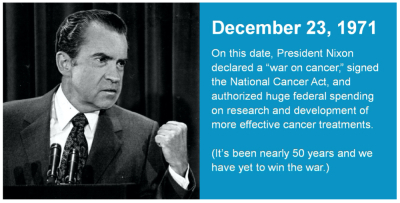
    Chemotherapeutic drug resistance is one reason cancer remains an unsolved clinical problem despite the efforts ever since President Nixon declared his "War on Cancer" in 1971.  Cancer cells, due in part to the genetic destabilization characteristic of the disease, are capable of expressing genes (normal or aberrant) that permit the cell to avoid the cytotoxic effect of such drugs with the patient providing the situs of selection for and growth of resistant cells.  The phenomenon is certain tumor types can have more deleterious consequences than in others, and this is particularly true for glioblastomas (and their non-malignant counterparts, gliomas), cancer of the cells that protect neurons in brain.  That organ, confined to the skull, cannot accommodate tumor growth without damaging the brain with which it is confined.

    Nixon
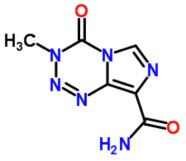
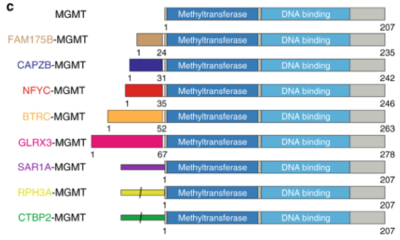
    The chemotherapeutic drug of choice for treating glioblastomas is temezolomide (TMZ), an oral alkylating agent that had its chemotherapeutic effect by introducing alkyl groups onto nucleotide bases (preferably at the N-7 and O-6 positions of guanine and N-3 position of adenine) in tumor cell DNA preferentially (due to the greater amount of DNA synthesis occurring in these cells) and disrupting the process leading to cell death (the O-6 methylation having the greatest capacity to induce apoptosis or programmed cell death). StructureO-6-methylguanosnine DNA methyltransferase (MGMT) is the cellular enzyme responsible for repairing alkylated bases in DNA and reduced expression of this gene (e.g., by hypermethylation of the MGMT promoter) is a biomarker for TMZ sensitivity in gliomas and glioblastomas.  Recently, a multinational team of researchers* reported genetic rearrangements associated with TMZ resistance, in a paper entitled "MGMT genomic rearrangements contribute to chemotherapy resistance in gliomas" published in Nature Communications.  This paper shows a subset of gliomas with rearrangements in the MGMT gene that produce overexpression of the gene and resistance as a result.  These authors screened 252 TMZ-treated recurrent gliomas by RNA sequencing and found eight different MGMT genetic fusions (designated BTRCMGMTCAPZBMGMTGLRX3MGMTNFYCMGMTRPH3AMGMT, and SAR1AMGMT in high-grade gliomas, HGG, and CTBP2MGMT and FAM175BMGMT in low-grade gliomas, LGG, in the paper) in seven patients (6 females) with recurrent disease, created by chromosomal rearrangement (see Figure 1c from paper; shown below).  These individuals' tumors showed "significantly higher" expression of the rearranged MGMT gene product.

    Figure cUpon further study, the authors report that five of the eight rearranged genes were located on Chromosome 10 in the vicinity of the MGMT gene itself.  The breakpoint in the MGMT was uniformly found at the boundary of exon 2 of the MGMT gene, at a point 12 basepairs upstream of the ATG translation "start" codon.  In three of the rearrangements, the breakpoint in the partner gene in the genetic fusion was found in the 5' untranslated region (UTR).  All fusions were found to be in-frame (i.e., the reading frame of the MGMT transcript was not disrupted) and the functional regions of the MGMT protein (the methyltransferase domain and DNA-binding domain) were intact.  A more fine-structure mapping experiment in the genetic rearrangement resulting in FAM175BMGMT found that the fusion was the consequence of a deletion of 4.8 Mb.

    The effect of these rearrangements on MGMT expression was elucidated using CRIPSR-Cas9 to produce the BTRC-MGMT, NFYC-MGMT, SAR1A-MGMT, and CTBP2-MGMT rearrangements in cells of two glioblastoma cell lines, U251 and U87.  When these cells and their untreated counterparts were challenged by growth in vitro with TMZ, only cells bearing the rearrangements (as confirmed by PCR analysis) were shown to be TMZ resistant.  Unlike genetic rearrangements in other cancers that produce fusion proteins (such as the abl-bcr gene produced in chronic myelogenous leukemia bearing the diagnostic Philadelphia chromosome), because most of the rearrangements found involving the MGMT gene were located upstream of the initiation codon of the MGMT gene these authors reasoned that these rearrangements produce increased expression of MGMT leading to TMZ resistance because the cells were better able to repair the methylation injury and replicate functionally.  This hypothesis was supported by real-time quantitative PCR analysis of MGMT transcripts in cells bearing the rearrangements, that showed a "striking" increase in expression of MGMT-encoding transcripts (an observation also found in tumors from patients whose gliomas or glioblastomas showed these rearrangements), and Western blot analysis confirmed higher expression levels of the MGMT protein.  In two of the rearrangements (BTRC-MGMT and NFYC-MGMT), higher molecular weight fusion proteins were detected as predicted from the genetic data.  These results were also replicated in patient tumor-derived stem cells for the BTRC-MGMT and SAR1A-MGMT rearrangements.

    These results, and the researchers' conclusion that these rearrangements caused TMZ resistance by overexpression of MGMT, were confirmed by re-establishing TMZ sensitivity in these cells in the presence of O6-benzylguanine (O6-BG), an MGMT inhibitor.  These results were further confirmed by detection of double-strand breaks in DNA in these cells in the presence of TMZ and O6-BG.

    The relevance of these results to TMZ resistance in vivo was demonstrated using nude mouse xenograft models bearing tumors produced using BTRC-MGMT U251 cells and U251 cells without the rearrangement as control; these cells also contained a recombinant luciferase gene.  Mice containing the rearrangement showed no significant prolongation of lifespan in the presence or absence of TMZ, indicating tumor cell resistance, whereas TMZ treatment of naïve U251 cells showed improved survival.

    While hypomethylation of the native MGMT promoter is the most frequently change associated with TMZ resistance, the results presented in this paper illustrate an alternative mechanism for glioblastomas and gliomas to acquire resistance to TMZ, the only current chemotherapeutic drugs for these maladies.  Because these rearrangements were found in patients with recurrent tumors, these authors hypothesize that the rearrangements were selected or by TMZ treatment.  A similar rearrangement has also been found in another cancer, medulloblastoma, after TMZ relapse.  These authors also suggest that detection of these rearrangements can be used clinically to determine appropriate treatment modalities, particularly for recurrent disease.

    * Seve Ballesteros Foundation Brain Tumor Group, Molecular Oncology Programme, Spanish National Cancer Research Center; Division of Life Science, Department of Chemical and Biological Engineering, Center of Systems Biology and Human Health and State Key Laboratory of Molecular Neuroscience, The Hong Kong University of Science and Technology;  Beijing Neurosurgical Institute, Capital Medical University; Department of Neurosurgery, Samsung Medical Center, Sungkyunkwan University School of Medicine; Department of Systems Biology, Columbia University; The Jackson Laboratory for Genomic Medicine; and Molecular Cytogenetics Group, Human Cancer Genetics Program, Spanish National Cancer Research Center, CNIO, 28029, Madrid, Spain

  • Federal Circuit Hands Down Modified Opinion in Illumina, Inc. v. Ariosa Diagnostics, Inc.

    By Kevin E. Noonan

    Federal Circuit SealEarlier this year, the Federal Circuit (somewhat surprisingly) found claims of two Sequenom patents directed to methods for detecting fetal DNA in maternal blood to satisfy the subject matter eligibility requirements of Section 101 (see "Illumina, Inc. v. Ariosa Diagnostics, Inc. (Fed. Cir. 2020)").  The surprise arose in part due to the Federal Circuit's track record of finding all diagnostic method claims to be ineligible as being directed to a natural law without "something more" to overcome the patentability preclusion created by the Supreme Court in Mayo Collaborative Services v. Prometheus Laboratories, Inc. (see, e.g., Judge Moore's dissent in Athena Diagnostics, Inc. v. Mayo Collaborative Servs., LLC, 927 F.3d 1333, 1352 (Fed. Cir. 2019) ( "Since Mayo, we have held every single diagnostic claim in every case before us ineligible.").  Another reason, of course, is that the Federal Circuit affirmed a finding of patent ineligibility in Ariosa Diagnostics, Inc. v. Sequenom, Inc.  Nevertheless, a divided panel found a patent eligibility-creating distinction in the claims asserted in this most recent case (over a dissent by the author of the Ariosa v. Sequenom decision, Judge Reyna) and today the Court issued a revised opinion in the face of Ariosa's petition for rehearing.

    To recap, the case arose over U.S. Patent No. 9,580,751 (the '751 patent) and U.S. Patent No. 9,738,931 (the '931 patent), directed to the solution of an unexpected difficulty in detecting cell-free fetal DNA (cffDNA):

    [T]he major proportion (generally >90%) of the extracellular DNA in the maternal circulation is derived from the mother.  This vast bulk of maternal circulatory extracellular DNA renders it difficult, if not impossible, to determine fetal genetic alternations [sic] . . . from the small amount of circulatory extracellular fetal DNA.

    The inventors found that cffDNA was significantly smaller (300-500 bp) than the "interfering" maternal DNA, and thus using admittedly conventional techniques of size separation the cffDNA could be isolated and rendered detectable.

    Illumina and Sequenom asserted claims 1, 2, 4, 5, 9, and 10 of the '751 patent and claims 1, 2, and 10–14 the '931 patent against Ariosa and Roche Diagnostics; the Court considered claim 1 from each patent to be representative:

    '751 patent:

    1. A method for preparing a deoxyribonucleic acid (DNA) fraction from a pregnant human female useful for analyzing a genetic locus involved in a fetal chromosomal aberration, comprising:
      (a) extracting DNA from a substantially cell-free sample of blood plasma or blood serum of a pregnant human female to obtain extracellular circulatory fetal and maternal DNA fragments;
          (b) producing a fraction of the DNA extracted in (a) by:
              (i) size discrimination of
              (ii) selectively removing the DNA fragments greater than approximately 500 base pairs,
              wherein the DNA fraction after (b) comprises a plurality of genetic loci of the extracellular circulatory fetal and maternal DNA; and
          (c) analyzing a genetic locus in the fraction of DNA produced in (b).

    '931 patent:

    1. A method, comprising:
      (a) extracting DNA comprising maternal and fetal DNA fragments from a substantially cell-free sample of blood plasma or blood serum of a pregnant human female;
          (b) producing a fraction of the DNA extracted in (a) by:
              (i) size discrimination of extracellular circulatory fetal and maternal DNA fragments, and
              (ii) selectively removing the DNA fragments greater than approximately 300 base pairs,
          wherein the DNA fraction after (b) comprises extracellular circulatory fetal and maternal DNA fragments of approximately 300 base pairs and less and a plurality of genetic loci of the extracellular circulatory fetal and maternal DNA fragments; and
          (c) analyzing DNA fragments in the fraction of DNA produced in (b).

    The District Court on summary judgment held these claims and all asserted claims to be ineligible under 35 U.S.C. § 101 and the Supreme Court's Alice/Mayo test (see "Illumina, Inc. v. Ariosa Diagnostics, Inc. (N.D. Cal. 2018)"), and Illumina appealed.

    In the original opinion, the Federal Circuit reversed, in an opinion by Judge Lourie joined by Judge Moore; Judge Reyna dissenting (as he does in this revised opinion).  Judge Lourie justified the different outcome here by stating "[t]his is not a diagnostic case.  And it is not a method of treatment case.  It is a method of preparation case."  But the majority based its decision on this distinction:  "[h]ere, it is undisputed that the inventors of the '751 and '931 patents discovered a natural phenomenon.  But at step one of the Alice/Mayo test, 'it is not enough to merely identify a patent-ineligible concept underlying the claim; we must determine whether that patent-ineligible concept is what the claim is 'directed to," citing Rapid Litig. Mgmt. Ltd. v. CellzDirect, Inc.  It is undisputed that cell-free fetal DNA (cffDNA) exists in maternal blood and its presence is a natural phenomenon, and moreover that the size differentials and distributions that form the predicate basis for the claims at issue here are also naturally occurring.  But the panel majority held that the claims were not merely "directed to" that natural phenomenon, but rather were directed to a method that exploits the natural phenomenon that renders the claims patent-eligible.  Sounding a theme he first enunciated in Vanda Pharmaceuticals Inc. v. West-Ward Pharmaceuticals, Judge Lourie recognizes the distinction that the claims at issue recited "specific process steps—size discriminating and selectively removing DNA fragments that are above a specified size threshold" that increased the relative amount of cffDNA in the processed sample compared to maternal DNA and thus "change[d] the composition of the mixture" and produced a DNA-containing fraction that was different from what naturally occurs in maternal blood.

    Judge Lourie's latest opinion reiterates most of these themes.  The basis of the decision remains that "this is not a diagnostic case.  And it is not a method of treatment case.  It is a method of preparation case."  As in the original opinion, the panel majority are somewhat critical of appellants' inability (in the majority's view) to "clearly identify the natural phenomenon that forms the basis of its challenge" but finds that the parties' differences on this point to be relatively meaningless distinctions and adopts Illumina's definition that the natural phenomenon underlying the claimed invention is that "cell-free fetal DNA tends to be shorter than cell-free maternal DNA in a mother's bloodstream."  But the majority arrives at the same conclusion as before:  although the claims are based on this natural phenomenon they "are not directed to that natural phenomenon but rather to a patent-eligible method that utilizes it" (emphasis in opinion).

    And the basis of this conclusion relies at least in part on the specific method steps recited by the claims, which might constitute the ineluctable "something more" mandated by the Supreme Court's jurisprudence that looks enough like novelty to disturb any patent practitioner (or more likely scholar) concerned with doctrinal consistency.  But this insistence also cabins the scope of the claims to the specifically recited steps, which goes a long way towards avoiding the overbroad scope that seems to have been at least part of the Supreme Court's concern regarding preemption motivating the Court's attempts to restrict patent eligibility of certain types of claims.  Also important for the panel majority is that the choice of the size distinctions recited in the claims are not themselves natural phenomenon but are "human-engineered parameters that optimize the amount of maternal DNA that is removed from the mixture and the amount of fetal DNA that remains in the mixture in order to create an improved end product that is more useful for genetic testing than the original natural extracted blood sample."  And the result of the claimed methods are a mixture of DNA fragments having a change in their composition, being enriched in fetal-derived DNA fragments shorter than 500 (the '751 patent) or 300 (the '931 patent) basepairs.

    The opinion, like its earlier version, distinguishes the claims at issue here with the claims in Supreme Court and Federal Circuit precedent found to be patent-ineligible, most notably that these claims are not directed to isolated DNA itself (Association for Molecular Pathology v. Myriad Genetics, Inc., 569 U.S. 576 (2013)), or merely detecting its presence in maternal blood (Ariosa), or even determining "whether a cell-free DNA fragment in a previously-prepared sample is fetal or maternal based on the natural size distribution of cell-free DNA fragments" but rather methods for preparing a mixture enriched in cffDNA based on "conventional separation technologies can be used in unconventional ways," specifically the claimed thresholds of 500 bp and 300 bp for separating fetal from material DNA ("Roche[] has presented no evidence that thresholds of 500 base pairs and 300 base pairs were conventional for separating different types of cell-free DNA fragments.").

    An admittedly cursory comparison between the majority opinion issued in March and the one issued today finds precious little difference in the reasoning advanced by the Court.  In contrast, Judge Reyna's dissent appears to refine some of the Judge's arguments but at bottom reiterates his opinion that these claims are directed to a patent-ineligible natural phenomenon.

    The Court is properly not transparent regarding the internal discussions and arguments asserted by those Judges who share the majority's views and those who share Judge Reyna's views.  But in light of the great similarities of these opinions it seems apparent that the Court was most comfortable not deciding to hear the case as a result of the revisions occasioned in the opinion handed down today.  Whether there are additional motivations (including putting the panel's disparate views in better condition for Supreme Court review) may become apparent if the Court deigns to revisit what it has wrought in the years since deciding the proper metes and bounds of Section 101 became a priority for the Court.

    Illumina, Inc. v. Ariosa Diagnostics, Inc. (Fed. Cir. 2020)
    Panel: Circuit Judges Lourie, Moore, and Reyna
    Opinion by Circuit Judge Lourie; dissenting opinion by Circuit Judge Reyna

  • By Kevin E. Noonan

    Federal Circuit SealLast week, the Federal Circuit took the opportunity presented in an appeal from judgment on the pleadings in XY, LLC v. Trans Ova Genetics, LC to distinguish claims directed toward a patent-eligible invention from invalidation under the Supreme Court's imperfectly applied Alice Corp. v. CLS Bank Int'l (2014) test.

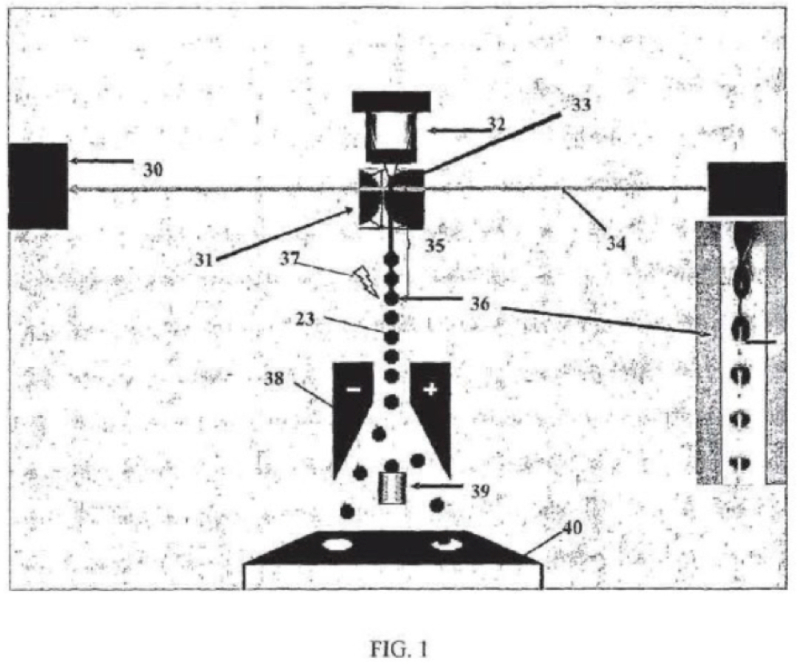
    The case arose over XY's assertion of Reissue Patent No. RE46,559 as well as U.S. Patent Nos. 6,732,422, 7,723,116, and 8,652,769 against Trans Ova.  The claims of the '559 reissue patent were directed to improving flow cytometric analysis.  As set forth in the opinion, the claimed invention related to "apparatus and methods for real-time discrimination of particles while being sorted by flow cytometry . . . resulting in enhanced discrimination between populations of particles" which could include cells, specifically sperm cells based on whether the sperm carried an X or a Y chromosome.  Useful applications included animal husbandry.  The opinion contains this illustration of the functional geometry of apparatuses encompassed by the asserted claims:

    FIG. 1and the following explanation:

    After passing through a laser beam (34), particles coupled to a light-emitting element may emit signals, such as fluorescence, which are then collected by at least one signal detector, such as a forward scatter detector (30).  . . .  The "signal detector may be connected to a system . . . in which signal data indicative of the signals may be processed and analyzed in order to determine a sort decision."  "While a sort decision []n is being determined, particles may pass through a drop delay (35)." . . .  Following a sort decision, "a pulse of charge (37) may be applied to a droplet (23) containing a particle.  Droplets may pass through charged deflection plates (38) in order to sort particles into a desired sort receptacle (40)" [citations to the specification omitted].

    The data produced in this way provides the basis for the apparatus to produce a more discriminating assessment of particles in a mixture, including differences between X- and Y-bearing sperm.  These methods involve signal processors programed to detect differences including "rotational alteration, translation operation, scaling operation, any combination of these and the like."

    Claim 1 is representative:

    1.  A method of operating a flow cytometry apparatus with at least n detectors to analyze at least two populations of particles in the same sample, the method comprising:
        (a) establishing a fluid stream in the flow cytometry apparatus with at least n detectors, the at least n detectors including a first detector and a second detector;
        (b) entraining particles from the sample in the fluid stream in the flow cytometry apparatus;
        (c) executing instructions read from a computer readable memory with a processor, the processor being in communication with the first detector in the flow cytometer, to detect a first signal from the first detector based on individual particles in the fluid stream;
        (d) executing instructions read from the computer readable memory with the processor, the processor being in communication with the second detector in the flow cytometer, to detect a second signal from the second detector based on the individual particles in the fluid stream;
        (e) executing instructions read from the computer readable memory with the processor to convert at least the first signal and the second signal into n-dimensional parameter data for detected particles in the sample, wherein the n-dimensional parameter data for particles from the at least two populations overlap in at least one of the dimensions;
        (f) executing instructions read from the computer readable memory with the processor to rotationally alter the n-dimensional parameter data so that spatial separation of the data from the particles from the at least two populations in the at least one dimension that is overlapped is increased;
        (g) executing instructions read from the computer readable memory with the processor to real-time classify each of the individual detected particles into one of a first population and a second population of the at least two populations based on at least the rotationally altered n-dimensional parameter data; and
        (h) using the real-time classification, sorting the individual particles with the flow cytometer.

    Trans Ova filed a motion for judgment on the pleadings based on the '559 reissue patent being invalid because the claims were not patent-eligible under § 101.  The District Court granted this motion, applying its understanding of the Supreme Court's two step analysis as set forth in Alice Corp. v. CLS Bank Int'l, 573 U.S. 208 (2014).  The Court held that the claims were directed to an abstract idea, specifically a "mathematical equation that permits rotating multi-dimensional data."  Under step two of the Alice test, the District Court held that there was no "inventive concept" to render the claims patent eligible, based on XY's admission that all claim elements were known in the prior art (albeit not in the arrangement or order recited in the asserted claims).  The District Court also granted Trans Ova's motion to dismiss because asserting the '422, '116, and '769 patents was barred by the doctrine of claim preclusion based on an earlier lawsuit.

    The Federal Circuit reversed the District Court on its patent eligibility decision, vacated the District Court's judgment on claim preclusion, and remanded, in an opinion by Judge Stoll joined by Judges Plager and Wallach.  With regard to judgment and invalidation for patent ineligibility, the panel held that the District Court had erred in its application of the Alice test.  Specifically, the Federal Circuit held that the asserted claims were not directed to an abstract idea; thus, if properly applied, the Alice test would have mandated that the District Court deny Trans Ova's motion.  The panel considered the Supreme Court's jurisprudence on patent eligibility to include the principle that "[l]aws of nature, natural phenomena, and abstract ideas are not patentable" to be tempered by the further Supreme Court instruction that "[a]t some level, 'all inventions . . . embody, use, reflect, rest upon, or apply laws of nature, natural phenomena, or abstract ideas,'" citing Mayo Collaborative Servs. v. Prometheus Labs, Inc., 566 U.S. 66, 71 (2012), and that further "[t]hus, an invention is not rendered ineligible for patent simply because it involves an abstract concept," citing Diamond v. Diehr, 450 U.S. 175, 187 (1981).  The District Court's error, according to the Federal Circuit, arose in its application of step one of the Alice test, because the asserted claims did not recite an abstract concept in the Court's view.  Even Trans Ova's counsel in argument before the Federal Circuit (according to the opinion) admitted that the claims of the '559 reissue patent were "not merely directed" to the mathematical concept, but rather to "a purportedly improved method of operating a flow cytometry apparatus to classify and sort particles into at least two populations in real time, wherein first and second detectors detect signals from individual particles and a processor converts the signals to n-dimensional parameter data and rotationally alters that data to increase spatial separation among the data, thereby facilitating classification and sorting of each individual particle."  The opinion expressly relied on the Supreme Court's Diehr opinion (as it must), as well as its own opinion in Thales Visionix Inc. v. United States, 850 F.3d 1343 (Fed. Cir. 201), for this conclusion.  The Court found the asserted claims of the '559 reissue patent to be analogous to the claims in Diehr because "the asserted claims 'describe in detail a step-by-step method' for accomplishing a physical process," citing Diehr.  The panel perceived a similar analogy with the Thales claims, which recited methods "in which at least two sensors or detectors gather data about an object before mathematical operations are applied to the gathered data to generate more accurate information about the object than was previously possible in the art."  And both sets of claims "purport to improve results" of previously practiced methods.  The panel appreciated the distinction between a claim directed to a mathematical formula and claims that apply a formula or algorithm to achieve "a function which the patent laws were designed to protect," citing Diehr.

    The opinion expressly rejected Trans Ova's contention (and a basis for the District Court's decision) that the asserted claims of the '559 reissue patent were analogous to the claims in Parker v. Flook that were held ineligible because those claims "'simply provide[d] a new and presumably better method for calculating alarm limit values,' requiring nothing more than updating an alarm limit—a number—through application of the recited formula" according to the Flook opinion.  And the panel further understood there to be a distinction between this case and Flook because "[t]he patent application [in Flook] contained no 'disclosure relating to the chemical processes at work, the monitoring of process variables, or the means of setting off an alarm or adjusting an alarm system.'"  Bringing to mind Judge Lourie's emphasis on "specificities" in Vanda Pharmaceuticals Inc. v. Hikma Pharmaceuticals USA Inc., the opinion recites in distinguishing Flook the specifically recited steps in the claimed method.  The opinion cites in support of these distinctions the Supreme Court's holding in Diehr that "a process is not unpatentable simply because it contains a law of nature or a mathematical algorithm."  Finally, the panel distinguished these claims from those in Cleveland Clinic Foundation v. True Health Diagnostics LLC, 859 F.3d 1352 (Fed. Cir. 2017), which were held ineligible on Section 101 grounds, because the Cleveland Clinic claims "used a known laboratory technique to observe a previously unknown natural phenomenon," whereas here the '559 reissue patent claims were directed toward improving a known laboratory technique using the application of the mathematical formula.

    With regard to the claim preclusion issue, the panel agreed with XY that the District Court erred by not comparing the claims of the '422, '116, and '769 patents asserted in this action with the asserted claims in the prior lawsuits.  While the District Court recited the proper test ("whether the scope of the patent claims asserted in the 2012 and 2016 lawsuits was 'materially' the same"), the Federal Circuit held that the court did not provide the required comparison.  "Instead," according to the panel opinion, "the district court concluded that claim preclusion applied to XY's '422 and '116 patent-infringement allegations simply because (1) these patents issued before XY filed the 2012 lawsuit; and (2) XY's allegations of infringement 'address the same, or substantially the same subject matter as previously filed claims and [are] directed at a previously accused product or process,'" citing to the District Court's ruling on the motion to dismiss.  The panel considered the District Court to have concluded, without explanation on the record, that this action was "'part of the same transaction that prompted the 2012 [l]awsuit,' because they were 'related in time, origin, and motivation' to, and would have been 'a convenient trial unit' with, the patents asserted in the 2012 lawsuit."  As for the '769 patent, which had not issued when the earlier lawsuits were commenced, the District Court believed litigation over this patent to be "a continuation of a patent already in suit" and thus that XY should have moved the District Court in that earlier litigation to amend its complaint to add the '769 patent.  The Federal Circuit consider its precedent, SimpleAir, Inc. v. Google LLC, 884 F.3d 1160, 1165 (Fed. Cir. 2018), to be "materially indistinguishable" from the circumstance here; in that case, the District Court had held separate lawsuits on two related patents involved the same cause of action solely because the two patents shared the same specification and were both terminally disclaimed over another prior patent.  The Federal Circuit held that later-asserted patent claims "could provide a larger claim scope to a patentee than earlier-asserted patent claims.  According to the Federal Circuit, here "[t]he district court did not even mention the asserted claims of the '422, '116, or '769 patents, let alone analyze their scope as compared to the scope of the patent claims asserted in XY's 2012 lawsuit," which comparison was required under its Simple Air decision.  On this basis, the Federal Circuit vacated and remanded the case to the District Court for a proper analysis of the similarities and differences of the claims asserted in this action and the prior lawsuits.

    This case illustrates hopeful and less hopeful trends in the Federal Circuit's jurisprudence on Section 101 subject matter eligibility.  On the one hand the decision illustrates the ease with which a district court can be convinced by an emphasis on the underlying basis for a claimed invention that the claims are directed to the "abstract idea" underlying the invention.  On the other hand, this decision follows a trend of the Federal Circuit distinguishing claims directed to the abstract idea itself and those directed to an application thereof (see, e.g.Rapid Litigation Management Ltd. v. Cellzdirect, Inc.)But before anyone become giddy at the prospect of the Court finding a reliable guide to subject matter eligibility, it must be considered that on the same day the Court handed down its decision in this case it also denied a petition for rehearing en banc in American Axle & Mfg. v. Neapco Holdings LLC, which will be the subject of a subsequent post.

    XY, LLC v. Trans Ova Genetics, LC (Fed. Cir. 2020)
    Panel: Circuit Judges Wallach, Plager, and Stoll
    Opinion by Circuit Judge Stoll

  • UIC JMLSThe UIC John Marshall Law School is holding an online conference entitled "IP, Technology & Social Justice in the Age of Coronavirus" on September 11, 2020.  The conference is being organized by the Center for Intellectual Property, Information & Privacy Law at UIC John Marshall Law School and the Institute for Intellectual Property & Social Justice.  The conference will run from 7:40 am to 3:00 pm (CT) and will offer 6.75 hours (pending) of CLE credit.

    Topics will include:

    • The Pandemic and Access to Health
    • The Pandemic and Civil Society: Civic Engagement in the IP System
    • Including Older Americans, Native Americans, and Americans with Disabilities
    • IP as Social Change: Reconceptualizing the Rightsholder/IP Consumer Symbiosis after Georgia v. Resource.Org

    Registration information for the conference can be found here.

    Registration Fees are $60 (general registration with CLE credit).  Registration without CLE credit, for government attendees, and for UIC students, faculty, adjunct professors, staff, IP Center advisory board members, and IIPSJ guests is free.  Limited scholarships available for 2018–2020 JMLS/UIC graduates; non-UIC students, faculty, staff; and need-based attendees.