• By Kevin E. Noonan

    Federal Circuit SealThe Federal Circuit recently vacated a District Court decision by Federal Circuit Judge Dyk, sitting by designation, based on erroneous claim construction in Baxalta Inc. v. Genentech, Inc.

    The case arose over Genentech's Hemlibra® (emicizumb-kxwh) product, which Baxalta alleged infringed its U.S. Patent No. 7,033,590.  Baxalta asserted claims 1, 4, 17, and 19; these claims were directed to certain elements of the "blood clotting cascade" for treatment of hemophilia A.  The invention claimed in the '590 patent involved using antibodies or antibody fragments to replace binding of Factor VIII (which is deficient or inhibited in hemophiliacs) to Factor IX, which permits restoration of the cascade (wherein Factor IX activates Factor X) as set forth in the following drawing:

    2020-08-30 Image
    The Federal Circuit found Claims 1, 4, and 19 to be illustrative:

    1.  An isolated antibody or antibody fragment thereof that binds Factor IX or Factor IXa and increases the procoagulant activity of Factor IXa.

    4.  The antibody or antibody fragment according to claim 1, wherein said antibody or antibody fragment is selected from the group consisting of a monoclonal antibody, a chimeric antibody, a humanized antibody, a single chain antibody, a bispecific antibody, a diabody, and di-, oligo- or multimers thereof.

    19.  The antibody or antibody fragment according to claim 4, wherein the antibody is a humanized antibody.

    At trial, the parties proposed alternative claim constructions for the terms "antibody" and "antibody fragment."  Baxalta's proposed claim construction defined "antibody" as "[a] molecule having a specific amino acid sequence comprising two heavy chains (H chains) and two light chains (L chains)."  Genentech's proposed construction was that "antibody" should be construed as "[a]n immunoglobulin molecule, having a specific amino acid sequence that only binds to the antigen that induced its synthesis or very similar antigens, consisting of two identical heavy chains (H chains) and two identical light chains (L chains)" (emphasis added).  These differences were relevant because Genentech's Hemlibra® product was a bispecific antibody, i.e., the heavy and/or light chains comprising the antibody were different, thus permitting the two portions of the antibody to recognize and bind to different antigens.  Judge Dyk, sitting by designation, held that the term "antibody," without more, could have different meanings to the skilled worker and both parties' definitions were consistent with these different meanings.  In deciding to adopt Genentech's proposed construction, Judge Dyk held that Baxalta's specification contained a definition of the term that was dispositive:

    Antibodies are immunoglobulin molecules having a specific amino acid sequence which only bind to antigens that induce their synthesis (or its immunogen, respectively) or to antigens (or immunogens) which are very similar to the former.  Each immunoglobulin molecule consists of two types of polypeptide chains.  Each molecule consists of large, identical heavy chains (H chains) and two light, also identical chains (L chains).

    This definition was inconsistent with the remainder of the '590 specification, that disclosed bispecific antibodies, and also inconsistent with other naturally occurring antibody embodiments, such as IgM and IgA.  Judge Dyk also dismissed the inconsistencies that this construction raised between claim 1 and claims 4 and 19 based in the one instance of express disclosure in the '590 specification.  The District Court also relied on amendments made during prosecution of the '590 patent claims, wherein Baxalta amended claim 1 as filed to replace "antibody derivatives" with "antibody fragments."  In Judge Dyk's view, these amendments amounted to a disclaimer of bispecific antibodies and limited the claims to antibody fragments.

    With regard to the District Court's construction of the phrase "antibody fragments."  Baxalta proposed construction of "[a] portion of a molecule having a specific amino acid sequence comprising two heavy chains (H chains) and two light chains (L chains)," whereas Genentech proposed to construe this term to mean "[a] fragment of an antibody which partially or completely lacks the constant region; the term 'antibody fragment' excludes all other forms of antibody derivatives."  Again relying on express language in the specification ("antibody fragments . . . partially or completely lack the constant region" and identifying examples of fragments (Fv, Fab, Fab' [and] F(ab)'2)," Judge Dyk construed the phrase "antibody fragment" to mean "a fragment of an antibody which partially or completely lacks the constant region" and that "the term 'antibody fragment' excludes bispecific antibodies."

    Based on these constructions, the parties stipulated that Genentech's Hemlibra® product did not infringe, and after the District Court entered judgment, Baxalta appealed.

    The Federal Circuit vacated Judge Dyk's claim construction and final judgment and remanded, in an opinion by Judge Moore joined by Judges Plager and Wallach.  The panel opinion reviewed Judge Dyk's construction de novo because the only evidence relied upon in Judge Dyk's decision was intrinsic evidence and thus the Federal Circuit owed the District Court no deference; see Teva Pharma. USA, Inc. v. Sandoz, Inc., 574 U.S. 318 (2015)).  Under this standard, the Federal Circuit found that Judge Dyk erred in construing the term "antibody."  Relying on the plain language of the claim (the first canon of claim construction under Phillips v. AWH Corp., 415 F.3d 1303 (Fed. Cir. 2005) (en banc); Judge Dyk joined 9 other Federal Circuit judges in this opinion), the Federal Circuit held that "nothing in the plain language of claim 1 limits the term "antibody" to a specific antibody consisting of two identical heavy chains and two identical light chains or an antibody that only binds the antigen that induced its synthesis or very similar antigens."  The panel also opined that the dependent claims "confirm[ed] that [the term] "antibody" is not so limited," inter alia, wherein dependent (and asserted) claim 4 expressly recited a bispecific antibody as a species of antibody or antibody fragment.  Construing a term in an independent claim to exclude expressly recited species in dependent claims is "inconsistent with the plain language of the claims," according to the panel, citing Intellectual Ventures I LLC v. T-Mobile USA, Inc., 902 F.3d 1372, 1378 (Fed. Cir. 2018); and Ortho-McNeil Pharm., Inc. v. Mylan Labs., Inc., 520 F.3d 1358, 1362 (Fed. Cir. 2008).  Genentech argued (at trial and before the Federal Circuit) that the proper outcome was to invalidate any such inconsistent dependent claims, which the panel refused to do based on the plain language of the claims.

    Turning to the specification, the panel also rejected the District Court's reliance on specific disclosure set forth above.  While acknowledging that, in isolation, that paragraph could be interpreted as providing a definition, "claim construction requires that we 'consider the specification as a whole, and . . . read all portions of the written description, if possible, in a manner that renders the patent internally consistent,'" citing Budde v. Harley-Davidson, Inc., 250 F.3d 1369, 1379–80 (Fed. Cir. 2001).  Judge Dyk's use of the specification to support his claim construction was also inconsistent with the practice of the Court, inter alia, because this excerpt is devoid of language that renders such "general statements" limiting, as set forth, for example, in Luminara Worldwide, LLC v. Liown Elecs. Co., 814 F.3d 1343, 1353 (Fed. Cir. 2016). Considering the specification as a whole, the panel notes that it contains "specific disclosures regarding bispecific, chimeric, and humanized antibodies and methods of production thereof," all of which rebut the District Court's construction.  The specification also expressly discloses methods for producing humanized or chimeric antibodies which are also inconsistent with Judge Dyk's claim construction.

    Finally, the Federal Circuit considered the prosecution history and concluded that it did not support the District Court's claim construction based on prosecution history disclaimer.  According to the panel, the disclaimer perceived by Judge Dyk was not "sufficiently clear and unmistakable" to amount to clear disclaimer, citing 3M Innovative Properties Co. v. Tredegar Corp., 725 F.3d 1315, 1325 (Fed. Cir. 2013). The District Court's construction was also inconsistent with allowance of claim 4, which expressly recites bispecific antibody fragments.

    The panel concludes by mandating the construction to be used on remand, wherein "antibody" is construed to mean "an immunoglobulin molecule having a specific amino acid sequence comprising two heavy chains (H chains) and two light chains (L chains)."

    Turning to construction of the phrase "antibody fragments," the Federal Circuit held Judge Dyk erred in his construction of this term, and held that on remand the phrase be construed to mean "[a] portion of an immunoglobulin molecule having a specific amino acid sequence comprising two heavy chains (H chains) and two light chains (L chains)."  The Federal Circuit based its finding of error on the District Court's reliance on a portion of the specification that recited:

    The term factor IX/IXa activating antibodies and antibody derivatives may also include . . . e.g., "technically modified antibodies" such as synthetic antibodies, chimeric or humanized antibodies, or mixtures thereof, or antibody fragments which partially or completely lack the constant region, e.g. Fv, Fab., Fab' or F(ab) etc.

    The error was in confining claims to specific embodiments recited in the specification, about which the opinion states the court "has repeatedly warned against," citing Thorner v. Sony Comput. Entm't Am. LLC, 669 F.3d 1362, 1365 (Fed. Cir. 2012).  The panel also notes that the specification contained language ("may also include," "e.g.," "such as," and "etc.") indicting that the patentee did not intend to provide a limiting definition of the phrase "antibody fragments."

    Thus, the Federal Circuit remanded the action back to the District Court, awarding costs to Baxalta.

    Baxalta Inc. v. Genentech, Inc. (Fed. Cir. 2020)
    Panel: Circuit Judges Moore, Plager, and Wallach
    (note: after oral argument, Judge Plager replaced Judge Stoll, who recused)
    Opinion by Circuit Judge Moore

  • CalendarSeptember 1, 2020 – IPWatchdog Virtual CON2020 – Keynote: Andrei Iancu, Under Secretary of Commerce for Intellectual Property & Director of the USPTO (IPWatchdog) – 12:05 pm (ET)

    September 1, 2020 – IPWatchdog Virtual CON2020 – Litigating Patents in Texas: Trends, Best Practices and Differences Between Districts – 12:45 pm (ET)

    September 1, 2020 – IPWatchdog Virtual CON2020 – Patents at the PTAB: How the Times Have Changed (or Not) – 2:15 pm (ET)

    September 2, 2020 – IPWatchdog Virtual CON2020 – Keynote: Chief Judge Paul Michel (CAFC, ret.) – 12:05 pm (ET)

    September 2, 2020 – IPWatchdog Virtual CON2020 – The Future of the CAFC: Is the Court Still Relevant? – 12:45 pm (ET)

    September 2, 2020 – IPWatchdog Virtual CON2020 – Strategies for Protecting Artificial Intelligence and Machine Learning post-Alice – 2:15 pm (ET)

    September 3, 2020 – IPWatchdog Virtual CON2020 – Keynote: Raymond Millien, Chief IP Officer & CEO, Volvo Car Ventures – 12:05 pm (ET)

    September 3, 2020 – IPWatchdog Virtual CON2020 – In Search of Injunctive Relief in Patent Infringement Litigation – 12:45 pm (ET)

    September 3, 2020 – IPWatchdog Virtual CON2020 – IP Transactions & Portfolio Management: Finding What You Need & Backfilling a Portfolio – 2:15 pm (ET)

    September 8, 2020 – IPWatchdog Virtual CON2020 – The Current State of Patent Eligibility Caselaw – 12:30 pm (ET)

    September 8, 2020 – IPWatchdog Virtual CON2020 – A Bridge of Tears for Life Sciences – 12:45 pm (ET)

    September 8, 2020 – IPWatchdog Virtual CON2020 – Hatch-Waxman and IPR Strategy – 2:15 pm (ET)

    September 9, 2020 – IPWatchdog Virtual CON2020 – Keynote: Tricia Thompkins, EVP, General Counsel and Secretary, Perry Ellis International, Inc. – 12:30 pm (ET)

    September 9, 2020 – IPWatchdog Virtual CON2020 – Leveraging Intellectual Property to Raise Structured Capital in Life Sciences – 12:30 pm (ET)

    September 9, 2020 – IPWatchdog Virtual CON2020 – IP as an Asset Class: Valuing Assets in Support of Monetization Strategy – 12:45 pm (ET)

    September 9, 2020 – IPWatchdog Virtual CON2020 – Litigation Finance: Funding Patent Infringement Litigation – 2:15 pm (ET)

    September 11, 2020 – IP, Technology & Social Justice in the Age of Coronavirus (Center for Intellectual Property, Information & Privacy Law at UIC John Marshall Law School and Institute for Intellectual Property & Social Justice) – 7:40 am to 3:00 pm (CT)

    September 14, 2020 – IPWatchdog Virtual CON2020 – Enforcing & Licensing 5G SEPs: An Innovator’s Perspective – 12:45 pm (ET)

    September 14, 2020 – IPWatchdog Virtual CON2020 – High-Tech Patent Litigation Trends: 101 and the Return of Competitor Lawsuits – 2:15 pm (ET)

    September 14, 2020 – IPWatchdog Virtual CON2020 – Preparing and Prosecuting Patents that Hold up to Challenge – 3:45 pm (ET)

    September 15, 2020 – "Traps for the Unwary Prosecutor: What Practitioners Should Know About US and European Patent Practice" (McDonnell Boehnen Hulbert & Berghoff LLP) – 10:00 am to 11:15 am (CT)

    September 15, 2020 – IPWatchdog Virtual CON2020 – Keynote: Rochelle Blaustein, Associate General Counsel, Technology Transfer & Intellectual Property, United States Department of Energy – 12:05 pm (ET)

    September 15, 2020 – IPWatchdog Virtual CON2020 – The Growing Importance of Trade Secret Protection – 12:30 pm (ET)

    September 15, 2020 – IPWatchdog Virtual CON2020 – Identifying, Valuing and Protecting Trade Secrets in the 21st Century – 12:45 pm (ET)

    September 15, 2020 – IPWatchdog Virtual CON2020 – The Gender Gap: Addressing STEM Education, Funding & Inventorship – 2:15 pm (ET)

    September 16, 2020 – IPWatchdog Virtual CON2020 – Ethics for IP Attorneys – 1:50 pm (ET)

    September 17, 2020 – IPWatchdog Virtual CON2020 – Keynote: Alden Abbott, General Counsel, FTC – 12:05 pm (ET)

    September 17, 2020 – IPWatchdog Virtual CON2020 – Efficiency in Draftsman Communications – 12:30 pm (ET)

    September 17, 2020 – IPWatchdog Virtual CON2020 – Enhancing Value Throughout the Patent Life Cycle – 2:00 pm (ET)

    September 17, 2020 – IPWatchdog Virtual CON2020 – Establishing a Patent Strategy for the Innovation Lifecycle – 2:15 pm (ET)

    September 23-24, 2020 – Summit on Biosimilars: Legal, Regulatory, and Commercial Strategies for the Innovator and Biosimilars Marketplace (American Conference Institute) – virtual conference

    September 23-24, 2020 – FDA Boot Camp (American Conference Institute) – virtual conference

    September 29, 2020 – IPWatchdog Virtual CON2020 – The Future of Monetization – 12:45 pm (ET)

    September 29, 2020 – IPWatchdog Virtual CON2020 – What Can Armor on WWII Planes & Honeybees Tell Us about Innovation Strategy? – 2:00 pm (ET)

    September 29, 2020 – IPWatchdog Virtual CON2020 – Everyone Wants to Be a Unicorn – But What About Patents? – 2:15 pm (ET)

    September 30, 2020 – IPWatchdog Virtual CON2020 – Keynote: Louis Foreman, CEO, Enventys Partners, founder of Edison Nation – 12:05 pm (ET)

    September 30, 2020 – IPWatchdog Virtual CON2020 – How China is Changing the Global Patent System – 12:45 pm (ET)

    September 30, 2020 – IPWatchdog Virtual CON2020 – Solutions for the U.S. Patent System – 2:15 pm (ET)

  • IPWatchdogIPWatchdog will be holding its Virtual CON2020 program from September 1 to September 30, 2020.  Among the patent-related online presentations being offered during the Virtual CON2020 program are:

    September 1

    • Keynote: Andrei Iancu, Under Secretary of Commerce for Intellectual Property & Director of the USPTO – 12:05 pm ET
    • Litigating Patents in Texas: Trends, Best Practices and Differences Between Districts – 12:45 pm ET
    • Patents at the PTAB: How the Times Have Changed (or Not) – 2:15 pm ET

    September 2

    • Keynote: Chief Judge Paul Michel (CAFC, ret.) – 12:05 pm ET
    • The Future of the CAFC: Is the Court Still Relevant? – 12:45 pm ET
    • Strategies for Protecting Artificial Intelligence and Machine Learning post-Alice – 2:15 pm ET

    September 3

    • Keynote: Raymond Millien, Chief IP Officer & CEO, Volvo Car Ventures – 12:05 pm ET
    • In Search of Injunctive Relief in Patent Infringement Litigation – 12:45 pm ET
    • IP Transactions & Portfolio Management: Finding What You Need & Backfilling a Portfolio – 2:15 pm ET

    September 8

    • The Current State of Patent Eligibility Caselaw – 12:30 pm ET
    • A Bridge of Tears for Life Sciences – panel with Patent Docs authors Donald Zuhn and Kevin Noonan; Sherry Knowles of Knowles IP Strategy; and Hans Sauer, Deputy General Counsel and Vice President for Intellectual Property for the Biotechnology Innovation Organization (BIO) – 12:45 pm ET
    • Hatch-Waxman and IPR Strategy – 2:15 pm ET

    September 9

    • Keynote: Tricia Thompkins, EVP, General Counsel and Secretary, Perry Ellis International, Inc. – 12:30 pm ET
    • Leveraging Intellectual Property to Raise Structured Capital in Life Sciences – 12:30 pm ET
    • IP as an Asset Class: Valuing Assets in Support of Monetization Strategy – 12:45 pm ET
    • Litigation Finance: Funding Patent Infringement Litigation – 2:15 pm ET

    September 14

    • Enforcing & Licensing 5G SEPs: An Innovator’s Perspective – 12:45 pm ET
    • High-Tech Patent Litigation Trends: 101 and the Return of Competitor Lawsuits – 2:15 pm ET
    • Preparing and Prosecuting Patents that Hold up to Challenge – 3:45 pm ET

    September 15

    • Keynote: Rochelle Blaustein, Associate General Counsel, Technology Transfer & Intellectual Property, United States Department of Energy – 12:05 pm ET
    • The Growing Importance of Trade Secret Protection – 12:30 pm ET
    • Identifying, Valuing and Protecting Trade Secrets in the 21st Century – 12:45 pm ET
    • The Gender Gap: Addressing STEM Education, Funding & Inventorship – 2:15 pm ET

    September 16

    • Ethics for IP Attorneys – 1:50 pm ET

    September 17

    • Keynote: Alden Abbott, General Counsel, FTC – 12:05 pm ET
    • Efficiency in Draftsman Communications – 12:30 pm ET
    • Enhancing Value Throughout the Patent Life Cycle – 2:00 pm ET
    • Establishing a Patent Strategy for the Innovation Lifecycle – 2:15 pm ET

    September 29

    • The Future of Monetization – 12:45 pm ET
    • What Can Armor on WWII Planes & Honeybees Tell Us about Innovation Strategy? – 2:00 pm ET
    • Everyone Wants to Be a Unicorn – But What About Patents? – 2:15 pm ET

    September 30

    • Keynote: Louis Foreman, CEO, Enventys Partners, founder of Edison Nation – 12:05 pm ET
    • How China is Changing the Global Patent System – 12:45 pm ET
    • Solutions for the U.S. Patent System – 2:15 pm ET

    Additional presentations may be added to the schedule above.  Information regarding those additional presentations as well as a complete agenda and list of speakers for and descriptions of all of the Virtual CON2020 presentations can be found here.  Registration for the Virtual CON2020 series is free.  Those interested in registering for the program can do so here.

  • By Kevin E. Noonan

    SARS-CoV-2Despite the challenges of addressing a previously unknown virus, development of an effective vaccine, soon, is a distinct possibility (see "Multiple Candidate Coronavirus Vaccines Being Developed According to WHO").  But as set forth in an article in Nature on Monday ("The unequal scramble for coronavirus vaccines — by the numbers") by Ewen Callaway, there is a legitimate concern that such vaccines may not be equitably accessible based on medical need.

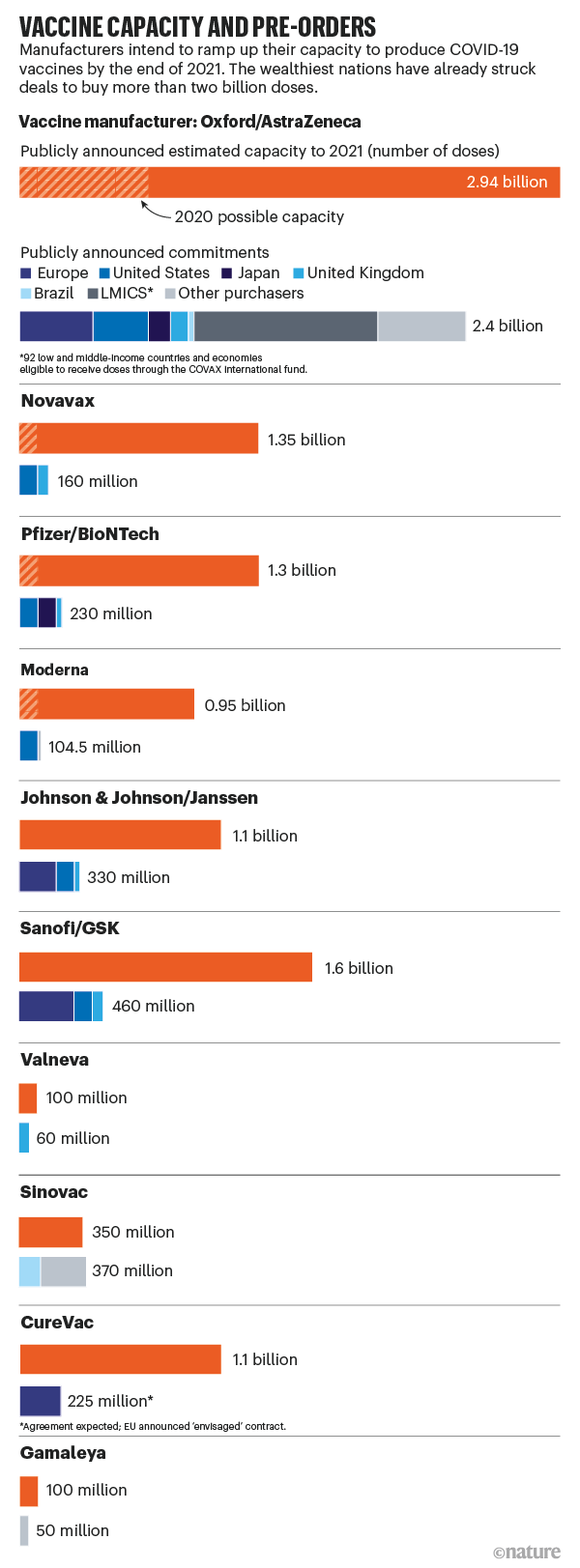
    The issue is a practical one:  how to produce enough doses in a short enough time to be effective in stemming the pandemic and delivering these doses where they are most needed.  Some of this is simply math:  as the subtitle of the article notes, "[w]ealthy countries have already pre-ordered more than two billion doses").  These are, as may be expected, countries like the U.S.  ("By mid-August, the United States had secured 800 million doses of at least 6 vaccines in development, with an option to purchase around one billion more") and UK ("the world's highest per-capita buyer, with 340 million purchased:  around 5 doses for each citizen"), as well as EU nations and Japan, Brasil, and Indonesia.  These statistics are illustrated in a graphic provided in the Nature article.

    Of course, these statistics fly in the face of the need, recognized by public health officials, that the pandemic will not be quelled until it is eradicated globally; after all, the days when diseases like COVID-19 can be limited to one region of the globe ended with international air travel and global mobility.  The article captures these sentiments (and the realities behind them) by quoting Tedros Adhanom Ghebreyesus, the director of the World Health Organization (WHO) as saying "We need to prevent vaccine nationalism."

    And this form of at least attempted vaccine hoarding is not new; as the article notes something similar happened in 2009 with the H1N1 influenza vaccine, but the severity of the COVID-19 pandemic raises the stakes on this type of behavior dramatically.

    There are several international organizations mobilizing to reduce this threat, including Gavi ("a Geneva-based funder of vaccines for low-income countries"), the WHO, and the Coalition for Epidemic Preparedness Innovations (CEPI), "a fund based in Oslo that was created to finance and coordinate vaccines for outbreaks," in support of the COVAX facility in an effort obtain vaccine supplies for the rest of the world.  Their goal is 2 billion doses of COVID-19 vaccines, with half of that amount targeted to "92 low- and middle-income countries and economies (LMICS)" and the rest to 75 "wealthier" countries (these countries are expected to pay for these doses).  Efforts by the COVAX group to date have amounted to 300 million doses of the vaccine developed by the University of Oxford, according to Mr. Calloway's article.  But the estimated cost of the desired 2 billion doses ($18 billion, or $9/dose) makes financing the effort a daunting task.

    There are any number of ideas on how to address the problem, including (not unexpectedly) permitting countries to impose compulsory licenses that would enable manufacturers in each country to make the vaccine.  There are alternatives that vaccine makers could pursue (such as partnering with domestic manufacturers in each country having the industrial capacity to do so) but such schemes may be premature in view of the present non-existence of an effective vaccine.  And as the article notes, these are only effective if there are patents protecting the vaccine product; it is difficult if not impossible to impose such licenses on trade secrets for example.  With a firm grip on the realities of vaccine development not often heard in such debates, Mark Feinberg, head of the International AIDS Vaccine Initiative in New York City is quoted in the article as saying "Patents and intellectual property are not what's standing in the way of fair distribution of COVID-19 vaccines; rather, equitable access and affordable prices require collaboration between governments and vaccine makers."

    The article optimistically asserts that 10 billion doses could be available by the end of 2021; this would require that "all of the frontrunner candidate vaccines are approved" (emphasis added), which is unlikely, and Jeffrey Almond, who is a vaccinologist and visiting scholar at the University of Oxford is quoted in the article as saying such estimates are "a guestimate" based on assumptions that are "overly optimistic."  Other, perhaps more realistic estimates (produced by Airfinity, a London life-sciences market analytics firm) estimates 2-4 billion doses by the end of 2021.

    And of course the article reminds us that how many people these dose estimates will vaccinate depends on the number of doses needed; for many of these vaccines are expected to need 2 doses to provide effective immunity, although some companies (including Johnson & Johnson and AstraZeneca) are attempting to produce a one-dose vaccine.

    These efforts are perhaps almost as big a challenge as producing the vaccine, which is constrained by biology and understanding of that will be needed to make an effective vaccine.  Distribution involved logistics, industrial-scale manufacturing, and perhaps most importantly the international politics, which has not proven to be either predictable, reliable, or particularly transparent in recent times.  Nevertheless, as this Nature article illustrates, perhaps now is the best time to begin to address these issues; once a vaccine is available it will not get any easier.

  • By Kevin E. Noonan

    SARS-CoV-2In the face of the economic and social consequences of the severe acute respiratory syndrome coronavirus 2 (SARS-CoV-2) pandemic (COVID-19) and the difficulties attendant in behavioral modifications that could slow progress of the disease (quarantine, lock-down, social distancing, frequent hand washing, and the use of facemasks), the world's best hope for a chance to return to normalcy is the development of an effective vaccine.  The last disease against a virus for which a disease was developed was mumps (caused by Mumps orthorubulavirus) in the 1960's; that vaccine took more than four years to be developed.  Even with the advances in immunology and virology in the 50+ years since that time, producing an effective vaccine less than 12 months after the outbreak of the SARS-CoV-2 pandemic would be (more hopefully, will be) a scientific triumph or a genuine miracle (depending on how one explains the unexpected).

    As of August 13th, according to the World Health Organization (WHO), there are 29 candidate vaccines undergoing clinical evaluation, and another 138 candidates in preclinical studies.  Those in Phase 3 studies include two based on inactivated viruses, from the People's Republic of China (Sinovac and Sinopharm, the latter being developed by the Wuhan Institute of Biological Products and the Beijing Institute of Biological Products).  There are two RNA-based candidate vaccines:  the Moderna/NIAID vaccine and the BioNTech/Fosun Pharma/Pfizer vaccine, both of which are lipid nanoparticle encapsulated RNAs.  The candidate furthest along (by accounts in the press) is the University of Oxford/AstraZeneca vaccine, based on a non-replicating viral vector.

    There are two vaccine in Phase 2 clinical trials:  another non-replicating viral vector (Adenovirus Type 5) from the CanSino Biological Inc./Beijing Institute of Biotechnology, and a protein subunit vaccine from Anhui Zhifei Longcom Biopharmaceutical/Institute of Microbiology, Chinese Academy of Sciences.  There are ten in Phase 1/2, including four DNA-based vaccines (from Inovio Pharmaceuticals/ International Vaccine Institute, Osaka University/ AnGes/ Takara Bio, Cadila Healthcare Limited, and Genexine Consortium), protein subunit vaccines (from Kentucky Bioprocessing, Inc. and Novavax), RNA (Arcturus/Duke-NUS) and non-replicating viral vectors (Janssen Pharmaceutical Companies), as well as a vaccine based on whole virion inactivation (Bharat Biotech).

    The remaining 11 vaccines in Phase 1 include a vaccine based on a measles-based replicating viral vector (Institute Pasteur/Themis/Univ. of Pittsburg CVR/Merck Sharp & Dohme), a plant-derived virus-like particle (VLP)-based vaccine (Medicago Inc.) and non-replicating viral vectors (from Gamaleya Research Institute and ReiThera/LEUKOCARE/Univercells).  Clover Biopharmaceuticals Inc./GSK/Dynavax is developing a "native-like trimeric subunit Spike protein vaccine," and Medigen Vaccine Biologics Corporation/NIAID/Dynavax has a protein subunit vaccine in Phase 1 clinical trials, while Vaxine Pty Ltd/Medytox is developing a vaccine based on a recombinant Spike protein formulated with Admax™ adjuvant.  Curevac and the Imperial College of London have RNA-based vaccines in clinical trials.

    Administration of these vaccines is almost universally intramuscular, typically requiring more than one dose where the doses are separated by 14-28 days (some with as long as 56 days between doses); the Oxford/AstraZeneca vaccine is effective with a single dose.

    Of the 138 candidate vaccines in preclinical trials, 12 are DNA-based; 9 are inactivated virus; 3 comprise live, attenuated virus; 19 are non-replicating viral vectors, typically Adenovirus 5 or another adenovirus type; 50 comprise protein subunits, often the viral Spike protein; 17 are replicating viral vectors, using vesicular stomatitis virus, influenza virus, or other viruses; 16 are RNA vaccines, usually mRNA-based; and 12 comprise virus-like particles.

    The incredible amount of time, money, effort, and intelligence behind these efforts are likely to produce a vaccine, particularly because this virus, unlike viruses that have proven intractable to vaccination stratagems, such as human immunodeficiency virus III, apparently does not mutate at a particularly high frequency, and its Spike protein provides the effector that binds to angiotensin I converting enzyme 2 (ACE2) in most species that can be infected (see "Sequence Comparisons Illustrate Susceptibility to Coronavirus Infection").  When the vaccine will be available is the question, and (to the frustration of politicians, leaders, and the general public) a frustrating one; the only thing perhaps even more frustrating is the fear that a significant part of the public will refuse to be vaccinated, producing an enduring reservoir of this disease resulting in a perpetual pandemic.  Perhaps more rational heads will prevail on this issue, but if the past eight months are any guide this is becoming more and more unlikely, with parlous consequences for us all.

  • By Kevin E. Noonan

    SARS-CoV-2The pandemic caused by severe acute respiratory syndrome coronavirus 2 (SARS-CoV-2) is the most severe since the 1918 influenza pandemic (colloquially known as the Spanish Flu; see, J. Barry, The Great Influenza: The Story of the Deadliest Pandemic in History, Penguin Books; Revised ed. edition (October 4, 2005)).  The geographic origins of the virus in Wuhan, China is well-established for the pandemic, but the biological origin is less well understood (although bats are the most likely culprit).

    Coronaviruses have arisen in bats, pigs, and cattle and one species, HCov-OC43 from cattle or swine, was responsible for a human pandemic in the late 19th Century.  These viruses appear to be promiscuous, being transmitted from bats, cattle, or swine to humans and from humans to tigers and pigs.  One possible reason is that coronaviruses including SARS-CoV-2 infect human cells through binding of the viral Spike protein to angiotensin I converting enzyme 2 (ACE2), a protein highly conserved in mammals related to its endogenous functions regulating vasodilation and vasoconstriction as part of the renin–angiotensin system.  Adaptation of the virus to different hosts, accompanied by changes in Spike protein structure, have been seen in the masked palm civet, believed to be an intermediate host between bats and humans; in this instance, the virus mutated at two Spike protein sites to amino acids having higher affinity binding to human ACE2.  However, the role of the civet has not been definitively established, with the Malayan pangolin being another possible intermediate.  Comparisons between SARS-CoV-2 Spike protein binding sequence and ACE2 in vertebrate species shows conservation that may be related to susceptibility, suggests animal reservoirs and intermediates between bats (the native species) and humans, and illustrates the possibilities and likelihoods that SARS-CoV-2 may infect various species including endangered species.

    Recently, an international team of researchers* discussed these features of host-virus interaction in a paper entitled "Broad host range of SARS-CoV-2 predicted by comparative and structural analysis of ACE2 in vertebrates" in the Proceedings of the National Academy of Sciences.  These researchers compared the amino acid sequence believed to be involved in Spike:ACE2 binding in ACE2 proteins from 410 vertebrate species (252 mammals, 72 birds, 65 fishes, 17 reptiles, and 4 amphibians), finding the relationships and conservation between the 25 amino acid region of ACE2:

    SerGlnThrPheAspLysHisGluGluAspTyrGlnLeuAsnLeuMetTyrAsnAsnAsnLysGlyAspArgArg

    where amino acid residues shown in bold are binding "hotspots" constrained with regard to binding to SARS-CoV-2 Spike protein sequences; amino acids intervening between some of these residues are not shown.

    The authors constructed five categories of binding affinity (very low-low-medium-high-very high) based on the human ACE2 sequence and report that catarrhine primates ("Old World" monkeys, apes, and humans) were the only group in the very high category; other mammals (and only mammals) fell into the medium-to-high categories.  Very high binders show essentially no variants in amino acid sequence in the population at large (although there can be low levels of variability).  The high binding category showed from one to five variations in the sequence; the majority of these variants showed predominantly conservative substitutions and were found in "12 cetaceans (whales and dolphins), 7 rodents, 3 cervids (deer), 3 lemuriform primates, 2 representatives of the order Pilosa (giant anteater and southern tamandua), and 1 Old-World primate (Angola colobus)."  While the medium category showed between two to five variants, overlapping in number of variants with the high category, these variants arose more frequently at hotspot positions or were nonconservative substitutions; domestic cat, Siberian tiger, and other felids were found in this category, as well as several "New World" primates, cattle, bison, sheep, goat, water buffalo, Masai giraffe and Tibetan antelope, significant because domestication raises the possibility of zoonotic transfer to humans.  Low binding variants had a higher proportion of nonconservative substitutions (and somewhat paradoxically included bats), while the very low category showed up to 14 mismatches in the sequence, higher frequencies of nonconservative substitutions and more of these substitutions arising at hotspot residues; this category contained "[a]ll monotremes (n = 1) and marsupials (n = 4), birds (n = 72), fish (n = 65), amphibians (n = 4), and reptiles (n = 17)" including "Chinese pangolin, Sunda pangolin, and white-bellied pangolin."  A frequent mutation in all categories was Met -> Thr (with lower frequencies of Met -> Ser, Met -> Asn, and  Met -> Ala).

    These authors further reported the results of an analysis of variants in the ACE2 amino acid sequence believed to bind to the SARS-CoV-2 Spike protein; humans carrying variants that showed less effective binding were, unfortunately, very rare (<0.001) arising in ten of the twenty-five amino acid residues.  The researchers further reported that, when analyzed for expected effects on binding these assessments complemented the sequence identity analysis, where substitutions predicted to destabilize binding were less likely to arise in susceptible species.  Overall, they report "lack of major conformational changes between species" which they assert supports their choice of human ACE2 sequences as the "template" for performing their comparisons.  Generally, however, their comparisons showed that "[t]he majority of ACE2 codons are significantly conserved across vertebrates and across mammals" which they attribute to "its critical function in the renin-angiotensin system" in mammals.  Conversely, bats show higher degrees of variants that result in less favorable binding, providing perhaps an explanation of why these species are (relatively) resistant to (or at least tolerant of) the consequences of viral infection.

    Combining their survey information and molecular modeling based on crystallographic assessments, these authors report that several residues on the Spike protein were positively selected for binding, while residues within (set forth in italics in the sequence above) and outside the ACE2 sequence were positively selected for Spike protein binding.

    Figures 4A & 4B
    As explained in the paper:  "In ACE2 (wheat-colored, with binding interface residues in yellow), selected residues occur both outside the binding interface (dark blue) and inside the binding interface (red, labeled with one asterisk)" (see Figures 4A and 4B from paper; shown above).

    The authors caution that this evidence is "solely based on in silico analyses" and thus their conclusions need experimental validation.  Nevertheless, they note that "[f]ive out of six species with demonstrated susceptibility to SARS-CoV-2 infection score very high [rhesus macaque and cynomolgus macaque] or medium [domestic cat, tiger and golden hamster].  Both species susceptible to infection but asymptomatic scored low [dog and Egyptian rousette bat], and the three species resistant to infection scored either low [pig] or very low [mallard and red junglefowl]" (references omitted).  Ferrets, it seems, are an exception, scoring as low ACE2 binders but being susceptible to SARS-CoV-2 infection; while the authors provide speculations regarding why this is the case, there is no known basis for this discrepancy.  The high susceptibility of Old World monkeys suggest that monkeys indigenous to China might form a reservoir for the virus, but the same is true for cervids (deer) and some species of whale, and medium-scoring species (both domesticated animals and animals found in zoos) are also susceptible and hence may be animal reservoirs responsible for zoonotic infections in humans.  And while bats have been the most commonly attributed (or blamed) zoonotic transfer source, bat species show the highest degree of resistance to infection with SARS-CoV-2.

    With regard to pangolins, these authors state:

    Considerable controversy surrounds reports that pangolins can serve as an intermediate host for SARS-CoV-2, with some reports proposing that SARS-CoV-2 arose as a recombinant between bat and pangolin betacoronaviruses, while another study rejected that claim.  In our study, ACE2 of Chinese pangolin, Sunda pangolin, and white-bellied pangolin had low or very low binding score for SARS-CoV-2 S.  Binding of pangolin ACE2 to SARS-CoV-2 S was predicted using molecular binding simulations; however, neither experimental infection nor in vitro infection with SARS-CoV-2 has been reported for pangolins.  Further studies are necessary to resolve whether SARS-CoV2 S binds to pangolin ACE2 [citations omitted].

    The paper concludes with a discussion of an unexplored aspect of the pandemic:  the effects of SARS-CoV-2 on threatened species, particularly those under human care to prevent their extinction (an irony consistent with the zeitgeist of 2020).  Forty percent of the species scoring in the researchers' very high, high, and medium categories are also either vulnerable, endangered, or critically endangered list established by the International Union of Conservation of Nature (IUCN) Red List of Threatened Species; another five species are threatened and two are extinct in the wild.  These data suggest to these researchers that it would be prudent to enforce  guidelines to minimize potential human-animal transmission for these species; fortunately such guidelines have been established previously by such groups as the North American Association of Zoos and Aquariums, the American Association of Zoo Veterinarians, and the European Association of Zoo and Wildlife Veterinarians.

    While the social, economic, and political consequences of the SARS-CoV-2 pandemic continue to evolve, some comfort (perhaps) can be had in realizing that one consequence is an intense focus on solving the biological questions the infection has raised, with the hope that the results obtained with be beneficial in countering the effects of the virus on humanity.

    * The Genome Center, University of California, Davis; School of Biology and Environmental Science, University College Dublin; Graduate Program in Pharmaceutical Sciences and Pharmacogenomics, Quantitative Biosciences Consortium, University of California, San Francisco ; Gladstone Institute of Data Science and Biotechnology, San Francisco; Cancer Program, Broad Institute of MIT and Harvard; Genetic Perturbation Platform, Broad Institute of MIT and Harvard; Max Planck Institute of Molecular Cell Biology and Genetics, Dresden; Max Planck Institute for the Physics of Complex Systems, Dresden; Center for Systems Biology Dresden; Center for Species Survival, Smithsonian Conservation Biology Institute, National Zoological Park; Department of Computational Biology, School of Computer Science, Carnegie Mellon University; Department of Ecology, Tibetan Centre for Ecology and Conservation, Hubei Key Laboratory of Cell Homeostasis, College of Life Sciences, Wuhan University,; College of Science, Tibet University, Lhasa; Department of Epidemiology & Biostatistics, Institute for Computational Health Sciences, and Institute for Human Genetics, University of California, San Francisco; Chan Zuckerberg Biohub, San Francisco; San Diego Zoo Institute for Conservation Research; Department of Evolution, Behavior, and Ecology, Division of Biology, University of California San Diego; Department of Restorative Dentistry and Biomaterials Sciences, Harvard School of Dental Medicine; School of Dental Medicine, Case Western Reserve University; Marine Mammal Program, Department of Vertebrate Zoology, Smithsonian Institution; Science for Life Laboratory, Department of Medical Biochemistry and Microbiology, Uppsala University; Bioinformatics and Integrative Biology, University of Massachusetts Medical School; Program in Molecular Medicine, University of Massachusetts Medical School; and John Muir Institute for the Environment, University of California, Davis.

  • By Kevin E. Noonan

    Federal Circuit CourtroomThe Federal Circuit's inchoate attempts to fashion a consistent, rational application of the Supreme Court's recent subject matter eligibility jurisprudence, while understandably Herculean in view of the difficulties inherent in that precedent, raises questions regarding the value of having a "specialized" Circuit Court for the purpose of harmonizing U.S. patent law (see "The Proper Role of the Federal Circuit"; "In Defense of the Federal Circuit: A Response to Judge Wood").  Such sentiments are understandable, particularly in view of the dissension amongst the Federal Circuit judges themselves (see, e.g., "Ariosa Diagnostics, Inc. v. Sequenom, Inc." and "Athena Diagnostics v. Mayo Collab. Servs.").  The most recent example of the fractured nature of the Court on this issue is American Axle & Mfg. v. Neapco Holdings LLC.  The opinions of the Circuit Judges on the question of granting American Axle's request for rehearing en banc is illustrative that these issues will not disappear soon without Supreme Court intervention.  (Whether such intervention would clarify or render the standard even more opaque is itself an open question.)

    The Court split 6:6 on whether to grant rehearing, thus denying the request.  Of the Judges denying the request, Judges Dyk, Wallach, and Taranto based their decision not to grant en banc reconsideration squarely on O'Reilly v. Morse (all other precedent cited in their opinion relies on what they consider the proper application of this decision).  In their view, the claims whose invalidation here the panel affirmed (while reversing this determination in the revised opinion as to other claims) suffered under Section 101 by not reciting the specific means by which the scientific principle was applied; this determination was challenged by Judge Moore's dissent in both the original panel decision and the amended decision issued with the Court's decision not to rehear the matter en banc as amounting to a "super-enablement" requirement.

    O'Reilly v. Morse was decided in 1853.  In the 167 years since that decision no court (not the Court of Customs and Patent Appeals, the Federal Circuit's predecessor court, no regional Circuit Court of Appeals including the Federal Circuit, not even the Supreme Court) has used the Morse precedent as the Federal Circuit has done in American Axle to support a finding of lack of subject matter eligibility for such claims. The ancient principle that "the exception probes the rule" here works in reverse:  the fact this the decision is an exception is an indication that the rule, fully probed, has been improperly applied in this decision. And Judges Dyk, Wallach, and Taranto provide cold comfort when their opinion against granting rehearing en banc asserts that their opinion is somehow narrow in scope.  As has been seen all too often in subject matter eligibility cases, when the Federal Circuit gives some litigants (and some district courts) a subject matter eligibility inch they take, if not a mile, then at least the next step in expanding the scope of claims that can be held ineligible.

    Nor does Judge Chen's agreement with his naysaying brethren (joined by Judge Wallach) convince in stating the judicial equivalent of "nothing to see here, move along."  While the Judge is correct that the application of law to fact in the Section 101 context has always been a case by case judgment, it can also be a misjudgment, the characterization of which can be discerned, inter alia, by the reaction to the decision of other learned judges on the Court.  This decision is clearly terra nova for patent eligibility if only for the reason that six other Federal Circuit judges believe it to have been decided in error.  (While not discounting their views, it is not surprising that Judges Dyk and Taranto agree to not rehear en banc, being the two judges who joined in both the original panel decision and the amended decision; using this calculus four of the judges not on that panel agree with their decision and six at least think that the entire court should rehear the case.)  While the Judge is also correct that O'Reilly v. Morse "remains good law," that is not the issue; the question is whether (as six of his colleagues agree) the failure is in the application of the law by the panel majority.

    One other aspect of Judge Chen's decision provides support for the position that the law has been improperly interpreted here.  Judge Chen writes:

    If claim 22 had omitted any reference to mass and stiffness, such that the claim simply recited "tuning to match the relevant frequency or frequencies," there would be no basis to say that the claim invokes Hooke's law.

    There is at least the following deficiency in this position.  It suggests that a way to obtain a claim to a practical application of a natural law is, no matter what you do, don't inform the public about the law upon which your method is based.  While Hooke's Law is of ancient provenance, that will not always be the case (indeed it may rarely be the case).  And to the extent that the law is interpreted in this way, that interpretation, and not permitting patenting of claims depending on a natural law, is the Constitutionally infirm position because it is directly contrary to "promoting progress."  This statement also is reminiscent of the U.S. Patent and Trademark Office's valiant but failed attempt to circumvent the Federal Circuit's Sequenom decision by setting a standard whereby a claim directed to merely detecting a natural law, without reciting the application of that natural law in providing a diagnosis, was patent eligible.  The Federal Circuit overruled that attempt ("properly" in view of the Sequenom decision) in Cleveland Clinic Foundation v. True Health Diagnostics LLC and at the same time rejected reliance on the Office's expertise for the sake of "the need for consistent application of our case law."

    Judge Newman's dissent from denial of rehearing en banc, joined by Judges Moore, O'Malley, Reyna, and Stoll illustrates (albeit not as forcefully as Judge Moore's dissent from the panel decision) the state of the Court's doctrinally incoherent precedent.  (Respectfully, Judge Reyna's presence on this dissent speaks volumes about the serious questions raised by the panel majority's decision, if only to the extent that rehearing en banc is warranted.)  Judge Newman's views and concerns regarding the Court's subject matter eligibility decisions echo her dissent in Athena; she states "[t]he court's rulings on patent eligibility have become so diverse and unpredictable as to have a serious effect on the innovation incentive in all fields of technology" and her concern remains that "[t]he victim is not only this inventor of this now-copied improvement in driveshafts for automotive vehicles; the victims are the national interest in an innovative industrial economy, and the public interest in the fruits of technological advance."

    The opinions of the Federal Circuit judges that denied rehearing en banc are not consistent with Supreme Court precedent to the extent that the Court recognized and cautioned that invalidation or denial of patent eligibility based on an overbroad application of Section 101 posed significant risks to innovation:

    At the same time, we tread carefully in construing this exclusionary principle lest it swallow all of patent law.  . . .  At some level, "all inventions . . . embody, use, reflect, rest upon, or apply laws of nature, natural phenomena, or abstract ideas."  . . .  Thus, an invention is not rendered ineligible for patent simply because it involves an abstract concept.  . . .  "[A]pplication[s]" of such concepts " 'to a new and useful end,' " we have said, remain eligible for patent protection.  . . .  Alice Corp. v. CLS Bank Int'l, 573 U.S. 208, 217 (2014) [some citations omitted].

    Judge Newman's dissent recognizes these principles, citing Le Roy v. Tatham, 55 U.S. 156 (1852), that "[a]ll technology is based on scientific principles—whether or not the principles are understood" and that "[t]he Court then and now understood the distinction between the basic principles of science and their practical application."  Her dissent also cites many of the cases following from O'Reilly v. Morse cited by her brethren denying rehearing en banc but distinguishing them in ways they do not, based on principles versus their application.

    Judge Stoll writes (joined by Judges Newman, Moore, O'Malley, and Reyna again), specifically challenging her colleagues' argument that what Judge Moore in her dissent from the panel opinion and the amended opinion characterizes as the "nothing more test" is consistent with O'Reilly v. Morse.  Indeed, Judge Stoll questions Judge Chen's reliance on the Morse precedent, stating:

    I note that Judge Chen does not identify any prior court opinions or articles that specifically refer to an "O'Reilly test," nor am I aware of any.  To the extent that the Supreme Court has cited O'Reilly, it has been for the general propositions that there is an implicit exception to § 101 and that preemption is an important concern in patent law.

    And with regard to the "how to" aspect of the majority's opinion, Judge Stoll writes:

    Even assuming that claim 22 applies Hooke's law (or any other unnamed law of nature), the claim seems sufficiently specific to qualify as an eligible application of that natural law.  The claim identifies specific variables to tune, including "a mass and a stiffness of at least one liner."  . . .  It requires that the tuned liner attenuate specific types of vibration, including "shell mode vibrations" and "bending mode vibrations," and further requires that the tuned liner is inserted in a "hollow shaft member."  . . .  With this level of specificity, claim 22 appears to be properly directed to "the application of the law of nature to a new and useful end," not to the law of nature itself.  Funk Bros. Seed Co. v. Kalo Inoculant Co., 333 U.S. 127, 130 (1948) (collecting cases).  Yet this level of detail is insufficient in the majority's view, and it remains unclear how much more "how to" would have been sufficient to render the claim eligible under the majority's approach [citations to the record omitted].

    Judge Stoll is also properly concerned with how far the Court has strayed from traditional principles of patent eligibility:

    The majority invokes § 101 to hold ineligible a method for manufacturing a drive shaft assembly for a car—a class of invention that has historically been patent eligible.  See, e.g., Diehr, 450 U.S. at 184 ("Industrial processes . . . have historically been eligible to receive the protection of our patent laws.").  In my view, the result in this case suggests that this court has strayed too far from the preemption concerns that motivate the judicial exception to patent eligibility.  The claims at issue here are far removed from the canonical ineligible claim that "simply state[s] the law of nature while adding the words 'apply it.'"  Mayo, 566 U.S. at 72 (citing Gottschalk v. Benson, 409 U.S. 63, 71–72 (1972)).  Indeed, the claims at issue do not recite any particular law of nature, much less preempt the use of Hooke's law in any particular context.  Instead, they are directed to a specific "method for manufacturing a shaft assembly" with a liner that attenuates certain types of vibrations.  '911 patent col. 11 ll. 24–36.  Even assuming that Hooke's law is required to tune the claimed liner (despite not being mentioned anywhere in the specification or claims), so are innumerable other laws of nature.  And there remain innumerable ways to apply Hooke's law to achieve the goal of mitigating problematic vibrations in a shaft assembly—perhaps, for instance, by using something other than a liner tuned to attenuate at least two different kinds of vibrations.

    After all, Judge Stoll notes that as one amicus posited, "the majority's original approach would have placed the combustion engine at risk of ineligibility—a proposition that would have seemed absurd just a few years ago, but now seems eerily plausible. . . one can still reasonably ponder whether foundational inventions like the telegraph, telephone, light bulb, and airplane—all of which employ laws of nature—would have been ineligible for patenting under the majority's revised approach" (see, e.g., "Federal Circuit Finds Calculating Machine Ineligible"; "Federal Circuit Invalidates Edison's Light Bulb Patent"; "Federal Circuit Invalidates A. G. Bell's Telegraphy Patent").

    All these are ample reasons, for Judge Stoll and in a more rational age anyone conversant in patent law to believe rehearing en banc is warranted.

    Finally, Judge O'Malley writes in dissent (joined by Judges Newman, Moore, and Stoll) based on her view that the panel majority, in both their original and amended opinion, transgressed the procedural standards advocated by The Advisory Committee on Appellate Rules pursuant to a letter to all Circuit Courts of Appeal from the American Academy of Appellate Lawyers.  The majority's rulings in her view were subject to the following procedural defects:

    (1) it announces a new test for patentable subject matter at the eleventh hour and without adequate briefing; (2) rather than remand to the district court to decide the issue in the first instance, it applies the new test itself; and (3) it sua sponte construes previously undisputed terms in a goal-oriented effort to distinguish claims and render them patent ineligible, or effectively so.

    These are enough, in Judge O'Malley's view, to merit rehearing en banc.

    The answer to the question posed in the title is clearly "yes" but it is good to consider why it should be done (and soon).  There is a principle in rhetoric of reductio ad absurdum, that you can probe whether a logical argument is flawed by taking it to its extreme and seeing whether the outcome is ridiculous.  The American Axle decision is a good illustration of the application of this principle by the Federal Circuit (no matter how unintentional or unrecognized by at least half of the judges).  While it is but a faint hope, the trend is somewhat positive:  in Sequenom the vote to deny rehearing en banc was 8 to 4; in Athena it was 7 to five, and in American Axle it was 6 to 6.  Like a lifeline, the opportunity to revisit if not reverse the Federal Circuit's trend to affirm invalidating granted patents under Section 101, no matter how absurd the outcome, is the only one that might compel the Supreme Court to clarify its position on subject matter eligibility.  Nothing in the Court's decisions has mandated the lengths to which the district courts have applied this section of the statute, nor compelled the Federal Circuit to affirm against the better judgment of an increasing percentage of its judges.  To the extent that several of those judges have stated in their opinions that they are compelled by the Supreme Court's recent decisions to apply the law as they have applied it, they have at the same time ignored the Court's admonition that it is up to the inferior courts to apply the law in light of the broad proscriptions in their decisions to (like Blackstone) probe the contours of what the law commands.  The failure to do so has provided no impetus for the Court to reconsider its own decisions or to correct any over-application of them to cases that they did not consider (American Axle being the latest and most egregious of these).  The Federal Circuit, a court created to apply its specialized expertise (an expertise recognized by the Supreme Court; see Warner Jenkinson Co. Hilton-Davis Chemical Co., 520 U.S. 17 (1997), and other cases), owes it to its institutional integrity (and to the rest of us) to give the Court the opportunity to do so.  After all, if the front page of The Wall Street Journal one day runs the headline "Court Destroys American Industry," shouldn't that court be the Supreme Court?

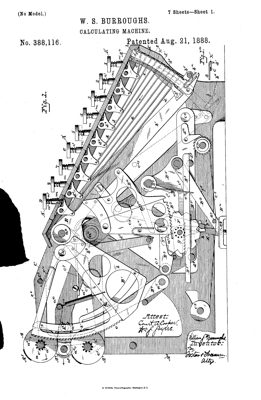
  • US0388116AAugust 23, 1891

    WASHINGTON, DC

    In a unanimous panel ruling, the Federal Circuit has found that the calculating machine of U.S. Patent No. 388,116 fails to meet the eligibility requirements of 35 U.S.C. § 101.  Inventor W.S. Burroughs of St. Louis described the machine as "mechanically assisting arithmetical calculations."  Particularly, it includes "one or more registers, of a series of independent keys and intervening connections constructed, arranged, and operating, as fully specified hereinafter, so as to indicate upon the register the sum of any series of numbers by the proper manipulation of the keys, and also so as to print or permanently record the final result."  But this device ran afoul of recent Federal Circuit case law regarding the so-called "abstract idea" exception to patentability.

    In a challenge brought by a potential licensee, the Court was asked to review the validity of the '116 patent.  While the Court agreed with the U.S. Patent and Trademark Office's ultimate conclusion that the claimed invention was novel and non-obvious, it found that the Office did not apply the § 101 test strictly enough during prosecution.

    At play was claim 1, which recites:

    The combination of a series of numbered independent indicators, a series of independent keys to each indicator, connections between each of the series of keys and each indicator, said connections being arranged to insure the movement of each indicator upon the movement of any key of its series and including a series of stops to each series of keys adjustable by but independent of the keys, arranged to vary the extent of movement of the indicator according to the position of the key struck, substantially as described.

    The Court began its analysis by stating that "under § 101 we first determine the focus and character of claim, including the problem that it purports to solve."  Here, the Court found that the '116 patent addresses the summing of numbers through the mathematical operation of addition.  The Court observed that such simple arithmetic functions have been performed by hand and with assistance by machines for thousands of years.  For instance, "the first abacus was introduced no later than 2700 B.C. to perform sums as well as to store partial results of more complex operations — clearly addition had previously been performed by humans in their minds or in writing prior to that."  Thus, the Court viewed the invention as being directed to an abstract idea.  Or, in the Court's words, no more than "a longstanding principle or an idea of itself."

    More specifically, the Court wrote that "the claim is directed to a fundamental concept of the sort that could be performed mentally; that is, a person, armed with paper and pencil, could perform the claimed operations."  The Court also found claim 1 to lack specificity, using result-oriented language that "recites what the inventor hopes to achieve without reciting how the inventor purports to have achieved that goal."  In particular, the arrangement of connections and the positions of the series of stops were "claimed so broadly as to encompass the mere idea of their functionality and not a specific implementation thereof."

    Burroughs argued that the invention of the '116 patent was a technical improvement in that it "eliminated painstaking and error-prone manual calculations required to sum a list of numbers."  But the Court disagreed, stating that "we have held many times in the past that automating an activity previously performed manually is not in and of itself patentable, even if said automation produces a faster and more accurate result."

    Moving on, the Court looked to the remaining elements of the claim to determine whether it included an inventive concept — something significantly more than the abstract idea that constituted a practical application of that idea.  It found that the additional elements of claim 1, indicators, keys, connections, and stops, were all well-understood, routine and conventional components claimed at a high level.  The Court concluded that "considering the elements of the claim both individually and as an ordered combination, they recite no additional parts or steps that would suffice to transform the nature of the claim into a patent-eligible application."

    Burroughs argued that claim 1 recited several inventive concepts that were neither previously known, nor conventional or routine.  But the Court found his position lacking, and instead reasoned that:

    Mr. Burroughs argues that his invention is an improvement in tallying sums.  As we noted earlier, that is no more than an abstract notion.  Our case law makes clear that improvements that are abstract themselves do not render a claimed abstract idea eligible for patent protection.  Furthermore, since the claim at hand merely recites the achievement of a result — a result that has previously been achieved in a similar manner for most of written history — the Burroughs machine is not the type of invention that patent law is intended to protect.

    Consequently, the Court held that '116 patent invalid under § 101, and Mr. Burroughs must return to the proverbial drawing board.

    The above is a sarcastic parody; our earlier sarcastic parodies can be found here:

    • "Federal Circuit Rules Public Key Cryptography Algorithm Invalid Under 35 U.S.C. § 101," July 22, 2020
    • "Federal Circuit Invalidates Edison's Light Bulb Patent," October 20, 2019
    • "Federal Circuit Invalidates A. G. Bell's Telegraphy Patent," September 2, 2019

  • CalendarAugust 25, 2020 – "Chasing technology 'unicorns' – How to spot acquisition targets early on" (LexisNexis IP and IPWatchdog) – 12:00 pm (ET).

    August 27, 2020 – "Drafting Patents to Ground Electric Power: AI and Section 101" (Intellectual Property Owners Association) – 12:00 pm to 1:00 pm (ET)

    September 11, 2020 – IP, Technology & Social Justice in the Age of Coronavirus (Center for Intellectual Property, Information & Privacy Law at UIC John Marshall Law School and Institute for Intellectual Property & Social Justice) – 7:40 am to 3:00 pm (CT)

    September 15, 2020 – "Traps for the Unwary Prosecutor: What Practitioners Should Know About US and European Patent Practice" (McDonnell Boehnen Hulbert & Berghoff LLP) – 10:00 am to 11:15 am (CT)

    September 23-24, 2020 – Summit on Biosimilars: Legal, Regulatory, and Commercial Strategies for the Innovator and Biosimilars Marketplace (American Conference Institute) – virtual conference

    September 23-24, 2020 – FDA Boot Camp (American Conference Institute) – virtual conference

  • ACIAmerican Conference Institute (ACI) will be holding its FDA Boot Camp conference on September 23-24, 2020 as a VIRTUAL conference.

    The conference will provide attendees with presentations on these topics:

    • The organization, jurisdiction, functions, and operations of FDA
    • The essentials of the approval process for drugs and biologics
    • The role of the Hatch-Waxman Act in the patenting of drugs and biologics
    • Clinical trials for drugs and biologics
    • Labeling in the drug and biologics approval process
    • cGMPs and other manufacturing concerns relative to products liability
    • Proactive adverse events monitoring and signal detection
    • Recalls, product withdrawals, and FDA oversight authority

    The conference presentations will be group into the Pre-Approval and Approval Process; FDA Review and Approval; IP Overview for Drugs and Biologics: Hatch-Waxman, BPCIA, Trademarks, and More; Post-Approval; Advertising, Promotions, and Related First Amendment Concerns.

    Co-Chairs Kurt K. Karst of Hyman, Phelps, McNamara PC and Rebecca K. Wood of Sidley Austin will speak on "Understanding the Relevance of New FDA Initiatives and Policies and How They May Redefine the Life Sciences Industry in the Aftermath of COVID-19."

    In addition, two pre-conference workshops will be offered on September 22, 2020.  The first, entitled "FDA Law 101: A Guide to Agency Structure, Jurisdiction, Regulation, and Applicable Laws," will be offered from 9:00 am to 12:00 am, and the second, entitled "Medical Devices, Combination Products, and Companion Diagnostics Boot Camp: A Review of FDA Guidelines and Regulations," will be offered from 1:30 pm to 4:30 pm.

    There will also be a post-conference workshop offered on September 24, 2020, entitled "Hatch-Waxman and BPCIA in the Trenches: Exclusivity and Bioequivalency Working Group," from 2:45 pm to 6:15 pm.

    A complete brochure for this conference, including an agenda, detailed descriptions of conference sessions, list of speakers, and registration form can be obtained here.

    The registration fee is $1,995 for registration by August 28, 2020 and $2,095 for registration thereafter. The  workshops are $600 apiece.  Patent Docs readers are entitled to a 10% discount off of the registration fee using discount code D10-806-806FX03.  Those interested in registering for the conference can do so here, by e-mailing CustomerService@AmericanConference.com, or by calling 1-888-224-2480.

    Patent Docs is a media partner of ACI's FDA Boot Camp.