• By Kevin E. Noonan

    University of California-BerkleyMotion practice continues in Interference No. 106,115 between Senior Party The Broad Institute, Harvard University, and the Massachusetts Institute of Technology (collectively, "Broad") and Junior Party the University of California/Berkeley, the University of Vienna, and Emmanuelle Charpentier (collectively, "CVC"), with CVC filing on January 6th its Reply to Broad's opposition to CVC's Miscellaneous Motion No. 6 for leave to subpoena discovery (including depositions) from Luciano Marraffini and Shuailiang Lin, neither of whom is a party to this interference (pursuant to an Order authorizing filing of this Reply issued by the Board on December 28th).

    CVC's motion was predicated on its contention that these witnesses had relevant testimony regarding Broad's priority, dates of conception, and activities related to reduction to practice, that Broad would not voluntarily provide these witnesses for deposition, and that such testimony would contradict allegations in Broad's priority statement.  CVC also asserted that it had attempted to obtain their testimony voluntarily but had been refused, making subpoena the only avenue available for obtaining their evidence.

    Broad InstituteBroad in its opposition contended that any such evidence would be redundant over evidence available from other witnesses and documents, and that much of any such testimony was not relevant to Broad's priority proofs.  Broad further argued that there were no inconsistencies between whatever testimony CVC could adduce from these witnesses and the "allegations" in its priority statement and evidence it would proffer with its (at the time, to be filed) Motion for Priority.

    Since filing its Opposition, Broad has filed its Priority Motion and CVC's Reply to Broad's Opposition depends in large part on that Motion, CVC contending that it supports their asserted reasons why testimony from Drs. Marraffini and Lin is relevant and necessary, most notably that "both Dr. Marraffini and Dr. Lin have personal knowledge concerning Dr. Zhang's work, including his prior unsuccessful attempts to achieve genomic cleavage in human cells."

    Regarding Dr. Marraffini, CVC contends (perhaps most relevantly) in its Reply that communications between Dr. Marraffini and Broad's inventor Dr. Zhang were used in support of Broad's Priority Motion, making Broad's position that any testimony from Dr. Marraffini would not be relevant evidence.  CVC responds by stating that "Broad's argument is misleading as its own priority evidence and Dr. Marraffini's public statements confirm that he has relevant information beyond the emails Broad produced in this proceeding.  This evidence includes discussions between Dr. Marraffini and Dr. Zhang that CVC contends establish Dr. Zhang's failures prior to June 2012, as well as "discussions where Marraffini conveyed to Zhang CVC's presentation of its work with chimeric RNA."  CVC also contends that "Dr. Marraffini's recollection of events contradicts Dr. Zhang's assertion that he successfully achieved genomic cleavage in human cells by November 2011," relying on statements from Dr. Marraffini that it took several months after starting a collaboration with Dr. Zhang and that Dr. Marraffini's collaboration did not start until 2012.

    Regarding Dr. Lin's testimony, CVC asserts that denying them an opportunity to depose him is inconsistent with Broad's reliance on experiments he conducted, and that substituting another witness (Dr. Sanjana) to provide testimony regarding Dr Lin's experiments would be improper.  CVC argues that "Dr. Lin is the person most competent to testify regarding his lab notebook, his experimental work and his communications with Dr. Zhang, all of which Broad relies on to support its priority motion" (emphasis in Reply).  This evidence is specifically relevant, according to CVC, because Broad relies on it to establish successful CRISPR cleavage in human cells in 2011.  CVC also argues that Dr Lin's testimony is necessary to reconcile Broad's assertions in its Priority Motion that Dr. Zhang "realized" the components necessary for successful CRISPR cleavage in eukaryotic cells and Dr. Lin's apparent comments to the contrary.

    CVC's Reply closes by noting that "Broad identifies no authority for its request for deposition time and waived any right to such time by not timely raising a request for discovery," and mentions that this request "undermines its assertions that these depositions will be redundant of other testimony, and also confirms the absence of any cognizable prejudice to Broad."  But like Broad, CVC also argues a fallback position, that should the Board permit cross-examination time to Broad it should be limited in substance to issues raised and examined by CVC and to "no more than one hour," which CVC apparently believes would prevent Broad from taking away any advantage of these depositions.

    Separately, the PTAB issued an Order authorizing CVC to file an Opposition to Broad's Contingent Responsive Motion No. 6, and the Broad to file a Reply to any such opposition.

  • CalendarJanuary 13, 2021 – "Second Medical Use Patents — Understanding Infringement and Enforcement" (Gowling WLG) – 9:00 to 10:00 am EST

    January 14, 2021 – "Priority Entitlement in Europe — Current Best Practice" (J A Kemp) – 2:30 to 3:30 pm GMT

    January 26, 2021 – "Second Medical Use Patents — Verifying Validity" (Gowling WLG) – 9:00 to 10:00 am EST

  • J A Kemp J A Kemp will be offering a webinar entitled "Priority Entitlement in Europe — Current Best Practice" on January 14, 2021 from 2:30 to 3:30 pm GMT (Greenwich Mean Time).  Marc Wilkinson and Chris Milton of J A Kemp will provide a concise review of European case law and practice with respect to a patentee's legal entitlement to a claim of priority, and briefly discuss what went wrong and why for the patentees in a recent high-profile case before the Board of Appeal of the European Patent Office (decision T844/18), where a high-value patent in the field of gene editing (CRISPR) was revoked for lack novelty over intervening prior art following a loss of priority.  The webinar will also outline practical steps and measures that can be taken by applicants to help safeguard priority claims in Europe.

    Those wishing to register can do so here.

  • GowlingGowling WLG will be offering two webinars on second medical use patents from 9:00 to 10:00 am EST on January 13, 2021 and from 9:00 to 10:00 am EST on January 26, 2021.  The first webinar, entitled "Understanding Infringement and Enforcement," will outline the key opportunities and obstacles surrounding second medical use patent protection, focusing on the United Kingdom, Canada, Russia, and China.  The panel, consisting of John Norman, Alex Gloor, Jenny Davies, Vladislav Ugryumov, and Jian Xu, will help attendees understand what to expect when a second medical use patent reaches the court, and explore the following questions:

    • What form can second medical use claims take?
    • What must be established for a second medical use patent to be infringed?
    • How do you enforce a second medical use patent?
    • Can you prevent off-label use?

    The second webinar, entitled "Verifying Validity," will look at the validity of second medical use patents across the United Kingdom, Canada, Russia, and China, and help attendees understand what to expect when the validity of a second medical use patent is called into question.  The same panel will explore the following questions:

    • What does it take for a second medical use to be sufficiently disclosed? A list of indications in the application? Clinical data? Or something in-between?
    • How do Courts address inventiveness of a second medical use patent in light of the first medical use?
    • What issues arise with disclosure of clinical trial protocols?

    Those wishing to register for these webinars can do so here and here.

  • By Kevin E. Noonan

    Federal Circuit SealIndefiniteness under U.S. patent law is a failure to satisfy the statutory requirements of 35 U.S.C. § 112(b), which reads:  "The specification shall conclude with one or more claims particularly pointing out and distinctly claiming the subject matter which the inventor or a joint inventor regards as the invention" (emphasis added).  The meaning of the statute was most recently explicated by the Supreme Court in Nautilus, Inc. v. Biosig Instruments, Inc., 572 U.S. 898, 910 (2014), which established the standard that the inherent imprecision of language cannot create "ambiguity . . . so great that it creates a 'zone of uncertainty' around the patent claims."  In practice, this led the Court to require "reasonable certainty" in claim language, a standard the patent claims at issue failed to satisfy in the Federal Circuit's recent decision in Horizon Pharma, Inc. v. Dr. Reddy's Laboratories Inc.

    The case arose in litigation of over a combination therapy of a non-steroidal anti-inflammatory (NSAID) medication and a proton-pump inhibitor (PPI) that minimized the gastrointestinal complications of NSAID administration.  The asserted patents, U.S. Patent Nos. 9,220,698 and 9,393,208, claimed methods of treating certain diseases with such combination formulations; claim 1 of the '698 patent was deemed representative by the Federal Circuit panel:

    1.  A method for treating osteoarthritis, rheumatoid arthritis, or ankylosing spondylitis comprising orally administering to a patient in need thereof an AM unit dose form and, 10 hours (±20%) later, a PM unit dose form, wherein:
    the AM and PM unit dose forms each comprises:
    naproxen, or a pharmaceutically acceptable salt thereof, in an amount to provide 500 mg of naproxen, and
    esomeprazole or a pharmaceutically acceptable salt thereof in an amount to provide 20 mg of esomeprazole;
    said esomeprazole, or pharmaceutically acceptable salt thereof, is released from said AM and PM unit dose forms at a pH of 0 or greater,
    the AM and PM unit dose forms target:
        i) a pharmacokinetic (pk) profile for naproxen where:
            a) for the AM dose of naproxen, the mean Cmax is 86.2 µg/mL (±20%) and the median Tmax is 3.0 hours (±20%); and
            b) for the PM dose of naproxen, the mean Cmax is 76.8 µg/mL (±20%) and the median Tmax is 10 hours (±20%); and
        ii) a pharmacokinetic (pk) profile for esomeprazole where:
            a) for the AM dose of esomeprazole, the mean area under the plasma concentration-time curve from when the AM dose is administered to 10 hours (±20%) after the AM dose is administered (AUC0–10,am) is 1216 hr*ng/mL (±20%),
            b) for the PM dose of esomeprazole, the mean area under the plasma concentration-time curve from when the PM dose is administered to 14 hours (±20%) after the PM dose is administered (AUC0–14,pm) is 919 hr*ng/mL (±20%), and
            c) the total mean area under the plasma concentration-time curve for esomeprazole from when the AM dose is administered to 24 hours (±20%) after the AM dose is administered (AUC0–24) is 2000 hr*ng/mL (±20%); and
    the AM and PM unit dose forms further target a mean % time at which intragastric pH remains at about 4.0 or greater for about a 24 hour period after reaching steady state that is at least about 60%.

    The District Court granted summary judgment in favor of defendants that this claim (and the remaining asserted claims) in the '968 and '208 patents were invalid for indefiniteness.  Among all the terms, technical and otherwise, in this claim the basis for the District Court's decision is the term "target," which the District Court construed to have its ordinary meaning of "set as a goal."  In so construing this claim term, the District Court rejected patentee Horizon's alternative construction, to "produce," because the specification used the words "produce" and "target" in ways that the term were not necessarily interchangeable.  Under this construction, the District Court held that "while the goal itself was clearly defined, the 'act of targeting that goal' was not."  Specifically, the District Court said that "'pills cannot be said to set goals,' and even if the claims were understood to say that it is a treating physician who sets the goals, the claims would require a treating physician to 'avoid having a subjective intent to achieve the defined outcomes.'"  Finally, the District Court found that the differing views of plaintiff's and defendant's experts as to the meaning of the term did not raise issues of material facts because the dispute involved opinion not fact.  This appeal followed.

    The Federal Circuit affirmed, in an opinion by Judge Hughes, joined by Judges Moore and O'Malley.  The panel found the term in this case to be readily construed according to its plain meaning, saying that "the claim term 'target' is a commonly understood word, and nothing Appellants point to in the specification or the prosecution history suggests that it should be given anything other than its ordinary meaning," which was the meaning used by the District Court, i.e., "set as a goal."  (Somewhat parenthetically, the opinion rejected patentee's argument that case law favors a construction that preserves validity, because this principle applies only where "the court concludes, after applying all the available tools of claim construction, that the claim is . . . ambiguous," citing LiebelFlarsheim Co. v. Medrad, Inc., 358 F.3d 898, 911 (Fed. Cir. 2004), and that was not the case here in the Court's opinion).

    While relying expressly on the Supreme Court's Nautilus opinion, the Federal Circuit also opined that "[o]ne circumstance in which claims are indefinite is where the claims, as properly construed, are nonsensical," citing Trs. of Columbia Univ. v. Symantec Corp., 811 F.3d 1359, 1366–67 (Fed. Cir. 2016).  In upholding the District Court's construction, and finding of indefiniteness, the panel asserted that "the 'target' clauses of claim 1 render the claim indefinite because '[t]he fact that a goal is clearly defined does not mean that the act of targeting that goal is clearly defined, and this is the crux of the definiteness problem here.'"  Simply put (as the District Court had) "a dose form, which is an inanimate object, cannot set a goal."

    After agreeing with the District Court that a dispute between experts does not raise a genuine issue of material fact that would preclude summary judgment, the panel affirmed the construction and the District Court's decision that the claims were indefinite and consequently invalid.

    Horizon Pharma, Inc. v. Dr. Reddy's Laboratories Inc. (Fed. Cir. 2021)
    Panel: Circuit Judges Moore, O'Malley, and Hughes
    Opinion by Circuit Judge Hughes

  • By Kevin E. Noonan

    Cancer, the "Emperor of All Maladies" as it has been termed, has been studied for millennia.  President Nixon's "War on Cancer" resulted in slow but steady progress, aided by the biotechnology revolution, the development of monoclonal antibodies (see Herceptin®) and more recent developments in immunological interventions like CAR-T cells (see "Global CAR-T Cell Therapy Market (2021 to 2027) – Size, Forecasts, Trials and Trends -ResearchAndMarkets.com").

    But the basis for many characteristics of cancer biology remain elusive, including what is classically termed the Warburg effect, i.e., the tendency of cancer cells to be dependent upon aerobic glycolysis instead of oxidative phosphorylation even in the presence of oxygen and thus not being an adaptation for low oxygen conditions as it is in normal cells.  (Those with long memories will remember the saga of the eminent Efraim Racker being fooled by a graduate student who presented falsified evidence of a protein kinase cascade that regulated glycolysis.)  This effect has been known since the 1920's (during the Golden Age of research into the biochemical basis of intermediary metabolism) when Otto Heinrich Warburg found that depriving tumor cells of oxygen and glucose resulted in cell death.  But the change has remained phenomenology perhaps until now.

    Hereditary leiomyomatosis and renal cell carcinoma (HLRCC) which is an inherited form of kidney cancer is characterized by deficiency in fumarate hydratase (FH), which catalyzes the reaction:

    Image 1
    as part of the Krebs (TCA) cycle in the mitochondria.  Until now there has been no understanding of why or whether this metabolic deficiency results in tumors that rapidly grow and metastasize.  In a recent paper, a team of university and National Institutes' researchers* recently reported that the growth aggressive phenotype is associated with expression of the Warburg effect, in a paper entitled "Mitochondrial DNA alterations underlie an irreversible shift to aerobic glycolysis in fumarate hydratase-deficient renal cancer," in Science Signaling.  These researchers show that the enzymatic deficiency is associated with an accumulation of fumarate in the cells, and this results in increased mutation rates in mitochondrial DNA as a consequence of fumarate accumulation.  The authors draw the conclusion that these cancer cells are "rewired" to promote tumor progression and metastasis due to a loss of mitochondria and a "metabolic shift" to aerobic glycolysis.

    FH is encoded by a nuclear-encoded gene but the enzyme is necessary for competent mitochondrially mediated metabolic function.  The basis for high fumarate's deleterious effects on mitochondria is the "nonenzymatic formation of an S-(2-succinyl)-cysteine (2SC) adduct that inactivates multiple proteins involved in tumor biology and metabolism."  The researchers found that there was a loss of respiratory-chain components encoded by mitochondrial DNA and with S-(2-succinyl)-cysteine (2SC) adduct-mediated inhibition of mitochondrial DNA replication.  This in turn was caused by inactivation of the sole mitochondrial DNA polymerase as well as mtDNA maintenance and repair proteins, leading to mitochondrial depletion in these cells.  The authors termed this mitochondrial depletion a "defining feature" of this tumor type and its aggressive growth and metastasis phenotype.

    The researchers studied a cohort of 24 HLRCC patients aged 21-70 with the majority (75%) having advanced metastatic disease.  Assessment of proteins in the respiratory chain showed disruption associated with morphological defects on the mitochondrial inner membrane (where these proteins are located in normal cells).  As summarized by the authors, "[t]ogether, these data demonstrate an impairment in the assembly of respiratory CI, CIII, and CIV in HLRCC tumor mitochondria with a substantial loss of protein abundance of mitochondrially encoded subunits."

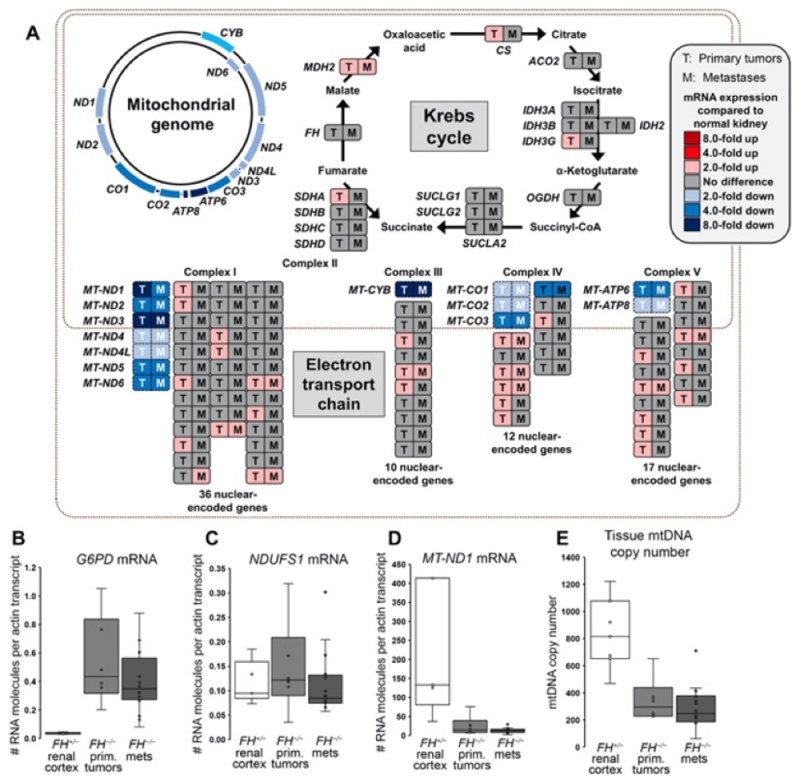
    These results were consistent with the detected down-regulation of mitochondrial mRNA synthesis in these cells which was not seen in the expression of nuclear gene-encoded mRNAs members of Krebs cycle or respiratory chain proteins, as illustrated in this Figure:

    Image 2
    As stated in the paper "[o]ur transcriptome analyses indicated that the underlying cause of respiratory chain dysfunction in HLRCC FH−/− tumors was the selective loss of expression of mtDNA-encoded subunits" of the respiratory chain"; the authors were able to correlate this reduction in mtDNA gene expression with a reduction in the number of mitochondria per cell, from an average of 833 mtDNA molecules in normal renal cells to between 344 and 294 copies in primary and metastatic HLRCC tumors, respectively.

    These changes were mirrored in HLRCC tumor-derived cell lines, albeit not entirely consistently.  To evaluate these inconsistencies the researchers restored normal FH levels by introducing heterologous FH-encoding constructs that showed "[r]obust FH activity."  Nevertheless, functional respiratory chain function was not established in these cells, consistent with the defect being associated with mitochondrial loss rather than merely FH disfunction:  "[o]ur observations indicate that loss of FH activity had a lasting impact on mitochondrial function even after FH activity was restored and fumarate levels were reduced in the tumor-derived cells."

    These results led the researchers to evaluate the status of mtDNA in these cell lines by DNA sequencing.  These experiments showed multiple deactivating mutations in several mtDNA-encoded genes involved in respiration, including mutations not found in the Human Mitochondrial DNA database (HmtDB), which the authors assert suggested that "these mutations are not tolerated in normal human tissues."  When similar experiments were performed in the HLRCC tumor samples, almost all (22) showed one or more somatic changes in mtDNA, each sample having on average 2.27 (range, 1-7) mutations in the mtDNA, wherein more than half of these mutations resided in protein-encoding mtDNA.  Such patterns of mtDNA mutations were not found in other types of renal cell carcinoma not associated with FH deficiencies.

    Finally, an analysis of the protein components of mtDNA, which encode proteins known to be involved in maintaining DNA integrity, were found by these researchers to be covalently modified by succinylation at cysteine (Cys) residues, resulting in their inactivation.  These results were consistent with the loss of mitochondria population in these cells.  These results were observed in both cells from HLRCC tumor cell lines and HLRCC patient samples.

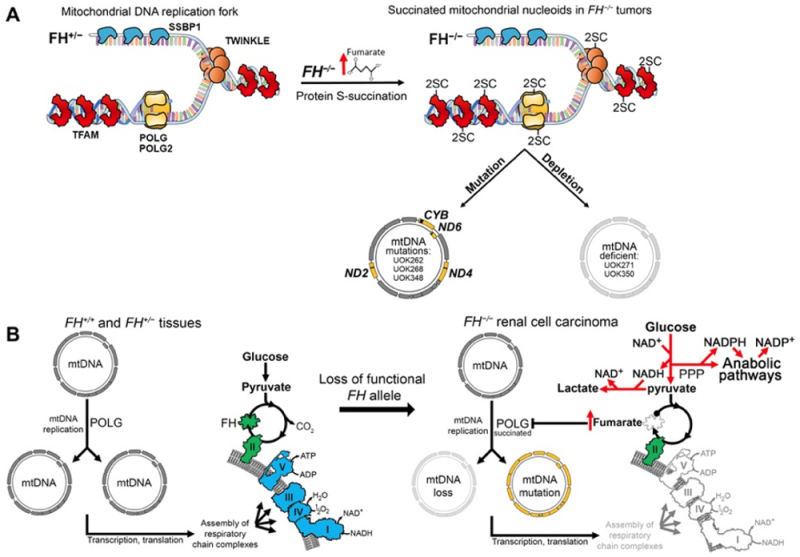
    These researchers summarized their results with this diagram:

    Image 3
    and by noting that FH deficiency resulted in inactivation of core enzymes involved in mtDNA integrity, repair, and replication and irreversible mitochondrial loss.  Mitochondrial loss "obligates cells to compensate for energy loss by shifting to dependence on aerobic glycolysis as an energy source."

    These changes were also associated with upregulation of enzymatic activity that promoted lipid synthesis, necessary for rapid tumor growth.  As summarized by the authors:

    [T]he metabolic compensations dictated by loss of mtDNA may result in features of the aggressive growth phenotype that characterizes HLRCC tumors, including increased fatty acid biosynthesis contributing to formation of new cell membranes, generation of the intermediates of the citric acid cycle that are used in anaplerotic reactions, and synthesis of other precursors necessary for biosynthesis of amino acids and nucleotides that are needed for rapid growth and invasiveness of this type of cancer.

    And:

    In summary, mitochondrial dysfunction forces metabolic remodeling in HLRCC tumors that favors anabolic pathways offering crucial bioenergetic and biosynthetic advantages for tumor growth and metastasis.  Understanding that mtDNA mutations and deletions represent the fundamental cause for the shift to complete dependence on aerobic glycolysis in this aggressive form of inherited, genetically defined RCC will hopefully provide insights into the development of effective forms of therapy for patients with HLRCC and other related cancers.

    * National Institutes of Health, National Cancer Institute, National Institute of Child Health and Human Development, Frederick National Laboratory for Cancer Research, and the University of Kentucky

  • By Donald Zuhn

    IPO #2Last month, Intellectual Property Owners Association (IPO) President Daniel J. Staudt sent a letter on behalf of the IPO to President-Elect Joe Biden and Vice President-Elect Kamala Harris "to recommend that intellectual property (IP) law and policy be priorities in your administration."  The letter states that:

    The IP system is fundamental to the nation's economic growth and job creation and to our global competitiveness.  The importance of innovation is clearer than ever at this moment in our nation's history as we face challenges such as the coronavirus pandemic and related economic instability, the climate crisis, and the need to ensure diverse and inclusive representation of viewpoints.

    With respect to the COVID-19 pandemic, the letter notes that "[t]he ability to leverage and build upon scientific research conducted over many years, made possible by the IP system, enabled industry to expedite the vaccine development process."  The letter also points out that developments with respect to personal protective equipment and innovative computer-implemented technologies that have allowed us to stay connected during the pandemic were also the result of years of investment in innovation.

    As for the climate crisis, the letter states that "IP is an integral part of developing new global environmental policies aiming for a more sustainable lifestyle based on green technologies," and expresses support for the incoming administration's pledge to invest $400 billion in clean energy and innovation.

    The letter also declares that "[c]losing the diversity gap in innovation is also vitally important to our economic growth and global competitiveness," noting that women, people of color, and other minority groups are vastly underrepresented in the patent system.  The letter points out that recent "scholarship indicates that increasing participation in inventing by underrepresented groups could increase U.S. GDP by as much as 4.4%," and suggests that "[i]t is imperative that the public and private sectors work together to close this gap and harness our country's potential to innovate at greater levels than ever before."

    Included with the letter is an Appendix providing several IP issues that "threaten sound innovation policy in the U.S. and worldwide," including clarifying patent subject matter eligibility; protecting trade secrets; ensuring predictable legal systems for all industries and technologies; addressing counterfeiting and trademark infringement; and providing high quality, enforceable IP rights and predictable legal systems in the U.S. and abroad.

    With respect to subject matter eligibility, the letter notes that the IPO "continue[s] to believe that legislative action is needed" to address Supreme Court decisions that have "detrimentally affected areas such as precision medicine & artificial intelligence and risk[] a chilling effect on further developments and investment in these critical technologies."  On the issue of trade secret protection, the letter states that "[i]nadequate protection of trade secrets abroad harms not only companies whose property is stolen, but also the country where the theft occurs, because companies are then less likely to form joint ventures and make high-value investments in those countries."

    The letter also argues that unfounded assertions continue to be made that IP rights constitute a barrier to innovation in order to justify compulsory licenses and forced technology transfer.  In particular, the letter states that:

    IPO members continue to witness concerted efforts to weaken intellectual property rights in the name of development, access to health, and environmental concerns.  Intellectual property rights have been unfairly portrayed as a barrier to technology transfer based on arguments that they limit availability of technologies and make them more expensive to secure.  The threat of intellectual property erosion, however, actually increases the cost of technology and slows its adaptation and deployment.

    The letter notes that the IPO continues to strongly oppose compulsory licensing of intellectual property rights with respect to all industries and technologies, adding that "[a]lthough IPO recognizes that compulsory licenses of IP rights may be legally permissible in limited and rare situations, IPO believes that licensing of IP rights is best accomplished through voluntary efforts."

    The Appendix concludes by touching on the issue of backlogs and other bars to securing IP protection, noting that "[i]ncreasing global competition drives IPO members to innovate faster than ever before, and in many cases product life cycle times are becoming extremely short" (as, for example, the unprecedented short timeline in which multiple COVID-19 vaccines have been developed).  In view of shorter product life cycles, the letter contends that "debilitating application backlogs at patent and trademark offices are at odds with the pace of innovation."

  • By Donald Zuhn

    USPTO SealIn an e-mail News Brief distributed last week, the U.S. Patent and Trademark Office reported on the participation to date in its COVID-19 Prioritized Examination Pilot Program.  The pilot program, which was implemented last May, allows applicants that qualify for small or micro entity status to request prioritized examination without paying the fees typically associated with such prioritized examination (see "USPTO Announces COVID-19 Prioritized Examination Pilot Program").  In announcing the pilot program, the Office noted that it would endeavor to reach final disposition of applications within six months, provided that applicants respond promptly to Office communications.

    In addition to providing expedited examination for qualifying applications, the pilot program also eliminates the requirement to pay the prioritized examination fee set forth in 37 C.F.R. § 1.17(c) ($1,050 for micro entities and $2,100 for small entities) or the processing fee set forth in 37 C.F.R. § 1.17(i)(1) ($35 for micro entities and $70 for small entities).  In addition to the requirement that applicants qualify for small or micro entity status, the claims of a participating application must cover a product or process related to COVID–19, and such product or process must be subject to an applicable FDA approval for COVID–19 use.  Such approvals may include, for example, an Investigational New Drug (IND) application, an Investigational Device Exemption (IDE), a New Drug Application (NDA), a Biologics License Application (BLA), a Premarket Approval (PMA), or an Emergency Use Authorization (EUA).  When the pilot program was announced, the Office noted that it would accept up to 500 requests.

    Other requirements for participating in the pilot program include making the request at the time of filing of a non-continuing original utility or plant nonprovisional application; at the time of filing of an original utility or plant nonprovisional application claiming the benefit of an earlier filing date under 35 U.S.C. §§ 120, 121, or 365(c) of one prior nonprovisional application or one prior international application designating the United States; or at the time of filing or after the filing of a Request for Continued Examination of a plant or utility application or a national stage of an international application.  However, any application that claims the benefit of the filing date of two or more prior filed nonprovisional U.S. applications or international applications designating the United States under 35 U.S.C. §§ 120, 121, or 365(c) is not eligible for participation in the pilot program.  In addition, requests to participate in the pilot program must include an Application Data Sheet, be made via the Office's patent electronic filing systems (EFS-Web or Patent Center), and qualifying applications cannot present more than four independent claims, more than 30 total claims, or any multiple dependent claims.

    In its e-mail last week, the Office noted that 251 patent requests for prioritized examination under the pilot program have been granted to date, resulting in the allowance or issuance of 33 applications or patents.  The Office also noted that more than half of the patent applications granted prioritized examination are directed to medical treatments, vaccines, and diagnostic technology, with the remainder being directed directed to ventilators, personal protective equipment (PPE), and other technology related to COVID-19.  In commenting on the pilot program, USPTO Director Andrei Iancu stated that "[o]ver the past two centuries, solutions to some of the nation's greatest problems have passed through the halls of the USPTO, and it's very likely that some of the solutions to America's current pandemic have already been examined by this agency."

  • MBHB Logo 2McDonnell Boehnen Hulbert & Berghoff LLP will be offering a live webinar on the "Top Patent Law Stories of 2020" on January 20, 2021 from 10:00 am to 11:15 am (CT).  Since 2007, the Patent Docs weblog has presented an annual, end-of-the-year review of the top stories in patent law.  In this presentation, Patent Docs co-authors Donald Zuhn, Kevin Noonan, and Michael Borella will take a look back at the top patent stories of 2020, many of which will likely impact patent applicants and practitioners in the coming year.

    While there is no fee to participate, attendees must register in advance.  Those wishing to register can do so here.  CLE credit is pending for the states of California, Illinois, New Jersey, New York, North Carolina, and Virginia.a

  • By Kevin E. Noonan

    In the latest development in Interference No. 106,115 between Senior Party The Broad Institute, Harvard University, and the Massachusetts Institute of Technology (collectively, "Broad") and Junior Party The University of California/Berkeley, the University of Vienna, and Emmanuelle Charpentier (collectively, "CVC"), Broad filed its priority motion (which, as Senior Party they were not obliged to do).

    Broad InstituteBroad's brief is a hybrid:  on the one hand establishing its dates of conception and actual reduction to practice, and on the other denigrating CVC's claims of conception and reduction to practice.  The latter portion of its argument hinges on two concepts:  first, that eukaryotic applications of CRISPR-Cas9 are governed by the principle of "simultaneous conception and reduction to practice" (a contention for which Broad has the burden of convincing the Patent Trial and Appeal Board), and second, that CVC's admissions prevent them from successfully arguing (as they do in their priority brief) conception followed by acting with diligence to reduce their invention to practice; this contention includes "admission by omission" to the extent, inter alia, that CVC neglected to include their experiments using fish cells from the provisional application, No. 61/716,256, filed October 19, 2012).

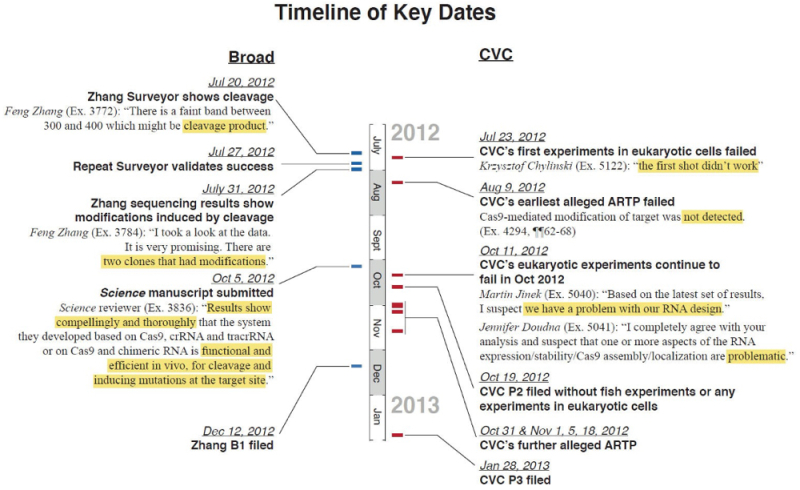
    The comparison between the two inventive timelines asserted by Broad was set forth in the motion by this graphic:
    Timeline
    Broad's brief is explicit, saying "CVC is not entitled to any of its asserted conceptions, all of which allegedly occurred before CVC had any success in eukaryotic cells.  Count 1 specifically requires specific biologic results in a eukaryotic cell for which the CVC inventors could have had no reasonable expectation of success absent successful eukaryotic experiments and thus could have no conception," citing Hitzeman v. Rutter, 243 F.3d 1345, 1358 (Fed. Cir. 2001), and the "law of the case," no doubt a reference to the outcome of the earlier Interference between the parties (No.106,048).  As illustrated in the timeline, Broad asserts an actual reduction to practice on either July 20th or 27th (depending on when Broad's inventors can be found to have "recognized and appreciated [their] success").  These experiments and their results were corroborated, according to the brief, by two witnesses (Dr. Andrew Ellington and Dr. Ronald Breaker) as well as by contemporaneous communications by Dr. Zhang and declarations of other laboratory members (whose status as inventors vel non is in dispute; see "CVC Files Substantive Motion No. 3 (for improper inventorship) and Broad Opposes").  Broad's brief also cites multiple other instances of actual reduction to practice (as illustrated in the timeline).  In contrast, Broad argues that "CVC did not achieve any success until, at the absolute earliest, October 31, 2012" based on the statements synopsized in the illustration for all earlier actual reduction to practice dates asserted by CVC.

    In addition, Broad argues that, while not needed, the Board can also consider evidence of Dr. Zhang's earlier conception beginning on June 26, 2012 (although the arguments asserted for this date are accompanied by the same language CVC used for its conceptions, such as "[h]e further reasonably expected" [that his CRISPR system would work in eukaryotic cells], and include assertions of diligence from that time to the asserted actual reduction to practice in July 2012).  Should the Board still consider CVC's evidence for earlier date(s) of conception, Broad's motion argues that "Dr. Zhang's successful eukaryotic experiments with his dual-molecule RNA CRISPR-Cas9 systems, which occurred well before all of CVC's alleged conceptions, should be taken into account"; Broad's relevant insight being that "[t]hese experiments answered the key question of whether a Cas9 system could be engineered to overcome the expected hurdles in eukaryotic cells," and conceding that "the concept of linking already-hybridized RNA using known linking methods would have been routine" (and thus distinguishing Broad's work and arguments about the routine status of reducing CRISPR to eukaryotic cell environment asserted by CVC in their priority motion).

    These arguments are supported by several appendices, including a chart showing Broad diligence as Appendix C.

    Turning to the legal argument, Broad leads with its argument regarding the "law of the case":  "mere words and in vitro experiments do not provide a reasonable expectation of success in achieving that specific biological result (a functional eukaryotic CRISPR-Cas9 system)."  Properly asserting that "applicable Federal Circuit precedent is clear that to have conception of a count claiming a specific biological result, the inventor must first have a reasonable expectation of success that the claimed result will be achieved," the brief goes on to assert that any "reasonable expectation of success that the claimed result will be achieved" requires that the claimed result actually be achieved.  The motion argument cites in support the situation in Hitzeman v. Rutter, where a party's claimed conception to a count directed to recombinant production of hepatitis B surface antigen (HBsAg) in yeast failed because "[o]ne skilled in the art at the time this application was filed would not have been able to reasonably predict that HBsAg could be expressed by yeast [and done so in particle form]."  Id. at 1357 (emphasis added).  Thus is the parallel established:  according to Broad, the uncertainty in practicing CRISPR in a eukaryotic cell (which was convincing to the Board in deciding the earlier interference between these parties) precludes CVC from depending on its earlier dates of conception, and the Board should recognize Broad's earlier dates of reduction to practice and award priority on that basis.

    The brief includes a certain degree of hagiography regarding Dr. Zhang having at least questionable relevance (but understandable in light of CVC's similar citation of the Novel Prize award to their inventors, Jennifer Doudna and Emmanuelle Charpentier).  Much of this history (including a grant proposal submitted in January 2012) certainly indicates Dr. Zhang's early recognition of the possible usefulness of CRISPR in eukaryotic cells and experiments to achieve this result, but none of it is asserted as part of Broad's conception (although citation of these early efforts (prior to April 2012) support Broad's attempts to put their inventors on the same chronological playing field as CVC's inventors).  The brief then tells the story of Dr. Marraffini's contribution (stemming from information he "heard about at a public conference") regarding sg-RNA CRISPR embodiments, establishing the basis for Broad's contention that this date, June 26, 2012 was Dr. Zhang's first conception of an invention corresponding to the Count in the interference) (the brief is also careful to assert that "[b]ecause Dr. Zhang had already engineered CRISPR-Cas9 systems with the analogous dual-molecule RNA CRISPR-Cas9 system to function in eukaryotic cells, he expected on June 26, 2012 when he received the email from Dr. Marraffini that he could successfully implement his engineered CRISPR-hSpCas9 system with a chimeric RNA having a sufficient tracrRNA length for use in eukaryotic cells in a manner analogous to his dual-molecule RNA system").  Broad's motion also seeks to establish that Dr. Zhang (in contrast to CVC's inventors) had a reasoned basis for expecting that "a CRISPR-Cas9 system could be engineered to overcome the major obstacles presented by eukaryotic cells including, for example, chromatin, RNA degradation, toxicity, and successful co-localization in the eukaryotic cellular milieu," this being his earlier successes in practicing the three-molecule variation of CRISPR in eukaryotic cells.  This for Broad establishes conception, wherein "Dr. Zhang had a definite and permanent idea of the complete operative invention of Count 1."

    Like in CVC's brief, Broad's motion includes an illustration of the experimental design of the sg-RNA used in these experiments, as described in an e-mail to Dr. Le Cong:
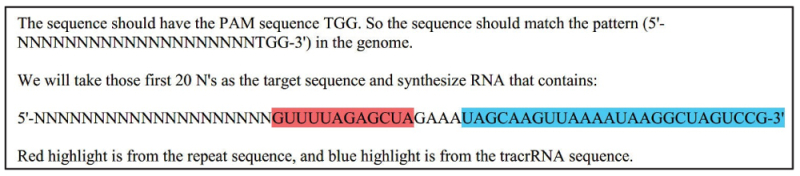
    Image 2
    Followed by a description of Dr. Zhang's asserted successful reduction to practice of embodiments of sg-RNA CRISPR in eukaryotic mouse cells on July 20th and 26th.  This success was verified according to the motion on July 31, 2012, showing by comparative sequencing the expected deletion in the target sequence:

    Image 3

    These data and experimental results are supported as they must be by collaborative declarations by several non-inventors (at least until the PTAB renders a decision on CVC's misjoinder of inventorship motion).  And with regard to the requirement that an inventor recognize her invention the motion asserts communications from Dr. Zhang as well as the submission of a manuscript to Science on October 5, 2012 containing in a Figure a map of the vector used in the July 2012 experiments:
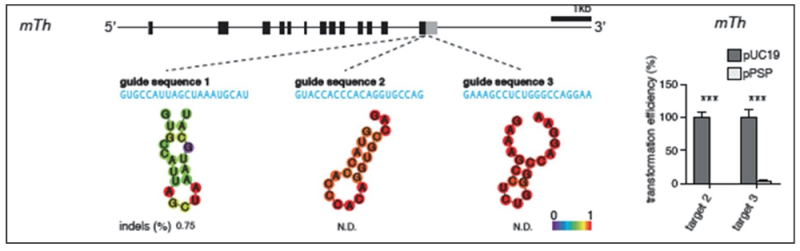
    Image 4
    The motion also asserts multiple additional actual reduction to practice events in August 2012.  These and other experiments were contained, according to Broad, in the "landmark" January 3, 2013 Science publication by Cong et al.

    Broad's arguments then provide the Board with a detailed description of the correspondence between its experimental evidence for actual reduction to practice and claim 18 of Broad U.S. Patent No. 8,697,359 or claim 156 of CVC U.S. Patent Application No. 15/981,807, extensively corroborated by non-inventor declarants for experiments conducted in July, August, and September 2012 and the October 5, 2012 Science manuscript.  This Section also includes positive statements about the authors' achievements by Science reviewers (which of course have no legal effect except in support of Broad's assertions of how these experiments would be understood by those of at least ordinary skill in the art).  And the motion again illustrates how Dr. Zhang "recognized and appreciated" his achievement regarding eukaryotic embodiments of CRISPR, from contemporaneous, corroborated statements.

    The motion provides further argument regarding earlier conception (June 26, 2012) by Dr. Zhang than the CVC inventors, based on his ability to have a reasonable expectation of success based on earlier successful experiments, something Broad asserts CVC did not have based on experimental failures and negative statements first adduced in the '048 Interference.  The motion also argues that, should the PTAB give credence to CVC's asserted conception date of March 2012 then Dr. Zhang's work prior to March 2012 should also be considered (although any such consideration would need to also take into account Broad's disclosure that sg-RNA embodiments were first considered after the June 26, 2012 communication from Dr. Marraffini).  And these arguments track some of the same resort to "routine techniques" asserted by CVC in support of its priority position.

    The motion concludes with assertions of diligence, supported by a log of day-to-day diligence provided in Appendix C of the motion, and that Dr. Zhang did not abandon, suppress, or conceal Broad's invention, based inter alia on the October 5, 2012 Science manuscript and Broad's provisional application filing on December 12, 2012 (which the Board recognized as Broad's earliest priority document; see "PTAB Grants Broad Motion No. 4 for Priority Benefit to U.S. Provisional Application No. 61/736,527").

    From all these facts Broad argued it is entitled to priority award in this Interference.

    * As a reminder, in an interference, the Junior Party (CVC) bears the burden of showing actual reduction to practice before reduction to practice by the Senior Party (Broad).  Cabilly v. Boss, 55 USPQ2d 1238, 1254-5 (BPAI 2000), citing Boises v. Benedict, 27 F.3d 539, 541-542, 30 USPQ2d 1862, 1864 (Fed. Cir. 1994); 37 C.F.R. §41.121.  This showing must be by a preponderance of the evidence.  Hahn v. Wong, 892 F.2d 1028, 1032, 13 USPQ2d 1313, 1317 (Fed. Cir. 1989), citing Oka v. Youssefyeh, 849 F.2d 581, 7 USPQ2d 1169, 1171 (Fed. Cir. 1988).

    The inventor is the party that first reduced the invention to practice, unless the other party can show that they were the first to conceive the invention and exercised reasonable diligence from a time just prior to the other party's conception through their own reduction to practice.  Hitzeman v. Rutter, 243 F.3d 1345, 1353, 58 USPQ2d 1161, 1166 (Fed. Cir. 2001), citing Cooper v. Goldfarb, 154 F.3d 1321, 1327, 47 USPQ2d 1896, 1900-01 (Fed. Cir. 1998).  A junior party that shows that she was first to reduce the invention to practice prevails, Hahn v. Wong 892 F.2d at 1317, and a junior party has no obligation to establish diligence in these circumstances, since it is first actual reduction to practice, not the relative diligence of the parties, that carries the junior party's priority burden.  Steinberg v. Seitz, 517 F.2d 1359, 1364, 186 USPQ 209, 213 (CCPA 1975).

    Conception is "the formation in the mind of the inventor, of a definite and permanent idea of the complete and operative invention, as it is hereafter to be applied in practice."  Hybritech Inc. v. Monoclonal Antibodies, Inc., 802 F.2d 1367, 1376, 231 U.S.P.Q. 81, 87 (Fed. Cir. 1986), citing  Coleman v. Dines, 754 F.2d 353, 359, 224 USPQ 857, 862 (Fed. Cir. 1985).  Since conception occurs in the mind of the inventor, there must be "corroborating evidence of a contemporaneous disclosure that would enable one of ordinary skill to make the invention."  Burroughs Wellcome, Id. at 1919, citing Coleman v. Dines, 754 F.2d 353, 359, 224 USPQ 857, 862 (Fed. Cir. 1985).  However, conception of a method does not require knowledge that the invention will work for its intended purpose.  Burroughs Wellcome Co. v. Barr Labs, Inc., 40 F.3d 1223, 32 USPQ 2d 1915 (Fed. Cir. 1994).  Relevant to Broad's arguments in their motion, in Burroughs Wellcome, the claims of the patents-in-suit were directed to methods for using AZT for treating AIDS, and the issue was whether the AZT inventors had conceived of the claimed methods before obtaining evidence that AZT could indeed provide an effective treatment for HIV infection.  Id. at 1225.  The Burroughs Wellcome defendants argued that for an invention in an "uncertain or experimental discipline, where the inventor cannot reasonably believe an idea will be operable until some result supports that conclusion," conception occurs only when there is experimental confirmation that the invention works for its intended purpose.  Id. at 1228.  The Federal Circuit was clear, stating: "[b]ut this is not the law.  An inventor's belief that his invention will work or his reasons for choosing a particular approach are irrelevant to conception."  Id., citing MacMillan v. Moffett, 432 F.2d 1237, 1239, 167 U.S.P.Q. 550, 552 (CCPA 1970).  This is sufficient for conception, unless there is evidence of subsequent experimental failure (the argument Broad relies upon in their argument against CVC): "[a] conception is not complete if the subsequent course of experimentation, especially experimental failures, reveals uncertainty that so undermines the specificity of the inventor's idea that it is not yet a definite and permanent reflection of the complete invention as it will be used in practice."  Id. at 1229, citing Rey-Bellet v. Engelhardt, 493 F.2d 1380, 1387, 181 U.S.P.Q. 453, 457-58 (CCPA 1974).

    Unlike conception, actual reduction to practice in the chemical or biotechnology arts requires that the inventor has reduced to practice an embodiment of the compound that works for its intended purpose.  Cooper v. Goldfarb, 154 F.3d 1321, 1327, 47 USPQ2d 1896, 1901 (Fed. Cir. 1998).  More than the existence of laboratory notebook pages showing an embodiment within the scope of the count must be corroborated for reduction to practice; corroboration that the embodiment was actually made is needed.  Hahn v. Wong, 892 F.2d 1028, 1032, 13 USPQ2d 1313, 1317 (Fed. Cir. 1989).  If the embodiment requires testing to establish its usefulness for its intended purpose, corroborated evidence of such testing is required.  Newkirk v. Lulejian, 825 F.2d 1581, 1582, 3 USPQ2d 1793, 1794 (Fed. Cir. 1987).  When testing is required to determine whether an embodiment of an invention works for its intended purpose, whether a party can sustain its burden of showing actual reduction to practice by a preponderance of the evidence depends on the extent, nature and results of the testing required.  Scott v. Finney, 34 F.3d 1058, 1061, 32 USPQ2d 1115, 1117-8 (Fed. Cir. 1994) , citing Newkirk v. Lulejian, 825 F.2d 1581, 1582, 3 U.S.P.Q.2d 1793, 1794 (Fed. Cir. 1987).