• By Kevin E. Noonan

    Federal Circuit SealThe metes and bounds of how courts should consider indefiniteness under 35 U.S.C. § 112(b) were addressed most recently by the Supreme Court in Nautilus, Inc. v. Biosig Instruments, Inc., 572 U.S. 898 (2014).  Regardless, however, of the Court's attempts to properly construe this portion of the Patent Statute (and the Federal Circuit's attempts to comply with those rubrics), the Federal Circuit's recent decision in Vascular Solutions LLC v. Medtronic, Inc. illustrates once again that in patent law very little is simple or straightforward.  And as set forth below, the Court's decision has led to the District Court judge recusing himself from any further involvement in this case.

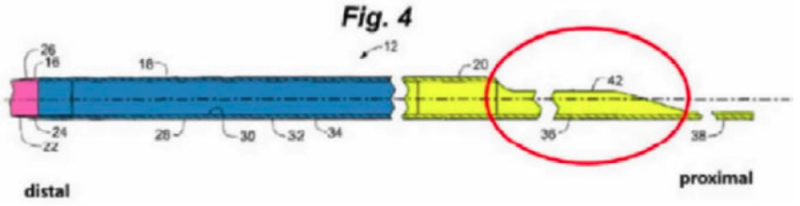
    The case arose over Medtronic's alleged infringement of forty claims from seven patents owned by Plaintiffs (including Teleflex, which was the name party in the opinion):  U.S. Patent Nos. 8,048,032; 8,142,413; RE45,380; RE45,760; RE45,776; No. RE46,116; and RE47,379; each of these patents descending from U.S. Patent Application No. 11/416,629, filed May 3, 2006.  According to the opinion, the claimed invention was directed to a "coaxial guide catheter that is deliverable through standard guide catheters by utilizing a guidewire rail segment to permit delivery without blocking use of the guide catheter."  The structure of these catheters are illustrated in this Figure (annotated by Medtronic's expert):

    Image 1 - Fig. 4
    where the yellow portion was "substantially rigid" and closest to the physician using the catheter (termed "proximal"); the blue portion was reinforced (presumably for stability); and the pink portion was closest to the heart ("distal").  The proximal portion comprised a side opening (in the red circle) permitting "interventional cardiology devices" to be delivered through the catheter to the heart (although this was not the only orientation permitted by the claims, forming the physical basis for the indefiniteness dispute between the parties).  Claims of the '032 and '776 patents are set forth in the opinion as illustrative; italicized language is relevant to the issues before the Court:

    The '032 patent:

    [Claim 11] A device for use with a standard guide catheter, the standard guide catheter having a continuous lumen extending for a predefined length from a proximal end at a hemostatic valve to a distal end adapted to be placed in a branch artery, the continuous lumen of the guide catheter having a circular cross-section and a cross-sectional inner diameter sized such that interventional cardiology devices are insertable into and through the lumen to the branch artery, the device comprising:
        an elongate structure having an overall length that is longer than the predefined length of the continuous lumen of the guide catheter, the elongate structure including:
        a flexible tip portion defining a tubular structure having a circular cross-section that is smaller than the circular cross-section of the continuous lumen of the guide catheter and a length that is shorter than the predefined length of the continuous lumen of the guide catheter, the flexible tip portion being sized having a cross-sectional outer diameter sized to be insertable through the cross-sectional inner diameter of the continuous lumen of the guide catheter and defining a coaxial lumen having a cross-sectional inner diameter through which interventional cardiology devices are insertable;
        a reinforced portion proximal to the flexible tip portion;
        and
        a substantially rigid portion proximal of and connected to, and more rigid along a longitudinal axis than, the flexible tip portion and defining a rail structure without a lumen and having a maximal cross-sectional dimension at a proximal portion that is smaller than the cross-sectional outer diameter of the flexible tip portion,
        such that when at least a distal portion of the flexible tip portion is extended distally of the distal end of the guide catheter with at least proximal portion of the reinforced portion remaining within the continuous lumen of the guide catheter, at least a portion of the proximal portion of the substantially rigid portion extends proximally through the hemostatic valve in common with interventional cardiology devices that are insertable into the guide catheter.

    [Claim 13] The device of claim 11 wherein the substantially rigid portion further includes a partially cylindrical portion defining an opening extending for a distance along a side thereof defined transverse to a longitudinal axis that is adapted to receive an interventional cardiology device passed through continuous lumen of the guide catheter and into the coaxial lumen while the device is inserted into the continuous lumen, the opening extending substantially along at least a portion of a length of the substantially rigid portion.

    [Claim 18] The device of claim 11 wherein the substantially rigid portion includes, starting at a from distal to proximal direction, a cross-sectional shape having a full circumference portion, a hemicylindrical portion and an arcuate portion.

    '776 patent:

    [Claim 25] A guide extension catheter for use with a guide catheter, comprising:
        a substantially rigid segment;
        a tubular structure defining a lumen and positioned distal to the substantially rigid segment;
        and
        a segment defining a partially cylindrical opening positioned between a distal end of the substantially rigid segment and a proximal end of the tubular structure, the segment defining the partially cylindrical opening having an angled proximal end, formed from a material more rigid than a material or material combination forming the tubular structure, and configured to receive one or more interventional cardiology devices therethrough when positioned within the guide catheter,
        wherein a cross-section of the guide extension catheter at the proximal end of the tubular structure defines a single lumen.

    The opinion recognizes that the claims of the '032 patent include the side opening as part of the substantially rigid portion/segment, while other claims (such as claim 25 of the '776 patent) recite the side opening as separate and distal to the substantially rigid portion/segment.

    Initially the dispute was between Teleflex and QXMédical, LLC (no longer a party in this lawsuit), wherein QXMédical filed for a declaratory judgment of non-infringement and Teleflex counterclaimed.  Claim construction in that case construed the term "substantially rigid" to mean "rigid enough to allow the device . . . to be advanced within the guide catheter."  In addition, the District Court construed the term to mean "1) 'the substantially rigid portion must have a considerable degree of flexibility,' and (2) 'the substantially rigid portion must be rigid enough to push the tubular structure through the guide catheter and into the coronary artery.'"  The opinion does not disclose the outcome of that case, but rather sets forth the proceedings before the District Court between Medtronic and Teleflex here, where Teleflex sued for infringement of the '380, '776, '379, and '760 patents by Medtronic's' Telescope product.  During this litigation, Teleflex moved for a preliminary injunction and applied the construction in the earlier QXMédica case in support.  The District Court denied Teleflex's preliminary injunction motion and proceedings were stayed while Medtronic prosecuted "multiple inter partes review (IPR) petitions [ultimately 15 IPRs]."  While the opinion notes some of the claims were invalidated by the Patent Trial and Appeal Board (PTAB) in these IPRs the asserted claims in this case survived and the PTAB's determinations were affirmed by the Federal Circuit.

    At this point in the proceedings, Teleflex followed with another preliminary injunction motion, and in consideration thereof the District Court recognized two groups of limitations with regard to the side opening feature:  "Group One," wherein the opening was part of the proximal substantially rigid portion; and "Group Two," where it was not part of the proximal substantially rigid portion, illustrated by Teleflex by this figure:

    2024-10-29 Image 2 - Fig. 4The District Court denied this second motion, finding that Medtronic had provided "a strong argument . . . that 'substantially rigid portion' should be construed to mean only that portion of the device that acts as a pushrod."  In its decision, the District Court also found fault with Teleflex's claim construction position, which the court understood would require that "the same device could simultaneously infringe two mutually exclusive claims within that patent" (emphasis in District Court opinion), wherein "the same substantially rigid portion shrinks or grows as necessary to accommodate two mutually exclusive limitations" (emphasis in District Court opinion).  For its part, the District Court rejected both parties' claim construction positions regarding the "substantially rigid" limitation, construing that term to require the side opening to be limited to the proximal portion of the catheter (i.e., the Group One embodiments).  Before ruling on this construction, the District Court took recourse to an independent expert (Andrei Iancu, former director of the U.S. Patent and Trademark Office) to provide a written report to the court on how the term should be best construed.  Also rejecting the parties' arguments (Medtronic's' being that the term was indefinite), Mr. Iancu in his report opined that the proper construction was that "the first proximal section of a multi-section guide extension catheter, that ends where there is a material drop in the overall rigidity of the guide extension catheter at or distally to the proximal end of the coaxial lumen where an interventional cardiology device is inserted"; he expressly rejected Medtronic's' indefiniteness contentions.

    The District Court agreed with Medtronic, holding that the two alternatives for the physical embodiments of the term were mutually exclusive and that under Teleflex's construction the same device could be found to infringe these mutually exclusive claims.

    The Federal Circuit vacated and remanded to the District Court, in an opinion by District Court Judge Mazzant, sitting by designation from the District Court for the Eastern District of Texas, joined by Chief Judge Moore and Judge Prost.  The opinion begins by asserting that the District Court erred in basing its indefiniteness determination on the claims being "mutually exclusive."  The consequence of the District Court's construction of mutual exclusivity is that "(1) claims in a patent cannot vary in the way they claim the disclosed subject matter, and (2) independent claims must be totally consistent with other independent claims."  The Federal Circuit states that "[c]laiming is not restricted in this way" and that:

    "The art of claiming sometimes involves drafting claims in a variety of ways to encompass the disclosed subject matter, so long as the claims themselves inform, 'with reasonable certainty,' those skilled in the art about the scope of the invention," citing Nautilus, Inc. v. Biosig Instruments, Inc.

    The opinion instructs the District Court on remand to conduct claim construction on a "clam-by-claim" basis and that "at the claim construction stage, the claims are not necessarily 'mutually exclusive' since each independent claim is a different ordered combination of limitations."

    The opinion also rejects the notion that the term "substantially rigid portion/ segment" needs to be consistent across claims.  The Court recognizing this to be a functional limitation the panel holds that a portion of the catheter that is substantially rigid needs to be "substantially rigid enough to achieve some function, citing Hill-Rom Servs., Inc. v. Stryker Corp., 755 F.3d 1367, 1374–75 (Fed. Cir. 2014).  Thus, as applied here:

    In some claims, such as claims 13 and 18 of the '032 patent, the substantially rigid portion/segment includes the side opening.  In other claims, such as claim 25 of the '776 patent, the side opening is distal to the substantially rigid portion/segment.  No matter if the side opening is within or distal to the substantially rigid portion/segment, that portion/segment of the catheter must maintain the substantial rigidity to achieve some function—in this case, the function of allowing the device to be advanced within the guide catheter.

    Addressing the requirement for consistency in claim construction under, for example, Rexnord Corp. v. Laitram Corp., 274 F.3d 1336, 1342 (Fed. Cir. 2001), and Samsung Elecs. Co., Ltd. v. Elm 3DS Innovations, LLC, 925 F.3d 1373, 1378 (Fed. Cir. 2019), the opinion asserts that its decision clarifies that while the term "substantially rigid portion" must be construed consistently across all the asserted claims, in functional claims such as these "that construction can be a functional construction that does not specify the boundary of the 'substantially rigid portion.'"  And the panel rejects Medtronic's' contention that reading the claims in this way would confuse the skilled artisan, finding the remedy for any such confusion in the recitation of the limitation in each individual claim.  The Court further characterizes as "premature" Medtronic's assertions regarding the effects on determinations of infringement (i.e., that the Court's construction would permit the same device to infringe claims that "measure the boundary" of the term differently which, in view of the preeminent role that claim construction plays in infringement determinations rings somewhat hollow).

    It is somewhat ironic that in an opinion written by a District Court judge sitting by designation, the claim construction task mandated by the Federal Circuit can be expected to be more difficult and less straightforward, which is likely to be the consequence of this decision.  In something of an ironic twist, the District Court judge, Chief Judge Patrick J. Schiltz of the District of Minnesota filed a recusal order stating that the court cannot impartially resolve the dispute as the basis for the recusal.  Further, the order asserts that the court "has no idea how to reconcile the facts presented to the court with the Federal Circuit's holding," and "does not believe that it can set aside its previous conclusions to make an impartial determination [it thus being] best that this case be handled by a different judge who can write on a clean slate."  And the District Court judge to whom the case was first assigned, Jerry W. Blackwell, himself recused without explanation on Monday.  The case is now assigned to Judge Nancy E. Brasel.  Chief Judge Schlitz's recusal order goes into additional detail regarding the court's inability to apply the Federal Circuit's ruling to the facts of the case before the court that led to his finding of indefiniteness that was overturned by the Federal Circuit.  While Federal Circuit decisions have no doubt in the past created confusion when remanded to district courts for further proceedings, this case suggests (as have others; see In Defense of the Federal Circuit: A Response to Judge Wood) that at least some of the Court's decisions in recent years have failed to satisfy its Congressional mandate to clarify U.S. patent law.

    Vascular Solutions LLC v. Medtronic, Inc. (Fed. Cir. 2024)
    Panel: Chief Judge Moore, Circuit Judge Prost, and District Judge Mazzant*
    Opinion by District Judge Mazzant
    * Honorable Amos L. Mazzant, III, District Judge, U.S. District Court for the Eastern District of Texas, sitting by designation.

  • By Kevin E. Noonan

    Federal Circuit SealThe Federal Circuit has been petitioned by plaintiff Teva Branded Pharmaceutical Products R&D, Inc. to reverse a decision in favor of Defendant Amneal Pharmaceuticals wherein the District Court entered an injunction ordering Teva to delist five Orange Book-listed patents, in Teva Pharms. Inc. v. Amneal Pharms. LLC.  This post concerns Teva's Reply brief answering Amneal's Responsive brief to Teva's Opening Brief on appeal.

    To recap, the issues arose in litigation over Amneal's ANDA directed to its generic version of Teva's ProAir® HFA (albuterol sulfate) Inhalation Aerosol product.  In this litigation, Teva asserted five Orange Book-listed patents:  U.S. Patent Nos. 8,132,712 ("the '712 patent"), 9,463,289 ("the '289 patent"), 9,808,587 ("the '587 patent"), 10,561,808 ("the '808 patent"), and 11,395,889 ("the '889 patent") (representative claims for these patents can be found here).

    The District Court granted Amneal's motion on the pleadings (asserted in its counterclaims as required by statute) that these patents were improperly listed in the Orange Book as not being directed to an FDA-approved drug nor method of using such a drug for treating a disease or disorder and granted an injunction compelling Teva to delist these patents.  Teva appealed, the Federal Circuit entering a stay on the order to delist during pendency of the appeal.

    On appeal Teva made two arguments:  the first is based on a legal and technical definition of how the term "drug product" is defined in the statute, and the second is whether the District Court erred procedurally, including whether claim construction was required to properly determine the first question.

    Amneal's Responsive Brief

    In its responsive brief, Amneal (unsurprisingly) argued that the District Court made the right decision (and to be fair has the easier argument, in view of the intrinsic tug of the argument that Orange Book-listed patents should, at a minimum, recite the drug product itself, in this case albuterol sulfate).  In its argument, Amneal emphasized (literally) that FDA's definition of a "drug product" recites "a finished dosage form . . . that contains a drug substance, generally, but not necessarily, in association with one or more other ingredients," citing 21 C.F.R. § 314.3 (emphasis added) (in contrast to Teva, Amneal cites the FDA rules rather than the statutory language).  Amneal contended that "the drug substance" is albuterol sulfate per se and not the combination of the drug and the inhaler that is the subject matter of the claims destined to be delisted if the District Court decision is affirmed.  As Amneal stated in its argument, "[i]t is undisputed, however, that the Asserted Patent claims do not recite, identify or refer to the drug substance—albuterol sulfate—as a part of the claimed inventions" (at least not expressly).  Amneal argued that, to overcome these infirmities, Teva and its amici (actually only two of seven) "seek in effect to rewrite the Listing Statute" by changing the plain meaning of the term "claims" therein to mean "reads on any part of" (which is an abbreviated but not entirely unfair characterization).  Where Amneal identified the principle distinction between the parties' positions was in the definition of the term "drug product."  Further, Amneal disputed the need for claim construction because "even if the claims were construed as Teva proposes, the Asserted Patents still would not qualify for listing in the Orange Book" as they do not recite albuterol sulfate as an affirmative limitation therein.

    Teva's Reply Brief

    In Teva's Reply to Amneal initially the brief notes that FDA approved it ProAir HFA as a drug, that the inhaler component is the dosage form, and patents claiming dosage forms must be listed under 21 U.S.C. § 321(g)(1)(D).  And this listing does precisely what the Hatch-Waxman regime intended:  notifying generic drug applicants of the patents that can be asserted in ANDA litigation (i.e., it provides the intended statutory benefit to them).  Teva continues by reasserting the consequences of affirming the District Court, including delisting "any genus patent, any patent that claims some but not all components of a drug product, and any patent that claims one but not all of the active ingredients in a drug product" (emphasis in brief).

    Teva further reiterates its positions in its Opening Brief:  that the statutory term "claim" should be interpreted to mean "read on" rather than "recite" (clearly a broader construction that resolves Teva's issue regarding the absence of the NDA-approved drug, albuterol sulfate, from the claims of the asserted patents); in this regard, Teva relies on the same precedent (and arguments) asserted in its Opening Brief.  Teva rebuts Amneal's arguments regarding the definiteness requirement in the statute (35 U.S.C. § 112(b)) as not requiring express recitation of the NDA-approved drug but rather (citing the statutory language) that the claim "inform, with reasonable certainty, those skilled in the art about the scope of the invention," citing Nautilus, Inc. v. Biosig Instruments, Inc., 572 U.S. 898, 901 (2014).  This requirement would not be necessary, Teva contends,"if the entire scope of a patent were explicitly recited in detail in the claims."  Properly understood, what the statute entails is providing notice of the boundaries of the right to exclude and to define limits," Teva argues, citing Ariad Pharms., Inc. v. Eli Lilly & Co., 598 F.3d 1336, 1348 (Fed. Cir. 2010) (en banc).

    As applied to the Listing Statute, Teva asserts Jazz Pharms., Inc. v. Avadel CNS Pharms., LLC, 60 F.4th 1373, 1379 (Fed. Cir. 2023), for the principle that claims must be construed based on "not just 'the words of the claims themselves'" but also "the remainder of the specification, the prosecution history, and extrinsic evidence concerning relevant scientific principles, the meaning of technical terms, and the state of the art," citing Phillips v. AWH Corp., 415 F.3d 1303, 1314 (Fed. Cir. 2005) (en banc) (citation omitted).  Teva, in making this argument, seeks (it appears) to refute Amneal's more straightforward argument that the absence of any recitation of the NDA-approved drug in the asserted claims is dispositive.  "'Claim language, standing alone' is not the correct standard of law and is contrary to uniform precedent" Teva asserts, quoting Nature Simulation Sys. Inc. v. Autodesk, Inc., 50 F.4th 1358, 1364 (Fed. Cir. 2022).  "Claim language," Teva asserts, "is a boundary, not a laundry list" and "[a] genus claim unambiguously encompasses every species in the genus without mentioning any one of them."  This is where Teva asserts Amneal errs in its responsive brief.

    Teva first argues that its asserted patents "claim" a drug so long as it claims a component of the FDA-approved drug product.  Citing Apotex, Teva argues that "[t]he listing decision thus requires what amounts to a finding of patent infringement [literal infringement, Teva specifies], except that the 'accused product' is the drug that is the subject of the NDA."  Amneal doesn't address this, Teva asserts, and thus its attempts to "make something of the modest distinctions between the scope of a claim and the scope of infringement fall flat."  This conclusion is supported, Teva asserts, by Teva Pharms. USA, Inc. v. Leavitt, 548 F.3d 103, 106 (D.C. Cir. 2008), and In re Actos End-Payor Antitrust Litig., 417 F. Supp. 3d 352, 369 (S.D.N.Y. Sept. 30, 2019).  Teva rebuts Amneal's attempts to distinguish Apotex, construing the language of the statute to support its interpretation (and rebutting Amneal's dismissal of Apotex as dicta because that court's decision was directed to interpreting the Listing Statute to determine whether the case raised a substantial question of patent law for jurisdictional purposes).  Teva also asserts the Jazz Pharma case as supporting its interpretation of the Apotex decision.

    On somewhat less firm grounds, Teva argues that a patent that claims a component of an NDA drug claims "the drug" based on the express definition of the term "drug" under 21 U.S.C. § 321(g)(D).  After distinguishing Amneal's (and the FTC's) analogy to construing claims to car brakes to encompass the car itself, Teva argues that "the term 'drug' is expressly defined to include its components" unlike the hypothetical car.  Teva also addresses the distinctions raised by Amneal regarding statutory language to "drugs" and "drug substance" patents and conflicts between them (as well as Congress's amendments to the statute to include as listable drug substance as well as drug patents, citing Helsinn Healthcare S.A. v. Teva Pharms. USA, Inc., 586 U.S. 123, 131-32 (2019).  (Indeed, Teva argues that some of these statutory changes were motivated by "a unique requirement to list patents claiming polymorphs" and, accordingly, "not all drug substance patents will also qualify as drug product patents."  Teva states that (incorrectly) Amneal argues that "a patent on a component, including a drug substance, cannot be a 'drug product patent'" where according to Teva's interpretation of the statute "FDA recognizes that there is."  Teva further argues that there is no "incongruity" between there being a broad definition of the term "drug" and the phrase "claims the drug for which the applicant submitted the application" in the statute because (in Teva's interpretation) this merely ensures that an applicant cannot list patents that claim "a" drug but claims the NDA-approved drug product.  But this interpretation "does not rule out patents on the components that are submitted to FDA" which, Teva argues, is the situation here.

    Teva also insists that FDA approved its ProAir HFA product as a drug, not a device.  If Amneal (or its supportive amici) believe this is not the proper policy then this is an issue for Congress not the courts, Teva argues, because the statute mandates that FDA treat combination products as drugs "in their entirety" (under a single application whenever appropriate" under 21 U.S.C. § 353(g)(1)(B)).  Contrary to Amneal's argument, Teva asserts that "FDA does not regulate 'the device part' of a combination product as a device on its own [but r]ather, a combination product in its entirety is regulated either as a drug or as a device, and the statutory scheme expressly contemplates that the device parts will sometimes be regulated as drug under  21 U.S.C. § 353(g)(1).  (Indeed, Teva maintains that Congress amended the statute in 1990 to "remove the exclusion of devices and their counterparts to 'facilitate the regulation of combination products,' as drugs," citing Genus Medical Technologies LLC v. FDA, 994 F.3d 631, 644 (D.C. Cir. 2021), and the Safe Medical Devices Act of 1990, Pub. L. No. 101-629, § 16(b), 104 Stat. 4511, 4526 (Nov. 28, 1990).

    Teva also disputes Amneal's arguments that its interpretation of the Listing Statute renders come provisions to be surplusage.  With regard to the statutory phrase "claims the drug" Teva argues that FDA has excluded "[p]atents claiming packaging, patents claiming metabolites, and patents claiming intermediates."  These patents may indeed raise infringement liability under the infringement clause of the Listing Statute but they cannot raise liability under the "claims the drug" clause, citing Hoechst-Roussel Pharms., Inc. v. Lehman, 109 F.3d 756, 759 & n.2 (Fed. Cir. 1997), for patents claiming metabolites, for example.  Nor should the Court find persuasive Amneal's arguments regarding other changes in the statute under the Orange Book Transparency Act of 2020, Pub. L. No. 116-290, 134 Stat. 4889 (2021), codified at 21 C.F.R. § 314.53(b)(1) because, Teva argues, "both the text and the legislative history refute the notion that Congress sought to change listing practices in the significant way Amneal hypothesizes."  Regarding Congress's motivations and directions to the GAO related to this statutory change, Teva disputes Amneal's implications that Congress intended to prevent device patents from being Orange Book listed.  Instead, Teva contends Congress was trying to determine the number of patents claiming the device-drug combination and those claiming the device per se (a heavily nuanced argument that comes perilously close to mimicking Amneal's contentions).  Nevertheless, "[c]urrent regulation and practice is to list precisely the types of patents Amneal complains are at issue here," Teva argues, and (turnabout being fair play) Teva notes that "[u]ntil recently, Amneal itself recognized as much with respect to its patents on epinephrine injection products—which likewise did not mention the active ingredient."

    Teva devotes a separate section to its arguments that the asserted patents are properly drug product patents.  This basis for affirming the District Court asserted by Amneal in its responsive brief was not part of the court's legal reasoning below, Teva states (terming it "an afterthought").  Regardless, Teva argues that the argument "cannot be reconciled with the text of either the Delisting Statute or the Listing Statute" (emphasis in brief), inter alia, because "Congress did not provide for delisting patents on the basis that it does not claim a drug product," citing 21 U.S.C. § 355(j)(5)(C)(ii)(I) (and Teva argues the patents ordered to be delisted did claim a drug product by virtue of being combination patents).  (Teva takes the opportunity to disparage the lack of legal reasoning, in its view, the FTC mustered in supporting Amneal's arguments in this regard, explicated in a detailed footnote.)  This portion of Teva's argument reaches the important difference between the parties (and amici): while agreeing that a "drug product" is a "finished dosage form, e.g., tablet, capsule, or solution, that contains a drug substance, generally, but not necessarily, in association with one or more other ingredients" under 21 C.F.R. § 314, does this definition include mechanical devices used to administer the drug? Teva's answer is expansive:  a patent claims a drug product "if it reads on one or more components of a drug," in this case "whether albuterol sulfate, the propellant, the inhaler device, or the entire inhaler, with its constituent parts."  Amneal contends that whatever else is claimed it must include the drug substance itself:  "because a drug product contains a drug substance, it insists that every drug product patent must expressly recite a drug substance (i.e., active ingredient)."  Teva's argument is bound up with the definitions and legal strictures of the relevant statutes ("the relevant regulation defines a 'drug product' as 'contain[ing] a drug substance, generally, but not necessarily, in association with one or more other ingredients," citing 21 C.F.R. § 314.3(b) (emphasis in brief)).  In contrast, Amneal's position is a simple and straightforward one:  how can a patent claim a drug product if the claims do not recite the drug substance itself?

    Teva also disputes whether its asserted patents are "formulation or composition" patents.  Teva claims they are, relying on FDA rules having "expressly recognized" that metered aerosols can be listed as "finished dosage forms."  Teva cannot rely on FDA definitions for the term "composition" (Teva's brief concedes there isn't one) and falls back on patent law definitions of "compositions of matter" as "all compositions of two or more substances and all composite articles, whether they be the results of chemical union, or of mechanical mixture, or whether they be gases, fluids, powders, or solids," citing In re Nuijten, 500 F.3d 1346, 1357 (Fed. Cir. 2007), and Jazz Pharms.  This language indicates that "composition patents" include patents on "composition articles" which easily (for Teva) includes "multiple physical components," citing, of all things, Ass'n for Molecular Pathology v. Myriad Genetics, Inc., 569 U.S. 576, 591 (2013).  Importantly here Teva argues that this use of the term is consistent with how the FDCA statute and FDA regulations use the term "component" with regard to drug products.  And Teva points out that what Amneal (and the FTC) define as a composition (i.e., "a mixture of active and inactive ingredients") is more properly termed a formulation, citing HZNP Meds. LLC v. Actavis Lab'ys UT, Inc., 940 F.3d 680, 683 (Fed. Cir. 2019), for this distinction (supported in a footnote by reference to the Hatch-Waxman letter, cited by Amneal, to the effect that "a formulation patent as a subcategory of composition patents" at https://www.fda.gov/media/149035/download?attachment.)

    The brief then addresses Teva's assertion that at a minimum claim construction is required, which the District Court pointedly did not perform.  Teva maintains its position that "a patent can claim an active ingredient without naming it," citing genus claims as an example (emphasis in brief).  Again here Teva takes the opportunity to denigrate the FTC's position (reminding the reader that it is "an agency with no specialized patent knowledge") that "limitations cannot be imported into the claims" (emphasis in brief), stating that claim construction is needed to ascertain properly whether the limitation is present in the claim in the first place.

    Finally, Teva restates its contentions that following Amneal's arguments will "destabilize the Hatch-Waxman regime" because the line drawn to balance the rights of branded drugmakers and their generic counterparts is one for Congress, not the courts to set down, citing PDS Consultants, Inc. v. United States, 907 F.3d 1345, 1360 (Fed. Cir. 2018).  Here, Congress had drawn the line, Teva argues, so that its patents are properly listed.  The brief calls "deeply flawed" arguments by Amneal and certain amici that permitting patents like the ones at issue here to be Orange Book-listed "stifles generic competition."  One reason is, Teva maintains, that "FDA typically takes more than 30 months to review an ANDA, meaning that the [statutory 30-month stay] does not actually delay approval" (although to be fair it cannot be said that the ANDA litigation process under §271(e)(2) accelerates approval, either).  Teva argues that this case illustrates that the current situation does not prevent generic competition because "[m]ultiple generic versions of ProAir HFA are already on the market; the first [being] approved in 2020" and Teva itself is marketing an authorized generic version of its branded ProAir HFA inhaler.  Teva extols the benefits of the Hatch-Waxman regime and its "highly ordered process" in contrast to "chaotic, hurried, and risky preliminary-injunction proceedings" arising from § 271(a) litigation proceedings.  Lost will be the notice provisions provided by Orange Book listing Teva asserts, an outcome warned against by the Association for Accessible Medicines in a comment to FDA stating that "[i]nformation on those device-related patents that 'read on' the approved drug product and that is subsequently listed in the Orange Book would be beneficial to the generic drug industry by allowing the normal pre-approval patent resolution to take place . . . ."

    The views of several amici will be discussed in future posts.

  • By Kevin E. Noonan

    District Court for the District of New JerseyThe Federal Circuit has been petitioned by plaintiff Teva Branded Pharmaceutical Products R&D, Inc. to reverse a decision in favor of Defendant Amneal Pharmaceuticals wherein the District Court entered an injunction ordering Teva to delist five Orange Book-listed patents, in Teva Pharms. Inc. v. Amneal Pharms. LLC.

    To recap, the issues arose in litigation over Amneal's ANDA directed to its generic version of Teva's ProAir® HFA (albuterol sulfate) Inhalation Aerosol product.  In this litigation, Teva asserted five Orange Book-listed patents:  U.S. Patent Nos. 8,132,712 ("the '712 patent"), 9,463,289 ("the '289 patent"), 9,808,587 ("the '587 patent"), 10,561,808 ("the '808 patent"), and 11,395,889 ("the '889 patent") having these representative claims:

    8,132,712:

    1.  A dose counter for a metered-dose inhaler, the counter comprising: an actuator; a rotary gear; a driver for driving the rotary gear in a step-wise fashion in response to displacement of the actuator, the rotary gear comprising a wheel mounted on a spindle which wheel having a plurality of ratchet teeth around its periphery; a pawl to prevent reverse rotation of the rotary gear; and a display coupled to the rotary gear, the display having a visible array of incrementing integers on a surface thereof indexable by a single integer in response to each step of the step-wise rotary motion of the rotary gear; wherein the pawl comprises at least two ratchet teeth each for engaging with the ratchet teeth of the wheel to prevent reverse rotation of the rotary gear, the at least two ratchet teeth being radially spaced such that one of the at least two ratchet teeth of the pawl engages with the ratchet teeth of the wheel following each step of the step-wise rotary motion of the rotary gear.

    18.  The use of a dose counter for preventing miscounting in a metered dose inhaler, the dose counter comprising: an actuator; a rotary gear; a driver for driving the rotary gear in a step-wise fashion in response to displacement of the actuator, the rotary gear comprising a wheel mounted on a spindle which wheel having a plurality of ratchet teeth around its periphery; a pawl to prevent reverse rotation of the rotary gear; and a display coupled to the rotary gear, the display having a visible array of incrementing integers on a surface thereof indexable by a single integer in response to each step of the step-wise rotary motion of the rotary gear; wherein the pawl comprises at least two ratchet teeth each for engaging with the ratchet teeth of the wheel to prevent reverse rotation of the rotary gear, the at least two ratchet teeth being radially spaced such that one of the at least two ratchet teeth of the pawl engages with the ratchet teeth of the wheel following each step of the step-wise rotary motion of the rotary gear.

    9,463,289:

    1.  An inhaler for metered dose inhalation, the inhaler comprising:
        a main body having a canister housing,
        a medicament canister, which is moveable relative to the canister housing and retained in a central outlet port of the canister housing arranged to mate with a canister fire stem of the medicament canister, and
        a dose counter having an actuation member having at least a portion thereof located in the canister housing for operation by movement of the medicament canister,
        wherein the canister housing has an inner wall, and a first inner wall canister support formation extending inwardly from a main surface of the inner wall, and
        wherein the canister housing has a longitudinal axis X which passes through the center of the central outlet port,
        the inner wall canister support formation, the actuation member, and the central outlet port lying in a common plane coincident with the longitudinal axis X.

    9,808,587:

    1.  An inhaler for metered dose inhalation, the inhaler comprising:
        a main body having a canister housing,
        a medicament canister, which is moveable relative to the canister housing and retained in a central outlet port of the canister housing arranged to mate with a canister fire stem of the medicament canister, and
        a dose counter having an actuation member having at least a portion thereof located in the canister housing for operation by movement of the medicament canister,
        wherein the canister housing has an inner wall, and a first inner wall canister support formation extending inwardly from a main surface of the inner wall,
        wherein the canister housing has a longitudinal axis X which passes through the center of the central outlet port, and
        wherein the first inner wall canister support formation, the actuation member, and the central outlet port lie in a common plane coincident with the longitudinal axis X such that the first inner wall canister support formation protects against unwanted actuation of the dose counter by reducing rocking of the medicament canister relative to the main body of the inhaler.

    10,561,808:

    1.  A dose counter for an inhaler, the dose counter having a counter display arranged to indicate dosage information, a drive system arranged to move the counter display incrementally in a first direction from a first station to a second station in response to actuation input, wherein a regulator is provided which is arranged to act upon the counter display at the first station to regulate motion of the counter display at the first station to incremental movements.

    11,395,889:

    1.  An incremental dose counter for a metered dose inhaler having a body arranged to retain a canister for movement of the canister relative thereto, the incremental dose counter having a main body, an actuator arranged to be driven and to drive an incremental output member in a count direction in response to canister motion, the actuator being configured to restrict motion of the output member in a direction opposite to the count direction, such that the actuator acts as an anti-back drive member when the actuator is in a non-depressed position, and wherein the incremental dose counter further comprises a second anti-back member configured to restrict motion of the output member in a direction opposite to the count direction when the actuator is disengaged from the output member by a bump surface.

    The District Court granted Amneal's motion on the pleadings (asserted in its counterclaims as required by statute) that these patents were improperly listed in the Orange Book as not being directed to an FDA-approved drug nor method of using such a drug for treating a disease or disorder, and granted an injunction compelling Teva to delist these patents.  Teva appealed, the Federal Circuit entering a stay on the order to delist during pendency of the appeal.

    On appeal, Teva makes two arguments:  the first is based on a legal and technical definition of how the term "drug product" is defined in the statute, and the second is whether the District Court erred procedurally, including whether claim construction was required to properly determine the  first question.  That first question is the more difficult one, to the extent to which Teva must convince the Court that the 1st Circuit erred in the Lantus decision and the District Court erred in interpreting the 2nd Circuit's decision in the Takeda case, both of which were decided consistently with the decision against Teva by the District Court.

    With regard to its statutory construction argument, Teva maintains that not only did it comply with the listing statute but that it was compelled by the statute to do so.  "A drug product patent must be listed in the Orange Book for a specific NDA (i.e., a brand-name product) if the patent 'claims the drug for which the applicant submitted the application'" under 21 U.S.C. § 355(b)(1)(A)(viii)(I) according to Teva's brief.  This argument can only be persuasive should "the drug for which the applicant submitted the application" be interpreted to encompass per se the inhaler device (and related administration-related accoutrement and not need to include express recitation of the drug administered thereby).  That interpretation further depends on the Federal Circuit being persuaded that the drug itself is impliedly contained in the claims to the "drug product," as interpreted by Teva, analogously to recitations of either genus claims to particular classes of drugs or more broadly to formulation claims reciting excipients and the like.  Teva argues that accepting the arguments by Amneal (and their supportive amici) would greatly reduce the number of Orange Book-listed patents in ways that would harm the careful "balance'" struck under the Hatch-Waxman framework in disclosing to generic competitors (and the public) what patents could be asserted against ANDA-seeking drugmakers under 35 U.S.C. § 271(e)(2).

    According to Teva, the District Court erred in what it means to claim a drug product, focusing not on that is recited in the claim but what generic drug product would be adjudged to be infringed.  In the context of Orange Book listing, Teva argues that under the statute, that definition "includes not just an 'article' that treats an illness or affects the body's functioning, but also any 'component' of such an 'article'" under 21 U.S.C. § 321(g)(1)(B)-(D).  This is because "FDA's rulemaking expressly contemplates that patents claiming a 'dosage form' will be listed in the Orange Book and identifies 'metered aerosols' like those at issue here as one example of a 'dosage form.'"

    The brief relies on this definition of the term "drug" in the statute:

    (A) articles recognized in the official United States Pharmacopoeia, official Homeopathic Pharmacopoeia of the United States, or official National Formulary, or any supplement to any of them; and (B) articles intended for use in the diagnosis, cure, mitigation, treatment, or prevention of disease in man or other animals; and (C) articles (other than food) intended to affect the structure or any function of the body of man or other animals; and (D) articles intended for use as a component of any article specified in clause (A), (B), or (C).

    21 U.S.C. § 321(g)(1) (italics emphasizing the portion of the statute expressly relied upon by Teva).  This definition is both "express" and "expansive," Teva argues, and applies to the listing statute as well, according to the brief.  Teva acknowledges that mere packaging cannot be listed but contends that its inhalers are part of the approved "finished dosage form" of the approved product and therefore the asserted patents to such inhalers et al. were properly listed.  Inclusion of subsection (D) above "ensures that the term 'drug' will reach the entirety (any 'component') of any drug product (any 'article[]' used to treat disease)," Teva argues.

    Relying on FDA regulations (68 Fed. Reg. 36,676, 36,680 (June 18, 2003)), the brief asserts that metered aerosols are "expressly categorized" as a dosage form, wherein 'drug delivery systems used and approved in combination with a drug'—a category that includes 'metered dose inhalers'—are distinguishable from the type of 'packaging and containers' that are not properly listed in the Orange Book," Teva citing Orange Book, Appendix C, at C- 1 (44th ed. 2024) in support for this argument.  Moreover, Teva argues that "FDA classifies MDIs [metered dose inhalers] like ProAir as "single-entity combination products," meaning a drug and a device "combined or mixed and produced as a single entity," wherein "[c]ombination products 'constitute a combination of a drug, device, or biological product'" under 21 U.S.C. § 353(g)(1)(A)" that are "regulated either as a drug or a device" under 21 U.S.C. § 353(g)(1).  Regarding MDIs, Teva argues that FDA has classified them as "drug-device combination products for which 'the primary mode of action . . . is attributable to the drug component,'" citing FDA guidance from 1993 (which states that "an aerosol delivery device will be considered a drug product . . . when the primary purpose of the device is delivering or aiding in the delivery of a drug and the device is distributed with the drug").  (This determination also applies to dose counters according to the brief.).  In this way Teva contends the Court must treat the inhaler as it would an excipient or other component of a drug formulation covered under the statute and relevant FDA regulations because that is how FDA approved the combination.

    The District Court, in Teva's telling, erred in ruling that the asserted claims must be delisted because none of those claims expressly recited the active ingredient of the drug product, albuterol sulfate, and did so without claim construction (despite the decision depending on whether the drug was claimed in any of the asserted claims).  The brief also asserts that the District Court apparently vacillated "between stating that the claims must recite the active ingredient and stating that the claims must recite the full product itself," finally resting on the purported need for the claims to recite expressly albuterol sulfate.  But Teva asserts another interpretation of the District Court's holding would require a properly Orange Book-listed patent would need to "recite every aspect of a drug (active ingredients, inactive ingredients, excipients, etc.)" which would permit listing only of "claim[s] with limitations explicitly directed to every part of the drug product [that] would satisfy the opinion," which would be "a dramatic narrowing of the scope of the Listing Statute and contrary to established law, citing in this regard Cadence Pharms. Inc. v. Exela PharmSci Inc., 780 F.3d 1364, 1369 (Fed. Cir. 2015), as an example.

    Teva asserts that the statute requires that its claims must, under 21 U.S.C. § 355(b)(1)(A)(viii), claim "the drug for which the applicant submitted the application" and the test for whether this is the case is if the accused product would infringe the asserted claims ("The scope of what a patent 'claims' is effectively coterminous with the products that infringe a patent.").  "Critically," the brief asserts (and this is the crux of whether Teva will be successful before the Federal Circuit), a "patent need not read on the entirety of a product to 'claim[]' the product," citing SunTiger, Inc. v. Sci Rsch. Funding Grp., 189 F.3d 1327, 1336 (Fed. Cir. 1999)("[i]f a claim reads merely on a part of an accused device, that is enough for infringement"), "[n]or, in the case of pharmaceuticals, must a patent recite the active ingredient by name in order to claim the drug" (basing this assertion on generic claims "whose active ingredient is one species within the genus," citing In re Omeprazole Patent Litig., 536 F.3d 1361, 1365-66 (Fed. Cir. 2008), and Indivior Inc. v. Dr. Reddy's Lab'ys, S.A., 930 F.3d 1325, 1349-50 (Fed. Cir. 2019)).  Thus, Teva argues that the Federal Circuit has held that a patent that "'claims the drug for which the applicant submitted the application'—and therefore 'must be listed'— if it contains a product claim that reads on the drug that is the subject of the NDA,'" citing Apotex, Inc. v. Thompson, 347 F.3d 1335, 1343-44 (Fed. Cir. 2003).  And under 21 U.S.C. § 321(g)(1)(D), that would include the claims Teva asserted before the District Court (because the term "drug" "covers the entirety of the drug product and any component thereof—not just the active ingredient").  This is because, Teva argues, the FDA-approved "drug product" is the ProAir HFA (the device in combination with albuterol sulfate) — and "[t]he statutory scheme treats combination products like ProAir HFA as drug products where—as is the case with ProAir HFA—the product's 'primary mode of action' is that of a drug" under 21 U.S.C. § 353(g)(1)(D)(i).

    The two "out-of-circuit" cases the District Court relied upon for its contrary determination — United Food & Commercial Workers Local 1776 v. Takeda Pharmaceutical Co., 11 F.4th 118 (2d Cir. 2021), and In re Lantus Direct Purchaser Antitrust Litigation, 950 F.3d 1 (1st Cir. 2020) – either actually supported Teva's position (Takeda) or were wrongly decided (Lantus), the brief asserts.  In the former case the court used an "infringement-type [judicial] analysis," which Teva argues was required but not performed by the district court.  And the latter case (as did the District Court here) equated "claims" for a drug with "mention[ing]," the drug in the claims, which is Teva's basis for asserting error.  The brief also notes that these were both antitrust cases, not patent cases, and as such did not address patent-specific issues important in this case.  In Takeda, according to Teva, the Second Circuit adopted the approach Teva espoused, that "a patent claims any product that falls within the bounds of the claim—a determination that must be made through an infringement-type analysis."  And that case was directed to a combination product, with the Second Circuit holding that a patent on only one component of the combination did not "read on" the approved drug comprising the combination.  Regarding Lantus, which held that "if a patent 'do[es] not mention the drug for which the sNDA was submitted, the patent does not "claim the drug" under the Listing Statute,'" the District Court also did not perform claim construction.  Moreover, Teva's brief contends "Lantus's reasoning is inapplicable by its own terms to Teva's claims directed to the entire inhaler product [because the] patent at issue in Lantus did 'not include a claim for an injector pen more broadly,' but rather 'mention[ed] that the drive mechanism is intended for use in a "drug delivery device"'" and in that case the listed claim, despite claiming "a device intended for use as an injector pen [did] not claim any injector pen" (rather it claimed merely a component part of the injector pen).  In this case, "three of the Asserted Patents plainly claim the entire inhaler . . . and thus claim the equivalent of the injector pen—precisely what the court in Lantus thought was missing."

    At a minimum, Teva argues, the District Court's decision was error because it was decided on the pleadings and not properly supported by claim construction, because the listing question is one of patent law needing "ordinary claim construction principles" to be applied in making a determination whether an accused infringing product infringes (and there is more to this analysis than "whether a claim name-checks the active ingredient or the drug" according to the brief).  The brief cites several Federal Circuit decisions and those from other circuit courts, including Jazz Pharms., Inc. v. Avadel CNS Pharms., LLC, 60 F.4th 1373 (Fed. Cir. 2023); Biogen Int'l GmbH v. Mylan Pharms. Inc., 18 F.4th 1333, 1336 (Fed. Cir. 2021); Teva Pharmaceuticals USA, Inc. v. Leavitt, 548 F.3d 103 (D.C. Cir. 2008); Am. Bioscience, Inc. v. Thompson, 269 F.3d 1077, 1080 (D.C. Cir. 2001), for the primacy of this principle.  Teva argues that the asserted claims in fact contain terms that encompass the active drug — albuterol sulfate — including "[a]n inhaler for metered dose inhalation" recited in the '289 and '587 patents; "medicament canister" recited in the '289, 587, and '712 patents; "an inhaler" recited in the '808 patent; "a metered dose inhaler" recited in the '889 and '712 patents; and "cannister" recited in the '889 patent.

    These errors by the District Court require the Federal Circuit to vacate the judgment and remand for further consideration, Teva argues.  Further Teva asserts that this would pose no burden on the District Court, which is construing claims in these patents during the litigation that has proceeded on other grounds not affected by the order to delist.  And doing so would help clarify circumstances like this under the Hatch-Waxman framework, Teva argues, which is beneficial because it "facilitate[s] a scheme that allows the parties to obtain patent certainty before the launch of a drug, thereby supporting the development of both brand and generic medicines" (emphasis in brief); without doing so the consequence of the District Court's decision will result in "significant uncertainty and risk" because "many more infringement disputes would be resolved only after launch of a generic product, including preliminary injunction proceedings, a post-launch jury trial, and an award of money damages."

    Teva concludes these arguments by imploring the Federal Circuit not to "disrupt" the balance struck by Congress that "[a]ll drug product patents must be listed in the Orange Book for every drug they claim, for as long as a claim of infringement can reasonably be made under those patents," and that "[t]raditional Paragraph IV invalidity and noninfringement challenges to those listed patents provide an expeditious pathway toward patent certainty."  It must be said that the highest burden towards that end will be the ineluctable lure of the more simple-minded concept that claims not reciting the drug product should not be Orange Book listed, regardless of the nuances found in Teva's explication of the statute and FDA ruled implementing its provisions.  The arguments against such statutory interpretations, by Amneal and almost all the amici, will be set forth in later posts.


  • Supreme Court SealThe Supreme Court issued an order this morning denying certiorari in Cellect, LLC v. Vidal.  A review of the arguments, pro, con, and amicus briefs submitted to the Court asking for certiorari over the Federal Circuit's In re Cellect decision can be found here and here.

  • By Kevin E. Noonan

    Supreme Court Building #3In view of the Supreme Court's "long conference" on September 30th, it seems timely to review the arguments, pro, con, and amicus briefs submitted to the Court asking for certiorari over the Federal Circuit's In re Cellect decision.  While that Court's recent Allergan USA Inc. v. MSN Laboratories Private Ltd. opinion may have made the issues (and whether the Supreme Court grants cert) less urgent, the pending U.S. Patent and Trademark Office (PTO) proposed rules limiting terminal disclaimer practice for overcoming obviousness-type double patenting and the permissible scope of those rules by an administrative agency after Loper-Bright Enterprises v. Raimondo continue to garner interest regarding whether the Court will take up review of this decision.  Last week, we reviewed the decision and arguments of the parties.  Today, we review the seven amicus briefs that were filed on behalf of Petitioner and the brief filed on behalf for Respondent.

    Amici for Petitioner:

    NYIPLA:  provided three Questions Presented that ask the Court to consider "whether [ODP] can [properly] vitiate Congressional guarantees of timely patent examination"; whether the Federal Circuit erred in creating a "rigid rule [that] eliminated all equitable considerations [regarding ODP] and ignoring binding precedent"; and whether ODP was abrogated by Congress enacting legislation conforming U.S. patent law with the URAAA/TRIPS provisions regarding patent term?

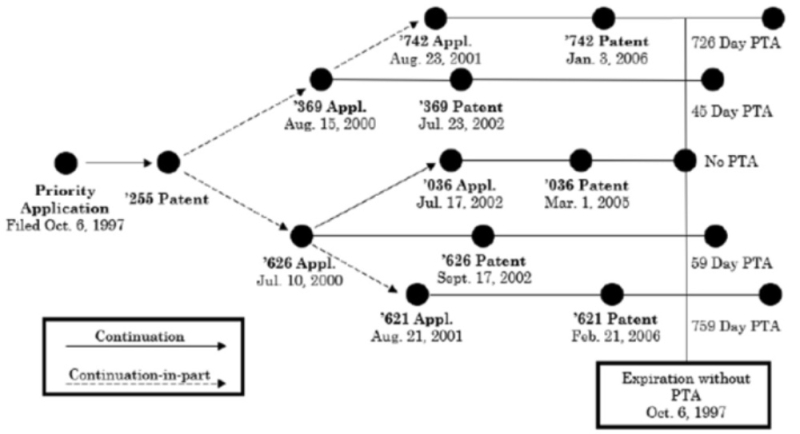
    The brief asserts that the Federal Circuit in its Cellect decision "usurped Congress's authority [by] abrogating [the statutory patent term] guarantees" and "rejected ODP's equities as well as "significantly adversely impact[ing] innovation."  Significantly, the brief provides this table showing the effects of PTA on U.S. patents from 2015 to 2023:

    Image 1
    While providing an erudite and thorough discussion on ODP, its origins, and equitable character, the brief makes its most significant arguments with regard to the importance of the Court granting cert., including that "It has been almost a century since the Court substantively addressed double patenting, and in the interim Congress has significantly amended the Patent Code at least five times."  Additionally, amicus argues that the Cellect decision will have widespread impact (based inter alia on the data set forth above) and in the NYIPLA's view that the Cellect decision "destroys" the guarantees regarding patent term embodied in the statute.  Indeed, amicus argues that "it is time to retire ODP" in view of the changes in U.S. patent law that have made irrelevant the equitable motivation for the doctrine stemming from the potential for serial filings that would award serial 17 year patent terms on patentably indistinct versions of an invention.


    AIPLA
    :  argued that the Cellect decision was an improper expansion of ODP to override statutory PTA, based on statutory construction (plain meaning) and amounting to a violation of the clear intent of Congress.  PTA is not an unjust extension of the patent term but a statutory restoration of term lost due to PTO delay.  The brief notes the structure of the patent term provisions of the statute, wherein § 154(a)(2) defines 20 year term; § 154(b) restores loss of term cause by PTO delay, with § 154(b) being entitled "Adjustment of Patent Term" and § 154(b)(1) being entitled "Patent Term Guarantees."  The brief performs some dictionary-based semantics on meanings of "adjust" and "extend" and asserts that "[p]ut simply, there is no unjust extension of term by PTA, but rather recovery of unjustly lost term due exclusively to PTO delay," stating that the Federal Circuit "conjured" Congressional intent contrary to these provisions of the statute.  With regard to the crux of the Federal Circuit's construction of the statute, the AIPLA maintains that § 154 "does not address ODP" and § 154(b)(2)(B) does not relate to ODP but rather "provides a commonsense limitation on PTA:  if an applicant has already specified a patent's expiration date by disclaiming some amount of term (a 'terminal disclaimer'), the applicant may not go beyond that date [by obtaining PTA]."  The Federal Circuit erred by implicating ODP in the application of § 154(b)(2)(B) because terminal disclaimers are purportedly "two sides of the same coin" (even as here under circumstances where TD not filed, although to be fair the basis was that a TD should have been filed).  The Court's analysis was error because it violates the "strong presumption" of congressional intent not to be rebutted except under "rare and exceptional circumstances," citing United States v. Clintwood Elkhorn Mining Co., 553 U.S. 1, 11 (2008) (quoting Ardestani v. INS, 502 U.S. 129, 135 (1991)). Here, the brief argues that Congressional intent can be found in the language that the Office shall provide PTA to restore term lost due to PTO delay, citing Smith v. Spizzirri, 144 S. Ct. 1173, 1177 (2024) (quoting Lexecon Inc. v. Milberg Weiss Bershad Hynes & Lerach, 523 U.S. 26, 35 (1998), and Petrella v. MGM, 572 U.S. 663, 685 (2014).  The brief also asserts that the Federal Circuit raised a "negative inference" which is improper under circumstances of having a "limited exception" which is itself improper:  "voluntarily surrender of statutorily granted PTA via a terminal disclaimer does not mean that Congress intended to nullify PTA entirely by exposing PTA-adjusted patents, where no terminal disclaimer is filed, to ODP."  The brief contends that this is not a case of the Federal Circuit "unearth[ing] Congress's hidden intent" but rather that the Court "just rewrote the statute."

    The brief also characterizes the decision as being a departure from the equitable underpinnings of ODP, because that doctrine was meant to limit patent term mischief and thus requires a showing of such mischief.  The basis is not just an extension of the patent term but an unjust extension, whereas PTA was intended to do exactly the opposite: restore deserved patent term lost due to USPTO delay.  The brief accuses the opinion of "gutt[ing] [the ODP] doctrine" of its equitable purpose (citing inter alia Immunex Corp. v. Sandoz Inc., 964 F.3d 1049, 1059 (Fed. Cir. 2020), for declaring ODP to be an equitable doctrine) and that prior ODP jurisprudence was directed towards preventing gamesmanship under Abiomed, Inc. v. Maquet Cardiovascular LLC, Civil Action No. 16-10914-FDS, 2023 U.S. Dist. LEXIS 104095, at *101 (D. Mass. June 15, 2023); Mitsubishi Tanabe Pharma Corp. v. Sandoz, Inc., 533 F. Supp. 3d 170, 214 (D.N.J. 2021); and Abbott Lab'ys v. Lupin Ltd., No. 09-152-LPS, 2011 U.S. Dist. LEXIS 53846, at *26-27 (D. Del. May 19, 2011), on the basis of unjust extension (there being no evidence of gamesmanship here).

    The brief also notes that the opinion discards the equitable requirements in favor of a "bright line rule" (which might resonate with the Court as the strongest argument for granting cert if history be our guide) and that some cases in the district court have already opined that "ODP depends solely on patent expiration dates and should not [be] influenced by equitable concerns," citing Allergan USA, Inc. v. MSN Lab'ys Priv. Ltd., No. 19-1727-RGA, 2023 U.S. Dist. LEXIS 172641 (D. Del. Sep. 27, 2023), later reversed by the Federal Circuit (by the same panel thar decided Cellect) as well as Ex parte Clantech, Inc. (PTAB 2024) and ACADIA Pharm. Inc. v. Aurobindo Pharma Ltd. (D. Del. Dec. 13, 2023).

    As to the consequences of the decision and the need for the Supreme Court to apply correction, the brief states that the decision has created uncertainty, upset settled expectations, harmed and innovation.  The magnitude of the possible implications is raised in the brief by citation of a law review article by Mark A. Lemley & Jason Reinecke, Our More-than-Twenty-Year Patent Term 1, 14-15 (Stanford L. & Econ. Olin Working Paper No. 586, 2023), https://ssrn.com/ab-stract=4529670 regarding the high frequency of patents obtaining PTA having an average of 411 days (some even longer) as well as the burden of monitoring patent estates "claim by claim" to avoid invalidation and the current increase in terminal disclaimer filings.


    Intellectual Property Owners (IPO): 
    In a brisk nine pages the IPO's brief emphasizes the Congressional mandate that the term of a patent shall be extended if PTO delay causes term to be lost under § 154(b)(1)(A).  "Congress intended these patent term adjustments to be mandatory, not permissive," according to the brief, relying, inter alia on the "black letter law" meaning of the word "shall."  It was legal error for the Federal Circuit to "in effect[] overrule[] the statute enacted by Congress based on a judge-made doctrine."  This assessment of the Court's error is supported by the Supreme Court's decision that "applied a traditional principle of statutory construction to the Federal Arbitration Act ("FAA") and determined that a judicially-created exception to an FAA provision could not stand," citing Henry Schein, Inc. v. Archer & White Sales, Inc., 139 S.Ct. 524, 530 (2019).  The brief also notes that the Federal Circuit came to the opposite conclusion (i.e., that ODP could not overrule a statute, § 156), in Novartis AG v. Ezra Ventures LLC, 909 F.3d 1367, 1375 (Fed. Cir. 2018).

    Terminal disclaimers in the PTA regime are "very clear[ly] defined" to have but "a limited role" in the statute:  firstly, it is the sole exception to PTA in the statute and accordingly, the scope of the exception should be limited, the brief citing United States v. Johnson, 529 U.S. 53, 58 (2000), for the principle that "[t]he proper inference . . . is that Congress considered the issue of exceptions and, in the end, limited the statute to the ones set forth."  The Federal Circuit's error in IPO's opinion was to "assume[] that ODP always applies and only briefly referred to the language of Section 154 after concluding that ODP invalidated Appellant's claims" (emphasis in brief).  The proper analysis, according to IPO, is to have "started (and ended) its analysis with the statute" and the proper result, arising from the proper analysis, would be that Cellect was entitled to the PTA because it had never filed a terminal disclaimer (i.e., it would be patentee's actions in doing so that provoked the loss of PTA).  The Federal Circuit's opinion to the contrary amounts to "a Catch-22 'gotcha,' [wherein a] patent owner may be entitled to a patent term adjustment under the statute, but according to the Federal Circuit's misinterpretation of the law, the patent term adjustment is a poison pill that can invalidate the patent in its entirety."

    The brief asserts that the consequences of the Federal Circuit's decision is that "valuable patent rights will be unfairly invalidated, which in turn will reduce the incentive for future investment in critical research," the evidence for which is that over the past 8 years more than one million patents have been granted PTA.  Other consequences include "unnecessary confusion" in the lower courts, citing contrary decisions on similar fact patters, in Acadia Pharms. Inc. v. Aurobindo Pharma Ltd., 2023 U.S. Dist. LEXIS 221663, at *21–24 (D. Del. 2023) (that ODP did not apply), and Allergan USA Inc. v. MSN Labs. Priv. Ltd., 2023 U.S. Dist. LEXIS 172641, at *59–60 (D. Del. 2023) (the latter case having been reversed in the interim by the Federal Circuit).  And this uncertainty will apply to continuation practice under § 120 and evoke "retroactive invalidation of many otherwise valid patents" IPO warns in its brief.


    Sonos, Ring Central, Nagra Kudelski Group, and Capstan Therapeutics: 
    This collection of smaller innovation-based companies argue in their brief that it is important for patent holders to know how long the patent term will be received in exchange for disclosure of their inventions to the public.  This consideration involves both practical (need for investment decisions) and ethical (comprising the quid pro quo of the patent system) realities in their view.

    The Federal Circuit's decision in the Cellect case undermines basic certainty for a wide range of inventions, this brief asserts.  Reviewing the bases for ODP development these amici argue that, absent gamesmanship it makes "very little sense" to apply ODP to today's circumstances, where all patents expire 20 years from their earliest priority date.  Here, the Federal Circuit expanded ODP to extend to additional patent term "(i) expressly provided by statute and (ii) created solely and exclusively by administrative delays within the Patent Office."

    This decision and application of ODP to PTA determinations are important, these amici assert, because such administrative delays occur frequently (over 50% of patents filed after enactment of Section 154(b) have been awarded PTA, on average in excess of 6 months, relying on Mark A. Lemley & Jason Reinecke, Our More-than-Twenty-Year Patent Term 1, 14-15 (Stanford L. & Econ. Olin  Working Paper No. 586, 2023), https://ssrn.com/ab-stract=4529670 and Dennis Crouch, Prosecution Delays and Patent Term Adjustment on the Rise Again (Nov. 13, 2022), https://pa-tentlyo.com/).  In the face of such statistics, the Federal Circuit's decision mandates that "even when a challenged patent expires later than the reference patent due to the Patent Office's delay and not as the result of any tactics by the patent owner, a court must invalidate that patent if it believes an earlier-to-expire patent in the same family renders it obvious" according to amici.  This is error because it "allows a judge-made doctrine to cut short a statutory patent term mandated by Congress; contradicts Federal Circuit precedent; treats two forms of statutory term adjustments differently even though the language of the statutes are similar; and upsets equitable considerations underlying the purpose of ODP."

    Amici assert that this brief is filed not to rehash these arguments but to "highlight the practical concerns the Federal Circuit's ruling creates for technology-driven companies, and the fundamental ways the ruling contradicts both basic fairness and predictability," stating that this is "not a situation where the [Supreme] Court should wait and see how the doctrine develops" (emphasis in brief) because it "impacts the investments (many of which will be years in the making) that companies like the amici are making now."

    Their argument further asserts that "[p]redictability is crucial to innovation," because "[c]ompanies rely on knowing the duration of patent protection in a variety of circumstances including: (i) when making decisions about research and development budgets, (ii) when deciding how to protect their innovations (e.g., whether to apply for patents or rely on trade secret protection), and (iii) when evaluating acquisitions of other companies."  The Cellect decision has upended this predictability for at least these reasons:

    First, the structure of patents and patent claiming, and how they are used to protect technologies for innovative companies, result in each individual claim protecting only "a small fraction of what has been invented."  As a result while the patent specification is a detailed description of several related inventions or aspects thereof each claim set encompasses (and protects) only a small subset of what is disclosed in the specification.  These are typically pursued in continuation applications filed according to the priority (i.e., value) of these different aspects.  These practices are sanctioned by the patent statute and do not raise concerns regarding gamesmanship (the brief saying it would be counterproductive and expensive to file all these claims in one application).  The result is filing many applications in patent portfolios for which, prior to the Cellect decision, patent holders understood their expiration dates (based on their earliest priority dates and any PTA earned during prosecution as a result of PTO delay).  This is no longer the case under Cellect, because now patent owners must determine expiration dates for each family member and the claims in each and then assess "the likelihood that a court will later find each individual claim of the later-expiring patents to be obvious relative to one or more claims of the reference [i.e., earliest-expiring] patent" (emphasis in brief) (this assessment constituting "only an educated guess" according to amici).  In addition to the legal uncertainties, this exercise poses "a gargantuan problem" in terms of number of patents and "millions in patent costs" required to be performed.  "If the Federal Circuit intended to undermine the settled expectations of patent holders, it would be hard to imagine a more effective way to do so," the brief asserts.

    Second, there is a great (and negative) impact on investment decisions by innovative companies, amici argue, affecting research and development, whether to pursue patent protection or rely on trade secrets or abandon intellectual property protection entirely.  This outcome is contrary to the well-recognized importance of patent protection for supporting innovation, as evinced by the Court's decisions in Pfaff v. Wells Elecs., Inc., 525 U.S. 55, 63, (1998); Apple Inc. v. Samsung Elecs. Co., 809 F.3d 633, 647 (Fed. Cir. 2015); Sanofi-Synthelabo v. Apotex, Inc., 470 F.3d 1368, 1383 (Fed. Cir. 2006); and Patlex Corp. v. Mossinghoff, 758 F.2d 594, 599 (Fed. Cir.), on reh'g, 771 F.2d 480 (Fed. Cir. 1985), and indeed even the Founders' inclusion of provisions for IP protection in the Constitution.  These legal principles, amici contend, are supported by academic and other studies showing that "legal decisions that change the expected value of patents have impacts on technology investments," citing as examples Alice Corp. v. CLS Bank Int'l, 573 U.S. 208 (2014) (where "a survey of 475 venture capital and private equity firms reported that 62% of investors said that their firm was less likely to invest in companies developing technologies that may not be patent eligible"; David O. Taylor, Patent Eligibility and Investment, 41 Cardozo L. Rev. 2019, 2027-28 (2020), https://pa-pers.ssrn.com/sol3/papers.cfm?abstract_id=3340937) and another survey after the Supreme Court's Bilski v. Kappos, 561 U.S. 593 (2010), and Mayo Collaborative Services v. Prometheus Laboratories, Inc., 566 U.S. 66 (2012), decisions that showed "investment in diagnostic technologies was nearly $9.3 billion dollars lower than it otherwise would have been"; A. Sasha Hoyt, The Impact of Uncertainty Regarding Pa-tent Eligible Subject Matter for Investment in U.S. Medical Di-agnostics Technologies, 79 Wash. & Lee L. Rev. 397, 445-46 (2022), https://scholarlycommons.law.wlu.edu/wlulr/vol79/iss1/8/).

    The Cellect decision not only reduces patent protection value but also makes protection "less predictable" (emphasis in brief), under circumstances where the amount of PTA to which a patentee is entitled depends on "unknown and stochastic processes within the Patent Office."  As a consequence, amici argue, the traditional exchange of patent protection for disclosure to the public becomes "something of a lottery" (emphasis in brief).  And these are the circumstances that arise if innovative companies continue to pursue patenting; amici contend that the reduction of return on (the quite large) investment in patenting "materially undermines the incentive to apply for patents in the first place" which "represents a serious loss to the public in the long term."


    Sanofi, Beigene, Merck Sharp & Dohme, EMD Serono, and Pfizer: 
    This brief provides an extensive history of the development of ODP (also termed herein "non-statutory double patenting" or "NSDP") and also that certainty and predictability has been disrupted by the Federal Circuit's Cellect decision.  The brief emphasizes the legal history of ODP and how it has become outdated inter alia by adoption of the 20-year patent term for U.S. patents, as well as the equitable aspects arising before adoption of the URAA/TRIPS regime, as a judicially created doctrine preventing serial filing and issuance of obvious variants of an invention.

    The brief asserts that despite elimination of the opportunity for "gamesmanship" in patent term under U.S. law after adoption of the URAA/TRIPS regime the Federal Circuit in Cellect "expands [the scope of] NSDP anyway," according to amici, citing In re Hubbell, 709 F.3d 1140, 1145 (Fed. Cir. 2013), and Gilead Scis., Inc. v. Natco Pharma Ltd., 753 F.3d 1208, 1217 (Fed. Cir. 2014).  Cellect in another example, here on the novel question of "whether NSDP could invalidate claims of patents within a family solely because of a statutory grant of PTA to some members of that family" (the answer being yes, of course).  In addition, amici argue that the decision has "sow[n] confusion in district courts, citing the poster-children for this confusion, Allergan USA, Inc. v. MSN Lab'ys Priv. Ltd., 2023 WL 6295496 (D. Del. Sept. 27, 2023), and Acadia Pharms. Inc. v. Aurobindo Pharma Ltd., 2023 WL 8803448 (D. Del. Dec. 13, 2023).

    Amici argue that this history establishes that the Cellect decision is "destabilizing" to the patent regime, particularly for the pharmaceutical industry, in part due to the "enormous" cost of investment in the face of patent term that is no longer "definite and predictable" being subject to "administrative inefficiencies and judicial whim."  The decision not only undermines the equitable principles upon which the ODP doctrine was established but is also legally incorrect based on proper construction of § 154(b)(2)(B) of the statute, these amici argue.  "The Federal Circuit applied a judge-made equitable doctrine in an inequitable way, contravening Congress's statutory guarantees in the process," the brief summarizes.  The brief also supports the value of patents (and the need for predictability thereof) in the pharmaceutical and other industries with numerous academic legal and other studies attesting to the public benefit of this investment.  The brief further addresses the "balance" between lowering drug prices and encouraging (through profit) investment to develop new drugs ("a policy question for Congress—not courts—and Congress has addressed that policy question many times," citing examples such as the Hatch-Waxman Act).

    In addition to these policy and practical errors, the brief expounds on the legal errors committed by the Federal Circuit, including misconstruing § 154(b)(2)(B).  These number three: first, contrary to the panel's rationale, "terminal disclaimers are not tied to NSDP the way the Federal Circuit presumed" (i.e., that filing a terminal disclaimer was always associated with NSDP).  Second, while NSDP was crafted (and § 154(b)(2)(B) enacted) for circumstances involving "serially filed applications with different default patent terms" (emphasis in brief) the Federal Circuit applied the doctrine to patents within the same patent family sharing a common default patent term (i.e., 20 years from a common earliest priority date).  Properly understood, amici argue that § 154(b)(2)(B) was intended to apply to situations where "original patent applications containing patentably indistinct claims are filed separately on different dates, rather than as part of the same patent family, resulting in patents with different default terms," [wherein] "NSDP might apply to the later-filed, later-expiring patent because the patents would have different default patent terms—different start and end dates—which is controlled by the patentee."  (And to the extent Congress wanted the Federal Circuit's interpretation to apply, the brief argues it would have said so expressly.)

    Amici also contend that applying NSDP in this situation is a misapplication of a doctrine intended to police unjustified extension of patent term to patent term extensions justified by a grant expressly enacted by Congress.  "Statutory guarantees like PTA are not unjustified, nor are they even in the patentee's control," the brief asserts, providing two reasons why applying NSDP as the Federal Circuit did in this case was error.  Finally in this regard amici argue that applying NSDP to situations not involving gamesmanship or other culpable behavior is a misapplication of the equitable principles underpinning NSDP.

    The brief concludes with an exhortation of the importance for the Court to grant certiorari, inter alia, to address the Federal Circuit's replacement of "Congress's carefully calibrated patent regime with one of judicial design" specifically with regard to pharmaceutical innovation including the costs thereof and the accompanying need for predictability for this technology.


    Pharmaceutical Research and Manufacturers of America (PhRMA) and Biotechnology Innovation Organization (BIO): 
    The principle argument in this brief is that the Federal Circuit used judicially created doctrine to overrule statutory PTA, while secondarily the brief argues that the decision upsets settled expectations.  Amici's stated interests are "[t]o protect [their] investments, members of PhRMA and BIO depend on a patent system that is robust, fair, and predictable. In particular, amici rely on the patent system to protect the diverse array of innovations they make in connection with developing a new medicine or treatment, including the unique compositions required to safely and effectively use new medicines in patients and novel manufacturing technologies needed to safely produce amounts of those medicines sufficient to meet an often immense patient demand."

    Amici argue that the nature of these technologies requires "filing a series of related patent applications derived from an original filing based on the inventive work."  As a consequence, they obtain patents with various expiration dates that are "dictated by the statutory scheme at issue here," wherein those terms vary according to the PTO "failing to meet its statutory deadlines in conducting the examination of the associated application."

    The brief contains these graphics to illustrate the effects on patent term created by the U.S. adopting the URAA/TRIPS regime that changed the term of U.S. patents from 17 years from issue to 20 years from earliest priority date:

    Image 2
    The prejudice illustrated in this graphic motivated Congress to enact 35 U.S.C. § 154(b) to restore term lost due to PTO delay:

    Image 3
    With specific instances of how the regime responds illustrated in this figure:

    Image 4
    The brief asserts that this "judge-made doctrine of non-statutory double patenting cannot displace these statutory requirements for patent-term adjustments" which is "clear from the statutory text of 35 U.S.C. § 154(b)."  (The brief also notes that the equitable basis for ODP was largely eliminated by the changes in term occasioned by adopting the URAA/TRIP regime.)

    The patent term adjustment regime according to the brief is "an essential part of the PTO's application-by-application examination process," consisting of a "back-and-forth dialogue between the PTO and the inventor."  In order to adequately protect innovation in these disciplines, "[l]ife sciences innovators commonly file robust applications reflecting the broad array of innovations that come with developing a new medicine," which include "not only the most promising active ingredient discovered but other promising candidates as well."  The result is that innovators can obtain "patent rights that provide commercially viable protection" that, in addition to preventing competitors from avoiding their patents by making simply narrow changes also benefits the public due to publication that occurs whether or not a patent is ever obtained.  But such patent applications take time to secure and often involve several rounds of continuation applications to pursue some claims not included in a patent arising from the first application filed but nevertheless ultimately deemed patentable (the brief explicating the history of such applications and the benefits that arise therefrom).

    The brief further sets out their argument that judge-made law cannot negate the statutory mandate, citing the differences between Novartis Pharmaceuticals Corp. v. Breckenridge Pharmaceutical Inc. (regarding PTA under § 154(b)) and Novartis AG v. Ezra Ventures LLC, (regarding PTE under § 156(a)).  Also argued are amici's contentions that the Federal Circuit misinterpreted the statutory language, which was related to instances where a terminal disclaimer had been filed, not ones where a court determines it should have been (and in a footnote echoes other amici that the Federal Circuit erred in considering ODP as the exclusive reason for filing a terminal disclaimer).

    With regard to settled expectations, the brief emphasizes the risk to innovative industries due to the time and expense of bringing pharmaceutical and biotechnology products to market and the related need for reliable patent protection with predictable term to ensure a chance at sufficient return to justify investment.  The brief says that the Federal Circuit's error relates to all technologies, citing Festo Corp. v. Shoketsu Kinzoku Kogyo Kabushiki Co., 535 U.S. 722, 739 (2002), but particularly affects innovation for pharmaceutical and biotechnology inventions (supported by several academic and industry studies) due to the excessive costs and time it takes to bring products to market in these industries and the propensity for failure.

    Finally, the brief reminds the Court that they have "often granted certiorari to realign the Federal Circuit's doctrines with governing statutes," naming SAS Inst. Inc. v. Iancu, 138 S. Ct. 1348 (2018); Halo Elecs., Inc. v. Pulse Elecs., Inc., 136 S. Ct. 1923 (2016); and Nautilus, Inc. v. Biosig Instruments, Inc., 572 U.S. 898 (2014) (frankly the brief could have named several more but the point was undoubtedly made).


    Teige P. Sheehan: 
    Teige P. Sheehan, a patent attorney, filed an amicus brief on his own behalf and argued specifically that the Federal Circuit's reasoning was circular and that the statute requires ODP to be resolved before PTA is assessed.  Regarding the circularity argument, the brief contends that a terminal disclaimer is a "cure" for an ODP defect by truncating the patent term to an earlier expiration date and that § 154(b)(2)(B) states that a PTA award cannot extend the expiration date later than the date set by the terminal disclaimer.  The Federal Circuit held that "because § 154 states that a terminal disclaimer—the cure for ODP—limits a PTA award, a PTA award itself can confer unpatentability for ODP in the absence of a terminal disclaimer" (emphasis in brief). Mr. Sheehan asserts in his brief that "[t]his is a classic instance of circular reasoning, an illogical basis for analysis repeatedly dismissed by this Court (e.g., in Nationwide Mut. Ins. Co. v. Darden, 503 U.S. 318, 327 (1992); King v. St. Vincent's Hosp., 502 U.S. 215, 222 (1991); Morse v. Republican Party of Virginia, 517 U.S. 186, 233 n.43 (1991); and Chevron, U.S.A., Inc. v. Nat. Res. Def. Council, Inc., 467 U.S. 837 (1984)) and which "provides no insight at all into whether Congress intended for a PTA award to confer ODP invalidity."  "[T]he statute explains the consequence on PTA of a terminal disclaimer having been entered to overcome ODP," the brief argues, [but] "[i]t does not mean, as the Federal Circuit would have it, [that] PTA creates the need for the terminal disclaimer by causing ODP invalidity."  And as with other amici (and Cellect itself) the brief also argues that this application of ODP doctrine by the Federal Circuit thwarts Congress's scheme for restoring patent term due to PTO delays under § 154(b).

    The statute asserts that the proper application of the statute, consistent with Congressional intent, is for ODP issues to be resolved before application of any PTA is awarded.  Such an application of the law would avoid instances that cause their own, unique anomalies, such as where "a patent can validly issue with a PTA award and its corresponding expiration date publicized, only to be rendered invalid for ODP later, when another patent subsequently issues."  This is exactly what occurred for two patents at issue in Cellect: "U.S. Patent No. 6,424,369 ("the '369 Patent") issued with an award of 45 days of PTA.  Over two-and-a-half years later, another patent was issued to Petitioner, U.S. Patent No. U.S. 6,862,036 ("the '036 Patent"), without receiving a PTA award.  . . .  The '369 Patent's 45 days of PTA meant it was set to expire after the '036 Patent did, resulting in a supposedly unjust extension of patent term, according to Respondent [and the Federal Circuit]."

    The brief concludes that "[t]his inflexible application of ODP is not only contrary to Congress's intent that ODP should be determined based on a patent's expiration date absent PTA, as expressed in § 154, but also serves none of the purported purposes of ODP doctrine while delivering an inequitable result to a patentee."

    Amicus for Respondent:

    Inari Agriculture, Inc.:  The only amicus brief submitted in support for Respondent was filed by Inari Agriculture, Inc. and this brief takes a decidedly aggressive and aggrieved tone in favor of the Federal Circuit's decision and the rationales behind it.  The company describes itself as being formed to "develop pioneering technology to selectively edit plant genes to enhance agronomic traits to increase crop yields and decrease inputs such as water and fertilizer," that "partners with independent seed companies to develop improved seeds using Inari's technology" but for whom ODP is needed to "protect[] innovators­ like Inari-from earlier patentees seeking to leverage legacy technology after their patents expire."  It castigates "an oligopoly of entrenched incumbents" that "dominate seed distribution and suppress competition" by abusing the patent system, spurred on by "commentaries [that] highlighted brazen strategies for exploiting loopholes in the PTA system [citing blog posts directed to maximizing PTA-increased term] and delaying patent issuance while wrongly attributing such delays to the PTO."  Examples cited in the brief include "[t]wo companies-Corteva and Bayer/Monsanto­[that] control over 70% of the U.S. corn seed market and 85% of corn-related intellectual property" and that "[t]ogether with BASF and ChemChina's Syngenta Group, these oligopolists own 95% of corn-related IP," by exerting patent rights over genetically modified seed.  The brief also cites extensively from briefs and other assertions by the Federal Trade Commission regarding such putative abuses, which the brief contends will (and in some instances at least prospectively already have begun to) address these issues (albeit a large portion of the brief also seems to set forth Inari's own arguments against these companies rather than address the question of certiorari grant, except to the extent that by doing so the Court might take away a tool that Inari believes will aid it in competing with the "oligarchs.")

    One final consideration remains (not addressed in these briefs because it arose after they were filed), which is the Federal Circuit's recent decision in Allergan USA Inc. v. MSN Laboratories Private Ltd.  In that case, a panel made up of the same Federal Circuit judges that decided In re Cellect reversed a district court decision that putatively applied the Cellect calculus for assessing when PTA can invalidate claims under the ODP doctrine.  The relationship between the patents at issue in Allergan was as follows:
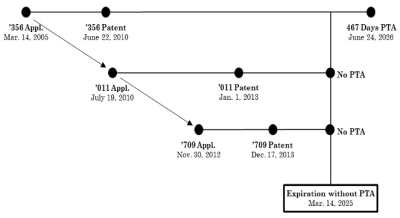
    Image 5
    In this case, the district court held that the '356 patent was invalid on obviousness-type double patenting grounds (ODP) for having patentably non-distinct claims over the '011 and '709 patentsThe district court expressly relied on the Federal Circuit's Gilead Scis., Inc. v. Natco Pharma Ltd. and In re Cellect decisions in reaching this judgment.  Nevertheless, the Federal Circuit reversed.  The rationale behind this (seemingly contrary) decision was that "Cellect established a rule that, when it comes to evaluating ODP on a patent that has received PTA, the relevant expiration date is the expiration date including PTA—not the original expiration date measured twenty years from the priority date."  That was not the factual posture in Allergan, according to the Court, which asserted the following rule for determining the effects of OPD on PTA:  "a first-filed, first-issued, later-expiring claim cannot be invalidated by a later-filed, later-issued, earlier-expiring reference claim having a common priority date"; as applied here the district court erred "[b]ecause the '356 patent was the first patent in its family to be filed and to issue, it [thus] does not extend any period of exclusivity on the claimed subject matter."  A comparison of the timelines in Allergan and Cellect reveals that these decisions are not completely consistent.  The existence of the decision, however, might be enough to convince the Supreme Court that it would be more prudent not to grant Cellect's certiorari petition and to permit the Federal Circuit to resolve a consistent application of ODP and PTA law before the Justices wade into these murky waters themselves. We should know how the Court decides by tomorrow.

  • By Kevin E. Noonan

    Supreme Court Building #1In view of the Supreme Court's "long conference" on September 30th, it seems timely to review the arguments, pro, con, and amicus briefs submitted to the Court asking for certiorari over the Federal Circuit's In re Cellect decision.  While that Court's recent Allergan USA Inc. v. MSN Laboratories Private Ltd. opinion may have made the issues (and whether the Supreme Court grants cert) less urgent, the pending U.S. Patent and Trademark Office (PTO) proposed rules limiting terminal disclaimer practice for overcoming obviousness-type double patenting and the permissible scope of those rules by an administrative agency after Loper-Bright Enterprises v. Raimondo continue to garner interest regarding whether the Court will take up review of this decision.

    To recap, the issue arose in a series of ex parte reexaminations over five patents owned by Cellect, U.S. Patent Nos. 6,424,369; 6,452,626; 6,982,742; and 7,002,621, that involve "solid state image sensors which are configured to be of a minimum size and used within communication devices specifically including video telephones" according to the '621 patent (only four of these patents were invalidated, the fifth, U.S. Patent No. 6,862,036 not having any PTA that raised the issue).  The chronological situation is set forth in an exhibit from Cellect's Federal Circuit appeal brief and reproduced in modified form in the opinion:

    Image 1
    The Federal Circuit affirmed the Patent Trial and Appeal Board decision invalidating the four patents that had term extending longer than that of the earliest to expire patent, U.S. Patent No. 6,862,036, which had amassed no patent term adjustment under 35 U.S.C. § 154(b) based on the provision of subsection 35 U.S.C. § 154(b)(2)(B) that stated:

    No patent the term of which has been disclaimed beyond a specified date may be adjusted under this section beyond the expiration date specified in the disclaimer . . . .

    According to the Federal Circuit, it is inequitable to the public that a second, later-expiring patent should be obtained ("an unjustified timewise extension of patent term") on an obvious variant of a patented invention, based on AbbVie Inc. v. Mathilda & Terence Kennedy Inst. of Rheumatology Tr., 764 F.3d 1366, 1373 (Fed. Cir. 2014) (there was no dispute that the claims in these five patents were not patentably distinct).  The panel's opinion found support in the statute (as had the Board), wherein application of PTA was limited under circumstances where there was or should have been a terminal disclaimer filed under 35 U.S.C. § 154(b)(2)(B); the fact that no such terminal disclaimer(s) were filed were not relevant to the Court's decision that the principle applied because they should have been filed.  The Court's decision was supported by the overriding policy consideration that the Court focuses on the need to "ensure that the applicant does not receive an unjust timewise extension of patent term" (as it has for over a decade; see "In re Janssen Biotech, Inc.; G.D. Searle LLC v. Lupin Pharmaceuticals, Inc."; "AbbVie Inc."; "Gilead Sciences, Inc. v. Natco Pharma Ltd."; "Eli Lilly & Co. v. Teva Parenteral Medicines, Inc."; and "Sun Pharmaceutical Industries, Ltd. v. Eli Lilly & Co.").  In so ruling, the Federal Circuit dismissed patentee's argument that patent term adjustment should not be treated any differently from patent term extension (PTE), for which the Court ruled in Novartis AG v. Ezra Ventures LLC (Fed. Cir. 2018) that a statutorily mandated extension of term should not be lost under a judicially created doctrine.  The reasoning by the Court was that the statutes were independently enacted and had "quite different purposes."

    Cellect's cert petition asserts error in the Federal Circuit's decision on grounds set forth in the Question Presented:

    Whether a patent procured in good faith can be invalidated on the ground that statutory Patent Term Adjustment, which requires lengthening a patent's term to account for time lost to Patent and Trademark Office delays, can trigger a judge-made patent-invalidation doctrine.

    In support of this Question, the Petition asserts that "the Federal Circuit has substituted a judge-made equitable doctrine for a patent term guaranteed by Congress."  In arguments in support of the Petition, Cellect asserts that the only reason for the different expiration dates of these patents is that "the Patent Office did not comply with its statutory deadlines for acting on patent applications," which raised patent term adjustment under the statute, with there being no evidence or allegations of gamesmanship, bad faith, or improper actions by patentee.  Cellect's arguments contrast the Federal Circuit's treatment of the statute under this case and Novartis AG v. Ezra Ventures LLC, 909 F.3d 1367, 1375 (2018), analogizes the PTA statute with how Congress enacted the earlier PTE statute, and asserts as evidence of Congressional intent to harmonize the two statutes the inclusion of the phrase "which shall include any patent term adjustment granted under section 154(b)" to § 156(a) when § 154(b) was enacted.  The PTE (§ 156a) and PTA (§ 154b) statutes "serve the same purpose," the brief contends, restoring patent term lost by bureaucratic delay (by FDA and PTO, respectively), and both use the mandatory phrase that lost term "shall be extended" for the appropriate period.

    The brief contains a very simplified example to illustrate how PTA is applied (although the wisdom of making it too simple may be questioned):

    By way of illustration, ODP applies when the owner of a patent for sliced bread goes on to seek related patents for sliced white bread and sliced wheat bread, and prosecutes those patent applications strategically so that they expire after the original patent and enlarge, in effect, the original patent's term through patenting obvious or marginal variations of its claims.

    As to reasons for granting the petition, the brief asserts that the Federal Circuit "turned a congressional 'guarantee' of a minimum effective patent term on its head by converting that guarantee into a threat to the validity or term of countless continuation patents."  Additional reasons supporting cert grant are that this change is "extremely consequential" to patentees, the issue here is plainly presented (should a judge-made doctrine supersede "an express statutory grant"?), and the Supreme Court is the only resort against the Federal Circuit, the brief stating that "the Federal Circuit's word on the question will be the last one in all patent cases unless this Court grants review."

    Specific aspects of Cellect's arguments include that the plain text of the statute ("shall be extended") "forecloses" the Federal Circuit's opinion under Supreme Court precedent, including Jennings v. Rodriguez, 583 U.S. 281, 300 (2018) (quoting Kingdomware Techs., Inc. v. United States, 579 U.S. 162, 171 (2016)); that courts are prohibited from adding exceptions to a statute not included by Congress, citing Diamond v. Chakrabarty, 447 U.S. 303, 308 (1980) (quoting United States v. Dubilier Condenser Corp., 289 U.S. 178, 199 (1933)); that the decision is contrary to Supreme Court decisions on consistency when statutes used same language, "serve the same purpose" and are "analogous," Abbott v. Perez, 585 U.S. 579 (2018); criticizes the Federal Circuit's reasoning regarding the language in § 154(b) suggesting a role for terminal disclaimers where such language was not found in § 156(a); is inconsistent with the Federal Circuit's decision in Novartis Pharmaceuticals Corp. v. Breckenridge Pharmaceutical Inc., 909 F.3d 1355, 1366 (Fed. Cir. 2018); and that "[i]n spurning the traditional, equitable ODP inquiry in favor of rigid presumptions of its own invention, the Federal Circuit repeated an error that this Court has often granted certiorari to correct," citing eBay Inc. v. MercExchange, L.L.C., 547 U.S. 388, 393 (2006); Monsanto Co. v. Geertson Seed Farms, 561 U.S. 139, 157 (2010); Nken v. Holder, 556 U.S. 418, 435, 436 (2009); Munaf v. Geren, 553 U.S. 674, 690 (2008); New York Times Co. v. Tasini, 533 U.S. 483, 505 (2001); KSR Int'l Co. v. Teleflex Inc., 550 U.S. 398, 419 (2007).

    As to the importance of the question, the brief asserts that the Federal Circuit's decision "upsets investment-backed expectations" contrary to Supreme Court admonitions in, for example, Festo Corp. v. Shoketsu Kinzoku Kogyo Kabushiki Co., 535 U.S. 722, 739 (2002); that it generates uncertainty, harming investment decisions, and "radically undermines . . . predictability"; and that it cause confusion in the lower courts, comparing district court decisions in Allergan USA, Inc. v. MSN Labs. Priv. Ltd., No. Civ. A. 19-1727-RGA, 2023 WL 6295496, at *22 (D. Del. Sept. 27, 2023) (since reversed by the Federal Circuit) with Acadia Pharms. Inc. v. Aurobindo Pharma Ltd., No. Civ. A. 20-985-GBW, 2023 WL 8803448, at *8 (D. Del. Dec. 13, 2023).  The brief also notes the importance for "long-lead-time, high-investment industries like pharmaceuticals," using PTE as an example (keeping in mind that the technology here does not have these attributes); is "especially burdensome" on smaller businesses; "upends well-established patent practice"; and predicts that inventors "will be compelled to prepare larger, all-but-the-kitchen-sink applications right out of the gate, thus delaying the arrival of important innovations and then swamping the Patent Office with administrative difficulty."  Consequently, the decision raises the potential for "invalidation of hundreds of patents worth billions or trillions of dollars" due to "retroactive invalidation" under circumstances where "these are problems of the Patent Office's own making" because "[a]s long as the Patent Office acts on applications within the statutory deadlines, there is no PTA in the first place"

    Finally, the brief characterizes this case as an ideal vehicle for the Court to decide, because there are no underlying issues of fact, no challenge that the claims were not patentably distinct, and that the Court can reach these issues for both PTE and PTA.

    The government's response in opposition has the tone of "move along, nothing to see here" regarding Cellect's assertions in their Petition.  The government's contrasting Question Presented to the Court is:

    Whether the ban on obviousness-type double patenting applies when patent-term adjustment causes a challenged patent to remain in force after the reference patent expires.

    The brief dismisses Cellect's reliance on Section 156 as being a different part of the statute enacted for a different purpose and sees no contradiction with Section 156 because Section 154 contains express provisions regarding terminal disclaimers and Section 156 does not.  According to the government, the statutory entitlement for PTA is bounded by exceptions including the one for patents having restricted term, and these differences evince a distinction Congress made between Sections 154 and 156 that justify the Federal Circuit treating them differently here and in Novartis v. Ezra Ventures.

    The brief raises an historical prohibition against double patenting relying on Miller v. Eagle Mfg. Co., 151 U.S. 186, 197 (1894), and Odiorne v. Amesbury Nail Factory, 18 F. Cas. 578, 579 (C.C.D. Mass. 1819) (No. 10,430) (Story, J.), that mandate that it is the later patent that "must be declared void," with Section 101 of the 1952 Patent Act as codifying this prohibition and Gilead Scis., Inc. v. Natco Pharma Ltd., 753 F.3d 1208, 1212 (Fed. Cir. 2014), as extending this prohibition to "obvious modifications of that invention that are not patentably distinct improvements," now termed obviousness-type double patenting, citing Eli Lilly & Co. v. Barr Labs., Inc., 251 F.3d 955, 967 (Fed. Cir. 2001), cert. denied, 534 U.S. 1109 (2002).  The ready remedy is filing a terminal disclaimer under Section 253(b) according to their brief, citing Application of Robeson, 331 F.2d 610, 614 n.4 (C.C.P.A. 1964).

    The government urges the Court to recognize that the current situation arose, in part, due to changes in the Patent Act caused by adoption of the Uruguay Round Amendments, and the government sees the current situation as being how it has handled the likelihood that certain patentees would lose term due to PTO delay.  Similarly, the brief discusses the origins and policy rationales for Section 156 and by contrasting them hopes to distinguish them.  The brief asserts that the Federal Circuit took into consideration the plain meaning of the statute in reaching its decision and that the absence of any evidence of gamesmanship by patentee did not change the analysis.

    In an instance where a Federal Circuit-derived "bright line rule" may be justified and helpful for achieving consistency, the brief argues that "the statutory recognition of the binding power of terminal disclaimers in § 154(b)(2)(B) is tantamount to a statutory acknowledgement that [obviousness-type double patenting] concerns can arise when PTA results in a later-expiring claim that is patentably indistinct" and "when a terminal disclaimer has been entered in a patent subject to PTA, no patent (or claim) may be extended beyond the disclaimed expiration date."  The Federal Circuit properly recognized that ODP and terminal disclaimers were "two sides of the same coin" and thus was justified in its interpretation of § 154(b)(2)(B) according to the government.  The government's brief attempts to blunt Cellect's argument that the Federal Circuit used the judge-made doctrine of ODP to overcome the provisions of the statute by saying that "while sometimes 'described as a court-created doctrine, obviousness-type double patenting is grounded in the text of the Patent Act,'" citing Abbvie Inc. v. Mathilda & Terence Kennedy Inst. of Rheumatology Trust, 764 F.3d 1366, 1372 (Fed. Cir. 2014), and Miller v. Eagle Mfg. Co., 151 U.S. 186, 197 (1894), Parker Drilling Mgmt. Servs., Ltd. v. Newton, 587 U.S. 601, 611 (2019), and AbbVie.

    With regard to the differences in treatment by the Federal Circuit between Section 154 and Section 156, the brief states that a critical textual distinction between Section 154 and Section 156 shows that Congress intended the two schemes to operate differently.  Whereas Section 154 precludes the use of PTA to extend a patent's expiration date beyond the "date specified in [a terminal] disclaimer," 35 U.S.C.154(b)(2)(B), Section 156 contains no comparable carveout and the Federal Circuit "recognized that distinction" in Novartis AG v. Ezra Ventures LLC, 909 F.3d 1367 (2018) (which decision also recognized this distinction regarding Section 154).

    The brief also asserts that the fact that it is undisputed that the claims in the different Cellect patents at issue were obvious variants of each other trumps the equity argument because undisputably these claims were in force after their proper expiration date and equity demands that they be invalidated under these circumstances, citing Boehringer Ingelheim Int'l GMBH v. Barr Labs., Inc., 592 F.3d 1340, 1348 (Fed. Cir. 2010).  The brief also argues that there is also no requirement for gamesmanship nor fraud for Section 154 to be applied here, based on the need to protect the public from unjustified extension of the patent term.

    Regarding Cellect's assertions on the importance of this case for Supreme Court review, the government argues that the Question Presented by petitioners is "not sufficiently important to warrant this Court's intervention" because it was consistent with earlier Federal Circuit precedent, was a unanimous decision and was not subject to rehearing.  Petitioner Cellect's argument that no other circuit will be able to consider the question is not germane because there hasn't been any disagreement among the Federal Circuit indicating a need for further review.  The Question Presented by petitioners is "not sufficiently important to warrant this Court's intervention" because it also "lacks substantial practical importance" due to limited applicability, i.e., when "a patent owner obtains a later-expiring patent that has claims that are not patentably distinct from those of an earlier-expiring patent; the USPTO's delay in examining and processing the later patent is sufficient to trigger PTA; the USPTO examiner does not recognize the indistinct nature of the claims of the later patent and does not reject them based on double patenting; and the patent owner does not follow the usual practice of filing a terminal disclaimer with respect to the later-expiring patent."  And any frustrated expectations by investors are not justified under the "bedrock principle" against double patenting (i.e., their expectations are not justified in the first place, particularly in view of "Section 154(b)(2)(B)'s express carve-out of terminal disclaimers from that grant [of PTA]").

    The brief also mentions the Federal Circuit's decision in Allergan USA, Inc. v. MSN Laboratories Private Ltd., No. 24-1061, 2024 WL 3763599 (Fed. Cir. Aug. 13, 2024), as removing any inconsistencies in the Court's jurisprudence.  The government's brief dismisses Petitioner's assertions that patentees will be newly burdened with the need to review all claims in related patents (which exists now) and disruptions in continuation practice based on Allergan.

    Cellect Reply Brief

    Cellect, in its Reply brief, addresses some "misstatements" made by the government (such as that "the rule against obviousness-type double patenting (ODP) is statutory rather than judge-made") and the government's arguments.  The first of these is displacement by the PTA statute which Cellect asserts it did not advance and, perhaps more importantly is actually about ODP displacing PTA rather than (as the government asserts according to Cellect) the other way around.  Cellect characterizes this argument as an admission by the government that the Federal Circuit's opinion is "indefensible."  Cellect challenges the government for trying to avoid the reality that the Federal Circuit performed a "massive and consequential rewrite of the statute."  And the Reply brief reiterates Cellect's contention that it is inexplicable (or at least the government has not provided an explanation) of why the Federal Circuit treated the application of ODP for PTE differently than PTA.

    The argument focuses on the Federal Circuit's construction of the portion of the statute that specifically mentions terminal disclaimers and criticizes for being counterintuitive the government's position regarding situations (like the one at issue) where terminal disclaimers have not been filed and the effect on PTA.  The government's reading amounts to a "back door limitation" to the statutory guarantee of PTA extension of patent term according to the Reply brief which is "especially implausible because the proffered limitation case (as it did [in this case]) wholly invalidate a patent that has no terminal disclaimer" (emphasis in brief) (the brief characterizes such actions by Congress if intentional to be nothing less than "cagey," citing Whitman v. Am. Trucking Assoc. for the principle that Congress "does not hide elephants in mouseholes").  The brief uses an analogy from immigration law to illustrate the incongruity Petitioner believes the government's (and Federal Circuit's) statutory construction produces.  The best and most consistent answer Cellect proffers is that "the [statutory] text limits PTA only when a terminal disclaimer has been filed and states that 'PTA shall be granted' when no terminal disclaimer is filed" (albeit avoiding the issue of the proper determination in cases like this where a terminal disclaimer should have been filed).

    The brief also provides its rebuttal to the government's position on the disparity between how ODP is applied to awarding term extensions for PTA and PTE; the effects of the changes in U.S. patent term by adoption of the URAA/TRIPS regime; and the equitable foundation of ODP.

    Regarding the importance of the Question Presented and whether the Court should grant certiorari, the brief reiterates its arguments (and criticizes the government's attempts to "minimize the importance" by "protestations [that] ring hollow" and "fail to grapple" with experiences contrary to their arguments by better-informed amici.  And the brief characterizes the recent Federal Circuit decision in Allergan v. MSN to be an "ad hoc turnabout" as being "the wages of ignoring the statutory text."

    The amicus briefs that were filed on behalf of Petitioner and Respondent will be the subject of a subsequent post.

  • By Kevin E. Noonan

    Federal Circuit SealEver since the Supreme Court's decision in Dickinson v. Zurko, federal courts (including the Federal Circuit) are compelled under the Administrative Procedures Act to review factual determinations by the U.S. Patent and Trademark Office under a substantial evidence standard.  The consequences of this standard are illustrated (once again) in the Federal Circuit affirming the Office's determination in an inter partes review (IPR) proceeding invalidating the challenged claims, in Novartis Pharma AG v. Regeneron Pharmaceuticals, Inc.

    Challenger Regeneron obtained institution of the IPR for all claims on U.S. Patent No. 9,220,631 owned by Novartis.  The claims were directed to "a small volume syringe such as a syringe suitable for ophthalmic injections."  Such syringes are useful for administering therapeutic agents (such as vascular endothelial growth factor (VEGF) antagonists) to the eye for treating ocular diseases.  Suitable syringes must be sterile and in order to avoid damaging the therapeutic agent must be sealed to prevent sterilizing agents (such as hydrogen peroxide) from contaminating the drug.  Tight seals have the disadvantage of increasing the pressure (force, termed according to the opinion the "break-loose force") required to administer the drug into the delicate ocular tissues.  A solution known in the prior art, treating the syringe with silicone oil, had the drawback that it can cause medical complications should it get into the patient's eye.

    The invention claimed in the '631 patent provided the following solution illustrated by claims 1 and 21:

    1.  A pre-filled, terminally sterilized syringe for intravitreal injection, the syringe comprising a glass body forming a barrel, a stopper and a plunger and
        containing an ophthalmic solution which comprises a VEGF-antagonist, wherein:
            (a) the syringe has a nominal maximum fill volume of between about 0.5 ml and about 1 ml,
            (b) the syringe barrel comprises from about 1 μg to 100 μg silicone oil,
            (c) the VEGF antagonist solution comprises no more than 2 particles >50 μm in diameter per ml and wherein the syringe has a stopper break-loose force of less than about 11N.

    21.  A blister pack comprising a pre-filled syringe according to claim 17, wherein the syringe has been sterili[z]ed using EtO or H2O2 with a Sterility Assurance Level of at least 10–6.

    According to the Federal Circuit's opinion, Novartis did not "meaningfully dispute" Regeneron's assertions that that the prior art disclosed all the limitations recited in the challenged claims, in particular PCT Publication No. WO 2011/006877 ("Siggs") that disclosed "a pre-filled terminally sterilized syringe containing a VEGF-antagonist" and PCT Publication No. WO 2009/030976 ("Boulange") that disclosed "a stopper with the claimed silicone oil and break-loose force limitations."  Rather, it was Novartis's contention that the worker of ordinary skill in the art would not have been motivated to combine these references having a reasonable expectation of success in doing so.  Novartis also asserted that objective indicia of non-obviousness supported its claims in defense of Regeneron's challenge.

    The Patent Trial and Appeal Board (Board) agreed with Regeneron in an extensive (128 page!) Final Written Decision that the challenged claims were obvious, supporting this determination by prior art references that include the Sigg and Boulange references.  The Board found that Sigg provided a terminally sterilized pre-filled syringe and that Boulange taught silicone sterilization methods that would minimize the risk of contamination.  Additionally, the Board found that the skilled worker would have had a reasonable expectation of success using the choice of stopper (Stopper C) taught by Boulange, which provided a tight enough seal to permit the syringe to be sterilized while having a break-loose force within the claimed 11N limit.  Regarding Novartis's assertion of objective indicia of non-obviousness, the Board opined that "[t]he stronger evidence of obviousness cannot be overcome with the weaker evidence of long-felt need and failure of others."

    The Federal Circuit affirmed, in an opinion by Judge Chen joined by Judges Prost and Reyna.  From the thirteen (!) arguments raised by Novartis, the opinion states that it considered only Novartis's principal ones.  The first of these was that the prior art teaches away from the combination of the Sigg and Boulange references.  In assessing and rejecting this argument, the Court noted that "teaching away" raised a question of fact, citing In re Fulton, 391 F.3d 1195, 1199–200 (Fed. Cir. 2004), and that the Board's factual determinations were reviewed by the Federal Circuit for substantial evidence, citing PersonalWeb Techs., LLC v. Apple, Inc., 917 F.3d 1376, 1381 (Fed. Cir. 2019).  The opinion summarized the Board's analysis as consisting of finding "a motivation to combine Sigg's sterilization process with Boulange's Stopper C because Boulange's baked-on siliconization process 'would help reduce the amount of "residual" or "free" silicone oil that can enter the protein formulation and cause negative effects'" and reviewed each in turn.  Regarding Boulange's Stopper C teachings, the panel rejected Novartis's contention that because the break-loose force of this stopper increased from 4.7N to 8.4N over three months, the skilled worker would not have chosen it in favor of stoppers with more consistent break-loose force characteristics over time.  The opinion notes that the challenged claims do not recite a limitation regarding consistent break-loose force and that the written description of the '631 patent disclosed that prior art stoppers having break-loose forces of up to 20N were "known in the prior art to be acceptable for intravitreal injections."  The Board's conclusions in this regard were also supported by the testimony of Regeneron's expert, and Novartis "did not submit any evidence showing that a skilled artisan would have been dissuaded from using a syringe that has a roughly 4N increase in break-loose force over time."  The Board's determination concerning the combination of Sigg with Stopper C as taught by Boulange was supported by substantial evidence according to the opinion.

    Novartis also argued that Stopper C was "markedly inferior" to another stopper (B1) disclosed in the Boulange reference.  The panel rejected this argument on the basis that "[i]n assessing whether prior art teaches away, that 'better alternatives exist in the prior art does not mean that an inferior combination is inapt for obviousness purposes,'" the opinion citing Bayer Pharma AG v. Watson Lab'ys, Inc., 874 F.3d 1316, 1327 (Fed. Cir. 2017) (quoting In re Mouttet, 686 F.3d 1322, 1334 (Fed. Cir. 2012)).  Once again, the Board relied on Regeneron's expert, who testified that "a skilled artisan would have been motivated to use Stopper C because it was comprised of rubber and coated with silicone oil—a common stopper design in the prior art," as well as the break-loose force of Stopper C being within the claimed 11N and the 20N limits disclosed in the '631 specification.

    The last argument from Novartis regarding "teaching away" was that Stopper C's "friction forces . . . were relatively high, something which does not appear to be acceptable for a medical device."  However, the data from the Boulange reference regarding such friction forces were obtained using versions of Stopper C that were not siliconized, whereas the embodiments of Stopper C relied upon by Regeneron in making its obviousness assertions in the IPR were siliconized.  It is this embodiment of Stopper C that the skilled worker would consider using, according to the Board (and this opinion), and for these embodiment the Court held that the Board's obviousness determination was supported by substantial evidence.

    Novartis's second argument was that the Board erred in finding that the skilled worker would have had a reasonable expectation of success in combining the Sigg and Boulange references to achieve the claimed invention, a question also reviewed under the substantial evidence standard under, inter alia, Intelligent Bio-Systems, Inc. v. Illumina Cambridge Ltd., 821 F.3d 1359, 1366 (Fed. Cir. 2016).  The basis for the Board's decision in this regard was that "Boulange's Stopper C was sealed tightly enough to be terminally sterilized using Sigg's vaporized hydrogen peroxide sterilization process," which Novartis argued was error because "Boulange's syringes were not sufficiently gas-tight to be able to use Sigg's sterilization process."  The Court considered Novartis's argument to be flawed as being "premised on an incorrect view of the [meaning] of the claim term 'terminally sterilized.'"  This is because the Board's meaning of the term was that it required "only minimizing the contact between the drug product and the sterilizing agent" (emphasis in opinion) and Novartis had not challenged that construction on appeal.  Thus, statements in the Sigg reference that few products had the "required tightness . . . to avoid ingress of sterilizing gasses [into the prefilled drug containing syringe]' (emphasis added) did not deprive the Board of substantial evidence regarding the skilled worker's reasonable expectation of success.  Yet again, the Board relied on Regeneron's expert testimony that "it was standard to design prefilled syringes to be gas-tight to protect the drug from degrading over its shelf life and to prevent sterilizing gas from entering the syringe," which was consistent with the Boulange reference, which disclosed that "lower break-loose forces are achievable in the invention 'without having to add lubricant and while preserving the tightness of the contact region between said two parts'" (emphasis in opinion).  In addition, the opinion notes that there was no evidence asserted that "any special tightness or specific stopper material, coating, or dimensions[] would have been required to achieve terminal sterilization."

    A final Novartis argument addressed by the Court  in the opinion was the Board's determination that the Sigg reference disclosed the limitation in claim 21 of a sterility assurance level of at least 10–6 being achieved using vaporized hydrogen peroxide.  The panel found the Board's conclusion in this regard to be supported by substantial evidence based on statements in the Sigg reference that "sterility for a health care product as achieving a sterility assurance level of 10–6" combined with a description of vaporized hydrogen peroxide as being a "sterilization treatment."  The Board combined these teachings from the prior art with expert testimony from Regeneron to conclude that "a skilled artisan would have known a sterility assurance level of 10–6 was based on regulatory requirements for health care products, and therefore pre-filled syringes are required to meet that sterility assurance level," which, according to the opinion, was supported by substantial evidence.  Although (for this issue) the Court implicitly acknowledged Novartis's identification of an inconsistency in some of Regeneron's evidence, the Federal Circuit held that under the substantial evidence standard "one inconsistent piece of evidence does not undermine [the Board's] finding."

    In a footnote, the opinion addressed two other arguments made by Novartis.  First, the Court held that the Board's reliance on certain non-prior art was not error because its determinations were supported by substantial evidence even if that art were ignored.  Second, regarding Novartis's arguments concerning the objective indicia of non-obviousness, the opinion notes that the parties had "extensively redacted this portion of the public version of the Board's decision" but the Court had found substantial evidence supporting the Board regardless (perhaps evincing an acknowledgement from the Court that the public deserved to be told the outcome even if the parties' redactions prevented the Court from setting forth the bases for its decision in the opinion.

    Novartis Pharma AG v. Regeneron Pharmaceuticals, Inc. (Fed. Cir. 2024)
    Nonprecedential disposition
    Panel: Circuit Judges Prost, Reyna, and Chen

  • By Kevin E. Noonan

    Federal Circuit SealOne of the anticipated consequences of the Supreme Court's Loper Bright decision is that it will unleash judges to impose their statutory interpretations of administrative agencies' applications of the law within their areas of purported expertise.  Whether that outcome arises, (relatively) recent experience has shown that the "tyranny of the judiciary" can be and has been unleashed in other aspects of U.S. patent law; an example is the recent District Court decision (thankfully overturned by the Federal Circuit, albeit on procedural grounds) in Astellas Pharma, Inc. v. Sandoz Inc.

    The case arose in ANDA litigation prompted by Sandoz's application for a generic equivalent of Astellas' Myrbetriq® drug (mirabegron) for treatment of overactive bladder conditions.  The opinion sets forth the mechanistic basis for the efficacy of the drug, which "is a beta-3 agonist that stimulates beta receptors in the bladder, thereby inducing bladder relaxation and improving bladder function."  However, during drug development it was discovered that it had a "food effect," i.e., the bioavailability of the drug was undesirably diminished by the presence of food in a patient's stomach (the drug was absorbed by the food and amounts below the clinically effective levels were absorbed by the patient's body).  Moreover, taking the drug on an "empty stomach" resulted in bioavailable levels that "reach[ed] potentially toxic [blood] concentrations."  Astellas developed sustained release formulations that were patented in U.S. Patent No. 10,842,780; after some litigation interplay, Astellas asserted claims 5, 20, and 25 of the '780 patent which were set forth in the opinion (italicized claims were independent or earlier claims in a dependency chain that are set forth for a clearer understanding of what was claimed):

    1.  A pharmaceutical composition, comprising 10 mg to 200 mg of [mirabegron], or a pharmaceutically acceptable salt thereof, in a sustained release hydrogel-forming formulation comprising a hydrogel-forming polymer having an average molecular weight of 100,000 to 8,000,000 and an additive having a water solubility of at least 0.1 g/mL at 20±5° C.,
        wherein the hydrogel-forming polymer is at least one compound selected from the group consisting of polyethylene oxide, hydroxypropyl methylcellulose, hydroxypropyl cellulose, carboxymethyl cellulose sodium, hydroxyethyl cellulose, and a carboxyvinyl polymer,
        wherein the additive is at least one selected from the group consisting of polyethylene glycol, polyvinylpyrrolidone, D-mannitol, D-sorbitol, xylitol, lactose, sucrose, anhydrous maltose, D-fructose, dextran, glucose, polyoxyethylene hydrogenated castor oil, polyoxyethylene polyoxypropylene glycol, polyoxyethylene sorbitan higher fatty acid ester, sodium chloride, magnesium chloride, citric acid, tartaric acid, glycine, β-alanine, lysine hydrochloride, and meglumine, and
        wherein a drug dissolution rate from the pharmaceutical composition is 39% or less after 1.5 hours, and at least 75% after 7 hours, as measured in accordance with United States Pharmacopoeia in 900 mL of a USP buffer having a pH of 6.8 at a paddle rotation speed of 200 rpm.

    5.  The pharmaceutical composition according to claim 1, wherein the hydrogel-forming polymer is at least one compound selected from the group consisting of polyethylene oxide, hyd[r]oxypropyl methylcellulose, and hydroxypropyl cellulose.

    20.  A method for treating overactive bladder comprising administering the tablet according to claim 18 to a subject in need thereof.

    22.  A pharmaceutical composition, comprising 10 mg to 200 mg of [mirabegron], or a pharmaceutically acceptable salt thereof, in a sustained release hydrogel-forming formulation comprising a means for forming a hydrogel and a means for ensuring penetration of water into the pharmaceutical composition, wherein a drug dissolution rate from the pharmaceutical composition is 39% or less after 1.5 hours, and at least 75% after 7 hours, as measured in accordance with United States Pharmacopoeia in 900 mL of a USP buffer having a pH of 6.8 at a paddle rotation speed of 200 rpm.

    23.  The pharmaceutical composition according to claim 22, comprising 10mg to 200 mg of [mirabegron].

    25.  A tablet, comprising the pharmaceutical composition according to claim 23.

    During pretrial proceedings, Sandoz limited its defenses to 35 U.S.C. § 112 (for each of written description, enablement, and indefiniteness).  A five-day bench trial and filing of post-trial motions by the parties followed.

    The District Court issued its final decision based on none of the parties' contentions.  Instead, "sua sponte," the District Court held that the claims were ineligible for patenting under § 101 under Mayo Collaborative Servs. v. Prometheus Lab'ys, Inc., 566 U.S. 66 (2012).  Support for this decision came from arguments and assertions in Astellas' post-trial briefing, specifically (in arguing enablement) that "[the] "inventive concept of the '780 Patent was discovering the dissolution rate that would address the food effect and achieving it using previously known formulation technology," which the District Court took to mean that "Astellas concedes that the '780 patent is enabled because it claims invalid subject matter: a natural law applied via routine, conventional, and well-known methods."  (A reminder that the aphorism that "everything you say can be used against you" is not limited to criminal law or police procedurals.)  In the District Court's view, "the claimed invention 'reflects merely the discovery of the food-effect-resolving dissolution profile," the District Court deemed the asserted claims invalid as patent ineligible'" and entered judgment for Sandoz.  The District Court denied Sandoz's motion under Federal Rule of Civil Procedure 52(b) to make findings of fact and conclusions of law to preserve the issues that were presented at trial.  The District Court's basis for denying the motion was that "[t]he [c]ourt could not have better invoked [Mayo]."  This appeal followed.

    The Federal Circuit vacated and remanded, in a decision by Judge Lourie joined by Judges Prost and Reyna.  The Court did not reach the merits (expressly; vide infra) but held that the District Court had abused its discretion based on the principle of party presentation, i.e., that courts "rely on the parties to frame the issues for decision and assign to courts the role of neutral arbiter of matters the parties present," citing Greenlaw v. United States, 554 U.S. 237, 243 (2008) (the District Court helped the panel reach this decision by stating in its ruling that it "sits not [as] an arbiter to resolve the disputes on the parties' favored terrain").  Support for the Court's finding can be found, according to the opinion, by copious precedent, including United States v. Sineneng-Smith, 590 U.S. 371, 375 (2020); United States v. Dowdell, 70 F.4th 134, 146 (3d Cir. 2023) (the opinion noting that "[w]e review procedural issues not unique to patent law under regional circuit law"); and Innogenetics, N.V. v. Abbott Lab'ys, 512 F.3d 1363, 1371 (Fed. Cir. 2008) (the opinion also noting that while not "ironclad" "rendering a patent invalid on a basis not advanced by any party is not . . . a circumstance [that would justify straying from the party presentation principle]").

    The opinion also invokes the presumption of validity codified under 35 U.S.C. § 282, which imposes on the party asserting invalidity the burden of establishing it by clear and convincing evidence, citing Microsoft Corp. v. I4I Ltd. P'ship, 564 U.S. 91, 95 (2011), and the impropriety for a court to declare a patent "valid," citing Panduit Corp. v. Dennison Mfg. Co., 810 F.2d 1561, 1569 (Fed. Cir. 1987); Shelcore, Inc. v. Durham Indus., Inc., 745 F.2d 621, 627 (Fed. Cir. 1984); and Env't Designs, Ltd. v. Union Oil Co. of Cal., 713 F.2d 693, 699 n.9 (Fed. Cir. 1984) (and continuing the analogy herein, akin to a criminal defendant being found not guilty rather than innocent).  The court's role is only "to determine whether the patent's challenger carried the burden of establishing invalidity," citing Lindemann Maschinenfabrik GMBH v. Am. Hoist & Derrick Co., 730 F.2d 1452, 1457 n.1 (Fed. Cir. 1984).  (It should not pass notice that much of this precedent stems from the time when a newly minted Federal Circuit began to flex its judicial muscles in setting forth consistent applications of the law over the district courts, which had been governed by the regional circuit courts of appeal with varying "takes" on how patent law should be applied.)

    Under the Federal Circuit's view of the law "the district court appears to have misapprehended its role in adjudicating the issue of patentability" according to the opinion.  Synthesizing Astellas' arguments concerning enablement under § 112 to arrive at a concession of ineligibility under § 101 was an abuse of discretion in view of these legal principles.  The panel also rejected the District Court's rationale for its decision on an issue never raised by the parties, that "it sensed 'in the [parties'] assertion that patent litigants may, in essence, consent around the bounds of patent eligibility.'"  According to the panel, "[i]t is for the parties—not the court—to chart the course of the litigation," citing Lannom Mfg. Co. v. U.S. Int'l Trade Comm'n, 799 F.2d 1572, 1579 (Fed. Cir. 1986), being directly on point, finding in that case the rubric that "[i]t is beyond cavil that a district court does not have authority to invalidate a patent at its own initiative if validity is not challenged by a party."  Another basis for criticism of the District Court was that court's belief that patent eligibility was "a threshold inquiry that it had a duty to address—even in the silence of the parties" (although to be fair it can be understood why over a decade of Federal Circuit precedent affirming motions to dismiss on § 101 grounds could have left that impression; see examples in earlier posts too numerous to set forth here).  According to the opinion, the presumption of validity under § 282 applies to "all grounds of validity" (emphasis in opinion), citing Cellspin Soft, Inc. v. Fitbit, Inc., 927 F.3d 1306, 1319 (Fed. Cir. 2019).

    For its part, Sandoz supported the District Court's decision, but was limited to citing "cases from the late 1800s and certain non-binding out-of-circuit cases," which were not persuasive (but do provide an interesting history lesson regarding the Supreme Court's and certain Circuit Courts of Appeal's varying historical antipathy to patents).  Moreover, the timing of these decisions, prior to enactment of the presumption of validity in the 1952 Patent Act provides the panel with sufficient justification to ignore whatever precedential force these decisions may retain.

    Astellas was less successful in having the Federal Circuit remand this matter to a different district court judge.  In addition to the abuse of discretion against them, the District Court made several statements (presumably on the record) that tended to evince a prejudice against patents to pharmaceuticals and the companies that asserted them.  These statements included that "[t]he pharmaceutical industry, to put it mildly, has perverted th[e] intent [of the Hatch-Waxman Amendments].  With alarming regularity since, brand and generic drug manufacturers have colluded to protect weak or invalid patents and share in the startling profits"; and that "this 'case is about the pharmaceutical industry's long-standing 'innovation' of patenting extended-release formulas for soon-to-expire active-ingredient patents."  Astellas asserted that the District Court's sua sponte entry of judgment against them on § 101 grounds was by itself enough to justify removal.  The Federal Circuit did not agree, first because the panel considered mandating reassignment on remand to be "an exceptional remedy, one that we weigh seriously and order sparingly," citing United States v. Kennedy, 682 F.3d 244, 258 (3d Cir. 2012), and Lazare Kaplan Int'l, Inc. v. Photoscribe Techs., Inc., 714 F.3d 1289, 1298 (Fed. Cir. 2013).  The Court expressly relied upon the Third Circuit standard for reassignment set forth in Arrowpoint Cap. Corp. v. Arrowpoint Asset Mgmt., LLC, 793 F.3d 313, 329 (3d Cir. 2015), requiring that "a reasonable person, with knowledge of all the facts, would conclude that the judge's impartiality might reasonably be questioned."  Astellas did not meet this standard, according to the opinion.*  But the District Court judge's record (having "overseen nearly two hundred patent cases and has ruled in favor of both innovative and generic manufacturers alike") and that Astellas could not provide any instance in which the District Court judge had "acted in a way that called into question his ability to . . . resolve the outstanding issues impartially and fairly" over the "life of this nearly four-year-old litigation" was enough to dissuade the Federal Circuit from mandating removal on remand.  In view of the Court' believing it had "clarified the proper course for adjudication," the opinion closes with the statement that "we trust that, upon remand, the district court can and will take an objective, measured, and thorough look into the legal issues and evidence of record to resolve only those disputes that exist between the parties."

    • In stating the Court's reasons for making this determination, the opinion provides, for the rest of us, the hopeful opinion that "we have serious doubts that, on the merits, the asserted claims—directed to nonnatural compositions of matter and associated methods of use—are ineligible for patent protection," albeit this being "an issue [the Court] decline[d] to resolve."

    Astellas Pharma, Inc. v. Sandoz Inc. (Fed. Cir. 2024)
    Panel: Circuit Judges Lourie, Prost, and Reyna
    Opinion by Circuit Judge Lourie

  • By Kevin E. Noonan

    Federal Circuit SealIn a joint appeal of two adverse decisions from the District Court, the Federal Circuit on procedural grounds rejected an appeal from the Wisconsin Alumni Research Foundation ("WARF") in Wisconsin Alumni Research Foundation v. Apple Inc.  The decision was based on the Court's conclusion that WARF was precluded from asserting infringement under the doctrine of equivalents (DOE) after having failed to establish literal infringement and having withdrawn its DOE assertions in an earlier litigation, and also precluded from asserting the same patent on DOE grounds against "next-generation" Apple products similar to ones deemed non-infringing earlier.

    The case arose over U.S. Patent No. 5,781,752 directed to "[a] predictor circuit [that] permits advanced execution of instructions . . . [i]n an electronic computer with a single processing unit" (alleged to be infringed by Apple's A7 and A8 processors in one of the decisions at issue and Apple's A9 and A10 processors in the other).  The first decision (WARF I) on appeal (regarding earlier litigation about the A7 and A8 processors in which the District Court found infringement by Apple and the Federal Circuit reversed) is the District's Court's refusal to permit WARF to litigate infringement under DOE that had been withdrawn in the earlier litigation, on the grounds that WARF had affirmatively abandoned that theory of infringement (as explained in the opinion, this abandonment was made in a context where Apple was precluded from introducing evidence at trial of its own patent, No. 9,128,725, regarding similar technology) and that the District Court's construction of the term "particular" ("to be associated with a single load instruction") "foreclosed an equivalent where the prediction could be associated with a group of load instructions" (emphases in opinion) because WARF's DOE theory would "vitiate the claim limitation by rendering meaningless the term "particular."  The District Court (in WARF II) after lifting a stay until resolution of WARF I refused to permit WARF from pursuing infringement of Apple A9 and A10 processors under DOE based on its decision in WARF I, supported by Federal Circuit precedent under Nystrom v. Trex Co., 580 F.3d 1281 (Fed. Cir. 2009), that ruled that "the plaintiff in that case was barred from revisiting a doctrine of equivalents theory of infringement based on waiver of that doctrine in past litigation over materially similar, earlier generation of the same products despite later generations being produced during and after the course of the first litigation."  These appeals followed.

    The Federal Circuit affirmed, in an opinion by Judge Prost joined by Judges Taranto and Chen.  As explained in the opinion, WARF argued in its appeal from WARF I that it did not waive its claim of infringement under DOE "generally" with respect to Apple's A7 and A8 processors, and that issue preclusion does not apply in WARF II.  Apple argued that the Kessler doctrine supported the District Court's decision in this regard, see Kessler v. Eldred, 206 U.S. 285 (1907) (the panel agreeing with this argument in its affirmance).

    With regard to WARF I and the District Court's waiver determination, the Federal Circuit asserted the preeminence of Federal Circuit law for waiver questions regarding "enforcement of a patent right," citing Harris Corp. v. Ericsson Inc., 417 F.3d 1241, 1250‒51 (Fed. Cir. 2005).  WARF's ultimate position on this question was that the District Court's claim construction of the term "particular" was a change of circumstances that precluded application of waiver in its DOE infringement theory under Exxon Chemical Patents, Inc. v. Lubrizol Corp., 137 F.3d 1475 (Fed. Cir. 1998).  Apple for its part argued that WARF made its own "strategic choice to abandon its [doctrine-of-equivalents] theory in order to prevent Apple from introducing evidence of Apple's own patent during the trial's liability phase," relying in large part upon the Federal Circuit's earlier decision reversing the District Court's finding of literal infringement and the absence in that decision of remand or a new claim construction.

    The Federal Circuit agreed with Apple.  Regarding WARF's "changed circumstances" concerning claim construction of the term "particular," the opinion asserts that "[t]he correct inquiry is whether the claim construction changed in a way that would excuse WARF's failure to raise, at the previous trial, the doctrine-of-equivalents theory that it now attempts to reassert in WARF I," concluding that it did not.  The Court held that the interpretation of the term was consistent with Apple's understanding that it should be given its plain and ordinary meaning (supported by its expert's testimony).  In addition, the opinion states that WARF was not prohibited from raising its DOE grounds for infringement at trial despite its assertion of its confidence regarding its literal infringement case.  Nor was the panel convinced that Apple's failure to pursue the narrower construction of the term at trial provided any justification for WARF not earlier pursuing its DOE case.

    The Court also held that, "for reasons unrelated to claim construction," WARF had waived its DOE infringement theory.  The basis for this conclusion is that WARF's actions had satisfied the standard under United States v. Olano, 507 U.S. 725, 733 (1993), for "intentional relinquishment or abandonment of a known right" by failing to present substantive arguments before the District Court for infringement under the DOE, citing Boss Control, Inc. v. Bombardier Inc., 410 F.3d 1372, 1380 (Fed. Cir. 2005), and United States v. Hible, 700 F.3d 958, 961 (7th Cir. 2012).  The panel characterized WARF's arguments against waiver as "recharacter[izations]" which the Court found to be contrary to the record.  In the panel's view, WARF "agreed to 'drop doctrine of equivalen[ts] and make no doctrine of equivalents arguments whatsoever at trial'," emphasis in opinion, "in exchange for Apple's agreement not to present its own patent at trial."  This constituted a "relinquishment of a known right" which resulted in the District Court ordering both parties not to present evidence about that Apple patent at trial.  In addition, the Court considered it relevant that both parties retained the "ability to argue their positions on what the plain and ordinary meaning required or allowed."  Under these circumstances, the panel held that while WARF could have pursued its DOE theory at trial that it now asserts, not doing so constituted an abandonment constituting waiver.

    Finally, in the WARF I appeal the panel turned to (and rejected) WARF's assertion of Exxon Chemical Patents, Inc. v. Lubrizol Corp.,137 F.3d 1475 (Fed. Cir. 1998), in support of its position.  The Court found WARF's assertion of this precedent, for the proposition that "when the doctrine of equivalents becomes a critical issue only after a new claim construction is adopted on appeal, a plaintiff's prior choice to not present that theory at trial does not constitute abandonment" was overbroad.  In the Court's view, that case involved circumstances where the Federal Circuit held on appeal that the District Court had discretion to consider an unasserted DOE infringement theory because the Federal Circuit had not "dispose[d] of" that infringement theory.  Although "[a]t a bird's eye view" the facts and circumstances in Exxon were similar to those here, the panel found sufficient distinctions to reject WARF's assertion of Exxon in this instance.  In Exxon, the District Court's claim construction "rendered [Plaintiff's] doctrine-of-equivalents theory moot," which was not the case here, and in Exxon "there was no reason for the jury to consider Exxon's doctrine-of-equivalents theory under the uncontested facts."  In this case, "in contrast, there were reasons for WARF to pursue its doctrine-of-equivalents theory—namely, the parties were actively disputing the scope of the plain and ordinary meaning of 'particular' before, during, and after trial," i.e., the question on the meaning of "particular" was not moot.  In addition, here (and not in Exxon) the Court found an affirmative abandonment of its DOE theory of infringement.  Finally, in Exxon, the Federal Circuit "did not grant a per se right to a new trial on the doctrine of equivalents" but provided the District Court with the discretion to do so.

    Regarding the WARF II appeal, the Court affirmed based on issue preclusion and the Kessler doctrine.  For the former, the standard applied by the Court is that "(1) the issue sought to be precluded is the same as that involved in a prior action; (2) the issue was actually litigated; (3) the determination of the issue was essential to the final judgment; and (4) the party against whom estoppel is invoked was represented in the prior action," citing Adair v. Sherman, 230 F.3d 890, 893 (7th Cir. 2000); the elements at issue here are limited to the first and second, implicating the question (according to the opinion) of "what is the issue"?  WARF contends the issue in WARF I to be "whether Apple's A7 and A8 processors literally infringe the '752 patent" and in WARF II to be "whether Apple's A9 and A10 processors infringe the '752 patent under the [doctrine of equivalents]."  Apple's contention is the same in both cases to be merely "whether Apple's accused products infringe the '752 patent."  The task the Court appreciates is to determine whether the two pairs of processors — A7/A8 and A9/A10 — are "essentially the same" and whether literal and DOE infringement "are part of the same overall issue of infringement."

    The opinion notes that "[a]ccused devices are essentially the same where the differences between them are merely colorable or unrelated to the limitations in the claim of the patent," citing ArcelorMittal Atlantique et Lorraine v. AK Steel Corp., 908 F.3d 1267, 1274 (Fed. Cir. 2018).  Here, the District Court held that the pairs of accused infringing processors satisfied this standard, and the Federal Circuit found no clear error in this determination.  The panel dismissed WARF's contentions that there was an issue based on failure of Apple to provide discovery regarding the A9/A10 processors and that there was a "'potential' significant [design] change" in the later-developed A9/A10 processors compared with the A7/A8 processors.  This decision was based on the Court's consideration of further proceedings below wherein both parties made assertions that the two pairs of processors were the same ("not more than colorably different" in Apple's language).  And the only additional discovery WARF wanted was "damaged-related discovery" according to the panel, not technical discovery relevant to the question of substantial sameness at issue here.

    The Court next considered the second prong of the test for issue preclusion, "whether the issue is infringement or the separate theories of infringement" and whether the issue litigated in the first action is identical to the one WARF wishes to pursue in the second action under B & B Hardware, Inc. v. Hargis Industries, Inc., 575 U.S. 138, 154 (2015).  Importantly, the panel interpreted the B&B Hardware holding to be that the legal standards applied in both actions were the same, not that the "factors or tests must be identical for issues to be identical."  The Court purports to apply the same analytical approach taken by the B&B Hardware Court, looking at "the statutes, the history, and the Restatement (Second) of Judgments" (i.e., the common law) to make its determination of issue identity.  Here, the statute is the same (35 U.S.C. § 271), as was the historical context for the DOE (Winans v. Denmead, 56 U.S. 330, 344 (1853); see also Graver Tank & Mfg. Co. v. Linde Air Prods. Co., 339 U.S. 605, 608 (1950), which treated literal and DOE infringement "as a single issue").  Finally, the panel's assessment of the teachings of the Restatement (Second) of Judgments sets forth "several factors" for situations where "there is a lack of total identity between the particular matter presented in the second action and that presented in the first."  These include "substantial overlap in evidence or argument"; whether "new evidence or argument involve application of the same rule of law as that involved in the prior proceeding"; "[c]ould pretrial preparation and discovery relating to the matter presented in the first action reasonably be expected to have embraced the matter sought to be presented in the second?"; and "[h]ow closely related are the claims involved in the two proceedings?"  These rubrics as applied by the Court supported the District Court's determination that issue preclusion should apply to WARF's renewed assertion of infringement under the DOE.  This treatment is also consistent with precedent, according to the opinion, citing Nystrom v. Trex Co., 580 F.3d 1281 (Fed. Cir. 2009) (relied upon by the District Court), and Aspex Eyewear, Inc. v. Marchon Eyewear, Inc., 672 F.3d 1335, 1343 (Fed. Cir. 2012).  The opinion also asserts a policy basis for their decision:

    For the foregoing reasons, we are convinced that literal infringement and the doctrine of equivalents are the same issue for issue-preclusion purposes.  To conclude otherwise would allow a patentee to proceed through the entirety of litigation only on a theory of literal infringement and, after losing its case, allow that same party to accuse the same entity of infringing the same patent, accusing the same or essentially the same products, as long as those products were sold after judgment of the first suit.

    Finally, the opinion turns to the proper application of the Kessler doctrine in support of the District Court's decision.  The doctrine is specific for patent law, according to the Court, wherein it "fills the gap between [claim and issue] preclusion doctrines . . . allowing an adjudged non-infringer to avoid repeated harassment for continuing its business as usual post-final judgment," citing Brain Life, LLC v. Elekta Inc., 746 F.3d 1045, 1056 (Fed. Cir. 2014).  As applied the right (to sell a non-infringing article after having been absolved of infringement of the claimed invention) "attaches to its product—to a particular thing—as an article of lawful commerce," the panel citing Rubber Tire Wheel Co. v. Goodyear Tire & Rubber Co., 232 U.S. 413, 418 (1914).  Closer to the circumstances in this case (and cited by the Court in support of the District Court's judgment) is SpeedTrack Inc. v. Off. Depot, Inc., 791 F.3d 1317, 1329 (Fed. Cir. 2015), where a plaintiff only asserting literal infringement was precluded under the Kessler doctrine from asserting DOE infringement in a second lawsuit arising after having failed to prevail against the same defendant for accused literal infringement.  As stated in the opinion, "WARF II presents exactly this type of litigation harassment, applied to a second suit against the very same defendant."

    These proceedings appear to exonerate Apple from infringement that an earlier jury had decided was worth $506 million (after prejudgment interest).

    Wisconsin Alumni Research Foundation v. Apple Inc. (Fed. Cir. 2024)
    Panel: Circuit Judges Prost, Taranto, and Chen
    Opinion by Circuit Judge Prost

  • By Kevin E. Noonan -

    Judge Newman_1As posted in July, the Special Committee of the Federal Circuit voted unanimously to maintain the suspension imposed on Judge Pauline Newman (see "Judge Newman Suspended for One Year by Federal Circuit") for another year.  On Friday, September 6th, the Judicial Council of the Court unanimously agreed to maintain the suspension.

    The Order was succinct:  per curiam, the Council declared that:

    Judge Newman shall not be permitted to hear or participate in any cases, at the panel or en banc level, for a period of one year beginning with the issuance of this Order, subject to consideration of renewal if Judge Newman's refusal to cooperate continues after that time and to consideration of modification or rescission if justified by an end of the refusal to cooperate.

    In a footnote, the Order notes that "[t]he Council sees no need for oral argument in this matter" but permitted Judge Newman's counsel to file a brief.  In this brief, filed August 14th, counsel made seven assertions:

    I. THE COMMITTEE IGNORED AND/OR IMPROPERLY DISCOUNTED JUDGE NEWMAN'S EVIDENCE OF CONTINUED FITNESS-

    A. SUPREME COURT'S DECISION IN RUDISILL IS HIGHLY RELEVANT

    B. JUDGE NEWMAN'S PARTICIPATION AT CONFERENCES IS HIGHLY RELEVANT

    C. THE COMMITTEE IMPROPERLY (AND PREEMPTIVELY) DISCOUNTED THE OPINIONS OF JUDGE NEWMAN'S OWN DOCTORS

    II. THE COMMITTEE IGNORED TROUBLING ACTIONS BY THE CHIEF JUDGE THAT FURTHER UNDERMINE CONFIDENCE IN THE FAIRNESS OF THE INVESTIGATION

    III. REFUSAL TO SIT FOR AN INTERVIEW CANNOT SUBJECT JUDGE NEWMAN TO SANCTIONS

    IV. COMMITTEE'S INSISTENCE THAT "COURT STAFF DESERVE TO WORK IN AN ENVIRONMENT FREE FROM ABUSE OR ANGER" IS IRRELEVANT TO WHETHER MENTAL HEALTH TESTING IS NEEDED

    V. COMMITTEE'S RECOMMENDATION IS NOT A SANCTION, BUT AN ATTEMPT TO COERCE COMPLIANCE

    VI. THE ONGOING LITIGATION PROVIDES SUFFICIENT REASON TO DECLINE THE COMMITTEE'S REQUESTS

    VII. NO FURTHER SANCTIONS ARE WARRANTED.

    A great deal of this argument has been made and rejected by the Special Committee (or the Judicial Counsel itself) before.  The brief notes that Judge Newman's suspension is the longest in U.S. judicial history and asserts that it is entirely unprecedented (emphasis in brief).  Reiterating a consistent theme in Judge Newman's earlier arguments the brief asserts that "Congress did not intend judiciary's self-policing mechanism to become an end-run around the constitutionally prescribed procedures for removing an Article III judge."  It demands that "[t]he Judicial Council should either bring this matter to a close or, if it believes that Judge Newman's behavior constitutes severe misconduct, refer Judge Newman for impeachment," consistent with the Judge's constitutional grounds for opposing the actions of the Special Committee and Judicial Council of the Court.

    The rhetoric has increased in temperature in this brief, accusing the Special Committee's Report and Recommendation (adopted by the Judicial Council) as having an "anti-Judge Newman bent," that "the Committee is playing with a stacked deck" regarding their rejection of Judge Newman's doctors' opinions', terming the proceedings a "stealth impeachment" and accusing the Special Council of "obfuscation, double-speak, and outright illegality."  "[T]he 'my way or the highway' approach and the bullying tactics will not work," the brief strongly asserts.

    The brief acknowledges the stark reality of Judge Newman's advanced age:  "While it is uncertain whether or not Judge Newman lives long enough to see herself vindicated, what is certain is that these proceedings will leave an indelible stain on the Federal Circuit and its misguided leadership."

    On the purported merits, the brief notes that "the Committee has now recommended continuing an already-unprecedented sanction for no legitimate reason" and what is demanded, neurological and psychological testing, no matter its outcome, "would not change the fundamental fact: absent impeachment, whether or not to leave the bench is a decision reserved exclusively to Judge Newman (or Congress) and not to her colleagues."

    According to the brief, Judge Newman's justification for her position of simple non-compliance with the Special Committee's demands is "the history of factual misstatements, misleading claims, legal errors, and overall hostility and antagonism" from the Special Committee (and thus her colleagues).

    Regarding Rudisill, the brief asserts that the Supreme Court's reversal of the Federal Circuit and adoption of the rationales in Judge Newman's dissenting opinion stands as evidence that "Judge Newman is not only 'aware' of the issues present in cases [contrary to the Special Committee's allegations] but is able to resolve them better than many of her colleagues."  And as for allegations that the Judge has gotten slower in writing opinions, the brief asserts that "in balancing speed and minimizing the risk of error, Judge Newman values the latter over the former," citing Justice Scalia's dissent in Pauley v. BethEnergy Mines, Inc., 501 U.S. 680, 716 (1991), that "[a]ny adjudication of claims necessarily involves a tradeoff between the speed and the accuracy of adjudication."

    For the first time, Judge Newman trains her rhetoric squarely at the Chief Judge, stating that "[t]o [do anything but bring these proceedings to an end and withdraw the suspension] is to allow any chief judge to make whatever accusations she may choose to make, launch an investigative process based on those accusations (whether they be true or not), hope to uncover something during that process, and then perpetually expand the investigation and the demands associated with it."  Indeed, one subsection of the brief is directed to allegations of "troubling actions" by that Judge as "further undermin[ing] confidence in the fairness of the accusation."

    With regard to the Committee's dismissal of Judge Newman's own physicians' medical opinions on her competence, the brief states that "[i]n order for that concern [that Judge Newman is seriously impaired but her doctors have not recognized it] to have any validity, one would have to believe that Judge Newman's mental health exhibits Dr. Jekyll and Mr. Hyde qualities, i.e., that she is perfectly stable, courteous, even-keeled, and in control of her memory everywhere, except in and around 717 Madison Place, NW, thus preventing anyone outside the courthouse who interacts with her from perceiving her alleged "paranoia," "agitation," and "confusion" (opining that "[n]o rational person can or would believe that such a state of affairs exists").

    The brief turns the tables on the Special Committee's allegations of Judge Newman's anger and unpleasant reactions to allegations against her by staff members, citing Katherine A. DeCelles et al., Anger Damns the Innocent, 32 Psych. Sci. 1214, 1214 (2021), for the principle that "anger is an invalid cue of guilt and is instead a valid cue of innocence; accused individuals . . . were angrier when they are falsely relative to accurately accused"; after all, according to the brief, "[i]t is highly likely that any other member of the Judicial Council would also be angry if accused by colleagues of incompetence."

    In Judge Newman's view, the terms of the sanction establish that it is meant to coerce compliance and thus is outside the scope of the Disability Act and the Rules, which do not "give either the Special Committee or the Judicial Council coercive powers."  And these attempts at coercion would be unavailing in any case, the brief asserting that "[i]t should be abundantly clear by now—more than 18 months into these unwarranted proceedings—that Judge Newman 'will steadfastly refuse to yield to the coercion of' suspension, meaning the Committee and the Judicial Council has to move on."  In this regard, the brief asserts (for other reasons) that "[t]he Disability Act (to the extent it is constitutional), permits the Council to suspend Judge Newman only 'on a temporary basis for a time certain,' not until 'compliance' is achieved" under 28 U.S.C. § 354(a)(2)(A)(i), citing McBryde v. Comm. to Rev. Cir. Council Conduct & Disability Ords. of Jud. Conf. of U.S., 264 F.3d 52, 67 n.5 (D.C. Cir. 2001), and Hastings v. Jud. Conf. of U.S., 770 F.2d 1093, 1108 (D.C. Cir. 1985), as contrary precedent.

    And again referencing the Judge's age, the brief asserts that "[i]t appears that the only reason the Committee is undaunted by the obvious collision between its chosen tack and the statutory and constitutional limits is its bet that, given Judge Newman's age, nature will take its course before her suspension runs into double digits."

    As has been the tenor of all of Judge Newman's arguments, it is clear that neither Judge Newman nor her colleagues on the Federal Circuit are willing to back down or come to a reasonable compromise.  The history of these contretemps suggest that one way of avoiding them (and the risk of the "indelible stain" on the Court Judge Newman attributes to the Committee's behavior) would be for Congress to mandate that investigation of future allegations of incapacity not be made by judges sitting on the same court as the Judge being investigated.  Judge Newman asked for such transfer and her request was denied (with predictable results over the course of the last year).  Such a mandate would avoid the appearance of the Special Committee or Judicial Council being prosecutor, judge, and jury on the matter and might avoid the perhaps inevitable interplay of personalities that has arisen during the course of these proceedings.

    In many ways nothing has changed; the Judicial Council has merely taken the procedural step of adopting the Special Committee's recommendation to continue Judge Newman's suspension from participating in the Federal Circuit's business for another year.  But without having to read between the lines it is abundantly clear that in many ways things have gotten worse and will continue to do so unless and until this matter is resolved.