• By Kevin E. Noonan —
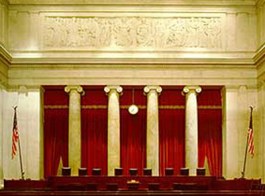
    Supreme Court Courtroom_cThe Supreme Court heard argument on Monday in U.S. v. Arthrex, involving the question of whether appointment of Administrative Patent Judges (APJs) and their authority under the Leahy-Smith America Invents Act violates the Appointments Clause of the Constitution.  Both the Government and Smith & Nephew, who lost this argument below, opposed Arthrex in this regard.  At argument, the U.S. Government was represented by Malcolm l. Stewart, Deputy Solicitor General, Department of Justice; Smith & Nephew was represented by Mark A. Perry; and Arthrex was represented by Jeffrey A. Lamken.

    The Government argued first; in what is clearly a procedural pattern, the Court permitted each advocate to make their argument in brief before the Chief Justice started the questioning.  Deputy Solicitor General Stewart began with reference to Edmond v. United States, where the Court held that Coast Guard Court of Criminal Appeals judges were inferior officers.  Here, he argued, the USPTO Director's supervisory powers exceed those in the Edmonds case.  For example, the Director can "promulgate binding guidance concerning substantive patent law," "designate particular board opinions as precedential," "decide whether any particular review will be instituted and which judges will sit on the panel," and "de-institute a review even after it has been commenced."  When included with the Director's power to convene a new panel and overturn any decision against PTO policy, the DSG argued that "[t]aken together, the Director's supervisory powers are fully sufficient to render administrative patent judges inferior officers."

    The Chief Justice's first question was directed to the limitations of the list of supervisory powers Mr. Stewart had mentioned, which the Chief considered to be "more or less ways of twisting the arms of the APJs" because the Director "can't . . . just change the decision of the APJ."  This system, the Chief seemed to believe, is "directly opposite to what the Appointments Clause was designed to do, which is transparency and make it clear who's responsible."  Mr. Stewart countered by saying the "supervisory mechanisms" available to the Director "are transparent."  But the Chief maintained that it is the APJ that applies "hypothetical" guidance from the Director and that is the executive decision.

    Justice Thomas followed up on Mr. Stewart's comment that the Director's powers are not plenary but are substantial, asking "what's substantial"?  Mr. Stewart admitted there isn't a bright-line test, and returned to Edmonds for the principle that "the mark of an inferior officer is that the inferior has a superior and is supervised at some level by Executive Branch officials who are appointed by the President and confirmed by the Senate."  He asked the Court to focus on "the mechanisms of control that are available in the first instance, issuing binding guidance and so forth, because the usual hallmark of supervisory authority is that the supervisor can tell the subordinate how to do the job before the subordinate does it."

    Justice Breyer noted that in Free Enterprise Fund v. Public Company Accounting Oversight Board, 561 U.S. 477 (2010) ("PCAOB") he dissented, citing a long list of civil servants of "various stripes and titles" where his question had been (and is in this case), are they officers of the U.S. and how do you tell?  What is the distinction here?  Mr. Stewart said the Government had acquiesced in its briefing that APJs are officers not employees, and Congress changed the law to make them officers and not civil servants.  Justice Breyer anticipated that answer and asked again, what is the difference between officers and civil servants in PCAOB?  Mr. Stewart enunciated a line ("exercising substantial authority under the laws of the United States") but admitted that it is "something very far from a bright line."  He noted that the removal provisions for APJs are the same as the removal provisions for all PTO employees, which he contends means that "Congress didn't intend for these officers to exercise any unusual level of independence from the Director."

    Justice Alito asked a "what if" question:  if Congress passed a law granting a deputy solicitor general to have "final and unreviewable authority" to decide if the government will appeal with regard to a particular statute, and the SG or Attorney General can decide which DSG will make the decision, would this be constitutional?  Mr. Stewart said it is "a close call," citing Morrison v. Olson, 487 U.S. 654 (1988), for the consequence of the DSG having authority limited to a narrow category of cases, and that the SG could specify the "substantive standards" that would cabin the DSG's decisions, which would make APJs inferior officers.  But he distinguished this case on the basis that here an APJ's decisions are reviewable.  Justice Alito asked whether having review extend to all the DSGs would change the hypo and Mr. Stewart said "somewhat" but it would be more apt if the SG could sit on the review panel and promulgate guidance that would govern the substantive standards.

    Justice Sotomayor asked whether Arthrex's argument comes down to "you're not an inferior officer if you can make final decisions that are unreviewable by the Director," which she characterizes as "a fairly straightforward line," while the Government's case is "a bit more amorphous."  She then asked Mr. Stewart to enunciate the Government's position on "what is your final test being judged against?"  Is the Government's "baseline" that the Director sets the policies and procedures governing the APJs?  Mr. Stewart said this was part of it, in the context of the Court's having "emphasized that there is no exclusive criterion for determining inferior versus principal officer status."  He distinguished "two different forms of control":  the Director "issue[s] policy guidance that will be binding on board panels in cases generally," but he is also "a member of the board, can participate in the board's decision-making process in individual cases."  In that case, the Justice said, "what is the advantage of us keeping the Edmonds test"?  To which Mr. Stewart said that the government is so big ("multifarious"), and has many officers of different types and responsibilities, that any attempt to craft a bright-line rule would give an "anomalous result" in certain cases.

    Justice Kagan focused on the weight the government gives on the Director being part of the Board in a rehearing, asking for clarification on how the appeals process works at the PTO.  She dug into the specifics, with regard to the Precedential Opinions Panel over which the Director doesn't have "full authority" (because it is made up of the Commissioner for Patents and the Chief Administrative Patent Judge as well as the Director).  Mr. Stewart admitted that here the Director's authority isn't plenary, and stated that even in Edmonds "[f]actual determinations could slip through the cracks."  But he noted that the Director could promulgate the policy guidance that would govern the decision, providing another means of exercising his authority.

    Justice Gorsuch asked:  in Seila Law LLC v. Consumer Financial Protection Bureau, 591 U.S. 321 (2020), the Court said that the chain of "executive officials must always remain subject to the ongoing supervision and control of the elected President through the President's oversight chain of dependence" so that the Executive authority is based on the President who must answer to the people.  Under this authority the Justice asked how this squares with the argument that even the Director cannot overturn the APJs?  Mr. Stewart in reply focused on the removal power while the Justice was concerned with the supervisory authority — and the CAFC doesn't count, because that is "a separate branch of government."  Mr. Stewart admitted that "there is no ability to ensure that the factual findings of two other members of the . . . panel could be overridden" but said that deciding for Arthrex wouldn't change that.

    Justice Kavanaugh had two concerns, saying "this structure is a real break from tradition, which we've said in cases like Free Enterprise Fund and many others, perhaps the most telling indication of a constitutional problem is the departure — the lack of historical precedent.  The lack of agency review of the ALJ decision by someone who's appointed by the President with advice and consent of the Senate is absent here and is ordinarily present and historically has been present."  And second, he noted that "these are multimillion, sometimes billion-dollar decisions being made not by someone who's accountable in the usual way that the Appointments Clause demands.  And the Director, on rehearing, does not have the unilateral power to reverse."  His question:  "How am I wrong?"  Mr. Stewart said the way APJs are appointed is not unusual, but the Justice said that "it is very unusual for them not to have agency review."  Mr. Stewart said it is "the norm" for agency heads to be able to review inferior officers' decisions but, citing Edmonds, such review does not need to be plenary.  But he counseled that the Court could take comfort in the ability for the Director to "instruct" APJ's on the Director's interpretation of the patent laws and ensure compliance with those interpretations.  His proposed remedy is for the Court to "sever the provision in the statute that said only the board can grant rehearings."

    Justice Barrett brought up the provisions of the MSPB that protects APJs from arbitrary firing, meaning (for her) that "at the end of the day, the Director is actually not the official in the Executive Branch that has the last word on the continuation in service."  Mr. Stewart said they can be removed as APJs without being removed from government service entirely, but the Justice wants to know what that means, if what they do is being an APJ?  Are they "benched without pay" or "benched with pay"?  Mr. Stewart set out their career options, saying that this is enough and that "the fact that the APJs are subject to the same removal protection as officers and employees generally indicates that Congress didn't intend for them to have any sort of special independence from — from the Director."

    Mr. Stewart closed by emphasizing that the Court has said there is "no exclusive criterion" to be applied to determine inferior officer status but here the tools the Director has are enough.

    Mr. Perry (for Smith & Nephew) attacked Arthrex's position immediately, saying it is based on one line from the Edmonds decision to the effect that "military judges couldn't render a final decision unless permitted to do so by other executive officers."  He distinguished the circumstances in Edmonds and the officers in that case with the PTO Director, whom he said "can and does give substantive guidance to APJs," having "unilateral institution and assignment power" and the authority to "order review of any board decision."

    The Chief began the questioning by saying well, if you won a case today there is the possibility that the next day the Director could grant rehearing, "stack" the panel with himself and two APJ's who agree with him, and reach the opposite conclusion, based on newly issued guidance; wouldn't this be a violation of due process?  Mr. Perry responded by denying that the due process question had anything to do with the Appointments Clause question before the Court (a position opposite to the position Mr. Lamken would take on behalf of Arthrex).

    Justice Thomas asked (as he had asked the Government) about the test Smith & Nephew would espouse for determining whether an APJ is an inferior officer.  Mr. Perry said that principal officers are one step removed from the President while APJs are three steps removed.  This "chain of command" test is one test, and another is "supervisions and control."  But Justice Thomas wanted to know "how much" supervision and control?  And Mr. Perry said that "the ultimate test is whether the President and his direct reports remain accountable for the operations of the agency."  Under the "totality of the circumstances," his position was that this principle is satisfied here.

    Justice Breyer asked whether there are any other examples similar to these for certain areas of authority that are "pretty unreviewable."  Mr. Perry said there are many such cases, such as AUSAs making decisions in court, which is how he characterized the priority date question at issue here ("Remember Alice?  It's a song about Alice").

    Justice Alito asked about a metaphor in their brief he called "the Goldilocks test" and went through a series of instances of control to get to the point where Mr. Perry agreed that "there's no longer sufficient control." These included where the Director does not control, provide or direct:

    • whether to institute IPRs in the first place;
    • how many and which APJs sit on which panels;
    • exemplary applications of patent law to fact patterns that are binding on APJs;
    • whether a panel's decision will be precedential;
    • whether a panel's decision will be reheard by controlling whether a Precedential Opinion Panel on which he sits votes to rehear a case;
    • how many and which APJs rehear a case
    • whether to dismiss an entire APR proceeding rather than allow a panel's decision to become final.

    Mr. Perry said that if all these powers (which the Director has) were removed, then the possibility of an inferior officer acting as a "sleeper agent" could arise, and in actuality "the suite of powers together, including one the Court didn't mention, which is the Director's final authority to confirm or cancel the patent claims, ensure that the political accountability rests at all times with the Director, not with the APJs."  When this answer did not satisfy the Justice, Mr. Perry suggested that an appropriate "magic divider" would be the relationship to the President (how many steps removed).

    Justice Sotomayor asked whether the idea of "the right or the need to have someone in the direct control of the President" is "totally at odds with an adjudicatory system of any kind."  Mr. Perry answered by conceding that "there is an inherent tension in agency adjudicatory-type proceedings between adjudicative independence and presidential control" for which Congress has struck an appropriate balance in many different ways.  Here, it is the "advance offering of guidance" that makes the difference — this enables the Director to "identify problems coming out of PTAB panels and direct future PTAB panels not to make those mistakes" and "preserves both the political accountability and avoids those due process-type problems that may arise in individual circumstances."

    Justice Kagan asked about how this structure arose, where there is no opportunity for direct review of adjudicatory decisions by the agency head?  Mr. Perry cited history, specifically USPTO officers who presided over interferences going back to the 19th Century, whom have always been appointed by the Secretary of Commerce, calling it a "patent-specific tradition."  But Justice Kagan wanted to know if Congress has ever specifically considered this "long tradition" with regard to the Appointments Clause, to which Mr. Perry said Congress first had the Director making the appointments and then changed to the Secretary to avoid Appointments Clause issues.

    Justice Gorsuch asked if it is fair to say this is a "rare bird" related to PTO history?  Mr. Perry seemed to admit that the USPTO acts outside some of the provisions of the APA.  The Justice raised the due process issue once again, and Mr. Perry reiterated that this question isn't before the Court.

    Justice Kavanaugh followed the "significant departure from general historical practice since the APA" aspect raised by Justice Gorsuch, calling it "a yellow flag, if not a red flag" and said that his worry is that "this gives a model for Congress to eliminate agency review of ALJ decisions and kind of fragment and take away from agency control going forward, because this — however this came about, to Justice Kagan's question, this would be a model going forward, and that would allow Congress to give extraordinary power to inferior officers, which is not how our government is ordinarily structured."  To this Justice there are two choices between principal and inferior officers, and this "hybrid" structure "gives enormous power to inferior officers, and it's really just out of the norm" — a comment that hit the nail on the head.  Mr. Perry cited Justice Scalia's dissent in Morrison v. Olson in response, and also stated that "the Director maintains the final authority under 318(b) to confirm or cancel any patent."

    Justice Barrett asked about the remedy should the Court hold against Smith & Nephew on the Appointments Clause issue, and whether the Court should be exercising its discretion to "save" the PTAB regime by making APJs employees-at-will?  Mr. Perry said if the problem the Court wishes to solve is agency reviewability, then the most direct solution would be to permit the Director to unilaterally review by severing the provision requiring board rehearing. 

    Mr. Perry summarized his argument by using a "sitting at the right hand of the President" standard for determining principal versus inferior officers.

    Arguing for Arthrex, Mr. Lamken emphasized the adjudicatory role of APJs, that "no superior in the executive has authority to review their decisions" and for that reason "accountability suffers."  Under usual circumstances, he said, if an agency head refused to review and overturn improvident decisions s/he could be removed from office.  But here, the principal officer is not accountable if the answer is "I have no authority [because] Congress made my supposed underlings the final word."  He further argued that the ability to remedy error in future cases doesn't provide a remedy the party at issue, thus introducing the due process argument.  This isn't how the Court ruled in Edmond, he said, which "emphasizes review by presidentially appointed, Senate-confirmed officers."  And the Federal Circuit's remedy — "striking APJ tenure protection" — isn't a remedy.  Congress is how the situation needs to be remedied.

    The Chief asked why it shouldn't be permissible for the Director to exercise "soft power of review" — "the executive allow the adjudicators a significant degree of leeway because they're just that . . . adjudicators"?  He suggested as a fair balance that "you don't want the politically accountable people to have the authority to overturn [factual decisions with large sums at stake] but, at the same time, in terms of basic patent rules and approaches and guidance, you do want them to have that responsibility."  Mr. Lamken argued that the Constitution permits adjudication by Executive branch agencies under circumstances where "the key protections against executive overreach, which is accountability to the people for the decisions, has to be observed."  Here, the current regime permits "unaccountable officers to decide those cases finally, stripping any accountable principal of authority to overturn them, [which] defeats that structural protection."  In addition, Mr. Lamken maintained that someone cannot be an inferior officer if there is no superior to review her decisions.  He continued to counter the Chief's citing the remedial procedures in the Office on substantially due process grounds for the individual litigant before the PTAB.  "For the public and aggrieved parties wanting to know who to hold accountable for the decision, there's just nobody."

    The Chief then raised the practicality issue, that "[with h]undreds and hundreds of administrative hearing examiners . . . making these sorts of decisions, the notion of meaningful review of each one seems to me to be fanciful."  To which Mr. Lamken replied that the inability of the Director to fulfill his duties is why he is accountable as a principal officer.

    Justice Thomas asked why accountability matters here?  Does it imply that the Director could render a better decision?  And Mr. Lamken said yes, as a matter of fact, but the point is that the APJs need to know that they are subject to review and reversal by the Director as a principal officer.  The Justice asked (as he had asked Mr. Perry) how much review?  Pro forma/rubber stamp review?  Mr. Lamken avoided that issue by saying it is the availability of review that matters, making an analogy between the district courts and the Supreme Court despite the relative rarity of certiorari.  "[W]hat you can't have is what we have here, which is not only can you not remove . . . the supposedly lower officers, but the director simply does not have authority to overturn their decisions no matter how vehemently . . . he may disagree with them."  The Justice then asked whether Congress could fix the problem by giving the Director discretionary review, which Mr. Lamken said is how the TTAB was restructured.  However, he did say that "this Court can't pencil in that sort of authority."  The Justice suggested that if Congress gave the Director the power to delegate his reviewing authority we would be in the same position, but Mr. Lamken countered by saying there the Director could decide not to delegate.

    Justice Breyer asked for analogies with other discretionary decisions in other contexts (such as whistleblowers, doctors), pointing out the failure of a "one-size-fits-all" approach.  Mr. Lamken returned to the due process/accountability theme adjudication by adjudication.  Bringing the argument back to the adjudicatory realm, he stated that "[f]or adjudication, being an inferior means having a superior who can review and overturn your decisions."

    Justice Alito asked about the remedy, saying the Arthrex brief argues that the Court should make the Appointments Clause decision and let Congress fashion the remedy.  In this case, what remedy is Arthrex seeking?  Mr. Lamken said if the IPR system is unconstitutional, the IPR should be dismissed.  But Justice Alito asked whether there is an alternative, permitting the Director to review.  Mr. Lamken resisted acknowledging judicial re-writing of the statute, saying this is "a sort of fundamental policy choice this Court does not make."  Mr. Lamken cited to the precedent in the Sorrell v. IMS Health Inc., 564 U.S. 552 (2011), where the Court said "there's multiple possibilities of how the statute could be changed, but we are not the institution to be . . . doing it.  The legislature has to make that change."

    Justice Sotomayor addressed the development of the Appointments Clause jurisprudence by the Court, stating that originally "the founding generation conceived of principal officers as synonymous with heads of departments," but that early statutes permitted inferior officers to make final adjudicatory decisions as early as 1793 in patents and 1803 in land grants.  Under this view, the person who is "responsible" is the person who makes the policy, not the person who implements it.  Because it is undisputed that APJs are not policymakers, the Director as a principal officer is responsible for the policies the PTAB and APJs implement them.  Mr. Lamken replied that if the Director is prevented by statute from reviewing and reversing the APJs then he isn't accountable.  To the Justice's assertion that the PTAB's decisions are reviewable by the courts, Mr. Lamken said the same is true for principal officers.  When the Justice said his position is equivalent to just ignoring the history, Mr. Lamken disagreed, distinguishing precedent regarding arbitrators who decide a single case without an enduring position to the status of APJs in this case.

    Justice Kagan asked whether it would be sufficient if the Director's review was limited to clear error, which Mr. Lamken said would be consistent with Edmonds.  But he balked at the Justice's suggestion for an egregious error standard, saying that at some point "where the authority of the Director is so cut off that he is not able to say with any accountability that the final decision of the APJ represents the views of the United States, that this is a decision that he is willing to stand behind as the word of the PTO" then that would be where he would draw the line.  The Justice suggested that the Edmonds case may be much closer to the current situation at the PTAB, on the basis that the standard just requires competent evidence, analogizing this situation to court cases and reviewing questions of fact.  Mr. Lamken said that "one thing that Congress can't do and still maintain you as an inferior officer is to say that your adjudicative decisions are not subject to review by any principal officer under any circumstances."  The Justice thought the situation is more complicated, being combined with a "raft" of other things/considerations.  And this situation is not completely analogous with Edmonds because the Director "couldn't possibly conceive — come up with every conceivable along the way."  Mr. Lamken characterized the various forms of control enunciated by Mr. Stewart for the Government as "contrivances" that "just show that Congress didn't give the Director the critical authority you need for adjudications:  the authority to review and overturn decisions so he can stand behind them as the final word of the United States."

    Justice Gorsuch asked whether this case isn't like other recent cases where the Court was able to sever the removal conditions and solve the constitutional issues, in particular Mr. Stewart's suggestion that the issue would be resolved if the Court severed the provision in Section 6(c) that said only the PTAB can grant a rehearing.  Mr. Lamken responded that this wouldn't fix the problem, because "the Director still wouldn't have unilateral authority to decide cases on rehearing."  The Justice attempted to define exactly what amendments would be needed, and Mr. Lamken referred to Congress needing to rewrite the statute.  The Justice also turned to the remedy and delay in getting resolution; Mr. Lamken referred again to the TTAB and how Congress fixed that issue.  He said "[t]his Court shouldn't be placing a thumb on the scale and giving judicial imprimatur to one of multiple diametrically opposed solutions."

    Justice Kavanaugh asked about severability, characterizing Arthrex's position as ALJ's have an historically settled position in the Executive branch with due process provided by agency review by principal officers.  The Justice said that "here, the problem is Congress departed from that tradition by keeping the due process part without the agency review part, and you can either keep the review if you want to keep them as inferior officers, or if you want to avoid agency — any agency review, Congress can do that too, but that, they'd have to do presidential appointment and Senate confirmation of the APJs."  The Justice said that the Court has "frowned upon repeatedly" the remedy of "taking down the whole system" and that "Isn't the nature of the constitutional problem here the lack of director review, which would mean us saying 6(c) is the constitutional problem?"  Mr. Lamken disagreed with that formulation, his answer being cut off (for time most likely) by the Chief.

    Justice Barrett referred to Arthrex's brief for the argument that "if there are multiple ways to cure a constitutional problem in a statutory scheme, then the judiciary ought not be blue-penciling it" and asked, "Can you think of any situation in which we have said, okay, well, there are multiple flaws in this scheme, but, you know, as Justice Kavanaugh was just saying, 6(c) seems to be the big problem, so we're going to think it's the cleanest to go that route? . . . Can you tell me the negative, that we've never done it?"  Mr. Lamken said in fact the Court had done this, citing Sorrell, but the Justice corrected him, saying she wanted to know if the Court has ever made a judicial policy choice:  "let's say that Justice Kavanaugh is right and that it seems very sensible and makes a lot of sense to solve this problem, assuming that we say there is one, by saying 6(c) is the problem, so that's the locus of the constitutional problem here, and we're going to say that that's what we're holding unconstitutional so that going forward, it's just that the PTAB can't have the final word."  Mr. Lamken said the Justice is right that the Court doesn't make policy choices.

    She then "pivots" to the Appointments Clause issue, saying there seem to be several "front-end controls," including "hiring and and firing and the ability of the director to set policy that the APJs must follow," which would indicate they are inferior officers and that this "case-specific review authority" is an anomaly to their role as inferior officers otherwise.  Mr. Lamken said the Court's precedent in Freytag v. Commissioner of Internal Revenue, 501 U.S. 868 (1991), held that "a single officer has many responsibilities to those of inferior officers, but if that officer has authority that goes beyond that for an inferior officer, if the officer is the final decision maker for the Executive Branch where no — he has no superior in that context, that officer is then a principal officer for all purposes and cannot continue in that office absent a proper appointment."

    Mr. Lamken wrapped up by saying that adjudicators must have a superior who can overrule their decisions "before they become the final word of the Executive Branch," which is not the case here.  Accordingly, APJs under the current statutory regime are principal officers whose appointment must satisfy the Appointments Clause.  And because the only solutions "point in opposite directions," the remedy must come from Congress.

    Mr. Stewart's rebuttal is directed to Arthrex's arguments without any colloquy from the bench.

    As is typically the case, the Justices' questioning did not reveal any particular hints to how they were thinking about the question before them, because their questions can often be posed as a counterfactual to test whether their preliminary understanding is correct.  It is clear that the due process question is top-of-mind for some of the Justices, as is the reticence of some to overturn the statutory regime on Appointments Clause grounds.  But the principal impression from the argument is the measured, ordered, almost step-by-step (and Justice-by-Justice) way the arguments played out.  Undoubtedly a consequence of the virtual platform, the Chief Justice began each round of questioning and then called on each Justice in seniority order.  While there was continuity to some of the questioning, with a Justice pursuing a line of questioning initiated by an earlier-questioning Justice, there was little of the free-for-all aspect that some arguments produced from the bench when arguments were heard in-person.  The overall tenor of the arguments reinforced the conventional wisdom that the Justices were using oral argument to test the limits of the question before them, with Justice Breyer taking his traditional role of using hypotheticals to illustrate the issues.  It seems clear that the Justices understood that Arthrex was asking them to invalidate how the Leahy-Smith America Invents Act altered the authority of the PTAB in the post-grant review scheme on constitutional grounds, and that before doing so they would consider the propriety of "blue-penciling" the current regime to avoid having to do so.  The patent world awaits how they come down on this choice.

  • USPTO SealThe U.S. Patent and Trademark Office will be holding the 2021 Women's Entrepreneurship Symposium on March 3, 2021, from 12:30 pm to 3:15 pm (EST).  The Symposium, which is being held as a free online event, will allow attendees to:

    • Learn about navigating today's changing marketplace and the challenges and opportunities for women to succeed;
    • Hear about ongoing efforts to bring more women into the innovation ecosystem; and
    • Hear personal stories from senior USPTO officials and other intellectual property experts.

    The Symposium will offer presentations on the following topics:

    • Fireside Chat: Advancing the Role of Women in the Intellectual Property Ecosystem
    • Always Dancing: Entrepreneurship and the Art of the Pivot
    • Creating a Pathway to Innovation

    Additional information regarding the Symposium, including an agenda and list of speakers, can be found here.  Those interested in registering for the event, can do so here.

  • J A KempJ A Kemp will be offering a webinar entitled "Claim Scope and Sufficiency: When Does a Broad Claim Fall for Insufficiency?" on March 4, 2021 from 2:30 to 3:30 pm GMT (Greenwich Mean Time).  Ravi Srinivasan and Chris Milton of J A Kemp will review the key EPO and UK cases concerning claim scope and sufficiency and further consider to what extent the recent UK Supreme Court decision in Regeneron v Kymab moves the dial in this regard.  The webinar will address the following topics:

    • Review of key UK and EPO cases in this field
    • Regeneron v Kymab from the UK Supreme Court — does the legal test change?
    • Recent cases applying Regeneron v Kymab

    Those wishing to register can do so here.

  • USPTO SealThe U.S. Patent and Trademark Office, in cooperation with the US-ASEAN Business Council and the U.S. Department of Commerce International Trade Administration and U.S Commercial Service, will be offering a webinar entitled "Protecting and Enforcing Intellectual Property Rights in Southeast Asia: What Small Businesses Need to Know" on March 4, 2021, from 7:00 pm to 8:45 pm (ET).  The webinar will consist of the following panel discussions:

    • Panel 1: Protecting and Enforcing IP in Architecture, Engineering, and Construction (AEC) Markets
    • Panel 2: Practical Market Experiences in Southeast Asia
    • Panel 3: U.S. Government Resources

    Additional information regarding the webinar, including an agenda and list of speakers, can be found here.  Those interested in registering for the event, can do so here.

  • ACIAmerican Conference Institute (ACI) will be holding its 36th Annual FDA Boot Camp on March 24th from 8:15 am to 5:45 pm EST and March 25th from 8:30 am to 1:45 pm EST as a VIRTUAL conference.  ACI faculty will give presentations on:

    • Understanding the Relevance of New FDA Initiatives and Policies and How They May Redefine the Life Sciences Industry in the Aftermath of COVID-19, by co-chairs Kurt K. Karst and Torrey Cope;
    • Navigating the Approval Process for Drugs and Biologics;
    • Exploring FDA's Expedited Review and Approval Programs: Applicability and Eligibility;
    • Appreciating the Nuances of the Approval Process for Controlled Substances;
    • Clarifying the Clinical Trial Process for Drugs and Biologics;
    • Patents and Related IP Protections and Mechanisms;
    • Hatch-Waxman and BPCIA Fundamentals: Understanding Follow-On Products and the Rules for Generic Entry;
    • Drugs and Biologics Labeling: Appreciating the Importance of the Final Step of the Approval Process;
    • Discovering the Unique Role of Current Good Manufacturing Practices ("cGMPs") in the Post Approval Process Part 1: Drug and Biologics Advertising and Promotion 101 and Part 2: Exploring the Subtleties and Safe Zones of Off-Label Communications;
    • Preparing for the Worst: Adverse Events Monitoring, Pharmacovigilance, Risk Management, and Recalls; and
    • Understanding the Scope of FDA Enforcement Authority and Actions.

    In addition, there will be two Pre-Conference Workshops on March 23rd.  The first, entitled "FDA 101: A Guide to Agency Structure, Jurisdiction, Regulation, and Applicable Laws," which will be held from 9:00 am until noon.  The second, entitled "Medical Devices Combination Products, and Companion Diagnostics Boot Camp: A Review of FDA Guidelines and Regulations," will be held from 1:30 until 1:40 pm.  There will also be a Post-Conference Workshop on March 25th, entitled "Hatch-Waxman and BPCIA in the Trenches: Exclusivity and Bioequivalency."

    An agenda for the conference and additional information regarding the workshops can be found here.  A complete brochure for this conference, including an agenda, detailed descriptions of conference sessions, list of speakers, and registration form can be obtained here.

    The registration fee for the conference alone is $1,695 (paid registration by March 5th) or $1,795 for paid registration by March 23rd.  Workshop registration is $400 apiece, and there is an All-Access Pass for the conference and all three workshops for $2,095 (paid registration by March 5th) or $2,195 for paid registration by March 23rd.  Patent Docs readers are entitled to a 10% discount off of registration using discount code D10-874-874EX06.  Those interested in registering for the conference can do so here, by e-mailing CustomerService@AmericanConference.com, or by calling 1-888-224-2480.

    Patent Docs is a media partner of ACI's Inaugural Summit on Women Leaders in IP Law.

  • By Kevin E. Noonan —

    Woolly MammothThe wooly mammoth (Mammuthus primigenius) is an iconic animal, like the saber tooth tiger or dire wolf, from a time in human history when our position at the top of the global food chain was decidedly not assured (and being something's prey was not limited to just other humans).  Perhaps this is a reason that resurrection of mammoths using Jurassic Park-like technology has some currency and appeal (but see How to Clone a Mammoth for reasons why this may not be such a good idea).  Perhaps paradoxically, the mammoth arose in Africa 5 million years ago and like its (very) distant Homo sapiens relatives migrated to colonize the Northern Hemisphere, with most of the evolutionary adaptations to new habitats (and speciation that accompanied them) rising in the Pleistocene Era (from about 2.6 million to 12 years ago).  From these speciation events arose the Columbian mammoth in North America about 1.5 million years ago and the "classic" wooly mammoth in northeastern Siberia about 700,000 years ago.

    Recently an international team* elucidated some genetic relationships between mammoths using DNA extracted from specimens from the Early and Middle Pleistocene, in a paper entitled "Million-year-old DNA sheds light on the genomic history of mammoths," in the journal Nature.  These results, termed "deep-time paleogenomics" by the authors, were obtained from three specimens, two of which were more than 1 million years old.  The specimens represented two distinct lineages present in Eastern Siberia in early Pleistocene, one of which resulted in wooly mammoth populations that survived to become contemporaneous with humans.  The third lineage gave rise to first mammoths in North America (Mammuthus columbi), resulting from a hybrid between these two lineages in Siberia in the Middle Pleistocene.  And perhaps not surprisingly, these researchers found most of the adaptation to cold seen in these animals were present in the samples from one million years ago.

    As reported by these researchers, DNA was extracted from the three specimens using now established techniques for highly degraded DNA samples and libraries prepared.  The libraries were sequenced and these sequences compared to genomic DNA sequences from the African savannah elephant (Loxodonta africana) and mitochondrial DNA from the Asian elephant (Elephas maximus).  Perhaps not unexpectedly, the specimen DNA was "considerably more fragmented and had higher levels of cytosine deamination than DNA from permafrost-preserved samples dating to the Late Pleistocene subepoch," which required modifications to the sequence analysis protocols.  Nevertheless, these researchers reported that they obtained complete mitochondrial DNA genomes from the three samples and 49 million (from the oldest sample, named Krestovka), 884 million (the Adycha sample)  and 3,671 million base pairs (the Chukochya sample) of nuclear genomic data from the three samples (with the highest DNA recovery coming from the most recent specimen, which from tooth morphology they thought to be an early wooly mammoth specimen).

    The ages of these specimens were then determined using the mitochondrial DNA sequences, ranging from 1.65 Ma (2.08–1.25 Ma; Krestovka), 1.34 Ma (1.69–1.06 Ma; Adycha) and 0.87 Ma (1.07–0.68 Ma; Chukochya). Genomic DNA was used to verify the two specimens having the highest amount of gDNA sequence obtained, against estimates of the highest number of changes from the latest Africa savannah element ancestor, which yielded 1.28 Ma (1.64–0.92 Ma) and 0.62 Ma (1.00–0.24 Ma), respectively.  These results were similar to the dates derived from the generally more intact mitochondrial DNA, but the authors cautioned that "this analysis is based on low-coverage data and the confidence intervals are wide."  Nevertheless, the authors also note that "[t]he DNA-based age estimates for the [the two genomic DNA] specimens are consistent with the geological age inferences that were independently derived from biostratigraphy and palaeomagnetism."

    The genetic analyses indicated that the samples were divergent from known mammoth species from the Late Pleistocene, and were consistent with the younger two specimens (Adycha and Chukochya) being ancestral to the wooly mammoths, while the oldest specimen (Krestovka) apparently diverged prior to the species split between the wooly mammoth and the Columbian (North American) mammoths.  The oldest specimen was estimated by these authors to have split from the later mammoth lineages between 2.66 and 1.78 million years ago based on both mitochondrial and genomic DNA data and had fewer derived alleles that differed from the Asian elephant than the younger two (indicating a closer evolutionary relationship).  Due to the relative closeness in time for the eldest and one of the younger specimens, these results are consistent with these two lineages together inhabiting eastern Siberia in the Early Pleistocene, with the earliest having diverged from all later mammoth species before mammoths appeared in North America.

    Regarding the Columbian (North American) mammoth, the genetic analyses also indicated that these mammoths shared a higher proportion of it ancestry from the earlier-diverging Krestovka species, which showed "excess derived allele-sharing between the Columbian mammoth and the Krestovka specimen."  These statistics were further consistent with one migration of n admixture of mammoth populations of the species from the Krestovka specimen (38-43% ancestry) and the wooly mammoth (57-62% ancestry).  Further analysis of later Columbian mammoth specimens indicated a second admixture with North American wooly mammoth species.

    The researchers then assessed the genetic adaptations expected to be found in animals descendent from African elephants living in Siberia, notably cold-tolerance and open-habitat adaptations.  These analyses were performed using protein-coding portions of the genetic information derived from these samples in comparison with known adaptations from Late Pleistocene wooly mammoths (as further compared with African and Asian elephants, who carried the "ancestral" alleles).  As reported in the paper, "85.2% (782 out of 918) and 88.7% (2,578 out of 2,906) of the mammoth-specific protein-coding changes were already present in the genomes of Adycha . . . and Chukochya [specimens], respectively."  These specimens showed no specific genetic changes arising in these populations in response to known changes in climate and mammoth morphology arising in the Middle Pleistocene.  These researchers also interrogated the DNA samples for 91 changes known to have arisen in the mammoth lineage.  These included genes thought to be involved in "hair growth, circadian rhythm, thermal sensation and white and brown fat deposits," the researchers finding "the vast majority of coding changes were present in both the Adycha (87%) and Chukochya (89%) genomes."  In contrast, another gene ("TRPV3, which encodes a temperature-sensitive transient receptor channel that is potentially involved in thermal sensation and hair growth") possessed only 2 of 4 amino acid sequence changes found in Late Pleistocene wooly mammoths, which indicated to these authors that these genetic alterations "occurred over several hundreds of thousands of years, rather than during a single brief burst of adaptive evolution."

    The authors conclude by a discussion of their results suggesting an admixture of an earlier-arising mammoth ancestor with wooly mammoths to produce the Columbian (North American) mammoth through a "hybrid speciation event" resulting in an almost 50:50 mix of ancestor species DNA.  Mitochondrial DNA assessments suggested that the most recent common female ancestor of all Late Pleistocene Columbian mammoths lived about 420 thousand years ago, which these authors use as a minimum date for the admixture event.  Because it is known that mammoths existed in North America 1.5 million years ago, these authors posit initial North American colonization by the Krestovka ancestral species.  They conclude their report by stating:

    The retrieval of DNA that is more than one million years old confirms previous theoretical predictions that the ancient genetic record can be extended beyond what has been previously shown.  We anticipate that the additional recovery and analysis of Early and Middle Pleistocene genomes will further improve our understanding of the complex nature of evolutionary change and speciation.  Our results highlight the value of perennially frozen environments for extending the temporal limits of DNA recovery, and hint at a future deep-time chapter of ancient DNA research in which specimens from high latitudes will have an important role.

    * From Centre for Palaeogenetics, Stockholm, Sweden; Department of Bioinformatics and Genetics, Swedish Museum of Natural History, Stockholm, Sweden; Department of Cell and Molecular Biology, National Bioinformatics Infrastructure Sweden, Science for Life Laboratory, Uppsala University, Uppsala, Sweden; Department of Zoology, Stockholm University, Stockholm, Sweden; Section for Computational and RNA Biology, Department of Biology, University of Copenhagen, Copenhagen, Denmark; The Francis Crick Institute, London, UK; Department of Biomolecular Engineering, University of California Santa Cruz, Santa Cruz, CA; Institute for Biochemistry and Biology, University of Potsdam, Potsdam, Germany; Department of Biological Sciences, Middle East Technical University, Ankara, Turkey; Department of Earth Sciences, Natural History Museum, London, UK; College of Plant Protection, China Agricultural University, Beijing, China; The Arctic University Museum of Norway, UiT – The Arctic University of Norway, Tromsø, Norway; Geological Institute, Russian Academy of Sciences, Moscow, Russia; Department of Ecology and Evolutionary Biology, University of California Santa Cruz, Santa Cruz, CA; Howard Hughes Medical Institute, University of California Santa Cruz, Santa Cruz, CA; and Department of Archaeology and Classical Studies, Stockholm University, Stockholm, Sweden.

    Image of Woolly mammoth model Royal BC Museum in Victoria by Thomas Quine, from the Wikimedia Commons under the Creative Commons Attribution 2.0 Generic license.

  • By Michael Borella —

    Federal Circuit SealInfinity Computer Products ("Infinity") sued Oki Data in the District of Delaware for infringement of four patents.  The District Court found the patents invalid due to indefiniteness and the Federal Circuit affirmed.  This case serves to illustrate two important points in patent law: (i) taking contradictory positions during prosecution will be held against the applicant, and (ii) the Federal Circuit will take said contradictory positions to an unnecessary extreme in order to support a holding of indefiniteness.

    Representative of the Infinity patents is U.S. Patent No. 6,894,811, claim 1 of which recites:

    A method of creating a scanning capability from a facsimile machine to a computer, with scanned image digital data signals transmitted through a bi-directional direct connection via a passive link between the facsimile machine and the computer, comprising the steps of:
        by-passing or isolating the facsimile machine and the computer from the public network telephone line;
        coupling the facsimile machine to the computer;
        conditioning the computer to receive digital facsimile signals representing data on a scanned document; and
        conditioning the facsimile machine to transmit digital signals representing data on a scanned document to the computer, said computer being equipped with unmodified standard protocol send/receive driver communications software enabling the reception of scanned image signals from the facsimile machine, said transmitted digital facsimile signals being received directly into the computer through the bi-directional direct connection via the passive link, thereafter, said computer processing the received digital facsimile signals of the scanned document as needed.

    The '811 patent is a continuation in part of U.S. Patent No. 5,530,558.  The emphasized term "passive link" was a point of contention in the suit and ultimately led to the invalidation of all of the Infinity patents.

    The claimed invention is directed to "using a fax machine as a printer or scanner for a personal computer."  According to the specification, its goal is to "provide a circuit for interfacing a PC and a facsimile to enable the facsimile to be utilized as a scanner or a printer for a PC and to accomplish all of the objectives of a scanner or a printer."

    Various embodiments involve this circuit being internal or external to a PC.  The internal version, with the circuit integrated into a fax modem, is illustrated in Figure 2b of the '811 patent, reproduced below.

    2021-02-23 Image 1An alternative embodiment involves the fax modem and circuit being integrated into the fax machine, and the PC connected to the fax machine by way of an RS232 serial cable.  This is illustrated in Figure 2f of the '811 patent, also reproduced below.  The parent '558 patent does not include Figure 2f.

    2021-02-23 Image 2During initial prosecution, the examiner cited U.S. Patent No. 5,452,106 ("Perkins") against the claims as anticipatory art.  Perkins discloses a similar arrangement in which a PC uses a fax machine as a printer and scanner.

    After a series of amendments, Infinity achieved an allowance by amending the claims as shown above.  This involved introducing the aforementioned term "passive link".  Notably, this term does not appear in the '811 patent nor does it appear in the parent '558 patent.  Nonetheless, Infinity relied heavily on this term and argued:

    The Applicant creates a passive link between the facsimile machine and the computer in order to accommodate the signal transfer for printing or scanning.  Therefore, the Applicant does not require any intervening apparatus as does Perkins.  The applicant therefore believes Perkins did not anticipate the methods used by the Applicant.

    Perkins' device 3 or card design requires a modem to be integrated into it in order to transfer signals for scanning or printing as part of his computer and facsimile transceiver interface.  In contrast, the Applicant can transfer digital signals between the facsimile transceiver and the computer without the need for a modem at the computer interface.

    In making this argument, Infinity relied on the disclosure of Figure 2f, that did not have a modem between the fax machine and the PC.  Infinity stated that:

    Contrary to the above, when the Applicant transfers digital data from the facsimile transceiver through a passive link for scanning to the computer, the non-intercepted data enters through the RS 232 type connector port of the computer and passes directly to the I/O Bus and is processed by the receiving circuits (i.e., UART, CPU) of the computer, providing a true non intercepted digital signal between the facsimile transceiver and the computer.

    In effect, the Applicant's method does not use intermediary peripheral circuitry for signal interception, resulting in demodulation or modulation which is required by Perkins with his card or device 3.

    Thus, Infinity's claims should have been narrowed by prosecution history estoppel to the embodiment of Figure 2f, or to at least exclude the embodiment of Figure 2b which does not have an RS 232 line and instead uses a modem between the fax machine and PC.

    After issuance, the '811 patent was subject of three ex parte re-examinations.  In one, U.S. Patent No. 5,900,947 ("Kenmochi") was cited against the claims.  To antedate this reference, Infinity argued that claim 1 should be given the earlier effective filing date of the '558 parent.  But as noted above, the '558 patent does not include Figure 2f (recall that that '811 patent is a continuation in part).

    In arguments, Infinity changed its tune and stated that "the RJ-11 telephone cable shown in Figs. 2b, 2c and 2d of the ['278 application] is the 'direct' and 'passive link.'"  This is problematic, because Infinity's previous arguments over Perkins effectively required the claims to be limited to the embodiment of Figure 2f, and also because Perkins arguably read on the embodiments of the '811 patent containing the RJ-11 cable.  Nonetheless, the re-examination resulted in another allowance.

    In the District Court, Oki Data contended that Infinity took two conflicting positions during prosecution, one to overcome Perkins and the other to overcome Kenmochi.  According to the Oki Data, this created uncertainty "as to where the 'passive link' ends and where the 'computer' begins".  The District Court agreed, finding that "Infinity had taken materially inconsistent positions regarding the extent of the claimed "passive link"—specifically, whether it ends at the I/O bus inside the computer (as argued to distinguish Perkins) or merely at the computer's port (as argued to antedate Kenmochi)."  This rendered the claims indefinite.

    On Appeal, the Federal Circuit agreed.  First, the Court noted that "a patent is invalid for indefiniteness if its claims, read in light of the specification delineating the patent, and the prosecution history, fail to inform, with reasonable certainty, those skilled in the art about the scope of the invention."  Of particular relevance is the principle that "[i]ndefiniteness may result from inconsistent prosecution history statements where the claim language and specification" otherwise do not afford the claims definiteness.

    The facts on record, as described above, probably should have been sufficient to affirm the District Court.  But the Federal Circuit went further, stating that Infinity's arguments to overcome Perkins "would lead one of ordinary skill to believe a passive link does not end at the computer's port but rather reaches to the I/O bus of the computer."  Thus, the Court found both the claimed "passive link" and "computer" to be indefinite.

    This appears to be a stretch, however.  Based on Figure 2f, one of ordinary skill in the art would understand that an RS 232 link is serial and would terminate at an RS 232 port.  Such a skilled person would also understand that the typical I/O bus is parallel.  Therefore, behind this port would be circuitry to serialize / de-serialize the bits transported by the link to a parallel format supported by the I/O bus.

    The notion that the passive link would somehow extend to the I/O bus was not supported by the state of the art nor was it actually argued by Infinity.  Instead, Infinity wrote that "the non-intercepted data enters through the RS 232 type connector port of the computer and passes directly to the I/O Bus and is processed by the receiving circuits (i.e., UART, CPU) of the computer."  The language here about the UART circuit (which processes serialized communications) is somewhat confusing but should not override the more logical conclusion that the passive link is coextensive with the RS 232 cable.

    The Court seems to recognize that it is wandering into Kafkaesque territory, and noted that "[w]e recognize that, in a vacuum, it might seem odd to hold 'computer' indefinite."  But the Court justified the outcome by shifting the blame to Infinity's own unclear statements.

    In short, the outcome for this case appears to be correct.  Infinity took contradictory positions during prosecution, which is enough to render the claims indefinite.  The whole discussion of the boundary between the passive link and the computer being uncertain was superfluous at best and specious at worst.

    Infinity Computer Products, Inc. v. Oki Data Americas, Inc. (Fed. Cir. 2021)
    Panel: Chief Judge Prost and Circuit Judges Clevenger and Taranto
    Opinion by Chief Judge Prost

  • By Kevin E. Noonan —

    Federal Circuit SealA little less than four years ago, the Federal Circuit rendered a decision in Amgen Inc. v. Sanofi that brought clarity to how the Court (and U.S. Patent and Trademark Office) should apply the written description requirement in 35 U.S.C. § 112(a) to properly circumscribe the scope of claims to monoclonal antibodies.  Earlier this month, on an appeal from remand, the Court took aim at the enablement requirement for antibody claims, with similar, scope-limiting results.

    The case arose when Amgen sued Sanofi and Regeneron over sales of Praluent® (alirocumab), which allegedly competes with Amgen's Repatha™ (evolocumab); Amgen's asserted patents, U.S. Patent Nos. 8,829,165 ("'165 patent") and 8,859,741 ("'741 patent"), claim a genus of antibodies that encompass Praluent®.  As background, blood plasma contains low-density lipoproteins that bind cholesterol and are associated with atherosclerotic plaque formation.  Liver cells express receptors for LDL (LDL-R) wherein binding thereto reduces the amount of LDL cholesterol in blood and reduces the risk of plaque formation and cardiovascular disease.  PCSK9 (proprotein convertase subtilisin kexin type 9) is a molecule that binds to and causes liver cell LDL-R to be destroyed, thus reducing the capacity and effectiveness of the liver cell's ability to reduce serum LDL-cholesterol.  The antibodies at issue in this suit bind to PCSK9 and prevent PCSK9 from binding to LDL-R, preventing their destruction and resulting in lower serum cholesterol.

    The following claims were recited in the opinion as being relevant to the issues before the Court:

    Claims of the '165 patent:

    1.  An isolated monoclonal antibody, wherein, when bound to PCSK9, the monoclonal antibody binds to at least one of the following residues: S153, I154, P155, R194, D238, A239, I369, S372, D374, C375, T377, C378, F379, V380, or S381 of SEQ ID NO:3, and wherein the monoclonal antibody blocks binding of PCSK9 to LDL[-]R.

    19.  The isolated monoclonal antibody of claim 1 wherein the isolated monoclonal antibody binds to at least two of the following residues S153, I154, P155, R194, D238, A239, I369, S372, D374, C375, T377, C378, F379, V380, or S381 of PCSK9 listed in SEQ ID NO:3.

    29.  A pharmaceutical composition comprising an isolated monoclonal antibody, wherein the isolated monoclonal antibody binds to at least two of the following residues S153, I154, P155, R194, D238, A239, I369, S372, D374, C375, T377, C378, F379, V380, or S381 of PCSK9 listed in SEQ ID NO: 3 and blocks the binding of PCSK9 to LDLR by at least 80%.

    Claims of the '165 patent:

    1.  An isolated monoclonal antibody that binds to PCSK9, wherein the isolated monoclonal antibody binds an epitope on PCSK9 comprising at least one of residues 237 or 238 of SEQ ID NO: 3, and wherein the monoclonal antibody blocks binding of PCSK9 to LDLR.

    2.  The isolated monoclonal antibody of claim 1, wherein the isolated monoclonal antibody is a neutralizing antibody.

    7.  The isolated monoclonal antibody of claim 2, wherein the epitope is a functional epitope.

    It is important to note that, while reciting the structure of the residues on PCSK9 (the antigen) that are bound by the claimed antibody, the claim does not recite any structural limitations of the antibody.  The only antibody characteristics recited as limitation are functional, i.e., the ability to bind (and not even specifically bind) to at least one of the recited PCSK9 residues and block PCSK9's interaction with the LDL-R.

    Evidence at the first trial showed that Amgen had produced a plurality of anti-PCSK9 antibodies and screened them for the ability to inhibit PCSK9 binding to LDL-R.  This screening was done using a "trial and error" process that reduced 3,000 human monoclonal antibodies down to 85 antibodies that "blocked interaction between the PCSK9 . . . and the LDLR [at] greater than 90%," of which the specification illustrated the three-dimensional binding arrangement for two (one of which became the Repatha™ antibody) by x-ray crystallography.  The specification of the Amgen patents in suit disclose amino acid sequence information for twenty-two human anti-PCSK9 antibodies able to compete for PCSK9 binding with these two more fully characterized antibodies.  Regeneron's patents (not at issue here) recited antibody-specific amino acid sequences for its claimed anti-PCSK9 antibodies.

    The jury in the earlier case found Amgen's patents not to be invalid.  The District Court had excluded evidence relating to written description and enablement based on Praluent® and other post-priority-date antibodies (i.e., that were produced after Amgen's earliest priority date).  The District Court, relying on Noelle v. Lederman as precedent, instructed the jury that an applicant can be entitled to claim scope encompassing generically described antibodies (as was the case for Amgen's claims) provided that the applicant provided a full characterized, novel antigen.

    The Federal Circuit reversed in part, affirmed in part, vacated in part, and remanded, in an opinion by Chief Judge Prost, joined by Judges Taranto and Hughes.  With regard to the written description question, the Court vacated and remanded, on the grounds that the District Court had instructed the jury based on the Court's pre-Ariad Noelle v. Lederman precedent, which was inconsistent with the Court's later en banc decision in Ariad v. Eli Lilly & Co.  The Court also found it to be error for the District Court to have excluded evidence regarding enablement, related to the "lengthy and potentially undue experimentation" Amgen needed to employ to arrive at its antibodies that fell within the scope of the claims of the '165 and '741 patents.  The Federal Circuit ordered a new trial for the District Court to consider post-priority-date evidence for the purposes of both enablement.  The District Court remanded for a new trial on written description as well, based on the jury instruction and evidentiary errors.

    On remand, the jury found that claim 7 of the '741 patent and claims 19 and 29 of the '165 patent were not invalid.  The District Court granted Sanofi's motion for JMOL with regard to enablement for these claims but denied JMOL on written description.  This appeal followed.

    In the instant appeal, the Federal Circuit affirmed in an opinion by Judge Lourie, joined by Chief Judge Prost and Judge Hughes.  The panel grasps the nettle of the question before it immediately, stating that "[t]he claimed antibodies are defined by their function: binding to a combinations of sites (residues) on the PCSK9 protein, in a range from one residue to all of them; and blocking the PCSK9/LDLR interaction."  This aspect of the issue before the Court was just as important and dispositive for the enablement question as it has become for the question of written description, under the reasoning set forth in this opinion.  The panel reverted (as it must) to its decision in In re Wands (and its famous "Wands factors"), the dispositive factor in the Court's decision being the amount of experimentation required to encompass the full scope of the claims at issue.  Albeit being a question of law, enablement depends particularly on the facts from which conclusions of law are based.  The opinion is sensitive to the requirement for patenting that the specification enable practice of the claimed invention throughout its full scope, and with the Wands rubrics that the scope of the claims can determine the extent of experimentation required and whether such experimentation is undue.  The opinion then focused on claims 19 and 29 of the '165 patent and claim 7 of the '741 patent in rendering its decision.

    Amgen's arguments were grounded in the disclosure in the specification regarding the type of experimentation required and the guidance provided therein on the extent of such experimentation, while Defendants argued that the scope of these claims encompassed "millions of antibody candidates," that antibody production was unpredictable, and that the specification lacked sufficient guidance because, inter alia, "practicing the full scope of the claims requires substantial trial and error."  Defendants emphasized not the antibodies Amgen had actually made but "the number of candidates that must be made and tested to determine whether they satisfy the claimed function."

    Calling In re Wands the Court's "go to" precedent, the opinion states that while itself a monoclonal antibody case, "Wands did not proclaim that all broad claims to antibodies are necessarily enabled" because "[f]acts control."  Here, the panel considered the facts (and the findings of invalidity) in more recent cases, including Wyeth & Cordis Corp. v. Abbott Laboratories, Enzo Life Sciences, Inc. v. Roche Molecular Systems, Inc., and Idenix Pharmaceuticals LLC v. Gilead Sciences Inc.  In all these cases, of course, the Federal Circuit found that the claims were not enabled, due to the broad scope of embodiments the claims in these cases encompassed and the amount of undue experimentation required to satisfy the enablement requirement throughout its full scope.  The panel set forth its synthesis of the Federal Circuit's analysis regarding satisfaction of the enablement requirement arising from these cases:

    What emerges from our case law is that the enablement inquiry for claims that include functional requirements can be particularly focused on the breadth of those requirements, especially where predictability and guidance fall short.  In particular, it is important to consider the quantity of experimentation that would be required to make and use, not only the limited number of embodiments that the patent discloses, but also the full scope of the claim.

    And citing a footnote in McRO, Inc. v. Bandai Namco Games Am. Inc.:

    In cases involving claims that state certain structural requirements and also require performance of some function (e.g., efficacy for a certain purpose), we have explained that undue experimentation can include undue experimentation in identifying, from among the many concretely identified compounds that meet the structural requirements, the compounds that satisfy the functional requirement [emphasis added].

    This precedent was controlling here:  "[w]hile functional claim limitations are not necessarily precluded in claims that meet the enablement requirement, such limitations pose high hurdles in fulfilling the enablement requirement for claims with broad functional language."  As applied to Amgen's claims, the panel recognized each of them to be "a composition claim defined, not by structure but by meeting functional limitations."  This outcome is consistent with Wands, according to the opinion, because the "functional breadth" of these claims is "indisputably broad" and "the claims are far broader in functional diversity than the disclosed examples."  Taking a real property analogy from AbbVie Deutschland GmbH & Co. v. Janssen Biotech, Inc., the opinion states that "[i]f the genus is analogized to a plot of land, the disclosed species and guidance 'only abide in a corner of the genus.'"  The opinion also referenced the unpredictability of the antibody arts as a relevant (and supportive) Wands factor in favor of invalidity.  And the quantum of guidance factor from Wands was also deficient, according to the opinion, because "any reasonable factfinder would conclude that the patent does not provide significant guidance or direction to a person of ordinary skill in the art for the full scope of the claims."

    Importantly, the panel cabined its decision by stating that while the "substantial amount of time and effort" required to produce the scope of antibodies claimed here is undue, "[w]e do not hold that the effort required to exhaust a genus is dispositive" (emphasis in opinion).  The Court struck a balance:  "[t]he functional limitations here are broad, the disclosed examples and guidance are narrow, and no reasonable jury could conclude under these facts that anything but 'substantial time and effort' would be required to reach the full scope of claimed embodiments."  But the facts here (which distinguish this decision from Wands) are that "the evidence showed that the scope of the claims encompasses millions of candidates claimed with respect to multiple specific functions, and that it would be necessary to first generate and then screen each candidate antibody to determine whether it meets the double-function claim limitations."  Under these facts, the substantialness of such time and effort was sufficient to be considered undue experimentation by the Court.

    While providing yet another fact-bound basis for invalidating (or limiting the scope of) claims to biotechnological inventions, it is unlikely to have been a coincidence that the opinion is authored by Judge Lourie, the architect of the Court's emphasis on structure in applying the written description requirement to biotechnology claims.  As the Judge emphasized in his seminal Regents of the University of California v. Eli Lilly case:

    Thus, an applicant complies with the written description requirement "by describing the invention, with all its claimed limitations, not that which makes it obvious," and by using "such descriptive means as words, structures, figures, diagrams, formulas, etc., that set forth the claimed invention," citing Lockwood v. American Airlines, Inc. (Fed. Cir. 1997).

    An adequate written description of a DNA, such as the cDNA of the recombinant plasmids and microorganisms of the '525 patent, "requires a precise definition, such as by structure, formula, chemical name, or physical properties," not a mere wish or plan for obtaining the claimed chemical invention.  Fiers v. Revel (Fed.Cir.1993).  Accordingly, "an adequate written description of a DNA requires more than a mere statement that it is part of the invention and reference to a potential method for isolating it;  what is required is a description of the DNA itself."  Id.

    A written description of an invention involving a chemical genus, like a description of a chemical species, "requires a precise definition, such as by structure, formula, [or] chemical name," of the claimed subject matter sufficient to distinguish it from other materials.  Fiers;  In re Smythe ("In other cases, particularly but not necessarily, chemical cases, where there is unpredictability in performance of certain species or subcombinations other than those specifically enumerated, one skilled in the art may be found not to have been placed in possession of a genus․").

    This precedent is thus well grounded in the Federal Circuit's concern that a patentee must satisfy the quid pro quo of the patent grant, so that the specification supports its claims throughout their entire scope, whether on enablement or written description grounds.  It has been a bane for the biotechnology industry that the courts (and to a lesser extent, Congress) have played "catchup" in determining the proper application of these standards to biotechnology inventions, resulting in claims either invalidated under such changing standards or failing to encompass the activities of accused infringers.  But this decision provides a consistent standard ("structure, structure, structure," as recited by former Chief Judge Rader on several occasions) and one that can be applied with consistency even though the resulting scope may prove insufficient to provide enough support to justify the costs of commercialization.  Which will be a bane on everyone.

    Amgen Inc. v. Sanofi (Fed. Cir. 2021)
    Panel: Chief Judge Prost and Circuit Judges Lourie and Hughes
    Opinion by Circuit Judge Lourie

  • CalendarFebruary 22, 2021 – "Avoiding Avoidable Oppositions through Attentive Patent Prosecution in India: The Telescopic View" (Lexology Webinars, iam, and Chadha & Chadha) – 10:00 am to 11:00 am (ET)

    February 23, 2021 – "Global Perspectives — Preliminary Injunctions in Life Sciences" (Gowling WLG) – 9:00 to 10:00 am EST

    February 24, 2021 – "The Partner Perspective" (Intellectual Property Owners Association Diversity & Inclusion Committee and PTAB Bar Association Diversity Committee) – 1:00 pm (ET)

    February 25, 2021 – "AI in Life Sciences — Patenting Dos and Don'ts" (Mathys & Squire) – 18:00 to 19:00 (GMT); 11:00 am to 12:00 pm (ET)

    February 25, 2021 – "How Allyship Advances Diversity & Inclusion in the IP Legal Profession: Part 2 — The Necessity of White Male Allyship in the Legal Profession" (Intellectual Property Owners Association) – 2:00 pm to 3:00 pm (ET)

    February 26, 2021 – "Drafting US Applications with Foreign Filings in Mind and Responding to Foreign Office Actions" (Intellectual Property Law Association of Chicago Patent Agents Committee, US Patent Committee, and International Patents Committee) – 12:00 pm to 1:00 pm (CST)

    March 9, 2021 – Summit on Women Leaders in IP Law (American Conference Institute) – 8:45 am to 5:15 pm EST

  • Chadha & ChadhaLexology Webinars, iam, and Chadha & Chadha will be offering a free webinar entitled "Avoiding Avoidable Oppositions through Attentive Patent Prosecution in India: The Telescopic View" on February 22, 2021 from 10:00 am to 11:00 am (ET).  Tarun Gandhi of Chadha & Chadha and Pooja Luthra of Google will discuss key aspects that patent applicants should keep in mind while prosecuting a patent application in India to keep frivolous opponents and oppositions at bay.  The webinar will focus on the following topics:

    • Statistics providing an insight into the trends of patent oppositions in India
    • How a patent opposition is instituted, appropriate forum, timeline, grounds (special focus on grounds encompassing formal requirements in India)
    • Important considerations while prosecuting an application in India
    • How companies take care of their formal requirements during prosecution
    • Important tips / takeaways.

    Those interested in registering for the webinar, can do so here.