• By Kevin E. Noonan

    When I awoke, the dire wolf
    Six hundred pounds of sin
    Was grinning at my window
    All I said was, "Come on in"

    But don't murder me, I beg of you
    Don't murder me, please, don't murder me

    "Dire Wolf," Grateful Dead, Workingman's Dead

    The dire wolf (Canis dirus), prototype of the various wolves that were important members of the House Stark family of characters in Game of Thrones, was found uniquely in North America until its extinction in the late Pleistocene (~13,000 years ago).  The relationship between this species and the indigenous gray wolf (Canis lupus), the coyote (Canis latrans), and the Asiatic wild dog or dhole (Cuon alpinus) is uncertain, however, based purely on shared morphologic characteristics.  Perhaps this "lone wolf" property, and its great size (~68kg/150lbs, despite artistic exaggeration), contributed to its iconic stature in popular culture as diverse as George R.R. Martin and the Grateful Dead, but "mythic" is not too exaggerated a description of this mighty beast in popular culture.

    Recently, a diverse and international group of researchers* have explored the relationships between these North American canid species, using both morphological characteristics and genetic comparisons between modern wolves and dire wolf fossils, from both mitochondria and, in a more limited extent genomic DNA (albeit focusing on comparisons of only one gene, COL1).  Sites where the more than 700 fossil dire wolf specimens used in these studies were obtained (and their associated academic institutions) were Natural Trap Cave, Wyoming (University of Kansas); Gigantobison Bay, Idaho (Idaho Museum Natural History); Sheridan Pit, Ohio (Cincinnati Museum Center); Guy Wilson Cave, Tennessee (University of Tennessee); American Falls Reservoir, Idaho (Idaho Museum Natural History); and Rancho La Brea Tar Seeps, California (La Brea Tar Pits and Museum), the latter being the predominant site for obtaining dire wolf fossils (100-fold more than gray wolf fossils from this site).

    The paper begins by debunking (somewhat) the idea that dire wolves were "sister-species" or conspecific with gray wolves.  Although morphology is highly similar between these species as evaluated by various comparative criteria, these authors screened 46 fossil dire wolf specimens dating between 12,900 and 50,000 years ago for mitochondrial DNA (mtDNA) and, at lower complexity, genomic DNA (which is much less well preserved).  One of the La Brea Tar Pit specimens provided DNA from type-1 collagen gene (COL1) of sufficient quality for comparison.  These experiments suggested that dire wolves were not closely related to either gray wolves, coyotes, African wolves (Canis lupaster) or dogs (Canis familiaris).  mtDNA analyses supported these results, that dire wolves formed their own group evolutionarily highly divergent from grey wolves and coyotes, as illustrated by this phylogenetic tree:
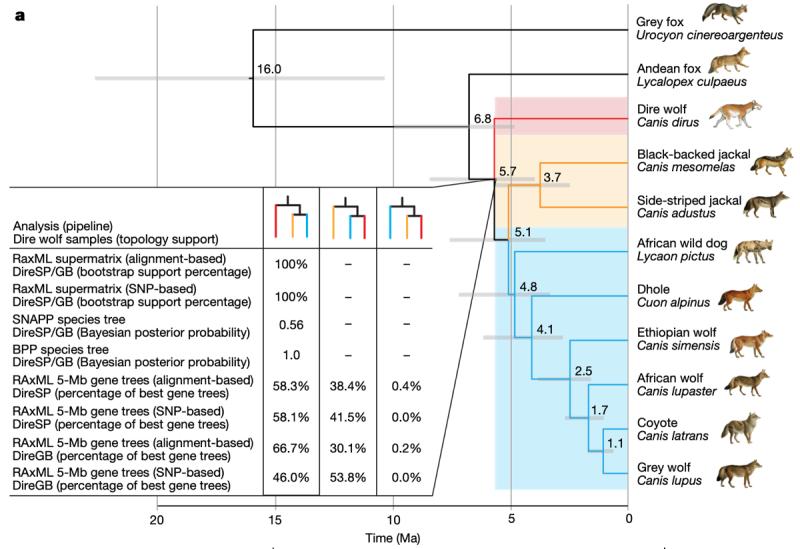
    Figure 2a
    Further, these researchers analyzed nuclear genomic data of the dire wolves together with previously published genomic data from eight extant canids:  grey wolf, coyote, African wolf, dhole, Ethiopian wolf (Canis simensis), African wild dog (Lycaon pictus), Andean fox (Lycalopex culpaeus) and grey fox (Urocyon cinereoargenteus—an outgroup).  Only the grey wolves, coyotes, dholes, and grey foxes had geographical ranges that overlapped the dire wolf during the Pleistocene prior to its extinction.  These analyses confirmed what these scientists characterized as a "distant evolutionary relationship" between the dire wolf and other canid species.  Further genomic comparisons indicated that the dire wolf was one branch of the canid lineage (the other two being African jackals and all other canid species), giving the surprising result that grey wolves are more closely related to African wild dogs, Ethiopian wolves, and dholes than they are to dire wolves.

    Using these results to provide a "clock" to estimate when dire wolves diverged from other canid species, this paper reports that dire wolves shared a common ancestor with other canid species about 5.7 million years ago (the estimate having a range of 4.0-8.5 million years), with further divergence from African jackals about 5.1 million years ago (3.5-7.6 million years ago).  Their genetic analyses also showed no evidence of extensive interbreeding between dire wolves and any other extant North American canid species.  There was some evidence of genetic admixture between ancestors of dire wolves and ancestors of grey wolves, coyotes, and dholes about 3 million years ago.  These results are consistent with the ready genetic admixture that occurs, inter alia, between modern coyotes and grey wolves.  The authors state that, in this context, "our finding of no evidence for gene flow between dire wolves and grey wolves, coyotes or their common ancestor—despite substantial range overlap with dire wolves during the Late Pleistocene—suggests that the common ancestor of grey wolves and coyotes probably evolved in geographical isolation from members of the dire wolf lineage."  Given evolution of other canid species, and their status of immigration from Asia, these results suggest to these researchers that the dire wolf arose in North America and may be related to the also-extinct Armbruster's wolf (Canis armbrusteri).  Their genetic analyses also suggest to these researchers that dire wolves are properly classified as their own separate genus, Aenocyon, an idea first proposed (not on genetic comparison grounds) in 1918 (see Merriam, J. C., 1918, Note on the systematic position of the wolves of the Canis dirus group. Bull. Dept. Geol. Univ. California 10, 531–33).  This genetic and geographic isolation of the dire wolf from other canid species would explain the estimated age of the dire wolf lineage and the evolutionary distance of this species from other canids.

    The paper ends with speculation regarding why dire wolves became extinct at the end of the Pleistocene (associated with megafaunal extinctions, i.e., die-offs of animals with weights greater than 100 pounds such as the American lion, the short-faced bear, mammoths, mastodons, ground sloths, and giant beavers) and other canids like coyotes and grey wolves in North America did not, in view of the "overall phenotypic similarities" between these beasts.  These speculations include greater morphological plasticity and dietary flexibility in canid species other than the dire wolf, or the ability to interbreed with other canids (which has been shown to permit acquired traits like coat color and enhanced immunity).  The researchers suggest that the inability of dire wolves to benefit from such phenotype acquisition through interbreeding might have prevented them from resisting diseases carried by Old World taxa arriving over the Bering land bridge.

    While the information is limited (e.g., only five dire wolf genomic DNA samples were sufficiently intact to be assayed), the results from these studies are another example of the power of genetic analysis to "fill in the blanks" from the fossil record to illuminate animal (and human) migration in the Pleistocene era that led to population patterns of animals in the New World in the Holocene (current) Era.

    * Department of Archaeology, Durham University, Durham, UK; Australian Centre for Ancient DNA, School of Biological Sciences, University of Adelaide, Adelaide, South Australia, Australia; Department of Ecology and Evolutionary Biology, University of California, Los Angeles, CA; School of Biological and Chemical Sciences, Queen Mary University of London, London, UK; Department of Archaeology, Classics and Egyptology, University of Liverpool, Liverpool, UK; School of Natural Sciences and Psychology, Liverpool John Moores University, Liverpool, UK; The Palaeogenomics & Bio-Archaeology Research Network, Research Laboratory for Archaeology and History of Art, The University of Oxford, Oxford, UK; Department of Anatomy, Des Moines University, Des Moines, IA; Department of Zoology, University of Oxford, Oxford, UK; Department of Anthropology, National Museum of Natural History, Smithsonian Institution, Washington, DC; Center of Excellence in Paleontology & Department of Geosciences, East Tennessee State University, Johnson City, TN; Department of Archaeology, University of Exeter, Exeter, UK; Institute of Archaeology, Russian Academy of Sciences, Moscow, Russia; ARAID Foundation, Instituto Universitario de Investigación en Ciencias Ambientales (IUCA) – Aragosaurus Group, Universidad de Zaragoza, Zaragoza, Spain; Department of Earth Sciences, Natural History Museum, London, UK; Section for Evolutionary Genomics, The GLOBE Institute, University of Copenhagen, Copenhagen, Denmark; Applied Paleoscience, Bothell, WA; Department of Archaeology, University of Sydney, Sydney, New South Wales, Australia; Department of Archaeology, University of Aberdeen, Aberdeen, UK; Department of Archaeology, Simon Fraser University, Burnaby, Canada; Institut des Sciences de l'Evolution – Montpellier, CNRS, Université de Montpellier, IRD, EPHE, Montpellier, France; Laboratoire Evolution & Diversité Biologique, UPS/CNRS/IRD, Université Paul Sabatier, Toulouse, France; Australian Museum Research Institute, Australian Museum, Sydney, New South Wales, Australia; Department of Ecology and Evolutionary Biology, University of California Santa Cruz, Santa Cruz, CA; Institute of Plant and Animal Ecology, Urals Branch of the Russian Academy of Sciences, Yekaterinburg, Russia; Ural Federal University, Yekaterinburg, Russia; Department of Anthropology, Texas A&M University, College Station, TX; Center for Evolution and Medicine, Arizona State University, Tempe, AZ; School of Human Evolution and Social Change, Arizona State University, Tempe, AZ; Halmos College of Arts and Sciences, Nova Southeastern University, Fort Lauderdale, FL; Department of Archaeology, University of York, York, UK; Institute of Systematics and Ecology of Animals, Siberian Branch of the Russian Academy of Sciences, Novosibirsk, Russia; Idaho Museum of Natural History, Idaho State University, Pocatello, ID; Zoological Institute of the Russian Academy of Sciences, St Petersburg, Russia; Sobolev Institute of Geology and Mineralogy, Siberian Branch of the Russian Academy of Sciences, Novosibirsk, Russia; Tomsk State University, Tomsk, Russia; McDonald Institute for Archaeological Research, University of Cambridge, Cambridge, UK; Greenland Institute of Natural Resources, Nuuk, Greenland; NTNU University Museum, Trondheim, Norway; Institute of Human Origins, Arizona State University, Tempe, AZ; Howard Hughes Medical Institute, University of California Santa Cruz, Santa Cruz, CA; South Australian Museum, Adelaide, South Australia, Australia; Palaeogenomics Group, Department of Veterinary Sciences, Ludwig Maximilian University, Munich, Germany


  • By Kevin E. Noonan

    The COVID-19 pandemic has spread throughout the globe, infecting more than 90 million people and causing almost two million deaths (see "Tracking coronavirus’ global spread").  SARS-CoV-2 infection is the cause of the COVID-19 pandemic; this virus is recognized as the latest viral infection in humans of zoonotic origins, in this case bats first arising in Wuhan, China.  The infection is known to be introduced into the lungs, and infection due to the viral Spike protein binding to the angiotensin 1 converting enzyme 2 (ACE-2) receptor expressed in the lung.

    Among the many consequences of SARS-CoV-2 infection are respiratory disease, as well as effects in the liver as well as neurological tissues.  The capacity of SARS-CoV-2 to infect brain is supported by finding viral RNA and proteins in brain tissue on autopsy, but the frequency of neurological infection remains unknown.  Regarding COVID-related disease in brain, there are a number of possible bases for the anecdotal reports of impaired function (including persistent headache and impaired consciousness and cognition), including inter alia reduced blood-borne oxygen due to impaired respiration.  This is a particular risk in patients with mild disease symptoms, because humans sense lack of oxygen indirectly by increased levels of carbon dioxide in the blood and thus brain and other neurological tissues can be oxygen-deprived unknowingly.  In addition, it has long been known that there can be psychological sequellae to severe, life-threatening, debilitating diseases and thus the effects of psychology rather than pathology is not easy to tweeze out of the clinical presentation of these effects.

    This week, an international group of researchers* illuminated how SARS-CoV-2 can infect neurological tissue and provides a viral explanation of neurological COVID infection, in a paper entitled "Neuroinvasion of SARS-CoV-2 in human and mouse brain," in the Journal of Experimental Medicine.  The experiments these researchers performed are illustrated in the paper's "graphical abstract":

    Image
    The first of these methods used human neural progenitor cells and human brain organoids produced therefrom, which the authors reference as having been used to study Zika virus infection (which had been associated with anencephaly in fetuses in utero).  These experiments showed infection of 2-week old human neural progenitor cells, wherein peak viral titers were found 12 hours after infection and were associated with increased cell death.  SARS-CoV-2 infection was found in 9-week old human brain organoids within 24 hours of infection and significant infection within 96 hours post-infection.  "[T]he majority of the SARS-CoV-2–infected cells were localized within MAP2-positive cellular fields of mature neurons," according to the authors, but infection was also observed in "SOX2-positive neural stem cells with bipolar morphology and cells localized around the neural tube–like structures."  Viral particles were observed by electron microscopy to be located intracellularly associated with endoplasmic reticulum, and were associated with "extensive neuronal cell death."  The authors conclude from these organoid studies that "SARS-CoV-2 can infect cells of neural origin and suggested that infected cells can promote death of nearby cells."

    Turning to molecular studies, the researchers reported investigation into whether some cells are more susceptible to virus-induced cell death than others, using single-cell RNA profiling.  These experiments were performed using 60-day old organoids virus-infected or mock-infected, and 96,205 cells were assayed in 31 clusters comprising "neural progenitors/outer radial glia, intermediate progenitor/ interneurons, neurons, and cortical neurons."  The researchers reported these experiments showed "widespread infectivity of SARS-CoV-2 in neurons, radial glia, and neuronal progenitor cells."  When compared with the effects of Zika virus (ZIKV) infection on neural tissues, "SARS-CoV-2–infected brain organoid up-regulated pathways related to cell division, organelle fission, and metabolic processes, while ZIKV showed enrichment in type I IFN pathways."  These results were consistent, according to these researchers, with reports that "SARS-CoV-2 induces a moderate IFN-stimulated gene response in other tissues" as well as "previous reports of specific virus replication being controlled by alternative pathways by neurons."

    When comparing SARS-CoV-2 infected cells with adjacent uninfected cells, the infected cells showed "enrichment of genes corresponding to viral transcription, along with enrichment for metabolic processes including electron transport–coupled proton transport, cytochrome c to oxygen, and NADH to ubiquinone" whereas the uninfected cells showed "a mitochondrial catabolic state with the up-regulation of alcohol metabolism, cholesterol synthesis, and regulation of cell death."  Consistent with the mechanism of infection in other tissues, experiments using ACE2 receptor-blocking antibodies showed that expression of ACE2 receptor was necessary for neural tissue infection, despite the low frequency of detecting ACE2 receptor mRNA expression in neural tissues.  In addition, IgG antibodies immunologically specific for the viral Spike protein were found in cerebrospinal fluid from patients with virus-associated acute encephalopathy, which antibodies were capable of blocking virus infection in human brain organoids.

    The authors also produced a mouse model of SARS-CoV-2 infection using transgenic mice that expressed human ACE2 in brain tissue. Intranasal administration of the virus produced infection in neural cells in the forebrain; in contrast there was "a relatively low density of infected cells [in] the dentate gyrus, the globus pallidus, and cortical layer 4."  In perhaps the most disquieting result reported in this paper, mice induced to express human ACE2 receptor in either lung tissue or ventricular structures in brain by Adenovirus infection were shown in later SARS-CoV-2 infection to have "signs of lung pathology but no weight loss or death," but both weight loss and death caused by brain infection even at much lower (100-fold) administered virus dose, suggesting neurological infection has high "neuroreplicative potential and lethal consequences."

    Finally, the paper reported results of three human autopsies of COVID-19 patients, all of which "had been admitted to the intensive care unit, . . . sedated and ventilated due to respiratory failure [within 3-18 days], and [wherein] their difficulty to be weaned from mechanical ventilation indicated the severity and highly pathogenic nature of the disease course."  The patterns of virus-specific immunostaining were somewhat idiosyncratic, but death was associated with "a temporal sequence of continued ischemic events."  Somewhat curiously, regions of SARS-CoV-2 infection were not associated with lymphocyte or leukocyte infiltration which indicates, according to these authors, that "although SARS-CoV-2 has neurotropic properties and can infect neurons in patients, it did not invoke an immune response typical of other neurotropic virus."

    The paper concludes that "the brain is a site for high replicative potential for SARS-CoV-2," that "SARS-CoV-2 causes significant neuronal death in human brain organoids," that "ACE2 is expressed at the protein level and is functionally required for SARS-CoV-2 infection in human brain organoids," and that "there is robust antibody response against the virus within the CSF," which can cause "cascading downstream effects in causing and amplifying CNS inflammation."  The mouse model studies reported "for the first time that SARS-CoV-2 neuroinvasion in mice can have significant remodeling of brain vasculature."  Human autopsy results, according to this paper, showed that neural pathology in humans was a consequence of acute ischemic damage caused by the infection (although these researchers emphasized that the small sample size limited the conclusions that they could draw from these results).  Despite these caveats, the paper concludes with these researchers asserting that:

    Altogether, our study provides clear demonstration that neurons can become a target of SARS-CoV-2 infection, with devastating consequences of localized ischemia in the brain and cell death, highlighting SARS-CoV-2 neurotropism and guiding rational approaches to treatment of patients with neuronal disorders.

    While gratifying to the extent that these researchers have explicated the ability of SARS-CoV-2 to infect neural tissues and produce neurological disease, the paper suggests that any hope that 2021 will be a better year than 2020 may be unfounded, or at least too much to hope for, as well as both a cautionary tale of the dangers of this infection and the importance of achieving effective vaccination quickly and universally.

    * From the Departments of Immunobiology, Genetics, Pathology, Internal Medicine, Comparative Medicine, and Neuroscience, Yale Medical School; Hôpital Pitié-Salpêtrière  and the Sorbonne, Paris.

  • CalendarJanuary 19, 2021 – "How Innovation & Creativity Drive American Competitiveness" (U.S. Chamber of Commerce Global Innovation Policy Center, International Trademark Association, and Intellectual Property Owners Association) – 2:30 pm to 3:30 pm (ET)

    January 20, 2021 – "When 'Please amend to fall into line with the granted claims in the US' (Shiga International Patent Office & HGF Limited) – 5:00 pm (ET)

    January 21, 2021 – "Sanofi, Vanda, and GSK, a New Year Voyage through the Land of Induced Infringement" (Intellectual Property Owners Association) – 12:00 pm to 1:00 pm (ET)

    January 26, 2021 – "Second Medical Use Patents — Verifying Validity" (Gowling WLG) – 9:00 to 10:00 am EST

  • IPO #2The Intellectual Property Owners Association (IPO) will offer a one-hour webinar entitled "Sanofi, Vanda, and GSK, a New Year Voyage through the Land of Induced Infringement" on January 21, 2021 from 12:00 pm to 1:00 pm (ET).  Tom Irving of Finnegan of Henderson, Farabow, Garrett & Dunner, LLP will moderate a panel consisting of Daniela Gill-Carey of UCB Biopharma, Sarah Hooson of Merck, and Margaret Tomaska of Eli Lilly and Co.  The panel will discuss the Federal Circuit decisions in Sanofi v. Watson and Vanda v. Westward, which provide blueprints for possibly obtaining, based on Phase III clinical trial results, many more years of U.S patent exclusivity.

    The registration fee for the webinar is $150 for non-members or free for IPO members (government and academic rates are available upon request).  Those interested in registering for the webinar can do so here.

  • U.S. Chamber of CommerceThe U.S. Chamber of Commerce Global Innovation Policy Center (GIPC), International Trademark Association (INTA), and Intellectual Property Owners Association (IPO) will be offering an online event entitled "How Innovation & Creativity Drive American Competitiveness" from 2:30 pm to 3:30 pm (ET) on January 19, 2021.  Sen. Chris Coons (D-DE), Sen. Thom Tillis (R-NC), and USPTO Director Andre Iancu will discuss the role innovation and creativity play in ensuring American competitiveness, economic IPO #1growth, and groundbreaking discoveries and how America can remain at the forefront of the global economy and a leader in innovation in the 21st century.

    Those interested in registering for the program, can do so here.

  • ShigaShiga International Patent Office & HGF Limited will be offering a webinar entitled "When 'Please amend to fall into line with the granted claims in the US' might not work in Europe and Japan" on January 20, 2021 at 5:00 pm (ET).  Masato Iida, Kentaro Horie, Craig Thomson, and Mike Nelson will examine a sample bio-pharma claim and supporting evidence, and provide U.S. practitioners with practical insight into how far you can push basis (support) and evidence requirements in both Europe HGFand Japan.  The panel will also provide guidance on how these lessons can inform a drafting style that should make prosecution in both Europe and Japan a more successful exercise.

    Those wishing to register can do so here.

  • By Donald Zuhn –-

    FireworksAfter reflecting upon the events of the past twelve months, Patent Docs presents its 14th annual list of top patent stories.  For 2020, we identified eight stories that were covered on Patent Docs last year that we believe had (or are likely to have) a significant impact on patent practitioners and applicants.  On Monday, we counted down stories #8 to #5, and today we count down the top four stories of 2020.  As with our other lists (2019, 2018, 2017, 2016, 2015, 2014, 2013, 2012, 2011, 2010, 2009, 2008, and 2007), links to our coverage of these stories (as well as a few links to articles on related topics) have been provided in case you missed the articles the first time around or wish to go back and have another look.  As always, we love to hear from Patent Docs readers, so if you think we left something off the list or disagree with anything we included, please let us know.  In addition, we will be offering a live webinar on the "Top Patent Law Stories of 2020" on January 20, 2020 from 10:00 am to 11:15 am (CT).  Details regarding the webinar, which will focus on a few of the most important stories on this year's list, can be found here.


    4.  Arthrex
    and Other PTAB Developments

    In October, the Supreme Court granted petitions for a writ of certiorari to review the Federal Circuit's decision in Arthrex, Inc. v. Smith & Nephew, Inc., in which the Court of Appeals determined that the manner in which administrative patent judges were appointed to the Patent Trial and Appeal Board violated the Appointments Clause of the Constitution (Art. II, sec. 2, cl. 2).  A decision in the case is likely to be issued by the Supreme Court this June, so it is quite possible that Arthrex will make our 2021 list.

    In addition to Arthrex, there were several other developments involving the PTAB that occurred in 2020.  In Facebook, Inc. v. Windy City Innovations, LLC, Facebook tried to join its own IPR to attack the claims asserted against it, which worked before the PTAB, but not before the Federal Circuit, which determined that joinder was only permitted for other parties who were seeking review of the same issues, and not for the same party seeking to change the scope of the review.  In Bozeman Financial LLC v. Federal Reserve Bank, the Federal Circuit held that the twelve regional Federal Reserve Banks, which sought to invalidate two Bozeman Financial patents in covered business method (CBM) review proceedings, are "persons" under the AIA, and therefore entitled to seek PTAB review.  In Argentum Pharmaceuticals LLC v. Novartis Pharmaceuticals Corp., Pfizer Inc. v. Chugai Pharmaceuticals Co., and Adidas AG v. Nike, Inc., the Federal Circuit continued its explication of the standing issue for unsuccessful petitioners in inter partes reviews.  In Amneal Pharmaceuticals LLC v. Almirall, LLC, the Federal Circuit determined that attorney's fees and an exceptional case determination were not available for fees and costs incurred when a patent owner defends an inter partes review challenge before the PTAB.  And in Uniloc 2017 LLC v. Hulu, LLC, the Federal Circuit found that the PTAB may consider patent eligibility under 35 U.S.C. § 101 for substitute claims.

    For information regarding this and other related topics, please see:

    • "Supreme Court to Consider Constitutional Propriety of Appointment of PTAB Judges," October 13, 2020
    • "Snyders Heart Valve LLC v. St. Jude Medical, LLC (Fed. Cir. 2020)," September 9, 2020
    • "USPTO Initiates Fast-Track Appeals Pilot Program," August 11, 2020
    • "Uniloc 2017 LLC v. Hulu, LLC (Fed. Cir. 2020)," July 26, 2020
    • "Arthrex Files Certiorari Petition in Arthrex Case, July 19, 2020
    • "Arthrex Files Certiorari Petition in Arthrex Case," July 14, 2020
    • "U.S. Government Petitions for Certiorari in Arthrex Case," July 13, 2020
    • "Smith & Nephew File Certiorari Petition in Arthrex Case," July 12, 2020
    • "In re Boloro Global Ltd. (Fed. Cir. 2020)," July 9, 2020
    • "Adidas AG v. Nike, Inc. (Fed. Cir. 2020)," June 28, 2020
    • "Supreme Court Takes Pass on Considering IPR Constitutionality," June 24, 2020
    • "Amneal Pharmaceuticals LLC v. Almirall, LLC (Fed. Cir. 2020)," June 8, 2020
    • "Pfizer Inc. v. Chugai Pharmaceuticals Co. (Fed. Cir. 2020)," May 5, 2020
    • "Argentum Pharmaceuticals LLC v. Novartis Pharmaceuticals Corp. (Fed. Cir. 2020)," May 3, 2020
    • "Thryv, Inc. v. Click-to-Call Technologies, LP (2020)," April 20, 2020
    • "Bozeman Financial LLC v. Federal Reserve Bank (Fed. Cir. 2020)," April 15, 2020
    • "Nike, Inc. v. Adidas AG (Fed. Cir. 2020)," April 13, 2020
    • "Genentech, Inc. v. Iancu (Fed. Cir. 2020)," March 30, 2020
    • "Facebook, Inc. v. Windy City Innovations, LLC (Fed. Cir. 2020)," March 22, 2020
    • "Naples Roundtable Requests PTAB to Make Decisions Precedential," March 20, 2020


    3.  But cf. American Axle & Mfg. v. Neapco Holdings LLC

    In contrast with past years, there was some sense that fewer "major" developments occurred with respect to subject matter eligibility in 2020.  For example, stories involving subject matter eligibility took the #2 and #5 spots on our 2019 list; the #2 spot on our 2018 list; the #1, #2, and #4 spots on both our 2016 and 2015 lists; the #1 and #2 spots on our 2014 list; and the #1 spot on our 2013 list.  And yet, our #2 and #3 stories for 2020 involve subject matter eligibility.

    Coming in at #3 is American Axle & Manufacturing, Inc. v. Neapco Holdings LLC, where the Federal Circuit issued an interesting (and somewhat troubling) decision on the patent eligibility of claims directed to a method for manufacturing a shaft assembly of a driveline system.  In October 2019, a divided panel of the Federal Circuit affirmed a District Court finding of patent ineligibility.  The Court of Appeals then denied rehearing en banc.  And in August, the Federal Circuit withdrew its original opinion and handed down a substitute opinion in response to the petition for rehearing and rehearing en banc (as the Federal Circuit also did in IIllumina, Inc. v. Ariosa Diagnostics, Inc.).  The Federal Circuit followed this practice in what we wrote at the time was perhaps its most confusing and controversial application of the Supreme Court's subject matter eligibility jurisprudence under Alice Corp. Pty. Ltd. v. CLS Bank International.  Judge Moore, writing in dissent, expressed the view that the Federal Circuit had embarked on a course that resembles "enablement on steroids" and "turns the [Section 101] gatekeeper into a barricade.  In October, the Federal Circuit followed up its substitute opinion by denying American Axle's motion to stay issuance of the Court of Appeals' mandate while awaiting the Supreme Court's decision on American Axle's petition for certiorari.

    For information regarding this and other related topics, please see:

    • "American Axle & Manufacturing, Inc. v. Neapco Holdings LLC (Fed. Cir. 2020)," October 25, 2020
    • "American Axle & Mfg. v. Neapco Holdings LLC (Fed. Cir. 2020)," August 9, 2020


    2.  Nothing to See Here — Congress and Courts "Move Along" on Patent Eligibility

    Aside from American Axle & Manufacturing, Inc., however, Congress and the courts appeared to "move along" on subject matter eligibility.  In January, the Supreme Court entered orders denying certiorari in five cases having petitions on subject matter eligibility, including Athena Diagnostics, Inc. v. Mayo Collaborative Services, LLC; Hikma Pharmaceuticals USA Inc. v. Vanda Pharmaceuticals Inc.; and Berkheimer v. HP Inc.  One possible conclusion is that the Court is comfortable with the state of diagnostic method patenting (i.e., it no longer exists in the U.S.).  Or perhaps the Court believed that its decision not to decide would motivate Congress to change the law.  Or maybe the Court was facing up to the reality that it did not have a solution to the problem, in which case Congress would be the only answer.  That last hope appeared to have been dashed (or at least put on hold) in February when Senator Thom Tillis, Chair of the Senate's Subcommittee on Intellectual Property, in an interview with the Intellectual Property Owner's association, noted that Congress would not be completing its work on a legislative solution to the patent eligibility problem.  Sen. Tillis told the IPO that "[g]iven the reasonable concerns that have been expressed about the draft [legislation] as well as the practical realities of the difficulty of passing legislation, absent stakeholder consensus I don't see a path forward for producing a bill—much less steering it to passage—in this Congress."  Sen Tillis noted that "[i]f we're going to get anything done on this issue, everyone will have to compromise," adding that "[a]nything less than that is dead on arrival."  So, 2020 provided no judicial or legislative solutions to the patent eligibility problem, and yet this lack of solutions was still good enough for this story to take the #2 spot on our list (which somehow seems fitting for 2020).

    For information regarding this and other related topics, please see:

    • "Simio, LLC v. FlexSim Software Products, Inc. (Fed. Cir. 2020)," December 29, 2020
    • "Adaptive Streaming Inc. v. Netflix, Inc. (Fed. Cir. 2020)," December 22, 2020
    • "An Analytic Approach to Patent Eligibility," December 16, 2020
    • "Gree, Inc. v. Supercell Oy (Fed. Cir. 2020)," December 3, 2020
    • "C R Bard Inc. v. AngioDynamics, Inc. (Fed. Cir. 2020)," November 15, 2020
    • "On the Patent Eligibility of Graphical User Interfaces: Part II," November 9, 2020
    • "On the Patent Eligibility of Graphical User Interfaces: Part I," November 8, 2020
    • "Stupid § 101 Tricks," November 1, 2020
    • "Realtime Data LLC v. Reduxio Systems, Inc. (Fed. Cir. 2020)," October 26, 2020
    • "Reconsidered: The Federal Circuit's Enfish Interpretation of Mayo-Alice," September 13, 2020
    • "Illumina, Inc. v. Ariosa Diagnostics, Inc. (Fed. Cir. 2020)," August 3, 2020
    • "XY, LLC v. Trans Ova Genetics, LC (Fed. Cir. 2020)," August 2, 2020
    • "The Three Properties of Patent-Eligibility: An Empirical Study," July 30, 2020
    • "Federal Circuit Rules Public Key Cryptography Algorithm Invalid Under 35 U.S.C. § 101," July 22, 2020
    • "Packet Intelligence LLC v. NetScout Systems, Inc. (Fed. Cir. 2020)," July 20, 2020
    • "Electronic Communication Technologies, LLC v. ShoppersChoice.com, LLC (Fed. Cir. 2020)," July 16, 2020
    • "In re Zunshine (Fed. Cir. 2020)," July 8, 2020
    • "Barbaro Technologies, LLC v. Niantic, Inc. (N.D. Cal. 2020)," May 28, 2020
    • "Uniloc USA, Inc. v. LG Electronics USA, Inc. (Fed. Cir. 2020)," May 6, 2020
    • "USPTO Assesses the Impact of Patent Eligibility's Changing Landscape," April 27, 2020
    • "Cardionet, LLC v. Infobionic, Inc. (Fed. Cir. 2020)," April 19, 2020
    • "Boehringer Ingelheim Pharmaceuticals Inc. v. Mylan Pharmaceuticals Inc. (Fed. Cir. 2020)," April 5, 2020
    • "Mallinckrodt Files Certiorari Petition in iNO v. Praxair," March 19, 2020
    • "Illumina, Inc. v. Ariosa Diagnostics, Inc. (Fed. Cir. 2020)," March 17, 2020
    • "What is an Abstract Idea, Anyway?" March 1, 2020
    • "A Step-by-Step Approach to Patent Subject Matter Eligibility Reform," February 17, 2020
    • "Pebble Tide LLC v. Arlo Technologies, Inc. (D. Del. 2020)," February 13, 2020
    • "CareDX, Inc. v. Natera, Inc. (D. Del. 2020)," February 12, 2020
    • "The Zombie Apocalypse of Patent Eligibility Reform and a Possible Escape Route," February 4, 2020
    • "iLife Technologies, Inc. v. Nintendo of America, Inc. (N.D. Tex. 2020)," January 27, 2020
    • "U.S. Supreme Court on Eligibility: Nothing to See Here, Move Along," January 13, 2020


    1.  Pandemic Impacts Patent Practice

    On March 11, World Health Organization Director-General Tedros Adhanom declared that the COVID-19 outbreak "can be characterized as a pandemic," cautioning that the WHO has "rung the alarm bell loud and clear."  At the time of the announcement, the WHO noted that there were 118,000 cases reported globally in 114 countries.  In its latest situation report, issued on January 12, 2021, the WHO indicates that there have been 88,387,352 cases globally.  The Director-General also stated in March that the pandemic was "not just a public health crisis, it is a crisis that will touch every sector — so every sector and every individual must be involved in the fight."

    As it has for nearly every single industry, the COVID-19 pandemic has had a profound impact on patent practice.  The pandemic has changed how most of us work, where most of us work, and what many of us work on.  In the early weeks and months of the pandemic, the U.S. Patent and Trademark Office, World Intellectual Property Organization, European Patent Office, IP Australia, Intellectual Property Office of New Zealand (IPONZ), Brazilian Patent and Trademark Office (INPI), Canadian Intellectual Property Office (CIPO), Mexican Institute of Industrial Property (IMPI), National Office of Intellectual Property (ONAPI) in the Dominican Republic, Intellectual Property India, National Intellectual Property Office (NIPO) in Sri Lanka, Israel Patent Office, Intellectual Property Office of Vietnam (NOIP), and Directorate General of Intellectual Property (DGIP) in Indonesia, among numerous other patent offices, modified deadlines and procedures to accommodate applicants and their representatives.

    In addition to providing some deadline relief at the beginning of the pandemic, the USPTO implemented a COVID-19 prioritized examination pilot program, in which applicants that qualify for small or micro entity status can request prioritized examination without paying the fees typically associated with such prioritized examination.  In September, the USPTO also implemented a deferred-fee provisional patent application pilot program in order to promote the expedited exchange of information about inventions designed to combat COVID–19.  And in June, USPTO Director Andrei Iancu sent a letter to the Chairmen and Ranking Members of the Senate and House Committees on the Judiciary, Senate Subcommittee on Intellectual Property, and House Subcommittee on Courts, Intellectual Property, and the Internet, to provide information regarding the Office's transition to full time telework, the status of patent and trademark filings and fee collections, and cost saving measures that the Office had taken in response to the COVID-19 pandemic-related economic downturn.  In his letter, the Director stated that the trends through mid-May were "troubling and the current economic uncertainty could lead us to revise FY 2020 and FY 2021 revenue estimates further downward."  Even though the U.S., like many other countries, is currently confronting a third wave of the COVID-19 pandemic, the USPTO, like many other patent offices, has tried to return to something akin to "normal" operations (or at least what must pass for normal during a pandemic).  The hope is that the coming spring will see sufficient distribution and adoption of vaccines such that we can all return to something that is not merely akin to normal.

    For information regarding this and other related topics, please see:

    • "Inherited Neanderthal Gene Encodes Genetic Risk for COVID-19," November 4, 2020
    • "USPTO Announces Deferred-Fee Provisional Application Pilot Program to Encourage COVID-19 Related Inventions," September 17, 2020
    • "USPTO Announces Additional Extension of Certain Patent Deadlines for Small and Micro Entities," June 29, 2020
    • "USPTO Director Updates Congress Regarding Impact of COVID-19 Pandemic on USPTO Operations," June 18, 2020
    • "USPTO Announces Extension for Petitioning for Restoration of Right of Priority or Benefit," June 14, 2020
    • "Impact of COVID-19 Pandemic on Patent Offices – June 10 Update," June 10, 2020
    • "USPTO News Briefs," June 2, 2020
    • "USPTO Announces Further Extension of Certain Patent Deadlines for Small and Micro Entities," May 27, 2020
    • "USPTO Announces COVID-19 Prioritized Examination Pilot Program," May 18, 2020
    • "Life Sciences Court Report & COVID-19 Impact on District Court Filings," May 17, 2020
    • "USPTO Announces Further Extension of Certain Patent Deadlines," April 30, 2020
    • "Impact of COVID-19 Pandemic on Patent Offices and Federal Courts – April 12 UPDATE," April 12, 2020
    • "USPTO Answers FAQs on Extension of Patent Deadlines under CARES Act," April 6, 2020
    • "USPTO Announces Extension of Certain Patent Deadlines," March 31, 2020
    • "Impact of COVID-19 Pandemic on Patent Offices and Federal Courts — March 29 UPDATE," MARCH 29, 2020
    • "Impact of COVID-19 Pandemic on Patent Offices and Federal Courts — March 26 UPDATE," March 26, 2020
    • "Impact of COVID-19 Pandemic on Patent Offices and Federal Courts — March 19 UPDATE," March 19, 2020
    • "Impact of COVID-19 Pandemic on Patent Offices and Federal Courts — March 18 UPDATE," March 18, 2020
    • "Impact of COVID-19 Pandemic on Patent Offices and Federal Courts — March 17 UPDATE," March 17, 2020
    • "Impact of COVID-19 Pandemic on Patent Offices and Federal Courts — UPDATED," March 16, 2020
    • "Impact of COVID-19 Pandemic on Patent Offices and Federal Courts," March 15, 2020

  • By Kevin E. Noonan

    Jaws 2One of the most notable movie taglines, "Just when you thought it was safe to go back in the water," was used to market the sequel to the original summer blockbuster movie, Jaws.

    It is perhaps impossible to not think of that message upon learning that the Patent Trial and Appeal Board of the U.S. Patent and Trademark Office on December 20, 2020 declared two interferences:  the first, Interference No. 106,126 involving the Broad Institute, Inc., the Massachusetts Institute of Technology, and the President and Fellows of Harvard College, and the second, Interference No. 106,127, involving the Regents of the University of California, the University of Vienna, and Emmanuelle Charpentier (each designated as the Junior Party) and each Interference naming Toolgen Inc. as Senior Party.

    The '126 interference involves the following Broad patents and applications (and their involved claims, which constitute all of the granted claims of all of the Broad patents):

    • U.S. Patent No. 8,697,359 – claims 1-20
    • U.S. Patent No. 8,771,945 – claims 1-29
    • U.S. Patent No. 8,795,965 – claims 1-30
    • U.S. Patent No. 8,865,406 – claims 1-30
    • U.S. Patent No. 8,871,445 – claims 1-30
    • U.S. Patent No. 8,889,356 – claims 1-30
    • U.S. Patent No. 8,889,418 – claims 1-28
    • U.S. Patent No. 8,895,308 – claims 1-30
    • U.S. Patent No. 8,906,616 – claims 1-30
    • U.S. Patent No. 8,932,814 – claims 1-30
    • U.S. Patent No. 8,945,839 – claims 1-28
    • U.S. Patent No. 8,993,233 – claims 1-43
    • U.S. Patent No. 8,999,641 – claims 1-28
    • U.S. Patent No. 9,840,713 – claims 1-41
    • U.S. Patent Application No.14/704,551 – claims 2 and 4-18
    • U.S. Patent Application No.15/330,876 – claims 1, 16-21, and 30-40,

    against only one pending application for Toolgen:

    • U.S. Patent Application Publication No. US20150344912 (Application No. 14/685,510) – claims 66-68, 70-74, 83, 85-88, and 90-94.

    None of the claims of any of the patents or applications of either party were designated as not corresponding to the Count.

    The count of the interference is set forth in the alternative, either as claim 18 of the Broad's U.S. Patent No. 8,697,359 (dependent on claim 15), which taken together recites the following invention:

    An engineered, programmable, non-naturally occurring Type II CRISPR-Cas system comprising a Cas9 protein and at least one guide RNA that targets and hybridizes to a target sequence of a DNA molecule in a eukaryotic cell, wherein the DNA molecule encodes and the eukaryotic cell expresses at least one gene product and the Cas9 protein cleaves the DNA molecules, whereby expression of the at least one gene product is altered; and, wherein the Cas9 protein and the guide RNA do not naturally occur togetherwherein the guide RNAs comprise a guide sequence fused to a tracr sequence.

    (where the underlined portion recites the relevant language from claim 18);

    or Claim 85 of Toolgen's U.S. Application No. 14/685,510:

    An isolated mammalian cell comprising a Type II Clustered Regularly Interspaced Short Palindromic Repeats (CRISPR)/Cas system for site specific, cleavage of a double-stranded target nucleic acid sequence in the isolated mammalian cell, wherein the CRISPR/Cas system comprises:
        a) a nucleic acid encoding a Cas9 polypeptide, wherein the Cas9 polypeptide comprises a nuclear localization signal and wherein said nucleic acid is codon-optimized for expression in mammalian cells, and
        b) a chimeric guide RNA comprising a CRISPR RNA (crRNA) portion and a transactivating crRNA (tracrRNA) portion,
        wherein the target nucleic acid sequence comprises a first strand having a region complementary to the crRNA portion of the chimeric guide RNA and a second strand having a trinucleotide protospacer adjacent motif (PAM), and
        wherein the Cas9 polypeptide and the chimeric guide RNA form a Cas9/RNA complex in the isolated mammalian cell and mediate double stranded cleavage at the target sequence.

    The Declaration gives Broad the priority benefit to U.S. Provisional Application No. 61/736,527, filed December 12, 2012, and to Toolgen U.S. Provisional Application No. 61/717,324, filed October 23, 2012.

    The '127 interference involves the following CVC applications (and their involved claims, which constitute all of the pending claims of all of the CVC patent applications):

    • U.S. Patent Application No. 15/947,680 – claims 156–185
    • U.S. Patent Application No. 15/947,700 – claims 156–185
    • U.S. Patent Application No. 15/947,718 – claims 156–185
    • U.S. Patent Application No. 15/981,807 – claims 156–185
    • U.S. Patent Application No. 15/981,808 – claims 156–170 and 172-185
    • U.S. Patent Application No. 15/981,809 – claims 156–170 and 172-185
    • U.S. Patent Application No. 16/136,159 – claims 156–184
    • U.S. Patent Application No. 16/136,165 – claims 156–184
    • U.S. Patent Application No. 16/136,168 – claims 156–184
    • U.S. Patent Application No. 16/136,175 – claims 156–184
    • U.S. Patent Application No. 16/276,361 – claims 3-31
    • U.S. Patent Application No. 16/276,365 – claims 3-32
    • U.S. Patent Application No. 16/276,368 – claims 3-31; and
    • U.S. Patent Application No. 16/276,374 – claims 3-32.

    against only one pending application for Toolgen:

    • U.S. Patent Application Publication No. US20150344912 (Application No. 14/685,510) – claims 66-68, 70-74, 83, 85-88, and 90-94.

    The count of this interference is set forth in the alternative, either as claim 156 of the CVC's U.S. Application No. 15/981,807:

    A eukaryotic cell comprising a target DNA molecule and an engineered and/or non-naturally occurring Type II Clustered Regularly Interspaced Short Palindromic Repeats (CRISPR)-—CRISPR associated (Cas) (CRISPR-Cas) system comprising
        a) a Cas9 protein, or a nucleic acid comprising a nucleotide sequence encoding said Cas9 protein; and
        b) a single molecule DNA-targeting RNA, or a nucleic acid comprising a nucleotide sequence encoding said single molecule DNAtargeting RNA; wherein the single molecule DNA-targeting RNA comprises:
            i) a targeter-RNA that is capable of hybridizing with a target sequence in the target DNA molecule, and
            ii) an activator-RNA that is capable of hybridizing with the targeter-RNA to form a double-stranded RNA duplex of a protein-binding segment,
        wherein the activator-RNA and the targeter-RNA are covalently linked to one another with intervening nucleotides; and
        wherein the single molecule DNA-targeting RNA is capable of forming a complex with the Cas9 protein, thereby targeting the Cas9 protein to the target DNA molecule, whereby said system is capable of cleaving or editing the target DNA molecule or modulating transcription of at least one gene encoded by the target DNA molecule.

    or Claim 85 of Toolgen's U.S. Application No. 14/685,510:

    An isolated mammalian cell comprising a Type II Clustered Regularly Interspaced Short Palindromic Repeats (CRISPR)/Cas system for site specific, cleavage of a double-stranded target nucleic acid sequence in the isolated mammalian cell, wherein the CRISPR/Cas system comprises:
        a) a nucleic acid encoding a Cas9 polypeptide, wherein the Cas9 polypeptide comprises a nuclear localization signal and wherein said nucleic acid is codon-optimized for expression in mammalian cells, and
        b) a chimeric guide RNA comprising a CRISPR RNA (crRNA) portion and a transactivating crRNA (tracrRNA) portion,
        wherein the target nucleic acid sequence comprises a first strand having a region complementary to the crRNA portion of the chimeric guide RNA and a second strand having a trinucleotide protospacer adjacent motif (PAM), and
        wherein the Cas9 polypeptide and the chimeric guide RNA form a Cas9/RNA complex in the isolated mammalian cell and mediate double stranded cleavage at the target sequence.

    The Declaration gives CVC the priority benefit to U.S. Provisional Application No. 61/757,640, filed January 28, 2013, and to Toolgen U.S. Provisional Application No. 61/717,324, filed October 23, 2012.

    As a reminder, an interference proceeds in two stages.  The first stage involves the parties presenting motions that can modify the count, have certain claims declared outside the scope of the count (or vice versa), seek to establish an earlier priority date, and ask for a finding that the claims are invalid under any of the provisions of the patent statute.  If these motions are not decided in a way that would disqualify one or both parties, then the interference will move to a second stage, where the Junior Party (Broad or CVC, respectively, unless either can establish an earlier priority filing date) will present its proofs of conception and reduction to practice and the Senior Party will be permitted to oppose.  The Senior Party is under no obligation to present proofs earlier than its earliest filing date unless the Junior Party evinces evidence of (at least) earlier conception.  In practice, the parties can both be expected to submit their priority evidence.

    The declaration of each Interference also contains a scheduling statement; in the '126 Interference there will be a telephone conference between APJ Katz and the parties on February 4th at 1:00 pm EST, and in the '127 Interference there will be a telephone conference between APJ Katz and the parties on February 4th at 3:00 pm EST.  In each Interference, four business days prior to the telephone conference the parties will submit a list of motions it proposes to file.  (Except in instances where this list is vanishingly small, it is unlikely that the Board will grant the parties' motions to file all these proposed motions.)  It is likely that one or both of Broad and CVC will ask the Board to redeclare the interference between all three of these parties.

    What motions the parties file should be available on the PTAB website shortly after the February 4th teleconference and will be the subject of a future post.

  • By Donald Zuhn –-

    FireworksAfter reflecting upon the events of the past twelve months, Patent Docs presents its 14th annual list of top patent stories.  For 2020, we identified eight stories that were covered on Patent Docs last year that we believe had (or are likely to have) a significant impact on patent practitioners and applicants.  Today, we count down stories #8 to #5, and later this week we will count down the top four stories of 2020.  As with our other lists (2019, 2018, 2017, 2016, 2015, 2014, 2013, 2012, 2011, 2010, 2009, 2008, and 2007), links to our coverage of these stories (as well as a few links to articles on related topics) have been provided in case you missed the articles the first time around or wish to go back and have another look.  As always, we love to hear from Patent Docs readers, so if you think we left something off the list or disagree with anything we included, please let us know.  In addition, we will be offering a live webinar on the "Top Patent Law Stories of 2020" on January 20, 2020 from 10:00 am to 11:15 am (CT).  Details regarding the webinar, which will focus on a few of the most important stories on this year's list, can be found here.


    8. 
    Patenting and Artificial Intelligence

    In October, the U.S. Patent and Trademark Office, which had earlier issued a request for comments on patenting artificial intelligence (AI) based inventions and then collated the comments it received from stakeholders, released a report entitled "Public Views on Artificial Intelligence and Intellectual Property Policy."  In its report, the USPTO noted that most commenters believed the current framework for examining computer-implemented software inventions should be suitable for examining AI-based inventions, but that it may be difficult to meet the requirements of 35 U.S.C. § 112(a) for certain AI-based inventions; that most commenters believed that AI may lead to changes in how the standard of a person of ordinary skill in the art is interpreted; and that some commenters expressed concerns that AI would lead to a proliferation of prior art making it difficult for examiners to conduct searches for relevant prior art.  Shortly after releasing that report, the USPTO released a study entitled "Inventing AI," which highlighted the increasing prevalence of AI-based patent applications in the U.S. over the past few decades.  The study, prepared by the Office of the Chief Economist of the USPTO, surveyed publicly available granted U.S. patents and U.S. patent application pre-grant publications published from 1976 through 2018.  In the study, the USPTO sets forth the perhaps unsurprising finding that the number of AI patent applications increased by more than 100% between 2002 and 2018, and the more surprising finding that the share of applications relating to AI grew from 9% to nearly 16% of all patent applications over that same time period.  The study suggests that it is clear that AI-based patents will remain an important part of the U.S. patent landscape going forward.

    For information regarding this and other related topics, please see:

    • "New USPTO Study Shows Rapid Growth, Regional Spread of AI-Based Patenting," October 27, 2020
    • "USPTO Publishes Report on AI-Related Policies," October 11, 2020
    • "'Creativity Machine' Cannot Be Named As Inventor," August 18, 2020


    7.  CRISPR Interference Progresses

    Five years ago, the journal Science picked the CRISPR (clustered regularly interspaced short palindromic repeats) technology as its "Breakthrough of the Year," declaring that the technology had "matured into a molecular marvel."  Not surprisingly, CRISPR's status as breakthrough molecular marvel has resulted in a battle over who has the best patent position with respect to this technology.  And despite an ongoing and worsening pandemic, Interference No. 106,115 between the Broad Institute, Harvard University, and the Massachusetts Institute of Technology (as Senior Party) and the University of California/Berkeley, the University of Vienna, and Emmanuelle Charpentier (as Junior Party) moved forward in 2020 with the two Parties presenting various motions and oppositions to those motions.  CRISPR interferences have now made three of our last four top stories lists, and could very well be on next year's list as well.

    In a related development, the Opposition Division of the European Patent Office revoked European Patent No. EP 2771468 in its entirety in January.  The patent, which named as Proprietors the Broad Institute, MIT, and Harvard College, had been opposed by Novozymes and CRISPR Therapeutics.  In December, the Technical Board of Appeal affirmed the revocation, finding that because Rockefeller University had not been named as an Applicant, the named Proprietors could not validly claim priority to several provisional applications, and by the filing date of the provisional application to which the named Proprietors could validly claim priority, there had published prior art that invalidated the granted claims.

    For information regarding this and other related topics, please see:

    • "Broad Files Priority Motion in CRISPR Interference*," December 31, 2020
    • "CVC Files Substantive Motion No. 3 (for Improper Inventorship) and Broad Opposes," December 30, 2020
    • "Broad Files Motion Opposing CVC's Motion to Subpoena Witnesses," December 28, 2020
    • "Broad Institute Loses Appeal in European Patent Office, Patents Remain Revoked," December 8, 2020
    • "CVC Discloses Priority Evidence and Earliest Conception Date in Interference," November 19, 2020
    • "CRISPR Housekeeping," October 29, 2020
    • "PTAB Grants Broad Motion No. 4 for Priority Benefit to U.S. Provisional Application No. 61/736,527," October 6, 2020
    • "PTAB Denies Broad Motion No. 3 to De-designate Claims as Not Corresponding to Count No. 1," October 4, 2020
    • "CVC Takes Its Turn at Filing Dispositive Motion to End Interference," September 28, 2020
    • "PTAB Denies Broad Motion No. 2 to Substitute the Interference Count," September 27, 2020
    • "Claim Construction by PTAB in CRISPR Interference Decision," September 24, 2020
    • "PTAB Decision Denying Broad's Substantive Motion No. 1 in CRISPR Interference," September 20, 2020
    • "PTAB Decides Parties' Motions in CRISPR Interference," September 11, 2020
    • "PTAB Hears Oral Argument on Motions in Interference No. 106,115," May 19, 2020
    • "The Plot Thickens: Sigma Aldrich Has Allowed Claims," May 14, 2020
    • "PTAB Sets Date for Oral Argument in CRISPR Interference," April 30, 2020
    • "CVC Files Reply to Broad Opposition to CVC's Motion to Exclude Broad Evidence," April 26, 2020
    • "Broad Reply No. 4 to CVC's Opposition No. 4 to Broad's Motion No. 4 for Priority to U.S. Provisional Application No. 61/736,527," April 22, 2020
    • "Broad Reply No. 3 to CVC's Opposition No. 3 to Broad's Motion No. 3 to De-designate Claims as Not Corresponding to Count No. 1," April 22, 2020
    • "Broad Reply No. 2 to CVC's Opposition No. 2 to Broad's Motion No 2 to Substitute the Count," April 21, 2020
    • "CVC Files Motion to Exclude Broad Evidence; Broad Opposes," April 16, 2020
    • "CVC Reply No. 2 to Broad's Opposition No. 2 to CVC's Motion No. 2 to Be Accorded Benefit of Priority," April 14, 2020
    • "CVC Reply No. 1 to Broad's Opposition No. 1 to CVC's Motion No. 1 to Be Accorded Benefit of Priority," April 12, 2020
    • "CRISPR Housekeeping," March 3, 2020
    • "CVC Files Motion in Opposition to Broad's Substantive Motion No. 4," February 20, 2020
    • "CVC Files Motion No. 3 in Opposition to Broad's Substantive Motion No. 3 to De-designate Claims as Not Corresponding to Count No. 1," February 10, 2020
    • "CVC Submits Motion No. 2 in Opposition to Broad's Substantive Motion No. 2 to Substitute the Count," February 5, 2020
    • "Broad Files Opposition to CVC's Motion No. 1 for Priority Benefit," January 30, 2020
    • "Meanwhile, Back at the Broad-CVC Interference . . .," January 29, 2020
    • "Broad Institute Patents Remain Revoked in Europe," January 28, 2020


    6.  IP Decisions Implicate Sovereign Immunity

    Last year, the question of sovereign immunity in patent cases — more particularly whether tribal sovereign immunity could protect the St. Regis Mohawk Indian Tribe from being named as a party in an inter partes review (IPR) proceeding, and whether the University of Minnesota, as an "arm of the state," could assert sovereign immunity in an IPR — made our top stories list (coming in at #3).  The issue of sovereign immunity with respect to IP cases has once again made our list for 2020.  In two recent cases, the Federal Circuit determined in Gensetix, Inc. v. Board of Regents of the University of Texas System that Gensetix was without remedy for a claim of infringement asserted against the Baylor College of Medicine, Diakonos Research, and William Decker with respect to patents licensed from the University of Texas (UT), because UT refused to join as a necessary party on sovereign immunity grounds.  In this case, the Federal Circuit found that the Eleventh Amendment precluded involuntary joinder of a State in a lawsuit brought by a citizen of the State or other States.  And last month, in Board of Regents of the University of Texas System v. Baylor College of Medicine, the Federal Circuit found that state sovereign immunity did not prevent a petitioner from instituting an IPR against a state or arm of the state in view of its decision in Regents of the University of Minnesota v. LSI Corp. (for which certiorari was denied in 2020).

    For information regarding this and other related topics, please see:

    • "Board of Regents of the University of Texas System v. Baylor College of Medicine (Fed. Cir. 2020)," December 23, 2020
    • "Gensetix, Inc. v. Board of Regents of the University of Texas System (Fed. Cir. 2020)," July 27, 2020
    • "Allen v. Cooper (2020)," March 23, 2020


    5.  Doctrine of Equivalents Continues to Make Comeback

    The doctrine of equivalents is a Supreme Court-created patent doctrine that arose in Graver Tank & Mfg. Co. v. Linde Air Products Co., 339 U.S. 605 (1950).  However, the doctrine fell into disfavor at the Federal Circuit during the 1990's and arguably provided the first inkling to the Supreme Court that the Federal Circuit's patent jurisprudence would benefit from the Court's closer oversight.  In Warner-Jenkinson Co. v. Hilton Davis Chem. Co. and Festo v. Shoketsu Kinzoku Kogyo Kabushiki, the Supreme Court reiterated the vibrancy of the doctrine; nevertheless, its successful assertion continued to decline.

    As we noted in our top stories list last year, the doctrine of equivalents began to make a bit of a comeback in 2019 (enough to make last year's top stories list, coming in at #10), and this comeback continued in 2020.  In March, the Federal Circuit continued its recent willingness to affirm findings of infringement under the doctrine of equivalents in Galderma Laboratories, L.P. v. Amneal Pharmaceuticals LLC, affirming the District Court's decision regarding infringement under the doctrine of equivalents with respect to some asserted patents (while reversing as to infringement under the doctrine of equivalents with respect to other asserted patents).  And then last month, in Eli Lilly & Co. v. Apotex, Inc., the Federal Circuit again affirmed a finding of infringement under the doctrine of equivalents.  Between those two decisions, however, the Federal Circuit, in Eagle Pharmaceuticals Inc. v. Slayback Pharma LLC, applied the dedication-disclosure doctrine to affirm a District Court dismissal on the pleadings of infringement allegations under the doctrine of equivalents.

    For information regarding this and other related topics, please see:

    • "Eli Lilly & Co. v. Apotex, Inc. (Fed. Cir. 2020)," December 27, 2020
    • "Supreme Court Denies Another Certiorari Petition on Doctrine of Equivalents," June 16, 2020
    • "Eagle Pharmaceuticals Inc. v. Slayback Pharma LLC (Fed. Cir. 2020)," May 11, 2020
    • "Galderma Laboratories, L.P. v. Amneal Pharmaceuticals LLC (Fed. Cir. 2020)," March 29, 2020
    • "DOE Infringers Petition for Certiorari over PHE "Tangential Relationship" Test," March 18, 2020

  • By Kevin E. Noonan

    University of California-BerkleyMotion practice continues in Interference No. 106,115 between Senior Party The Broad Institute, Harvard University, and the Massachusetts Institute of Technology (collectively, "Broad") and Junior Party the University of California/Berkeley, the University of Vienna, and Emmanuelle Charpentier (collectively, "CVC"), with CVC filing on January 6th its Reply to Broad's opposition to CVC's Miscellaneous Motion No. 6 for leave to subpoena discovery (including depositions) from Luciano Marraffini and Shuailiang Lin, neither of whom is a party to this interference (pursuant to an Order authorizing filing of this Reply issued by the Board on December 28th).

    CVC's motion was predicated on its contention that these witnesses had relevant testimony regarding Broad's priority, dates of conception, and activities related to reduction to practice, that Broad would not voluntarily provide these witnesses for deposition, and that such testimony would contradict allegations in Broad's priority statement.  CVC also asserted that it had attempted to obtain their testimony voluntarily but had been refused, making subpoena the only avenue available for obtaining their evidence.

    Broad InstituteBroad in its opposition contended that any such evidence would be redundant over evidence available from other witnesses and documents, and that much of any such testimony was not relevant to Broad's priority proofs.  Broad further argued that there were no inconsistencies between whatever testimony CVC could adduce from these witnesses and the "allegations" in its priority statement and evidence it would proffer with its (at the time, to be filed) Motion for Priority.

    Since filing its Opposition, Broad has filed its Priority Motion and CVC's Reply to Broad's Opposition depends in large part on that Motion, CVC contending that it supports their asserted reasons why testimony from Drs. Marraffini and Lin is relevant and necessary, most notably that "both Dr. Marraffini and Dr. Lin have personal knowledge concerning Dr. Zhang's work, including his prior unsuccessful attempts to achieve genomic cleavage in human cells."

    Regarding Dr. Marraffini, CVC contends (perhaps most relevantly) in its Reply that communications between Dr. Marraffini and Broad's inventor Dr. Zhang were used in support of Broad's Priority Motion, making Broad's position that any testimony from Dr. Marraffini would not be relevant evidence.  CVC responds by stating that "Broad's argument is misleading as its own priority evidence and Dr. Marraffini's public statements confirm that he has relevant information beyond the emails Broad produced in this proceeding.  This evidence includes discussions between Dr. Marraffini and Dr. Zhang that CVC contends establish Dr. Zhang's failures prior to June 2012, as well as "discussions where Marraffini conveyed to Zhang CVC's presentation of its work with chimeric RNA."  CVC also contends that "Dr. Marraffini's recollection of events contradicts Dr. Zhang's assertion that he successfully achieved genomic cleavage in human cells by November 2011," relying on statements from Dr. Marraffini that it took several months after starting a collaboration with Dr. Zhang and that Dr. Marraffini's collaboration did not start until 2012.

    Regarding Dr. Lin's testimony, CVC asserts that denying them an opportunity to depose him is inconsistent with Broad's reliance on experiments he conducted, and that substituting another witness (Dr. Sanjana) to provide testimony regarding Dr Lin's experiments would be improper.  CVC argues that "Dr. Lin is the person most competent to testify regarding his lab notebook, his experimental work and his communications with Dr. Zhang, all of which Broad relies on to support its priority motion" (emphasis in Reply).  This evidence is specifically relevant, according to CVC, because Broad relies on it to establish successful CRISPR cleavage in human cells in 2011.  CVC also argues that Dr Lin's testimony is necessary to reconcile Broad's assertions in its Priority Motion that Dr. Zhang "realized" the components necessary for successful CRISPR cleavage in eukaryotic cells and Dr. Lin's apparent comments to the contrary.

    CVC's Reply closes by noting that "Broad identifies no authority for its request for deposition time and waived any right to such time by not timely raising a request for discovery," and mentions that this request "undermines its assertions that these depositions will be redundant of other testimony, and also confirms the absence of any cognizable prejudice to Broad."  But like Broad, CVC also argues a fallback position, that should the Board permit cross-examination time to Broad it should be limited in substance to issues raised and examined by CVC and to "no more than one hour," which CVC apparently believes would prevent Broad from taking away any advantage of these depositions.

    Separately, the PTAB issued an Order authorizing CVC to file an Opposition to Broad's Contingent Responsive Motion No. 6, and the Broad to file a Reply to any such opposition.