• CalendarFebruary 10, 2021 – Celebration spotlighting three contemporary Black women inventors: Aprille Ericsson, Ayanna Howard, and Arlyne Simon (U.S. Patent and Trademark Office) – 12:00 pm to 1:30 pm (ET)

    February 16, 2021 – "New Ways of Understanding the Patent-Eligibility of Software and Business Methods" (McDonnell Boehnen Hulbert & Berghoff LLP) – 10:00 am to 11:15 am (CT)

    March 9, 2021 – Summit on Women Leaders in IP Law (American Conference Institute) – 8:45 am to 5:15 pm EST

  • MBHB Logo 2McDonnell Boehnen Hulbert & Berghoff LLP will be offering a live webinar entitled "New Ways of Understanding the Patent-Eligibility of Software and Business Methods" on February 16, 2021 from 10:00 am to 11:15 am (CT).  In this presentation, MBHB attorney and Patent Docs author Michael Borella will discuss the Alice v. CLS Bank test, for which a literal understanding is not possible because the test is too vague and poorly defined.  Nonetheless, a careful review of Federal Circuit § 101 case law since 2014 shows that a reasonably accurate way of predicting whether claims will survive an Alice challenge in the USPTO or courts is available.  In particular, such a review suggests that there are three factors that when present make claims more likely to be eligible.  Conversely, the lack of any of these factors make it less likely that the claim will be found eligible. The webinar will discuss these factors in detail, including how they are derived from the case law, and use them as an analytical framework for determining patenting strategy.

    While there is no fee to participate, attendees must register in advance.  Those wishing to register can do so here.  CLE credit is pending for the states of California, Illinois, New Jersey, New York, North Carolina, and Virginia.

  • USPTO SealThe U.S. Patent and Trademark Office will be offering a free online Black History Month celebration spotlighting three contemporary Black women inventors:  Aprille Ericsson, Ayanna Howard, and Arlyne Simon.  The online event will take place on February 10, 2021, from 12:00 pm to 1:30 pm (ET).  The panelists will offer firsthand accounts of their amazing career paths and game-changing invention.

    Those interested in registering for the event, can do so here.

  • Supreme Court Building #1Chicago patent attorneys Kevin E. Noonan, Michael S. Borella, Aaron V. Gin, and Adnan M. "Eddie" Obissi have filed an amicus brief supporting Supreme Court review of the Federal Circuit's decision to invalidate claims of American Axle's U.S. Patent No. 7,774,911 under 35 U.S.C § 101.  The Attorneys (who are all Patent Docs authors or contributors) argue that the Federal Circuit's 6-6 split on whether to rehear the case en banc is compelling evidence that the court is severely divided in how it applies the patent-eligibility analysis of Alice Corp. v. CLS Bank Int'l.

    In finding American Axle's method of manufacturing vibration-damping driveline shafts to be directed to no more than an unclaimed law of physics, the Federal Circuit has misapplied the Supreme Court's Alice test, and in doing so, has called into question the eligibility of any invention, the Attorneys write.  They walk through examples of how the Federal Circuit's application of the test would have rendered iconic historical inventions such as the telephone and light bulb invalid under § 101, whereas proper application of the test would have had the opposite outcome.

    The Attorneys urge the Supreme Court to take up this case because the lower courts and the U.S. Patent and Trademark Office desperately need its guidance.  The justices are scheduled to confer on February 19, and the certiorari decision should follow shortly after that.

    The brief can be found on the Supreme Court's American Axle docket.

  • By Kevin E. Noonan

    USPTO SealThe U.S. Patent and Trademark Office Patent Trial and Appeal Board has declared interferences individually between Toolgen as Senior Party and as Junior Party the parties in the pending interference, Broad Institute, Harvard University, and the Massachusetts Institute of Technology (collectively, "Broad") and The University of California/Berkeley, the University of Vienna, and Emmanuelle Charpentier (collectively, "CVC") (see "Separate Interferences Declared between Toolgen and Broad and CVC over CRISPR Priority Question)".  This raises questions about the strength and priority position of Toolgen's claims, which suggests a review of the prosecution might reap benefits in relevant comprehension.

    Toolgen filed its earliest priority applications as U.S. Provisional Application Nos. 61/717,324, filed October 23, 2012; 61/803,599, filed March 20, 2013; 61/837,481, filed June 20, 2013; and International Application No. PCT/KR2013/009488, filed in the Korean Patent Office on October 23, 2013.  Thus, its earliest priority date, October 23, 2012, is two months prior to Broad's earliest priority date of December 12, 2012 for U.S. Provisional Application No. 61/736,527 (see "PTAB Decides Parties' Motions in CRISPR Interference").  Upon entering U.S. national phase as a continuation, U.S. Application No. 14/685,510, on April 13, 2015, Applicant Toolgen filed a preliminary amendment, having claims directed to provoking an interference with Broad and its colleagues and CVC.

    Seven months later, on November 17, 2015, the USPTO issued an Office Action from Primary Examiner Catherine S. Hibbert, rejecting the claims under 35 U.S.C. §§ 101, 103, and 112.  The §§ 101 and 112 rejections were quickly dispatched by amendment, but rejections under § 103 persisted until the Patent Trial and Appeal Board reversed the Examiner in a decision handed down June 22, 2020.  The basis for the obviousness rejection was, as a primary reference, the first Doudna et al. U.S. Application Publication No. US2014/0068797, claiming priority to provisional applications filed in May and September 2012, combined with references teaching nuclear localization signal modifications to target the Cas9 protein to the eukaryotic nucleus, and a reference for codon optimization for enhanced expression in human cells) or the Jinek 2012 Science paper (Jinek et al., 2012, "A Programmable Dual-RNA–Guided DNA Endonuclease in Adaptive Bacterial Immunity," Science 337: 816-21) combined with these secondary references.  Toolgen responded by asserting that the skilled artisan would not have had a reasonable expectation to expect that CRISPR exemplified in bacterial cells would be operable in eukaryotic cells (a very similar argument to the one The Broad and colleagues used to prevail in the first Broad/CVC interference (see "PTAB Decides CRISPR Interference in Favor of Broad Institute — Their Reasoning" and "Regents of the University of California v. Broad Institute, Inc. (Fed. Cir. 2018): Federal Circuit Affirms PTAB in Appeal of CRISPR Interference").

    This argument did not persuade the Examiner, who maintained the rejection substantially unfazed through a Final Rejection, a Non-Final Rejection after Toolgen filed a Request for Continued Examination, followed by another Final Rejection, this last in the face of expert testimony from Dr. Bryan R. Cullen, and through several Examiner interviews.  These later rejections were maintained even after the PTAB's decision in the earlier Broad/CVC interference, on the rationale that "the fact pattern for each of the application records for the Broad/UC Interference were different than the fact pattern for the instant application and the Board's decision in the Broad/US Interference was not precedential" (perhaps and certainly true, respectively, but frustratingly missing the point).  Further, the same rationale was proffered by the Office when Toolgen argued that "the fact that different patent applications include difference fact patterns and evidence does not give the Patent Office latitude to characterize the same prior art disclosure completely differently across different patent applications," Toolgen arguing that doing so is "arbitrary and capricious."  The Office took a similar stance in rejecting Toolgen's arguments for unexpected results by citing the Doudna and Jinek prior art as teaching that CRISPR cleavage was not unexpected because those references taught such cleavage.  Of course, this rationale ignored the argument Toolgen was making that the achievement of CRISPR cleavage in a eukaryotic cell was surprising and unexpected for all the reasons previously persuasive to the Board and Federal Circuit in the first Broad/CVC interference.

    Finally, Toolgen appealed (successfully) but in the interim the PTAB declared Interference No. 106,115 (see "New CRISPR Interference: The Details"), and like Sigma-Aldrich had done previously (see "Sigma-Aldrich Wants Its Piece of CRISPR Pie"), petitioned the Director under 37 C.F.R. §§ 1.181 and 1.1.83 and the Chief Administrative Patent Judge under 37 C.F.R. §§ 41.3 and 41.103 on September 29, 2019 to declare an interference.  (This petition was dismissed on procedural grounds on April 6, 2020.)

    Shortly thereafter the PTAB reversed the § 103 rejection.  In its opinion, the Board wrote:

    Although the Examiner extensively discussed the disclosures of the Doudna '086 provisional and the Doudna '256 provisional and explained why she determined they disclosed the claimed subject matter, the Examiner did not establish that Doudna, which incorporates these provisionals by reference . . . is prior art.  The Examiner never compared any claim of Doudna to the disclosures of the Doudna '086 provisional or the Doudna '256 provisional.  . . .  It was the Examiner's initial burden to do so but, even were it not, it became the Examiner's obligation to do so once Appellant argued that Doudna was not prior art . . . .

    The Board also noted that it was persuaded by Toolgen's argument that the cited art did not support a skilled worker having had a reasonable expectation of success in practicing CRISPR in a eukaryotic cell, at least in part due to Dr. Cullen's expert testimony as well as evidence of record of Dr. Doudna's contemporary statements regarding her uncertainty about the unpredictability of eukaryotic cell embodiments of CRISPR (some of the same evidence The Broad successfully asserted in the first Broad/CVC Interference).  The Board summarized its decision as follows:

    To conclude, on the present record, the Examiner has not demonstrated that all references in the cited combination qualify as prior art.  However, even had the Examiner done so, we determine that the Examiner has not established a prima facie case of obviousness.  Although the Examiner accounted for each claim element in the cited prior art combination, "[o]bviousness requires more than a mere showing that the prior art includes separate references covering each separate limitation in a claim under examination."  UnigeneLabs.,Inc. v. Apotex, Inc., 655 F.3d 1352, 1360 (Fed. Cir. 2011).  Proof of obviousness requires a showing of at least a reasonable expectation of success from the perspective of a person of ordinary skill in the art.  In re Vaeck, 947 F.2d488, 493 (Fed. Cir. 1991) . . . .  Here the balance of evidence of record supports that the relevant field was highly unpredictable, which diminishes any reasonable expectation of success in achieving the claimed invention.  Considering the evidence of record, on balance it supports Appellant's positions. We therefore reverse the Examiner's rejection over Doudna, Gustafsson, and Chen.

    And the Board came to a similar conclusion regarding the obviousness rejection asserted using Jinek as the primary reference.

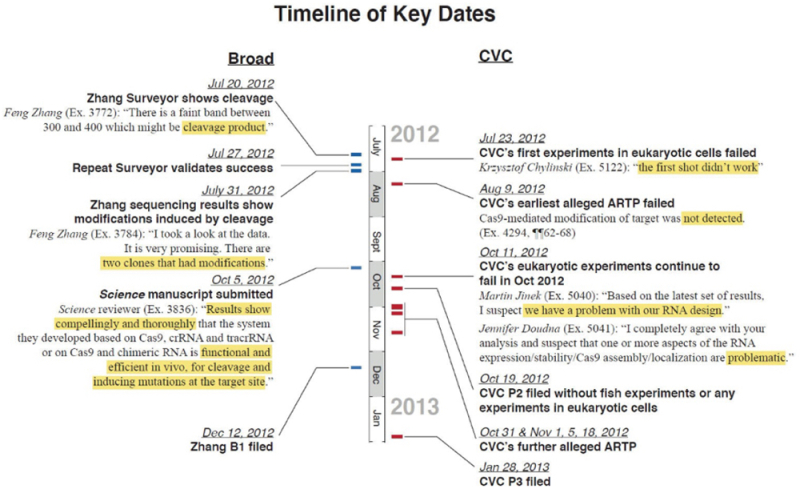
    This prosecution history presages Toolgen's likely arguments in each of the current interferences.  Like Broad, Toolgen will likely argue that CVC's earlier priority dates were inoperable in eukaryotic cells and thus its October 2012 date (and any earlier dates of conception followed by actual reduction to practice) should entitle it to priority.  The path forward against Broad is less clear, however, particularly in view of the evidence presented in Broad's priority motion (see "Broad Files Priority Motion in CRISPR Interference*"), including this timeline:

    Image
    Toolgen has no priority application filed earlier than Broad's asserted July 20, 2012 date of actual reduction to practice, and should the Board (and Federal Circuit) be persuaded by Broad's "simultaneous conception and reduction to practice" standard for awarding priority, Toolgen may be no more successful than CVC in having priority awarded to its patent application (depending, of course, on its first successful demonstration of practicing CRISPR in eukaryotic cells).

    But that remains in the future.  Both sets of interference parties have proposed Preliminary Motions, which the Board will consider tomorrow.  These motions, and the Board's decision on which motions it will entertain, will be the subject of future posts.

  • Signal Processing Claims for Decrypting Encrypted Information Found Patent Eligible

    By James Korenchan

    District Court for the Eastern District of TexasLast week, the U.S. District Court for the Eastern District of Texas, Marshall Division ruled that Defendant Apple, Inc. (hereinafter "Apple") failed to show that claims related to signal processing are patent ineligible under 35 U.S.C. § 101.

    Plaintiff Personalized Media Communications, LLC (hereinafter "PMC") asserted that Apple infringed PMC's U.S. Patent. No. 8,191,091 (the '091 patent).  Apple had moved to dismiss all claims of the '091 patent as directed to ineligible subject matter.  The Court denied this motion to dismiss, finding that the '091 patent claims to be patent-eligible.  Apple then moved for summary judgement that all the claims of the '091 patent are invalid under § 101.  (Apple's motion also moved for relief under § 101 with respect to PMC's U.S. Patent Nos. 8,559,635 and 7,752,649, but only the '091 patent was addressed by the Court in the present decision due to it being the only patent set for trial at the time.)

    The '091 patent includes four independent claims, including claim 13, which Apple asserted as being representative of all of the claims of the '091 patent.  The Court's decision thus addressed only claim 13.

    Claim 13 is as follows:

    13.  A method of decrypting programming at a receiver station, said method comprising the steps of:
        receiving an encrypted digital information transmission including encrypted information;
        detecting in said encrypted digital information transmission the presence of an instruct-to-enable signal;
        passing said instruct-to-enable signal to a processor;
        determining a fashion in which said receiver station locates a first decryption key by processing said instruct-to-enable signal;
        locating said first decryption key based on said step of determining;
        decrypting said encrypted information using said first decryption key; and
        outputting said programming based on said step of decrypting.

    The '091 patent generally aims to provide an integrated multimedia system in which a "receiver station" can, among other things, combine various types of programming (e.g., television, radio, computer communications), generate user-specific information related to such programming, identify and block those who pirate programming, and — in the case of the invention of claim 13 — identify, and then decrypt, programming and instruction signals that are encrypted.

    The Court began its analysis by determining whether claim 13 as a whole is directed to an abstract idea.  In its motion for summary judgement and in the previous motion to dismiss, Apple argued that the '091 patent is directed to the abstract idea of "using an instruct-to-enable signal to decrypt (convert from unintelligible to intelligible) information," and asserted that claim 13 claim "focuses on the abstract idea of decrypting encrypted information, rather than the physical system or the specific software that processes and decrypts the information."  Apple argued that this alleged abstract idea is akin to the "manipulation of data" and other abstract ideas that the Federal Circuit found to be patent ineligible in the likes of Intellectual Ventures I LLC v. Symantec Corp., 838 F.3d 1307 (Fed. Cir. 2016), and Digitech Image Techs., LLC v. Elecs. For Imaging, Inc., 758 F.3d 1344, 1351 (Fed. Cir. 2014).  Additionally, Apple argued that all but the decrypting and outputting steps were known in the art before the priority date of the '091 patent.

    Apple also noted that the Federal Circuit previously affirmed invalidity of other PMC patents that are "closely related" to the '091 patent under § 101.  Lastly, Apple cited to a deposition of a named inventor in an attempt to demonstrate that the concepts of encryption and decryption were well-known before the '091 patent and fail to render the claims eligible.

    In response to Apple's motion to dismiss, the Court had concluded that that the claims of the '091 patent are directed to methods of using an instruct-to-enable signal included in digital information to determine a fashion in which a station locates a decryption key that can decrypt encrypted information.  The Court had also concluded that claim 13 "describes an improvement to the delivery of 'instruct-to-enable signals' and a technical way to decrypt transmitted information.  In support of this improvement, the Court cited to the specification of the '091 patent:

    [T]he '091 patent says that transmitting the "instruct-to-enable signal" in the "information transmission" improves the reliability of the signal's delivery.  The patent states the improved delivery process increases the number of functions the "instruct-to-enable signal" can control because the signal can "occur at precise times in programming and can synchronize the operation of receiver station apparatus to the timing of programming transmission."  Second, the claim requires a "receiver station" that is able to "locate[] a first decryption key" by processing the "instruct-to-enable signal."  The specification shows that decrypting "digital programming" "based on" the "control signal" can be a technical solution for causing a receiving device to decrypt a transmission.  [Citations omitted.]

    Here, PMC indicated that it agreed with the Court's previous analysis, and the Court indicated that Apple provided no contrary evidence.

    The Court nevertheless proceeded with its § 101 analysis, referring yet again to its previous finding that, even if the claims were directed to an abstract idea, additional elements in the claims would transform them into patent-eligible applications of that idea:

    Claim 13 of the '091 Patent is a patent-eligible application at least because of its arrangement of steps.  "[A]n inventive concept can be found in the nonconventional and non-generic arrangement of known, conventional pieces."  Bascom Glob. Internet Servs. v. AT&T Mobility LLC, Case No. 2015-1763, 2016 WL 3514158, at *6 (Fed. Cir. Jun. 27, 2016).  Although some of the pieces in the '091 Patent are perhaps known and conventional—such as encryption and decryption—the '091 Patent arranges them in a way that is sufficient to confer an inventive concept, including "determining a fashion in which [a] receiver station locates a first decryption key by processing [an] instruct-to-enable signal" and "locating said first decryption key based on said step of determining."  [Citations omitted.]

    The Court thus found that the '091 patent is directed to patent eligible subject matter.

    Personalized Media Communications, LLC v. Apple, Inc. (E.D. Tex. 2021)
    Report & Recommendation by Magistrate Judge Payne

  • By Kevin E. Noonan

    Federal Circuit SealWhile much has been written about the effect of the post-grant review provisions of the Leahy-Smith America Invents Act (2012) in invalidating U.S. patents, the change in the law most responsible for how easy it has become to invalidate patents is arguably the Supreme Court's decision in Dickinson v. Zurko (1999).  That decision, which applied the provisions of the Administrative Procedures Act (1948) to judicial review of U.S. Patent and Trademark Office determinations mandated that disgruntled patentees and patent applicants show that factual decisions by the Office are not supported by substantial evidence in order to overturn these decisions.  These considerations extend even to questions of law like obviousness, which are based on factual determinations. And this difficulty was ultimately the reason Columbia University did not prevail in its attempt to overturn the Patent Trial and Appeal Board's judgment in an inter partes review proceeding that invalidated challenged patent claims for obviousness in Trustees of Columbia University v. Illumina, Inc.

    The appeal arose from five IPRs involving U.S Patent Nos. 9,718,852; 9,719,139; 9,708,358; 9,725,480; and 9,868,985.  The claims were directed to methods for "sequencing by synthesis" (SBS) (methods of nucleic acid sequencing) and recited, in separate patents, analogues of the nucleotide bases adenine, guanine, cytosine, and thymidine.  These derivatives were modified by having a unique detectable label conjugated to the base by a cleavable linker and further using a small, cleavable chemical moiety to block or cap the 3' hydroxyl on the deoxyribose sugar comprising the nucleotide to prevent extension of a polymerize nucleic acid chain:

    Structurewhere "Y" is a cleavable linker, "Tag" is the detectable label, and "OR" is the cleavable chemical moiety in this adenine embodiment of the claimed invention; analogous embodiments for guanine, cytosine, and thymidine were provided in particular challenged patents.  In the practice of the claimed methods, these species were added to a reaction mixture comprising a polymerase capable of incorporating the modified base into a growing nucleic acid strand, synthesis permitted to occur with detection of the specific detectable tags, and then cleavage of the blocking moiety and the tag with the next cycle of polymerization permitted to occur.  These steps comprised a cycle of the sequencing by synthesis (SBS) reaction and could be used inter alia in automated sequencing regimes.

    The relevant limitations of the claims involved "the use of a capping group that is 'small,' and not a 'ketone group,' 'a methoxy group, or an ester group.'"  The four references used by the PTAB to hold these claims obvious included use of an allyl group which satisfies these characteristics.  The references were:  "(1) Tsien et al., WO 91/06678 (May 16, 1991) ("Tsien"), (2) James M. Prober et al., A System for Rapid DNA Sequencing with Fluorescent Chain-Terminating Dideoxynucleotides, 238 SCIENCE 336–41 (Oct. 16, 1987) ("Prober"), (3) Michael L. Metzker et al., Termination of DNA synthesis by novel 3′- modified-deoxy-ribonucleoside 5'-triphosphates, 22 NUCLEIC ACIDS RESEARCH 4259–67 (1994) ("Metzker"), and (4) Dower et al., U.S. Patent 5,547,839, Aug. 20, 1996 ("Dower")."  The Tsien and Dower references taught SBS methods, Tsien using allyl capping groups, and the Dower patent teaching "small" capping groups, which can include allyl groups.  The Metzker reference, which provided one basis for Columbia's argument that the challenged claims were not obvious, disclosed a DNA sequencing method "equivalent to SBS" but taught that allyl capping groups provided incomplete activity.  The Board found that the claims to nucleotide analogues were obvious over the combination of the Tsien and Prober references or the combination of the Metzker, Prober, and Dower references (although the Federal Circuit's opinion states that the Prober reference was directed to "limitations not at issue in this appeal" and provided no further explication of that reference's relevance).

    The basis for the Board's first determination of obviousness is that the Tsien reference disclosed the use of allyl capping groups in SBS methods.  The Metzker reference was applied in the alternative for the same teaching, the Board disagreeing with Columbia's position that the incomplete termination teachings of Metzker taught away from Tsien's teaching that allyl capping groups could be used for SBS methods as well as concluding that "a person of ordinary skill would have understood that Metzker's experiment could be further improved by 'increasing [nucleotide] concentration or reaction time.'"  The Board's conclusions were not unanimous, however, with one member of the panel dissenting on the grounds that the teachings of the Metzker reference would have "discouraged" the skilled worker from pursuing SBS methods using modified nucleotides having allyl-capped residues.

    The Federal Circuit affirmed, in an opinion by Judge Lourie joined by Judges O'Malley and Reyna.  The panel rejected in turn the three arguments asserted by Columbia.  First, Columbia contended that the Board erred in its interpretation of the Metzker reference's teachings, and failed to recognize that those teachings would have constituted a "teaching away" by informing that skilled person that allyl capping groups were not efficient enough for successful SBS (because, according to the opinion's characterization of Columbia's argument, "SBS requires efficient incorporation of nucleotides").  The panel held that the Board's conclusions regarding the Metzker reference's teachings were supported by substantial evidence, and that teaching away must be shown by "'clear discouragement' from implementing a technical feature," citing Univ. of Md. Biotechnology Inst. v. Presens Precision Sensing GmbH, 711 F. App'x. 1007, 1011 (Fed. Cir. 2017) (quoting In re Ethicon, Inc., 844 F.3d 1344, 1351 (Fed. Cir. 2017)).  In the Court's view, Columbia did not meet this threshold based on three facts.  First, the Tsien reference taught successful SBS methods using nucleotides having allyl capping groups.  Second, the Board "carefully evaluated Metzker and found that it confirms rather than negates Tsien's teachings."  With regard to whether the SBS methods were successful enough, the panel was content with the Board's determination that Metzker did not describe SBS methods using allyl-capped nucleotide analogues as failures.  And third, while the art taught SBS methods using alternative capping groups the existence of "better" alternatives does not negate "inferior" alternatives in the prior art from supporting an obviousness determination.

    Columbia's second argument, that the skilled worker would not have had a reasonable expectation of success in achieving SBS using analogue nucleotides comprising allyl-capped moieties, was equally unavailing.  The panel's basis for rejecting this argument was that a "reasonable expectation of success" does not require "the best of all possible results."  (And in a wonderful aphorism, the opinion notes that "[s]uccess may not have only one definition."  Words to live by indeed.)  Once again, the Court held that the Board's findings on the reasonable expectation of success issue was supported by substantial evidence.  These findings include as a side note that Illumina had in a separate reexamination made the argument that the Tsien reference would not have provided a reasonable expectation of success for SBS methods, which the Board and the Court rejected because in that reexamination the priority date (which affected what was known by the person of skill in the art) was 1994 rather than, as here, October 2000.  With regard to the application of the inefficient termination by allyl capping moieties in Metzker, the panel agreed with the Board that the skilled worker "would have known that 'increasing concentration [of nucleotides] or reaction time could help incorporation efficiency.'"  Despite the necessarily speculative nature of that finding the Court held that the Board was entitled to rely on Illumina's expert to support it.  And the panel refused the invitation it perceived Columbia was making that it "reweigh" the evidence to come to a different conclusion.

    Finally, Columbia's own specification provided support for the Board's reasoning that the skilled worker would expect (reasonably) that nucleotide analogues comprising allyl capping moieties could be used in SBS methods.  As has frequently been the case in adverse decisions in other contexts (see Ariosa Diagnostics, Inc. v. Sequenom, Inc., for example), disclosure intended to render claims as unlimited as possible here were used to support their invalidity.  Indeed, Columbia's patent cited the Metzker reference "as evidence that allyl groups can be 'used to cap the 3′-OH group using well-established synthetic procedures'" (emphasis in opinion) as well as other positive statements about this reference.  And the opinion cited PharmaStem Therapeutics, Inc. v. ViaCell, Inc., 491 F.3d 1342, 1362 (Fed. Cir. 2007), for the proposition that "[a]dmissions in the specification regarding the prior art are binding on the patentee for purposes of a later inquiry into obviousness" (itself a quote from Constant v. Advanced Micro-Devices, Inc., 848 F.2d 1560, 1570 (Fed. Cir. 1988)).  The opinion asserts that "[i]n sum . . . Columbia has not pointed to any flaw in the Board's analysis."  In the Court's view, the Board was given "two alternative theories" of whether (or not) the skilled artisan would have had a reasonable expectation of success in using detectably labeled nucleotide analogues comprising allyl capping groups in SBS methods and substantial evidence supported their conclusion.

    As for Columbia's third argument, that the Metzker teachings (as flawed as Columbia contended they were) were limited to adenine analogues, and did not support obviousness of challenged patents relating to guanine, cytosine, or thymidine analogues, the panel summarily rejected it, stating that the Board had considered the evidence to support application of these references in its obviousness rejections for these patents as well, and substantial evidence supported the Board's conclusions.

    The message is clear:  a patentee (or applicant) facing the Board's invalidation (or rejection) based on obviousness will find it very difficult to overturn unless the factual basis upon which the Board rests its obviousness conclusion is not supported by substantial evidence.  This reality suggests that the fight must be had before the Board, with as much contrary evidence as possible of whatever form or type supports a conclusion of non-obviousness.  Because cases like this one strongly suggest that it is unlikely that there will be another opportunity to prevail before the Federal Circuit.  

    Trustees of Columbia University v. Illumina, Inc. (Fed. Cir. 2021)
    Nonprecedential disposition
    Panel: Circuit Judges Lourie, O'Malley, and Reyna
    Opinion by Circuit Judge Lourie

  • ACIAmerican Conference Institute (ACI) will be holding its Inaugural Summit on Women Leaders in IP Law on March 9, 2021 as a VIRTUAL conference from 8:45 am to 5:15 pm EST.  ACI faculty will give presentations on:

    • Honoring the Top Accomplishments of Women in IP/2019, featuring Deputy Chief Administrative Patent Judge Jacqueline Wright Bonilla;
    • Fostering Inventorship in Women and the Search for Equality in Innovation — a Working Group on Fostering a Versatile and Diverse IP Team;
    • The Art of Communicating;
    • A Future Forecast on Appreciating the Symbiosis between IP and Emerging Technologies;
    • Inspiring Advice from a Lineup of Influential Senior Level Women in IP;
    • A Keynote Address, and
    • An End of Day Wrap-up from the Advisory Board and Co-Chairs Gail H. Zarick, IP Counsel, IBM and Flora W. Feng, Senior Legal Director, Global Intellectual Property, PepsiCo.

    In addition, there will be a Pre-Conference Seminar on Monday, March 8th presenting a Special International Women's Day IP Career Focus Group from 3:30 to 5:30 pm EST.  This seminar will feature Lisa Jakob, Managing Counsel, Trademarks and Copyrights, Merck & Co., Inc. and Co-Founder of WIN: The Women In Law Network, and Lisa Pensabene, Partner, O'Melvany & Myers LLP, also Co-Founder of WIN.  This session will explore the opportunities available to women in the IP field, providing an opportunity for participants to hear from accomplished women attorneys on getting ahead in an IP career.

    An agenda for the conference and additional information regarding the workshops can be found here.  A complete brochure for this conference, including an agenda, detailed descriptions of conference sessions, list of speakers, and registration form can be obtained here.

    The registration fee is $1,095 with paid registration by February 26th and is $1,195 thereafter.  The pre-conference seminar is $295.  Patent Docs readers are entitled to a 10% discount off of registration using discount code D10-705-705DX06.  Those interested in registering for the conference can do so here, by e-mailing CustomerService@AmericanConference.com, or by calling 1-888-224-2480.

    Patent Docs is a media partner of ACI's Inaugural Summit on Women Leaders in IP Law.

  • IPO #2The Intellectual Property Owners Association (IPO) will offer a one-hour webinar entitled "PTAB: Year in Review – 2020" on February 4, 2021 from 2:00 pm to 3:00 pm (ET).  Chris Comiskey of Collins Aerospace, Michael R. Houston of Foley & Lardner LLP, and Shaun Snader of United Therapeutics will discuss 2020's major developments at the Patent Trial and Appeal Board (PTAB) and how they may impact patent litigation practice going forward before the PTAB and beyond.  The panel will discuss the following topics:

    • Summary of key developments
    • Constitutionality of PTAB judges — ensuing developments on Arthrex
    Non-reviewability of PTAB decisions related to institution
    • Discretionary denial – NHK Spring/Fintiv factors and proposed new PTAB rules

    There is no registration fee for the webinar.  However, those interested in attending the webinar should register here.

  • USPTO SealThe U.S. Patent and Trademark Office will offer a webinar entitled "China IP Basics, Part 1: Protecting your patents, trademarks, trade secrets, and copyrights" on February 4, 2021 from 9:00 to 10:50 am (ET).  The webinar is designed to address the needs of small and medium-sized businesses looking to protect their IP in China, and the program will include presentations by senior attorneys from the USPTO's China team and experienced practitioners from the private sector.  An agenda for the webinar can be found here.

    Those interested in registering for the webinar can do so here