• Life Sciences "Top 54"

    By Donald Zuhn

    IPO #2Last month, the Intellectual Property Owners Association (IPO) and Harrity Analytics announced the release of the 38th annual list of the top 300 organizations receiving U.S. utility patents (see "IPO & Harrity Analytics Release List of Top 300 Patent Holders for 2019").  Patent Docs readers may recall that the U.S. Patent and Trademark Office stopped releasing its annual list of top patent recipients in 2006 in order to "discourag[e] any perception that we believe more is better."

    HarrityAs with the 2019 report, the 2020 report was compiled in collaboration with Harrity Analytics, based on data obtained from the U.S. Patent and Trademark Office.  The IPO and Harrity Analytics noted that patents reported on the 2020 list are utility patents granted during the 2020 calendar year that listed the organization or a subsidiary as the owner on the printed patent document.  Harrity Analytics then used organization and subsidiary data provided to two independent third-party data providers and reviewed over 200,000 assignments to attribute ownership to the correct organizations, where applicable.  The report notes that patents that were granted to two or more organizations jointly are attributed to each organization separately, and that companies for which patents were granted to subsidiaries are combined with patents granted to the parent.

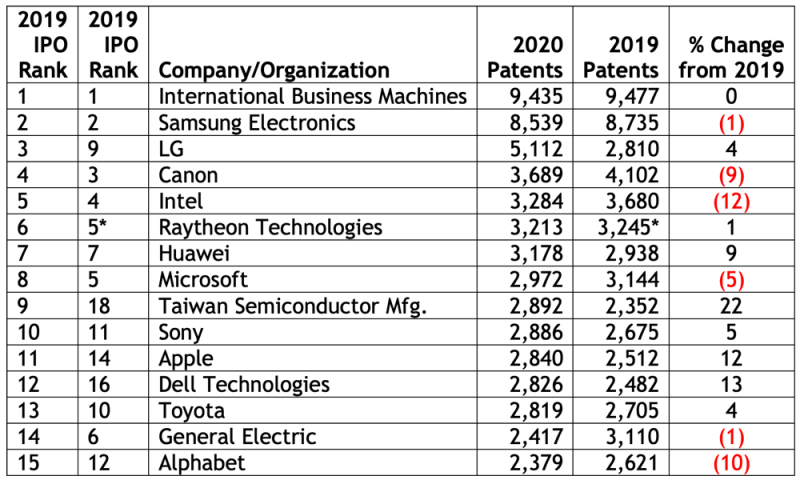
    The IPO and Harrity Analytics also noted that 352,469 patents were issued in 2020, down less than 1% from the 354,507 patents that issued in 2019.  The top fifteen companies on the IPO Top 300 are listed below (click on table to expand):

    2020 Top 15* Merger of United Technologies and Raytheon.

    Ford and Amazon fell out of the Top 15 in 2020.  Ford dropped from 13th to 19th and Amazon dropped from 15th to 16th in 2020.  Jumping into the Top 15 were Taiwan Semiconductor Mfg. (18th to 9th) and Dell (16th to 12th).  Also, Raytheon Technologies, resulting from a merger of United Technologies and Raytheon, was a new addition to the Top 15; in 2019, United Technologies ranked 8th with 2,847 patents and Ratheyon ranked 124th with 398 patents.

    As in past years, Patent Docs used the IPO's list of top patent holders to compile a list of the top "life sciences" companies and organizations receiving U.S. utility patents in 2020.  Each organization's IPO top 300 ranking for 2020 is indicated in the "2020 IPO Rank" column; the IPO top 300 ranking for 2019 (if available) is indicated in the "2019 IPO Rank" column; and the change in number of patents from 2019 is indicated in "% Change from 2019."  The Life Sciences Top 54 is listed below (click on table to expand):

    2020 Top 54
    Please note that some of the companies and organizations listed above may be involved in work outside the life sciences sector, and therefore, a portion of the patents granted to these companies and organizations may be directed to other than life sciences-related inventions.  Our list also includes medical device companies.

    For additional information regarding this topic, please see:

    • "IPO & Harrity Analytics Release List of Top 300 Patent Holders for 2019," May 20, 2020
    • "IPO Releases List of Top 300 Patent Holders for 2018," August 7, 2019
    • "IPO Releases List of Top 300 Patent Holders for 2017," July 4, 2018
    • "IPO Releases List of Top 300 Patent Holders for 2016," June 14, 2017
    • "IPO Releases List of Top 300 Patent Holders for 2014," July 1, 2015
    • "IPO Releases List of Top 300 Patent Holders for 2013," July 7, 2014
    • "IPO Releases List of Top 300 Patent Holders for 2012," June 24, 2013
    • "Another Look at IPO Top 300 and Life Sciences Top 53," June 11, 2012
    • "IPO Releases List of Top 300 Patent Holders for 2011," June 7, 2012
    • "IPO Releases List of Top 300 Patent Holders for 2010," June 30, 2011
    • "IPO Releases List of Top 300 Patent Holders for 2009," May 26, 2010
    • "IPO Releases List of Top 300 Patent Holders for 2008," May 14, 2009
    • "IPO Releases List of Top 300 Patent Holders," May 22, 2008
    • "IPO Posts List of Top 300 Patent Holders," April 20, 2007

  • By Kevin E. Noonan

    Federal Circuit SealIn a terse, non-precedential opinion, the Federal Circuit affirmed a district court's judgment that Defendants Torrent Pharmaceuticals and Indoco Remedies Ltd. had failed to prove that the claims asserted by Plaintiff/patentee Takeda were obvious, either under the statute or the judicially created doctrine of obviousness-type double patenting, in Takeda Pharmaceutical Co. v. Torrent Pharmaceuticals Ltd.

    The case arose in ANDA litigation over Takeda's allegations that Defendants would infringe claims 4 and 12 of Orange Book-listed U.S. Patent No. 7,807,689:

    4.  A compound of the formula
    Image 1
    or pharmaceutically acceptable salts thereof.

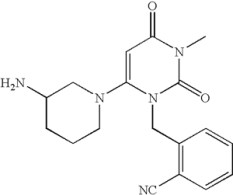
    12.  A compound of the formula
    Image 2
    wherein the compound is present as a benzoate salt.

    These claims cover the active ingredient for Takeda's alogliptin benzoate formulations, marketed under the brand names Nesina®, Kazano®, and Oseni® for treatment of Type II diabetes.  Defendants' challenges were based on factual determinations by the District Court, including testimony from three experts; based on this evidence the District Court found that Defendants had not established invalidity on either statutory (over the cited art) or obviousness-type double patenting grounds.

    Not surprisingly the Federal Circuit affirmed, in an opinion by Judge Chen joined by Judges Mayer and Dyk.  The Court recognized Defendants' arguments to be grounded in whether a skilled worker would have had a reasonable expectation of success, in the context of what the opinion characterized as "the undisputed factual finding" that "in the relevant art of pharmaceutical development, very small changes in molecular structure can have dramatic effects on the properties of the molecule" and "the more distantly related two chemical structures are, the less probable it will be that they have the same biological effect."  Regarding obviousness-type double patenting, Defendants asserted Takeda's co-owned U.S. Patent No. 7,723,344 as disclosing a "lead compound" (termed F162 in the opinion) that upon further development would have rendered the alogliptin compound obvious.  This contention was that the structural differences between these compounds (replacement of a pyrimidinone scaffold with uracil) would have been obvious in view of two scientific references, which Defendants argued taught "scaffold replacement techniques" and that uracil lowered blood glucose in animal studies, respectively.  The opinion rejected this argument on the grounds that "[c]ollectively, these references, along with other evidence of record, do not demonstrate that uracil was known to possess DPP-IV inhibitory activity or other characteristics desirable in a scaffold for DPP-IV inhibition as of the relevant priority date" and accordingly that there was no clear error in the District Court's determination that Defendants failed to establish invalidity on obviousness-type double patenting grounds over this art.

    Defendants' second argument in favor of obviousness-type double patenting is that the skilled worker would have been motivated to replace a fluoro-olefin substituents in F162 by an amide in alogliptin, based on the skilled worker recognizing these substituents as isosteres.  The District Court had found that the skilled worker would not have been motivated to make this substitution, which the Federal Circuit held was not clear error because Defendants had not cited any art that provided this motivation and there were "myriad more conservative and predictable modifications that were available for transforming F162 into a 'novel' compound" (and Takeda had elicited an admission from Defendants' expert at trial that he did not know of any prior art disclosing this specific modification.

    Turning to obviousness under 35 U.S.C. § 103, Defendants asserted art purportedly teaching substitution of a xanthine scaffold moiety for the uracil moiety in alogliptin.  The Federal Circuit agreed that the District Court did not err in concluding that Defendants had not shown that the skilled worker could reasonably expected this substitution to be successful.  This was because "the interchangeability references on which Indoco relies do not pertain to DPP-IV inhibitors or diabetes [thereby failing any expectation that the substituted compound would be operative], nor do they, or any other prior art of record, teach substituting an existing xanthine scaffold for uracil (thereby failing to establish the viability of the substitution on structural grounds]."

    The opinion concludes by considering Defendants' argument that the District Court erred as to the level of skill of the ordinarily skilled worker.  This question arose with regard to whether the skilled person should have "specific experience developing DPP-IV inhibitors and/or type II diabetes drugs," and was relevant to the weight the District Court gave to the testimony of Takeda's expert who lacked such experience.  The Federal Circuit found this distinction immaterial because the District Court considered the prior art from both perspectives (i.e., a skilled artisan with and without such expertise) and found Defendants had not shown Takeda's asserted claims to be obvious ("[g]iven the substantive gaps in establishing motivation and reasonable expectation of success identified above, the record supports the district court's conclusion that it would have reached the same outcome under either definition of a skilled artisan").  Moreover, the opinion states that Defendants failed to show that applying the standard to the skilled artisan issue they espouse would have made any difference.   Accordingly, the Federal Circuit affirmed the District Court's finding against Defendants.

    Takeda Pharmaceutical Co. v. Torrent Pharmaceuticals Ltd. (Fed. Cir. 2021)
    Nonprecedential disposition
    Panel: Circuit Judges Dyk, Mayer, and Chen
    Opinion by Circuit Judge Chen

  • By Kevin E. Noonan

    Senior Party Toolgen and Junior Parties The Broad Institute, Massachusetts Institute of Technology, and Harvard University (collectively, "Broad") in Interference No. 106,126 and University of California/Berkeley, the University of Vienna, and Emmanuelle Charpentier (collectively, "CVC") in Interference No. 106,127 each filed Lists of Proposed Motions that the Board considered recently and responsive thereto will issue its rulings shortly (see "The CRISPR Chronicles: Enter Toolgen").  The Broad list will be the subject of this post.

    Broad InstituteBroad's list contains six proposed motions and in some respects mirrors the motions filed in on-going Interference No. 106,115 against CVC (see "CRISPR Interference Parties Propose Motions").  Broad Motion No. 1 under 37 C.F.R. §§ 41.121(a)(1)(i) and 41.208(a)(2) asks the Board to substitute the Count in this interference, much as it did in the '115 interference and for essentially the same reasons:  "to cover Broad's best proofs, which are directed to CRISPR-Cas9 systems using dual-molecule RNA."  In addition, Broad mentions that both parties to this interference contend having invented CRISPR embodiments useful in eukaryotic cells and thus request that priority to this invention be determined by the Board throughout its scope, dual- or single-molecule embodiments.  Broad's proposed Count 2 reads as follows:

    A CRISPR-Cas9 system, for use in a eukaryotic cell, comprising:
        a) a Cas9 or a nucleic acid encoding the Cas9 and
        b) an RNA or a nucleic acid encoding the RNA, wherein the RNA is a dual RNA comprising a CRISPR RNA (crRNA) and a trans activating crRNA (tracrRNA) or wherein the RNA is a chimeric RNA comprising a crRNA fused to a tracrRNA,
        wherein the crRNA directs the Cas9 to a target sequence in a eukaryotic cell, whereby a site-specific, double-strand break is introduced, or the target sequence is edited.

    Broad proposes that, should the Board prefer to include an alternative Count, then Toolgen claim 85 from U.S. Patent Application No. 14/685,510 could be used in the alternative to two Broad claims that Broad has asked in a Contingent Motion (below) be added to this Interference.

    Broad Motion No. 2 (contingent) under 37 C.F.R. §§ 41.121(a)(1)(i) and 41.208(a)(2) seeks to add claims 1, 40, and 41 of Broad U.S. Patent Application No. 15/160,71:

    Claim 1.  An engineered CRISPR-Cas system in a eukaryotic cell having a DNA molecule, the CRISPR-Cas system comprising:
        I.  a Cas9 or a nucleotide sequence encoding the Cas9, and
        II.  an RNA or a nucleotide sequence encoding the RNA, the RNA comprising
            (a) a first RNA comprising (i) a guide sequence capable of hybridizing to a target sequence of the DNA molecule adjacent to a Protospacer Adjacent Motif (PAM) in the eukaryotic cell, and (ii) a tracr mate sequence, and
            (b) a second RNA comprising a tracr sequence capable of hybridizing to the tracr mate sequence,
        wherein the guide sequence directs the Cas9 to the target sequence,
        whereby the DNA molecule is cleaved or edited in the eukaryotic cell.

    and claims 74, 94, and 95 of U.S. Patent Application No. 15/430,260:

    Claim 74. A method comprising: introducing into, or expressing in, a eukaryotic cell having a DNA molecule,
        (I) a Cas9 protein or a nucleotide sequence encoding the Cas9 protein,
        and
        (II) an RNA or a nucleotide sequence encoding the RNA, the RNA comprising:
            (a) a first RNA comprising a first ribonucleotide sequence and a second ribonucleotide sequence, and
            (b) a second RNA, and
        wherein, the second RNA forms an RNA duplex with the second ribonucleotide sequence, and
        wherein, in the eukaryotic cell, the first ribonucleotide sequence directs the Cas9 protein to a target sequence of the DNA molecule,
        whereby the Cas9 cleaves or edits the DNA molecule or alters expression of at least one product of the DNA molecule in the eukaryotic cell.

    These claims are in condition for allowance (subject to Broad filing terminal disclaimers), and according to Broad "[b]ased upon communications with the Examiner during a January 26, 2021 interview, Broad understands that claims that are generic to encompass both dual RNA and chimeric RNA embodiments of CRISPR-Cas9 systems for use in and methods to direct site specific binding and cleavage of a target sequence in eukaryotic cells."

    Broad Motion No. 3 under 37 C.F.R. §§ 41.121(a)(1)(iii) and 41.208(a)(2) asks the Board to designate claims as not corresponding to Count 1 in the Interference as declared or its Proposed Count 2 should the Board grant Broad's Contingent Motion No. 2.  This motion is based on "the limitation to the use of vectors for RNA expression, which is patentably distinct from Count 1 and Proposed Count 2" nor disclosed in Toolgen's application in interference.  The patents and claims Broad seeks to exclude on this basis are:

    • U.S. Patent No. 8,697,359 – Claims 1-14
    • U.S. Patent No. 8,771,945 – Claims 1-25
    • U.S. Patent No. 8,795,965 – Claims 1-25
    • U.S. Patent No. 8,865,406 – Claims 1-23
    • U.S. Patent No. 8,871,445 – Claims 1-25
    • U.S. Patent No. 8,889,356 – Claims 1-23
    • U.S. Patent No. 8,889,418 – Claims 25-28
    • U.S. Patent No. 8,895,308 – Claims 1-24, 29
    • U.S. Patent No. 8,906,616 – Claim 24
    • U.S. Patent No. 8,932,814 – Claims 1-24
    • U.S. Patent No. 8,945,839 – Claims 1-20
    • U.S. Patent No. 8,993,233 – Claims 1-43 (all involved claims)
    • U.S. Patent No. 8,999,641 – Claims 1-21
    • U.S. Patent No. 9,840,713 – Claims 1-14, 37 and 40-41
    • U.S. Application No. 14/704,551 – Claims 2 and 4-18 (all involved claims)
    • U.S. Application No. 15/330,876 – Claims 1, 16-21, and 30-40 (all involved claims)

    This motion asks the Board to designate additional claims as not corresponding to Count 1 or Proposed Count 2 on a different basis, regarding "the limitation to a selected protein, namely, Staphylococcus aureus Cas9":

    • U.S. Patent No. 8,865,406 – Claims 1-30 (all involved claims)
    • U.S. Patent No. 8,895,308 – Claims 1-30 (all involved claims)
    • U.S. Application No. 15/330,876 – Claims 1, 16-21, and 30-40 (all involved claims)

    This motion asks the Board to designate additional claims as not corresponding to Count 1 or Proposed Count 2 on yet a different basis, regarding "the limitation that the Cas9 is a chimeric CRISPR enzyme in that it comprises a first fragment and a second fragment, wherein each of the first and second fragments is from a different Cas9 protein":

    • U.S. Patent No. 8,889,418 – Claims 1-28 (all involved claims)

    This motion asks the Board to designate additional claims as not corresponding to Count 1 or Proposed Count 2 on another different basis, regarding "the limitation to a system for improved localization to the nucleus of a eukaryotic cell, namely, having two or more nuclear localization signals":

    • U.S. Patent No. 8,871,445 – Claims 1-30 (all involved claims)
    • U.S. Patent No. 8,932,814 – Claims 1-30 (all involved claims)
    • U.S. Patent No. 8,993,233 – Claim 7
    • U.S. Application No. 14/704,551 – Claims 9-11
    • U.S. Application No. 15/330,876 – Claim 34

    This motion asks the Board to designate additional claims as not corresponding to Count 1 or Proposed Count 2 on another different basis, regarding "the limitation that the Cas9 comprise one or more mutations, including, but not limited to, whereby as a result of such mutations the Cas9 is a nickase that does not cause cleavage resulting in a double strand break in the target DNA":

    • U.S. Patent No. 8,865,406 – Claim 8
    • U.S. Patent No. 8,889,356 – Claims 1-30 (all involved claims)
    • U.S. Patent No. 8,889,418 – Claims 1-28 (all involved claims)
    • U.S. Patent No. 8,932,814 – Claims 1-30 (all involved claims)
    • U.S. Patent No. 9,840,713 – Claims 2 and 18-19
    • U.S. Application No. 14/704,551 – Claim 5
    • U.S. Application No. 15/330,876 – Claim 19-20

    This motion asks the Board to designate additional claims as not corresponding to Count 1 or Proposed Count 2 on another different basis, regarding "the limitation that the Cas9 be fused to specified protein domains or includes one or more heterologous domains or includes a functional domain":

    • U.S. Patent No. 8,993,233 – Claims 1-43 (all involved claims)

    This motion asks the Board to designate additional claims as not corresponding to Count 1 or Proposed Count 2 on another different basis, because "Broad's Involved Claims that are not limited to use of CRISPR Cas system in eukaryotic cells with 'fused' or 'chimeric' RNA" and thus should be removed from the interference should the Board deny Broad's Motion No. 1:

    • U.S. Patent No. 8,697,359 – Claims 1-3, 5-10, 12-17 and 19-20
    • U.S. Patent No. 8,771,945 – Claims 1-4 and 6-29
    • U.S. Patent No. 8,795,965 – Claims 1-30 (all involved claims)
    • U.S. Patent No. 8,865,406 – Claims 1-30 (all involved claims)
    • U.S. Patent No. 8,871,445 – Claims 1-30 (all involved claims)
    • U.S. Patent No. 8,889,356 – Claims 1-30 (all involved claims)
    • U.S. Patent No. 8,889,418 – Claims 1-28 (all involved claims)
    • U.S. Patent No. 8,895,308 – Claims 1-30 (all involved claims)
    • U.S. Patent No. 8,906,616 – Claims 1-4 and 6-30
    • U.S. Patent No. 8,932,814 – Claims 1-30 (all involved claims)
    • U.S. Patent No. 8,945,839 – Claims 1-28 (all involved claims)
    • U.S. Patent No. 8,993,233 – Claims 1-43 (all involved claims)
    • U.S. Patent No. 8,999,641 – Claims 1-28 (all involved claims)
    • U.S. Patent No. 9,840,713 – Claims 1-7 and 9-41
    • U.S. Application No. 14/704,551 – Claims 2 and 4-18 (all involved claims)

    These motions are significant, because if the Board grants any or all of them Broad will remove these claims from the risk of having the Board find they are not entitled to priority as to these claims. Specifically, as set forth in Broad's Motion:

    Only claims 4, 11, and 18 of U.S. Patent No. 8,697,359; claim 5 of U.S. Patent No. 8,771,945; claim 5 of U.S. Patent No. 8,906,616; claim 8 of U.S. Patent No. 9,840,713, and claims 1, 16-21, and 30-40 of application 15/330,876 should remain designated as corresponding to Count 1.

    Broad's Motion No. 4 under 37 C.F.R. §§ 41.121(a)(1)(iii) on the grounds that Toolgen's claims corresponding to the Count are unpatentable.  The basis for this motion is that Toolgen is not entitled to the benefit of priority to its earliest-filed application, U.S. Provisional Application No. 61/717,324. Specifically, Broad contends this application does not provide an adequate written description based on several purportedly necessary features of CRISPR in eukaryotic cells (including the timing of the introduction of constructs encoding Cas9 and chimeric RNA; use of Cas9 comprising a single nuclear localization signal at the carboxyl terminus of the protein; and use of a chimeric RNA prepared "exogenous to and before introduction into the eukaryotic cell."  In addition, the Broad contends that Toolgen's involved claims are invalid under 35 U.S.C. § 102 and § 103 based on several prior art references, all based on the Board finding Toolgen's involved claims are not entitled to the benefit of priority to its '324 provisional application.  (Significantly, because in an interference a party asserting unpatentability of an opponent's claims on prior art grounds is required to show why those references don't invalidate their claims, Broad notes that the Board has granted Broad's patents and applications-in-interference (in the '115 Interference) the benefit of priority to U.S. Provisional Application 61/736,527, having a filing date of December 12, 2012, which antedates all the references Broad asserts against Toolgen's claims in interference.

    Broad's Motion No. 5 under 37 C.F.R. §§ 41.121(a)(3) for the Board to keep the parties and the Board apprised of allowance of pending Toolgen applications and to keep the Examiner in each such application apprised on the existence of this Interference.

    Finally, Broad's Motion No. 6 under 37 C.F.R. § 41.208(a)(4) seeks judgment based on priority.

    The Board having set February 4th as the date for a teleconference with each set of  parties jointly, the Board's Order notifying the parties as to which motions they are authorized to file and which have been deferred or denied is expected within the week.  During the call the parties were able to inform the Board more specifically of the bases for their motions, provide a proffer if the Board needs additional evidence or information, and provide opposing parties the opportunity to give the Board their views.  With the Order on which motions are permitted the Board will also set a briefing schedule.  All these events will be the subject of future posts.

    * As a reminder, an interference proceeds in two stages.  The first stage involves the parties presenting motions that can modify the count, have certain claims declared outside the scope of the count (or vice versa), seek to establish an earlier priority date, and ask for a finding that their opponents' claims are invalid under any of the provisions of the patent statute.  If these motions are not decided in a way that would disqualify one or both parties, then the interference will move to a second stage, where in each Interference the Junior Party (Broad, in the '126 Interference and CVC in the '127 Interference) will present its proofs of conception and reduction to practice and the Senior Party Toolgen will be permitted to oppose and/or present its own priority evidence.  The Senior Party is under no obligation to present proofs earlier than its earliest filing date unless the Junior Party evinces evidence of (at least) earlier conception.  In practice, the parties can both be expected to submit their priority evidence.

  • CalendarFebruary 16, 2021 – "New Ways of Understanding the Patent-Eligibility of Software and Business Methods" (McDonnell Boehnen Hulbert & Berghoff LLP) – 10:00 am to 11:15 am (CT)

    February 16, 2021 – "Staying Relevant with Blockbuster Technologies" (LexisNexis IP and IPWatchdog) – 11:00 pm (ET)

    February 16, 2021 – "Amendments to the Israeli Patent Law — A Call to the Public from the Israel Ministry of Justice" (Reinhold Cohn and American Intellectual Property Law Association) – 11:00 am to 12:30 pm (Eastern) and 6:00 pm to 7:30 pm (Israel Time)

    February 17, 2021 – "Patenting Artificial Intelligence (AI) inventions in Japan and the US" (Intellectual Property Law Association of Chicago International Relations Committee and Japan Patent Attorneys' Association) – 6:00 pm to 7:30 pm (CST)

    February 18, 2021 – "Patent Law Year in Review 2020" (Federal Circuit Bar Association Patent Litigation Committee) – 1:00 to 3:00 pm (ET)

    March 9, 2021 – Summit on Women Leaders in IP Law (American Conference Institute) – 8:45 am to 5:15 pm EST

  • Federal Circuit Bar Association_2The Federal Circuit Bar Association (FCBA) Patent Litigation Committee will be offering a remote program entitled "Patent Law Year in Review 2020" on February 18, 2021 from 1:00 to 3:00 pm (ET).  Jill Schmidt of Genentech, Inc.; Susan Tull of Finnegan, Henderson, Farabow, Garrett & Dunner, LLP; Sharonmoyee Goswami of Cravath, Swaine & Moore LLP; and Andrew R. Sommer of Greenberg Traurig, LLP will cover developments in patent law with a focus on patent law decisions from the United States Supreme Court and United States Court of Appeals for the Federal Circuit, including developments in the law of patentability, infringement, damages, design patents, and various issues that come up in PTAB trial proceedings.

    The webinar is complimentary for FCBA members and students, $50 for government/academic/retired attendees, and $175 for private practitioners.  Those interested in registering for the program, can do so here.

  • IPLACThe Intellectual Property Law Association of Chicago (IPLAC) International Relations Committee and Japan Patent Attorneys' Association (JPAA) will be presenting a program entitled "Patenting Artificial Intelligence (AI) inventions in Japan and the US" on February 17, 2021 from 6:00 pm to 7:30 pm (CST).  Daryl Lim, Professor of Law, UIC/John Marshall Law School and Patrick G. Burns of Greer, Burns & Crain, Chicago will moderate a panel consisting of Takeshi Iizuka, Executive Director, JPAA; Naoki Okumura of Nakamura & Partners; Atsuko Miura of Tokai Patent Law Firm; and Ryan Phelan of Marshall Gerstein will provide a presentation about AI patents in Japan, a presentation about AI patents in the U.S., and a panel discussion with questions and comments.

    There is no charge for IPLAC members, but those wishing to attend must first join the IPLAC.  Those interested in registering for event can do so here.

  • LexisNexisLexisNexis IP and IPWatchdog and will be offering a webinar entitled "Staying Relevant with Blockbuster Technologies" on February 16 , 2021 at 11:00 pm (ET).  Kae Gruner of Acella Pharmaceuticals, LLC; Sarbani Chattopadhyay of LexisNexis PatentSight; and Gene Quinn of IPWatchdog will discuss tackling the effects of patent cliffs as companies try to extend the patent protection of their blockbuster technologies, and will look at the most common strategies for doing so.  The panel will address the following topics:

    • How to identify relevant patent cliffs
    • How to map patents to products
    • Common ways to extend the patent protection of a technology
    • How to identify these extension strategies

    Those interested in registering for the webinar can do so here.

  • AIPLA #1Reinhold Cohn and the American Intellectual Property Law Association (AIPLA) will be offering a webinar entitled "Amendments to the Israeli Patent Law — A Call to the Public from the Israel Ministry of Justice" on February 16, 2021 from 11:00 am to 12:30 pm (Eastern) and 6:00 pm to 7:30 pm (Israel Time).  David Gilat of the Reinhold Cohn Group will moderate a program consisting of the following three sessions:  (1) a general review of the Ministry of Justice call to the public; (2) workshops in virtual breakout rooms, allowing participants to concentrate on subjects of particular interest; and (3) an open discussion for questions.

    Those interested in registering for the program, can do so here.

  • By Kevin E. Noonan

    USPTO SealSenior Party Toolgen and Junior Parties The Broad Institute, Massachusetts Institute of Technology, and Harvard University (collectively, "Broad") in Interference No. 106,126 and University of California/Berkeley, the University of Vienna, and Emmanuelle Charpentier (collectively, "CVC") in Interference No. 106,127, each filed Lists of Proposed Motions that the Board considered last week and responsive thereto will issue its rulings shortly (see "The CRISPR Chronicles: Enter Toolgen").  The Toolgen lists have sufficient similarities that they will be the subject of this post, with the individual Junior Parties' lists being the subject of later posts.

    As a reminder, an interference proceeds in two stages.  The first stage involves the parties presenting motions that can modify the count, have certain claims declared outside the scope of the count (or vice versa), seek to establish an earlier priority date, and ask for a finding that their opponents' claims are invalid under any of the provisions of the patent statute.  If these motions are not decided in a way that would disqualify one or both parties, then the interference will move to a second stage, where in each Interference the Junior Party (Broad, in the '126 Interference and CVC in the '127 Interference) will present its proofs of conception and reduction to practice and the Senior Party Toolgen will be permitted to oppose and/or present its own priority evidence.  The Senior Party is under no obligation to present proofs earlier than its earliest filing date unless the Junior Party evinces evidence of (at least) earlier conception.  In practice, the parties can both be expected to submit their priority evidence.

    ToolGenAs might be expected, there are several similarities in Toolgen's lists for each Interference.  Toolgen's Motion No. 1 is the same on each list.  It requests the Board's permission to file an expedited miscellaneous motion under 37 C.F.R. §1.645(d)* asking the Board to stay the '126 Interference (as well as the '127 Interference) until the Federal Circuit rules on any appeal of the Board's Final Judgment in Interference No. 106,115 now pending between Broad as Senior Party and CVC as Junior Party.  In the alternative, Toolgen asks for the stay to extend until after Final Board Decision if there is no appeal.  The basis is that such a stay will "promote efficient and fair resolution of the pending interferences," upon which grounds it is within the Board's discretion to grant.  In addition, the Board's decision in the '115 Interference may result in "cancellation of all of Broad's or CVC's claims, or a combination," which would "narrow the issues for this and the '127 Interference."  This argument is based on the Board having declared this interference (and the '127 Interference) having as a Count the same Claim 18 of Broad's U.S. Patent No. 8,697,359 as in the '115 Interference Count, and having each claim involved in this (and the'127) interference also being involved in the '115 Interference.  Toolgen also notes that "in both interferences, parties are challenging Broad's involved claims under Section 102(f) for improper inventorship, for which briefing already is underway in the 115 Interference" and "the briefing, discovery and priority proofs in the 115 Interference will clarify the priority dispute in this proceeding."  That earlier Interference should be concluded well in advance of this one, providing further basis for granting the motion.  Toolgen asks the Board to set a briefing schedule for a total of five weeks, and to set Time Period No. 1 (when all other motions briefs are due) for no less than six weeks after this motion is decided.

    Toolgen's Motion No. 2 under 37 C.F.R. §§ 41.121(a)(1)(ii) and 41.208(a)(3) is also the same on each list, and Toolgen seeks to be granted the priority benefit of U.S. Provisional Application Publication No. 61/837,481, filed June 20, 2013; and PCT Application KR2013/009488, filed October 23, 2013.  These are "interior" priorities arising after the earliest filed provisional application and before the pending application upon which this Interference (and the '127 Interference) was declared.

    Toolgen's Motion No. 3 under 37 C.F.R. §§ 41.121(a)(1)(ii) and 41.208(a)(3) is a motion to attack accorded benefit.  In the '126 Interference against Junior Party Broad, the motion is directed to benefit of Provisional Application No. 61/736,527, filed on December 12, 2012.  In the '127 Interference against Junior Party CVC, the motion is directed to Provisional Application No. 61/757,640, filed on January 28, 2013.

    Toolgen's Motion No. 4 under 37 C.F.R. § 41.121(a)(1)(iii) is for judgment that the involved patents or applications of each Junior Party are unpatentable for failure to satisfy the written description and enablement requirements of 35 U.S.C. § 112(a).  The basis in each case is that the patents and applications "do not enable one of ordinary skill in the art to practice the use of CRISPR-Cas technology in all types of eukaryotic cells without undue experimentation."

    Toolgen's Motion No. 5 in the '127 Interference and Motion No. 7 in the '126 Interference under 37 C.F.R. § 41.121(a)(1)(iii) is for judgment that the involved patents or applications are unpatentable under 35 U.S.C. § 102 or § 103.  In the '126 Interference, the grounds for this motion are that CVC's involved claims in all the patents or application in interference are anticipated or obvious over U.S. Application Publication No. 2016/0298138 assigned to Sigma-Aldrich Co. LLC, and/or U.S. Application Publication No. 2015/0322457 assigned to ToolGen, as well as additional references set forth in an Appendix to this paper.  In Motion No. 5 in the '126 Interference, Toolgen contends that Broad's involved claims in all the patents or applications in interference are anticipated or obvious over Cong et al., "Multiplex Genome Engineering Using CRISPR/Cas Systems," Science 339: 819-23 (February 2013; published online January 2013), and/or Mali et al., "RNA-Guided Human Genome Engineering Via Cas9," Science 339: 823-26 (February 2013; published online January 2013), as well as additional references set forth in an Appendix.  In both motions, Toolgen asks the Board to relax the 25-page limit to permit them to explain how each of the involved claims recited in the motion are unpatentable.

    The lists then vary considerably between the Interferences.  In the '126 Interference, Motion No. 5 under 37 C.F.R. § 41.121(a)(1)(iii) is for judgment that Broad's patent and applications in interference are unpatentable for improper inventorship under 35 U.S.C. § 102(f) (pre-AIA) or 35 U.S.C. § 115(a) (post-AIA).  The basis for this motion is the record of proceedings involving Broad's European Patent No. EP 2771468, which include a declaration from Broad's attorney Thomas Kowalski, who testified as to inventorship in that application.  According to Toolgen, "[a] number of the alleged inventive contributions detailed in the Kowalski Declaration are applicable not only to the PCT Applications**, but also to the Broad claims involved in this interference."  Accordingly, Toolgen requests leave to file a motion of unpatentability due to these alleged deficiencies.

    Toolgen's Motion No. 6 in the '126 Interference under 37 C.F.R. 41.150(c) is for additional discovery, specifically with regard to Dr. Luciano Marraffini.  The Board has granted a similar motion to CVC in the '115 Interference (see "PTAB Grants CVC Motion for Marraffini Deposition").  "Because Dr. Marraffini's testimony is equally as pertinent to the present interference as it is to the 115 Interference," Toolgen argues, "additional discovery concerning Dr. Marraffini is warranted here, as well."  Toolgen asks as part of this motion for "copies of documents from Dr. Marraffini produced in the 115 Interference and to participate in, including by examination or cross-examination, any deposition examination or cross-examination of Dr. Marraffini in the 115 Interference," as well as leave to serve its own subpoenas for documents or further deposition.

    Toolgen's Motion No. 8 in the '126 Interference is for judgment under 37 C.F.R. § 41.121(a)(1) that all Broad's patents and applications are unenforceable for inequitable conduct.  The basis for this motion asserted by Toolgen is purported irregularities in how certain applications were designated first as having post-AIA and then pre-AIA status, as well as statements that "Zhang's lab had reduced to practice a working CRISPR-Cas9 cleavage system in a eukaryotic cell prior to May 2012," which Toolgen asserts was untrue.

    Toolgen's Motion No. 9 in the '126 Interference and Motion No. 6 in the '127 Interference are for a protective order under 37 C.F.R. § 42.54 to allow Toolgen to file its priority statement under seal.  The basis for this motion is to protect "sensitive and confidential information" from disclosure to "third-party competitors, such as Sigma-Aldrich."  (It should be remembered that CVC asked for a similar protective order in the '115 Interference, which the Board denied; see "Board Denies CVC Motion to Seal Priority Statement".)

    Toolgen's Motion No. 10 in the '126 Interference and Motion No. 7 in the '127 Interference is a miscellaneous motion under 37 C.F.R. § 41.104(a) for the Board to order the '126 and '127 Interferences to proceed on the same schedule.

    Finally, Toolgen's Motion No. 11 in the '126 Interference and Motion No. 8 in the '127 Interference are each motions under 37 C.F.R. § 41.208(a)(4) for judgment based on priority of invention.

    The Board having set February 4th as the date for a teleconference with each set of  parties jointly, the Board's Order notifying the parties as to which motions they are authorized to file and which have been deferred or denied is expected within the week.  During the call, the parties were able to inform the Board more specifically of the bases for their motions, provide a proffer if the Board needs additional evidence or information, and provide opposing parties the opportunity to give the Board their views.  With the Order on which motions are permitted, the Board will also set a briefing schedule.  All these events will be the subject of future posts.

    * The Interference Rules were revised several years ago and collected with all post-grant proceedings in Chapter 41 of the C.F.R.  Nevertheless, the current rules have provisions for such stays which it can be expected the Board will consider when it decides whether to grant leave for Toolgen to file a brief in support of this motion.

    ** These include PCT/US2013/074611; PCT/US2013/074667; PCT/US2013/074691; PCT/US2013/074736; PCT/US2013/074743; PCT/US2013/074790; PCT/US2013/074800; PCT/US2013/074812; PCT/US2013/074819; and PCT/US2013/074825.

  • By Kevin E. Noonan

    Senior Party Toolgen and Junior Parties The Broad Institute, Massachusetts Institute of Technology, and Harvard University (collectively, "Broad") in Interference No. 106,126 and University of California/Berkeley, the University of Vienna, and Emmanuelle Charpentier (collectively, "CVC") in Interference No. 106,127 each filed Lists of Proposed Motions that the Board considered today and responsive thereto will issue its rulings shortly (see "The CRISPR Chronicles: Enter Toolgen").  The CVC list will be the subject of this post.

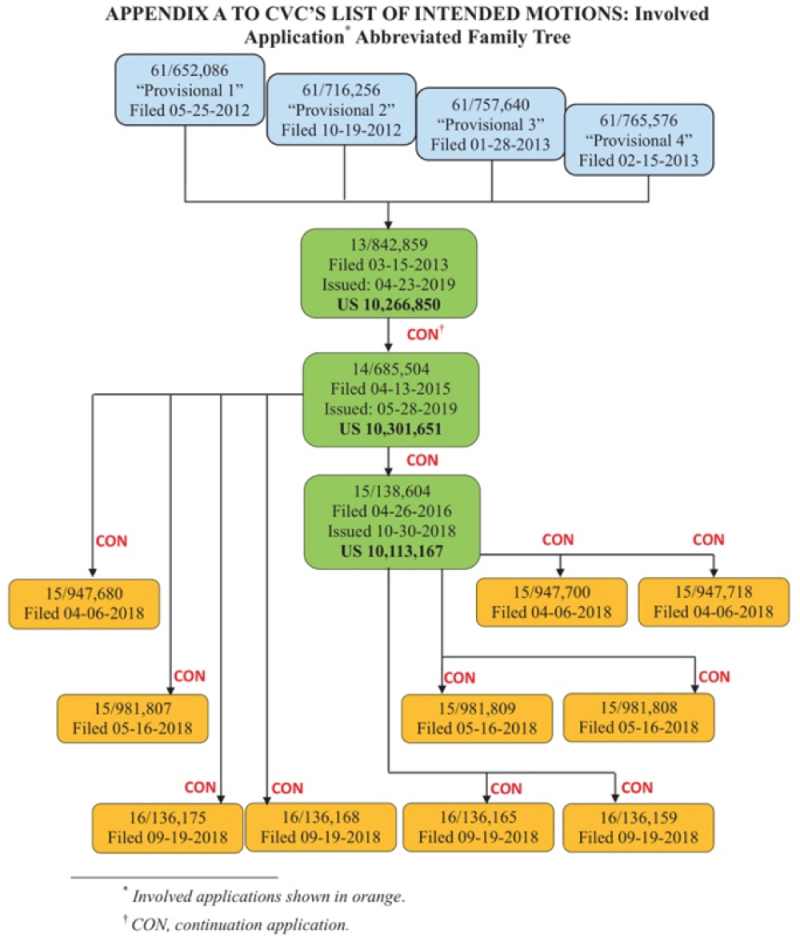
    CVC's list contains six proposed motions and in some respects mirrors the motions filed in on-going Interference No. 106,115 against Broad (see "CRISPR Interference Parties Propose Motions").  CVC Motion No. 1 under 37 C.F.R. §§ 41.121(a)(1)(ii) and 41.208(a)(3) seeks to be awarded priority to their first-filed priority applications (specifically, in the alternative either the P1 or P2 applications), as set forth in this diagram:

    2021-02-07 Image
    As shown in the diagram, all of CVC's applications having allowable claims that have formed the jurisdictional basis for this interference depend on the four provisional applications designated P1 through P4, and have an earliest priority date of May 25, 2012.  Given their status as the discoverers of CRISPR (for which Jennifer Doudna and Emmanuelle Charpentier received the 2020 Nobel Prize in Chemistry), it is unsurprising that CVC has the earliest priority date.  Whether this is enough to constitute a constructive reduction to practice is the issue in the 106,048 Interference; CVC is careful to argue that "no estoppel or prior decision of the PTAB weighs against authorizing this motion" and "[t]he PTAB's Decision on Motions in Interference No. 106,115 is not final, as it is still subject to review by the Federal Circuit," citing Vardon Golf Co. v. Karsten Manufacturing Corp., 294 F.3d 1330 (Fed. Cir. 2002).  In addition, CVC notes that the Count in this interference is not the same as the Count in the '048 Interference.  CVC also requests that the Board increase the page limits for its brief to 55 pages, and exclude claim charts from that limit, "[d]ue to the complexity of the issues and extensive evidentiary record implicated by this Motion."

    CVC Motion No. 2 seeks to have the Board deny the benefit of Toolgen's priority application, U.S. Provisional Application No. 61/717,324, filed October 12, 2012.  This proposed motion is devoid of any further asserted bases for the Board to grant leave to file this motion, stating merely that "CVC should be given the opportunity to develop its arguments in full."

    CVC Motion No. 3 under 37 C.F.R. § 41.121(a)(3) and Standing Order, ¶ 203.2, seeks to have the Board add Toolgen's U.S. Patent No. 10,851,380 to this interference.  The grounds for this motion is that the '380 patent contains at least one claim within the scope of the Count, specifically that recites "methods of introducing a site-specific, double-stranded break at a target nucleic acid sequence in a eukaryotic cell, the method comprising introducing a chimeric guide RNA (i.e., a single guide RNA) and Cas9 into the eukaryotic cell."  In the alternative, CVC asks the Board to add the '380 patent to this interference sua sponte.

    CVC's Motion No. 4 under 37 C.F.R. § 41.121(a)(1) is for judgment that Toolgen's involved claims corresponding to the Count are unpatentable.  CVC contends that Toolgen's involved claims are invalid under 35 U.S.C. § 102 over CVC's U.S. Patent Application Publication No. 2014/0068797, which claims the benefit of priority to the P1 provisional application illustrated above.  Specifically, CVC notes that "ToolGen added a codon-optimization limitation to overcome an anticipation rejection over the '797 publication" and CVC's P1 and P2 priority applications disclose codon optimization.  Presciently addressing the expected response to this argument, that as Broad has contended in the '048 and '115 Interferences that CVC's P1 and P2 provisional applications do not disclose eukaryotic CRISPR embodiments, CVC's brief notes that "[an] anticipatory reference need not demonstrate utility," citing Rasmusson v. SmithKline Beecham Corp., 413 F.3d 1318, 1326 (Fed. Cir. 2005).  And CVC argues that "[b]ecause the requirements for an anticipatory reference differ from the written description requirement to support a constructive reduction of practice of a count, the Board's Decision on Motions in the '115 interference between CVC and the Broad Institute does not control here."  Finally, CVC argues that the Board authorizing its Motion No. 4 would be consistent with 37 C.F.R. § 41.1(b) "to secure the just, speedy, and inexpensive resolution of every proceeding before the Board" and inter alia that "ToolGen aggressively sought this interference via petition and ex parte prosecution, which included inaccurate characterizations of what CVC's P1 and P2 disclose, including incorrect statements regarding the necessity of codon optimization and NLSs for functionality in eukaryotes."  As with Motion No. 3, CVC asks the Board to increase the page limit to 40 pages and to exclude claim charts from this number.

    CVC's Motion No. 5 (contingent) is for judgment that Toolgen's claims are unpatentable under 35 U.S.C. §§ 102 or 103 over Sigma's U.S. Application Publication No. 2016/0298138, which claims priority to its first provisional application filed October 23, 2012, should the Board grant CVC's Motion No. 2 that Toolgen's application in interference is not to be entitled to priority its U.S. Provisional Application No. 61/717,324, filed October 12, 2012.

    Finally, CVC's Motion No. 6 under 37 C.F.R. § 41.208(a)(4) seeks judgment based on priority.

    The Board having set February 4th as the date for a teleconference with each set of parties jointly, the Board's Order notifying the parties as to which motions they are authorized to file and which have been deferred or denied is expected within the week.  During the call, the parties were able to inform the Board more specifically of the bases for their motions, provide a proffer if the Board needs additional evidence or information, and provide opposing parties the opportunity to give the Board their views.  With the Order on which motions are permitted the Board will also set a briefing schedule.  All these events will be the subject of future posts.

    * As a reminder, an interference proceeds in two stages.  The first stage involves the parties presenting motions that can modify the count, have certain claims declared outside the scope of the count (or vice versa), seek to establish an earlier priority date, and ask for a finding that their opponents' claims are invalid under any of the provisions of the patent statute.  If these motions are not decided in a way that would disqualify one or both parties, then the interference will move to a second stage, where in each Interference the Junior Party (CVC, in the '126 Interference and CVC in the '127 Interference) will present its proofs of conception and reduction to practice and the Senior Party Toolgen will be permitted to oppose and/or present its own priority evidence.  The Senior Party is under no obligation to present proofs earlier than its earliest filing date unless the Junior Party evinces evidence of (at least) earlier conception.  In practice, the parties can both be expected to submit their priority evidence.