• Academics and Other Experts File Amicus Brief in Newman v. Moore et al.

        By Kevin E. Noonan

    It has been a remarkable feature of the Federal Circuit's suspension of the Honorable Judge Pauline Newman that few have taken a stand publicly on the propriety of the suspension (something the Judge herself recently mentioned; see "An American (and Entirely Unnecessary) Tragedy").  That has now changed, with the D.C. Circuit Court of Appeals receiving amicus briefs from four separate groups submitted in support of Judge Newman's challenge.  These amici ask the Court to reverse the District Court's dismissal of her lawsuit challenging the Judicial Council's actions on, inter alia, Article III and due process grounds.  Another one of these amicus briefs is discussed herein. 

    The amici here include:

    • The Manhattan Institute, a "nonprofit policy research foundation whose mission is to develop and disseminate ideas that foster individual responsibility and agency across multiple dimensions."

    • Dean Pinkert, an "international trade and human rights consultant, whose projects range from labor practices in U.S.-facing supply chains to trade remedies and intellectual property."

    • Steve C. Charnovitz, who is on the faculty of George Washington University Law School and who "writes on international trade, foreign relations law, and environmental sustainability."

    • Rochelle Dreyfuss, emerita law professor at the NYU School of Law whose scholarship focused on patent law and the Federal Circuit.

    • Brian Dean Abramson, "a leading expert on vaccine law."

    • Andrew C. Michaels, associate professor of law at the University of Houston Law Center who specializes in intellectual property law.

    • Hugh Hansen, emeritus professor of law at Fordham Law School.

    • Howard Knopf, a retired Canadian lawyer.

    These amici assert that the legitimacy of the judiciary "relies on its ability to resolve disputes impartially and maintain public confidence in its integrity."  In instances such as the one before the Court, the law contains "structural safeguards," like transferring a case to a different circuit to "ensure that disciplinary proceedings are both impartial and perceived as fair," the latter effect being "essential."  These amici characterize the allegations raised against Judge Newman to be "precisely the type of circumstances that demand such precautions."  The manner in which these proceedings have been conducted in this case "create a risk of impropriety or the appearance of bias if the case were to remain within the circuit," amici assert.

    The brief's first argument is that "history and case law suggest" that an accused judge not be tried by her colleagues on the court, which is particularly the case where, as here, some of these colleagues are the judge's accusers.  The brief reminds the Court that until recent times the only mechanism for disciplining a federal judge was impeachment, citing United States v. Claiborne, 727 F.2d 842, 845 (9th Cir. 1984), and McBryde v. Comm. to Rev. Cir. Council Conduct & Disability Ords. of Jud. Conf. of U.S., 264 F.3d 52, 66 (D.C. Cir. 2001).  Amici consider there to have been "good reason" for this, inter alia, to avoid "overreach" by different branches of government against other branches (protections particularly important to the judiciary; to paraphrase Stalin, "how many divisions [of troops] do judges have"?).  Being entitled to such protection depends, according to the brief, on judges deserving the benefits thereof, and entitlement depends on the judiciary's integrity remaining "beyond reproach."  Because there are instances where a judge's past conduct, while not amounting to impeachable conduct needs correction, and in other instances where methods for alternative relief are necessary, as evidenced by decisions that "highlight[] how the role of the judicial council is to provide administrative remedies in the absence of judicial relief," citing Chandler v. Jud. Council of Tenth Cir. of U. S., 398 U.S. 74, 85 (1970).  Enactment of the Judicial Conduct and Disability Act showed that the court had the authority to effectively discipline federal judges for "conduct unbecoming or that reflected poorly on the integrity on the institution."  The Act contained provisions aimed at these protections, giving initial responsibility to the Circuit's Chief Judge.  But importantly. the Act provided, as these amici see things, proceedings that are "forward-looking and not punitive," citing  In re Complaints of Jud. Misconduct, 9 F.3d 1562, 1566 (U.S. Jud. Conf. 1993), and "inquisitorial and administrative" rather than "adversarial," the brief citing In re Memorandum of Decision of Jud. Conf. Comm. on Jud. Conduct & Disability, 517 F.3d 563, 567 (U.S. Jud. Conf. 2008).  And one provision ensuring "good behavior" in such circumstances is moving the proceedings to another circuit.

    Here the Federal Circuit has ignored these built-in safeguards, amici assert.  Part of the implementation of the Act included establishment of a set of Judicial Conference Rules "designed to provide a mandatory and nationally uniform governing structure to the procedural aspects of judicial conduct and disability proceedings."  These may differ from circuit to circuit according to the brief, but it is the uniformity of the rules that stand out amici argue (the brief further stating that complaints such as this one are "the rarest type"; this conclusion stems from the information contained in a report, entitled Implementation of the Judicial Conduct and Disability Act of 1980: A Report to the Chief Justice, 22 (2006) by former Justice Breyer).  The brief walks through the typical procedural steps involved in evaluating a complaint against a judge, including early determinations of whether a complaint has merit and, if determined to be so the Chief Judge of the Circuit convening a special committee to further investigate (all these steps having been features of this investigation of Judge Newman).  Even these early procedural steps are rare, the brief stating that "only 25 out of 1,363 complaints in 2023 being referred to a special committee" according to Complaints Against Judges, U.S. Cts. (2024).  It is up to the judicial council from that circuit to decide whether to recommend public reprimand or other penalties (which can include recommending impeachment to the House of Representatives).

    This is a recitation of the "ordinary course of events," according to the brief, and while it "may appear straightforward, there are structural concerns that give pause."  One such concern is a recognition that "the process for judicial discipline is built on the presumption of good-faith action by the investigating judges," which is usually ("the vast majority of cases") but not always true.  The need for such good faith "is a critical element because the chief judge acts as detective, prosecutor, and arbiter for the accused through the entire procedure" (statuses that Judge Newman has asserted in her complaint relating to due process deficiencies), citing McBryde.  Because there is this "potential for misconceived actions against a particular judge serving on the same circuit," the Rules contain provisions for transferring the matter to another circuit, or for the Chief Judge to recuse herself as safeguards.  But, the brief emphasizes, these steps are discretionary to the Chief Judge.  The brief provides illustrative examples (taken from the Breyer Report) and enumerates the benefits of such safeguards.  These include that "transferring cases eases internal tensions," citing In re Jud. Misconduct J.C. Nos. 03-20-90043 and 03-20-90044, 2 (Jud. Coun. Third Cir. 2021), and In re Charges of Jud. Misconduct, 769 F.3d 762, 763 (D.C. Cir. 2014).  Amici also assert that such transfers "preserve[] the public trust," using to illustrate "perhaps the highest-profile such instance in modern times, [wherein] 83 judicial-misconduct complaints against D.C. Circuit Judge Brett Kavanagh were transferred from the D.C. Circuit's judicial council to the Tenth Circuit's judicial council" in In re Complaints Under the Judicial Conduct and Disability Act, Nos. 10-18-90038 through 10-18-90112 (10th Cir. Jud. Council 2022).  Amici draw a comparison between these "unfounded complaints" (that were ultimately dismissed) with those against Judge Newman (the brief asserting "as those against Judge Newman should be [dismissed]").  The brief also notes the strong motivation of avoiding a perception of impropriety, citing transfer from the Ninth Circuit to the Second Circuit in a case of alleged sexual impropriety against "then-Judge Alex Kozinski in In re Complaint No. 17-90118, at 1 (2d Cir. Jud. Council Feb. 5, 2018)."  The brief also notes that "transfers for independent review are common in instances where public confidence and the perception of impartiality are in jeopardy," setting forth several other instances for illustration.

    The brief concludes with confirmation by retired Federal Circuit Chief Judge Paul Michel of amici's "reading of the situation" with regard to the wisdom of a circuit transfer in this case.  The Chief Judge's views were set forth in an IP Watchdog article entitled Judge Newman's Suspension by the CAFC Has Marred Public Faith in the Federal Judiciary.  The brief states that in this article the former Chief Judge "raises timely concerns that should be taken seriously" and takes the opportunity (and word count) to set forth these comments in detail:

    Normally, one would assume the chief judge's motivations are proper: simply to protect the court and litigants before it.  But the mere appearance of bias is regarded as being just as harmful to justice as actual bias.  Given Judge Newman's accounts of their interactions, at least the appearance of bias against her by the chief judge is hard to dismiss. . . .

    Given the chief judge's apparent animus against Judge Newman, how can she herself be regarded as an impartial adjudicator?  Even the impartiality of the other judges may be questioned if, like the staff, they were perhaps fearful of adverse consequences if they failed to support the wishes of the chief judge.

    No one, I suggest, can confidently untangle these diametrically opposing versions of the truth without a trial-like proceeding.  And, so far, that has been repeatedly denied by all the external authorities who have looked at this case.

    Finally, all should be able to agree that the disputed facts should be decided by a neutral body.  Such neutrality must be beyond question for the sake of faith in the courts by litigants and the public alike.  That, after all, is the basis of judicial recusals.  Yet requests by Judge Newman to transfer the case to another circuit have all been rejected.  That alone is troubling. . . .

    Getting the facts straight always lies at the heart of doing justice.  In this case, however, the relevant facts have yet to be established and verified.  In its brief filed in the district court, the Federal Circuit wrote that all the disability charges were "moot", removing these charges from the district court.  Yet, Judge Newman was not returned to judicial service, and she has now been "suspended" for a second year, on the same charge of "failure to cooperate."

    Judges from around the country anxiously ask me regarding the actions taken against Judge Newman: "What's going on with the Federal Circuit?"  Is it not time for some outside authority to intervene and to end this impasse before it further undermines the credibility of the Federal Circuit, and potentially the entire judiciary?

    It should go without saying that amici here wholeheartedly agree with former Chief Judge Michel and request that the Circuit Court reverse the judgment of the district court and "render a judgment indicating a need to transfer the underlying proceedings to another circuit."  This judgment "would obviate any concerns about impartiality arising from internal tensions within the Federal Circuit and begin to remedy the damage being done to the rule of law by Judge Newman's arbitrary suspension," amici assert.


  • Snow Globe - DNA & BinaryThe authors and contributors of Patent Docs wish their readers and families a Happy Holidays!  It is also our hope that all of our readers, along with their families and friends, have a healthy and safe holiday.

  • The Buckeye Institute Files Amicus Brief in Newman v. Moore et al.

        By Kevin E. Noonan

    Buckeye InstituteIt has been a remarkable feature of the Federal Circuit's suspension of the Honorable Judge Pauline Newman that few have taken a stand publicly on the propriety of the suspension (something the Judge herself recently mentioned; see "An American (and Entirely Unnecessary) Tragedy").  That has now changed, with the D.C. Circuit Court of Appeals receiving amicus briefs from four separate groups submitted in support of Judge Newman's challenge and asking the Court to reverse the District Court's dismissal of her lawsuit challenging the Judicial Council's actions on, inter alia, Article III and due process grounds, one of which is discussed herein.

    The Buckeye Institute is a self-described non-partisan "think tank" dedicated to "formula[ing] and promot[ing] free-market policies" in Ohio and elsewhere.  Their amicus brief is based on the importance of public confidence in the judiciary, which the brief argues has been harmed by the manner in which the Judicial Conduct and Disability Act has been employed in this case.  The importance of the judiciary is one reason why the Founders "insulated" judges with impeachment as the "sole means" for removing them, the brief asserts.  The public nature of impeachment is the antithesis of proceedings which, as here, are conducted "behind closed doors," ascribing the need and right to such open proceedings as being protected under common law and the First Amendment.

    The brief asserts that "conducting judicial disciplinary proceedings in the dark undermines public confidence in our judiciary."  The standard for judicial proceedings has been their "openness," with "contemporaneous review in the forum of public opinion [being] an effective restraint on possible abuse of judicial power," amici citing Justice Brennan's concurring opinion in Richmond Newspapers, Inc. v. Virginia, 448 U.S. 555, 592 (1980), and quoting in re Oliver, 333 U.S. 257,279 (1948).  This case, amici argue, "illustrates the improper secrecy used throughout judicial disciplinary proceedings."  Amici's apprehension of the lack of public confidence finds support in commentators including former Chief Judge Michel, quoted in IP Watchdog.  As a consequence, the brief asserts that unless there are such open proceedings "the appearance of bias cannot be refuted."  The brief notes that Judge Newman has asked that the proceedings and materials involved be disclosed to the public and that her request has been denied (despite seemingly contrary understanding in the Commentary of Rule 23 of the Rules for Judicial-Conduct and Judicial Disability Proceedings) (while at the same time imposing a "gag order" on Judge Newman and her counsel precluding their release of the materials).  The brief further sets forth a history of preventing Judge Newman from disclosing the purported evidence against her (Defendants-Appellees have "threatened [Judge Newman] and her attorneys with unspecified sanctions if any portion of the documents contained in that volume were made publicly available") and a certain amount of reneging on representations that some of these materials would be permitted to be disclosed, for example after Judge Newman dropped Court IV of her complaint regarding her First Amendment claim.

    The brief goes on to assert that such actions are contrary to the intent of the Judicial Conduct and Disability Act of 1980, which amici assert "was intended to boost public confidence in the judicial complaint process" (based on the circumstances prior to its enactment, where "informal internal discussions were the only means of enforcing judicial misconduct short of impeachment"), saying that in this case that intention "falls short of that goal."  The Federal Circuit Judicial Council's actions in this case to suppress disclosure, which contrary to the need for openness is not in fact against the law, and which is ratified under 28 U.S.C. § 360(a) (granting the Council's discretion in this regard but amounting to "near total ban on disclosure" according to amici), as well as prohibiting any person from intervening or appearing as amicus in the proceedings.

    The situation is contrary to amici's assertions that free and open public access to inherently adjudicatory procedure is key to public confidence in the judiciary, where free and open access is "not unlike the right of an accused defendant to a public trial," citing a dissent in United Press Associations v. Valente, 123 N.E.2d 777, 786 (N.Y. Ct. App. 1954), based on English Common Law tenets going back to the years immediately after Magna Carta and prevailing in this country's colonies prior to the nation's founding.  Accordingly, the brief asserts that "the common law and the First Amendment guarantee the right to open access to judicial proceedings," citing Nixon v. Warner Commc'ns, Inc., 435 U.S. 589, 597 (1978), relying on Ex parte Drawbaugh, 2 App.D.C. 404 (1894).  In addition to the common law right to an open trial, amici find support in the First Amendment right of freedom of the press as well as the public "to attend and observe criminal proceedings," citing Press-Enter. Co. v. Superior Court, 478 U.S. 1, 9 (1986), and  Globe Newspaper Co. v. Superior Court, 457 U.S. 596, 603 (1982).  Indeed, "every circuit to consider the issue" has found these rights extend to civil proceedings, exemplified in Dhiab v. Trump, 852 F.3d 1087, 1099 (D.C. Cir. 2017), the brief providing an extensive history of the importance of open access to judicial proceedings in civil matters.

    These considerations should apply to administrative proceedings like this one, the brief argues, based on the same common law and First Amendment principles.  Consistent with this contention is their application to the Executive Branch "in a variety of [administrative agency] contexts."  Due to the "quasi-judicial" character of the proceedings against Judge Newman, the brief argues that similar due process considerations apply to her (in addition to the public's right to access:  "the public has an interest in open access to adjudicatory decision-making" as being "key to public confidence in the judiciary").

    The practices and applications of the administrative procedures provided by the Judicial Conduct and Disability Act here, that have permitted "the adjudicator to determine what documents can and cannot be accessed, despite the accused judge's consent, is inconsistent with the idea of open access" according to amici.  The brief terms judicial protection of privacy rights (in context, that of the Judicial Council and the witnesses asserted in support of Judge Newman's suspension) to be "the exception, not the rule," citing In re Sealed Case, 931 F.3d 92, 96 (D.C. Cir. 2019), and Washington Legal Found. v. U.S. Sentencing Comm'n, 89 F.3d 897, 899 (D.C. Cir. 1996).  The appropriate test has been a balancing test, amici contend, between "the litigant's legitimate interest in anonymity against countervailing interests in full disclosure" under Sealed Plaintiff v. Sealed Defendant, 537 F.3d 185, 189 (2d Cir. 2008).  But here, amici assert that the Act "begins with the notion that all documents, except for some final opinions, should not be publicly available" with a few narrow exceptions.  While permitting accused judges to request that documents related to an investigation be released that request can (as here) be denied by the court's chief judge at her discretion.  This is improper, the brief contends, because the correct presumption (consistent with the law) should be one of openness.  The brief sets forth five factors to be applied for determining whether cases within the purview of the Act should proceed anonymously, and six factors relating to release of documents.  In this case,the brief contends that "[t]he judge adjudicating this matter, who was also the complainant, has not attempted to satisfy any of the above[-cited] elements for keeping the proceedings or other information secret" (emphasis added).  Even though Judge Newman's request for the documents to be released significantly reduced the judiciary's claim of a privacy interest, the brief accuses the Act and how it has been implemented by this Judicial Council of "put[ting] secrecy over the public's right to access," which is "not only inconsistent with the JCDA's purpose of formalizing the complaint process to provide some—but very limited—public access, but it is inconsistent with hundreds of years of open access to the judiciary so that the public can be confident that its inner workings are fair, and how the judiciary handles other privacy concerns."  In making these arguments, amici take away issues of personal animus towards or injury to Judge Newman and ground their argument in the injury to the public in keeping these proceedings secret.

  • By Kevin E. Noonan

    Judge Newman_1The Honorable Pauline Newman, Circuit Judge for the U.S. Court of Appeals for the Federal Circuit, has been battling her suspension from the Court imposed by the Judicial Council for two years (including proceedings leading up to the suspension; see "Judge Newman and the On-Going Attempts to Remove Her from the Federal Circuit"; "Judge Newman Matter Continues"; "Federal Circuit Special Committee Responds to Judge Newman's Counsel's Request for Clarification Regarding Misconduct Hearing"; "Federal Circuit Special Committee Recommends One-Year Suspension of Judge Newman"; "Judge Newman Suspended for One Year by Federal Circuit"; "Judge Newman's Suit Continues";  "Special Committee of the Judicial Council of the Federal Circuit Replies").  Recently, her efforts came to naught, as the D.C. District Court dismissed her suit against her colleagues (see "Judge Newman's Suit Comes to an End") and the Judicial Counsel renewed her suspension for another year (see "Special Committee's Suspension Recommendation Adopted by Federal Circuit; Judge Newman Suspension Renewed").

    Judge Newman has tenacity as a strong character trait and this is evidenced by her filing an appeal with the D.C. Circuit Court of Appeals earlier this month.  While the Judge asserted several grounds for challenging her suspension before the District Court (including due process violations and procedural irregularities), her appeal to the Circuit Court has winnowed those challenges to one, that the suspension is unconstitutional, wherein if her brethren wished to remove her from the court the proper avenue was to ask the House of Representatives to impeach her.

    The brief extols Judge Newman for her six decades of making contributions to U.S. patent law, turning considerations of her age from a liability to a unique strength (Judge Giles Sutherland Rich is perhaps the only jurist having a longer tenure of such contributions).  These contributions include work with UNESCO, the State Department, work on revisions to the Paris Convention, as an advocate for creation of the Federal Circuit, and of course her forty years on that Court.  During that time, the brief asserts that the Judge has published "over 2,000 majority, concurring, and dissenting opinions," with her dissents "hav[ing] been routinely vindicated by the United States Supreme Court,  . . . as recently as this year."  Providing succinct rebuttal to allegations of intellectual infirmity (the supposed predicate for investigations leading to her suspension), the brief cites "both lay and expert witnesses" attesting to the contrary (she is an "unusually cognitively intact . . . woman" who appears "20 or more years younger than her stated age").  "Nevertheless," the brief maintains, the evidence of the past 18 months show the Judge has been "functionally removed from office" and such removal "without impeachment is wholly inconsistent with the Framers' carefully calibrated system of checks and balances."  Accordingly, Judge Newman argues that either the application of the Disabilities Act in this case or the Act itself is unconstitutional.

    The brief sets forth the history of the proceedings that have led to the current situation (substantially as Judge Newman herself has presented them in public fora; see "An American (and Completely Unnecessary) Tragedy") in a narrative peppered in its text and footnotes with factual rebuttals of the alleged facts justifying the Judge's suspension.  The narrative also notes procedural idiosyncrasies if not irregularities, such as her assertion that "[t]his was the first time in the history of the Disability Act that a complaint against a circuit judge which proceeded to the committee investigation stage was kept within the same circuit" ("[d]espite Judge Newman's requests"), suggesting the existence of animus or perhaps a lack of certainty about the strength of the allegations against the Judge.  Addressing her refusal to provide the "hospital records, medical, psychiatric or psychological, and other health-professional records that relate to" the alleged "heart attack" and a "fainting episode," as well as all "hospital records and medical, psychiatric or psychological, or other health-professional records of any treatment or consultation in the last two years regarding attention, focus, confusion, memory loss, fatigue or stamina" the brief provides a simple explanation:  none of the events comprising these "false allegations" ever happened according to Judge Newman so she could not provide evidence that does not exist.  Evincing an inclination to appropriately cooperate, the brief asserts that Judge Newman did provide expert reports by clinicians of her choosing that support her contention that there has been no basis for allegations of diminished mental or intellectual capacity.  Without any rebuttal expert testimony or evidence, the Judicial Council imposed a suspension in September 2023 which was renewed in September 2024 according to the brief (and the records of the proceedings before the Judicial Council).

    The brief also provides a short discourse on proceedings before the District Court (necessarily short in view of that court granting the Judicial Council's motions to dismiss), including a synopsis of Judge Newman's arguments relevant to the positions she takes before the Circuit Court.

    The brief asserts three bases for the Court to overturn Judge Newman's suspension:

    • "First, this Court should invalidate the Disability Act's remedies provision as unconstitutional on its face or provide a limiting construction that renders it constitutional."  This argument is based on limitations to the Disability Act to suspensions for "a temporary basis for a time certain" precluding a judge from being assigned no new cases, as opposed to the total preclusion under Judge Newman's suspension from all cases, including ones for which she has already participated in panels.  "No judicial council has ever issued an order that effectively prevents a judge from performing all judicial functions," the brief contends.

    • "Second, assuming the Disability Act is given a constitutional construction, it authorizes only suspensions that are, in the Disability Act's plain words, 'for a time certain' and 'temporary.'"  The current behavior of the Judicial Council of imposing upon the Judge repeated one-year suspensions is contrary to the plain language of the Disability Act and provides a basis for the Circuit Court to reverse the Judicial Council's order according to the brief.

    • "Finally, this Court should exercise jurisdiction over Judge Newman's 'as applied' challenges.  In those challenges, she contends that the nature of her suspension violates the Constitution and the Act, and that the Judicial Council proceeding itself violated Due Process of Law because, among other conflicts, its members are fact witnesses."  The district court held it did not have jurisdiction for these allegations under McBryde v. Comm. to Rev. Cir. Council Conduct & Disability Ords. of Jud. Conf. of U.S., 264 F.3d 52, 54 (D.C. Cir. 2001), which the brief argues was error.

    Regarding Judge Newman's constitutional arguments, the brief sets forth the constitutional status of Article III judges as members of a co-equal branch of the Federal government and the importance of ensuring judicial independence.  One aspect of this status is the capacity and opportunity to "exercise judicial power" (which, if it means anything must include "the ability to perform routine judicial functions such as hearing cases, and ruling on the controversies brought before the court"), the brief citing Supreme Court precedent from 1823 (United States v. Maurice, 26 F. Cas. 1211, 1214 (C.C.D. Va. 1823)) to 2018 (Lucia v. SEC, 585 U.S. 237, 270 (2018) (Sotomayor, J., dissenting)) consistent with this definition.  And from Marbury v. Madison the "exercise of judicial power" has been the exclusive province of the judiciary, specifically "the persons [Judges] to whom is delegated the judicial Power of the United States" (emphasis in brief).  This status and its prerogatives have been consistently applied the brief asserts, citing "historical and modern practice" against "administrative suspensions from judicial office."  And this is precisely what has occurred to Judge Newman who has been prevented under an administrative statute (the Disability Act) from performing any judicial work (not just hearing cases) and that "the entirety of her constitutional 'duties' have been reduced to 'receiv[ing] emails from various court departments, including HR, Circuit Librarians, the Administrative Services Office . . . regarding network outages, server patches, new equipment upgrades, and the new International IT access policy,' and being invited 'to various court-related social events.'"

    The history of courts dealing with disabled judges has not been suspension, the brief argues, but providing additional help (inter alia, from other judges in the performance of the work of the court).  Importantly, in earlier instances such additional help was relied upon when a disabled judge could not perform his duties, but the judge retained the capacity to perform those duties when able.  The crux of this portion of the argument is what the purportedly disabled judge chose whether or not to perform those judicial duties; they were not taken from such judges against their will (as has happened here).  "It was well understood that the power to decide whether or not to exercise the judicial office to which one was duly appointed for life rested with the judge himself, and not with his colleagues" according to the brief (the power to remove a judge "derelict in his duties" remained with Congress through impeachment).  Uniform recognition of the constitutional unsoundness of a Judicial Council suspending a judge from the exercise of her judicial office is supported by historical precedent, the brief reminding the Court that "in twenty-six years not a single federal judge was involuntarily suspended from her judicial functions as punishment for any misconduct" (citing the Breyer Report, Implementation of the Judicial Conduct and Disability Act of 1980, Report to the Chief Justice of the Judicial Conduct and Disability Act Study Committee, 239 F.R.D. 116, 143 (Sept. 2006), as well as the history of exercise of the Disability Act in other Circuits).  This history of the exercise of Judicial Council's authority regarding the exercise of a disabled judge's judicial power is one where judges voluntarily decided to temporarily do so.  In addition, the brief notes that even in instances where a judge's power to exercise his judicial office was diminished it did not result in "complete divestiture" of the power to adjudicate cases (citing instances in the Fifth, Seventh, Ninth, and Tenth Circuits; it might be noted that all of these cases involved district court judges).  A good reason for earlier Judicial Council's reticence to do so, the brief contends, is "that such an action traduces the House's sole power of impeachment and the Senate's sole power to try impeachments, and is therefore unconstitutional" (emphasis in brief).

    Judge Newman's brief sets out a jurisprudential pathway for the Circuit Court to rule in her favor without totally upsetting the administrative applecart providing a route for fairly  dealing with truly disabled judges.  The brief argues the issue is one of statutory construction to avoid a constitutional question (which was one basis for the decision below, which relied on a narrow construction of the Disability Act to dismiss Judge Newman's facial challenge of the law), citing Dimmitt v. City of Clearwater, 985 F.2d 1565, 1572 (11th Cir. 1993).  The brief calls this a "cardinal principle" under Crowell v. Benson, 285 U.S. 22, 62 (1932), and Commc'ns Workers of Am. v. Beck, 487 U.S. 735, 762 (1988), and paints it as a choice for the appellate panel.  But make no mistake, the brief casts this as a choice, and if the Circuit Court cannot find an amenable way to narrowly construe the Act then it must render a decision regarding it constitutionality the Judge contends.  And, the brief asserts, "the upshot is that under either approach, judicial councils lack the power to suspend a judge from the exercise of all her judicial functions" (emphasis in brief).

    The narrowing limitation the brief suggests is to "authorize judicial councils to limit, 'on a temporary basis for a time certain' [under] 28 U.S.C. § 354(a)(2)(A)(i), a judge's docket, but not to completely revoke a judge's ability 'to exercise judicial power.'"  This approach has the advantage, according to the brief, that it would not disturb earlier decisions in other judicial disability cases (where, as Judge Newman's brief asserts other Judicial Councils had not overstepped the scope of the suspensions they handed down), and would be "consistent with judicial councils' long-standing understanding of their own powers as well as statutory and constitutional limits on those powers" (emphasis in brief) (reinforcing the point).  Should the Court take this approach, Judge Newman states that this would "recognize that an order that fully divests a judge from judicial functions is well outside the Act's statutory limits," that the Federal Circuit's Judicial Council had never been "clothed with authority to deprive Judge Newman against her will of the 'power to hear and determine judicially questions submitted,'" and accordingly, the Court should issue a declaratory judgment or injunction on her behalf.

    The brief considers the alternative (wherein the Circuit Court does not construe the Disability Act narrowly), which is that the Act is unconstitutional.  This conclusion follows directly from separation of powers principles and that it necessarily involves the Judge's ability to exercise judicial power, which is "the power to perform routine judicial functions such as hearing cases, and delivering judgments."  Permitting unlimited suspensions as has happened against Judge Newman substitutes ("abrogates") an administrative order for the "constitutionally prescribed impeachment process."

    The brief then considers the consequences of the Circuit Court holding that the suspension provisions of the Disability Act to be constitutional, and argues that in that case only time-limited suspensions having a definite end date are authorized by the Act under its plain meaning (from the statutory provisions that such suspensions are permitted "on a temporary basis for a time certain" and limited to the judge being assigned no new cases) under 28 U.S.C. § 354(a)(2)(A)(i)).  In this regard, the brief sets out canons of statutory interpretation for a definition that whatever these provisions may mean they do not include the unlimited suspension imposed on the Judge.  Under a plain meaning interpretation, the brief argues that "Judge Newman's suspension from judicial duties must have a definitive end date" and that "[t]he order that permits renewed suspensions until Judge Newman submits to medical testing is therefore ultra vires and in excess of Defendants-Appellees' statutory authority."  (Ironically, the Judicial Council opposes this interpretation because it would permit a judge under suspension to "wait the committee out, thwart the functioning of the Act, and be free and clear of any consequence for ongoing misconduct after a single year."  But even if the Court gives credence to this argument, Judge Newman counters that "it is long-settled that courts are obliged to give statutes their plain and ordinary meaning even where it may lead to unwelcome results," citing Lamie v. U.S. Tr., 540 U.S. 526, 534, 538 (2004).  What the Judicial Council ignores is the fact that, should this occur, the Council's remedy is to refer the matter to the House of Representatives for impeachment proceedings to commence according to Judge Newman.)

    Finally, Judge Newman's brief argues that the D.C. Circuit has jurisdiction to consider "as applied" challenges (another basis for the district court's dismissal, relying on McBryde).  This portion of the brief is based on explication of 28 U.S.C. § 357, which the brief argues does not preclude review of all orders issued even if some such issues fall within its proscriptive purview.  This is because there is "a fundamental principle of administrative law" that courts "shall [i.e., must] hold unlawful and set aside agency action . . . found to be in excess of statutory jurisdiction, authority, or limitations" under 5 U.S.C. § 706(2)(C), as held in Cuozzo Speed Techs. v. Lee, 579 U.S. 261, 275 (2016), and Wallace v. Christensen, 802 F.2d 1539, 1551 (9th Cir. 1986) (en banc).  This is the case, the brief argues, even when such an order is "final and not appealable" because the reviewable question remains whether the agency "act[ed] outside its statutory limits," citing SAS Inst. v. Iancu, 584 U.S. 357, 370-71 (2018) (the brief using here the analytical rubrics as set forth in SAS).  As for McBryde, the brief asserts error below because exceptions to that decision include situations where "a long-term disqualification from cases . . . , by its practical effect, affect[s] an unconstitutional 'removal,'" 264 F.3d at 67 n.5 [which is] precisely the situation Judge Newman finds herself in.  McBryde does not empower the Judicial Council to "string[] together and indefinitely extend[] numerous suspensions" as the Judicial Council of the Federal Circuit has done here, Judge Newman argues.  Interpreting McBryde as broadly as the Judicial Council has here and the District Court held below "would leave certain decisions of judicial councils entirely beyond review" the brief contends, citing Weinberger v. Salfi, 422 U.S. 749, 762 (1975).

    Without expressly raising the types of extensive due process arguments made below, the brief asserts that "Judge Newman enjoys a right to a judicial review of unlawful agency actions" as do all citizens, even if certain aspects, such as whether the Judicial Council's actions are "arbitrary and capricious," are not available to her.  In the context of interpreting the McBryde decision, the brief argues that the District Court held outside its jurisdiction Judicial Council acts such as refusing to transfer this matter to another circuit, despite the Judicial Council taking on the roles of "witness and adjudicator," and "investigator and litigant," which constituted a due process violation without a remedy from a reviewing court.  Regardless, the brief argues that the McBryde decision has been "overtaken by events" and is no longer good law for what it was advocated by the Judicial Council and applied by the District Court.

    As evidenced by Judge Newman's recent public remarks, the Judge apparently has no intention of "going way quietly."  On the contrary, the Judge seems to intend to continue her opposition to suspension by the Judicial Council for as long as it takes or time permits.

  • By Michael Borella

    ImageFor most of the last two decades, the U.S. Patent and Trademark Office offered its electronic filing system (EFS), through which practitioners could file patent applications and related prosecution documents, and private patent application information retrieval (private PAIR), through which practitioners could view filed applications.  Both were retired on November 8, 2023 in favor of Patent Center.

    Patent Center existed as a "working beta" for a number of years.  This alone is not an issue — organizations launching new web portals often introduce them with a soft launch so that they can crowdsource their final debugging.  However, the formal cutover to Patent Center thirteen months ago has been a disaster.  And with EFS no longer being available as a backup, practitioners are forced to use a buggy, poorly-designed web application with an unintuitive interface for mission critical activities on behalf of their clients.

    Patent Center defects are legion.  According to one collection (which has not been updated in six months), there are 141 reported and unresolved issues with Patent Center.  These range from the merely inconvenient to the highly problematic.  Here, I will describe a handful of the most prevalent, irritating, and disruptive.

    Ghost Sessions (the spooky side of staying logged in too long)

    Like many web portals, Patent Center downloads a number of scripts to run in your browser when you access it.  However, the client side of the application frequently gets out of sync with the server side.  In particular, the server side may time out your session while the client side thinks that the session is still valid.  This means that the Patent Center user interface will appear to be responsive and will allow you to perform a few tasks before informing you that your session has been logged out.  Or just refusing to respond altogether.  Any work that you have done in such a ghost session is lost and you will need to do it again.

    Surprise Logouts (because productivity is overrated)

    This issue may or may not be related to the ghost sessions issue.  In some cases, you are progressing through a multi-part transaction with Patent Center and you will find yourself unceremoniously logged out.  Your progress may or may not be lost.  Most annoyingly, these surprise logouts can happen during the penultimate step of a lengthy transaction, right after you hit the "submit" button to file documents, or when paying a fee.  In the latter two situations, it may be unclear whether your submission or payment actually went through.

    401 Errors (you shall not pass)

    This bug popped up a few months ago and is now remarkably common.  I rarely go a day without getting several of these (I even received one while writing this article).  If you leave a Patent Center session open in a browser tab for a while, it will eventually log you out (on both the client and the server this time) and tell you that you lack authorization to access the site.  That is fine, except that once you have a tab in this state, reloading Patent Center will not work.  Instead, you need to close the tab and open a new tab to get back in to Patent Center.

    Progressive Slowdowns (every click feels like an eternity)

    Most of us pop into Patent Center to upload and file a few documents, then log out.  However, if you have the misfortune of having to stay in Patent Center for a while to make a number of filings, you will find that each transaction makes the interface a little slower.  Eventually, Patent Center gets unbearably unresponsive and you will need to log out and back in to remedy the situation.  In recent experience, you will notice the slowness after making about 5-10 submissions.  This type of behavior is a symptom of a memory leak — a bug in which software allocates more and more memory without releasing it properly.

    And these are just a few issues.  There are plenty more, such as Patent Center not accepting files with capital letters in its extension (e.g., "file.PDF").  Converting text from uppercase to lowercase is a simple activity taught in computer science 101.  Apparently, the USPTO's new motto is "Innovation starts here, but not if your file name yells at us."

    Further, Patent Center had a data breach earlier this year involving private assignment data being made publically available.  The USPTO has "addressed" this breach by shutting down access to assignment data in Patent Center, forcing the public to use its unreliable patent assignment search portal instead.

    All these issues may not seem significant to anyone which does not use Patent Center on a regular basis.  But they are.  These problems occur frequently and regularly.  Each time you have to log back into Patent Center or reenter data, you need to spend time.  As in all industries, time is money.  The consequence of a defect-ridden portal in that the USPTO is pushing costs to applicants.  Moreover, it is not hard to believe that a submission has been filed or that a fee has been paid when it has not.  This can lead to loss of rights for applicants and penalties for practitioners.

    In an ideal world, the USPTO would be open about these problems, and release a memo along the lines of "We screwed up and here is what we are doing to fix it."  But that has not happened.  Instead, Patent Center stands as a prime example of institutional incompetence.  To be clear, it is not the job of applicants and practitioners to help the USPTO debug its own software — we have other jobs that are demanding and often require long hours.  The USPTO needs to step up.

    Without an efficiently functioning web portal, the USPTO cannot achieve its mandate to protect American intellectual property rights.  If we are lucky, the next USPTO director will take the necessary steps to fix the most significant Patent Center issues early in their term.

  • By Kevin E. Noonan

    Judge Newman_1Last month, at the Biotechnology Innovation Organization (BIO) Intellectual Property Counsels Committee (IPCC) conference in Washington, DC, the Honorable Judge Pauline Newman of the Federal Circuit gave a lunchtime address that was different from others she has given at many conferences in the past.  This one was heart-rending, inspirational, and illuminating, the subject being the circumstances and history around her suspension (going on two years now) from her duties and responsibilities on the Court.

    Much of what the Judge discussed is public knowledge (see "Judge Newman and the On-Going Attempts to Remove Her from the Federal Circuit"; "Judge Newman Matter Continues"; "Federal Circuit Special Committee Responds to Judge Newman's Counsel's Request for Clarification Regarding Misconduct Hearing"; "Federal Circuit Special Committee Recommends One-Year Suspension of Judge Newman"; "Judge Newman Suspended for One Year by Federal Circuit"; "Judge Newman's Suit Continues"; "Special Committee of the Judicial Council of the Federal Circuit Replies"; "Judge Newman's Suit Comes to an End; Special Committee's Suspension Recommendation Adopted by Federal Circuit"; "Judge Newman Suspension Renewed") but the talk was more personal and disclosed more specifics about how Judge Newman experienced the situation as it developed.  It was foreshadowed (in retrospect) by the Court schedule of cases in early 2023 that did not include the Judge on any panel.  Not having any reason to suspect anything untoward was about to occur, the Judge thought she was being given a respite to catch up on her writing opinions on some cases on her docket.  That presumption of collegiality was shattered when, in early March 2023 the Chief Judge visited her in chambers and informed her that she should step down from the bench.  The putative reasons were that she had become incompetent and disabled due to having suffered a heart attack and evinced by fainting in the court hallways.  In Judge Newman's telling, both incidents came as a surprise to her (they never happened).  Nevertheless, the Chief Judge initiated the proceedings to have Judge Newman removed, which resulted in the Judicial Council recommending and the Judge's Federal Circuit colleagues voting unanimously that Judge Newman be suspended.  The Judge voiced surprise that such a vote was unanimous.

    It is also well-known that Judge Newman did not accept this verdict and brought suit in the D.C. District Court based on her status as an Article III judge requiring impeachment under the Constitution; that she had been denied due process; and that the asserted predicate bases of the Federal Circuit's action were without merit.  Having lost the suit before the district court, Judge Newman has now appealed, and that process, the Judge estimated, is likely to take a few years to be resolved.

    And in some ways that is the point, Judge Newman noted, saying that in every action or statement from the Chief Judge, the Judicial Council, or their Department of Justice counsel in her lawsuit what is mentioned in the first sentence or so is the Judge's age.  Noting that she is 97, the Judge acknowledged that the timetable of the appeal is not favorable, but with characteristic spirit said that if it is resolved within a few years we can all celebrate her centenary (which statement was enthusiastically received).  The Judge also said that her age was likely to be the cause of relative disinterest from Members of Congress and others who may be personally sympathetic but have not taken any action on her behalf.

    The Judge spent a few minutes talking about the history of the Court and its beginnings, how it was at first opposed by some (including the ABA) and once established was led by such legal giants as Judges Rich and Markey.  At least some of this history was used as a backdrop to the state of the Court now, and Judge Newman's apprehension that many of her colleagues, and a large part of the patent bar, have been publicly reticent to speak out on the merits or process of her suspension (even if privately sympathizing with her).  The reason for this, Judge Newman posited, is fear — fear of repercussions from those who have initiated and supported her suspension (analogizing this to the famous Nixon enemies list).  The Judge did not ascribe personal animus to those who have done so, however; pragmatically she attributed her suspension as being motivated by a desire to have a younger jurist appointed to the Court.  But it has not escaped her notice that her opinions have frequently been in dissent, and speculated that there may be some of her colleagues on the Court who would rather not be told they are wrong with the frequency with which she had done so when permitted to do so.

    As has consistently been the case, the Judge was the antithesis of the caricature of a declining jurist whose time on the bench has past.  As always, Judge Newman was charming, engaging, entirely on top of the narrative and spoke without any sign of hesitation.  Judge Newman is rightly recognized as one of the "lion(esse)s of the law" she extolled in tribute to her earlier colleagues on the Federal Circuit and her commitment to the court as a venerable institution.  The contretemps of the past two years have been  misguided, unseemly, and regrettable, and while unlikely it is an outcome devoutly to be hoped that rationality and good sense prevails and Judge Newman be restored to the bench where she so evidently belongs.

  • By Joshua Rich and Andrew Velzen

    USPTO SealOn May 10, 2024, the U.S. Patent and Trademark Office published a Notice of Proposed Rulemaking (NPRM) regarding terminal disclaimer practice.  The proposed rule would have required any terminal disclaimer filed to obviate nonstatutory (obviousness-type) double patenting to include provisions tying the validity and enforceability of the claims of that patent to the validity and unenforceability of each of the claims in the other patent.  The NPRM drew over 300 comments, including a highly critical open letter from former USPTO Directors and others.  Now, in light of the vociferous criticism, much like Drake[1] or Nirvana[2] (or for an older audience, Gilda Radner[3]), the USPTO has said "Nevermind."[4]

    The NPRM announced a proposed change to 37 C.F.R. § 1.321 that would have added an additional requirement for a terminal disclaimer to be used to overcome nonstatutory double patenting rejections (in addition to the common ownership requirement).  Namely, under the proposed rule, the terminal disclaimer would also have needed to:

    [I]nclude an agreement . . . that the patent in which the terminal disclaimer is filed, or any patent granted on an application in which a terminal disclaimer is filed, will be enforceable only if the patent is not tied and has never been tied directly or indirectly to a patent by one or more terminal disclaimers filed to obviate nonstatutory double patenting rejections in which:

    any claim has been finally held unpatentable or invalid as anticipated or obvious by a Federal court in a civil action or by the USPTO . . . or

    a statutory disclaimer of a claim is filed after any challenge based on anticipation or obviousness to that claim has been made."[5]

    The proposed rule would purportedly "promote innovation and competition by allowing a competitor to avoid enforcement of patents tied by one or more terminal disclaimers to another patent having a claim . . . held unpatentable."[6]

    There were a raft of potential problems with the proposed rule, ranging from conflicts with codified law and precedent to policy concerns, as we noted in previous posts.[7]  Following in our footsteps, several former high-ranking USPTO officials (including former Directors) signed onto an open letter to Director Vidal.[8],[9]  In fact, the Directors found the NPRM so inflammatory, that they called for not only a non-enactment of the proposed rule, but also an immediate withdrawal of the NPRM, itself.

    The letter argued that the proposed rule was an improper — indeed, illegal — exercise of rulemaking authority on two basic grounds.

    First, it argued that the proposed rule would constitute a "substantive" rule and, therefore, was beyond the USPTO's statutory authority to implement (i.e., illegal).  Under 35 U.S.C. § 2(b)(2)(A), the USPTO "may establish regulations, not inconsistent with law, which . . . shall govern the conduct of proceedings in the Office."[10]  This is frequently interpreted as giving the USPTO the authority to make procedural rules, but not substantive ones.[11]  Notably, both the proposed rule and former Directors' letter preceded the overturning of Chevron deference by the Supreme Court in Loper Bright Enterprises v. Raimondo.[12]  That decision shifted the ground beneath the USPTO's feet, robbing it of deference in rulemaking, and arguably making the proposed rule even further outside the USPTO's purview.

    Second, the Directors' letter argued as we had before that the proposed rule conflicted with the Patent Act because it would render entire families of patents invalid or unenforceable whenever a single claim in an entirely different patent tied to it by a terminal disclaimer was found invalid or unenforceable.  It did not seem like a close question, since 35 U.S.C. § 282(a) requires that:

    A patent shall be presumed valid.  Each claim of a patent (whether in independent, dependent, or multiple dependent form) shall be presumed valid independently of the validity of other claims; dependent or multiple dependent claims shall be presumed valid even though dependent upon an invalid claim.  The burden of establishing invalidity of a patent or any claim thereof shall rest on the party asserting such invalidity [emphasis added].

    The proposed rule would have turned that presumption on its head and linked the validity of all members of a terminal disclaimer family together.  If one claim had fallen, it would have been an anchor around the neck of all the others, sinking them with it.

    The Directors' letter also attacked the proposed rule on policy grounds.  It argued the NPRM relied on an insufficient investigation of the need for the proposed rule and that the proposed rule "seeks to solve a problem that does not exist."  Indeed, even the data presented in the NPRM, itself, seemed to undercut the necessity of the proposed rule.  Furthermore, the letter set forth a parade of horribles that could result as unintended consequences of the proposed rule.

    In light of the former Directors' letter (and many other negative comments), the USPTO has now announced that it "has decided not to move forward with the proposed rule at this time and to withdraw the proposed rule," citing "resource constraints."[13]  In a note of grace in withdrawing the proposed rule, the USPTO noted that:

    Despite the decision not to move forward with the proposed rule at this time, the USPTO appreciates and takes seriously the thoughtful perspectives raised by commenters.  The USPTO will continue engaging with its stakeholders as it works to foster a balanced, robust, and reliable intellectual property system.

    Regardless, the final result is the one suggested by the authors and the former Directors alike:  the withdrawal of the proposed rule requiring changes to terminal disclaimer practice to obviate nonstatutory double patenting.

    [1] https://en.wikipedia.org/wiki/Honestly,_Nevermind
    [2] https://en.wikipedia.org/wiki/Nevermind
    [3] https://www.youtube.com/watch?v=fZLeaSWY37I
    [4] https://public-inspection.federalregister.gov/2024-28263.pdf
    [5] https://www.federalregister.gov/documents/2024/05/10/2024-10166/terminal-disclaimer-practice-to-obviate-nonstatutory-double-patenting.
    [6] https://www.federalregister.gov/documents/2024/05/10/2024-10166/terminal-disclaimer-practice-to-obviate-nonstatutory-double-patenting
    [7] For in-depth discussions of the problems with the proposed rule, see https://www.patentdocs.org/2024/05/uspto-proposed-rule-change-to-terminal-disclaimer-practice.html, https://www.patentdocs.org/2024/05/the-usptos-proposed-terminal-disclaimer-rule-a-litigators-perspective.html
    [8] The letter was signed by former directors Andrei Iancu, David Kappos, and Drew Hirshfeld and former deputy directors Laura Peter and Russell Slifer. A copy of the letter can be found here: https://patentdocs.typepad.com/files/2024-05-28-letter.pdf
    [9] For an extensive discussion of the letter, please see https://www.patentdocs.org/2024/06/former-directors-request-rescission-of-proposed-rule-change.html.
    [10] https://www.law.cornell.edu/uscode/text/35/2.
    [11] See also Merck & Co. v. Kessler, 80 F.3d 1543 (Fed. Cir. 1996); Animal Legal Def. Fund v. Quigg, 932 F.2d 920 (Fed. Cir. 1991).
    [12] No. 22–451, 603 U.S. __, 144 S. Ct. 2244 (2024).
    [13] https://public-inspection.federalregister.gov/2024-28263.pdf

  • By Michael Borella and Joshua Rich

    USPTO SealThe advice to practitioners faced with marginally relevant prior art has long been "when in doubt, cite it."  There was a small cost for the applicant (or practitioner) to cite such art by filing an information disclosure statement (IDS), but substantial potential risks that could arise if the art was not cited.  On the other hand, examiners had to consider tangentially-related art along with the most relevant art.  The USPTO has now decided to institute a fee for filing large IDSs, which may very well have unintended, adverse consequences for the patent system as a whole.  It will create greater ethical challenges for practitioners and may degrade patent quality.  That is, the USPTO's cure may be worse for everyone involved than the problem has been for examiners.

    The duty to disclose prior art on an IDS is unique to U.S. patent law practice.  While some other jurisdictions have prior art disclosure procedures (for example, in Canada, applicants can identify prior art voluntarily or do so in response to an examiner's request) or require identification of co-pending applications in other jurisdictions (such as in India, where the art cited in these applications may be used for evaluation of patentability), the U.S. requirements are both obligatory and more extensive.  As set forth in 37 C.F.R. § 56(a), the duty of disclosure requires that:

    Each individual associated with the filing and prosecution of a patent application has a duty of candor and good faith in dealing with the Office, which includes a duty to disclose to the Office all information known to that individual to be material to patentability as defined in this section [emphasis added].

    § 56(b) adds some clarity on whether art is "material", stating that "information is material to patentability when it is not cumulative to information already of record or being made of record in the application."

    The duty applies to a surprisingly large number of individuals — all patent practitioners (whether in house or outside counsel) working on the application, all inventors, and any other individuals "associated with the filing and prosecution of a patent application."

    A failure to discharge the duty of disclosure can have severe consequences for both the patentee (a finding of inequitable conduct can render the patent unenforceable) and practitioners (who can face professional discipline).  That is, the cost of failing to disclose a material, non-cumulative reference is potentially devastating.  Accordingly, it is critical for an applicant to thoroughly disclose all such references.

    But the rub with the duty to disclose is that there is no clear definition of what is material to patentability or cumulative.  Both of these terms have a degree of subjectivity, and will be fiercely litigated based on facts unique to each case.  Given that, the aforementioned individuals are incentivized to disclose all known art when filling out IDSs because the cost of an incremental disclosure is far lower than that of even just being accused of inequitable conduct.

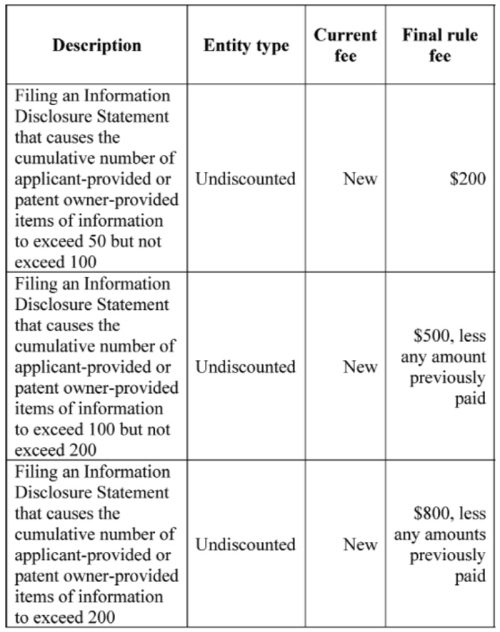
    The USPTO contends, however, that "[in] many instances, these large IDS submissions contain clearly irrelevant, marginally relevant, or cumulative information."  To battle this perceived problem, on November 20, 2024, the USPTO published its final rule for "Setting and Adjusting Patent Fees During Fiscal Year 2025" in the Federal Register.  While the final rule includes a number of fee increases and new fees, the IDS-specific fees are set forth in Table 10 and excerpted below.

    Table
    Notably, while Table 10 provides the large entity (undiscounted) fees, the final rule makes no mention of small or micro entity discounts for these fees.  Thus, it appears that the new IDS payment rules are as follows for all applicants:

    a first amount ($200) in § 1.17(v)(1) for a cumulative number of applicant-provided or patent owner-provided items of information in excess of 50;

    a second amount ($500) in § 1.17(v)(2) for a cumulative number of applicant-provided or patent-owner-provided items of information in excess of 100 but not exceeding 200, less any amount previously paid under § 1.17(v)(1); and

    a third amount ($800) in § 1.17(v)(3) for a cumulative number of applicant-provided or patent owner-provided items of information in excess of 200, less any amounts previously paid under § 1.17(v)(1) and/or (v)(2).

    The USPTO justifies these fees by noting that "[a]bout 5% of applications contain 51 to 100 applicant-provided items of information, about 4% of applications contain 101 to 200 applicant-provided items of information, and only 4% of applications contain more than 200 applicant-provided items of information."  While this means that the new IDS fees are expected to only impact about one of every eight applications, the USPTO states that it has provided examiners with "approximately 80,000 additional hours each year to consider large IDS submissions in applications, costing the agency $10 million annually."  The USPTO further asserts that "this cost is subsidized generally by patent fees, primarily maintenance fees collected for patents that resulted from applications that did not contain large IDS submissions."

    At first blush, this seems to be a reasonable justification for the fees.  However, upon deeper reflection it is not clear how the USPTO has calculated these numbers and whether they reflect actual costs in practice.  For example, it is common practice for applicants to file continuation applications with an IDS citing all art from all parent applications.  This can easily break the new 50-reference limit on free IDSs, especially if the application family has foreign counterparts where art has been cited or is perhaps the 3rd or 4th continuation (or more).

    This is less of a burden than meets the eye because the USPTO typically assigns the same examiner to all U.S. applications in a family.  So the majority of references in an IDS for a continuation may have already been considered by the examiner, and the examiner can proceed through the cited references much more quickly than references that are actually new.  If the USPTO's analysis does not take this factor into account, it is misleading and could dramatically overestimate the actual cost of handling large IDSs.

    Regarding continuations and the like, the USPTO writes:

    The cumulative count is determined for each application or patent separately.  That is, the count from an application does not carry over to any continuing applications, CPAs, reissue applications, or any post-issuance proceedings such as supplemental examinations or reexamination proceedings.  Instead, continuing, CPA, and reissue applications and post-issuance proceedings will start with a count of zero.[1]

    This means that references cited in a parent application do not count against any of its child applications unless those references are re-cited in the children.  But the USPTO reiterates its policy that examiners must "consider items of information that were considered in a parent application when examining a child application (e.g., a continuation, continuation-in-part, or divisional application) without any action required on the applicant's part."  It continues by clarifying that "applicants who wish to avoid paying the IDS size fees in a child application for items of information considered in a parent application may do so by not resubmitting the items."  That is, for the examiner, an applicant citing the same references makes essentially no difference in the scope of art that must be considered, but the applicant may face substantial fees for re-citation of those references.

    The USPTO's statements suggest a fee-reducing solution for applicants — do not cite any references in child application if those references were cited and considered in any of its parents.  The applicant will still need to cite any references that were not cited in the parent applications, but that number is likely to be significantly smaller.  The downside to this strategy is that the uncited references from the parent application will not appear on the face of the any patent that issues from the child application.

    The value of the cited references being so clearly set forth in the patent is debatable, but it is clear that it provides some benefit.  On one hand, whether references are printed on its face has no material impact on the validity of a patent.  On the other hand, it may be helpful to show a jury (and perhaps certain judges) this crystal clear evidence that the examiner found the issued claims patentable over the references.  And for the public, it provides immediate notice that the cited art was considered by the examiner without requiring a dive into the prosecution history.

    To simplify its enforcement of the IDS fee plan, the USPTO is also requiring that "an IDS contain a clear written assertion by the applicant and patent owner that the IDS is accompanied by the appropriate IDS size fee or that no IDS size fee is required."  While "[t]here is no specific language required for the written assertion, . . . it should be readily identifiable on the IDS and clearly convey the applicable IDS size fee by specifying the particular paragraph in § 1.17(v) that applies (e.g., ''the fee due under 1.17(v)(2)''), if any."

    The USPTO will update its standard IDS form to incorporate this language, but there is a trap for the applicant.  Unlike other fees, the applicant cannot generally authorize the office to charge the appropriate IDS fee to a deposit account.  Instead, "authorization to charge fees to a deposit account is not a compliant written assertion under the new § 1.98(a) requirement, unless the authorization clearly identifies the particular IDS size fee that should be charged for submission of a particular IDS."

    This means that the applicant needs to maintain an accurate count of applicant-submitted references per application.  Doing so is an onerous task that the USPTO is pushing on to applicants.  While there may be software tools to help an applicant do this bookkeeping, these tools are not free and the labor cost of using them is not cheap.  So, for the privilege of paying the USPTO more fees, applicants have do more work.  And the burden will fall most heavily on small and micro entities and lower-cost practitioners who have less ability to spread the cost of calculation over numerous applications.

    The USPTO states, to the contrary, that "the fee should not disproportionately impact small and micro entities."  We disagree.  All USPTO fees disproportionately impact small and micro entities.  The largest entities are multi-billion and trillion dollar companies.  While their patent budgets are finite, they are often quite large and can be adjusted for inflation and fee increases.  On the other hand, small and micro entities are often startups, small businesses, or individual inventors.  These entities are self-funded or funded through loans, angel investors, and/or venture capital, and every dollar counts.  Patent filing and prosecution (not to mention inter partes reviews) are significant costs that are harder to absorb than for larger entities.  As a general premise, bureaucracy favors the powerful.  Here, the USPTO's increase in the bureaucratic process required to comply with the duty to disclose will disproportionately impact those with fewer resources.

    In any event, what is an applicant to do in light of the final rule and its new IDS fees?  Here are a few concrete suggestions to reduce the impact of these fees and the time-cost of associated labor.

    • As noted above, refrain from filing previously-cited art in IDSs in continuations and other forms of child applications.  While doing so results in the references not appearing on the issued patent, they are still of record in the file wrapper of the parent(s).

    • The new fees are based on the number of applicant-cited references per application, but not the size of these references.  To the extent that the applicant can cite to longer, more comprehensive references in lieu of multiple shorter references containing the same content, the applicant should do so.[2]  For example, a product manual (if it qualifies as prior art) is often one of the most detailed and relevant references available to applicants and could (in principle) replace several other references that are cumulative.

    • Many applicants use third-party prior art search firms.  Applicants may wish to instruct these firms to provide search results for no more than the very most relevant references found.  Applicants have no duty to disclose references of which they are not aware and do not have in their possession.  Of course, this may make the examiner's job more difficult and decrease patent quality, but it is a problem the USPTO is buying for itself.

    • Applications with corresponding academic publications may be the type that most easily run afoul of the new fees.  Modern academic papers routinely cite dozens or even hundreds of non-patent literature references.  Some of these are quite lengthy (e.g., book chapters or entire books).  Moreover, it may be difficult for patent practitioners to reasonably determine the relevance or cumulative nature of such references in highly sophisticated, complex sciences and technologies.  Current practice is to cite all references in a corresponding paper in an IDS, and there may not be a way to avoid doing so without incurring more actual cost than the USPTO fees themselves.

    • While applicants should avoid citing references of marginal relevance, they need to remember the subjective nature of such an analysis.  When push comes to shove, it is better for both the applicant and practitioner to pay the USPTO a few hundred dollars than risk any eventual patent being found unenforceable due to a known but uncited reference.

    In short, there may be steps that applicants can take to minimize the effect of the new fee rules.  But we are going to see prosecution practices change in unpredictable ways that may not benefit applicants, practitioners, examiners, or the public.

    [1] Given that the cost of Requests for Continuing Examination (RCEs) are going up significantly, the cost of an IDS citing additional references may factor heavily into whether an applicant files a continuation application or an RCE.  This is another unintended consequence of the USPTO’s fee changes, but it is unclear how it will change prosecution practice.

    [2] It should go without saying that the applicant must never engage in gamesmanship, such as combining multiple references into one file and submitting it as a single reference or citing a later-dated, more comprehensive document instead of an earlier publication.

  • By Kevin E. Noonan


    Vidal  KathiAs has been expected, the Director of the U.S. Patent and Trademark Office, the Honorable Kathi Vidal, has announced her resignation.  Deputy Director Derrick Brent will assume her position (at least temporarily) starting in the second week of December.

    As Director, Ms. Vidal (at right) has been involved in a variety of efforts unlikely to survive the change in administration and her letter exhibits her awareness of these changing tides.  Her announcement relates her intentions to go back to the private sector.

    Regarding her tenure, Ms. Vidal provides praise for the PTO workforce and called the Office during her tenure an "agency of opportunity."  While citing a number of the Office's accomplishments while she was Director she expressly calls out the agency's Strategic Plan Accomplishments Page, the National Strategy for Inclusive Innovation, and National Entrepreneurship Strategy and creation of "the new Office of Public Engagement."  The Office's continuing mission, she states, is "to drive U.S. innovation, inclusive capitalism, and global competitiveness for the benefit of all Americans," and calls for a peaceful and orderly transition" of administrations.

    The message itself is set forth below, including her personal e-mail address.

    Message to my USPTO friends and colleagues:

    It has been an honor and a true joy to be with you on our collective journey these last few years.  Together we have transformed the USPTO.  We have executed on our mission to proactively defend and promote strong intellectual property to lift communities, create better jobs, and foster the American innovative spirit in everyone.  And we have been successful because of our commitment to putting employees first.

    Though our work is not done, it is time for me to turn the reins over to Deputy Director Derrick Brent, who has worked alongside me every step of the way.  My last day at the USPTO will be in the second week of December.  I will be moving back into the private sector and working with individuals and companies directly, committed to our same mission.

    Know that the work we have done—from weaving employee experience and inclusion into the fabric of our operations, to focusing on the USPTO as not only America's Innovation Agency but as an agency of opportunity—will persist.

    Thank you for your dedication, service, and support of one another.  You have challenged me, and each other, to be better.  And you have showed up every day with ingenuity and thoughtfulness to meet that challenge!  You are not only some of the most skilled and innovative people I've ever worked with, you are my friends and treasured colleagues, and I will be forever grateful for your work, which powers our communities and country.

    Our record of accomplishments during the Biden-Harris Administration is unprecedented (Strategic Plan Accomplishments Page).  Together we pointed the USPTO in a new direction focused on employees and customers.  We united under the mission to drive U.S. innovation, inclusive capitalism, and global competitiveness for the benefit of all Americans.  We sat at the table with our union representatives to enshrine our people-first approach into updated collective bargaining agreements for Patents and Trademarks employees, and for support staff to come.  And we created the new Office of Public Engagement to expand and strengthen our outreach.  I am very proud of the amazing progress we've made together.

    We would not have gotten this far without the strength of our people at the USPTO.  We have developed processes, procedures, and policies to improve the employee experience and inclusion.  Thousands of you contributed to those changes through my small listening sessions, with questions and ideas in the employee portal, and in conversations at events.  And as a result, we were named one of the most inspiring places to work in government this year.  That is an accolade I know I am very proud of and that agency leadership is committed to maintaining.

    As we approach the end of the Biden-Harris Administration, please keep up the good work and continue to execute on our mission for innovators and creators.  And please stand ready to work with the incoming administration's team.  As President Biden said last week, the American people deserve a peaceful and orderly transition.

    Even though I will be moving on in the next few weeks, I am committed to finding new ways to work alongside and support you, including founding a new ChIPs USPTO chapter, working to foster our alumni network that we launched here together, supporting you through the Patent and Trademark Office Society and the American Association of Patent Judges, advancing our National Strategy for Inclusive Innovation and National Entrepreneurship Strategy, and so much more!

    I will remain a click away at kathividal2024@gmail.com and will see you on socials.

    With gratitude,

    Kathi

  • By Kevin E. Noonan

    Federal Circuit SealThe Federal Circuit has been petitioned by plaintiff Teva Branded Pharmaceutical Products R&D, Inc. to reverse a decision in favor of Defendant Amneal Pharmaceuticals, wherein the District Court entered an injunction ordering Teva to delist five Orange Book-listed patents, in Teva Pharms. Inc. v. Amneal Pharms. LLC.  This post concerns Amneal's response to Teva's arguments in its Opening Brief.

    To recap, the issues arose in litigation over Amneal's ANDA directed to its generic version of Teva's ProAir® HFA (albuterol sulfate) Inhalation Aerosol product.  In this litigation, Teva asserted five Orange Book-listed patents:  U.S. Patent Nos. 8,132,712 ("the '712 patent"), 9,463,289 ("the '289 patent"), 9,808,587 ("the '587 patent"), 10,561,808 ("the '808 patent"), and 11,395,889 ("the '889 patent") having these representative claims:

    8,132,712:

    1.  A dose counter for a metered-dose inhaler, the counter comprising: an actuator; a rotary gear; a driver for driving the rotary gear in a step-wise fashion in response to displacement of the actuator, the rotary gear comprising a wheel mounted on a spindle which wheel having a plurality of ratchet teeth around its periphery; a pawl to prevent reverse rotation of the rotary gear; and a display coupled to the rotary gear, the display having a visible array of incrementing integers on a surface thereof indexable by a single integer in response to each step of the step-wise rotary motion of the rotary gear; wherein the pawl comprises at least two ratchet teeth each for engaging with the ratchet teeth of the wheel to prevent reverse rotation of the rotary gear, the at least two ratchet teeth being radially spaced such that one of the at least two ratchet teeth of the pawl engages with the ratchet teeth of the wheel following each step of the step-wise rotary motion of the rotary gear.

    18.  The use of a dose counter for preventing miscounting in a metered dose inhaler, the dose counter comprising: an actuator; a rotary gear; a driver for driving the rotary gear in a step-wise fashion in response to displacement of the actuator, the rotary gear comprising a wheel mounted on a spindle which wheel having a plurality of ratchet teeth around its periphery; a pawl to prevent reverse rotation of the rotary gear; and a display coupled to the rotary gear, the display having a visible array of incrementing integers on a surface thereof indexable by a single integer in response to each step of the step-wise rotary motion of the rotary gear; wherein the pawl comprises at least two ratchet teeth each for engaging with the ratchet teeth of the wheel to prevent reverse rotation of the rotary gear, the at least two ratchet teeth being radially spaced such that one of the at least two ratchet teeth of the pawl engages with the ratchet teeth of the wheel following each step of the step-wise rotary motion of the rotary gear.

    9,463,289:

    1.  An inhaler for metered dose inhalation, the inhaler comprising:
        a main body having a canister housing,
        a medicament canister, which is moveable relative to the canister housing and retained in a central outlet port of the canister housing arranged to mate with a canister fire stem of the medicament canister, and
        a dose counter having an actuation member having at least a portion thereof located in the canister housing for operation by movement of the medicament canister,
        wherein the canister housing has an inner wall, and a first inner wall canister support formation extending inwardly from a main surface of the inner wall, and
        wherein the canister housing has a longitudinal axis X which passes through the center of the central outlet port,
        the inner wall canister support formation, the actuation member, and the central outlet port lying in a common plane coincident with the longitudinal axis X.

    9,808,587:

    1.  An inhaler for metered dose inhalation, the inhaler comprising:
        a main body having a canister housing,
        a medicament canister, which is moveable relative to the canister housing and retained in a central outlet port of the canister housing arranged to mate with a canister fire stem of the medicament canister, and
        a dose counter having an actuation member having at least a portion thereof located in the canister housing for operation by movement of the medicament canister,
        wherein the canister housing has an inner wall, and a first inner wall canister support formation extending inwardly from a main surface of the inner wall,
        wherein the canister housing has a longitudinal axis X which passes through the center of the central outlet port, and
        wherein the first inner wall canister support formation, the actuation member, and the central outlet port lie in a common plane coincident with the longitudinal axis X such that the first inner wall canister support formation protects against unwanted actuation of the dose counter by reducing rocking of the medicament canister relative to the main body of the inhaler.

    10,561,808:

    1.  A dose counter for an inhaler, the dose counter having a counter display arranged to indicate dosage information, a drive system arranged to move the counter display incrementally in a first direction from a first station to a second station in response to actuation input, wherein a regulator is provided which is arranged to act upon the counter display at the first station to regulate motion of the counter display at the first station to incremental movements.

    11,395,889:

    1.  An incremental dose counter for a metered dose inhaler having a body arranged to retain a canister for movement of the canister relative thereto, the incremental dose counter having a main body, an actuator arranged to be driven and to drive an incremental output member in a count direction in response to canister motion, the actuator being configured to restrict motion of the output member in a direction opposite to the count direction, such that the actuator acts as an anti-back drive member when the actuator is in a non-depressed position, and wherein the incremental dose counter further comprises a second anti-back member configured to restrict motion of the output member in a direction opposite to the count direction when the actuator is disengaged from the output member by a bump surface.

    The District Court granted Amneal's motion on the pleadings (asserted in its counterclaims as required by statute) that these patents were improperly listed in the Orange Book as not being directed to an FDA-approved drug nor method of using such a drug for treating a disease or disorder, and granted an injunction compelling Teva to delist these patents.  Teva appealed, the Federal Circuit entering a stay on the order to delist during pendency of the appeal.

    On appeal, Teva made two arguments:  the first is based on a legal and technical definition of how the term "drug product" is defined in the statute, and the second is whether the District Court erred procedurally, including whether claim construction was required to properly determine the first question.

    Amneal's Responsive Brief

    In its responsive brief, Amneal (unsurprisingly) argues that the District Court made the right decision (and to be fair also has the easier argument, in view of the intrinsic tug of the argument that Orange Book-listed patents should, at a minimum, recite the drug product itself, in this case albuterol sulfate).  In its argument, Amneal emphasizes (literally) that FDA's definition of a "drug product" recites "a finished dosage form…that contains a drug substance, generally, but not necessarily, in association with one or more other ingredients," citing 21 C.F.R. § 314.3 (emphasis added) (in contrast to Teva, Amneal cites the FDA rules rather than the statutory language).  Amneal contends that "the drug substance" is albuterol sulfate per se and not the combination of the drug and the inhaler that is the subject matter of the claims destined to be delisted if the District Court decision is affirmed.  As Amneal states in its argument, "[i]t is undisputed, however, that the Asserted Patent claims do not recite, identify or refer to the drug substance—albuterol sulfate—as a part of the claimed inventions" (at least not expressly).  Amneal argues that, to overcome these infirmities Teva and its amici (actually only two of seven amicus briefs filed) "seek in effect to rewrite the Listing Statute" by changing the plain meaning of the term "claims" therein to mean "reads on any part of" (which is an abbreviated but not entirely unfair characterization).  Teva does indeed argue in its opening brief that the claims of its asserted patents read on its ProAir inhalation device, but that this is analogous to claims for excipients or generic claims that do not recite the species identified as the active pharmaceutical ingredient.  Where Amneal identifies the principle distinction between the parties' positions is in the definition of the term "drug product," as will be set forth herein.  Further, Amneal disputes the need for claim construction because "even if the claims were construed as Teva proposes, the Asserted Patents still would not qualify for listing in the Orange Book" as they do not recite albuterol sulfate as an affirmative limitation therein.

    Amneal's brief identifies the legal issue in the appeal as being the proper construction of that portion of the statute that sets forth what must be disclosed in any patent listed in the Orange Book (21 U.S.C. § 355(b)(1)(A)(viii)):

    (viii) the patent number and expiration date of each patent for which a claim of patent infringement could reasonably be asserted if a person not licensed by the owner of the patent engaged in the manufacture, use, or sale of the drug, and that—

    (I) claims the drug for which the applicant submitted the application and is a drug substance (active ingredient) patent or a drug product (formulation or composition) patent; or

    (II) claims a method of using such drug for which approval is sought or has been granted in the application.

    Amneal's interpretation of this portion of the statute is that it requires any patent listed to be one wherein "there [would] be a reasonable basis to assert that the patent would be infringed by the unauthorized manufacture, use, or sale of the NDA drug" (emphasis added).  The brief sets forth the history of this portion of the statute insofar as it was changed in 2021, purportedly due to an appreciation (evinced by a House committee report) of "the proliferation of device patents submitted under the auspices of the Listing Statute for drug device combination products, including, most commonly, inhalers," which delayed generic entry by an average of 3.4 years.  Relevant to the issue before the Court, Amneal cites the definition of "drug product" in FDA regulations (but not the statute) to require the presence of the drug substance, citing 21 C.F.R. § 314.3:  "Drug product is a finished dosage form, e.g., tablet, capsule, or solution, that contains a drug substance, generally, but not necessarily, in association with one or more other ingredients (emphasis in brief)."  The statute, on the other hand, defines the term "drug" broadly (according to Amneal) at 21 U.S.C. § 321(g)(1):

    (A) articles recognized in [certain compendia]; and (B) articles intended for use in the diagnosis, cure, mitigation, treatment, or prevention of disease in man or other animals; and (C) articles (other than food) intended to affect the structure or any function of the body of man or other animals; and (D) articles intended for use as a component of any article specified in clause (A), (B), or (C).

    and defines "device" at 21 U.S.C. § 321(h)(1) as:

    [A]n instrument, apparatus, implement, machine, contrivance, implant, in vitro reagent, or other similar or related article, including any component, part, or accessory, which is — (A) recognized in [certain compendia], (B) intended for use in the diagnosis of disease or other conditions, or in the cure, mitigation, treatment, or prevention of disease, in man or other animals, or (C) intended to affect the structure or any function of the body of man or other animals, and which does not achieve its primary intended purposes through chemical action within or on the body of man or other animals and which is not dependent upon being metabolized for the achievement of its primary intended purposes.

    As interpreted by the D.C. Circuit, "FDCA prohibits the FDA from treating a device as if it were a 'drug,'" citing Genus Medical Techs. LLC v. United States, 994 F.3d 631, 644 (D.C. Cir. 2021), "even though [Amneal concedes] the term 'drug' is so broadly defined that it linguistically could include a device."  Amneal points out that the District Court held, consistent with the decision by the Second Circuit's decision in United Food v. Takeda Pharm. Co. Ltd., 11 F.4th 118, 134 (2d Cir. 2021), that "the Listing Statute required a drug product patent to claim not just any 'drug,' but specifically 'the drug for which the applicant submitted the application,'" nor did any of the asserted claims to inhaler devices qualify under the statute as a "finished dosage form."

    Regarding the requirements for qualifying as a drug product Amneal's brief identifies three:

    • "First, it must be a 'patent for which a claim of infringement could reasonably be asserted [against unauthorized] manufacture, use or sale' of the NDA product. 21 U.S.C. § 355(b)(1)(A)(viii).  In other words, it must be infringed by the NDA product.

    • "Second, the patent must be a 'drug product' patent, which simply means that it must claim a drug product. 21 U.S.C. § 355(b)(1)(A)(viii)(I) [although this seems to beg the question here].

    • "Third, the patent must 'claim[] the drug for which the applicant submitted the application.""

    Amneal argues that the second and third requirements act in tandem to require that the patents claim not just any drug product but the approved drug product itself.  Under this interpretation, the Orange Book-listed claims must recite the drug product (here, albuterol sulfate) and as they undisputedly do not the Court should affirm the judgment of the District Court and lift the stay of the injunction compelling Teva to delist these patents.

    Amneal argues that Teva's interpretation of these statutory provisions is erroneous, by being contrary to how the term "claims" is interpreted, inter alia, in Hoechst-Roussel Pharms., Inc. v. Lehman, 109 F.3d 756, 758-59 (Fed. Cir. 1997), and Graver Tank & Mfg. Co., Inc. v. Linde Air Prods. Co., 339 U.S. 605 (1950).  Further, Amneal argues that this interpretation would render superfluous the requirement that the patent "claims the drug," contrary to statutory interpretation precedent citing Facebook, Inc. v. Windy City Innovations, LLC, 973 F.3d 1321, 1336 (Fed. Cir. 2020), and Arlington Cent. Sch. Dist. Bd. of Educ. v. Murphy, 548 U.S. 291, 299 n.1 (2006) in support for this argument.  Also, Amneal argues, this overbroad reading of the statute would permit listing of patents for "any type of component, regardless of its nature."  While conceding that "adjacent" provisions of the NDA statute permits "NDA applicants to submit information and samples of all components of the NDA drug" in Amneal's view what is permitted to be listed in the Orange Book is more narrow (it "does not broadly permit listing of any kind component patents" (emphasis in brief)).  What is permitted is listing patents of only one kind, those that claim "a drug substance (active ingredient)" under 21 U.S.C. §355(b)(1)(A)(viii)(I), and Amneal argues that "this implies that patents on other kinds of drug components are not authorized," citing Syngenta Crop Protection, LLC v. Willowood, LLC, 944 F.3d 1344, 1361 (Fed. Cir. 2019) (emphasis added).  Amneal objects to Teva's "plug[ging]" the "component" aspect of the definition of the term "drug" into the statute, due to the specificity of the statutory language for "the drug for which the applicant submitted the application."  Citing Genus Medical Techs. again Amneal further argues that "the FDCA prohibits the FDA from treating a device as if it were a drug" and thus ("by extension") the statute should prohibit FDA from listing patents that claim only devices from being listed as if they claimed a drug.

    Amneal argues that the plain meaning of the Listing Statute does not authorize listing of "any drug product" (emphasis in brief) but only if the patent "claims the [NDA] drug" under 21 U.S.C. § 355(b)(1)(A)(viii)(I) and further that this interpretation is supported by the legislative history (which indicates "congressional intent to curtail the listing of device component patents specifically").  This interpretation, Amneal argues, is also consistent with FDA's definition of a "drug product," the inclusion of which in the Listing Statute necessarily contains the NDA-approved drug product itself.  (Amneal points out that in other contexts Teva itself argued that "drug product patents must require the presence of the active ingredient to qualify for listing in the Orange Book," citing Warner Chilcott (US), LLC v. Teva Pharms. USA, Inc., No. 18-1241 (Fed. Cir. 2018)).  If a "drug product" requires the presence of an approved drug substance in the product, Amneal argues that a "drug product patent" must also do so (emphasis in brief), and if a drug product patent must also claim the FDA-approved drug, "at a minimum" such a patent "must . . . require the presence of the particular drug substance in the NDA product."

    Taken together none of the asserted patents meet these requirements, Amneal asserts.

    Turning to Teva's arguments, Amneal asserts they are "both erroneous and problematic" for four reasons: they "stray from controlling black letter patent law" under 35 U.S.C. § 112 and erroneously equating "claiming with being infringed"(emphasis in brief); the interpretation would make superfluous the "claiming the drug" requirement; Teva's arguments "ignore[] FDA's definition of 'drug product'"; and "would open up the Orange Book to patents on any aspect of the NDA product or any component that happens to be found in the NDA product."  So doing would be contrary to the existence of the "powerful exclusionary rights bestowed on Orange Book patents" (naming an automatic preliminary injunction, i.e., the 30-month stay, and automatic permanent injunction for the prevailing NDA holder). Amneal also mentions that requiring Orange Book-listed patents to recite the approved drug product "provides a clear rule that will allow stakeholders to more confidently order their affairs when it comes to the listing of patents in the Orange Book" (elsewhere calling this a "commonsense notion").

    Specifically, Amneal argues that the claims in an Orange Book-listed patent must recite the NDA-approved drug, not merely by infringed by the accused generic product as Teva contends, if only because Federal Circuit precedent, Hoechst-Roussel Pharms., Inc. v. Lehman, 109 F.3d 756, 758-59 (Fed. Cir. 1997), has acknowledged the statutory requirement that the patent "particularly pointing out and distinctly claiming the subject matter which the inventor . . . regards as the invention" under 35 U.S.C. § 112(b).  Amneal makes a simple and straightforward argument, that because "the words of the claim do the claiming," citing Corning Glass Works v. Sumimoto Elec. U.S.A., Inc., 868 F.2d 1251, 1258 (Fed. Cir. 1989) (emphasis in brief), the absence of those words (specifically, of the NDA-approved drug substance, albuterol sulfate) precludes Teva from properly Orange Book listing the asserted claims.  Once again, Amneal asserts the legislative history of amendments to the Listing Statute to illustrate Congress's concerns, including a direction to the General Accounting Office "to submit data on claims in listed patents 'that claim a device that is used for the delivery of the drug, but do not claim such device in combination with an active ingredient or formulation of a drug,'" Orange Book Transparency Act of 2020, Pub. L. No. 116-290, 134 Stat. 4889, 4892 (Jan. 5, 2021).  This history, Amneal argues, also forms the basis for the Court to narrowly construe the Listing Statute, because it "demonstrates [that] these requirements were introduced expressly to preclude Orange Book listing of the very type of device patents at issue here."  This "plain meaning" interpretative analysis is supported by the Takeda case from the Second Circuit and In re Lantus Direct Purchaser Antitrust Litig., 950 F.3d 1, 7-8 (1st Cir. 2020), relied upon by the District Court, Amneal argues.  Amneal also cites a 1997 Guidance from FDA "explaining" that "a drug product patent must explicitly 'refer to' the NDA product," where Amneal contends "refer to" be interpreted to mean "recite in the claims" of such a patent.  Teva's arguments that "being infringed" is equivalent to "claiming" is contrary to Federal Circuit precedent, Amneal argues, including Hoechst, and is not supported by the Apotex case, relied upon by Teva.  In that case, Amneal argues, the Court merely held that infringement is a necessary, but not sufficient condition (emphasis in brief), and in any case Amneal contends, statements relied upon by Teva are merely dicta (because they were directed to whether the Federal Circuit had jurisdiction).  Amneal similarly dismisses the relevance of Envirotech Corp. v. Al George, Inc., 730 F.2d 753, 759 (Fed. Cir. 1984), and Teva's proffered interpretation of Takeda.

    Amneal further challenges Teva's construction of the Listing Statute as rendering the "claims the drug" requirement to be superfluous and that it is "far more expansive than afforded by a fair reading of the Listing Statute" so as to encompass "any component found in the [approved] NDA product" (emphasis in brief).  Amneal challenges Teva's argument that requiring the "NDA drug substance" to be present would render the "drug substance" category superfluous, because the statute contains two categories of patents:  "A drug substance patent requires only the drug substance per se, whereas a drug product patent requires both the drug substance and some further aspect(s) of the drug product."  And the requirement is not merely for "a" drug but for "the" NDA-approved drug "for which the applicant submitted the application" under 21 U.S.C. § 355(b)(1)(A)(viii)(I), which is also the most unambiguous way of understanding the meaning of the term in the context of the Listing Statute, Amneal argues.

    Amneal puts its greatest reliance in this regard on the Genus Medical Techs. LLC case, wherein the Court held that "the FDA is prohibited from regulating as a 'drug' anything that meets the statutory definition of a 'device,' even if that item also meets the definition of a 'drug'" because FDA is prohibited from Orange Book-listing patents that claim only a device, Amneal argues.  ("Teva's interpretation cannot be correct, because it would permit precisely what the FDCA prohibits.")  Devices are not drug formulation "ingredients" (which can be listed under the category as components of a "formulation" or "composition") in Amneal's view.

    Amneal also addresses Teva's attempts to overcome ("decouple") the undisputed absence of any mention of the drug substance, albuterol sulfate, from the asserted claims of the Orange Book-listed patents at issue.  Simply put, the proper consequence of this absence is for the Court to recognize that these patents to not "claim" the NDA drug product and thus should be delisted, according to Amneal.

    Amneal further argues that its interpretation of the Listing Statute "best aligns" with Hatch-Waxman Act goals regarding the balance between exclusivity for brand drugmaker's NDA-approved drugs (and the "extraordinary" injunctive rights conferred by the statute) and opportunities for generic competition.  Adopting Teva's interpretation of the Listing Statute, on the other hand, would permit "patents having nothing to do with the drug development efforts for a given product" to be listed in the Orange Book "as long as the claimed invention, no matter how inconsequential, was found in some part of the NDA product."  And Teva (in addition to listing the asserted patents in this litigation in connection with 21 different products) retains the right to assert them against generic drugmakers under other subsections of 35 U.S.C.§ 271, albeit without the extraordinary advantages conferred by 35 U.S.C.§ 271(e)(2).

    Finally, in this regard Amneal rebuts Teva's "baseless and hyperbolic" policy arguments (which will be discussed in future posts on the two amicus briefs submitted in support of Teva).

    Amneal asserts in a separate section of the brief that the claims of any properly Orange Book-listed claims must recite the presence of the approved drug, albuterol substrate, and further that there is no need for claim construction because, on their face none of the listed patents asserted by Teva satisfy this requirement.

    Teva's Reply to Amneal is discussed here.