
The Decision on Priority
By Kevin E. Noonan –

On March 26, the Patent Trial and Appeal Board, without holding an oral hearing and despite a rather sharply worded opinion by the Federal Circuit vacating and remanding its earlier priority decision (see “Regents of the University of California v. Broad Institute, Inc. (Fed. Cir. 2025)“), granted priority in Interference No. 106, 115 to Senior Party The Broad Institute, Harvard University, and MIT (collectively, “Broad”) over Junior Party the University of California/Berkeley, the University of Vienna, and Emmanuelle Charpentier (collectively, “CVC”). To the extent that the Federal Circuit held that the Board erred in the manner in which the evidence was considered and settled interference law applied, this Decision on Priority shows little evidence of any inclination by the Board to reconsider either aspect of its prior analysis, once more seemingly being content to focus on the trees at the expense of the forest.
Procedurally, the Decision properly imposes the burden on CVC to show earlier conception by a preponderance of the evidence. The Decision delves deeply into the details of the methods for achieving eukaryotic CRISPR, assessing that evidence and finding the same indications in favor of Broad directed to their earlier reduction to practice swaddled in the language of conception (albeit avoiding the “incomplete conception” terminology found in their first priority decision). The Board rejects as unsupported by the evidence that achieving eukaryotic CRISPR would be “straightforward,” as some evidence and testimony asserted, once the sgRNA species was disclosed, the Decision stating that:
[W]e find that one of ordinary skill in the art would have been a practicing Ph.D. research scientist who would have known about the routine techniques and methods available but would have been less capable than the Zhang, Church, Kim, and Joung labs to reduce an embodiment of Count 1 to practice,
the Board apparently being convinced by Broad’s argument that the laboratories that quickly reduced eukaryotic CRISPR to practice (asserted by CVC as evidence that the methods used were “routine and well-known to the worker of ordinary skill) were not persons of ordinary skill but rather persons having sufficiently extraordinary skill to disqualify their efforts for the role attributed to them by CVC, despite the contemporaneous attribution to CVC of the methods for successfully performing CRISPR cleavage in eukaryotic cells. Paradoxically the Board’s appreciation that the Broad inventors may have been of greater than ordinary skill did not provide an explanation for why they were able to achieve actual reduction to practice of eukaryotic CRISPR slightly more rapidly (only a matter of a few months) than the CVC inventors were able to achieve.
Somewhat ironically, the Board once again focuses on statements by the CVC inventors regarding their difficulties in achieving CRISPR cleavage in eukaryotic cells, supported in this approach by their understanding that:
The court stated that “[t]he Board erred in its analysis by failing to consider routine methods or skill, and, instead, focusing almost entirely on Regents’ scientists’ statements about perceived experimental difficulties and doubts about success,” but the court did not say that the Board erred in considering the CVC inventors’ statements and the extent of their research or experimentation at all in the determination of the preponderance of the evidence of conception.
But the Board seemingly ignored similar references to the frustrations of failure emanating from the Broad lab prior to the disclosure of sgRNA species by Dr. Marraffini (see CVC Opposition to Broad Opening Brief, which recites multiple examples of similar frustrations that seemed to disappear after Dr. Marraffini’s disclosure, including multiple instances of Zhang himself and his students evincing sentiments of failure prior to obtaining their invention from Marraffini (“the results were ‘nonspecific’” (Zhang); “wondering whether “‘other factors need to be identified’ for a working CRISPR system” (Lin); “Zhang’s experiments ‘all failed’; ‘d[id] not work in human cells; and had ‘fail[ed] to induce genome modification’”; “‘it was really a pity’ that Zhang’s lab ‘did not work it out before seeing [CVC’s] paper.’” (Lin)). The Board justifies its focus on any changes in the CRISPR methods during development by CVC as being evidence of incomplete conception (albeit avoiding that particular sobriquet) because:
Count 1 includes the ability of the CRISPR-Cas9 system to cleave or edit DNA in the eukaryotic cell to alter gene expression, we consider any additional requirements that affected the ability of the CRISPR-Cas9 system to cleave or edit DNA in the eukaryotic cell to alter gene expression to be a substantive aspect of the inventors’ conception of an embodiment within the scope of Count 1.
And there are other assertions in the Decision indicating a particular perspective when considering the relationship between conception and reduction to practice that seem inconsistent with the Federal Circuit’s concerns with the Board’s prior assessment of priority, for example “[t]he need for seven months of diligent work is not consistent with the CVC inventors having conceived of and described a complete system that would have required only ordinary skill, without extensive research or experimentation, to reduce to practice.”
In addition, CVC’s arguments suffered from the Federal Circuit’s decision not to overturn the Board’s determination that CVC’s earliest provisional applications (U.S. Provisional Application Nos. 61/652,086, P1, and 61/716,256, P2) did not provide a constructive reduction to practice of eukaryotic CRISPR (ironically because they did not disclose an actual reduction to practice of eukaryotic cell CRISPR), as illustrated in this graphical representation:
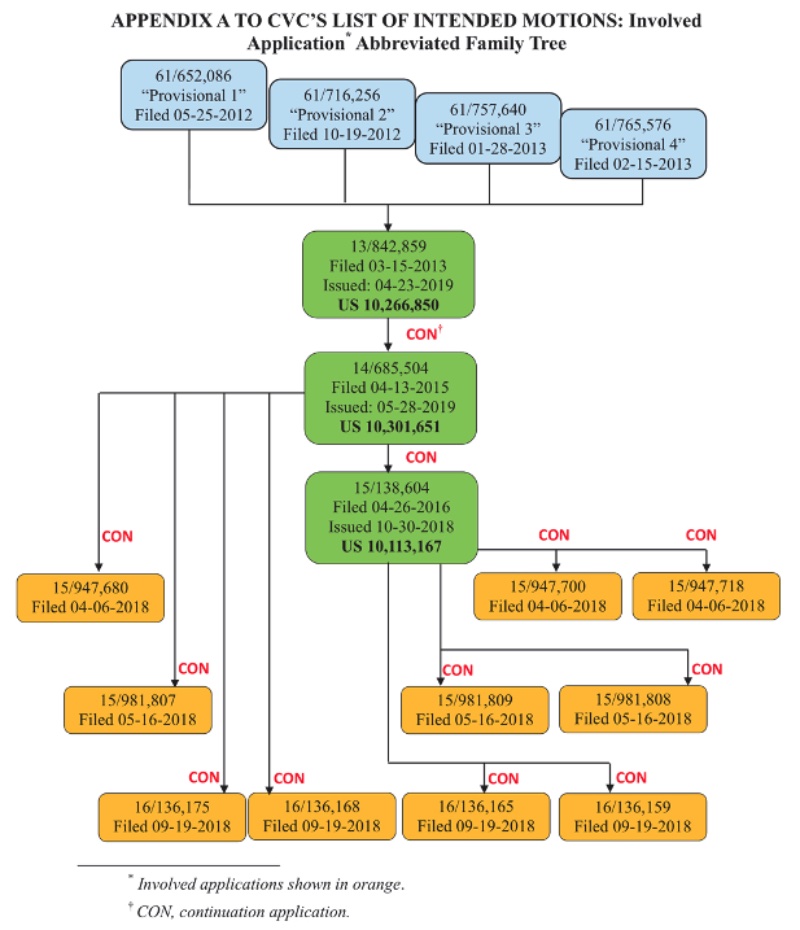
The Board’s decision is based on Broad’s earlier evidence of actual reduction to practice and the later filing date of CVC’s U.S. Provisional Application No. 61/757,640 (which was credited with constructive reduction to practice for containing experimental evidence of actual reduction to practice). Underlying this analysis is a sub silentio acceptance of Broad’s long-standing argument that the complexity of performing CRISPR in eukaryotic cells raised a “simultaneous conception and reduction to practice” standard as applied but not enunciated in the Decision.
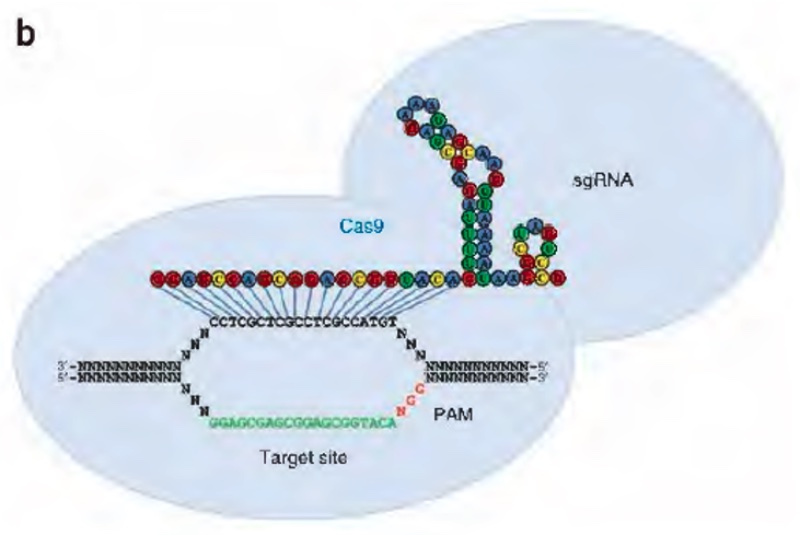
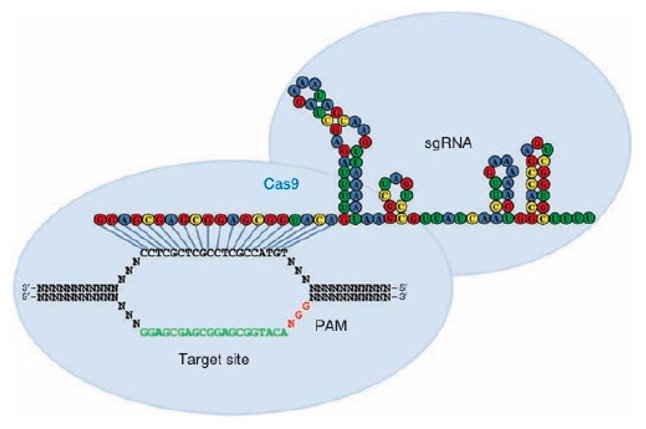
The Decision relies as well on certain structural differences in the sgRNA species developed by Broad, which could be relevant to their success in achieving actual reduction to practice according to Broad, as shown in these illustrations wherein the top illustration was used in vitro (CVC) and the bottom in vivo (Broad):
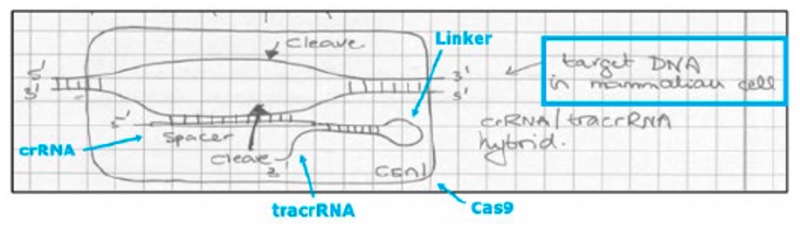
The Board apparently disregarded the history of the efforts to practice CRISPR cleavage in eukaryotic cells, which showed various variations and timelines of success, but that the one thing that all the labs had in common was using sgRNA to do so, a species unrecognized by any of these groups (including the Broad) prior to CVC’s disclosure of it. As pointed out in CVC’s Opposition to Broad’s Opening Brief on Remand, prior to Dr. Marraffini’s disclosure on June 26, 2012, the RNA components of CRISPR used by Broad (as disclosed in the January 12, 2012 NIH grant relied upon for Broad’s additional priority claim; see Parties Supplemental Priority Statements on Remand) had the structure:
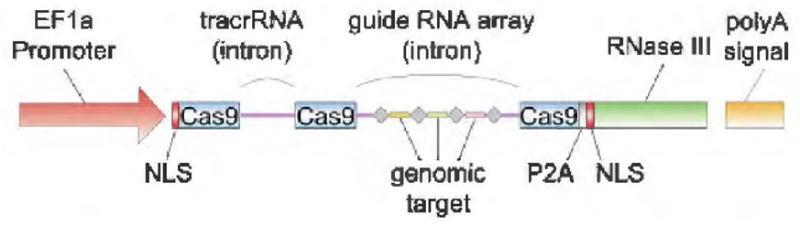
as compared with the sgRNA invented by CVC and disclosed by Dr. Marraffini and used substantially identically by Broad and the four other labs identified and relief upon by CVC:
Regarding derivation, as in its earlier Decision, the Board adopts the position that its determination regarding conception suffices to reject CVC’s arguments about derivation. By determining that CVC did not have sufficiently complete conception to be entitled to priority it follows (for the Board) that CVC’s inventors could not have disclosed the invention sufficiently for the Broad inventors to have derived it.
This Decision, like the one before it, will no doubt be appealed and that will give the Federal Circuit the opportunity to inform the PTAB, and the rest of us, whether its earlier decision and the instructions contained therein were followed or disregarded by the Board in arriving at substantially the same decision arrived at four years ago (see “PTAB Grants Priority for Eukaryotic CRISPR to Broad in Interference No. 106,115“). Ultimately, the question will be whether in the Board’s reconsideration of its determination of priority, the Federal Circuit believes that reconsideration of the issue of conception was performed “under the proper application of the legal framework.”
There is likely to be some comfort the CVC inventors can take from this outcome: whether the party who ultimately gets priority to the patents for this invention is remembered in the future, Jennifer Doudna and Emmanuelle Charpentier will be always remembered for winning the 2020 Nobel Prize for Chemistry for CRISPR.
 Patent Docs
Leave a comment