
By Dunstan Barnes and Catalina “Caty” Medrano –

On March 12, 2026, U.S. Patent and Trademark Office Director John A. Squires announced new supplemental guidance regarding examination of design patent applications related to computer-generated interfaces and icons. Prior to this announcement, the U.S. was lagging behind three of the other four major design jurisdictions (the European Union, Japan, and the Republic of Korea) in protecting digital designs for augmented and virtual reality. Until this announcement, apart from designs protecting typefaces and fonts, U.S. law required design patents to be tied to—and illustrated as being on or part of—a physical article of manufacture. This limited potential protection for designs that are entirely virtual or projected. This gap in protection created strategic challenges for businesses investing heavily in immersive technologies. In light of the new guidance, applicants may now protect designs by identifying, but not necessarily depicting, the article of manufacture for the design.
Brief Background of Graphical User Interfaces (GUIs)
The earliest interactive display may date back to the 1950s, when Canadian Navy engineers integrated radar displays with trackball-operated cursors. While this pioneered the concept of direct manipulation through use of a display, it preceded the modern desktop standard by decades. During the 1960s and 1970s, computers remained specialized tools for professional environments. Text-based interfaces where users typed commands to execute processes were the norm, with most system design focused on hardware optimization and backend computational logic.
The landscape shifted dramatically in the 1980s with the release of the Apple Macintosh. As the first commercially successful mass-market computer featuring a GUI, the Macintosh became a catalyst for a new era of design centered on human interaction and user-friendliness. By the 1990s, the rapid adoption of personal computers in homes and small businesses introduced a user base with diverse backgrounds and less technical training. This shifted the market toward visually intuitive interfaces. As graphics technology advanced, vibrant color schemes and smooth transitions became essential benchmarks of a successful system.
Today, this paradigm remains the gold standard for interface development. Modern innovations, such as Apple’s pinch-to-zoom gestures and Google’s Material Design, are direct results of this evolution toward natural, high-fidelity interaction.
As we move forward into the future, designers have begun to develop GUIs that are not necessarily tied to a “display screen,” since they may be projected or virtual in nature.
Background of U.S. GUI Protection
The origin of U.S. design patent protection for graphical user interfaces is often traced back to Ex parte Strijland, 26 U.S.P.Q.2d (BNA) 1259 (B.P.A.I.), in which the applicant sought to protect the “ornamental design for an icon for information or the like, as shown and described.” (claimed icon shown below).
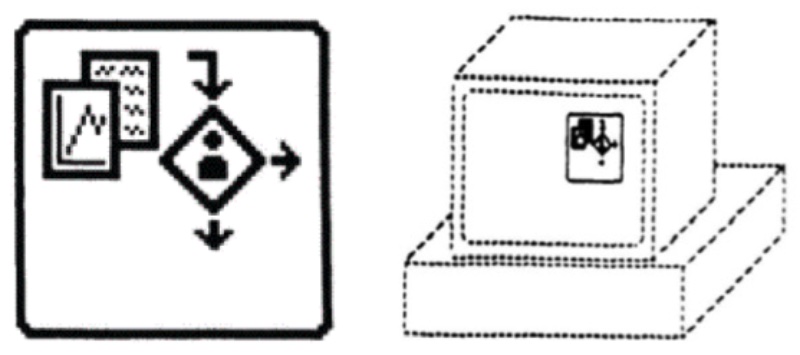
Despite affirming the rejection of the applicant’s design, the Board provided a roadmap as to how future applicants could seek to protect GUI designs, including showing an article of manufacture (such as a computer or display screen) in broken lines. The Strijland holding indicated that computer-generated icons are patent eligible and afforded protection under 35 U.S.C. § 171 so long as the specification demonstrates, including specifically through drawings, the design applied to an article as required by 35 U.S.C. § 171 and by 37 CFR § 1.152. By 1996, the USPTO had adopted the Strijland roadmap as its approach for assessing the subject matter eligibility of virtual designs.
Current Laws in the European Union
On May 1, 2025, the European Union—covering 27 member states—made significant changes to its design protection system. While the different changes are set to take effect (or already have taken effect) on different dates, one aspect of the new regulation that is in force already has expanded the definition of “product” to include “digital and non-physical creations.” Even though the existing EU design law allowed for protection of such designs as icons, GUIs, and fonts without reference to a display screen, the new changes more clearly allow applicants to protect wholly virtual components.
As such, as of the publication date of this article, each of the following categories of design are protectable by a Registered European Union Design:
• Graphic elements: logos, graphic symbols, icons, and graphic works
• Digital interfaces: GUIs, typefaces and fonts, application animations
• Virtual environments: objects in video games, metaverse products, and virtual spatial configurations
• Physical presentations: packaging, sets of articles, and interior arrangements (e.g., store designs)
Even before the new changes, many graphical designs were protectable without need for reference to a display screen or article of manufacture. For example, Registered European Union Design No. 015019470-0001, filed in April 2023, is directed to a 3D or animated character without reference to a display screen or article of manufacture.

Current European Union design laws tend to provide more flexible protection for graphical designs than many other jurisdictions.
Current Laws in Japan
Prior to April 2020, Japanese design law limited protection for GUI designs to visual designs that were stored locally and shown on an electronic device, such as a PC or smartphone.
Starting on April 1, 2020, Japan’s Design Act allowed broader design protection for GUIs, including images that are not stored locally (e.g., images that are found on the internet and not saved to a computer) as well as GUIs that are projected onto roads or walls. Note that Japan’s Design Act still requires a functional relationship between the GUI and the article of the design.
For example, six months after the new provisions took effect, the Japan Patent Office (JPO) granted Japanese Design Registration No. 1672383, which was filed on April 1, 2020, the date that the changes to Japan’s Design Act came into effect. This Japanese design registration is directed to a vehicle information display image. In particular, the design is directed to several images that may be projected onto a road surface from an image protection apparatus on a vehicle, such as a motorcycle. The images have a functional relationship between the projected GUI and the article of the design—for example, the projected GUI may be used to indicate to nearby drivers that the vehicle intends to change direction. The projected GUI may also help the driver to visually recognize the road surface condition around the vehicle, and may help other drivers to be aware of the presence of the vehicle due to the illuminated light on the road surface.
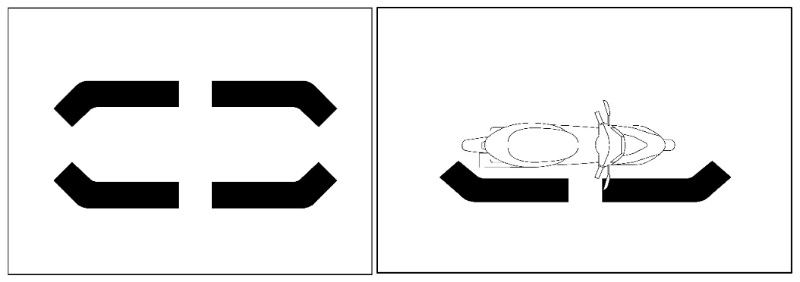
Prior to the changes to Japan’s Design Act, this GUI design would not have been protectable.
In March 2024, the JPO issued guidelines to further clarify how it would interpret the new regulations. These guidelines, which were published in response to a design patent application for a GUI in virtual reality, specified the following:
• To be protected, a GUI must be used for operating a physical device or must be displayed as a result of performing a function of a physical device.
• A GUI merely displayed in virtual reality, such a cosmetic virtual item, is not a protectable image.
• A GUI displayed in virtual reality may be protectable, so long as it meets all the traditional requirements for image protection (e.g., the GUI must have a functional relationship to the article of the design).
The updated JPO guidelines from the JPO provide a pathway for applicants considering filing applications for projected or virtual reality GUI designs.
Current Laws in the Republic of Korea (South Korea)
Prior to October 2021, designs that appeared outside of a physical article were not protectable in Korea. In October 2021, Korea amended its Design Protection Act to allow for the protection of projected and augmented reality designs. Similar to the current law in Japan, the new amendment allows for image designs not displayed on a screen to be protected, so long as design is used for “operation of a device that exhibits a function.”
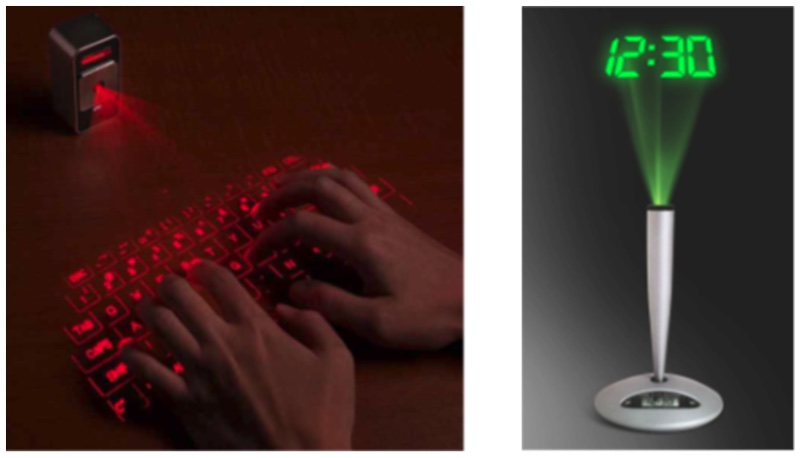
The Korean Intellectual Property Office (KIPO), which was elevated to ministry status in October 2025 and renamed the Ministry of Intellectual Property (MOIP), has provided two examples of previously unprotectable projected designs in its Design Examination Guidelines (figures below) that are now protectable under the current Korean Design Protection Act.
Current Laws in the United States
With the March 12, 2026 guidance, the USPTO has now:
(1) removed the requirement in MPEP § 1504.01(a) that the drawing depict the article of manufacture (e.g., a computer or a portion thereof) in either solid or broken lines for design patent applications drawn to computer-generated interfaces or icons where both the title and claim properly identify an article of manufacture;
(2) clarified that a design of a computer-generated interface or icon for a computer, computer display, or computer system is more than a mere transient or disembodied picture or three-dimensional image and is patent-eligible subject matter when disclosed and claimed in accordance with the pertinent rules and statutory requirements;(3) clarified that claim and title language that indicates that an icon or interface is “for” a computer, computer system, or computer display panel adequately describes a design for an article of manufacture under 35 U.S.C. 171 and that examiners will no longer be instructed to object to such claims and titles under 37 CFR 1.153 or 37 CFR 1.1067;
(4) highlighted additional types of patent-eligible designs based on the USPTO’s expanded understanding of design patent protection in light of new design formats resulting from the continued modernization of technology (see below); and
(5) provided guidance for examiners and applicants relating to these updates.
These highlighted types of eligible designs include projections and holograms for computers, computer displays, and computer systems where the appearance of the interfaces and icons is separate from the claimed computer, computer display, or computer system that generates it.
Examples that would be newly compliant with the current USPTO guidance are shown below:
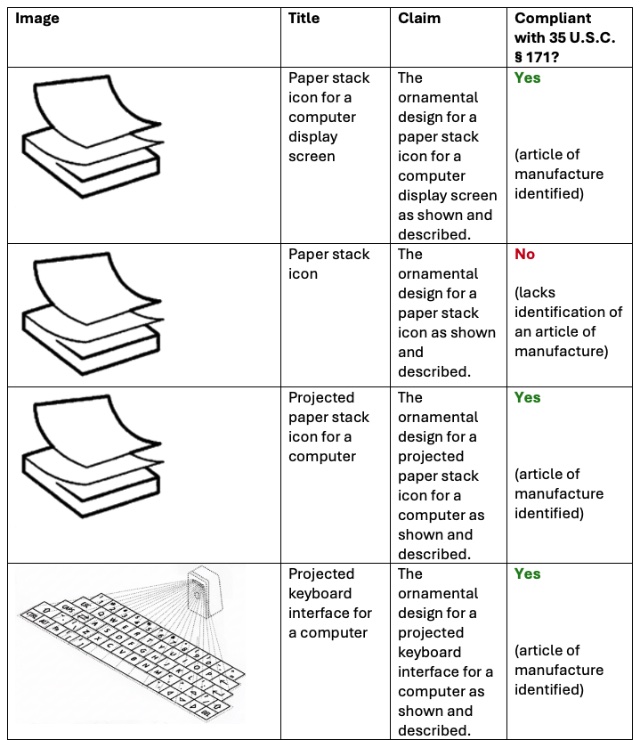
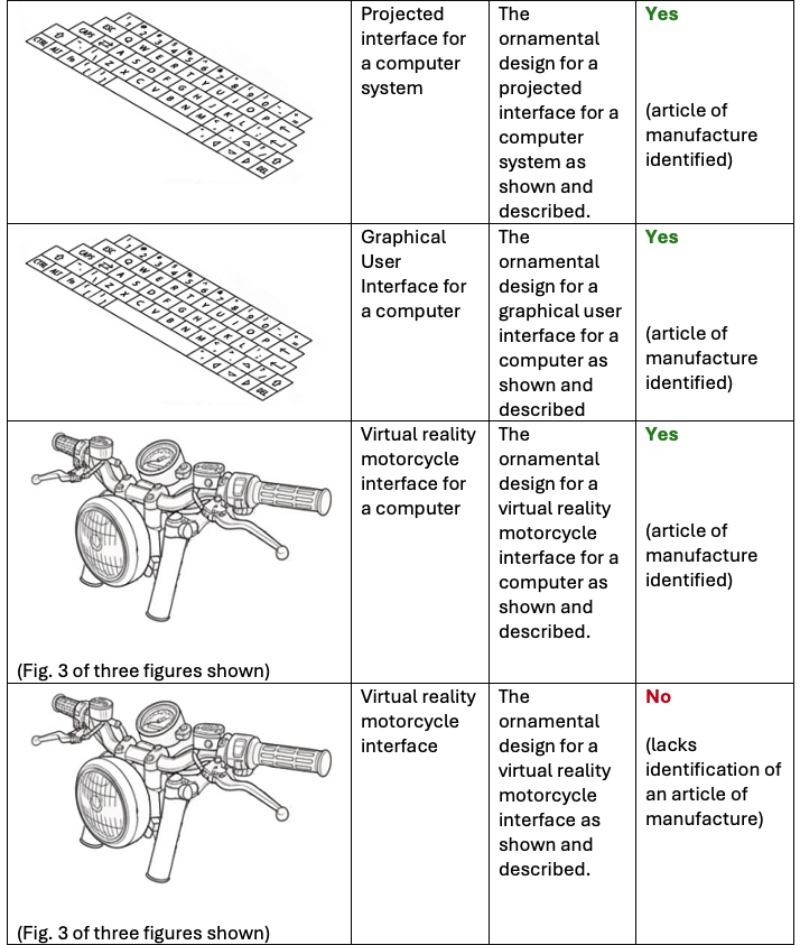
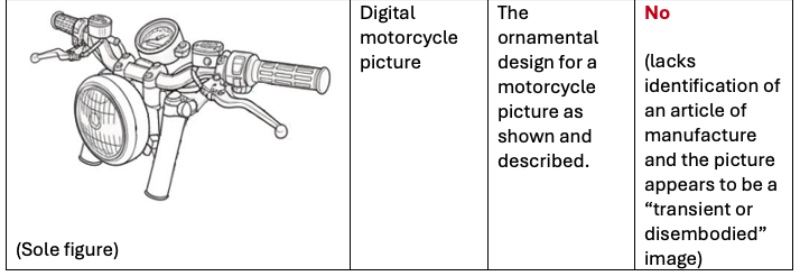
As a result of the new USPTO guidance, it is no longer necessary for applicants either to provide a dashed broken line perimeter to illustrate a display screen or to include a display screen in the title and claim. That being said, applicants must ensure that a suitable article of manufacture is identified in both the title and claim.
The new USPTO guidance also corrects a bothersome legal fiction. For decades, GUI design inventors have had to sign a declaration—under penalty of perjury—stating that they have invented a new design for a “display screen [or portion thereof] with graphical user interface” (implying on its face that they have invented a new display screen as part of their new GUI design) when, in reality, they have designed a new graphical user interface that may be displayed on a display screen. In light of the new USPTO guidance, design patent titles and claims can better reflect inventors’ actual inventions to graphical user interfaces, projected interfaces, and virtual reality interfaces themselves.
 Patent Docs
Leave a comment