
By Kevin E. Noonan –

The Parties – Senior Party Broad Institute, Harvard University, and MIT (collectively, “Broad”) and Junior Party Regents of the University of California, Berkeley; University of Vienna; and Emmanuelle Charpentier (collectively “CVC”) – each timely filed a paper on conception dates upon which they intend to rely in the Patent Trial and Appeal Board (PTAB) reconsideration on priority under remand from the Federal Circuit, who last year vacated and remanded the Board’s decision awarding priority in Interference No. 106,115 to Senior Party Broad.

CVC’s submission relied on the four dates contained in its earlier-filed Substantive Motion No. 2: “This motion first shows that the inventors had a complete conception by March 1, 2012 . . . . The motion provides additional evidence of conception, alternatively, by April 11, May 28, or June 28, 2012” (emphasis added in CVC’s Paper). Also mentioned in this Paper is that Broad acknowledged CVC’s assertion of these conception dates in its earlier-filed motions, which CVC also asserted in its Reply Brief for Substantive Motion No. 2, which addressed the putative absence asserted by Broad (in its Opposition to CVC Substantive Motion No. 2) of certain components (a U6 promoter) in CVC’s Reply Brief, which asserted that CVC was using this promoter by at least May 28, 2012.
The Broad in its Paper argued first for complete conception before CVC’s earliest conception date (March 1, 2012), specifically directed to Inventor Zhang’s “vector design” on August 7, 2011 and system disclosed in a January 12, 2012 NIH grant proposal. Broad also asserts independent conception of an embodiment on June 26, 2012 comprising a GAAA linker (characteristic of sgRNA).
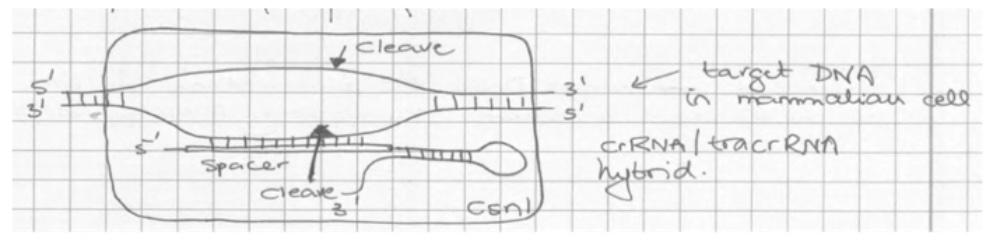
These assertions will be argued in the Parties’ Opening Briefs filed on October 10, 2025 (limited to 25 pages); response/opposition to their opponents briefs filed on November 7, 2025 (limited to 25 pages); and a Reply by each party filed on December 5, 2025 (limited to 10 pages). It should be recognized with regard to Broad’s submission that the conception dates prior to CVC’s March 1, 2012 date are directed to so-called “dual guide” RNA species (wherein the CRISPR (crRNA) and tracer (tracrRNA) are present in the CRISPR complex with the Cas9 endonuclease as separate species), and CVC’s conception comprises so-called “single guide” RNA (sgRNA), illustrated by a laboratory notebook page submitted by CVC in this interference as evidence of conception:
The Count (that defines the interfering subject matter in the ‘115 Interference as declared) reads as follows:
Count 1: Claim 18 of Broad U.S. Patent No. 8,697,359
An engineered, programmable, non-naturally occurring Type II CRISPR-Cas system comprising a Cas9 protein and at least one guide RNA that targets and hybridizes to a target sequence of a DNA molecule in a eukaryotic cell, wherein the DNA molecule encodes and the eukaryotic cell expresses at least one gene product and the Cas9 protein cleaves the DNA molecules, whereby expression of the at least one gene product is altered; and, wherein the Cas9 protein and the guide RNA do not naturally occur together, wherein the guide RNAs comprise a guide sequence fused to a tracr sequence.
Thus, to establish priority each Party will need to show conception of this CRISPR using this sgRNA species.
Moreover, Broad’s assertion of conception of the sgRNA (which comprises the GAAA linker) is apparently contrary to (or perhaps inconsistent with) evidence of record in the interference regarding communication of CVC’s conception of sgRNA by Dr. Marrafini who attended a public scientific talk by Dr. Doudna after CVC’s earliest provisional applications disclosing CRISPR using these species had been filed (albeit dates not recognized as giving CVC priority in Substantive Motions CVC filed in an effort to be declared the Senior Party).
These issues will no doubt be argued extensively in the Parties’ briefs-on-remand discussed in forthcoming posts.
 Patent Docs
Leave a comment