
By Andrew Williams —
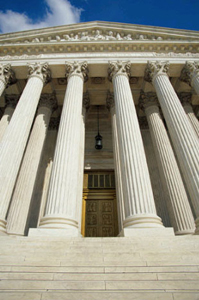 On November 27, 2017, the Supreme Court will hear arguments in two cases that were ultimately appealed from IPR Final Written Decisions issued by the PTAB. The first of these, Oil States Energy Services, LLC v. Greene's Energy Group, LLC, will analyze whether IPRs (and presumably other post-issuance proceedings) are constitutional. Specifically, the sole question to be considered by the Court is:
1. Whether inter partes review––an adversarial process used by the Patent and Trademark Office (PTO) to analyze the validity of existing patents––violates the Constitution by extinguishing private property rights through a non-Article III forum without a jury.
This case was appealed from a Federal Circuit Rule 36 affirmance, so there is no appellate decision for the Supreme Court to reference. However, as we reported at the time, the Federal Circuit did previously consider this constitutional issue in MCM Portfolio LLC v. Hewlett-Packard Co. In that case, a three-judge panel concluded that because patents are public rights and "the grant of a patent is primarily a public concern," Congress was able to create administrative procedures for assessing their validity. The outcome was similar to that in the Patlex Corp. v. Mossinghoff case, in which the Court had determined that patents were primarily a public concern, and correspondingly ex parte reexaminations did not violate Article III of the constitution. Nevertheless, not everyone agrees that patents are public rights, and this case will likely turn on whether the Supreme Court instead determines that issued patents are private rights that can only be reviewed in Article III courts. And what will be the outcome? On the one hand, it is not often that the Supreme Court affirms the Federal Circuit, which would suggest the Court will find the proceedings unconstitutional. But it is also difficult imagining this Court taking a decidedly pro-patent position by dismantling the very post-issuance procedures that are responsible for invalidating large numbers of allegedly "bad" patents. Perhaps the oral argument will provide some clarity.
The MCM Portfolio case may have been the last time the Federal Circuit spoke on the constitutionality issue, but various judges expressed their opinions in concurrences and dissents to a denial of a petition for initial hearing en banc. In Cascades Projection LLC v. Epson America, Inc., the Appellant had sought initial en banc review on the constitutionality issue because it believed that the MCM Portfolio case would be controlling on any other panel. Judge Newman concurred because even though she believed that the issue should ultimately be decided by the en banc Court, it would benefit from full consideration by another panel. Judge Dyk, author of the MCM Portfolio opinion, joined by the other two members of the panel (Chief Judge Prost and Judge Hughes), wrote in support of the denial because he believed the prior case was correctly decided (naturally), and wrote to address issues raised by the dissents. Judge O'Malley dissented without expressing any definitive opinion on the merits. Instead, she thought it was far from certain that patent rights are public rights, and therefore this issue deserved the attention of the full court. Finally, Judge Reyna provided a well-reasoned dissent advocating strongly for unconstitutionality. First, he believed that the Supreme Court precedent was clear that only Article III courts had the authority to set aside or annul a patent right. Second, he found the MCM Portfolio and Patlex Corp. decisions to be inconsistent and irreconcilable. Finally, he believed that separation of powers needs to be addressed, adding that the Court "should consider the constraints Article III imposes on the adjudication of patent rights by administrative authority." Of course, all of these opinions will be moot once the Supreme Court decides the present case.
Ultimately, this case may come down to how the Court understands the 1898 case of McCormick Harvesting Machine v. Aultman. In that case, the patentee had sought the add claims via reissuance. However, the Examiner found that at least some of the issued claims were invalid and sought to revoke the patent right. The Supreme Court at the time determined that the Patent Office did not have the authority to do so:
It has been settled by repeated decisions of this court that when a patent has received the signature of the secretary of the interior, countersigned by the commissioner of patents, and has had affixed to it the seal of the patent office, it has passed beyond the control and jurisdiction of that office, and is not subject to be revoked or canceled by the president, or any other officer of the government. It has become the property of the patentee, and as such is entitled to the same legal protection as other property.
The only authority competent to set a patent aside, or to annul it, or to correct it for any reason whatever, is vested in the courts of the United States, and not in the department which issued the patent.
Moreover, the Court stated that "to attempt to cancel a patent upon an application for reissue when the first patent is considered invalid by the examiner would be to deprive the applicant of his property without due process of law, and would be in fact an invasion of the judicial branch of the government by the executive." The Petitioner in the present case, as well as others that believe IPRs are unconstitutional, has taken the position that the statements in McCormick suggest that Congress could not establish any statutory process capable of cancelling or revoking patents once issued by the Office. On the other hand, Respondent Greene's Energy and the Federal Respondent, as well many others arguing for the persistence of IPRs, point out that Congress had not provided the Patent Office with the ability to revoke patents. As a result, the holding in that case turned on a lack of statutory authority, not constitutional authority. In addition, due process can be satisfied (according to this position) by the administrative proceedings, especially because there is the opportunity for appellate review by an Article III court. Interestingly, the McCormick case does not mention or invoke the constitution per se. Nevertheless, it does invoke due process concerns, and many of the cases it cited dealt with the constitutionality of property rights. Cynically, it would seem that the Supreme Court could defensibly adopt either position. Indeed, there are commentators that have noted that this case might be more about the Court's desire to make a pronouncement about the administrative state rather than its desire to control abuses by the Patent Office.
There was significant amicus support for both parties, as well as briefs filed in support of neither party. In the days leading to the argument, we will highlight some of the arguments made. Below is a listing of the filed briefs in the case, as well as links to copies of the briefs (copies of most briefs made available by the American Bar Association)
Merits Briefs
Brief of Petitioner Oil States Energy Services, LLC
Brief of Respondent Greene's Energy Group, LLC
Brief of Federal Respondent
Amicus briefs in support of Petitioner
Brief of 27 Law Professors
Brief of AbbVie, Inc. et al.
Brief of Alliacense Limited LLC
Brief of Biotechnology Innovation Organization (BIO) et al.
Brief of Cato Institute and American Conservative Union Foundation
Brief of Eagle Forum Education & Legal Defense Fund
Brief of Evolutionary Intelligence LLC
Brief of Gary Lauder et al.
Brief of IEEE – USA
Brief of InterDigital, Inc. et al.
Brief of J. Kenneth Blackwell et al.
Brief of LiquidPower Specialty Products Inc.
Brief of Pacific Legal Foundation et al.
Brief of the Pharmaceutical Research and Manufacturers of America
Brief of Professor Dmitry Karshtedt
Brief of Professor James W. Ely, Jr. et al.
Brief of Security People, Inc.
Brief of Thirty-Nine Affected Patent Owners
Brief of Unisone Strategic IP, Inc.
Brief of University of New Mexico
Brief of US Inventor, Inc. et al.
Amicus briefs in support of Respondent
Brief of 72 Professors of Intellectual Property Law
Brief of AARP and AARP Foundation
Brief of Act I The App Association
Brief of Alliance of Automobile Manufacturers
Brief of America's Health Insurance Plans
Brief of Apple Inc.
Brief of Arris Group, Inc. et al.
Brief of Askeladden LLC
Brief of BSA I The Software Alliance
Brief of Dell Inc. et al.
Brief of General Electric Company
Brief of Initiative for Medicines, Access & Knowledge (I-MAK)
Brief of Intel et al.
Brief of Internet Association et al.
Brief of Knowledge Ecology International
Brief of Mylan Pharmaceuticals Inc.
Brief of Professors of Administrative Law et al.
Brief of Public Knowledge et al.
Brief of Professor Lee A. Hollaar
Brief of Retail Litigation Center, Inc. et al.
Brief of SAP America et al.
Brief of Taiwan Semiconductor Manufacturing Co., Ltd.
Brief of U.S. Golf Manufacturers Council
Brief of Unified Patents Inc.
Brief of Volkswagen Group of America
Amicus briefs in support of neither party
Brief of 3M Company et al.
Brief of American Intellectual Property Law Association
Brief of Association for Accessible Medicines
Brief of the Association of Amicus Counsel
Brief of Boston Patent Law Association (BPLA)
Brief of The Civil Jury Project at New York University School of Law
Brief of H. Tomás Gómez-Arostegui and Sean Bottomley
Brief of Houston Intellectual Property Law Association
Brief of Intellectual Property Law Association of Chicago
Brief of Intellectual Property Owners Association
Brief of The Patent Trial and Appeal Board Bar Association
Brief of Shire Pharmaceuticals, LLC


 Patent Docs
Leave a comment